Front matter (continued 2)
Reading edition
I even tried writing backwards so that Scharber could read my message normally from inside his helmet. Where the needle of heat touched, plastic seethed, and a visible line was left.
I wrote:
It's us, Scharber. Lanvin, the Harvers. Changed. Micro-androids now—like race of Xian origin. Friendly. Go home, Scharber. But please send radiogram. Urge imperative need to keep our bodies alive. Will return to them. A million thanks for everything.
The eyes of the Atlas who was our friend, stared again. Lakes of nervous reaction came into them. The plains of the cheeks whitened, as with some strange frost.
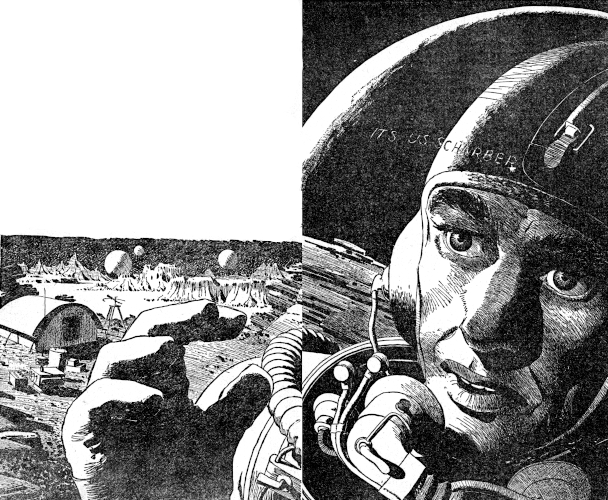
The eyes of the Atlas who was our friend stared ... stared fearfully at the message being inscribed so mysteriously on his plastic helmet.
The earthquake spoke:
"Charlie? Or am I going space nuts? Maybe this could be.... But who ever heard of it!..."
Panic at his own thoughts made Scharber move suddenly. The movement threw Jan and Doc and me from the frame of his face window. As we tumbled in the thin, methane atmosphere of Ganymede, I heard Doc laugh.
"Scharber will probably be all right," he said. "It's the shock of difference, again. But the message won't vanish from the plastic. He won't think that madness made him dream it. He's tough and young. He'll straighten out.... Come on, let's get started—for Earth!"
VII
We were lifted upward toward the limits of the atmosphere by the jets of our rods, aided by natural updrafts, which we sought out. Joined together as a group by the floss cable, we were certainly far heavier than any of Arrhenius' theoretical spores; but we had the advantage of intelligence to seek out forces to help us. We were not inert particles to be buffetted by chance impulses of nature.
We attained the high ionosphere of Ganymede where the sky was almost as black as space, where accelerated residual molecules beat against us, giving us some of their upward motion, and where sound had almost been smothered by the vacuum. There, Doc clutched mine and Jan's hands for sonic contact, and said thinly:
"Last chance for vocal speech. We'd better know how we all feel. In the parchments we carry we have about the greatest possible material gift to man, a dream of his from his beginnings. Practical freedom from death, from physical affliction. Immensely increased range of possibilities. The universe, in almost all of its phases, can truly become his stamping ground, now. It's a treasure that men would kill to have. To me it is an inevitable and wonderful step of progress. But there's a confusion in it, based on a split in human nature. You've seen and felt how it works. The mistrust of old instincts for the completely different and revolutionary. Fear and even horror that invokes a savage compulsion to fight back. There's trouble ahead—between the two halves of man's character—represented by eagerness and revulsion. We know how it is from our own feelings. The android bodies we now have are the substance of the treasure, the gift. We exult at its legendary advantages; yet we have a terror of a strange exile, if we can't get back to our weak, natural flesh! The answer, on Earth, when the Big Change really comes, will be emotional adjustment, acclimation, time. Right?"
I answered Doc quickly: "You're looking for possible treachery in our nerves—opposition. Don't worry, Doc. I know every feeling you've mentioned. But the balance is all on the side of belief that progress is inevitable and good. I say this as a pretty average guy, Doc. Let Jan speak for herself."
My wife smiled. "Charlie knows I agree," she said. "So let's get the show on the road...."
We rose still higher in the atmosphere, to a place where the rising sun's rays were like a thin wind blowing against us. It was the pressure of light, the same thing that makes the vanes of an antique photometer spin. Gently, but with increasing speed, we were urged into space. One thing was wrong. Our Earthward course was to sunward, against that minute thrust of solar light. But there was a way to correct part of this.
Accelerating with the help of the pressure, we swept around Ganymede in an orbit; we waited until our direction reversed itself, as must always happen in circular motion. Then we really built up velocity with long bursts from our rods, and tangented sunward, breaking our last tie with the Jovian moon. We were on our way.
I felt my hide stiffening defensively. Over long periods we were not entirely without need of shelter in the awful spatial dryness, so we kept watch. The void is not completely empty. It contains many scattered hydrogen and helium atoms, and a rarer sprinkling of cosmic dust. We were lucky. Gleaming like a planet reflecting solar light, we saw a lump of rock moving with us toward the sun. We jetted to it and clung, laughing silently in the vacuum.
Doc's lips formed the words: "More speed. Time is short. Use up the cartridges of the rods. We have more."
Any object, broken clear of the gravity of a planet or large moon, is free in space. Acceleration is resisted then only by inertia. A relatively small force can build velocity enormously.
We were traveling at many miles per second when Doc mouthed: "Not too much. Eventually we must apply the brakes."
We fused our way into the meteor with our rods, and hollowed it out. We closed the exit with the slag of our excavations. True, the sun's radiations were a source of energy to our android tissues; but they also hastened drying—our worst enemy here since our body fluid was water.
As time went on, our skins hardened further, forming a kind of shell around the moisture in our vitals. And we had a small supply of water in steel cylinders. In a pinch, we needed little. We had food, too, similarly packed—Xian gelatins containing the radioactive and other minerals necessary to sustain protoplastic flesh, and give it a sure energy source in space.
While we were burrowing into the meteor Jan did a whimsical thing. With a diamond-chip tool she inscribed over the entrance of our cave:
"Dr. Shane Lanvin and Charles and Janice Harver traveling to Earth in the Miniature—2037 A.D."
"There," she said in silent lip motion, for the reading of which we were gaining practice. "Maybe the inscription on that quartz-grain meteor you used to carry, Doc, was just as casual. Maybe it was carved, just on the spur of the moment, recording a journey of little Xians."
"You happen to be right," Doc answered. "I knew those hieroglyphics by heart. I drew them once for Kobolah. He translated. Four micro-Xians were traveling the short distance from one of their inhabited asteroids to another."
Later, the three of us fell into a kind of sleep. Or was it creeping death? It scared me. Our metabolism slowed. Consciousness left us. And so, time went very quickly. Maybe our tissues actually froze. I know now that this hibernation is a natural android function, conserving physical forces during long periods of inactivity. And it could not stop for good our rugged vitality. We revived when the sun was nearer, and warmed us more. Stiff with dryness, we drank water, and loosened up our muscles.
We cleared the exit of our burrow, and crept out on the surface of the meteor. Rushing on in its elongated eclipse around the sun, it had come close enough to Earth to make the latter a disc of about one-quarter the apparent diameter of the Moon, as seen from Chicago on a clear night.
"Our meteor probably won't get much closer," I mouthed. "So we might as well jump soon. No use wasting the energy of our rods, decelerating a meteor mass, too."
Doc nodded.
"Where will we be most likely to find our old selves?" we read from Jan's lips.
"At the Space Medicine Research Hospital, near Chicago, I'd guess," Doc answered. "They send them nearest our homes. Or—peek over a shoulder at a newspaper, or into somebody's television. I think we are news. Are you both sure you know just what to do if that old protoplasm of ours hasn't got tired of waiting for us?"
"Yes," Jan replied.
"Fine," Doc commented. "So we'll drink some water, eat a little, limber up, and then start for home without the meteor."
Much of our physical forces had returned with the prospect of activity. Like any awakening, it was a natural tuning up of body. But I think that even our android chemistry had suffered in our vast journey. Doc and Jan both looked thinned down. I hugged Jan in appreciation of her unwavering spirits.
"Good kid," I said. "It shouldn't be long, now, with luck."
We all jumped, then, and broke our velocity in one direction with our rod-blasts, bending our course toward Earth, now only hours away, even at steadily declining speed. And so, as unheralded as ghosts, but as significant as a new dawn of history, we came in.
Yes, we still hit the fringes of the atmosphere a bit too fast. The floss bond, holding us joined, burned in the heat of friction. Thereafter, there was no keeping together in tumultuous vastness, that, though it was just the Earth's air, seemed infinite to our tininess. I could cry out for Doc, and more especially for Jan; but there could be no answer. Really, it was the first bad break we had had.
I was high over a coastline. And a circumstance, particularly effective in The Small, helped me to orient myself. I found a bit of quartz-dust floating near me. I clung to it. Yes, I had heard of quartz crystals functioning sometimes as natural radio receivers. But my tiny ears were much better designed than the human to pick up minute sounds.
For more than an hour I listened to overlapping broadcasts. But the most powerful station I heard was in Frisco. So that was the city beneath me. I heard several newscasts. Parts of them were significant:
"... Dr. Shane Lanvin, micrologist, and the Harver couple, his associates, seem near death now in Chicago. For almost five months a spark of life has been sustained by intravenous feeding and other therapy. Dr. Lanvin's party was sent to investigate certain threatening micro-phenomena in the vicinity of Jupiter. Should any credence be given to a fantastic radiogram sent from Ganymede by another member of the party about a micro-race of supermen? Perhaps not; but it has been the thing that sparked the special effort to sustain life in these three during the past six weeks."
I was already jetting, riding the prevailing winds high in the stratosphere, and at last grabbing a lift on the skin of a passenger rocket-plane. From high up Chicago looked almost as it did from normal human eyes. There was no feeling of being lost in enormity, at least. That was how I found the Experimental Hospital, and descended toward it. The rest was easy. I had only to follow the newscast men to the three rooms.
Hovering in the air, I felt the thunderous vibration of a doctor explaining wearily for perhaps the thousandth time:
"Tissues and organs have no fundamental defect; some repair and replacement has even been made. There should be consciousness, but there is not. The rest is mystery."
I went to Jan's room first. How long had it been since I had seen her real face? It was waxen, now. All the color faded, as in an old painting. Never mind how I felt; it was bad enough. I drifted to Doc's room. His eyes and cheeks were sunken. Hovering high over him, I could not tell that he breathed. Then I saw myself, gigantic and pallid. The embarrassment of seeing this corpselike thing was lessened by the fact that it resembled my former lusty self only slightly.
"Hurry back, Jan, please," I urged aloud, though no one could hear me. "Hurry back, Doc."
I heard things in that room. Physicians conversing in thunderous undertones: "I'm getting tired of this. Interesting case, but it has been too long. Can't last much longer. Yes, sometimes it seems an unkindness to try to maintain life in something doomed to die."
Now that there was a chance at last, the help of those doctors might be wavering.
I found an interne writing at a table in the corridor. It occurred to me that, had it been necessary, I would even have dunked my entire body in ink from his pen-nib, and written him a message by dragging myself across the paper of the form he was filling out. But I still had my jet rod, so I clung to his knuckle, and scribbled on the form in a charred line left by a needle of atomic fire:
I have returned. So have the others. Please continue your efforts. Thanks.
Charles Harver.
The interne's hand jerked. I was hurled toward the ceiling. But I heard his bone-jarring roar:
"Hey—Fletch! Dave! Look at this!"
If they didn't understand or believe, still they would be alert and interested. There would be no breakdown of their struggle to keep those bodies living.
I went back to the pallid thing that had been I, and did what was necessary, after I had cached the parchments I carried, and most of my equipment, in a groove in the molding on the wall. I allowed myself to be inhaled. Deep in the lungs, I cut my way into a capillary with a diamond splinter. It was an insignificant wound, really. Then, in a rushing flood, while dim, reddish light penetrated to my eyes, I was borne along. I knew by a violent turbulence that I passed through the heart. Then there was a sense of rising. Absolute gloom meant that I was inside the skull. There I lodged myself in as small and unimportant blood vessel as I could find.
The rest was simple after that. I merely relaxed. It seemed that I went to sleep. But I was in my own brain. Encouraged by a natural affinity, the little energy-node or whatever it was that was my awareness and my ego, went home. It was, shall we say, a wanderer's return.
When I awoke it was mid-morning. The mental pictures of recent events remained vivid, yet they had assumed almost the character of a dream. Beyond my window were maples and pines. A robin was scolding. It was very pleasant, indeed, until I thought of Jan and Doc.
"Mr. Harver, you're awake!" a nurse exclaimed. "We knew from last night's tests that you were suddenly much better! There had been a message written in an impossible way...." Here, the girl looked frightened.
"Never mind!" I growled. "How is my wife? And Dr. Lanvin?"
"Mrs. Harver is still asleep. But even her color is far better, and she smiles to herself. Dr. Lanvin is much improved, too, though he is still very weak, and has not regained consciousness."
I sighed with relief. They'd gotten back just as I had. Yet, with what we'd brought back, this was not an end but a tense and wonderful beginning. The android secret. Improved man, large or small. A revolutionary fact to be thrust on our mortal race, with all its doubts and enthusiasms and prejudices; to be pushed into the age-old familiar sequence of birth, death, happiness, suffering, and decay of our kind! It was monumental in its possibilities for triumph and disaster; and for a weak moment I had a mighty wish not to disturb the peace, and to let all of this sleep forever.
Of course doctors and newscast men talked to me that day:
"... The message? 'I have returned....' Just what, in plain language, did that mean?... What did you find in your explorations in miniature? There is a story from somebody named Scharber on the way to Earth from the Jovian system, now. A yarn about a race that made itself unbelievably small. Yes—to hide itself, I suppose."
"You might like the story when and if you hear all of it," I answered. "Let Dr. Lanvin, my superior, talk, when he is able."
Late that day I was on my feet briefly. I held my wife in my arms, saw her smile, heard her say: "Well, here we are, and what now, Charlie? I even wonder if folks will be disturbed to know that tiny Xians have been visiting Earth for ages, unnoticed. It's kind of creepy."
Doc grinned up at us wanly from his bed. "This carcass of mine seems pretty well spent from the strain of my absence," he laughed. "Oh, I guess the damned thing could be patched up some more. But why bother? When I can have another body, same size, same shape, same organs, including a brain duplicated to the last filament of a brain-cell—no special principle required, as in The Small—all built of tough protoplast, and with a few things straightened for a youthful appearance and advantages? Not a robot any more than a man is a robot, but a human of firmer flesh, capable of all that a human is capable of, but much more. Glad to see you two up and around."
Yeah, Doc had always been a progressive. Oh, he'd had his doubts, too; but now, if the Great Change fazed him at all, he didn't show it.
VIII
Jan and I soon left the hospital and set up housekeeping in an apartment of our own. But with all that medical science could do, Doc still had to stay in bed for a month. But he started directing the forces of destiny, almost as soon as he could give orders.
I was in on the deal, of course, as were several doctors from the hospital, and Bowhart, and Scharber when he arrived on Earth from Ganymede.
"Gonna do it, Doc, aren't you?" Scharber said, when he first saw him lying there, pale and wasted. "You lugs scared me plenty once. Now, though, I feel foolish. Big words you need for this! It's the dawn of the demigods!"
My blood thrilled with a mighty promise, too. At night, going to sleep, I'd exert my will. Lodged inside my head was a micro-android. I'd will myself into it again. And so, for a little while, I'd escape from my own mountainous form, to float free in the air and consult the notes and drawings on the parchment that I'd hidden on a molding in my hospital room.
Doc and Jan would do the same. They, too, following the plan we had made in space, had similarly cached their portions of his notes. But now we had assembled the complete record of the android process in Doc's house.
And so the beginning was made. When Doc was able to get around again, things really got under way. He obtained a government grant. A whole lab and a large staff of workers, was set aside for us. Retorts, pressure-vats, and other apparatus to produce the basic materials, were constructed and installed.
Ours was a major project, coinciding in time with another major project. For the first real starship was finally under construction on the Moon. Three more years it would take to be completed.
But our enterprise reached practical fruition in fourteen months. I was among the men present when Dr. Lanvin lowered himself into a tank of special gelatins.
He was nude and emaciated; yet he kept his humor, and a certain dignity. A thin hand made a slight gesture. To Scharber and me and the others, he said:
"This will be the easiest trick, learned among the micro-Xians. Simple tissue-replacement, cell by cell. Improved protoplast in place of protoplasm. That's all. Well, wish me luck."
The anesthetic that had been injected into his veins worked. He slumped down gently. The gelatins closed in over his face, and the month of slow gestation toward rebirth began. I saw his body at various stages of the process; little changed in appearance except for much increased robustness.
Other duties intervened, so I did not observe his actual removal from the tank nor his reawakening. But Jan and I met him a few hours later, as he left the small hospital of our lab. The old gray suit he wore, hardly fitted him. He still had his ragged blond mustache. You could tell that he was he—with many years subtracted. He looked about as old as I was—twenty-three. But these were the only signs.
He grinned like a kid, jubilant, but a bit self-conscious. He said, half joshing:
"Look me over—the miracle of the era, the successor to natural man; and no casual observer could ever tell that I'm not as humans have always been. I eat, I breathe oxygen; I need some foods with a different mineral content, it is true. I sleep if I want to. Given a mate of like substance, I can reproduce my own kind. But I won't age. Cut a finger off me, and it would manage to live independently for a long time. Wound me terribly, and I'd probably manage to heal up someway. Deprive me of air, or common chemical foods, and my body would try to seek out other sources of energy—sunlight, radioactivity, or whatever is available. Even change my basic tissue fluid from water to—"
It sounded a little like bragging, so Jan cut in with a feminine tease: "Yes, Dr. Lanvin. But put on your overcoat. People will think it odd that you're carrying it on such a sharp winter afternoon."
Doc laughed back, and obliged her almost with embarrassment, and we were three old friends together.
"People get injured," I said, "or just grow old; and though limited rejuvenation and repair is possible, this is a far better way. That's how it should go, Doc; and you'd think that no one with sense would want to stop it. In months there'll be thousands of androids. But here we are again—unsure of how it'll all be taken. Like you say, this is succession to natural man. It can be conceived of as the old Threat of the Robot idea, with refinements. A force of staggering newness, wonderful to the point of being terrifying. We're almost certain that there'll be trouble."
The story of all we'd learned among the micro-Xians, and its repercussions here at home, was mostly regarded as a fantastic rumor at first. It was talked of lightly on the newscast, and wherever people gathered:
"Little People that have been around all the time, watching us? Shucks, even my Irish grandmother knew that! So we're gonna become wonderful, artificial critters! Homo ex Machina! Well, well!... Okay—take me—I was always one for improvements!"
Yes, it went something like that. And when people first truly knew, their reactions were mild, curious, and friendly. One incident I remember particularly.
Jan and I and Doc and a very pretty girl were walking in a quiet street near the University. The girl was someone I had known from a picture. She looked like the picture, again, now. That is, she had become like Doc. For the sake of youth and beauty, women can be more bold than men. She was Irma Tandray Lanvin, Doc's former wife—returned. And maybe she'd learned something about her man—that her rival, science, was part of him, and that she'd better take him as he was. Maybe he'd also learned the need of being attentive to a woman. Anyway, they both looked devoted, now, and I hoped it was so.
But what I meant to tell about was our neighbors. First we met Corbison, the mechanic, saying:
"Hi, Professor Lanvin. A fella'd hardly know you."
"It's still me," Doc answered.
Others gathered around as we paused to talk.
"How do you feel, Doctor?" asked an elderly woman. And when he replied, "Fine!" she said, "Think of it! I'm glad!"
There was even a pooch, who began with a prolonged sniffing at Doc, which progressed to a puzzled yelp, a wrinkling of brow above soulful and humorous brown eyes, then a licking of his hand, and a caper. In my mind the thought sprouted that a dog could become android, too.
"Wouldn't the word be 'canoid?'" Jan teased, knowing me well enough to be sometimes almost clairvoyant.
"Ah, the language struggles to keep up with progress!" a bookish youth commented lightly.
One of two small boys with their father fumbled with my fingers. "Aw, it feels just like anybody's hand, Mister," he growled, disappointed.
"That's a case of mistaken identity, young fella," I pointed out. "I am anybody—yet."
Irma Tandray Lanvin took his grubby mitt, and laughed. "Is that the same, Joey?" she questioned. "It shouldn't be, but I'll bet it is."
The kid looked as if his leg was being pulled.
There was just friendly interest and wonder among all those people, then.
"What they reminded me of," Irma said later, "was some kind of simple natives on a lost island, being shown a mirror for the first time—before they think of black magic. Is that what we all are, basically, at first? Simple? Trusting?"
"That's a good question," Jan commented.
And so it was for months more. But all the elements of catastrophe were present. Earth was a crowded but beautiful place. Technology had done much to give it an idyllic mood, and to shelter its inhabitants in cotton-wool. But that same technology that could build so miraculously, still held a devilish potential, if it served minds motivated by hate and fear. Need one even remember, here, the asteroids that were the fragments of Planet X, or the glassy, fused-down ruins of Mars, still slightly tainted with radiations of nuclear fusion and fission?
The drives of intellect, of whatever origin, seem always to have a sullen, combative streak, constructive in one sense, since it is the force that brings peoples up from nothing. But the stubborn taking of sides also harbors deadly danger.
Almost unobtrusively at first, the threatening clouds began to gather throughout the world. At our busy and expanding lab, Bowhart, who, with Scharber, had been crewman aboard the Intruder, came to represent one phase of the opposition to the Great Change.
I remember what he said to me one day, his earnest face serious, his brow crinkled with the effort to be reasonable:
"Charlie, I could be all wrong. But for some time I've been thinking. Already there are twenty thousand once near-dead people who have been changed over; not to mention five thousand others who were in good health. Part of me admires the humanitarian angles here. But then there's that feeling of a slow, creeping invasion, so far unopposed. I can't exactly put my finger on just what makes it horrible; but at night I wake up sweating cold all over. Maybe I've got a blind spot in my head. All I know is that most everything about this remarkable duplication of humanity goes against the instincts in my slow Neanderthal guts. No, don't argue, Charlie. I've heard all of Dr. Lanvin's counter-points, and I just can't feel right about the whole thing. So I'd be a hypocrite if I worked in this lab any longer. I'll leave today, with the best of wishes to you and yours, and Dr. Lanvin. Tell him, will you?"
"All hail, Bow," I said, shaking his hand. "Thanks for the honesty. I know what you mean. I've felt it all myself, even though I don't quite agree."
Scharber, his former buddy, was also present in my office. They shook hands almost formally, now. For Scharber had moved all the way to the other side of the fence. He'd become the thrilled, eager kind.
"Poor Bow," he growled after Bowhart was gone. "A good guy, a gentleman. But mixed up, like some tough kid, afraid to ride on a merry-go-round. Feeling a black-rat-brown-rat difference. A primitive terror of being crowded out by something far more vigorous, and different from what he has always conceived of as human. Which brings up the reason why I'm here to see you, Charlie. I've screwed up my nerve to change the quality of my bones and meat. As far as I'm concerned, the process might as well start tonight. Okay?"
I nodded. "Okay. Fine, Scharber," I said.
If folks had all been like Scharber, there would have been no obstruction of progress. If they had all been like Bowhart, there would at least have been no danger. But as always, there were other types. Among them were those who like to speak out against something.
Among these, now, was an old classmate of mine, whom I have mentioned before, one Armand Cope. Already he was becoming minorly famous, laying down the "facts" with a definite oratorical talent. I think that he was, in the main, honest in his beliefs. But pledged and prejudiced to one point of view, he was blindly violent toward its opposite number. Cope was a fanatic. And now, with the smokes of fear curling in many minds, nothing could have been more dangerous than his activities, and the activities of the numerous individuals who were like him.
I heard him speak over the radio and television. Always his words drummed on the same points:
"Friends, the craze for gadgets has become a folly, an insult to man's dignity. The proof has become brutally plain today. All we ever wanted was to live an uncomplex life—having houses that we build, and crops that we raise, with simple materials and simple work of our muscles, as nature intended. Science? Much of it should have stopped before it ever started. It was a trap from the first, offering its benefits as bait, not letting us know that it led to this mechanical abomination, which seeks to sully our own natural being with a hideous slime of the laboratory! The prospect makes one's nerves crawl; death is better than the triumph of such a thing! We must fight and fall, if necessary! Let the maniacs and fools know the real strength of humanity!"
Plenty of people were eager to listen to Cope, and to cheer him on.
I gulped, and then grinned at Doc rather wanly. Jan and I were in his house that particular evening.
"It's like we thought it would be, before anyone on Earth even knew about what we were bringing them," Jan said.
"You're going to talk back, Shane," Irma, Doc's wife, commented, with a thread of steel in her voice.
"Of course I'm going to talk back," he answered. "But I'm afraid that that could never do enough good. There'll always be enough point to what Cope and his kind say, for scared, furious souls to cling to. I wish mightily that it could be different; but I suspect that what I say will only help to consolidate another fierce belief, to oppose Cope's believers. Yes, like two mighty armies being drawn up for battle. That is the real danger! Well, anyway I've got to try."
And so Dr. Lanvin was on television the following evening, speaking from the Civic Center of Chicago. Jan and I left to run the lab, listened from my office. It was a good speech:
"... I've never liked cheap, showy gadgets, performing some small function that a person might do as well, and as easily, and with less affectation, with his own head and hands. There, perhaps Mr. Cope and I agree, as, no doubt we do about a pastoral simplicity when it is possible—the smells of rain and woods and gardens. But Cope forgets that, crowded as the Earth is, with its billions of mouths to feed, such beautiful, rustic inefficiency is no longer possible, and hence beyond being argued for, reasonably, unless the starship brings us to other habitable worlds.
"Which presents the subject of inventions—natural products of natural minds which are too sublime to be called gadgets. The starship, for one. The android process, for another. Does Mr. Cope suppose that the benefits the latter represents, would ever encourage mankind as a whole to suppress it? It couldn't be suppressed, by law or by anyone, as long as there are people left to dream of vigor going on and on.
"Mr. Cope says further that his nerves crawl. This is nothing more than the mistrust of the new and unknown, which time will take away. Yet, worst of all, he speaks of fighting and falling. I hope that he does not mean it. For today, that can truly be a thing of horror, and final silence. Therefore, I plead that he, and all those who have been tempted to think in this manner, review their reasoning, and correct its defects."
I visited Cope at his home. "Look, Cope," I said, "we used to be friendly enough to live and let each other live. Don't you see that what you're doing now can end all that has been built, and finish the human race—natural and android—entirely? You're bucking a logic and a need for betterment that's far too big for anyone—the death of death, you might say. What do you want in its place? The death of everyone? You've got to stop talking as you do, Cope, pounding on the detonator of a world!"
His intellectual face went white with rage at what I had said. "You—Harver!" he growled softly. "You dare to talk to me like that! When you helped to turn this hellish development loose on Earth! Make every human being a snake, and it would not be half as bad. Yes, I was half your friend. But now get out of my house—out before I kill you!"
Further signs of danger were soon more definite, after that. Several days after Scharber's emergence from the process, I was walking with him in a Chicago street. A tactless acquaintance of his, of opposite inclinations and a dislike of him, previously entertained, ran into us in a theatre lobby.
"Hi, Scharber," he greeted. "I heard. You were born a robot, so why bother to change? And why didn't you at least order yourself a better face?"
Scharber retained a normal capacity for getting sore, and only a normal amount of self-control. "A robot is a machine, Powers," he said. "So is the old time protoplasmic man. So is the android. It's silly to make a distinction, based on silly pride at being what you seem to think of as exclusively human. And maybe your face could also benefit by some changes."
Sure, Powers had been brooding, too, and brewing up poison. The fact that he swung at my companion, proved it. Scharber ducked like lightning, and responded with a much-pulled return punch—if he'd given it half of full force, Powers' jaw would have been a mush of bone-splinters. Powers went flat; and it was some seconds before he started to scream and curse:
"Tin monsters!" he spat venomously and inaccurately. "Get them—both of them! Trying to crowd us off the Earth!"
Somebody with sense shouted, "Keep your heads!" But that, to some others, only represented the challenge of opposition. A half-dozen men came at us at once. I upset two of them all right; but being still just ordinary, I wouldn't have had much chance, if it wasn't for Scharber. Presently, with a pack gathering around us, we had to fight our way out of there, Scharber sprinting away at last, with me riding him pickaback. No protoplasmic man could have run a third as fast as he did then. I suspect that that display of speed scared and infuriated our attackers, further.
Other androids came up against this same kind of experience, and their constant victories in such scuffles, sharpened their terrifying aspect in many minds, and the conviction that there had to be a battle to the death.
Nor was it only humans of the older order who gave way to outbursts of fury. Soon it was give and take. Androids retained all of the old capacities for various emotions. It seemed that each violent incident would be followed by something worse.
I saw one android blown to bits, his flesh still squirming hours after he had ceased to exist as a composite entity. One severed arm had drawn itself along the ground with clutching fingers, almost like a great slug crawling, for two hundred yards.
There was something demoniac about that, which, for the moment, almost made me agree with Armand Cope.
The fury of the conflict came to a head one night when our laboratory went up in a cloud of nuclear fire. Five hundred persons were wiped out in the blast. It was lucky, indeed, that the lab was outside of Chicago proper, or the casualty list would have been much longer. Of our inner circle of friends, only Scharber was in the blast, and he escaped flying fragments and incandescent heat by dropping behind some heavy masonry. Radiations couldn't hurt him at all, though for a time he must keep away from the rest of us. The others of our group were safe in town.
There was the cold rage in Scharber's face when I first spoke to him from a little distance at the edge of the ruins.
"Damn them all, Charlie!" he growled. "Stupid, thick-headed, backward fools!"
"Easy, Scharb," I said. "The government, and the considerable majority of saner people, are trying to restore order."
It was true. Police forces were everywhere. Our president pleaded for calm. A cache of nuclear munitions was discovered and put under guard. It might even have belonged to androids. Nobody knew. It was in an old Chicago cellar. But of one thing we were sure—that there had to be many other caches of hellstuff, undiscovered and available to the hotheads and jerks, hidden in caves and woods and various other places, throughout the world.
One thing wasn't done. Armand Cope, and other rabble-rousers like him, were not put under restraint. It could have been accomplished within the emergency provisions of democracy, though a willful connection between the speeches that they had made and the blowup of the lab, could not be proven. Maybe the government was afraid to restrain them—afraid that their arrest would make them martyrs—and that this martyrdom would trigger the bombshell in the taut nerves and frightened minds of their followers. This belief may well have been the truth.
IX
Jan and I went to Doc's house, inside a police cordon, for a discussion. We risked radiation by bringing Scharber along. We wanted to make sure that he wouldn't do anything vindictive, which might well have happened had we left him by himself.
Irma met us at the door. "Shane almost wishes now that the android process had remained just the property of the micro-Xians," she said. "That's how bad matters seem to him at this point."
Doc jumped to his feet as we entered his study. "Cope means to speak again tonight," he announced. "Cope, and about a hundred others of his crowd, from scattered radio and television stations. We know about what they'll say, more or less. Yeah—'Get rid of these mechanical demons while there are still less than thirty-thousand of them. Before it's too late! Kill the serpent! Return to simplicity! Do you know that even their radioactive metabolism is poisonous to us?'"
Doc paused and groaned. "The latter isn't even true," he went on. "At least not while an android is on Earth, breathing oxygen and living by chemical energy. Then the radiation of a subatomic tissue-process is suppressed almost to zero. But that's the way most of Cope's arguments go—they leap thinly to conclusions, without thinking matters out to any depth. But many people don't want to think deeply, or else they're too frightened. And tonight I suspect that Cope and his bunch will give the order to attack. Charlie, what are we going to do?"
I was in a cold sweat. "You know what we can try as a temporary relief measure, Doc," I said. "We can silence Cope and a few of the others—you know how. The only trouble is that there are so many of those loudmouths, and only you and I and maybe Jan who are in a position to do the only thing that can be done. We may not be able to shut up anywhere near enough of them to get over this danger spot, but we have to try."
Jan came over to me and pressed my hand, and it helped. She was always courageous and cool.
As it turned out, there were few speeches of Cope's kind made that night. Cope collapsed before the television lenses and the microphones. No, he didn't die; he had what looked very like an epileptic fit. He dropped before he uttered a word. He frothed at the mouth, he snored. He looked ridiculous, even mad.
Why all this happened was simple. It was an old Xian trick. A micro-android—Doc had transmigrated briefly again—was inside Cope's skull, tampering with his brain. The tiniest flash at lowest power from a jet rod directed against the proper nerve center, was how it was done.
Doc silenced another character called Minton. I gagged another pair of flannel-mouths named Trefford and Donalds the same way. Jan managed to fix one called Parkhurst. That made five of the worst who had been operating around Chicago. But it still left over ninety others. It worried us badly, until we got back home, and into normal-sized bodies, once more. Scharber had been a good boy, staying out of trouble beside Doc's television, with Irma.
"Not one of the others said much either," he announced quietly. "They all fell on their faces the same way." He paused for just a second before he added, "I wonder why?" his eyes oddly aglow.
"There could be only one answer to that, couldn't there?" Irma hinted.
Doc grinned reminiscently.
Jan smiled. "The elves of legend, the helpful ones," she chuckled. "Well, who knows but what there's a connection with those old folk tales? Legends frequently have a basis in fact. It seems that I remember a strange, deep little guy who lives way out in space, and down near the limit of smallness. His name was Kobolah, and lots of his people didn't believe that Earthians should be trusted. He almost got into trouble over that. But it appears that he still has lots of friends among his own kind who'd like to see the android become successful among us. It seems, further, that if Kobolah's particular asteroid world took off for the stars, already, as appeared to be intended, he and some pals have so far stayed behind. Or else it was just some pals of his who helped us. But who knows? Maybe we'll see him again. Anyway, his world was as wonderful a place as you could imagine. I wonder if there's anything more strange in the whole universe?"
As Jan's musing words ended, I saw a strange, speculative look in Scharber's face. Doc's eyes were soft for a second.
"I guess that miniature things still intrigue me," he said. "But we're tied up with bigger facts now. I think we've won a temporary peace, but I'll bet that that's all it will be—temporary. Even if Cope and the rest of the same crop stop shouting, now, there'll be others to do just as they did. In a day or two we'll know for sure."
Doc was right. On the very next evening Armand Cope was on the air again, frightened, but determined. "This treachery of last night, even though I do not understand its method, makes me even better aware that this is a fight to the finish," he growled. "A fight against a hideous thing, to which there can be no end except victory or death. As long as I am a man, I shall be proud...."
Doc shrugged mildly. "I'd almost say 'Blah, tiresome fool!'" he remarked. "But it wouldn't be fair. Cope stubbornly believes what he says, I'm sure. It's etched into his nature. To a lesser degree with most, it's the same with many others. So, this is it."
The following evening, Doc made his suggestions over the air, speaking from his house:
"I am addressing those, who, in the eyes of some, have ceased to be human. But perhaps the term, 'android' should be dropped entirely. We are men in form, mind, emotion, aim, and pleasure—let there be no instinctive, sullen, backward doubt of that! Our shape and our organs are human. We have sprung from man's aspirations, and his quest for more knowledge and better living. Though the knowhow of our living was borrowed from another people, it would have come to men on Earth in time, and by their own efforts. We are thus, simply, a far hardier variety of what humans have always been. To those who are weaker, troubled by fear, less understanding, we should be generous, until more time lets them realize these truths. Therefore, I suggest that we leave the Earth to them, going outward where our powers permit us to go freely."
That is how it has been. Among the androids, as if the interstellar regions was their natural habitat, Dr. Lanvin's hint took hold at once. On Earth, tension eased gradually, until even Armand Cope's voice sounded puzzled, and then sank to silence.
But let me tell about a side-event. Doc found a toy-sized craft in his workshop, a ship with tapered bow and stern, and retractable airfoils. It was less than an inch long. Need I say how we boarded it—Doc, Jan, and I? Or how later, we and one Kobolah, conversed under the scope of a micro-manipulator, while Scharber and Doc's Irma took turns watching us through the lenses?
We thanked the tiny Xian for all his help. We saw his electronic visual filaments blink over his eyes when Jan suggested:
"Kobolah, you could be cast in a larger form like the old Xians. You could go with Dr. Lanvin in the first ship to leave for the solar system of Sirius."
"Maybe—someday," he buzzed in answer. "Not now. To Sirius? I'm going there, anyway with my own people soon. Time? There is plenty—for everything. May you make few errors."
Then, with his jet rod he blasted off into the air. Within a minute, his ship, aboard which were hundreds of his kind that we had seen, spat blue fire, and darted out of the open window.
Scharber chuckled almost wistfully. "Micro-androids," he said. "Strangest thing I ever saw. Why didn't he take me with him? Got to start seeing the outer-universe somewhere. Why not in miniature? Darn, androids can go anywhere."
X
The next day, Scharber's protoplastic form was found inert in his small bachelor's apartment. When we were notified, Doc and I had a look at the place. On Scharber's study table were many brief messages, written on paper with a heat-charred line. The words were English, and spelled correctly; but the script was strange. I knew the instrument of the writing. I had written with it myself.
But Scharber had left a note of his own, written to us in ink:
Dear Dr. Lanvin, Mrs. Lanvin, Charlie, Jan. Everybody—So I win.... The Little Guy must have guessed. Anyway, he brought his ship here. Then he wrote his questions—though he could hear me answer. Do I want to come along? Yeah—look at the other papers—see for yourselves. You must have made a good impression out there—you who were there. So he likes Earthlings. For pets, maybe? Who knows? Well—I didn't say no.... Wish me luck, and the same to you. Do me a favor? Whoever goes first out to Sirius, take this big carcass of mine along—being android, it ought to keep for a long time. Maybe I'll need it after a while. Right now I'm getting a smaller edition. So long for maybe a hundred years, more or less.
Scharber.
Smiling like an elf, Doc looked at me. "How do you feel?" he asked.
"Same as you, I suppose," I answered. "Haunted...."
During the year that followed, that first starship was completed, and ten others of the huge mile-long craft were begun. Jan and I saw them all in their cradles when we went out to the Moon to visit my mother and dad.
It was really meant to be a farewell trip. Jan and I hadn't expected to get berthed on that first starcraft, the Euclid, but it happened. Not all of the voyagers were of the new flesh.
"Farewell nothing," Dad told me slyly at the house. He looked more like a slightly older brother of mine, than somebody paternal.
"We're going along, Charlie," Mom intimated. "We've always been ready for new adventure, haven't we?"
In due course the Euclid came to the New Mexico Spaceport to pick, up its passengers, Jan and I and the folks had been on Earth for over a month by then. We and Doc and Irma arrived at the port on the same rocket plane, and as I looked up at the brooding hull of that colossus I felt a little as if a kid dream of mine had come true—that I was matching my lusty strength against the whole universe, and winning. To fight and to win against something, has been a need in human blood and bone for uncounted eons. But should I feel a bit puny and sheepish, too? Comparing myself to Doc, for instance?
This was his special day. Back there behind us, as we approached the starship—back there beyond the guardropes—were the crowds of curious, thrilled, scared, envious humanity. Some cheered for what the Euclid meant to progress—or perhaps they cheered more for a greater triumph—the thirty-thousand demigods who would be among its passengers. But was some of the cheering given in relief at being rid of them?
Bowhart was there, to shake hands with Doc and me and Irma and Jan, and to meet my folks.
"Good luck to you all," he said. "No Great Change, yet, for you, Charlie? So I hear. Funny, hunh? Dr. Lanvin—I want to give you special best wishes. You look happy, so I guess if you're satisfied, nothing I can say will be an offense. But I still wouldn't want to be you for a million dollars."
Bowhart must have known that much, saying what he did; because Doc wasn't at all offended—just airily nettled, like an ageless leprechaun pitied by an urchin.
"Oh?" he asked lightly. "In the past many a millionaire would have given more than a million for another week of life and vigor, and it was no sale. The value is a lot bigger; but it doesn't cost that, now—it doesn't cost anything except a little more growing up. What do you want to do, Bow? Drink beer, eat ice cream, make love? I can do all that, too. Someday you'll get it through your fuddled head that I'm still human. I think you're catching on already. Yes, the androids are leaving Earth; but you know that the process that makes them is still here. Every day there are more labs. Because people get hurt terribly, or wear out beyond reasonable repair. And what would you expect them to want to do then, just die?"
Doc wasn't just talking to slow minded Bowhart, but to all humanity that was like him. It was his final message. But there was another touch to it that wasn't in words. It was a cocky gentle air that maybe suggested the contrast of—say—eating a fine dinner, and then taking a long dive, unclothed, through the vacuum of space—both with equal relish.
Bowhart looked puzzled, and a bit sullen. Maybe he was beginning to catch on at last.
Well, we made that enormous jump across the light-years to the Sirian System. Seventy-nine years it took. I don't think that even an Xian ship could have done much better. There's no overdrive or time-travel in sight. Funny, isn't it—here, for once, nature resists us. But to avoid boredom there was the older idea of suspended animation—natural to the android, and capable of being induced in the older flesh by special anesthetics and chilling. My wife and our friends passed the first two years of the journey awake, to help operate the ship. The other seventy-seven years passed as a moment.
We found us a world just slightly smaller than the Earth, and young and beautiful. There was no native intelligence yet, comparable with the human. The valley in which we live is rich and lush, and it slopes down to the ocean. Like my dad and mother, Jan and I have a sturdy house of stone; cleared fields, and livestock descended from the animals and poultry brought out from Earth.
It's Mom's old rustic dream. It's even Cope's! It's an idyll.
A town is springing up fast nearby. It is one of the first colonial settlements of what may become a great Earthborn interstellar union.
Doc is in the town with Irma, building it, planning, full of goodwill for everyone. Scharber's normal-sized android body still sleeps in a special vault under the town hall. But who knows at what moment he and Kobolah may come?
Doc kids my folks and Jan; but especially he kids me:
"You're silly, Charlie, why don't you switch over to the android level? What are you waiting for? Sure, I like to live in a house, too; but sometimes I sleep out in the rain or the snow just for the hell of it! Of course there's no real good in that kind of nonsense! But changed over, a man has an average of a twenty per cent increase in intelligence, simply on the basis of better energy and alertness! You may think that you feel good, but even if no trials come to demand superior stamina, you'll feel better; you'll do three times the work, and never tire at all! Why, even on Earth, according to reports that are relayed from starship to starship coming this way in a long string, humans as they were are almost gone. So what are you—a diehard, a stick-in-the-mud? Even—you?"
"Maybe it's the seventy-seven years lost, Doc," I josh back at him. "I've got to catch up, perhaps. Of course I recognize all the advantages. I've been through the mill. Just as with you, in my head, lodged against my upper skull and doing me no harm, the medics say, is a micro-android which my ego has inhabited, and which I almost never use now. I remember what it is like to be super, Doc. I grant that it is all the truth. But there's time. Just let me think some more."
Yeah, Jan and I think of all we've seen, that we never dreamed was there. Beauty, strangeness, vastness, smallness, wonder, knowledge. We've come a long awesome way.
You feel that you know a little more about the universe, and that you're warmly and humbly a little nearer to its ultimate Mystery, and are at peace. You know that the Great Change in man is right, and was intended.
We've been stubborn, and I'm not entirely sure why. I know that we and the others of the old flesh will yield to progress sooner or later. Maybe we've been clinging sentimentally to the past of man. But deep down, I believe I know the real reason. We're slow, we're human; just give us time. It's hard to accept the responsible role of demigod.
We're just scared of so much newness.