L.T. Meade (continued 2)
Reading edition
When Owen went away, this shadow fell on me. The shadow to me lay in the pain of his absence, in the fact that no long summer days, no joyous winter evenings, were bringing him back to me. I never connected disgrace and Owen; how could I? Was he not my hero, my darling?
When no reason was given for his lengthened absence, I formed a reason of my own. He had gone to win some of the glory he spoke of, to execute some of the brave deeds, the recital of which had so often caused both our eyes to sparkle, and both our hearts to glow.
I could hardly guess what Owen was to do, in those distant countries where he had gone so suddenly and mysteriously, but that some day he would return covered with fame—a knight who had nobly won his spurs, I felt quite sure of. This was the silver lining to the cloud, which Owen’s absence had cast upon my path, and this thought enabled me to bear the long years of his absence, with outward gaiety and inward patience.
And now, kneeling by my window, looking out at the fluctuating, shifting, restless tide, I told my heart that the long probation time was over, that at last, at last, Owen was coming home; but was the hero returning? was the laurel-crowned coming back with his long tale of glorious victories? Alas! Owen had sinned. This fact danced before me on the treacherous waves, floated in front of my weary eyes. Owen was no great man, gone away to perform noble deeds; Owen had gone because of his sin.
Oh! my gay castle in the air! Oh! my hero-worship, with my hero lying shattered at my feet. He, a Morgan, had brought disgrace on his race; he, a Morgan, had sinned; he, my brother, had sinned bitterly. And I thought him perfect.
The blow was crushing. I laid my head down on the window-sill, and sobbed bitterly. I was sobbing in this manner loudly and unrestrainedly, when a hand was laid on my shoulder, a firm cool hand that I knew too well to startle me even then.
“What is it? my maid; what’s the trouble?” said the tender voice of Gwen.
I had been deeply hurt with Gwen for the tone in which she had spoken of Owen half an hour before, but now I was too much broken down, and too much humbled, to feel angry with any one, and I turned to my old nurse with an eager longing to let her share some of the burden which had fallen upon me.
“Gwen, do you know about Owen?”
“Of course I do, my lamb. Dear, dear, praised be the Lord for His goodness!”
Gwen was a Methodist, and I was well accustomed to her expressions, but I could hardly see their force now, and raised my tear-dimmed eyes questioningly.
“And why not? Gwladys,” she said, in reply to my look. “Have we not cause to praise the Lord? have we not hope that the prayer that has gone up earnestly has been answered abundantly? Don’t you be foolish enough to suppose, in your poor weak little heart, that no one cared for Owen Morgan but you. Yes, my maid, others gave a thought to the lad in the far-away country, and many a strong prayer went up to the God of gods for him. Why, sweet Mistress Amy has told me how the Squire prayed, and I know she prayed, bless her dear heart! and I have had my prayers too, Gwladys, my dear, and now perhaps they’re being answered.”
It was quite evident, from these words, that while I was in the darkness of despair with regard to Owen, Gwen was in the brightness of some hope. It was also evident that she had known for years what I only knew to-day, but I was too sore at heart to question her on this point now, though I turned eagerly to the consolation.
“How do you know that your prayers are answered?” I asked.
“Nay, Gwladys, I don’t say as they’re answered, but I have a good strong hope in the matter. Don’t it stand to common-sense, my maid, that I should have hope now; the lad is coming back to his own people, the lad is ready to work, honest and hard too, in the coalfields. Don’t it look, Gwladys, something like the coming home again of the prodigal?”
I was silent. Gwen’s words might be true, and she, even if she did love Owen as I loved him, might take the comfort of them. She who had known of the sorrow and pain for four years, might be glad now if she could; but I, who until a few hours before had placed Owen far above even the elder brother in the father’s house, how could I think of the repentant prodigal, in his rags and misery, without pain, how could I help failing to receive comfort! I little knew then, I little dreamt, that our rags and misery, our shame and bitter repentance, may often but lead us nearer to the Father and the Father’s home. If the storm alone can bring the child to nestle in the Father’s breast, surely the storm must be sent for good!
“Gwen,” I said, at last, “I think ’tis very hard.”
“What’s hard? my dear.”
“I think ’tis hard that this should have been kept from me all these years, that I should have been dreaming of Owen, and fancying good and glory, when ’twas all shame and evil. I think ’twas very bitter to keep it from me, Gwen.”
“Well, my dear, I’d have broke the news to you, and so I think would the Squire, but my mistress, she was so fearful that you’d fret—and—and—she knew, we all knew, how your heart was bound up with Mr Owen.”
“I think it is bitter to deceive any one,” I continued, “to let them waste love. Well, ’tis done now, it can’t be helped.” There was, I knew, a bitter tension about my lips, but my eyes were dry, they shed no more tears. I felt through and through my frame, that my hero was gone, my idol shattered into a thousand bits.
“Gwen,” I said, “I could not ask David to-day, but I had better know. I don’t mind pain. I’m not a child, and I’ve got to bear pain like every one else. What was it Owen did, Gwen,—what was his sin?”
“Nay, my dear, my dear, I can’t rightly tell you, I don’t rightly know, Gwladys. It had something to say to money, a great lot of money, and I know David saved him, David paid it h’all up and set him free. I don’t know what he did rightly, Gwladys, my maid, I never heard more than one little end and another little end, but I believe there was dishonour at the bottom of it, and ’twas that cut up the Squire, and I’m quite sure too, Gwladys, that the Squire never told my mistress the half; she thought ’twas all big debts that they must cramp the estate to pay, but ’twas more.”
“What was it?” I said, “I don’t want to be deceived again, I wish to know all.”
“I can’t tell you, my dear, I don’t know myself, ’tis only thoughts I have, and words Mistress Amy has dropped, but she did not mean me to learn anything by ’em. Only I think she felt bitter, when people called the Squire stingy, for she knew what an awful lot of money it took to clear Owen.”
“I must know all about it,” I said; “I shall ask David to tell me if you won’t.”
“My dear, I can’t, and I think, if I was you, I’d not do that.”
“Why?” I asked.
“My maid, isn’t it better to forget what you does know, than to try to learn more.”
“I don’t understand you, Gwen, what do you mean?”
“Why, this, my lamb, don’t you think when the Lord has forgiven the lad, that you may forgive him too, where’s the use of knowing more of the sin than you need to know, and where’s the use of ’ardening your ’art ’gainst the one you love best in the world?”
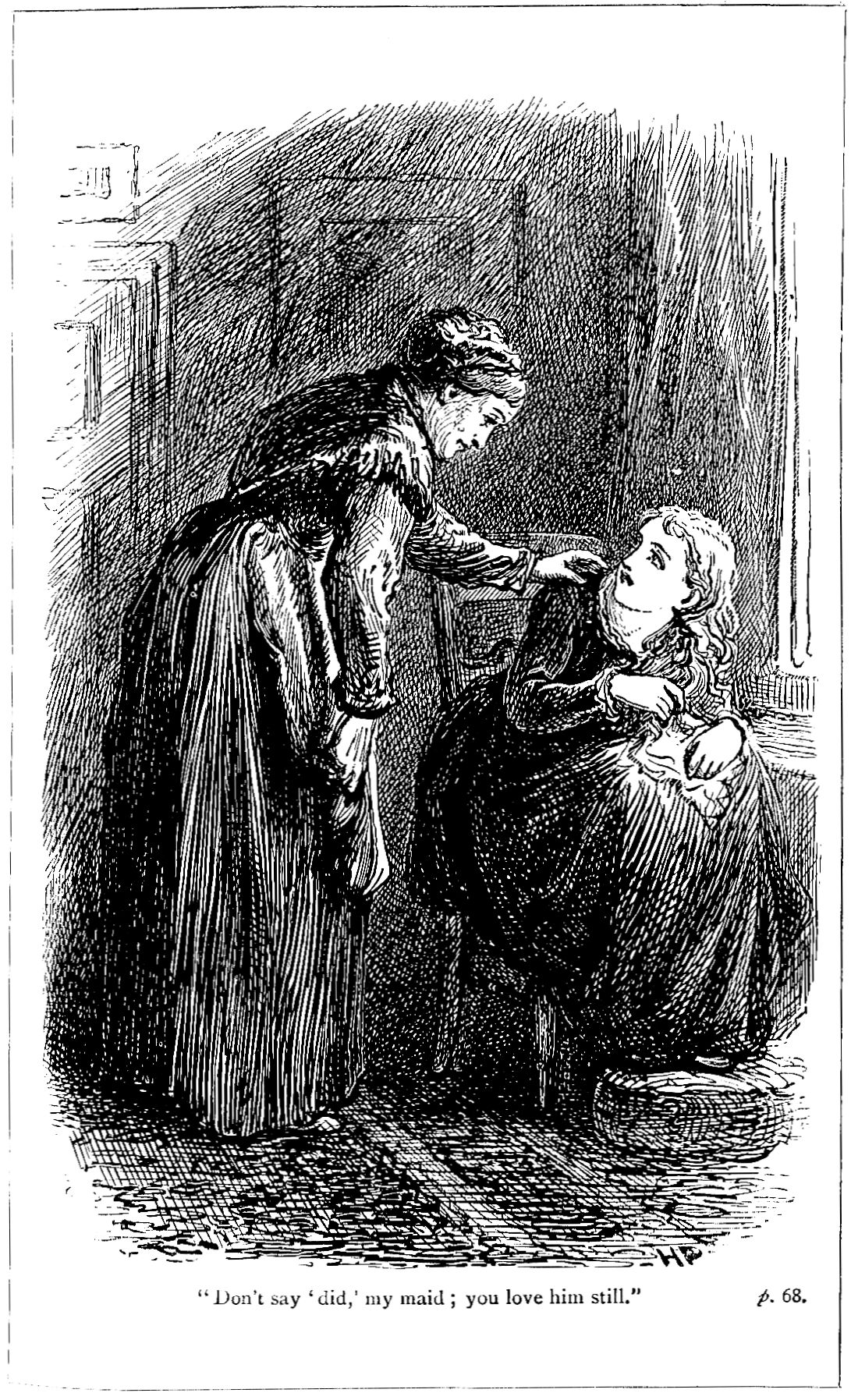
“Oh! I did love him, I did love him,” I sobbed passionately, all my calm suddenly giving way.
“Don’t say ‘did,’ my maid, you love him still.”
“But, Gwen,” I said, “he has sinned, the old, grand, noble Owen is never coming back. No, Gwen, I don’t love the man who brought disgrace and misery on us all—there—I can’t help it, I don’t.”
“Dear, dear,” said Gwen, beginning to smooth down her apron, and trying to stroke my hair, which I shook away from her hand. “What weak creatures we are! dear, dear, why ’tis enough to fret the Lord h’all to nothing, to hearken to us, a-makin’ idols one time o’ bits o’ clay, and then when we finds they ain’t gods for us to worship, but poor sinnin’ mortals like ourselves, a-turnin’ round and hating of ’em; dear, dear, we’re that weak, Gwladys, seems to me we can never have an h’easy moment unless we gets close up to the Lord.”
“I wish you wouldn’t preach,” I said, impatiently.
“No, my dear, I ain’t a-going, but, Gwladys, I will say this, as you’re wrong; you were wrong long ago, but you’re more wrong now; you did harm with the old love, but if you ain’t lovin’ and sisterly to Owen now, you’ll do harm as you’ll rue most bitter. I’m a h’ignorant, poor spoke woman, my maid, but I know as Owen will turn to you, and if you’ll be lovin’ to him, and not spoil him, as h’everybody but David has h’always bin a-doin’, why you may help on the work the good Lord has begun. But there, you’ll take what I says in good part, my dear, and now I may as well tell you what brought me in at this hour to see you.”
“Yes, you may tell me,” I said, but I spoke wearily, there was no interest in my voice.
“I thought how ’twould be,” continued Gwen, “I guessed how the maid would fret and fret, and when you turned me out of your room so sharp, I was fit to cry with the fear on me that you thought poor old Gwen had turned selfish, and ’ad an h’eye to her own comfort and meant to leave the Squire.
“Why, my dear, it stan’s to reason I should fret. Do I not remember the old time when the old mistress was alive, and when your mother came home a bride, so grand, and rich, and beautiful; and now to know that there’ll never be a woman of the house about, and only the Squire and the little blind darlin’ to live at Tynycymmer; but you’re right, Gwladys, ’twould never do to part the Squire and the little lad; and I was ’shamed o’ myself for so much as thinkin’ of it; and before I dropped asleep, with the baby close to me, so that I could see his little face, I made up my mind that I’d think no more of the lonesomeness, but stay at Tynycymmer, after you and my mistress went away. When I settled me to do that, I felt more comfort; but still, what with the feel of not seeing my maid every day, and being worried, and kissed, and made a fool of by her; and what with the thought that she had a sore heart of her own for Mr Owen’s sake, who was coming back so different from what she fancied; I was no way as easy in my mind as I am most nights. And ’twas that, Gwladys, and the moon being at the full, and me only asleep for a few minutes, that made me set such store by the dream.”
Gwen’s last words had been very impressive, and she and I believed fully in dreams.
“What was it?” I asked excitedly, laying my hand on her arm.
“Well, my dear; ’twas as vivid as possible; though by the clock, I couldn’t ’ave bin more’n five minutes dreamin’ it. I thought we had h’all gone away to the black coal country, where there’s never a green leaf or a flower, only h’everything black, and dear, dear! as dismal as could be; and I thought that David went down into one of those unearthly places they calls a mine. Down he would go, into a place not fit for honest men, and only meant for those poor unfortnets as ’ave to trade by it.”
“I mean to go into a mine when we live at Ffynon,” I interrupted.
“Then, my dear, I can only say as you’ll tempt Providence. Why, wot was mines invented for? Hasn’t we the surface of the earth, green and pleasant, without going down into its bowels; but there, Gwladys, shall I finish the dream?”
“Oh, yes!” very earnestly; “please go on.”
“Well, my maid; David, he went down into the mine, and we all waited on the surface to see him drawed h’up; and the chains went clankin’, and one after the other everybody came up out of the pit but David; and after a while we heard that David had gone a long way into the pit, and he couldn’t find his way back again; and the place where he went was very dangerous; and all the miners were cryin’ for the Squire, and they went down and they tried every mortal man of ’em to get him out of the mine; but there was a wind down below in that dreadful place louder than thunder, and when the men tried to get to where David was shut up, it seemed as if it ’ud tear ’em in pieces. So at last they one and all was daunted, and they said nothing could be done. Then, Gwladys, we all cried, and we gave the Squire up for lost, when suddenly, who should come to the pit’s mouth but Owen—Owen, with his breath comin’ hard and fast, and his eyes shinin’, and he said, ‘I’m not frighted; David saved me, and I’ll save David, or I’ll die!’ And with that, before anyone could hinder him, he went down into the dark, loathsome pit!”
“Well?” I said, for Gwen had paused.
“That’s h’all. I woke then. The rest was not revealed to me. When I woke, the cock crowed sharp and sudden, that made it certain.”
“What?” I asked, in an awe-struck, frightened voice.
“Why, ’twill come true, my maid. ’Twas sent to us for a comfort and a warnin’. If David saved Owen, Owen will save David yet.”
Chapter Seven.
Very New and very Interesting.
It is certainly possible when one is only sixteen to go to sleep in the depths of misery, and to awake after a few hours of slumber, with a heart, if not as light as a feather, yet quite sufficiently so, to enable one to dance, not walk, to eat with an appetite, and to laugh with more than surface merriment. These easily changed feelings may be reckoned as some of the blessings of this pleasant age.
At sixteen we have our sharp sorrows, but we have our equally keen pleasures, and it is quite impossible for us to be sad always.
So on the morning after Gwen had related to me her dream, though there were sore places which I could not quite bear to touch, somewhere about my heart, yet the leading fact which danced before my young eyes lay concentrated in the one word—change. We were going away, we were going to make another place our home; we would soon be in all the grand excitement of a move. I was very childish in the matter, for this experience was so new to me, so completely novel. I had never seen a house in the chaos of a removal. I had never seen furniture ruthlessly piled up in corners, beds in packing-cases, chairs and tables upside down, carpetless and straw-littered floors.
It must have been centuries since Tynycymmer had known such a revolution. Except in the attics, everything was in apple-pie order. Even the Tynycymmer attics were not half so disorderly as they should be. Regularly twice a year they were well cleaned out, and reduced to an alarming degree of niceness. The drawing-rooms, dining-room, study, library, were always destined to hold just their own furniture, and no other. And how proper and staid that old furniture looked! those chairs would never tumble down with one, those rather thread-bare carpets would fade and fade, it was true, until all brightness and beauty had left them, but how provokingly orderly they would keep, and how unnecessary it was to do anything to them except at the grand annual cleanings!
I have been so put out and so tired by the everlasting sameness of Tynycymmer, that on some of these exciting occasions, I have forced my way into the dethroned and disarranged rooms, tied the housemaid’s white apron over my hair, and flourished wildly about with a mop, never subsiding into rationalism until I had laid one or two articles of value in fragments at my feet.
But now we were going to have confusion grand and glorious, for the cottage at Ffynon was to be furnished with some of the superabundance of Tynycymmer.
Mother and David went through the old rooms many times, and everything that was small enough, and choice enough, and pretty enough, was marked to go. Mother and David both looked sad during these pilgrimages through the Tynycymmer rooms. But whenever David said, “Mother I should like you to have this, for such a corner,” or, “Mother, we will put this in Owen’s room,” she just bent her stately head in acquiescence, and said, “It shall be as you wish, my son.”
So the rare cases of old china went away, and the choicest landscapes were removed from the walls; only the family portraits remained in the portrait gallery, and a painter’s proof of Noel Paton’s “Mors Janua Vitae,” which David and Amy had brought home after their wedding tour, was left undisturbed in David’s study.
Then the waggons came, old-fashioned, slow, and cumbersome, and the furniture was stowed in, and Gwen and mother and David went to and fro.
At last the cottage was ready, everything to our least belongings, packed and put away, and mother and I saw the day dawn when we were to leave Tynycymmer, and take up our abode at Owen’s house. I found on the morning of that day in late October, I found on that last day, to my astonishment, that even going away had its sorrows. A mist of tears came dimming my eyes as I looked at the sea, as I wandered through the gardens and grounds, as I peeped into the no longer orderly rooms. Memories I had tried to put out of sight returned to me. That arbour overhanging the sea, where I had talked to Amy of Owen, and Amy, in a short, vivid, last flash of resentment, had told me I was wrong; that David was the brave man. Poor little gentle Amy! I had never loved her very much, I had scorned her earnest words; but they were true. I acknowledged them with a great stab at my heart, when I visited the arbour for the last time.
Here was the horse-chestnut-tree where Owen and I had sat and dreamed dreams, summer after summer. I hurried away from it. Here was the cherry-tree from which I had stolen the cherries, for which Owen had reproved me. Here, crawling listlessly after me, was the lame, and half-blind terrier, which had once belonged to Owen, and had been sportive enough when Owen and I were together. Here was the study, where I had copied Owen’s exercises. Here the stain, still left in the carpet, where Owen had upset the ink. Here the spot—here, by the deep, mullioned window—where, after a long labour for Owen, he had put his arm round my childish neck, looked full into my eyes, and “called me the best little sister in the world.”
Oh! what ailed the place this morning; it was alive with Owen, peopled with Owen in every nook. From each corner Owen started up and confronted me, as he was. As he was—what was he now? I dashed my blinding tears away. Kissed little David, hugged Gwen, who was absolutely speechless with her own sorrow, got into the carriage beside mother, and was off—away! For mother’s sake, who was very white, and seemed to be suffering intensely, I abstained from shouting. For David’s sake, who kept his hat well down, and who never spoke, I, too, remained silent. In process of time we arrived at Ffynon, and at the cottage which was to be our future home. A tree or two surrounded it; a little scrap of a garden, neat with gravel, and bright with late geraniums in pots, led up to it. Inside there was a drawing-room, low and small; a dining-room to match; behind, kitchens, a pantry, and cellars; over head, four bed-rooms. That was absolutely all. Goodness me! dear, dear! as Gwen would say, was there ever such a nutshell of a place! Why, it was a toy-house, a doll’s abode. I could stand on tiptoe and touch the ceiling of the apartment set aside for my slumbers. I could stand by the bedstead at one end of the room, and nearly pull the bell at the other. But then the bedstead was so pretty, so tiny, so bright! The whole room, encased in its fairy-like pink and white, was like a little bower; the muslin curtains were partly drawn, the blinds partly down, the evening sun cast a glow over everything. I approached the window, whistling to my canary as I went. I drew up the blinds, and pushed back the curtains. My cheeks were hot, I wanted to see my waves. Perhaps from long habit, I thought I should see them. I looked out, and behold! a black country—hills, low and barren destitute of trees, clothed with coal dust; straight, red brick chimneys, from which curled volumes of ugly smoke; roads winding everywhere, of a grimy grey; a train of coal trams, whizzing up to the noisy dirty station; the roar of steam-engines filling the air; dark figures rushing here and there, and the machinery and shaft of what I afterwards learned was David’s mine, quite close. The entrance to this mine lay within not many hundred yards of the house. Oh! there was noise enough and life enough here, but it was ugly! ugly! ugly! I quickly shut down the window; I drew the blinds and curtains into their former position. I would not acknowledge, even to myself, how my heart rose up in wild longing for the green trees, and the fresh, sweet, salt waves of Tynycymmer; I only said to myself, “The cottage is lovely, fairy-like; but the view is ugly!”
That night I slept well in my little room, and in the morning was able to acknowledge that, though the coal country was far from beautiful, and Ffynon was not quite the home to choose, yet any change was welcome to me; and had Owen only been coming back the hero I had painted him, had dear old David’s brave face not worn such a patient look, had my mother not been quite so silent, and quite so sorry for leaving Tynycymmer, and had Gwen been still to the fore to scold me, and pet me, I should have been, notwithstanding the ugly view, the happiest girl in the world.
I got up early this first morning, and went out. I ran down, without anyone knowing it, to the place where the machinery roared loudest, and the black coal dust was thickest. I looked into the mouth of the shaft, watched with interest the rows of grimy miners getting into the cage, and descending into the mine; started back at first from their black faces, which, relieved by the dazzling white of teeth and eyeballs, made them look hardly human; presently gathered courage, came close, asked eager questions, made all verbal preparations for a speedy descent into the coal mine; rather laughed at the idea of fear in the matter, and returned home in time for breakfast, my light dress covered with dirty stains, my golden hair full of coal dust, my whole person very dirty indeed.
“Gwladys,” said mother, “you must never venture near the shaft alone again.”
“If you do, Gwladys, I must take you back to Tynycymmer,” said David.
I did not want that; if Ffynon was dirty, it was very new and very interesting.
Chapter Eight.
I said I would do much for these Children.
We were a fortnight at Ffynon. All my possessions were unpacked and put neatly away in the wardrobes allotted to them. My favourite books, my “Cambrian Magazine,” my “Westward Ho!” my “Arabian Nights,” my “Mabinogion,” reflected gay colours behind polished glass doors. Packing-cases had disappeared. The cottage inside was perfection, bright with potted plants, cool with muslin drapery, glowing with rich crimson curtains. The rare and lovely Tynycymmer china filled niches in the drawing-room, exquisite landscapes from the pencils of Fielding and Cooper adorned the walls, the blackest of coal sent out the clearest flames of ruddy hue from the highly-polished grates. Every room was perfect, perfect with neatness, cleanliness, order, and perfect also with a minute, but highly-finished beauty. The tiny abode hardly needed even a fairy’s touch to render it more lovely, on the day Owen was expected home. On this day mother came down in the black velvet robe which had lain by for years. It was worn high to her throat, finished off at neck and wrists with Honiton. A tiny Honiton cap rested becomingly on her shining, abundant, still raven black hair.
I was lying on my bed, my face flashed, my yellow locks in confusion, a rumpled cotton dress, too soiled for July, too out of season for October, adorning my person, when mother in her massive folds, her eyes bright as stars, came in.
“Make yourself nice, my darling. Owen will be here before long,” she said.
She kissed me and went away. When she left me I jumped up, and looked at my watch. It was not yet four o’clock. Owen could not arrive before another hour. I cared nothing about my dress. I could not sit in state in the tiny drawing-room to meet Owen. I put on a winter jacket, and my hat, ran downstairs, and went out.
Mother saw me from the window, and called after me, and I called back in reply—
“I shall not be long, I shall return in time for Owen.”
Mother turned away with a sigh. What a rebellious, thoughtless young thing I was! Of course mother wanted me. She would like to look at me in my trim, orderly, number one gown, to arrange a ribbon here and a curl there, to sigh, and smile, and talk, to hazard a thousand sweet innocent conjectures. Should we know our darling? What would he think of me? I had been such a little one when he went away!
These remarks, these touches, these looks, would have helped mother through that last trying hour of suspense, that hour which, if all has been well, if all will be well, is still fraught with pain through its very intensity. Yes, they would have helped mother, and driven me wild. I was selfish. I went on my way. Oh! that ugly coal country, with the wintry fading light of the first November evening over it! I kicked up coal dust with my feet, and two heavy tears fell from my eyes. Yes, Owen was coming home. Even now, each moment was bringing him nearer to us. Owen was coming home, and I was unhappy. Between this hour, and the hour six weeks before, when David had broken to me one sad fact, a strange but complete revulsion had taken place within me. I was a childish creature still, childish in heart and nature; but just, perhaps, or in part, perhaps, because I was so inexperienced, so immature, I had turned from my hero, I had hardened myself against the warmest love of my life.
Yes, I had made a god and worshipped it. Nothing was too good for it, no homage too great to lay at its feet, no sacrifice too worthy to offer at its shrine. Mother, David, Amy, were all as nothing in comparison of this my hero. My dream lasted through my childhood and early youth, then suddenly it vanished. My god was a clay god, my idol was dust.
Owen Morgan still lived. Owen Morgan was coming back to his mother, brother, sister, but my perfect Owen was dead. A man who had sinned, who had brought disgrace on us, was coming home to-day. More and more as the time drew nearer I had shrunk from seeing, from speaking to, from touching, this altered Owen. I was intensely unmerciful, intensely severe, with the severity of the very young. No after repentance, no future deed of glory could wipe away this early stain. I had been deceived—Owen had sinned—and my Owen was dead. As I walked quickly along the barren, ugly coal country, I pictured to myself what my feelings would have been to-day had this not been so. Would mother have sat alone then in her velvet and lace to meet the returning hero? Would I? ah! what would I not have done to-day? I could not think of it. I dashed away another tear or two and walked on. I chose unfrequented, lonely paths, and these abounded in plenty, paths leading up to old, used-up shafts, and neglected mines; paths with thin ragged grass covering them, all equally ugly. At last I came to a huge cinder-heap, which had lain undisturbed so long, that some weak vegetation had managed now to grow up around it. Here I sat down to rest. The cinder-heap was close to the closed-up shaft of an unused pit. In this fortnight I had already learned something of mining life, and I knew where to look for the old shafts, and always examined them with curiosity. As I sat there, I heard the voices of two children, who, evidently quite unaware of my close neighbourhood, were talking eagerly together, at the other side of the cinder-heap. It was a boy’s voice I heard first—high, shrill, passionate.
“Yes, indeed, Nan; they’ll call me a coward. No, Nan; I’ll not be daunted. I will go down on Monday!”
To these words the girl replied with sobs. I heard the boy kissing her; then there was silence, then the same eager voice said—
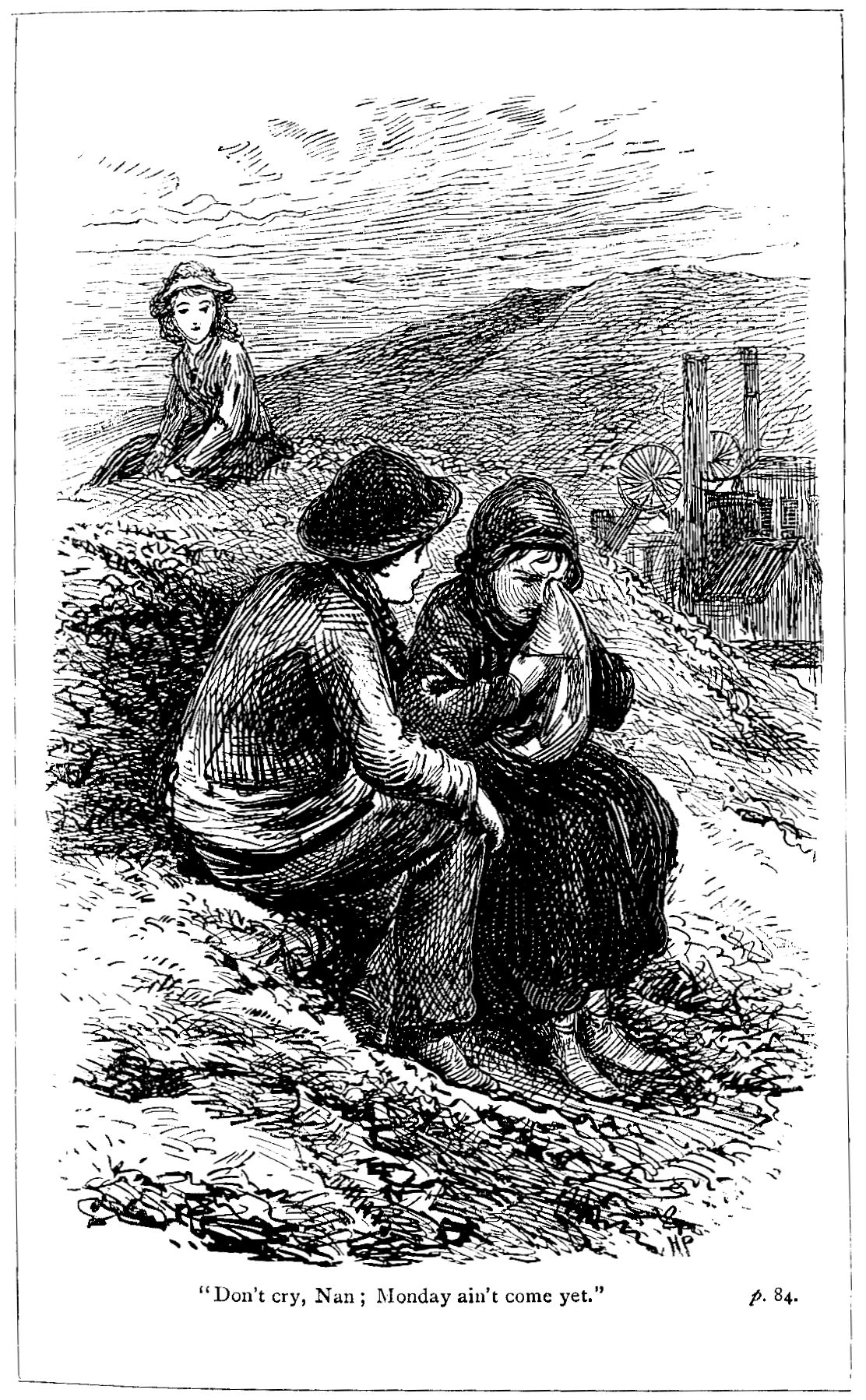
“Don’t cry, Nan; Monday ain’t come yet. Let’s talk of something pleasant.”
“Don’t talk at all, Miles. Let’s sing.”
“Shall we sing ‘The Cross?’”
“I don’t—no, I do care. Yes, we’ll sing that.” There was a pause, then two sweet, wild voices took up the following words to a plaintive Welsh air:—
“The cross! the cross! the heavy cross! The Saviour bore for me! Which bowed Him to the earth with grief, On sad Mount Calvary. “How light, how light, this precious cross Presented now to me; And if with care I take it up, Behold a crown for me!”
Here the voices ceased suddenly, and I again heard a kiss of comfort, and the sound of a girl’s sob. I could bear no more. I started to my feet, ran round the cinder-heap, and confronted the children.
“Please don’t be frightened! I heard you sing. I want you to sing again. I want to know what’s the matter. I’m Gwladys Morgan—you may have heard of me; my brother is going to manage the mine at Ffynon.”
Two pairs of black eyes were raised to my face, then the boy rose slowly to his feet, came forward a step or two, and after gazing at me with the most searching, penetrating glance I had ever been favoured with, said brightly, as if satisfied with the result of his scrutiny—
“I’m Miles, and this is little Nan.”
“And father works down in the mine,” said little Nan.
“Father’s name is Moses Thomas—he’s deputy,” said the boy again, in a proud tone.
“Go on,” I said, seating myself close to the children; “tell me all about yourselves. I’m so glad I’ve met you. I am sure we shall be friends. I like you both already. Now you must let me know your whole story, from beginning to end; only first, do, do sing that lovely hymn again.”
“I’ll sing, Miss Morgan,” said the boy, instantly; “but you’ll forgive little Nan; little Nan’s in trouble, and her voice ain’t steady.”
Throwing back his head, looking straight before him, and clasping his hands round his knee, he sang to the same wild measure the next verse of the Methodist hymn:—
“The crown! the crown! the glorious crown! A crown of life for me. This crown of life it shall be mine, When Jesus I shall see.”
“When Jesus I shall see,” he repeated, under his breath, looking at the girl as he spoke. As the children looked at each other they seemed to have forgotten my presence.
“What’s the cross you’ve got to bear? Nan,” I asked.
An old-fashioned, troubled, anxious face was raised to mine; but it was Miles who answered.
“’Tis just this, Miss Morgan: ’tis nothing to fret about. I’ve got to go down into the mine to work on Monday. I’ve never been into the mine before, and little Nan’s rare and timmersome; but I says to her that she’s faithless. She knows, and I know, that the Lord’ll be down in the mine too. ’Tis none so dark down there but He’ll find me h’out, and take care on me.”
“He didn’t find out Stephie,” sobbed Nan, all her composure giving way. “He took no care on Stephie.”
“What is it?” I said; “do tell me about it; and who is Stephie? Miles.”
“Stephie is dead, Miss Morgan. There’s only us two now—only us and father. Mother died arter Stephie went; she fretted a good bit, and she died too; and then there was Nan, and me, and father. We lives near Ffynon Mine, and father’s deputy; and we’re none so rich, and father works rare and ’ard; and he don’t get much money, ’cause the times is bad; and I’m fourteen, and I’m very strong, and I says I should work.”
“No—no—no!” here screamed the girl, forgetting, in a perfect paroxysm of fright and grief, the presence of the stranger. She clasped her arms round the boy’s neck, and her white lips worked convulsively.
“There it is,” said Miles; “she’s sure set agen it, and yet it must be.” Then bending down and speaking in a low voice, in her ear. “Shall I tell the lady about Stephie? Nan.”
“Yes,” said Nan, unloosing her hold, and looking up into his face with a sigh. She had the scared look in her wild, bright eyes, I have seen in the hunted hare, when he flew past me—dogs and horsemen in full pursuit. Now she buried her head in her brother’s rough jacket, with the momentary relief which the telling of Stephie’s story would give to the tension of her fears.
“Tell me about Stephie,” I said.
“Stephie,” continued Miles—“he was our brother. Mother set great store by Stephie; he was so strong, and big, and brave. Nothing ’ud daunt ’im. Many of the lads about ’ere ’ud try; and they’d say, ‘Wait till the day you goes down inter the mine, and you’ll show the white feather’; but he—he larfed at ’em. He ’ad no fear in ’im, and h’all the stories ’bout fire-damp, and h’all the other dangers—and worse’rn all, the ghosts of the colliers as died in the mine, they couldn’t daunt him. Other lads ’ud run away, wen they come near the h’age; but he—he on’y counted the days; and ‘Mother,’ ’e’d say—for mother war werry weakly—‘Mother, wen you ’as my wage, you can buy this thing and t’other thing, and you’ll be strong in no time.’ Well, mother she thought a sight on Stephie, and she never wanted ’im to go down inter the mine; and she used to ask father to try and ’prentice ’im to another trade, for he war so big, and bright, and clever; but the times was bad, and father couldn’t, so Stephie had to go. He was clever, and fond o’ readin’, and a man wot lived near, lent ’im books, real minin’ books, and he knew ’bout the dangers well as anybody; but nothing could daunt Stephie, and he often said that he’d work and work, and rise hisself; and he’d try then ef he couldn’t find h’out something as ’ud help to lessen the danger for the colliers. At last the day came wen he was to go down.”
Here Miles paused, drew a long breath, and little Nan buried her head yet farther into his rough jacket. He stooped to kiss her, then raising his head, and fixing his eyes on my face, he continued. “The day ’ad come, and Stephie got h’up very early in the mornin’, and he put on ’is collier’s dress, and we h’all got up—Nan and h’all; and mother she give ’im ’is breakfast. Well, he was standin’ by the fire, and mother’s ’and on ’is shoulder, and ’er eyes on ’is face, when father, he came.
“Father had h’always promised to go down the first time wid Stephie, and show ’im the mine, and put ’im wid someone as ’nd learn ’im ’is work; but now he said, ‘Stephie, lad, I can’t go down till night. I ’as ’ad a sudden call elsewhere, so thee ’ad better wait, lad;’ but Stephie answered, ‘No, father; there’s poor little James, Black William’s son, and he’s going down too, to-day; and he’s rare and daunted, and I ain’t a bit; and Black William said as he might stay along wid me the first day, so I must go, father, and Black William ull take care on us both;’ then father, he said no more—on’y mother, she cried and begged Stephie to wait. And he looked at ’er amost scornful, for h’all he loved her so; and he said, ‘Does thee tell me to forsake the little sickly lad?’ Then he kissed mother, and he kissed little Nan, and waved his hand back at ’em, and set off running to the bank, and I ran wid ’im, and he said to me, ‘Miles, lad, don’t you h’ever be daunted when your turn comes to go down, for God takes care of h’everybody, in the earth and on the earth—’tis all the same to God.’ Then he stepped on to the cage, and gripped the hand of little James, who was shakin’ fit to drop, and he called h’out to me—‘Tell mother as I’ll be coming up wid the day crew, and to ’ave supper ready, for I’ll be very ’ungry,’ and the other colliers larfed to ’ear ’im so ’arty.
“Well, Miss Morgan, that day mother war stronger nor ordinary, and she cleaned and scrubbed the floor, and when evening came, she got a rare and good bit of supper ready, and just wen we was looking h’out for Stephie, and mother had put a rough towel, and water in the tub, ready for him to wash hisself, who should come runnin’ in but the wife of Black Bill, h’all crazy like, and ’ringin’ ’er ’hands; and she said there had been a gas explosion, and h’every livin’ soul in the mine was dead.”
Here Miles paused; speaking again in a moment, more slowly.
“That wasn’t true. A few did escape, and was brought up next day. But Black Bill was dead, and Stephie, and little James. Black Bill was found all burnt dreadful; but Stephie and little James—it was the after-damp had done for them. They was found in one of the stalls; Stephie’s arms round the little lad.” Another long pause. “Mother, she never held up her head—she died three months later, and now there’s on’y Nan, and father, and me. Nan is such a careful little body, and keeps the house so trim.”
“You are not afraid to go down into the mine?” I said.
“Well, miss, it is a bit of a cross; partic’lar as it cuts up the little ’un so; but, good gracious! it ain’t nothin’; there ain’t bin a h’accident for h’ages—and I ain’t daunted.”
“When are you going down?”
“On Monday, Miss Morgan.”
“Little Nan,” I said, turning to the child, “I mean to come to see you at your own house on Monday. You may expect me, for I shall be sure to come; and I’ll bring you pictures—lots; and if you like, I can show you how to colour them.”
I thought this offer must charm Nan, and make her forget the terrors of the mine; but it did not. She looked gravely, almost fretfully at me, and it was Miles who said, “Thank you.”
“I must go now,” I said, jumping to my feet. “I have stayed too long already; but I’m very glad I have met you, Miles, and Nan. I think your Stephie a real, real hero; and, Miles, I love you for being so brave, and I should like, beyond anything, to shake hands with you, and to kiss little Nan.”
After clasping a small brown hand, and pressing a warm salute on two trembling lips, I started home. The children’s story had excited me, and warmed my heart. For the present it absorbed my thoughts, even to the exclusion of Owen. I said I would do much for these two. This boy and girl, so lonely, so interesting, with their tragic story and tragic life, should find in me a benefactor and friend. The thought was delicious and exhilarating. David, through my intervention, should rescue Miles from the miner’s life, and relieve the timid little sister from her worst fears. My spirits rose high as I contemplated this event, which a word from my lips could bring about. I entered the house humming the wild sweet air which the children had set to their Methodist hymn. The music of my voice was greeted by the richer music of gay and happy laughter. I stood motionless in the hall. My heart almost ceased to beat, then bounded on wildly. The colour fled from my cheeks and lips, returning in a moment in a full tide of richest crimson. I could have given way then. I could have rushed to Owen’s side, thrown my arms round his neck, and wept out on his breast, a whole flood of healing and forgiving tears. Had I done so, my soul would have been knit to his with a love strong as the old love was weak—noble as the old passionate affection was erring and idolatrous; but I did not. I conquered the emotion, which the sound of his voice, and his laughter, had stirred within me. I told myself that that was not my Owen—mine, my hero was dead. Untidy, pale, agitated, but unforgiving, I opened the drawing-room door and went in. David, mother, and Owen, were standing in a loving, happy group. I went up to the group—they had not heard me come in—and touched Owen on the sleeve, and said, in a quiet voice, “Welcome home, brother.”
For an instant two bright, dark eyes looked expectantly into mine—one instant the brilliant eyes wore that look—one instant after, they were blank with disappointment. Then all was commonplace—a commonplace, but affectionate brother’s kiss was on my cheek, and a gay voice said, laughingly—
“Why, Gwladys, you’re as wild and disreputable-looking a little romp as ever.”
Chapter Nine.
Earth—Air—Fire—Water.
Whether Owen had come back, in my opinion, a hero, or an unpardoned and disgraced man, appeared after his first swift glance into my face to affect him very little, if at all; and I had to admit to myself that whatever else he may have failed in, he had arrived at Ffynon with a full knowledge of the duty which he had undertaken.
As a boy, he had always loved engineering, and when in those bright and happy days he and I had discussed his golden future, the pros had generally ended in favour of his becoming an engineer.
“All things considered, I should like this best, Gwladys,” he would say. And though in these very youthful days he appeared to care more for poetry and the finest of the fine arts, yet it was here, I believe, that his true talent lay. Owen had not been idle during the four years of his exile, he had studied engineering as a profession when he was at Oxford, and during these years he had gone through a course of practical training with regard to the duties of a mining engineer, not only in the German mines, but in the North of England. He now brought this knowledge to bear on the rather slow working and unprofitable mine at Ffynon. This mine, which belonged to our mother, had at one time yielded a great deal of coal and was a source of much wealth, but of late, year by year, the mine yielded less, and its expenses became greater. It was worked on an old-fashioned system; it had not the recent improvements with regard to ventilation; and many serious accidents had taken place in consequence. Neither was the manager popular, he worked the mine recklessly, and many accidents of the most fatal character were constantly taking place from the falls of roofs, this expression meaning the giving way of great portions of the coal for want of proper supports being put under it. A short time before Owen’s return, the manager of the mine for some more flagrant act of carelessness than usual, had been dismissed, and it was on hearing this, that Owen had written to David, telling him of his studies and his profession, reminding him also that when a boy he had more than once gone down into the old mine at Ffynon, that with his present knowledge he believed the mine to be still rich in coal, and that it only needed to be properly worked to yield a fine return. He spoke strongly against the unprofitable and expensive system which had hitherto been adopted; and finally he begged of David to give him permission to step into the manager’s shoes, and for at least a year to have absolute control of the mine: promising at the end of that time to reduce order out of chaos, to lessen current expenses, and to bring in the first instalments of what should be large profits.
He had frankly told David his reason for this: he had a debt to pay, a debt of love and gratitude it was true, but still a debt that fretted his proud spirit, a debt that must be paid before he could know happiness again. But it was just on account of this reason that David hesitated to accept the services of one whose knowledge of the work he meant to undertake, was certainly great. The primary motive in Owen’s heart, seemed to David, in the present state of Ffynon mine, hardly a worthy one. Coal was valuable, gold scarce, but lives were precious; it seemed to David that until all was done to insure the safety of the lives of those men and boys who worked in the mine, gold ought to weigh very low in the balance, and as he alone of us all knew something truly of his brother’s character, so he hesitated to accept his offer; but while David hesitated, mother urged. Mother was ignorant of the miner’s life; gold to mother was not valueless: she had dreams of the Morgans being restored to all their former riches and power, she had also, notwithstanding his one fall, still implicit faith in Owen. Owen would not only win the gold but make the mine safe. It was a grief to her to leave Tynycymmer, but it was a counterbalancing delight to live on any terms for a year with her favourite son; she urged the acceptance of his offer. Thus urged, David yielded.
We moved to Ffynon. Owen arrived, eager, hopeful, enthusiastic, as of old. Handsome and brilliant as ever he looked as gay as though he had never known a sorrow. So I thought for the first week after his arrival, then I saw that his spirits were fitful, sometimes I fancied a little forced; a bad report of the mine would depress him for the day, whereas good news would send his gay laugh echoing all over the small house.
Thus I found myself in the midst of mining life. Mother, hitherto profoundly ignorant of such matters, now took up the popular theme with interest and zest.
She and I learned what fire-damp, black-damp, after-damp meant. We learned the relative destructiveness of explosions by gas and inundations by water. Then we became great on the all-important subject of ventilation. We knew what the steam jet could do, what furnace ventilation could effect. I admired the Davy lamps, learned something of their construction, and at last, I obtained the strongest wish I at present possessed, namely, a visit to this underground region of awe and danger, myself. It is a hackneyed theme, and I need scarcely describe it at length. I remember stepping on to the cage with some of the enthusiasm which I had admired in Miles’ brave hero brother, and long before I reached the bottom of the shaft, suffering from an intolerable sense of suffocation, and shivering and shaking with inward fear, such as must have overtaken poor little James on that fatal day. Finally, when I got to the bottom, recovering my courage, rejoicing in the free current of fresh air which was blown down from the great fan above, growing accustomed to the dim light of the Davy lamps, and then discovering little, by little, that the mine with its rail-roads, its levels, its drift ways, where the loaded trams of coal ran swiftly down, impelled by their own weight, its eager, grimy workers, its patient horses, destined many of them to live and die in this underground gloom, was very like a town, and had an order and method of its own.
The knowledge gained by the visit, the knowledge gained by listening to Owen’s and David’s conversation, the knowledge perhaps greater than all, which I had won by my friendship for Miles and Nan, inspired in me the strongest respect and admiration for the brave collier. He works in the dark, his heroic deeds are little heard of beyond his own circle, and yet he is as true a hero as the soldier in the field of battle or the sailor in the storm: his battle-field is the mine, his enemies, earth, air, fire, and water. Any moment the earth can bury him in a living tomb, a vast quantity of that solid coal may give way, and crush him beneath its weight; any instant, the air, in the poisoned form of black, or after-damp, may fill his lungs, take all power from his limbs, fell him in his strength and prime to the earth, and leave him there dead; or in half an instant, through the explosion of a match, the wrong adjustment of a safety-lamp, the whole mine may from end to end become a cavern of lurid fire, destroying every living thing within its reach. Or one stroke too many of the miner’s pick, may let in a volume of black and stagnant water from an unused and forgotten pit, which rising slowly at first, then gaining, in volume, in strength, in rapidity, buries the miners in a watery grave of horrible and loathsome desolation.
Yes, the miners are brave; for small pay they toll unremittingly, labouring in the dark, exposed to many dangers. Day by day these men go down into the mines literally with their lives in their hands. The wives, mothers, sisters, know well what the non-arrival of a husband, father, brother means. They hope a little, fear much, weep over the mangled remains when they can even have that poor source of consolation, and then the widow who has lost her husband, dries her eyes, puts her shoulder to the wheel, and like a true Spartan woman, when his turn comes, sends down her boy to follow in his father’s steps, and, if God wills it, to die bravely, as his father died before him.
I visited the schools about Ffynon, and noticed the bright dark-eyed, Welsh children, each boy among them destined to become a collier as he grew up. Many of these boys shrank from it, struggled against it, feared it as a coming nightmare; some few, as the dreaded time drew near, ran away to sea, preferring the giving up of father and mother, and encountering the hardships of the sea, to the greater hardships of the mine, but most of them yielded to the inevitable fate.
I found, too, on observation that the colliers of Ffynon were a religious people; the sentiments I had heard in astonishment and almost awe dropping from the lips of little Miles, I found were the sentiments rather of the many than the few. They lived an intense life, and they needed, and certainly possessed, an intense faith.
The body of them were not Church people; they had a simple and impassioned service of their own, generally held in the Welsh tongue. At these services they prayed and sang and listened to fervent addresses. At these services, after an accident, slight or great, the men and women often bowed their heads and wept. Their services were alive and warm, breathing the very breath of devotion, suited to their untrained, but strong natures. They left them with the sense of a present God alive in each heart; a God who would go with them into the mine, who would accompany them through the daily toil and danger, and, if need be, and His will called them, would carry them safely, even in a chariot of fire, into the Golden City.
To the religious miner, the descriptions of Heaven as written in the Apocalypse, were the very life of his life. He loved to sit by his fire on Sunday evenings, and slowly read from the well-worn page to his listening wife, and his lads and lasses, of the city sparkling with gems and rich with gold. To the man who toiled in the deepest of darkness, a land without night or shadow was a theme of rapture. To the man who knew danger and pain, who fought every day with grim death, that painless shore, that eternal calm, that home where father, mother, brother, sister, rudely parted and torn asunder here, should be together, and God with them, was as an anchor to his soul. No place on earth could be more real and present than Heaven was to the religious collier. Take it from him, and he could do no more work in the dark and dangerous mine; leave it with him, and he was a hero. The colliers had one proud motto, one badge of honour, which each father bequeathed as his most precious possession to his son—this motto was “Bravery;” one stigma of everlasting disgrace which, once earned, nothing could wipe out, “Cowardice.” In the collier’s creed no stone was too heavy to roll away to rescue a brother from danger. Into the midst of the fire and the flood, into the fatal air of the after-damp, they must go without shrinking to save a companion who had fallen a victim to these dangers. Each man as he toiled to rescue his fellow man, knew well that he in his turn, would risk life itself for him. No man reflected credit on himself for this, no man regarded it as other than his most simple and obvious duty.
Into the midst of this simple, brave, and in many ways noble people, came Owen with his science and his skill. He went down into the mine day after day, quickly mastered its intricacies, quickly discovered its defects, quickly lighted upon its still vast stores of unused treasures. At the end of a month he communicated the result to David. I was seated by the open window, and I heard, in detached sentences, something of what was spoken, as the brothers paced the little plot of ground outside, arm in arm. As I watched them, I noticed for the first time some of the old look of confidence and passion on Owen’s face. The expressive eyes revealed this fact to me—the full hazel irids, the pupils instinct with fire, the whole eyes brimming with a long-lost gladness, proclaimed to me that the daring, the ambition I had loved, was not dead.
“Give me but a year, David,” I heard him say in conclusion. “Give me but one year, and I shall see my way to it. In a year from this time, if you but give me permission to do as I think best, the mine shall begin to pay you back what I have lost to you!”
David’s voice, in direct contrast to Owen’s, was deep and sad.
“I don’t want that,” he said, laying his hand on his brother’s arm, “I want something else.”
“What?” asked Owen.
“I want something else,” continued David. “This is it. Owen, I want you to help me to fulfil a duty, a much neglected duty. I take myself to task very much for the gross way I have passed it by hitherto. God knows it was my ignorance, not my wilful neglect, but I ought to have known; this is no real excuse. Owen, I have lived contented at Tynycymmer, and forgotten, or almost forgotten, this old mine. I left things in the hands of the manager; I received the money it brought without either thought or comment. And all the time, God help me, the place was behind its neighbours. I had not much money to expend on it, and I was content it should be worked on the old system, never thinking, never calculating, that the old system involved danger and loss of life. The mine is not ventilated as the other mines are; in no mine in the neighbourhood do so many deaths occur. You yourself have discovered it to be full of many dangers. So, Owen, what I ask of you is this, help me to lift this sin of my neglect off my soul. I don’t want the money, Owen; it is enough for me, it is more than enough, to see you as you now are; the money, I repeat, is a thing to me of no value, but the people’s lives are of much. I can and will raise the sum you require to put the mine into a state of safety, to perfect the ventilation, to do all that can be done to lessen the danger for the colliers. Do your part in this as quickly as possible, Owen, and let us think nothing of money gains for the present.”
While David was speaking, Owen had again drawn a veil of perfect immobility over his face. Impossible, with this veil on, to guess his thoughts, or fathom his feelings.
“Of course, of course,” he said, “the ventilation shall be improved and all that is necessary done.”
Chapter Ten.
Little Twenty.
I had not forgotten my promise to visit Nan on the day her brother first went down into the mine.
I selected a bundle of illustrated papers—some old copies of Punch—as, judging from the delight I took in them myself, I hoped they would make little Nan laugh. I also put a sixpenny box of paints into my pocket. These sixpenny paint-boxes were the most delightful things the Tynycymmer children had ever seen, so, doubtless, they would look equally nice in the eyes of Nan.
The Thomas’s cottage was one of a row that stood just over the pit bank. I ascended the rather steep hill which led to it, entered the narrow path which ran in front of the whole row of houses, and where many women were now hanging out clothes to dry, and knocked at Nan’s door. She did not hear me; she was moving briskly about within, and singing to her work. Her voice sounded happy, and the Welsh words and Welsh air were gay. I knocked a second time, then went in.
“I am so glad to hear you singing, Nan,” I said. “I was sure you would be in trouble, for I thought Miles had gone into the mine to-day!”
Little Nan was arranging some crockery on the white dresser. She stopped at the sound of my voice, and turned round with the large china tea-pot in her hand. When I had seen her on Saturday, seated weeping on the old cinder-heap, I had regarded her as a very little child. Now I perceived my mistake. Nan was no child; she was a miniature woman. I began to doubt what effect my copies of Punch and my sixpenny paints would produce on this odd mixture; more particularly when she said, in a quiet old-fashioned voice—“But he did go into the mine, Miss Morgan; Miles went down the shaft at five o’clock this mornin’.”
“You take it very calmly when the time comes,” I continued; “I thought you would have been in a terrible state.”
“Yes, ain’t I easy,” said Nan, “I never thought as the Lord ’ud help me like this; why, I ain’t frighted at all.”
“But there’s just as much danger as ever there was,” I said. “Your not being frightened does not make it at all safer for Miles down in the pit.”
I made this remark, knowing that it was both unkind and disagreeable; but I was disappointed; I had meant to turn comforter—I was provoked to find my services unnecessary.
“There ain’t no danger to-day,” replied Nan, to my last pleasant assurance.
“How can you say that?” I asked.
“’Cause the Lord revealed it to me in a dream.”
Now I, too, believed in dreams. I was as superstitious as the most superstitious Welsh girl could possibly be. Gwen, my isolated life, my Welsh descent, had all made me this; it was, therefore, with considerable delight, that, just when I was beginning to place Nan very low in my category of friends, I found that I could claim her for a kindred spirit.
“You are a very odd little girl,” I said; “but I’m sure I shall like you. See! I’ve brought you Punch, and the Illustrated News, and a box of paints, and perhaps I shall show you how to colour these pictures, as the children did at Tynycymmer.”
Then I seated myself uninvited, and unrolled my treasures; my newspapers, my copies of Punch, my paint-box with the lid off, were all revealed to Nan’s wondering eyes.
“Get me a saucer and a cup of water,” I said, “and I’ll show you how to colour this picture, and then you can pin it up against the wall for your father to see when he comes home.”
“If you please, miss,” said Nan, dropping a little curtsey, and then coming forward and examining the print in question with a critical eye, “if you please, miss, I’d rayther not.”
“What do you mean?” I said.
“Well, miss, I’m very gratified to you; but, father, he don’t like pictures pasted up on the walls, and, indeed, Miss Morgan,” getting very red, her sloe-black eyes gleaming rather angrily, “I ’as no time for such child’s play as lookin’ at pictures, and colourin’ of ’em, and makin’ messes in cups and plates. I ’as enough to do to wash h’up the cups and saucers as is used for cookin’, and keepin’ the house tidy, and makin’ the money go as far and as comfort as possible. I’m very gratified to you, miss; but I ’as no time for that nonsense. I ain’t such a baby as I looks.”
As little Nan spoke, she grew in my eyes tall and womanly, while I felt myself getting smaller and smaller, in fact, taking the place I had hitherto allotted to her. I rolled up my despised goods hastily, rose to my feet, and spoke—
“You are not half as nice as you looked. I am very sorry that I disturbed so busy and important a person. As I see you don’t want me, I shall wish you good morning.”
I had nearly reached the door, when Nan ran after me, laid her hand on my arm, and looked into my face with her eyes full of tears.
“I ain’t a wishin’ you to go,” she said, “I wants you to set down and talk to me woman-like.”
“How old are you? you strange creature,” I said; but I was restored to good humour, and sat down willingly enough.
“I’m ten,” said Nan, “I’m small for my h’age, I know.”
“You are, indeed, small for your age,” I said, “and your age is very small. Why, Nan, whatever you may pretend about it, you are a baby.”
“No, I ain’t,” said Nan, gravely and solemnly, “it ain’t years only as makes us babies or womans, ’tis—”
“What?” I said, “do go on.”
“Well, miss, I b’lieves as ’tis anxiety. Miles says as I has a very h’anxious mind. He says I takes it from mother, and that ages one up awful.”
“I’ve no doubt of it,” I said. “I’ve felt it myself, ’tis overpowering.”
“I don’t think you knows it much, miss,” said Nan. “I should say from the looks o’ you, that you was much younger nor me.”
“Mind what you’re about,” I said, “I’m sixteen—a young lady full grown. But come, now, Nan, with all your anxiety, you were merry enough when I came in—you did sing out in such a jolly style,—I thought you such a dear little thing; I did not know you were an old croak.”
“Why yes,” said Nan, half-smiling, and inclined to resume her song, “I’m as light as a feather this mornin’, that’s the Lord’s doing.”
“What did the Lord do for you, Nan?”
“He sent me a token, miss, as sure as sure could be, and it came just in the minute before waking.”
“What was it?” I repeated, for little Nan had paused, her face had grown soft and almost beautiful; the hard unpleasing lines of care and anxiety had vanished, and in their stead, behold! the eyes were full of love and faith, the lips tender, trustful, but withal, triumphant.
“I was sore fretted,” she began, “as father couldn’t go down with Miles; he had to stay to go ever the mine with the strange gentleman as is to be manager, and Miles going down h’all alone, reminded me sore of Stephie. And I was frettin’, frettin’, frettin’, and the prayers, nor the hymns, nor nothing, couldn’t do me no good, and Miles hisself, at last, he were fain to be vexed with me, and when I went to bed my heart was h’all like a lump o’ lead, and I felt up to forty, at the very least, and then it was that the Lord saw the burden was too big for me, and He sent me the dream.”
“What was it? Nan.”
“I thought, miss, as I seed the Lord Hisself, all pitiful and of tender mercy. I seed Him as plain as I sees you, and He looked me through and through, very sorrowful, as I shouldn’t trust Him, and Miles, he was standin’ on the cage, just afore it went down, and there was an empty place near Miles, and I saw that every one had their comrade and friend with them, ’cept Miles; and then the Lord, He went and stood by Miles, on the empty space, and He put His arm round Miles, and he looked at me, and I saw the Lord and Miles going down into the dark, dark pit together.”
“I’m sure that was true,” I said, “that was very much what Miles said himself, don’t you remember? You were much better after your dream, were you not? Nan.”
“Yes, miss, I was light and easy in my mind, as if I was twenty!”
“What do you mean, now?” I said.
“Well, Miss Morgan, I can’t help it. I know I’m queer, the folks all say I’m queer. I know I haven’t h’aged with my years. Sometimes, miss, the anxiety brings me up to fifty, and I feels my hair’s a-turnin’ white; then again, I’m thirty, and forty; most times I feels like thirty, but now and then, as to-day, the Lord gives me a special revelation, and then, why, I’m as light as a feather, and down to twenty, but I’m never below that, miss.”
And yet I meant to offer that creature toys! Such was my mental comment, but before I could speak again, the door was opened, and a tall man—coal-black—with gleaming eyeballs, and snowy teeth, came in. He took no notice of me, perhaps he did not see me, but in passing through to another room, he called out in a full cheery voice—
“I say, little lass, how do you feel?”
“Fine, father, down to twenty.”
“Well, Twenty, bustle about, and get me some dinner; I’ll be ready for it in ten minutes.”
“I must go away now,” I said, rising.
“No, miss, that you mustn’t; I wants you to see father. Father’s a wonderful man, Miss Morgan, he have had a sight o’ trouble one way and t’other, and he’s up to fifty in years; but the Lord, He keeps him that strong and full o’ faith, he never passes thirty, in his mind; but there, what a chatterbox I am, and father a wantin’ his dinner!”
The old-fashioned mortal moved away, laid a coarse but clean cloth on a small table, dished up some bacon and potatoes in a masterly manner, and placed beside them a tin vessel—which, she informed me, was a miner’s “jack”—full of cold tea.
“Father will never go down into the mine without his jack o’ tea,” she explained; and just then the miner, his face and hands restored to their natural hue, came in.
“Father,” said Nan, in quite a stately fashion, “this lady is Miss Morgan; she’s a very kind lady, and she spoke good words to Miles o’ Saturday.”
“Mornin’, miss,” said the miner, pulling his front lock of hair, “I’m proud to see you, miss, and that I am; and now, lass,” turning to his daughter, “you’ll have no call to be anxious now no more, for this young lady’s brother was h’all over the mine this mornin’, and he and Squire Morgan promises that all that is right shall be done, and the place made as snug and tight as possible. That young gentleman, miss,” again addressing me, “is very sharp; he knows wot he’s about, that he do!”
“Is the mine dangerous?” I asked.
“No, no,” said the collier, winking impressively at me, while Nan was helping herself to a potato, “but might be made safer, as I says, might be made safer; another shaft let down, and wentilation made more fresh. But there! praise the Lord, ’tis all to be done, and that in no time; why, that mine will be so safe in a month or two, that little Nan might go and play there, if she so minded.”
As the big man spoke, looking lovingly at his tiny daughter, and the daughter replied, with anxious, knitted brows, “You know, father, as I don’t play,” he looked the younger of the two.
“No more you does, Twenty,” he replied, “but even Twenty can put away her fears and sing us a song when she hears a bit of good news.”
“Shall I sing a hymn? father.”
“Well, yes, my lass, I does feel like praisin’—there, you begin, and I’ll foller up.”
Little Nan laid down her knife and fork, fixed her dark eyes straight before her, clasped her hands, and began—
“We shall meet beyond the river, By and by, And the darkness shall be over, By and by. With the toilsome journey done, And the glorious battle won, We shall shine forth as the sun, By and by.”
She paused, looked at her father, who joined her in the next verse—
“We shall strike the harps of glory, By and by. We shall sing redemption’s story. By and by. And the strains for evermore Shall resound in sweetness o’er Yonder everlasting shore, By and by. “We shall see and be like Jesus By and by. Who a crown of life shall give us, By and by. All the blest ones who have gone To the land of life and song, We with gladness shall rejoin By and by!”
I have given the words, but I cannot describe the fervent looks that accompanied them, nor catch any echo here, of the sweet voice of the child, or the deep and earnest tones of the man. The strong spiritual life in both their natures came leaping to the surface, the man forgot the stranger by his hearth, he saw his God; the child, too, forgot her fears and her anxieties, and as she sang she became really young.
Chapter Eleven.
They Talked of Money.
Since my arrival at smoky, ugly Ffynon, I had never again to complain of being buried alive. The life I led was certainly not the life I should have chosen. I was young; I had day dreams. Had the choice been mine, I should have liked, as all other young things, to win for myself either pleasure, love, or fame. But the choice was not mine; and at Ffynon, strange as it may seem, I grew more contented than I had been now for many years at Tynycymmer.
I was pleased with the people, I liked their occupation, their life. I soon found interests outside myself—a grand secret—thus I grew happy. Nan and Miles soon also became my real friends: I learned to appreciate their characters, to understand them; they were alike in many ways, but in far more ways were they different. Nan had more character and more originality than Miles, but Miles had far more simple bravery than Nan. They were both religious; but Miles’s religion was the least dreamy, and the most practical. On the whole, I think the boy had the grander nature, and yet I think I loved the girl best.
I made many other acquaintances amongst the colliers, but these two children were my friends.
In about a fortnight after Owen’s return, David went back to Tynycymmer, and we settled down quietly into our new and altered life. From morning to night Owen was busy, now making engineering plans, now down in the mine. As a boy he had been dilatory and fitful in his movements, working hard one day, dreaming or idling away the next; but now this boyish character had disappeared—now all this was changed. Now he worked unremittingly, unflinchingly; he had a goal before him, and to this goal he steadily directed his steps, looking neither to the right hand nor to the left. In his present plans, whatever they may have been, mother helped him. Mother gave him of her sympathy and her interest. Long ago, dearly as they loved each other, I don’t think those two natures had quite met; but this was no longer so now; the same hope animated both pairs of eyes, the same feeling actuated both breasts. They had long conferences, anxious, and yet hopeful consultations; but it was less in their words than in their faces that I read that their wishes were the same.
I never saw mother look happier. Her long-lost son seemed now more her son than ever.
And I—had I, too, got back my Owen? had my hero returned? was this my brother, once dead to me, now alive again?
Alas! no. We were friends, Owen and I; we were outwardly affectionate, outwardly all that could be wished; but the man of the world made no advances of heart and confidence to the still childish sister; and the sister was glad that this should be so. We kissed each other affectionately night and morning, we chatted familiarly, we broached a thousand gay topics, but on the old sacred ground we neither of us ventured to set our feet. After a time I concluded that Owen had really forgotten the old days; and believing this, I yet was glad.
Why so? Why was my heart thus hard and unforgiving? Had my love for Owen really died? I do not think it had. Looking back on that winter now, with the light of the present, making all things clear, I believe that this was not so. I know now what was wrong: I know that I, by my pride, by the lack of all that was really noble in my affection, had set up a thin wall of ice between my brother’s heart and my own.
Once, I think, Owen made an effort, though a slight one, to break it down. He had been talking to my mother for an hour or more; their interview had excited him; and with the excitement still playing in his eyes he came to my side, and stood close to me as I bent down to water some plants.
“Poor little girl!” he said, laying his hand on my hair, “you are very good to come and live in this poky, out-of-the-way corner of the world; but never mind, Gwladys, soon there will be plenty of money, and you can do as you like.”
“How soon? Owen,” I said, raising my head and looking in his face.
“How soon? In a year, at farthest.”
“Will the mine then be safe ’n a year?”
The bright look left Owen’s face. “What do you know of the mine? child,” he laughed. “I am speaking about money.”
I made no reply to this, though Owen waited for it. I watered my flowers in silence, and then walked away. Yes, there was a gulf between us.
I might have broken it down then—he gave me the opportunity: he showed by his manner that the old days still occupied some dim corner of his memory; the old days were not quite forgotten; but I would not break down the wall; I would not breathe on the ice with the breath of love. I walked away, and my opportunity was gone! As I did so, I thought of David’s words when he begged of me to help Owen to keep in the right path; when he expressed his fears, and asked me to aid him. I did not aid him—I neglected my duty. Owen was not the only sinner. In God’s sight, was he the worst?
Meanwhile, in the outside world, the people of Ffynon talked of a good time coming, of freedom from danger, of improvements about to be effected, which would enable the mothers to send down their boys into the mine without fear, and would insure the return of the fathers to the children, of the husbands to their wives. Higher wages, too, and more constant employment would follow the new, safe, and profitable system, which not only would save lives, but bring a much greater proportion of coal to the surface. Thus all parties were bright and happy—all parties happy from their own point of view; but while the miners talked of safety, mother and Owen talked of money.
Chapter Twelve.
You are Changed to me.
The events in this story followed each other quickly, I must not delay in writing of them. Hitherto I have but skirted the drama, I have scarcely ventured to lift the folds of the dark curtain, but now I hesitate no longer.
Here! I push back the veil, let those who will step with me beyond its kind screen. I am going into a battle-field, and the place is gloomy. Heavy with clouds is the sky, red with blood the ground, and cold with death lie the conquered, ay, and the conquerors too. But enough! my story must tell itself, the shadows must come up one by one as they will.
We were five months at Ffynon, and the dreary winter had nearly passed, a few snowdrops and crocuses were in the little garden, and all spring flowers that money could buy and care cultivate, adorned the pretty cottage within. I had been on a long rambling expedition, and had taken Nan with me, and Nan had entertained me as I liked best to be entertained, with accounts of mining life and mining danger. Strange, how when we are young, we do like stories of danger. I came back a good deal excited, for Nan had been giving me particulars, learned from her mother’s lips, of the fearful accident caused in our very mine in 1856 by fire-damp, when one hundred and fourteen lives were swept in a moment into eternity. “That was a dark day for Ffynon,” said Nan, “not a house without a widow in it, not a home without a dead husband or father. Mother lost her father and brother, and our Stephie was born that very night. Mother warn’t twenty then, but she got old in a minute and never grew young again. Eh! dear,” added the small thing, with her heavy old world sigh, “ain’t it a weary world, Miss Morgan?”
“Well, I don’t know,” I said, “you are inclined to take a dark view of life, but things will brighten, Nan. Owen is making things so delightfully safe down in the mine, that soon you’ll have no cause to be anxious, and then you’ll grow young, as young as me, and enjoy your life.”
“I’ll never be younger nor twenty,” said Nan, solemnly, “never; and, Miss Morgan, I can’t help telling you something.”
“Well, my dear, what is it?”
“They do say, father and Miles, not to me, for they knows I’m so anxious, but I hears ’em whispering when they thinks I’m asleep o’ nights. They do say that for all Mr Morgan is so keen about saving the miners, and making things safe and compact, that he have the coal pillars what supports the roof, cut all away to nothing, and the timber what’s put in, in place o’ the pillars, ain’t thick enough. It don’t sound much I know, but it means much.”
“What does it mean? Nan,” I asked.
“Why, falls o’ roofs, Miss Morgan. Oh! I knows the sign of ’em, but there,” seeing how white my face had grown, “may be ’tis ’cause I’m an anxious thing, and they do say there’s a heap more coal bin brought up, and the ventilation twice as good.”
I made no reply to this. I did not say another word. When we came in sight of Nan’s cottage, I bade her adieu by a single-hand shake, and ran home. On the gravel sweep outside the sunny, smiling cottage, might be seen the substantial form of Gwen, and by Gwen’s side, his hat off, the breeze stirring his wavy brown hair, stood Owen.
Graceful, careless, happy, handsome, looked my brother, as he raised his face to kiss David’s boy, who sat astride on his shoulder. The baby was kicking, laughing, crowing, stretching his arms, catching at Owen’s hair, and making a thousand happy sounds, the first indications of a language he was never to learn perfectly on earth. Alas! what did the baby see in the darkness, that made his face the brightest thing I ever looked at, the brightest thing I ever shall look at in this world. The sight of the baby and Gwen caused me to forget Nan’s words; I ran forward eagerly and spoke eagerly.
“Gwen, what a surprise! how delighted I am! have you come to stay? Oh! you darling, darling pet!” These last words were addressed to little David, whom I took out of Owen’s arms, and covered with kisses. “How much he has grown! What a beauty he is!—like a little king. There! my precious lamb; go back to Owen, for I must give old Gwen a hug!”
Laughing heartily, Owen received him back, perched him anew on his shoulder, while I turned to Gwen, whom I nearly strangled with the vehemence of my embrace. “There! you dear old thing. Have you come to live with us? Oh! how dreadfully, dreadfully I have missed you. Oh! never mind your cap. I’ll quill you another border in no time. Now, are you coming to live here? Do speak, and don’t look so solemn.”
“Dear, dear, my maid!” said Gwen, shaking herself free, and panting for breath. “Good gracious! Gwladys, my maid, I’m a bit stout, and none so young; and you did shake me awful.” A pause, pant-pant, puff-puff from Gwen. “Why, there! I’m better now, and fit to cry with the joy of seeing you, my maid; but,”—with a warding-off gesture of her fat hands—“good gracious! Gwladys, don’t fall on me again.” A peal of laughter from Owen, in which the baby joined.
“Speak,” I said, solemnly; “if you don’t instantly declare your intentions, and the duration of your stay, I shall strangle you.”
“’Twas on account o’ the fever,” said Gwen. At these words my hands dropped to my sides, the baby’s laughter ceased to float on the air, and Owen was silent. “There’s nought, to be frighted at,” continued Gwen, observing these signs; “on’y a case or two at the lodge, and little Maggie and Dan, the laundress’s children were rather bad. The Squire said it warn’t likely to spread; but it would be best to make all safe, so he sent little David and me here for a fortnight, or so. Dear heart, he was sore down in the mouth at sayin’ good-bye to the baby; but I was pleased enough, Gwladys, my maid. I wanted to get a sight o’ your yellow hair, and to see my mistress, and Mr Owen.”
“And I’m delighted to renew my acquaintance with you, Gwen,” responded Owen, heartily. “I assure you I have not forgotten you. There! take baby now,” he added. “I think I hear my mother calling you.” When Gwen was gone, Owen, to my surprise came to my side, and drew my hand through his arm.
“I want to talk to you about the baby,” he said. “What a splendid fellow he is? How sad he should be blind. Somehow I never realised it before. I always knew that David’s boy was without sight, but, as I say, I never took in the meaning of it until I looked into those beautiful dark eyes. Isn’t David awfully cut up about it? Gwladys.”
“I’m not sure,” I replied. “You must remember, Owen, that he is accustomed to it; and then all about baby’s birth was so sad. Indeed, David does not like even to talk much about him; and when we are by, he never takes much notice, when he is brought into the room, only Gwen tells me how he comes up every night to see him, and how he kisses him—indeed, I know he quite lives for baby.”
“Gwladys, I wish you would tell me about Amy? Was she worthy of that noble fellow?”
I looked at Owen in surprise—surprise from a twofold cause, for the voice that brought out the unexpected and unusual words trembled.
“He is the noblest fellow I know, quite,” said Owen, emphatically, looking me full in the face. “What kind of woman was his wife?”
“I did not know her very well,” I replied. “I don’t believe I cared greatly for her. Still, I am sure, Owen—yes, I know that she was worthy of David.”
Owen turned away his face, looked on the ground; in a moment he spoke in a different tone, on a different subject.
“I was quite glad to see that little bit of enthusiasm in you; you used to be a very affectionate, warm-hearted child, and I thought it had all died out.”
I felt my face growing crimson. I tried not to speak, then the words burst forth—
“It has not died away; I can love still.”
“I make no doubt of that, my dear,” continued he, carelessly, “but you have not the same pleasant way of showing it.”
He dropped my hand and walked towards the house, but his indifferent words had renewed the feeling with which I had parted from Nan. He too might be indifferent, but at least he should know. I would tell him Nan’s words.
“Owen, I want to ask you a question.”
“Well!” turning round, and leaning his graceful figure against the porch.
“We are going to be rich again, before long?”
“Perhaps; I cannot say.”
“But you are getting up a lot of coal now out of the mine?”
“Certainly; the weekly supply is nearly double what it was six months ago.”
“Then of course we must be rich before long?”
“There is the possibility, but mines are uncertain things.” A pause, a scarcely suppressed yawn, then Owen turned on his heel. “I am going in, Gwladys; I don’t care to talk business out of business hours, and I want to have a chat with mother.”
His tone of easy indifference, coming so soon after seeing Nan’s suffering face, and hearing her words of intense anxiety, half maddened me. I know I forgot myself. I ran forward and caught his arm, and made him look me full in the face. No fear then, as he gazed at my crimsoning cheek and angry eye, that he should say I lacked my childhood’s enthusiasm.
“You are not going in yet,” I said, “for I have got something to say to you—something, I repeat, which I will say. You need not pretend to me, Owen, that we are not getting rich, for I know we are. But I ask you one question, Is it right that we should have this money at the risk of the colliers’ lives? is it right, in order that we should have a little more gold, that the coal pillars should be cut away, until the roofs are in danger of falling? and is it right that the timber supports should be made thinner than is safe? All this adds to our money, Owen; is it right that we should grow rich in that way?”
“Good God! Gwladys;” a pause, then vehemently, “How dare you say such things to me! who has been telling you such lies?”
“I won’t mention the name of the person who has told me the truth, but I have heard it through the colliers; the colliers themselves are speaking of it.”
Owen covered his face with his hand; he was trembling, but whether with anger or pain, I could not say. I stood silent, waiting for him to speak; he did not, perhaps for two minutes; those minutes watching his trembling hand, seemed like twenty.
“You and the colliers have both made a mistake,” he said then; “they have exaggerated notions of the necessary thickness of the coal pillars. I never have them worked beyond what is safe. As to the timber supports, they are measured with the nicest mathematical accuracy. You and they both forget that I am an engineer, that I work the mine with a knowledge which they cannot possess. Good God! to think that I am capable of risking willingly men’s lives to win gold; to think that you, Gwladys, should believe me capable of it; but you are not what you were. Once, such words could never have been said to you of me. You are changed to me utterly, and I am utterly disappointed in you.” He pushed his hat over his eyes, and before I could reply was several paces away, walking rapidly in the direction of the still romantic and once beautiful Rhoda Vale.
Chapter Thirteen.
Pride’s Pit.
During the long and dull winter months which preceded this spring, I had been gradually, yet surely, sinking into a state of indifference about Owen. What had commenced with a sense of poignant pain, had by this time subsided into at most an uncomfortable feeling of dissatisfaction. I knew there was a chord in my heart which when struck could set my whole nature out of tune. But was it not possible, in the airs which life played, she might leave this harsh note unsounded? This possibility took place. During the winter months mother, Owen, and I spent together, I grew accustomed to being near and yet far from him.
Our little home was very bright, a cloud which I had but dimly and unawares partaken in for years, had been removed. Why should not I too enjoy this season of serenity and bliss? Calling pride to my aid, I did enjoy it. I even loved Owen, not in the old way, but with a very considerable affection. I tried to forget all the past, to give him a place in my heart beside mother and David. And in a measure I was successful, in a measure I put out of sight the ugly cloud, the dark disappointment which had shattered my air castle, and made my childhood’s hero dust. So by the hearth on winter evenings, I listened to brilliant stories from Owen’s lips, stories of his foreign experience, of things he had learned when studying in the German mines; tales of adventure, funny nothings dropped from his lips at these times, pleasant things to listen to, and to think of afterwards, when I lay curled up in my warmly-curtained bed. But though Owen’s mind directed his words at these times, imagination supplying the needful colour, a due sense of either absurdity or pathos supplying the necessary point, a musical voice adding intensity to the narrative; yet I think he waited until I had gone to bed, to let his heart speak. Then how near may mother and he have drawn, how truly, in a figurative sense, did the hand of one take the hand of the other, did the soul of one respond to the soul of the other, as they whispered of hopes and fears, of a dark past to be atoned for and wiped away by a bright future! For never, never once during the winter, did Owen’s heart speak to my heart; never, until now, to-day—now, when it leaped up into his eyes, and addressed me with a passionate cry of pain. My whole heart responded to those words, to that bitter cry; trembling I ran up to my room and locked myself in, trembling I threw myself on my bed, fought and wrestled for a few moments with my tears, then let them come. Strange as it may seem, my tears flowed with as much pleasure as sorrow. I had made a discovery in that bitter moment. Owen still loved me. Owen had not forgotten the old days. This was a pleasure to me, this was a joy, greater than my pain; for I had made so sure that it had all passed from him, all the old happy life, the old day dreams. Now, for the first time, holding my hands before my burning, tear-dimmed eyes, did it occur to me, that I too had sinned. Owen had not forgotten me, that was plain; perhaps during the sad years of his exile, some of his softest and best thoughts had been given to the child, whose warm love, whose quick appreciation and sympathy, whose unselfish attentions had won so much from him in his boyhood and youth. However or in whatever way he had sinned, he had never forgotten his home or his own people; as soon as possible he had returned to them, not to idle, but to work, and so to work that he might atone for the past. No, Owen had not returned perfect, but was I perfect? How had I treated him—with any true love, with any real sympathy? Alas! he had looked for it, and had been—he himself told me to-day—bitterly disappointed.