Margaret Murray Robertson (continued 5)
Reading edition
It would be impossible to say to whom was due the honour of originating the idea of assembling for a grand pleasure party of some sort, all the people of Gershom “and vicinity.” A good many people claimed it, and it is probable they all had a right to do so. For so natural and agreeable a plan might well suggest itself to several minds at the same time. It took different forms in different minds, however. All were for pleasure, but there were various opinions as to how it could best be secured.
The young people generally were in favour of an expedition to Hawk’s Head, or to the more distant, but more accessible wonders of Clough’s Chasm, where in a sudden deep division of the hills lay a clear, still lake, whose depths it was said had never yet been sounded. Others approved rather of some plan that would allow a far larger number to participate in it, than such an expedition would allow. And while this was being discussed in a manner that threatened the falling through of the whole affair, it was taken up by that part of the community who considered themselves chiefly responsible for the well-being of the body politic, and who considered themselves also, on the whole, eminently qualified to perform the duties which the responsibilities implied. And by them it was declared that a great temperance demonstration was at this time desirable.
Such a demonstration would do good in many ways. It would revive the drooping spirits of those who were inclined to despond as to the prosperity of the cause. It would rouse from slumber the consciences of some who had once been its active friends, and it would strengthen the hands of all faithful workers; it would bring on the field all the best speakers of the country, and give an impulse to the cause generally.
All this was said with much energy and reiteration, and a good deal of it was believed; at any rate, all other plans for pleasure were made to give way before it. It did not so much matter what might be made the occasion of the gathering, so that folks got together to have a good time, said the young and foolish, who thought much of whatever would give enjoyment for the time, and little of anything else. As to listening to speech-making—there need be no more of that than each might choose; so in the end almost all fell in with the idea of the great temperance demonstration, and notice was given to the country at large accordingly.
But it is only as far as two or three people concerned themselves with it that we have anything to do with the matter, either as an occasion for amusement or as a demonstration of principle. Davie brought home to Katie the news of all that was intended, and added a good deal as to his opinion of it, which he acknowledged he would have liked to give at a meeting called to make arrangements, which he and Ben had just attended.
“You should have heard them, grannie, and then you would shake your head at them and not at me.”
And Davie gave them a specimen of the remarks that had been made and the manner of them, that made even his grandfather smile. There had been a great deal of inconsequent talking, as is usual on such occasions, and the chances were that the meeting would have come to an end without having definitely settled a single point which they had met for the purpose of settling, if it had not happened that Clifton Holt—at home for his vacation, he said—strayed into the school-house toward the end.
“And it must be acknowledged that Clif has a head,” said Davie discontentedly. “He is a conceited fellow but he is smart. In ten minutes they had decided on the place, the grove above Varney’s place, and had appointed committees for all manner of things. And he made them all believe that the meeting had settled the whole and not himself. You should have heard John McNider ‘moving,’ and Sam Green ‘seconding,’ and Jim Scott ‘suggesting,’ and every one of them believing that he was doing it out of his own head. It is a good thing that Clif thinks Gershom too small a place for him. He’d play the old squire in a new way. He’s got more gumption in his little finger than Jacob has in his whole body;” and remembering that his grandfather was present, he paused, and then added: “He’ll make a spoon or spoil a horn, will Clif. And, grannie, I’m hungry.”
“Well, there is milk and bread in the pantry. Bring it to your brother, Katie, as he’s tired. And we’ll hope, Davie lad, that the spoon will be made and the horn no’ spoiled. You’re over ready with your judgments, I doubt.”
When Katie brought the bread and milk she ventured to ask some further particulars as to arrangements.
“Oh, you’ll hear all about it. You are on two or three committees at least. No, I don’t remember what they are. Setting tables, I think. You’ll hear all about it, and if you don’t, then all the better,” said Davie shortly.
“And what have they given you to do? Surely they didna neglect the general interest so far as to overlook you.”
For when Davie took that line with Katie, grannie considered that he needed to be put down a bit. Davie laughed. He understood it quite well.
“No, grannie dear, I’m on two or three of their committees as well as Katie—and so is half the town for that matter. And they think they are doing it for ‘the cause,’” added Davie, laughing. “Grannie, I would give something if I could write down every word just as it was spoken. I never read anything half so ridiculous in a book.”
“My lad, things are just as folk look at them. I daresay your friends Ben, and Sam and Jim Scott saw nothing ridiculous about it till you made them see it. And the master was there, and John McNider—”
“But the master didna bide long; and as for John—if you give him a chance to make a speech, that is all he needs—”
“Whisht, Davie lad, and take the good of things. It is a good cause anyway.”
“Oh, grannie, grannie! as though the cause had anything to do with it, at least with the most of them!”
“Well, never mind. You can take the good of the play without making folk think it’s for the cause. And you’ll need to help the preparations. As for Katie, I doubt I canna so well spare her—except for the day itself.”
The last few words had been between these two when the others had gone out of the room. Grannie had a little of the spirit of which Katie had a good deal. She was sociably inclined, and, though it troubled her little that she or those belonging to her should be called odd, she know it troubled Katie, and she wanted her to have the harmless enjoyment that other young girls had, and to take the good of them. And she desired for Davie, also, that he should be able to do and to enjoy something else besides the work of the farm, which was certainly his first duty. But she knew that his grandfather’s desire to keep him from evil companionship might keep him also from such companionship as might correct some faults into which he was in danger of falling, being left too much to himself, and might do him good in other ways. So, whenever a fair opportunity occurred to give the young people a taste of amusement which seemed harmless and enjoyable, she quietly gave her voice in favour of it. And in her opinion this was one of the occasions.
“If we are to refuse to put a hand to any good work till all who wish to help are models of discretion, we’ll do little in this world, Davie lad. And you’ll do what you can to make the occasion what it ought to be for the honour of the town, since it is to be in Gershom.”
“Oh, grannie, grannie! What would folk say to hear you? As though the whole town werena agog for the fun of it, and as though I could make a straw’s difference.”
“You can make a difference to your mother and Katie and the bairns. And I dinna like to hear you laughing at folk, as though you didna believe in them and their doing. We canna all be among the wise of the earth, and I would like Katie to get the good of this—she who gets so little in the way of pleasure.”
“Oh, Katie! She’s better at home than holding sham committee meetings with a parcel of idle folk. There’s plenty to do it all without her.”
“Oh, as to committee meetings, I doubt she could be ill spared to many of them, but for the day itself, to hear the speaking and see the show like the rest. And you are not to spoil it to her beforehand, Davie.”
“Well, I winna, grannie. It will be great fun I dare say.”
“And as it’s a leisure time, you must do what you can to help with the rest, and all the more as I canna spare Katie. And she will have preparations to make at home. But we’ll hear more about it, it is likely.”
“Plenty more, grannie. Oh, yes; I’ll help. It is to be a grand occasion.”
“But the preparing beforehand is the best of all, they say,” said Katie.
But even her grandmother was as well pleased that Katie should have nothing to do with general preparations. All sorts of young people were to help, and it could hardly be but that some foolish things should be said and done where there was so much to excite and nothing to restrain, and her Katie’s name was as well to be kept out of it all. But she put no limit as to the preparations that were to be made at home in the way of cakes and tartlets and little pats of butter, for it was to be a great occasion for Gershom.
There had been demonstrations of this kind before in Gershom and the vicinity. Indeed, this was a favourite way of promoting the cause of temperance, as it has more recently become the favourite way of promoting other causes in Canada. In some spot chosen for general convenience a great many people assembled. The greater the number the greater the good accomplished, it was supposed. The usual plan was for parties of friends to keep together, and either before or after the speech-making—which was supposed to be the chief interest of the day—to seek some suitable spot in field or grove for the enjoyment in common of the many nice things stored in the baskets with which all were supplied.
But Gershom folk aimed at something beyond the usual way. In Finlay Grove, which had been chosen as the place of meeting, tables were to be set up and covered for—
“Well—we’ll say five hundred people,” Clifton Holt suggested at one of the meetings for the settling of preliminaries. “And let us show them what Gershom can do.”
Of course he did not know in the least what he was undertaking for Gershom in this off-hand way, nor did any one else till it was too late to change the plan. Not that there was any serious thought of changing it. The honour of Gershom was at stake, and “to spend and be spent” for this—to say nothing of “the cause”—seemed to be the general desire.
Davie Fleming did his part well. He drew loads of boards from the saw-mill, and loads of crockery from the various village stores. He helped to fix the tables and many seats, and to build the platform for “the speakers from a distance,” vaguely promised as a part of the day’s feast. Indeed, he distinguished himself by his zeal and efficiency, and was in such request that he was obliged to promise that he would be on the ground early in the morning of the day to help about whatever might still have to be done.
He had got quite into the spirit of it by this time. It was great fun, he said, and he was a little ashamed of the part he had taken in keeping Katie out of it all. So he proposed that she should go with him that morning and stay for an hour or two. She could go quite easily, he said, for he could put her over the river on a raft which he had made for his own convenience, to save the walk round by the bridge. But Katie could not be spared. The children were all expected to go with the Scott’s Corner Sunday-school to the High-School, from thence to walk with several other Sunday-schools in procession to the Grove, and Katie must help to get them ready and see them off. When Davie came back at noon he had some news to give her.
“The squire and Miss Elizabeth have come home, and they have company at Jacob’s—friends of Mr Maxwell’s, they say; but it is likely they would be staying at the parsonage if they were. They have come at a good time. They’ll see folks enough in their meeting-clothes for once.”
Davie had come home to put on his own “meeting-clothes,” and declined his dinner in his hurry to get away again. Katie took it more quietly. In her joy at the prospect of seeing Miss Elizabeth again, the prospect of seeing so many people “in their meeting-clothes” seemed a secondary matter, and this was too openly acknowledged to please her brother.
“Katie,” said he discontentedly, “I think the less we have to do with the Holts to-day the better.”
“Jacob and his wife, you mean,” said Katie, laughing. “Oh, I shall have nothing in the world to do with them.”
“I mean Jacob and his wife and all the rest of them. However, there will be so many there to-day for Clif to show his fine clothes and his fine manners to, that he’ll have no time for the like of you.”
“But I’ll see his fine clothes and his fine manners too, as well as the rest. And there are some things that look best a little way off, you know.”
“That’s so. And if it’s Holts you want, you’d better stick to Betsey.”
“Yes, and Ben,” said Katie, laughing.
“Bairns,” said grannie gravely, “you’re no quarrelling, I hope. Are you ready, Katie? And, Davie lad, are you sure it’s quite safe for your sister to go over the river on your raft? And will she no’ be in danger of wetting her clean frock? It would save her a long walk, and the day is warm, if you are sure it’s safe.”
“It has carried me safe enough, grannie dear, and Ben Holt and more of us. I ken Katie’s precious gear beside me, to say nothing of her frock. But it’s safe enough.”
“Well, go away, like good bairns, and dinna be late in coming home.”
Chapter Twenty One.
A Temperance Speech.
Both Katie and her frock got safely over the river on Davie’s raft, which was a very primitive affair. They had a field or two to cross from the landing-place, and at the opening made in the fence for the people from the village to pass through on their way to the Grove, she found the squire and Miss Elizabeth. They were sitting in Miss Elizabeth’s low carriage, at a loss what to do, because they had been told that the committee had decided that no carriage was to be admitted within the grounds, and Miss Elizabeth did not like to set rules and regulations at defiance, but neither did she like that her father should have to walk up the hill to the Grove. In this dilemma she appealed to Davie.
“Oh, never mind the committee, Miss Elizabeth. Go ahead up the hill; and, besides, I’m on that committee, and I’ll give you a pass,” said Davie, appreciating the situation.
Miss Elizabeth laughed, and so did Katie; but when Miss Elizabeth proposed that he should take her place in the carriage and drive her father up to the stand where he was to sit, Katie laughed more than the occasion required, Davie thought. Of course he could not refuse, and yielded with a good grace.
The field was none of the smallest, and the carriage moved slowly, so that Elizabeth and Katie reached the neighbourhood of the speakers’ stand almost as soon as the squire. They were in time to see Clifton help his father up the steps to his place on the stand, where a good many other gentlemen were seated. Then they saw him hand into the carriage a very pretty young lady, a stranger, and drive away with her. Davie looked after them with a grimace.
“That is cool! Holts indeed.”
“I hope my brother is not committing an indiscretion,” said Miss Elizabeth gravely.
“Oh, I guess she likes it. And he is one of the managers; he may do as he likes.”
“I am not so sure of that,” said Miss Elizabeth.
“But who is she?” asked Katie; “I think she is the prettiest girl I ever saw—and such a pretty dress!”
“Yes, she is very pretty. She is Miss Langden. She and her father came last night. They are staying at my brother’s. They are friends of Mr Maxwell’s, I hope Clifton has not done a foolish thing in taking her away.”
The little carriage was making slow progress round the grounds, with many eyes fixed upon it, and certainly the handsome young couple sitting in it were a pleasant sight to see. Many a remark was passed upon them by friends and strangers alike; admiring remarks generally they were, and though they did not reach the ears of the young people, Clifton could very easily imagine them. He enjoyed the situation, and if his companion did not, as one observing lady remarked, “her looks belied her.” By and by they came round to the stand again and stopped to speak with Elizabeth.
“I am glad you brought the carriage, Lizzie,” said her brother. “It is a sight well worth seeing, and one gets the best view in going all the way round.”
It was a sight worth seeing. There were already many hundreds of people on the ground. It was a large grassy field, sloping down gradually nearly to the river. The Grove, where the speakers’ stand had been placed, and where many long tables were spread, was toward the upper part of it, but there were trees scattered through all the field, and groups of people were sitting and walking about here and there through the whole of it, and more were arriving every moment.
There was a good deal of bright colour about the “meeting-clothes” of some of them, and the effect at a distance was pleasing. In the lower part of the field toward the right, where there were trees enough for shade, but an open space also, many children were running about, and their voices, possibly too noisy for the pleasure of those close beside them, came up the hill with only a cheerful murmur that heightened the effect of the scene.
“I consider myself fortunate in being permitted to witness such a gathering,” said the young lady in the carriage. “You must feel it to be very encouraging to see so many people showing themselves to be on the right side.”
“Yes, there is a very respectable gathering. There are a great many from neighbouring towns,” said Elizabeth; “I am very glad we have so fine a day.”
“We can make room for you, Miss Holt,” said Miss Langden.
“Yes, Lizzie, come; we will drive round again. You can have a far better idea of the numbers when you see the whole field.”
But Elizabeth declined. Indeed, she ventured to express a doubt whether it were the right thing to do. But Clifton only laughed, and asked her who she supposed would be likely to object.
“All the same; I would rather not do what others are not permitted to do,” said Elizabeth gravely.
“All right, Lizzie,” said her brother.
The young lady at his side made no movement.
“Shall we take another turn round the field?” said Clifton. “Oh, yes, Lizzie, we shall be back before the speech-making begins. We would not lose a word of that for a great deal,” said Clifton, laughing.
Elizabeth stood looking after them, with a feeling of some discomfort. It was very foolish for Clifton to make himself so conspicuous, she thought, and then she turned at somebody’s suggestion to go and look at the tables before they were disturbed. Here she fell in with Katie again, and with her cousin Betsey, and they all went together round the tables.
They were twelve in number, and were capable of seating not quite five hundred, but a great many people, and they were loaded with good things of all sorts. The speakers’ table was splendid with flowers and glass and silver. The good and beautiful from all baskets, or a part of whatever was best and most beautiful, had been reserved for it, and Katie hoped that the stranger young lady had got a good view of it. The other tables were leaded also. There did not seem to be a full supply of plates and knives and things on some of them, but that would doubtless be considered a secondary matter as long as the good things lasted; and there seemed little chance of their failing.
The supply reserved for the second tables, and even for the third and fourth tables, seemed to Miss Elizabeth to be inexhaustible. Baskets of cookies and doughnuts, and little cakes of all kinds; great trays of tartlets and crullers, boxes of biscuits, and buns and rolls of all shapes and sizes, fruit-pies, and crackers, and loaves of bread: there seemed to be no end of them.
“End of them! If they hold out, we may be glad,” said Miss Betsey. “Every child on the field is good for one of each thing, at least, biscuits and cookies and all the rest, and there are hundreds of children, to say nothing of the grown-up folks. They’ve been all calculating to have the children come in at the last, but two or three of us have concluded to fix it different.”
The speaking was to come before the eating, and as the crowd who would wish to hear would leave no room for the children, Miss Betsey’s plan was that they should have their good things while the speaking was going on, at a sufficient distance to prevent their voices from being troublesome, and that the tables should be left undisturbed. Some dozens of young people were detailed to carry out this arrangement, and Davie and Katie were among them. Miss Elizabeth would have liked to go with them; but she was a little anxious about her father, who had been made the chairman of the occasion, and did not wish to be far away from him.
The children’s tea was the best part of the entertainment, David said afterward. There was some danger that the third, or even the second tables would have little to show, for it had been agreed by those who served the children that while any of them could eat a morsel, it should be supplied. And it was a good deal more than Miss Betsey’s “one apiece all round” of everything. The quantity that disappeared was amazing.
Miss Betsey came out wonderfully in her efforts in behalf of the young people. Miss Elizabeth had been rather surprised to find her in the Grove at all, and had quite unintentionally allowed her surprise to appear. It was not like her cousin Betsey to take part in this sort of thing, on pretence of its being a duty, and her thought was answered as if she had spoken it.
“I told mother I wasn’t going to set up to be any wiser than the rest of the folks this time. It’s a good cause, and if we don’t help it much, we can’t do much harm. I mean the children shall have a good time as far as victuals are concerned.” And so they did.
Betsey sacrificed her chance of hearing some good speaking, which was a greater disappointment to her than it would have been to some others, and Katie stayed with her. But when the children were at last satisfied, they turned their faces toward the stand, still hoping to hear something. They passed along slowly, for there was a great crowd of people, not half of whom were listening to what was said. At one side of the stand, a little removed from it, but yet near enough to hear if they cared to listen, they saw Miss Elizabeth and her brother, and Miss Langden. Katie pointed her out to Miss Betsey.
“How pretty she is, and such a pretty dress, and everything to match! Look, Miss Betsey. Did you ever see anything prettier?”
“Why, yes. I don’t know but I have. The dress is well enough,” said Betsey.
Which was faint praise. The dress was a marvel of elegant simplicity in some light material of soft dim grey, with just enough of colour in flowers and ribbons to make the effect perfect. It was worth while coming a long way just to see it, more than one young person acknowledged. The dress and the wearer made a very pretty picture to many eyes. She was very modest and gentle in manner, and listened, or seemed to listen, like the rest, but Clifton Holt claimed much of her attention, smiling and whispering now and then in a way that made his sister uncomfortable, she scarcely knew why, for the young lady herself did not seem to resent it.
Betsey had not lost much, it was several times intimated to her during her progress up the hill. “The speakers from a distance” had all failed to appear except two. The forte of one of these seemed to be statistics. He astonished his audience if he did not edify them, putting into round numbers every fact connected with the temperance cause that could possibly be expressed by figures—the quantity of spirits consumed in Canada, the money paid for it, the quantity of grain employed in its manufacture, the loss in flour and meal to the country, the money received for licences, the number of crimes caused by its use, and the cost of these to the country. The other “went in” for “wit and humour,” and there was much clapping of hands and laughter from such of the audience as had not heard his funny stories before, and his was generally pronounced a first-rate speech.
Squire Holt was in “the chair,” but the duty of introducing the speakers was performed by Mr Maxwell, for the squire was feeble, and not equal to all that devolved upon him. Indeed, he dropped asleep, poor old gentleman, while the statistics were being given, and lost the point of the stories and got very tired, as Elizabeth could see. But Mr Maxwell did his part well, and just as Betsey settled herself to hear, he introduced Mr Langden, a friend of the cause from the States.
Mr Langden gave them some statistics also, and expressed himself delighted with the gathering, and the evidence of interest in the good cause. He was delighted, too, with their little town and the water-power, and with their country generally, which was a finer country than he had imagined it to be, and not so far behind his own section. He said a great many agreeable things, and though it did not, in the opinion of the critical part of the audience, amount to much as a temperance address, it was such a speech as it was pleasant to hear.
Then Mr Burnet came forward and charmed the audience with his grand flowing periods. But though his words were splendid, they were few; for Mr Burnet did not care to waste his words on a weary and hungry people. And then came the speech of the day.
Just as Mr Maxwell was considering whether he should give the people a ten minutes’ address, as was of course expected, or dismiss them at once to the tables, toward which some of them were already directing their steps, Clifton Holt came on to the stand and whispered a few words to him, and then came forward, asking leave, not to make a speech, but to introduce a new speaker. He did make a speech, however, short, but telling, and was cheered heartily; but the cheering rose to its loudest and longest when Mark Varney came forward on the stand.
Was it Mark Varney? It was a very different man from the down-looking, heartless poor fellow who had disappeared from Gershom two years ago. Erect and broad and brown he stood, with a look of strength and firmness on his face, though his lips trembled, that no one remembered to have seen there since his early youth, before his foe had mastered him.
In the silence that fell after the first shout of welcome, the people pressed forward, eager to see and hear. A movement toward the point of interest took place through all the field. Those who had grown tired of listening, and those who had not cared to listen, drew near, and several of those on the platform pressed forward the better to see and hear.
Mr Maxwell did not; he drew back rather, after a glance toward the spot where Miss Holt and Miss Langden were sitting, and, resting his elbow on the back of Squire Holt’s chair, leaned his head on his hand. Miss Langden did not see the glance, for she was listening to Clifton, who had returned and was saying something to her. But Elizabeth saw that there was a strange look, grave and glad, on his face, and that he was very pale.
Gradually the rustle and movements which had given Mark time to quiet the trembling of his lips came to an end, and then he and all the throng were startled by a sudden cry—loud and strong, though it was but one man’s voice:
“Mark Varney, before all!”
It might have terribly spoiled the effect, but it did not. It gave poor Mark, who was no orator, and who, with his heart full, did not find the right words ready, a beginning.
“Yes, Tim Cuzner, it is Mark Varney, who hasn’t been seen in these parts for two years, nor for a good while before that, in his right mind—and you are the very man I want to talk to, Tim, you and a few others. I’ve got something to tell you. A few others? Yes, I’ve got something to say to every man in this Grove. I am not going in for a temperance lecture, though it wouldn’t be the first time. I was a living temperance lecture in the streets of Gershom for a long while, as Squire Holt and Jacob and all the folks here know.
“But I want to say a word to every young man here because there isn’t a young man in this Grove, I don’t care who he is, whose feelings as to liquor I don’t know all about. I know, and I remember this minute, just how it feels never to have tasted a drop. I remember how the first temptation to drink came to me, and I know how it feels after the first glass, and the second, and the third. I know just how strong and scornful a young man feels when folks begin to warn him, and how impossible it looks to him that danger should be near. I know every step of the dark way that leads down to the gates of death—to the very gates—for I have been there.
“I don’t know just how far down that road any of you young men may have got by this time, but I know that some of you are on it somewhere. I know where you used to be, Tim Cuzner, and you haven’t been standing still since then. No. Come now, don’t get mad and go away. If my life would help you to set your feet on solid ground in any other road, you should have it and welcome. But it wouldn’t; no, nor ten such lives.
“But I’ll tell you what will help you, and what every young man here who feels the curse of strong drink needs as much as you do, and what we all need to keep us safe from the temptations that are everywhere. There is only one thing in the earth beneath or the heaven above that will touch the spot, and that’s the grace of God!
“That doesn’t seem much, does it? The grace of God! You’ve heard old Mr Hollister tell about it time and again, and you’ve heard Mr Maxwell, and the folks in conference meeting talk of it, and it has got to seem to you just like a word, a name, and that’s all. But I tell you, Tim and boys, it is a power. I know it, for it has dealt with me and broken me to pieces, and made me over new.”
Mark was no orator, though he had the clear, firm, penetrating voice of one; but his words, because of the surprise of his presence, and the change which had been wrought in him, and because of his earnestness and simplicity, had on his audience all the effect of the loftiest eloquence. He had a great deal more to tell them of the darkness and misery and sin through which he was passing, when the minister found him and laid hands on him, and followed him day in and day out, and never got tired of him, nor discouraged about him, but laboured with him, and encouraged him, and gave him the hope that though he could not save himself, God could save him.
He tried to say a word about the night which they two passed together beside his wife’s coffin, but he broke down there, and went on to tell how he went away to give himself a chance, because it had seemed to him then, that if he should stay among his old companions and the daily temptations of his life nothing could save him.
He did not tell his mother, and he did not write to her, because at first he never knew what day his enemy might overcome him, and then she would have had to put away hope and take up her old burden again.
But he had fallen into good hands over yonder in the States, and he had much to tell of the kindness shown him there, and the Lord had stood by him and helped him, as He would help all who came to Him in their need.
The people who heard all this were moved by it in a wonderful way. It was like a miracle, they said to one another, that Mark Varney’s lips should be opened to speak as he was speaking. It was like life from the dead to see him standing there, they said, as indeed it was.
“And you must excuse me for saying so much about myself, because that is just what I came here to do. I was coming home soon, at any rate; but when I saw in a newspaper a notice of this gathering in Finlay’s Grove, I thought it would be as good a time as any to come and show which side I am on now. And if I can, I mean to get back my farm again. And if I can’t, why, I shall have to get another, and if God will let me help Him to save two or three such as I was when our minister found me, I’ll be content with my work. I can’t talk. I don’t suppose I shall ever speak from a platform again as long as I live, but I mean to help some poor souls I know of up out of the pit.
“And I tell you, I’m glad to get home. I have only just seen mother a minute and my little Mary. And I haven’t seen Squire Holt yet to speak to, nor the minister.”
Then he turned his back on his audience, and a good many people thought that was a lame ending to a good speech, but all did not think so. At least it was good to see the old squire holding his hand, and to hear him telling him that he had got to his right place at last. And it was good to see how he and Mr Maxwell were shaking hands, and all the rest of the people on the stand crowding round to have their turn. Indeed, it seemed to be a general business, for Mr Burnet was shaking hands with Mr Maxwell, and so was the old squire, and John McNider clambered up on the stand on purpose to do the same thing, and so did several other people.
By and by the minister came forward, and they all thought he was going to make a speech. But he did not. He told them tea was ready, and that all the elderly people were to go to the tables first, and that the young people were to serve them. But nobody seemed in a hurry to move, and then Squire Holt came forward, and instead of making a speech, he asked them to sing the Doxology.
And didn’t they sing it? Mark Varney, who had led the choir once on a time—and a good many in the crowd vowed that he should lead it again—began in his wonderful, clear tenor, and then the sound rose up like a mighty wind, till all the hills echoed again. And then they all went to tea.
Elizabeth meant that her father should go home at this time, but when Mr Maxwell brought him down to her, he declined to acknowledge himself tired, and went to the table with the rest, and Elizabeth took her place to serve. Miss Langden had a seat at the “speakers’ table,” and was well served, as was right. Clifton had the grace to deny himself the pleasure of sitting down beside her, as there were more than guests enough for all the seats, but he devoted himself to her service, as every lady said, and enjoyed it as well as he would have enjoyed his tea.
Davie was on the “tea and coffee committee,” and his business at this time was to be one of several to carry great pitchers of one or other of those beverages from mighty cauldrons, where they were being made in a corner of the field, to a point where cups could be conveniently filled and distributed at the tables.
But from the midst of the pleasant confusion that reigned supreme in this department, Davie suddenly disappeared, leaving the zealous, but less expert Ben to take his place.
“He’s got something else to do, I expect, Aunt Betsey, and you’ll have to get along with me somehow, for I saw him tearing down toward the river like sixty, and there would be no catching him even if I was going to try.”
“There was nothing the matter, was there, Ben?” asked Katie; but so little did she think it possible, that she did not even wait for the answer which Ben was very ready to give.
Chapter Twenty Two.
Poor Davie.
It was not that Davie thought anything serious was the matter that, as Ben said, “he went tearing” down the hill toward the river, but that he feared there might be before all was done, unless there was some way of preventing it.
“Where are them boys?” he heard one mother say to another, as he passed with his empty pitcher in his hand, and the answer was—
“They’ve gone down to the river, I expect. But I don’t suppose there’s any danger—not to Gershom boys, who swim there every summer day of their lives.”
But there were many boys and girls also on the grounds who did not belong to Gershom, and to some of them a river big enough for a boat to sail on, would have a charm which must certainly draw them to its banks, and it would have been a good plan to appoint a committee to see to such, Davie thought.
“I’ll just have a look down there,” he said to himself, and as soon as he was over the fence and out of sight, he ran rapidly toward the river. There were all sorts of children there, some of whom had wandered down to the mill-pond. There were two boats on the river, but there were grown people as well as children in them, and there were grown people walking on the bank who might justly be considered responsible for the safety of those who could not take care of themselves, and Davie was about to turn up the hill again, when a little fellow hailed him.
“I say, Davie, what do you suppose Dannie Green and Frankie Holt and two more boys are doing? They have taken your raft and are going to have a sail on the Black Pool—so they said.”
“They could never do it,” said Davie, with a sudden fear rising.
There was no turning up the hill after that. He ran across the two fields to the point where the raft had been left. It was gone sure enough, and he hastened on, stumbling over the stones and timber which Jacob Holt had last winter accumulated on the Varney place. Then he went through the strip of woods, and round the rocky point beyond, thinking all the time that such little fellows never could have pushed the raft so far up the stream, and that it was foolish for him to run.
But he was not a minute too soon. He could never tell afterward, whether he saw the raft, or heard the frightened cry first, but he knew that a boy had overbalanced and fallen into the water while trying to reach bottom with his pole in the deeper waters of the pool; and the next moment he had thrown off boots and coat, and was striking out toward the spot where he had disappeared. The boy would rise in a minute, he thought, and he could get hold of him.
But he did not rise for what seemed to Davie a very long time, and might never rise of himself. There was not a particle of risk, Davie knew, in diving to search for him, and if there had been, he would hardly have considered it in the excitement of the moment. It would have been the last of little Frank Holt if he had considered it long. The little fellow had fallen head foremost, and possibly had struck his head on one of the roots or sticks that had accumulated in the bottom of the pool, for when Davie brought him to the surface, he seemed quite insensible, and he struck out for the Ythan side of the pool. He did what he could for the boy, letting the water flow from his mouth and ears, and rubbing him rapidly for a time.
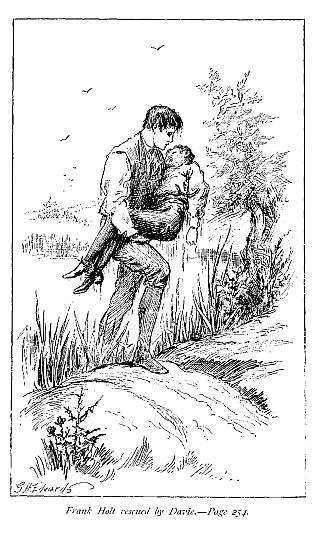
He caught sight of the other lads as they reached the opposite shore with the raft, and saw them running at full speed in the direction of the Grove. But he felt that he must not wait for the help they would be sure to send, and gently lifting the boy in his arms, he went with him with all speed through the wood and up the hill to the house.
A single sentence told the story, and in a minute little Frank was in a warm bath and then in a warm bed. He soon showed such signs of life as encouraged them to hope that there was not much the matter with him; and then Davie thought of the consternation which the other lads would cause when they carried the tale to the Grove.
“I doubt you’ll need to go as quick as you can, Davie. Think of the poor father and mother if they should hear.”
“Ay, lad, make what haste you can,” said his grandfather, and neither of them were the less urgent that the child was the son of their “enemy.”
So Davie went down the field again in his wet clothes, but that mattered the less as he had the river to swim, the raft being on the other side. He put on his dry coat over his wet garments, and no one seemed to notice as he entered the Grove. No rumour of the accident had as yet spread through the crowd, and Davie spoke only to Miss Elizabeth, as he met her on the way home with her father. Happily the father and mother knew nothing of the matter, till by and by the boy, wrapped in one of Mrs Fleming’s best blankets, was carried and set with his bundle of wet clothes in the hall. It was his uncle Clifton who took him home, and all that he could tell about the matter was that he had fallen into the Black Pool, and somebody had taken him out.
Dan Green kept his own counsel, running straight home and putting himself to bed. After his first sleep, however, he woke in such a fright that he could keep the tale no longer, but told it to his mother with many sobs and tears. His mother soothed and comforted him, believing that he had been startled out of a troubled dream. But the next day the story was told in Gershom at least a thousand times; and when Davie went into the post-office for his grandfather’s weekly paper, he heard, with mingled amazement and disgust, extravagant praises of his courage in saving the boy’s life.
“Courage? Nonsense! Risk? Stuff!” He never bathed in Black Pool that he did not dive in at one side and come out at the other. Why, his little brother could do that. There was no more danger for them than for a musk-rat, and Davie hurried away to escape more words about it, and to avoid meeting Mr Maxwell and his friends, who were coming down the street. In his haste he nearly stumbled over Jacob Holt, who held him fast, and that was worse than all the rest. For Jacob could not utter a word, but choked and mumbled and shook his hand a great many times, and when David fairly got away, he vowed that he should not be seen at the post-office again for a while, and he was not, but it was for a better reason than he gave to himself then.
For Davie went about all next day with a heavy weight upon him, and a dull aching at his bones, as new as it was painful. He refused his dinner, and grew sick at the sight of his supper; and tossed, and turned, and muttered all night upon his bed, longing for the day. But the slow-coming light made him wish for the darkness again, for it dazzled his heavy eyes, and put strange shapes on the most familiar objects, and set them all in motion in the oddest way. A queer sort of light it seemed to be, for though he closed his eyes he did not shut it out, and the changes on things and the odd movements seemed to be going on still within the lids.
So in a little he rose and dressed, and roused his brothers to bring the cows into the yard, meaning to help as usual with the milking. But the milking was done and the breakfast over, and worship, and no one had seen Davie. He was lying tossing and muttering on the hay in the big barn, and there at last, in the course of his morning’s work, his grandfather found him. He turned a dull, dazed look upon him as he raised himself up, but he did not speak.
“Are you no’ well, Davie? Why did you no’ come to your breakfast?”
“I’m coming,” said Davie, but he did not move.
His grandfather touched his burning hand and his heart sank.
“Come awa’ to your grandmother.”
“Yes, we’ll go to grannie,” said Davie.
Blinded by the sunlight, he staggered on, and his grandfather put his arm about him. Mrs Fleming met them at the door as they drew near.
“What can ail the laddie?” asked his grandfather, with terror in his eyes.
They made him sit down, and Katie brought some cold water. He drank some and put some on his head, and declared himself better.
“It is some trash that he has eaten at that weary picnic,” said grannie.
“No, grannie, I hadna a chance to eat.”
“And you have eaten little since. Well, never mind. You’ll go to your bed, and I’ll get your mother to make you some of her herb tea.”
“And I’ll be better the morn, grannie,” said Davie, with an uncertain smile.
He drank his mother’s bitter infusion, and tossed and turned and moaned and muttered, all day and all night, and for many days and nights, till weeks had passed away, and a time of sore trial it was to them all.
He was never very ill, they said. He was never many hours together that he did not know those who were about his bed, and young Dr Wainwright, who came every day to see him, never allowed that he was in great danger. But as day after day went on, and he was no better, their hearts grew sick with hope deferred. Grannie alone never gave way to fear. She grew weak and weary, and could only sit beside him, little able to help him; but he never opened his eyes but her cheerful smile greeted him, and her cheerful words encouraged him. His mother waited on him for a while, but she was not strong, and had no spring of hope within her. Katie worked all day and watched all night, and scorned the idea of weariness, but the Ythan water that trickled around her milk-pans in the dairy, carried daily some tears of hers down to the Black Pool.
“It is grandfather I’m thinking about,” said she one day when she burst out crying in Miss Betsey’s sight. “I am afraid I shall never be able to keep from thinking that God has been hard on grandfather, if anything should happen to Davie.”
“But God is not hard on your grandfather and there is nothing going to happen to Davie,” said Betsey, too honest to reprove the girl for the expression of thoughts which she had not been able to keep out of her own mind. It was the plunge into the Black Pool and the going about afterward in his wet clothes that had brought on this illness, and that it should be God’s will that David Fleming’s grandson, his hope and stay, should lose his health, perhaps his life, in saving the son of Jacob Holt, looked to Miss Betsey a terrible mystery. She did not say that God was hard on him, as poor Katie was afraid of doing; but when, now and then, there came a half hour when it seemed doubtful whether Davie would get through, the thought that God would not afflict His servant to the uttermost helped her to still hope for the lad. As far as words and deeds went, she showed herself always hopeful for him, and did more than even the doctor himself in helping him to pull through.
In country places like Gershom, where professional nurses were not often to be found, when severe sickness comes into a family necessitating constant attention by night as well as by day, the neighbours, far and near, might be relied upon for help, as far as it could be given by persons coming and going for a night or a day. The Flemings had had severe sickness among them more than once, but they had never called on their neighbours for help, and they could not bring themselves to do so now, even for night-watching. That she should trust Davie to any of the kind young fellows who night after night offered, their services, was to grannie impossible. She did not doubt their good-will, but she doubted their wisdom and their power to keep awake after their long day’s work. “And it is no’ our way,” said Mrs Fleming, and that ended the discussions, as it had ended them on former occasions.
“But they never can get through it alone this time,” said Miss Betsey, “and I don’t know but it is my duty to see about it, as much as anybody.”
It was just in the hot days in the beginning of August when Betsey was wont to give up butter-making and set to the making of cheese, the very worst time of the year for her to get away from home. But she saw no help for it.
“You must do the best you can, mother, you and Cynthy, and Ben will give what help you need with the lifting. If I should never make another cheese as long as I live, I can’t let Mrs Fleming wear herself out, and maybe lose her boy after all.”
So Miss Betsey went over one morning “to inquire,” she said, and some trifling help being needed for a minute, she took off her bonnet, and “concluded to stay a spell,” and that night Ben brought her bag over which she had packed in the morning, and she stayed as long as she was needed, to the help and comfort of them all.
As for the grandfather, it went hard with him these days. He was outwardly silent and grave as usual, giving no voice to the anxiety that devoured him. But at night when his wife slumbered, worn out with the day’s watching, or when she seemed to slumber, and in Pine-tree Hollow, which in the time of his former troubles had become to him a refuge and a sanctuary, his cry ascended to God in an agony of confession and entreaty. He, too, wondered that it should be God’s will that the child of his enemy should be saved, and his child’s life made the sacrifice; but he did not consciously rebel against that will. It was God’s doing; Davie had not even known whose child it was whom he tried to save. This was God’s doing from beginning to end.
Far be it from him to rebel against God, he said to his wife when, fearing for him and all that he might be thinking, she spoke to him about it. It was a terrible trouble, but it did not embitter him as former trouble had done, and his enemy had fewer of his thoughts at this time than might have been supposed.
But he had not forgiven him. He knew in his heart that he had not forgiven him. When Jacob came with his wife, grateful and sorry, and eager to do something to express it, he kept quiet in a corner of Davie’s room, into which they were not permitted to enter. Mrs Fleming said all that was needful on the occasion, and when Jacob broke down and could not speak of his boy who had been given back to them almost from the dead, she laid her hand gently upon his arm and said, “Let God’s goodness make a better man of you,” and even Mrs Jacob did not feel like resenting the words. But there was no one who could help them in their present trouble, she repeated, as they went sorrowfully away.
No one except Miss Betsey, grannie felt gratefully, as she turned into the house again—Miss Betsey, who seemed made of iron, and never owned to being tired. She slept one night in three, when Katie and her mother kept the watching, and at other times she took “catnaps” in the rocking-chair, or on Mrs Fleming’s bed, when grannie was at her brightest and could care for Davie in the early part of the day.
And poor Davie tossed and muttered through many days and nights, never so delirious as to have forgotten the summer’s work, but never quite clear in his mind, and always struggling with some unknown power that, against his will, kept him back from doing his part in it. Till one day he looked into his grandfather’s face with comprehending eyes, and said weakly, but clearly:
“It must be time for the cutting of the wheat, grandfather; I have been sick a good while, surely?”
“Ay, have you; a good while. But you are better now, the doctor says. But never heed about the cutting of the wheat. Mark Varney has done all that, and more. We have had a good harvest, Davie.”
“Have we, grandfather?” said Davie, looking with surprise and dismay at the tears on his grandfather’s face.
“God has been good to us, laddie,” said Mr Fleming, trying to speak calmly, and then he rose and went out.
“So we’ve had a good harvest, have we? And Mark Varney! I wonder where he turned up. Oh, well! it’s all right I daresay—and—I’m tired already.” And he turned his head on the pillow and fell asleep.
Yes, Mark Varney had taken Davie’s work into his own hand. He came over with Mr Maxwell as soon as he heard the lad was ill. He made no formal offer of help, but just set himself to do what was to be done. He had all his own way about it, for Mr Fleming was too anxious to take much heed of the work, since some one else had taken it in hand; and no one knew better how work should be done than Mark. He had all the help he needed, for the neighbours were glad to offer help, and give it, too, in this time of need. The harvest was got through and the grain housed as successfully as the hay had been before Davie, lank and stooping, crept out over the fields of Ythan.
It was Sunday afternoon again when Katie and he went slowly down the brae toward the cherry-trees. Their grandfather and grandmother looked after them with loving eyes.
“The Lord is ay kind,” said Mrs Fleming, and then she read the 103rd Psalm in the old Scottish version, which she “whiles” liked to do. She paused now and then because her voice trembled, and on some of the verses she lingered, reading them twice over, seeking from her husband audible assent to the comfort they gave:
“‘The Lord our God is merciful, And He is gracious, Long-suffering, and slow to wrath, In mercy plenteous.’
“Ay is He! as we ken well this day. And again:—
“‘Such pity as a father hath Unto his children dear, Like pity shows the Lord to such As worship Him in fear.’
“‘Such pity as a father hath.’ We ken well what that means, Dawvid; a father’s pity; such pity and love as we felt for our Davie, when he lay tossing in his bed, poor laddie. And—as we felt for—him that’s gone—”
She could say no more at the moment, even if it would have been wise to do so. But by and by she rose and came toward him, and standing half behind him, laying her soft, wrinkled old hand on his grey head, she said softly:
“If I could but hear you say that you forgive—Jacob Holt!”
Then there was a long silence in which she did not move.
“Because—I have been thinking that the Lord let our laddie do that—good turn for His—to put us in mind—” Again she paused. “And I would fain hear you say it, for His sake who has loved us, and forgiven so much to us.”
“I wish him no ill. I wouldna hurt a hair of his head. I leave him in God’s hands.”
He spoke huskily, with long pauses between the sentences. Whether he would have said more or not she could not tell. There was no time for more, for the bairns came in with their mother from the Sunday-school, and quiet was at an end for the moment.
It was a long time before the subject was touched upon between them again, and it was he who spoke first.
Chapter Twenty Three.
Poor Grannie.
The Langdens had stayed ten days in Gershom. Half the time Miss Langden had passed with Miss Holt, and they had both enjoyed the visit, though not quite in the same way. Her father needed much of Elizabeth’s care and attention at this time, and it would not have been possible for her to devote herself constantly to her visitor. But Miss Essie was not a difficult person to entertain—quite the contrary.
She took interest in many things. She had her journal to keep up, and many letters to write. And then Mr Clifton Holt was at home, and at her service. Mr Maxwell was a frequent visitor also; and when he came, Miss Holt felt at liberty to attend to her own affairs, knowing that they did not need her presence. Clifton was not so mindful of their old friendship, or not so well aware of their present relation, for he did not seem to think it was the thing to do to leave their visitors to entertain each other; and certainly he was never made to feel himself to be an intruder, though his sister often feared that he might be so.
Then Miss Langden had a great desire to see as much as possible of “this interesting country” as she politely called Canada; and as much of it as could be seen while driving about with Clifton in his sister’s low carriage, or in the larger carriage with Clifton and Mr Maxwell, or her father, she saw, and professed herself delighted with it. She admired the farm-houses and the farmers, and the farmers’ wives and daughters, and laid herself out to captivate them in a way that Clifton declared to be wonderful. To Elizabeth it seemed natural enough.
They saw a good deal of company in a quiet way. The Holts took pains to invite, at one time or another, the greater part of Mr Maxwell’s friends, in order that Mr Langden and his daughter might make their acquaintance, and both in different ways won golden opinions among them.
The good people of Gershom were naturally well-disposed toward the friends of their minister, and Mr Langden was a quiet, shrewd business man, without a particle of pretence, whose company they would have enjoyed under even less favourable circumstances. He took much interest in listening to the very things they liked best to tell about—the early settlement of that part of the country, its features and resources, agricultural, mineral, commercial; the history of railroads, manufactures, and business ventures generally. If there were anything worth knowing about any of these matters that Mr Langden did not know before his visit came to an end, it was not for want of questions asked, Clifton Holt said, laughing, to his daughter. Which was quite true—and he had asked some questions and received some answers which neither Clifton nor Jacob had heard, and knew more about some things in Gershom than Clifton himself knew at that time. Some hints that there had been thoughts of business as well as pleasure in his mind in visiting Gershom had transpired, and it would have been agreeable to hear more about it, but Mr Langden was better at asking questions than at answering them, and no one knew any more about his plans when he went than when he came. But people liked him, and liked to talk about him and his visit afterward.
And his daughter was very much admired also. That is to say, she was admired in her character of visitor to Miss Elizabeth—as a pretty and amiable and beautifully-dressed young lady from “the States.” But when the discussion went farther, and her possible future as a resident of Gershom was hinted at, all were not so sure about her. A minister’s wife! That was another affair. Would she fit into that spot? She did not look much like the ministers’ wives that the Gershom people knew most about.
“I suppose it comes as natural to her to have gloves, and boots, and bonnets to match every gown she puts on, as it does for the most of folk to wear one pair as long as they’ll last,” said Miss Smith from Fosbrooke—a much more primitive place than Gershom—“and she looks as if she set a value on such things, as even good folks will do till they’ve learned better.”
“And the minister’s salary isn’t equal to all that, and wouldn’t be, not if it was raised to eight hundred dollars, which isn’t likely yet a spell,” said Mrs Coleman, the new deacon’s wife.
“Not unless she has money of her own. And if she has—well, ministers’ folks are pretty much so, wherever they be, or whatever they’ve got; and such articles of luxury are not the thing for ministers’ wives—not in this wooden country.”
“I know one thing,” said Miss Hall, the dressmaker. “Her trunk was never packed to come here short of five hundred dollars, to say nothing of jewellery. I’ve handled considerable dry-goods in my time, and I know that much.”
“Ah, well. I guess any one that’s lived in ‘the States,’ and that talks as cool as a cucumber about going to travel in Europe, isn’t very likely to settle down in Gershom—not and be contented,” said Myrilla Green, who had lived in “the States” herself, and was supposed to know the difference.
“Ah! I guess there’s as good folks as her in Gershom;” and so the talk went on.
But it was the opinion of several of the ladies interested in the discussion, that clothes, and even money, did not amount to much in some cases. The young lady had the missionary spirit, as any one who had heard her talk must see, and she was not likely to be influenced by secondary motives.
Of course the discussion of the possibility implied by all this was inevitable in the circumstances, though no one in Gershom knew anything about the matter; and the parties most concerned could have given them little satisfactory information with regard to it. The first of the two years of probation, which Mr Langden had insisted upon, had not yet passed, and Mr Maxwell could not have renewed the question of an engagement, if he had wished to do so, or if Miss Essie had given him an opportunity, which she did not. Not a word was spoken between them that all Gershom might not have heard, though nothing could be more friendly and pleasant than their intercourse during these ten days.
But then Miss Essie was on friendly terms with every one. Nothing could be more charming than her manners, it was said. She was “not a bit stuck up,” the Gershom girls acknowledged. If she had any “citified airs” they were not of the kind that are especially displeasing to country people. She was friendly with every one, and before her visit came to an end, it came into Elizabeth’s mind that she was particularly pleasant in words and ways with her brother Clifton.
It had come into Clifton’s mind also, and Elizabeth longed to tell him just how matters stood between Miss Langden and Mr Maxwell. But she did not feel at liberty to do so, and she could only hope that Clifton’s devotion would be in this case, as it had been in others, only transitory, and that he would not suffer more than was reasonable for his folly. Of what passed between Mr Langden and Jacob Holt very little was known. They went together over the ground which Jacob had so long coveted, and Mr Langden saw the advantages which the locality offered for the purpose proposed. He would have considered the purchase of the land to be a good investment, but Jacob could not bring himself to urge the unpleasant subject of sale on Mr Fleming, now that Davie was so ill, and he knew that urging would avail nothing, but it was a great disappointment to him.
He said little about it to Mr Langden; but that gentleman knew more of the relations existing between him and Mr Fleming, and of other things besides, than Jacob fancied. They saw a good many people who were interested in the proposed enterprise, and got information which would help him to decide about future investments, he said, but he took no definite step with regard to the matter before he went away.
It had been understood that Mr Maxwell was to take his “vacation” at this time, and that he was to go with his friends through a part of their travels. But Davie Fleming was at the worst, and his mother and his grandparents were in great trouble, and the minister could not bring himself to leave them. Of course his friends were disappointed, but not unreasonably so, for they could understand his feeling, and it was agreed that if it were possible he should join them at some point in their route, and so they said good-bye lightly.
Clifton Holt went with them to the city of Montreal, where they stayed a few days, as all American tourists do. Then they sailed down the Saint Lawrence to Quebec and farther, and up the Saguenay, and he sailed with them, and doubtless added to their pleasure by the information he was able to give as to events and places in which all travellers are supposed to interest themselves.
Clifton enjoyed it, and would have enjoyed going farther with them. But on their return to Montreal, they met with a party of friends whom they found it expedient to join, and so Clifton returned to Gershom, with the intention of remaining at home for a time. His father was still feeble, and Clifton seemed inclined to take the advice which his sister had long ago given him, to seek to obtain some knowledge of the business which Jacob had hitherto been carrying on in his own name and his father’s.
Elizabeth received a little note or two from Miss Langden before she left Canada, in which much admiration was expressed for her friend’s “interesting country,” and much pleasure in her remembrance of the days spent in Gershom; and she had another after her return to her aunt’s house, where she was to pass some time. And then she did not hear from her again for a long time.
Davie got better, but not very rapidly. He remained gaunt and stooping, and had little strength, and Miss Betsey, who still considered herself responsible for his health, carried him away to the Hill; and then giving Ben a holiday after his busy summer, sent them both away to visit her cousin Abiah, who had a clearing and a saw-mill ten miles away. There were partridges there, and rumours of a bear having been seen, and there was fishing at any rate, and Davie was assured that ten days of such sport as could be got there in the woods ought to make a new man of him.
But Betsey had another reason for sending him away. On the day of her visit, Mrs Fleming, who had acknowledged herself to be weak and weary from anxiety and watching, knew herself to be ill; not very ill, however. She had often, in her younger days, kept about the house, and done all her work when she felt far worse than she did now, she said. But she could not “keep about” now, and that was the difference. Davie would be well away, for he would fret about his grandmother, and that would do neither of them any good.
Davie’s visit to the woods did not make a new man of him; but it did him good, and he needed all his strength and courage when he came home again, for grannie, who had been “not just very well” when he went away, was no better when he returned.
“And they never told me, grannie,” said he, indignantly.
“There was nothing to tell, my laddie, and you are better for going. And now you must help Katie to cheer your grandfather, and keep your brothers at their work.”
And Davie saw that his grandfather needed to be cheered. He seemed to have grown a very old man during the last few months, he thought. He had gone about the farm, and kept the boys at their work, and had helped sometimes, Katie said, while Davie was away. But now he gave all that up to him. Mark Varney came now and then when there was anything extra to be done; and though Davie was not so strong as before his illness, they were as well on with their fall work as the neighbours generally.
But except with a word of advice, or an answer to questions, which Davie was pertinacious in asking, as to what was to be done, and what left undone, the old man took little part in what had filled his life before. He went about the house and barns, with his head bowed, and his hands clasped behind him, making Katie wild with the wistful, helpless longing of his face.
“It is no good for grannie to see you so downcast, grandfather. Courage is what is needed more than anything in a time of sickness, Betsey says. And, grandfather, grannie is no’ so very ill.”
“Is she no’, think you, Katie? She says it, but oh, my heart fails me.”
“She says it, and I think she is right. And, grandfather, she often says, you ken that the Lord is ay kind.”
“Ay, lass! but His kindest touch cuts sore whiles. And if He were to deal with me after my sins—”
“But, grandfather; He never does, and He hurts to heal—as I have heard you say yourself.”
“Ay. I have said it with my lips, but I doubt I was carrying a sore and angry heart whiles, when I was putting the folk in mind. And, oh, Katie, lassie, He is far awa’. He has hidden His face from me.”
“But only for a moment, grandfather; don’t you mind, ‘For a small moment have I forsaken thee, but with great mercies will I visit thee’? And grannie is no’ so very ill.”
She drew him gently from the room where grannie was slumbering, so that she need not be disturbed. It seemed to her the strangest thing that her grandfather should speak to her in this way, and that she should have courage to answer him. He sat down on a seat by the door, and leaned his chin on the hand that rested on his staff, and looked away over Ythan fields to the hills beyond. But whether he saw them or not was doubtful, for his eyes were dazed and heavy with trouble, and Katie could not bear to see him so.
“She is not so very ill,” she repeated. “She is sometimes better and sometimes worse, but she has no thought that she is going to die. She will be better soon.”
“She is a good ten years younger than I am. I should go first by rights. But she has had much to weary her, and she would doubtless be glad to rest.”
“No, grandfather, she would not. She is glad at the thought that she will be spared a little while for—all our sakes.”
“Who is that coming down the road? It is the minister, I think, and Betsey Holt.”
The old man rose hastily.
“I’ll awa’ up the brae,” said he. “No, it is no disrespect to the minister, but I canna hear his words to-day.”
And up the hill he went to the pasture-bars, and through the pasture “to Pine-tree Hollow,” Katie thought, as her eyes followed him anxiously.
“But He may show him His face, up yonder,” said Katie, with tears; “and I am sure, and so is Miss Betsey, that she is no’ so very ill.”
Grannie had never thought herself very ill. Even when all her days were spent in bed, she only called herself weary at first. There had been a very warm week about that time, and she had suffered from the heat, and had kept herself quiet. But she did not think herself ill, and certainly Katie did not think it. For though she was not strong, she did not suffer much, except that she was feverish and restless now and then, and she was always sweet and bright and easily pleased, and not at all like the sick people that Katie had seen. It was a pleasure to be with her, to wait on her, and to listen to her. For there were times when she had much to say, soothing her own restlessness with happy talk of many things which Katie liked to hear.
She told her about her father—so grave and kind and trustworthy—and about Hughie, who was so good and clever, but who had “gone wrong,” and been lost to them, leaving their life so dreary. And once or twice she spoke of one over whom she had kept the silence of many a year. It was Katie’s own name she heard—but it was of another “bonnie Katie” that her grandmother murmured so fondly, one who had been beguiled—who had sinned and suffered, and died long ago. But she always spoke brokenly of her when she was restless and feverish, and Katie, though she would have liked to hear more, strove always to turn her thoughts away.
But almost always her talk was happy and bright. In those days Katie heard more of her grandmother’s youthful days than she had ever heard before. She spoke about her home, and her brothers and sisters, and about “the gowany braes” and “the silver Ythan,” and the songs they used to sing, before it had ever come into her mind that there was trouble and care before her. She even tried to sing again, in her faint sweet voice, some of the dear old songs, laughing softly at her own foolishness.
But she never once spoke as though she thought she might not recover; even when she gave Katie words of counsel or caution, it was just in the way she used to do when they were going about their work together, and the girl was sure that she would soon be well again, and that that was Miss Betsey’s thought too.
But seeing her as she stood looking down on her grandmother’s sleeping face that morning, Katie was not so sure of what Miss Betsey’s thoughts might be. Still, her grandmother’s eyes opened and she smiled her old cheerful smile, as she said she was glad to see them.
“You must tell grandfather that the minister is come, Katie,” said she.
Mr Maxwell had seen Mr Fleming stepping up the brae, and he knew well that no words of his could comfort him. He could only hope as Katie did, that his Lord and Master might show him His face in the solitude he sought.
He had few words to say to Mrs Fleming, for she seemed inclined to slumber through the afternoon.
“I wish you could stay with us to-night, Miss Betsey,” said Katie’s mother. “I am afraid grandmother is not so well.”
“There is not much difference either way, I think. I would be glad to stay, but Uncle Gershom has had another bad turn, and I promised cousin Lizzie I would stay with her to-night. But I will come over to-morrow morning before I go home if I can get away.”
“Do you think her very ill?” asked Mr Maxwell as they walked down the hill together.
“I have not thought her very ill. I don’t know that she is worse to-day, but she is certainly no better. I suppose it depends on whether her strength holds out. She is an old woman now.”
These were anxious days to Katie; but her grandfather had more of her thoughts than her grandmother.
“And it is a wonder to me that he should be so broken down, a good man like him, even by such sore trouble. Even the loss of grannie would be but for a few days, and he has the Lord Himself in the midst of it all.”
But this was a mistake on Katie’s part. For all this time, strangely and sadly enough, he was ringing the changes on his old complaint: “Thou art a God that hidest Thyself.” He had not the Lord Himself in those days. Even when he pleaded, as he did day and night, for Davie’s life, it was the cry of despair that came out of his sore trouble, rather than the “prayer of faith” to which the promise of healing to the sick is given.
And as he bowed himself down beneath the pines, it was the same. He was in a maze of perplexity and fear. Had he been sinning against God all this time? Had he been hating not the sin, but the sinner? Had it been beneath God’s hand that he had been refusing to bow? And now was God leaving him to hardness of heart?
For he was utterly broken and spent, and in the weakness of mind which exhaustion of body caused, he had almost lost the power to discriminate or reason. He could not command his thoughts. The wind moaned in the pines above him, and the sunshine came and went, flickering and fading, and brightening again, and with the monotonous sound and the ever-changing light, there came voices and visions, and he seemed to listen as in a dream:
“It was God’s will, grandfather. God kens, and it was His will. I would fain hear you say once that you have forgiven your enemy.”
His enemy! Was Jacob Holt his enemy? And if he were, could even an enemy bring evil on him or his without permission? What had it all come to—the long pain, the persistent shrinking from this man, whom God alone might judge? Had he been hating him all this time—bringing leanness to his own soul, and darkness, and all the evil that hatred must ever bring? And where was it all to end? And what must he do, now that his sin had found him out?
For his time was short, and the end near. And then his thoughts wandered away to the old squire lying on his death-bed—the man who had declared himself willing to stand on the same platform with old David Fleming, when his time should come to be judged. And that time was close at hand now, and his own time could not be far away, and then he must stand face to face with Him whose last words were, “Father, forgive them!”—face to face with Him who had said, “Love your enemies,” “Forgive, and it shall be forgiven unto you.”
Over and over the same round his thoughts went, till, worn out with anxiety and watching, and lulled unconsciously by the soft “sough” of the wind in the pines, he fell asleep. Pine-tree Hollow was all in shadow when he awoke, but when he had gone a few steps, he saw the sunlight lying on the high hills to the east. His first thoughts were of what might have been happening at home while he slept, and he quickened his steps.
And as he walked he was conscious that his sleep had done him good. He was stronger and calmer, and could command his thoughts again, and he hurried eagerly on. The sight of Katie passing quietly out and in to the dairy quieted him still more. It must be well with grannie or Katie would not be there.
“Well, my lassie?”
“Yes. Grannie has been sleeping, but she is awake now, and has been asking for you. Mother is with her now.”
He went into the house slowly and quietly. Katie’s mother was sitting by the bed, with her sad eyes fastened on the face of the grandmother, who seemed to have fallen into slumber again.
“She has been wandering a little, I think,” said Mrs James.
“Wandering?” repeated Mr Fleming drearily.
Grannie opened her eyes, and looked first at one and then at the other.
“No, my dear, it wasna that I was wandering. I was dreaming, I think—a strange grand dream—of a far country. And—Dawvid—I saw our Katie there, and her little bairn—and I saw our Hughie, and James, and many another. But I saw them first and best; and we have no cause to fear.”
Even as she spoke her eyes closed again. The old man sat down with a sinking heart. Did not these sound like “last words?” Had she not got a first glimpse of the “far country” to which she was hastening? How vain to struggle against God, he thought. He never uttered a word. His daughter-in-law looked at him with compassionate eyes that he could hardly bear. Katie came in with a glass of milk in her hand.
“She is not asleep again, is she? Well, I must waken her, because she must take something. The sleeping is good for her, but she must take something to keep up her strength. Grannie dear, take this,” and she raised her gently.
She opened her eyes and smiled.
“Oh, ay! I’ll take it. And I could take a bit of bread, I think.”
“Well, mother will bring a bit.” But Katie was greatly surprised.
“I think I’m better, if I were only stronger a bit,” said grannie.
Over Katie’s bright face Mr Fleming saw the grave face of her mother, and though he knew that it was her way rather to fear than to hope, his heart sank.
“I’ll soon be better, I think. Are you there, Dawvid? You ken I couldna go and stand before the Lord and tell Him that you hadna forgiven your enemy.”
“She is wandering,” whispered Katie’s mother.
“No; I’m no wandering, but whiles I feel—as if I were slipping awa’—and you’ll give me your hand, Dawvid, and that will keep me back. Ay. That will do,” and her eyes closed again.
Katie followed her mother from the room.
“It is not far away now.”
“Mother, don’t say it. She is not going to die. Oh, mother! mother! Surely God is not going to take her from us yet. No. I’m not going to cry; I havena time,” said Katie. “And, mother, she says it herself, and I don’t think she is going to die. Oh, if Miss Betsey could have been here to-night!”
Katie resolutely put away her tears and her fears, and prepared for a night of watching. First, she made her mother lie down with a warm wrapper on her, so that she might be ready to come at any moment. Then she sent the bairns to their beds, and wished that Davie would come home. Then she remembered, with a pang of remorse, that her grandfather had not had his supper, and she got his accustomed bowl of bread and milk, and carried it into the room. Neither of them had moved, and stooping and listening, it seemed to Katie that her grandmother was sleeping naturally and sweetly. Her grandfather shook his head at the sight of the food.
“You must take it, grandfather,” said Katie in a whisper.
She put the bowl on a chair, and knelt down beside him.
“You need not move,” she said softly, and she fed him as he had often fed her when she was a little child.
“My good Katie!” said he, but it would not have been well for him to try to say more.
Davie came in before the supper was over. Katie nodded cheerfully, but did not speak till they were both in the kitchen.
“Well?” said Davie.
“She is no worse. I think she seems better. She has eaten a wee bit of bread, but mother says you cannot always tell by that. We must just wait.”
It was a long and anxious night to these two. It was well that grannie should sleep, but in her utter weakness it was also necessary that she should have nourishment often. She had grown sick of the sight of everything in the way of food, and she had had her choice of whatever the best housewives of Gershom could supply. For days she had only taken a little milk, and to-night she seemed to take it with relish. In a little she woke and spoke:
“Are you no’ coming to your bed, Dawvid? It is time surely.”
Her clasp of his hand loosened as Katie offered the milk to her lips. The old man rose, but he had been sitting in an uneasy posture, and tottered as he moved to the door.
“Grandfather,” said Davie, “lie down on the other side. It will be better for you and grannie too. Come grandfather. Katie, lay the pillow straight.”
“But I might disturb her—and I might fall asleep.”
But he yielded.
“She would like it, grandfather, and we can waken you if you fall asleep.”
So the two old people slumbered together, and Katie had to steal away to weep a few tears in the dark while her brother watched beside them, and they did not dare to ask themselves whether they hoped or feared in the stillness that fell on them.
“They say this is the old squire’s last night,” whispered Davie at last. “I saw Ben coming out as I passed.”
“Maybe no,” said Katie, who was determined to be hopeful to-night. “They have said that before. Maybe he’ll win through this time too.”
“Ay. But he is an old man, and it must come soon.”
Now and then they exchanged a word or two, and Katie put the cup to her grandmother’s lips, and the night wore on. Whether their grandfather slept or not they could not tell, but he made no movement that could disturb her, and he still held her hand, to keep her from “slipping away,” as she had said.
Once the mother came in and looked, but she only said she was sleeping quietly, and they made her lie down again. Toward morning Katie brought a quilt and a pillow, and Davie lay down on the floor beside the bed, and Katie prayed and waited for the dawn.
Chapter Twenty Four.
Poor Old Squire.
Betsey Holt had not found the old squire so low as she expected to find him when she went to his house after leaving Mr Fleming’s, and seeing him comfortable, and apparently no weaker than she had seen him before, she hesitated as to what she ought to do.
“There will be nights when you will need me more cousin,” said she, “and I think—”
But Elizabeth’s face made her pause.
“Dear cousin, stay with me to-night. No, I do not think he is going to die to-night, though Dr Wainwright thought it could not be long. But do stay with me, cousin. I seem to be alone and good for nothing.”
“You are tired, and no wonder. You look sick. Yes, I’ll stay. I think, on the whole, I’d better.”
Betsey did not say that it was Mrs Fleming she had been thinking of when she hesitated. She took off her bonnet and prepared to stay.
“I made up my mind to be here to-night as soon as I heard that your father wasn’t well. I thought once I’d go home and come back after sundown, but it doesn’t matter about going. They’ll know why I stay, and I guess likely Ben will come along over after milking is done.”
“Is there no one we could get to help your mother and Cynthia for a few days? I would send anywhere for help to them if you could only stay with me till—”
“Oh, I guess they’ll get along, and Hepsey Bean is near by. If they get into a fix they can send for her. I’ll stay anyway. Isn’t your brother Clifton round?”
“No, he went to the city yesterday; he left before we thought my father worse. I hope he will be home to-morrow.”
“Well, I hope he will, and I guess he’d better stay a spell next time he comes.”
Elizabeth had been up for the night, and after a visit to her father, who was still sleeping quietly, Betsey persuaded her to go and lie down, promising to call her at the turn of the night, or sooner if there should be any change. Elizabeth was glad to go, for she was very tired.
“I feel so safe in leaving him with you, cousin,” said Elizabeth, the tears starting in her eyes. “You must not think that I am always so—downhearted, but I feel as if I might give way—as if I might lay a little of my burden on you, and—”
“And so you may, with no if about it, only there is a better place to lay it, as you don’t need me to tell you by this time. She thinks she knows what trouble is, and perhaps she does,” continued Betsey as she followed Elizabeth with her thoughts. “For trouble is just as folks take it, and she has been pretty tenderly dealt with hitherto. But I guess she is not one that trouble can do any real harm to. The Lord sees it all, and she is in His hand, and I needn’t worry about her. She’ll be kept safe through it all.”
But she gave a good many thoughts to Elizabeth’s possible troubles as she sat there alone. Before the “turn of the night” Elizabeth came down rested and refreshed, she said. Jacob came in and sat a while, but scarcely a word was spoken. He offered to stay, but it was not necessary, his sister said.
“No! When is Clifton coming back?” asked he.
“To-morrow, I hope,” said Elizabeth.
“He must not go away again.”
“No. Not for a time.”
Elizabeth’s rest and refreshment “did not seem to amount to much,” Betsey thought as she watched her sitting in the firelight after Jacob went away. Not many people had ever seen on Elizabeth’s face the look it wore now. She seemed to have forgotten that there was any one to see. Except that she raised her head now and then to listen for sounds in her father’s room, she sat perfectly motionless, “limp and hopeless,” Betsey said to herself, and after a little she said aloud:
“Cousin Lizzie, you are not going to be ‘swallowed up of overmuch sorrow,’ are you? That would be rebellion, and there is no deeper deep of misery to a Christian than that.”