MY MOCKING-BIRD.
Reading edition
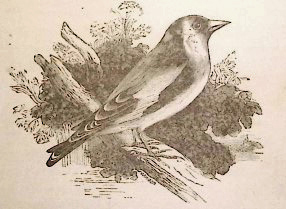
IF you are an artist, and want to color this little fellow, be sure you use no yellows or glowing reds about him. His back must be made a sort of ashy brown, and his wings and tail nearly black, and his legs and bill quite black. A bit of white, as you see, may be put on his breast, but even this must not be too white; it ought to have a brownish tinge. There is really not a bit of brightness for trimming; no yellow at the tips of his wings, no ruffle of red about his throat. He isn't pretty, and I may as well own it at once. The lovely goldfinch in the cage opposite him, with her brilliant yellow wings that contrast so beautifully with the green vines among which she loves to hop, is often tossing her head at him in a saucy way, as though she knew she was a beauty; and I'm sure she does, for the first place she visits when I let her out of her cage, is the looking-glass.
Ah, but let me be just to my poor little goldfinch, if she is a trifle vain. There was a time that she really did not know it was her own pretty self she saw in the glass, and she actually took a seed with her, and offered it to the bird in the glass.
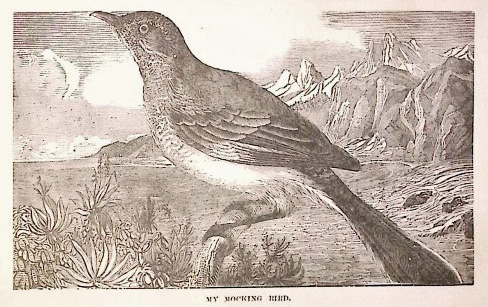
MY MOCKING-BIRD.
But you should see her when Mornie—that's the homely bird's name—makes up his mind to sing. She retires to the most distant corner of her cage, curls herself up in a still little heap, puts her head on one side, and listens without the flutter of a feather. Either I imagine it or there really does come a sad look in her eyes, as though she thought she would give all the yellow in her lovely tail if she could sing like that.
Oh, how he sings! Sometimes like a canary, sometimes like a wood-robin in a spring morning, sometimes like the true mate of the pretty little goldfinch herself. In fact, like any bird that he has ever heard; springing the notes from one style of music to another much more quickly than a young Miss at the piano can change her music, and begin again.
A mischievous bird is this Mornie of mine. In addition to his musical powers, he can cackle exactly like a hen; and when Mollie, my little errand girl, first came to live with me, Mornie kept her half the time running to see which hen had laid an egg, so sure was she that she would find a fresh one.
Then, no sooner does Tom go to sawing wood in the back-yard, than Mornie begins her "Screak! Screak! Screak!" so exactly like the sound which the saw makes, that you would be almost certain to think Tom had moved his work to the side piazza where Mornie hangs. Very often he wakens in the middle of the night and gives us a song. But there is this queer thing about him then. All his fun seems to be gone. Whether he is lonely and homesick or not, I do not know, but the plaintive little note that belongs to him is all he sings in the night.
That is not the time, he thinks, for mocking anybody.
I have some trouble in preparing his food for him; he is really very dainty, unlike my goldfinch. He is very fond of raw meat chopped fine; and indeed must have it, or he would lose his health. Mush and milk is also a favorite dish of his; at least, that is what we call it, though the meal is not cooked like our mush, but stirred raw into the milk.
Then, too, he must have his fresh fruit in its season. Strawberries are his special favorites, but he will kindly condescend to eat any fruit that he can get after strawberries are gone. Still, you need not suppose that his tastes are all so dainty. He is by no means above eating a good-sized grasshopper or beetle, and a fat worm now and then he considers a special dainty.
Now I have taken a good deal of pains to inquire into the character and habits of mocking-birds, and I find that mine is not an unusual one, but is quite like his race; so that if you think of getting such a bird for a pet, you may safely feed him as I do mine, and expect him to act very much as Mornie does.
He and all his class are very brave when they have any young birds to defend; they have been known to kill snakes by darting at their eyes and biting, and by striking them sharp blows on the head with their beaks. It is said that even cats discover that it is wise to keep away from the pretty little nest where young mocking-birds are being reared; if they don't, the fierce father bird will dart at them and pick their eyes out.
My cat Tabby has learned by some means that she is not to have any thing to do with Mornie; I never taught her, so I think he has explained it to her. By the way, another accomplishment he has is to bark like a dog. Tabby, who is mortally afraid of dogs, went around half the time with her back arched like a bow, when Mornie first came into the house; but she has learned now, that the bark which she dreads comes from the bird in the cage; and if she is awakened suddenly from a nap, and begins to arch her back in fear, she remembers in a trice, and goes off under the barn to feel ashamed.
Isn't it a wonder that Mornie never tries to talk? Perhaps he does try, but he never succeeds. I often feel sorry for him, to think that when he knows so much, he cannot learn to speak one little word. However, he gives me a great deal of pleasure with his music; as much as goldfinch does with her pretty ways and her gay dress; both of them are cheerful and happy all day long, and do just as well as they know how. Without any judgment, or reason, or soul, each contrives to do well and joyfully just what God wants him to do.