JONESIE AND THE ALL-STARS
Reading edition
I
Joe Tyson, playing third on the Randall’s School first team, pegged the ball across in the general direction of first base. Steve Cook stabbed the air with a gloved hand and the ball continued blithely on its way, disappearing behind the grandstand. Four blue-stockinged youths raced home, the fourth registering the tenth tally for Popham Academy.
Daniel Webster Jones, Jr., seated cross-legged in front of the bench on the home side of the field, score book on knees, credited the enemy with four runs and added a black dot under the “E” column and opposite the name of Tyson.
“Of course,” murmured Jonesie reflectively, “in order to throw to first you’ve got to know more than the ball.”
Of the three occupants of the bench, weary and disgruntled with waiting, none replied to the sagacious observation. Jonesie, however, hadn’t expected any reply. He didn’t care. When there was no one to talk to, Jonesie talked to himself. That was much better than keeping still. Jonesie had a horror of being bored, and nothing bored him quicker than inactivity, either of body or tongue. That was the reason why, on a perfectly glorious afternoon in early June, he was to be found seated Turk-fashion here keeping score for the Team.
Art Simpson, the manager, whose duty it was to preside over the official score book, was in the infirmary with a delightful case of double mumps, and Billy Carpenter, baseball captain, had, so to speak, drafted Jonesie from a comfortable seat in the stand, thrust a black-covered book and a leaky fountain pen upon him and bade him keep the score. Jonesie knew how to do that after a fashion, but his fashion was not Art Simpson’s, and he soon found the intricacies too many for him. After Jimmy Buell had been caught flat-footed off second and chased down between that station and third by exactly six-ninths of the opposing team, Jonesie gave it up in despair. The only redeeming feature of his task was the fact that it allowed him to square accounts to some extent with one or two fellows he had grudges against. Thus Carpenter himself, for imposing such a task on Jonesie, had been credited with two errors when, as a matter of fact, Billy had so far played his position faultlessly. Jimmy Buell, too, had erred, according to the book, not once, but three times, and even Steve Cook, who was a particular friend of Jonesie’s, had a neat period set opposite his name in the error column. Jonesie had chuckled when he set that down. It was always fun getting a rise out of Steve!
Daniel Webster Jones, Jr., was a cherub-faced youth of fifteen with coppery brown hair brushed sleekly back, gray-blue eyes that were pools of truth and innocence, a somewhat button-like nose that attested to good nature, and a general appearance of physical and mental well-being. Folks generally, and nice elderly ladies in particular, fell in love with Jonesie at first sight. They simply couldn’t help it. Such candor and truthfulness and innocence shone from his countenance it did one good merely to look upon it. For the rest, he was comfortably rounded as to figure, a fact which perhaps increased his likeness to a cherub, dressed very carefully—Jonesie was always a little in advance of the fashions—and carried himself with an air.
After much searching the ball was back in the pitcher’s hands. (For no especial reason Jonesie credited Gordon, who had thrown it in, with an assist!) Carey Bingham, football captain, who was umpiring, was evidently getting tired of standing out there in the sun, for he called three strikes on the Popham batsman in succession—Proudfoot, the Randall’s slab artist, had never been known to pitch three good ones in succession before!—and then ruled the next man out at first in spite of the fact that Steve Cook had quite failed to tag him. But Popham had a comfortable lead of eight runs, it was getting late and Carey wanted to get on the river before suppertime. Popham objected only half-heartedly to the decision, being doubtless quite willing to hurry the battle through.
The bench filled as the perspiring players trotted in from the field. Billy Carpenter, squeezing in behind Jonesie, glanced at the score.
“Ten to two, isn’t it?” he asked wearily.
“Yes,” replied Jonesie. “Gordon up! Proudfoot on deck! Billings in the hold!”
“What’s the inning, Jonesie?” inquired Joe Tyson from further along the bench.
“Last of the ninth,” answered Jonesie promptly.
“Get out! It’s the eighth!” declared Billy Carpenter. “Let’s see. Of course it’s the eighth, you idiot!”
“Is it?” murmured the non-official scorer. “All right. I just said ninth so as you fellows would get off easier.”
“Is that so?” said Billy unamiably. “Never you mind about us. Just you—— Here, what the dickens are those things over there in my column?”
“Those?” asked Jonesie innocently. “Oh, those are errors.”
“Errors! When did I make an error, you lunkhead?”
“I forget; third, I guess; maybe it was the fourth.”
“You’re dippy! I haven’t made an error to-day! You rub those out, Jonesie, or I’ll kick you back to school!”
“My mistake,” replied Jonesie untroubledly, canceling the dots. “Say, Billy, why don’t you have a good team?”
“The team’s all right,” answered the captain, mollified as the untruthful periods disappeared. “We’ve had perfectly rotten luck to-day.”
“Oh, sure!” Jonesie’s tone was maddeningly sarcastic. “Blame it on the luck, Billy. Say, honest, Billy——”
“Don’t you be so fresh with your ‘Billys,’ kid,” advised the other, prodding Jonesie’s spine with the toe of his shoe. Billy was a senior, and at Randall’s seniors exacted proper respect from lower-class fellows.
“My mistake, Mr. Carpenter,” corrected Jonesie sweetly. “I was going to say—Proudfoot up! Billings on deck!—going to say that I could make up a team of lower-class fellows that would beat you all around the block, Bil—er—Carpenter.”
“You could do wonders,” responded the captain derisively. “Suppose, though, you credit that Popham first base with a put-out if you’re not too busy talking nonsense.”
“No trouble at all,” murmured Jonesie, placing a period in the wrong space and so adding to the glory of the Popham left-fielder. “The trouble with this bunch of yours is that they can’t bat, can’t field and can’t handle the ball. Aside from that, though, Billy, they’re certainly a fine lot. Who threw that to first?”
“Why don’t you watch the game and find out?” snarled Billy.
“Call this a game? It—it’s a farce, that’s what it is, a blooming farce!” Jonesie gave the assist to the shortstop on a chance and chattered on. “You see, Bil—that is, Mr. Carpenter—in order to play baseball you’ve got to know more than the ball.”
“Oh, cut it out,” growled Billy. “A fat lot you know about it!”
“If you mean baseball, I know a great deal. I don’t pretend that I invented the game, Billy, but I certainly organized the Nile Valley League and——”
“Say, you bum scorer, who’s up?”
“You are, you talented right-fielder!”
“What on earth is the Nile Valley League?” inquired Billy, who had never heard of that mythical aggregation. Jonesie glanced around with a look of pitying surprise.
“And you’re captain of a ball team!” he exclaimed. He shook his head gently. “Honest, Billy, I look at you in wonder! You’re on deck, by the way.”
Billy got up and selected a bat with much care. Jonesie watched him pessimistically.
“Say, Cap, in order to use that you’ve got to know more than the bat,” he volunteered helpfully. Billy scowled.
Randall’s failed to add to her score and Popham came in. With a man on first the second batsman lined a hot one at Billy, and Billy watched it travel into center field while he wrung a bunch of aching fingers. Jonesie smiled and restored one of the canceled errors opposite the captain’s name.
“Prophetic,” he murmured. “That’s what it was, prophetic!”
Popham added another run to her tally in that first of the ninth, but Jonesie didn’t trouble to score it. He was too busy drawing a picture of Steve Cook at first on the margin of the page. It wasn’t a good likeness, but it showed a lot of action, and it pleased Jonesie. So enthralled was he with his artistic endeavors that the teams had changed sides before he realized it, and he hurriedly set down several assists, put-outs and errors wherever they looked best.
Billy was disgruntled when he got back to the bench, and he was rather rude in the way in which he thrust Jonesie aside to get his seat.
“Ah,” observed Jonesie, looking about with a gratified air, “the heroes are back again! In order to catch a ball, Billy, you’ve got to know——” But a muscular hand closed about Jonesie’s throat from behind and the remark was not concluded. Instead, “Buell at bat!” he announced huskily. “Gordon on deck! Proudfoot in the hold!”
Jonesie remained silent while Jimmy Buell fell victim to the puzzling slants of the Popham pitcher. But he felt communicative to-day, and after Buell had disconsolately reseated himself Jonesie went on brightly.
“Honest, Carpenter,” he said, “I wasn’t joshing about that.”
“About what?” growled Billy, working the fingers of his right hand experimentally to see if they were broken or merely dislocated.
“About making up a team from the lower-class fellows and showing your bunch a few of the rudiments of baseball. You see, Billy, it isn’t so much that your fellows can’t play; I think they could if they knew how; but no one has ever shown them, do you see? Now, I think—what? yes, you’re on deck, Billings!—I think that if you could only play a game or two with a team that knew a little about it, do you see——?”
“I’ll wring your neck for you in a minute,” returned Billy angrily. Jonesie silently considered the chances of Billy’s carrying out the threat. It was Billy himself who made the next remark.
“I’d like to see the bunch of players you’d get together, Jonesie,” he said. “They’d be wonders.” He laughed most disagreeably. “Bring ’em along some day and give us some sport, Jonesie. We need practice——”
“You sure do! You need more than that, though, old top; you need to learn what to do on a ball field. For instance, now, if someone explained to Proudfoot that a bat is made to swat the ball with and not to hang over his right shoulder, he might do something besides posing like one of those Roman gladiators at the circus. Yes, sir, Billy, you fellows certainly ought to have a little instruction.”
Captain Carpenter opened his mouth to reply hastily and angrily. But he closed it again. After all, it was only Jonesie talking! Jonesie indicated on the score book that Proudfoot had been hit by a pitched ball and had taken his base and then credited the Popham pitcher with a put-out on the ground that anyone who inflicted pain on Proudfoot was a public benefactor and deserving of reward! Then, after another moment, Jonesie spoke again.
“What day will it be convenient to play us, Billy?” he asked.
“Play who?” inquired Billy, wondering whether it was worth while to relieve Steve Cook in the coacher’s box and try to get Proudfoot around for a run.
“This team I’m going to get up,” answered Jonesie. “Any day next week will suit us.”
Billy laughed derisively. “Cut out the comedy, Jonesie,” he begged.
“Well, I don’t much blame you,” was the reply. “It would look bad to be beaten by a lot of lower-class fellows. I guess you’re right to back down, Billy.”
“Oh, dry up, Jonesie! And credit Billings with a two-bagger, why don’t you? Say, what sort of a score is that you’re keeping, anyway?”
“This? This is the finest little score you ever saw. What did you say Billings made?”
“I said—— Good work, Charlie! Guess I’d better go out and take a hand.” The bases were filled and Billy’s good nature was restored by the prospect of adding a few runs to their meager score.
“Then you mean you won’t play us?” insisted Jonesie as the older boy pushed by him.
“Play you? Yes, we’ll play you, Jonesie.” Billy laughed. “Bring on your team!”
“Next—next Thursday?” yelled Jonesie.
“Sure thing!”
Jonesie whistled softly to himself, not at all melodiously, and scrawled strange forms on the margins of the score sheet. He was thinking. When Jonesie thought it was safe to assume that sooner or later, and probably at no very distant time, something of interest would happen at Randall’s!
His preoccupation was rudely dispelled by the sound of a bat striking a ball and the frenzied shouts of the few onlookers who had survived eight wearisome innings. Jonesie looked up to see Steve Cook legging it to first, the Popham center-fielder racing back toward the distant fence and the bases emptying. Behind first base Billy Carpenter was waving and shouting. Behind third Jimmy Buell was doing likewise. Jonesie sighed. More work for the scorer!
And then a flat silence fell. Away out in center field a blue-stockinged youth had, after a desperate race, put up a hand and pulled down the ball. Steve had flied out! The game was over! Popham had won, 11 to 2! or was it 10 to 2?
Jonesie added an error to Billy’s column on general principles and closed the book with a vindictive slam.
II
“Sparrow,” asked Jonesie that evening, “did you ever play ball?”
It was Saturday and so, of course, Sparrow Bowles, who was a tall and lanky youth and, in spite of being Jonesie’s roommate, was much disliked by that young gentleman, had a perfect right to spend his time over one of Dumas’ most exciting romances. It might be added, however, that Sparrow would have done just what he was doing had it been Monday or Friday or any other day of the week. I refuse to even insinuate a virtue that Sparrow didn’t possess. Sparrow looked up regretfully from the book.
“No,” he muttered. “What for?”
“Then you’re the chap I want,” replied Jonesie cheerfully. “I’ll put you down——” He frowned intently for a moment at the list before him and poised a pencil above it—“I’ll put you down for third base.”
“You can put me down for—for batter, if you like,” jeered Sparrow, thus showing the depths of his ignorance of the National Game, “but you don’t get me to break my fingers!”
Jonesie didn’t even glance up. “That just about finishes it,” he murmured. “I think, though, I’ll put Pinky at first instead of Wigman. Pinky says if he doesn’t play there he won’t play at all.”
“Say, what are you talking about?” demanded Sparrow, curiosity getting the better of an inherent contempt for any of Jonesie’s plans.
“I’m talking,” answered Jonesie with dignity, folding his list and returning it to a pocket, “about the All-Stars Baseball Team. You see, I’m getting up a team to give Billy Carpenter’s bunch of amateurs a little practice. We play them Thursday.”
“Play the School Team!” Sparrow turned Dumas’ face down on his knees and stared blankly at his roommate. “Say, are you funny in your head? Why—why, they’d lick the stuffing out of any team you could make up!”
“That’s what Billy thinks,” chuckled Jonesie.
“Should think he might!”
“But this team I’m getting up, Sparrow, is something a little bit out of the ordinary. Listen to this.” Jonesie found his list again and read it for Sparrow’s benefit. “Bumstead, pitcher; Jones, catcher; Trainor, first base; Hoyt, second base; Bowles, third base; Wigman, shortstop; Clint Wrenn, right field; George Wrenn, center field; Nash, left field. What do you think of that, Sparrow?”
“I think you’re crazy,” replied Sparrow with enthusiasm. “I’ll bet there isn’t a fellow in the lot ever played baseball!”
“Yes, there is,” rejoined Jonesie with a grin. “Both those Wrenns have played a lot. I thought first I wouldn’t have them, but I couldn’t get anyone else. You see, I told Billy I’d make up the team from the lower classes. But I put the Wrenns in the outfield where they won’t be able to do much harm.”
“If they can play why don’t you let them?” asked Sparrow puzzledly.
“‘A little learning is a dangerous thing,’” quoted Jonesie. “I’ve tried to get fellows who never have played, because I can teach them. You can’t teach a fellow who thinks he knows the whole thing to start with. Do you see?”
“No, I don’t see,” said Sparrow bluntly. “I suppose it’s another of your silly jokes, but you don’t get me into it!”
“Joke!” exclaimed Jonesie indignantly. “There’s no joke about this. It’s a perfectly—er—sincere attempt to help the School Team. Didn’t you hear what happened to them to-day? Got licked by Popham! Ten to two—or eleven to two; there’s some doubt about the exact figures, I think! And what’s Popham? A little old one-horse school up back there in the woods! Don’t you see that the Team needs to go up against a bunch that can give them a few pointers on how the game ought to be played? Why, Billy was almost tearful when I agreed to get a nine up, and——”
“Aw, piffle!” interrupted Sparrow inelegantly. Sparrow was somewhat addicted to inelegant speech. I trust he did not learn it from Dumas. “Why, there isn’t a fellow on that list who knows what a ball looks like! Maybe the Wrenns do, but the rest——”
“You forget that we have three days to practice,” answered Jonesie patiently. “I shall teach them——”
Sparrow laughed immoderately. “You! Bet you never played baseball in your life!”
“Right-o; at least, not much. But I’ve watched a lot of it and I’ve got a pretty good notion of the way it ought to be played, old Sparrow Hawk.” Jonesie found his cap, settled it on the extreme back of his head and moved toward the door. “First practice is at three on Monday, Sparrow.”
“Me! You won’t get me into it,” declared Sparrow warmly. “I won’t have anything to do with your old team!”
Jonesie observed him in a pained way. “I’m afraid I’ll have to insist, Sparrow,” he said gently but firmly. “You wouldn’t like it generally known how Faculty found out about that little party at Steve Cook’s. You know, Sparrow, I’ve never told anyone about that—yet. But if you don’t play on the All-Stars I’ll be so dreadfully disappointed that I may get sort of loose-tongued. Disappointment affects me that way. Queer, isn’t it? Three o’clock, Sparrow. Ta-ta!”
Jonesie closed the door behind him, and Sparrow could hear him tramping down the corridor, whistling blithely; Sparrow frowned darkly at the book on his knees.
“And I never caught a ball in my life!” he groaned.
III
SCHOOL TEAM VS. ALL-STARS!
THERE WILL BE A GAME OF BASEBALL BETWEEN THE SCHOOL TEAM AND JONES’S ALL-STARS ON THE PLAYING FIELD AT THREE O’CLOCK THURSDAY. THIS IS THE ATHLETIC EVENT OF THE SEASON, AND IT IS HOPED THAT THE SCHOOL WILL SHOW ITS APPRECIATION OF THE EFFORTS OF THE ALL-STARS TO PROVIDE INSTRUCTION FOR THE SCHOOL TEAM BY TURNING OUT IN FORCE. SPECIAL TRAINS WILL BE RUN, AND A RATE OF ONE AND A HALF THE REGULAR FARE WILL BE CHARGED.
COME ONE, COME ALL!
This notice appeared on the bulletin board on Monday morning and provided a deal of amusement and much speculation at Randall’s. Jonesie was overwhelmed with requests for further particulars and offers of skilled assistance. In every case Jonesie referred the inquirer to the notice and informed him that the team was already made up. Billy Carpenter cornered him in the corridor between recitations and demanded to know what he meant by such tomfoolery. Jonesie was surprised and pained.
“Didn’t you agree to play my team on Thursday?” he demanded.
“I was only in fun, you little idiot! A fine lot of ball players you’ll get! You take that notice down, Jonesie. If you don’t, I will!”
“Seems to me it’s a funny thing to back down now,” replied Jonesie, more in sorrow than in anger, “after I’ve made the team up and we’re to begin practice this afternoon. Still, of course, if you are really afraid to play us——”
“Who’s on your team?” asked Billy.
Jonesie enumerated the members of the All-Stars and Billy grinned.
“Who’s going to pitch?” he asked.
“Tubby Bumstead.”
Billy’s grin broadened and he clapped Jonesie on the shoulder. “All right,” he said gaily, “we’ll play you four innings, Jonesie, if you last that long. It’ll be funny, anyhow, eh?”
“Funny!” said Jonesie indignantly, even a little bitterly. “You think it’s funny when I go to all this trouble to help you fellows out! I’ve a good mind not to do it! I’ve a good mind to just let you fellows go on the way you’re going and get licked by every little whippersnapper team that comes along, Billy! Funny! Huh! You won’t think it’s so funny when we lick you!”
“All right, Jonesie,” Billy laughed. “We’ll play you. Who do you want for an umpire?”
Jonesie shrugged his shoulders. “Any fellow you like. How about Gus Peasley?”
“Has he ever umpired a game?” asked Billy doubtfully.
“I’ll find out. If you don’t want Gus, though——”
“Sure, Gus will do. Let’s make it as funny as we can, eh?”
And Billy went off chuckling, leaving Jonesie apparently silent with indignation.
At noon he sought out Gus Peasley. Gus was an Upper Middler and so, in a way, might be considered impartial. “Ever umpire a ball game, Gus?” asked Jonesie.
Gus shook his head. “I was kicked by a mule once, though,” he said with apparent irrelevancy.
“You’re the fellow we want, then,” said Jonesie with deep conviction, “to umpire the game on Thursday.”
“Say, are you really going to play the School Team?” asked the other eagerly. “Why didn’t you give me a show, Jonesie?”
“I agreed to play only lower-classers, Gus. But Billy and I both want you to umpire.”
“Shucks, I never umpired a game in my life! I’d look fine, wouldn’t I?”
“I’ll lend you a book of rules, Gus, and you can study it a bit. The game’s on Thursday at three. Don’t forget.”
“But—— Here! Hold on, you silly idiot! I’m not going to umpire for you! Don’t be a chump, Jonesie!”
“Why not, when we both want you to? It isn’t anything to do and it’ll be heaps of fun, Gus.”
“Heaps of fun!” muttered Gus. “Someone’ll bump me on the head with a bat, I suppose! Well, all right. If you can stand it I can. Don’t forget those rules, though. Does that book tell when a foul ball is a strike and all that sort of thing?”
“Surest thing you know! You’ll have it all down pat by Thursday, Gus. Thanks awfully.”
On Monday, Tuesday and Wednesday afternoons the All-Stars were supposed to hold practice, and about three-fourths of the school went down to the field to enjoy the spectacle. But the All-Stars were not to be found on any of the afternoons mentioned. That Jonesie and Pinky Trainor and Tubby Bumstead and all the other members of the team were busy somewhere seemed probable since none of them was visible around the school, but they certainly were not on the playing field, and some six score youths were correspondingly disappointed.
But had any of them penetrated to the Games Room situated on the upper floor of the Recitation Hall they would have been at once surprised and interested. There, behind locked doors, the All-Stars were practicing. The practice was novel, however. Instead of batting and fielding and sliding to bases, the All-Stars sat in chairs or along the edge of the billiard table and not a bat nor a ball was to be seen. But Jonesie was coaching.
“Now, then, take Jimmy Buell. He will play left field for them, I suppose. Who knows anything about Jimmy?”
No one did, apparently, until young George Wrenn hazarded: “He’s sort of crazy about golf, isn’t he?”
“That’s so,” agreed Tubby Bumstead. “He’s trying for the team, or he was in the Fall.”
“That may do,” said Jonesie thoughtfully, making a note on the sheet of paper beside him. “We may be able to work that up. Anything else?”
Evidently that exhausted Buell and after a moment Jonesie went on.
“The next fellow is Gordon,” he announced.
Several of the All-Stars chuckled, and Jonesie smiled demurely himself.
“Onions!” said Pinky explosively, and the room rang with laughter.
“Onions,” agreed Jonesie. “That’ll do for Gordon, I guess! And that leaves only Proudfoot, and——”
“‘Quentin Durward,’” proclaimed Ernest Hoyt, “‘is probably the most popular work of the great novelist, William Makepeace Thackeray.’”
The All-Stars chuckled and giggled.
“‘A lambkin,’” contributed Sparrow Bowles, “‘is a fleece-bearing quadruped closely related to the domestic lamb or sheep.’”
“Don’t believe he ever wrote that one,” laughed Tubby.
“Yes, he did, too. Sumner Hayes heard Old Fury read it in class last year.”
“It’s great, anyway,” applauded Jonesie, scribbling feverishly on his paper. “Lambkin for Proudfoot’s! There, that’s the lot of ’em. I’ll have copies of this ready for you fellows to-morrow and then, next day, we’ll have a quiz. Practice is over!”
IV
“Bumstead at bat, Trainor on deck!” proclaimed Arthur Simpson, who, released from the infirmary, was once more on hand. Not, however, that Simpson was according this contest with the All-Stars the honor of a score.
“Now then, Tubby,” called Captain Jonesie from the visitors’ bench, “remember the lesson!”
Tubby, a little embarrassed because of the fact that he had never played ball before so large an audience, grinned as he stepped into the box. The audience cheered madly. Tubby dared a glance at the crowded stand and Proudfoot sent over a perfectly good strike. Gus Peasley, however, more ill at ease than anyone else there, proclaimed it a ball. Rufe Brown, the School Team’s catcher, howled dismally.
“Say, Peasley, do you know a strike when you see it?” he demanded.
“A strike,” replied Gus, half closing his eyes as an aid to memory, “is a ball passing over any part of the plate and between the batter’s shoulder and knees.”
“Well, didn’t that?” asked Rufe menacingly.
“I dare say, but the batsman wasn’t ready for it,” replied Gus quite calmly. He might be frightened, but he didn’t intend anyone should know it! “Play ball!”
Grumblingly the catcher threw the sphere back to pitcher and said uncomplimentary things about Gus as he knelt to give his signal. Proudfoot’s next attempt was so palpably poor that Gus merely grunted. Then came a second strike, which Gus called by its right name, thereby slightly mollifying the disgusted Rufe. But Proudfoot was unable to add a third and eventually Tubby Bumstead, after some urging on the part of his teammates and the audience, trotted to first, and Jonesie promptly stationed himself near by to coach. The stand howled and laughed and whistled, Pinky Trainor picked up a borrowed bat and faced the pitcher, and Jonesie began to coach the runner.
“Now then, Tubby, don’t forget the lesson! Take a lead; that’s it! Oh, let him throw if he wants to. Take another yard. Whoa! Why, Steve, you really caught it! Fellows, did you see Steve Cook catch the ball? Do it again, Steve, will you please? They didn’t see it. All right, Tubby! On your toes again! Ready to steal on the second ball, you know! Don’t forget the lesson!”
Pinky, following instructions, declined to offer at any of the balls offered him, and was finally called out. Clint Wrenn, however, actually had the effrontery to wallop one of Proudfoot’s best out-shoots and send it safely between second and third, while Tubby romped to the next station.
“Well done, Clint!” applauded Jonesie as he strode to the plate. “Oh, very nicely managed, sir. Ah, Mr. Proudfoot, salutations to you! And how is your throwing arm to-day?”
Proudfoot smiled and whipped a quick one over to first. Unfortunately Steve Cook was so busy listening to Jonesie that the ball went past him and Tubby legged it home, while Clint went on to second, sliding to the bag, not because there was any actual danger of being thrown out, but because he wanted to do the thing thoroughly. The spectators applauded generously this gratuitous performance, and then gleefully welcomed Tubby across the plate. Billy Carpenter, looking both puzzled and disgusted, viewed Jonesie with suspicion.
“Strike him out, Proud,” he directed. “He can’t hit!”
“Ay, so do!” chanted Jonesie, circling his bat wildly about his head and dancing a sort of Highland fling at the plate. “Be neither pitiful nor kind, Mr. Proudfoot! Dispose of me quickly, I pray! Who am I to stand here and dare your Jove-like bolts? Ah, Mr. Proudfoot——”
“Ball!” quoth Gus.
“Get off the plate, Jonesie,” directed Rufe Brown. “Want to get one in the ribs?”
“Not I, forsooth! See, I retreat. Mr. Umpire, I request you to observe that most promptly I retreat! With all my heart——”
“Str—— Ball two,” said the umpire.
“What? Say, you cross-eyed chump, what do you think you’re doing here? Are you umpiring or—or——” Rufe choked with emotion. Proudfoot rolled his eyes to heaven and crossed his arms to express his contempt for the decision. Whereupon Clint Wrenn started abruptly for third base and——
“Look out!” bawled the pitcher.
“Third! Third!” shouted Billy Carpenter frantically.
“Out of my way!” yelled Rufe, stepping forward with the ball.
“Where are you coming?” inquired Jonesie anxiously, stepping in front of him.
“Throw it!” implored the third baseman. Rufe pushed Jonesie ungently aside and threw it. But the ball struck in front of the base and, although Joe Tyson made a heroic effort to stop it, went rolling on into left field, while Clint romped home into the outstretched arms of Jonesie. Up hurried Pitcher Proudfoot and Captain Carpenter and First Baseman Cook, each sputtering with wrath.
“Say, you—you——?” began Proudfoot, indicating Gus Peasley with a clenched fist.
“Put him back on third,” demanded Billy irately. “Jonesie got in Rufe’s way deliberately! If you can’t umpire decently——”
“This isn’t baseball, anyway,” declared Steve bitterly, still smarting from the incident of the throw that went by first. “It’s a farce!”
“Did you see what he did to me?” asked Jonesie in hurt tones. “He pushed me aside—violently! He said to me, ‘Look out!’ and I said, ‘Where are you coming?’ and then he distinctly pushed me! The umpire saw it, didn’t you, Gus? And you’re perfectly disgusted, aren’t you? Considering, Billy, that we are your—er—guests here to-day, I don’t think we should be pushed and shoved about! I really don’t! Anyway, not with violence, Billy!”
“Oh, cut it out! If you fellows want to play ball, why, play ball, but don’t try any baby tricks. This isn’t a—a circus!” And Billy eyed Jonesie and Umpire Peasley with distinct displeasure.
“Of course we want to play ball!” responded Jonesie indignantly. “That’s what we’re here for, isn’t it? That’s what we practiced for all these days! Go on and play; we’re ready. We didn’t stop the game, did we? Honest, Billy, you surprise me, you do really!”
“Do they get that last run?” demanded Proudfoot truculently.
“Sure,” answered Gus. “The runner scored, didn’t he?”
“Jones got in Rufe’s way, though, and the ball went into the outfield——”
“In order to throw to third, Mr. Proudfoot,” declared Jonesie authoritatively, “you’ve got to know more than the ball.”
“Oh, give them the run,” said Steve. “We’ll lick ’em to a standstill. Come on, fellows.”
They went, lingeringly, filled to the brim with remarks they wanted to offer, but didn’t. After all, as Steve Cook said, it was only a farce, a parody. Only—and Billy Carpenter picked up a pebble and hurled it away with unnecessary violence—Jonesie did make a fellow so mad!
Jonesie struck out miserably, and Hoyt, rolling a slow one to Proudfoot, followed him to the bench. Then the School Team came in and the All-Stars distributed themselves about the field, many in really original locations. For instance, Nash, playing in left, took up a position some twenty yards behind third base and Wigman seemed unable to tear himself away from close proximity to the second bag. Tubby Bumstead, who had once pitched two games for a grammar school team, strode to the box with all the nonchalance of a Mathewson, picked up the ball and promptly threw it over Jonesie’s head.
“That’s the stuff, Tubby!” cried Jonesie, trotting after the sphere. “That’s pitching, old top! You got it with you to-day! Now, then, first man, Tubby! Don’t forget the lesson! Bingham likes ’em high. Give him one, Tubby.”
Tubby’s attempt was not successful, and Gus droned, “One ball!”
“That’s the way, Tubby! Now another one a little bit higher. Bingham doesn’t like to reach for ’em, do you, Bing?”
“Don’t you be so fresh!” growled Bingham, who was a senior and properly mindful of the respect due him from lower-class fellows.
“A thousand pardons, Bing! Here it comes now! Bang it, Bing! Bing it, Bang! Bang——”
Bingham swung at a wide one and missed, and Jonesie, who had never before tried to catch behind a swinging bat, turned his back and dexterously stopped the ball. The audience approved wildly. Bingham scowled. Tubby, recovering some of his lost science, sent a nice straight ball across, and Bingham, trying to shut his ears to Jonesie’s artless prattle and not succeeding, struck too late. Jonesie stepped nimbly aside and ducked, and the ball collided with Gus Peasley. Gus said “Ugh!” in disgusted tones and doubled up. However, as he was properly guarded by a body protector, no harm was done, and Jonesie sent back the ball and followed it with a flood of conversation.
“That was a dandy, Tubby! Sort of a fade-away, what? Say, you’ve got it with you to-day, all right! That’s pitching ’em, Tubby! He couldn’t even see it. His sight isn’t what it was since he blew up the laboratory!”
“Say!” Bingham turned threateningly upon Jonesie. “You cut that out or I’ll beat you, you fresh kid!”
“No offense, Bing——”
“And don’t call me ‘Bing’!”
“Just as you say, old top! I only mentioned that laboratory experiment of yours because——”
“You say that again and——”
“How was it?” demanded Jonesie as the ball settled into his mitt.
“Strike three!” replied Gus promptly.
“What? You—you robber!” shrieked Bingham. “I’ve a good mind to—to——” He started toward Gus, but Jonesie interposed.
“Don’t lose your temper,” he pleaded. “It was a strike, Bing, honest it was! Right over the middle——”
“You, too,” interrupted Bingham angrily. “You tried to queer me! I wasn’t looking at the ball——”
“What’s the row?” demanded Carpenter, pushing his way in to the agitated group. Bingham explained a trifle incoherently. Billy listened and took him by the arm.
“All right. Come on,” he said wearily. “You got caught, Bing. No use kicking. Hit it out, Rieger.”
And Rieger did hit it out. He sent a fine long fly into left field. Young Nash, hands in pockets, turned and watched it descend to earth some two hundred feet beyond him while the spectators laughed and howled with glee. It was George Wrenn who fielded the ball to second in time to hold Rieger at that bag. Jonesie, mask in hand, stepped authoritatively in front of the plate.
“Nash,” he called, “play back another foot or two!”
Joe Tyson went to first to coach and Buell lolled over behind third. On second Rieger seemed strangely inattentive to his duties as a base runner. Hoyt and Wigman stood close by, and from all indications the trio were engaged in conversation. In fact, it was possible to catch snatches of it even in the stand:
“I’m not saying you did, am I? Every fellow knows, though——”
“... Again and I’ll....”
“Don’t rile him, Wigman! Let bygones be bygones——”
“Come on!” bawled Tyson exasperatedly. “Get off that base!”
“Hey! Rieger! What’s the matter with you? Are you glued there? Come on!” And Jimmy Buell, back of third, waved frantically.
“... Just once more,” threatened Rieger wildly, “and I’ll come over there and——”
“... Sore subject,” piped Hoyt. “As far as I’m concerned ... as long as he owns up to a thing....”
Steve Cook let one delivery go by and then landed on the next. By some miracle Pinky Trainor, at first, managed to get in front of the ball and, although it bounded away from him, he picked it up and raced across the bag the fraction of a second ahead of Steve. The stand applauded warmly and hilariously and Rieger went on to third. Joe Tyson, grinning, tapped the plate with a bat and winked at Tubby.
“A low one for Joseph,” called Jonesie. “He eats ’em alive, Tubby. Now then, one right down here! That suit you, Joe?”
Joe shook his head. The umpire called “Ball!” doubtfully, and Jonesie rewarded him with a grieved look.
“He didn’t like that one, Tubby. Try again. Here, Joe, show him where you want it.” And Joe obligingly indicated the locality with his bat. “Get that, Tubby?” asked Jonesie anxiously. “Now try and give him one like that. We strive to please, Joe. That’s our motto. Right over, Tubby, and just where the gentleman wants it! Here she comes, Joe! Whack it! Whack it! Whack——”
“Strike!” proclaimed Gus.
Joe grinned at Jonesie. “Say, that was all right,” he said.
“Glad you liked it. If you don’t get what you want, ask for it, Joseph. Send him another of those, Tubby. He likes ’em. Here we go! Here we go! Don’t hit him, Tubby! One more now!”
“Two balls!” said the umpire.
“That’s pitching, Tubby, that’s pitching! But don’t make him reach for ’em. He’s a friend of mine. What’s the matter with your neck, Joe?”
“Nothing.”
“You ought to have it looked at. All right, Tubby! I knew a fellow who had one of those things on his neck and—— Make it good, Tubby! Sort of low, you know!—and didn’t look after it, Joe——”
“Strike two!” announced Gus.
“Say!” bawled Joe, turning wrathfully. “Keep your mouth closed for a minute, will you? You’re worse than a phonograph! There’s nothing the matter with my neck!”
“Oh, all right!” Jonesie tossed the ball back. “Better hit at this one, Joe. Tubby always makes the fourth one good. I don’t want to alarm you about your neck, but if I had it I’d certainly have it attended to before it got any worse. If you let it go very long they’ll have to operate and——”
Against his better judgment Joe put a hand tentatively to the back of his neck. Tubby wound up quickly and pitched. Joe’s hand came down suddenly and grabbed at his bat, and the bat swung wildly.
“You’re out!” cried Gus.
Joe leaned on his bat and looked disgustedly at Jonesie.
“You wait until this game’s over,” he said dispassionately. “I’ll see you later, Jonesie!”
Jonesie smiled sweetly and sorrowfully.
The School Team took the field and the All-Stars came to bat in the first of the second inning. But although George Wrenn found Proudfoot for a hit that landed him on first, and although Jonesie coached him superbly and incessantly, the next three batters went out ignobly.
Billy Carpenter started things going for the School Team with a long hit into center and reached second. Jimmy Buell swaggered to the plate, tapped it knowingly and waited.
“What does he want?” asked Tubby.
“Ah, to be sure! What sort of a ball would you like, James?” Jonesie inquired solicitously. Jimmy laughed.
“Any old thing, Jonesie, as long as I can reach it.”
“The gentleman is not particular, Tubby. Try a few of those ‘floaters’ right over the tee. James is using a niblick this shot.”
Jimmy stirred and muttered.
“One ball,” said Gus.
“Try again, Tubby! Careful of this one, James, and keep your eye on the ball. Don’t forget the carry-through, old top. Going to try a full swing?”
“Aw, cut it out!” growled Jimmy.
“Let’s see, James, you didn’t make the team last Fall, did you? It’s simply awful the way favoritism rules in athletics here! Keep your eye on the ball, James! Careful now!”
“Strike one!”
“Maybe you’d better try a brassie, old man. You want distance this time, you know. If you get bunkered——”
“Keep it up! You’re not bothering me a bit, Jonesie.”
“I’ll bet you’ll make the Golf Team yet, James. Any fellow with an eye like yours and a—er—physical development——”
Jimmy let the next one pass, and Gus promptly announced another strike. Jimmy wanted to argue about it, but Jonesie returned the ball without delay, and Jimmy had to content himself with a few well-chosen remarks which, owing to the fact that he umpired from a place well removed from danger, Gus probably never heard.
“I suppose,” continued Jonesie, “it’s awfully hard to hit a golf ball, James. They’re so small, aren’t they? Regular little pills! Did you ever hit one, James?”
“I’ll hit you if you don’t close your mouth!”
“Fie, James! You’re losing your temper! If you do that you’ll never make the Golf Team, I know. Now then, James! Hit behind the ball; you topped that last one, you know; and follow through, James, follow——”
Jimmy followed through all right, but the ball whacked against Jonesie’s protector—Jonesie didn’t pretend to catch them when struck at—and Gus crooned, “Striker’s out!” Tubby, running up, got the ball in time to hold Billy Carpenter at second. Jimmy Buell retired to the bench with dragging bat, talking all the way. Gordon, the next batsman, played his position in right field better than he batted. But on this occasion he found what he wanted in the first ball pitched, and swung hard. Unfortunately the ball started straight down the third-base line, and although Billy Carpenter bounded frantically to the left to get out of its way, it bounded off him and rolled toward second. Billy walked disgustedly to the bench, rubbing his leg, and Gordon proudly perched himself on first.
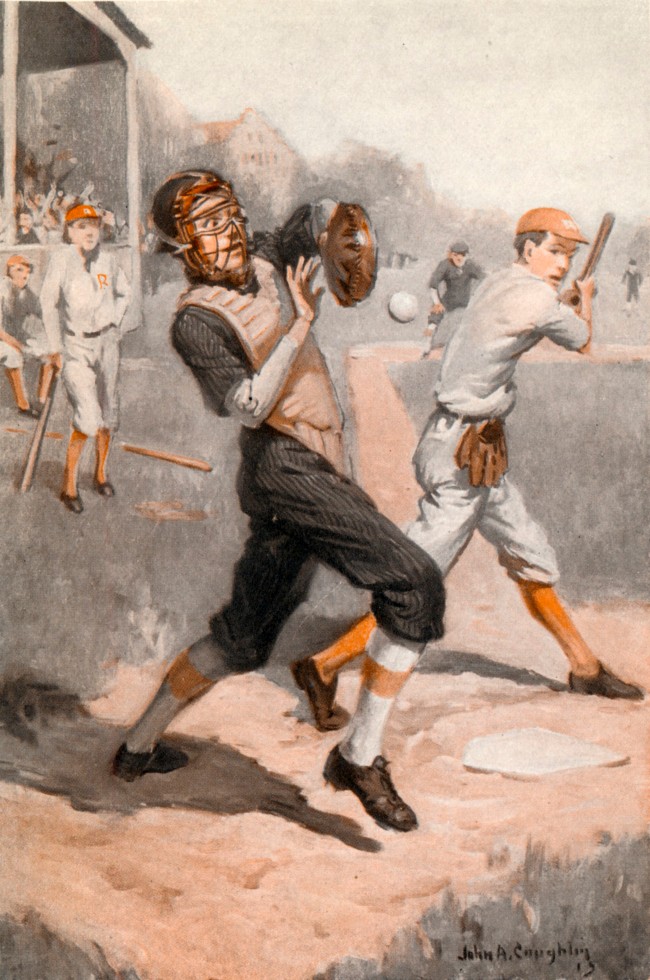
“Jonesie didn’t pretend to catch them.”
“Two gone!” called Jonesie cheerfully. “Play for the batter, fellows! And don’t forget the lesson!”
“Say, what’s this old lesson you’re always talking about?” asked Proudfoot as he squared himself to the plate.
“Never you mind, Horace Erasmus,” replied Jonesie. Proudfoot, who was not at all proud of his name as set down in the school catalogue, frowned.
“And never you mind about my name,” he rejoined shortly.
“Well, it is your name, isn’t it?”
“That’s none of your business. You’re too fresh. You——” Proudfoot’s further remarks were halted by the strange behavior of the All-Stars. One by one they were edging toward the left of the field. As they went they held their noses and looked accusingly toward first base, where Pinky Trainor was elaborately binding a handkerchief about his face. Even Tubby showed signs of uneasiness. Jonesie’s voice rang out sharply.
“What’s the matter with you fellows?” he asked irately. “What are you all doing?”
“We can’t stand it, Cap,” called Hoyt from out in short left field.
“Stand it! Stand what?”
“The—the odor!”
“What odor?”
“Onions!”
There was a brief moment of silence, and then the fellows in the stand behaved most remarkably. They rocked to and fro in their seats, clung to each other desperately and even rolled into the aisles, all the while emitting choking, gurgling sounds that might later evolve into laughter, but which at present more closely resembled the painful gasps of a person lately rescued from drowning! And the same or similar effects might be noted on the field and on the School Team’s bench. In fact, everyone appeared to be on the verge of apoplexy save only Mr. Gordon. Gordon, with clenched fists and crimson cheeks, faced the world desperately. Then, while the stand still choked and sputtered, his eyes fell on Pinky Trainor beside him, Pinky swaying dizzily as one about to pass into unconsciousness, Pinky with his nose tightly bound with a none too clean handkerchief. With a roar of rage Gordon sprang and Pinky went down. But Billy Carpenter, red of face and making odd gurgling noises in his throat, leaped weakly to the rescue and the writhing forms were torn apart. And then—and only a few witnessed it—Tubby, who had apparently run to the aid of his fallen teammate, suddenly dug a hand holding a baseball into Gordon’s ribs and Gus Peasley, with a feeble wave of his hand, gasped:
“Out—at—first! Oh, help!”
The latter part of the remark seemed addressed to no one in particular, and Gus sat down on the turf and held his sides very tightly, rocking to and fro, which, you must acknowledge, was a most undignified proceeding for an umpire.
V
The All-Stars met in Jonesie’s room that evening and disbanded. But first Jonesie addressed them from the study table most eloquently.
“As long,” declared Jonesie magnificently, “as the annals of Randall’s School survive the fame and glory of the All-Stars will—er—illuminate the pages of history! We have to-day performed a deathless, imperishable deed. Summoned from—er—the humble walks of life, like the Minute Men of old or What’s-his-name from the plow, we sprang into the breach and—er—battled nobly and valiantly. Victory was ours! For two hard-fought innings we held the School Team at bay and finally triumphed by valor and science!”
Young Nash snickered. Jonesie shot a reproving glance at him and went on.
“Handicapped by ignorance, by lack of practice, by youthfulness and want of experience, we stood shoulder to shoulder upon the trampled field and——”
“Joe Tyson says we didn’t win,” interrupted Tubby. “Says the game didn’t go four and a half innings.”
“Who cares what he says? Who cares what any of them say? They refused to continue. They forfeited the game. The umpire said so. We won a noble victory with the aid of courage, science and——”
“Onions,” murmured Pinky.
THE END