Front matter (continued 3)
Reading edition · Edition 2
This is a very abstruse letter—does your head ache, Daddy? I think we ’ll stop now and make some fudge. I ’m sorry I can’t send you a piece; it will be unusually good, for we ’re going to make it with real cream and three butter balls.
Yours affectionately,
Judy.
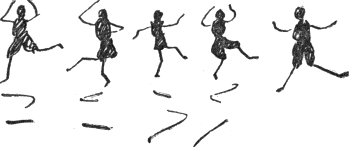
P. S. We ’re having fancy dancing in gymnasium class. You can see by the accompanying picture how much we look like a real ballet. The one on the end accomplishing a graceful pirouette is me—I mean I.
December 26th.
My dear, dear Daddy,
Have n’t you any sense? Don’t you know that you must n’t give one girl seventeen Christmas presents? I ’m a Socialist, please remember; do you wish to turn me into a Plutocrat?
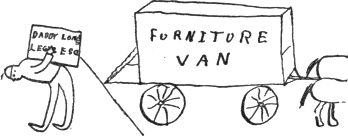
Think how embarrassing it would be if we should ever quarrel! I should have to engage a moving van to return your gifts.
I am sorry that the necktie I sent was so wobbly; I knit it with my own hands (as you doubtless discovered from internal evidence). You will have to wear it on cold days and keep your coat buttoned up tight.
Thank you, Daddy, a thousand times. I think you ’re the sweetest man that ever lived—and the foolishest!
Judy.
Here ’s a four-leaf clover from Camp McBride to bring you good luck for the New Year.
January 9th.
Do you wish to do something, Daddy, that will insure your eternal salvation? There is a family here who are in awfully desperate straits. A mother and father and four visible children—the two older boys have disappeared into the world to make their fortune and have not sent any of it back. The father worked in a glass factory and got consumption—it ’s awfully unhealthy work—and now has been sent away to a hospital. That took all of their savings, and the support of the family falls upon the oldest daughter who is twenty-four. She dressmakes for $1.50 a day (when she can get it) and embroiders centerpieces in the evening. The mother is n’t very strong and is extremely ineffectual and pious. She sits with her hands folded, a picture of patient resignation, while the daughter kills herself with overwork and responsibility and worry; she does n’t see how they are going to get through the rest of the winter—and I don’t either. One hundred dollars would buy some coal and some shoes for the three children so that they could go to school, and give a little margin so that she need n’t worry herself to death when a few days pass and she does n’t get work.
You are the richest man I know. Don’t you suppose you could spare one hundred dollars? That girl deserves help a lot more than I ever did. I would n’t ask it except for the girl; I don’t care much what happens to the mother—she is such a jelly-fish.
The way people are forever rolling their eyes to heaven and saying, “Perhaps it ’s all for the best,” when they are perfectly dead sure it ’s not, makes me enraged. Humility or resignation or whatever you choose to call it, is simply impotent inertia. I ’m for a more militant religion!
We are getting the most dreadful lessons in philosophy—all of Schopenhauer for to-morrow. The professor does n’t seem to realize that we are taking any other subject. He ’s a queer old duck; he goes about with his head in the clouds and blinks dazedly when occasionally he strikes solid earth. He tries to lighten his lectures with an occasional witticism—and we do our best to smile, but I assure you his jokes are no laughing matter. He spends his entire time between classes in trying to figure out whether matter really exists or whether he only thinks it exists.
I ’m sure my sewing girl has n’t any doubt but that it exists!
Where do you think my new novel is? In the waste basket. I can see myself that it ’s no good on earth, and when a loving author realizes that, what would be the judgment of a critical public?
Later.
I address you, Daddy, from a bed of pain. For two days I ’ve been laid up with swollen tonsils; I can just swallow hot milk, and that is all. “What were your parents thinking of not to have those tonsils out when you were a baby?” the doctor wished to know. I ’m sure I have n’t an idea, but I doubt if they were thinking much about me.
Yours,
J. A.
Next morning.
I just read this over before sealing it. I don’t know why I cast such a misty atmosphere over life. I hasten to assure you that I am young and happy and exuberant; and I trust you are the same. Youth has nothing to do with birthdays, only with alivedness of spirit, so even if your hair is gray, Daddy, you can still be a boy.
Affectionately,
Judy.
Jan. 12th.
Dear Mr. Philanthropist,
Your check for my family came yesterday. Thank you so much! I cut gymnasium and took it down to them right after luncheon, and you should have seen the girl’s face! She was so surprised and happy and relieved that she looked almost young; and she ’s only twenty-four. Is n’t it pitiful?
Anyway, she feels now as though all the good things were coming together. She has steady work ahead for two months—some one ’s getting married, and there ’s a trousseau to make.
“Thank the good Lord!” cried the mother, when she grasped the fact that that small piece of paper was one hundred dollars.
“It was n’t the good Lord at all,” said I, “it was Daddy-Long-Legs.” (Mr. Smith, I called you.)
“But it was the good Lord who put it in his mind,” said she.
“Not at all! I put it in his mind myself,” said I.
But anyway, Daddy, I trust the good Lord will reward you suitably. You deserve ten thousand years out of purgatory.
Yours most gratefully,
Judy Abbott.
Feb. 15th.
May it please Your Most Excellent Majesty:
This morning I did eat my breakfast upon a cold turkey pie and a goose, and I did send for a cup of tee (a china drink) of which I had never drank before.
Don’t be nervous, Daddy—I have n’t lost my mind; I ’m merely quoting Sam’l Pepys. We ’re reading him in connection with English History, original sources. Sallie and Julia and I converse now in the language of 1660. Listen to this:
“I went to Charing Cross to see Major Harrison hanged, drawn and quartered: he looking as cheerful as any man could do in that condition.” And this: “Dined with my lady who is in handsome mourning for her brother who died yesterday of spotted fever.”
Seems a little early to commence entertaining, does n’t it? A friend of Pepys devised a very cunning manner whereby the king might pay his debts out of the sale to poor people of old decayed provisions. What do you, a reformer, think of that? I don’t believe we ’re so bad to-day as the newspapers make out.
Samuel was as excited about his clothes as any girl; he spent five times as much on dress as his wife—that appears to have been the Golden Age of husbands. Is n’t this a touching entry? You see he really was honest. “To-day came home my fine Camlett cloak with gold buttons, which cost me much money, and I pray God to make me able to pay for it.”
Excuse me for being so full of Pepys; I ’m writing a special topic on him.
What do you think, Daddy? The Self-Government Association has abolished the ten-o’clock rule. We can keep our lights all night if we choose, the only requirement being that we do not disturb others—we are not supposed to entertain on a large scale. The result is a beautiful commentary on human nature. Now that we may stay up as long as we choose, we no longer choose. Our heads begin to nod at nine o’clock, and by nine-thirty the pen drops from our nerveless grasp. It ’s nine-thirty now. Good night.
Sunday.
Just back from church—preacher from Georgia. We must take care, he says, not to develop our intellects at the expense of our emotional natures—but methought it was a poor, dry sermon (Pepys again). It does n’t matter what part of the United States or Canada they come from, or what denomination they are, we always get the same sermon. Why on earth don’t they go to men’s colleges and urge the students not to allow their manly natures to be crushed out by too much mental application?
It ’s a beautiful day—frozen and icy and clear. As soon as dinner is over, Sallie and Julia and Marty Keene and Eleanor Pratt (friends of mine, but you don’t know them) and I are going to put on short skirts and walk ’cross country to Crystal Spring Farm and have a fried chicken and waffle supper, and then have Mr. Crystal Spring drive us home in his buckboard. We are supposed to be inside the campus at seven, but we are going to stretch a point to-night and make it eight.
Farewell, kind Sir.
I have the honour of subscribing myself,
Your most loyall, dutifull, faithfull and obedient servant,
J. Abbott.
March Fifth.
Dear Mr. Trustee,
To-morrow is the first Wednesday in the month—a weary day for the John Grier Home. How relieved they ’ll be when five o’clock comes and you pat them on the head and take yourselves off! Did you (individually) ever pat me on the head, Daddy? I don’t believe so—my memory seems to be concerned only with fat Trustees.
Give the Home my love, please—my truly love. I have quite a feeling of tenderness for it as I look back through a haze of four years. When I first came to college I felt quite resentful because I ’d been robbed of the normal kind of childhood that the other girls had had; but now, I don’t feel that way in the least. I regard it as a very unusual adventure. It gives me a sort of vantage point from which to stand aside and look at life. Emerging full grown, I get a perspective on the world, that other people who have been brought up in the thick of things, entirely lack.
I know lots of girls (Julia, for instance) who never know that they are happy. They are so accustomed to the feeling that their senses are deadened to it, but as for me—I am perfectly sure every moment of my life that I am happy. And I ’m going to keep on being, no matter what unpleasant things turn up. I ’m going to regard them (even toothaches) as interesting experiences, and be glad to know what they feel like. “Whatever sky ’s above me, I ’ve a heart for any fate.”
However, Daddy, don’t take this new affection for the J. G. H. too literally. If I have five children, like Rousseau, I shan’t leave them on the steps of a foundling asylum in order to insure their being brought up simply.
Give my kindest regards to Mrs. Lippett (that, I think, is truthful; love would be a little strong) and don’t forget to tell her what a beautiful nature I ’ve developed.
Affectionately,
Judy.
Lock Willow,
April 4th.
Dear Daddy,
Do you observe the postmark? Sallie and I are embellishing Lock Willow with our presence during the Easter vacation. We decided that the best thing we could do with our ten days was to come where it is quiet. Our nerves had got to the point where they would n’t stand another meal in Fergussen. Dining in a room with four hundred girls is an ordeal when you are tired. There is so much noise that you can’t hear the girls across the table speak unless they make their hands into a megaphone and shout. That is the truth.
We are tramping over the hills and reading and writing, and having a nice, restful time. We climbed to the top of “Sky Hill” this morning where Master Jervie and I once cooked supper—it does n’t seem possible that it was nearly two years ago. I could still see the place where the smoke of our fire blackened the rock. It is funny how certain places get connected with certain people, and you never go back without thinking of them. I was quite lonely without him—for two minutes.
What do you think is my latest activity, Daddy? You will begin to believe that I am incorrigible—I am writing a book. I started it three weeks ago and am eating it up in chunks. I ’ve caught the secret. Master Jervie and that editor man were right; you are most convincing when you write about the things you know. And this time it is about something that I do know—exhaustively. Guess where it ’s laid? In the John Grier Home! And it ’s good, Daddy, I actually believe it is—just about the tiny little things that happened every day. I ’m a realist now. I ’ve abandoned romanticism; I shall go back to it later though, when my own adventurous future begins.
This new book is going to get itself finished—and published! You see if it does n’t. If you just want a thing hard enough and keep on trying, you do get it in the end. I ’ve been trying for four years to get a letter from you—and I have n’t given up hope yet.
Good-by, Daddy dear,
(I like to call you Daddy dear; it ’s so alliterative.)
Affectionately,
Judy.
P. S. I forgot to tell you the farm news, but it ’s very distressing. Skip this postscript if you don’t want your sensibilities all wrought up.
Poor old Grove is dead. He got so he could n’t chew and they had to shoot him.
Nine chickens were killed by a weasel or a skunk or a rat last week.
One of the cows is sick, and we had to have the veterinary surgeon out from Bonnyrigg Four Corners. Amasai stayed up all night to give her linseed oil and whisky. But we have an awful suspicion that the poor sick cow got nothing but linseed oil.
Sentimental Tommy (the tortoise-shell cat) has disappeared; we are afraid he has been caught in a trap.
There are lots of troubles in the world!
May 17th.
Dear Daddy-Long-Legs,
This is going to be extremely short because my shoulder aches at the sight of a pen. Lecture notes all day, immortal novel all evening makes too much writing.
Commencement three weeks from next Wednesday. I think you might come and make my acquaintance—I shall hate you if you don’t! Julia ’s inviting Master Jervie, he being her family, and Sallie ’s inviting Jimmie McB., he being her family, but who is there for me to invite? Just you and Mrs. Lippett, and I don’t want her. Please come.
Yours, with love and writer’s cramp.
Judy.
Lock Willow.
June 19th.
Dear Daddy-Long-Legs,
I ’m educated! My diploma is in the bottom bureau drawer with my two best dresses. Commencement was as usual, with a few showers at vital moments. Thank you for your rosebuds. They were lovely. Master Jervie and Master Jimmie both gave me roses, too, but I left theirs in the bath tub and carried yours in the class procession.
Here I am at Lock Willow for the summer—forever maybe. The board is cheap; the surroundings quiet and conducive to a literary life. What more does a struggling author wish? I am mad about my book. I think of it every waking moment, and dream of it at night. All I want is peace and quiet and lots of time to work (interspersed with nourishing meals).
Master Jervie is coming up for a week or so in August, and Jimmie McBride is going to drop in sometime through the summer. He ’s connected with a bond house now, and goes about the country selling bonds to banks. He ’s going to combine the “Farmers’ National” at the Corners and me on the same trip.
You see that Lock Willow is n’t entirely lacking in society. I ’d be expecting to have you come motoring through—only I know now that that is hopeless. When you would n’t come to my commencement, I tore you from my heart and buried you forever.
Judy Abbott, A.B.
July 24th.
Dearest Daddy-Long-Legs,
Is n’t it fun to work—or don’t you ever do it? It ’s especially fun when your kind of work is the thing you ’d rather do more than anything else in the world. I ’ve been writing as fast as my pen would go every day this summer, and my only quarrel with life is that the days are n’t long enough to write all the beautiful and valuable and entertaining thoughts I ’m thinking.
I ’ve finished the second draft of my book and am going to begin the third to-morrow morning at half-past seven. It ’s the sweetest book you ever saw—it is, truly. I think of nothing else. I can barely wait in the morning to dress and eat before beginning; then I write and write and write till suddenly I ’m so tired that I ’m limp all over. Then I go out with Colin (the new sheep dog) and romp through the fields and get a fresh supply of ideas for the next day. It ’s the most beautiful book you ever saw—Oh, pardon—I said that before.
You don’t think me conceited, do you, Daddy dear?
I ’m not, really, only just now I ’m in the enthusiastic stage. Maybe later on I ’ll get cold and critical and sniffy. No, I ’m sure I won’t! This time I ’ve written a real book. Just wait till you see it.
I ’ll try for a minute to talk about something else. I never told you, did I, that Amasai and Carry got married last May? They are still working here, but so far as I can see it has spoiled them both. She used just to laugh when he tramped in mud or dropped ashes on the floor, but now—you should hear her scold! And she does n’t curl her hair any longer. Amasai, who used to be so obliging about beating rugs and carrying wood, grumbles if you suggest such a thing. Also his neckties are quite dingy—black and brown, where they used to be scarlet and purple. I ’ve determined never to marry. It ’s a deteriorating process, evidently.
There is n’t much of any farm news. The animals are all in the best of health. The pigs are unusually fat, the cows seem contented and the hens are laying well. Are you interested in poultry? If so, let me recommend that invaluable little work, “200 Eggs per Hen per Year.” I am thinking of starting an incubator next spring and raising broilers. You see I ’m settled at Lock Willow permanently. I have decided to stay until I ’ve written 114 novels like Anthony Trollope’s mother. Then I shall have completed my life work and can retire and travel.
Mr. James McBride spent last Sunday with us. Fried chicken and ice-cream for dinner, both of which he appeared to appreciate. I was awfully glad to see him; he brought a momentary reminder that the world at large exists. Poor Jimmie is having a hard time peddling his bonds. The Farmers’ National at the Corners would n’t have anything to do with them in spite of the fact that they pay six per cent. interest and sometimes seven. I think he ’ll end by going home to Worcester and taking a job in his father’s factory. He ’s too open and confiding and kind-hearted ever to make a successful financier. But to be the manager of a flourishing overall factory is a very desirable position, don’t you think? Just now he turns up his nose at overalls, but he ’ll come to them.
I hope you appreciate the fact that this is a long letter from a person with writer’s cramp. But I still love you, Daddy dear, and I ’m very happy. With beautiful scenery all about, and lots to eat and a comfortable four-post bed and a ream of blank paper and a pint of ink—what more does one want in the world?
Yours, as always,
Judy.
P. S. The postman arrives with some more news. We are to expect Master Jervie on Friday next to spend a week. That ’s a very pleasant prospect—only I am afraid my poor book will suffer. Master Jervie is very demanding.
August 27th.
Dear Daddy-Long-Legs,
Where are you, I wonder?
I never know what part of the world you are in, but I hope you ’re not in New York during this awful weather. I hope you ’re on a mountain peak (but not in Switzerland; somewhere nearer) looking at the snow and thinking about me. Please be thinking about me. I ’m quite lonely and I want to be thought about. Oh, Daddy, I wish I knew you! Then when we were unhappy we could cheer each other up.
I don’t think I can stand much more of Lock Willow. I ’m thinking of moving. Sallie is going to do settlement work in Boston next winter. Don’t you think it would be nice for me to go with her, then we could have a studio together? I could write while she settled and we could be together in the evenings. Evenings are very long when there ’s no one but the Semples and Carrie and Amasai to talk to. I know ahead of time that you won’t like my studio idea. I can read your secretary’s letter now:
“Miss Jerusha Abbott.
“Dear Madam,
“Mr. Smith prefers that you remain at Lock Willow.
“Yours truly,
“Elmer H. Griggs”.
I hate your secretary. I am certain that a man named Elmer H. Griggs must be horrid. But truly, Daddy, I think I shall have to go to Boston. I can’t stay here. If something does n’t happen soon, I shall throw myself into the silo pit out of sheer desperation.
Mercy! but it ’s hot. All the grass is burnt up and the brooks are dry and the roads are dusty. It has n’t rained for weeks and weeks.
This letter sounds as though I had hydrophobia, but I have n’t. I just want some family.
Good-by, my dearest Daddy.
I wish I knew you.
Judy.
Lock Willow,
September 19th.
Dear Daddy,
Something has happened and I need advice. I need it from you, and from nobody else in the world. Would n’t it be possible for me to see you? It ’s so much easier to talk than to write; and I ’m afraid your secretary might open the letter.
Judy.
P. S. I ’m very unhappy.
Lock Willow,
October 3d.
Dear Daddy-Long-Legs,
Your note written in your own hand—and a pretty wobbly hand!—came this morning. I am so sorry that you have been ill; I would n’t have bothered you with my affairs if I had known. Yes, I will tell you the trouble, but it ’s sort of complicated to write, and very private. Please don’t keep this letter, but burn it.
Before I begin—here ’s a check for one thousand dollars. It seems funny, does n’t it, for me to be sending a check to you? Where do you think I got it?
I ’ve sold my story, Daddy. It ’s going to be published serially in seven parts, and then in a book! You might think I ’d be wild with joy, but I ’m not. I ’m entirely apathetic. Of course I ’m glad to begin paying you—I owe you over two thousand more. It ’s coming in instalments. Now don’t be horrid, please, about taking it, because it makes me happy to return it. I owe you a great deal more than the mere money, and the rest I will continue to pay all my life in gratitude and affection.
And now, Daddy, about the other thing; please give me your most worldly advice, whether you think I ’ll like it or not.
You know that I ’ve always had a very special feeling toward you; you sort of represented my whole family; but you won’t mind, will you, if I tell you that I have a very much more special feeling for another man? You can probably guess without much trouble who he is. I suspect that my letters have been very full of Master Jervie for a very long time.
I wish I could make you understand what he is like and how entirely companionable we are. We think the same about everything—I am afraid I have a tendency to make over my ideas to match his! But he is almost always right; he ought to be, you know, for he has fourteen years’ start of me. In other ways, though, he ’s just an overgrown boy, and he does need looking after—he has n’t any sense about wearing rubbers when it rains. He and I always think the same things are funny, and that is such a lot; it ’s dreadful when two people’s senses of humor are antagonistic. I don’t believe there ’s any bridging that gulf!
And he is—Oh, well! He is just himself, and I miss him, and miss him, and miss him. The whole world seems empty and aching. I hate the moonlight because it ’s beautiful and he is n’t here to see it with me. But maybe you ’ve loved somebody, too, and you know? If you have, I don’t need to explain; if you have n’t, I can’t explain.
Anyway, that ’s the way I feel—and I ’ve refused to marry him.
I did n’t tell him why; I was just dumb and miserable. I could n’t think of anything to say. And now he has gone away imagining that I want to marry Jimmie McBride—I don’t in the least, I would n’t think of marrying Jimmie; he is n’t grown up enough. But Master Jervie and I got into a dreadful muddle of misunderstanding, and we both hurt each other’s feelings. The reason I sent him away was not because I did n’t care for him, but because I cared for him so much. I was afraid he would regret it in the future—and I could n’t stand that! It did n’t seem right for a person of my lack of antecedents to marry into any such family as his. I never told him about the orphan asylum, and I hated to explain that I did n’t know who I was. I may be dreadful, you know. And his family are proud—and I ’m proud, too!
Also, I felt sort of bound to you. After having been educated to be a writer, I must at least try to be one; it would scarcely be fair to accept your education and then go off and not use it. But now that I am going to be able to pay back the money, I feel that I have partially discharged that debt—besides, I suppose I could keep on being a writer even if I did marry. The two professions are not necessarily exclusive.
I ’ve been thinking very hard about it. Of course he is a Socialist, and he has unconventional ideas; maybe he would n’t mind marrying into the proletariat so much as some men might. Perhaps when two people are exactly in accord, and always happy when together and lonely when apart, they ought not to let anything in the world stand between them. Of course I want to believe that! But I ’d like to get your unemotional opinion. You probably belong to a Family also, and will look at it from a worldly point of view and not just a sympathetic, human point of view—so you see how brave I am to lay it before you.
Suppose I go to him and explain that the trouble is n’t Jimmie, but is the John Grier Home—would that be a dreadful thing for me to do? It would take a great deal of courage. I ’d almost rather be miserable for the rest of my life.
This happened nearly two months ago; I have n’t heard a word from him since he was here. I was just getting sort of acclimated to the feeling of a broken heart, when a letter came from Julia that stirred me all up again. She said—very casually—that “Uncle Jervis” had been caught out all night in a storm when he was hunting in Canada, and had been ill ever since with pneumonia. And I never knew it. I was feeling hurt because he had just disappeared into blankness without a word. I think he ’s pretty unhappy, and I know I am!
What seems to you the right thing for me to do?
Judy.
October 6th.
Dearest Daddy-Long-Legs,
Yes, certainly I ’ll come—at half-past four next Wednesday afternoon. Of course I can find the way. I ’ve been in New York three times and am not quite a baby. I can’t believe that I am really going to see you—I ’ve been just thinking you so long that it hardly seems as though you are a tangible flesh-and-blood person.
You are awfully good, Daddy, to bother yourself with me, when you ’re not strong. Take care and don’t catch cold. These fall rains are very damp.
Affectionately,
Judy.
P. S. I ’ve just had an awful thought. Have you a butler? I ’m afraid of butlers, and if one opens the door I shall faint upon the step. What can I say to him? You did n’t tell me your name. Shall I ask for Mr. Smith?
Thursday Morning.
My very dearest Master-Jervie-Daddy-Long-Legs-Pendleton-Smith,
Did you sleep last night? I did n’t. Not a single wink. I was too amazed and excited and bewildered and happy. I don’t believe I ever shall sleep again—or eat either. But I hope you slept; you must, you know, because then you will get well faster and can come to me.
Dear Man, I can’t bear to think how ill you ’ve been—and all the time I never knew it. When the doctor came down yesterday to put me in the cab, he told me that for three days they gave you up. Oh, dearest, if that had happened, the light would have gone out of the world for me. I suppose that some day—in the far future—one of us must leave the other; but at least we shall have had our happiness and there will be memories to live with.
I meant to cheer you up—and instead I have to cheer myself. For in spite of being happier than I ever dreamed I could be, I ’m also soberer. The fear that something may happen to you rests like a shadow on my heart. Always before I could be frivolous and care-free and unconcerned, because I had nothing precious to lose. But now—I shall have a Great Big Worry all the rest of my life. Whenever you are away from me I shall be thinking of all the automobiles that can run over you, or the sign-boards that can fall on your head or the dreadful, squirmy germs that you may be swallowing. My peace of mind is gone forever—but anyway, I never cared much for just plain peace.
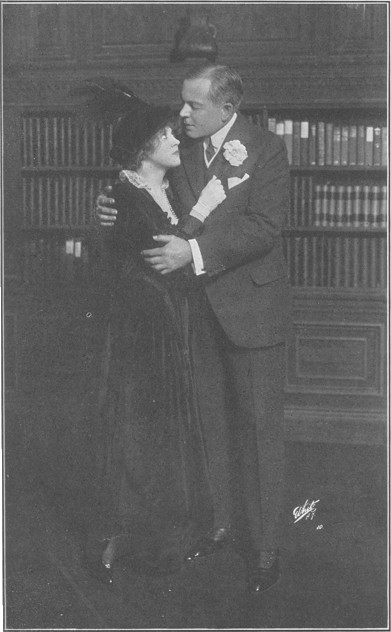
THE IDENTITY OF DADDY-LONG-LEGS IS ESTABLISHED.
Please get well—fast—fast—fast. I want to have you close by where I can touch you and make sure you are tangible. Such a little half hour we had together! I ’m afraid maybe I dreamed it. If I were only a member of your family (a very distant fourth cousin) then I could come and visit you every day, and read aloud and plump up your pillow and smooth out those two little wrinkles in your forehead and make the corners of your mouth turn up in a nice cheerful smile. But you are cheerful again, are n’t you? You were yesterday before I left. The doctor said I must be a good nurse, that you looked ten years younger. I hope that being in love does n’t make every one ten years younger. Will you still care for me, darling, if I turn out to be only eleven?
Yesterday was the most wonderful day that could ever happen. If I live to be ninety-nine I shall never forget the tiniest detail. The girl that left Lock Willow at dawn was a very different person from the one who came back at night. Mrs. Semple called me at half-past four. I started wide awake in the darkness and the first thought that popped into my head was, “I am going to see Daddy-Long-Legs!” I ate breakfast in the kitchen by candle-light, and then drove the five miles to the station through the most glorious October coloring. The sun came up on the way, and the swamp maples and dogwood glowed crimson and orange and the stone walls and cornfields sparkled with hoar frost; the air was keen and clear and full of promise. I knew something was going to happen. All the way in the train the rails kept singing, “You ’re going to see Daddy-Long-Legs.” It made me feel secure. I had such faith in Daddy’s ability to set things right. And I knew that somewhere another man—dearer than Daddy—was wanting to see me, and somehow I had a feeling that before the journey ended I should meet him, too. And you see!
When I came to the house on Madison Avenue it looked so big and brown and forbidding that I did n’t dare go in, so I walked around the block to get up my courage. But I need n’t have been a bit afraid; your butler is such a nice, fatherly old man that he made me feel at home at once. “Is this Miss Abbott?” he said to me, and I said, “Yes,” so I did n’t have to ask for Mr. Smith after all. He told me to wait in the drawing-room. It was a very somber, magnificent, man’s sort of room. I sat down on the edge of a big upholstered chair and kept saying to myself:
“I ’m going to see Daddy-Long-Legs! I ’m going to see Daddy-Long-Legs!”
Then presently the man came back and asked me please to step up to the library. I was so excited that really and truly my feet would hardly take me up. Outside the door he turned and whispered, “He ’s been very ill, Miss. This is the first day he ’s been allowed to sit up. You ’ll not stay long enough to excite him?” I knew from the way he said it that he loved you—and I think he ’s an old dear!
Then he knocked and said, “Miss Abbott,” and I went in and the door closed behind me.
It was so dim coming in from the brightly lighted hall that for a moment I could scarcely make out anything; then I saw a big easy chair before the fire and a shining tea table with a smaller chair beside it. And I realized that a man was sitting in the big chair propped up by pillows with a rug over his knees. Before I could stop him he rose—sort of shakily—and steadied himself by the back of the chair and just looked at me without a word. And then—and then—I saw it was you! But even with that I did n’t understand. I thought Daddy had had you come there to meet me for a surprise.
Then you laughed and held out your hand and said, “Dear little Judy, could n’t you guess that I was Daddy-Long-Legs?”
In an instant it flashed over me. Oh, but I have been stupid! A hundred little things might have told me, if I had had any wits. I would n’t make a very good detective, would I, Daddy?—Jervie? What must I call you? Just plain Jervie sounds disrespectful, and I can’t be disrespectful to you!
It was a very sweet half hour before your doctor came and sent me away. I was so dazed when I got to the station that I almost took a train for St. Louis. And you were pretty dazed, too. You forgot to give me any tea. But we ’re both very, very happy, are n’t we? I drove back to Lock Willow in the dark—but oh, how the stars were shining! And this morning I ’ve been out with Colin visiting all the places that you and I went to together, and remembering what you said and how you looked. The woods to-day are burnished bronze and the air is full of frost. It ’s climbing weather. I wish you were here to climb the hills with me. I am missing you dreadfully, Jervie dear, but it ’s a happy kind of missing; we ’ll be together soon. We belong to each other now really and truly, no make-believe. Does n’t it seem queer for me to belong to some one at last? It seems very, very sweet.
And I shall never let you be sorry for a single instant.
Yours, forever and ever,
Judy.
P. S. This is the first love letter I ever wrote. Is n’t it funny that I know how?
THE END
CHARMING BOOKS FOR GIRLS
May be had wherever books are sold. Ask for Grosset & Dunlap’s list
WHEN PATTY WENT TO COLLEGE, By Jean Webster.
Illustrated by C. D. Williams.
One of the best stories of life in a girl’s college that has ever been written. It is bright, whimsical and entertaining, lifelike, laughable and thoroughly human.
JUST PATTY, By Jean Webster.
Illustrated by C. M. Relyea.
Patty is full of the joy of living, fun-loving, given to ingenious mischief for its own sake, with a disregard for pretty convention which is an unfailing source of joy to her fellows.
THE POOR LITTLE RICH GIRL, By Eleanor Gates.
With four full page illustrations.
This story relates the experience of one of those unfortunate children whose early days are passed in the companionship of a governess, seldom seeing either parent, and famishing for natural love and tenderness. A charming play as dramatized by the author.
REBECCA OF SUNNYBROOK FARM, By Kate Douglas Wiggin.
One of the most beautiful studies of childhood—Rebecca’s artistic, unusual and quaintly charming qualities stand out midst a circle of austere New Englanders. The stage version is making a phenominal dramatic record.
NEW CHRONICLES OF REBECCA, By Kate Douglas Wiggin.
Illustrated by F. C. Yohn.
Additional episodes in the girlhood of this delightful heroine that carry Rebecca through various stages to her eighteenth birthday.
REBECCA MARY, By Annie Hamilton Donnell.
Illustrated by Elizabeth Shippen Green.
This author possesses the rare gift of portraying all the grotesque little joys and sorrows and scruples of this very small girl with a pathos that is peculiarly genuine and appealing.
EMMY LOU: Her Book and Heart, By George Madden Martin.
Illustrated by Charles Louis Hinton.
Emmy Lou is irresistibly lovable, because she is so absolutely real. She is just a bewitchingly innocent, hugable little maid. The book is wonderfully human.
Ask for complete free list of G. & D. Popular Copyrighed Fiction
Grosset & Dunlap, 526 West 26th St., New York
STORIES OF RARE CHARM BY GENE STRATTON-PORTER
May be had wherever books are sold. Ask for Grosset and Dunlap’s list.
THE HARVESTER
Illustrated by W. L. Jacobs
“The Harvester,” David Langston, is a man of the woods and fields, who draws his living from the prodigal hand of Mother Nature herself. If the book had nothing in it but the splendid figure of this man, with his sure grip on life, his superb optimism, and his almost miraculous knowledge of nature secrets, it would be notable. But when the Girl comes to his “Medicine Woods,” and the Harvester’s whole sound, healthy, large outdoor being realizes that this is the highest point of life which has come to him—there begins a romance, troubled and interrupted, yet of the rarest idyllic quality.
FRECKLES. Decorations by E. Stetson Crawford
Freckles is a nameless waif when the tale opens, but the way in which he takes hold of life; the nature friendships he forms in the great Limberlost Swamp; the manner in which everyone who meets him succumbs to the charm of his engaging personality; and his love-story with “The Angel” are full of real sentiment.
A GIRL OF THE LIMBERLOST.
Illustrated by Wladyslaw T. Brenda.
The story of a girl of the Michigan woods; a buoyant, lovable type of the self-reliant American. Her philosophy is one of love and kindness towards all things; her hope is never dimmed. And by the sheer beauty of her soul, and the purity of her vision, she wins from barren and unpromising surroundings those rewards of high courage.
It is an inspiring story of a life worth while and the rich beauties of the out-of-doors are strewn through all its pages.
AT THE FOOT OF THE RAINBOW.
Illustrations in colors by Oliver Kemp. Design and decorations by Ralph Fletcher Seymour.
The scene of this charming, idyllic love story is laid in Central Indiana. The story is one of devoted friendship, and tender self-sacrificing love; the friendship that gives freely without return, and the love that seeks first the happiness of the object. The novel is brimful of the most beautiful word painting of nature, and its pathos and tender sentiment will endear it to all.
Ask for complete free list of G. & D. Popular Copyrighted Fiction
Grosset & Dunlap, 526 West 26th St., New York
MYRTLE REED’S NOVELS
May be had wherever books are sold. Ask for Grosset & Dunlap’s list
LAVENDER AND OLD LACE.
A charming story of a quaint corner of New England where bygone romance finds a modern parallel. The story centers round the coming of love to the young people on the staff of a newspaper—and it is one of the prettiest, sweetest and quaintest of old fashioned love stories, * * * a rare book, exquisite in spirit and conception, full of delicate fancy, of tenderness, of delightful humor and spontaniety.
A SPINNER IN THE SUN.
Miss Myrtle Reed may always be depended upon to write a story in which poetry, charm, tenderness and humor are combined into a clever and entertaining book. Her characters are delightful and she always displays a quaint humor of expression and a quiet feeling of pathos which give a touch of active realism to all her writings. In “A Spinner in the Sun” she tells an old-fashioned love story, of a veiled lady who lives in solitude and whose features her neighbors have never seen. There is a mystery at the heart of the book that throws over it the glamour of romance.
THE MASTER’S VIOLIN,
A love story in a musical atmosphere. A picturesque, old German virtuoso is the reverent possessor of a genuine “Cremona.” He consents to take for his pupil a handsome youth who proves to have an aptitude for technique, but not the soul of an artist. The youth has led the happy, careless life of a modern, well-to-do young American and he cannot, with his meagre past, express the love, the passion and the tragedies of life and all its happy phases as can the master who has lived life in all its fulness. But a girl comes into his life—a beautiful bit of human driftwood that his aunt had taken into her heart and home, and through his passionate love for her, he learns the lessons that life has to give—and his soul awakes.
Founded on a fact that all artists realize.
Ask for a complete free list of G. & D. Popular Copyrighted Fiction
Grosset & Dunlap, 526 West 26th St., New York
AMELIA BARR’S STORIES DELIGHTFUL TALES OF OLD NEW YORK
May be had wherever books are sold. Ask for Grosset and Dunlap’s list.
THE BOW OF ORANGE RIBBON. With Frontispiece.
This exquisite little romance opens in New York City in “the tender grace” of a May day long past, when the old Dutch families clustered around Bowling Green. It is the beginning of the romance of Katherine, a young Dutch girl who has sent, as a love token, to a young English officer, the bow of orange ribbon which she has worn for years as a sacred emblem on the day of St. Nicholas. After the bow of ribbon Katherine’s heart soon flies. Unlike her sister, whose heart has found a safe resting place among her own people, Katherine’s heart must rove from home—must know to the utmost all that life holds of both joy and sorrow. And so she goes beyond the seas, leaving her parents as desolate as were Isaac and Rebecca of old.
THE MAID OF MAIDEN LANE; A Love Story. With Illustrations by S. M. Arthur.
A sequel to “The Bow of Orange Ribbon.” The time is the gracious days of Seventeen-hundred and ninety-one, when “The Marseillaise” was sung with the American national airs, and the spirit affected commerce, politics and conversation. In the midst of this period the romance of “The Sweetest Maid in Maiden Lane” unfolds. Its chief charm lies in its historic and local color.
SHEILA VEDDER. Frontispiece in colors by Harrison Fisher.
A love story set in the Shetland Islands.
Among the simple, homely folk who dwelt there Jan Vedder was raised; and to this island came lovely Sheila Jarrow. Jan knew, when first he beheld her, that she was the one woman in all the world for him, and to the winning of her love he set himself. The long days of summer by the sea, the nights under the marvelously soft radiance of Shetland moonlight passed in love-making, while with wonderment the man and woman, alien in traditions, adjusted themselves to each other. And the day came when Jan and Sheila wed, and then a sweeter love story is told.
TRINITY BELLS. With eight Illustrations by C. M. Relyea.
The story centers around the life of little Katryntje Van Clyffe, who, on her return home from a fashionable boarding school, faces poverty and heartache. Stout of heart, she does not permit herself to become discouraged even at the news of the loss of her father and his ship “The Golden Victory.” The story of Katryntje’s life was interwoven with the music of the Trinity Bells which eventually heralded her wedding day.
Ask for complete free list of G. & D. Popular Copyrighted Fiction
Grosset & Dunlap, 526 West 26th St., New York
THE NOVELS OF CLARA LOUISE BURNHAM
May be had wherever books are sold. Ask for Grosset and Dunlap’s list.
JEWEL: A Chapter in Her Life.
Illustrated by Maude and Genevieve Cowles.
A sweet, dainty story, breathing the doctrine of love and patience and sweet nature and cheerfulness.
JEWEL’S STORY BOOK.
Illustrated by Albert Schmitt.
A sequel to “Jewel” and equally enjoyable.
CLEVER BETSY.
Illustrated by Rose O’Neill.
The “Clever Betsy” was a boat—named for the unyielding spinster whom the captain hoped to marry. Through the two Betsys a clever group of people are introduced to the reader.
SWEET CLOVER: A Romance of the White City.
A story of Chicago at the time of the World’s Fair. A sweet human story that touches the heart.
THE OPENED SHUTTERS.
Frontispiece by Harrison Fisher.
A summer haunt on an island in Casco Bay is the background for this romance. A beautiful woman, at discord with life, is brought to realize, by her new friends, that she may open the shutters of her soul to the blessed sunlight of joy by casting aside vanity and self love. A delicately humorous work with a lofty motive underlying it all.
THE RIGHT PRINCESS.
An amusing story, opening at a fashionable Long Island resort, where a stately Englishwoman employs a forcible New England housekeeper to serve in her interesting home. How types so widely apart react on each other’s lives, all to ultimate good, makes a story both humorous and rich in sentiment.
THE LEAVEN OF LOVE.
Frontispiece by Harrison Fisher.
At a Southern California resort a world-weary woman, young and beautiful but disillusioned, meets a girl who has learned the art of living—of tasting life in all its richness, opulence and joy. The story hinges upon the change wrought in the soul of the blasè woman by this glimpse into a cheery life.
Ask for complete free list of G. & D. Popular Copyrighted Fiction
Grosset & Dunlap, 526 West 26th St., New York
JOHN FOX, JR’S. STORIES OF THE KENTUCKY MOUNTAINS
May be had wherever books are sold. Ask for Grosset and Dunlap’s list.
THE TRAIL OF THE LONESOME PINE.
Illustrated by F. C. Yohn.
The “lonesome pine” from which the story takes its name was a tall tree that stood in solitary splendor on a mountain top. The fame of the pine lured a young engineer through Kentucky to catch the trail, and when he finally climbed to its shelter he found not only the pine but the foot-prints of a girl. And the girl proved to be lovely, piquant, and the trail of these girlish foot-prints led the young engineer a madder chase than “the trail of the lonesome pine.”
THE LITTLE SHEPHERD OF KINGDOM COME
Illustrated by F. C. Yohn.
This is a story of Kentucky, in a settlement known as “Kingdom Come.” It is a life rude, semi-barbarous; but natural and honest, from which often springs the flower of civilization.
“Chad.” the “little shepherd” did not know who he was nor whence he came—he had just wandered from door to door since early childhood, seeking shelter with kindly mountaineers who gladly fathered and mothered this waif about whom there was such a mystery—a charming waif, by the way, who could play the banjo better that anyone else in the mountains.
A KNIGHT OF THE CUMBERLAND.
Illustrated by F. C. Yohn.
The scenes are laid along the waters of the Cumberland, the lair of moonshiner and feudsman. The knight is a moonshiner’s son, and the heroine a beautiful girl perversely christened “The Blight.” Two impetuous young Southerners’ fall under the spell of “The Blight’s” charms and she learns what a large part jealousy and pistols have in the love making of the mountaineers.
Included in this volume is “Hell fer-Sartain” and other stories, some of Mr. Fox’s most entertaining Cumberland valley narratives.
Ask for complete free list of G. & D. Popular Copyrighted Fiction
Grosset & Dunlap, 526 West 26th St., New York
B. M. Bower’s Novels Thrilling Western Romances
Large 12 mos. Handsomely bound in cloth. Illustrated
CHIP, OF THE FLYING U
A breezy wholesome tale, wherein the love affairs of Chip and Della Whitman are charmingly and humorously told. Chip’s jealousy of Dr. Cecil Grantham, who turns out to be a big, blue eyed young woman is very amusing. A clever, realistic story of the American Cow-puncher.
THE HAPPY FAMILY
A lively and amusing story, dealing with the adventures of eighteen jovial, big hearted Montana cowboys. Foremost amongst them, we find Ananias Green, known as Andy, whose imaginative powers cause many lively and exciting adventures.
HER PRAIRIE KNIGHT
A realistic story of the plains, describing a gay party of Easterners who exchange a cottage at Newport for the rough homeliness of a Montana ranch-house. The merry-hearted cowboys, the fascinating Beatrice, and the effusive Sir Redmond, become living, breathing personalities.
THE RANGE DWELLERS
Here are everyday, genuine cowboys, just as they really exist. Spirited action, a range feud between two families, and a Romeo and Juliet courtship make this a bright, jolly, entertaining story, without a dull page.
THE LURE OF DIM TRAILS
A vivid portrayal of the experience of an Eastern author, among the cowboys of the West, in search of “local color” for a new novel. “Bud” Thurston learns many a lesson while following “the lure of the dim trails” but the hardest, and probably the most welcome, is that of love.
THE LONESOME TRAIL
“Weary” Davidson leaves the ranch for Portland, where conventional city life palls on him. A little branch of sage brush, pungent with the atmosphere of the prairie, and the recollection of a pair of large brown eyes soon compel his return. A wholesome love story.
THE LONG SHADOW
A vigorous Western story, sparkling with the free, outdoor, life of a mountain ranch. Its scenes shift rapidly and its actors play the game of life fearlessly and like men. It is a fine love story from start to finish.
Ask for a complete free list of G. & D. Popular Copyrighted Fiction.
Grosset & Dunlap, 526 West 26th St., New York
KATE DOUGLAS WIGGIN’S STORIES OF PURE DELIGHT
Full of originality and humor, kindliness and cheer
THE OLD PEABODY PEW. Large Octavo. Decorative text pages, printed in two colors. Illustrations by Alice Barber Stephens.
One of the prettiest romances that has ever come from this author’s pen is made to bloom on Christmas Eve in the sweet freshness of an old New England meeting house.
PENELOPE’S PROGRESS. Attractive cover design in colors.
Scotland is the background for the merry doings of three very clever and original American girls. Their adventures in adjusting themselves to the Scot and his land are full of humor.
PENELOPE’S IRISH EXPERIENCES. Uniform in style with “Penelope’s Progress.”
The trio of clever girls who rambled over Scotland cross the border to the Emerald Isle, and again they sharpen their wits against new conditions, and revel in the land of laughter and wit.
REBECCA OF SUNNYBROOK FARM.
One of the most beautiful studies of childhood—Rebecca’s artistic, unusual and quaintly charming qualities stand out midst a circle of austere New Englanders. The stage version is making a phenomenal dramatic record.
NEW CHRONICLES OF REBECCA. With illustrations by F. C. Yohn.
Some more quaintly amusing chronicles that carry Rebecca through various stages to her eighteenth birthday.
ROSE O’ THE RIVER. With illustrations by George Wright.
The simple story of Rose, a country girl and Stephen a sturdy young farmer, The girl’s fancy for a city man interrupts their love and merges the story into an emotional strain where the reader follows the events with rapt attention.
Grosset & Dunlap, 526 West 26th St., New York