CÆDWALLA (continued 3)
Reading edition
"Now, the best thing we can do, boys, is to cut down enough of this to make a clearing for us to lie down in, and we can pile the cut bushes up to the windward of us, and bring ashore the sail and the skins, and such stores as we've got, and make ourselves as snug as we can until daylight breaks. Here, Athelhune, wilt thou set four of them to work with their axes, while I and the others go back to the old boat who has made her last journey, I fear."
This seemed to all a reasonable proposition, and Athelhune began at once to set the men to work. Although it was very dark, yet, as they had become accustomed to it, it was not really so difficult as it would seem to work in the dimness.
"Hullo! who art thou?" called out Ceolwulf, as he fell over the prostrate body of a man. "Why, it's brother Malachi I do believe, and he's gone to sleep; but that won't do. Here, Wulfstan, come and lead him up the shore. Make him walk; if he goes to sleep he will never wake up again. Hi! Malachi, wake up!"
But Malachi was sound asleep, worn out with cold and wretchedness, and it took a great deal of shaking to rouse him up. When at last he was made to understand where he was, he had scarcely any strength left to walk, and it was with extreme difficulty Wulfstan could get him up the beach and on the top of the cliff; and then Athelhune set him to work to carry the bushes, which the others cut, to the windward side of the clearing they were making.
Ceolwulf and the others now returned with the other things, and they very soon made a tolerable shelter from the wind and snow by stretching the sail and other coverings over stakes driven in the ground, and kept up by the masts and oars, which were rested in the forked end of the upright stakes.
"I suppose we can do nothing more for the old boat?" said Athelhune.
"No, she will have to take her chance. I don't think much will be left of her to-morrow; the tide is rising fast, and the wind doesn't show any signs of going down. It's true she will be sheltered a little by the reef outside, but not much, for there will be a good depth of water over it at high tide."
"Dost thou know where we are now?"
"It's where I thought. We are at the end of the Foreland, and have had a near chance of going out to sea," said Ceolwulf.
"Are there any houses near here?"
"No, not nearer than our old home at the head of the haven; but that was burnt down the night we escaped in the boat—at least so it seemed to me as I looked back."
"Canst count on any one helping us if we show ourselves by daylight?"
"Aye, I can count on some if they've not been killed; but I shall have to go to work cautiously, as we have got no boat now to go back with, unless we can capture another one."
"Well, the best thing we can do will be to lie as snug here as we can, and close together, to keep ourselves warm."
As they were now all fairly well warmed by their exertions in making the tent and clearing the ground, there was not much risk to such hardy men from going to rest, and they all lay down under the shelter of the sails and skins, and were soon sound asleep.
The first to wake next morning was Wulfstan, who got up at once, and without waking any one, or at least disturbing them, he went out on to the cliff to see what could be seen of the place where they were wrecked.
The sun had only just risen. It had ceased snowing for some time apparently, for all signs of it had disappeared, and a glorious sight met his eyes. At his feet lay the old boat, lying broadside on to the steep shingle beach, and a large hole in her showed where she had struck the night before. She did not seem to have been any more damaged, and doubtless the reef, which was just beginning to show as the tide receded, had protected her; for the tides were then at neap or nearly so, and consequently the sea had not risen so high or had as much force as it would have had if the spring tides had then prevailed. Beyond the boat the white breakers were tumbling in creamy foam, tinged with the red and gold of the rising sun, which cast a gleaming path of light from the horizon to the feet of Wulfstan; on each side of this path of glory, the sea was deep greeny-grey, ending in a blue and misty purple under the rising sun; above the transparent depths of the exquisite primrose-coloured sky a few fleecy golden clouds floated in the fathomless blue of the heavens, while a gentle but rather keen breeze brought health and vigour to the lungs of the hardy boy. Far on the horizon, towards the north-east, a distant line of grey hills showed where the great Andredesweald stretched away in the distance.
Sniffing the fresh sea air, the boy ran along the beach, and, turning a point a little way to the south-west of him, came upon a long reef of rocks running far out into the sea, and over which the waves were rushing and tumbling in wild confusion as the tide ebbed into the main channel stream.
Out upon these rocks a solitary heron was looking for his morning meal with outstretched neck, while flocks of oxy birds rose in flickering flight, or settled, with shrill cry, on the luxuriant sea-weed that clothed the rocks with sheeny growth.
As Wulfstan went further on, following the shore as it trended towards the west, a great wall of chalk rose suddenly above the low gravel cliff, and shut out all further view in that direction. Above, the magnificent chalk cliff, that went in sheer descent from a height of some three hundred feet into the blue sea below, crowned with a smooth slope of brown turf, rose in gradual swell to sink again in steeper descent towards the north, while its precipitous sides sloped abruptly to the low ground of the foreland.
"Oh! there's our dear old Binbrigge dune!"[1] cried Wulfstan, who had many a time ridden over those grassy slopes, and been lowered over the cliff to collect the sea-fowls' eggs that were laid in otherwise unapproachable nooks and ledges of the precipice.
[1] Bembridge Down.
The boy had forgotten all the past weeks. He seemed once more at home, and wandered on, forgetful of the shipwreck, the sick brother left on the mainland, and his own burnt home.
He was roused from his dreams by a rustling in the long coarse grass that fringed the low cliff, and directly afterwards a boy's voice called out, in amazement:
"Why, it's the young eorl Wulfstan, I do believe!"
"What, Stuff, is it thou?" cried Wulfstan joyfully, as a thick-set, sturdy, shock-headed young Wihtwara of about Wulfstan's age emerged from the cover of the tall grass.
"Why, where hast thou been, Wulfstan, all this while?"
"Aha, Stuff, I've been a voyage, and I have killed a wild boar, and thou canst not think how well I can fish. Brother Malachi has taught me how to make net, and what's the right sort of bait for pout, and bass, and lots of things."
"Oh, Wulfstan, thou dost not say so! And where's Ædric and old Biggun? But thou hadst better not be seen, or thou wilt be killed, that thou wilt."
"What happened that night when Arwald attacked us?"
"What, don't thee know? That was a fine night, that was. How it did burn just! and weren't there a many head broke! Oh, Loki!"[1]
[1] LOKI.—The Scandinavian God of Mischief. He caused the death of Baldur the Beautiful.
"Who was killed? What became of father?"
"Why, who's that a-standing there on the point yonder? I do believe its old Biggun! and he's calling thee. Thou hadst better run, Wulfstan."
"Thou must come too, and tell us all that has happened."
"I don't know about that," said Stuff, scratching his head, and looking dubiously in the direction of Ceolwulf, of whom he seemed to stand considerably in awe.
"Thou hadst better, Stuff, for if thou dost not I will make thee."
"Thou make me! I'd like to see thee do it. Why, I've——"
But before he could say any more Wulfstan had seized him round both arms, and putting his foot behind Stuff's heels, laid him on the ground in an instant, falling on him at the same time, so that all poor Stuff's breath was knocked out of his body with the concussion.
"There, I told thee thou hadst better do what I bid thee."
But Stuff struggled manfully on the ground, and did all he could to shake or roll Wulfstan off him.
"Ah, wouldst thou? If thou dost not lie still and listen to what I am going to say, I will pommel thee black and blue. Dost thou not know I am thine eorl now? or at least I am till Ædric comes back."
But Stuff only struggled all the harder, for he was a sturdy young Wihtwara and very obstinate, until at last Wulfstan had to put his threat into execution, and began to beat the breath out of his unruly antagonist.
The contest was speedily ended by the arrival of Ceolwulf, who, seeing the struggle, and not understanding the cause, strode hastily up to the spot, fearing lest some harm should happen to his young lord.
"Hullo! what's all this about?" he exclaimed, as he saw that he need not have been uneasy about Wulfstan, who was evidently master of the situation. "Whom have we got here?"
"It's Stuff, Biggun; he didn't want to come to thee, and I said I would make him. He doesn't understand that I'm his master now."
"Do thou leave him to me, Wulfstan; it isn't for the like of thee to be rolling on the ground with such as he. He won't get away now, I'll make sure."
Wulfstan accordingly allowed the youngster to rise, and Ceolwulf said sharply to him:
"Down on thy knees, and beg the young eorl's pardon for having dared to be insolent to him, or it will be the worse for thee."
Stuff did as he was bid sullenly enough, saying as he did so:
"He didn't know as how he was his eorl now, there had been such changes."
"Don't talk to me of changes," said Ceolwulf. "He who has once been born a thrall is always a thrall to his eorl until he frees him, and that thou wilt not be in a hurry."
"Never mind, Stuff, thou shalt not be hurt, if thou art only wise and behavest properly. Of course, thou didst not know, that's all."
"Now come along with us, we can't be standing here where anyone might see us. Do thou come and tell us all that's been going on since we've been away," said Ceolwulf.
The three went off in the direction of the wreck, where, on their arrival, they found all astir.
"Is there any water about here fit to drink, Ceolwulf, thinkest thou?" called Athelhune.
"Aye, that there is, and very good water, too," cried Wulfstan. "Come with me, Beornwulf, and I will show thee where the spring is."
"Go with the young eorl, Beornwulf and Osborn, and take a bucket or two if thou hast them," said Athelhune.
They very soon found the spring, which was not far off along the shore, but the opposite way to that which Wulfstan had taken before. Amid some dead seaweed, blown up above high water mark, and a few large stones covered with moss and lichen and sheltering a few ferns, a clear spring of water welled up in unpolluted purity, and, trickling over the stones, lost itself immediately in the loose shingle of the shore. A spring that might elsewhere have been the source of some large stream, but here, cut off at once in its earliest infancy, joined the sea without longer life than a few short feet of furrowed stone—a fitting subject for a moralist or divine; but, as neither Wulfstan nor his companions were in the least degree disposed to either character, they drew as much water as they wanted, and returned to the others.
Ceolwulf had elicited from the reluctant Stuff a short account of all that had taken place after the destruction of Ælfhere's houses and farm-buildings. It appeared that Arwald had left a trusty adherent of his to look after the district, and to set the thralls to work to pursue their usual avocations as if nothing had happened, only all the produce was to be considered as Arwald's property.
Ceolwulf could not find out anything about his master, Ælfhere. As far as he could make out, nobody had found his body after he was seen to fall in the midst of the fight; but Stuff said everyone declared he must be dead, as he was seen to receive a terrible wound in the head from an axe, and "there was them as said Arwald had carried off his body."
When asked whether he thought the people were discontented with the man whom Arwald had placed over the thralls, Stuff said he thought nobody liked him; but they were all afraid of him, as there were some fighting men left to support his authority.
"How many are there?"
"I don't rightly know the proper number, but I think there are not more than eight or nine."
"Dost thou think, if we drove them off or killed them, the rest of the people would fight for their young eorls, Ædric and Wulfstan?"
"Aye, that I do. Thou knowest us all well enough for that, Biggun."
This answer being considered satisfactory, it was agreed it would be best to keep the boy with them all day. That they would try and get the boat up out of the reach of the sea and cover her up as well as possible in order to prevent her being seen by anyone; that then, at nightfall, they would march, under Ceolwulf's guidance, to a knoll, covered with thick brushwood and trees; that they would make their head-quarters at this place; and if Ceolwulf, after seeing a few of the old servants and herdsmen of Ælfhere should judge that they really could offer an effectual resistance to an attack from Arwald, that they would then make an onslaught on the ruined house and farm buildings, and drive off the party Arwald had placed there, and that they would then send over to Cædwalla and ask him to come to take possession of the island.
In accordance with this determination, immediately after their simple meal the men all set to work, under Ceolwulf's instructions, to pull the boat up the beach, a matter very much more easy to accomplish now that they had taken everything out of her, and could see what they were about. They cut down a couple of straight and slight young ash trees, and dividing them into three lengths each, they soon had the old boat up high and dry under the low cliff, hauling her up on the ash rollers. Ceolwulf then made a careful examination of the hole in the boat, and was pleased to see that it would not take very much time to put a couple of new planks in, and she would then be capable of at least making one voyage across to Boseham in fine weather.
Having accomplished this part of their work, the men were set to clean the armour and weapons, and put what food was left in the buckets, and get all ready for their expedition a little before nightfall.
Brother Malachi had quite recovered his usual spirits, and had become an object of much interest and astonishment to Stuff, who had never seen a man like him. He longed to ask Wulfstan all about him, but was rather shy of talking to the young eorl now that he had so clearly established his rightful position, and he was also struck by the respect the others paid him.
The day passed away without particular incident. About an hour before dusk Ceolwulf directed all to fall in, and, telling Stuff to keep near him, led the way to their intended stronghold. Their route lay through dense brushwood, but Ceolwulf soon struck into a narrow track where walking was more easy, but in which they were obliged to proceed in single file.
After going in this way about a mile, they descended a very steep declivity, and came out upon an open meadow. And then the strangers perceived that they were on the border of a large land-locked piece of water, to which, standing where they were, they could see no inlet from the sea.
The tide was up, and the expanse of silver water stretching up to the foot of a high down at its western end, and washing a steeply-wooded shore opposite, had all the appearance of a magnificent lake or splendid harbour, offering a very different scene to what it would be in five hours' time, when, instead of a silver mirror in which the hills and woods and autumn sky were pictured, a tiny stream would sluggishly meander between brown slush and slimy mud.
Crossing this meadow, the party plunged once more into the dense wood, and ascending a slight rise, dipped again to the level of the sea; but the wood was so thick they could see nothing on either hand or ahead, and had still to walk in single file.
Again the path rose steeply in front, and they seemed to be mounting a considerable acclivity. Climbing higher and higher, Ceolwulf left the beaten track, and turned aside through the low growth of oak and ash that seemed unable to attain to any size, and were gnarled and twisted into all sorts of fantastic shapes.
Scrambling over some moss-covered boulders, Ceolwulf stopped, and said:
"Here, men, we will make our camp; there is a spring down the steep slope on that side, and by felling a few trees, we can make a very fair shelter for ourselves, as well as a stockade against any sudden attack."
The place, certainly, was well chosen. There was a small open space on the top of the hill, but no view could be obtained from this as the trees grew thick all round. It was, however, sufficiently obvious that the sides of the hill were very steep, and a handful of men could hold their own for some time, especially with the aid of a few fallen trees to form a breastwork.
As it was now getting dark, no time was to be lost in making their preparations for spending the night. While these operations were going on, Ceolwulf said he would go down into the valley, and find out how matters really were in the vicinity of their old home. So saying, and equipping himself in his hawberk, and with all his offensive weapons, he disappeared among the trees on his way down the hill.
CHAPTER IX.
"I CAN CALL SPIRITS FROM THE VASTY DEEP."
Ceolwulf descended the steep side of the thickly-wooded hill with the assured step of one who well knew his way, although the increasing gloom of night was fast spreading over hill and dale. After walking about a mile through the dense brushwood, the old Wihtwara emerged upon a smooth slope of grassy down, and even he, sturdy and matter-of-fact old heathen as he was, stopped a moment to look at the beautiful scene before him; not so much struck, however, with its beauty and poetry, as from a desire to take in all he could of the well-known aspect of his native land while yet there was any chance of seeing, and to compare the present appearance of the cottages with what they had been before the fatal onslaught of Arwald and his followers.
At Ceolwulf's feet stretched the close, wind-worn grass of the westerly sloping hill-side, reflecting the rich glow which still suffused the darkling sky. Beyond gleamed the sheen of a wide-stretching marsh, across which the curlews called and the bitterns cried, and in which the reflection of the evening star, setting over the distant top of St. Boniface Down, streamed in flickering light. Across the Marsh a bank of land separated the floods that came from the centre of the island, from the waters of the great deep; for on the other side of this narrow strip of land a wide and magnificent bay spread out its grey depth, till it met the violet of the sky beneath the crimson glow of the departed sun. Rising out of this sea, and forming the western side of the noble bay, loomed a magnificent hill, the base of which lay bathed and hidden in the green-grey mist; but enough of the shape of the promontory could be seen to justify its name of the "Dunnose," by which it is now known. The upper part of the hill stood up in clear outline, presenting a solid, opaque mass of deep purple against the golden background, and descended abruptly towards the north in two steep slopes, or escarpments, to the level of a wide-reaching valley that led up to the centre of the island. On the other side of this valley a line of downs presenting their slope to the western light, stretched in fore-shortened length, till they ended in a wooded hill immediately fronting the place where Ceolwulf stood. The lovely scene gradually changed from the lingering warmth of day to the colder shades of night, and all objects grew rapidly indistinguishable.
"Too late to make out what is left of the house," muttered Ceolwulf, "and as the floods seem to be out, I don't see that I can cross the Yare by the old ford. I shall have to go round by the sands along the dunes."
At that time, and indeed until long after, that part of the island on which Ceolwulf and his companions had been cast was known as Binbrygea or Bembridge Island, as the other end of the Isle of Wight, which was equally separated from the middle part of the island by an inlet of the sea, was called Freshwater Island; and as the internal communication at that early time was very defective, there was no bridge over the Yare, and the inhabitants who wished to pass from Bembridge to the centre of the island had to go round by the sandbanks cast up by the sea along the shore where Sandown now flourishes.
There was a ford at low water over the marshes, but it was very difficult to find, and impassable if there were any extra water in the small river Yare. The homestead where Wulfstan and Ædric were brought up was built at the head of what until a few years ago was Brading Haven, and which at that time was a large and magnificent sheet of water stretching up nearly to where Sandown Railway Station now is. The home and farm buildings stood among some old trees, the ancestors of the present Park of Nunwell, and were sheltered from the north-west and north-east by rising ground and the woods that spread in an uninterrupted forest right through the island to Yarmouth, covering all the north side of the island with a dense growth; the only clearings being about Whitgaresbyrig, now Carisbrooke, and Cerdicsford, now Yarmouth. The few patches of land ploughed up by the Romans had rapidly gone out of cultivation during the wild period of the fifth and sixth centuries, and the sparsely scattered inhabitants lived chiefly on the results of the chase and such dairy produce as their rude methods of farming could raise, and in this part of their domestic economy the Jutish conquerors of the Isle of Wight were much assisted by the more cultivated race whom they conquered, and many of whom they kept as their slaves.
Ceolwulf once more fell into his former long swinging stride, and, turning more to the left, directed his steps towards the shore of the open sea.
After proceeding for about a mile and a half, until he had nearly reached the sea beach, he suddenly turned to the right, and plunging through some thick reeds he came to the edge of the river Yare. There was evidently a ford here, for the reeds were broken and trodden down. Groping his way with his spear, Ceolwulf at last emerged on the bank on the other side.
He had now reached a level tract of land rising gently to the foot of the Downs, which had faced him when he first emerged from the wood; he was still a good couple of miles from the old homestead, but as he was now in a more populous part it behoved him to be rather more cautious in his advance.
A little ahead of him and to his left was a belt of thick, low scrub and brushwood, through which could be seen here and there a whiter patch, looking like the walls of some building; but in the dim light it was difficult to make out anything clearly, excepting that in one place a pile of masonry rose above the bushes, and stood out against the stars in a jagged and broken outline.
Ceolwulf now paused a moment and listened intently for any sound, but all was still; occasionally a dull thud reached his car, caused by the sea breaking on the shingly shore behind him, and the fast dying leaves of an old oak near shivered in the scarcely perceptible breeze, but all else was still as the grave.
Suddenly a sharp whirr rose on the silence, and a sound of heavily flapping wings beat the quiet air as a nightjar started out of the old oak tree to search for his evening meal. Ceolwulf was superstitious, like all his race, and he especially disliked the place where he now found himself.
He well knew what those ruins were, and firmly believed, like all the dwellers round, that the place was haunted. Men had lived there who were as gods compared to the rough, uncultured Jute, and now their dwelling was become a ruin, and desolation brooded over its halls.
Little more than two hundred years ago that house had been a stately mansion, from which civilisation and Christianity spread their soothing influences around, where a cultivated Roman gentleman dwelt with his family of well-regulated servants, slaves in name, but as much attached to their master and mistress as any free servants could be, and perhaps still more so from the knowledge that their treatment was the pure result of the humanity of their master, who, as far as the laws were concerned, could have treated them far otherwise. In the wreck of the Roman empire all the life of an expanding culture was crushed out of Britain, and the old civilisation, religion and government were but as myths dimly told by the rude conquerors to their children. The house whose ruins were faintly delineated in the doubtful light had been a Roman villa of very elegant proportions, and fitted with all the appliances a luxurious civilisation knew well how to adapt to domestic comfort; but since the fatal night of slaughter, fire, and rapine, when the invader had harried the island, and remorselessly put to the sword all the men who were likely to show courage or ability, and had made slaves of the young women, the gaunt and blood-stained ruins had been left desolate, haunted by the memories of past happiness, and the horror of that awfully evil night, to which the superstition of the Jutes added the terror of their weird mythology.
As Ceolwulf, startled as he was for the moment by the flight of the night-jar, begun once more to pursue his way, a shrill cry, like that of a child in pain, only with a sound in it different to that which proceeds from human beings, startled him again.
The cry rose piercingly on the night, and then sank in silence once more.
"It's only an owl, I do believe," muttered Ceolwulf, looking in the direction of the sound. "But who can be stirring there at this time of night?" he added, as a flickering ruddy glare shone on the masonry of a remote part of the ruined Roman villa.
The flame had suddenly sprung up—for Ceolwulf felt sure he must have seen it before if it had been there—and suddenly it was obscured again, only to reappear in another minute. "There's somebody, or something, passing in front of that light," thought Ceolwulf, "and, be it witch or fiend, I must find out who it is before I go any further."
So saying, he cautiously turned towards the light, and at the same time felt for a piece of dried skin he wore suspended round his neck.
"Ah! thanks be to Woden! I have not lost that," he chuckled, "and I rubbed my sword in wolf's grease too, so that they can't throw any magic over that," he added, for the powerful virtues of a dried and split wolf's snout were universally held to be a sure antidote against magic; while wolf's grease was an undoubted protection from the wiles of the evil spirits who haunted desolate places, or were hostile to the human race.
Protected by such lucky possessions, Ceolwulf felt his courage rise, and advanced with resolution.
As he approached nearer, again that shrill and wild screech rose upon the air, and set Ceolwulf's blood curdling, and this time the cry ended in a low, prolonged and shivering sigh above his head.
"It's that owl, stupid!" said Ceolwulf to himself, clutching nervously his precious wolf's snout, but wishing much he had more confidence in what was, without doubt, a sure safeguard.
Stealthily stepping over the damp twigs and briar-covered stones, he got nearer and nearer to the light, but could make out no objects distinctly, and he now found that the light was further off than he had at first thought.
"Perhaps, after all, it is only a marsh fire, and it's no use following that," Ceolwulf growled, as he knocked his shin against a large block of stone lying half concealed among the tangled brushwood.
But, at this moment, as if to contradict him, the flame leaped up with greater brilliancy, and he saw a tall figure pass in front of the flame and disappear in the inky black beyond.
Paying more attention than ever to the inequalities of the ground, and arranging his arms as carefully as he could to prevent the light of the fire falling upon them, and announcing his presence by an unlucky gleam, Ceolwulf crept warily up, fearful lest the slightest sound should betray his approach; while ever and anon the unearthly cry that had previously startled him rang vibrating through the silence.
Keeping well in the shade of every bush and obstacle that intervened between him and the light, he was at last able to creep within a distance sufficient to enable him to make out the objects immediately within range of the fire, and the sight that he saw was not reassuring to one imbued with all the wild magic of the mystic northern legends.
Squatting before the fire, and occasionally attending to an iron pot that hung suspended over it from an iron rod that looked as if it had once been used for other purposes, which was held up by two forked sticks placed far enough off from the fire to prevent their being burnt, was a strange, uncanny-looking figure. Nothing could be seen, intervening immediately as it did between the fire and Ceolwulf, but the coal-black outline of a figure sparsely clad, with a hood over its head, and, as it turned towards one side or the other, showing the outline of a very hooked nose and chin, that, owing to the loss of the creature's teeth, approached the nose so closely as almost to touch it. A few locks of wispy hair hung down over the forehead beneath the hood, and a long and skinny arm from time to time stirred the mixture in the pot, while the other arm seemed to hold together the garment in which the figure was dressed. As Ceolwulf looked intently, fascinated and awe-struck by the sight of this being, whom he could not possibly mistake for anything else than a most undoubted witch, surprised by him in her unholy work, he heard her mutter scraps of sentences from time to time, but could not make out a word she said.
"She is brewing spells, I do believe. Now for whom can she be doing that? If only I could get her on our side it would be bad for Arwald. Hullo! what she's doing now? Soul of Woden! but there's another, and it's got horns!"
This remark was caused by a hairy object, which Ceolwulf had not before noticed, raising a gaunt head from which two long curving horns protruded, and which proceeded to get up on its haunches, and then upon its feet, and presented the outline of a fine goat.
"So she's really raised the soul of him who dwells in Hellheim. I hope he won't tell her I am here," muttered Ceolwulf, clutching more vigorously than ever at his wolf's snout. "I wish I could make out what she is saying. What a height she is! and where's she gone to now? I shall have to move round a bit to see the other side of the fire."
The figure had risen up, and had taken the pot off the hook which suspended it over the fire, and had then disappeared into the darkness on the other side, the goat remaining, turning however in the direction where Ceolwulf was, and beginning to utter the plaintive "hinny" that has procured for its race the name of "Nanny goat."
"I don't like this; I believe it has seen me, and is telling her I am here. Well, if I must come out, I must; but I'll hold on a bit longer yet, and perhaps if it does not look at me I shan't feel so queer." So saying, Ceolwulf moved to one side, and, drawing back, made his way round to the other side of the fire.
It took him, however, some time to grope his way among the thick brushwood and fallen stones, for the darkness was all the greater owing to his having looked so long at the light. At last he reached a loophole in the ruins, and found he was opposite to where he had previously stood.
The ruins in this part were not quite so dilapidated. There yet remained a portion of the roof that had fallen in, but still rested upon such columns as had not been thrown down on that terrible night when fire and sword had done their awful work on the peaceful household. Under this shelter the figure of the being whom he had so suddenly come upon was bending over something—what, Ceolwulf could not see, for the light of the fire, which was now sinking down, only blazed fitfully on the face of the walls, and was not powerful enough to pierce the gloom of the covered portion of the ruins.
"There's somebody else in there, that's certain, for she's talking. If she turns me into a toad for it, I must hear what she's saying," and Ceolwulf wriggled himself through the aperture, and crept stealthily nearer, and then suddenly stopped, horror-struck.
"Why, it's the voice of my dead eorl!" he exclaimed in terror, his hair standing up in fear upon his head, and his knees knocking together. He was so terrified at the thought of seeing his disembodied master, that his first thought was to fly from the spot. But the voice spoke again, feebly and with difficulty:
"Tell my children, if thou ever seest them, to revenge me on the House of Arwald, till not a stock remains from which that evil race could renew its life."
"Hush, my lord!" mumbled the aged voice of the hag whom Ceolwulf had first seen. "If I had harboured thoughts of vengeance, should I have succoured thee? Who did me and mine more grievous wrong than thou and thy fathers?"
"Then, why, in Woden's name, didst thou not leave me to die? I should have done so by this, and thought myself none the worse," answered the faint voice of the invisible speaker.
"That's right," muttered Ceolwulf to himself. "I see they tell us true. The heroes don't become less men down there in Nifleheim."
No other sound came from the deep shadow of the recess, and Ceolwulf began to think he would go on his way, only, in spite of his superstitious terrors, he wished very much to see if he could not get a glimpse of his dead lord, if indeed, there was anything to be seen.
The fire was now dying down, but occasionally flickering up, and casting weird shadows over the ruins, and Ceolwulf was just turning to go, when the voice again spoke:
"Woman, wilt thou give my message to my sons, if ever thou meetest them? I have not long to stay here; promise me."
"My lord, I have done what I could to save thy body, but I will do naught which can imperil thy soul. I will take no message of hatred to thy sons."
"Woman, darest thou refuse me? Dost thou dare to disobey me—— Ah! but the descendant of Cerdic is indeed fallen low when his bond woman scoffs at his command."
"My lord, leave thoughts of vengeance to God, and think of what I have tried to tell thee of death. Ah," murmured the old woman, "if only I could remember more clearly all that my mother used to tell me; but these are weary times indeed, when they only who worship the real, true God are miserable old women. How can any words of mine persuade my master to believe that his gods are false, or to trust to what I know to be truth?"
"Thou hast saved me, then, to live to know I shall be dishonoured? and then, when I knew this, I was to die? Was this thy plan? Woman, thou hast well avenged thy wrongs and those of thy race. By letting Ælfhere know that he was to die as a woman in his bed, driven from his home, and unavenged on his enemies, thou hast inflicted on him a misery far worse than death on the battle-field."
"My lord, it was not so. Should I, timid old woman as I am, should I have risked death in every horrid shape merely to satisfy a feeling of which I know nothing? No; I was taught to love my enemies, do good to those that persecute me, and pray for those that despitefully use me."
"Woman, I believe thee not. May Wodin's curse alight on thee for a false traitress! I die unavenged I die dishonoured, and thou openly sayest thou wilt bear no message to my sons if thou shouldst meet them."
All this time the ideas of Ceolwulf were undergoing a change. Could it be that his master was really alive? As this thought took possession of his mind, the supernatural terror gradually gave place to one of hope, curiosity, and delight.
"I will stand it no longer, come what will; so here goes," he muttered, and stepping into the open space, among the ruins, he called out resolutely:
"My Lord Ælfhere, thou shalt not die unavenged. Thy thrall Ceolwulf has heard thee, and will bear thy words to the young eorls. Whether thou bee'st alive or dead, Ceolwulf vows it on the edge of his sword."
CHAPTER X.
"FOR MY SAKE, BE COMFORTABLE."
The bold speech of Ceolwulf produced the most absolute silence. The fire had now become a mere heap of glowing embers, and nothing was distinguishable in the darkness.
As Ceolwulf peered into the blackness where the voices had seemed to come from, he thought he could hear a faint rustle as of some one moving. Again his superstitious fears came over him. He was seized with panic, and turning to make a hasty retreat, he caught his foot in a trailing branch of ivy and came heavily to the ground.
Muttering a terrified and hasty ejaculation, he rose to his feet, and for the moment forgot which way he had come. While turning over in his mind this important question, he heard a hollow voice say:
"Is it really thou, Biggun, or art thou a dream of my weary and fitful brain?"
"Surely, my lord, it is thy voice; but if thou art dead, let me not see thee."
"I am alive, Biggun, but have not long to live. Come nearer. Put some sticks on the fire before it goes out, that I may see thee, whether thou art my faithful Ceolwulf or not."
Ceolwulf did as he was told, but with considerable difficulty, for it was no easy matter to find any dry sticks, and had it not been for the help of the old woman, who came out to assist him, he would scarcely have been able to accomplish his object. When the fire burnt up again brightly, Ceolwulf, to his disgust, found that the terrible witch whom he had so dreaded was no other than the poor old slave Deva, the most despised of the female serfs in Ælfhere's household.
"Why, Deva, woman, how didst thou save thy life when so many better than thou died around the homestead?"
"It is not the lowly blade of grass the storm lays low, but the lofty wheatstalk."
"True; but who would have thought of thee being the only one left to care for our master? Thou art a better woman, Deva, than I took thee for."
"Ceolwulf," said the invisible Ælfhere, "stand not prating there, but come here that I may see thee, and hear tidings of my sons, if they yet live."
The woman Deva took up a half-burnt brand from the fire, and going before Ceolwulf to light him, pointed to a rude couch made of a few skins.
On this lay a wasted form, the lower limbs swathed in bandages, and a blood-stained cloth around the head. The face was ghastly white, and an unkempt and grizzly beard spread over the chest.
"My lord, my lord, it is thou of a surety; but how art thou changed!" cried Ceolwulf.
"Speak not of that, man; tell me of my boys."
"They are well, my lord, and one is not far hence."
"Not a prisoner in the hands of the traitor Arwald? Tell me not that; anything but that!"
"No, my lord, not so bad as that. He is safe among a trusty band of men who have come to win for thee thine own again."
"Thou bringest me life, Ceolwulf. Oh that I could live to revenge me on that nithing! then I should go to the land of heroes and feast for ever among my ancestors! But tell me more."
Ceolwulf then narrated the events of the past three weeks, making as light as he could of the wound of Ædric, and praising the manliness and enterprise of Wulfstan.
As Ælfhere listened his eye grew bright and his breathing quick, while at the narration of the assault on Cissanceaster he could not forbear to exclaim, "Well done, brave sword!" "Bravely sped, keen axe!" at each episode of the hard-fought fight.
"That Cædwalla is worthy to succeed to the throne of Cerdic, and I trust he may yet fare well! So those strange men," alluding to the monks, "were hospitable to thee, were they? And yet they were strangers in blood and language. It is odd how Deva here, instead of handing me over to Arwald, as she might have done, has nursed me and tended me as if I were of her race and had always benefited her; but this is no time for thinking, we must act, Ceolwulf——" Then, suddenly recollecting his crippled condition, he added, despairingly: "Ah, well, I talk of acting, who must lie here while death-blows are dealing. Aye, and must die, too, before I can drink the blood of my enemies."
"Say not so, my lord; with care and attention, and with the assistance of the bald-headed man I have brought with me, I doubt not we shall have thee well and on thy legs in a few days."
"No, Ceolwulf, no, my fighting days are done, and I shall soon rest with my fathers. But enough of this. Thou must get thee back to thy men. What thinkest thou of bringing them hither? There is water here. Thou canst make a stout defence of these old walls if thou art attacked. No fire will hurt them now, and it will be a safe hiding-place, if it be thought well to keep concealed."
"It is well planned, my lord, but I do not yet know the state of feeling among the old servants and people round; however, we cannot go on much longer, for we must have food, and this will do as well as the place where they now are, or better, for aught I know. Shall I bring them here to-night, my lord?"
"Aye, Ceolwulf, do so, and that quickly, for I fain would see my little son before I die. And thou hadst best do it before dawn too, that no prying eyes may see thy march."
"I will, my lord; but had not Deva best allow the fire to go out, or, at least, to bank it up, lest any other stray passer should be attracted by it, as I was?"
"There's none dare venture near," said Deva, contemptuously; and then added bitterly: "The memory of their evil deeds haunts this place, and the sons of those who murdered the innocents shudder for the iniquity of their fathers without knowing wherefore."
"I go, then, my lord; and when thou hearest the cry of the curlew repeated four times, know it will be the signal of our approach, and let Deva, there, light a brand, that we may see where to enter."
So saying, Ceolwulf disappeared in the darkness, and Deva prepared to attend to the fire, banking it up to burn some time, but so as not to give much light.
It did not take the hardy old Jute long to reach the encampment of his allies. They had already got things into order, and, under the practised hand and eye of Athelhune, a fairly defensive breastwork of timber surrounded the little clearing.
Four men also were posted as sentries, and Ceolwulf was challenged by a rough voice before he could get nearer than two hundred yards of the camp, and so well did the man understand his duty that he did this without himself giving any clue to his whereabouts, having concealed himself in the brushwood, so as to command the only natural approach.
"'Tis a friend, man—Ceolwulf; let me pass."
On hearing and recognising his voice, the sentry emerged from his ambush.
"Is all well?" said Ceolwulf.
"Aye, aye, there's naught stirring; but we are all grievous hungry," grumbled the man.
"Thou shalt have food enough soon," and Ceolwulf strode past to the encampment. Here he found all, excepting another man on guard at the entrance, were sound asleep. Wulfstan was lying near Malachi, and Stuff was sleeping near a burly Boseham man, who had taken the precaution to tie a thong tightly to the boy's hands, and allowing sufficient play for the boy to turn over, had made the other end fast to his own wrist.
Ceolwulf went up to Athelhune, and, shaking him vigorously, soon woke him up.
"What is it, man? Canst not let me have a quiet night for once?" growled the still sleepy chieftain.
"Thou shalt sleep fast enough presently, and with better chance of food and safety than here, but thou must rouse up now. There's work to be done first, and good news to cheer thee besides. The Eorldoman Ælfhere is still alive."
"Truly?"
"True as I stand here. I have seen him and talked with him."
"That ought to help us much with the country side. When they know their lord is alive and is at the head of a trusty band, they will gather thick round him."
"Aye, that they will; but we will talk of this presently. We must move our camp at once before dawn to where he is."
In a few moments all was stir and confusion. The sentries were still left at their posts to keep watch, while the others quickly packed up such things as they had brought. When all was ready, the men were arranged in line, the sentinels were called in, and Ceolwulf put himself at the head. The column then filed off into the path, and without further adventure reached the ford which Ceolwulf had crossed. Here they halted, while Ceolwulf took three men with him and reconnoitered as far as the outskirts of the ruins. Stopping here himself, he sent the men back, telling two of them to halt at equal distances from himself and the main body, while the third man was to act as guide.
Having given these directions, he imitated the cry of the curlew four times, at the preconcerted intervals of time.
As Ceolwulf stood awaiting the lighting of the fire-brand that should have answered his signal, he heard a twig broken a few yards from where he was standing, and, peering through the gloom, he fancied he descried a figure move off into a denser part of the thicket.
While he was hesitating whether to follow it or not the flashing of the torch diverted his attention, and the speedy arrival of the main body made it necessary to see to their guidance into the ruins. However, thinking it of very great importance that their movements should not be observed, and feeling tolerably sure that there was someone concealed there, he directed four of the young men to go through the bush, and, either pursue, capture, or kill, any one who might be there.
He then guided the others towards the entrance to the ruins, a proceeding made all the easier by the light of the torch.
Ceolwulf had not yet told Wulfstan of the discovery he had made, fearing the boy, in the wild delight of the surprise, should do some foolish thing, and break the silence so necessary to their movements. He now, however, took him aside, and, telling him he had something of very great importance to confide, impressed upon him at the same time the necessity of absolute quiet. When he saw that the boy was quite ready to give his submission to what should be required of him, he told the joyful news.
Wulfstan for a moment was almost beside himself with joy, but a look from Ceolwulf restrained him, and he managed to master his transports.
"Oh, Ceolwulf, where is he?" whispered the boy. "Can't I see him? is he very ill?"
"Thou shalt see him, Wulf; but he is very ill, and thou must not trouble him with questions."
"Ceolwulf, hast thou brought my boy?" called the voice of Ælfhere.
At the sound of his father's voice Wulfstan started away from Ceolwulf, and in a moment was at the side of the couch. Pressing his father's feeble, hot hands, he whispered, "Father, father, I am so glad! I never thought I should see thee again. Oh, poor father, how thou must have suffered! Ah! that nithing Arwald, he shall pay for this."
"That's right, my own Wulf, there spake the blood of the free Jute. I shall die now happier, knowing that I leave behind me one who will one day grow up a worthy upholder of the honour of Cerdic," said Ælfhere, fondly caressing his son's curly head.
A deep sigh close by startled Wulfstan.
"Why, father, who is here? didst thou hear that sigh?"
"It's only old Deva, my son; she has been good to me, and thou must do all thou canst to make her more comfortable when thou gainest possession of the homestead."
"Why does she sigh like that? father, is she ill, too?"
"No, but she is a woman, and a slave, and has poor, dastardly thoughts. She would not have us avenge our wrongs; what thinkest thou of that?" and Ælfhere laughed a scoffing laugh.
"Why, father, that's what brother Malachi says too."
And he was going to tell his father all about that curious man, when Ceolwulf came up, bringing Athelhune with him, and then they all three talked over the fortifying of the ruins and their plans for getting provisions.
These topics did not please Wulfstan, who very soon dropped off to sleep by the side of his father. Deva brought a stone, and, covering it with a portion of one of the skins off the couch, placed it under his head for a pillow, and so left him, after throwing over him another covering.
The rest of the band had now settled down for the night, sentries, as before, being placed at proper posts, and all was once more silent.
Before Ceolwulf prepared to take his well-earned rest for the short period of the night that yet remained, he inquired whether the four men whom he had sent to follow up the figure he had seen in the bushes had returned. Greatly to his dissatisfaction he heard that they had come back, but had discovered no signs of anyone.
"We shall hear more of that to-morrow, I doubt not," growled the old man, as he lay down to rest not far from his master, Ælfhere.
The next day was some little way advanced before the men were astir, Wulfstan, as usual, being the first to awake.
He could scarcely believe he was not still dreaming when he saw his wounded father lying on the couch beside him; however, recollections of the past night soon brought back a sense of reality, and he gazed at the worn and ghastly face of his father with tears of pity and sympathy.
One by one the others woke up, until at last the whole party was up and about. Such of the food as was left from the previous day was now divided equally, but it was not enough to satisfy the hunger of these vigorous men, and all agreed that something must be done to obtain a fresh supply.
Ceolwulf and Athelhune decided that the first thing to do was to put the ruins in a state of defence, and for this purpose all hands were set to work at once. The hewn stones that faced the rough rubble of the walls were piled up as skilfully as they were able to arrange it, and the space to be defended was much contracted; but they took care to enclose the well within their walls.
Cutting down some of the brushwood which grew close against the ruins, they made a rude shelter with the boughs, and wattled it with hazel. Into this cabin they carried the Eorldoman Ælfhere, whose wounds had been examined by Malachi, and pronounced very serious; indeed, it was a marvel he had lived so long, for the battle-axe of the Jutes and Saxons did not leave much life in a foeman when once it was driven home. In Ælfhere's case, however, the blow had been partially turned aside by the eorldoman's own axe. When Athelhune, who now that the conduct of the expedition was completed had taken command in right of his rank as eorldoman and chief officer of Cædwalla, saw that the defences could be completed without much more labour, he consulted with Ceolwulf about the necessity of sending out a party to forage. There was no question about the absolute need of getting food, only it was a matter of great importance not to alienate the sympathy of Ælfhere's ceorls or labourers; but as nearly all the cattle and crops, of which there was very slight store, belonged to Ælfhere, and were now in the hands of Arwald's eorldoman who was left in the occupation of the house at Brædynge, there was less chance of their taking anything that belonged to any one else. At this early time in the Saxon settlements the free rovers, who had come under the leadership of their own elected chiefs, were still very free and independent, and the difference between the eorls and the ceorls was much less marked than it was in the later Saxon time, when in the days of Æthelred the life of a ceorl was valued at a third of the "were," or money value of a thane, and a sixth of that of a royal thane: but in the seventh century, and in the unsettled state of the lawless parts of the South Saxon and West Saxon kingdoms, the right of each eorldoman depended very much upon his might, and the title to property, both real and personal, rested chiefly upon the power of defending what each man possessed by his own strong arm and good sword, supported by such adherents as affection or interest attached to him.
It was therefore decided that at nightfall Ceolwulf should take out two of the most enterprising men, and carry off what he could from the barns around the old house of Ælfhere. The men who were told off for this service were directed to rest. The others went on with the completion of the defences.
After Malachi had attended to the wounded and seemingly dying eorldoman, he began to examine the ruins of the building in which he found himself.
The whole place was littered with débris, broken pottery, fallen columns, decaying rafters that had once supported the roof, and tiles. The work of clearing away a space round the well had disclosed several curious short columns made of tiles all very close together, but the spaces had been hastily filled again to render the standing room all the firmer. During the progress of raising the walls the men had uncovered here and there fragments of coloured designs, which they would have liked to explore further, but Athelhune was anxious to get the defences in a fitting state to stand an assault before nightfall, and all examination of them was at that time put off.
Malachi, however, being looked upon as a rather feeble idiot, was allowed to do what he liked, and he had now uncovered a picture such as he had never seen before, at least not in that style and size.
Such art productions as he had ever seen consisted in a few pictures in an illuminated manuscript which belonged to a monastery in his native Ireland or Ierne: among them was one representing our Lord under the symbol of the Good Shepherd. The pictures were the work of a Byzantine artist, and traces of classical influence were naturally seen in the designs and their treatment. He was, therefore, at once struck by the similarity of the large figure playing on some musical instrument, surrounded by animals, to the illumination of the Good Shepherd. His delight, which was very great, was caused not only by the novelty and beauty of the discovery, but because he concluded that there must have been Christians here—a somewhat rash conclusion to come to on such a slight foundation.
While he was removing still more of the rubbish, he was aroused from his absorption by an aged voice near him saying:
"Ah, many's the time I have looked at that picture, and thought of them that did it."
"What! woman, thou knowest who did this?" cried Malachi in astonishment, looking at the aged form of the old woman.
Without immediately answering him, Deva looked at him for some time, and then slowly said:
"And who be ye? Thou art not a Saxon; thy speech is different, and thy clothes are different, and thou lookest not like a blood-thirsty fellow such as they are. What are ye?"
"I am a poor servant of our Lord, come into these parts to see if I cannot do the Lord's work among the heathen."
"The Lord!—the Lord's work!—the heathen!" repeated the old woman as one in a daze. "'Tis long, long since I heard these words. I doubt if there's any left in all these parts who know even what such words mean. Man, what art thou? I mean whence comest thou? What race art thou of?"
Malachi briefly explained that he was an Irish monk come to preach among the heathen Saxons, and on questioning her, in turn, was overjoyed to find that she still had preserved a dim memory of the truths of Christianity, obscured by the mists of six generations of bondage, and unassisted by any contact with other Christians. On being questioned closely, however, she acknowledged she had heard that there was still a holy man left, who was said to live in a cave in the face of a high cliff overlooking the sea. Tradition said he had learnt what he knew from a succession of holy men who had retired there when the island was taken by the Jutes under Whitgar and Stuffa.
The two were now joined by Wulfstan, who had always been very frightened of poor old Deva, whom he looked upon as a witch; but now that he had seen so much of the world he felt it would not do to have these ideas any longer. As there was now nothing more to be done but wait patiently for Ceolwulf to return with the party that had gone out after the food, he asked Malachi to tell him a story; but Malachi, who wanted to learn more about these ruins, suggested that Deva should tell them all she knew.
The poor old woman was in a talking mood. She looked upon the arrival of Malachi as an answer to her complaint of the night before, and she somehow felt that she was not so lonely. Here was a man who had the same ideas as herself, and knew far more than she did of the real, true faith, and one who, like the Master she dimly served, was ready to lay down his life for the good of others.
The wish of her heart was going to be realised; she would learn more about the Lord before she died. Being in this happy frame of mind, she was willing to do what was wanted of her, and said she would try and recollect things told her by her mother and grandmother.
Wulfstan stretched himself on the pavement to listen, while Malachi sat with hands folded and an intelligent interest on his ascetic features.
CHAPTER XI.
"MEMORIES OF LONG AGO."
"It's very difficult to remember things clearly," said old Deva, meditatively. "There's mother now, and what she said, and then grandmother, and how many did she say there were before her, all slaves like me? It was granny's grandmother that was made the first slave, and she was born a princess—at least, so grannie said; but perhaps she didn't know," and the poor old woman sank into a reverie, from which brother Malachi roused her by saying gently:
"But who lived in these ruins, mother? Canst thou tell us who they were that built these buildings, and made this beautiful pavement?"
"Aye, that I can; they were my own forefathers—at least, some of them were. Those must have been lovely days, when the land was tilled in peace, each man worshipped God as He ought to be worshipped, and there was plenty and goodwill throughout the length and breadth of the land.... But those days will never come again! There's naught but ravaging, and murdering, and starving, and no one left to tell us the way of salvation. And, thank the Lord, I shall soon depart, and there's none left after me to mourn her weary life out as I have mourned mine."
"Dost really mean to say, Deva, that thou art the daughter of a princess?" said Wulfstan, wonderingly.
"Aye, that I am, for all my rags, and my old age, and my ugliness—— No! not daughter—what am I talking about?—but descended from one, just as thy father is always saying he is descended from Cerdic. And now I come to think about it, I must be a good two lives nearer to my princess than thy father to his Cerdic, for I am old enough to be Ælfhere's grandmother. My ancestress was the daughter of Natanleod, and he ruled all this land before thy Saxons or Jutes came here."
"Natanleod," said Malachi, repeating the name as if he had heard it before, but could not quite recollect where. "There were some people who came to a place near my home who told me of a great prince or king who, when the Angles first came over to Britain, had fought a great fight against them; but, as it was a long time ago, they could not remember much about it, but I think his name sounded like Natanleod. I know they said he was a Christian, and they thought he was killed in a battle; and now I come to think of it, they mentioned the very name Cerdic, who thou sayest was Ælfhere's ancestor, as the name of the heathen who was attacking him."
"How odd it would be if you had met some of old Deva's relations!" said Wulfstan.
"Ah, my child, they were scattered far over the earth," said Deva, mournfully. "Some went to a place called Ierné,[1] some to a country over the water called—called—my old memory won't help me now, but it sounded like 'Morick.'"
[1] Ireland.
"Was it Armorica, mother?" said Malachi.
"Why, that was the name, to be sure. Now how didst thou know that? They've called me witch-wife many a time, because they said I knew more than human beings ought to know, but my knowledge is ignorance to what thine is."
"It is nothing so very wonderful, mother. Those same strangers I told thee of often told me where their people went to, and many a time they would have liked to have crossed the sea again to meet those of their kith and kin that were scattered abroad."
"Well, well. And maybe thou hast met with those that really were my blood. Ah, they would not be proud of poor old Deva, the slave daughter of Helva, a slave too. How things do change, to be sure!"
"But, mother," put in Malachi, who thought he saw signs in her of going off into a reverie again, "what about this house? Thou hast not told us yet who built it."
"And how do I know who built it?" said the old woman, testily.
"Why, thou saidest just now thy forefathers built it," said Wulfstan.
"Then if I told him, why does he ask me again?" said Deva, wearily. "I shall go and see how the wounded eorldoman is."
"Don't go yet, Deva," said Malachi. "He was sleeping very well when I came to look at these pavements, and we should hear him if he moved or wanted anything. And so thou art descended from the great Prince Natanleod, art thou! In those days men were indeed cleverer than they are now. There are none living near here who could work like those who made these walls or wrought these pictures. Thou canst not remember what thy grandmother said about the destruction of her grandmother's home?"
"Yes I can, though," said Deva. "Ah! well I can remember her telling me, for she would take me up here on a summer's evening when the young moon was just going down there behind yon hill. These floors were not covered up so much then, and many stones have fallen down since. She would always choose that evening in the month when the moon was like that, and it was getting dark and dusk—a time when all the land is hushed, and young men and maidens like to meet by a lonely hillside or pleasant dell, while the cockchafers buzz and the beetles boom. Because, she said, it was on an evening like that her grandmother had always told her the story, and it was on an evening like that the dreadful deed was done. They came, they came," said the old woman, stretching out her skinny arm and pointing with most dramatic action to a large gap in the ruins towards the land-locked Brædynge Haven, whose shining waters could be seen framed in this very gap, "up there"——
But Deva did not finish her sentence, for both Wulfstan and Malachi, who had followed the old woman's action and gesture, broke in upon her words with a wild and simultaneous cry that rang through the silence of the ruins, like the shrill scream of an affrighted sea-bird, as it suddenly espies the robber of its nest suspended overhead.
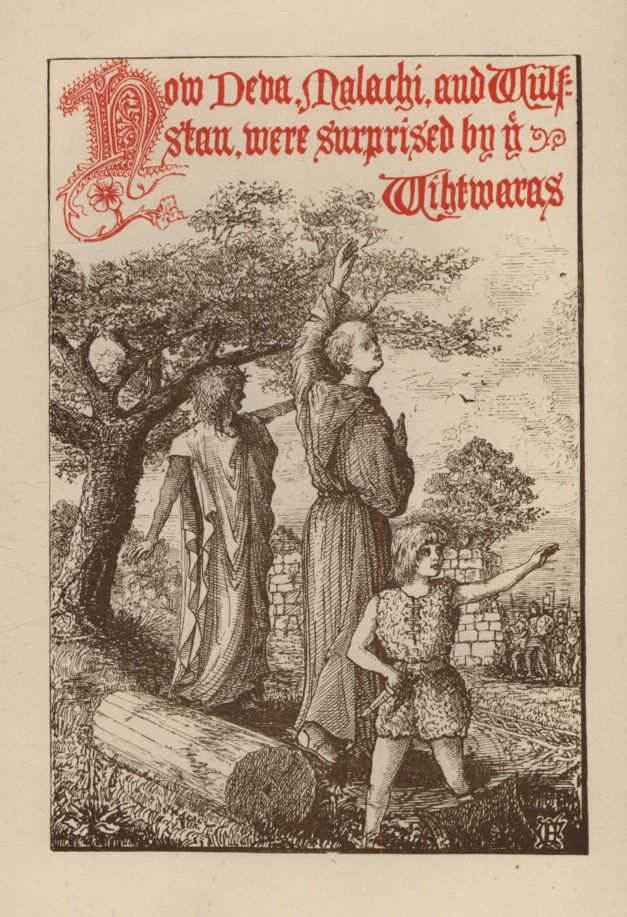
How Deva, Malachi, and Wulfstan, were surprised by ye Wihtwaras
There, entering by the same gap through which their ancestors had come to slaughter the ancestors of Deva, was a band of armed men, who, the moment they saw that their approach was known, added to the din and confusion that already prevailed by shouting their battle-cry together, and rushing upon the few men who, with Athelhune, were left to defend the encampment.
Malachi and Wulfstan had, as they shouted "to arms," darted back into the enclosure, nearly fenced in by this time, fortunately, and had with great promptitude begun to pile up the stones that had been left to close in the only means of exit or entrance for the little fortification, when suddenly Wulfstan darted out again, and returned in another minute helping poor old Deva over the rough stones.
"One moment more, and I should have been too late," cried Wulfstan, joyously, as he led the good old woman up to his father's side.
"It's only putting off the fated day, Wulfy, a little longer," said Ælfhere, drearily. "But this torture is worse than all that has gone before, for I must lie here and see all who are faithful to me and my little son slain before my eyes, and I unable to move hand or foot, or strike a blow for their safety. Oh! Woden, all-Father, help me!"
It was, indeed, a hopeless prospect. There were, besides Malachi, old Deva, Wulfstan, and the wounded eorldoman, only Athelhune and three men, and the attacking force consisted of at least twelve; but the quick eyes of Wulfstan detected among them five or six faces of men he had known as ceorls on his father's farm, and he shouted out loudly to them by name, calling on them to turn on the false traitors who had done such foul wrong, and to fight for their lord, Ælfhere, who was still alive.
It did not seem, however, that his words produced any effect; for the band of men, seeing that their surprise had in part failed owing to the inner line of wall that had been raised, after consulting a moment together, advanced on three sides, with the evident intention of taking the little fort by assault.
At first sight it seemed as though nothing could save the little party inside the hastily contrived defences, and this was evidently the view of their assailants, who rushed on to the attack in all the confidence of an easy victory; but the very extremity of their position supplied the defenders with the courage of despair.
Athelhune, with the quick apprehension of one suited to command, had heard with pleasure Wulfstan's words, and hastily told him to point out to him the men whom he had addressed. Two were advancing on the side where Athelhune and Wulfstan were standing.
Judging, that if the men who were Arwald's own people, and who had come from the other part of the island, could be disposed of, the other men would be less likely to fight with any vigour, especially if they knew that they would be received into favour again by their old eorl's son; Athelhune shouted out to his men to kill the traitors who came with Arwald, but to spare the poor fellows who were compelled to fight against their will for a tyrant and robber they hated; and he immediately hurled a stone with all his force at the man who seemed to be the leader of the party. The blow was warded off by the man's shield, but in raising his arm to do this he exposed himself to a spear thrust which Beornwulf, who was standing near Athelhune, promptly gave him; and although the man, with great heroism, continued to struggle on, yet his blows lost much of their force, and eventually he fell fainting to the ground.
Meanwhile it was already obvious that Athelhune's well-judged words, added to Wulfstan's expostulations, had had their effect, and had also been useful in a way Athelhune had not thought of; for the men who were from the other part of the island were now evidently suspicious of their allies, who had given some grounds for it by not pressing up quite so eagerly as the others had done; and this very consciousness of mistrust served to make the men work less heartily together.
It was quite clear to the man who succeeded to the leadership of the assailants on the fall of Athelhune's antagonist that what had got to be done must be done by his own men, and that the others would join in heartily enough as soon as they saw success attending their efforts. Being, therefore, a brave and energetic man, he called to his men to follow him, and sprang at the wall.
The defences had been raised nearly eight feet high, and a rude platform had been made about four feet high all round inside; thus the defenders had the advantage of striking down at their foe, as well as being protected by the breastwork of the wall. The walls were, however, very imperfectly made, without any mortar or cement; if, therefore, any of the defenders were to push too violently against it in places, he was liable to displace some of the upper stones, and expose himself. This, however, was not such a disadvantage as at first sight it seemed, for the second leader, leaping up to grasp the top of the wall, in order to pull himself over, had seized a stone that was insecurely placed, and being at the same time pressed upon by Beornwulf above, who was waiting to strike with his spear the moment the man came within thrusting distance, the mass gave way, and came down with the man, falling upon him, and crushing his legs with its weight. The two men who were behind him, and who were bold enough, caring more for the destruction of their foes than for the safety of their friends, sprang on to the step thus offered, and were climbing into the breach when they were resolutely met by Athelhune and Beornwulf, and a hand-to-hand fight of a desperate nature began.
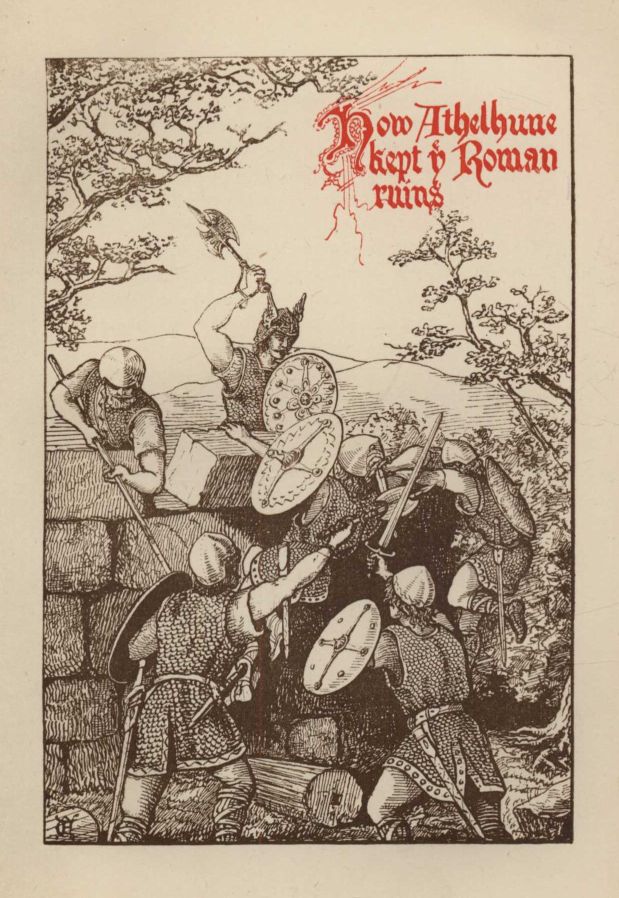
How Athelhune kept ye Roman ruins
The other half-hearted assailants were either making weak attempts to climb over the wall, or were trying to pull their crushed leader from under the weight of the stone that was lying upon his legs, and which was now rendered doubly heavy by the warrior, who was fiercely exchanging blows with Athelhune, using it as a standing place.
This desire for the safety of their fallen leader was more ostentatious than genuine, and was certainly not conducive either to his comfort or the success of the assault; for the only immediate result was to extort the fiercest execrations from the crushed leader, who suffered untold agonies by their wrenching his limbs from under the weight, and had the further consequence of causing their champion, who was engaged in the hand-to-hand fight with Athelhune, to reel on the unsteady stone. He thus missed a favourable, and what would have probably been a decisive blow at his antagonist, and received instead the full force of a tremendous stroke from Athelhune's axe, which toppled him down off the stone upon the men who were pulling at his chieftain.
Thus Athelhune was relieved of his assailant at a very opportune moment, for his neighbour, Beornwulf, was being hard driven by the Wihtwara, who was a powerful, resolute man, and, having scrambled up to the top of the wall, was more than a match for Beornwulf, who had hardly recovered from his late wound inflicted by Ceolwulf in the Andredesweald, and who was, besides, somewhat weak from want of food. Athelhune, having disposed of his foeman, turned in an instant to Beornwulf's help, and with a swinging blow of his axe shore through the leathern gaiters of the Wihtwara, as he stood striking down at Beornwulf. The force of the blow was so terrific that it not only severed the leg completely below the knee, but inflicted a deep gash in the other leg, and the wretched man fell headlong upon Beornwulf inside the fortification.
Meanwhile things had not been going quite so well on the other side of Athelhune. The two men who were defending that part of the little fort were Boseham men, and had not had experience of fighting like the body-guard of Cædwalla; they were, besides, physically inferior, being weakened by the long famine from which they, in common with the rest of the South Saxons, had been suffering; they also mistook the efforts of the old ceorls of Ælfhere for really hostile intentions, and were proportionately dispirited at the unequal nature of the contest.
The result, therefore, of the first onset had been the breaking down of the hastily-constructed defences in front, and the entry of two of Arwald's men, closely followed by three of their Brædynge allies. The two Boseham men were forced back, still fighting, and were left by the leading Wihtwara of Arwald's party to be disposed of by the others behind him.
He himself made a rush for where the wounded Eorldoman Ælfhere was lying, and without a pause waved his gleaming axe over the defenceless eorl's head. The axe rose, flashed, descended, but at the same instant two other forms had darted forward, another flash of steel almost simultaneous with that of the Wihtwara glanced in the air, and the spear of Wulfstan, driven with all the energy of rage and despair nerving his boyish strength, pierced the heart of the man who was about to murder his father; but Wulfstan's blow would have been too late had it not been for another interposition. Brother Malachi, seeing inevitable death awaiting Ælfhere, had rushed forward, and being without any weapon to ward off the blow, had without a moment's thought thrust out his arms to intercept the stroke. With a fortunate instinct he had held them high up, so that the blow had not gathered full force, but the axe inflicted a fearful wound, and Malachi's arm dropped useless to his side. But he had done his work, he had gained his object, and he sank to the ground with a sense of gratification as he saw the Wihtwara fall. There was now only one determined foe left, for the rest of the assailants, who had at no time shown any great desire to come to close quarters, were now evidently wavering, and seeing that Athelhune and Beornwulf had disposed of their antagonists, and were coming hastily to assist the Boseham men and Wulfstan, they drew together and retreated outside the enclosure, the Wihtwara belonging to Arwald going with them. Wulfstan could hardly believe in their good fortune; it seemed impossible that four armed men only, a monk, and a boy should have been able to resist the determined attack of twelve men. Had these been all animated with the same spirit as the six followers of Arwald they certainly could not have made much of a fight of it; but the lucky recognition of his father's ceorls by Wulfstan, and Athelhune's well-timed speech, had turned the scale, and they were masters of the field.
But Athelhune was not satisfied with that; springing on to the wall he shouted out to the Brædynge men to return to their eorldoman, who was waiting to reward them for their services, and who had recognised how skilfully they had managed to baffle the attempts of his enemies. He also told Wulfstan to call to them by name, and invite them to come and see their lord.
These words had their due effect, and the men came in with a sheepish air to look at their wounded master, and to salute him with respectful words. Two or three of them with greater presence of mind suddenly turned upon the only follower of Arwald still alive or unwounded, and disarmed him, accomplishing the feat so quickly as to allow him no time to defend himself.
This was a very hopeful sign of their returning fidelity, and Athelhune saw it with very visible satisfaction; but, like a prudent commander, he would take no rest until he knew what had become of Ceolwulf, for he could not disguise from himself the danger that so small a party as only three men ran, now that he knew the enemy were aware of their arrival and whereabouts.
He thought the best thing to do, therefore, would be to send off three of the most trustworthy of the ceorls to look for Ceolwulf, tell him what had happened, and hasten his return with the much-needed supplies, the want of which was now more than ever felt. Wulfstan having told him who were the men he liked best, he sent them off, and then turned to examine the results of the fight.
His first care was for Malachi, whose heroism and self-sacrifice had raised him to a pinnacle of glory. The wound he had received was of a ghastly nature; the axe had struck the arm below the elbow, had cut to the bone, and then glanced sideways, inflicting a desperate gash, and poor Malachi had already fainted from loss of blood. But Athelhune had seen plenty of wounds of a worse kind than this; indeed, the one he had himself just now given to his antagonist was of a far more terrible nature, and he did not doubt that Malachi would recover. He quickly picked a handful of grass, the softest he could find, placed it firmly over and round the wound, then tore off a piece of the dead Wihtwara's tunic, and bound the arm tightly up. Finally, making a sling, and suspending it round Malachi's neck, and inserting the arm in it, he had him placed under the shelter by Ælfhere's side. Then, leaving Deva and Wulfstan to watch over the two wounded men, he went out to see what had become of the other Wihtwaras.
The first man lay dead, close to the wall; near him lay the second leader, still unable to move, for both his legs were broken, and the stone yet rested on them; across him lay the warrior who had nearly killed Athelhune, and who lay face downwards, his helmet cut through, and showing clear evidence of what a well-delivered blow from an English battle-axe could do: he was stone dead. Inside the fortification lay the other man, whose leg had been shorn off by Athelhune; he was fast bleeding to death: nothing could be done for him, even if they had felt inclined. Near the cabin, where Ælfhere and Malachi were placed, was lying the other Wihtwara, with Wulfstan's spear still in him; and not far off was the captured follower of Arwald, sitting disconsolate and sulky, with his hands and feet tied fast.
Of Athelhune's little party only two had received wounds, and those very slight. Wulfstan was unhurt, and had forgotten all about his hunger in the joy of having slain his first enemy, and, more than all, saved his father. The rest of the men were talking together, and already Beornwulf and the Boseham men were fraternising with their late foes, who were offering to go and bring some refreshments, when a distant trampling announced the arrival of a considerable body of some sort.
Athelhune directly ordered the men to their posts, and urged them hastily to repair the walls, and then sent one of the Brædynge men to reconnoitre.
There were a few minutes of breathless suspense, for had a fresh enemy appeared it would have fared badly with the weary and scanty defenders. Suddenly a loud cheer relieved their minds, and they knew that Ceolwulf was coming, and bringing them food.
CHAPTER XII.
"THE KING SHALL HAVE HIS OWN AGAIN."
The wild cheering that answered the shouts of Ceolwulf and his party was scarcely over when the old ceorl appeared, accompanied by a number of Ælfhere's former servants, carrying baskets of provisions and other comforts, from which it was quite evident that there was no further danger to be apprehended from Arwald or his followers; indeed, it was soon known to Athelhune and Ælfhere that all the men of Arwald's party had been engaged in the late assault, and that there was no immediate risk of Arwald himself coming with a larger band, as the news would not reach him rapidly, seeing that all his men were either killed, wounded, or prisoners, and none of Ælfhere's men were likely to report the matter. This was good news to Athelhune's men, who were nearly worn out, and they were very soon engaged in discussing the good cheer.
Some of the choicest of the food was brought to Ælfhere, and although the wounded eorldoman was able to eat but little, yet that little seemed to do him good.
"Oh, father, what a joyful time is this!" cried Wulfstan, with his mouth full of a juicy morsel of pork pasty. "How I do wish Ædric were here! It seems years since I saw him; how he will wish he had had my luck!"
"My son," said Ælfhere, "the gods have been good to us; we must remember to save of the arms of those robbers to make an offering to Woden. There is one of them taken alive; it will be as well to offer him up, that my ceorls who died when they attacked us that night may have one more foeman to hack in pieces in Valhalla. Mind thou seest to it that he is taken care of. Verily, as he hath made me suffer, so shall he suffer."
Old Deva was all this time sitting rocking herself backward and forward over the fire she had lighted; near her was sitting her goat. The two seemed to understand each other. She was chanting some doggerel in an unknown tongue, in which the words "Arthur ap Uther Pendragon" seemed to occur very frequently, but nobody paid her any attention.
It had now become quite dark, and the scene was very picturesque; the men had piled up a large fire, and were stretched in various attitudes around it. They had laid the dead bodies of the Wihtwaras in a distant part of the ruins, for all were now dead; those who were mortally wounded having been put out of their sufferings by a merciful cynicism, human life in that rough age being very lightly valued.
The news of Ælfhere's existence and the arrival of the young Eorl Wulfstan, with old Biggun, had spread over the neighbourhood, and all the populace had turned out, and were thronging round the ruins. Athelhune, who did not know whether they were to be trusted, was at first a little uneasy, and told his men secretly to be on their guard; but Ceolwulf soon reassured him, and he cast off all anxiety, feasting and enjoying himself with the rest.
Song and jest and practical joke rapidly succeeded, and it would have been hard to realise that only about an hour before that same spot had been the scene of a desperate fray, in which at least ten of the revellers had been deadly antagonists; but so it was then, when men were more like children than they are now, when the world has grown older, and the transitions from one frame of mind to another were more rapid and complete, and impressions were less lasting.
As all of Athelhune's party were very weary, directions were given by Ceolwulf that a trusty band of the ceorls of Ælfhere should guard the ruins that night, while he and a few more returned to the half-burnt homestead at Brædynge. With him dispersed the rest of the crowd, and the ruins once more sank to their usual silence.
The night passed tranquilly enough. When day broke next morning, the sun rose on a sleeping band of men, and they were not aroused from their deep, refreshing sleep until the servants of Ælfhere were busied in preparing the morning meal.
Wulfstan woke with a deep sense of comfort. He was at home, as it were. Round him were the faces of many who had been familiar to him from infancy, and he sniffed up the fresh morning air that blew salt and pure from the sea with the relish of healthy youth.
The ruins bore a new aspect. Fresh rushes had been laid down near and around the little cabin where Ælfhere lay; a large iron vessel was steaming over the fire a little way off, from which the fragrant smell of a well-seasoned stew reached him, and this he appreciated even more than the pure air from the sea.
In different parts of the ruins his companions-in-arms were either still recumbent or were going through a simple toilet. Personal cleanliness was not much in fashion in the seventh century, except when it was likely to conduce to comfort, and not many, therefore, were found indulging in the luxury of a wash in the cold water from the well; but some there were, and of this number was Athelhune.
When all were aroused, breakfast was served. It was pleasant to Wulfstan to see how much better his father seemed this morning, and that Malachi also was going on well. He had had his wound dressed and strapped up again, and this time some linen was substituted for the rough remedies of Athelhune.
After breakfast a council of war was called, near the wounded Ælfhere, and it was debated what should be done next, as it was not likely Arwald would allow the death of his men to go unavenged, and the news was sure to reach him soon. It was also discussed whether it would not be better to move Ælfhere to the homestead again.
It was finally decided that this should be done, and it was also thought the restoration of the eorldoman to his home should be made as important as possible; for as Arwald was sure to hear of the matter very soon, it would be as well to let him know that the love of Ælfhere's ceorls was still with their lawful lord, the descendant of the first chieftain that led the free band of roving Jutes to conquer the land for themselves and their descendants.
Messengers, therefore, were sent out to all the country round, and all the ceorls and their thralls were invited to assist at the ceremony of bringing home the eorldoman. It was also widely disseminated that Cædwalla had sent a large force to assist Ælfhere, and to restore the Wihtwaras and Wihtea to the domination of Wessex, a part of which kingdom it had originally formed, until Wulfhere, the son of Penda, had quite recently handed it over to Edilwalch, king of the South Saxons; who, however, had never done more than appoint Arwald as his deputy, with instructions to depress such of the Wihtwaras as still preserved any attachment to Wessex.
It was quite evident to Athelhune and Ælfhere that Arwald would not allow these proceedings to pass off unmolested; or, if he did not feel himself able to attack them at once, he would undoubtedly do so in the course of a few days, when he had collected enough men for the purpose; but they hoped that the ceorls and thralls would be all wrought up to enthusiasm by the unexpected return of their own eorldoman, and would be able to make a stubborn and effectual resistance.
To the surprise of all, Ælfhere seemed much better this morning: whether it were that the treatment of Malachi had really done any good, or that the excitement of the evening before, combined with the delightful satisfaction of having been saved by his own son, and seeing his enemies slain, had roused him from his despondent torpor, and so produced this good effect. But, from whichever cause it arose, there could be no doubt of the fact—he was decidedly better. His wounds looked more healthy, and he was much more cheerful.
The ruins of the Roman villa—for whatever Deva might think about her ancestors having built it, there was no doubt it was built by the Romans or Romanised Britons—were about two miles distant from the house of Ælfhere. Ceolwulf had given directions to have the house made as comfortable as possible, and all traces of its occupation by Arwald's followers were carefully obliterated. Care also was taken that there should be a large supply of food; for no Saxon or English ceremony could be considered complete at which a large amount of good cheer was not consumed; and the usual result of a very splendid festival was the half starving of the poorer population for some weeks afterwards; but as it also had another effect, namely, the producing of a good many quarrels, which generally terminated fatally, the number of mouths to be filled subsequently was somewhat reduced.
When all was properly prepared, which was not until the afternoon, a litter was made for Ælfhere, and another for Malachi, who was now treated with greater respect, while old Deva was also placed in an important position; then Athelhune and Ceolwulf marshalled the procession. The advance was led by Ceolwulf, attended by all the old servants of Ælfhere carrying such hastily contrived banners as could be obtained for the occasion, and armed with axe and spear. Then came a crowd of thralls; a great many ceorls followed, all armed also; and immediately behind them came the litter of Malachi, followed by that of Ælfhere, by whose side walked Wulfstan and Deva, and attended by one or two of his own servants carrying refreshments. Behind the eorldoman came Athelhune, followed by Beornwulf and Osborn, and the four Boseham men, their arms all bright, and their accoutrements in proper order. This was the end of the organised procession, but a crowd of men, women, and children came thronging behind, shouting, talking, and gesticulating.