I.—Battle of Jutland: First Phase
Reading edition
Battle of Jutland I. By Allan Westcott, U.S. Naval Academy.
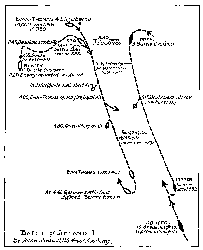
This diagram indicates the courses and ranges during the first stage of the battle, from the establishment of contact by the battle cruiser squadrons at 3:30 P. M. until the arrival of the German battle fleet about 5 P. M.
The British battle cruisers, and, presumably, those of Hipper also, were formed in bow and quarter line; or line of bearing—the ships on parallel courses but diagonally astern of the leader. During the approach the light cruisers and destroyers on each side—the position of which is not indicated—were spread out ahead of the main squadrons. The British second light cruiser squadron later took station ahead of Beatty and at 4:38 gave warning of the approach of the German battle fleet.
At 4:42 the British battle cruisers turned in succession, (squadron right countermarch,) the rear ships following the course of the leader. According to the diagram published with the official British reports in The London Times, Admiral Hipper's turn at 4:52 was to the left; but the German charts and some later British diagrams indicate the direction as above.
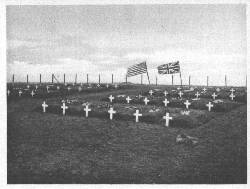
Graves of American soldiers who perished in the sinking of the Tuscania, at Port Charlotte, Island of Islay, Scotland (Times Photo Service)
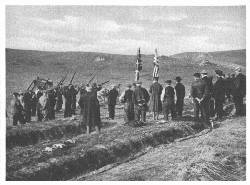
County volunteers of Islay firing a volley at the funeral of Tuscania victims at Kilnaughton, to the accompaniment of bagpipe lament (Times Photo Service)
One of the many artistic posters used by the United States Government in the Third Liberty Loan campaign, April 6 to May 4, 1918