PROPAGATION (continued 2)
Reading edition
If to be used for edging, the dwarf plants may be set 3 or 6 inches apart; the larger kinds require a foot or 15 inches in which to develop. In field cultivation the greater distance is the more desirable. From the very start the plants must be kept free from weeds and the soil loose and open. Handwork is essential until they become established. The plants will last for years.
Annual marjoram is managed in the same kind of way as to seeding and cultivation; but as the plant is tender, fresh sowings must be made annually. To be sure, plants may be taken up in the fall and used for making cuttings or layers towards spring for the following seasons beds. As annual marjoram is somewhat smaller than the perennial kind (except the dwarf perennial variety), the distances may be somewhat less, say 9 or 10 inches. Annual marjoram is a quick-growing plant—so quick, in fact, that leaves may be secured within six or eight weeks of sowing. The flowers appear in 10 to 12 weeks, and the seed ripens soon after.
When it is desired to cure the leaves for winter use, the stems should be cut just as the flowers begin to appear, and dried in the usual manner. (See page 25.) If seed is wanted, they should be cut soon after the flowers fall or even before all have fallen—when the scales around the seeds begin to look as if drying. The cut stems must be dried on sheets of very fine weave, to prevent loss of seed. When the leaves are thoroughly dry they must be thrashed and rubbed before being placed in sieves, first of coarse, and then of finer mesh.
Uses.—The leaves and the flower and tender stem tips of both species have a pleasant odor, and are used for seasoning soups, stews, dressings and sauces. They are specially favored in France and Italy, but are popular also in England and America. In France marjoram is cultivated commercially for its oil, a thin, light yellow or greenish liquid, with the concentrated odor of marjoram and peppermint. It has a warm, and slightly bitter taste. About 200 pounds of stems and leaves are needed to get a pound of oil. Some distillation is done in England, where 70 pounds of the plant yield about one ounce of oil. This oil is used for perfuming toilet articles, especially soap, but is perhaps less popular than the essential oil of thyme.
Mint (Mentha viridis, Linn.)—Spearmint, a member of the Labiatæ, is a very hardy perennial, native to Mediterranean countries. Its generic name is derived from the mythological origin ascribed to it. Poets declared that Proserpine became jealous of Cocytus's daughter, Minthe, whom she transformed into the plant. The specific name means green, hence the common name, green mint, often applied to it. The old Jewish law did not require that tithes of "mint, anise and cumin" should be paid in to the treasury, but the Pharisees paid them while omitting the weightier matters, justice, mercy, and faith (Matthew xxiii, 23). From this and many other references in old writings it is evident that mint has been highly esteemed for many centuries. In the seventeenth century John Gerarde wrote concerning it that "the smelle rejoyceth the heart of man." Indeed, it has been so universally esteemed that it is found wild in nearly all countries to which civilization has extended. It has been known as an escape from American gardens for about 200 years, and is sometimes troublesome as a weed in moist soil.
Mint, Best Friend of Roast Lamb
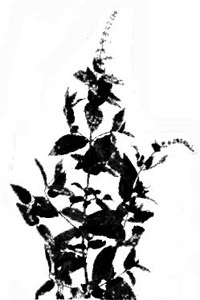
Description.—From creeping rootstocks erect square stems rise to a height of about 2 feet, and near their summits bear spreading branches with very short-stemmed, acute-pointed, lance-shaped, wrinkled leaves with toothed edges, and cylindrical spikes of small pink or lilac flowers, followed by very few, roundish, minute, brown seeds.
Cultivation.—The plant may be easily propagated by means of cuttings, offsets and division in spring. They may be expected to yield somewhat of a crop the first season, but much more the second. In field culture they will continue profitable for several years, provided that each autumn the tops are cut off near the ground and a liberal dressing of manure, compost or even rich soil is given. In ordinary garden practice it is well also to observe this plan, but usually mint is there allowed to shift for itself, along with the horseradish and the Jerusalem artichoke when such plants are grown. So treated, it is likely to give trouble, because, having utilized the food in one spot, its stems seek to migrate to better quarters. Hence, if the idea is to neglect the plants, a corner of the garden should be chosen where there is no danger of their becoming a nuisance. It is best to avoid all such trouble by renewing or changing the beds every 5 or 6 years.
Mint will grow anywhere but does best in a moist, rich loam and partial shade. If in a sheltered spot, it will start earlier in the spring than if exposed. Upon an extensive scale the drills should be 2 inches deep and 12 to 15 inches apart. Bits of the rootstocks are dropped at intervals of 6 to 12 inches in the rows and covered with a wheel hoe. For a new plantation the rootstocks should be secured when the stems have grown 2 or 3 inches tall.
For forcing, the clumps are lifted in solid masses, with the soil attached, and placed in hotbeds or forcing house benches. Three or four inches of moist soil is worked in among and over them and watered freely as soon as growth starts. Cuttings may be made in two or three weeks. Often mint is so grown in lettuce and violet houses both upon and under the benches. During winter and spring there is enough of a demand for the young tender stems and leaves to make the plants pay. It is said that the returns from an ordinary 3 x 6-foot hotbed sash should be $10 to $15 for the winter. For drying, the stems should be cut on a dry day when the plants are approaching full bloom and after the dew has disappeared in the morning. They should be spread out very thinly in the shade or in an airy shed. (See page 25.) If cut during damp weather, there is danger of the leaves turning black.
Uses.—In both the green and the dried state mint is widely used in Europe for flavoring soups, stews and sauces for meats of unpronounced character. Among the Germans pulverized mint is commonly upon the table in cruets for dusting upon gravies and soups, especially pea and bean purees.
In England and America the most universal use of mint is for making mint sauce, the sauce par excellence with roast spring lamb. Nothing can be simpler than to mince the tender tops and leaves very, very finely, add to vinegar and sweeten to taste. Many people fancy they don't like roast lamb. The chances are that they have never eaten it with wellmade mint sauce. In recent years mint jelly has been taking the place of the sauce, and perhaps justly, because it can not only be kept indefinitely without deterioration, but because it looks and is more tempting. It may be made by steeping mint leaves in apple jelly or in one of the various kinds of commercial gelatins so popular for making cold fruit puddings. The jelly should be a delicate shade of green. Of course, before pouring into the jelly glasses, the liquid is strained through a jelly bag to remove all particles of mint. A handful of leaves should color and flavor four to six glasses full.
Parsley (Carum Petroselinum, Linn.), a hardy biennial herb of the natural order Umbelliferæ, native to Mediterranean shores, and cultivated for at least 2,000 years. The specific name is derived from the habitat of the plant, which naturally grows among rocks, the Greek word for which is petros. Many of the ancient writings contain references to it, and some give directions for its cultivation. The writings of the old herbalists of the 15th century show that in their times it had already developed several well-defined forms and numerous varieties, always a sure sign that a plant is popular. Throughout the world today it is unquestionably the most widely grown of all garden herbs, and has the largest number of varieties. In moist, moderately cool climates, it may be found wild as a weed, but nowhere has it become a pest.
"Ah! the green parsley, the thriving tufts of dill; These again shall rise, shall live the coming year." —Moschus
Curled Parsley
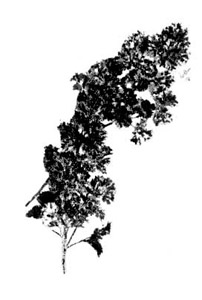
Description.—Like most biennials, parsley develops only a rosette of leaves during the first year. These leaves are dark green, long stalked and divided two or three times into ovate, wedge-shaped segments, and each division either entire, as in parsnip, or more or less finely cut or "curled." During the second season the erect, branched, channeled flower stems rise 2 feet or more high, and at their extremities bear umbels of little greenish flowers. The fruits or "seeds" are light brown or gray, convex on one side and flat on the other two, the convex side marked with fine ribs. They retain their germinating power for three years. An interesting fact, observed by Palladius in 210 A. D., is that old seed germinates more freely than freshly gathered seed.
Cultivation.—Parsley is so easily grown that no garden, and indeed no household, need be without it. After once passing the infant stage no difficulty need be experienced. It will thrive in any ordinary soil and will do well in a window box with only a moderate amount of light, and that not even direct sunshine. Gardeners often grow it beneath benches in greenhouses, where it gets only small amounts of light. No one need hesitate to plant it.
The seed is very slow in germinating, often requiring four to six weeks unless soaked before sowing. A full day's soaking in tepid water is none too long to wake up the germs. The drills may be made in a cold frame during March or in the open ground during April.
It is essential that parsley be sown very early in order to germinate at all. If sown late, it may possibly not get enough moisture to sprout, and if so it will fail completely. When sown in cold frames or beds for transplanting, the rows may be only 3 or 4 inches apart, though it is perhaps better, when such distances are chosen, to sow each alternate row to forcing radishes, which will have been marketed by the time the parsley seedlings appear. In the open ground the drills should be 12 to 15 inches apart, and the seed planted somewhat deeper and farther apart than in the presumably better-prepared seedbed or cold frame. One inch between seeds is none too little.
In field culture and at the distances mentioned six or seven pounds of seed will be needed for the acre. For cultivation on a smaller scale an ounce may be found sufficient for 50 to 100 feet of drill. This quantity should be enough for any ordinary-sized family. In all open ground culture the radish is the parsley's best friend, because it not only marks the rows, and thus helps early cultivation, but the radishes break, loosen and shade the soil and thus aid the parsley plants.
When the first thinning is done during May, the parsley plants may be allowed to stand 2 inches asunder. When they begin to crowd at this distance each second plant may be removed and sold. Four to six little plants make a bunch. The roots are left on. This thinning will not only aid the remaining plants, but should bring enough revenue to pay the cost, perhaps even a little more. The first cutting of leaves from plants of field-sown seed should be ready by midsummer, but as noted below it is usually best to practice the method that will hasten maturity and thus catch the best price. A "bunch" is about the amount that can be grasped between the thumb and the first finger, 10 to 15 stalks.
It is usual to divide the field into three parts so as to have a succession of cuttings. About three weeks are required for a new crop of leaves to grow and mature after the plants have been cut. Larger yields can be secured by cutting only the fully matured leaves, allowing the others to remain and develop for later cuttings. Three or four times as much can be gathered from a given area in this way. All plain leaves of such plants injure the appearance and reduce the price of the bunches when offered for sale.
If protected from frost, the plants will yield all winter. They may be easily transplanted in cold frames. These should be placed in some warm, sheltered spot and the plants set in them 4 by 6 inches. Mats or shutters will be needed in only the coldest weather. Half a dozen to a dozen stalks make the usual bunch and retail for 2 or 3 cents.
In the home garden, parsley may be sown as an edging for flower beds and borders. For such purpose it is best to sow the seed thickly during late October or November in double rows close together, say 3 or 4 inches. Sown at that time, the plants may be expected to appear earlier than if spring sown and to form a ribbon of verdure which will remain green not only all the growing season, but well into winter if desired. It is best, however, to dig them up in the fall and resow for the year succeeding.
For window culture, all that is needed is a box filled with rich soil. The roots may be dug in the fall and planted in the box. A sunny window is best, but any window will do. If space is at a premium, a nail keg may be made to yield a large amount of leaves. Not only may the tops be filled with plants, but the sides also. Holes should be bored in the staves about 4 inches apart. (See illustration, page 2.) A layer of earth is placed in the bottom as deep as the lowest tier of holes. Then roots are pushed through these holes and a second layer of earth put in. The process is repeated till the keg is full. Then plants are set on the top. As the keg is being filled the earth should be packed very firmly, both around the plants and in the keg. When full the soil should be thoroughly soaked and allowed to drain before being taken to the window. To insure a supply of water for all the plants, a short piece of pipe should be placed in the center of the keg so as to reach about half way toward the bottom. This will enable water to reach the plants placed in the lower tiers of holes. If the leaves look yellow at any time, they may need water or a little manure water.
As parsley is grown for its leaves, it can scarcely be over fertilized. Like cabbage, but, of course, upon a smaller scale, it is a gross feeder. It demands that plenty of nitrogenous food be in the soil. That is, the soil should be well supplied with humus, preferably derived from decaying leguminous crops or from stable manure. A favorite commercial fertilizer for parsley consists of 3 per cent nitrogen, 8 per cent potash and 9 per cent phosphoric acid applied in the drills at the rate of 600 to 900 pounds to the acre in two or three applications—especially the nitrogen, to supply which nitrate of soda is the most popular material.
A common practice among market gardeners in the neighborhood of New York has been to sow the seed in their cold frames between rows of lettuce transplanted during March or early April. The lettuce is cut in May, by which time the parsley is getting up. When grown by this plan the crop may be secured four or five weeks earlier than if the seed is sown in the open ground. The first cutting may be made during June. After this first cutting has been made the market usually becomes overstocked and the price falls, so many growers do not cut again until early September when they cut and destroy the leaves preparatory to securing an autumn and winter supply.
When the weather becomes cool and when the plants have developed a new and sturdy rosette of leaves, they are transplanted in shallow trenches either in cold frames, in cool greenhouses (lettuce and violet houses), under the benches of greenhouses, or, in fact, any convenient place that is not likely to prove satisfactory for growing plants that require more heat and light.
This method, it must be said, is not now as popular near the large cities as before the development of the great trucking fields in the Atlantic coast states; but it is a thoroughly practical plan and well worth practicing in the neighborhood of smaller cities and towns not adequately supplied with this garnishing and flavoring herb.
A fair return from a cold frame to which the plants have been transplanted ranges from $3 to $7 during the winter months. Since many sashes are stored during this season, such a possible return deserves to be considered. The total annual yield from an acre by this method may vary from $500 to $800 or even more—gross. By the ordinary field method from $150 to $300 is the usual range. Instead of throwing away the leaves cut in September, it should be profitable to dry these leaves and sell them in tins or jars for flavoring.
When it is desired to supply the demand for American seed, which is preferred to European, the plants may be managed in any of the ways already mentioned, either allowed to remain in the field or transplanted to cold frames, or greenhouses. If left in the field, they should be partially buried with litter or coarse manure. As the ground will not be occupied more than a third of the second season, a crop of early beets, forcing carrots, radishes, lettuce or some other quick-maturing crop may be sown between the rows of parsley plants. Such crops will mature by the time the parsley seed is harvested in late May or early June, and the ground can then be plowed and fitted for some late crop such as early maturing but late-sown sweet corn, celery, dwarf peas, late beets or string beans.
When seed is desired, every imperfect or undesirable plant should be rooted out and destroyed, so that none but the best can fertilize each other. In early spring the litter must be either removed from the plants and the ground between the rows given a cultivation to loosen the surface, or it may be raked between the rows and allowed to remain until after seed harvest. In this latter case, of course, no other crop can be grown.
Like celery seed, parsley seed ripens very irregularly, some umbels being ready to cut from one to three weeks earlier than others. This quality of the plant may be bred out by keeping the earliest maturing seed separate from the later maturing and choosing this for producing subsequent seed crops. By such selection one to three weeks may be saved in later seasons, a saving of time not to be ignored in gardening operations.
In ordinary seed production the heads are cut when the bulk of the seed is brown or at least dark colored. The stalks are cut carefully, to avoid shattering the seed off. They are laid upon sheets of duck or canvas and threshed very lightly, at once, to remove only the ripest seed. Then the stalks are spread thinly on shutters or sheets in the sun for two days and threshed again. At that time all seed ripe enough to germinate will fall off. Both lots of seed must be spread thinly on the sheets in an airy shed or loft and turned daily for 10 days or two weeks to make sure they are thoroughly dry before being screened in a fanning mill and stored in sacks hung in a loft.
Varieties.—There are four well-defined groups of parsley varieties; common or plain, curled or moss-leaved, fern-leaved, and Hamburg. The last is also known as turnip-rooted or large-rooted. The objections to plain parsley are that it is not as ornamental as moss-leaved or fern-leaved sorts, and because it may be mistaken for fools parsley, a plant reputed to be more or less poisonous.
In the curled varieties the leaves are more or less deeply cut and the segments reflexed to a greater or less extent, sometimes even to the extent of showing the lighter green undersides. In this group are several subvarieties, distinguished by minor differences, such as extent of reflexing and size of the plants.
In the fern-leaved group the very dark green leaves are not curled but divided into numerous threadlike segments which give the plant a very delicate and dainty appearance.
Hamburg, turnip-rooted or large-rooted parsley, is little grown in America. It is not used as a garnish or an herb, but the root is cooked as a vegetable like carrots or beets. These roots resemble those of parsnips. They are often 6 inches long and 2 inches in diameter. Their cultivation is like that of parsnips. They are cooked and served like carrots. In flavor, they resemble celeriac or turnip-rooted celery, but are not so pleasing. In Germany the plant is rather popular, but, except by our German gardeners, it has been little cultivated in this country.
Uses.—The Germans use both roots and tops for cooking; the former as a boiled vegetable, the latter as a potherb. In English cookery the leaves are more extensively used for seasoning fricassees and dressings for mild meats, such as chicken and veal, than perhaps anything else. In American cookery parsley is also popular for this purpose, but is most extensively used as a garnish. In many countries the green leaves are mixed with salads to add flavor. Often, especially among the Germans, the minced green leaves are mixed with other vegetables just before being served. For instance, if a liberal dusting of finely minced parsley be added to peeled, boiled potatoes, immediately after draining, this vegetable will seem like a new dish of unusual delicacy. The potatoes may be either served whole or mashed with a little butter, milk and pepper.
Pennyroyal (Mentha Pulegium, Linn.), a perennial herb of the natural order Labiatæ, native of Europe and parts of Asia, found wild and naturalized throughout the civilized world in strong, moist soil on the borders of ponds and streams. Its square, prostrate stems, which readily take root at the nodes, bear roundish-oval, grayish-green, slightly hairy leaves and small lilac-blue flowers in whorled clusters of ten or a dozen, rising in tiers, one above another, at the nodes. The seed is light brown, oval and very small. Like most of its near relatives, pennyroyal is highly aromatic, perhaps even more so than any other mint. The flavor is more pungent and acrid and less agreeable than that of spearmint or peppermint.
Ordinarily the plant is propagated by division like mint, or more rarely by cuttings. Cultivation is the same as that of mint. Plantations generally last for four or five years, and even longer, when well managed and on favorable soil. In England it is more extensively cultivated than in America for drying and for its oil, of which latter a yield of 12 pounds to the acre is considered good. The leaves, green or dried, are used abroad to flavor puddings and other culinary preparations, but the taste and odor are usually not pleasant to American and English palates and noses.
Peppermint (Mentha piperita, Linn.) is much the same in habit of growth as spearmint. It is a native of northern Europe, where it may be found in moist situations along stream banks and in waste lands. In America it is probably even more common as an escape than spearmint. Like its relative, it has long been known and grown in gardens and fields, especially in Europe, Asia and the United States.
Description.—Like spearmint, the plant has creeping rootstocks, which rapidly extend it, and often make it a troublesome weed in moist ground. The stems are smaller than those of spearmint, not so tall, and are more purplish. They bear ovate, smooth leaves upon longer stalks than those of spearmint. The whorled clusters of little, reddish-violet flowers form loose, interrupted spikes. No seed is borne.
Cultivation.—Although peppermint prefers wet, even swampy, soil, it will do well on moist loam. It is cultivated like spearmint. In Michigan, western New York and other parts of the country it is grown commercially upon muck lands for the oil distilled from its leaves and stems. Among essential oils, peppermint ranks first in importance. It is a colorless, yellowish or greenish liquid, with a peculiar, highly penetrating odor and a burning, camphorescent taste. An interesting use is made of it by sanitary engineers, who test the tightness of pipe joints by its aid. It has the faculty of making its escape and betraying the presence of leaks. It is largely employed in the manufacture of soaps and perfumery, but probably its best known use is for flavoring confectionery.
Rosemary (Rosemarinus officinalis, Linn.)—As its generic name implies, rosemary is a native of sea-coasts, "rose" coming from Ros, dew, and "Mary" from marinus, ocean. It is one of the many Labiatæ found wild in limy situations along the Mediterranean coast. In ancient times many and varied virtues were ascribed to the plant, hence its "officinalis" or medical name, perhaps also the belief that "where rosemary flourishes, the lady rules!" Pliny, Dioscorides and Galin all write about it. It was cultivated by the Spaniards in the 13th century, and from the 15th to the 18th century was popular as a condiment with salt meats, but has since declined in popularity, until now it is used for seasoning almost exclusively in Italian, French, Spanish and German cookery.
Description.—The plant is a half-hardy evergreen, 2 feet or more tall. The erect, branching, woody stems bear a profusion of little obtuse, linear leaves, green above and hoary white beneath. On their upper parts they bear pale blue, axillary flowers in leafy clusters. The light-brown seeds, white where they were attached to the plant, will germinate even when four years old. All parts of the plant are fragrant—"the humble rosemary whose sweets so thanklessly are shed to scent the desert" (Thomas Moore). One of the pleasing superstitions connected with this plant is that it strengthens the memory. Thus it has become the emblem of remembrance and fidelity. Hence the origin of the old custom of wearing it at weddings in many parts of Europe.
"There's rosemary, that's for remembrance; pray, love, remember: And there is pansies, that's for thoughts." —Hamlet, Act iv, Scene 5.
Cultivation.—Rosemary is easily propagated by means of cuttings, root division and layers in early spring, but is most frequently multiplied by seed. It does best in rather poor, light soil, especially if limy. The seed is either sown in drills 18 to 24 inches apart or in checks 2 feet asunder each way, half a dozen seeds being dropped in each "hill." Sometimes the seedbed method is employed, the seed being sown either under glass or in the open ground and the seedlings transplanted. Cultivation consists in keeping the soil loose and open and free from weeds. No special directions are necessary as to curing. In frostless sections, and even where protected by buildings, fences, etc., in moderate climates, the plants will continue to thrive for years.
Uses.—The tender leaves and stems and the flowers are used for flavoring stews, fish and meat sauces, but are not widely popular in America. Our foreign-born population, however, uses it somewhat. In France large quantities, both cultivated and wild, are used for distilling the oil of rosemary, a colorless or yellowish liquid suggesting camphor, but even more pleasant. This oil is extensively used in perfuming soaps, but more especially in the manufacture of eau de cologne, Hungary water and other perfumes.
Rue (Ruta graveolens, Linn.), a hardy perennial herb of roundish, bushy habit, native of southern Europe. It is a member of the same botanical family as the orange, Rutaceæ. In olden times it was highly reputed for seasoning and for medicine among the Greeks and the Romans. In Pliny's time it was considered to be effectual for 84 maladies! Today it "hangs only by its eyelids" to our pharmacopœia. Apicus notes it among the condiments in the third century, and Magnus eleven centuries later praises it among the garden esculents. At present it is little used for seasoning, even by the Italians and the Germans, and almost not at all by English and American cooks. Probably because of its acridity and its ability to blister the skin when much handled, rue has been chosen by poets to express disdain. Shakespeare speaks of it as the "sour herb of grace," and Theudobach says:
"When a rose is too haughty for heaven's dew She becometh a spider's gray lair; And a bosom, that never devotion knew Or affection divine, shall be filled with rue And with darkness, and end with despair."
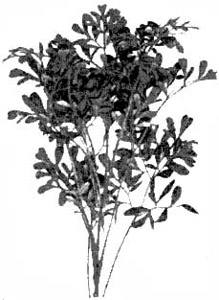
Description.—The much branched stems, woody below, rise 18 to 24 inches and bear small oblong or obovate, stalked, bluish-green glaucous leaves, two or three times divided, the terminal one broader and notched at the end. The rather large, greenish-yellow flowers, borne in corymbs or short terminal clusters, appear all summer. In the round, four or five-lobed seed vessels are black kidney-shaped seeds, which retain their vitality two years or even longer. The whole plant has a very acrid, bitter taste and a pungent smell.
Cultivation.—The plant may be readily propagated by means of seed, by cuttings, by layers, and by division of the tufts. No special directions are needed, except to say that when in the place they are to remain the plants should be at least 18 inches apart—21 or 24 inches each way would be even better. Rue does well on almost any well-drained soil, but prefers a rather poor clayey loam. It is well, then, to plant it in the most barren part of the garden. As the flowers are rather attractive, rue is often used among shrubbery for ornamental purposes. When so grown it is well to cut the stems close to the ground every two or three years.
Rue, Sour Herb of Grace
Uses.—Because of the exceedingly strong smell of the leaves, rue is disagreeable to most Americans, and could not become popular as a seasoning. Yet it is used to a small extent by people who like bitter flavors, not only in culinary preparations, but in beverages. The whole plant is used in distilling a colorless oil which is used in making aromatic vinegars and other toilet preparations. A pound of oil may be secured from 150 to 200 pounds of the plant.
Sage (Salvia officinalis, Linn.), a perennial member of the Labiatæ, found naturally on dry, calcareous hills in southern Europe, and northern Africa. In ancient times, it was one of the most highly esteemed of all plants because of its reputed health-insuring properties. An old adage reads, "How can a man die in whose garden sage is growing?" Its very names betoken the high regard in which it was held; salvia is derived from salvus, to be safe, or salveo, to be in good health or to heal; (hence also salvation!) and officinalis stamps its authority or indicates its recognized official standing. The name sage, meaning wisdom, appears to have had a different origin, but as the plant was reputed to strengthen the memory, there seems to be ground for believing that those who ate the plant would be wise.
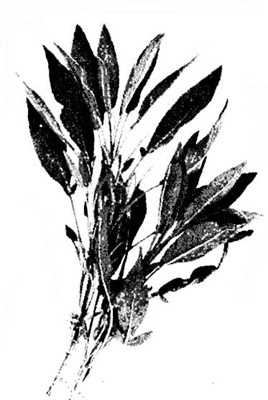
Description.—The almost woody stems rise usually 15 to 18 inches high, though in Holt's Mammoth double these sizes is not uncommon. The leaves are oblong, pale green, finely toothed, lance-shaped, wrinkled and rough. The usually bluish-lilac, sometimes pink or white flowers, borne in the axils of the upper leaves in whorls of three or four, form loose terminal spikes or clusters. Over 7,000 of the small globular, almost black seeds, which retain their vitality about three years, are required to weigh an ounce, and nearly 20 ounces to the quart.
Cultivation.—Sage does best upon mellow well-drained soil of moderate fertility. For cultivation on a large scale the soil should be plowed deeply and allowed to remain in the rough furrows during the winter, to be broken up as much as possible by the frost. In the spring it should be fined for the crop. Sage is easily propagated by division, layers and cuttings, but these ways are practiced on an extensive scale only with the Holt's Mammoth variety, which produces no seed. For other varieties seed is most popular. This is sown in drills at the rate of two seeds to the inch and covered about ¼ inch deep. At this rate and in rows 15 inches apart about 8 pounds of seed will be needed to the acre.
Sage, the Leading Herb for Duck and Goose Dressing
Usually market gardeners prefer to grow sage as a second crop. They therefore raise the plants in nursery beds. The seed is sown in very early spring, not thicker than already mentioned, but in rows closer together, 6 to 9 inches usually. From the start the seedlings are kept clean cultivated and encouraged to grow stocky. By late May or early June the first sowings of summer vegetables will have been marketed and the ground ready for the sage. The ground is then put in good condition and the sage seedlings transplanted 6 or 8 inches apart usually. Clean cultivation is maintained until the sage has possession.
When the plants meet, usually during late August, the alternate ones are cut, bunched and sold. At this time one plant should make a good bunch. When the rows meet in mid-September, the alternate rows are marketed, a plant then making about two bunches. By the middle of October the final cutting may be started, when the remaining plants should be large enough to make about three bunches each. This last cutting may continue well into November without serious loss of lower leaves. If the plants are not thinned, but are allowed to crowd, the lower leaves will turn yellow and drop off, thus entailing loss.
Relative Sizes of Holt's Mammoth and Common Sage Leaves
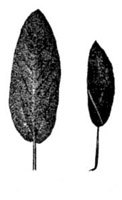
For cultivation with hand-wheel hoes the plants in the rows should not stand closer than 2 inches at first. As soon as they touch, each second one should be removed and this process repeated till, when growing in a commercial way, each alternate row has been removed. Finally, the plants should be 12 to 15 inches apart. For cultivation by horse the rows will need to be farther apart than already noted; 18 to 24 inches is the usual range of distances. When grown on a large scale, sage usually follows field-grown lettuce, early peas or early cabbage. If not cut too closely or too late in the season sage plants stand a fair chance to survive moderate winters. The specimens which succeed in doing so may be divided and transplanted to new soil with little trouble. This is the common practice in home gardens, and is usually more satisfactory than growing a new lot of plants from seed each spring.
For drying or for decocting the leaves are cut when the flowers appear. They are dried in the shade. If a second cutting is to be made, and if it is desired that the plants shall live over winter, this second cutting must not be made later than September in the North, because the new stems will not have time to mature before frost, and the plants will probably winterkill.
Sage seed is produced in open cups on slender branches, which grow well above the leaves. It turns black when ripe. The stems which bear it should be cut during a dry afternoon as soon as the seeds are ripe and placed on sheets to cure; and several cuttings are necessary, because the seed ripens unevenly. When any one lot of stems on a sheet is dry a light flail or a rod will serve to beat the seed loose. Then small sieves and a gentle breeze will separate the seed from the trash. After screening the seed should be spread on a sheet in a warm, airy place for a week or so to dry still more before being stored in cloth sacks. A fair yield of leaves may be secured after seed has been gathered.
Uses.—Because of their highly aromatic odor sage leaves have long been used for seasoning dressings, especially to disguise the too great lusciousness of strong meats, such as pork, goose and duck. It is one of the most important flavoring ingredients in certain kinds of sausage and cheese. In France the whole herb is used to distill with water in order to secure essential oil of sage, a greenish-yellow liquid employed in perfumery. About 300 pounds of the stems and leaves yield one pound of oil.
Samphire (Crithmum maritimum, Linn.), a European perennial of the Umbelliferæ, common along rocky sea coasts and cliffs beyond the reach of the tide. From its creeping rootstocks short, sturdy, more or less widely branched stems arise. These bear two or three thick, fleshy segmented leaves and umbels of small whitish flowers, followed by yellow, elliptical, convex, ribbed, very light seeds, which rarely retain their germinating power more than a year. In gardens the seed is therefore generally sown in the autumn as soon as mature in fairly rich, light, well-drained loam. The seedlings should be protected with a mulch of straw, leaves or other material during winter. After the removal of the mulch in the spring no special care is needed in cultivation. The young, tender, aromatic and saline leaves and shoots are pickled in vinegar, either alone or with other vegetables.
Dainty Summer Savory
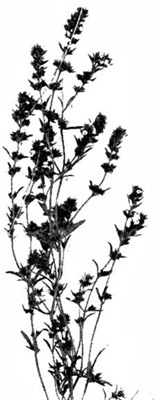
Savory, Summer (Satureia hortensis, Linn.), a little annual plant of the natural order Labiatæ indigenous to Mediterranean countries and known as an escape from gardens in various parts of the world. In America, it is occasionally found wild on dry, poor soils in Ohio, Illinois, and some of the western states. The generic name is derived from an old Arabic name, Ssattar, by which the whole mint family was known. Among the Romans both summer and winter savory were popular 2,000 years ago, not only for flavoring, but as potherbs. During the middle ages and until the 18th century it still maintained this popularity. Up to about 100 years ago it was used in cakes, puddings and confections, but these uses have declined.
Description.—The plant, which rarely exceeds 12 inches in height, has erect, branching, herbaceous stems, with oblong-linear leaves, tapering at their bases, and small pink or white flowers clustered in the axils of the upper leaves, forming penciled spikes. The small, brown, ovoid seeds retain their viability about three years. An ounce contains about 42,500 of them, and a quart 18 ounces.
Cultivation.—For earliest use the seed may be sown in a spent hotbed or a cold frame in late March, and the plants set in the open during May. Usually, however, it is sown in the garden or the field where the plants are to remain. In the hotbed the rows may be 3 or 4 inches apart; in the field they should be not less than 9 inches, and only this distance when hand wheel-hoes are to be used, and each alternate row is to be removed as soon as the plants begin to touch across the rows. Half a dozen seeds dropped to the inch is fairly thick sowing. As the seed is small, it must not be covered deeply; ¼ inch is ample. When the rows are 15 inches apart about 4 pounds of seed will be needed to the acre. For horse cultivation the drills should be 20 inches apart. Both summer and winter savory do well on rather poor dry soils. If started in hotbeds, the first plants may be gathered during May. Garden-sown seed will produce plants by June. For drying, the nearly mature stems should be cut just as the blossoms begin to appear. No special directions are needed as to drying. (See page 25.)
Uses.—Both summer and winter savory are used in flavoring salads, dressings, gravies, and sauces used with meats such as veal, pork, duck, and goose and for increasing the palatability of such preparations as croquettes, rissoles and stews. Summer savory is the better plant of the two and should be in every home garden.
Savory, Winter (Satureia montana, Linn.), a semi-hardy, perennial, very branching herb, native of southern Europe and northern Africa. Like summer savory, it has been used for flavoring for many centuries, but is not now as popular as formerly, nor is it as popular as summer savory.
Description.—The numerous woody, slender, spreading stems, often more than 15 inches tall, bear very acute, narrow, linear leaves and pale lilac, pink, or white flowers in axillary clusters. The brown, rather triangular seeds, which retain their vitality about three years, are smaller than those of summer savory. Over 70,000 are in an ounce, and it takes 15 ounces to fill a quart.
Cultivation.—Winter savory is readily propagated by means of cuttings, layers and division as well as seeds. No directions different from those relating to summer savory are necessary, except that seed of winter savory should be sown where the plants are to remain, because the seedlings do not stand transplanting very well. Seed is often sown in late summer where the climate is not severe or where winter protection is to be given. The plant is fairly hardy on dry soils. When once established it will live for several years.
To increase the yield the stems may be cut to within 4 or 5 inches of the ground when about ready to flower. New shoots will appear and may be cut in turn. For drying, the first cutting may be secured during July, the second in late August or September. In all respects winter savory is used like summer savory, but is considered inferior in flavor.
Southernwood (Artemisia Abrotanum, Linn.), a woody-stemmed perennial belonging to the Compositæ and a native of southern Europe. It grows from 2 to 4 feet tall, bears hairlike, highly aromatic leaves and heads of small yellow flowers. The plant is often found in old-fashioned gardens as an ornamental under the name of Old Man. In some countries the young shoots are used for flavoring cakes and other culinary preparations.
Tansy (Tanacetum vulgare, Linn.), a perennial of the Compositæ, native of Europe, whence it has spread with civilization as a weed almost all over the world. From the very persistent underground parts annual, usually unbranched stems, sometimes 3 feet tall, are produced in more or less abundance. They bear much-divided, oval, oblong leaves and numerous small, yellow flower-heads in usually crowded corymbs. The small, nearly conical seeds have five gray ribs and retain their germinability for about two years.
Tansy is easily propagated by division of the clumps or by seed sown in a hotbed for the transplanting of seedlings. It does well in any moderately fertile garden soil, but why anyone should grow it except for ornament, either in the garden or as an inedible garnish, is more than I can understand. While its odor is not exactly repulsive, its acrid, bitter taste is such that a nibble, certainly a single leaf, would last most people a lifetime. Yet some people use it to flavor puddings, omelettes, salads, stews and other culinary dishes. Surely a peculiar order of gustatory preference! It is said that donkeys will eat thistles, but I have never known them to eat tansy, and I am free to confess that I rather admire their preference for the thistles.
Tarragon, the French Chef's Delight
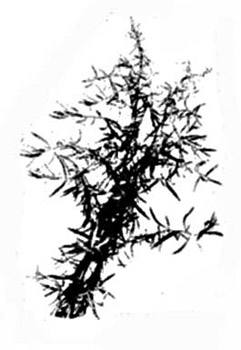
Tarragon (Artemisia Dracunculus, Linn.), a fairly hardy, herbaceous rather shrubby perennial of the Compositæ, supposed to be a native of southern Russia, Siberia, and Tartary, cultivated for scarcely more than 500 years for its leaves and tender shoots. In all civilized countries its popular name, like its specific name, means dragon, though why it should be so called is not clear.
Description.—The plant has numerous branching stems, which bear lance-shaped leaves and nowadays white, sterile flowers. Formerly the flowers were said to be fertile. No one should buy the seed offered as tarragon. It is probably that of a related plant which resembles tarragon in everything except flavor—which is absent! Tagetes lucida, which may be used as a substitute for true tarragon, is easily propagated by seed and can be procured from seedsmen under its own name. As tarragon flowers appear to be perfect, it is possible that some plants may produce a few seeds, and that plants raised from these seeds may repeat the wonder. Indeed, a variety which naturally produces seed may thus be developed and disseminated. Here is one of the possible opportunities for the herb grower to benefit his fellow-men.
Cultivation.—At present tarragon is propagated only by cuttings, layers and division. There is no difficulty in either process. The plant prefers dry, rather poor soil, in a warm situation. In cold climates it should be partially protected during the winter to prevent alternate freezing and thawing of both the soil and the plant. In moist and heavy soil it will winterkill. Strawy litter or conifer boughs will serve the purpose well. Half a dozen to a dozen plants will supply the needs of a family. As the plants spread a good deal and as they grow 15 to 18 inches tall, or even more, they should be set in rows 18 to 24 inches apart each way. In a short time they will take possession of the ground.
Uses.—The tender shoots and the young leaves are often used in salads, and with steaks, chops, etc., especially by the French. They are often used as an ingredient in pickles. Stews, soups, croquettes, and other meat preparations are also flavored with tarragon, and for flavoring fish sauces it is especially esteemed.
Probably the most popular way it is employed, however, is as a decoction in vinegar. For this purpose, the green parts are gathered preferably in the morning and after washing are placed in jars and covered with the best quality vinegar for a few days. The vinegar is then drawn off as needed. In France, the famous vinegar of Maille is made in this way.
The leaves may be dried in the usual way if desired. For this purpose they are gathered in midsummer. A second cutting may be made in late September or early October. Tarragon oil, which is used for perfuming toilet articles, is secured by distilling the green parts, from 300 to 500 pounds of which yield one pound of oil.
Thyme for Sausage
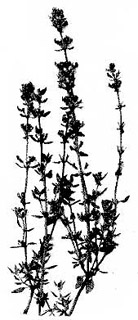
Thyme (Thymus vulgaris, Linn.), a very diminutive perennial shrub, of the natural order Labiatæ, native of dry, stony places on Mediterranean coasts, but found occasionally naturalized as an escape from gardens in civilized countries, both warm and cold. From early days it has been popularly grown for culinary purposes. The name is from the Greek word thyo, or sacrifice, because of its use as incense to perfume the temples. With the Romans it was very popular both in cookery and as a bee forage. Like its relatives sage and marjoram, it has practically disappeared from medicine, though formerly it was very popular because of its reputed properties.
Description.—The procumbent, branched, slender, woody stems, which seldom reach 12 inches, bear oblong, triangular, tapering leaves from ¼ to ½ inch long, green above and gray beneath. In the axils of the upper leaves are little pink or lilac flowers, which form whorls and loose, leafy spikes. The seeds, of which there are 170,000 to the ounce, and 24 ounces to the quart, retain their germinating power for three years.
Cultivation.—Thyme does best in a rather dry, moderately fertile, light soil well exposed to the sun. Cuttings, layers and divisions may be made, but the popular way to propagate is by seed. Because the seed is very small, it should be sown very shallow or only pressed upon the surface and then sprinkled with finely sifted soil. A small seedbed should be used in preference to sowing in the open ground first, because better attention can be given such little beds; second, because the area where the plants are ultimately to be can be used for an early-maturing crop. In the seedbed made out of doors in early spring, the drills may be made 4 to 6 inches apart and the seeds sown at the rate of 5 or 6 to the inch. A pound should produce enough plants for an acre. In hand sowing direct in the field, a fine dry sand is often thoroughly mixed with the seed to prevent too close planting. The proportion chosen is sometimes as great as four times as much sand as seed. Whether sown direct in the field or transplanted the plants should finally not stand closer than 8 inches—10 is preferred. When first set they may be half this distance. In a small way one plant to the square foot is a good rate to follow. The young plants may be set in the field during June, or even as late as July, preferably just before or just after a shower. The alternate plants may be removed in late August or early September, the alternate rows about three weeks later and the final crop in October.
Thyme will winter well. In home garden practice it may be treated like sage. In the coldest climates it may be mulched with leaves or litter to prevent undue thawing and freezing and consequent heaving of the soil. In the spring the plants should be dug, divided and reset in a new situation.
When seed is desired, the ripening tops must be cut frequently, because the plants mature very unevenly. But this method is often more wasteful than spreading cloths or sheets of paper beneath the plants and allowing the seed to drop in them as it ripens. Twice a day, preferably about noon, and in the late afternoon the plants should be gently jarred to make the ripe seeds fall into the sheets. What falls should then be collected and spread in a warm, airy room to dry thoroughly. When this method is practiced the stems are cut finally; that is, when the bulk of the seed has been gathered. They are dried, threshed or rubbed and the trash removed, by sifting. During damp weather the seed will not separate readily from the plants.
Of the common thyme there are two varieties: narrow-leaved and broad-leaved. The former, which has small grayish-green leaves, is more aromatic and pleasing than the latter, which, however, is much more popular, mainly because of its size, and not because of its superiority to the narrow-leaved kind. It is also known as winter or German thyme. The plant is taller and larger and has bigger leaves, flowers and seeds than the narrow-leaved variety and is decidedly more bitter.
Uses.—The green parts, either fresh, dried or in decoction, are used very extensively for flavoring soups, gravies, stews, sauces, forcemeats, sausages, dressings, etc. For drying, the tender stems are gathered after the dew is off and exposed to warm air in the shade. When crisp they are rubbed, the trash removed and the powder placed in stoppered bottles or tins. All parts of the plant are fragrant because of the volatile oil, which is commercially distilled mainly in France. About one per cent of the green parts is oil, which after distillation is at first a reddish-brown fluid. It loses its color on redistillation and becomes slightly less fragrant. Both grades of oil are used commercially in perfumery. In the oil are also crystals (thymol), which resemble camphor and because of their pleasant odor are used as a disinfectant where the strong-smelling carbolic acid would be objectionable.
Besides common thyme two other related species are cultivated to some extent for culinary purposes. Lemon thyme (T. citriodorus, Pers.), like its common relative, is a little undershrub, with procumbent stems and with a particularly pleasing fragrance. Wild thyme, or mother-of-thyme (T. serpyllum, Linn.), is a less grown perennial, with violet or pink flowers. It is occasionally seen in country home gardens, and is also used somewhat for seasoning.