OBSERVATIONS IN OFFICE. (continued 2)
Reading edition
When public clamor called attention to these supposed abuses, and it became necessary to make some effective demonstration of honesty, a special agent was directed to examine into the affairs of the service and report the result. It was particularly enjoined upon him to investigate every complaint affecting the integrity of public officers, collect and transmit the proofs of malfeasance, with his own views in the premises, so that every abuse might be uprooted and cast out of the service. Decency in official conduct must be respected and the public eye regarded! Peremptory measures would be taken to suppress all frauds upon the Treasury. It was the sincere desire of the administration to preserve purity and integrity in the public service.
From mail to mail, during a period of three years, the agent made his reports; piling up proof upon proof, and covering acres of valuable paper with protests and remonstrances against the policy pursued; racking his brains to do his duty faithfully; subjecting himself to newspaper abuse for neglecting it, because no beneficial result was perceptible, and making enemies as a matter of course. Reader, if ever you aspire to official honors, let the fate of that unfortunate agent be a warning to you. He did exactly what he was instructed to do, which was exactly what he was not wanted to do. In order to save time and expense, as well as farther loss of money in the various branches of public service upon which he had reported, other agents were sent out to ascertain if he had told the truth; and when they were forced to admit that he had, there was a good deal of trouble in the wigwam of the great chief. Not only did poor Yorick incur the hostility of powerful senatorial influences, but by persevering in his error, and insisting that he had told the truth, the whole truth, and nothing but the truth, he eventually lost the respect and confidence of the "powers that be," together with his official head. I knew him well. He was a fellow of infinite jest. There was something so exquisitely comic in the idea of taking official instructions literally, and carrying them into effect, that he could not resist it. The humor of the thing kept him in a constant chuckle of internal satisfaction; but it was the most serious jest he ever perpetrated, for it cost him, besides the trouble of carrying it out, the loss of a very comfortable per diem.
The results of the policy pursued were precisely such as might have been expected. A very large amount of money was annually expended in feeding white men and starving Indians. Such of the latter as were physically able took advantage of the tickets-of-leave granted them so freely, and left. Very few ever remained at these benevolent institutions when there was a possibility of getting any thing to eat in the woods. Every year numbers of them perished from neglect and disease, and some from absolute starvation. When it was represented in the official reports that two or three thousand enjoyed the benefit of aid from government within the limits of each district—conveying the idea that they were fed and clothed at public expense—it must have meant that the Territory of California originally cost the United States fifteen millions of dollars, and that the nuts and berries upon which the Indians subsisted, and the fig-leaves in which they were supposed to be clothed, were embraced within the cessions made by Mexico. At all events, it invariably happened, when a visitor appeared on the reservations, that the Indians were "out in the mountains gathering nuts and berries." This was the case in spring, summer, autumn, and winter. They certainly possessed a remarkable predilection for staying out a long time. Very few of them, indeed, have yet come back. The only difference between the existing state of things and that which existed prior to the inauguration of the system is, that there were then some thousands of Indians living within the limits of the districts set apart for reservation purposes, whereas there are now only some hundreds. In the brief period of six years they have been very nearly destroyed by the generosity of government. What neglect, starvation, and disease have not done, has been achieved by the co-operation of the white settlers in the great work of extermination.
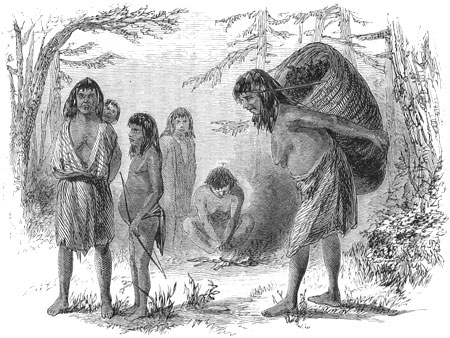
OUT IN THE MOUNTAINS.
No pretext has been wanted, no opportunity lost, whenever it has been deemed necessary to get them out of the way. At Nome Cult Valley, during the winter of 1858-'59, more than a hundred and fifty peaceable Indians, including women and children, were cruelly slaughtered by the whites who had settled there under official authority, and most of whom derived their support either from actual or indirect connection with the reservation. Many of them had been in public employ, and now enjoyed the rewards of their meritorious services. True, a notice was posted up on the trees that the valley was public land reserved for Indian purposes, and not open to settlement; but nobody, either in or out of the service, paid any attention to that, as a matter of course. When the Indians were informed that it was their home, and were invited there on the pretext that they would be protected, it was very well understood that, as soon as government had spent money enough there to build up a settlement sufficiently strong to maintain itself, they would enjoy very slender chances of protection. It was alleged that they had driven off and eaten private cattle. There were some three or four hundred head of public cattle on the property returns, all supposed to be ranging in the same vicinity; but the private cattle must have been a great deal better, owing to some superior capacity for eating grass. Upon an investigation of this charge, made by the officers of the army, it was found to be entirely destitute of truth: a few cattle had been lost, or probably killed by white men, and this was the whole basis of the massacre. Armed parties went into the rancherias in open day, when no evil was apprehended, and shot the Indians down—weak, harmless, and defenseless as they were—without distinction of age or sex; shot down women with sucking babes at their breasts; killed or crippled the naked children that were running about; and, after they had achieved this brave exploit, appealed to the state government for aid! Oh, Shame, Shame, where is thy blush, that white men should do this with impunity in a civilized country, under the very eyes of an enlightened government! They did it, and they did more! For days, weeks, and months they ranged the hills of Nome Cult, killing every Indian that was too weak to escape; and, what is worse, they did it under a state commission, which in all charity I must believe was issued upon false representations. A more cruel series of outrages than those perpetrated upon the poor Indians of Nome Cult never disgraced a community of white men. The state said the settlers must be protected, and it protected them—protected them from women and children, for the men are too imbecile and too abject to fight. The general government folded its arms and said, "What can we do? We can not chastise the citizens of a state. Are we not feeding and clothing the savages, and teaching them to be moral, and is not that as much as the civilized world can ask of us?"
At King's River, where there was a public farm maintained at considerable expense, the Indians were collected in a body of two or three hundred, and the white settlers, who complained that government would not do any thing for them, drove them over to the Agency at the Fresno. After an expenditure of some thirty thousand dollars a year for six years, that farm had scarcely produced six blades of grass, and was entirely unable to support over a few dozen Indians who had always lived there, and who generally foraged for their own subsistence. The new-comers, therefore, stood a poor chance till the agent purchased from the white settlers, on public account, the acorns which they (the Indians) had gathered and laid up for winter use at King's River. Notwithstanding the acorns, they were very soon starved out at the Fresno, and wandered away to find a subsistance wherever they could. Many of them perished of hunger on the plains of the San Joaquin. The rest are presumed to be in the mountains gathering berries.
At the Mattole Station, near Cape Mendocino, a number of Indians were murdered on the public farm within a few hundred yards of the head-quarters. The settlers in the valley alleged that government would not support them, or take any care of them; and as settlers were not paid for doing it, they must kill them to get rid of them.
At Humboldt Bay, and in the vicinity, a series of Indian massacres by white men continued for over two years. The citizens held public meetings, and protested against the action of the general government in leaving these Indians to prowl upon them for a support. It was alleged that the reservations cost two hundred and fifty thousand dollars a year, and yet nothing was done to relieve the people of this burden. Petitions were finally sent to the state authorities asking for the removal of the Indians from that vicinity; and the state sent out its militia, killed a good many, and captured a good many others, who were finally carried down to the Mendocino reservation. They liked that place so well that they left it very soon, and went back to their old places of resort, preferring a chance of life to the certainty of starvation. During the winter of last year a number of them were gathered at Humboldt. The whites thought it was a favorable opportunity to get rid of them altogether. So they went in a body to the Indian camp, during the night when the poor wretches were asleep, shot all the men, women, and children they could at the first onslaught, and cut the throats of the remainder. Very few escaped. Next morning sixty bodies lay weltering in their blood—the old and the young, male and female—with every wound gaping a tale of horror to the civilized world. Children climbed upon their mothers' breasts, and sought nourishment from the fountains that death had drained; girls and boys lay here and there with their throats cut from ear to ear; men and women, clinging to each other in their terror, were found perforated with bullets or cut to pieces with knives—all were cruelly murdered! Let any one who doubts this read the newspapers of San Francisco of that date. It will be found there in its most bloody and tragic details. Let them read of the Pitt River massacre, and of all the massacres that for the past three years have darkened the records of the state.
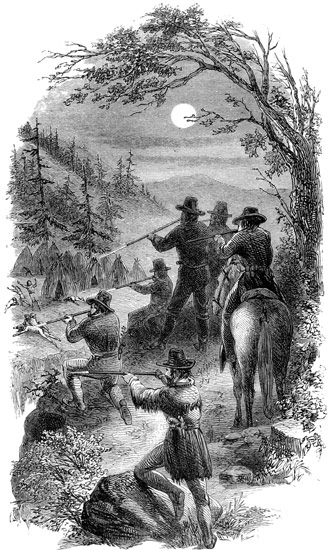
PROTECTING THE SETTLERS.
I will do the white people who were engaged in these massacres the justice to say that they were not so much to blame as the general government. They had at least given due warning of their intention. For years they had burdened the mails with complaints of the inefficiency of the agents; they had protested in the newspapers, in public meetings, in every conceivable way, and on every possible occasion, against the impolicy of permitting these Indians to roam about the settlements, picking up a subsistence in whatever way they could, when there was a fund of $250,000 a year appropriated by Congress for their removal to and support on the reservations. What were these establishments for? Why did they not take charge of the Indians? Where were the agents? What was done with the money? It was repeatedly represented that, unless something was done, the Indians would soon all be killed. They could no longer make a subsistence in their old haunts. The progress of settlement had driven them from place to place till there was no longer a spot on earth they could call their own. Their next move could only be into the Pacific Ocean. If ever an unfortunate people needed a few acres of ground to stand upon, and the poor privilege of making a living for themselves, it was these hapless Diggers. As often as they tried the reservations, sad experience taught them that these were institutions for the benefit of white men, not Indians. It was wonderful how the employés had prospered on their salaries. They owned fine ranches in the vicinity; in fact, the reservations themselves were pretty much covered with the claims of persons in the service, who thought they would make nice farms for white men. The principal work done was to attend to sheep and cattle speculations, and make shepherds out of the few Indians that were left.
What did it signify that thirty thousand dollars a year had been expended at the Tejon? thirty thousand at the Fresno? fifty thousand at Nome Lackee? ten thousand at Nome Cult? forty-eight thousand at Mendocino? sixteen thousand at the Klamath? and some fifty or sixty thousand for miscellaneous purposes? that all this had resulted in the reduction of a hundred thousand Indians to about thirty thousand? Meritorious services had been rewarded, and a premium in favor of public integrity issued to an admiring world.
I am satisfied, from an acquaintance of eleven years with the Indians of California, that, had the least care been taken of them, these disgraceful massacres would never have occurred. A more inoffensive and harmless race of beings does not exist on the face of the earth; but, wherever they attempted to procure a subsistence, they were hunted down; driven from the reservations by the instinct of self-preservation; shot down by the settlers upon the most frivolous pretexts; and abandoned to their fate by the only power that could have afforded them protection.
This was the result, in plain terms, of the inefficient and discreditable manner in which public affairs were administered by the federal authorities in Washington. It was the natural consequence of a corrupt political system, which, for the credit of humanity, it is to be hoped will be abandoned in future so far as the Indians are concerned. They have no voice in public affairs. So long as they are permitted to exist, party discipline is a matter of very little moment to them. All they ask is the privilege of breathing the air that God gave to us all, and living in peace wherever it may be convenient to remove them. Their history in California is a melancholy record of neglect and cruelty; and the part taken by public men high in position, in wresting from them the very means of subsistence, is one of which any other than professional politicians would be ashamed. For the Executive Department there is no excuse. There lay the power and the remedy; but a paltry and servile spirit, an abject submission to every shifting influence, an utter absence of that high moral tone which is the characteristic trait of genuine statesmen and patriots, have been the distinguishing features of this branch of our government for some time past. Disgusted with their own handiwork; involved in debt throughout the state, after wasting all the money appropriated by Congress; the accounts in an inextricable state of confusion; the creditors of the government clamoring to be paid; the "honest yeomanry" turning against the party in power; political affairs entangled beyond remedy; it was admitted to be a very bad business—not at all such as to meet the approval of the administration. The appropriation was cut down to fifty thousand dollars. That would do damage enough. Two hundred and fifty thousand a year, for six or seven years, had inflicted sufficient injury upon the poor Indians. Now it was time to let them alone on fifty thousand, or turn them over to the state. So the end of it is, that the reservations are practically abandoned; the remainder of the Indians are being exterminated every day; and the Spanish Mission System has signally failed.