"Crown and Sceptre" (continued 7)
Reading edition
“Better too much on the qui vive than too drowsy,” said the general, at last, good-humouredly. “I was afraid, Forrester, it was an attempt on the part of the enemy to escape.”
“And we could clear it all up with a word, Samson,” said Fred, who was full of self-reproach.
“But don’t you speak it, Master Fred,” whispered Samson, who had contrived to get another jerkin. “If you tell, they’ll go down to the wood, and find that brother of mine, and bring him in, and here he’ll be lying in clover, and doctored up, and enjoying himself, while poor we are slaving about in sunshine and rain, and often not getting anything to eat, or a rag to cover us.”
“I shall not speak, Samson, for there was no harm done,” said Fred, quietly; “but I wonder at your covering your enemy from the cold.”
“Needn’t wonder, sir. Didn’t I always cover my tender plants from the cold? It wasn’t because I liked them, but so as they’d be useful by-and-by. My brother Nat will be useful by-and-by. I want him. I shall give him such a lesson one of these days as shall make him ashamed of himself.”
A trumpet rang out again on the night air, and men dismounted, picketed their horses once more, and some lay down to snatch a few hours’ rest, while others sat together talking and asking one another questions about the attack they foresaw would most probably take place that day, for the night was waning, and they knew that before long the dawn would be showing in the east, and that it would be morn; while, in spite of plenty of sturdy courage and indifference to danger, there were men there who could not refrain from asking themselves whether they would live to see the next day.
It was somewhere about sunrise when Fred fell asleep, to dream of being in the dense thicket, carrying Nat, the Hall gardener, on his back to the hole broken through into the secret passage, where he threw him down, and covered him up with bushes to be out of the way till he got better; but, as fast as he threw him down, he came back again, rebounding like a bladder, till Samson came to his help, drew his sword, and pricked him, when he sank down to the bottom and lay still. Then Scarlett seemed to come out of the hole and reproach him for being a coward and a rebel, seizing him at last and shaking him severely, and all the while, though he struggled hard, he could not free himself from his grasp. So tight was his hold that he felt helpless and half strangled, the painful sensation of inability to move increasing till he seemed to make one terrible effort, seized the hands which held him, looked fiercely in his assailant’s eyes, and exclaimed, “Coward, yourself!”
“Well, sir, dare say I am,” was the reply; “but what can you expect of a man when you take him out of his garden and make a soldier of him all at once.”
“Samson!”
“Yes, sir. Breakfast’s ready, sir, such as it is. What’s the matter with you? I never had such a job to waken you before.”
“I—I was very sound asleep,” stammered Fred, rising hastily. “Did—did I say anything?”
“Pitched an ugly word at my head about not being so brave as you thought I ought to be, that’s all.”
“Don’t take any notice of what I said, I must have been dreaming.”
“That’s what I often wake up and feel I’ve been doing,” said Samson. “I often don’t know whether I’m on my head or my heels; it seems so strange. Wonder how that Nat is. He always gets the best of it. Lying there with nothing to do. Just his way, sir, curling himself up snug, and letting other people do his work. There you are, sir, bucket of clean water from the lake. Have a good wash, and you’ll feel like a new man. What a difference it must make to you, sir, dressing yourself out here, after having your comfortable room at home, and you so near it, too. Why, sir, the colonel might have told you to go home to sleep. Say, sir!”
“Well?” said Fred, taking his head out of the bucket of clear cold water, and feeling afterwards, as he rubbed himself dry, that new life was running through his veins.
“Wouldn’t it be nice for you to run down to the Manor to breakfast, sir, and bring back a few decent things to eat? I wouldn’t mind coming with you and carrying the basket.”
Fred looked hard at Samson, whose face was perfectly stolid for a few moments; but a little ripple gradually spread over his left cheek, and increased till it was a broad grin.
“Well, sir, you see it is so tempting. I’d give anything for a bowl of new warm milk. When are we going to have a good forage again, so as we might catch some chickens and ducks or a young pig?”
“I’m afraid there’ll be other work on hand to-day, Samson,” replied Fred, sadly, as he glanced in the direction of the Hall. “There, take away that bucket.”
“Yes, sir. Done you good, hasn’t it? and you can dry your head. Puzzle some of them long-haired chaps to get theirs dry.”
Samson went off with his young master’s simple toilet arrangements, and Fred joined his brother-officers in their frugal meal, after which he spent the morning in a state of indecision.
“I will do it,” he said, when afternoon had come; and, giving his sword-belt a hitch, and thrusting his morion a little on one side, he began striding forward, planting his boots down heavily on the soft heather, in which his great spurs kept catching till he at last nearly fell headlong.
Recovering himself, he went on, hand upon hip, and beating his gloves upon his thigh, till he came to where Colonel Forrester was slowly pacing up and down, with his hands clasped behind his back.
As Fred drew nearer, an orderly came up to the colonel, and presented a letter, which brought the lad to a standstill. He had been having a long struggle with self, and had mastered his shrinking, but he was so near the balance of vacillation still, that he felt glad of the excuse to hang back, and walked aside, feeling like one who has been reprieved.
“How do I know what he will say?” thought Fred, glancing back at his father’s stern, wrinkled countenance as he read his despatch. “It isn’t like the old days, though I used sometimes to feel shrinking enough then. It is not between father and son, but between colonel and one of his followers.”
Fred felt as if he would like to walk right off; but there were those at the Hall occupying his thoughts, and he made an effort over his moral cowardice and stopped short, meaning to go to his father as soon as the messenger had left.
He had not long to wait, for the orderly saluted and rode off, but there was something else now to check him. His father looked so very severe, and as if there was something very important on his mind.
“I have chosen a bad time,” thought Fred. “I’ll go away and wait.”
“No, no,” he said, half aloud; “how can I be so foolish? I will go up and speak to him like a man. It is mean and cowardly to hang back.”
He stepped toward the colonel again, but there was another reprieve for him, the general riding up; and for the next quarter of an hour the two officers were in earnest converse.
“Yes,” said Fred; “I have chosen a bad time. I’ll go.”
But he did not stir, for at the same moment he felt that the general might be planning with his father that which he sought to prevent.
“I’ll go and speak now they are together,” he said to himself, desperately. “General Hedley likes me, I think, and he could not be very cross.”
“No, I dare not,” he muttered; and he paced to and fro again till the general touched his horse’s flanks, and rode slowly away, Colonel Forrester following him thoughtfully for some distance, till in a fit of desperation Fred hurried to his side.
“Want me, my boy?” said the colonel, gravely.
“Yes, father. I want to ask you something.”
“Yes; go on. I am very much occupied just now.”
Fred looked at him piteously, his words upon his lips, but refusing to be spoken.
“Well, my boy, what is it? Are you in some great trouble?”
The words came in so much more kindly a tone, that Fred made a step toward his father, and the barrier of discipline gave way, and it seemed to be no longer the stern officer but the father of the old Manor house days he was longing to address.
“Well, my boy, what is the trouble?” said Colonel Forrester, kindly.
“It is about—”
Fred did not finish his sentence, but pointed across the lake.
“Ah, yes, about the Hall!” said the colonel, with a sigh. “Well, my boy, what do you wish to say?”
“Are they keeping to what was in Sir Godfrey’s message, father?”
“Yes, my boy,” sternly.
“But don’t you think they could be persuaded to surrender?”
“Yes, Fred.”
“Oh, father, I am glad,” cried the boy, joyously.
“Yes, persuaded,” continued Colonel Forrester, in measured tones, “with sword and gun, not till they are utterly helpless. Then they may.”
“Oh, father!”
“Yes, my boy; it is very sad, but they will not see that their case is desperate.”
“Is the attack to be made to-day, father?”
“I am not the general in command, my boy. That is a matter for another to decide.”
“Yes; but you know, father, and you can trust me.”
“Of course I can, Fred, and I will. Yes; the attack is to be made directly.”
“And will it succeed?”
“It must. It shall. No. I will not interfere,” he added to himself a moment later.
“And you, father?” said Fred, anxiously.
“Well, my boy, what of me?”
“You— Oh, father. Must I speak out. Don’t be angry with me. I have no right to say such things to you, but I always looked upon Scar Markham as a brother, and they always treated me at the Hall as if I was a son; and it does seem so terrible for you to be going up at the head of armed men to attack our dear old friends.”
Colonel Forrester stood with his brow knit.
“You are angry with me, father; but I can’t help speaking. I say it seems so terrible. You ought not to do this thing.”
Fred’s hesitation had gone. He had taken the plunge, and now he felt desperate, and ready to speak on to the end. He gazed full in the stern face with the lowering brows, but it checked him no longer. His words came fast, and he caught his father by the arm.
“If you speak to General Hedley, he will listen to you, for Sir Godfrey is your oldest friend; and think, father, how horrible it would be if the Markhams were to be killed.”
The brows appeared to be knit more closely, and Colonel Forrester’s gaze seemed fierce enough to wither his son.
But Fred kept on, begging and importuning his father to do something to change the general’s purpose, without obtaining any reply.
“Then you are going to lead the attack on the Hall, father?” said Fred at last.
The colonel turned upon him sharply.
“You must not, you shall not,” cried Fred, excitedly. “Yes; I see you are angry with me; but—”
“No, my boy, not angry,” said the colonel, gravely; “but very, very proud of you. No, my boy, I am not going to head the fight.”
“Father!” cried Fred, joyously.
“And I have done more than beg General Hedley to excuse me from all participation in to-day’s work.”
“Then it really will be to-day?”
“Yes, my boy, it really will be to-day, and I’d give anything for this day to be past, and the worst known.”
“But they will give them quarter, father?”
“Yes, my boy, of course, but who can say what may happen in dealing with fierce, reckless men, fighting as they believe for their lives. Those with whom they are engaged may be willing to take them prisoners, but they will fight with terrible desperation, incited by Sir Godfrey’s example, and no one can say how the attack will end.”
“Yes, father, I see,” said Fred, sadly, “but could you not persuade General Hedley to give up the attack?”
Colonel Forrester was silent for a few moments, and then said sadly—
“No.”
“Oh, father! think of Lady Markham and of little Lil.”
“I have thought about them, my boy,” said the colonel, speaking in a slow, measured voice, “and I have three times over begged of the general to spare the Hall and its defenders, and to let us go on at once.”
“And what did he say?” cried Fred, eagerly.
“He asked me if it was the voice of duty speaking, or that of friendship, and what could I say?”
Fred looked at him piteously.
“How could I leave that nest of hornets to harass our rear, and gather a fresh and stronger force together, so as to be ready for the next detachment which comes along west. No, boy, I am obliged as an officer to agree with my superior that every man must be cleared out of that Hall before we can stir. Sir Godfrey Markham has his fate in his own hands.”
“What do you mean, father? Surrender?”
“Of course. He shall have due respect paid to him and his followers; but it is madness to expect it of him, even for their sake.”
“For their sake, father?”
“Yes, my boy. There, I may as well tell you. I am not the stern, implacable enemy you think me. I wrote to Sir Godfrey last night, asking him to surrender for his wife and daughter’s sake.”
“You did this, father?” cried Fred, eagerly.
“I did, my boy.”
“And what did he say?”
“He sent a stern, insulting message, similar to his last, and those who were with him threatened to crop the next ambassador’s ears if he dared present himself at the Hall.”
“Let me go and make another appeal to Sir Godfrey.”
“You heard the threat?” said Colonel Forrester, looking at his son curiously.
“Yes, I heard, father.”
“And will you risk it, if I give you a message to take?”
“Yes, father, it was a vain boast. They dare not insult a messenger.”
“No, my boy, you shall not go,” said Colonel Forrester, laying his hand upon his son’s shoulder. “It would be courting injury for no good purpose.”
“But if it would save Sir Godfrey and poor Scarlett?”
“It would not, Fred.”
“Don’t say that, father. If I could see Scar Markham, he would perhaps listen to me; and if he did, he might have as much influence upon Sir Godfrey as I have upon you. Father, let me try.”
“No, Fred, it cannot be,” said the colonel, sternly. “I am not in command here. The general has sent twice, the second appeal being made through my request, and in each case the answer was an insult.”
“Bit, father—”
“It is useless, my boy, so say no more. Sir Godfrey brings the assault on himself. I have done all I can. General Hedley acknowledges it, and you see I have ceased to be the stern officer to you, and have spoken kindly and in the spirit you wish.”
“But one moment, father. Do you think we could persuade Sir Godfrey through Scarlett?”
“No, my boy, and I am afraid I should act precisely the same were I in his place. No more now.”
“But, father, shall I be expected to go forward with the troops?”
“No. I have provided against that, Fred. You and I will not be combatants here.”
“Why, father!” cried Fred, excitedly. “Look!”
“Yes,” said Colonel Forrester, sadly. “They have begun. I thought it would not be long. I dreaded being in the general’s confidence over this.”
Chapter Thirty Seven.
Watching the Attack.
That which Fred had dreaded had indeed begun, for about a hundred and fifty men had been told off for the attack, and these had prepared themselves by picketing their horses, arming themselves with stout axes for the barricades, and dragging after them stout scaling-ladders.
The advance had seemed to be dilatory before, and the generally received opinion in the camp had been that the defending party, to save risk, was to be starved into submission.
But those who judged did not know the general. He had been waiting his time, for sundry reasons: respect for Colonel Forrester, and mercy, being among these; but now that he found it necessary to adopt strong coercive measures, he was prompt and quick in every step.
Fred Forrester was freed from the terrible necessity of taking part in the attack, but that did not lessen his eagerness to see what would be the result, and in consequence he hurried to the top of the nearest woodland summit, and from thence prepared to witness the issue of the fight.
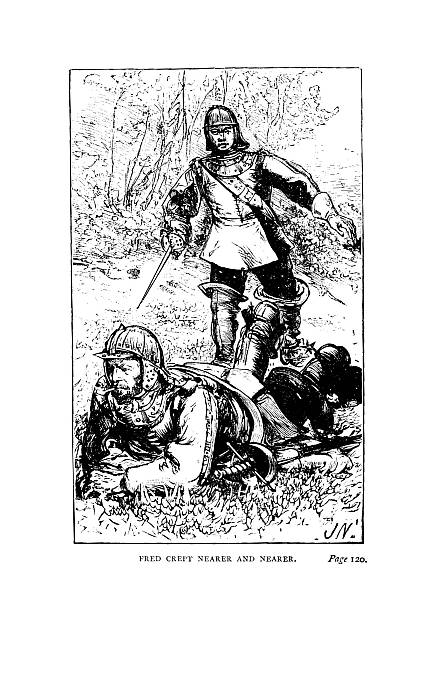
As he reached the clump of beeches which crowned the hill, he caught sight of the back of some one lying at the very edge of the wood, in the commanding spot he had selected for himself, and where he had often stood to make signs to Scarlett in the old boyish days. For a moment or two he hesitated, and then approached, wondering who it could be, and taking the precaution to draw his sword, for it was not likely to be one of their own men.
It was disconcerting to find any one there, and for the moment he was ready to draw back. But, on the other hand, it might be a spy of the enemy, who had crept up there to watch their proceedings; and under these circumstances, Fred felt that there were only two courses open to him, flight or bold attack.
To make such an attack in cold blood required consideration. It was not like taking part in an exciting charge, amid the stirring din of battle, when the pulses were bounding, and the bray of the trumpet called them to advance. He, a mere youth, had to go single-handed to an encounter with a great broad-backed fellow, who, at the first brunt, might turn the tables upon him.
“But he is a spy,” said Fred to himself; “and he is sure to be half afraid;” and without further hesitation, the lad advanced softly, keeping well behind.
As he drew nearer he could see that the man was upon his chest with his arms folded for a support; his morion was tilted back over his ears, so that it covered his neck, and as he watched the advance, he slowly raised first one and then the other leg, crossing them backwards and forwards, and beating the ground with his toes as if they were portions of a pick-axe.
A peculiar feeling of hesitation came over Fred again, and he found himself asking whether he ought not to go down for help, and whether there were any of the man’s companions near.
This he felt was only common prudence; and, stepping back, he carefully searched among the trees and round the edge of the hill. But no, the man seemed to have come up quite alone; and, gaining confidence from this, he went softly back, taking care not to trample upon any dead twig, so as to give the alarm.
In a few minutes he was again at the edge of the wood, near enough to see that the man wore a backpiece, and that the hilt of his sword was quite near his hand.
The hesitation was gone now. A glance showed that the attacking party were near the end of the lake, and that outposts of three or four men were dotted here and there, ready to drive back or capture any of the Cavaliers who might try to make their escape.
“I’ll do it,” said Fred to himself; and, stooping down, he crept nearer and nearer, holding back any twig or obtruding branch with his sword, and wincing and preparing for a spring, when a bramble grated against the edge of his blade.
But the man was too intent upon the scene below, and paid no heed to a warning which, had he been on the alert, would have placed Fred at a terrible disadvantage.
The lad’s eyes, as he crept on with sword in advance, were fixed on the back of the man’s half-hidden neck; and he had made his plans, but for all that he could not help glancing down at the advancing men, and pausing to note that the Cavaliers were at the barricaded windows, ready for their enemy.
And now for a moment Fred again wondered whether he was doing right, and whether his more sensible plan would not have been to go down to the camp and spread the alarm.
His answer to this thought was to set his teeth, which grated so loudly that his grip tightened on the hilt of his sword, and he felt sure that he must have been heard.
But no; the man lay perfectly still, watching intently, as motionless, in fact, as if he had been asleep; and Fred crept step by step nearer and nearer, till he felt that he was within springing distance, and then stopped to take breath.
“How easy it would be to kill him,” he thought, “and how cowardly;” and he was about to put his first idea into action, namely, to make one bold spring forward, and snatch the man’s sword from the sheath.
But the sword might stick, the sheath clinging to it tightly, as it would sometimes; and if it did, instead of the man being helpless, it would be he who was at the mercy of one who might beat him off with ease.
So, giving up that idea, he paused a few moments, till the man raised his head a little higher, so as to get a better view of those below, and then with one bold spring, Fred was upon his back, with the point of his sword driven in a peculiar way into the soft earth.
That idea had occurred to him at the last moment, and even in the intense excitement of the moment he smiled, as he saw in it success, for it effectually baffled the man in what was his first effort—to draw his sword, which was pinned, as it were, to the ground by Fred’s weapon being passed directly through the hilt.
There was an angry snort, as of a startled beast, a tremendous heave, and a coarse brown hand made a dart at the sword-blade, and was snatched away with an exclamation of pain. Then in fiercely remonstrant tones a harsh voice shouted—
“You coward! Only let me get a chance!”
“Samson!” cried Fred, starting back as he removed his knee from the back of the man’s head, and the ex-gardener’s steel cap rolled over to the side.
“Master Fred!” was the answer; and Samson turned over and sat up, staring in his assailant’s face.
“You here?”
“Here, sir, yes; and look what you’ve done. Don’t ketch me sharping your sword again, if you’re going to serve me like that.”
He held up his hand, which was bleeding from the fact of his having seized hold of the blade which had pinned down his hilt.
“But I thought you were one of the enemy—a spy.”
“Then you’d no business to, sir. I only come up here to see the fight.”
“But I thought you were down in the ranks—gone to the attack.”
“Me? Now, was it likely, sir, as I should go and fight against the Hall? No, sir, my bad brother Nat, who is as full of wickedness as a gooseberry’s full of pips, might go and try and take the Manor, if it was only so as to get a chance to ransack my tool-shed; but you know better than to think I’d go and do such a thing by him. Would you mind tying that, sir?”
Samson had taken a strip of linen out of his morion, and after twisting it round the slight, freely bleeding cut on his finger, held it up for Fred to tie.
“Thank ye kindly, sir. I meant that for a leg or a wing, but it will do again for them.”
“I am very sorry, Samson,” said Fred, giving the knot a final pull.
“Oh, it don’t matter, sir; only don’t try any o’ them games again. So you thought I was a spy?”
“Yes.”
“And what was you going to do with me?”
“Make you a prisoner, and take you down to camp.”
“Well, you are a one!” said Samson, looking at his young master, and laughing. “Think of a whipper-snapper like you trying to capture a big chap like me.”
Fred winced angrily.
“Well, not so much of a whipper-snapper as Master Scarlett, sir; but you haven’t got much muscle, you know.”
“Muscle enough to try.”
“Yes, sir,” said the ex-gardener, thoughtfully; “but it isn’t the muscle so much as the try. It’s the thinking like and scheming. You see a bit of rock stands up, and you can’t move it with muscle, but if you put a little bit of rock close to it, and then get a pole or an iron bar, and puts it under the big rock and rests it on the little, and then pushes down the end, why, then, over the big rock goes, and it’s out of your way.”
“Yes, Samson,” said Fred, thoughtfully, as he watched the advance; “and so you didn’t care to go to the attack?”
“No, sir, I wouldn’t; but it was tempting, though; ay, that it was.”
“Tempting?”
“Well, you see, Master Fred, Nat has got some chyce cabbage seed, and he’d never give me a pinch, try how I would; no, nor yet sell a man a pen’orth. He kept it all to himself, just out of a nasty greedy spirit, so that his cabbages might be bigger and heavier than ours at the Manor. I’d have had some of that seed if I’d gone, for he couldn’t have come and stopped me now.”
“No, poor fellow! I wonder how he is?”
“Getting better, sir. He’s as tough as fifty-year-old yew. Nothing couldn’t kill him; but look, sir, look! See how they’re getting up to the terrace. Ah!”
This exclamation was made as a white puff suddenly seemed to dart from one of the windows of the Hall, and then there was another, and another, the reports seeming to follow, and then to echo from the next hill.
But no one in the attacking force seemed to fall, neither did it check them. On the contrary, they appeared to be spurred into action, and instead of creeping on as it were in a slow steady march, they broke up into little knots, and dashed forward, while a second line kept steadily on.
“Look at them! look at them, Master Fred! Don’t it make you feel as if you wished you was in it?” cried Samson, excitedly. “That’s it; fire away; but you won’t stop ’em. All Coombeland boys, every man-jack of ’em, and you can’t stop them when they mean business.”
“No,” said Fred between his teeth, as he tried to keep down the feelings of elation engendered by the gallantry of the attack, by forcing himself to think of how it would be were he Scarlett Markham, and these men enemies attacking his home. “Look, look, Samson!” he whispered, with his throat dry, his tongue clinging to the roof of his mouth, and the scar of his worst wound beginning to throb.
“Yes, I’m a-looking, sir,” said Samson, in as husky a voice. “There, they’ve got a ladder up against the big long window, and they’re swarming up it. They’ll be indirectly, and drive the long-haired gentlemen flying like leaves before a noo birch broom.”
“No,” said Fred, shading his eyes with his hands; “no. Ah, did you hear the crash? How horrible! Some of them must be killed.”
“Not they, Master Fred. But I don’t see how they did it. Fancy turning the ladder right back with seven or eight lads running up it! But it was well done.”
“Can you see whether any one is hurt?”
“Not at this distance, sir. Not they, though, unless they’ve got any of those long thin swords skewered into them. I’ve tumbled twice that height out of apple-trees, and no one to fall upon. They’d all got some one to tumble on, except the bottom one, and I don’t suppose he’s much hurt.”
“Hurt, man? He must be killed.”
“Tchah! not he, sir. T’others would be too soft. Look, sir; don’t lose none of it. You may never have such a chance again. Yes; there, they’ve got the ladder up once more, and some’s holding it while the others goes up. Yes. Huzza! they’ll do it now. No. If they haven’t overturned it again.”
“Yes,” said Fred, sadly, and yet unable to help feeling pleased, so thoroughly were his sympathies on both sides. “They’re giving it up, Samson; they’re retiring.”
“No, sir; only carrying some of the hurt ones out of the fight. There goes another ladder up—two. Hah! look at that!”
Fred’s eyes were already riveted on the fresh scene, for, plainly seen even at that distance, the strong oaken-boarding screen nailed over the window at the end of the terrace on the ground floor was suddenly thrown down, and with a shout which was faintly heard on the hill, a party of about five and twenty Cavaliers rushed out, sword in hand, taking the attacking party in the flank with such vigour that they gave way, the two scaling-ladders were overturned, and for the moment the Puritans took to flight, and the attack seemed to have failed.
“Beaten, Samson,” said Fred, unable to crush down a feeling of satisfaction, even at the reverse of his own party.
“Beaten, sir? Not they. Only driven back. It’s just like the waves down by the cave, yonder; they come back again stronger than ever. Told you so, sir. Look at that.”
Samson Dee was right, for a solitary figure had suddenly stepped forward from the second rank, rallied the beaten men, and advanced with them slowly and steadily. There was a desperate mêlée, as the Cavaliers, reinforced by more from within, tried to complete their rout, and then, as it seemed to the excited watchers, the Royalists were driven back step by step, by sheer force of numbers. Then in the midst of a seething confusion, all swayed here and there along the terrace, and on and on, till the barricaded windows and porch were reached, and then, as they were checked by the stubborn walls as water is stopped by a pier, they struggled fighting ever sidewise, a stream of mingled men along the front of the house and over the broken-down boarding, till the tide of confusion set right through the open window into the Hall.
At first this human current was a mingling of both sides; then the Cavalier element seemed to disappear, and as Fred watched with starting eyes, he could see at last that it was a steady stream of their own men which flowed through the opening.
“They’re in, Master Fred! The day’s ours. Hark! Hear them firing inside? Look! Look!”
It was plain enough to see: from the window, whence the scaling-ladders were thrown down, men come dropping forth sword in hand, Cavaliers evidently, to be encountered by those of the Puritan party still without. Then out came other Puritans, to take the Cavaliers in the rear, as they fought together in a knot facing all round, with their swords flashing as they made their gallant defence.
Then a rush seemed to take place, and they were overpowered, while the smoke came slowly rolling out from the open window, though the firing had ceased.
The fighting still went on within for a few minutes; then a rush as made out from door and window, and a tremendous cheer arose, loud enough to strike well upon the spectators’ ears, helmets were seen flashing, swords flourished in the air, and it was plain enough that resistance had ceased, while the attacking force were gathering together once again.
“Smoke seems long while rolling out, Master Fred; must ha’ been a deal o’ firing we did not hear.”
“Oh!” shouted Fred, as like a flash the truth came home to him.
“What’s the matter, lad? Are you hurt?” cried Samson.
“No, no; look! The dear old Hall!” cried Fred. “Don’t you see?”
“Smoke, sir? Yes.”
“No, no, my good fellow, not smoke alone; the poor old place is on fire.”
And without another word, Fred, followed closely by Samson, dashed down the hill.
Chapter Thirty Eight.
“Is there nothing we can save?”
It was too true.
Whether started by some smouldering wad, or by a piece of furniture being driven into one of the fire-places, or, as was more probable, by the wilful act of one of the Royalist party, who was determined that the victors should not profit by their success, the Hall was on fire, and the smoke, which rapidly increased in volume, showed that the danger must be great.
“Don’t run quite so fast, Master Fred,” panted Samson. “You can’t keep up at that pace. Better take it a bit more coolly.”
There was wisdom in the hurried words, and Fred slackened his speed a little, so as to allow his follower to come alongside; and in this way, taking in the whole proceedings as they ran, they continued their course down the park slope, toward the lake.
There before them in the evening glow was the fine old house, with the dense cloud of smoke slowly rising, and shouts reached them as men were seen running to and fro in obedience to the orders, but what those orders were it was impossible to tell.
In front of the building a strong body of the general’s men was drawn up, and in their midst the prisoners stood in a knot, while from time to time horsemen came slowly in, leading other prisoners, who had evidently been captured in efforts to escape.
But though Fred strained his eyes eagerly, the distance kept him from recognising any familiar faces, and a terrible sense of heart-sinking increased as he hurried on.
All at once the thundering of horses’ hoofs was heard behind, and a familiar voice shouted Fred’s name.
He turned to see that it was his father, who slightly checked his powerful horse as he came up.
“Quick! you two,” he cried; “lay hold of the mane, and run.”
Fred grasped the idea in an instant, seized the horse’s thick mane, and dropped into step as the sturdy beast trotted on. But the mane was all on Fred’s side, and Samson missed his opportunity, but as the horse passed on, he made a snatch at the tail, twisted his hand in the thick hair, was nearly jerked off his feet, but recovered himself, and held on, improving his position by degrees, and contriving to keep up.
“They must have done this themselves, Fred,” said Colonel Forrester, in a deeply troubled voice. “Hah! that’s right. We must save the place.”
“What are they doing, father?”
“Our men are joining line toward the stable yard, and getting buckets, I think. Hold on tightly.”
“I’m quite right, father,” panted Fred; and he kept up till they reached the men who surrounded the prisoners, and who burst into a cheer as the colonel came up.
Fred’s position prevented him from seeing exactly who were numbered among the prisoners, and at that moment the general drew rein at their side.
“You shouldn’t have let them fire the place, Hedley,” said Colonel Forrester, in a voice full of reproach.
“It was not our doing, man. Some of their own party started it. There was a fire in the big dining-room. Hangings, chairs, and linen were thrown upon it. The fire blazed up the oak panellings, and the open windows fanned the draft.”
“We must save it. Come on.”
“We are doing everything possible, man; but the water is in a well, and what can we do with three or four buckets?”
“Give me a score of men to try and tear down the burning part,” cried Colonel Forrester, who had leaped from his horse, and thrown the reins to the nearest soldier. “Here, quick! fifty of you come on.”
He was close up to the porch, from which the men were tearing down the barricade, but the general was bending over him directly.
“Look at me, Forrester,” he said.
The latter gazed up at him sharply, to see that his face was blackened with smoke, and the general’s lips parted to speak.
“I stayed in yonder till I was driven out by the fire. It is not safe to go.”
“But we must save the place,” cried the colonel; and he dashed through the opening the men had made, followed by Fred and Samson, a dozen more, including the general, influenced by his friend’s example, rushing after them.
They reached the Hall, but only to find that the flames were literally rushing out of the great dining-room door, on the one side, and running up the panelled walls, setting the beautiful ceiling ablaze, while from the library, on the other, there was a furnace-like roar, as the flames literally charged up the oaken staircase, whose balusters were already glowing, and the gallery and corridor were fast flaring up as the fire licked and darted and played about.
“You see,” said the general, as he seized the colonel’s arm again, “if we had ample water and the proper means, we could do nothing.”
Colonel Forrester groaned as he saw the fire darting up the panels, the carved beams of fine old oak already well alight, and the various familiar objects falling victims to the flames. Even as he gazed, with the cool air of evening rushing in behind them through the porch, and wafting the clouds of smoke upward to pass rapidly along the corridor as if it were some large horizontal chimney, he saw the canvases of the old family paintings heave and crumple up, while the faces of Sir Godfrey’s ancestors seemed to Fred to be gazing fiercely through the lurid light, and reproaching him for helping to desolate their home.
Frames, panelling, the oaken gallery rails, blazed up as if they had been of resin in the tremendous heat; the stained-glass in the various windows crackled, flew, and fell tinkling down.
“Well,” said the general, quietly, “you see, the place was fired in two places. We can do nothing?”
“No,” groaned Colonel Forrester, as he looked wildly round. Then, in a despairing tone, as he gripped his son’s arm, “Fred, is there nothing we can save?”
As he spoke, a great burning fragment of the gallery balustrade fell with a crash on to the oaken floor, the embers scattering in all directions, the gallery floor rose in the intense heat, as if a wave were passing through it, and as all backed involuntarily toward the door, one of the suits of armour fell forward with a crash.
“It would be utter madness,” said General Hedley. “At least here. We could not have stayed a minute but for the cool air rushing in behind. If you wish to try and save anything, we must break in through the windows from outside.”
The argument was unanswerable; and after a last wild gaze round, the little party gave way step by step, and were literally driven out by the tremendous heat, Fred’s last look back being at the splendid staircase, now one raging mass of fire, which was spreading upward with terrific speed.
As they stood outside once more, the dense clouds of smoke were pouring through the upper windows, and directly after, from the broad casement above the porch, where Fred had held converse with the Cavaliers in his character of ambassador, a great billowy wave of lurid smoky flame lapped and flapped like a fiery banner, and then floated upward into the soft cool air.
The afternoon had been calm and windless, but now it seemed as if a sharp breeze was setting in toward the doomed house, fanning the flames and making them roar, while overhead, and rapidly increasing in volume, floated a huge cloud of smoke, spreading and spreading till it resembled the head of a gigantic tree, whose black and purply grey foliage brightened from time to time with a lurid glow.
But by this time axes were at work breaking down the stout boarding from the wide drawing-room window to the right of the porch. This great wide window had been completely covered, as a means of defence, save that here and there slits had been left to enable the defenders to fire on their enemies.
So stoutly was this work done with boards torn from stabling and barn at the back of the house, that it took some time to clear an opening and dash in a portion of the casement, and the fire had been gaining strength so potent, that as the first casement was driven in a volume of hot stifling smoke shot out, was apparently driven in by the air which rushed toward the house, there was a dull report, and the interior, that had been black the moment before, suddenly glowed with dull red, which was brightened by flashes.
Colonel Forrester was checked for the moment, as he tried to climb in, but calling on Samson and his son to follow, he rushed on.
Samson was second, and Fred had reached the sill, when there was a bright flame, which illumined the smoke-filled room, and he uttered a cry for help, and hesitated, for he had caught a glimpse of those who had preceded him lying prone upon the floor.
The help was quickly rendered, a dozen stalwart troopers dashing in, half to come struggling out choking and blinded.
What followed, Fred hardly recalled. He knew that he had leaped down to try and drag his father out, when something seemed to seize him by the throat, a terrible dizziness robbed him of sense, and the next thing he comprehended was that he was lying on the grass, with a man bathing his face, and that for a few minutes he could not speak or make out what it all meant.
“Better, my lad?” said a well-known voice; and he recognised the face of the general bent down over him, and saw that the morion he wore gleamed in the bright light cast upon it.
“My father!” cried Fred, as his understanding grew more clear.
“Safe. He has just recovered a little. Your servant, too. Yes; here he is.”
“Fred, my boy,” said a husky voice. “Thank Heaven! he is safe.”
“Safe? Yes, father; only a little giddy. You have escaped?”
“Yes; they dragged us out in time. Look at the poor Hall.”
Fred turned to see that from half the windows the flames were rushing out with a fearful violence, the centre of the old building being now a glowing furnace, whose flames fluttered and roared and leaped, while the wings were rapidly being eaten into by the flames.
“And we can save nothing, Hedley,” said the colonel, sadly.
“Yes, sir, our lives. We can do no more. Pretty well that we got you out, and that the prisoners left the place.”
Fred had risen, and was standing by the general’s side, looking at him wildly.
“Well?” said the latter. “What are you thinking?”
“The wounded, sir—the dead?” said Fred, huskily.
“There were no dead. The wounded were all brought out, I feel sure. My boy, we have done our best. Forrester, are you well enough to move?”
“Yes; better now.”
“You see the place is doomed. It is a sad affair; but we are guiltless. I will place the prisoners in your hands. See that they are courteously treated, and send them off under the escort of a troop to Barnstaple—at once. You can go and help.”
This last was to Fred, who accepted the duty eagerly, and the next minute he was making his way with his father in the direction of the knot of prisoners, whose armour shone in the light of the glowing pile.
Chapter Thirty Nine.
A Fruitless Search.
As Colonel Forrester and his son approached the prisoners, who were lying about on the grass in a variety of easy, careless attitudes, gazing at the fire, which had now assumed terrible proportions, Fred became aware of the fact that in place of being despondent, the Cavaliers were chatting away in the most indifferent manner.
But their conversation ceased, for from behind came a loud crashing noise, caused by some floor falling, and a buzz of wonder and admiration arose as the glowing windows suddenly belched forth flame, spark, and glowing flakes of fire, in so many eddying, whirling columns, which rose up and up to mingle and gild the lower surface of the cloud of smoke which glowed with orange and purple and red, while sparks flashed and glittered as they darted here and there like the flakes of a snowstorm suddenly changed to gold.
The scene was glorious now, for after a moment’s pause, the burning wood which had fallen formed fresh fuel to the mighty furnace within the thick walls, and the flames rushed up with renewed violence, illumining the scene far and near. Great sombre trees grew visible, brightened by the wondrous glow; the lawn seemed to be cut up into paths of light, and further away, ruddy reflections flashed from the lake; while the noble old Hall seemed to stand out against a dark background, with every angle, battlement, and vane clearly cut, till the smallest carving was plainly defined.
But for the horror of the scene, Fred could have stood and gazed with delight at the wondrous series of changes that were taking place; the clouds of smoke, which seemed to form vast spirals, ever turning, and rolling over, now dull red, now bursting into light, as if from fires therein; the eddying scintillations which crackled and exploded, and disappeared; the ruddy tongues of flame which darted in and out as if the long low windows were monstrous dragons’ mouths, from which the darting forks came to play over golden stony lips, and lick the mullions and buttresses around. Then came a fresh explosion, as pent-up gases, generated by heat, burst forth to augment the fire with hiss, crackle, and flutter, as it seemed to gain its climax, and then sank down with a low dull roar.
From time to time there was a sharp tinkling, as the higher windows cracked, broke, and fell upon the stones. Then came pouring down a spouting torrent of silver fire, shooting right out of a stone gargoyle-mouth as the molten lead from one part of the roof, dammed up by other lead which had not melted, at last forced its way spattering on to the paved terrace below.
But after these brilliant bursts, which had enchained Fred’s attention for a time, he turned once more toward the group of prisoners, whose loud, careless talking had begun again, and he passed between two of the guard stationed round them in a circle, while lying outside, in a confused heap, just as they had been thrown, were the weapons of which the Cavaliers had been deprived.
As Fred drew nearer, he could see that the careless attitudes of some of the party were assumed, for in spite of the glow shed by the fire, it was plain enough that the cheeks of several were of a deathly pallor, and that they were suffering intense pain. One had a scarf tied tightly round his arm; another had a broad bandage about his brow; hardly one seemed to have escaped some injury in the desperate sally and defence. But the aim of all was to carry their defeat with an air of the most careless indifference—as if wounds were nothing to them, and they held their Puritan captors in the most profound contempt.
“Hallo!” shouted a voice Fred had before heard, “here’s my fire-eating young ambassador. Why, hang it all, sirrah! How is it you were not to the front before? I’d rather have given up my sword to you than have had it knocked out of my hand by the ugliest crop-eared knave I ever met.”
Fred, the moment before, was eagerly scanning the group in search of Sir Godfrey and his old companion; but he had searched in vain, and he was anxiously debating within himself as to whether that meant bad news or good. Had they escaped? and were they now safe, or—?
He was checked by the greeting of the tall, fair Cavalier, and advanced to him at once, the high-spirited officer continuing his bantering speech the while.
“Why, you heinous young rebel,” he cried, “have you come to trample on your poor prisoners now you have taken them; or are we to be shot, or hung, or what?”
“Don’t talk to me like that, sir,” said Fred, eagerly, as he paused by where the Cavalier lay; and now he could see that his jerkin was darkened in one spot with blood.
“How do you want me to talk, then, eh?”
“Sir Godfrey?—Scarlett Markham? Where are they?”
“Escaped,” said a gentleman lying by, with careless levity. “Run for it—broken through your lines, and got clean away.”
“Not they,” said the tall Cavalier, warmly. “Sir Godfrey Markham was not the man to leave his friends in the lurch; and as for my young friend Scarlett, he would have stood by us to the end.”
“But they are not here?” said Fred, anxiously.
“Here, sir? No. They must be with your other prisoners.”
“Other prisoners?” faltered Fred, turning pale, as a horrible thought assailed him, and he darted a frightened glance at the burning Hall; “there are no other prisoners but these.”
“What!” cried the Cavalier, starting to his feet, and then turning faint, so that he would have fallen, but for Fred’s arm. “Thank you, my lad,” he said frankly; “a little weak, I suppose. Yes; I will lie down.”
Fred helped him into a reclining position again upon the turf.
“Tell me all you know about them, sir,” said Fred, going down on one knee to help the wounded officer. “Scarlett and I used to be great friends. Did they escape right away?”
The Cavalier seemed at first to be about to respond in his old careless, bantering, half-mocking way, but as he saw the eagerness of manner, and the anxiety in the lad’s eyes, his manner changed.
This was no ruse, he saw; no cunning trick to find out which way the Markhams had gone, but a true honest feeling for one who had been a friend, but was now transformed by political troubles into an enemy.
“Shake hands,” he said warmly. “I like you, boy. I’ll tell you all I know.”
Fred eagerly took the prisoner’s hand, as the others looked on curiously, their assumption of carelessness gone, and a dull look of despair making its appearance in their eyes and at the angles of their mouths. And as Fred took that hand, it was cold and damp, and the grip was feeble, as its owner said slowly—
“Sir Godfrey Markham and I divided our little force, after drawing lots for choice; I won the choice, and selected the task of making the sally. It would have been too irksome to me to stay behind a barrier and wait to be attacked. I suppose you know—your people were too strong for us, and we were beaten back, followed by your men, till we were all together struggling in the dining-room, from there into the hall, and then on the great staircase. I saw Sir Godfrey and young Scarlett several times during the struggle; then we were all pell-mell, here, there, and everywhere, and I recollect no more.”
“But where did you see them last?”
“I cannot say—in the drawing-room, I think.”
“Yes. What were they doing?”
“What do you think they were likely to be doing, boy? Fighting bravely for their king.”
There was a pause.
“You do not think that—”
Fred did not finish his sentence. “That they set fire to the Hall? No; Sir Godfrey was too proud of his old home to destroy it.”
“I did not mean that,” said Fred, hoarsely; “I meant—”
“Wounded—killed?” Fred bowed his head. He could not speak, for there was a horrible idea tugging at his brain, one which he could not shake off.
“Wounded? Perhaps. Killed? Heaven forbid! No; I hope and believe that they fought to the last, and then escaped, or else, far more likely, they are—”
He stopped short, for the idea that troubled Fred had now been communicated to him, and he drew in his breath with a look of horror. Then, as if unable to control himself, he glanced sharply at the burning building, while, giddy and weak with emotion, Fred walked slowly back, to make his way to his father, who met him and took his arm.
“Have you heard any news of them?” said the colonel, hoarsely.
“No, father,” half whispered Fred; and he repeated the Cavalier’s words.
Colonel Forrester glanced at the burning Hall, nearly every portion of which had now been seized upon by the flames, and he drew a deep hissing breath, as he whispered to himself—
“No, no; impossible! They must have escaped. Fred,” he said aloud, “they will not tell us if we ask—it is quite natural; so we are quite in the dark as to how many the defenders were. There were none killed, and I find that the wounded were all carried out. Sir Godfrey and his son must have escaped, or if not, they will be brought in by some of the outposts.”
Fred made no answer; he could not speak, for a terrible picture was before his eyes—that of Sir Godfrey, wounded to the death, unable to stir, and Scarlett trying to bear him out to safety, but only to be overtaken and beaten down by the flames.
He walked on by his father in silence, while the latter gazed straight before him, thinking to himself of the past, when he and Sir Godfrey were the fastest of friends.
“This cruel war!” he said to himself. “Friend against friend, brother against brother. Poor Godfrey! Poor Scarlett! So full of brave manliness and courage. Fitting end for two brave spirits; but I feel as if I had assisted at their death.”
But at that moment Fred made a mental effort.
“I will not believe it,” he said, with a shudder. “It is too horrible.” Then aloud, “Father, may I take something to the prisoners, and help them? They look very bad.”
“Yes, yes; of course,” said the colonel, starting as it were back to the present. “Poor fellows! The surgeon must be with them now; but go and do your best.”
But hard as Fred worked by the light of the burning house, he could do little to assuage the pains, mental and bodily, of the prisoners. They assumed a careless indifference, a good-humoured contempt for their captors. They were Cavaliers—gentlemen who did not scruple to serve as ordinary soldiers for the benefit of their country; and they smiled at the rough stern men of the Puritan ranks. But deep in their hearts there was a despairing rage at being conquered, which bit and stung, and made them writhe more than the throbbings of their wounds.
The refreshments Fred took to them, helped by Samson, were simple, but most welcome; and more than one eye brightened and directed a friendly grateful look at the lad who busied himself on the captives’ behalf.
“No; no more, my boy,” said the tall, fair Cavalier, smiling at Fred, as he pressed him to eat. “I have a wound here that throbs as if some one were thrusting a red-hot iron through my shoulder. I suppose it is all right, but your surgeon has not hands like some delicate lady.”
“Can I do anything?” said Fred, eagerly. “Shall I bathe the wound?”
“No, my desperate and deadly enemy, no,” said the Cavalier, smiling as he look Fred’s hand; “and look here: some of these days the war will be over, and if you and I are not sleeping too soundly, you must come and see me, and I’ll come and see you. At present our duty is to kill each other, or take one another prisoner. By-and-by we shall have more time. There,” he said, drawing a ring from his finger; “you wear that, and remember that Harry Grey always feels respect and esteem for a brave enemy, while for you— Oh, curse it! We are not enemies. God bless you, my lad! You and Scar Markham ought to be working together as a pair.”
He turned impatiently away, laid his head upon the folded cloak, of which Fred had made a pillow and closed his eyes, as if annoyed that he should have seemed weak; while, after pressing the ring tightly down in its place, Fred stood back watching the group of wounded and captive men for a few minutes, before turning away, and then stopping short by the little heap of swords of which they had been deprived.
As it happened, one with a peculiarly shaped guard took his attention, for he remembered having seen it hanging to the belt of the Cavalier he had been tending.
Stooping down, he was in the act of drawing it from among the others, when the sentinel made a movement to arrest his hand.
“Don’t interfere,” said Fred, sharply. “I will be answerable to Colonel Forrester for what I have done.”
The man drew back, and stood resting upon his clumsy firelock again, while, as the lad stood with the sword in his hand, he raised his eyes from the hilt, and found that the Cavalier was watching him, and making a sign to him to approach once more.
Fred stepped to his side.
“No,” he said; “you cannot have it. You are a prisoner.”
“Of course,” said the wounded man, smiling; “though if I had it, I could not use it. I was going to say I am glad you have taken it. A capital blade, my boy. Here, unbuckle the belt, and take it and the sheath. Yes, I insist. That’s right. Keep it, lad, and don’t, if we meet again, use it on me. No, no thanks; it is yours by right of capture. Now I want a nap.”
Chapter Forty.
A Sad Report.
The Cavalier let his head sink once more upon his pillow, and Fred went slowly away, to go and watch the flames rising and falling as the Hall burned rapidly, sending forth a glow of heat that could be felt far away.
And now that the hurry and excitement were at an end, Fred had time once more to think of those of whose fate he was still uncertain.
Just then a prisoner was being brought in, and he hurried to the spot, but only to turn away disappointed, to go and gaze once more at the burning pile, musing sadly on the times when he had passed such pleasant hours about the place which had been to him as a second home; and thinking, as he gazed through the open windows into the furnace within, of the various rooms where every object was so familiar—picture, ornament, carved cabinet, trophy—and now all turning to glowing embers.
“Seems a pity, Master Fred, don’t it?” said a voice at his elbow.
“You here, Samson?”
“Yes, sir; just come from round at the back.”
“Has the fire made its way there?”
“Oh, bless you, sir, it’s been creeping and rushing and leaping over everything! Even the big tool-house and fruit-room’s burned. Such a pity. Nice lot of tools all destroyed; and, not that I want to find fault, but a deal better set than we ever had at the Manor. Why, there was a barrow, sir, as run that light in your hands, no matter how you filled it, as made it a pleasure to work.”
“And all burned, Samson?”
“All burned into ashes, sir. I never could understand it, but it always did seem hard as a man like brother Nat should have such a barrow as that, while I had one as I was ashamed of.”
“We must get to the wilderness to-night, Samson, somehow.”
“Oh, he won’t hurt, sir,” said Samson, roughly. “He’s right enough; but I’ve got a bottle o’ cider, and three bread-cakes, and half a roast fowl to take with us when we go.”
“That’s right,” said Fred, smiling in spite of himself; but only to turn serious as an agonising thought shot through him, for a portion of the roof of the Hall fell just then, and a whirlwind of sparks sprang into the evening sky.
“Have you heard any news, Samson?” whispered Fred.
“News, sir?”
“Of Sir Godfrey and Scarlett?”
Samson stood gazing straight at the fire, his eyes half shut, and his forehead a maze of puckers and wrinkles, and he seemed not to have heard in the intentness of his watching the progress of the fire.
“Do you hear what I say?” reiterated Fred. “Is there any news of Sir Godfrey and Scarlett?”
“Yes, I hear what you say, sir.”
“Then why don’t you speak?”
“’Cause I haven’t nothing good to say.”
“Oh, Samson, there is no bad news?”
“No, sir; there’s no bad news at all.”
“Then what do you mean? What have you heard?”
“Don’t, don’t ask me, my lad.”
“But I do ask you, and I will know.”
“I only know what the men think, and of course that may mean nothing.”
“What do they think?”
“Now, look ye here, Master Fred,” cried Samson, appealingly, “what’s the good of your bullying me into saying things which will only make you cross with me, and call me a thundering idiot, or some other pretty thing like that?”
“But anything’s better than suspense, and I want to know the worst.”
“Well, then, you can’t,” said Samson, gruffly. “There aren’t no worse, because it’s all guessing.”
“Well, then, what do they guess?”
“Now, look ye here, Master Fred—is it fair to make me tell you, and put you in a passion; and you a-standing there with a sword by your side, and another in your hand?”
“Speak, sir—speak!”
“Very well, sir; here goes. And if you fly in a passion, and do anything rash to me, it will only be another triumph for my brother Nat.”
“Will you speak, sir?”
“Yes, I’m going to, sir; but one must make a beginning. Well, then, Master Fred, it’s only hearsay, and you know what hearsay is. Some one heard one of the prisoners say that he saw Sir Godfrey go down wounded, and young Master Scarlett jump across him, fighting like a madman; and then people were driven all sorts of ways, but not before there was a regular burst of fire sweeping along; and they think that Sir Godfrey and poor Master Scarlett was overtaken by the flames. Master Fred! Master Fred! don’t take on like that. It’s only what they say, you know, dear lad, and it may be all wrong.”
The rough fellow laid his hand upon his master’s arm, as Fred turned away.
“But it’s what I fear—it’s what I fear,” he groaned. “And my father thinks the same; I know he does. Oh, Samson, how horrible! how horrible! If I only knew who fired the place!”
“Oh, I know that, sir,” said Samson. “One of the prisoners boasted about it—not one of the gentleman Cavaliers, but one of the rough fellows like me. He says he set the place a-fire in two places, when he saw the game was up; and he said that it was so as we shouldn’t have comfortable quarters—a mean hound!”
“Poor Scar! poor old Scar!” groaned Fred, walking slowly away, to try and get somewhere alone with his sorrow, as he thought of his brave, manly young friend.
He walked on till he was right away down by one of the clumps of trees at the west end of the lake; and as he groaned again he started, for he thought he was alone, but Samson had followed him softly.
“Don’t ’ee take on, Master Fred, lad. Be a man. I feel as if I should like to sit down and blubber like a big calf taken away from its mother, but it won’t do, lad, it won’t do; we’re soldiers now. But if I could have my way, I’d just get them all together as started this here war, and make ’em fight it out themselves till there wasn’t one left, and then I’d enjoy myself.”
“Don’t talk of enjoyment. Samson, my lad.”
“But I must, for I just would. I’d go and get the sharpest spade I could find, and take off my jerkin, and bury what was left of ’em, and that would be the finest thing that could happen for old England.”
“Nonsense, man! You don’t understand these things,” said Fred, sadly.
“And I don’t want to, sir. What I understand is that instead of fighting the French, or the Spaniards, or any other barbarous enemies, we’re all fighting against one another like savages; and there’s the beautiful old Hall burning down to the ground like a beacon fire on a hill, and who knows but what it may be our turn next?”
“What, at the Manor, Samson?”
“Yes, sir. Why not?”
“Heaven forbid, man! Heaven forbid!”
“And I say ‘Amen,’ sir. But come back to camp, and let’s get you a bit of something to eat; and, I say, sir, you did give my hand a deep cut. Think that new sword you’ve got’s as sharp as the one I whetted for you?”
“I don’t know, Samson,” said Fred, drearily. “I hate the very name of sword.”
“And so do I, sir, proud as I was the first day I buckled mine on. I aren’t much of a smith, but I can blow the bellows like hooray, and when the time comes, as it says in the Bible, I’ll make the fire roar while some one hammers all the swords and spears into plough-shares and pruning-hooks, and cuts all the gun-barrels up into pipes. That’s right, sir; come along.”
Fred said no more, but, with their shadows darkly shown upon the trampled grass, the pair walked back to camp.
Chapter Forty One.
Nat is Lost.
“Have I been to sleep, Samson?”
“Yes, sir, sound as a top. You dropped off after you had that bread and cider.”
“And the Hall?—is it still burning?”
“Yes, sir; a regular steady fire down at the bottom, with the walls standing up all round.”
“And the prisoners?”
“All gone, sir. They packed ’em off to the west’ard in a couple of waggons, and a troop of our men as escorts. Fine fellows, sir, all but that one as fired the Hall. I couldn’t help being sorry to see how wounded and helpless they were. But how they carried it off, laughing and talking there till they’d been seen to, and were tired and got stiff! Then it began to tell on ’em, and they had to be lifted into the waggons and laid on the straw almost to a man.”
“I hope they’ll all recover,” said Fred, sadly.
“So do I, sir, even if we have to fight ’em again. But we shall see no more of the poor lads for a long time, unless some of their party rescues them, cures them, and the game begins over again. Feel ready, sir?”
“Ready?”
“Yes; it’s about twelve o’clock, and I thought you might like to come and help me bully that ugly brother of mine.”
“Why, Samson,” said Fred, with a sad smile, “every one says you two are so like.”
“So we are, sir, to look at,” replied Samson, grinning; “but I never said I was good-looking, did I?”
“Yes, I’m ready,” said Fred, rising from his heather couch. “Oh, how stiff and cold I am!”
“You’ve just wakened; that’s why. You’ll be as fresh as fresh soon. Come along, sir, and we’ll give that rascal such a bullying.”
“With care and chicken,” said Fred, with a miserable attempt at being jocose.
“Now, don’t I keep telling you it’s only to make him strong, so as he can feel it all the sharper when I give him the big beating I’ve promised him? Come along, sir.”
Fred made a few inquiries as to the state of affairs; learned that the camp was quite at rest, and that he was not likely to be called on duty, and then, with a terrible depression of spirits, increasing at every step, he walked on beside Samson on as dark a night as he could recall.
“Dark, sir?” said the ex-gardener, in response to a remark. “Well, yes, sir, it is; but it don’t make any difference to us. We could find our way where we are going with our eyes shut.”
The darkness was not their only difficulty: they had to avoid the sentinels again, and neither could say for certain whether any changes had been made.
Still, both had been on moorland, over bog, and through the deepest woods in the dark on trapping expeditions times enough. They had even been in the darkness on the dangerous cliff slopes again and again, so that they had no hesitation in going rapidly on till the lake had been skirted and the wilderness reached, without their being challenged. Then the dense undergrowth was entered, and they stood listening for a few moments.
There were distant sounds—the snort of a horse where it was picketed, a low humming as if some sentry were cheering his dreary watch by recollections of an old west-country ditty, and then from a little distance there was the half-hissing, half-grating cry of a white owl, as it flapped along upon its downy, silent pinions, while, through the trees at the edge of the wood, there was a dull red light, which showed where the embers of the great oaken beams of the Hall sent forth their dying glow.
“Let’s go on,” whispered Fred, just as something came gliding along the edge of the wilderness, and as they moved it uttered a piercing screech, turned, and swept away.
“Ugh!” ejaculated Samson; but Fred’s hand was upon his lips, and they stood close together with throbbing hearts, wondering whether the two cries would alarm the nearest sentinel.
But they heard nothing, and as silently as possible stole in among the trees, it being impossible to make any selection of route.
“How them owls do chill one, like, in a unked place like this! ’Member that one as come out of the wood shed as we went in last winter? Always scares me.”
“I dare say it scares them more than it does us,” whispered back Fred. “Now don’t speak.”
“Right, sir.”
Fred led on, moving more by instinct than sight, and seeming to feel which was the way to the spot where they had left the injured man; but it was a long and arduous task, and not till after he had gone astray three times did he pause in perplexity.
“If I could get any idea of where the Hall lay, perhaps I could find him,” whispered Fred; “but we have turned about so, that I don’t know which way we are looking now.”
“More don’t I, sir; for aught I know we might be somewhere hundreds of miles away. It’s so plaguey dark.”
“Look! Isn’t that the reflection of the fire?”
“No, sir; there’s nothing there. Ah, look there!”
A dull low sound fell upon their ears, and simultaneously there was a flash of light in quite a different direction to that in which they had been straining their eyes.
“What’s that, sir?”
“Some part of the Hall fallen in.”
“And made the fire flash up just as it does when you’re burning rubbish. That’s right, sir.”
“Yes; and I can find it now,” whispered Fred.
The struggle through the undergrowth was resumed, every step having to be taken with the greatest caution; and at last, after making endless diversions to avoid tree-trunks and masses of tangled growth that they could not force their way through, Fred stopped short.
“What is it, sir?”
“This is the place.”
“No, sir, I don’t think it is.”
“Yes; I can tell by the touch. I am close up to the fallen tree. There, I can feel the touchwood. Be quiet. Hist! Nat! Nat!”
There was no reply, and after a pause, Fred called again, as loudly as he dared.
“No, sir; I thought it wasn’t,” said Samson, softly. “It’s further up.”
“Be silent, man,” said Fred, impatiently. “I am sure we are right. It may be a little to the left or a little to the right, but its close here.”
He called again and again softly, but without result.
“Let me try, Master Fred, as you are so sure.”
Fred gave his consent, whispering to his companion to be careful.
“Nobody won’t take any notice of what I do, Master Fred,” whispered Samson. “I’ll give him an old cry we used to have on the moor, when we were boys;” and directly after, sounding distant and strange, and as if it could not possibly have been given by his companion, there rang out a peculiar low piping whistle, followed by a short jerky note or two.
“That’s oyster-catcher, Master Fred, as you well know. If he hears that he’ll answer and know it’s friends—I mean enemies.”
Fred made no reply to his follower’s paradoxical speech, but listened intently.
“Again,” he said, after a time; and the cry rang out, to be followed by a dull thud as of footsteps, and a clink of steel against steel.
Fred felt his arm grasped, and Samson’s hot breath in his ear.
“Keep quiet. There’s a sentry close by, and they’re going the rounds.”
The dull sound of footsteps died away, and not till then did Samson venture upon another call, that proved to be as unavailing as those which had preceded it.
“P’raps he’s asleep,” said Samson, softly; “but that ought to have roused him.”
Fred drew a long breath, as in imagination he saw the poor wounded fellow lying there in the dark and cold; and as a chilly perspiration bedewed his face, he felt a horrible feeling of reproach for not having given notice of an injured man lying in the wood. For he told himself, and the thought gathered strength, that perhaps they had come too late.
For a few minutes he could not speak, and when he did, his heart was beating heavily, as he whispered—
“Samson, do you think—?”
He could not finish the terrible sentence, one which his companion misconstrued.
“Of course I do, sir. I told you so. This aren’t the place, I’m sure.”
“It is! it is!” said Fred, with passionate energy, “Here, I am touching the old tree; and, yes—I know. Here is the place where he must be lying.”
“Very well, then, sir, stoop down and lay hold of his leg gently, and give it a pull. Be on the look-out, for he can be very nasty at being woke up. Maybe he’ll kick out. He used to when we were boys.”
Fred felt dizzy as he listened to his companion’s careless utterance, and he asked himself whether he should tell him what he thought. Twice over he was on the point of speaking, but he clung to the hope that his ideas might be only fancy, and he stood there turning icily cold.
The idea seemed so terrible—to stoop down there in that utter darkness and touch the form of the poor fellow who had been left in despair and loneliness to die, untended and without a soul to whom he could say a farewell word. No; he could not do it, and he felt as if he must turn and rush out of the wood.
“Feel him, Master Fred?” whispered Samson.
Again the sensation of cold and dread came over Fred, and he was about to yield to it and hurry away, when his determination mastered, and, setting his teeth fast, he bent down, went upon hands and knees, and felt on before him, letting his hand sink slowly so as to reverently touch him who he felt must be lying dead.
“Well, sir—got him?”
“No!” whispered Fred, hoarsely, as his hand touched the twigs and leaves.
“Try again, sir.”
Fred crept on, and again stretched out his hand.
“Now you have him, sir?”
“No,” said Fred, with a throb of excitement sending a thrill through him; “he is not here.”
“There, what did I tell you!” said Samson, in a satisfied tone. “You would be so obstinate. This aren’t the place.”
“But it is,” whispered Fred. “I can feel where he laid. The twigs are all levelled down.”
“Nonsense, sir!”
“I tell you I am right; it’s the hole he made for himself. This is the place, and— Hah!”
“Got him?”
“No; but here is your jerkin that you left to cover him.”
“Then you are right, sir. Well, feel about more.”
“I cannot get any further. This is the place, and he has either been found, or he has crept away, and— Yes, that’s it; he hasn’t had strength to creep back.”
“Then we must call again.”
“Yes.”
Samson repeated his cry, over and over again, without result, and then, Fred having rejoined him, they stood listening.
“We cannot find him to-night, Samson.”
“No, sir. Well, it doesn’t much matter. He’s ever so much better, or he wouldn’t have gone out for a walk. Here, let’s sit down and eat this here bread and chicken, and drink the cider, sir. I feel as if I hadn’t had anything for a week, and the food has been bumping about my lips and asking to go in ever since we started. I’m glad now I brought it, but I’ve been sorry I was so stupid all along.”
“Do you think we could find him if we searched?” said Fred, ignoring his companion’s remark about the food.
“Sure we couldn’t, sir, without a lanthorn; and if we had one we durstn’t use it. Let’s set down and have a bite.”
“No, no. Look here! If he has crept away, he is sleeping somewhere not far off, and he is sure to come back. Give me the food, and I’ll lay it in there ready for him. He’ll find it when it’s light.”
“Put it there, sir?”
“Yes.”
“But the slugs and snails and beetles and things ’ll come and eat it all before morning. Don’t let’s waste good food, sir, like that.”
“Do as I bid you, sir. Give me the food.”
Samson sighed and obeyed. The bread and fowl were placed with the bottle on the jerkin at the far end of the little tunnel where Nat had lain, and Fred backed out.
“Come,” he said laconically.
Samson grunted dismally, and followed his leader; and after they had struggled out of the wilderness, they made their way back to camp without any further check than a challenge or two, the password enabling them to reach the tent not long before morning dawned.
Chapter Forty Two.
Baiting a Trap.
“Yes, my boy; sad, sad indeed,” said Colonel Forrester. “I would have given anything to have prevented it.”
Father and son were walking round the ruins of the Hall, which were still too heated to allow of approach, while from the heap of débris within a thin filmy smoke arose.
“Do you think there is any hope, father?” said Fred, after a long pause.
Colonel Forrester looked at him quickly.
“I mean of Sir Godfrey and poor Scar being alive?”
Colonel Forrester did not reply, but turned away with his brow full of deep furrows; and feeling as if everything like happiness was at an end, Fred turned away from the scene of desolation, and walked up toward the little camp on the hill, wondering how it would be possible to convey the terrible tidings to the two who must be suffering a very martyrdom of anxiety at the Manor.
“I could not do it. I dare not,” muttered Fred. “And besides, it is too soon. There may be hope.”
But as he said those last words to himself, he pictured the wounded father defended by his son, and then the rushing flames, and he groaned in spirit as he felt how hopeless it all seemed.
“Heard all the news, Master Fred, I s’pose?”
Fred started, for he had not heard the approach of Samson.
“No; I have heard nothing. I have been with my father at the ruins.”
“I was there at ’bout six o’clock, sir. Couldn’t have thought the old place would have burnt so fast.”
“But you said news, Samson?” cried Fred, eagerly. “Not news of them?”
“No, sir; not news of them,” replied Samson, sadly. “News of our stopping here for the present.”
“No.”
“Well, sir, I hear that’s to be it, unless a stronger party comes and drives us away. Seems to me as we’re like the little ones playing king o’ the castle; and no sooner is one up a-top than another comes and pushes him down. But, Master Fred; had your breakfast, haven’t you?”
“Yes,” said Fred, whose thoughts were at the ruins.
“So have I, sir. Well, look here, sir; I want to see whether the slugs and snails have been at that there food in the wood. What do you say to going to see?”
“We cannot go till night, Samson,” said Fred, sadly.
“Yes, we can, sir. Look here; I’ll cut a couple o’ long willows, and get some worms in the Hall garden, and I dare say I can find a basket. Then let’s you and me go careless like to the far end of the lake, just as if we were going to try for a fish or two, and nobody will notice us then. Once we are there, we can creep up through the bushes to the wilderness, and get that bit o’ food.”
“And see if your brother is better?”
“Nay, nay; I’m not going to take all that trouble ’bout such a fellow as him, sir. ’Tis ’bout that food I’m thinking. Shall we go, sir?”
“Yes, Samson, yes; and look here: don’t try to deceive me like this, because it will not do.”
“Oh well, it never was no use to argue with you, sir, when you was a schoolboy. Now you’re a young officer, you’re harder still. There, I’m not going to say any more; but is it likely I should do all this ’bout an enemy, unless it was to make him a prisoner? There, I’m off to get them rods and worms.”
Samson went across to the Hall garden, and shortly afterwards reappeared with a pot and basket.
“We can get the two rods somewhere down by the lake,” he said; and one of the sentinels as he stood, firelock in hand, smiled grimly, and thought of how he would like to leave his monotonous task, and go down to the lake side to fish, after the fashion he had so loved when a boy.
This man watched them right to the edge of the water, where he saw Samson select and cut two long willow rods, and strip them clean of leaf and twig before shouldering them, and marching on beside his master.
“It’s well to be them,” grumbled the man, “for who knows whether in these days of bloodshed a lad may ever have a chance to fish again?”
He shouldered his firelock, and continued his slow tramp to and fro, looking out for the enemy, but more often turning his gaze toward his fishing friends.
“Bring the hooks and lines, Master Fred?” said Samson, as they went on toward the west end of the lake.
“Hooks and lines? No.”
“Well, sir, we can’t fish without lines. Didn’t I tell you to get ’em while I got the worms?”
“No.”
“Well, now, that’s strange. But I did mean to, sir. What are we to do? Go back?”
“No, no! Don’t let’s waste time.”
“But we can’t catch no fish without a hook.”
“We don’t want to catch any fish.”
“But we want people to think we do.”
“Yes; and if they see us with rods down by the water, they will think so.”
“More stoopids they, sir. I needn’t carry this here ugly pot o’ worms and the basket, then, no longer, sir?”
“Yes, you must. Don’t throw them away. We had better keep up the look of being fishermen.”
“Very well, sir; just as you like. But I say, Master Fred, what’s the good of all this? Don’t let’s go.”
“Not go?”
“I don’t see why we should take the trouble to go and look after a fellow like Nat. He never was any credit to me, and he never will be. Like as not, if he gets better, he’ll give me a topper.”
“Come along, and hold your tongue, Samson. Do you suppose I can’t see through you?”
“Yes, I do, sir,” said Samson, with a chuckle. “Chap did try to make a hole through me just after we turned soldiers, but it’s all grown up again. I say, Master Fred, though, ser’us—think Nat is alive?”
“Yes, of course, poor fellow! No, don’t hurry now. Some one may be watching us. Let’s pretend to be picking out a good place.”
“Poor fellow!” grumbled Samson, as he obeyed, and began holding overhanging boughs aside and leaning over the water. “Don’t suppose you’d say, ‘Poor fellow!’ if I was to be lying wounded there, Master Fred.”
“No, of course not,” said Fred, angrily; “I should say I was very glad to get rid of you, and I wouldn’t stir a step to bring you bread or water or anything.”
Samson stopped short, and burst into a roar of laughter.
“What’s the matter, now?” cried Fred, wonderingly.
“Oh, you can tell ’em when you like, sir,” cried Samson. “Haw, haw, haw! No, no, no; you won’t get me to believe that. But let’s get on, sir; we’re ’bout out o’ sight of the sentries. No; there’s one looking at us over the hill. Let’s sit down just yonder, and seem to begin.”
A glance casually taken showed the wisdom of this proceeding, and one chose a spot by a tree, the other went twenty yards further toward the wood, and they began to go through the motions of people fishing, changing their places from time to time, Samson passing right on beyond Fred, and the latter after a few minutes going on past Samson, till they were well in among the trees, and not far from the steep rocky bank where the passage came down to the lake.
For the first time since the discovery, Fred went on without recalling that day when they drained the place, for he was too eager to go in search of Nat, who must be, he felt sure, lying somewhere in the wood, weak and suffering, and praying for their help.
“Now,” said Samson, at last, “let’s carry our rods a little way in and hide ’em with the basket, ready for us when we’ve done. I may pitch the pot o’ worms away now, sir, mayn’t I?”
“No, no; put them with the basket. There, in that bush—that’s the place.”
The rods were thrust in amongst the thick undergrowth, and then Fred took a final look round, seeing nothing, and then leading the way, easily enough now by day, for the displaced twigs showed to their practised eyes where they had passed before.
But even now it was no easy task to achieve before they came to the fallen oak, with its two mighty trunks, the one living, the other dead.
Then they stopped—startled; for there was a loud rustling, the leaves and twigs were forced apart, and for the moment they felt that they were discovered.
“Only a rabbit,” said Samson, coolly, as the sound died away. “What a noise them little chaps can make, Master Fred! Go along.”
“No, no; stop,” cried Fred.
“It was only a rabbit, sir.”
“Yes, I know; but don’t you see?”
“See what, sir?”
“If there have been rabbits here, it’s a sure sign that Nat is not in his hiding-place.”
“Yes; I didn’t think of that,” said Samson, taking off his steel cap to give his head a scratch. “Never mind, sir; go on. He may have been back and gone out for a walk. It’s just like him; being as awk’ard and contrary as can be.”
Fred hesitated a moment or two, and then, feeling depressed and disappointed, thinking that the poor faithful follower of the Markhams was sharing their misfortunes, and perhaps lying dead hidden among the bushes, he took a step or two further on, pressed the twigs aside, and peered into the verdant tunnel Nat had made his temporary home.
“He is not here,” he said sadly, as he crept in.
“Nor yet been there, sir?”
“No! Yes,” cried Fred, changing his tone from one full of despondency to the very reverse. “He has been here, Samson. The food is all gone.”
“Don’t shout, sir. We may be heard. But that don’t prove nothing. Rabbits and rats and field mice and all sorts of things may have been and eaten it. Cake and chicken! What waste! I might as well have eaten it myself,” he muttered. Then, once more aloud, “We may as well drink what’s in the bottle, sir.”
“But it’s gone, Samson,” cried Fred, from the end of the tunnel.
“Gone, sir? The rabbits couldn’t have—”
“And your jerkin is gone, too.”
“Hooray! Then the poor old—”
Samson checked his jubilant speech before it was half ended, and continued, in a grumbling tone—
“That’s just like Nat I told you how awk’ard he could be.”
Fred came struggling back out of the verdant tunnel, and rose to his feet. Then, looking round, he said—
“We must try and follow his track, Samson. Which way is he likely to move—”
He, too, stopped short, staring wildly before him; and then he caught Samson’s arm, unable to speak, so sudden was the hope which had flashed in upon his brain.
“See him, sir?” whispered Samson, as he stood gazing in a startled fashion in the same direction. “Oh, Master Fred, sir,” he burst out, “don’t, don’t say the poor lad’s dead. Nat, Nat, old chap, not without one good-bye grip of the hand.”
“No, no, no,” gasped Fred, half dragging his companion back.
“Not dead, sir?” panted Samson.
“No, no, no!”
“And you couldn’t see him, sir?”
“No.”
“Then what do you mean by serving a fellow like that?” muttered Samson to himself. “I didn’t think I could make such a fool of myself—about an enemy, too.”
“Samson,” whispered Fred, excitedly, “can I trust you?”
“No, sir. ’Tarn’t likely,” growled the man, morosely. “I’m sartain to go and tell tales everywhere, and blab it all out, whatever it is.”
“No, no; I don’t believe you, lad. You always were true as steel, Samson.”
“Master Fred, lad, I’d die for you!” half sobbed Samson, with his face working; and he clung now to the hand extended to him. “But do, do speak, sir. Poor Nat aren’t dead?”
“No, no! How could I have been such an idiot!”
“Such a what, sir? Here, who says so?” cried Samson, truculently.
“I can’t think how it was I never thought of it before.”
“Here, sir, ’pon my head, I don’t know which hole you’re coming out of. What do you mean?”
“They’re alive, Samson; they’re alive!”
“He’s alive, sir—he’s alive, you mean.”
“No; I mean they must be alive.”
“But there never was but one Nat, sir; and that was quite enough.”
“You don’t understand me, man.”
“No, sir, and nobody else could, talking like that.”
“No, of course not. That’s why I said could I trust you. Scar and Sir Godfrey and Nat must be all safe.”
“Do you know what you are talking about, sir, or are you a bit off your head?”
“I’m as clear-headed as you are, man. Look there!”
“Yes, sir, I’m a-looking, and there’s a heap o’ sere ’ood with a bit of a hole in it.”
“Yes; some one has been through there.”
“What, do you think he has made himself another hole?”
“Yes, Samson.”
Fred gave a quick, excited look round, but they were alone in the patch of forest.
“Yes, sir, I’m a-listening.”
“There’s a secret passage leads from there right up to the Hall.”
“Secret grandmother, sir!”
“There is, I tell you,” cried Fred, with his voice trembling from excitement. “Scar and I found it one day, and traced it right to the edge of the lake.”
“Not gammoning me, are you, sir?”
“No, no, Samson.”
“You didn’t dream all this?”
“No, I tell you. We found it by accident, and when we were looking for the end we found that hole where that fallen tree had broken a way into the passage. We piled up all those branches to hide the place.”
“Well, you stun me, Master Fred. And you think our Nat heard ’em there, and has gone to jine ’em?”
“He found them, or they found him. Hist!”
Fred crept close to the heap of dead wood, a portion of which, sufficient for a man to creep through, had been removed, and pressing as far in as he could, he made a trumpet of his hands and cried softly—
“Any one there?”
Samson had followed close to him, and he listened to his master’s voice as it seemed to go in a hollow whisper echoing along under the earth.
“Well, it do stun me,” he said, taking off his morion for a fresh scratch.
“Is any one there?” cried Fred again, as loudly as he dared; and there was no response. “Scar! Nat! Sir Godfrey!” he cried again; and after pausing to listen each time for a reply which did not come, he turned at last to encounter Samson’s dubious face.
“Hope you’re right, sir!” he said.
“Yes, man, certain. You see? You can hear?”
“Yes, sir, I can hear; and I suppose there’s a sort of drain there.”
“Drain, man? I tell you it’s a secret passage.”
“Maybe, sir; but that don’t prove they are hiding in it.”
“But they must be,” cried Fred, excitedly. “Scar knew of it. They were cut off by the fire. They took refuge there, and I am sure they are hiding now; and, thank Heaven, safe.”
“Well, sir, they’re all mortal enemies, but I’m so glad to hear it that I say Amen with all my heart; but is it true?”