"Crown and Anchor" (continued 5)
Reading edition
“Did he not fire again?”
“No,” replied the Spaniard, his countenance lighting up with a sort of ferocious joy that made me think for the moment he had gone suddenly mad at the recollection of his past sufferings. “Before the villain could aim a second shot in my direction, the most wonderful thing happened that, I believe, could ever have occurred. Yes, Señor Capitano, I declare to you, it was the most wonderful thing, now that I recall it again in speaking to you, that I have ever heard of in all my life. Ay, so wonderful and providential, that it would seem incredible to me were I not certain by this very occurrence, which has brought it home to me, that there is a Power above which watches over us and preserves us from danger, no matter how imminent that danger may be, and when the help of man is of no avail; a Power, too, that as frequently punishes the wicked in the very act of their wickedness, as happened in this case.”
At that moment, the sentry who always stood on guard without the door of the sick bay entered the cabin, and saluting Captain Farmer, said the first lieutenant wished to speak to him; whereupon the captain, apologising for having to absent himself at such a critical point, at once withdrew, saying that he would not be long away.
Chapter Twenty Two.
“A Dios!”
“I can quite believe you, señor,” said Captain Farmer on his return after a very brief interval, resuming the thread of the discourse as if no interruption had occurred. “Pray continue your story. I am dying to know what happened to checkmate that scoundrel of a mate as he was going to take another shot at you, thus defeating the design of the murdering ruffian.”
“Without doubt, Señor Capitano, I will tell you,” replied the Spaniard, drawing a long breath as he recommenced his yarn. “As the villain Gomez cocked and raised the revolver again—for I could see him plainly from the light of the ship’s lantern flashing on the barrel—Dios! I perceived under the sheet of the foresail, which was flapping loosely about, for we were becalmed and the vessel was drifting aimlessly as she pleased, the mutineers taking no heed of anything but their accursed drink—I perceived, I say, a steamer approaching, end on and going apparently at full speed. I could have shouted out to warn the men on the forecastle, for the gag had been miraculously removed from my mouth, as I have told you, only a minute or so. But, Carramba, I would not have lifted my voice to have saved them, had I possessed a hundred mouths; for, I thought of my brother and his wife and child, and I exulted at their coming fate—Dios! My heart was throbbing with joy.”
“How awful,” said Captain Farmer, on the Spaniard’s voice failing him at the terrible recollection of his experiences; “but, I can sympathise with you.”
“Es Verdad, it was awful—so awful, that my heart was nigh bursting and my brain seemed on fire,” replied the other in a calmer tone. “However, I had not long to wait, the whole thing, from the first moment I observed the steamer to the collision, lasting barely a second of time, although to me it was an eternity; for, as I saw the steamer, and heard the sound of her paddle-wheels, even as the villain Gomez aimed at me, the prow of the avenging vessel—which I regarded then, as now, as an instrument in the hand of God—came crashing into the bows of our ship, cutting through her hull and deck, and crumpling up the forecastle, señor, as if it had been a paper bag.”
“And the mutineers?”
“Carramba!” cried the Spaniard, whose vindictiveness I thought appalling; only, of course, one had to make allowances for what he had suffered and the crimes the men of whom he spoke had committed. “They were all mangled and crushed in a moment, in the midst of their game of monte, as they were fighting and quarrelling over the stakes. The villain Gomez had his skull cracked like an eggshell by the foremast coming down on top of him, as it went by the board with all its yards and gear. The maintopmast, then fell also leaving La Bella Catarina the wreck you saw, Señor Lieutenant, and you, young gentleman, before she foundered.”
He bowed to Mr Jellaby, as well as to myself, on saying this, as if to emphasise his description.
“Did not the steamer stop?”
“No, Señor Capitano,” replied he in answer to this question of Captain Farmer’s. “Everybody must have been asleep aboard, I think, just before it happened, and they had no lookout man on the watch; although as it was in the early grey of the morning, and we had no lights except that lantern on the forecastle, which could not have been seen at any distance, and was, of course, extinguished in the general smash-up afterwards, it was perhaps not to be wondered that they ran us down. The collision, though, appeared to wake them up, for I saw a dark figure on the paddle-box nearest to me as the steamer swung herself clear of us and forged ahead again. She had a good deal of way on, and by the time she stopped her engines she was some distance away and lost to sight in the darkness, there being a slight surface fog on the water; so, hearing nothing and seeing nothing of us, her people must have come to the conclusion that we had gone to the bottom, and so put her on her course again.”
“Why,” inquired the captain, “did not those wretched scoundrels cry out when the steamer came on them like that?”
“How could they? It was all done in a moment, as I have told you. One instant the devils were there, gambling and drinking and swearing amongst themselves, and the next, cr–r–r–ash, and they were gone to their patron saint below!”
“And then you were alone?”
“Yes, so far as I knew; but I was not quite certain yet that the scoundrel Gomez had not lied merely to sport with my misery, and that, perhaps, my poor brother might be still alive. However as the hours wore on without him ever making his appearance, and the crash of the collision would have well-nigh wakened the dead, I gave up hope, beginning to wonder then, as the sun rose up and the sea became illumined with light, whether some passing vessel might not sight the wreck and bear down to rescue me. By-and-by, though, on morning melting into day, and, later on, the afternoon waning on the approach of the shades of night, without ever a distant sail coming in sight to banish my despair, this hope, too, fled.”
“You saw nothing, then?”
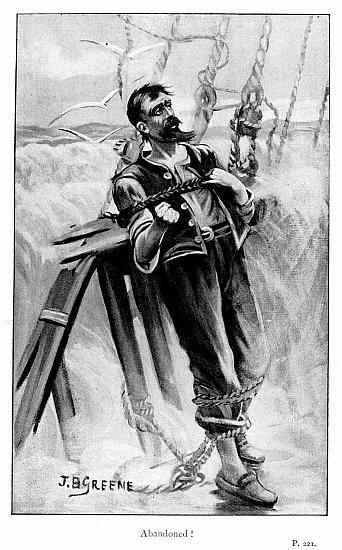
“Nothing but the seagulls, which swooped down over my head to see whether I were alive or dead; and it was fortunate my hands were free, or else they would have pecked out my eyes. Nothing but these and the boundless waste of the ocean, whose waters lapped the sides of the ship, which kept afloat, much to my surprise. Her buoyant cargo supported her, although her hold was full up to the main deck, and the sea washing in and out of her forwards; and, there was I, tied up there in the rigging like a dog, listening to the melancholy sound of the breaking waves. I was, you must recollect, utterly unable to help myself, for my arms were pinioned like my legs, although my hands were loose and I could move them about: but, otherwise, I was powerless and could not stir from the place where I was lashed, the ropes binding me being just secured beyond my reach by that villain Gomez, so as to make my agony all the greater.”
“It must have been fearful,” said Captain Farmer. “I wonder your brain did not give way.”
“Thanks be to God, no! My reason was preserved throughout this terrible ordeal for some wise purpose or other; though, I must say, I prayed for death to release me from my sufferings, a maddening thirst now consuming me, to add to the torture that was preying on my mind,” replied the other, shuddering at the recollection. “At last, the wind began to blow more strongly and the sea to get up. This lessened my pangs of thirst; but, the waves, constantly breaking over the side, almost drowned me, so one evil took the place of another, and this was all the benefit I reaped from the change. It must have been the following day, I think, for I became so numbed with the cold and exposure, the circulation of my blood being arrested by my cramped position, that I took no heed how the time went, when a ship at length hove in sight, and my heart began to beat again with renewed hope, in spite of my despairing thoughts and misery. Oh, heavens! The ship came nearer and nearer, so that I could see she was a vessel of war belonging to the French nation, and my torturing hope became a certainty. But, would you believe it, señor, when she had closed the wreck so that I could see the gun-ports on her upper deck, she luffed up and bore away again, hoisting her tricolour flag, which I shall always loathe the sight of now, as if in mockery of my condition. Fancy, deserting a shipwrecked man like that!”
“The commander of this very ship stopped us to say he had sighted the wreck of your vessel; but, unhappily, he was unable to lay-to to send a boat aboard,” explained Captain Farmer, to excuse the French captain’s conduct. “If he had not done this, perhaps we would never have come across you and been able to take you off, which I am heartily glad we were fortunate enough to succeed in doing!”
“Gracias, señor,” rejoined the Spaniard, stretching out his hand, which our captain gripped in cordial interchange of friendship, “but you did not tell another ship to go to my rescue, you came yourself! The English are always brave and generous!”
“By Jove, he’s right about that French ship,” observed Mr Jellaby to me, aside, when the captain had translated this remark of the Spaniard, leaving out, however, his personal compliment to himself and our nation. “It was a scurvy trick to sail off like that, without examining the wreck. But it’s just like those Johnny Crapauds, youngster. They’re deuced good fair-weather friends but never stand by a fellow in distress!”
“I have not much more to tell you,” went on the Spaniard after those little reciprocities between him and the captain. “It was one morning that the French vessel abandoned me and the next that yours came to my help. Dios, I could not believe I was in my senses when I heard the voices of your officers! I thought I was in a state of delirium and that the sight of your ship, especially after the disappointment of the preceding day, was only a mirage of my imagination, like the Fata Morgana!”
“But, you hailed us, sir,” I said here, on the captain motioning me to come forward. “Why, you answered me when I spoke to you, sir!”
“I may have done so, my dear young gentleman,” he replied with a faint smile, patting me on the head in an affectionate sort of way, as if he were caressing a pet poodle, so at least Mr Jellaby said afterwards to the other fellows; “but, I have no recollection of it, I assure you. Still, I must say that your voice seemed familiar to me just now, when you first came into the cabin here and addressed me. It seemed to me a voice that I had heard in a dream.”
He then proceeded to compliment me on my Spanish, saying, in true hidalgo fashion, that I spoke it better than himself, which, as Mr Jellaby remarked, had to be taken “with a good deal of side on!”
Don Ferdinando Olivarez, to give him his rightful name, concluded his narrative by asking Captain Farmer to land him at Madeira, where he had friends who would supply all his needs, giving him the means to return home to Cadiz, to which port, he said, he must go back for business reasons; besides having to report the loss of his ship, though, as he added with a sigh, he no longer had a “home” there, now that his poor brother was dead, for he was the last of his race!
Of course, the captain promised to comply with his request, explaining that, although he had not intended stopping at the island, we would in any case have passed pretty close to it in our passage to the Cape; and that he would be only too glad to call in and put our passenger ashore, regretting, however, that he should have to lose the pleasure of his company so soon.
Dr Nettleby at this point interrupted any further exchange of civilities between the captain and the Spaniard, who was profuse in his thanks, declaring that his patient required rest, or he would not be able to go ashore either at Madeira or any other place on this planet.
The stern medico, who had been very much interested in Don Ferdinando’s story, or he would never have permitted so much talking, then bundled us all incontinently out of the sick bay, Captain Farmer included.
Four days later we arrived off Funchal, passing, at the eastern extremity of the island, Machico Bay, where the lovers mentioned by Larkyns landed and lived and died, according to the legend. This, the Spanish captain said was quite true, for he had seen the grave himself and the little church erected to their memory, a statement that quite delighted our friend Larkyns, as he was able to throw it in the teeth of Mr Stormcock as soon as he heard it, in refutation of the base calumny of the latter in asserting that he had invented the yarn he told us at mess.
I was very sorry when Don Ferdinando left the ship, for his misfortunes and the fact of my having been in the boat that rescued him, made him seem like an old friend whom I had known for years, although we had only been such a short time acquainted.
He was very kind, too, in noticing me; and, before he was rowed ashore in the captain’s gig, he presented me with a real gold medallion with the image and superscription stamped thereon of Saint Nicholas, the protector of all sailors. The Spanish captain told me that this had originally belonged to the great navigator, Christopher Columbus, of whom he was a distant descendant, and that it had been in his family for generations. He had always worn it, he said, next his heart as a preservative against shipwreck, and he fervently believed it was owing to his having it on him that he had been so miraculously saved when everyone else who had been on board La Bella Catarina with him had perished.
His now giving it to me was the most practical proof of his friendship he could offer, as he valued it beyond anything he possessed, and I only took it for fear of hurting his feelings, for I did not like to deprive him of it. He was, in truth, a noble fellow, and showed that his gratitude did not merely lie in mere empty words and idle compliments.
No, “out of sight out of mind” was not his guiding maxim, like it is of some people whom we all have met in the course of our lives; for, even after he had uttered his farewell as he rowed away from the ship in the captain’s gig, wishing us with a graceful wave of the hand “A Dios!” he did not forget us, sending back by the coxswain a splendid present of flowers and fruit and vegetables, almost loading the gig, indeed, for the acceptance of the wardroom and gunroom messes. He forwarded, as well, a case of valuable wine of some special vintage for Captain Farmer’s own table.
No one in fact who had done him a kindness when on board passed out of his remembrance, apparently, on his leaving; for, to the doctor he sent a diamond ring, to Lieutenant Jellaby a lady’s fan, which, judging by what he had heard of his partiality for the fair sex, I suppose he thought would please him most; and to Corporal Macan and Bill Bates, who had been especially prominent at his rescue, a box of cigars each, while he also sent to the captain a handsome sum of money for him to distribute amongst the crew as he thought best.
Chapter Twenty Three.
“Cape Smoke!”
We only stopped at Madeira long enough to get a few purser’s stores to add to the supply with which the generosity of Don Ferdinando had already provided us. We also took in some water, for two of our tanks below had been “started” during our bucketting about in the bay, and Captain Farmer feared we might run short when we reached the warm latitudes; as, in the event of our falling across the usual calms prevalent in the neighbourhood of the Equator, we might be rolling about a week or two, roasting, in the Doldrums!
But, luckily, we were blessed with favouring winds and made a good passage, picking up the North-East Trades shortly after we said “good-bye” to Funchal, with its pretty white villas nestling on the hillside amid a background of greenery; and then, meeting with strong westerly breezes instead of calms, on getting further south into the Tropics, we crossed the Line on Christmas Day, when all the good people at home, I thought at the time, would be shivering with cold and saying, as they snuggled up to the fire, gazing perhaps on a snow-covered landscape without, “What seasonable weather we are having!” while we were sweltering in the heat under a copper sky, with the thermometer up to 98 degrees in the shade of the awnings!
From the Equator, we had a splendid run to the Cape, taking altogether exactly sixty-five days clear for our passage from England.
During this interval I and my brother cadets had to attend “school” every morning from half-past 9 o’clock to 11:30 in the captain’s outer cabin under the poop, where the chaplain, who also filled the post of naval instructor, officiated as schoolmaster-in-chief, teaching us mathematics and the theory of navigation, as well as seeing that we kept up our logs, which Captain Farmer himself inspected once a week, to make certain that the chaplain, on his part, attended to his duty.
We got on very well with the Reverend Mr Smythe, who had all his longshore starchiness knocked out of him by his long bout of sea-sickness, the poor man having been confined to his bunk and completely prostrate with the fell malady from the hour that we weighed anchor at Plymouth until we “brought up” at Madeira. I should not, perhaps, have made use of this term, as it savours of tautology, the unfortunate chaplain having been industriously occupied in doing little else save “bringing up” all the time; especially when we were pitching and rolling in the Bay of Biscay!
Every day, too, at a quarter of an hour before noon, we had to muster on the poop, where, under the tutelage of the master, Mr Quadrant, we watched for the dip of the sun; and, as soon as the master reported that it was twelve o’clock to the captain, who told him “to make it so,” and Eight Bells was struck on the ship’s bell forwards, we would adjourn to the gunroom below.
There we all worked out the reckoning, showing our respective calculations or “fudgings” as the case might be, to Mr Quadrant; when if these “passed muster,” we entered the result in our log-books, along with other observations and facts connected with the daily routine of the ship and her progress towards her destination.
To ascertain this, in addition to taking the sun at noon and noting the attitude of certain stars at night, the log was hove every hour; and each of us learnt in turn to fix the pin in the “dead man,” as the log-ship is styled—the triangular piece of wood, with a long line attached, by which the speed of the ship is ascertained.
The first piece of this cord is termed the “stray line,” and is generally of the same length as the ship, so as to allow for the eddy and wash of the wake astern; and, at the end of this stray line, a piece of bunting is inserted in the coil, from which a length of forty-seven feet three inches is measured off and a disc of leather put on the line to mark the termination of the first knot, or nautical mile. Two knots are put at the end of another length of forty-seven feet three inches; three knots at a third, and so on, until as much of the line has been thus measured and marked off at equal distances as will test the utmost sailing capacity of the ship—a single knot being placed midway, also, between each of these divisions, to denote the half knots.
Two sand-glasses are used in connection with the log-line, as the old quartermaster, who was our instructor in this branch of our nautical education, explained, the one called “the long glass,” which runs out in twenty-eight seconds, while the other is a fourteen-second glass, which is generally adopted at sea when the ship is going over five knots with a fair wind.
The first mentioned is only used in light breezes; and, as Bob Ricketts showed us by careful manipulation, reeling off bights of the line and keeping the slack loosely in his hands, the thing to be particular about is to heave the log-ship over the side clear of the ship, and see the glass turned as soon as the bunting mark is reached, denoting that all the “waste” has run out.
Then, whatever mark you can distinguish on the line nearest to your hand at the expiration of the allotted twenty-eight or fourteen seconds, when the man holding the glass sings out “Stop!” as the last grain of sand empties itself out of the bulb, that will be the speed of the ship.
The division of knots on the log-line bear the same proportion to a mile, as the twenty-eight or fourteen seconds of the glass does to an hour of time; so, if the four-knot mark be to hand, and the “long” glass be used, she is going four knots, or nautical miles, per hour. It will be eight knots if the “short glass” be the standard of measurement; the time the line has taken being only half the former, and the number of the knots having to be doubled to keep the proportion between the length of line and the space of time equal.
It did not take me long to master what the old quartermaster had to teach me on this point; but some of the other cadets were awfully stupid at first, I must say, particularly that brute Andrews, in spite of his bumptiousness and conceit.
He gave old Ricketts a lot of trouble before he remembered to put in the pin prior to pitching the log-ship overboard; though without this it could not float upright, and was as good as useless to gauge our speed.
The ass could not be made to understand this, and omitted putting in the pin time after time so persistently, that Ricketts had to tell the commander that he “could make nothing out of him.”
In addition to these details of ’boardship life, we were also instructed in practical seamanship by one of the boatswain’s mates.
He was an old hand who had been at sea so long that he seemed to smell of salt water and tar; while his face was like a piece of pickled beef covered with a quantity of hair that resembled spunyarn more than anything else, being as stiff and wiry as an untwisted rope.
Old Oakum, however, was a thorough sailor, every inch of him, and he taught me much more than I had learned on board the Illustrious, not only in “knotting and splicing” and other things.
Under this worthy’s guidance I practised the “goose step” of going aloft, as it might be described by a drill sergeant, the mizzenmast being placed at our disposal every fine afternoon, and it was pretty nearly good weather all the time of our passage southwards, to learn the art of reefing and furling sails and to send down or cross upper yards; so that we became in the end almost as expert as our tutor, the old salt one day telling Tommy Mills and myself that we took in a royal “as good and better as any two able seamen could a done it, blow me!”
It was not “all work and no play,” either, for we had plenty of fun and skylarking down in the gunroom; making the oldsters there, like Mr Stormcock and the assistant-paymaster, Mr Fortescue Jones, frequently wish they, or rather that we, had never been born to come to sea to torment them.
The very duty of the ship itself was an endless source of occupation and amusement to us, the commander keeping the men “at it” continually from sunrise to sunset, until he had so licked us all into shape that we were the smartest ship’s company afloat, I think; for the discipline was such that the old Candahar might have been four years in commission instead of the brief three months that had elapsed from our hoisting the pen’ant to our casting anchor in Simon’s Bay, a port to the eastward of the “Stormy Cape,” where our men-of-war usually moor.
Here, we remained for ten days to refit, setting up our lower rigging, which had got very slack through the heat of the Tropics, and taking in fresh provisions and water, besides all of us having a run ashore to shake the reefs out of our legs.
All the men, too, were allowed leave by watches each day of our stay, and few took advantage of the licence to misbehave themselves although temptation enough was thrown in their way by the hospitable inhabitants.
Amongst these few, I am sorry to say, Corporal Macan distinguished himself, falling a victim to his “ould complaint,” by coming aboard on the second day after our arrival in a state of glorious intoxication, despite his solemn promise to Dr Nettleby, through whom the commander had given him permission to land, that he “wouldn’t touch a dhrop ov the craythur, not if Ould Nick axed him.”
Larkyns, who was in charge of the launch, in which the culprit was brought back helpless to the ship in the afternoon, noticing his condition when he tried to go up the side, ordered him to report himself to the sergeant of marines; but, Mr Macan, who was valiant in his cups, waxed indignant at this and flatly refused to obey the command, saying that he would not mind going before the commander, or the first lieutenant, or even meeting the doctor himself, though he was loth to see him for the moment with his broken promise staring him in the face; but as for going and reporting himself to the sergeant he should not, no, not he.
“An’ is it to rayport mesilf to that omahdaun ye’re afther axin me, sor?” he said scornfully, tossing his head and leering out of his little pig eyes in the most comical way. “Faix, I’d rayther not, wid your favour, sor. I wouldn’t demane mesilf by spakin’ to the loikes ov Sarjent Linstock, sor!”
The upshot was that poor Macan was put under arrest and confined in the cells that night; and when brought before the captain the next day for insubordination and drunkenness, as he had no excuse to offer he was disrated, losing his rank of corporal, with all its perquisites and privileges!
On the doctor taxing him with breaking his pledged word, however, in an after interview that worthy had with the delinquent, he vehemently protested his innocence of that charge at all events.
“I tould yez, sor, I wouldn’t touch a dhrop ov the craythur, maynin’ whisky, sure,” he said, with a miserable attempt at a grin; for he felt very much humiliated at losing his stripes, Macan sober being quite a different man to Macan drunk. “An’ faix I niver bruk me wurrud at all, at all, I’ll swear, sor.”
“How can you have the face to deny it, man?” cried the doctor, angrily. “Why, I saw the state you were in myself when you came aboard the other night!”
“That mebbe, sor,” replied the undaunted Irishman, with a little of his old bravado; “but it warn’t the ould complaint, I till ye, sor.”
“What was it, then, that made you drunk, you rascal?” rejoined the doctor, with a twinkle in his eye, knowing his man, “for, drunk you were—ay, as drunk as Chloe?”
“Faix, sor,” said Macan, noting instantly the doctor’s change of mood, and grinning all over his face in consequence, “it wor the Cape shmoke that did it. Sure, it obfusticated me, sor, entirely!”
Chapter Twenty Four.
We join the Admiral at Singapore.
“Cape smoke?” said I, inquiringly, to Mr Stormcock, who happened to come up the hatchway on to the main deck as the doctor was thus cross-examining the ex-corporal of marines outside the sick bay, where poor Macan was now doing “sentry-go” after his reduction to the ranks, to make his humiliation the more complete. “What is that? It can’t be real smoke, I suppose!”
The master’s mate laughed.
“Smoke, eh, youngster?” he repeated in his ironical way, being the driest old stick we had in the gunroom and certainly, according to Larkyns, a judge of considerable experience of the article under discussion. “Bless you, it’s the most rotgut stuff any fellow ever put in his inside, and only a Dutchman could have invented it! I can tell you it’s a liquor that’s best left alone. Take my advice, Vernon, and don’t you have anything to do with it!”
“I won’t,” I replied. “Have you ever tasted it, Mr Stormcock?”
He looked at me hard, thinking at first that I meant to chaff him; but seeing that I asked the question in perfect good faith, without any intention of alluding to his reported “little weakness,” he proceeded to answer me, truthfully enough.
“By jingo! youngster, I can tell you, I speak from my own knowledge,” he said, as he turned away to go forwards, “I had too much of it once when I was at the Cape before and it gave me the shakes next morning so badly that my teeth rattled like a horse’s jaws when chewing a hammer!”
This expression amused me very much, for I had never heard previously of a horse indulging in that species of diet; so, I went up on the quarter-deck to take my watch with a broad smile on my face, which attracted Mr Jellaby’s notice at once, as he had a keen relish for a joke.
“Hullo, youngster, you’re grinning like a Cheshire cat eating green cheese!” he exclaimed. “I suppose you have heard the news, and that makes you so chirpy?”
This made me all agog in a moment, with the expectation of something very exciting coming, and I answered his question in the Irish fashion, by asking another with much eagerness.
“What news, sir? I haven’t heard of any.”
“Why, the redcoats belonging to the garrison at Cape Town are going to give a grand ball in our honour, and of course all the gunroom officers as well as the wardroom fellows will be invited,” he replied. “I daresay they’ll be able to spare you from your important duties aboard for the occasion, and I’ll try to smuggle you off myself if I can. By Jove, it will be a splendid hop, for the Cape Town girls are chawming, they tell me!”
I was not old enough yet, however, for this encomium of his on the young ladies of the colony to be any inducement to me, and, to tell the truth, was a little disappointed at hearing what his wonderful news was, imagining it to have been something very different.
“Oh!” I said, without any improved enthusiasm, such as he doubtless expected. “Thank you, sir.”
“Well you are an ungrateful young cub!” he cried. “Catch me putting myself out of the way again to give you a treat! One would think from your glum look that I was going to bring you up on the quarter-deck before the captain, instead of offering to take you to the ball!”
I felt quite sorry at having hurt his feelings, he looked so chagrined; but, before I could say anything in excuse for the apathetic way in which I had received his intelligence, Mr Bitpin, who had overheard the conversation, came to my rescue.
“Nonsense, Jellaby!” he said. “What can a boy like that know about girls? Time enough for him to think of the petticoats when he’s twenty years older; and then he’ll be a fool if he runs after them as much as you do!”
“Ah, you’re jealous, Bitpin, because you’re not a lady’s man!” retorted Mr Jellaby, recovering his good humour in a moment, as he always did, no matter how much he might be put out. “If you were as great a favourite with them as I am, you’d sing a different song, I know.”
“As great a fiddlestick!” ejaculated the other with infinite scorn, having the reputation of being as much of a woman-hater as Diogenes. “If I was as big an ass about those ‘chawming girls’ as you call them, I tell you what I would do—I’d go and hang myself!”
He said this so fervently, that, in spite of Mr Bitpin’s burlesque of his manner of speaking, “Joe” fairly roared with laughter, in which the gunnery lieutenant, who had just come up from below to see about something deficient in one of the upper deck guns, which had been reported to him by Mr Triggs during the morning’s inspection, joined with much gusto.
Their merriment so enraged Mr Bitpin that he went down to the wardroom in the most wrathful mood, declaring that they were a couple of idiots and that the service was going to the devil through the Admiralty neglecting the claims of their best officers and promoting a lot of empty-headed coxcombs, who thought more of prancing about in a ballroom in patent leather pumps than of keeping their watch regularly and attending to their duties aboard ship!
Notwithstanding all adverse comments, however, Mr Jellaby’s news of the forthcoming ball proved true, for I heard it confirmed at the captain’s table the same evening.
Captain Farmer was in the habit of inviting his officers in turn to dinner three times a week, the commander being a regular guest and one of the lieutenants and mates, with a couple of midshipmen and naval cadets being generally present on each occasion; while the doctor and chaplain, as also the purser and marine officers, only came occasionally to these gatherings, the conversation mostly dealing with professional matters in which those belonging to the executive were mainly interested and the other branches not much concerned.
It was for this reason, I suppose, the captain did not invite these latter officers more often than he could help!
During the progress of the courses this evening, the talk, as usual, was on service topics; but when the cloth had been removed and the toast of “the Queen” honoured in the customary way, each of us youngsters being then allowed our one glass of wine to drink the health of Her Majesty, Captain Farmer introduced the subject of the garrison ball.
“I have here invitation cards for all of you, even including you, Master Vernon,” he said, handing them round and passing one over to me which was inscribed with my name in full; the “sojer officers,” as Tommy called them, having managed through the purser or master-at-arms, or by some other means, to get hold of all our names correctly, both great and small. “So, gentlemen, we must try and make as brave a show as we can in return for the compliment, the affair really being given in our honour. We need only keep an anchor watch, so nearly all of you may be spared, I think, for the night. You’ll have to settle it with the commander as to who shall remain on board.”
This was soon settled, Mr Bitpin offering at once to do double duty for the nonce, as he did not care about dancing and besides wished leave for the two following days to go up country on a visit to a Caffre kraal; while Plumper, the fat mate, who had the toothache very badly, also volunteered to remain.
So did the master and purser and Mr McGilpin, the assistant-surgeon; the latter saying that he had no stomach for consorting with “the meeletary,” they being “a maist feckless set o’ loons.”
As for the middies and us cadets, we had to draw lots to decide who should go and who stop behind; but, at the last moment, the commander gave permission for us all to go, save Andrews, who had been impertinent to the first lieutenant in the afternoon and was ordered to remain in the ship.
I was not sorry I went, after all, for it was a jolly affair and I enjoyed myself mightily, especially at the supper table, where the redcoats shone to perfection; this opinion of mine being shared, I believe, by most of my fellow youngsters, who cared more for the grand tuck out they had than all the dancing in the world.
I noticed, though, that Mr Jellaby kept up his reputation as a lady’s man, waltzing and flirting all the evening with an awfully fat Dutch frau, who was broader of beam than comported with her short stature, and whom the susceptible lieutenant subsequently described as “the most chawming woman” he had ever met in his life! “Joe” got awfully chaffed about her by all of his brother officers of the wardroom whose rank permitted them to take such a liberty with him; and, though we could take no share in their personal amenities, we youngsters grinned our approval of the various witty remarks and rejoinders that passed to and fro on our way back aboard the following day—the ball having lasted till long after daybreak the next morning, and Simon’s Bay being all astir, with plenty of “Simons,” black and white, astir ashore and afloat, as we rowed out to the ship, we having nearly outstayed our leave, the captain and commander preceding us aboard by a long spell.
We gave a return dance to the garrison folk and hospitable inhabitants generally the day before we sailed for the China Sea; when the old Candahar was decked out so gaily with bunting and evergreens, with which we were lavishly supplied from the shore, that the riggers of Portsmouth Dockyard would not have known her.
Her upper deck was a perfect parterre of flowers and foliage, intertwined with the flags of all nations, and enclosed under an awning, which latter had a canvas screen all round to keep out the prying eyes of the bluejackets on the forecastle.
Going round with Mr Fortescue Jones, the assistant-paymaster, whom I had taken a liking to in consequence of his having served under Sir Charles Napier, Dad’s old captain and my own personal patron, he noticed this screen and he told me another anecdote of the old admiral, to add to my list.
“His flagship, the Duke of Wellington, was lying off Kiel or Copenhagen, I forget which exactly, and the officers were about to give a similar entertainment to ourselves as an acknowledgment of the kind treatment they had received from the inhabitants of the place. Like ours, the ship was decorated throughout regardless of expense, everyone subscribing to the fund, and a screen similar to what we had was being put up when the admiral coming down from the poop chanced to notice this.
“‘Hullo!’ he cried. ‘What’s that for?’
“‘Why, sir,’ explained the commander, ‘it’s to keep the men forrud from staring at the dancers.’
“‘The deuce it is!’ said the old fellow, taking an awful lot of snuff, Mr Jones remarked,” as if I were not acquainted with this habit of the veteran sailor.
“‘By whose orders was it rigged up?’
“‘Orders, sir?’ replied the commander, a bit nonplussed. ‘By mine, sir.’
“‘Then mine are for you to rig it down at once,’ cried the admiral, in a mighty fume, walking up and down and waving his arms about like a windmill backwards and forwards from his waistcoat pocket to his nose. ‘I won’t have any screens fitted up on board my ship to keep out my sailors from seeing what they have as good a right to see and enjoy as any of those with whom they have fought and bled. No sailors, no ball, or I’m a Russian! You can put that in your pipe and smoke it, Mr Commander!’”
“Did the ball come off, Mr Jones,” I inquired of the narrator, “after all?”
“No,” said he. “The fleet had to sail the very same day for which it was fixed. I believe old Charley arranged that it should be so, on purpose to pay out the commander, who had set his heart on it; for he was very hard on the men always, and the admiral could not stand that.”
“He was a good friend, always, to the sailors?” I remarked. “I have heard my father say so.”
“Rather! Why, he would do anything for them, regardless of his own comfort, and they in return would follow him anywhere, night or day, in the face of a thousand batteries. He was, indeed, like a father to them,” continued the paymaster, who was fond of yarning about his old experiences with the admiral. “I recollect after the bombardment of Bomarsund and the capture of a lot of prizes up the Baltic, we put into Kiel again, and the men wanted to draw advances to have a spree ashore, but the admiral told the purser to refuse them, and when they grumbled about it he gave them a ‘dressing-down’ from the poop, having them all piped aft by the bosun for the purpose. ‘Lads,’ says he, ‘I’ll let you have ten shillings apiece, but not a farthing more to spend, now! I want you to save all your prize-money for your wives and sweethearts when you return to England, for I don’t wish to have my eyes scratched out on Common Hard when I come out of the dockyard on landing, as I should, if I were fool enough to allow you to spend all your money out here instead of making you keep it, as I intend, till you get home!’ He was a rare good old sort was the admiral, young Vernon!”
“So I should think,” I replied, “from all I have heard.”
But there our chat ended, the Cape people just beginning to come off to “cut their capers,” as Master Larkyns remarked to me, making me a target as usual for one of his fearful puns.
Our dance was as great a success, I think, as the garrison ball, judging by the approving comments of our guests, who kept it up till the middle watch had well-nigh come to a close.
Mr Jellaby, I noticed, inconstant fellow that he was, payed attentions of the most marked character on this occasion, all the time the festivities lasted to a Cape damsel of the most slender figure, contrasting strongly with the stout lady who was his former flame and who had come off especially, so the wardroom officers said in their chaff, to renew her attack on the heart of the lieutenant.
Mr Jellaby, proved a recreant knight and the Dutch lady had to content herself with the cavalier-ship of the youngest and most diminutive cadet on board, my chum, little Tommy Mills!
But Tommy’s gallant championship of the deserted fair one and the lieutenant’s fresh flirtation had to terminate, like everything else in this world; and hardly had the last of our visitors quitted the ship than the hands were turned up to weigh anchor, the old Candahar sailing soon after daybreak and shaping a course southwards to pick up the westerly trade winds of the “Roaring Forties.”
With studding sails, upper and lower, on each side, we bowled along gaily, the wind right astern all the way some two thousand miles odd or so, until we fetched the meridian of the Island of Saint Paul in the middle of the great southern ocean; when, we hauled up to the north-east and steered for the Straits of Sunda, leading into the China Sea—finally joining the admiral in command of the station at Singapore, where we cast anchor again in the outer roads one broiling morning in March, just four months from the date of our leaving home.
Chapter Twenty Five.
“The Heathen Chinee.”
“What a rum place!” cried Larkyns, when the ship was safely moored and Captain Farmer had gone off in his gig to pay his respects to the admiral, whose flagship lay hard by, all of us then having time to look round and survey the strange and picturesque surroundings—semi-European, semi-Oriental, all tropical—of Singapore harbour, the capital of the Straits Settlements and great port of the Eastern Archipelago, amid which we now found ourselves. “I’m blowed if it doesn’t look like the pantomime of ‘Ali Baba and the Forty Thieves’ at Drury Lane!”
“That’s not at all a bad simile, youngster,” observed the commander, who was just coming down from the poop, after seeing everything snug and that the awnings had been spread over the decks, with windsails rigged up leading through the hatchways to introduce what air there was to the heated atmosphere below. “Only, instead of forty, I should think there were forty thousand thieves amongst that crowd of Asiatics, with their serpent’s eyes and slimy bodies! It looks like a water picnic, does it not?”
It was certainly a wonderful and varied scene that we gazed at over the hammock rail, the glaring sun overhead, the vividly blue sea stretching up to the white beach in front of the busy-looking town and the verdant hills beyond, with white villas nestling amid the green, like Madeira, and big, gru-gru palms and agaves, with other odd, broad-foliaged plants to tell that we were in more outlandish latitudes; while, skimming over the glassy blue water, that turned to an emerald green in its depths and was so transparent that the sandy bottom could be seen, with various molluscs crawling about amongst the algas, were hundreds of boats of every description—from the trim-built man-o’-war’s cutter down to the slipper-like sampan and aboriginal coracle of as queer construction as the catamaran of the Coromandel coast or the war canoe of the Sandwich Islands.
Other even queerer craft lay at anchor like ourselves, only further up the harbour, chief amongst them being Chinese junks of every size, from the huge, travelling tea-chest from Woosung or Amoy of three or four thousand tons burthen, down to the “junklet” from the nearer provinces of the Celestial Empire of lesser proportions.
But, all were alike in form, veritable facsimiles of the picture of the Great Harry of the time of Henry the Eighth, which I remember seeing in an old book on history when I was cramming up for my examination and looked at every work I could come across in order to increase my store of knowledge.
These junks all had great, staring, goggle eyes painted on their bows on either side, John Chinaman believing that without these fanciful addenda his stagey-looking craft “no see no piecee walk can do.”
Their sails also were very funny, being huge mats, of trapezoidal shape, that resembled so many Venetian blinds.
These sails were hoisted on tall poles of eighty to hundred feet in height, without a joint, while their floating rattan cables completed their theatrical appearance, circling round their prows with the tide like snakes.
In addition to these were likewise any number of Malay prahus and “prams” from Borneo and Celebes and the Philippine Islands generally; Arab dhows and “grabs” from the Persian Gulf; English-captained, Lascar-manned trading vessels from Calcutta and Madras; fishing schooners from the Torres Straits and Sydney, laden with cargoes of sea-slugs, for Chinese consumption; besides merchant ships from every port in Europe—although, I noticed that the British and American flags were decidedly in the ascendant.
All this heterogeneous collection of vessels, of every known nationality and rig, come hither at all seasons, but the Chinese junks mostly when the north-east monsoon sets in to blow them along with their favourite stern wind.
They resort here as to a common meeting ground or exchange mart, to swop their cargoes, the silks and teas and spices and precious gums of the East being bartered for the manufactures and merchandise of the West; while the keen though sleepy-looking Dutchmen, Chinese, Jews, Parsees, Siamese, Englishmen and Yanks, who negotiate and this interchange of wares manage to conduct the bargaining in their various lingoes by the aid of a polyglot dialect of their own, chuckling over the dollars and cash and cowries as they rake them in with the impression that they are getting the best of the deal, when all the time, perhaps, they are being cheated themselves!
So Commander Nesbitt now told us, kindly particularising the various points of interest to us two youngsters and explaining all we did not know, which meant pretty nearly everything, as he had served in these waters before; while to Larkyns and myself Singapore and its migratory population, with their prominent characters and characteristics, were all new, as, indeed, they were to most of the fellows in the gunroom, excepting Mr Stormcock and Plumper, the fat senior mate, both of whom, like the commander, had previously been on the station and were acquainted of old with the place and its people.
But neither Larkyns nor myself need have been in any hurry to make our observations; for, we had ample opportunity of learning all we wished to know, and a good deal more, too, of Singapore and its surroundings, as we remained here over six weeks.
The Candahar had orders to await the coming of Admiral Hope from England by the overland mail, in succession to Admiral Sir Michael Seymour, whose period of service had expired before the former left London to take up his commission.
In order to understand the position of affairs leading up to the events I am now about to speak of, in which, possibly, I took a more prominent part than I might have chosen had I been given the option, I may mention that through the action mainly of the last-named officer, in capturing Canton and forcing his way almost up to the gates of Pekin, which seemed to bring the Imperial Ruler of the Universe and Emperor of the Sun, Moon and Stars to his senses, the series of intermittent wars between Great Britain and China, which had been waged at intervals since the year 1840, breaking out again after more than one temporary cessation of hostilities, like a smouldering fire ever and anon bursting into flame, had been, it was sanguinely believed by the authorities, brought to a permanent close by the Treaty of Tientsin, signed in 1858.
This treaty, however, which as Lord Elgin, our plenipotentiary, wrote home to warn the Government, had “been extorted only from the fears” of the Chinese, was not to be ratified until the succeeding year, the date of our arrival on the scene; where the Celestials hoped that they might by then have time to prepare themselves for a renewal of the struggle, although, of course, our wise men in office never thought of such a thing, implicitly giving faith to the assurances of the pigtailed mandarins that peace was as good as settled, and that friendly relations betwixt ourselves and the yellow-skinned descendants of the great Confucius would be resumed and their ports open to our trade at the time fixed—only, not till then!
How those blandly-smiling mandarins must have twinkled their little pig eyes and tossed their pigtails in gay abandon at the simplicity of the “Outer Barbarians” whom they thus beguiled in the usual “Heathen Chinee” fashion, as we subsequently discovered to our cost, although this is anticipating matters.
Chapter Twenty Six.
A Hornet’s Nest.
Towards the middle of April, to proceed with my regular yarn, within two months of the time fixed for the ratification of this paper treaty, our new chief arrived at Singapore; when, taking over the command from his predecessor, who at once started off in the homeward mail steamer, Admiral Hope sailed with the fleet to Shanghai—the Candahar forming part of the squadron that escorted our ambassador, Mr Bruce, to the mouth of the Peiho River, where he was appointed to meet the Chinese officials and with them journey on to Pekin, there to complete all the requisite formalities for the final execution of the treaty.
Reaching Shanghai without mishap and finding Mr Bruce ready to accompany us, although the mandarins had already interposed obstacles to delay his departure in order to evade the obligations they had entered into on behalf of their imperial master in the art of subterfuge and evasion, we proceeded on the 11th June to the Gulf of Pechili; anchoring under the lee of the Sha-liu-tien, or “Wide-spreading-sand Islands,” some fifteen miles off the entrance to the Peiho.
The water here being too shoaly to allow the larger vessels of the fleet to approach near the shore, the admiral embarked aboard one of the smaller gunboats, thinking the coast clear and everything peaceful; but on getting close to the mouth of the river, he discovered to his surprise that a series of formidable earthworks had been erected on both banks in place of the Taku Forts which Admiral Seymour had destroyed in the preceding year.
The river itself, also, had been rendered impassable by a series of booms and stakes, so arranged as to be protected by the fire of the batteries, whose numerous embrasures spoke to their containing a large number of guns; while, to remove any doubts as to the hostile character of these preparations, the officer Admiral Hope sent to acquaint the authorities in charge of these fortifications of the arrival of our ambassador was refused permission to land.
On communicating this news to Mr Bruce, who was accompanied on his ambassadorial mission by Monsieur Bourbillon, the representative of the French Government,—a council of war was held on board the flagship; when it was determined to force the passage of the river, so that the ambassadors should be able to go up to Pekin in accordance with the Emperor of China’s express permission to that effect given under his sign manual.
The admiral therefore forwarded off at once a letter to the commandant in charge of the defences, telling him that unless the obstructions were removed within the next forty-eight hours, he, the admiral, would set to work to clear them away himself in the manner he thought best.
This was explicit enough; and as no answer was received to this communication by sunset on the 24th, the limit of the ultimatum, Admiral Hope proceeded to prove himself as good as his word.
An unsuccessful attempt was made by the boats of the flagship the very same night to pull up some of the iron stakes driven into the bed of the river, that held the booms in their position across its mouth.
This failed through the tenacity of the mud, the effort of the bluejackets being discovered by the batteries, which fired on them, compelling them to desist and return to their ship; but, this was a mere flash in the pan, the real attack being planned for the morrow.
In the meantime, the fleet had moved in from the Sha-liu-tien Islands to the anchorage opposite the entrance to the Peiho, where our ship and the Chesapeake, with some of the others remained out of range of the batteries, which we on our side, were unable to reach with our guns for any effective purposes.
The gunboats of lesser draught, however, proceeded to cross the bar of the river; where also the boats of the bigger ships were subsequently despatched, filled with all the small-arms men and marines available to form a reserve force which was to attack the principal batteries in the flank after the gunboat had pounded them in front, as well as fill up casualties in the first line.
Every man on board the Candahar was on the alert on the morning of the memorable 24th June, I can tell you, when the boatswain’s pipe went screeching through the ship at daylight, and the commander sang out the order to “Man and arm boats.”
“I bet we don’t have any fight at all!” grumbled Mr Stormcock, as he buckled on his sword and prepared to go in the launch with Mr Gilham, who was directed to command her, Larkyns, having to play second fiddle in the boat on this occasion. “Those blessed Chinamen won’t come up to the scratch as soon as they see we mean business.”
“Perhaps not,” said Mr Gilham. “But, they were precious sharp last night in detecting those fellows that went after the booms. I think they mean fighting this time, they’re keeping so dark.”
“Well, I only hope they do, sir,” replied the master’s mate, with a heavy sigh that evidently came from the bottom of his heart. “For my part, I think they’ll cut and run at the first shot, as they’ve always done before. I was out here, sir, in the Fatshan affair up the Canton River in ’57, and I remember as we boarded the junks on one side, all of us racing after them up the creek, the yellow devils would jump out on the other, without standing up against us for an instant.”
While they were talking, I managed to scramble into the bows of the launch unobserved, nobody noticing me till we had left the ship and it was too late; and, though Mr Gilham shook his fist at me and told me I was “acting against orders,” he beckoned me to come aft, where Larkyns and Mr Stormcock made a place for me between them in the sternsheets, the rest of the boat being crammed with bluejackets and marines, the latter sitting down on the bottom boards between the thwarts and the knees of those pulling.
On pulling inshore we made fast to some junks which had been requisitioned and moored just inside the bar for the purpose, and here we remained while the gunboats went on to the assault; Admiral Hope leading the advance in person and hoisting his flag on the little Plover, which showed the way to the rest, moving onward to the first obstruction in the river, a long row of iron piles linked together by eight-inch hawsers hove taut.
As we watched our comrades making this forward movement at last, the flood tide filled the turgid stream of the Peiho, flooding the reedy marshes on either side of its banks; until, presently, a sheet of muddy water stretched up to the base of the forts, lapping their wide earthen escarpments.
These made no sign of defiance whatever, not a man being seen on the parapets, nor a gun peeping from their embrasures, which were hidden with mantlets.
Every heart beat high with excitement; and instead of fearing the worst, the worst we feared was a hollow victory!
The gunboats all took up their several positions, anchoring so as to command the forts and support those attacking the booms; and at two p.m., when the ebb began to flow and there was no danger of the stream carrying the vessels too close in, the Opossum was ordered by signal to pull up the first pile, which she did by the aid of tackles and steam power.
On the removal of this obstacle, the admiral passed through towards the second barrier, which was immediately under the concentric fire of the batteries on both banks of the river.
Here the question would be decided at length whether the Chinese meant fighting or not.
We had not long to wait for the decision.
Hardly had the bows of the Plover touched the boom than “Bang” went a single gun from the nearest earthwork.
This seemed like a signal; for, almost at the instant of its discharge, a terrific fire of shot and shell from forty pieces of cannon was hurled on the unfortunate Plover and her consort the Opossum, which followed her close up behind, both being immediately wreathed in smoke and flame and having their decks swept fore and aft by every discharge.
It was a regular ambuscade, a hornet’s nest!
In less than twenty minutes, the two gunboats were so badly shattered as to be almost silenced; though the plucky little Plover still remained in the van, with the admiral’s signal still flying, “Engage the enemy,” with the red pennant under, which Mr Gilham told me meant “as close as possible.”
She held out, too, in spite of her not having nine men of her original crew left efficient out of the party with which she commenced the action; while Lieutenant Rason, who commanded her, was killed by being cut in two by a round shot.
The admiral himself was grievously wounded by the splinter of a shell in the thigh, and the rest of the officers swept down—a terrible amount of slaughter in so small a space.
Of course, we did not know all this till afterwards; but we could see the poor little temporary flagship’s battered state, as she swung all abroad across the sullen, dark-flowing river, now seemingly red with blood from the flashes of the guns, whose murderous roar rent the air each moment, sweeping down our comrades and laying them mangled and bleeding on the deck, every time we heard the sound.
Then, we noticed a signal for assistance thrown out from the solitary spar the Plover had yet standing; and the Lee and Haughty, which were anchored below the first barrier and busily engaged with the batteries on the left bank, at once weighed and proceeded to the admiral’s aid.
A few minutes later, Admiral Hope, though fainting from loss of blood, transferred his flag to the Opossum, which had not been so badly served out as the Plover; but, no sooner had the square white flag, with its red Saint George’s cross been seen flying on the second gunboat, than every gun in every battery was apparently directed on her, the admiral getting wounded a second time, while nearly every officer and man was shot down.
“By heavens, it’s too cruel!” cried Mr Stormcock, jumping up in the launch as the Opossum dropped down towards us on the ebb tide, away from the withering fire. “Can’t we do something to help them?”
Chapter Twenty Seven.
“Blood’s thicker than Water!”
“Ay!” replied Mr Gilham, who was equally impatient to go to the rescue of our poor comrades, and, if not able to help them, to fall beside them, the lieutenant speaking in a hoarse tone, with his face of that pattern which shows a desperate purpose, and biting his lip so that the blood came, to keep in his repressed feeling. “But, not before the word’s given for us to go forward. I wish to God this would come!”
It was terrible work for us, lying sheltered there under the lee of the junk to which we were moored, looking on inactive, listening to the whistle of the round shot hurtling in the air and hearing the heavy thud of the missiles as they crashed through the sides of the gunboats; for we pictured the devastation these missiles wrought inboard, with the shrieks of the wounded, the groans of the dying, and the hapless bodies of the dead strewing the decks.
It was more terrible far to us than for those participating in the grim tragedy with all its attendant horrors.
They were fighting and oblivious of everything save a mad longing to kill and slay; while we were doing—nothing!
Every one of us in the launch of the Candahar felt that; and yet, what could we do?
A limit, however, came at length to our endurance.
The Plover and Opossum, which had dropped out of the first line, drifted down nearer to us; and then, the captain in command of the reserve called for volunteers to re-man those staunch little vessels that had borne all the burden and heat of the battle so far, but were staunch, practically speaking, no longer, being almost floating wrecks, and their crews either wounded or dead.
No second call was needed, the men being all alert in an instant, the boats’ crews vieing with each other as to which should supply the fresh hands required for the gunboats; although these would be going, as they well knew, into the very jaws of death.
Fortunately the launch was the nearest.
“Give way, men!” cried Mr Gilham, waving his sword over his head in a perfect delirium of joy at being at last no longer a mere spectator of the exciting scene. “Now, we have a chance, lads; pull like devils lest it be taken from us!”
But, the lieutenant might have spared his breath, for the men’s blood was up; and, with a bound, the heavily-laden launch dashed forwards as if she were a racing galley, distancing all her competitors, and being alongside the leading gunboat before the rest had got half=way up, our start giving us an advantage, which even their lesser weight could not lessen.
In less than a minute, the lot of us scrambled on board the Opossum, bluejackets, marines, gunners and all.
We found the engineer and one solitary uninjured stoker below, the others having all been killed by a bursting shell.
These men, however, were still sticking manfully to their posts in the engine-room, notwithstanding that they must have been longing all the while to scuttle up on deck and “have a shy” at the treacherous beggars who had caught us in such a villainous trap; and at once piling on steam, the gunboat in which we were in, followed by the Plover, hurried up to the front again to relieve the Lee and Haughty which were now standing the brunt of the fire from the enemy’s batteries, and looked decidedly as if they were getting the worst of it.
The Lee, indeed, had a hole knocked in her bows which a wheelbarrow could have been trundled into; while her consort had been hulled repeatedly below the water, and, being close in under the guns, these, as the tide fell, plunged their shot right through her bottom planking.
“Hot work, ain’t it, youngster?” observed Mr Stormcock to me, presently, when we came under fire and I had the pleasant sensation of a jinghal ball passing close to my ear, cutting a bit out the collar of my jacket and making me wince, though I can honestly say I was not frightened at this, my first experience of being really in action. “Keep moving about and there’ll be less chance of your being picked off. A lively man who does his work without thinking of the shot, seldom gets touched. So I found it two years ago, at all events, when I was in the thick of it at Canton!”
“That’s thrue, sor,” put in Corporal Macan, who had lately regained his stripes after a long spell of good behaviour that atoned for his debauch at the Cape which lost him his rank; the Irishman now being engaged in serving the bow gun of the gunboat with the utmost deliberation, taking steady aim with each shot which he pitched into the cavalier of the nearest battery and knocking the gun into “smithereens” at his third attempt, though, for every weapon of the enemy which we silenced they seemed to bring a hundred others to bear on us. “Jist kape hopping about an’ faith ye’ll niver be hit, sure. Och, murther, what’s that now?”
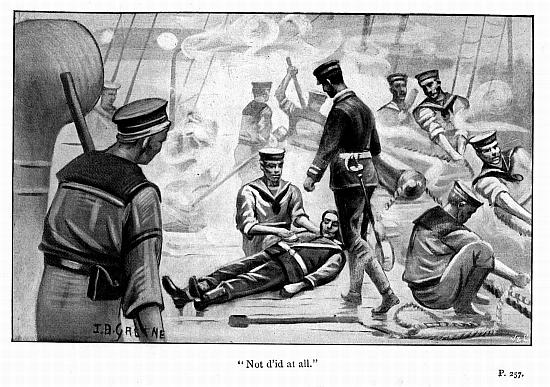
As he jerked out the sudden exclamation, he certainly acted up to his advice; for, he gave a hop that took him some ten feet in the air ere he fell down on the deck, all covered with blood.
“Poor Macan!” said Mr Stormcock, bending over his prostrate form, and trying to lift him in vain. “Well, he’s done for at last, I’m afraid. We could have better spared a better man, perhaps!”
“He’s dead, sir, sure enough,” corroborated one of the marines who had been assisting to work the big bow gun, the carriage of which had been smashed, on one side by a heavy chain shot, which must, we all thought, have settled the corporal at the same time. “He’ll never eat plum duff again, poor chap. He was a good one over his vittles, too, was the corporal, and likewise at his drink!”
“Faix, ye lie, ye divil,” cried the seemingly lifeless man, reviving at this moment and struggling to his feet. “I’m not d’id at all, at all! D’ye think now I’m going to be kilt—by a Haythin Chaynee? Begorrah, whin I am kilt, may the saints in h’iven presairve me from it yit!—I hopes as how it’ll be by a Roosian, or a Proosian, or a dacint Christian man of some sort or t’other, an’ not, faix, by one of thim yaller-faced Johnnies over yander!”
We all laughed at this, it being quite a relief to find our old friend the corporal had not yet lost “the number of his mess,” as he was the life and soul of the ship on the lower deck, drunk or sober!
He had, however, a narrow squeak of it; for a splinter had jogged his leg from the ankle to the knee, while the bollard on which he had been standing had been shot away under his feet.
This caused that wonderful jump of his which had surprised me so much, himself all the more, too, the heavy fall he had on the deck afterwards having knocked him senseless for the time and, indeed, bruised him very considerably.
Macan, though, had all an Irishman’s pluck, and would not give in.
“Sure, sor, it’s ownly a thrifle,” he urged, when told by Mr Stormcock to go below to Mr McGilpin, who was busy in the after-cabin, attending to those of the wounded that the Chinese gunners, who aimed remarkably well, had not put altogether beyond the reach of surgical aid. “I wudn’t throuble the docthor wid it; an’ faix, I want to pay thim Chaynee images fur smashin’ me crockery! Bedad, an’ I will, too, for I’ve got my hands left all right an’ a straight oye, an’, I’ll have a slap at ’em ag’in, sure, by your leve, sor!”
“Carry on!” cried Mr Stormcock, who had been assisting to wedge up the gun so that it could be still fired, only the carriage having been injured by the shot. “Make as good practice as you did before, Macan; and, then you’ll soon be revenged on some of those beggars!”
“I will that, sor,” replied the corporal, bending down to the rear right of the sixty-four pounder, which had been slewed round in the direction of the battery abreast us, and taking careful aim. “A ha’porth more illivation, Number 2. Well—muzzle left! Well—fire!”
Bang it went off, making the dirt fly from the embrasure opposite, while a cloud of smoke rose up, as if a magazine had been exploded; and so we continued, hammer and tongs, the atmosphere all sulphur and gunpowder, the deck slippery with gore, our ears deafened with the ceaseless discharges of the guns, till it really seemed “as if Hell had broken loose!” as Mr Stormcock said.
It was the last sentence the master’s mate ever uttered; for a bullet penetrated his brain the next instant, and he dropped down beside me stone dead, almost as soon as the words escaped his lips.
I hardly knew what occurred after that, I was so saddened by the loss of Mr Stormcock, whom I had always found a very good friend to me, for he had taught me a good deal; and, notwithstanding that I had not taken to him at first, I had since learnt to have a most sincere regard for him, while he on his part, though so much older than myself, liked me, I believe, for he appeared fond of being in my company.
His death, however, only added one more to the long list of those who had already fallen; while every moment some fresh casualty occurred.
The enemy’s fire got hotter as the afternoon wore on and the fight proceeded, until everyone felt the task the admiral had attempted, with his comparatively weak force, in attacking such formidable defences, was doomed to failure; although not a single man thought of abandoning the struggle or confessing, as was the case, that we were “licked!”
But, it could not be much further prolonged; for, at six o’clock, the Kestrel had been sunk, fighting her guns to the last, the Lee obliged to run on the mud to prevent her meeting a like fate; while the Plover and Opossum, which were still in the van, had been pretty well knocked out of shape.
The Cormorant was ahead of us all, with the sorely wounded admiral lying bleeding in his cot on her deck, our gallant chief persisting in watching the battle to its bitter end, in spite of being compelled from absolute exhaustion to give up the immediate command of the squadron to his senior officer, Captain Shadwell; though it was as much as the gunboat could do to keep her prominent position, in face of the terrible fire on her front and flanks.
To retreat, however, was impossible then, as there was not water enough in the river for the vessels that still floated to recross the bar before midnight; besides which, if they attempted to move off while daylight lasted, they would be exposed to the risk of greater loss from the terrible fire from the batteries which was certain to be hailed on them.
Under the desperate circumstances of the case, therefore, it was determined by the senior officer, who acted in concert with the other captains present, that a bold stroke should be attempted to save the honour of the day, which was to try and carry the forts by assault—a “forlorn hope” in every sense of the word!
No sooner was this desperate expedient resolved on than it was gallantly set about, the boats filled with the marines and small-arms men, who yet remained below the barrier at the river mouth being brought to the front—an operation in which we were generously aided by Commodore Tatnall, of the United States steam frigate the Toeywan, which had been lying off the Peiho for some time, out of the line of fire.
“Great Scott!” cried this noble-hearted American to his officers as he saw our poor fellows pulling up the heavily-laden launches and cutters against stream, under the withering fire of the batteries, with a sort of dogged resolution, determined to do or die, giving the boats a friendly tow to the nearest point of land and approaching as close as he could to the low, muddy shore on which the rising tide was beginning now to flow again, regardless of any ill consequences to himself or his ship; albeit he was supposed to be a neutral, the Government of the United States not having taken sides with us in the war. “Blood’s thicker than water, boys! Let us lend them a hand. Thunder, they are brother sailors and white men like ourselves!”
Chapter Twenty Eight.
The Harvest of Death!
Nor did the sympathy of the American commodore cease here; for the boats of the Toeywan helped to pick up many of our wounded fellows who were struggling in the water, while a lot of his men, coming alongside one of the gunboats, which had redoubled their fire in order to cover the landing of the assaulting party, climbed on board and “lent a hand” to man the gun.
The stalwart “down easters,” when called to order by their officer later on, when leaving this vessel to regain their own ship, excusing themselves for having taken so unneutral a part in the action, on the plea that seeing we were short-handed and in a tight place, they had done it “for fellowship sake!”
Most of our fellows were in the attacking column, though neither I nor Larkyns, nor, indeed, any of the other youngsters, were permitted to accompany them, but I can tell of my own knowledge with what wistful eyes we watched their progress from the deck of the little spitfire of a vessel that I was only on board of on sufferance, I having smuggled myself in with Larkyns, who was on duty as midshipman of the launch; for the gunboat had now returned to the barriers further up the river and began hammering again at the batteries, in order to divert their attention from our field column, after assisting to bring up a quota of the force and waiting till they disembarked from the boats.
Gallantly the little band, a compact mass of six hundred men, pursued their way through the treacherous mud, night closing in as they struggled onward, and the darkness only lit by the flashes of our guns firing over the head of the column at the fortifications in their front; the Chinese only replying to our cannonade in a half-hearted fashion, as if they had got weary of the job, leading us thus to believe that the “forlorn hope” had an easy task before it!
But, Larkyns and myself were both deceived, this sudden quiet on the part of the enemy being really a ruse; for, hardly had the column reached firm ground than the hitherto silent batteries all at once burst into a sheet of flame, pouring shot and shell, jinghal balls, rifle bullets, in fact every variety of deadly missile known in war, on the heads of our devoted men, at such close quarters, too, that not one in three escaped the avalanche of destruction!
The Tartar garrison defending the place, we subsequently learnt, used bows and arrows and matchlocks, in addition to the best modern weapons, the better to discomfit their foes; “those vile red devils of barbarians,” as they called us, who had so rashly ventured to tackle them at close quarters, thinking to “catch a weasel asleep.”
“Oh, Vernon, look, look!” cried Larkyns, as the gloomy night with its overhanging pall of smoke from the endless bombardment, which had been going on ever since mid-day, was lit up by a crimson glow that enabled us to see every detail of what took place and even recognise the features of some of our officers. “See how they are mowed down—not a man of them will come back alive!”
Saying which, grown lad that he was of seventeen, and courageous and foolhardy to desperation, he burst into tears, the tension on his nerves from the excitement we had all gone through since the early hours of that ill-fated morning having completely unmanned him, making him for the moment a perfect baby!
But I was just as bad; and, to relieve our feelings, we helped the marine gunners, who were pounding away at the rascally Chinese, although we had presently to stay our fire, for fear of hitting friends as well as foes.
The end was not far off now, things shortly coming to a climax.
Half our men fell at the first discharge; but the remainder resolutely rushed on to the broad ditch in front of the bastion, and about a third of these got bravely through this obstruction, some fifty finally reaching the base of the works.
There were no scaling ladders, however, wherewith to climb the steep escarpments, no available reinforcements, for every man jack that could be spared from the gunboats was there, to fill the voids in the ranks which dwindled and dwindled each instant; and so at last, although the handful of heroes who succeeded in getting up to the foremost fort, advancing almost within sight, so to speak, of victory, might possibly have held their own where they were until morning, if they had been allowed to remain, being partly sheltered now by the salient angle of the fortification, our senior officer, perceiving the hopelessness of continuing any longer the unequal contest, ordered “the retreat” to be sounded.
Then came the most harrowing scene of all.
If the Chinese fire had been hot before, its intensity was increased tenfold as soon as the bugle-call echoed out shrilly between the reports of the heavy guns and fusillade of the musketry, and the remnants of the gallant little band began to fall back on their boats, retiring in wonderful order despite the cruel pelting they received on all sides, not a wounded man being left behind whose life could be saved.
A wonder it was, though, as Larkyns said, that a single soul escaped; for the guns which were aimed at the poor, worn-out fellows as they waded out through the mud to their boats, were now turned on the latter as they got into these, scattering grape as they were massed together, and when the gunboat advanced to their rescue.
“Boom!” came the round shot hopping over them; and “Bang!” and “Rattle!” and “Rattle!” and “Bang!” they went on incessantly until all were out of range, the boats in tow resembling a funeral procession which, with its weird surroundings, seemed like Holbein’s “Dance of Death.”
It was such a ghastly picture, which those who saw it will never forget.
The lapping water had by this time overflowed the shelving banks of the river, which spread out far beyond its regular bounds into the reedy plains and marshes on either hand, the swollen stream bringing down, as the tide ebbed again towards midnight, the wreckage of the gunboats that had been sunk during the conflict.
Broken spars and the remnants of the destroyed booms floated along, impeding the progress of the craft that had escaped, and blocking the narrow channel where only sufficient depth could be obtained to admit of their passage out to sea; while the corpses of the slain that had fallen overboard floated by similarly on the turbid bosom of the Peiho.
All these baffled our poor fellows who were struggling for their lives when the boats upset, and endeavouring to swim to the steamers, which, on their part, were trying their hardest to get across the bar before it would be too late!
All the time, too, the Manchurian marksmen were busy taking pot-shots at some unhappy survivor wallowing in the mud under the forts, which were firing furiously without a moment’s cessation, lighting up the hideous scene on which the dark heavens above, without a star to be seen, looked down in horror.
Of the eleven vessels we had engaged from first to last, three were sunk, four disabled, and three more so much damaged as to require considerable repair subsequently before being again fit for service; while out of a total of eleven hundred men who had started off so gaily in the morning to play their part in this tragic play, our casualties amounted to five hundred, so that not one half ever returned to swing in their respective hammocks again.
“By Jove we have got a thrashing!” said Commander Nesbitt, ruefully, next morning, when Dr Nettleby came to make his report as to the state of the wounded we had and there was a general counting up of losses. “I didn’t think John Chinaman had it in him to make such a stand!”
“Neither did I,” replied Captain Farmer, who was standing by on the poop, looking over the taffrail at the spot made memorable by last night’s carnage, though the whilom muddy river appeared bright enough now with the sun shining down on its rippling surface, and no trace of the fight of yesterday visible save the masts of one and part of the hull of another of the sunken gunboats in the distance, and the grim forts staring down on them defiantly, apparently quite uninjured by the pounding they had received. “They have certainly given us a licking, but they’ll have a very heavy reckoning to pay for their temporary triumph by-and-by, Nesbitt, or I am very much mistaken! I suppose you recollect the old proverb, Hodie mihi, eras tibi?”
“Can’t say I do, sir,” said the commander in answer, scratching his head reflectively as he raised his cap for the purpose, with the object apparently of quickening his memory by that means. “I’m afraid I’ve forgotten all my Latin, sir, long since. What does it mean, eh?”
“‘To-day it is my turn, to-morrow it may be yours,’” replied Captain Farmer, looking as grim as the Taku Fort as he translated the sentence for the other’s benefit. “The Emperor of China had best bear this in mind, for there’ll be a pretty fine kick up, I tell you, when they come to hear of this business in England!”
“You are right there, sir,” agreed Commander Nesbitt. “There will be a jolly row about it in the papers and in Parliament, I know! But it is none of our fault; we have done nothing to be ashamed of, for we’ve done our best!”
“Ay, though defeated we’re not disgraced,” said the captain, as he came down the poop-ladder to go into his cabin. “It’s a sad affair, though, a sad affair. We’ve lost Bitpin and Stormcock and Morgan and that poor lad Jackson amongst the officers killed, besides those wounded, and I can’t say yet how many men, but between thirty and forty, I fear!”
“Yes, sir, it is a bad job,” replied the commander, bending his head and looking grave for an instant, but the next moment a bright look came in his face and he shook his fist at the distant forts; “but we’ll pay you out yet, pigtails and all, for this day’s work!”
“Let us hope so,” said the captain, as he crossed the quarter-deck and disappeared from view beneath the break of the poop, going into his own cabin to send in his report to our senior officer, Admiral Hope, who was subsequently invalided home, being so dangerously wounded as to be incapable of attending to any other business after forwarding his dispatches home. “And, the sooner the better, Nesbitt—the sooner the better!” Both officers judged the feeling of their countrymen well, but quite twelve months elapsed before all our preparations were completed for retaliating on the Chinese and proving to them, in that forcible mode which seemingly only appealed to their reason, that “the worst piece of work they ever did in their lives was to tread on the tail of the British lion,” as Doctor Nettleby observed to Mr Jellaby in my hearing later on the same day.
Chapter Twenty Nine.
A Good “Deal.”
In the meantime, the fleet sailed away from the scene of action, after honourably burying the dead and destroying our sunken vessels; so that the Chinese, who had a weak habit at that time and in later years, too, of indulging in fiction when referring to their martial exploits, should not be able to boast of having captured our ships, the Candahar putting in at Hong Kong to refit later on, after visiting Shanghai again on leaving the Gulf of Pechili.
Here Larkyns, who had succeeded poor Mr Stormcock in his office as caterer of the gunroom mess, distinguished himself, quite unwittingly, in a financial operation which gained him the credit of being a very “smart” fellow indeed in the sense in which our American cousins use the term; besides earning for himself the good opinion of all of us in the gunroom, whom he benefited by the exploit.
It happened in this wise.
Master Larkyns being ashore one day at Victoria, the chief town of Hong Kong, which is built up the side of a hill facing the harbour, noticing a lot of people collected round one of the merchant’s stores, asked naturally, midshipman like, “What the row was about?”
He was told an auction was going on; so, in he went to see the fun, taking much interest in the biddings.
Presently, a hogshead of claret was put up by the auctioneer, and, thinking this a good opportunity for laying in a stock for the mess, as we would be in commission probably in warm latitudes, for the next two or three years, when the wine would come in rather handy, Larkyns listened eagerly for the price and heard it offered at 12 pounds.
This seemed a big sum, but, if the worst came to the worst, and his messmates grumbled at his extravagance, he thought, he could pay for it out of his own pocket, he thought; and so, in his impetuous way, he bid 12 pounds, 10 shillings, without waiting for anyone to make an offer, which no one doing, his sudden jump having paralysed the brokers present, to his great surprise and joy the wine was knocked down to him at the price he named.
By-and-by, however, his joy was changed to grief; for, the auctioneer asked him for a cheque or a reference, when he found out that, instead of buying a single hogshead of claret, as he believed to be the case on bidding for it, he had purchased a whole consignment of the wine, of which the single specimen offered had been a sample—the transaction involved the outlay of more than 1500 pounds, which of course he could never pay, although he had the 12 pounds, 10 shillings he had offered, and a few pounds more in his pocket as well.
Here was a pretty to-do; and, he was just wondering whether he should solve the Gordian knot by cutting and running, when, luckily, a man without a hat rushed in breathlessly from a neighbouring store, and coming up to the auctioneer, asked him if the wine was sold yet.
“You’re a bit too late,” replied the master of the rostrum, pointing out Larkyns to his astonished gaze. “I have just knocked it down to this gentleman.”
“Indeed!” exclaimed the stranger. “At what?”
“Twelve pounds, ten shillings.”
“Ah, that all?” cried the hatless individual; and, turning to Larkyns, he said with an entreating air, “I’ll give you an advance of ten shillings a hogshead if you let me have it.”
Our caterer was quite bewildered.
“I don’t mind,” he said at last, looking from the auctioneer to the stranger and back again to his creditor, who stood waiting for the 1500 pound cheque. “That is, if this gentleman here is satisfied.”
“Oh, that’s all right,” said the auctioneer. “I know Mr —, and his word is as good as his bond. He’ll give you the difference between your bid and his present offer, and you’ll gain something by the deal.”
“By Jove!” cried Larkyns. “I never thought of that, but I wanted some wine for the mess.”
“I daresay we can manage that,” said the buyer, evidently pleased with his bargain, though had he known of my friend’s mistake in time before he made his offer he might not have been so generous. “I’ll tell you what I’ll do, I will give you 50 pounds to take over the consignment, and a cask of the wine into the bargain.”
This Master Larkyns readily agreed to, as may be well imagined; and the upshot of the affair was, that our mess funds were 50 pounds richer by this visit of Larkyns to the auction rooms.
This enabled us to live “like fighting cocks” while we remained in port; and when the wardroom officers chanced to pay us a visit, which I noticed they more frequently did now than formerly, we were able to offer them a glass of claret, which was rather a novelty in those days in the gunroom mess.
After refitting, we went for a cruise to the East Indies, where we found the new admiral who had come out to replace Admiral Hope; and, in the spring of the following year, having served for eighteen months as a naval cadet, I was promoted to the rank of midshipman, the captain and first lieutenant, having convinced themselves of my competency by asking me how I would manage to get a six-pounder to the top of a perpendicular hill, my answer to which question was that I would head it up in a cask and “parbuckle” it up.
“Glass-eye” smiled rather quizzingly at this, requesting to know what sort of cask I would employ. I settled him at once, however, by saying that a claret cask would do; there having been a joke current of his coming to see how the gunroom was getting on about luncheon time, at the time our wine cellar had been so sumptuously replenished by Larkyns, who, by the way, got his step to acting mate the same month that I was made midshipman.
Chapter Thirty.
In a Bamboo Cage.
During the interval that had elapsed since our defeat in front of the Taku Forts, to proceed now to more stirring events, the English and French Governments had been organising a joint expedition against China; to demand an apology for the treatment their respective representatives had received, and insist on the stipulations of the historical Treaty of Tientsin being practically, and not merely formally, adhered to.
By the middle of the year 1860, the ten thousand men that comprised the English contingent, under the leadership of Sir Hope Grant, had assembled at Chusan, all ready for the campaign.
They were not joined here by the French under General Montauban, who mustered only seven thousand bayonets, until some weeks later, our allies being very dilatory in their movements.
On the 1st August, this imposing force, a joint army seventeen thousand strong, which was conveyed up the Gulf of Pechili in no less a number than a hundred and twenty transports, escorted by the French and English fleets, that totalled over ninety sail, landed at Pahtang, some ten miles to the north of the Peiho river. Here, their disembarkation was not interfered with, our old friends the Chinese expecting us to make another assault on the Taku Forts, that had before repulsed us, which they had rendered much stronger in the months that had since elapsed.
But “once bitten twice shy” was our motto; and, by making a march across country, we defeated a large army, mainly composed of Tartar cavalry, on the way, our redcoats, in company with the battalions of Monsieur Pantalou, made short work of the Chinese “braves.”