III
Reading edition
FEEDING THE SOIL
The Great War not only starved people: it starved the land. Enough nitrogen was thrown away in some indecisive battle on the Aisne to save India from a famine. The population of Europe as a whole has not been lessened by the war, but the soil has been robbed of its power to support the population. A plant requires certain chemical elements for its growth and all of these must be within reach of its rootlets, for it will accept no substitutes. A wheat stalk in France before the war had placed at its feet nitrates from Chile, phosphates from Florida and potash from Germany. All these were shut off by the firing line and the shortage of shipping.
Out of the eighty elements only thirteen are necessary for crops. Four of these are gases: hydrogen, oxygen, nitrogen and chlorine. Five are metals: potassium, magnesium, calcium, iron and sodium. Four are non-metallic solids: carbon, sulfur, phosphorus and silicon. Three of these, hydrogen, oxygen and carbon, making up the bulk of the plant, are obtainable ad libitum from the air and water. The other ten in the form of salts are dissolved in the water that is sucked up from the soil. The quantity needed by the plant is so small and the quantity contained in the soil is so great that ordinarily we need not bother about the supply except in case of three of them. They are nitrogen, potassium and phosphorus. These would be useless or fatal to plant life in the elemental form, but fixed in neutral salt they are essential plant foods. A ton of wheat takes away from the soil about 47 pounds of nitrogen, 18 pounds of phosphoric acid and 12 pounds of potash. If then the farmer does not restore this much to his field every year he is drawing upon his capital and this must lead to bankruptcy in the long run.
So much is easy to see, but actually the question is extremely complicated. When the German chemist, Justus von Liebig, pointed out in 1840 the possibility of maintaining soil fertility by the application of chemicals it seemed at first as though the question were practically solved. Chemists assumed that all they had to do was to analyze the soil and analyze the crop and from this figure out, as easily as balancing a bank book, just how much of each ingredient would have to be restored to the soil every year. But somehow it did not work out that way and the practical agriculturist, finding that the formulas did not fit his farm, sneered at the professors and whenever they cited Liebig to him he irreverently transposed the syllables of the name. The chemist when he went deeper into the subject saw that he had to deal with the colloids, damp, unpleasant, gummy bodies that he had hitherto fought shy of because they would not crystallize or filter. So the chemist called to his aid the physicist on the one hand and the biologist on the other and then they both had their hands full. The physicist found that he had to deal with a polyvariant system of solids, liquids and gases mutually miscible in phases too numerous to be handled by Gibbs's Rule. The biologist found that he had to deal with the invisible flora and fauna of a new world.
Plants obey the injunction of Tennyson and rise on the stepping stones of their dead selves to higher things. Each successive generation lives on what is left of the last in the soil plus what it adds from the air and sunshine. As soon as a leaf or tree trunk falls to the ground it is taken in charge by a wrecking crew composed of a myriad of microscopic organisms who proceed to break it up into its component parts so these can be used for building a new edifice. The process is called "rotting" and the product, the black, gummy stuff of a fertile soil, is called "humus." The plants, that is, the higher plants, are not able to live on their own proteids as the animals are. But there are lower plants, certain kinds of bacteria, that can break up the big complicated proteid molecules into their component parts and reduce the nitrogen in them to ammonia or ammonia-like compounds. Having done this they stop and turn over the job to another set of bacteria to be carried through the next step. For you must know that soil society is as complex and specialized as that above ground and the tiniest bacterium would die rather than violate the union rules. The second set of bacteria change the ammonia over to nitrites and then a third set, the Amalgamated Union of Nitrate Workers, steps in and completes the process of oxidation with an efficiency that Ostwald might envy, for ninety-six per cent. of the ammonia of the soil is converted into nitrates. But if the conditions are not just right, if the food is insufficient or unwholesome or if the air that circulates through the soil is contaminated with poison gases, the bacteria go on a strike. The farmer, not seeing the thing from the standpoint of the bacteria, says the soil is "sick" and he proceeds to doctor it according to his own notion of what ails it. First perhaps he tries running in strike breakers. He goes to one of the firms that makes a business of supplying nitrogen-fixing bacteria from the scabs or nodules of the clover roots and scatters these colonies over the field. But if the living conditions remain bad the newcomers will soon quit work too and the farmer loses his money. If he is wise, then, he will remedy the conditions, putting a better ventilation system in his soil perhaps or neutralizing the sourness by means of lime or killing off the ameboid banditti that prey upon the peaceful bacteria engaged in the nitrogen industry. It is not an easy job that the farmer has in keeping billions of billions of subterranean servants contented and working together, but if he does not succeed at this he wastes his seed and labor.
The layman regards the soil as a platform or anchoring place on which to set plants. He measures its value by its superficial area without considering its contents, which is as absurd as to estimate a man's wealth by the size of his safe. The difference in point of view is well illustrated by the old story of the city chap who was showing his farmer uncle the sights of New York. When he took him to Central Park he tried to astonish him by saying "This land is worth $500,000 an acre." The old farmer dug his toe into the ground, kicked out a clod, broke it open, looked at it, spit on it and squeezed it in his hand and then said, "Don't you believe it; 'tain't worth ten dollars an acre. Mighty poor soil I call it." Both were right.
Courtesy of American Cyanamid Co.
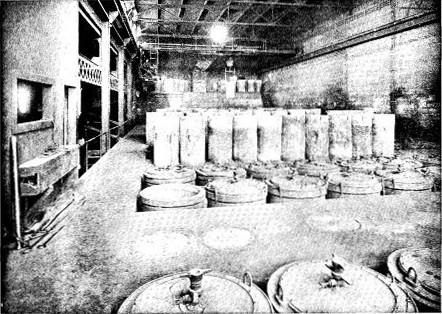
FIXING NITROGEN BY CALCIUM CARBIDE
A view of the oven room in the plant of the American Cyanamid Company. The steel cylinders standing in the background are packed with the carbide and then put into the ovens sunk in the floor. When these are heated internally by electricity to 2000 degrees Fahrenheit pure nitrogen is let in and absorbed by the carbide, making cyanamid, which may be used as a fertilizer or for ammonia.
Photo by International Film Service
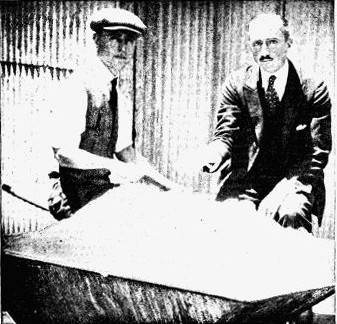
A BARROW FULL OF POTASH SALTS EXTRACTED FROM SIX TONS OF GREEN KELP BY THE GOVERNMENT CHEMISTS
NATURE'S SILENT METHOD OF NITROGEN FIXATION
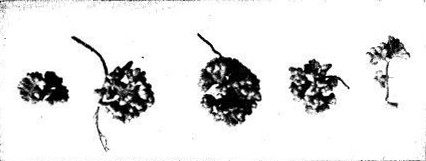
The nodules on the vetch roots contain colonies of bacteria which have the power of taking the free nitrogen out of the air and putting it in compounds suitable for plant food.
The modern agriculturist realizes that the soil is a laboratory for the production of plant food and he ordinarily takes more pains to provide a balanced ration for it than he does for his family. Of course the necessity of feeding the soil has been known ever since man began to settle down and the ancient methods of maintaining its fertility, though discovered accidentally and followed blindly, were sound and efficacious. Virgil, who like Liberty Hyde Bailey was fond of publishing agricultural bulletins in poetry, wrote two thousand years ago:
But sweet vicissitudes of rest and toil Make easy labor and renew the soil Yet sprinkle sordid ashes all around And load with fatt'ning dung thy fallow soil.
The ashes supplied the potash and the dung the nitrate and phosphate. Long before the discovery of the nitrogen-fixing bacteria, the custom prevailed of sowing pea-like plants every third year and then plowing them under to enrich the soil. But such local supplies were always inadequate and as soon as deposits of fertilizers were discovered anywhere in the world they were drawn upon. The richest of these was the Chincha Islands off the coast of Peru, where millions of penguins and pelicans had lived in a most untidy manner for untold centuries. The guano composed of the excrement of the birds mixed with the remains of dead birds and the fishes they fed upon was piled up to a depth of 120 feet. From this Isle of Penguins—which is not that described by Anatole France—a billion dollars' worth of guano was taken and the deposit was soon exhausted.
Then the attention of the world was directed to the mainland of Peru and Chile, where similar guano deposits had been accumulated and, not being washed away on account of the lack of rain, had been deposited as sodium nitrate, or "saltpeter." These beds were discovered by a German, Taddeo Haenke, in 1809, but it was not until the last quarter of the century that the nitrates came into common use as a fertilizer. Since then more than 53,000,000 tons have been taken out of these beds and the exportation has risen to a rate of 2,500,000 to 3,000,000 tons a year. How much longer they will last is a matter of opinion and opinion is largely influenced by whether you have your money invested in Chilean nitrate stock or in one of the new synthetic processes for making nitrates. The United States Department of Agriculture says the nitrate beds will be exhausted in a few years. On the other hand the Chilean Inspector General of Nitrate Deposits in his latest official report says that they will last for two hundred years at the present rate and that then there are incalculable areas of low grade deposits, containing less than eleven per cent., to be drawn upon.
Anyhow, the South American beds cannot long supply the world's need of nitrates and we shall some time be starving unless creative chemistry comes to the rescue. In 1898 Sir William Crookes—the discoverer of the "Crookes tubes," the radiometer and radiant matter—startled the British Association for the Advancement of Science by declaring that the world was nearing the limit of wheat production and that by 1931 the bread-eaters, the Caucasians, would have to turn to other grains or restrict their population while the rice and millet eaters of Asia would continue to increase. Sir William was laughed at then as a sensationalist. He was, but his sensations were apt to prove true and it is already evident that he was too near right for comfort. Before we were half way to the date he set we had two wheatless days a week, though that was because we persisted in shooting nitrates into the air. The area producing wheat was by decades:[1]
THE WHEAT FIELDS OF THE WORLD
Acres
1881-90192,000,000
1890-1900211,000,000
1900-10242,000,000
Probable limit300,000,000
If 300,000,000 acres can be brought under cultivation for wheat and the average yield raised to twenty bushels to the acre, that will give enough to feed a billion people if they eat six bushels a year as do the English. Whether this maximum is correct or not there is evidently some limit to the area which has suitable soil and climate for growing wheat, so we are ultimately thrown back upon Crookes's solution of the problem; that is, we must increase the yield per acre and this can only be done by the use of fertilizers and especially by the fixation of atmospheric nitrogen. Crookes estimated the average yield of wheat at 12.7 bushels to the acre, which is more than it is in the new lands of the United States, Australia and Russia, but less than in Europe, where the soil is well fed. What can be done to increase the yield may be seen from these figures:
GAIN IN THE YIELD OF WHEAT IN BUSHELS PER ACRE
1889-901913
Germany1935
Belgium3035
France1720
United Kingdom2832
United States1215
The greatest gain was made in Germany and we see a reason for it in the fact that the German importation of Chilean saltpeter was 55,000 tons in 1880 and 747,000 tons in 1913. In potatoes, too, Germany gets twice as big a crop from the same ground as we do, 223 bushels per acre instead of our 113 bushels. But the United States uses on the average only 28 pounds of fertilizer per acre, while Europe uses 200.
It is clear that we cannot rely upon Chile, but make nitrates for ourselves as Germany had to in war time. In the first chapter we considered the new methods of fixing the free nitrogen from the air. But the fixation of nitrogen is a new business in this country and our chief reliance so far has been the coke ovens. When coal is heated in retorts or ovens for making coke or gas a lot of ammonia comes off with the other products of decomposition and is caught in the sulfuric acid used to wash the gas as ammonium sulfate. Our American coke-makers have been in the habit of letting this escape into the air and consequently we have been losing some 700,000 tons of ammonium salts every year, enough to keep our land rich and give us all the explosives we should need. But now they are reforming and putting in ovens that save the by-products such as ammonia and coal tar, so in 1916 we got from this source 325,000 tons a year.
Courtesy of Scientific American.
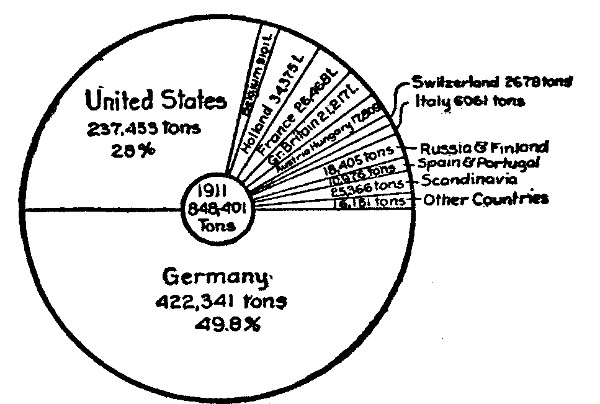
Consumption of potash for agricultural purposes in different countries
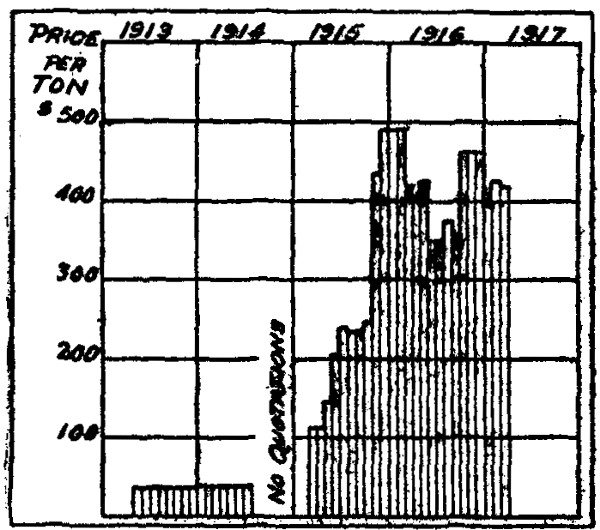
Germany had a natural monopoly of potash as Chile had a natural monopoly of nitrates. The agriculture of Europe and America has been virtually dependent upon these two sources of plant foods. Now when the world was cleft in twain by the shock of August, 1914, the Allied Powers had the nitrates and the Central Powers had the potash. If Germany had not had up her sleeve a new process for making nitrates she could not long have carried on a war and doubtless would not have ventured upon it. But the outside world had no such substitute for the German potash salts and has not yet discovered one. Consequently the price of potash in the United States jumped from $40 to $400 and the cost of food went up with it. Even under the stimulus of prices ten times the normal and with chemists searching furnace crannies and bad lands the United States was able to scrape up less than 10,000 tons of potash in 1916, and this was barely enough to satisfy our needs for two weeks!
What happened to potash when the war broke out. This diagram from the Journal of Industrial and Engineering Chemistry of July, 1917, shows how the supply of potassium muriate from Germany was shut off in 1914 and how its price rose.
Yet potash compounds are as cheap as dirt. Pick up a handful of gravel and you will be able to find much of it feldspar or other mineral containing some ten per cent. of potash. Unfortunately it is in combination with silica, which is harder to break up than a trust.
But "constant washing wears away stones" and the potash that the metallurgist finds too hard to extract in his hottest furnace is washed out in the course of time through the dropping of the gentle rain from heaven. "All rivers run to the sea" and so the sea gets salt, all sorts of salts, principally sodium chloride (our table salt) and next magnesium, calcium and potassium chlorides or sulfates in this order of abundance. But if we evaporate sea-water down to dryness all these are left in a mix together and it is hard to sort them out. Only patient Nature has time for it and she only did on a large scale in one place, that is at Stassfurt, Germany. It seems that in the days when northwestern Prussia was undetermined whether it should be sea or land it was flooded annually by sea-water. As this slowly evaporated the dissolved salts crystallized out at the critical points, leaving beds of various combinations. Each year there would be deposited three to five inches of salts with a thin layer of calcium sulfate or gypsum on top. Counting these annual layers, like the rings on a stump, we find that the Stassfurt beds were ten thousand years in the making. They were first worked for their salt, common salt, alone, but in 1837 the Prussian Government began prospecting for new and deeper deposits and found, not the clean rock salt that they wanted, but bittern, largely magnesium sulfate or Epsom salt, which is not at all nice for table use. This stuff was first thrown away until it was realized that it was much more valuable for the potash it contains than was the rock salt they were after. Then the Germans began to purify the Stassfurt salts and market them throughout the world. They contain from fifteen to twenty-five per cent. of magnesium chloride mixed with magnesium chloride in "carnallite," with magnesium sulfate in "kainite" and sodium chloride in "sylvinite." More than thirty thousand miners and workmen are employed in the Stassfurt works. There are some seventy distinct establishments engaged in the business, but they are in combination. In fact they are compelled to be, for the German Government is as anxious to promote trusts as the American Government is to prevent them. Once the Stassfurt firms had a falling out and began a cutthroat competition. But the German Government objects to its people cutting each other's throats. American dealers were getting unheard of bargains when the German Government stepped in and compelled the competing corporations to recombine under threat of putting on an export duty that would eat up their profits.
The advantages of such business coöperation are specially shown in opening up a new market for an unknown product as in the case of the introduction of the Stassfurt salts into American agriculture. The farmer in any country is apt to be set in his ways and when it comes to inducing him to spend his hard-earned money for chemicals that he never heard of and could not pronounce he—quite rightly—has to be shown. Well, he was shown. It was, if I remember right, early in the nineties that the German Kali Syndikat began operations in America and the United States Government became its chief advertising agent. In every state there was an agricultural experiment station and these were provided liberally with illustrated literature on Stassfurt salts with colored wall charts and sets of samples and free sacks of salts for field experiments. The station men, finding that they could rely upon the scientific accuracy of the information supplied by Kali and that the experiments worked out well, became enthusiastic advocates of potash fertilizers. The station bulletins—which Uncle Sam was kind enough to carry free to all the farmers of the state—sometimes were worded so like the Kali Company advertising that the company might have raised a complaint of plagiarizing, but they never did. The Chilean nitrates, which are under British control, were later introduced by similar methods through the agency of the state agricultural experiment stations.
As a result of all this missionary work, which cost the Kali Company $50,000 a year, the attention of a large proportion of American farmers was turned toward intensive farming and they began to realize the necessity of feeding the soil that was feeding them. They grew dependent upon these two foreign and widely separated sources of supply. In the year before the war the United States imported a million tons of Stassfurt salts, for which the farmers paid more than $20,000,000. Then a declaration of American independence—the German embargo of 1915—cut us off from Stassfurt and for five years we had to rely upon our own resources. We have seen how Germany—shut off from Chile—solved the nitrogen problem for her fields and munition plants. It was not so easy for us—shut off from Germany—to solve the potash problem.
There is no more lack of potash in the rocks than there is of nitrogen in the air, but the nitrogen is free and has only to be caught and combined, while the potash is shut up in a granite prison from which it is hard to get it free. It is not the percentage in the soil but the percentage in the soil water that counts. A farmer with his potash locked up in silicates is like the merchant who has left the key of his safe at home in his other trousers. He may be solvent, but he cannot meet a sight draft. It is only solvent potash that passes current.
In the days of our grandfathers we had not only national independence but household independence. Every homestead had its own potash plant and soap factory. The frugal housewife dumped the maple wood ashes of the fireplace into a hollow log set up on end in the backyard. Water poured over the ashes leached out the lye, which drained into a bucket beneath. This gave her a solution of pearl ash or potassium carbonate whose concentration she tested with an egg as a hydrometer. In the meantime she had been saving up all the waste grease from the frying pan and pork rinds from the plate and by trying out these she got her soap fat. Then on a day set apart for this disagreeable process in chemical technology she boiled the fat and the lye together and got "soft soap," or as the chemist would call it, potassium stearate. If she wanted hard soap she "salted it out" with brine. The sodium stearate being less soluble was precipitated to the top and cooled into a solid cake that could be cut into bars by pack thread. But the frugal housewife threw away in the waste water what we now consider the most valuable ingredients, the potash and the glycerin.
But the old lye-leach is only to be found in ruins on an abandoned farm and we no longer burn wood at the rate of a log a night. In 1916 even under the stimulus of tenfold prices the amount of potash produced as pearl ash was only 412 tons—and we need 300,000 tons in some form. It would, of course, be very desirable as a conservation measure if all the sawdust and waste wood were utilized by charring it in retorts. The gas makes a handy fuel. The tar washed from the gas contains a lot of valuable products. And potash can be leached out of the charcoal or from its ashes whenever it is burned. But this at best would not go far toward solving the problem of our national supply.
There are other potash-bearing wastes that might be utilized. The cement mills which use feldspar in combination with limestone give off a potash dust, very much to the annoyance of their neighbors. This can be collected by running the furnace clouds into large settling chambers or long flues, where the dust may be caught in bags, or washed out by water sprays or thrown down by electricity. The blast furnaces for iron also throw off potash-bearing fumes.
Our six-million-ton crop of sugar beets contains some 12,000 tons of nitrogen, 4000 tons of phosphoric acid and 18,000 tons of potash, all of which is lost except where the waste liquors from the sugar factory are used in irrigating the beet land. The beet molasses, after extracting all the sugar possible by means of lime, leaves a waste liquor from which the potash can be recovered by evaporation and charring and leaching the residue. The Germans get 5000 tons of potassium cyanide and as much ammonium sulfate annually from the waste liquor of their beet sugar factories and if it pays them to save this it ought to pay us where potash is dearer. Various other industries can put in a bit when Uncle Sam passes around the contribution basket marked "Potash for the Poor." Wool wastes and fish refuse make valuable fertilizers, although they will not go far toward solving the problem. If we saved all our potash by-products they would not supply more than fifteen per cent. of our needs.
Though no potash beds comparable to those of Stassfurt have yet been discovered in the United States, yet in Nebraska, Utah, California and other western states there are a number of alkali lakes, wet or dry, containing a considerable amount of potash mixed with soda salts. Of these deposits the largest is Searles Lake, California. Here there are some twelve square miles of salt crust some seventy feet deep and the brine as pumped out contains about four per cent. of potassium chloride. The quantity is sufficient to supply the country for over twenty years, but it is not an easy or cheap job to separate the potassium from the sodium salts which are five times more abundant. These being less soluble than the potassium salts crystallize out first when the brine is evaporated. The final crystallization is done in vacuum pans as in getting sugar from the cane juice. In this way the American Trona Corporation is producing some 4500 tons of potash salts a month besides a thousand tons of borax. The borax which is contained in the brine to the extent of 1-1/2 per cent. is removed from the fertilizer for a double reason. It is salable by itself and it is detrimental to plant life.
Another mineral source of potash is alunite, which is a sort of natural alum, or double sulfate of potassium and aluminum, with about ten per cent. of potash. It contains a lot of extra alumina, but after roasting in a kiln the potassium sulfate can be leached out. The alunite beds near Marysville, Utah, were worked for all they were worth during the war, but the process does not give potash cheap enough for our needs in ordinary times.
Photo by International Film Service
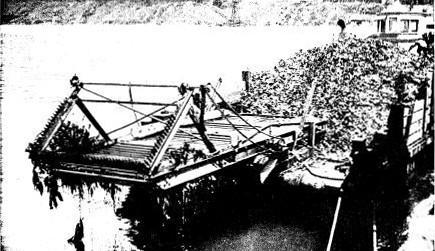
IN ORDER TO SECURE A NEW SUPPLY OF POTASH SALTS
The United States Government set up an experimental plant at Sutherland, California, for the utilization of kelp. The harvester cuts 40 tons of kelp at a load.
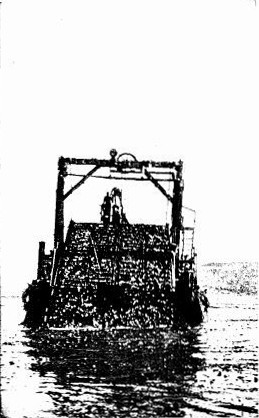
THE KELP HARVESTER GATHERING THE SEAWEED FROM THE PACIFIC OCEAN
Courtesy of Hercules Powder Co.
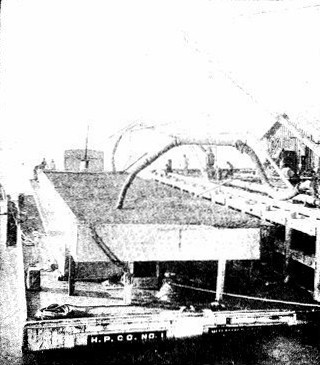
OVERHEAD SUCTION AT THE SAN DIEGO WHARF PUMPING KELP FROM THE BARGE TO THE DIGESTION TANKS
The tourist going through Wyoming on the Union Pacific will have to the north of him what is marked on the map as the "Leucite Hills." If he looks up the word in the Unabridged that he carries in his satchel he will find that leucite is a kind of lava and that it contains potash. But he will also observe that the potash is combined with alumina and silica, which are hard to get out and useless when you get them out. One of the lavas of the Leucite Hills, that named from its native state "Wyomingite," gives fifty-seven per cent. of its potash in a soluble form on roasting with alunite—but this costs too much. The same may be said of all the potash feldspars and mica. They are abundant enough, but until we find a way of utilizing the by-products, say the silica in cement and the aluminum as a metal, they cannot solve our problem.
Since it is so hard to get potash from the land it has been suggested that we harvest the sea. The experts of the United States Department of Agriculture have placed high hopes in the kelp or giant seaweed which floats in great masses in the Pacific Ocean not far off from the California coast. This is harvested with ocean reapers run by gasoline engines and brought in barges to the shore, where it may be dried and used locally as a fertilizer or burned and the potassium chloride leached out of the charcoal ashes. But it is hard to handle the bulky, slimy seaweed cheaply enough to get out of it the small amount of potash it contains. So efforts are now being made to get more out of the kelp than the potash. Instead of burning the seaweed it is fermented in vats producing acetic acid (vinegar). From the resulting liquid can be obtained lime acetate, potassium chloride, potassium iodide, acetone, ethyl acetate (used as a solvent for guncotton) and algin, a gelatin-like gum.
PRODUCTION OF POTASH IN THE UNITED STATES
19161917
SourceTons K2OPer cent. of total productionTons K2OPer cent. of total production
Mineral sources:
Natural brines3,99441.120,65263.4
Altmite1,85019.02,4027.3
Dust from cement mills 1,6215.0
Dust from blast furnaces 1850.6
Organic Sources:
Kelp1,55616.03,75210.9
Molasses residue from distillers1,84519.02,8468.8
Wood ashes4124.26211.9
Waste liquors from beet-sugar refineries 3691.1
Miscellaneous industrial wastes63.73051.0
Total9,720100.032,573100.0
—From U S. Bureau of Mines Report, 1918.
This table shows how inadequate was the reaction of the United States to the war demand for potassium salts. The minimum yearly requirements of the United States are estimated to be 250,000 tons of potash.
This completes our survey of the visible sources of potash in America. In 1917 under the pressure of the embargo and unprecedented prices the output of potash (K2O) in various forms was raised to 32,573 tons, but this is only about a tenth as much as we needed. In 1918 potash production was further raised to 52,135 tons, chiefly through the increase of the output from natural brines to 39,255 tons, nearly twice what it was the year before. The rust in cotton and the resulting decrease in yield during the war are laid to lack of potash. Truck crops grown in soils deficient in potash do not stand transportation well. The Bureau of Animal Industry has shown in experiments in Aroostook County, Maine, that the addition of moderate amounts of potash doubled the yield of potatoes.
Professor Ostwald, the great Leipzig chemist, boasted in the war:
America went into the war like a man with a rope round his neck which is in his enemy's hands and is pretty tightly drawn. With its tremendous deposits Germany has a world monopoly in potash, a point of immense value which cannot be reckoned too highly when once this war is going to be settled. It is in Germany's power to dictate which of the nations shall have plenty of food and which shall starve.
If, indeed, some mineralogist or metallurgist will cut that rope by showing us a supply of cheap potash we will erect him a monument as big as Washington's. But Ostwald is wrong in supposing that America is as dependent as Germany upon potash. The bulk of our food crops are at present raised without the use of any fertilizers whatever.
As the cession of Lorraine in 1871 gave Germany the phosphates she needed for fertilizers so the retrocession of Alsace in 1919 gives France the potash she needed for fertilizers. Ten years before the war a bed of potash was discovered in the Forest of Monnebruck, near Hartmannsweilerkopf, the peak for which French and Germans contested so fiercely and so long. The layer of potassium salts is 16-1/2 feet thick and the total deposit is estimated to be 275,000,000 tons of potash. At any rate it is a formidable rival of Stassfurt and its acquisition by France breaks the German monopoly.
When we turn to the consideration of the third plant food we feel better. While the United States has no such monopoly of phosphates as Germany had of potash and Chile had of nitrates we have an abundance and to spare. Whereas we formerly imported about $17,000,000 worth of potash from Germany and $20,000,000 worth of nitrates from Chile a year we exported $7,000,000 worth of phosphates.
Whoever it was who first noticed that the grass grew thicker around a buried bone he lived so long ago that we cannot do honor to his powers of observation, but ever since then—whenever it was—old bones have been used as a fertilizer. But we long ago used up all the buffalo bones we could find on the prairies and our packing houses could not give us enough bone-meal to go around, so we have had to draw upon the old bone-yards of prehistoric animals. Deposits of lime phosphate of such origin were found in South Carolina in 1870 and in Florida in 1888. Since then the industry has developed with amazing rapidity until in 1913 the United States produced over three million tons of phosphates, nearly half of which was sent abroad. The chief source at present is the Florida pebbles, which are dredged up from the bottoms of lakes and rivers or washed out from the banks of streams by a hydraulic jet. The gravel is washed free from the sand and clay, screened and dried, and then is ready for shipment. The rock deposits of Florida and South Carolina are more limited than the pebble beds and may be exhausted in twenty-five or thirty years, but Tennessee and Kentucky have a lot in reserve and behind them are Idaho, Wyoming and other western states with millions of acres of phosphate land, so in this respect we are independent.
But even here the war hit us hard. For the calcium phosphate as it comes from the ground is not altogether available because it is not very soluble and the plants can only use what they can get in the water that they suck up from the soil. But if the phosphate is treated with sulfuric acid it becomes more soluble and this product is sold as "superphosphate." The sulfuric acid is made mostly from iron pyrite and this we have been content to import, over 800,000 tons of it a year, largely from Spain, although we have an abundance at home. Since the shortage of shipping shut off the foreign supply we are using more of our own pyrite and also our deposits of native sulfur along the Gulf coast. But as a consequence of this sulfuric acid during the war went up from $5 to $25 a ton and acidulated phosphates rose correspondingly.
Germany is short on natural phosphates as she is long on natural potash. But she has made up for it by utilizing a by-product of her steelworks. When phosphorus occurs in iron ore, even in minute amounts, it makes the steel brittle. Much of the iron ores of Alsace-Lorraine were formerly considered unworkable because of this impurity, but shortly after Germany took these provinces from France in 1871 a method was discovered by two British metallurgists, Thomas and Gilchrist, by which the phosphorus is removed from the iron in the process of converting it into steel. This consists in lining the crucible or converter with lime and magnesia, which takes up the phosphorus from the melted iron. This slag lining, now rich in phosphates, can be taken out and ground up for fertilizer. So the phosphorus which used to be a detriment is now an additional source of profit and this British invention has enabled Germany to make use of the territory she stole from France to outstrip England in the steel business. In 1910 Germany produced 2,000,000 tons of Thomas slag while only 160,000 tons were produced in the United Kingdom. The open hearth process now chiefly used in the United States gives an acid instead of a basic phosphate slag, not suitable as a fertilizer. The iron ore of America, with the exception of some of the southern ores, carries so small a percentage of phosphorus as to make a basic process inadvisable.
Recently the Germans have been experimenting with a combined fertilizer, Schröder's potassium phosphate, which is said to be as good as Thomas slag for phosphates and as good as Stassfurt salts for potash. The American Cyanamid Company is just putting out a similar product, "Ammo-Phos," in which the ammonia can be varied from thirteen to twenty per cent. and the phosphoric acid from twenty to forty-seven per cent. so as to give the proportions desired for any crop. We have then the possibility of getting the three essential plant foods altogether in one compound with the elimination of most of the extraneous elements such as lime and magnesia, chlorids and sulfates.
For the last three hundred years the American people have been living on the unearned increment of the unoccupied land. But now that all our land has been staked out in homesteads and we cannot turn to new soil when we have used up the old, we must learn, as the older races have learned, how to keep up the supply of plant food. Only in this way can our population increase and prosper. As we have seen, the phosphate question need not bother us and we can see our way clear toward solving the nitrate question. We gave the Government $20,000,000 to experiment on the production of nitrates from the air and the results will serve for fields as well as firearms. But the question of an independent supply of cheap potash is still unsolved.