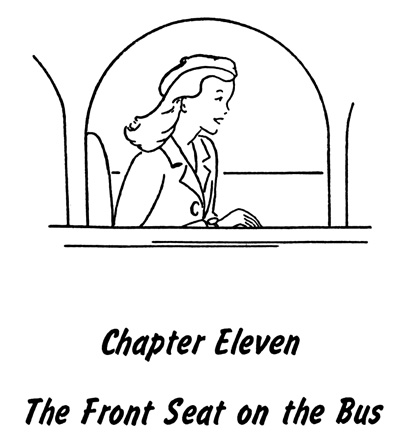
Chapter Eleven The Front Seat on the Bus
Reading edition
THE storm was followed by three weeks of clear, hot weather. The lake was soft and clean, like rain water. The garden thrived in the heat, and the little rabbits grew sleek and fat, and kept everyone busy gathering clover for them.
One morning Janie awoke to hear the clop-clop of the farmer’s horses as they walked down the road. They were drawing an elaborate machine painted bright red and yellow, like a circus wagon. The farmer, all in faded blue, looked drab by comparison.
“Mom,” she called. “Look at the fancy wagon the farmer has this morning. What is he going to do with that?”
Mom raised her shade, and the boys popped their heads out of the upstairs windows.
“That is a brand new reaper,” she answered. “My, doesn’t it glisten! This must be the first time he’s had it out. That machine cuts the grain, then ties it into sheaves. He’ll stack them in yellow shocks all over the field, and Aunt Claire will sunburn her nose while she puts it all on canvas.”
Janie wriggled her way back to the middle of the bed, and reached down to the floor for her slippers. Harvesting meant August, and August meant hayfever. Hayfever meant going to town to the doctor’s office for shots. She made a face, but it wasn’t so bad, really. Just a quick little pinch, like getting caught with a pin.
“Mom,” she called again. “When do I go to town for my shots?”
Mrs. Murray was brushing her teeth, and the answer sounded a little bubbly at first. “You can start any time now,” she answered. “How would you like to go in tomorrow morning?”
Jane looked puzzled. “Daddy won’t be here. Who would take me?”
“You can go in on the bus, and come back with Daddy.”
All by herself on the bus! Janie glowed. Billy asked if he couldn’t go along, but Mom said, “Not this time, Billy. I need you to help cut grass.”
Janie thought about the trip all day. She washed her hair, and put it up in pin curls all over her head, pressed her blue dress, and brushed her hat. She put some pink polish on her fingernails. Mom offered to let her take one of her prettiest handkerchiefs, but what Grandma loaned her was the best of all.
“Come here, Janie,” she said, and she unfastened her wrist watch. “You’ll be needing a watch to tell the time, what with having to meet a bus, and keep an appointment at the doctor’s and all. I want you to take my watch.” Janie’s eyes popped.
“But, mind you take good care of it, and don’t let it drop.”
“Oh, thank you, Grandma,” said Jane, kissing her. “Thank you. I’ll take ever so good care of it. I’ll be just as careful as I know how.” She slept that night with the little watch near her ear. It seemed to talk to her in a fast small voice. “Going to town on the bus,” it said over and over again. “Going to town on the bus.”
She slept late the next morning. By the time she was dressed the boys were off fishing, and Grandma and Mom were finishing their coffee on the porch.
“Hurry up, sleepy head,” Mom said. “It’s nine o’clock now, and the bus leaves at ten minutes after ten. You’ll just about have time to eat your breakfast and gather your things together before it’s time to leave.”
Janie drank her milk and decided against the cereal. She reached for a piece of coffee cake, all crumbly with powdered sugar on the top, but Grandma changed her mind for her.
“If I were you, Lady Jane,” she said, “I’d eat my cereal. You have a long day ahead of you, and besides, how would a fashionable creature like you look with powdered sugar all over the front of her dress?” Jane giggled and dug into her corn flakes.
“Is there anything I can buy for you, Grandma? Do you want me to telephone for you while I’m in town?”
The senior Mrs. Murray cocked her head and thought. “Not unless it would be some embroidery cotton,” she said. She searched through a large paper box that must have contained hundreds of skeins of bright-colored embroidery cotton. “Here, this is it.” She extracted a few strands of salmon colored thread. “Put this in your purse, and see if you can match it for me. Here,” she added, pressing a coin into the palm of Janie’s hand, “buy something for yourself.”
“Grandma! That’s too much money.”
“Well then, buy an extra hair ribbon to match your yellow sweater.” Janie laughed. She dropped the money and the thread into her purse, and ran to get her hat. She was driving over to the station with Mrs. Williams. When Mrs. Williams took her husband down to the bus station in the morning, everyone who wanted to go to town that day seemed to be jammed into the car with her. She tooted at the gate, and Janie kissed her mother and Grandmother hastily, and ran up the garden steps.
“Hello, Mrs. Williams,” she said, a little out of breath. “Do you think we’ll be on time?” Mrs. Williams smiled as she eased the shiny, dark car into second gear. “Of course we’ll be on time,” she said. Her voice was deep and rich, and when she said “of course”, it sounded like “of coss.” Janie never tired of looking at her and listening to her talk. She was so pretty, and she could play the piano just like someone you’d hear at a concert. She had crossed the ocean half a dozen times. She had gone to the opera in Paris, and she had climbed a mountain in Switzerland. She had flown to South America. It was no wonder she said “Of coss” about meeting a bus. Janie sighed with joy, and shifted a little on the seat.
They came to the place where the railroad used to be, and then they turned onto the main highway, and Mrs. Williams faced the direction from which the bus would come. There were other people waiting to go to town. A young woman carried a little baby on one arm, and a black, oilcloth covered bag on the other. The day was warm, but the baby was wrapped from head to foot in a thick pink blanket. Even his little face was pink. When I have a baby, Jane thought, I’ll let him stay uncovered in the summer. Poor little fellow. He looks like a boiled shrimp.
A stout lady in a summery print dress held a parasol over her head, and squinted down the road every so often to see if the bus was coming. A boy, about fourteen years old, sat on a large stone at the roadside. He was dressed in a Boy Scout uniform, and he carried a shoe box, which he handled gingerly. I’ll bet it’s eggs, thought Jane. I’ll bet it’s two dozen eggs that he’s taking into town for someone.
Mrs. Williams looked out of the window. “Here it comes,” she cried. “It will be here in just a minute.” Jane hugged her purse. The fifty cents in her hand made a sharp red ring where she held it tight.
Jane was out of the car and over at the side of the road with the others before she knew it. “Good-by, Mrs. Williams,” she called. “Thank you for the ride.”
The boy scout waited for the lady with the pink baby to get on ahead of him. The stout lady with the parasol came next. Janie clutched her purse and her hat and climbed the rubber covered steps, and the boy scout was right behind her, still balancing his eggs. She dropped her fifty cents into the glass box, and looked around for a seat. “That will be fifty-five cents, Miss,” said the driver. “Oh dear,” said Janie, and she searched quickly through her purse for a nickel. She found one, and the bus began to roar and tremble as it turned out on the highway.
The seats were pretty well taken by the time it came to Oak Lake, but there was one seat that Janie had always wanted, and glory be, it was vacant now. Perhaps none of the grown folks wanted that seat. It was right up in front, across from the driver. It faced the aisle instead of facing forward the way the others did, but Janie didn’t mind. She sat side ways and leaned her arms on the window sill. It was glorious. They gained speed as they rolled along through the gentle Wisconsin hills. Farmers were at work everywhere, busy with harvesting the grain. It would be a fine day for playing White Horse.
Now the houses were much closer together. They were nearing the city. Janie knew every landmark well. She had been traveling this road ever since she was a baby, but things looked different from the front seat of the big bus, just as the trees in the yard looked different when you crawled up and sat on the roof, and then they rolled down a busy shopping street.
They passed through the outskirts of the city. They stopped near a ladies’ dress shop to wait for the light to change. There was a woman in the show window, busily draping a manikin. The figure was beautifully gowned and had an expression of great hauteur. Everything was perfect, except her head, and that was shining bald. At her feet lay a carefully arranged blond wig. The woman was still draping the skirt as the bus started on through the intersection. Janie grinned to herself. “I must remember,” she thought, “never to go out without my wig.”
People were beginning to leave the bus now. Janie was going all the way down to the terminal. They had to travel much more slowly, now that the traffic was heavy, and once they had to stop while a bridge went up, and a long coal boat slid through on its way up the river. Once over the bridge, they threaded their ponderous way down a hill and over a lot of railroad tracks, and then the driver turned and turned at his wheel, and they cut sharply into the long dark tunnel at the terminal building. There were other big busses lined up, and they nosed into the ramp just as a boat eases up to a pier.
By now Jane felt like a seasoned traveler. She picked up her purse and walked into the waiting room with the others. She made straight for the public telephones, and put her purse on the little shelf in front of her. She put a nickel in the slot, and dialed the doctor’s number slowly and carefully. “This is Jane Murray,” she said as the office girl answered. “What time would you like to have me come out?”
“The doctor can see you at four, Jane.”
“Thank you, Miss Clark. Good-by.”
The little watch said half past eleven. She left the terminal, and walked slowly down the busy street. The shop windows were fascinating. There were stores that sold wallpaper and paint, and there were shops that sold nothing but baby clothes. One little place, about the size of the pantry at home, sold nothing but nuts. There was a pan of fresh-roasted nuts slowly revolving in the window. An imitation squirrel looked at them greedily out of his imitation eyes.
A newsboy shouted at the corner, something about “Wuxtra, Wuxtra!” He shouted so that he got red in the face. Just as Janie got close to him, he stopped to draw a breath, and she looked at him in surprise. He wasn’t excited at all. His eyes were as matter of fact as her own. Only his voice was wrought up so. Pigeons circled far overhead. They lived in the balconies and towers at the top of the tall buildings.
A policeman blew his whistle at the street crossing near a big department store, and Janie marched across with the crowd. She pushed on the revolving door until her little cubicle swung her right into the store. My, but it smelled good. No wonder, she was in the perfume department. She walked to the notions department, and bought the skein of salmon colored thread for Grandma. Notions department ... what a funny name, she thought. I wonder if they call it that because ladies say: “I have a notion to buy this, or I have a notion to buy that.” I must remember to ask someone about it sometime.
A river ran close to the building, and Jane walked over to the windows to look out. A sign read:
Eat Your Lunch In Our Sky Room DINE ABOVE THE CLOUDS.
Jane squinted up. It wasn’t above the clouds, really, but something in her imaginative heart responded to the invitation. She looked in her purse. There was the one dollar bill she had earned taking care of Sammy, and Mom had given her thirty-five cents for lunch and car fare. “That’s where I’m going to eat my lunch,” she said. “That’s how I’ll spend my dollar.”
She walked over to the row of elevators. A pretty lady in a neat gray uniform clicked a little snapper that she had in her hand, and that was a signal for the elevator to climb. They went up, up, and up, past dresses and hats and chairs and mixing bowls. They passed long rolls of carpeting that looked like giant crayons laying side by side on the floor. “Call your floor please,” the operator sang out, and at each stop people would squeeze out, and new people would squeeze in. They passed dress materials and lamps and luggage.
At last they came to the top floor, and Janie stepped out into what was called a lounge. It looked like a large living room, and people sat on the chairs and davenports waiting to meet their friends, or perhaps they were just resting.
A tall lady who seemed to be the hostess stood at the entrance and smiled and bowed as the people came in. She smiled very sweetly at Jane. “Good afternoon,” she said. “Where would you like to sit?” The large room seemed crowded, but along one side of the room ran a sort of porch, a long narrow balcony overlooking the river. It had a curved glass roof, like a conservatory.
“Oh,” said Jane eagerly. “Could I sit out there?”
“Yes, you could,” said the lady. “Come along with me,” and she led Jane to a small table next to one of the windows. The river was eight stories straight down, and on all sides the buildings rose even higher than Jane’s balcony. From where she sat, she could see three bridges. It was interesting to see that they crossed the river at an angle instead of in a businesslike straightforward way. Then she remembered a story that Grandma used to tell. It seemed that over one hundred years ago, when the city was first founded, it was really three separate towns. The people on the west side of the river quarreled with the people on the east bank, and vowed never to have anything to do with them. When the streets were laid out they were careful to see that they did not line up with the streets across the river. They wanted to make it inconvenient ever to build a bridge. Now there were many bridges, a little askew perhaps, but happily making one big friendly town out of the little squabbling villages.
Jane was so absorbed in the view that she forgot to order until a smiling waitress reminded her. Then she remembered she was hungry. Breakfast was so long ago. She read everything on the long menu, and mentally counted her money. This was to be something different, something special. No ham sandwich and a glass of milk this time. She finally decided upon an elaborate chicken mixture in a potato basket, and a chocolate ice-cream sundae for dessert.
The food was delicious, and Janie was engrossed. Once, as she lifted a spoonful of ice cream, she looked up to see a sea gull watching her from his perch just out side the window. He wasn’t nearly so pretty close up as he was from a distance. He was quite awkward and ugly looking, except for his eyes. They were like clear, red glass. Janie smiled at him, but he only looked at her bleakly. “Greedy,” he seemed to say. “There you sit, eating chicken and ice cream, while I have to scour the river for my dinner.” With that unhappy observation he was gone.
“Grouch,” Jane said, and continued to enjoy her lunch.
A noisy tug chortled up the river leaving a wake of foam. It was small enough to scuttle under the bridges, and the bridge tender only waved his arm in salute, instead of having to turn all the machinery as he did for the big boats.
The clock in one of the tall buildings across the river chimed and Janie looked up. Goodness! It was one o’clock. The waitress brought the check, and Janie extracted her crisp one dollar bill and laid it on the slip of paper. She wasn’t quite sure of what to do next, but grown people always put something on the tray for the waitress. She added a dime and a nickel from her rapidly dwindling supply.
An exquisite creature, dressed in the very latest fashion, walked slowly up and down the aisles between the tables. Every curl was in place. Her face had the pleasantly blank expression of a wax doll. Her posture was faultless, and she moved so very gracefully and formally, it was almost like dancing. Janie held her breath. In spite of all that Mom had taught her, she stared. She had never seen anything so beautiful in all her life, even on circus posters.
She rose to leave, but her eyes wouldn’t come away from the beautiful lady. She walked backwards, and missing the entrance, bumped into a palm tree.
The hostess at the entrance looked as if she hadn’t seen the mishap, but her eyes were sparkling.
“Would you like to be a model when you grow up, dear?”
“Oh yes,” said Jane blissfully walking away on air. All the way down to the street floor she studied her reflection in the tiny mirror at the elevator operator’s elbow. She held her chin very high, and lowered her eyelashes. That was better. With her eyes half closed she looked just right.
“Main floor,” the operator called. “Main floor, watch your step, please.”
Jane floated out with her nose in the air, and tripped on the ledge. Down she went, full length, on the floor. Half a dozen people helped her up, and were very solicitous.
“Are you hurt, little girl?”
“Did you trip?”
“Let me brush you off.”
“Dear me, such a fall!”
“Can I get you a drink of water?”
“Perhaps you’d better sit down for a moment.”
Janie was embarrassed, but otherwise quite all right. “Thank you,” she said to each one who wanted to help her. “Thank you, but I’m not hurt. I’m all right now. I only stumbled.”
She started off by herself once more, and this time she didn’t lower her eyelashes, and she didn’t float. “I’ll wait till I get home,” she thought. “I’ll practice that walk in my room.”
She looked at her watch once more. It was early in the afternoon, only one-fifteen. Two hours stretched before her to do with as she pleased. She decided to go to the stamp store. All the Murrays except Mom collected stamps, and they had worn a beaten path to the stamp store. Mom would have none of it. “I collect stamps, all right,” she said. “I collect them off the floor and under the beds. I shouldn’t be surprised if I’d brush stamps out of my hair!”
The stamp man was glad to see her. He was small and gray and stooped. He always seemed absorbed in something he was peering at through a magnifying glass. He was like a kindly absent-minded gnome. Janie sat on a stool at the counter, and pushed off her hat. It was good to sit down after the hot walk up the street. A fly buzzed on the screen at the window, and the clock ticked. That was the only sound as the old man and the young girl pored over the bright-colored paper squares. She looked and looked, and at last decided upon three stamps, one for each of the boys. She opened her purse and reached for her money, but the money was gone. She searched again, and turned the purse upside down and shook it, but there was nothing in it but a handkerchief and two skeins of embroidery cotton.
“Oh, Mr. Marckus,” she wailed. “What will I do? I’ve lost my money.”
“Eh? What’s that you say?”
“I’ve lost my money. It must have fallen out of my purse when I fell getting out of the elevator. I wanted to buy these stamps for the boys, and now I’ve lost my money.”
Mr. Marckus carefully put a stamp down with a pair of tiny tweezers. He squinted at her distressed face.
“How much do you need,” he asked.
“Oh, I don’t really need anything. I can walk from here to the doctor’s office, and I’m getting a ride back to the lake with Daddy, but I spent a whole dollar on myself, and now I wish that I could buy something for the boys.”
“Well, you can’t charge anything here,” said Mr. Marckus in his dry, dusty, little voice. “If I gave credit to all the young ones who came in here, I’d never be able to make enough to pay my rent.”
Janie’s cheeks burned. “I didn’t mean,” she started to say.
“I know you didn’t,” said Mr. Marckus. “Your whole family, from your Grandmother down have always been good customers of mine. Here, take the stamps, and we’ll say they’re a birthday present. You have a birthday pretty soon, don’t you?”
“No,” said Janie, looking happy again. “Not until September.”
“Makes no difference,” he said. “A present’s a present.”
He went back to his magnifying glass, and seemed to pay no attention to Janie’s delighted thanks as she prepared to leave.
The twenty-two blocks to the doctor’s office seemed very long indeed. When she got there the waiting room was crowded and she was thirsty and tired. When Daddy called for her at five o’clock she thought she had never been so glad to see him.
“Well, chickie,” he said, pinching her nose. “Did you have a good day? Did you have a fine time spending your hard-earned dollar?”
She settled back in the front seat gratefully, and the car headed for the lake. “Daddy,” she confessed. “I had fun. It was a good day, but I spent my whole dollar on a fancy meal. I ate so much that I felt uneasy all afternoon, and now my money is gone and I have nothing to show for it, not even a new hair ribbon.”
Daddy chuckled. “That’s all right, Janie, my girl,” he said. “We all learn our little lessons.”