IV. A CHAT WITH THE NURSE.
Reading edition
Seated cosily in an easy chair, with Marie near by at work on some bandages, Henare was listening most attentively to her efforts to tell him some of the dreadful sufferings of France in the early days of the war.
It took him all his time to make out what she said. The scene was a sadly busy one. There were several interruptions, many were coming and going all the time. Fresh batches of broken and groaning men were being brought in every hour; and restored men were taking farewell of nurses and friends before returning to the slaughter.
The cannon-boom could be distinctly heard day and night, but it disturbed no one at the hospital, for they had grown accustomed to it.
All the while Marie was talking, in the midst of this strange sad scene, the irregular punctuation kept on.
Boom—boom . . . . boom . . . . boom—boom—boom.
With many a shrug of the shoulders, and many a shake of her pretty head, Marie related to Henare all she dared of the brutal and revolting conduct of the Germans when first they swept over the border. She told him of the coarseness, the drunkenness, and the bullying of all ranks and grades of the invading Huns.
Every now and again Henare ground his teeth, and muttered "Py cripes; I pay him out," and "Te taipo, te bally taipo." When he heard as much as he could stand, he ventured the remark, "I tink the Sherman soldier no hurt te gell and te woman, eh?"
Marie looked at him a moment, and then said, "What you say, M'sieur?"
"I say te ole brute no hurt te wahine an' te piccanini—te woman an' te gell"—he answered slowly.
"Oh dear me," said Marie in real surprise, "did you nefar read ze newspaper?"
"Oh, my korry," he replied, "I can't read te Prenchy langwidge, all te word spell wrong, and te talk all silly."
"No, no, no, M'sieur, ze French speech ees ze most beauteeful in all ze land."
"Werra, where te Maori come in?"
"Ah!"
"Eh?"
When left to himself the manly Maori boy pictured up the whole scene as well as he could, and longed to get back to the trench—or over the parapet—to pay out the demons who had outraged Marie's noble people. He was getting well unusually quickly, and though loth to leave the charmed spot, he felt that he would soon be fit to fight again. He was busy thinking out all kinds of plans for getting even with the Huns; and he formed a mental picture of the Kaiser which was not very complimentary to that potentate. Henare saw him as a big villain with short, sharp horns above his ears, to match his upturned moustache; small wicked eyes, and a big mouth, with little tusks protruding.
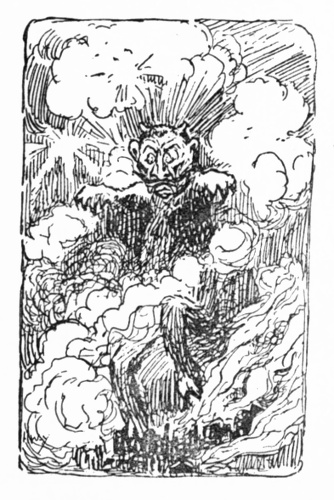
This image was very vivid to Henare's native imagination, and he muttered to himself, "Py cripes, that him all right; he just want te cow feet and te monkey tail, then he te ole taipo, straight."
A week after his chat with the little French nurse, Henare was passed as fit for service again. He had made many friends, both French and English, around the hospital; so on the day of his departure he hunted up each one and solemnly shook hands and said "good-bye." He came to Marie last of all. She was standing just outside the big, sunlit doorway, watching the far off train of waggons slowly bringing in another batch of wounded men. Her sweet little Frenchy face looked dreadfully serious—but she turned round with that sunny smile of hers when Henare spoke.
He shuffled nervously, gave a funny little cough, that he ought to have been ashamed of as a "Maori brave," then held out his hand and said, "So long, Marie, I go back now. My korry, you make me get well too quick."
She put her head picturesquely on one side, took hold of the brown hand held out to her, and said, "Au revoir, Henri; I hope you weel be vera safe."
Henare felt queer. Sensations passed all over him that he had never known before. The impulse was to pick up this lovely French doll and run right away with it. But he pulled himself up and said, "Py cripes, I better go, I tink," and he bolted.
On the way back to the lines a New Zealander was chaffing Henare about Marie, and asking him whether he was going to hand over Kiri to Wiremu.
"No ploomin fear," he replied, "Not me."
"What about Marie, then?"
Henare stopped short and said—
"I tell you bout that, mate. I like to have Marie just for te pretty doll. She te beauty, py cripes, yeh. When she put te head on one side an smile, she mak me feel wery funny on te shest, t'that all!"