"Cormorant Crag" (continued 6)
Reading edition
He walked away, leaving the boys together, carefully avoiding each other’s eyes, as they felt that they were prisoners indeed, and wondered what was to be their fate.
Vince took a few turns up and down upon the sand with his hands deep in his pockets. Mike seated himself upon the keg he had occupied over his breakfast, for in their frame of mind they both resented being ordered to go and help the men; but at that time the worst pang of all seemed to be caused by the fact that, just at the moment when they wanted each other’s help and counsel, with the strength of mind given by the feeling that they were together, they were separated by the unfortunate conduct of one.
Chapter Twenty Six.
The Pirate Captain of their Dreams.
The walk did Vince good, for the action given to his muscles carried off the sensation which made his fists clench from time to time in his pockets and itch to be delivering blows wherever he could make them light on his companion’s person.
He did not notice that he was ploughing a rut in the sand by going regularly to and fro, for he was thinking deeply about their position; and as he thought, the dread that the captain’s words had inspired, endorsed as they were by Daygo’s, began to fade away, till he found himself half contemptuously saying to himself that he should like to catch the skipper at it—it meaning something indefinite that might mean something worse, but in all probability keeping them prisoners till he had got away all his stores of smuggled goods.
Then, as the rut in the sand grew deeper from the regular tramp up and down, Vince’s thoughts flitted from the trouble felt by his mother, who must be terribly anxious, to his companion, whose back was towards him, and who with elbows on knees had bent down to rest his chin upon his hands.
Vince was a little surprised at himself, and rather disposed to think that he was weak; for somehow all the hot blood had gone out of his arms and fists, which were now perfectly cool, and felt no longer any desire to fly about as if charged with pugno-electricity, which required discharging by being brought into contact with Mike’s chest or head.
“Poor old Ladle!” he found himself thinking: “what a temper he was in! But it was too bad to hit out like that, when what I did was to help him. But there, he didn’t know.”
Vince was pretty close to his fellow-prisoner now; but he had to turn sharply round and walk away.
“Glad I didn’t hit him again, because if I had we should have had a big fight and I should have knocked him about horribly and beaten him well, and I don’t want to. I’m such a stupid when I get fighting: I never feel hurt—only as if I must keep on hitting; and then all those sailor fellows would have been looking on and grinning at us. Glad we didn’t fight.”
Then Vince began to think again of their position, which he told himself was very horrible, but not half so bad as that of the people at both their homes, where, only a mile or two away from where they were, the greatest trouble and agony must reign.
“And us all the time with nothing the matter with us, and sitting down as we did and eating such a breakfast! Seems so unfeeling; only I felt half-starved, and when I began I could think of nothing else.—Such nonsense! he’s not going to kill us, or he wouldn’t have given us anything to eat. Here, I can’t go on like this.”
Vince stopped his walk to and fro at the end of the beaten-out track in the sand, and turned off to stand behind Mike, who must have heard him come, but did not make the slightest movement.
Then there was silence, broken by the voice of the French captain giving his orders to his men, who were evidently rearranging the stores ready for removal.
“I say, Mike,” said Vince at last.
No answer.
“Michael.”
Still no movement. “Mr Michael Ladelle.”
Vince might have been speaking to the tub upon which his fellow-prisoner was seated, for all the movement made.
“Michael Ladelle, Esquire, of the Mount,” said Vince; and there was a good-humoured look in his eyes, which twinkled merrily; but the other did not stir.
“Ladle, then,” cried Vince; but without effect,—Mike was still gazing at the sand before him.
“I say, don’t be such a sulky old Punch. Why don’t you speak? I want to talk to you about getting away. Mike—Ladle—I say, you did hurt when you hit out at me. I shall have to pay you that back!”
No answer.
“Look here: aren’t you going to say you’re sorry for it and shake hands?”
Vince waited for a while and then burst out impatiently,—
“Look here, if you don’t speak I’ll kick the tub over and let you down.”
All in vain: Mike did not move, and Vince began to grow impatient.
“Here, I say,” he cried, “I know I’m a bit of a beast sometimes, but you can’t say I’m sulky. I did nothing; and if it was I, you know I’d have owned I was in the wrong and held out my fist—open; not like you did, to knock a fellow down.”
Another pause, and Vince exclaimed,—
“Well, I am—”
He did not say what, but stood with extended arm.
“I say, Mikey,” he said softly, “I know you haven’t got any eyes in the back of your head, so I may as well tell you. I’m holding out my hand for a shake, and my arm’s beginning to ache.”
“Don’t—don’t!” said Mike now, in a low voice, full of the misery the lad felt. “I feel as if you were jumping on me for what I did.”
“Do you? Well, I’m not going to jump on you. Come, I have got you to speak at last, and there’s an end of it. I say, Ladle, it’s too stupid for us two to be out now, when we want to talk about how we’re stuck here.”
“I feel as if I can’t speak to you,” said Mike huskily.
“More stupid you. Didn’t I tell you it’s all over now? You were in a passion, and so was I. Now you’re not in a passion, no more am I; so that’s all over. You heard what the pirate captain said about us?”
“Yes,” said Mike dolefully.
“Well, he and old Joe— Here, Ladle: I’m going to kick old Joe. I don’t care about his being old and grey. A wicked old sneak!—I’ll kick him, first chance I get, for leaving us in the lurch; but that isn’t what I was going to say. Here, why don’t you turn round and sit up? Don’t let those beggars think we’re afraid of them. I won’t be,—see if I am.”
Mike slowly changed his position, turning round and sitting up.
“Now, then, that’s better,” said Vince. “What was I going to say? Oh! I know. The pirate captain and old Joe wanted to make us believe that we were to be taken out to sea, to walk the plank or be hung or shot or something.”
“Joe said something about Botany Bay and sending us there.”
“No, he didn’t; he said Bottonny, and there is no such place. He couldn’t do it, and he couldn’t keep us prisoners here.”
“He might kill us.”
“No, he mightn’t. Bah! what a silly old Ladle you are! He couldn’t. People don’t do such things now, only in stories. I tell you what I believe.”
“What?” said Mike, for Vince paused as if to think.
“Well, I believe he feels that his old smuggler’s cave is done for now we’ve found out the way down to it, so he’s going to clear it out and start another somewhere else. He means to keep us prisoners till the last keg’s on board, and as soon as this is done he’ll go to his boat and take his hat off to us and tell us we may have the caverns all to ourselves.”
“Think so?” said Mike, looking up at his companion for the first time.
“Yes, I believe that’s it, Ladle; and if it wasn’t for knowing how miserable they must be over yonder I should rather like all this—that is, if you’re going to play fair and not get hitting out when we ought to be the best of friends.”
“Don’t—don’t, Cinder: I can’t bear it,” groaned Mike, letting his head drop in his hands. “I hurt myself a hundred times more than I hurt you.”
“Oh, did you! Ha! ha!” cried Vince. “Come, I like that: why, I shall have a bruise as big as the top of my hat! Oh, I say, Ladle, old chap, don’t—don’t talk like that! It’s all right. You thought I was fighting against you. Sit up. Some of the beggars will see.”
Mike sat up with his face twitching, and kept his back to the upper part of the cavern.
“That’s better. Well, I say I should really like it if it wasn’t for them at home. I call it a really good, jolly adventure, such as you read of in books. Now, what we’ve got to do is to wait till they’re asleep, cut off all their heads with their own cutlasses, seize the boat, row off to the lugger, wait till old Joe comes back, and then spike him with the points of cutlasses till he pilots us out safely. Then we’ve got to sail home as prize crew of the lugger, which would be ours. Stop! there’s something we haven’t done.”
Mike stared.
“Old Joe. As soon as we’re out of the dangerous passages we’ve got to batten him down in the hold, and that’s the end of the adventure.”
“How can you go on like that?” said Mike piteously. “Making fun of it all, when we’re so miserable.”
“That’s why: just to cheer us up a bit, and set us thinking about what’s next to do.”
“I can’t think,” said Mike. “It’s a pity we didn’t stop in the seal hole.”
“Stop there? We should have felt nice by now. Why, our legs would be all swollen, and we should be so hungry that— Here, I say, Ladle, you wouldn’t have been safe. I wonder how you’d taste?”
“I say, do be serious, Cinder. It’s too horrible to laugh at it.”
“Well, so it is, old chap, but I am thinking hard all the time, yet I can’t see any way out of it. I know we could swim almost like seals; but look at the water out there,—we couldn’t do anything in it.”
“No, we should be sucked down in five minutes.”
“Yes. The old pirate knows it, too, and that’s why he leaves us alone. I say, he does look like a pirate, though, doesn’t he? with that pistol, and the rings in his ears.”
“Oh! I never saw a pirate, only on those pictures we tried to paint. But what about the cliffs?”
“No good. They’re either straight up and down or overhanging. We couldn’t do it.”
“We might get over the other side and make signals.”
“Yes; there is something in that. But don’t you think we might get away by the passage? The sentry may go to sleep.”
“No good,” said Mike bitterly. “Those fellows daren’t.”
“S’pose not,” said Vince thoughtfully. “Old Jarks is the sort of chap to wake ’em up with his pistol. It’s of no use yet, Ladle; the idea hasn’t come. Yes, it has! Why can’t we wait our chance and seize the boat and get it off? We could manage.”
“Hush!” whispered Mike.
The warning was needed, for the captain came from the back of the stack of packages, and marched down towards where they were.
Chapter Twenty Seven.
What will he do with us?
“Aha!” he cried. “So you sall not try to escape any more?”
“No,” said Vince coolly, looking the speaker full in the face. “I say, what time do you have dinner?”
The Frenchman stared at him for a few moments fiercely, and then burst into a boisterous fit of laughter.
“You are a drôle de garçon” he said. “You are again hungry?”
“I shall be by the time it’s ready. But, I say, captain, how much longer are you going to keep us here?”
“Aha!” he said, with a shrug of the shoulders and a peculiar gesticulation with his hand, as if he were throwing something away, while he looked at them both sidewise through his half-closed eyes: “You are fatigue so soon? You vant to go somevere else?”
“We want to go home.”
“Good leetler boy: he vant to go home. But not yet, mes amis. You give the good capitain all zis pains to move his cargo, and you vill not help.”
“Oh, I’m ready enough to help,” said Vince. “So’s he; but they will be very anxious about us at home.”
“Ta ta ta ta ta!” cried the captain. “Vy, you sink so mosh of your selfs. Ze bon papa vill say to la maman, ‘Ah! ma chère, dose boy go and tomble zem selfs off ze cliff;’ and ze maman sall wipe her eye and say, ‘pauvre garçon—poor boy, it is vat I expect.’”
“And instead of that,” said Vince, “you are going to send us home, and then they will not be fidgeting any more.”
“Aha! you sink so. Vell, ve sall see. So I go to be vairy busy, and it is better zat you two do not fight any more. So come vis me.”
“Where?” said Vince suspiciously.
“Vere? Oh! you sall see, mon brave, vairy soon.”
The boys exchanged glances, but feeling that it was hopeless to resist, they followed the captain down to where the boat was lying, just as she had returned a few minutes before, without Daygo.
The men in her were just keeping her afloat, but they ran her stern on to the sand as they saw the captain coming, and one of them leaped out to hold her steady.
“In vis you!” said the captain sharply.
“All right, Mike,” whispered Vince. “Come on, and don’t seem to mind.”
He set the example by putting one foot on the gunwale and springing in lightly. Mike followed, and then the captain; while the man standing ankle-deep in the water waited till they were seated, and then, giving the boat a good thrust out, sprang on the stern, and climbed in as they glided over the transparent water, stepping forward quickly to seize an oar, and pulling sharply with his companion.
The boys gazed eagerly upward as soon as they were clear of the great overhanging archway, and saw the impossibility of escape by any cliff-climbing; for the mighty rocks were at least twenty feet out of the perpendicular, leaning over towards the little bay, whose waters were running, eddying and boiling like a whirlpool as they raced along, seizing the boat’s head and seeming about to drag her right along towards a jagged cluster of rocks, standing just above the surface, and amidst which the current raged and foamed furiously.
But the men knew their work. One pulled hard, the other backed water, and by their united efforts the boat was forced into an eddy close under the cliff; and to their amazement the boys found that they were being carried in the opposite direction to that in which the main body of the water was racing along.
“You vill escape and climb ze cliff? No, mes enfans,” said the captain: “you cannot climb. You vill take my boat to go avay? Aha! you sink so? No, it is not for you to manage ze boat. She vill capsize herself if you try.”
Vince said nothing, but eagerly looked around; but it was everywhere the same—the roaring waters tearing wildly along in the crater-like cove, and from their seat in the boat no entrance, no exit, was visible.
“Now I take you bose and drop you ovaire-board: you sink, you go home?” said the captain, showing his teeth. “Yaas, you go home, but not to see ze bon papa, ze belle maman. It is not possible. Von of my men say von day he have sick of me, and he vill go. He shump ovaire-board to svim, and he svim vis his arm and leg von, two, twenty stroke, and zen he trow les mains out of ze vater, and he cry for ze boat; but zere vas no boat, and he turn round upon himself two time, and go down a hole in ze vater. I stand and look at him, but he came up again nevaire. He vas a good man—bon matelot—but he go. You like to shump in and svim? Eh bien, you shake ze hand, shump in. Au revoir, but ve shall meet again nevaire. You go? Non? Eh bien! I make you ze offaire.”
The boys felt that it was all true, and marvelled where they were going, for the eddy was taking them along by the mighty rocks, which were overhanging them again; and, as far as they could make out, the cliffs under which they passed and the ridge away facing the cavern mouth, which they had imagined to be an island, were all one.
The captain seemed to be paying little heed to them, sitting with his eyes half-closed; but he was watching them all the time closely, and noted their astonishment as the men suddenly began to tug at their oars with all their might, apparently to avoid a rock, round one side of which the water was rushing with tremendous force, just as if the eddy stream along which they had been riding suddenly curved round it. The men were making for the other end, and as they drew nearer the water roared and splashed up, and it appeared to both that they must be carried right upon it by some undertow.
But every foot of the place, and all its difficulties, were perfectly familiar to the captain’s crew, and by making use of the many cross streams and eddies, they were able to guide the boat into safety, as in this case; for just as Mike seized the gunwale with one hand, to be prepared for the shock, and Vince clenched his fists and gave a glance to the left, the boat’s prow passed the end of the detached rock, they glided into an opening like a gash cut down through the massive rock-wall, and the next minute were swept into a comparatively calm pool, surrounded by towering cliffs, which seemed to overlap on their right; and there, right before them, rode by a couple of hawsers attached to great rings fixed in the rock-face behind, a long, low three-masted lugger of the kind known as a chasse-marée.
Vince looked sharply round for the channel by which this vessel must come and go—for it seemed certain that such a way must exist, since so large a boat could not by any means have entered the circular cove facing the cavern; and he was not long in seeing that, some twenty or thirty feet beyond her bow, the water was coming swiftly in round the cliff, which lapped over another to its right, but so calmly did the tide run that at the first its motion was unperceived.
Vince had hardly grasped this fact, when the boat was run up alongside, one of the men sprang into the lugger with the boat’s painter and made it fast, while the boat seemed to tug to get away, and the captain turned to his prisoners.
“Aboard!” he said sharply; and as there was nothing for it but to obey, Vince made a virtue of necessity, and going forward, climbed up and over the bulwark, to stand upon a beautifully white deck, and see that rigging, sails and spars were all in the highest state of order.
Six or eight men were waiting, and they came aft at once, to stand as if waiting for orders, while Mike and the captain stepped on board.
“Back at once!” said the Frenchman to a stern-looking, red-faced man, who appeared to be the mate. “All ze boats; and work hard to get all on board.”
This order was given in a low tone, but Vince’s ears were sharpened by his position, and he divined its full meaning.
The men hurried to the side, and rapidly began to lower one of the boats hanging to the davits; while in his close scrutiny Vince grasped the fact that they were upon no peaceful vessel: there being a couple of longish guns forward, and another pair aft, all evidently in the best of trim, and ready for use at a very short notice.
While the men were busy the captain came to where the boys were standing together aft, and laying his hands upon their shoulders, he led them forward to where one of the stout hawsers ran over the side to the great ring secured in the rock.
“You see zat hawser, mon ami?” he said.
“Yes,” said Vince wonderingly.
“Look you zen at ze ozaire.”
“Yes, I see it,” said Vince.
“Vat you make of zem?”
“They look strained too much, and as if they would part.”
“Good boy! You vould make a good sailor. Zey vill not part, for zey are new, and très fort—strong. Now you look here, mon ami.”
As he spoke he picked up a heavy dwarf bucket, with its rope attached, raised it above his head, and hurled it some twenty feet into the smooth water between the lugger and the high cliff face.
The water was like glass, and streaked with fine threads apparently; and the next minute the lads grasped the reason why, for the bucket had hardly touched the water when it began to be borne towards the lugger’s side, striking it directly after sharply, and then diving down out of sight.
Vince ran across the deck instantly to see it rise; and Mike followed, the captain joining them to lay his hands upon their shoulders once more.
“Aha! you see him come up again? No? Look encore and encore, and you nevaire sall see him. Vat you say to zat?”
“There must be a tremendous current,” said Vince. “Yais,—now,” said the captain. “Après, some time he run all ze ozaire vay and grind ze sheep close up right to ze rock. Vat you sink now? You shump ovaire, and svim avay? You creep along ze hawser and try to climb up ze cliff? No, I sink not now. You stay here on ze deck and vait till I vant you—ven ze boat come back. Dat is vy I show you how go avay ze bucket. Look now again.”
One of the boats was ready, and two men in her. The rope that held her to the side was cast off, and in an instant she glided away across the pool, towards an opening that had been unnoticed before, was deftly steered, and passed out of sight.
“Why, she must come out where we saw the water rushing at the other end of the rock!” thought Vince; and he stood watching while the other boats left the side of the lugger, to be cleverly guided to the same spot, and glide out of sight directly.
A feeling of helplessness came over the boys as they saw all this, and realised that now they were, beside the captain and a man who kept going in and out of a low, hutch-like place forward, the only occupants of the vessel; and that if their captor had any particular designs upon them, this would be the likely time for their happening. But they now had proof that this was not going to be the case, for the Frenchman took no further heed to them. He went to the cabin-hatch and descended, leaving them with the deck to themselves.
“What do you think of it now?” asked Mike dolefully.
“I don’t know,” said Vince, gazing up at the towering rocks, dotted with yellow ragwort and sea-pink, by which they were surrounded; “but it’s a change. I wouldn’t care if they only knew at home about our being safe. I say, isn’t it likely that some one may come along the cliffs and be searching for us, and then we can signal to him?”
“Who ever came along the cliffs and looked down here?” said Mike. “We’ve been about as much as any one, but we never looked down into this pool.”
“No,” said Vince thoughtfully: “it puzzles me. I hardly make out whereabouts we are. I say, though, look forward: that’s the galley, and the chap we saw is the cook.”
“Of course,” said Mike; “there’s the chimney, and the smoke coming out.”
“Let’s go and see what there is for dinner.”
Mike’s forehead wrinkled up, and he felt disposed to say something reproachful; but he was silent, and followed his companion to the galley door, where the man they had seen looked up at them grimly, and as if resenting their presence.
“What’s for dinner, old chap?” said Vince coolly.
The sour look on the man’s face passed away. Vince’s countenance, and his free-and-easy way, seemed to find favour, and he said gruffly,—
“Lobscouse.”
“What, for the skipper?” said Vince, who had a lively memory of the captain’s breakfast.
“Men,” said the man laconically.
“And for the skipper?”
The man smiled grimly, and took the lid off a pot, which arose an agreeable steam, that was appetising and suggested good soup. Then, without a word, he pointed to a dish upon which lay a pair of thick soles, and to another, on which, ready egged and crumbed, were about a dozen neatly prepared veal cutlets.
“Got any potatoes,” said Vince.
The man raised a lid and showed the familiar vegetable, bubbling away on the little stove, which was roaring loudly, and put the saucepan down again.
“Well, we shan’t starve,” said Vince, as they each gave the cook a nod and walked as far forward as they could. “Captain hasn’t a bad notion about eating and drinking.”
“And smuggling and kidnapping,” said Mike bitterly.
“Kidnapping!” said Vince cheerily. “Ah, to be sure, that’s the very word: I thought something had been done to us that there’s a proper word for. That’s it, Ladle—kidnapped. Yes, we’ve been kidnapped.—I say!”
“Well?”
“Look here: are we two chaps worth anything?”
“I don’t feel to be now,” said Mike; “I’m too miserable.”
“Well, so am I miserable enough, but I suppose we must be worth something, and that’s why the skipper’s going to feed us well.”
“What nonsense have you got in your head now?”
“Nonsense? I call it some sense. For that’s it, Ladle, as sure as you stand there; he has kidnapped us, and he’s going to take us right away somewhere. Ladle, old chap, I feel as sure of it as if he’d told us. It is all nonsense about making an end of us. I was sure it only meant trying to frighten us; but we’re two big, strong, healthy lads, and he’s going to take us right away.”
“Do you mean it? What for?”
Vince looked sadly at his companion in misfortune for a few moments, and then he said huskily,—
“To sell!”
Chapter Twenty Eight.
Prisoners, but not of War.
Michael Ladelle was a good-looking lad, as people judge good looks; but at that moment, as he stood with his hand resting on the bulwarks of La Belle-Marie, he was decidedly plain, so blank and semi-idiotic did he seem, with his eyes dilated, his jaw dropped and his brains evidently gone wool-gathering, as people say, so utterly unable was he to comprehend his companion’s announcement.
Still it was only a matter of moments before he shut his mouth, and then nearly closed his eyes, wrinkled up his face, and burst into a fit of laughter, which, however, was of so hysterical a nature that for a time he could not check it. At last, though, he mastered it sufficiently to say,—
“To do what with us?”
“To sell,” said Vince again, as he gazed sadly in his companion’s face.
“To sell!” cried Mike, growing more calm now; and his voice had a ring of contempt in it as he said,—
“Why, any one would think this was Africa, and we were blacks. What nonsense!”
“It isn’t nonsense,” said Vince. “That man will do anything sooner than have it known where his hiding-place is; and he won’t kill us—he dares not on account of his men; but he’ll get us out of the way so that we shan’t be able to tell.”
“Oh, I won’t believe it!” cried Mike angrily. “Such a thing couldn’t be done.”
“But it has been done over and over again,” said Vince: “I’ve read of it. They used to sell men and boys to sea-captains to take out to the plantations; and once they were there, they had no chance given them of getting back for years and years.”
“I don’t believe it,” said Mike sharply. “It might have been in the past, but it couldn’t be done now.”
“That’s what I’ve been trying to think,” said Vince sadly; “but this wouldn’t be done in England. This is a Frenchman, and the French have colonies abroad, the same as we have. How do we know where he’ll take us?” Mike started at this, and looked more disturbed. “I say,” he said at last, “you don’t really think that, do you, Vince?”
“I wish I didn’t,” replied the boy sadly; “but it’s what has seemed to come to me, since we’ve been on board here. I don’t know where this man comes from, but he’s a regular smuggler, and there’s no knowing where he’ll take us.”
“But my father—your father—you don’t suppose they’ll stand still and let us be taken off without trying to stop it. Father’s just like a magistrate in the island.”
“Of course they wouldn’t stand still and allow it to be done; but how will they know?”
Mike was silent, and his face now began to look haggard as he stared at his companion.
“Whoever knew that this Captain Jacques had a place in the island where he stored rich cargoes of foreign things? Why, he may have been doing it for years, and your father, though he is like a magistrate, hasn’t known anything about it.”
“No, nor your father either,” said Mike sadly. “I don’t think anything of that,” continued Vince; “what I do think a great deal of is that neither you nor I, who’ve always been climbing about the cliffs and boating shouldn’t have found it out before.”
“But surely now we’re missing they’ll find it out,” cried Mike, who was ready to snatch at any straw of hope.
“I don’t see how,” said Vince. “They’re sure to think that one of us met with an accident, and that the other was drowned in trying to save him.”
Mike was silent for some moments, during which he stood gazing wistfully at his fellow-prisoner.
“That would be very nice of them to think that of us,” he said at last, slowly. “But do you think they would believe us likely to be so brave?”
“Oh yes, they’d think so,” said Vince quickly—“I’m sure they would; but I don’t know about it’s being brave. It’s only what two fellows would do one for the other. It’s what English chaps always do, of course, but it’s like making a lot of fuss about it to call it brave. I should say it’s what a fellow should do, that’s all.”
“And no one knows—no one saw us go to the hole,” said Mike bitterly. “Oh, I say, Vince, we have made a mess of it to keep it a secret.”
“Yes, we have, and no mistake.”
“And no one knows,” repeated Mike thoughtfully. “Don’t you think Lobster might know, and tell them?”
“No, I’m sure he can’t. Of course old Joe knows; but he won’t speak, because if he did, and told the truth, the captain here would be ready to shoot him.”
“And my father would have him locked up, and tried for what he has done.”
“Yes,” said Vince, nodding his head; “Joe won’t speak—you may depend upon that. Why, Mike, while we were fishing for that crab, and were so still, some one must have come across the cave behind us and never known we were there.”
“Yes, and then we were caught as fast as the crab was and—”
“Eh bien, mes enfans, my good boy, are you hungry for your dinner?”
“Not very,” said Vince, turning sharply as the skipper came silently up behind them. “We feel as if we should like to dine at home.”
“Aha! You not mean zat, my bon garçon. Not ven I ask you to have dine vis me. Let us go and demand vat ze cook man—ze chef—have to give us, for it is long time since ze déjeuner and ve have much to do after. Come, sheer up, as ze sailor Anglais say. You like ze sea?”
“Yes,” said Vince; “both of us do.”
“And you can reef and furl ze sail?”
“Yes, we’ve often been in a boat.”
“Brava! it is good; and, aha! ze brave cook go to prepare ze cabin for ze dinnaire. You sall bose be my compagnie cet—to-day.”
Just then Vince caught sight of one of the lugger’s boats, and noticed that it was particularly broad and punt-like in make, evidently so that it should carry a big load and at the same time draw little water—a shape that would save it from many dangers in passing over rocks, and also be very convenient for running in and landing upon the sands.
This boat was very heavily laden with bales, carefully ranged and stacked, while the boat’s gunwale was so close to the surface that a lurch would have caused the water to flow in.
But the men who managed her seemed to be quite accustomed to their task; and after a sharp look directed at them by the skipper, he paid no more attention, but walked away.
It was different, though, with the boys; who, having ideas of their own connected with escaping from their position, watched the approach of the boat with intense curiosity, wondering how it could be rowed so easily against a current which ran with such tremendous force.
“I can’t make it out,” said Vince, as the boat came closer, and apparently with very little effort on the part of the men after they had passed out by the opening by which the prisoners had been brought on board.
“How is it, then?” said Mike.
“I suppose it’s because they know all the currents so well. It’s very hard to see; but I think that, as the water rushes round this cove and goes right across, most of it passes through the openings into our bay and makes all that swirling there.”
“Of course it does,” replied Mike. “I can see that.”
“Well, you might let me finish,” said Vince. “All this water flows right across.”
“You said that before.”
“And then,” continued Vince, without noticing the interruption, “part of it which there isn’t room for at the openings strikes against the rocks, and can’t get any farther.”
“Of course it can’t.”
“Well, it must go somewhere: water can’t be piled-up in a heap and stay like that; so it’s reflected—no, you can’t call it reflected—it’s turned back, and forms another stream, which flows back this way.”
“It couldn’t be,” said Mike shortly.
“Well, that’s the only way I can see, and that boat has come as easily as can be. Yes, I’m sure that’s it, Ladle; and you may depend upon it that three or four feet down the water’s rushing one way, while on the surface it’s flowing in the other direction.”
“Ah, well, it doesn’t matter to us,” said Mike bitterly, as the boat was brought up alongside cleverly, made fast, and her crew began to rapidly pass the bales over on to the deck, all being of one size, and, as Vince noticed, of a convenient size and weight for one man to handle.
“But it does matter to us, Mike,” whispered Vince eagerly.
“Why?”
“Because you and I couldn’t manage one of those big boats unless the currents helped us; but if we knew how these men managed them—”
“We could slip into one of them in the dark and get away.”
Vince nodded, and Mike drew a deep breath.
“Don’t look like that,” whispered Vince; “here’s Jacques coming to ask us why we don’t help.”
But they were wrong, for the captain took them each by the shoulder, his hands tightening with a heavy grip, which seemed to suggest that he could hold them much harder if he liked; and in this way he marched them before him to the cabin-hatch.
“Down vis you!” he said. “To-day you sall be vis me; to-morrow vis ze crew.”
“Aren’t you going to let us go back to-morrow?” said Vince quickly.
“Non! Go down.”
That first word was French, but any one would have understood what it meant—the tone was sufficient.
The boys gave a sharp look round the little cabin, which was plain enough, with its lockers for seats, and narrow table, which just afforded room for the three who entered the place.
“Sit,” said the captain shortly; and, directly after, “Mangez—eat. You do not understand—comprends—ze Français?”
“We do—a little,” said Mike.
“Aha! zat is good,” said the captain, with a peculiar laugh. “Zen ve sall be bons amis—good friend, eh? Now eat. You like soup, fish, eh?”
“We don’t like to be taken off like this, sir,” said Vince, who turned away from the food, good as it was, with disgust, wondering the while how he could have eaten so hearty a meal with the captain before. “We want to know what you are going to do with us.”
“Ah, truly you vant to know,” said the captain, partaking of his soup the while. “But ze ship boys do not ask question of ze capitaine.”
“But we’re not ship’s boys,” said Mike haughtily. “We are gentlemen’s sons, and we want to know by what right you drag us away from home.”
“Aha! yes; you eat your soup, mon brave boy, vile he is hot. Perhaps ze storms come to-morrow, and you are vere you get no soups no more, eh?”
“Look here, sir,” said Mike, flushing in his excitement, “will you set us ashore somewhere if we promise not to tell?”
“Non,” said the captain shortly. “Ve talk about all zat before! Eat your soup.”
For answer Mike dropped his spoon upon the table, and the captain glared at him viciously, but passed his anger off with an unpleasant laugh.
“Aha,” he said, “you vill not eat. I know. Ze souris—ze mouse, you know, valk himselfs into ze trap and spoil ze appetite. Ze toast cheese is not taste good, eh?”
Vince had his own ideas, and he ate a few spoonfuls of the soup and took some bread; but it seemed to choke him, and he soon put down his spoon, and the man, who seemed to act as cook and steward, took away the tureen and brought in the fish—the soles they had seen—well cooked and appetising; but the boys could not eat, in spite of the easy banter with which the captain kept on addressing them, and the fish gave way to cutlets and vegetables.
“Ah, I see,” said their captor at last: “you vill not eat, and I know ze reason. Ma foi, and it is too late to make ze amende you call him. You bose mean to eat ze grand krebs you ’ave catch and ’ave give him to ze men. Hélas! it is, as you say, a pity. Now you forget him, and eat ze cotelette. To-morrow you not like ze dinner vis ze crew, and,” he added, with a grin, “you may bose be vairy sick—malade-de-mer, eh?”
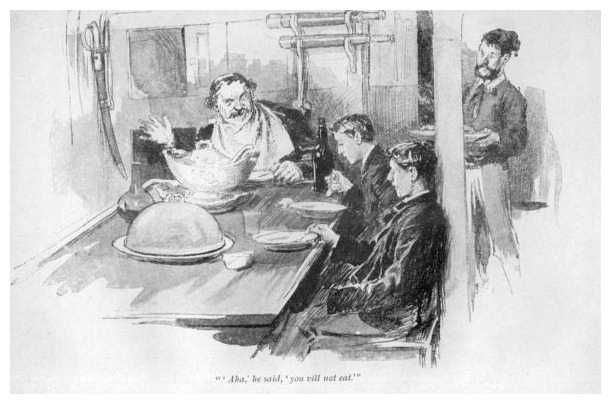
He helped them both liberally, but they could not eat; and soon after they followed their host on deck, to find that the hatches were off, and the bales all carefully stacked below, while the emptied boat had disappeared and another was on the way, Vince paying great heed to the manner in which she glided up to the lugger just about amidships.
By the time it was dusk five heavy loads had been brought on board, and the hatches were then replaced, the boats all but one being hoisted to the davits, the other left swinging by its painter from a ring-bolt astern; and from the number of men aboard the boys judged that no one was left at the caves. They noticed too that, contrary to custom, no light was hoisted anywhere about the vessel, and that, though there were lanthorns in the men’s cabin forward, and in the captain’s aft, no gleam shone forth to play upon the water.
No one seemed to pay any heed to the prisoners, who went from place to place to gaze now up at the darkening rocks, with the stars above them beginning to twinkle faintly here and there, now down at the black waters, which, as the night deepened, began to reflect the bright points of light from the heavens. But soon after, to take their attention a little from their cares, they began to notice that the dark depths below them were alive with light—little specks, that looked like myriads of stars in motion, rising from below the vessel’s keel, coming rapidly towards the surface and then gliding rapidly away. Every now and then there was a flash of light, just as if a pale greenish-golden flame had darted through the water from below; and, after noticing this several times, Vince said quietly—
“Fish feeding.”
“Don’t,” said Mike petulantly. “Who’s to think about fish feeding, when we’re like this? You don’t seem to mind it a bit.”
“Don’t I?” said Vince quietly; “but I do. Every time I see one of those little jelly-fish sailing along there, it makes me think of the light in our window at home—the one mother always puts there when I’m up at your place, so that I may see it from ever so far along the road. Father always jokes about it, and says it’s nonsense, but she puts it there all the same; and it’s there now, Mike, for she’s sure to say I may have been carried out to sea in some boat and be coming back to-night.”
“Oh, don’t—don’t!” groaned Mike: “it seems too horrid to hear.”
“Hush! what’s that?” said Vince. “Only a seabird calling somewhere off the water.”
“No, it isn’t,” whispered Vince. “One of the men wouldn’t have answered a seabird like that. It’s a boat coming from somewhere out yonder.”
“No boat would come through such a dark night, with all these dangerous currents among the rocks.”
But a minute later a boat did glide out of the darkness, a rope was thrown over the bulwarks, made fast, and as a man climbed over on to the deck the captain came out of his cabin and went forward to where the fresh comer was standing.
It was so dark that they could not make out what he was like, but in the stillness every word spoken could be heard; and they recognised the voice directly, as, in answer to a growl from the captain about being late, the man said,—“Been here long enough ago, Skipper Jarks, if it had been any good, but she don’t rise to it to-night. I’ve been hanging about ever so long, but she don’t touch what she should. There won’t be enough water for you on the rocks to-night by a foot.”
“Peste!” ejaculated the captain; “and I vant to go. But after an hour, vat den?”
“Be just as she is now, skipper. Wind’s been agen it since sundown, and kep’ the water back: you won’t get off to-night.”
“Bah!” ejaculated the captain angrily; but he changed his manner directly: “Ah, vell, my friend Daygo, ve must vait, eh? You vill stay vis me here?”
“Nay,” said the man. “I’ll have to go back. I’m cruising about round the island a-looking for them two young shavers.”
The captain turned his head sharply round and looked aft; but, keen as his sea-going eyes were, the presence of the boys passed unnoticed, and, probably concluding that they were farther aft, the captain said in a lower tone, but still perfectly audible.
“Dey look for zem?”
“Look for ’em? The whole island’s been at it ’bout the rocks and cliffs, and with every boat out; but do you know, Skipper Jarks, they arn’t fund ’em.”
The old scoundrel chuckled, and Mike heard Vince’s teeth grate together; and then directly after, he drew a deep breath, like a sigh, for the captain said softly,—
“And zey vill not find zem, eh?”
“They’ve been all day a-looking for their corpusses—for they’re dead now.”
“Aha! so soon?”
“Ay, skipper; they say they’ve gone off the rocks and been drownded, and when they told me I says I wondered they hadn’t been years ago, for they was the owdaciousest pair as ever I see. They’d do anything they took in their heads.”
“Aha! is it so?” said the captain.
“Ay, Skipper Jarks, it’s so; but I’m ’fraid I shan’t find their corpusses to-night. What do you say?”
“Nosing, mon ami: I on’y sink zat ze brave pilot. Josef Daygo, who know evairy rock and courant about ze island, vill find zem if any ones do. But, my friend, vat you sink? Zey find ze vay down to ze cave?”
“Nay, not they. Nobody can climb down they rocks.”
“And you sink zere is no one who find ze leetler passage?”
“Sure of it, skipper. If any one had found that there way down do you think he’d ha’ kep’ it to hisself? Nay, I should ha’ been sure to ha’ heered it, and if I had I’d ha’ done some’at as ’d startled him as tried to go down. On’y one man in the Crag know’d of that till they two dropped upon it somehow. I dunno how. It’s been a wonder to me, though, as nobody never did. Well, I must be going back: I’ve got a rough bit to do ’fore I gets home, and then I’ve got to go up to the Doctor’s.”
“Vell, you vill eat and drink somesing,” said the captain. “Come to ze cabin, and ve sall see.”
As it happened, he led the way across the deck, and then along the port side aft to the cabin-hatch, from whence came soon after the call for the cook, who went to and fro carrying plates and glasses, while the two boys still stood in their former places, leaning over the bulwarks and apparently watching the phosphorescent creatures in the sea, but seeing none.
It was some time before either of them spoke, and then it was Vince who broke the silence.
“So we’re both dead and swept out to sea, are we?” he said.
He waited for a few moments, and then, as Mike did not speak, he said, in a low whisper:
“I say, Mike, shouldn’t you like to take a piece of rock and drop it through old Joe’s boat?”
“No.”
“Well, I should. Of all the old rascals that I ever heard of he seems to be about the worst. Why, he’s regularly mixed up with this gang. Did you hear? It seems that you can only get in and out at certain times of the tide, and nobody knows how to pilot any one in but old Joe Daygo.”
“Did you understand it to be like that?” said Mike eagerly.
“Yes, he seems to be the regular pilot, and comes to take this French lugger in and to steer it out among the rocks. Oh, it’s terrible; and we’ve got old Joe to blame for all our troubles. I wish we’d sunk his boat.”
“Shouldn’t we have sunk ourselves too?”
“Well, perhaps. I should like to drop something through its bottom.”
“I shouldn’t,” said Mike quietly. “Why not? It would serve him well right.”
“Because I should like to use it ourselves.”
“Eh? What do you mean?” said Vince excitedly. “Now, younkers,” said a voice behind them, “skipper says I’m to show you two to your bunks.”
It was a rough, hairy-faced fellow who spoke to them, though in the darkness they did not get a very good view of his features.
“To our bunks?” said Vince.
“Yes; come along. You’re lucky: you’ve got a place all to yourselves.”
He led them aft, to where a small hatchway stood, close to that of the captain’s cabin, from whence the sound of voices came so loudly that, regardless of his companions’ presence, the man stood and listened.
“But I tell you I must go back, skipper,” said Daygo, “and it’s getting late.”
“Oui—yais, I know zat, mon ami,” said the captain; “but I have ze good pilot on board, and it is late and ver’ bad for him to go sail among ze rock and courant. I say it is better he sall stay all ze night, and not go run ze risk to drown himselfs. I cannot spare you. I have you, Daygo. You are a so much valuable mans. So I sall keep you till I sail.”
“Keep me?” growled Daygo.
“Yais. You sall eat all as mosh as you vish, and drink more as you vish, but you cannot go avay. It is not safe.”
There was the sound of a heavy fist brought down upon the table, and then the man, who had picked up a lanthorn, turned to them and said,—
“Down with you, youngsters!”
The boys obeyed, and the man followed.
“Old Daygo don’t like having to stay,” he said laughingly. “There you are, lads!—just room for you both without touching. Shall I leave you the lanthorn?”
“Please,” said Vince. “Thank you.—I say—”
“Nay, you don’t, lad,” said the man, with gruff good humour; “you’ve nothing to say to me, and I’ve nothing to say to you. I don’t want the skipper to come down on my head with a capstan bar. Here, both on you: just a word as I will say—Don’t you be sarcy to the skipper. He’s Frenchy, and he’s got a temper of his own, so just you mind how you trim your boats. There, good-night.”
“One moment,” said Vince, in a quick whisper.
Bang! went the door, and they heard a hasp put over a staple and a padlock rattled in.
“Here, youngsters!” came through the door.
“What is it?”
“Mind you put out that light when you’re in your bunks. Good-night!”
“Good-night,” said Mike.
“Bad night,” said Vince. And then: “Oh, Ladle, old chap, what shall we do?”
Chapter Twenty Nine.
Longings for Liberty.
It was easier to ask that question than to answer it, and they cast a brief glance round the bare, cupboard-like place, with its two shelves, which represented the prisoners’ beds, each bearing a small horsehair mattress and a French cotton blanket.
“Put out the light,” was all the answer Vince received; and, after holding it to the side of the place for a moment or two, he opened the lanthorn door and blew the candle out.
“No good to keep that in. Only makes the place hot and stuffy. I’m going to open that light.”
The “light” was a sort of wooden shutter, which took the place of an ordinary cabin window, and as soon as he had drawn it wide open the soft night air entered in a delicious puff.
“Hah! that’s better,” sighed Vince. “Come here and breathe, Ladle, old chap. It’s of no use to smother ourselves if we are miserable. I say, isn’t it a beautiful night?”
“Who’s going to think anything beautiful when one’s like this? It’s horrible!”
“Pst!” whispered Vince, for the voice of the captain was plainly heard overhead, and the deep growl of old Daygo in answer, the way in which the tones grew more subdued suggesting that the speakers had gone right forward.
“I should like to pitch that old villain overboard,” said Mike, in a fierce whisper.
“Well, if you’d let me tie a rope round him first I’d help you, Ladle; but I shouldn’t like him to drown till he’d had time to get a little better.”
“Better?” said Mike: “he’ll never grow any better.”
“Well, never mind him,” said Vince. “Now then, let’s look the state of affairs in the face. You won’t tell us what to do, so I must see what I can think of.”
“Have you thought of anything?” cried Mike eagerly.
“If you shout like that, it won’t be much good if I have,” said Vince, in an angry whisper.
“I’m very sorry, Vince,” said Mike humbly. “I’ll be more careful.”
“We shan’t get away if you’re not.”
“Get away? Then you see a chance?” cried Mike eagerly.
“Just the tiniest spark of one if you’re ready to try.”
“I’ll try anything,” whispered Mike.
“Wouldn’t mind going into the seal hole again?”
“Vince, old chap, I’d do anything,” said Mike, seizing his fellow-prisoner’s arm and holding him tightly. “What shall we do?”
“I’m afraid it’s going to be very risky, for we don’t know anything about the rocks and currents, and we may be upset. Now do you see?”
“I see: you mean escaping in a boat,” said Mike eagerly; “but how?—what boat?”
“Don’t take much thinking to know that,” replied Vince; “the only thing that puzzles me is how they could be so stupid as to leave a boat there swinging to a painter.”
“Old Joe’s boat!” cried Mike joyously; and Vince clapped a hand over his mouth in anger, for just then they heard the voices of the captain and old Daygo as they walked forward again; and as far as the prisoners could make out, the two men were walking up one side of the deck and down the other, talking earnestly, but what was said the boys could not catch.
“Yes, old Joe’s boat,” said Vince in a subdued voice; “but if you’re going to shout we may as well go to bed and have a night’s rest.”
“I really will mind, Cinder—I will indeed,” whispered Mike. “I couldn’t help that, old chap. But tell me, how are you going to manage it?”
“There’s only one way,” replied Vince, with his lips close to his fellow-prisoner’s ear; “climb out of the window, and then over the bulwark to get down inside it where it’s dark; then creep along till we can feel the painter.”
“Then creep over the bulwark and drop down one after the other.”
“Cut the painter,” said Vince.
“And then we’re free.”
There was a pause, during which Mike got tight hold of Vince’s hand, and the latter felt that it was cold and wet from the boy’s excitement.
“I don’t know so much about being free,” whispered Vince. “We should be away from this wretched old lugger; but where should we be going then? Didn’t I warn you about the rocks and currents?”
“Yes; but we should have old Joe’s boat, and we can manage that easily enough.”
“Yes, if we’re in the open sea, even if she’s sinking, Ladle; but shut-in here among the rocks I don’t know how we should get along. But anything’s better than sitting down and not having a try.”
“Yes, anything,” said Mike, in a low, excited whisper.
“Yes, anything. We must try for the sake of those at home. I know my father is sure to say to me, ‘Didn’t you try to escape?’”
“So will mine,” said Mike. “Oh yes, we must have a good try. Think we can climb up?”
“I’m just going to try,” said Vince, kneeling down to take off his boots. “If you like to try you can. If not, you’ve got to go down on all fours under the window, so that I can step on your back and climb out.”
Mike was silent for a few moments, and then he said softly,—
“I’ll do which you like, Cinder.”
“Then I think I’ll try first. If I can’t manage it you can.”
“But stop a moment: suppose there’s any one on deck?”
“It will be very dark.”
“But there’ll be lanthorns burning and a watch kept.”
“I feel sure there’ll be no lights, because they might be seen from the cliffs; and as they know they’re so safe here, I don’t believe there’ll be any watch kept.”
“I wish I’d got a head like yours, Cinder.”
“Do you? Well, we can’t change. That’s it. My! how tight my boots were! It’s getting them wet and letting them dry on one’s feet.—Pst! Slip into your berth.”
Their needs and experience were beginning to make them obey a sharp order without question; and as Vince lowered down the shutter Mike crawled into the lower bunk silently enough, while, almost without a sound, Vince crept into the one above, stretched himself upon his back, and placed his hands together under his head.
The reason for this sudden action was that he had seen a gleam of light play for a moment beneath the rough door; and they were hardly in their places when there was the sound of descending steps on the ladder, the shape of the door marked out plainly by the light all round. Then came the rattling of a key in the padlock, which was drawn out of the staple, the door was flung open, and the hutch of a place was filled with the dull, soft light of a lanthorn, as a man stepped in.
It was hard work to lie there with the lanthorn held close up to them, but the boys both stood the ordeal. Mike was lying with his face close to the bulkhead, and of course with his back to their visitor and his features in the shade; but Vince’s was the harder task, for he had assumed his attitude as being the most sleep-like, and to give better effect to his piece of acting, he had opened his mouth, and went on breathing rather heavily, while the fact of his having his boots off, and one foot sticking out over the bunk side, helped materially over the bit of deception.
“I wonder who it is,” thought Vince; and, as if in answer, a familiar voice said, in a low tone,—
“Aha! Vous êtes not too much frighten to go fast asleep?”
Vince did not need to open his eyes, for he could see mentally vividly enough the swarthy, brown, deeply-lined face, with the keen dark eyes, and the crafty look about the mouth, drawn into an unpleasant smile, while the big earrings seemed to glisten in the soft light.
“You are fast asleep—hein?” said the man, rather sharply; but no one stirred, though Vince could feel the perspiration standing in a fine dew upon his forehead and by the sides of his nose.
“I came to see if you are good boys, and sall put out your light quite safe; for all ze powder is down underneas you, and you muss not blow yourselfs up and spoil my sheep. You hear, big, stupede boy?”
Vince gave vent to a low, gurgling sound, and made up his mind to babble a few words about the caverns; but his throat was dry, and his tongue refused to act.
Perhaps it was as well, for in doing so he might have overdone his part, which was perfect.
Then the light was withdrawn, the captain went out, and the door was carefully fastened, the light fading from round the door while something shook loudly as he ascended the ladder and dropped the trap down with a snap, which was followed by the crash of iron, as if another loop were passed on a staple.
“Hasn’t dropped any sparks, has he, Vince?” whispered Mike, turning softly in his bunk.
“Can’t see any,” was the reply. “Oh, I say, Ladle, and I blew out our candle and saw them fly!”
“But do you think it’s true? Is the powder here, or did he only say it to frighten us?”
“I don’t know,” whispered Vince. “There must be a powder magazine, for he has cannon on deck. But I didn’t see any trap door: did you?”
“Yes—just as you put out the light. You knelt on it when you took off your boots.”
“Oh dear!” sighed Vince. “I’m all dripping wet. Isn’t this place horribly hot?”
“Hot? I feel as if my things were all soaked.”
“Don’t talk. We must lie still now, and wait. I don’t think he’ll come again.”
“I do,” said Mike. “He’ll never be such a noodle as to believe we two will stop here without trying to escape.”
“I don’t know,” sighed Vince. “I’m afraid we’re quite safe?”
“What, to escape?”
“No—to stop in prison; for I expect we shan’t be able to get on deck.”
“But we’re going to try?”
“Yes,” said Vince through his closely set teeth; “we’re going to try.”
Chapter Thirty.
A Bold Dash for Freedom.
As the boys lay perfectly still in their bunks, gradually growing cooler, and feeling that even if they were over the part of the hold used as a powder magazine there was nothing to fear so long as there was no light near, they heard a step twice overhead, then all was perfectly still but the faint rippling of the swift current as it passed under the vessel and glided on across to the rocks.
They whispered to each other from time to time; Mike being impatient to begin their attempt, but Vince always refusing till he felt satisfied that all was still.
At last this feeling of satisfaction came, and, passing his legs out of his bunk, he dropped lightly on to the floor to begin feeling about, till his hand touched a rough hinge, and on the other side a ring which lay down in the woodwork of a trap door.
But he did not say anything, only rose and pulled open the light again, keeping it in that position by passing the leather strap which formed its handle over a hook in the ceiling, a slit having been cut in the piece of leather.
“Now, Ladle,” whispered Vince, “come and kneel here, then I can stand on your back.”
Mike obeyed at once, and then whispered quickly,—
“Vince, there is a trap door here: I’m right on it.”
“I know,—I touched it; but there’s no candle. Ready?”
“Yes.”
Vince took hold of the opening frame, which was only just big enough for him to pass through, stepped lightly on to his companion as he stiffened himself on all fours, and then began to creep out.
For a few moments he hesitated, for there was the black water beneath him, full of sparks, gliding rapidly along, so brightly that he felt that if any one were on deck looking over the bulwark he must be seen; but the thought of freedom and those at home nerved him, and as soon as he was in a sitting position, with his legs inside, he bent down and whispered to his companion, who had risen,—
“Take tight hold of my legs till I give a jerk, which means let me loose.”
Mike seized the legs firmly; and, thus secured, Vince stretched out his arms and began to feel about overhead, to find that the top of the light was just below the projecting streak, which runs, iron-bound, round the most prominent part of a vessel, from stem to stern, to protect the side from injury when it glides up to wharf, pier, or pile. This stood out about a foot, and Vince felt that if he could only climb on this, the rest would be easy.
He passed his hands cautiously over it, and, reaching in, found to his great delight a ring-bolt, through which it was possible to pass two or three fingers. Jerking his leg, he felt himself free, and rose up, getting first one foot and then the other on the sill of the opening.
There was no difficulty in standing like this, and as he did so he felt Mike’s arms tightly embracing his legs, an act which hindered further progress if he had meant to climb higher.
But he was satisfied with what he had done; after peering about a little, and listening for some minutes, he jerked one leg again, felt them freed, and began to descend.
To an active boy, whose nerves were firm, this was easy enough; and directly after he stood in the little cabin, breathing hard, but able to find words, and whisper to his anxious fellow-prisoner.
“It’s as easy as easy,” he said: “nothing to getting up a bit of stiff cliff;” and he then described what he had found, and how all seemed as still as could be. “Couldn’t you hear any watch on deck?”
“Not a sound of them. I believe every one’s below; and I say, Mike, we needn’t get over on deck at all. There’s plenty of room to take hold of the top of the bulwarks and walk along. All we’ve got to do is to mind the stays when we come to them, and step round carefully.”
“Yes, I understand perfectly,” said Mike. “Come on, and let’s get it over.”
“Wait till I’ve put on my boots. I shall want them.” The boy knelt down and hurriedly drew them on, and laced them as well as he could in the dark; then raising himself on to the window-sill without assistance, he drew himself into his old position, and reaching up and over the streak, found the ring-bolt, which rattled faintly, and, passing his fingers through, stood up on the sill, and then drew himself on to the projecting woodwork.
Here he crouched for a few moments listening, before rising erect, with one hand upon the top of the bulwark, over which he looked; but all was dark, and there was not a sound to be heard save the faint rustling below him made by Mike.
This was the most nervous part of the business. A certain amount of tremor had troubled the lad as he climbed out, and the thought of having a slip did once bring the perspiration out upon his forehead; but the effort needed dulled the fear, and he soon stood where he was in safety. But to listen to a companion undergoing the same trial in the darkness was another thing; and Vince felt ten times the dread as he listened and shivered to hear the ring-bolt seized and his companion slowly drawing himself upward so that he could stand.
Suppose he lost his nerve—suppose he slipped and tell with a splash into that black, spangled water—what could he do? Poor Mike would be swept away directly, and his only chance of life would be for him to swim steadily till he reached the rocks, and then try to find one to which he could cling, and draw himself up.
But Vince did better than think: he tightened his grasp of the bulwark rail by crooking his hand, and softly extended one leg over the streak.
This had the effect he desired. The next moment it was struck by a hand feeling about. Then the trouser was tugged at, and directly after the bottom was turned over and over, so as to form a good roll to grip. Then, with this for a second hand-hold, Mike was helped, and his climb on to the shelf-like projection became easier for the aid afforded, and he too rose to stand panting beside Vince.
They felt that everything depended upon their coolness, and hence they stood there, facing inward, holding on to the bulwark and listening.
But all was still; and at last, satisfied that it was time to move, Vince whispered “Now,” and began to edge himself along to the right—that is, towards the forward part of the boat.
Mike started at the same moment, taking step for step, their hands touching at every movement. It was an easy enough task this, for there was plenty of hold and standing room—the only danger being that they might be heard by some one on the watch, while there was the chance that they had been heard and this was a new trap to re-catch them.
But their hearts rose as they crept slowly and silently along in the silence, and then went down deeply into a sense of despair, for a thought suddenly struck Vince which made him stop and place his lips close to his companion’s ear, and whisper,—
“Suppose, as Joe is going to stop, they have hoisted the boat on deck?”
Mike replied promptly, and with a decision that was admirable under the circumstances,—
“Don’t make bugbears. Go on and try.”
It was rude enough to have brought forth a sharp retort at any other time; but then Vince felt its justice, and he went on again, and his hand touched the shrouds which held the mainmast in place, and a little care had to be exercised to pass round. But this was silently achieved by both; and Vince was gliding his right-hand along the top of the bulwarks once more, when it was as if an electric shock had passed through him, for he had suddenly touched something unmistakably like a man’s elbow.
For a few moments he was ready to doubt this; but the doubt passed away directly, for from close to him a heavy, snoring breath was drawn, and as he gazed with starting eyes he made out dimly the head and shoulders of a man who was evidently the watch, but who conducted his watching by folding his arms upon the bulwarks, laying his head thereon, and going off fast asleep.
Vince felt that all was over unless they went back some little distance, climbed over and crossed the deck to the other side; and once more placing his lips to Mike’s ear, he told him of the obstacle in the way, and suggested this plan.
Then Mike’s lips were at his ear,—
“Take too much time—may tumble over another—go on.”
The proposal almost took the boy’s breath away, but he was strung up by his companion’s firmness to do anything now, and, drawing a deep breath, he prepared to advance; but paused again, with his blood running cold, for there was an uneasy movement on the part of the watch and a low, growling muttering.
Silence once more; and then, nerving himself, Vince advanced his left hand till it was close to the sleeping man’s elbow, then, edging along a little, he reached out his right-hand till he could grasp the bulwark beyond the other elbow; but the position brought his face down close to the back of the sleeper’s head, and he could feel the warmth emanating from it and the man’s rising breath, while he trembled as he dreaded lest the man should feel his.
Then Vince felt that he ought to step back and tell Mike how to manage—as he was acting; but, knowing that all this meant delay and that speed was everything, and might mean success instead of failure, he knew that he must trust to his comrade’s own common sense. And now, with the feeling upon him that if the man awoke suddenly he would start and fall back into the sea, he tightened his hold of his right-hand, relaxed that of his left, edged along, and was safely past.
Naturally all these thoughts darted almost instantaneously through his mind, and a few moments only elapsed between Mike’s words and his being safe upon the other side; while now, as he stood thus, after leaving ample room for his companion, the strain upon his nerves seemed to be greater, for he had to try and see Mike’s movements, and listen in agony to the faint rustling sound he made.
Poor Mike had a harder test of his courage than that which had fallen to Vince’s lot; for as by instinct he took the same means of getting by the obstacle as the former, and was standing with arms outstretched, the man made a sudden movement and growled out some tongue-blundered word, at the same time raising his head and striking Mike’s chin slightly, to make the boy’s teeth go together with a sharp click.
“It’s all over,” thought Vince. But he was wrong: the man settled his head down again in a more satisfactory position, and uttered a low, grumbling sigh of resting weariness.
Then Mike was alongside of his partner in the flight, and they edged themselves rapidly along to the foremast shrouds—so short a distance, but to them, with their nerves on the strain, so far.
Now came another heart-compressing question to Vince. The boat, when Joe Daygo arrived, had been made fast a short distance in front of the foremast: was it there now?
A strange hesitation came over the lad; he did not like to pass beyond the fore-chains to test this, for he felt that if it had been removed and hoisted on board the disappointment would be so keen as to be almost unbearable, for to let it down unheard would be impossible; but once more mastering himself he passed on, holding by the light shrouds which gave at his touch, and then began to run his hand once more along the bulwark to feel the line, which had been passed over and twisted to and fro over one of the belaying pins.
No—no—no.
Yes!
There it was, and as he grasped it the boat answered to his touch as it swung alongside and grazed softly against the copper sheathing.
“Got it?” was whispered.
“Yes;” and Vince’s hand went to his pocket for his knife, as his busy, overstrung brain asked why it was that they had not been searched and their knives taken away.
But he did not withdraw the knife, for he found that it would be easy enough to cast the rope loose, and he turned to Mike.
“Down with you!” he said.
“No: you first.”
A noise as of a heavy blow.
A savage yell, followed by a scuffling sound from where the sleeping man had been standing, and the boys stood holding on there, paralysed for the moment.
“Curse you if you hit me!” began a rough voice from out of the darkness; but the speech was cut short by a sharp clicking, and the familiar voice of the French captain arose, sharpened by rage and sounding fierce and tigerish in spite of the peculiarity of his broken English, mingled with words in his native tongue.
“Dog! Canaille! Vite sleep-head fool! Anozaire vord I blow out you brain and you are ovaire-board.”
The sleeper growled something, which was again cut short by the French skipper.
“Vat? How you know zat ze boy do not get on deck to take a boat and go tell of my store cachette? To-morrow you are flog by all ze crew, and zey sall sare all ze monnaies zat vould come to you.”
Vince drew on the painter, and then pressed Mike’s shoulder for him to descend, while he began softly to cast off the rope.
Mike did his best to go down in silence, and Vince his to cast off without making a sound; but the boat ground against the side, the belaying pin rattled, and there was a rush from where the captain stood.
Mike was in the boat as the last turn was cast off from the belaying pin; and then, without a moment’s hesitation, Vince leaped down, fortunately alighting beyond his companion upon one of the thwarts, and then falling forward upon his hands just as there was a flash of light and a loud report.
The thrust given by Mike and the impetus of Vince’s leap sent the boat out to where it was caught by the current; but, instead of its bearing them away from the lugger, it seemed to keep them back for a few moments, but only for the bows to be seized by an eddy just as there was another flash, report, and simultaneously a dull thud, as of something being hit. Then the shouting of orders, the appearance of a light, and the hurrying of feet was more distant, as if the lugger had suddenly been snatched away; but the two lads knew that they were in one of the terrible rushing currents, and were being borne along at a tremendous rate. Where? In what direction?
They could not tell, for the tide had turned.
Chapter Thirty One.
The Perils of the Scraw.
In the hurry and confusion the boys crouched in the bottom of the boat for some minutes, gazing at the lugger, and seeing lanthorn after lanthorn dancing about. Then one descended like a glowworm apparently on to the surface of the water, and they knew that a boat had been lowered and that there would be pursuit. And all the time they felt that without effort on their part they were being borne rapidly along as fast as any one could chase them; but they were in a boat familiar to them, and furnished with oars and sails if they could only reach the open water. Then a despondent feeling came over them as they realised that they were surrounded by towering rocks, and as they crouched lower they fully expected from moment to moment to hear a grinding sound, and feel a sharp check as a plank was ripped out by some sharp granite fang, and then hear once more the rippling of the water as it rushed into the boat.
And this in the darkness; for the bright stars above and the phosphorescent atoms with which the black waters were dotted did not relieve the deep gloom produced by the overhanging cliffs.
“Hurt, Vince?” whispered Mike at last.
“Yes, ever so.”
“Oh! Want a handkerchief to bind it up?” cried Mike, in horror.
“Well, it does bleed—feels wet—but it don’t matter much.”
“But it does,” said Mike excitedly. “Where did it hit you?”
“On the shin; but it didn’t hit me—I hit it.”
“What! The bullet?”
“Go along! don’t joke now. I came down against an oar. Oh, I see: you thought he hit me when he fired.”
“Of course.”
“Pooh! he couldn’t aim straight in the dark. I’m all right. But I say: there’s water in the boat. Not much, but I can hear it gurgling in. Why, Mike,” he cried excitedly, after a few moments’ search, “here’s a little round hole close down by the keel. There, I’ve stopped it up with a finger; it’s where his bullet must have gone through. Got your handkerchief?”
“Yes.”
“Tear off a piece, to make a plug about twice as big as a physic-bottle cork.”
There was the sound of tearing, and then Mike handed the piece of cotton, which was carefully thrust into the clean, round hole, effectually plugging it; after which Vince proposed that they should each take an oar.
“Can’t row,” said Mike shortly.
“No, but we may want to fend her off from a rock. Hullo! where are the lanthorns now? I can’t see either the lugger or the boat.”
Mike looked back, but nothing was visible.
“We’ve come round some rock,” said Vince. “We shall see them again directly.”
But the minutes glided on, and they saw no light—all was black around as ever, but the loud, hissing gurgle of the water told that they were being borne along by some furious current; and at last came that which they had been expecting—a heavy bump, as the prow struck against a rock-face so heavily that they were both jerked forward on to their hands, while the boat was jarred from stem to stern.
They listened with a feeling of expectant awe for the noise of water rushing in; but none came, and a little feeling about was sufficient test to prove that there was no more than had come in through the bullet hole. But while they were waiting there came another heavy blow, and their state of helplessness added to their misery.
“Oh, if it was only light!” groaned Mike.
“Yes, we could use the oars or hook to fend her off.”
Bump went the boat again, and they caught at the side to save themselves, conscious now, in the thick darkness, that they were being whirled round and round in some great whirlpool-like eddy, which dealt with the boat as if it were a cork.
“Don’t seem as if we can do anything,” said Vince at last, as the boat swept along, with the water lapping and gurgling about them just as if it were full of hungry tongues anticipating the feast to come as soon as they were sucked down.
“No,” said Mike, “it doesn’t seem as if we can do anything.”
“’Cept one thing, Mike,” said Vince in a low deep tone, which did not sound like his own voice.
“What?”
“Say our prayers—for the last time.”
And in the midst of that intense darkness, black as ebony on either side, while above and below there were still the bright glittering and softened streaks of light, there was an interval of solemn silence.
Vince was the first to break that silence, and there was something quite cheerful in his tones now as he said,—
“Shake hands, Mikey: I’m sorry you and I haven’t always been good friends. I have often been a regular beast to you.”
Mike grasped the extended hands in a firm grip with both of his, as he said, in a choking voice,—
“Not half so bad as I’ve been to you, Cinder. I’ve got such a hasty temper sometimes.”
“Get out!” cried Vince sharply. “There, I’m better now. I’m afraid we’re going to be drowned, Ladle, but I feel as if we ought to be doing something to try and save ourselves. It’s being so cowardly to sit still here. They wouldn’t like it at home.”
“But what can we do? I’m ready.”
“So am I; but it’s so dark. I say, though, we must be going round and round in a sort of hole.”
“Then we shall be drawn right down somewhere into the earth.”
“Not that! I tell you what, it’s like one of those great pot-holes in the big passage, only a hundred times as big; and the water’s sweeping the boulders round, and grinding it out and carrying us along with it. Look here, we shall be kept on going round and round here, if we don’t get smashed, till daylight; and then old Jarks’ll come and find us, and we shall be worse off than ever. I say, though, don’t you think we could do something with the boat-hook?”
“What?”
“Wait till we bump against the rocks again, and then try and hold on.”
“If you did the water would come over the stern.”
“I don’t know. Well, look here: I’ll try. If it does I’ll let go directly.”
Taking hold of the boat-hook Vince knelt down right forward, thrust the iron-armed pole over the bows, and holding it like a lance in rest he waited, but not for long. Very soon after the iron point touched against stone, and he was thrown backward, nearly losing the pole, while the boat was sent surging along on one side for a few moments, bumped on the other side, then back again as if she were being sent from side to side, and directly after the keel came upon a rock which seemed to slope up like a great boulder standing in their way. There for a brief moment or two it was balanced, and made a plunge forward like a dive, the water came with a rush over the bows, and surged back to where Mike was kneeling, and then they were rushing onward again more swiftly than ever.
For a few moments the pair were too breathless to speak, but Vince recovered from the confusion caused by the shock and the rapidly following exciting incidents, and he shouted aloud,—
“Bale, Mike, bale! It’s all right: we’re out of that whirlpool, and we’re going along again.”
“You’ve got the baler forward,” said Mike huskily.
“Eh? So I have in the locker here. I say, how deep do you make the water? There’s hardly any here.”
“Only a few inches.”
“Then we’re all right yet; but we may as well have that out.”
He felt for the locker, and drew out the old tin pot, crept aft to where his companion knelt, and, after lifting the board which covered in the keel depression, he began to toss out the water rapidly, and soon lowered it so that the pot began to scrape on the bottom, while Mike listened with a feeling of envy attacking him, for he felt that it must be a relief to be doing something instead of kneeling there listening and wondering whether the pursuing boat was anywhere near.
“There!” said Vince at last, in a triumphant tone; “that’s different to baling when you feel that the water is coming in as fast as you throw it out. I haven’t got it all, but as much as I can without making a noise.”
He replaced the bottom board and then returned the pot to the locker, and Mike moved a little forward now to meet him half-way.
“Think we’re going as fast now as ever?” whispered Mike.
“Eh? I don’t know. I was too busy to think about it. No, not quite, and— I say, are we going right?”
“Right?”
“Well, I mean as we were. We seemed to be going south, as far as I could make out by the stars; and now we’re going north.”
“Nonsense! impossible!”
“Look, then! I’m sure we had our backs to the pole star, and that meant going south, and out to sea; but now we’ve got our faces due north.”
“Yes,” said Mike, after a few moments’ pause; “that’s right: we’re going north.”
“Well, that isn’t out to sea.”
“No,” replied Mike thoughtfully.
“And running along at such a rate as we are, we ought to have been ever so far away by this time, instead of rushing along here deep down among the rocks, as if we were in a narrow channel. I can’t make it out: can you?”
Mike remained thoughtful and silent again for a time, and then said wearily,—
“No; I can’t understand it. It gives me the headache to think; and being whirled along like this is so confusing. My thoughts go rushing along like the water.”
“Don’t talk so loud, Mike,” said Vince, after a pause, “or we shall be heard. But we must have left them a long way behind, or else they’ve covered over their lanthorn so as to come upon us by surprise.”
“Think they are near us, then?”
“Must be, because the tide would carry them along as fast as it does us; and they have the advantage of knowing the way. Oh! I do wish we could get out in the open sea; and then, once we were clear of the rocks, we’d show them what the boat could do. It would puzzle them to—”
He was going to say “catch us then,” but he stopped short, gazing upward, out of the black chasm in which they were, at the stars.
“What is it? See the light?” whispered Mike.
“No: I was trying to make out our course. The passage has wound off to the right, and we’re going east.”
“Of course it would zigzag and turn about,” said Mike wearily; “but we’re in deeper water here, for we don’t seem to go near any small rocks.”
“No; but we’re going by plenty of big ones on the left. The current runs close to them, I’m sure, though it’s ever so much wider now. I believe I could almost have touched either side with the boat-hook a bit ago; now I can only touch one side.”
“It’s more ripply, too, now, isn’t it?”
“Ever so much: seems to boil up all about us, and you can’t see the bright specks sailing about so fast. The top of the water was as smooth as glass when we were in the great lugger.”
“That’s a sign we are near the sea, then,” said Mike, with more confidence in his tones.
“Yes, and I don’t like it,” said Vince thoughtfully.
“Why?”
“Because I’ve been thinking that there must be another way out; and knowing all about it, as they do, they’ll be waiting at the mouth of this horrible zigzag place along which we’re dodging all this time, and catch us after all.”
“Oh, Cinder!” cried Mike passionately, “don’t say that: it would be too hard. It may be too dark for them to see us if we lie close and don’t make a sound. And look,” he said joyfully: “we really are close to the sea now, for we’re going due south.”
“Due south it is,” assented Vince, as if he were standing at a wheel steering. “Yes, I suppose you’re right, for I can hear the sound of surf. Listen.”
“Yes, I can hear,” replied Mike; “but it sounds smothered-like.”
“Rocks between us, perhaps. Now then: only whispers, mind!—close to the ear. Don’t let’s lose our chance of getting away by telling them where we are. I say!”
“Yes.”
“If there was a boat anywhere near us, could you see it?”
Mike turned his eyes to right and left before answering:
“Sure I couldn’t on that side, and I don’t think I could on this.”
“That’s what I felt, and if we’re lucky we’ll escape them after all. Now then, silence, and let’s get the oars across and each take his place on the thwarts, ready to row hard if we are seen.”
Each from long practice felt for the thole-pins and placed them in their proper holes; then, softly taking up their oars, they laid them right across the boat, with handle standing out on one side, blade on the other, and waited in silence, with the boat gliding on.
At the end of about a quarter of an hour, during which minute by minute they had expected to be swept out into open water where the great Atlantic tide was rolling along by the solitary island, Mike whispered,—
“I say, the boat has turned quite round more than once. Doesn’t that account for the stars seeming different?”
“No, because we can tell we are sometimes going forward and sometimes back.”
“But look! we’re going north now.”
“Yes, I know we are,” said Vince; “and I’m beginning to know how it is.”
“Well, tell me. It’s so horrible to be puzzled like this.”
Vince was silent.
“Why don’t you speak?”
“Because I was thinking. Ladle, old chap, we’ve gone through too much, what with the seals’ cave, and being caught and then put down in that stifling hole over the gunpowder. We’re both off our heads—in a sort of fever.”
“I’m not,” said Mike shortly. “You are, or else you wouldn’t talk such stuff.”
“I talk such stuff, as you call it, because my father’s a doctor, and I’ve heard him tell my mother about what queer fancies people have when their heads are wrong.”
“Two people couldn’t be queer in the same way and with the same things. What’s the good of talking like that?”
“Very well: you tell me how it is. I can’t understand it, and the more I try the more puzzled I am. It’s horrible, that’s what it is, and I feel sometimes as if we had been carried away by the tide to nowhere, or the place where the tides come and go in the hollows of the earth.”
“We shall be out at sea directly, and then we shall be all right.”
“No, we shan’t be out at sea directly, and we shan’t be all right; for we’ve got into some horrible great whirlpool.”
“What!” cried Mike excitedly. “A whirlpool?”
“Yes, that’s it; and we’re going round and round, and that’s why it is that we are sometimes looking south and sometimes north.”
“But you don’t think—if it is as you say—that at last we shall be sucked down some awful pit in the middle?”
“I don’t know,” said Vince. “I can’t think properly now. I feel just as if my head was all shut up, and that nothing would come out of it. I say, Mike!”
There was no reply, for Mike was gazing wildly up at the stars, trying to convince himself of the truth or falsity of his companion’s words; but he only crouched lower at last, with a feeling of despair creeping over him, and then he turned angrily, as Vince began to speak again, in a low, dreamy voice.
“That’s it,” he said: “we are going round and round. I wish we’d had some more of old Jarks’ dinner, and then gone to sleep quietly in our bunks. We couldn’t have been so badly off as we are now.”
“Then why did you propose for us to escape?”
“Because I thought we ought to try,” said Vince sharply, as he suddenly changed his tone. “There, it’s of no use to talk, Mike. We’re in for it, and I’m not going to give up like a coward. I don’t know where we are, and you don’t; but we’re in one of those whirls that go round and round when the tide’s running up or down, and we can’t be any worse off than we are now, for there are no rocks, seemingly.”
“But the middle—the hole.”
“They don’t have any hole. Why, you know, old Joe sailed us right across one out yonder by the Grosse Chaine, and we went into the little one off Shag Rock. It’s one like that we’re in, and I daresay if it was daylight we could see how to get out of it by a few tugs at the oars, same as we got out of that one when we went round and round before. Oh, we shall be all right.”
Mike did not speak, for the words seemed to give him no comfort.
“Do you hear, Ladle?” continued Vince. “If we had been likely to upset, it would have been all over with us long ago; but we go on sailing round as steadily as can be, and I feel sure that we shall get out all right. What do you say to lying down and having a nap?”
“Lie down? Here? Go to sleep?” cried Mike in horror. “I couldn’t.”
“I could,” said Vince. “I’m so tired that I don’t think I could keep awake, even if I knew old Jarks was likely to come and threaten me with a pistol. But, I say, Ladle, that wretch shot at us twice. Why, he might have hit one of us. Won’t he have to be punished when we get away and tell all about him?”
“Yes, I suppose so—if ever we do get away,” said Mike sadly.
Then they relapsed into silence, both watching the stars to convince themselves that they were going round and round, making the circuit of some wide place surrounded by the towering rocks, which made the sea look so intensely black.