Chapter I · The History of the City in ancient and mediæval times
Reading edition
1. Byzantium Before Constantine.
It is impossible to approach Constantinople without seeing the beauty and the wonder of its site. Whether you pass rapidly down the Bosphorus, between banks crowned with towers and houses and mosques, that stretch away hither and thither to distant hills, now bleak, now crowned with dark cypress groves; or up from the Sea of Marmora, watching the dome of S. Sophia that glitters above the closely packed houses, till you turn the point which brings you to the Golden Horn, crowded with shipping and bright with the flags of many nations; or even if you come overland by the sandy wastes along the shore, looking across the deep blue of the sea to the islands and the snow-crowned mountains of Asia, till you break through the crumbling wall within sight of the Golden Gate, and find yourself at a step deep in the relics of the middle ages; you cannot fail to wonder at the splendour of the view which meets your eyes. Sea, sunlight, the quaint houses that stand close upon the water's edge, the white palaces, the crowded quays, and the crowning glory of the Eastern domes and the mediæval walls—these are the elements that combine to impress, and the impression is never lost. Often as you may see again the approach to the imperial city, its splendour and dignity and the exquisite beauty of colour and light will exert their old charm, and as you put foot in the New Rome you will feel all the glamour of the days that are gone by.
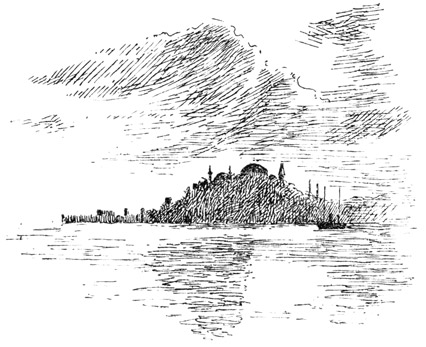
SERAGLIO POINT AFTER SUNSET
So of old the Greeks who founded the city dwelt lovingly on the contrast of sea and land here meeting, and hymned the nymphs of wave and spring, the garden by the shore.
"Where ocean bathes earth's footstool these sea-bowers Bedeck its solid wavelets: wise was he Who blended shore with deep, with seaweed flowers, And Naiads' rivulets with Nereids' sea."
Strictly speaking the peninsula on which the city stands is of the form of a trapezium. It juts out into the sea, beating back as it were the fierce waves of the Bosphorus, and forcing them to turn aside from their straight course and widen into the Sea of Marmora, which the ancients called the Propontis, narrowing again as it forces its way between the near banks of the Hellespont, which rise abrupt and arid from the European side, and slope gently away in Asia to the foot of Mount Ida. Northwards there is the little bay of the Golden Horn, an arm as it were of the Bosphorus, into which run the streams which the Turks call the Sweet Waters of Europe. The mouth of the harbour is no more than five hundred yards across. The Greeks of the Empire spanned it by a chain, supported here and there on wooden piles, fragments of which still remain in the Armoury that was once the church of S. Irene. Within is safe anchorage in one of the finest harbours of the world.
South of the Golden Horn, on the narrow tongue of land—narrow it seems as seen from the hills of the northern shore—is the city of Constantine and his successors in empire, seated, like the old Rome, on seven hills, and surrounded on three sides by sea, on the fourth by the still splendid, though shattered, mediæval walls. Northwards are the two towns, now linked together, of Pera and Galata, that look back only to the trading settlements of the Middle Ages.
The single spot united, as Gibbon puts it, the prospects of beauty, of safety, and of wealth: and in a masterly description that great historian has collected the features which made the position, "formed by Nature for the centre and capital of a great monarchy," attractive to the first colonists, and evident to Constantine as the centre where he could best combine and command the power of the Eastern half of his mighty Empire.
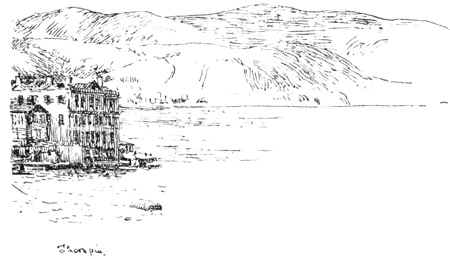
THERAPIA
"Situated in the forty-first degree of latitude, the imperial city commanded, from her seven hills, the opposite shores of Europe and Asia; the climate was healthy and temperate, the soil fertile, the harbour secure and capacious, and the approach on the side of the continent was of small extent and easy defence. The Bosphorus and Hellespont may be considered as the two gates of Constantinople, and the prince who possessed those important passages could always shut them against a naval enemy and open them to the fleets of commerce. The preservation of the eastern provinces may, in some degree, be ascribed to the policy of Constantine, as the barbarians of the Euxine, who in the preceding age had poured their armaments into the heart of the Mediterranean, soon desisted from the exercise of piracy, and despaired of forcing this insurmountable barrier. When the gates of the Hellespont and Bosphorus were shut, the capital still enjoyed, within their spacious enclosure, every production which would supply the wants, or gratify the luxury, of its numerous inhabitants. The sea-coast of Thrace and Bithynia, which languish under the weight of the Turkish oppression, still exhibits a rich prospect of vineyards, of gardens, and of plentiful harvests; and the Propontis has ever been renowned for an inexhaustible store of the most exquisite fish, that are taken in their stated seasons without skill, and almost without labour. But when the passages of the straits were thrown open for trade, they alternately admitted the natural and artificial riches of the north and south, of the Euxine, and of the Mediterranean. Whatever rude commodities were collected in the forests of Germany and Scythia, as far as the sources of the Tanais and the Borysthenes; whatsoever was manufactured by the skill of Europe or Asia; the corn of Egypt, and the gems and spices of the farthest India; were brought by the varying winds into the port of Constantinople, which for many ages attracted the commerce of the ancient world."
There is no wonder that legend should surround the beginnings of the imperial city of the East. Men from Argos and Megara under the navigator Byzas founded it about 657 B.C. But mythology made the founder the son of Neptune the sea god, and said that Io, changed into a heifer, swam across the narrow strait that divides Europe from Asia, and so gave it the name of Bosphorus, which means literally Oxford. The Delphic oracle told men to settle "opposite the land of the blind," for blind were those men of Megara who some years before had chosen Chalcedon on the Asiatic shore instead of the matchless site on which rose the city of Byzantium.
The early history can be briefly told. Byzantium was the first of the cities of Europe to fall into the hands of Darius. It was burned to the ground by the Persians, rescued and rebuilt by Pausanias, was threatened by the Ten Thousand on their retreat, and saved by the eloquence of Xenophon. Two years it was besieged by Philip of Macedon, and was saved by the Athenians. When Rome first showed her power in those lands Byzantium was her ally; but her chequered fortunes ended their first epoch with destruction at the hands of Septimius Severus in 196 A.D. She waited then for a century till her real founder came. Byzantine coins go back as far as the fifth century B.C., and there were in the early Middle Ages many surviving memorials of pre-Christian times; of these there are now left only the striking Corinthian column standing on a high granite base in the garden of the old Seraglio, which almost certainly commemorates a victory of the Emperor Claudius Gothicus, some parts of the foundations of the Hippodrome, an inscription in the Doric dialect which formerly stood in the Stadium, and that wonderful serpent column, which only came, it is true, to the city after Constantine rebuilt it, but which was centuries before in the temple of Apollo at Delphi.
2. From Constantine to Justinian.
The true history of the city begins with Constantine the Great. It is said that he hesitated at first, like the men of Megara, between Byzantium and Chalcedon, when he came to choose a spot from which to rule the East. But when he chose aright he founded a city which has endured to this day, and which it is inconceivable should ever be deserted again. The site on which he built is about four miles long, broadening from less than a mile where it fronts the Bosphorus to four miles from where the Marble Tower now stands to the Golden Horn. Seven hills and six valleys diversify the ground. The seven hills as we see them now stretch thus from east to west. First is that irregular elevation ending at Seraglio Point, on which stand the buildings of the old Seraglio, S. Irene, S. Sophia, the great mosque of Sultan Ahmed, and the Hippodrome. Second, and north-west of it, is the hill on which stands the column of Constantine himself, now burned and broken. On the third stands the great tower by the War Office (Seraskierat), the mosques of Bayezid and Suleiman. A valley descends northwards to the Golden Horn; and across it runs the Aqueduct of Valens, and on the other side is the hill marked by the mosque of Mohammed the Conqueror. The fifth hill stretches from the fourth almost to the Golden Horn, and on it stands the mosque of Selim. The sixth hill, divided from the fifth by a valley ascending from the Golden Horn, has now the ruins of the palace called by the people "the House of Belisarius," and the seventh extends from the south of the Adrianople Gate to the Sea of Marmora. As the old foundation, so the new planning of Constantine has its legend. It is said that he traced the boundary of his city himself, walking spear in hand and marking the line of the walls; and when his courtiers asked him how far he could go he answered, as though he saw a sacred vision, "Until He tarries Who now goes before." He ascribed in his laws the founding to the command of God.
He did not cover the whole ground of the Seven Hills. It is difficult to trace with certainty the line of the walls, but it would seem probable that they extended from what is now the inner bridge across the Golden Horn to a point on the Sea of Marmora about midway between the gate of Daoud Pasha and the Psamatia Gate. This would exclude part of the fifth, sixth, and seventh hills; but it is improbable that they were left entirely unprotected or completely excluded from the city of Constantine. By the sixth at any rate already stood the Blachernae, later to be the famous palace of the Byzantine emperors. Sycae, across the Golden Horn, was the name of what is now Galata. It was at one time the quarter where the Galatian mercenaries dwelt, and quite early in history it had another division named Pera, or "across the water." The seaward walls remained as they had been in old Byzantium, and they were repaired, and brought forward to the point whence the new land walls started. Of the remains of Constantine's time there are none that are not half destroyed or wholly altered, but the Church of S. Irene still recalls the days of its first founder, and the serpent column from Delphi still stands in the Hippodrome where he placed it.
The divisions of Constantine's city are not easy to recover. For municipal government it had, like Rome, fourteen regions, two of which were outside the walls, those (xiii.) of Sycae and (xiv.) of Blachernae. From the Golden gate, which was not far from the Marmora end of the land walls (the name Isa Kapou Mesjidi still recalls the Holy Name of Jesus which it bore), a road led to the Augusteum. The Forum of Constantine stood outside where the old Byzantine walls had been, and west of the Hippodrome. The Hippodrome extended south-west from the Forum of the Augusteum. North-east at some distance stood the Church of S. Irene. The Augusteum which, as Mr Bury says, we may translate place impériale, had the Church of S. Sophia, begun probably by Constantius, on the north; on the east the Senate house, and some buildings of the Palace; on the south the great Palace itself, built eastwards of the Hippodrome and commanding the magnificent view over the Marmora islands to the shores of Asia and the snows of Olympus.
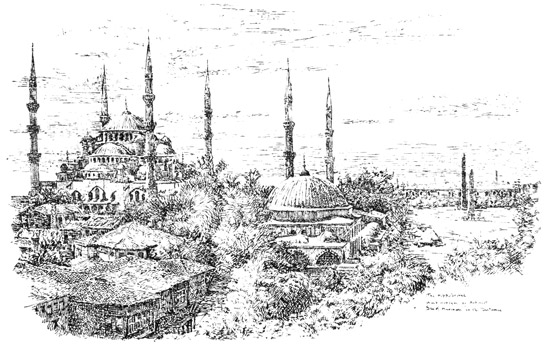
THE HIPPODROME AND MOSQUE OF AHMED
Of the splendour of the city of Constantine many hints of description remain. Constantinople was enriched, says one writer, by the spoils of all other cities: Rome and Athens, Sicily and Antioch, were robbed of treasures. Of all these treasures the most wonderful, almost if not quite alone, survives. For eight hundred years it had already stood in the Sanctuary of Delphi, the serpent column with its triple head, inscribed with the names of the Greek city states which had triumphed on the field of Platæa. Through all the changes of the sixteen centuries since Constantine lived the column has still remained where he set it. Its heads are now broken off, and one may be seen in the museum; but parts of the inscription on the coils might still be traced fifteen years ago when rubbings were taken. The name of the Tenians, whose trireme brought the news to the Greeks of the Persian approach, may still be seen. "For this service," says Herodotus, "the Tenians were inscribed in Delphi, on the tripod, among those who had overthrown the barbarian." Thus for nearly two thousand four hundred years this memorial has endured. Of all the wonders of the city of Constantine there is none like it.
From Constantine to Justinian the history of the city may be rapidly traversed, for no great builder came between them to rival their work. It was on May 11, 330 A.D., that the city of Constantine was dedicated and received the name of New or Second Rome. Throned in the Hippodrome, ever after to be the centre of Byzantine life, Constantine gave thanks to God for the birth of this fair city, the daughter (so wrote S. Augustine), as it were, of Rome herself. Grandeur, riches, dignity, he could give to his new city: but before he died it was plain that he could not bequeath to her a legacy of peace.
The early history of Constantinople is largely concerned with the defence of the true Christian faith, handed down from the Apostles, against the errors of Arius. The Council of Nicæa (Isnik) in 325, summoned by Constantine at a place not more than a day's journey from Constantinople, defined the being of the Second Person of the Blessed Trinity as Ὁμοούσιον , of one essence (substance), with that of the Father, but centuries passed before the false teaching was overcome. It was natural that at Constantinople, the seat of imperial government, the strife should be concentrated. Thither the Arian leaders went to denounce the great S. Athanasius of Alexandria to the Emperor. It was there that Constantine gave his order to the aged bishop Alexander that Arius should be admitted to communion. There the bishop lay in prayer before the altar in the apse of S. Irene, beseeching God to spare him the profanation. There that very day Arius met his awfully sudden death.
Under the sons of Constantine the imperial city witnessed scenes of disturbance and persecution. As soon as Constantius freed himself from the danger of civil war, he threw himself warmly into the support of Arianism, and "devoted the leisure of his winter quarters," says Gibbon, "to the amusement or toils of controversy; the sword of the magistrate, and even of the tyrant, was unsheathed to enforce the reasons of the theologian"; and he refers to the happy passages in which Ammianus Marcellinus records the results of his disastrous activity, in language which loses nothing in Gibbon's English.
"The Christian religion, which in itself is plain and simple, he confounded by the dotage of superstition. Instead of reconciling the parties by the weight of his authority, he cherished and propagated by verbal disputes the differences which his vain curiosity had excited. The highways were covered with troops of bishops, galloping from every side to the assemblies which they call synods; and, while they laboured to reduce the whole body to their own particular opinions, the public establishment of the posts was almost ruined by their hasty and repeated journeys." The "opinions" indeed were far from original to Constantius, but his support of Arianism rendered the position of the Church in the imperial city dangerous and uncertain. Five times was the bishop Paul banished from the city. The Catholics rose in tumult, and the streets of Constantinople saw for the first time what they have often since witnessed, a massacre in which not even the churches preserved those who fled to them for refuge. Another fatal precedent had already been set when Constantine died, by the murder of many princes of his house. One of the few survivors ascended the throne in 361, on the death of the last of Constantine's sons. This new Emperor was Julian, whom later ages have named the Apostate.
Julian had been baptized and had "followed the way of the Christians" till he was twenty. He had even, it seems, taken minor orders as a reader. But he was greatly attracted by the old Greek ideals, and had not patience to study the Christian religion perfectly. As Emperor he set himself seriously to revive Paganism, which had received its death-blow from Constantine.
The pagan Emperor was above all things a pedant and a doctrinaire. It is impossible to study his life or his writings without a sense of his extraordinary self-conceit. He was moral in life, sound and excellent even to weariness in his platitudinarian sentiments; but he was obstinate, and blind, and abnormally self-conscious, as men of his mould always are. He was so convinced that he was right that he was utterly blind to the good deeds of Christians and deaf to their arguments, even from the clearest thinkers. We see in him not a trace of intellectual progress, even on his own lines; we find him throughout intensely superstitious and fond of dabbling in occult arts. As a student, he somewhat hastily accepted certain conclusions, and found himself a marked man in consequence. From that moment he clung to his philosophy with the tenacity of a limited mind; and we may be quite sure the story is legendary that such a man admitted on his deathbed the triumph of a religious system which he had combated all his life.
Julian was brought up probably in Constantinople. As Emperor he did not a little to increase the pride and beauty of the city. Especially interesting to him were the constitutional rules which Constantine had set up in imitation of the old Rome, and he paid notable respect to the office of the Consul, and enlarged the powers of the Senate. Art and science he endeavoured to foster by endowments for teaching in the schools of the city, and in this he was followed by his successors. Julian died a disappointed man in 363, and his successors inclined to the Catholic party; but still Arianism was strong, and its strength was felt not least in Constantinople. Jovian proclaimed toleration, Valentinian followed him, Valens professed Arianism. While religions contended, the material prosperity of the city continued to grow. In 378, when the Goths drew near to besiege the imperial city, they turned back, it is said, at the sight of its increased size. Already people of every kindred and tongue poured into the great mart for commerce and pleasure. At length, says Sozomen, it far surpassed Rome both in population and riches, and Eunapius thus describes its importance in his day:—"Constantinople, formerly called Byzantium, allowed the ancient Athenians a liberty of importing corn in great quantities; but now not all the ships of burden from Egypt, Asia, Syria, Phœnicia, and many other nations can import a quantity sufficient for the support of those people whom Constantine, by unpeopling other cities, has transported thither." Already there began the custom, which has lasted so many centuries, of building houses on wooden piles thrust out into the sea. As the incursion of the barbarians became more dangerous many took refuge in the capital; and yearly the churches grew in importance, and the monasteries attracted more religious.
"There were many structures which Constantine had only commenced; and the completion of the fortifications of the city had been left to Constantius; Julian found it necessary to construct a second harbour on the side of the sea of Marmora;[1] Valens was obliged to improve the waterworks of the city by the erection of the fine aqueduct which spans the valley between the fourth and fifth hills. And how large a number of hands such work required appears from the fact that when the aqueduct was repaired, in the ninth century, 6000 labourers were brought from the provinces to Constantinople for the purpose."[2]
But while the magnificent aqueduct of Valens (364-378) still towers over the city, as one views it from the heights of Pera, no other great building was added till the reign of Theodosius the Great (378-395), which marks the triumph of Catholic Christianity and the great increase in the splendour of the patriarchal and imperial abode. A contemporary, Gregory of Nyssa, quaintly describes the results of the theological interests which now surrounded the throne. Not only did great preachers fill the churches with attentive crowds, but the poor took up the tale. "The city is full of mechanics and slaves who are all of them profound theologians, and preach in the shops and in the streets. If you desire a man to change a piece of money for you he informs you wherein the Son differs from the Father; if you ask the price of a loaf you are told by way of reply that the Son is inferior to the Father; and if you enquire whether the bath is ready, the answer is that the Son was made out of nothing." This was in the time of the Arian triumph. It was the work of great preachers, as well as of the orthodox Emperor, to recover the Church from the blows she had received in the house of her friends.
The three great saints of the Eastern Church in the fourth century were in different ways associated with Constantinople. S. Basil of Cæsarea in Cappadocia, (brother of S. Gregory of Nyssa) was a fellow-student of the Emperor Julian, and died in 379. He knew very little directly of the seat of empire; he probably only twice passed through it; but his writings, full in every page of lucid order and perspicuous exposition, did much to vindicate the position which the orthodox in Constantinople were struggling to retain. Probably it was before his death that the great preacher, S. Gregory of Nazianzus, was pleading in the imperial city, and vindicated by his great oration the worship of the Holy Trinity. The site of his first preaching was commemorated by the building of the Church of Anastasia, a name given to denote the rising again of the Catholic faith of Nicæa. The sixteenth century mosque of Mehmed Pacha, south-west of the Hippodrome, preserves the position of the church, which was destroyed in 1458. At first the mission of S. Gregory was conducted amid scenes of the greatest disturbance and at great danger to his own life. His church was profaned, he himself was stoned. But when Theodosius entered the city in triumph he gave to S. Gregory the great church of the Twelve Apostles, and himself sought to seat him upon the episcopal throne. Humble, and weakened by suffering, it was with reluctance that the saint entered upon the heritage of the church; but he records that when he entered the sanctuary the light that burst forth on the chill November day cheered him to give thanks before all the people for the benefits which the Blessed Trinity had bestowed. After a month of reluctance he was at length installed as bishop. In May 381 the second General Council of the Church was assembled by the order of the Emperor Theodosius at Constantinople. It reasserted the creed of Nicæa, emphasised the Catholic teaching of the Divinity of the Holy Ghost, and condemned the heresy of Apollinaris. Its claim to be ecumenical rests on its unanimous acceptance of "all the nations and all the churches of the Christian world."
By this council the precedence of the bishop of Constantinople in the Church was assigned as next after that of the Roman bishop, "because it is the new Rome."
S. Gregory, attacked by critics for his acceptance of the see, which he had so reluctantly received, withdrew to Nazianzus. "The title of a saint had been added to his name, but the tendencies of his heart, and the elegance of his genius, reflect a more pleasing lustre on the memory of Gregory of Nazianzen," says Gibbon in his inimitable way. The consecration of his successor, a senator named Nectarius, who when elected had not yet been baptised, is described by the same classic as "whimsical," but it served to bring peace to the Church of Constantinople. The conquests of Theodosius confirmed the security of the imperial throne, and under the rule of the orthodox Emperor the Church in the East regained her peace. By his order all churches were given up to the orthodox, and his edict condemned all those who taught heretical doctrines, and "who, though possessing a sound faith, form congregations separate from the canonical bishops." Under Theodosius the security of life and property in the imperial city tended to a great increase of wealth and population; and with that to a considerable extension of the area occupied.
"Should the zeal of the Emperor to adorn the city continue," said the orator Themistius, "a wider circuit will be required, and the question will arise whether the city added to Constantinople by Theodosius is not more splendid than the city which Constantine added to Byzantium."
"No longer is the vacant ground in the city more extensive than that occupied by buildings; nor are we cultivating more territory within our walls than we inhabit; the beauty of the city is not as heretofore scattered over it in patches, but covers the whole area like a robe woven to the very fringe. The city gleams with gold and porphyry. It has a [new] Forum, named after the Emperor; it owns baths, porticos, gymnasia; and its former extremity is now its centre. Were Constantine to see the capital he founded, he would behold a glorious and splendid scene, not a bare and empty void; he would find it fair, not with apparent but with real beauty."[3]
The beginning of the fifth century witnessed the great extension of the city which the orator so grandiloquently describes in anticipation. Anthemius, who ruled during the earlier part of the minority of Theodosius II., built the great wall, a mile or in parts a mile and a half to the west of Constantine's wall, which still extends from the Sea of Marmora to the so-called "palace of Belisarius." It was within the city now rapidly growing, that the greatest preacher of the early Church, began at the end of the fourth century to exercise his marvellous influence over the crowds that thronged the great church of the capital. Arcadius, the son and successor of Theodosius I., having heard of the splendid eloquence of John, a preacher of Antioch, whom men came to call Chrysostom (the golden-mouthed), nominated him to the throne of Constantinople on the death of Nectarius in 397.
He set an example, which the clergy sadly needed, of simplicity and asceticism; he was not only a reformer but an organiser of missions, and above all a preacher of righteousness. The Emperor and Empress, Arcadius and Eudocia, were among his most ardent admirers. He owed his nomination to the imperial minister Eutropius; yet he denounced his vices at the height of his power, and when he fell preserved him in sanctuary from the rage of the people. But the Empress and the courtiers soon grew restless under his searching exposure of vice and worldliness. He was a severe disciplinarian: bishops were ready to turn against him, and the ladies of the court were determined to avenge themselves on their censor. When he denounced the Empress almost openly as Jezebel, it was clear that peace could not long be maintained even in appearance. Charges of heresy, complicated by his charitable succour of some Eastern monks whom the bishop of Alexandria had ill-treated and banished, led to his condemnation by a council of his enemies at Chalcedon, across the Bosphorus. When the citizens heard this they surrounded the palace of their beloved bishop and kept watch all night lest he should be seized, but he gave himself up and was banished to Hieron (now Anadoli Kavak) at the mouth of the Black Sea on the Asiatic side. The people assembled round the imperial palace with threats; an earthquake shook the resolution of the Empress, and Chrysostom was brought back in triumph to his throne. His position seemed stronger than ever. Always ready to believe the best, he accepted the Empress's assurance of friendship and repaid it with courtierlike expressions of respect. But it was soon apparent that the friendship could not be continued without a sacrifice of principle. Eudocia envied, it would seem, the divine honours of the pagan emperors; and the dedication of her statue in September 403 was made the occasion of blasphemous and licentious revelry. From the ambo of the great church S. John Chrysostom denounced the wickedness of the festival, while the sound of the disturbance could be heard as he spoke. Men declared that he compared the Empress to Herodias—"Again Herodias dances: again she demands the head of John on a charger."
The Empress demanded the punishment of the bold preacher. Intrigues won over the Emperor, time-serving bishops brought up ingenious distortions of Church rules through which Chrysostom could be punished. It was pretended that he was not legally bishop, and at last the timid Emperor gave the order to arrest him, an act which was accomplished, in a scene of brutal disorder and violence, in the great church itself on Easter Eve 404, when the sacrament of baptism was being ministered to three thousand catechumens.
Two months later he was sent into banishment, and his adherents underwent a bitter persecution. They appealed to the churches of the West for aid: Chrysostom himself wrote to Rome, Milan, and Aquileia. But the Emperor was not to be moved. In his banishment at Cucusus, on the borders of Cilicia and Armenia, the Saint exercised as wide an influence as on his throne. Constant letters to Constantinople cheered the loyal clergy, comforted penitents, aroused faint hearts to devoted service of God. But his sufferings in exile were at length made fatal by the brutality with which he was hurried from place to place, and he gave up his soul on September 14, 407, a martyr to his zeal for righteousness. Thirty years afterwards in 438 his body was translated to the city where his memory was still cherished. It came in triumphal procession down the Bosphorus followed by crowds of boats, and was laid in a tomb by the altar in the Church of the Holy Apostles; the Emperor, Theodosius II., praying for the pardon of God on the sins of his parents.
Thus briefly the tale of Chrysostom may be told. It is characteristic of the struggles through which the Church of Constantinople had to pass during the years of unchecked imperial power, when it was dependent on the arbitrary authority of a sovereign who might be weak and led by evil counsellors, or wicked and resentful of any criticism of his deeds, but who had always at his command a body of brutal soldiery, often pagan and retaining of the old Roman tradition only the implicit obedience to the commands of their ruler. The name of S. John Chrysostom, loved and honoured by the people in his life, has remained the chief glory of the Church of Constantinople. It is said that his tomb was rifled by the Crusaders in 1204, and his head is shown among the relics of the Cathedral of Pisa; but in countless ways his memory is still preserved by the Church which he ruled. At the Cathedral Church of the Patriarchate in the Phanar they point to-day to a pulpit and a throne (of much later date) as his; and the ancient liturgy of the East, used from time immemorial in the Church of Constantinople, has been given his name, as that of the most famous of the holy prelates who used it.
The troubles of the Church, which centred round the persecution and martyrdom of S. Chrysostom, were followed by at least outward peace in religious matters. The chief clergy of Constantinople became the mere officers of the Court. But the dangers of the times, when again and again the barbarian was at the gates, turned men's minds to the repair of the fortifications and the completion of their circuit around the now greatly extended city.
The work of Anthemius, regent during part of the minority of Theodosius II., was eulogised by Chrysostom himself. The office of Prætorian Præfect of the East which he held, was honoured, said the great preacher, by his holding it. He restored the defences of the Empire after the weakness of Arcadius, "and to crown the system of defence he made Constantinople a mighty citadel. The enlargement and refortification of the city was thus part of a comprehensive and far seeing plan to equip the Roman State in the East for the impending desperate struggle with barbarism; and of all the services which Anthemius rendered, the most valuable and enduring was the addition he made to the military importance of the capital. The bounds he assigned to the city fixed, substantially, her permanent dimensions, and behind the bulwarks he raised—improved and often repaired indeed by his successors—Constantinople acted her great part in the history of the world."[4]
The two greatest interests of Constantinople have always been the military and the ecclesiastical. The Eastern churches have always looked, and look to-day, on the New Rome as the centre of true religion and sound learning. The theology of the Councils is the theology of the great Church of Constantinople and its patriarchs; and in the days of its bitterest persecution, in the times when the infidel has ruled, the strongest sentiment of the Greek people, who feel that the city is still truly their own, is that of loyalty to the unalterable faith and the immemorial liturgies of the holy Orthodox Church preserved by the successors of S. Chrysostom. But while the intense intellectual keenness of the East and the chivalrous conservatism of the ancient Greek families preserves undisputed the dominion of religion, and the thronged churches witness to a devotion which is perhaps more conspicuous than in any city which lives on to our day from the centuries of the Middle Ages, the great city of Constantine can never cease to be the home of a military power, where military science is cultivated and the soldier's life is the most prominent before the eyes of the people. Even at the lowest point of the Empire, the great city of the Cæsars was always a military stronghold of the first class. The streets have never ceased to be thronged with soldiers, and the military pageants of to-day look back for their origin and their necessity to the days of Constantine and Theodosius and Anthemius the wall-builder. It is said that to-day the city is more completely defended than any other in Europe. More than sixteen centuries ago it was the strength of the walls of Anthemius and the size of the army and the fleet that he gathered that turned back the army of Attila. Just as the whole city was concerned in the doings of the Church, its buildings, its festivals, its councils, so were all the citizens bound to take part in its military defence. The walls, like the churches, belonged to all. Strict laws, from which no one was exempt, and the power of levying special taxes besides the due proportion of the city land-tax, made every man liable to contribute. Characteristically the Hippodrome had its share in directing the work. The two factions of the Circus, the blues and the greens, were charged with the direction; and it is said that in 447 they furnished no less than sixteen thousand labourers for the work.
The reign of Theodosius II. was the great age of the construction of defences. The walls of Anthemius were built in 413; in 439 the sea walls were extended to include the part of the city now enclosed. In 447, an earthquake, always the greatest enemy of the fortifications and responsible even now for more destruction than any other force, overthrew much of what had been so lately built, with fifty-seven towers. Attila was almost at the gates, and was dictating an ignominious treaty of peace. But, as an inscription which may be read to-day on the gate now called Yeni-Mevlevi Haneh Kapoussi tells—
"In sixty days, by order of the sceptre loving Emperor, Konstantinos the Eparch added wall to wall."
A Latin inscription makes the same record almost in the words of the contemporary chronicler Marcellinus Comes—
"Theodosii jussis gemino nec mense peracto Constantinus ovans haec moenia firma locavit Tam cito quam stabilem Pallas vix conderet arcem."
This addition was a new wall, in front of that of Anthemius, with 192 towers, and a moat without, forming tiers of defence. It was this magnificent series of bulwarks which, in the words of the historian of the walls, "so long as ordinary courage survived and the modes of ancient warfare were not superseded, made Constantinople impregnable, and behind which civilisation defied the assaults of barbarism for a thousand years."[5]
Theodosius II. reigned till 450. The later part of his reign was disturbed by the Nestorian controversy, in which the bishop of Constantinople himself involved the Church. The denial by this prelate of the title Theotokos (Mother of God) to the Blessed Virgin Mary was no obscure attack upon the reality of the Incarnation as the Church had always received it; and the people of the city as well as the clergy received the new teaching with disgust. Eastern and Western bishops united against the heresy, and in 431 the third General Council of the Church at Ephesus condemned it and its author, and again defined the Catholic faith. The party of Nestorius was not suppressed, though he was himself deposed, and in the sixth century it became the great agent of Christian missions in the East.
Hardly was this false teaching rejected before a new heresy arose. Eutyches, a monk of Constantinople, denied the existence of two natures in Christ, and after a dispute which shook the Church for twenty years his teaching was at last condemned by the fourth General Council, which met at Chalcedon, just across the Bosphorus. The Council also emphasised the importance of the position now held by the New Rome by enacting that it should be "magnified in ecclesiastical matters even like the elder imperial Rome, as being next to it." This rule was accepted by the Emperor Marcian, and the power it gave to consecrate the metropolitans of Thrace, Asia, and Pontus was supported by the State as a badge of supremacy. The emperors who followed Marcian were all more or less concerned in the theological strife which the opinions of Eutyches had raised. The Monophysites, as the party which rejected the decisions of Chalcedon came to be called, was constantly rising into power in the Court. The imperial crown was worn in turn by four adventurers, who deposed prelates and attempted to reconcile parties at their will. In 482 the Emperor Zeno, with the advice of the patriarch Acacius, put forth the Henoticon (form of union), which was intended to reconcile the Monophysites to the Catholic Church. The controversy was far from stilled by this inept document; and when in 484, Felix, the pope of Rome, with other Western bishops, wrote to the patriarch Acacius, declaring him deposed from his office, and separated from the communion of the faithful, a schism was caused in Constantinople itself. While the majority of the clergy and people treated the Roman decree with contempt, some of the monks, and especially the Akoimetai (an order which kept up perpetual worship by succession of worshippers, and thus received the name of "sleepless"), refused communion with their own patriarch. The Henoticon had divided the Church. The patriarchates of Antioch and Alexandria were Monophysite; Jerusalem and Constantinople were orthodox.
The reign of Anastasius, the son-in-law of Leo, whose wife was the widow of his predecessor Zeno, was regarded by the orthodox as an era of persecution. Himself a man of piety and virtue, he was greeted by the people in the Circus on his accession with the cry, "Reign as you have lived!" He added to the defences of the city a great wall stretching from the Marmora to the Euxine, some thirty-five miles from Constantinople; but he unhappily turned to theology, and widened the gulf which the Henoticon had made between the Emperors and the Church. In November 512, the streets again ran with blood shed by the people for the cause of religious truth. Amid these years stained by crime and folly, the imperial city was again and again in danger from external as well as internal foes. At the beginning of the reign of Anastasius the Isaurians who had been driven from the city rebelled, and for five years there was war, ended only when, in 498, Isaurian captives were led in triumph through the streets. Eleven years before, Theodoric the Goth had stood before the gates, but turned back from the massive strength which he could not overthrow. He was now ruler of Italy. And even in the East, Huns, Romans and Goths again and again threatened the capital. Anastasius dabbled in theology to the end, made overtures to Pope Hormisdas which came to nothing, and died at the age of eighty-eight, regretted by none.
He was succeeded by an illiterate but honest Thracian soldier, Justin. Orthodox and straightforward, he was welcomed by the people as a saviour and a second Constantine. Under his rule peace was made with the orthodox West, and the Church again had rest.
With the death of Justin, 527, we reach the second great epoch of the history of the imperial city. Constantinople before the days of Justinian, when Theodoric, about 461, was sent as a hostage to the Imperial Court, et quia puerulus elegans erat meruit gratiam imperialem habere, was the most glorious city of Europe. Jordanes, the historian of the Goths, tells how he marvelled at the wondrous sight. "Lo! now I behold," said he, "what I have often heard, but have never believed, the glory of so great a city!" Then turning his eyes this way and that, beholding the situation of the city and the concourse of ships, how he marvels at the long perspective of lofty walls. Then he sees the multitude of various nations like the stream flowing forth from one fountain which has been fed by many springs; then he beholds the soldiers in ordered ranks. "A god," said he, "without doubt a god upon earth is the Emperor of this realm, and whoso lifts his hand against him, that man's blood be on his own head." Thus the barbarian may well have spoken when he had his first sight of the majesty of the Empire and its civilization in its Eastern home.
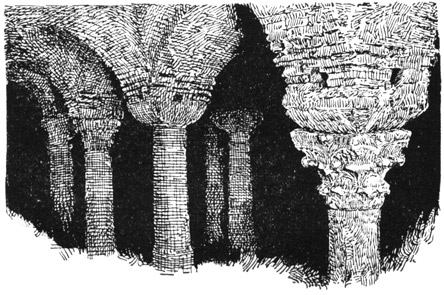
YERI BATAN SERAI (CISTERN)
Within a few years there was a great change. Earthquakes, rebellions, fires, compelled the rebuilding of a great part of Constantinople, and Justinian the Great, lawyer, theologian and organiser of victory, left monuments as enduring in architecture as in the other spheres of his activity. With the exception of the churches of S. John of the Studium and S. Irene, and the walls of Theodosius, there are to-day no great works of the Christian period, save a very few of the later Emperors, remaining in Constantinople except those which Justinian built. His architects created the Byzantine style which reached its magnificent completion in S. Sophia. The finest of the cisterns which astonish the traveller to-day are the work of his age; and as we walk by the splendid walls that extend from the Marmora to the Golden Horn, it is along his triumphal way that we tread. The first book of the "Aedifices" of Procopius, written to commemorate his achievements in building, is even now a handbook in little to the glories of Constantinople.
Leaving to our description of the city the still standing work of the great Emperor, we must here shortly sketch the reign which was for nine centuries the most glorious memory of the Eastern Empire. Born in 482 or 483, Justinian was the son of a Dardanian peasant, and was born at Scupi (Üsküp), "at the crossing-point of great natural routes across the western part of the Illyrian peninsula." When his uncle Justin raised himself to the throne in 518 he was sent for and trained to succeed to, if not already to exercise, supreme power. So long as Justin lived Justinian was his chief adviser. When Vitalian, the orthodox Goth, whose troops in the neighbourhood of the city seemed to threaten the new dynasty, was murdered in the palace, it was Justinian, for whose concern in the crime no valid evidence has been produced, who rose to the highest place in military as well as civil affairs. In 523 he married the beautiful Theodora, whose earlier life has been covered with shame by historians whose veracity is open at least to suspicion. She is described by the bitter Procopius as everything that is vile; it is probably true that her youth was disreputable; but it is certain that she made the noblest atonement for the past by the charity and piety of her later life and by the courage and wisdom which were of profit even to the Empire.[6] Of her beauty there is no doubt. Small, pale as marble, but with brilliant eyes, the bitterest of her enemies describes her; and when he uses the language of compliment he declares of the statue erected in her honour by the baths of Arcadius that "the face is beautiful but falls short of the beauty of the Empress, since it is utterly impossible for any mere human workmen to express her loveliness." Four years after the marriage, which was one of unbroken affection till the Empress died in 548, Justinian was associated with his uncle on the imperial throne. On April 1, 527, he became sole Emperor, and he reigned till 565.
Constantinople under Justinian became again the centre of Christian Europe. But before his power was fully established it was threatened by the gravest of the great insurrections with which the populace showed its independence and its fickle levity. The sedition arose in the Circus, and it was long the fashion to believe that Constantinople was ruled entirely under the sway of the factions of the Hippodrome. A more critical investigation has shown that the demes (δῆμοι) or parties were organised bodies intimately connected with the court and the municipality. The demes had two parts, military under democrats, and civil, or political, under demarchs. The heads of each faction were officers of the court and the army, and the demes were fully organised for military purposes. Not only were they, as we have seen, intrusted with the building of the wall, but they provided, under the Emperor Maurice, troops for the guarding of the long walls; and Justinian himself, at the end of his reign, used them in a similar way. It was to the demes, one writer seems to show, that Justin owed his throne. But while their military and political importance is now fully recognised, we are still without an explanation of how they became connected with the parties and colours of the Circus.
However that may be, we find in the reign of Justinian two large Circus parties, the Blues and the Greens, with whom were merged as sub-divisions the Reds and the Whites, who organised the races and had so much liberty allowed them by the laws, that they were able to defy emperors and set public order at defiance. But the madness of their riot was not without a method. To the demes or factions were allowed privileges which seemed the last relics of the ancient freedom of the Greek cities. "In the sixth century," says Professor Bury, "the outbreaks of the demes represent a last struggle for municipal independence, on which it is the policy of imperial absolutism to encroach. The power of the demarchs had to give way to the control of the præfects of the city."
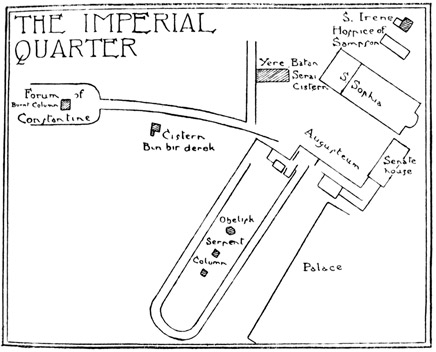
THE IMPERIAL QUARTER
On January 13, 532, there began an insurrection called ever after the "Nika" (conquer), from the watchwords of the insurgents, which threatened the imperial throne, and went nigh to destroy the whole city. The præfect of the city led to execution some criminals belonging to both parties, three days before. The Greens, during the celebration of public games in the Hippodrome on Sunday, January 11, appealed to the Emperor against Calapodius, the imperial minister, and the most extraordinary dialogue occurred. "Be silent, Jews, Samaritans and Manichæans," cried Justinian's mandator, uttering imperial commands, but they renewed their complaints, and finally passed into insults, calling the Emperor tyrant and murderer. Justinian determined to show his indifference to the mob by the execution that night of criminals of both factions. Two were rescued, and the two factions determined to procure their pardon, and on the 13th, when the great games took place, they appealed to Justinian, but in vain. The two demes then declared themselves united, and having no answer from the præfect whose house they surrounded, they set fire to the prætorium, and then in the night spread the fire over the imperial quarter. The portico of the Palace, the Baths of Xeuxippus, the Senate-house, and the wooden church of S. Sophia were set on fire. Next morning they marched to the Palace and demanded the dismissal of the unpopular ministers. Justinian was about to yield, and indeed had given the order, when the insurgents determined to depose him. Anastasius had left three nephews, Probus, Hypatius and Pompeius. Failing to find the first the mob burned his house. The two other brothers remained in safety in the palace. Next day the greatest general of the age, Belisarius, who had but recently returned from a victorious campaign against the Persians, sallied forth from the palace with a body of barbarian troops, Goths and Heruls—for the garrison of the city could not be trusted—and fierce fighting occurred for two days in the streets. The clergy did their utmost to restore peace, but were utterly unheeded, and in the evening of the 16th the Church of S. Irene, built by Constantine, was burnt, though not to the ground, and the Hospice of Samson, which stood between it and S. Sophia, were also destroyed. On the 17th, Saturday, the fire spread still further, and almost all the centre of the city was reduced to ashes. At night Justinian determined to give up Hypatius and Pompeius to the mob, hoping no doubt that if they were conspiring against him they would be less dangerous outside than within the palace. In spite of their reluctance he drove them forth to their own houses. Next day, early on the Sunday morning, the Emperor himself went down to the Hippodrome and made what was little better than an abject submission. He swore on the gospels to forgive all that had been done, if order were now restored. "The blame is not yours but all mine. For the punishment of my sins I did not grant your requests when first you spoke to me in this place." Some cried out that he swore falsely, and no heed was taken of his words. A few hours later Hypatius was proclaimed Emperor, and as the mob surrounded the palace it seemed that there was nothing for the Emperor but flight. It was then, when Justinian was ready to yield and cross the Bosphorus to the safety of Chalcedon, that Theodora showed herself worthy of the purple. "No time is this," she cried, "to ask whether a woman should be bold before men or valiant when men are afraid. They who are in extremest peril must think of nothing but how best to meet what lies before them. To fly, if ever it be expedient, would now not be so, I declare, even if it preserved us. For a man born into this light not to die is impossible; but for one who has been Emperor to become an exile is not to be endured. Let me never come to be without this purple robe nor live that day when men shall cease to call me their sovereign Lady. If you, Emperor, wish to escape, it is no hard matter. Here is the sea, and there lie the ships. But consider whether you may not one day wish that you had exchanged your mean safety for a glorious death. For me I love the ancient saying, 'How brave a sepulchre a kingdom is!'"
Thus Theodora proved herself fit mate for a Cæsar, and worthy of her crown; and those who had counselled flight now found courage to resist. While Justinian's men planned an attack, the followers of Hypatius agreed upon delay, and he himself sent, it would seem, to make peace with the Emperor. As his messenger went, he was told that the Cæsar had fled, and then the unhappy pretender took upon him the dignity of Emperor. In a few hours Belisarius led his troops upon the multitude assembled in the Hippodrome, and before nightfall they forced their way in with fire and sword, and of all the citizens gathered in the Circus not one left it alive. Justinian was not told till too late that Hypatius had been willing to submit. The two brothers were dragged out with contumely, and the next morning before daylight they fell under the swords of the barbarian soldiers. The Emperor, it is said, would have spared them, but Theodora, "swearing by God and by him, urged him to have them killed." Zachariah of Mitylene says that more than 80,000 persons perished in the riot.
At midday on Monday, January 19, Constantinople was at peace; but it was in ruins. Three distinct conflagrations had reduced the grandest monuments of the city of Constantine to ashes. On the first two days of the riot all the buildings of the Augusteum were destroyed, and with them S. Sophia, the "Great Church," only its baptistery, it would seem, being saved. Two days later the buildings north-west of S. Sophia were in flames, and among them the Hospice for poor and sick folk, "founded in ancient times by a holy man whose name was Samson," and Constantine's Church of S. Irene. On the 17th the buildings round the Mesê, the street which connected the forum of Constantine with the Augusteum, and the "great porticoes leading up to the agora named from Constantine, and many houses of rich men, and large property, were burned." Thus, a great part of what had been the first Byzantium, which was adorned with the finest buildings of Constantine, was utterly destroyed. To one who saw the blackened ruins, they seemed like the masses of molten lava round the crater of a volcano. To Justinian, already a great law-giver, came the task of building anew the imperial city.
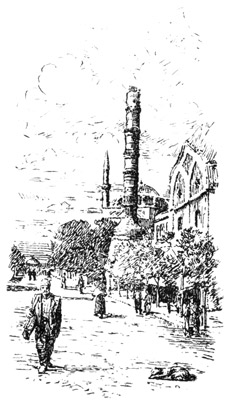
THE BURNT COLUMN
The Emperor began at once with the rebuilding of the Great Church of the Divine Wisdom. On the 23rd of February the work was begun: on December 26, 537, the new church was dedicated. "The procession," says Theophanes, who wrote from older materials in the eighth century, "started from the church of the Anastasia," where S. Gregory of Nazianzus had long preached to the men of Byzantium, "Menas, the patriarch, sitting in the royal chariot, and the King walking with the people." In 558 the eastern part of the dome with the apse was destroyed by an earthquake and was rebuilt. Agathias, a contemporary historian, thus describes the building and the restoration:
"Now the former church having been burnt by the angry mob, Justinian built it up again from the foundations, as great, and more beautiful and wonderful, and this most beautiful design was adorned with much precious metal. He built it in a round form, with burnt brick and lime. It was bound together here and there with iron; but they avoided the use of wood, so that it should no more be easily burnt. Now Anthemius was the man who devised and worked at every part. And when by the earthquake the middle part of the roof and the higher parts had been destroyed, the Emperor made it stronger, and raised it to a great height. Anthemius was then dead, but the young man Isidorus and the other craftsmen, turning over in their minds the earlier design, and comparing what had fallen with what remained, estimated where the error lay, and of what kind it was. They determined to leave the eastern and western arches as they were. But of the northern and southern they brought towards the inside that portion of the building which was upon the curve. And they made these arches wider, so as to be more in harmony with the others, thus making the equilateral symmetry more perfect. In this way they were able to cover the measurelessness of the empty space, and to take off some of its extent to form an oblong design. And again, they wrought that which rose up above it in the middle, whether cycle or hemisphere or whatever other name it may be called. And this also became more straightforward and of a better curve, in every part agreeing with the line; and at the same time not so wide but higher, so that it did not affright the spectators as before, but was set much more strong and safe."
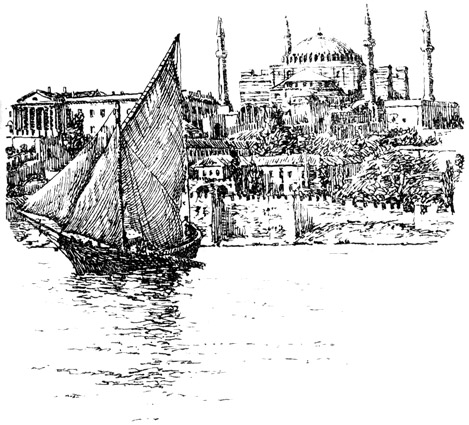
S. SOPHIA AND THE MINISTRY OF JUSTICE FROM THE SEA
A more minute account of the work must be reserved till we pass from history to description. Here we have only to summarise and characterise the work of the great architects whom Justinian employed to rebuild his city. The opportunity was a great one. Constantinople was now the centre of the civilised world. Thither came in the sixth century a crowd as motley as those gathered together on the day of Pentecost, or as may be seen now on the bridge of Galata. Men of Mesopotamia and Syria, Persians, Greeks from the islands and the Peloponnese, men of Sicily and Africa, Alexandrines and Palestinian Jews, met with the Roman and with the barbarian subjects of the now again undivided empire.
Of this vast gathering of the nations Byzantine art was the result and the reflexion. But adaptive as it was of every influence that came before the eyes of its great masters, it was, above all, like the city where it reached its highest glory, pre-eminently religious and Christian. The new style has been called "historical-dogmatic," and indeed it combined in a marvellous manner the traditions of different races under the uniting power of the Catholic faith.
The genius which gave to the Byzantine architecture its completed glory was that of Anthemius of Tralles, of whose skill contemporary writers write in enthusiastic applause. His works, says Agathias, "even if nothing were said about them, would suffice of themselves to win for him an everlasting glory in the memory of man as long as they stand and endure."
The characteristics of the art of Anthemius at its highest development may be seen to-day in Constantinople. There are few churches earlier than his time still standing. Among these may be the semi-basilican S. Thekla and S. Theodore of Tyrone, and certainly are S. John of the Studium and S. Irene. The last was rebuilt by Justinian immediately after the Nika insurrection in 532, but it belongs to the earlier style. Similar to it was the church of S. Peter and S. Paul, now destroyed, but of which some beautiful marble capitals lie in the sea close to the palace of Hormisdas. Later came the still standing church of S. Sergius and S. Bacchus, called by the people "little S. Sophia," built about 527 by Justinian himself. This prepares the way for almost every feature which appears developed and completed in the great S. Sophia itself. The two most striking characteristics of the new style are the impost capital and the merging of subsidiary spaces in one central building.
The impost capital is probably first seen in the great cistern, also of Justinian's day. I may here repeat what I have said elsewhere.[7]
"Strygowski[8] regards this impost-capital as the work of the builder of the great cistern, who he thinks may have been Anthemius, here proving his fitness for the great work of S. Sophia. It was, he shows, an architectural revolution. The capital, with undercut volutes, was suitable for a straight architrave, but not for the arch. Hence a piece was inserted to transfer the weight from the angles to the centre. The Theodosian age used an inserted impost. The constructive activity of the age of Justinian produced the impost-capital.
As to design, the capitals lying neglected about the city, together with those in situ in the churches and cisterns, furnish a perfect museum of the types with which others, dispersed over the whole area of the empire, agree in the minutest particulars of design and workmanship. The acanthus leaves, so familiar through all the work of the centuries—from the Golden Gate (388) onward, and the portico to S. John of the Studium a century later—assume the beautiful "windblown" design in the ruins near the "Rose Mosque."[9]
The second feature is the arrangement which unites the longitudinal with the central building and makes the whole effect of the interior of one piece by relating every piece of work, pillar, arch, semi-dome, to the one vast central dome which crowns the whole. From without, but more clearly from within, the architecture of S. Sophia is seen to form one entire and perfect whole. It is impossible to conceive it deprived of a single feature without the sacrifice of the whole. To mutilate would be to destroy.
Seen then in its grandeur at S. Sophia the work of Justinian changed the appearance of the whole city. Procopius in his Aedifices records what was when he wrote in 558, a complete list of what had been built in the reign. Everywhere there were arising, as though by an enchanter's wand, palaces, churches, baths, aqueducts, great cisterns supported on exquisitely carved columns, new markets, houses for the great nobles, barracks, hospitals, convents. The splendour and beauty of the new city, its richness of decoration, marbles, statuary, mosaics, struck all beholders with amaze. The chroniclers, who in other times would have been satisfied to tell of military successes and court intrigues, now tell of measurements and designs, and collect lists of gems and splendours of decoration. The reign of Justinian, in spite of many foreign dangers, and oppression at home, is the most magnificent period of early Byzantine history; and the magnificence seemed to be expressed in the buildings of Constantinople.
When Procopius in his Ædifices has told of the glories of S. Sophia, he goes on to speak of the Augusteum and its statues. Chiefest among them, one of Justinian himself as Achilles. Then S. Irene, then the churches of the Blessed Virgin at the Blachernae and at Balukli beyond the triumphal way. Church after church follows in his tale, and chief among them those which the mariner sees as he sails up the Golden Horn. "As to the other buildings, it would be hard to name them all." The Hospice of Samson rose again from its ruins, probably close by where the gate of the old Seraglio now stands. The baths of Xeuxippus, which lasted down to the time of Mohammed the Conqueror, with the other buildings near the Augusteum and the forum of Constantine, were restored. "In addition to this he rebuilt and added great magnificence to the house named after Hormisdas, which stands close to the palace, to which he joined it,"—that pathetic ruin whose broken wall hangs over the Marmora to-day. When the eulogist comes to the palace itself, words fail him to repeat its glories, the pictures, mosaics, marbles, that combine to make the walls glitter as with life. After works of beauty come those of use, and the cisterns receive as much praise as works more brilliant yet hardly more beautiful.
It is buildings such as these that enable us to see what Justinian was to the capital of his Empire. Every year it seemed that new victories and new conversions were increasing the power of the Empire and the Church. While Belisarius reconquered Italy and made the name of the Cæsar again honoured at Rome and Ravenna, ended the cruel rule of the Vandals in Africa and Sicily, crushed the Goths of Spain, and kept the strong Persian prince at bay on the eastern frontier of the empire, Christian missions spread the faith of the orthodox Church to the Caucasus and the Sudan. Again and again did processions of returning warriors pass along the triumphal way, but the Emperor alone entered by the Golden Gate. It was in the Hippodrome that Belisarius celebrated his triumph over the Vandals. It was nigh six hundred years, Procopius thought, since any had had the same. But Belisarius walked with a proud humility from his own house to the Hippodrome, and thence from his own tent to the imperial throne. The rich spoils that were spread out were the treasures of all the years of Vandal conquest, and among them some of the vessels that Titus had brought from the temple at Jerusalem and Generic the Vandal conqueror had taken from Rome. These Justinian gave to churches in the Holy City. As the captives were led up to the imperial throne all eyes were fixed on the Vandal chief, Gelimer, wearing the purple, as in mockery, with his kindred about him, "himself the tallest and most beautiful of the Vandals." As he walked up to the throne he looked up, and uttering no lament for his fallen state, said with the poet's simple feeling, "Vanity of vanities." They stripped him of his robe and made him fall on his face before the Emperor. Beside him knelt his conqueror, and supplicated for his pardon, and the day was crowned by generosity such as the Emperor loved to show and the people to applaud.
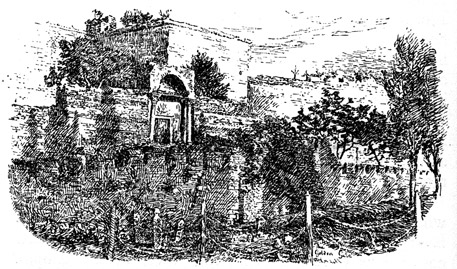
THE GOLDEN GATE
Such scenes became familiar to the people as the years of victory rolled on. They saw, too, Belisarius, drawn through the streets in his chariot by the captives of his wars, when he received the dignity of Patrician. The empire of Justinian, based upon the old laws which he collected and enlarged, cherishing the traditions of old Rome, was eager to revive every glory of former days. "And then," says Procopius, who himself the bitterest of satirists of the present, looked not unkindly on the past, "men saw things long forgotten thus renewed by time." But the picture, brilliant though it was, was not unclouded. The city of the Cæsars was again and again threatened by barbarians and struck by the visitation of God. In 542 Constantinople was devastated by a terrible pestilence, the bubonic plague, that has lost none of its terrors in fifteen hundred years. For four months it raged, and at its height Procopius declares that as many as ten thousand perished in a day. It spared no constitution and no age, and God alone could be the cause of it. Justinian, who was one of the few who recovered, was assiduous in charitable aid; but the loss to the city could hardly be conceived—no trades, no shops, says the recorder of many horrors, remained, and "many for fear leaving their bad courses, consecrated themselves to God, and many when the danger was passed fell to their old despising of God again."
After plagues came famines and earthquakes, and in the last year of the reign, the dread army of the Huns, under Zabergan, drew nigh even to the walls of Constantinople, murdering and ravaging as they came. Hastily the treasures of the church northwards of the city were brought for safety within the walls, and Belisarius in old age again came forward to save the empire. It was his last victory, and seven years later he passed away, honoured and beloved. The Emperor himself died but a few weeks later in November 565. The glories of the reign had passed away before the aged ruler laid down his power; but he left a reconquered Empire and a capital that was the wonder of the world.
He left too a memory as a theologian, which the church for some centuries continued specially to honour in her most solemn service. Justinian, the legislator, the builder and the organizer of victory, seemed to the vision of Dante to dwell like the sun in perpetual light.
Sì come'l sol, che si cela egli stessi Per troppa luce, quando il caldo ha rose Le temperanze de' vapori spessi; Per più letizia sì mi si nascose Dento al suo raggio la figura santa.
To this aspect of his life we can give here but little attention; but it is not to be doubted that it was as a theologian that the men of his Constantinople heard most of their ruler's doings. Far into the dark hours, says the chronicler of his reign, he sat writing the theological treatises which expressed the teaching of the Church; night after night he would study in his library the writings of the Fathers, and the Sacred Scriptures, with some learned prelates or monks at hand, that he might discuss with them the questions as they rose before his mind. From the time of his predecessor he had been engaged in corresponding with Popes on theological points, and when he became sole ruler he determined once for all to settle the side issues which depended on the great Monophysite contest. Edict after edict, letter after letter, treatises closely argued and tightly packed with patristic and scriptural learning, and even hymns, showed the restless activity of the imperial theologian. When in 535 Anthemius of Trebizond was made Patriarch of Constantinople, and when Pope Agapetus came on a mission from the Gothic King Theodahad, the discussion of articles of the faith brought the deposition of the patriarch as a monophysite, and the succession of Mennas, head of the hospice of Samson. Then came the conflict with the Origenists, which led indirectly to the controversy of "the Three Chapters" and the session of the Fifth General Council. Of this it were here a weariness to tell. Let it suffice to say that on May 5, 553, the Council met in the southern gallery of the great Church of the Divine Wisdom. The Pope himself was at Constantinople but he would not attend the sessions. He was lodged at first in the royal palace of Placidia at the eastern end of the promontory, beyond S. Irene, looking over the sea to Asia and the churches of Chalcedon. Then he fled by night to cross the Bosphorus and took refuge in the Church of S. Euphemia at Chalcedon where a hundred years before the council had sat. Embassies crossed and recrossed the sea; even the great general Belisarius was an envoy, but Vigilius, when the Council met, refused to join it, to speak, or to vote: and the Council made short work of the foolish, bombastic, hesitating pontiff. It condemned those who refused to receive its decisions and struck Vigilius out of the diptychs on which were inscribed the names of those prayed for at the Eucharist.
But if there was no Roman patriarch present, there was the new patriarch of Constantinople, Eutychius, and the patriarchs of Alexandria and Antioch, while he of Jerusalem sent proxies. To the decisions of the council a hundred and sixty-four signatures were affixed. Theologians still contest as to whether it was a free and open council; but it was accepted beyond question, though after some years, by the whole Church. It did its work: it safeguarded the Catholic faith by stripping bare the meaning of statements which indirectly attacked the Divine and Human Natures of the Incarnate Son. It condemned these subtle suggestions, and it preserved to the Church the real Christ of Whom she had learned.
These theological questions stand out, it may seem to some to-day, too boldly in the history of the New Rome: but they know little of the capital of the East who do not know how close to its life lie these matters of dogma and definition. The very tradesmen at their work talked of them, as they talked in the time of Gregory; and there was nothing which the crowds who thronged the markets and the basilicas in the days of Justinian more readily or more constantly discussed. Constantinople in these first centuries of her life had the theological interest closest to her heart; as the years went on the needs of defence brought the military interest to the top.
The city in Justinian's days was rich and full of bread. All the glory of the world seemed there to be gathered together, and with it the vice, which stern laws and the charitable institutions, founded by the imperial sovereigns, endeavoured as best they could to conquer or to heal. The thronged markets sold every kind of goods, for commerce or luxury. The monks who brought the silkworm from China to the Emperor's court enabled him to found an industry which added greatly to resources of his empire and the prosperity of his people. The mosaics, which glittered on the walls of the churches, were made by skilled artists in the city itself—carved work, images (the icons which the Greek Church has never ceased to love), jewellery, beautifully wrought, were among the manufactures of the great trading centre of the East; and the military engines for which the Eastern army was renowned were made within the walls of the capital itself. The pages of Procopius and Agathias, of Lydus and John of Ephesus, show a busy hurrying life, elaborate administrative arrangements, official classes greedy and exclusive, popular agitations hasty and fickle, an accumulating luxury with all its accompaniments of oppression, avarice, and vulgar show. The millionaires of the sixth century, with their gout, their costly equipages, and their summer palaces on the Bosphorus or at Chalcedon, were a prominent feature in the life of the great city. Beside them were the dusky traders from the far East, the hordes of bearded monks ever ready to join in the logical squabbles or take part in popular riots, and the silent barbarian soldiers, opening wondering eyes on the disputes and the splendours of the imperial city, and prompt at the word of command to dethrone emperors or massacre their foes. In such a city it would have been strange if there were order or peace; and indeed the constant complaint of the chroniclers is of nobles, clerics and artizans, whom it was impossible to restrain. Yet amid this scene of confusion at any moment the imperial power might show itself with arbitrary and brutal abruptness. When a servant maid by mischance spat on the robe of the dead Empress Eudocia as it was carried to the tomb she was executed immediately and without protest.
3. From Justin II. to the Latin Conquest.
In 565 Justinian died, and the glory of his reign set in a dull glow that heralded storms. Justin II., his nephew, was a tyrant and a madman, but it was power which brought out his tyranny and his madness. When he came to the throne he spoke mildly and well. He made profession of orthodoxy in S. Sophia; he was raised on the imperial shield in the palace; he promised in the Hippodrome to pay the debts of the dead Emperor. They were strange scenes, such as the people of Byzantium often saw, and strangest of all to our minds is that which shows the citizens in the place of public games clamouring before the imperial throne for the payment of debts of Justinian.
Constantinople is still the same. Even when it looks cowed, it has still its impudence and its determination to criticise. Justin's doings were watched and mocked at, as if he had been the humblest tradesman, by the city jesters. He built a golden chamber in the palace by the sea: he set up a pillar to record his virtues, and then some one affixed a tablet on it:
Build, build aloft thy pillar, And raise it vast and high; Then mount and stand upon it, Soar proudly in the sky; East, south and north, and westward, Wherever thou shalt gaze, Nought shalt thou see but ruins, The work of thine own days.
Meanwhile the barbarians were coming nearer to the Empire. The Avars demanded tribute, and the Turks, a name that was so soon to be a familiar terror, sent envoys to the Cæsar's court. The enemies, it might seem, were already closing in when Justin became a lunatic, bursting into mad fits of rage, and drawn about the palace in a toy cart, while the "whole senate and city" knew of the sad fate of their Emperor. Sophia, his wife, had all the masterful genius of her aunt Theodora. It was she who gave the rule to Tiberius II., under whom the empire steadily decayed. Maurice, his successor, was a severe ruler, whom the people learned to hate. When at last his reign ended in a revolution and a flight, it was the people of Constantinople, the demes and the factions of the Circus, who gave him to death, and placed the imperial crown on the head of Phocas, his successor.
While Constantinople thus dethroned and set up the civil rulers of the Empire, it was claiming for its patriarch the highest position in the Church. When at the beginning of the sixth century the patriarch John had signed the formula drawn up by Pope Hormisdas, he repudiated any claim to superiority on the part of the old Rome: the two cities and the two Sees he declared were one. As early as 518 the patriarch of Constantinople called himself "universal bishop": in 595 the great Pope Gregory, who had himself, as a papal envoy, seen the greatness of the Eastern See, vigorously protested, to the Emperor Maurice, against the assumption to the title. But while the patriarchs used the title in no exclusive sense, they were determined, as they are determined to-day, to assert the independence of their See and its equality with that of Rome.
Ecclesiastical independence did not preserve the Empire from political weakness. Phocas was soon seen to be worse than Maurice, and one conspiracy after another was begun in the Hippodrome and ended by a massacre in the streets. The Green faction in the Circus called the Emperor a drunkard and a madman to his face. Famine and pestilence ravaged the crowded city, and when Heraclius, already a renowned general, brought his fleet up the Hellespont and anchored at the Golden Horn the collapse of the power of Phocas was immediate, and a new Emperor was crowned in the great church of the "Capital of the World." The reign of Heraclius, gallant man though he was, began in almost unbroken disaster, and when in 615 Jerusalem fell into the hands of the Persians it seemed that the end was at hand. In the next year, as had already happened under Phocas, a Persian army encamped at Chalcedon. When negotiations were in vain, when Heraclius had even formed the idea of transferring the seat of Empire from Constantinople to Carthage, and had only abandoned it after his preparations were far advanced, when the terror and indignation of the people forced him to take oath before the patriarch in S. Sophia that he would never leave "the Queen of Cities," at length the courage of the empire awoke, the nobles sacrificed their wealth and the churches their treasures, the fleet utterly destroyed that of the Persians, and Heraclius delivered the city and the empire by a march as brilliant as it was daring. Leading five thousand veterans across Asia Minor and through the mountains he "penetrated into the heart of Persia and recalled the armies of the great king to the defence of their bleeding country." After three campaigns he returned in triumph and entered, as no Emperor since Theodosius the Great had done, by the Golden Gate.
In his absence thirty thousand Avars, who had swept over the Balkan provinces like a devouring flame, broke through the great wall and encamped under the very walls of the city itself. Churches in the suburbs were burnt to the ground and the famous Church of the Theotokos in Blachernae was on the point of being destroyed, when some panic caused the Avar horsemen to retire. The danger was too obvious for the warning to be neglected, and the Senate, which had refused with contumely the offers of the barbarian leaders, allies of the Persian King, drove back the enemy and immediately increased the fortifications by a new wall. This splendid barrier, magnificent to-day in its ruins, stretched from the enclosure outside the palace of Blachernae, at the foot of the sixth hill, to the Golden Horn. It is flanked by three hexagonal towers.
A year later, in 627, the Emperor, who dreaded even the sight of the sea, crossed the Bosphorus by a bridge of boats, decked with branches of trees to imitate a forest. Landing north of the city he marched inland and crossed the valley at the head of the Golden Horn—below the "Sweet Waters of Europe"—by a bridge made by Justinian nearly opposite the end of the walls. So along the triumphal way he went, past the new walls that have ever since borne his name, and entered by the Golden Gate, the Emperor who had vanquished the Persians, saved his empire, and brought back the greatest of all relics, the sacred wood of the true Cross, which S. Helena, the mother of Constantine, had found on Calvary.
But Heraclius was not to triumph unchecked. The fatal temptation of theological strife conquered even the conqueror of the Persians, and the beginning of the Monothelite controversy dates from the Ekthesis of Sergius the patriarch, a document which, if it were intended to make peace, certainly provoked, war that was not ended, though its area was defined, by the decision of the Fourth General Council, which met at Constantinople in 680, and condemned those who denied that Christ had two wills, human and divine.
The dreary years of the latter half of the seventh century may be rapidly summarised. Constantinople saw the settlement of barbarians, Slaves and Balgars, almost at its gates. Emperor succeeded emperor without anyone appearing who was worthy to be the heir of Heraclius. At length in 672 the Saracens, who had long devastated Asia, brought a fleet up the Hellespont and besieged the city. Their total defeat by Constantine IV., whom his people nicknamed Pogonatus (the bearded), was the greatest triumph of the Christian powers against the infidel; it was won, it is said, by the newly-discovered "Greek fire," so long to be the terror of the foes of the Empire. Constantinople proved herself the bulwark of Europe against the infidel. The nations of the West sent their envoys to applaud. Six hundred years later another Constantine was to fall, when his city was at length captured by the followers of Mohammed.
Justinian II., the son of Constantine Pogonatus, was a great builder like his namesake, whom probably he sought to imitate; but in character he was far from resembling the builder of S. Sophia. In the inimitable phrases of Gibbon, "The name of a triumphant law-giver was dishonoured by the vices of a boy.... His passions were strong; his understanding was feeble; and he was intoxicated with a foolish pride that his birth had given him the command of millions, of whom the smallest community would not have chosen him for their local magistrate. His favourite ministers were two beings the least susceptible of human sympathy, an eunuch and a monk; to the one he abandoned a palace, to the other the finances; the former corrected the Emperor's mother with a scourge, the latter suspended the insolvent tributaries, with their heads downwards, over a slow and smoky fire. Since the days of Commodus and Caracalla, the cruelty of the Roman princes had most commonly been the effect of their fear; but Justinian, who possessed some vigour of character, enjoyed the sufferings and braved the revenge of his subjects about ten years, till the measure was full of his crimes and of their patience."
The attempt to banish a popular general whom he had long imprisoned was the occasion of a revolt which cast the Emperor from the throne; and the hippodrome saw again an act of tragic vengeance, when the tongue and nose of the fallen Cæsar were slit in the presence of the people who had borne with him too long.
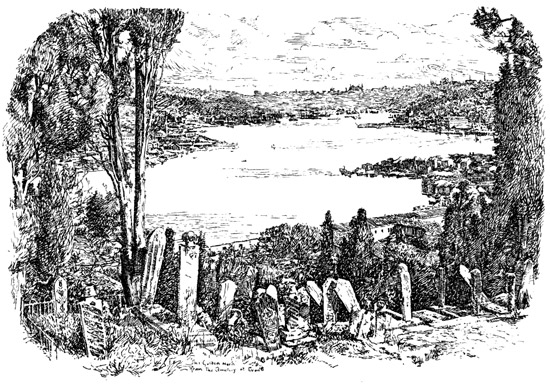
THE GOLDEN HORN FROM EYÛB
Let Professor Bury's summary continue the tale:—"The twenty years which intervened between the banishment of Justinian in 695 and the accession of Leo the Isaurian in 717 witnessed a rapid succession of monarchs, all of whom were violently deposed. Isaurian Leontius was succeeded by Apsimar, who adopted the name Tiberius, and these two reigns occupied the first ten years. Then Justinian returned from exile, recovered the throne, and 'furiously raged' for six years (705-711). He was overthrown by Bardanes, who called himself Philippicus; then came Artemius, whose imperial name was Anastasius; and finally the years 716 and 717 saw the fall of Anastasius, the reign and fall of Theodosius, and the accession of Isaurian Leo, whose strong arm guided the Empire from ways of anarchy into a new path."[10]
In the tragedies of these years Constantinople bore its full share, and no more strange contrast to the scene of his barbarous mutilation could be imagined than that when Justinian II. sat again, ten years later (705) in the hippodrome, with his feet on the necks of the two monarchs who had filled his throne in the meantime. As the fickle people saw the "slit-nose," as they called him, triumphant over Leontius and Apsimar they called out in the words of the psalms, which came so readily to their lips, "Thou hast trodden upon the lion and the asp: the young lion and the dragon hast thou trodden under thy feet."
Six years later (711) there was a more terrible tragedy. Justinian was justly dethroned and slain, and his little boy Tiberius, the child of his exile, was torn from the church of the Theotokos at Blachernae and cruelly butchered outside the palace wall. The next years were stained by crimes and follies hardly less revolting than those that had gone before; there could be no more bitter irony than the single word which the humble tax-gatherer, who was elevated against his will to the imperial throne under the name of Theodosius II., inscribed upon his tomb—ὑγίεια—health was to be found nowhere for the empire in his day.
His successor, Leo the Isaurian, whom the Senate and the patriarch of Constantinople chose in 718 to be their lord, had seen an adventurous life, and was already the general and imperator of the great eastern army.
His first task was to defend the city against the Saracens. The great siege of 718, lasting twelve months, failed chiefly through his skill and patience. The invaders encamped before the city in August 717; the name of their Suleiman was one which was later to be very familiar to the Byzantines. When winter came it was one of those bitter seasons to which Constantinople is often subject. For many weeks snow lay on the ground, and the besiegers suffered far more than the garrison. Leo defended the city with extraordinary skill, and at length, at the right moment, by a well planned sortie he scattered the infidels, and of the great host of a hundred and eighty thousand men the Mohammedan historians say that only thirty thousand escaped back to the East. No greater feat was ever performed by the great empire, the bulwark of Christendom, than this heroic defence and splendid repulse.
It was not wholly the work of Leo, for the Bulgarians came from the north to his aid, and a pestilence, even before the storms of the Dardanelles destroyed their fleet, caused the withdrawal of the Saracen host. Then as an administrator he reformed the government, as a legist he reissued and revised the laws. The great earthquake of 739 caused the institution of a new tax, if not a new financial system.
"Some of the oldest monuments in the city were thrown down by the shock, the statue of Constantine the Great, at the gate of Attalus; the statue and sculptured column of Arcadius; the statue of Theodosius I., over the Golden Gate, and the church of Irene, close to S. Sophia. The land walls of the city were also subverted; and in order to repair the fortifications Leo increased the taxes by one-twelfth, or a miliarision in a nomisma."
Thus Professor Bury.[11] But to such acts, important though they were, Leo the Isaurian does not owe the fact that his name will never be forgotten in the history of the Empire which he ruled. It was he who began the attack upon the ancient custom of the Eastern churches which gave rise to the long and bitter iconoclastic controversy. It were idle for a Western accustomed to the severity and restraint of English worship to pretend to judge without partiality the conflict which arose in the eighth century among the Easterns. To Englishmen it comes with a shock of surprise to learn that they are regarded as Romanists, as has recently happened, because they do not use incense in every public service of the Church, according to the immemorial usage of the East. Similarly it is with diffidence that we learn to recognise the reverence paid to icons, pictures of sacred things, as a true and helpful part of Oriental devotion. It tends, we think, to superstition; as much perhaps as our grandfathers' pride in the black gown of the preacher, or the curious customs which led in England to the "plethoric Sunday afternoon." Leo the Isaurian, and after him his son, Constantine V. (nicknamed Copronymus by his people, probably "from his devotion to the stables"), of whom the latter certainly had no sense of the reality of religion, embarked on an ill-omened attempt to purge from the Church, and to destroy in the sacred buildings themselves, all the brilliant pictures and mosaics which commemorated the saints and received the homage, bordering no doubt on superstition, of the faithful. They objected that it was a sin to represent Christ in art at all; and that the representation of His Mother tended to the exaltation of her name into that of a Divinity. "Apostles of rationalism" these Emperors have strangely been called, who fought against an ineradicable passion of their people. As dear to the hearts of the Greek Christians as their subtle questionings into the deep meanings of divine things, their determination to be satisfied with nothing less than a precise and logical definition of the faith once for all given to the saints, was their craving for outward and visible signs to represent the gifts of God at once in the Divine Life and in the lives of the saintly followers of the Lord, and their own reverence and consecration of all that was beautiful in the work of man. The force of Mohammedanism had lain in its austere rejection of any outward image of Divine things; heretics, Judaising or Monophysite, had from time to time taken up the cry against these innocent representations of the saints. If the "worship" of images tended to obscure the spiritual truth of religion, the destruction of all visible memorials of the saints, emblems of the divine attributes, or representations of the passion of Christ, was even more certain to tell against the real belief of a race at once ignorant and dramatic, to whom the eye was the constant teacher of the mind. However strange and unedifying the reverence paid to icons may seem to the modern Western mind, it is but the shallowest ignorance which would call it idolatry, and it is plain that any hasty attempt to interfere with the popular expression of religious ideas must tend, if hastily and unskilfully conducted, to impair the faith of the people itself. Led by men who were believed by the enthusiastic and conservative Byzantines to be influenced by Monophysites, Jews and Mohammedans, it was certain to provoke a desperate resistance, and that the more widespread because the issue was not an intricate matter of scholastic teaching, but a plain issue of practice in which every day passions were deeply concerned.
In 726, almost, it would seem, without warning, the Emperor Leo issued an edict that all images in churches should be utterly abolished. The patriarch, rather than consent to the action, resigned his office. The story of what followed may be given in the words of Mr Tozer.[12]
"The work of destruction now commenced in earnest; the statues were everywhere removed, and the pictures on the walls were whitewashed over, and though numerous outbreaks occurred, and some executions took place before it was accomplished, yet on the whole the opposition was not formidable. The act which caused the greatest indignation was the removal of the magnificent image of Christ which surmounted the bronze gateway of the imperial palace, and was the object of great reverence. In order to take down this statue and burn it, a soldier of the guard had mounted a ladder, when a number of women assembled at the spot to beg that it might be spared; but, instead of listening to them, the soldier struck his axe into the face of the image. Infuriated by this, which appeared to them to be an insult offered to the Saviour Himself, they dragged the ladder from under his feet and killed him. The Emperor avenged his agent by executing some, and exiling others, of the offenders, and set up in the place of the statue a plain cross, with an inscription explaining the significance of the change.
"In the defence of images there stood forth two champions, the one in the West, the other in the East; and the points of view from which they respectively regarded them illustrate the different feelings of the two churches on the subject. The former of these was Pope Gregory II., who at first strongly remonstrated with the Emperor on his edict, and afterwards, when he endeavoured to enforce its observance in Italy, encouraged his people to disregard the order, and defied his nominal sovereign in violent and even insulting language. At last he excommunicated his nominee, the patriarch Anastasius. But he advocated the retention of images on the practical ground of their utility in instructing the young and ignorant, and as being an incentive to devotion. Far more exalted and more subtly defined was the position attributed to them by the other advocate, who spoke from the distant East. This was John of Damascus, otherwise known as S. John Damascene, the last of the Fathers of the Greek Church. This learned and acute theologian, who in many ways was superior to the age in which he lived, at one time filled a civil post of some importance under the Caliphs, who now ruled in Syria, but afterwards retired to the monastery of S. Saba, in the wilderness of Engedi, the strange position of which, overhanging a deep gorge that leads down to the Dead Sea, is still the wonder of the traveller. As he lived in the dominion of the Saracens he was beyond the reach of the Emperor's arm, and now undertook the cause of his suffering co-religionists. In three powerful addresses he set forth his arguments for image worship. Some of them follow the familiar lines of defence, that these objects were memorials of the mysteries of the faith; and that in the adoration of them the spiritual was reached through the medium of the material. But beyond this he made it plain that, to his mind, and the minds of those who thought with him, the worship of images was closely connected with the doctrine of the Incarnation, the earthly material having been once for all sanctified when the Son of God took human flesh, and being thenceforth worthy of all honour. From this we may learn both how it came to pass that the most religious men of the age became enthusiasts for what was in itself superstitious, and also what was the cardinal point of difference between them and their opponents. For, while the one side regarded figures of Christ as a degradation of a heavenly being, to the other they were a practical confession of His true humanity, and any disregard of them appeared in the light of a denial of the Incarnation. At last, when it was found that the Emperor persevered in his attack, the iconoclasts were anathematised by the orthodox congregations in all the Mahometan countries outside the Empire. Both John and Gregory protested throughout against the interference of the State with the Church in this matter as being beyond its province; and, owing to the close connection which existed between the clergy and the people, they were generally regarded as the assertors of liberty and of the right of private judgment in opposition to despotism."