Color Reproductions OF Brumidi Frescoes in the United States Capitol
Reading edition
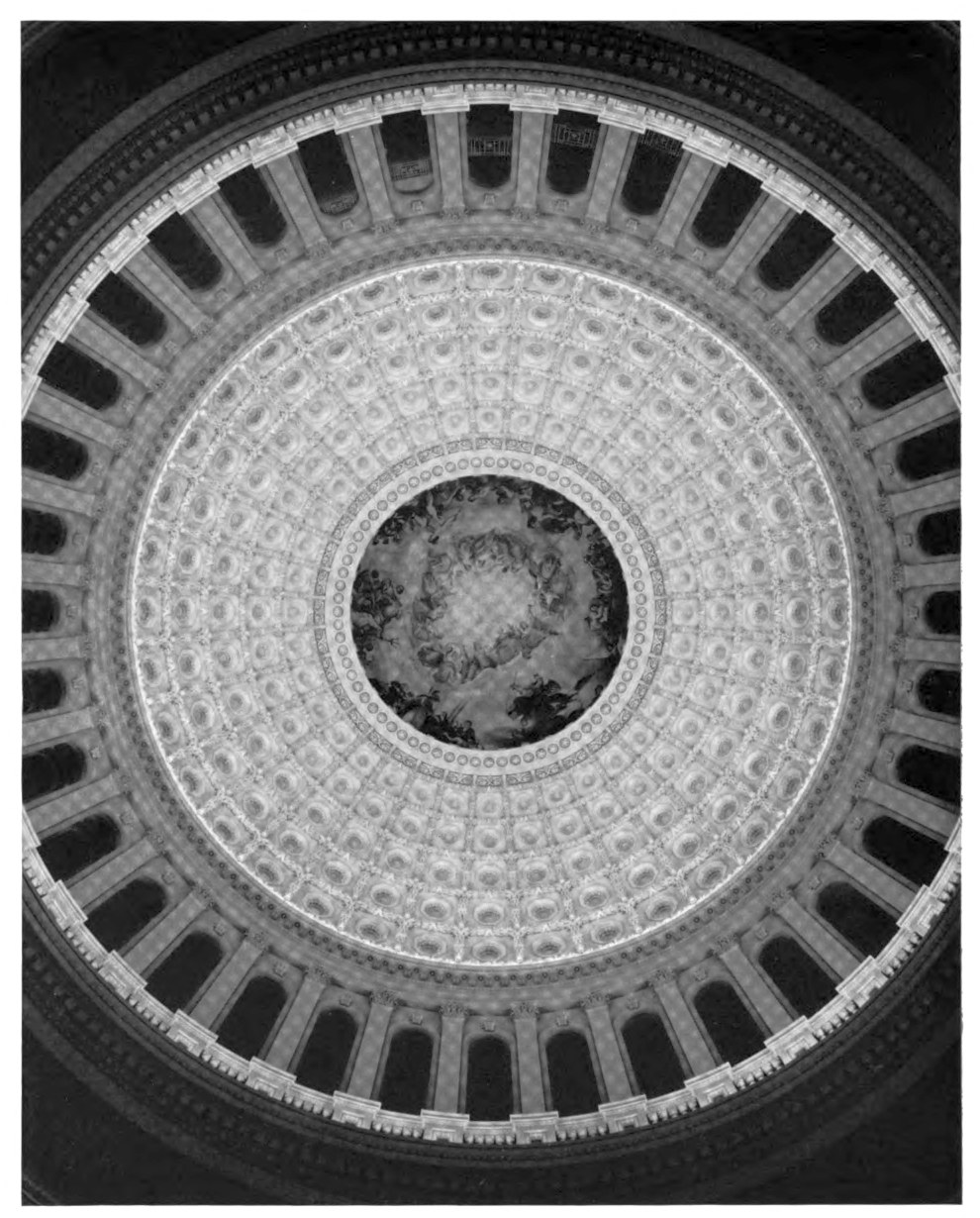
BRUMIDI’S FRESCOED CANOPY IN THE EYE OF THE DOME
The Dome Canopy as here pictured was photographed from the exact center of the Rotunda, 180 feet below. Unavoidably, the balcony around the Eye of the Dome hides the outer portion of all six allegorical groups. In order to make individual “close-ups” of these groups our photographer went to the top balcony of the Dome at night, carrying his own lighting equipment. His six kodachromes, each made at a distance of 65 feet, the diameter of the Dome at this point, follow:
(S. D. Wyeth’s six-page booklet, printed in 1866, gives the “Description of Brumidi’s Allegorical Painting within the Canopy of the Rotunda.” Since Brumidi finished this canopy in 1865 we may reasonably suppose that Wyeth’s interpretations came directly from the artist. For this reason Wyeth’s own legends are quoted on the following six pages.)
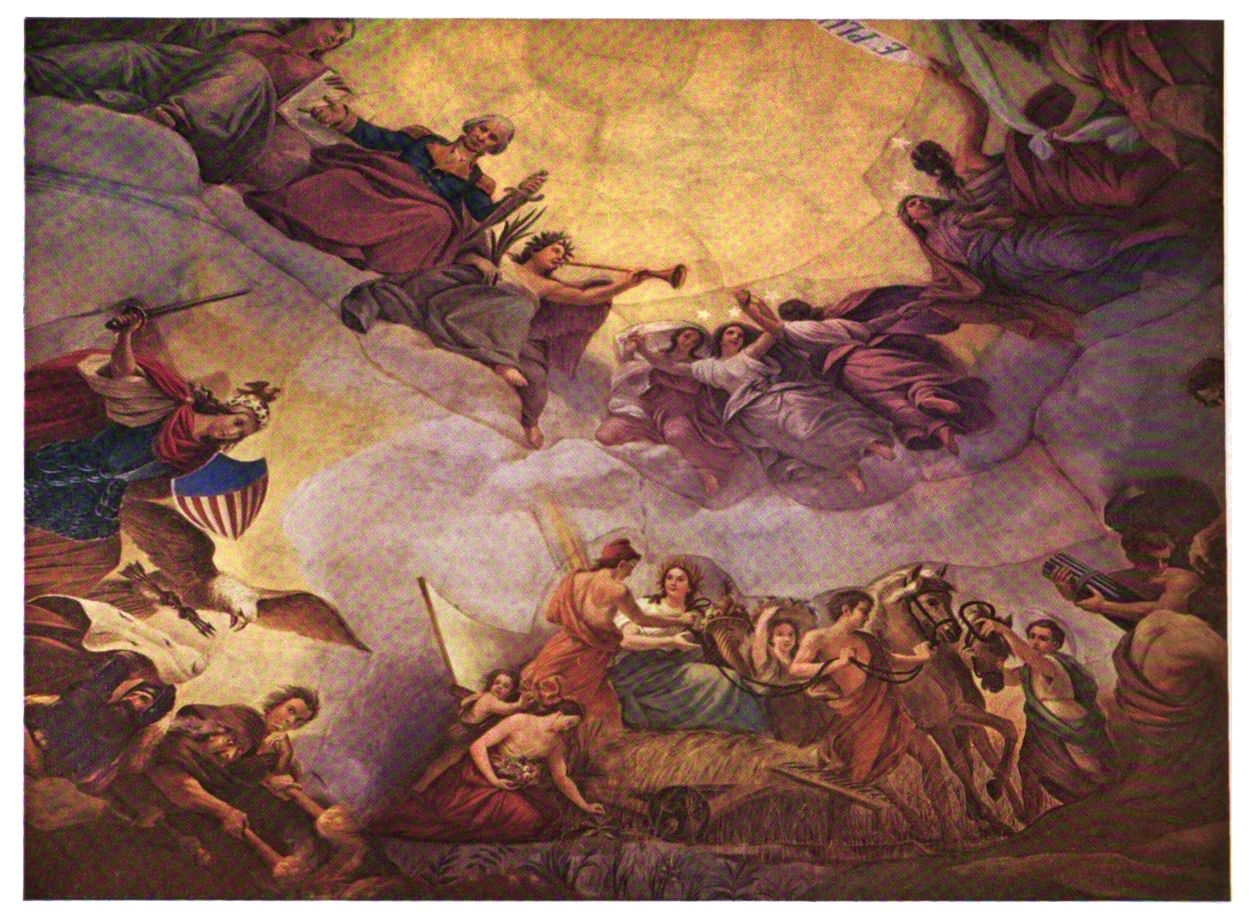
AGRICULTURE
“CERES, the Goddess of Harvests and the Fields, with the Horn of Plenty, is in the center. Young America, with Liberty Cap, of red, the bonnet rouge of France, having under his control a pair of vigorous horses hitched to an American Reaper, in conscious pride is exhibiting his skill. The background is a luxuriant mass of prolific vegetation. Flora is gathering flowers, and, hovering near, is a cherub. Beyond is Pomona with a basket of fruit.”
Wyeth—1866
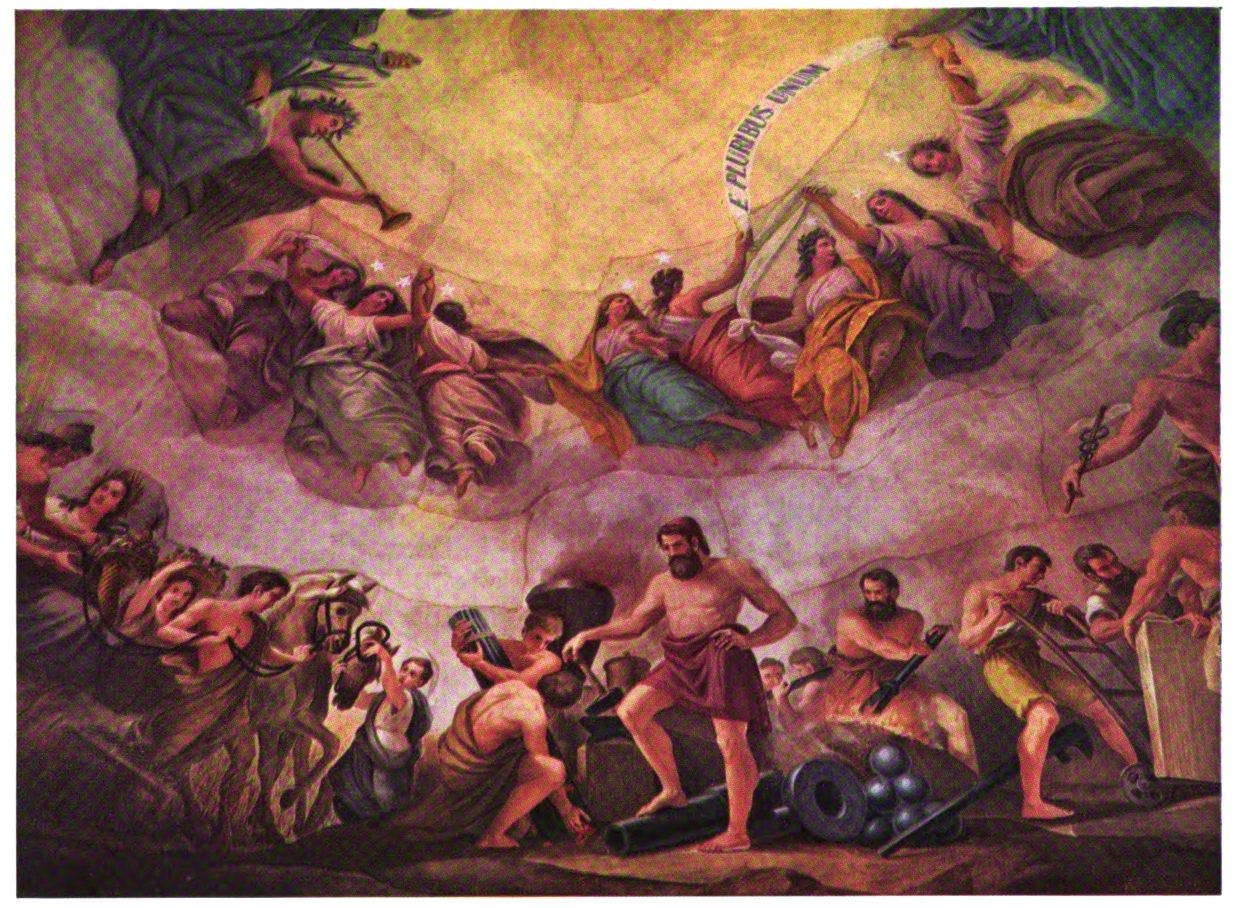
MECHANICS
“VULCAN, the old stalwart Tubal Cain of Grecian mythology, is the colossal genius of this group. His right foot rests on a cannon. Machinery, forges, mortars, and cannon balls, strewn around, remind us of forging thunderbolts, as well as of combat with, and victory over, the giant forces of nature, and making them subservient to human will and purposes.”
Wyeth—1866
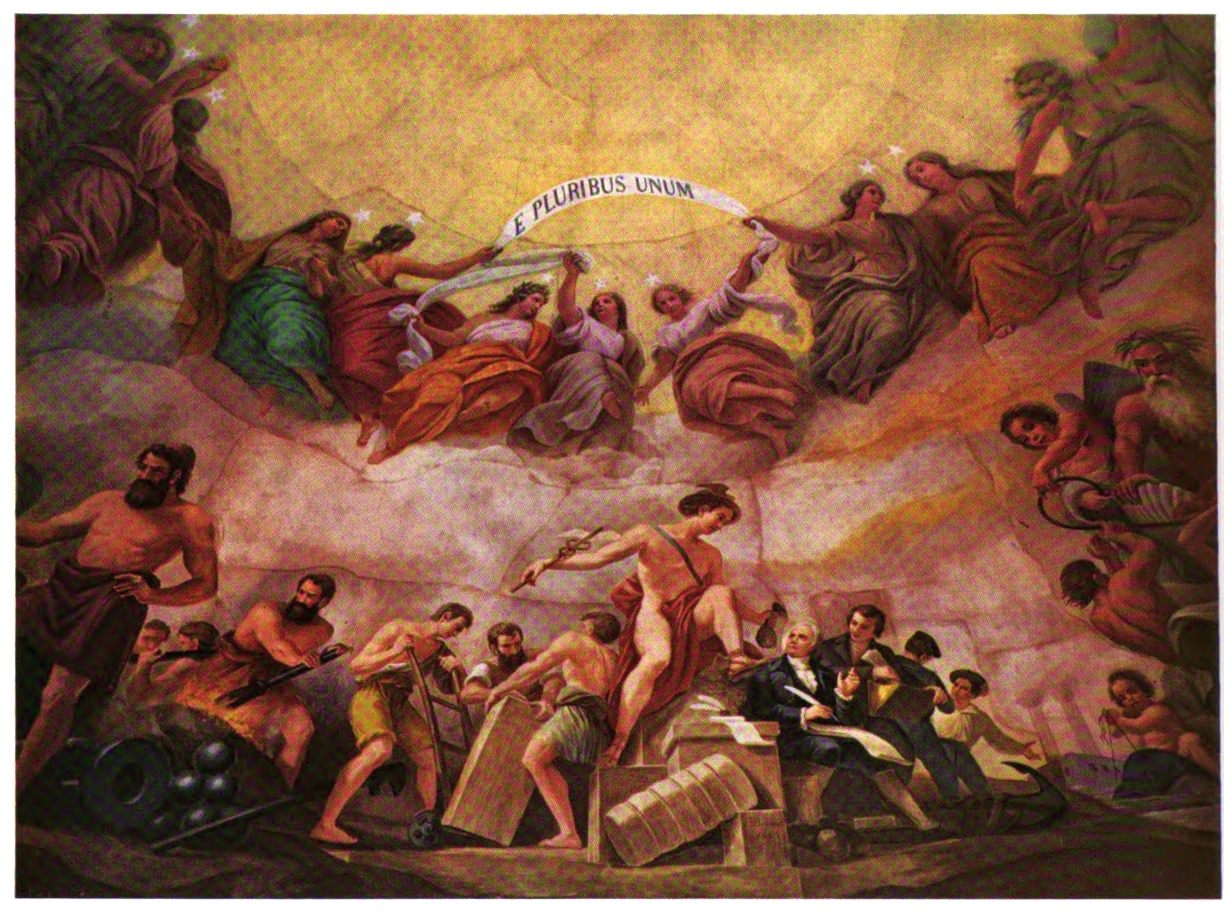
COMMERCE
“MERCURY, the Protector of Travellers and Merchants, holds in his hand a bag of gold, to which he is directing the attention of Robert Morris, the Financier of the American Revolution. It was he who guided to a successful issue the entangled pecuniary embarrassments of our country in its struggle for independence. Alas! for himself, he died a bankrupt, and in confinement for debt. Boxes of merchandise, and bales of goods, with men at work among them, are to be seen. Two sailors point to a gunboat in the distance.”—Wyeth—1866
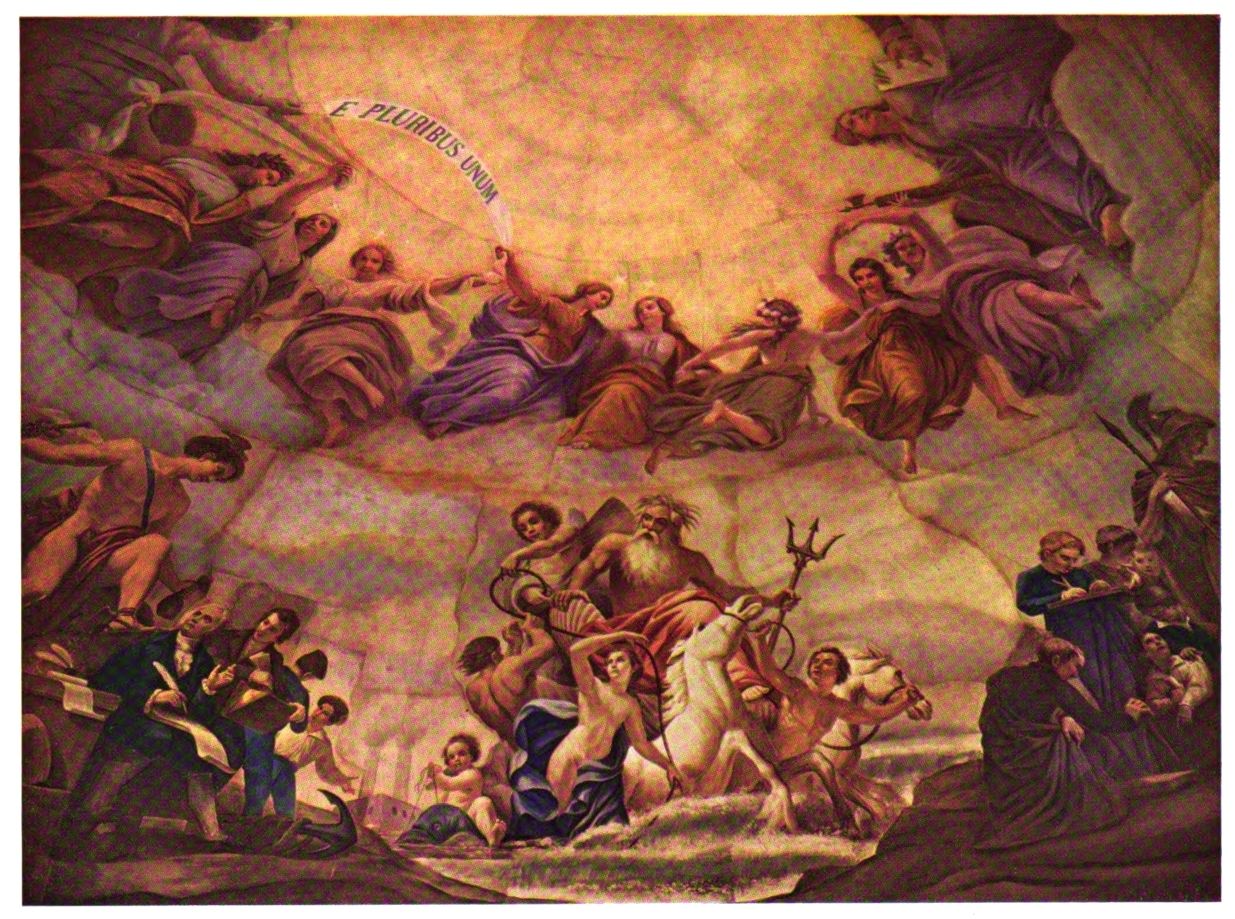
MARINE
“NEPTUNE, in marine state, bearing his trident, in his car, accompanied by his charioteer and attendants, is emerging astonished from the deep. The beautiful Aphrodite (Venus), born of the sea foam, half risen from the waves, holds in her hand the Atlantic cable, given her by a winged cherub, and is about dropping it into the sea.”—Wyeth—1866
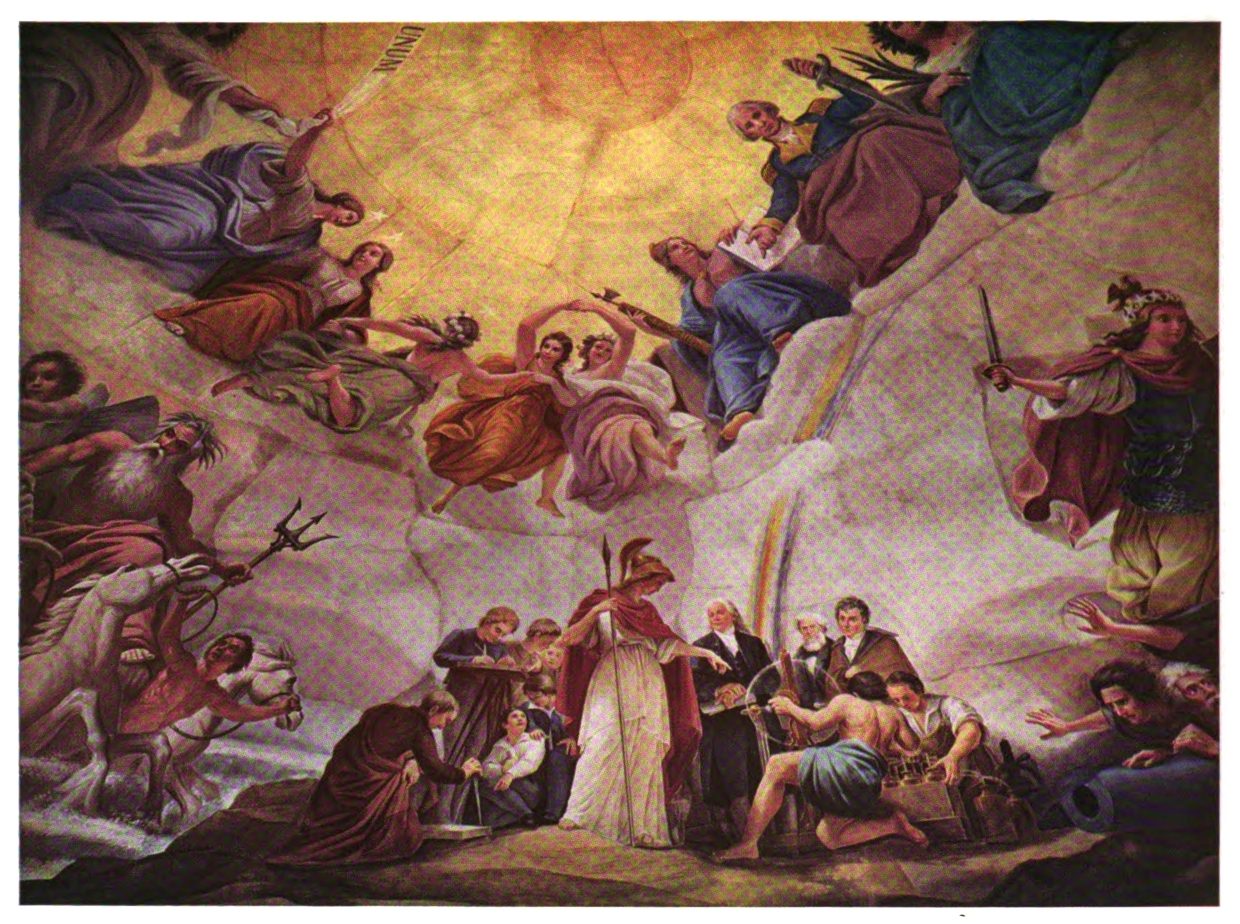
ARTS AND SCIENCES
“MINERVA, the Goddess of Wisdom, stands gloriously prominent, with helmet and spear, as she springs, full grown, from the brain of Jupiter. In meek attitudes, but with glowing faces, attentive to her teachings, are Benjamin Franklin, Printer and Philosopher, Robert Fulton, of Steamboat renown, and S. F. B. Morse, the generally acknowledged inventor of the Magnetic Telegraph. There are also boys, with wondering eyes, and expressive gestures, listening to the instructions of a school teacher.”—Wyeth—1866
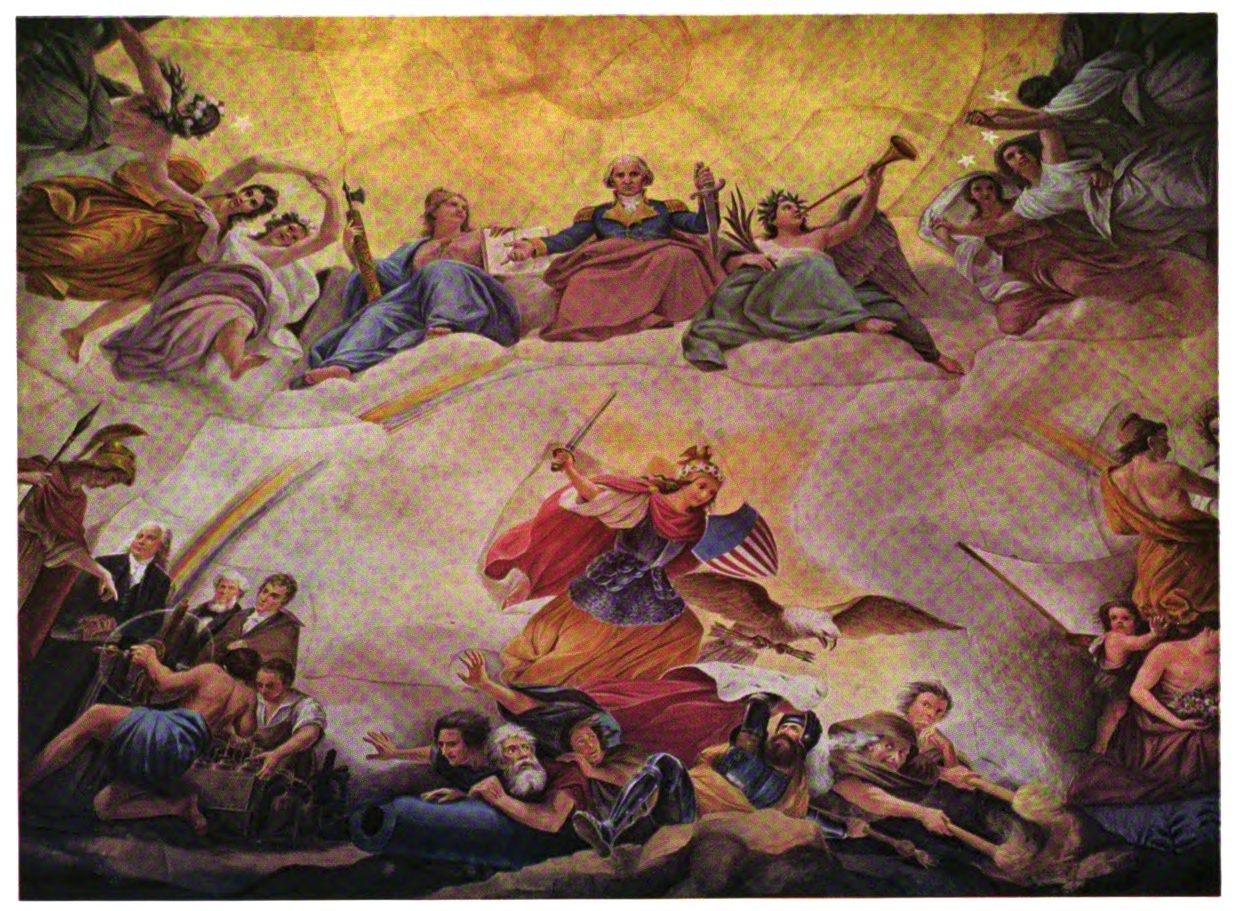
WAR
“FREEDOM, terrible in vengeance, with upraised sword, is striking down Tyranny and Kingly Power. They are overcome, and flee from her wrath in dismay; with them is Anger, and also Vengeance and Discord bearing the incendiary torch. An angry Eagle, striking with his beak, is fighting for, and by the side of, Freedom.”
“WASHINGTON, the Savior of his Country, apotheosized, appears seated in majesty. On his right is the Goddess of Liberty, and on his left is a winged idealization of Victory and Fame, sounding a trumpet, and in triumph displaying the victor’s palm. Forming a semicircle are thirteen female figures, representing the thirteen States.”—Wyeth—1866
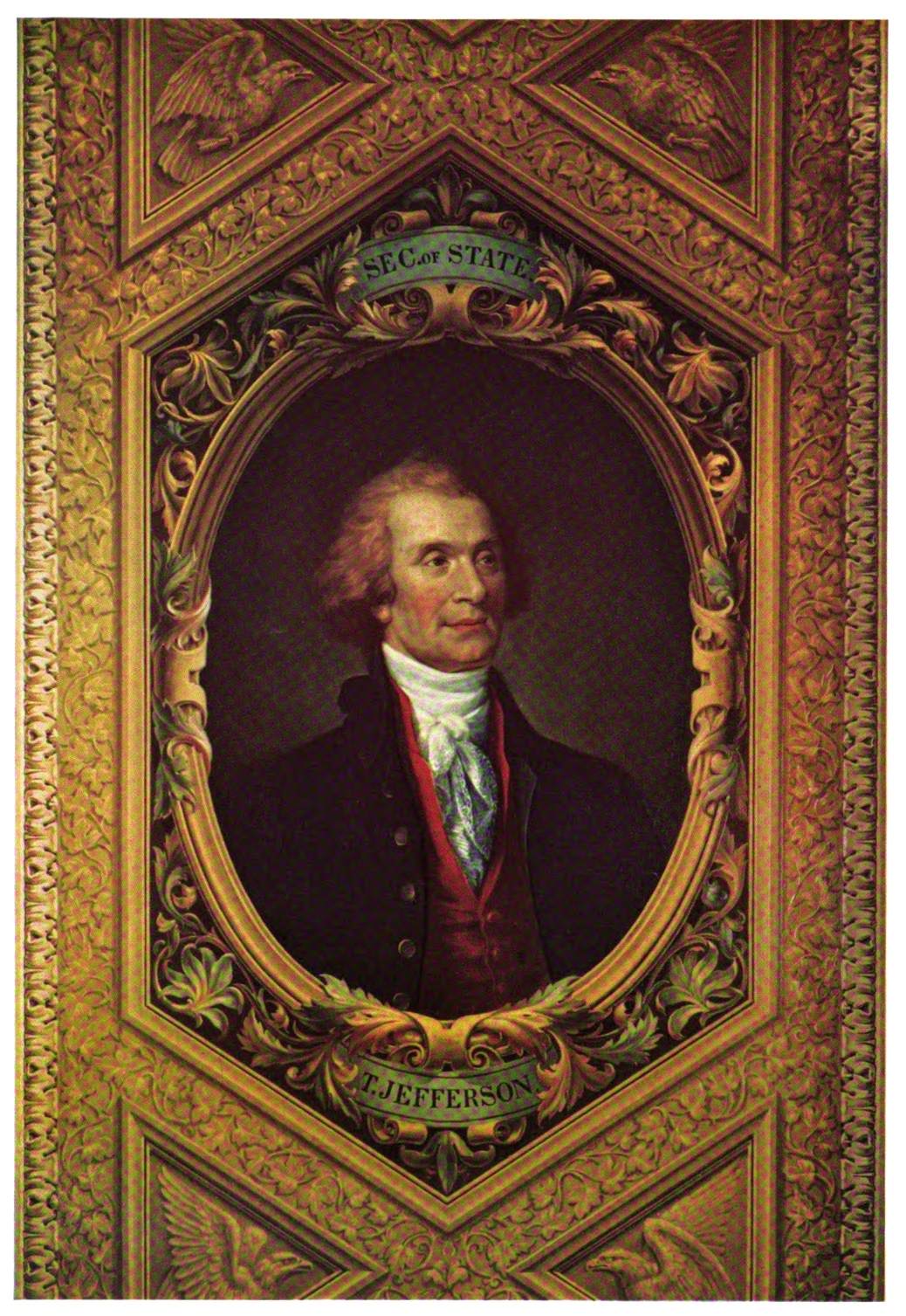
THOMAS JEFFERSON
Of the five portraits in color of Washington’s first cabinet, painted by Brumidi on the walls of the President’s room, that of Thomas Jefferson is considered by many to be the most lifelike. Brumidi gave Jefferson the favored location beneath the portrait of George Washington, thus bestowing honor on the Secretary of State, the highest ranking Cabinet officer. The delicate graceful carvings of the picture frame are another Brumidi delusion. Both the portrait and the frame are painted in oil on dry plaster. Mr. Fairman suggests that there is enough resemblance between the Brumidi Jefferson and the Trumbull Jefferson in the Declaration of Independence in the Rotunda “upon which to base a theory that Brumidi was at least influenced by the work of Trumbull.”
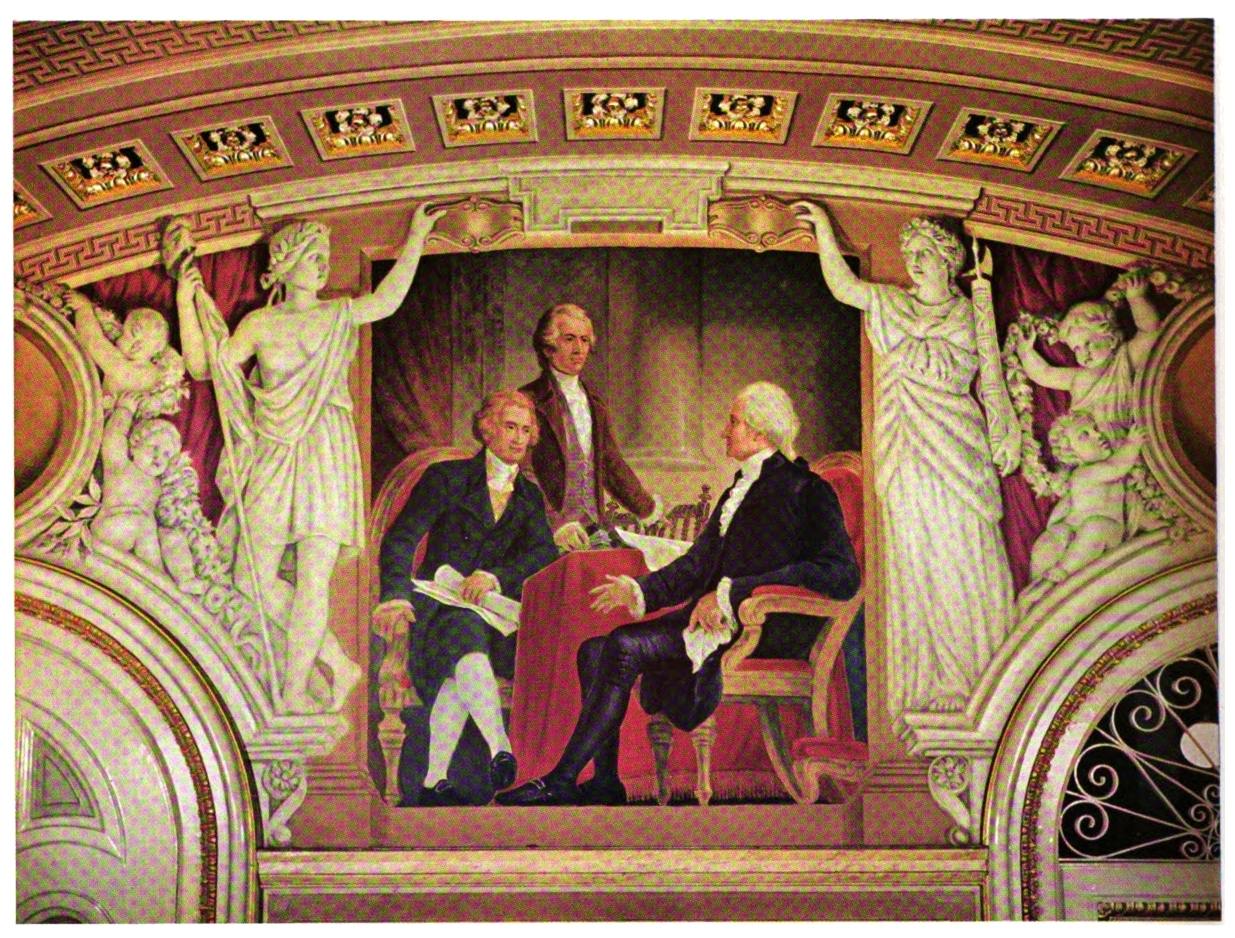
WASHINGTON-JEFFERSON-HAMILTON
Brumidi was paid $500 for this mural of Washington-Jefferson-Hamilton on the south wall of the Senate Reception Room as indicated by an 1873 voucher. Portions of two empty medallions showing in this reproduction beyond the “decorative figures in light and shade (chiaroscuro)” remind us of Brumidi’s sorrowful words in 1874: “Now many panels remain empty, disfiguring the elaborate ornaments and gilded mouldings around them, which sooner or later must be completed.”
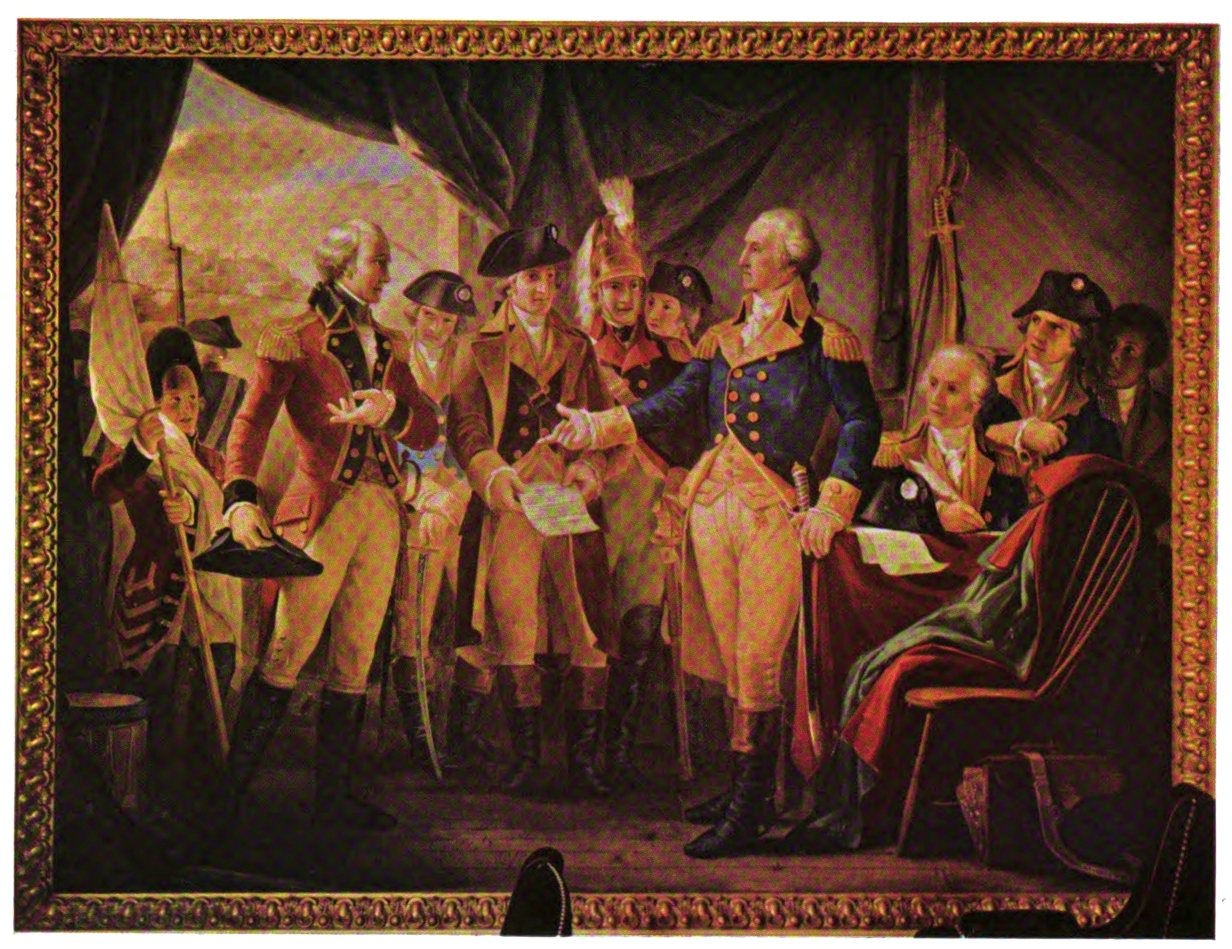
WASHINGTON AT YORKTOWN
This Cornwallis-Washington mural on the wall of the House of Representatives Chamber was criticized in 1857 as “unsuited to halls of deliberation where calm thought and unimpassioned reason are supposed to reside.” For architectural reasons, however, the painting will presently be removed from the House Chamber to a spot more accessible to ardent friends of Brumidi. On the strap of the brief case, lower right, is the famous Brumidi signature, “C. Brumidi, artist. Citizen of the U. S.” (Brumidi’s Dome Canopy signature can be found on page 52.)
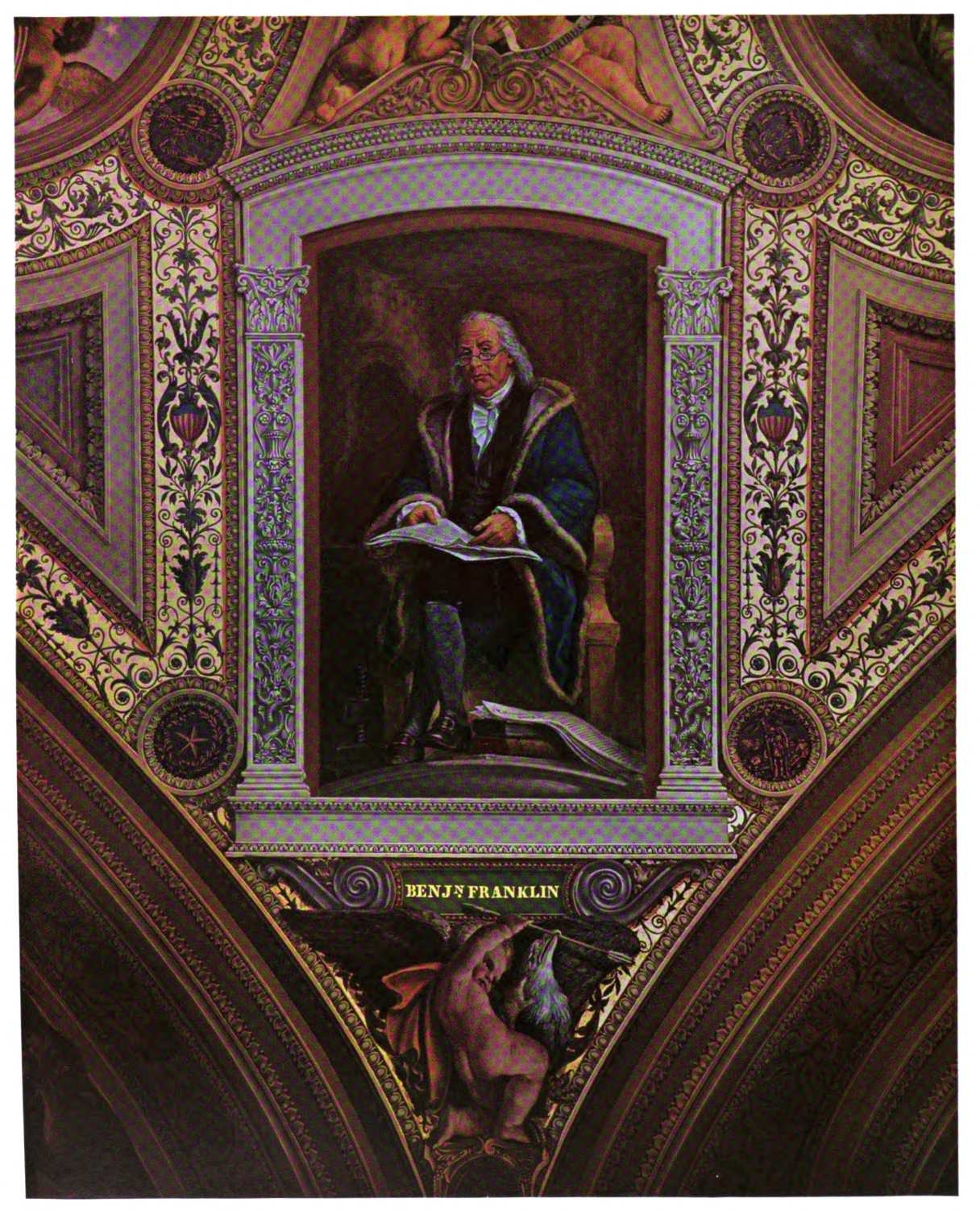
BENJAMIN FRANKLIN
Brumidi’s choice of Benjamin Franklin as an American statesman to represent “History” in the decorative scheme of the frescoed ceiling of the President’s Room is appropriate. It may be that one of the half dozen sheets of parchment shown in the picture is meant to represent the Declaration of Independence, and the five others to represent the Constitution of the United States. Franklin helped to write both of these immortal documents. It has been said that Franklin is here at once easily recognized since this picture contains “all the characteristics of his many portraits and statues which are generally known.”
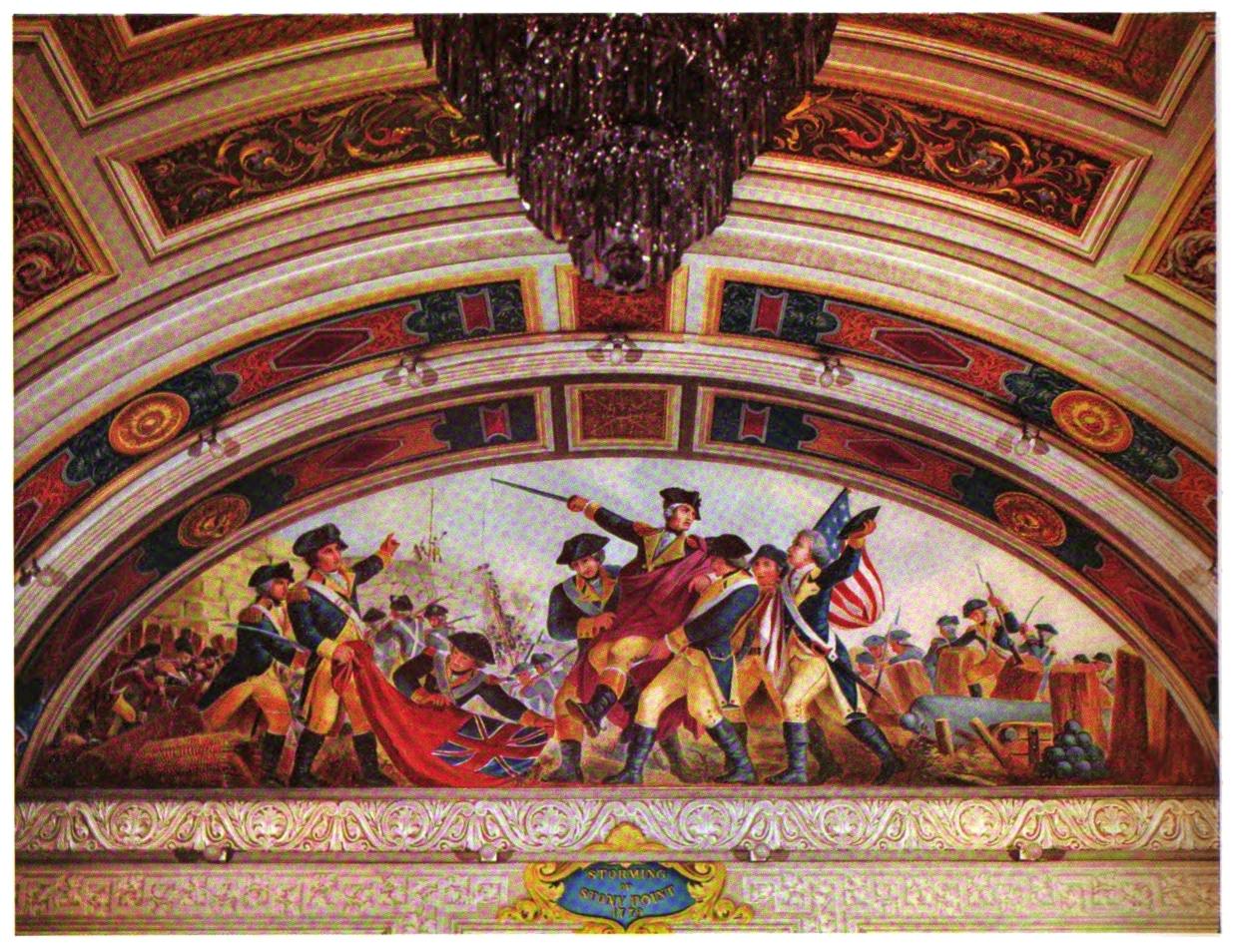
STORMING OF STONY POINT
Of the five frescoed lunettes in the larger Appropriations Committee Room of the Senate painted by Brumidi, the “Storming of Stony Point” is probably the most colorful. A voucher signed by Brumidi and dated October 19, 1871, reads, “For painting in fresco three panels in Committee Room on Military Affairs, Senate Wing, U. S. Capitol, viz: Washington at Valley Forge, Storming of Stony Point, Boston Massacre, @ $1000 each.” Said Senator Voorhees in 1880, “Who ever passed through the room of the Committee on Military Affairs without feeling that the very genius of heroism had left there its immortal inspirations.”
TELEGRAPH
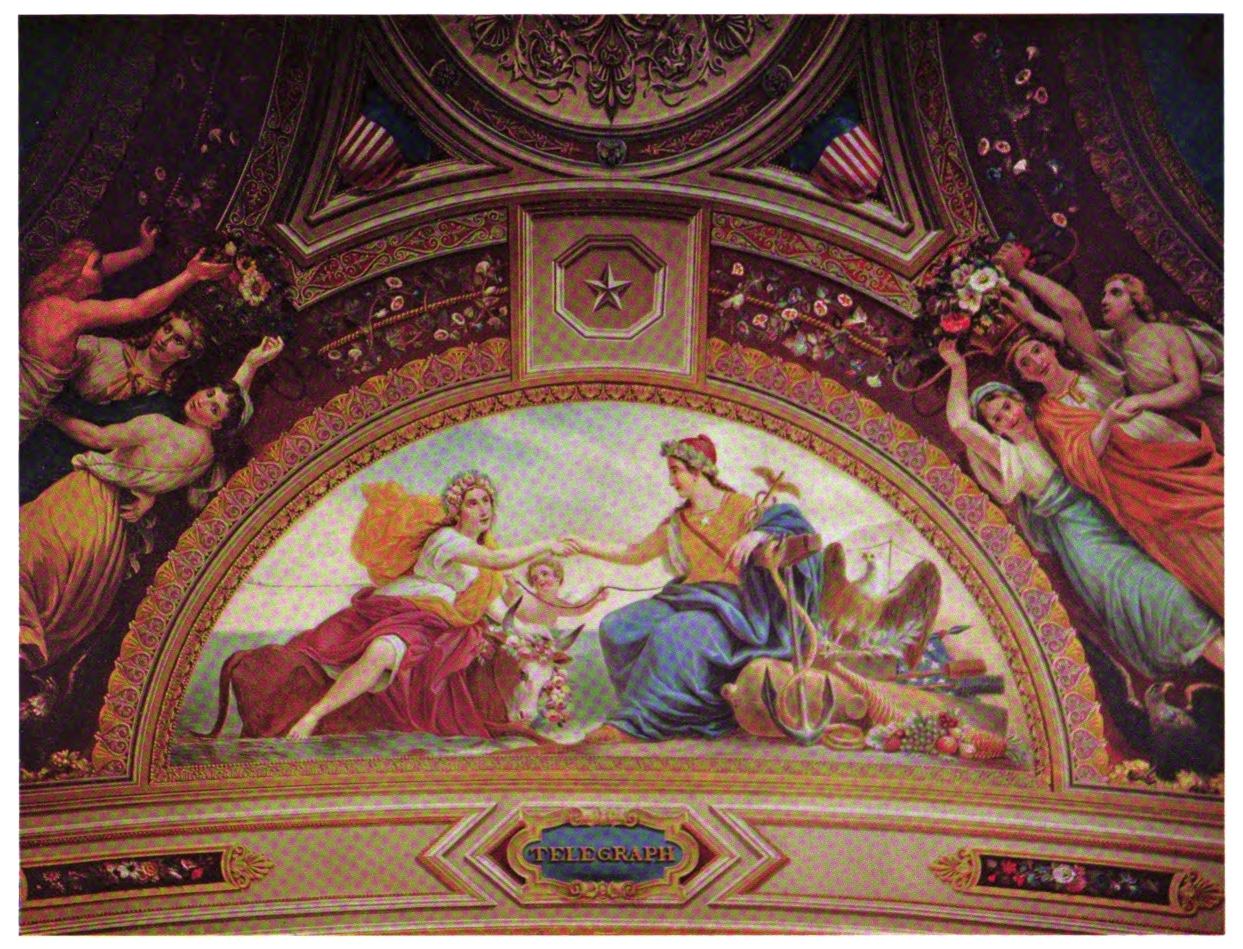
The laying of the Atlantic cable, with its great significance, has been painted by Brumidi into two Capitol frescoes. “Telegraph” is Brumidi’s own title for this lunette painted as a part of the ceiling fresco in the District of Columbia Committee Room of the Senate. The beauty, freedom, and plenty of America extending a welcome across the seas, as here portrayed, was always in the heart of the artist. The working sketch for this lunette was among the Brumidi paintings stored in a Washington bank vault for forty years.
LEGISLATION
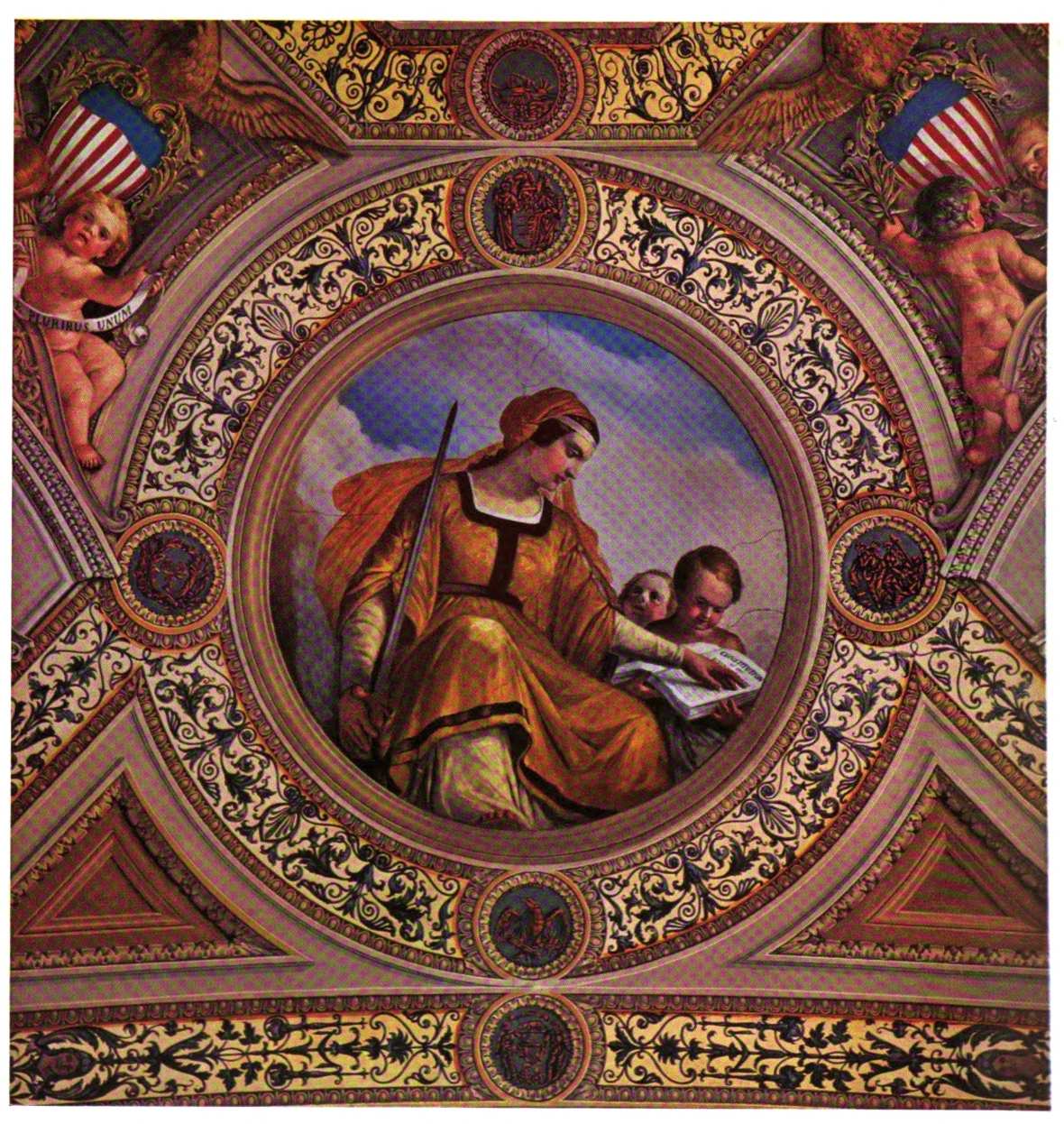
One of four Madonnas from the frescoed ceiling of the President’s Room, Senate Annex.