CLAP OR POX.
Reading edition
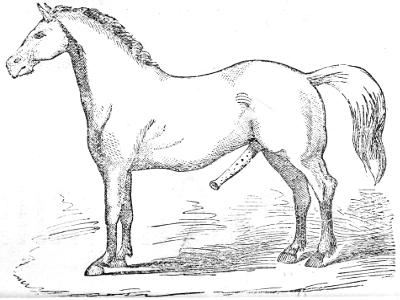
On the 7th day of June, 1853, a Stallion was brought under my observation, owned by Christian Kerr, of Centre township, then Union county, which had ten distinct ulcers on his penis, varying in size from a pea to a dime. These ulcers were accompanied with a discharge, sometimes bloody, emitting a very disagreeable odor, that was perceptible at a distance of three or four rods. The attendant of this horse, noticed these ulcers about five days previous to the time I was consulted, when the marks were very small. He remarked to me, that “people declined to allow his horse to cover their mares, stating, that he was diseased with the pox.” And I actually found this to be the case. I dressed the horse, and sent him away.
That night I examined all the works veterinary Science that I could command, and found but a single one that made the least mention of the disease, but giving neither the cause or treatment of it.
In less than a week, I had over twenty mares to attend, that were affected by the horse.
I treated the horse and mares according to the best of my judgment, having first obtained the advice of an eminent human Physician, and I soon became perfect master of the disease, and saved all but two mares that were placed under my care. I found, that where the disease had taken deep root and entered the system, every effort to save the animal was in vain, and hence, I am satisfied, that where the disease has been suffered to go unchecked, until it became so deeply rooted as to vitiate the whole system, it is incurable.
CAUSE.
Mares will sometime get in season early in the spring, when they will discharge a thin, whitish fluid, resembling bluish milk, of a glutinous nature, but very clean. If the mare does not become pregnant until the latter part of May or the beginning of June, this fluid will change into a mattery state, and will affect the parts in the region of the womb to such an extent as to cause rawness and inflammation.
A mare, that is in a condition as described above, is very apt to communicate to the horse covering her, the disease of Gonorrhœa, or Clap, especially if such horse be permitted to cover from five, twelve and fifteen mares a day, where another horse, covering only once every few days will escape unharmed. The reason of this is evident; the penis of the one covering so many mares, becomes very tender and almost transparent, so as almost to cause the blood to shine through it.
Another instance in which a horse is apt to become diseased, is, when he is suffered to cover a mare on the ninth day after she has undergone the process of foaling. At this period there is still a discharge of bloody matter, which is very apt to generate clap in an animal of the opposite sex.
DESCRIPTION OF DISEASE.
Sometimes there will appear on the penis of the Stallion, small white blotches, on the surface of the skin, from the size of a pin’s head to that of a grain of wheat, which, on the following day will be double in size. On the third or fourth day, a pea might be set in the ulcers, which will emit an offensive odor, and which will spread with great rapidity.
In the mare blotches will appear on the shape, of a deep red color, apparently eaten through the surface of the skin, which will enlarge very rapidly. In a day or two, small tumors will appear, extending from the shape in a downward direction to the hams. These tumors are of different sizes, varying from that of a pea to that of a half gallon crock. They are of a very virulent nature, very often causing a painful rawness in the entrance to the womb, and extending from one to one and a half inches.
TREATMENT.
The Stallion should be brought out to a fence, and a mare should be placed on the other side of the fence, distant about one rod. This will cause the Stallion to present his penis. A clean crock should be in readiness, containing two ounces of chloride of lime, and two quarts of lukewarm water. There should also be on hand a teacup, containing a stem of nitrate of silver one fourth of an inch in length, which should be pulverized and dissolved in tablespoonful of water. Another teacup should be at hand, containing one teaspoonful of tincture of myrrh.
In the crock there should be a sponge the size of an ordinary apple, with a small stick tied to it. Each of the cups should be provided with a small pencil, made of soft muslin, about the size of a quill.
The operator should now draw on a pair of leather gloves, and seize the penis at the point with the left hand, and with the right hand, take the sponge and wash off the whole penis, from one end to the other. Then stir up the cup containing the nitrate of silver, take the pencil and anoint all the spots or marks on the penis; then follow with the tincture of myrrh.
This operation should be accomplished in less than fifteen minutes, and the application should be made twice a day.
The mare should be brought out with a blind bridle and collar on, and tied with the head to a post. The tail should be doubled up and a rope looped around it, and it should be drawn on the back and the rope tied to the collar. Then the whole shape should be washed off with the solution of chloride of lime; then anoint the marks with the nitrate of silver, and also with the tincture of myrrh. At each operation these preparations should be introduced about one and half inches within the shape.
Should any tumors have made their appearance, they must be dressed in the same manner. If they are large and soft, they should be cut open and then dressed in the same way.
The foregoing disease has sometimes reappeared in other animals for four years following my treatment of the above cases but by always bringing them promptly to my notice, I succeeded invariably in checking it, so that it never came to the same state as before.