Front matter (continued 2)
Reading edition
Sagebrush areas, or brushy zones adjacent to the pinyon-juniper woodland usually do not contain juniper logs; when hollow juniper trees or logs are not available, P. truei is not found as resident of such areas. As mentioned earlier, individuals of P. truei may venture into such areas to feed if they are adjacent to pinyon-juniper woodland.
An individual of P. truei may have more than one nest within its home range (for example Nos. 105 and 241 cited above). Each mouse probably has refuges, each containing a nest, strategically located in its home range. Thus, if a mouse is chased by a predator, or by another mouse, it need not return to its main nest, but can seek refuge in one of its secondary nests. These secondary nests were small and were invariably constructed from shredded juniper bark. Some of these nests were little more than a scant handful of shredded bark that formed a platform to sit upon. Other nests were larger and ball-shaped, with one opening on the side. All of the secondary nests that were found were inside hollow juniper logs. The bark used in construction of the nests had, in each case, been transported from nearby living trees. The logs had previously lost their bark through decay.
The evidence indicates that these secondary refuges are prepared with considerable care. Not only is the bark transported for some distance, but it is shredded into a soft mass of fibers. When a mouse first establishes itself in a new area, perhaps it begins several such nests before settling upon the most favorable site. The less desirable sites, if still within the animal's range, are then available (barring competition by a new inhabitant) for outlying refuges.
My data do not indicate whether individuals of P. maniculatus use a similar arrangement of nests within their home ranges. The population of P. maniculatus was sparse in the trapping grid, and the habitat these mice occupied was such as to make following them extremely difficult.
In captivity, both species constructed nests that were indistinguishable to me, when the mice were given cotton, kapok, or pieces of burlap as building material. The cotton or kapok was used directly, but the burlap was shredded into a fine mass of fluffy fibers. The burlap seemed to me to be the best building material, for it maintained its shape best.
Both species constructed nests that resembled inverted bowls. Solitary mice naturally built smaller nests than those built by females with young.
The entrance to the closed nests varied; often the female would bolt through the side of the nest where there was no opening. Sometimes the mice would exit and enter through the top of the nest. In some cases it appeared that the entire nest was closed; probably the occupant had closed the entrance. Such a closed nest would have the advantage of greatly moderating the microenvironment within the nest, and would allow the animal within to remain comfortable with a minimum expenditure of energy. The larger nests found in the trapping grid resembled those built by captives. Nests built of grasses were always larger than those built of juniper bark. Juniper bark is as easily worked into nests as are grasses, in my judgment. Therefore, difficulty of construction of nests from this material probably does not account for the smaller size of the nests composed of bark. I think the difference in insulating characteristics between the two materials probably accounts for the difference in size of the nests.
Reproduction
In Mesa Verde, Peromyscus reproduces from April through September. Reproduction is greatly reduced in the autumn, and most females complete reproduction before October.
Ten of the 20 females of P. maniculatus, taken in May, contained embryos; five others were lactating. Lactating and pregnant females were collected on May 5, 1962, indicating that reproduction in some females began in early April. In September, 15 of 34 females were pregnant or lactating, whereas in October only two out of 15 females of P. maniculatus were reproducing. Only one female of P. maniculatus was found to contain embryos in October. This large adult was taken on October 3, 1963, and had six embryos, each five millimeters long. She probably would have produced a litter later in October, and would have been nursing into November. A report of October breeding in north-central Colorado described nine of 23 females of P. maniculatus as being in a reproductive state; seven were lactating and one was pregnant between October 26 and 31, 1952 (Beidleman, 1954:118).
In the Museum of Natural History, the University of Kansas, there are 35 females of P. maniculatus more than 144 millimeters in total length taken from Mesa Verde in November, 1957 (Anderson, 1961:53). None of these contained embryos, and no pregnant females have been taken from the park in November.
P. truei and P. maniculatus reproduce at about the same time. A female of P. truei prepared as a specimen on May 10, 1964, contained four embryos, each 20 millimeters long, indicating a breeding time in mid-April. Svihla (1932:19) reported the gestation period for non-lactating P. truei to be 25 to 27 days and for lactating individuals, 40 days. Lactation tends to increase the gestation period of other Peromyscus by about five days (Asdell, 1964:266). The gestation period of nine non-lactating females of P. m. rufinus was reported by Svihla to be 23 to 24 days. Lactation increased the length of the period of gestation in this subspecies to between 23 and 32 days (mean for seven females 26.57 ± 0.73, Svihla, 1932:19).
Females of P. truei were observed in various stages of reproduction from June through September. Ten of the 20 females of P. truei taken in September were reproducing; four contained embryos and the other six were lactating. In October, only one of 17 females caught in snap traps was lactating. Lactating females were caught in live-traps as late as October 23, although most females had ceased reproduction by then. No pregnant or lactating females were observed in November.
In P. maniculatus, puberty has been placed at 32 to 35 days for females weighing 13 grams, and in males at from 40 to 45 days, at weights of 15 to 16 grams (Jameson, 1953:45). In P. truei, the weight of the testes is reported to rise in March and diminish through September, with accessory organs following the same cycle (Asdell, 1964:267). Young of P. truei nurse for about one month, although some litters may not be weaned until 40 days of age. Young of P. maniculatus are weaned between 22 and 37 days of age (Svihla, 1932:30).
Twenty-six pregnant females of P. maniculatus, taken in the breeding seasons of 1961-1964, contained from one to eight embryos each; the mean was 4.65 ± 1.67. Other investigators have found similar mean values in this species (Asdell, 1964:266).
Thirteen females of P. truei taken in the breeding seasons of 1961-1964, contained from three to six embryos each; the mean was 4.0 ± .912. Svihla (1932:25) reported litter sizes, at birth, of two to five and a mean of 2.84, in 19 litters. Other investigators have reported litter sizes of one to five with a mean of 3.4, and one to six with a mean of 3.6 (Asdell, 1964:268). Apparently P. truei does not have more than six young per litter.
In captivity, females of both species began reproduction in early February. These captives had been kept for several months at a temperature of 21 degrees Centigrade, and on a daily photoperiod of 15 hours. Some captive males had enlarged, scrotal testes in January; the extended photoperiod and warm temperature probably influenced the breeding condition. In both species testes of wild males caught in autumn after late September and on through the winter were abdominal, except for one male of P. maniculatus which had enlarged, scrotal testes on October 15.
Dates at which different animals arrived at breeding condition varied, in part owing to subadults (young of the year) appearing in the catch from early summer to late autumn. Some adult females appeared to be pregnant or lactating throughout much of the summer and early autumn, whereas other females, that were caught a number of times, apparently reproduced only once in the summer.
Some females may fail to breed even though they are mature enough to do so. One female of P. truei captured eight times (August 30 to September 20) was a juvenile when first caught, and was classed as young (in postjuvenal molt) on September 10. She did not reproduce in her first breeding season, unless she did so after September 20, which is unlikely. Another female of P. truei was an adult when first caught, and was caught 12 times (August 21 to October 25). At no time were her mammae enlarged and she was not lactating or pregnant. It is improbable that she reproduced earlier in the season, for teats of mice that have reproduced earlier usually are enlarged to such a degree that previous parturition is clearly indicated. It was surprising to catch a female, of any age, 12 times in two months without sign of reproductive activity.
Only one female of P. maniculatus did not show reproductive activity. She was a juvenile on July 19 when first caught; a subadult on August 28 when caught the third time, and an adult on October 23 when caught the fifth time.
Burt reported a rest period of a month or more in the summer, in Michigan, during which many females of P. leucopus did not reproduce. They began to breed again in late summer at about the time when young of the year began reproducing (Burt, 1940:17, 19). Abundant mast was correlated with reproductivity in autumn, according to Jameson (1953:54), who thought that "food is a basic determinant of the autumn reproduction" of P. leucopus.
Little has been written about the length of time males remain in breeding condition. Difficulties in determining breeding condition are many. Fertility customarily is determined by sectioning testes and noting the presence or absence, and relative abundance, of sperm. This procedure necessarily sacrifices the individual and indicates the breeding condition at only one moment and for only the individuals sacrificed. My observations of males caught a number of times in live traps shed some light on the breeding condition of males, but the investigator is likely to err in extrapolating physiological data from morphology when he notes whether the testes are abdominal or scrotal and whether they are enlarged or small. It was assumed that testes that have not descended, and that lie within the abdominal cavity, are not capable of producing viable sperm. This is the condition in most juveniles, and in all males during winter. As the breeding condition is attained, testes descend into the scrotum. Soon the testes and their accessory organs enlarge and are readily apparent.
Howard (1950:320) reported that numerous males of P. leucopus sired litters when their testes appeared to be abdominal, and therefore questioned whether the criterion of descended testes is valid as an indicator of breeding condition. My captive males of P. maniculatus and P. truei did not sire litters when their testes were abdominal, even though such males were left with adult females for as long as four to five months (August through December). Captive pairs of both species yielded no evidence of reproductive activity until January when, as mentioned earlier, some of the males had scrotal testes. Young were born first in early February, although their parents had been confined together since the preceding August. Jameson reported the testes of fecund males of P. maniculatus as almost always 8.0 millimeters or larger (Jameson, 1953:50). Testes that are at least partly scrotal must be considered as being capable of producing motile sperm, even though this may not be the case for all individuals.
Toward the beginning and end of the breeding season the testes and accessory organs of wild mice were small and probably produced few if any sperm. At these times some males apparently were so frightened by being handled that the testes were retracted into the inguinal canals. It would have been easy to consider such males as having abdominal testes when in fact they did not. In such cases the scrotum usually was noticeably enlarged; it was found also that in many cases the testes returned to the scrotal position if the mouse was held gently for a few minutes. Careful handling of animals was found to prevent, or at least retard, retraction of the testes. Retraction of the testes from the scrotum was not a problem at the height of the breeding season when the testes were engorged.
I had originally assumed that all adult males would be fertile throughout the breeding season, and that any males with abdominal testes would be subadults or young of the year. This assumption was an oversimplification; all adult males did not reach breeding condition at the same time of year. My data do not support a firm conclusion, for it is difficult to follow non-captive individuals throughout a breeding season, owing to sporadic appearance of animals in traps. Nevertheless, observations of mice that were trapped a number of times indicated the following:
1) Some adult males that had abdominal testes in the middle of July reached breeding condition as late as late August and even late September.
2) Some juvenal males had scrotal testes at the time their postjuvenal molt was just beginning to be apparent on their sides. Most juvenal males did not have scrotal testes, and many juveniles that appeared repeatedly in traps from mid-July through late October did not attain breeding condition. A mouse that was a juvenile in mid-July must have been born in mid-June.
3) Apparently animals born early in the breeding season may reproduce later in that season, whereas those born later in the breeding season tend not to breed until the following year.
Possibly cooler evening temperatures in July and August, due to the relatively larger amounts of precipitation in those months, inhibit reproductive development of late-born young. Most plants have ceased vegetative growth and have produced seeds by this time; but the interrelationships between growing seasons, climatic conditions, and reproductive physiology are unknown.
Only one adult of each species had scrotal testes after late September; the P. truei had scrotal testes on October 24, 1963, and the P. maniculatus had scrotal testes on October 15 of that year.
Growth
Growth of captive P. maniculatus and P. truei is discussed in several reports. One of the most complete is that of McCabe and Blanchard (1950) on P. m. gambelii and P. t. gilberti in California. A detailed discussion of the dentition in P. truei and wear of the teeth in different age groups is given by Hoffmeister (1951). Molt in these species has been considered by a number of authors (Collins, 1918; McCabe and Blanchard, 1950; Hoffmeister, 1951; Anderson, 1961). The report by McCabe and Blanchard is valuable because molt is compared between the two species from the first to the twenty-first week of postnatal development.
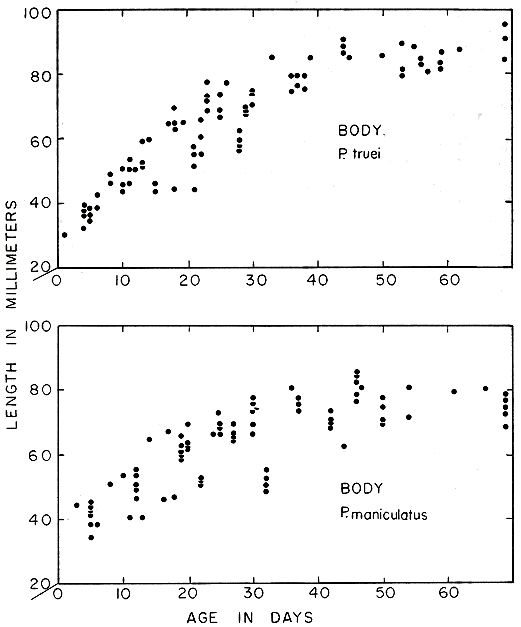
Fig. 18: Scatter diagram of postnatal growth of captive mice, showing increase in length of bodies from birth to 70 days of age. The records for P. truei represent 11 individuals of five litters; those for P. maniculatus represent 17 individuals of four litters.
The thoroughness of the above-mentioned studies is readily apparent to those who have worked with mice of the genus Peromyscus. Nevertheless, the ecology of local populations of P. maniculatus and P. truei as reported for the San Francisco Bay area (McCabe and Blanchard, 1950) has little relationship to the ecology of mice of other subspecies of these species, in southwestern Colorado. Indeed, the preferred habitats, and to some extent the behavior, differ strikingly in Colorado and California.
Fig. 19: Graphs showing postnatal growth of solitary captive individuals of P. truei and P. maniculatus, representing the only young in each of two litters.
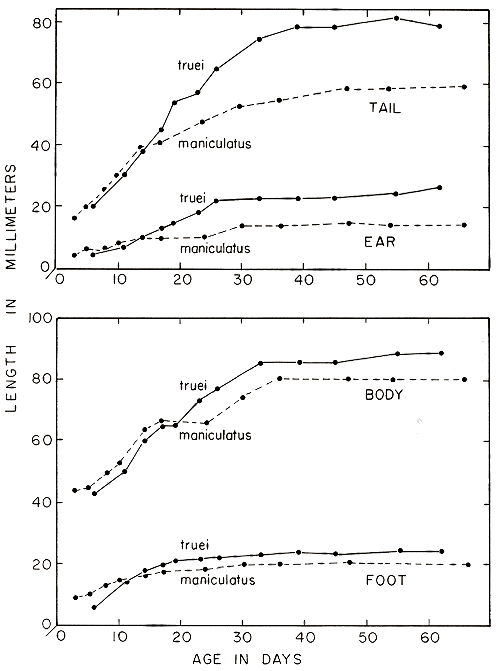
Figures 18 and 19 show that some litters grow appreciably faster than others, but the end results are about the same. Since the young were measured at irregular intervals, statistical procedures for calculating confidence limits of the curves were not applicable.
Solitary young reared by one female of each species, attained maximum size more rapidly than animals having litter mates (Fig. 19). Nevertheless, solitary individuals and individuals from litters all reach essentially the same size 50 days after birth.
The gestation time of P. truei is several days longer than that of P. maniculatus, and the young of truei are fewer and heavier than those of maniculatus. As would be expected, truei remains in the nest longer and nurses longer than maniculatus.
Young of each species grow rapidly for the first month, and attain, in that time, the largest percentage of their adult size; they grow rapidly up to sometime between the thirtieth and fiftieth days. Thereafter the rate of growth diminishes and the animals begin to gain weight rather than continuing to extend the lengths of the body and appendages.
Figure 19 reveals that the appendages of young maniculatus attain most of their length about a week earlier than those of truei. Young truei acquire mobility and coordination somewhat later than young maniculatus, but both species are seemingly equal in these respects by about the end of the second week.
Length of gestation period, number and size of embryos, amount of time spent in the nest, and time required for bodily growth are all of major importance in determining the relative success of truei and maniculatus. These parameters will be considered further in the discussion.
Parental Behavior
In the laboratory, pregnant females were supplied with either kapok, cotton, or a piece of burlap with which to make a nest. The kapok or cotton was used directly by the mice in constructing a hollow, compact, moundlike nest. When burlap was used for nest building, the female first completely frayed the cloth by chewing it into a fluffy mass of fibers.
When the top of a nest was opened to inspect young, the female would attempt to pull the nesting material back into shape by means of forefeet and teeth. The mother's defensive posture was to cover the young with her body, often lying over them and facing upward, toward the investigator. In this semi-recumbent position, the female would attack the investigator's fingers with her forefeet and teeth. Often the female would stand bipedally and use the forefeet and teeth to mount the attack. If at this time a young chanced to wander away from the mother, she would quickly pick it up and place it in the nest at her feet.
When disturbed, females of both species, but especially P. maniculatus, often dove headlong under their nest or into the wood shavings on the floor of the cage. This type of retreat was most often used when young were nursing. Time is required even by the mother to disengage nursing young, and this mode of escape is the most expedient. The mother disengaged nursing young by licking around their faces and pushing with her paws.
Nursing females of both species tolerated the male parent in the nest. A male and female often sat side by side in the nest and by means of their bodies participated in covering the young. Males were not observed to attempt any defense of the nest, or of the young. Females were tolerant of older young in the nest when another litter was born and was being nursed. In one nest, a female of P. truei gave birth to a litter of three when her older litter was 29 days old. The three older young continued to nurse until they were 37 days old, at which time they were removed from the cage. The female appeared tolerant of this nursing by members of the older litter, but appeared to give preference to the wants of the younger offspring.
One female of P. truei lost or killed all but one young of her litter; at about the same time, a P. maniculatus and all but one of her young inexplicably died. Since the remaining young maniculatus, a male, was just weaned and was considered expendable, I placed him in the cage with the female truei and her 33-day-old, male offspring. The reaction to the newcomer was unexpected. The female immediately covered the P. maniculatus and her own young and prepared to defend them against me. Later, when the P. maniculatus was disturbed, he had only to emit a squeak and the female truei would run to cover and protect him. When the young male of P. truei was 69 days old the female kept him out of the nest, but still kept the male maniculatus in the nest with her. Although the female was somewhat antagonistic to her own young, she did not injure him, but only kept him out of the nest. The male truei was left in the cage with his mother and the P. maniculatus from September 23 to December 10. None of the mice had any apparent cuts on the ears or tail to indicate fighting. As much as seven months after the P. maniculatus was introduced into the cage, the female truei continued to cover him with her body whenever there was a disturbance. The male maniculatus not only tolerated this attention, but ran under the female truei when frightened. "Adoption" of young of another species has been reported for a number of animals, but, without further evidence, it is not possible to postulate that such adoptions occur between species of Peromyscus in nature.
Young males are tolerated by their mothers after weaning. One young male maniculatus was left in the cage with his mother from the time of his birth in autumn until late February of the following year. A litter was born on February 24. A young male P. truei was also left in the cage with his mother until he had acquired most of his postjuvenal pelage; the female and male usually sat together in the cage.
Females of both species sometimes eat their young when the young die shortly after birth. One female of each species killed three of her four young, and ate their brains and viscera. In one of these cases, the female, of P. maniculatus, also died; the female of P. truei was the same one that adopted the surviving P. maniculatus. The female truei continued to nurse her one remaining young for at least several days after killing three of his litter mates. A reason for this cannibalism might have been that I had fed these mice for several weeks on a mixture of grains low in protein content. Inadequacy of this diet for nursing females may have caused them to become cannibalistic. The feed of all captives was changed to Purina Laboratory Chow after the young were killed.
Transportation of Young
Females of both species transported their young either by dragging them collectively while the young were attached to mammae, or by carrying them one at a time in the mouth. Since mice of the subgenus Peromyscus have three pairs of nipples, they probably transport only six young collectively. Svihla (1932:13) has stated that both pectoral and inguinal teats are used in transporting young, in contrast to Seton's reputed assertion that only inguinal nipples were used. But Svihla neglected to cite Seton's complete statement. Seton (1920:137) recorded a litter of three as using only the inguinal mammae, but on the following page recorded the use of both inguinal and pectoral mammae by another litter of four. My findings agree with those of Svihla. Nursing females of both species were removed periodically from cages by lifting them by the tail. The young would hang onto the mammae and the female would clutch the young to her with all four feet. Young two weeks old or older crawled behind the mother while nursing.
The method of transporting young in the mouth has been mentioned by Seton (1920:136) and described by Lang (1925) and Hall (1928:256). These authors report that the mother picks the young up in her paws, and places it ventral-side up in her mouth, with her incisors around it. The young are not picked up by the skin on the nape of the neck, as are the juveniles of dogs and cats. I have found that females of both species of Peromyscus carry their young ventral-side up in their mouth while the young are small, and sometimes when the young are older. Generally, when females of P. truei moved young weighing more than 10 grams, the female grasped the young from the dorsal side, across the thorax just posterior to the shoulders, and held them with the incisors more or less around the animal. Perhaps this method was used with older young because of the observed tendency of the larger young to resist being turned over and grasped from the ventral side, and because their increased weight would have made it difficult, if not impossible, for the mother to pick them up with her paws. The young rarely resisted the efforts of the mother to move them by this method; when grasped across the thorax by the mother, the young would remain limp until released. Some females of P. truei would drag almost fully grown young back into the nest in this manner. I have not observed older young of a comparable age to be moved by females of P. maniculatus. The females of P. maniculatus appear to be somewhat less concerned than those of P. truei for the welfare of their young once they are mobile and close to being weaned.
The following listing describes changes in postnatal development of young, of each species, from birth to nine weeks of age.
P. truei P. maniculatus
FIRST WEEK: At birth, young are helpless, red overall, small with wrinkled skin. Pinna of ear folded over and closed; eyes closed; digits not separated from rest of foot. At birth, young are helpless, red overall, smaller than P. truei, skin wrinkled. Ear, eyes, and digits as in P. truei.
Redness diminished by fourth day. Redness decreases and disappears by fourth day.
Hair apparent by fifth day; dorsal one-half or two-thirds of body more darkly pigmented than venter by fourth day. Hair apparent by fourth day; body bicolored by end of week.
Young squeak loudly and suck; sometimes crawl, but drag hind legs. Young squeak loudly; sucking more pronounced than in P. truei; may crawl, but drag hind legs.
SECOND WEEK: Appreciable increase in size; head about 60 percent larger than at birth, by 14th day, and still large in proportion to body. As in P. truei.
Toes on hind foot separated more from foot. As in P. truei, but somewhat more advanced.
Body well haired by end of week; dorsum dark gray, venter whitish; tail bicolored in most, but not haired. Body well haired by end of week; dorsum dark gray with brownish tint; venter whitish; tail bicolored in most, but not haired.
Pinna of ear unfolded and open by end of week. As in P. truei, but developmentsomewhat more advanced.
Through day 10, use hind legs to push, but by end of week use legs to crawl; difficult to hold, squirm but do not bite. Crawl well by end of week; difficult to hold, squirm but do not bite; agile.
Walk behind mother while nursing; agile.
THIRD WEEK: Eyes open on 16th to 21st day. Eyes open on 16th to 20th day, partly open earlier.
Gray pelage of dorsum brownish. Apparently there is a molt line progressing posteriorly from nose; the molt line has moved to shoulder region by end of week; pelage anterior to line browner, grayer posterior to it. Pelage of dorsum brownish; molt line across shoulders progressing posteriorly; browner anterior to line, grayer posterior to it.
Tail haired and weakly bicolored in some individuals by end of week. Tail haired and bicolored in all individuals.
Young walk and jump well; squirm but rarely bite. Young walk and jump well; fight and bite when handled.
FOURTH WEEK: Begin to eat solid foods at 23-29 days, but also nurse. Some young eat grain by 24th day; others continue to nurse.
Molt line about 3/4 inch posterior to head. Juvenal pelage completed by end of week. Some young have brownish hair on front legs. Juvenal pelage complete; no sign of postjuvenal molt.
Young roll over on backs and use feet to ward off litter mates that are dropped into nest, or into container, with them. As in P. truei; also, all jump well, and fight fiercely when handled.
FIFTH WEEK: Young weaned on 30th to 40th day; some nurse beyond 30th day if female is lactating. All young weaned before or by end of week; none observed to nurse beyond 30th day, even if female is lactating.
Juvenal pelage complete and no postjuvenal molt apparent on dorsum. Juvenal pelage complete; postjuvenal pelage not apparent on most, but probably present on all, and concealed under juvenal pelage.
SIXTH WEEK: Postjuvenal pelage apparent in most individuals under juvenal | pelage, especially along lateral line. Postjuvenal molt apparent in most young; almost complete in some, except above tail and on flanks.
SEVENTH WEEK: Postjuvenal pelage apparent in most young; in some the molt line has progressed well up on the sides, but not to mid-dorsum. Postjuvenal pelage apparent in all young; less distinct molt line than in P. truei.
EIGHTH WEEK: All individuals growing; total lengths of 156-170 millimeters; weight 17-22 grams. Growth completed in some individuals; those in larger litters have total lengths of 128-144 millimeters; weight 14-17 grams.
NINTH WEEK: Testes partly scrotal in one male on 59th day. "Scrotum in season usually large, vaginae open, evidence of coitus common." (McCabe and Blanchard, 1950:39).
New brown pelage encroaching on saddle and on hind legs; postjuvenal molt completed in some individuals by eleventh week. Postjuvenal molt completed in some individuals by end of week. New pelage tends to be concealed under juvenal pelage longer than in P. truei.
Changes Owing to Increase in Age
Increase in length of limb bones, changes in proportion of bones in the skull, eruption and degree of wear of teeth, and changes in pelage can be used to ascertain relative age. Different investigators might choose different limits for the three categories young, subadult, and adult. Museum specimens were assigned to one of five age groups listed below mostly on the basis of tooth wear, essentially as described by Hoffmeister (1951:1).
Juvenile: M3 just breaking through bony covering of jaw or showing no wear whatsoever.
Young: M3 worn smooth except for labial cusps, and M1 and M2 showing little or no wear.
Subadult: M3 worn smooth; labial cusp may persist, but is well worn; M1 and M2 having lingual cusps worn, but not smooth; labial cusps showing little wear.
Adult: Lingual cusps worn smooth and labial cusps showing considerable wear; labial cusp of M3 may persist.
Old: Cusps worn smooth; not more than one re-entrant angle per tooth discernible, frequently none.
For live animals examined in the field, criteria based on pelage and breeding condition were used, as follows:
Juvenile: Only gray, juvenal pelage present.
Young: Subadult pelage apparent on lateral line or on sides; body usually smaller than in adults.
Subadults: Subadult pelage having mostly replaced juvenal pelage; mice often as large as adults; testes of males often abdominal in breeding season; gray juvenal pelage may persist on head of some individuals.
Adult: Adult pelage present; body usually largest of all animals in population; females may have enlarged mammae from nursing previous litters; testes of males usually scrotal in breeding season; gray pelage may be present on head of some individuals.
Old individuals in the field could not be distinguished from adults; hence any animals that appeared older, or more developed, than subadults were classified as adults.
In P. truei, subadult pelage appears first on the lateral line or on the flanks; new pelage is ochraceous and contrasts markedly with the gray juvenal coat. In P. maniculatus, the subadult pelage contrasts less with the juvenal coat; the new pelage progresses from anterior to posterior over the body in the same manner as in truei, but replaces the juvenal coat in a less distinct manner than in truei. As a result, contrast often is lacking between juvenal and subadult pelages in maniculatus making it difficult to assign an individual to one of these two age categories when examined in the field. In museum specimens, the subadult pelage is much more noticeable because it can be compared with the pelages of other specimens. The subadult pelage in P. maniculatus is duller than the adult pelage: In P. truei the subadult and adult pelages appear to have an equal sheen.
In early winter, the postjuvenal pelage acquired by young individuals of P. truei was thick and luxuriant and indistinguishable from the winter pelage of adults. My observations lead me to conclude that individuals born late in the breeding season molt from juvenal summer pelage directly into winter adult pelage. Technically, this new coat is the postjuvenal one, yet it cannot be distinguished as such after the molt is completed.
Anomalies and Injuries
Anatomical anomalies were rare in the individuals of Peromyscus that I examined. When anomalies were found they were striking, principally because of their low rate of occurrence.
One female of P. truei, born in captivity, had a congenital defect of the pinna of the right ear, noted on the fifteenth day after birth. Closer examination then and later revealed that the pinna was normal in all respects except that the tip was missing. The tip showed no evidence of injury. When the mouse was subadult, this defective pinna was approximately half as long as the normal pinna. The topmost part of the defective pinna was somewhat more constricted in circumference than the normal one.
On September 11, 1963, a subadult male of P. truei was captured that had five functional toes on its right front foot, the only one of more than 175 individuals caught and handled in the field that exhibited polydactyly. The front foot was examined closely in the field, but it could not be determined how or where the extra bones of the sixth toe articulated. Peromyscus normally has four full-sized toes on each front foot, and a small inner toe hardly more than an enlarged tubercle, having no nail.
A few mice of both species had broken toes or claws torn off. Such injuries were more common on toes of the hind foot. In several instances the toes were shortened, as if by marking, although the animals concerned had been marked earlier by clipping toes other than the injured toes. The reason for these injuries is not apparent, although they could have been caused by fighting, or from having been caught in doors of Sherman live traps.
Toes of several mice were swollen and inflamed due to small glochids of cacti that were stuck in them. Apparently the mice had stepped on the glochids by chance, for I found no evidence that Peromyscus of either species eats cacti.
One P. truei had a broken tail; three other individuals had tails about one-half normal length. One P. maniculatus had a shortened tail. Some of these injuries probably were caused by the Sherman live traps; several individuals of P. truei were released after having been caught by the tail by the spring-loaded door of these traps.
On October 17, 1963, an adult P. truei had a bleeding penis; when this mouse was recaptured on October 25, the injury was healed.
Losses Attributed to Exposure in Traps
Observations of wild mice caught in live traps suggest that metabolic maturity is reached later than physical and reproductive maturity. In such trapping, it became apparent that juvenal and young mice suffered from exposure to cold and to heat much more than did subadult or adult mice. Although traps were carefully shaded and ample nesting material and food provided, some mice died in the traps. An overwhelming majority of these mice were juveniles and young.
Traps were checked in the morning, both in the summer and autumn, yet mice died in traps that were barely warm to the touch, in summer, and cool to the touch in autumn. Older mice frequently were found in traps that were warm, or even hot, to the touch; yet the older mice rarely died in such traps. Apparently the tolerance of adults is much greater to heating and chilling. Greater bulk and perhaps longer pelage in adults might provide sufficiently better insulation to account for this difference.
Occasionally juvenal mice were found in traps in a sluggish and weakened condition, especially in autumn when nights were cool. In such cases the mice were either cupped in the hands and warmed until lively enough to fend for themselves, or, if especially weakened, were taken to the laboratory. None of such animals that were returned to the laboratory lived for more than two weeks. Most of those released in the field did not reappear in the traps.
I conclude that juvenal and young mice placed under stress by overheating or cooling die immediately or live only a few days. Subadult and adult animals tolerate more extreme conditions of overheating or cooling, presumably because they are able to regulate their internal temperature better, by either losing or retaining heat more effectively.
Mice found dead in overheated traps had salivated heavily, and may also have licked the fur on their chests to increase heat dissipation. One such adult, of P. truei, had a wet chest when he was taken from a warm trap; when released, this mouse ran to a nearby plant of Comandra umbellata, and ate a few of the succulent leaves before running off. This individual was trapped several times later in the summer, and apparently suffered no ill effects from the exposure.
Dental Anomalies
Abnormalities in the formation and occlusion, or decay of teeth, are relatively rare in wild mammals. Of all bodily structures, the teeth apparently are under the most rigid genetic controls; they form early in the embryo and follow rigidly specified patterns in their ontogeny. Apparently any deviation from the normal pattern of tooth formation is quickly selected against. All specimens of P. m. rufinus and P. t. truei in the collection of the Museum of Natural History at the University of Kansas, and in my collection, were examined for dental anomalies. A total of 317 specimens of P. m. rufinus and 54 specimens of P. t. truei were examined. The following specimens were found to have abnormalities:
K. U. 69361, P. maniculatus, adult: Small bundles of plant fibers are lodged between all upper teeth and have penetrated the maxilla anterior to the left M1. The maxillary bone is eroded away from the roots of all teeth. The anteriormost roots of both lower first molars are almost completely exposed, because the dentary has been abraded away.
K. U. 76041, P. maniculatus, young: A piece of plant fiber is wedged between the left M2 and M3. The maxillary bone has eroded away from around the roots of M3, indicating the presence of an abscess in this area.
K. U. 69362, P. maniculatus, adult: All teeth in the lower right tooth-row are greatly worn, especially on the lingual side. The labial half of the right M1 is all that remains; decay is apparent both in the crown and roots on the lingual side of this tooth.
K. U. 69397, P. maniculatus, old: The maxillae have eroded away from around the anterior roots of each first upper molar, leaving these roots unsupported.
C. L. D. 231, P. maniculatus, old: The teeth in this female are greatly worn; re-entrant angles are not visible in any teeth. A circular hole, 0.1 millimeter in diameter, exists in the dentine immediately over (when viewed from the underside of the skull) the posterior root of the right M1. The crowns of the teeth are greatly reduced in height, and the dentine is thin.
Anomalies in the Skull
Wormian bones and other abnormalities in the roofing bones are noted, as follows:
K. U. 76090, P. maniculatus, young: The interparietal is divided; the divided suture is in line with the suture between the parietals. The interparietal is 7.8 millimeters long.
K. U. 76091, P. maniculatus, young: A wormian bone, 0.5 millimeter by 0.2 millimeter, lies between the anterior border of the interparietal and the posterior border of the left parietal, at a point midway between the center line of the skull and the posterolateral border of the parietal bone.
C. L. D. 248, P. maniculatus, adult: An oval wormian bone, 1.1 millimeters long and 0.6 millimeter wide, lies between the parietals at their posterior margin; the long axis of the bone is parallel to the long axis of the skull.
C. L. D. 246, P. maniculatus, juvenal: The interparietal is divided equally by a suture. An oval wormian bone, 0.3 millimeter long and 0.1 millimeter wide, lies between the frontals, midway between the anterior and posterior borders of these bones.
C. L. D. 656, P. maniculatus, young: A small, rounded wormian bone lies between the right parietal and interparietal, lateral to the posterior junction of the suture between the parietals. This bone extends anteriorly into the parietal bone from the suture of the interparietal and parietal. This bone is 0.7 millimeter wide, and extends 0.6 millimeter into the parietal.
C. L. D. 662, P. maniculatus, subadult: An elongated, diamond shaped wormian bone closes the suture between the parietal bones. This bone is 2.3 millimeters long and 0.8 millimeter wide.
K. U. 34735, P. truei, old: The anterior one-quarter of the left parietal bone is slightly depressed; and the posterior one-third of the left frontal and anterior one-quarter of the left parietal are thin and sculptured. This malformation of the roofing bones posterior to the orbit probably is not the result of a break, for the orbital part of the frontal bone is normal. The frontal-parietal sutures are in the normal positions on both sides of the skull.
The above-mentioned anomalies do not appear to be correlated with age or locality at which the specimens were taken. Apparently such anomalies are present throughout the population, but in a small percentage of specimens.
Food Habits
Mice of the genus Peromyscus are known to eat a wide variety of plants and arthropods, and to be highly opportunistic in selection of food (Cogshall, 1928; Hamilton, 1941; Williams, 1955, 1959a; Jameson, 1952; Johnson, 1962). In order to determine possible food preferences, captive mice of both species were fed plants indigenous to Mesa Verde. Entire plants were used whenever possible; available seeds also were offered (Tables 5, 6). All feeding experiments were replicated with at least six different individuals in order to minimize the trends resulting from individual preferences or dislikes. The mice of each species tended to be consistent in their feeding.
The plant species listed in Tables 5 and 6 were those that were eaten or rejected by a majority of the individuals tested.
Plant material eaten by P. maniculatus and refused by P. truei included only the leaves and stem of Viguiera multiflora. Plant material eaten by P. truei and refused by P. maniculatus included the leaves of Calochortus gunnisonii and the leaves and stem of Erigeron speciosus.
Table 5—Plants, or Parts of Plants, Eaten by Captive Individuals of P. truei in Mesa Verde National Park, Colorado. 0 = not eaten, + = eaten, - = not offered.
Species of Plant Leaves Stem Flower Seeds
Amelanchier utahensis - - - +
Calochortus gunnisonii + + - +
Chaenactis douglasii 0 0 - -
Chrysothamnus depressus 0 0 0 -
Chrysothamnus nauseosus + 0 0 -
Comandra umbellata + + - -
Erigeron speciosus + + - -
Eriogonum alatum - - - +
Juniperus osteosperma - - - +
Lupinus caudatus 0 0 + -
Lithospermum ruderale 0 0 - 0
Mellilotus alba + + + +
Mellilotus officinalis + + + -
Orthocarpus purpureo-albus + + + +
Pedicularis centranthera + + - -
Penstemon linarioides + + - +
Pinus edulis - - - +
Polygonum sawatchense + + - 0
Solidago petradoria 0 0 0 -
Viguiera multiflora 0 0 0 0
Plant material eaten by captives of both species included Calochortus gunnisonii—stem and seeds; Comandra umbellata—leaves and stem; Eriogonum alatum—seeds; Penstemon linarioides—leaves and stem; Pinus edulis—seeds; and Juniperus osteosperma—seeds.
Plant materials refused by both species of mice included the leaves and stem of Chaenactis douglasii, the leaves, stem and seeds of Lithospermum ruderale, and the leaves, stem and flowers of Solidago petradoria.
Cricetine rodents chew plant and animal foods thoroughly; contents of their stomachs appear as finely-particulate fragments. These fragments invariably contain pieces of epidermis from ingested plants. Due to the presence of cutin in the cell walls, epidermis is last to be digested.
Microscopic analysis of plant epidermis is useful in helping to determine food habits of various animals (Dusi, 1949; Williams, 1955, 1959a; Brusven and Mulkern, 1960; Johnson, 1962). The microscopic analysis of stomach contents provides a practical method of determining which plants are eaten by rodents. Contents of stomachs and intestines were removed from mice caught in snap traps, and from preserved specimens. The contents were placed on a piece of bolting silk, washed thoroughly with running water, stained with iron-hematoxylin and mounted on slides, or stored in 70 per cent ethanol (Williams, 1959a; Douglas, 1965).
Table 6—Plants, or Parts of Plants, Eaten by Captive Individuals of P. maniculatus in Mesa Verde National Park, Colorado. 0 = not eaten, + = eaten, - = not offered.
Species of Plant Leaves Stem Flower Seeds
Artemisia ludoviciana 0 0 - -
Calochortus gunnisonii 0 + - +
Chaenactis douglasii 0 0 - -
Comandra umbellata + + - -
Erigeron speciosus 0 0 - -
Eriogonum alatum - - - +
Juniperus osteosperma - - - +
Lappula redowskii 0 0 - +
Lithospermum ruderale 0 0 - 0
Orthocarpus purpureo-albus 0 0 + +
Penstemon linarioides + + + -
Pinus edulis - - - +
Purshia tridentata + + - -
Sitanion hystrix 0 0 - 0
Solidago petradoria 0 0 0 -
Sphaeralcea coccinea + + - +
Stipa comata 0 0 - +
Viguiera multiflora + + - -
In order to analyze these epidermal fragments, a collection of plants was made within the park. Slides of the epidermis of these plants were prepared and analyzed for diagnostic characters (Douglas, 1965:197-199). Features such as the stomatal arrangement in relation to subsidiary cells; the types of trichomes, scales and glands; the cellular inclusions such as starch grains, mucilage and resins are of taxonomic value (Metcalfe and Chalk, 1950). The configuration of the anticlinal cell walls is useful in separating species that are similar in other respects (Douglas, 1965:199).
The following species of plants, and other food items, were identified in the stomach or intestinal contents of Peromyscus maniculatus:
Agropyron smithii Artemisia sp. Eriogonum umbellatum Lupinus ammophilus Penstemon linarioides Phlox hoodii Stipa comata Arachnid legs
Stomach and intestinal contents of P. truei contained the following food items:
Artemisia nova Artemisia sp. Penstemon cf. barbatus Penstemon cf. linarioides Poa fendleriana Arachnid legs Eriogonum sp. Gutierrezia sarothrae Yucca sp. Chitin Feathers
Many of the plants eaten by the mice had large numbers of crystals in the epidermis. Druses were the most abundant, but raphid crystals also were seen. Every slide contained at least one species of plant which contained druses. Such crystals are composed mostly of calcium oxalate (Esau, 1960:41). In Mesa Verde, families of plants having crystals include: Boraginaceae, Chenopodiaceae, Compositae, Cruciferae, Leguminosae, Liliaceae, Malvaceae, Ornargraceae, Rosaceae, and Saxifragaceae. Calcium oxalate is a highly insoluble compound and is innocuous if it passes through the gastro-intestinal tract without being absorbed. In rats of the genus Neotoma, some calcium oxalate passes through the intestines unchanged, but large amounts of calcium are absorbed through the intestine. The urine of pack rats is creamy in color and contains calcium carbonate. It is not understood how these rats metabolize the highly toxic oxalic acid, when converting calcium oxalate to calcium carbonate (Schmidt-Nielsen, 1964:147-148). Apparently calcium oxalate passes through the intestine unchanged in both species of Peromyscus, for their urine is clear and yellowish.
Although both species of mice appear to prefer plants having soft leaves, some plants having coarse leaves also are eaten. Many of the slides contained isolated sclerids. The stomach contents of one individual of P. truei contained a small fragment of the epidermis of Yucca. This fragment may have come from a young shoot. It is unlikely that Peromyscus would eat the larger, coarser leaves of Yucca.
Pinyon and juniper nuts were found in nests of all mice. Captive mice were especially fond of pinyon nuts, and these probably provide a substantial part of the diet of Peromyscus in the autumn and early winter. The winter staple of P. truei appears to be juniper seeds. Nesting sites of this mouse often could be located by the mounds of discarded seeds lying nearby.
Both species eat pinyon and juniper seeds; since P. truei lives in the forest, it has better access to these foods than does P. maniculatus. Mice remove the embryos of juniper seeds by chewing a small hole in the larger end of the seed. The seed coats of juniper are extremely hard, and a considerable amount of effort must be expended to remove the embryo. Captives discarded the resinous and pithy, outer layers of juniper berries. Individuals of P. truei are adept climbers. Since many juniper berries remain on branches throughout the winter, the ability of these mice to forage in the trees would be especially advantageous when snow covers the ground.
Water Consumption
Peromyscus maniculatus is ubiquitous, occurring in habitats ranging from mesic boreal forests to arid southwestern deserts. Most subspecies of P. maniculatus live in moderately mesic or near-mesic environments, but a few have adapted to arid conditions. It has been assumed that the success of P. maniculatus in inhabiting such diverse habitats is associated with its adaptability to different kinds of food and varying amount of available water (Williams, 1959b:606).
Throughout its range P. maniculatus coexists with one or more other species of Peromyscus that are more restricted in distribution. Peromyscus truei is one such species.
Both species live under xeric or near-xeric conditions, for the climate of Mesa Verde is semi-arid. Other than a few widely-scattered springs, there are no sources of free water on the top of the Mesa Verde land mass; thus animals inhabiting the park must rely upon moisture in the plants and other foods they eat, or upon dew.
Several investigators have studied water consumption in mice of the genus Peromyscus (Table 7). Dice (1922) did so for the prairie deer mouse, P. m. bairdii, and the forest deer mouse, P. leucopus noveboracensis, under varying environmental conditions. He found that both species drank about the same amounts of water per gram of body weight, and that food and water requirements did not differ sufficiently to be the basis for the habitat differences between these species. Neither of his samples was from an arid environment. Chew (1951) studied water consumption in P. leucopus, and recently reviewed the literature on water metabolism of mammals (Chew, 1965). In his studies of five subspecies of two species of Peromyscus, Ross (1930) found significant differences in water consumption between species but not between subspecies within a species. One of the subspecies of P. maniculatus tested was from a desert region, whereas the other two were from mesic areas along the coast of California.
Lindeborg (1952) was the first to measure water consumption of both P. m. rufinus and P. t. truei, the species and subspecies with which my experiments are concerned. Lindeborg also tested the ability of five races of Peromyscus to survive reduced water rations. Unfortunately, the subspecies chosen for these experiments did not include P. t. truei or P. m. rufinus. Lindeborg (1952:25) found that the "amounts of water consumed by various species of Peromyscus from different habitats within the same climatic region were not conclusively different." However, he did find significant differences between some subspecies from different geographical areas. For example, he found no significant difference in water consumption between P. m. bairdii from Michigan and either P. m. blandus or P. m. rufinus from New Mexico, but he found a highly significant difference between P. l. noveboracensis from Michigan and P. l. tornillo from New Mexico. Lindeborg also found that the subspecies of Peromyscus that consumed the least water, and that were best able to survive a reduced water ration, were those from the more xeric climatic areas.
Some mammals may be able to change their diets in times of water stress, and thereby compensate for a shortage of water. At such times, Dipodomys selects foods with high percentages of carbohydrates and conserves water by reducing the amounts of nitrogenous wastes to be excreted (Schmidt-Nielsen et al., 1948).
Williams (1959b) found that P. m. osgoodi from Colorado drank more water on a diet rich in protein than on one rich in carbohydrates. But, her mice on a high carbohydrate diet used less than a normal amount of water for a period of only five weeks; at the end of the five weeks they were drinking about as much as they had been when on the control diet of laboratory chow. Likewise, mice adjusted to the high protein diet by consuming more water; but by the end of the fifth week their daily water consumption approximated the amount drunk when fed on laboratory chow. Because of these results, Williams questioned the validity of the assumption that P. maniculatus is able to inhabit a diversity of habitats because of its adaptability with respect to food and water requirements.
I conducted a series of experiments on water and food consumption by individuals of P. truei and P. maniculatus. It was thought that if there were differences in water or food consumption, or both, knowledge of them might help to explain the obvious differences in habitat preferences of these two species in Mesa Verde National Park.
In August of 1965, 30 individuals of P. truei and P. maniculatus were trapped in Mesa Verde National Park at elevations of 7000-8400 feet, and transported to Lawrence, Kansas, where the experiments were carried out.
Mice were housed in individual metal cages (10 x 7.5 x 5 inches), having removable tops of wire mesh, and an externally-mounted water bottle that had a drop-type spout extending into the cage. Cages were on one of five shelves of a movable tier of shelving, and were rotated randomly, from one shelf to another, each week. A layer of dry wood shavings covered the bottom of each cage. A control cage was similarly equipped.
The mice were kept in a room in which temperature and photoperiod were controlled. The ambient air temperature of this room was 20 to 23 degrees Centigrade throughout the experiments, and averaged 21 degrees. Humidity was not controlled, but remained low throughout the experiments. The room was illuminated for eight hours each day, from about 9 A. M. to 5 P. M.
The animals were fed at least once a week, at which time all remaining food was weighed and discarded, and the remaining water was measured. Tap water was used in all of the experiments. The cages were cleaned each week. Each time the cages containing mice were handled, the control cage was handled in the same way. The amount of evaporation was determined each week by measuring the water remaining in the bottle of the control cage.
Water and food consumption of individuals of P. maniculatus and P. truei were measured when the mice were fed diets of differing protein content. To my knowledge, the only other study in which water consumption was measured for mice of the genus Peromyscus on diets of different protein contents was by Williams (1959b). Because of the limited number of animals available, it was decided that the best results could be obtained by placing all individuals on the same diet for a predetermined number of weeks, then on a second diet for a certain period, and so on.
Each mouse was weighed at the beginning, at the mid-point, and at the end of each experiment. The mice were weighed on the same days, at times when they were inactive. Because weights of individual mice differ, water and food consumption was calculated on the basis of the amount consumed per gram of body weight per day. All foods were air-dry and contained a negligible amount of water.
First, food and water consumption was measured for nine individuals of each species on a diet of Purina Laboratory Chow. This chow contains not less than 23 per cent protein and 4.5 per cent fat, and about 57 per cent carbohydrate. Since the mice had been maintained on this diet for several months prior to the experiments, food and water consumption was measured for a period of only two weeks. Individuals of P. truei consumed more total water and more water per gram of body weight than individuals of P. maniculatus (Table 7).
Next, 10 mice of each species were placed on a diet of Purina Hog Chow for a period of four weeks. This chow contains not less than 36 per cent protein and one per cent fat, and about 42 per cent carbohydrate. Both species increased their daily water consumption immediately after being placed on this diet (tables 7 and 11). On the high protein diet, P. truei again consumed much more water than did P. maniculatus (tables 7 and 9).
Table 7—Food and Water Consumption of Peromyscus maniculatus and P. truei When Fed Diets of Different Protein Content. Food and Water Consumption Are Determined for the Grams, or Milliliters, Consumed per Gram of Body Weight per Day; Daily Totals Are also Given.
Peromyscus maniculatus rufinus
Diet per cent protein No. mice Food /gram /day ± S. D. Total grams /day Water /gram /day ± S. D. Total water /day
Lab Chow 23 9 .201 .074 4.455 .262 .183 5.751
Hog Chow 36 10 .238 .060 5.232 .496 .186 10.749
Corn 11 11 .149 .044 3.144 .174 .012 3.696
Peromyscus truei truei
Diet per cent protein No. mice Food /gram /day ± S. D. Total grams /day Water /gram /day ± S. D. Total water /day
Lab Chow 23 10 .216 .070 6.353 .373 .119 10.880
Hog Chow 36 10 .230 .079 6.966 .653 .189 19.571
Corn 11 10 .158 .010 4.318 .332 .016 9.034
The tendency of both species to eat more of the hog chow than they ate when fed standard laboratory chow may reflect a higher palatability of the hog chow. Both species consumed similar amounts of food per gram of body weight, on each of the diets (Table 7). The larger P. truei requires more grams of food per day than the smaller P. maniculatus, but this slight difference in food consumption probably has no effect on the distribution of these species within Mesa Verde.
The results obtained with the low protein diet were strikingly different from those of the first two experiments. In this experiment the same groups of mice were placed on a diet of whole, shelled corn for a period of six weeks. The corn contained less than 11 per cent protein, about three per cent fat, and about 80 per cent carbohydrate.
By the end of the first week, on the low protein diet, all mice had reduced their water intake by about half the amount used per day on the high protein diet (Table 7). There was not a statistically significant difference, for either species, between the average amounts of water drunk in the first and in the sixth weeks of the experiment.
The data in Table 7 show that on all three diets, individuals of P. maniculatus drank less water per gram of body weight than individuals of P. truei. Variation in water consumption was high; some individuals of P. maniculatus that drank more than the average amount for the species, consumed as much water as some individuals of P. truei that drank less than the average amount. In general, individuals of P. maniculatus drank about half as much water each day as individuals of P. truei. Individuals of both species were consistent in their day-to-day consumption.
Table 8—Amounts of Mean Daily Water Consumption as Reported in the Literature for Species of Peromyscus. Figures in Parentheses are Means; Those Not in Parentheses Are Extremes.
Mean daily ml./gm. wt./day Water consumption total ml. per day Temperature Humidity Per cent dietary protein Investigator
(.262) (5.70)
P. m. rufinus .124-.699 2.71-15.07 20-23 low 23 [A]
P. m. rufinus (.101) (2.39) 20-25 24-47 [B]
P. m. osgoodi .16-.25 3.2-4.3 18-22 10-20 23 [C]
(.126) (1.74)
P. m. bairdii .082-.177 1.12-2.72 21 25-68 [D]
P. m. bairdii .124-.182 (2.37-3.17) 20-25 24-47 [B]
(.372) (10.80)
P. t. truei .224-.561 7.0-16.92 20-23 low 23 [A]
P. t. truei (.085) (2.77) 20-25 24-47 [B]
P. l. nov. .057-.117 1.36-2.29 21 25-68 [D]
P. l. nov. (5.36) 18 62.5 [E]
[A]
Douglas
[B]
Lindeborg, 1952
[C]
Williams, 1959
[D]
Dice, 1922
[E]
Chew, 1951
Table 8 shows average water consumption for several species of Peromyscus as reported in the literature, and as determined in my study. It is difficult to compare my results with most of the data in the literature, because of a lack of information as to protein, fat, carbohydrate, and mineral contents of foods used in other studies. Lindeborg (1952) and Dice (1922) fed mice on a mixture of rolled oats, meat scraps, dry skimmed milk, wheat germ, etc. described by Dice (1934). Their data on water consumption in P. maniculatus indicate that this mixture probably is lower in protein content than Purina Laboratory Chow, that was used in my experiments and those of Williams' (tables 8 and 9).
The amount of dietary protein consumed under natural conditions is not known for most wild animals. One index of the minimum amount of protein necessary is the amount required for an animal to maintain its weight. At best, this can be only an approximation of the required amount, for other factors, such as stress, disease, change in tissues during oestrus or gonadal descent, and changes in constituents of the diet other than protein, would all be expected to affect the body weight (Chew, 1965:145-147).
The data in Table 7 show that both species vary their food intake with changes in diet. Table 10 shows weight changes that took place in individual mice when fed each of the three diets. A change in weight of one gram cannot be considered as important, for the weight of an individual mouse fluctuates depending upon when he last drank, ate, defecated or urinated.
The only significant changes in weight occurred when mice were fed low protein food (Table 10). Individuals of P. truei lost 15.72 per cent and individuals of P. maniculatus lost 10.03 per cent of their total body weights on this diet. This indicates that food having a protein content of more than 10 per cent but less than 23 per cent is required for maintenance of weight in these animals.
Although knowledge of the amount of water consumed, ad libitum, by adult mice is valuable information, maintenance of the population depends upon reproduction and dispersal of young individuals. My trapping data indicate that only two to three per cent of the adults live long enough to breed in consecutive breeding seasons. In spring, the breeding population is composed largely of mice that were juveniles or subadults during the latter parts of the breeding season. Therefore, the critical time for the population may well be the time when the season's young are being produced. Any unfavorable circumstances, such as a shortage of food or water, that would affect pregnant or lactating females would be of primary importance to the integrity of the population.
Table 9—A Comparison of Mean Daily Water Consumption of Mice on High Protein Diets. Numbers in Parentheses Are Average Values; All Others Are Ranges of Values.
Species Mean daily H2O consumption Temperature Relative humidity Investigator
cc./gm. wt. Total cc.
P. m. osgoodi (0.27-0.54) (4.6-9.3) 18-22 C 10-20 Williams, 1959
(0.496) (10.74)
P. m. rufinus 0.186-0.764 4.54-16.57 20-23 C low Douglas
(0.653) (19.57)
P. t. truei 0.429-1.031 13.28-30.28 20-23 C low Douglas
One would assume that pregnant and lactating females require more water than non-pregnant females. One might also assume that juveniles require different amounts of water and food than adults. Juveniles have less dense pelage than adults, and probably are affected more by their immediate environment because of their relatively poor insulation. Juveniles might also be in an unfavorable situation insofar as water conservation is concerned, because they are actively growing, and in most cases, acquiring new pelage; it is well known that these are times of stress for the individual.
Table 10—Weights of Mice at Start and Finish of Experiments, Showing Changes in Weight and Mean Weights, and Means of Changes in Weight (mean delta).
Peromyscus truei truei
No. Lab Chow Hog Chow Corn
Start End Δ Start End Δ Start End Δ
1 31.0 31.3 0.3 31.3 32.3 1.0 32.3 29.0 3.3
5 31.1 30.5 0.6 30.5 32.8 2.3 32.8 28.7 4.1
6 27.6 27.1 0.5 27.1 29.5 2.4 29.5 27.3 2.2
7 28.0 26.3 1.7 26.3 27.5 1.2 27.5 22.2 5.3
13 25.8 30.6 4.8 30.6 27.0 3.6 27.0 22.2 4.8
14 26.9 30.7 3.8 30.7 31.4 0.7 31.4 27.3 4.1
15 25.4 29.4 4.0 29.4 29.8 0.4 29.8 24.0 5.8
16 33.0 32.9 0.1 32.9 30.5 2.4 30.5 26.0 4.5
19 37.6 38.1 0.5 38.1 31.8 6.3 31.8 22.0 9.8
20 23.5 25.8 2.3 25.8 26.2 0.4 26.2 22.9 3.1
Ȳ 28.9 30.2 1.8 30.2 29.8 2.0 29.8 25.2 4.7
Peromyscus maniculatus rufinus
No. Lab Chow Hog Chow Corn
Start End Δ Start End Δ Start End Δ
2 23.0 20.7 2.3 20.7 21.1 0.4 21.1 18.6 2.5
3 22.7 23.1 0.4 23.1 23.8 0.7 23.8 20.7 3.1
4 22.0 21.1 0.9 21.1 21.8 0.7 21.8 21.3 0.5
8 26.3 28.1 1.8 28.1 15.8 2.3 25.8 23.8 2.0
9 21.5 24.0 2.5 24.0 25.1 1.1 25.1 21.8 3.3
10 … … … … … … 22.5 20.0 2.5
11 21.0 22.1 1.1 22.1 20.8 1.3 20.8 19.0 1.8
12 22.3 23.2 0.9 23.2 21.3 1.9 21.3 20.4 0.9
17 18.9 20.0 1.1 20.0 19.2 0.8 19.2 19.4 0.2
18 17.0 17.5 0.5 17.5 19.5 2.0 19.5 17.3 2.2
21 18.9 18.1 0.8 18.1 20.2 2.1 20.2 17.3 2.9
Ȳ 21.4 21.8 1.2 21.8 21.8 1.3 21.9 19.9 2.2
Lindeborg (1950:76) found that 15 days before parturition, pregnant and non-pregnant females of P. m. bairdii drank about the same amounts of water, that females consumed more water after the young were born and until they were weaned, and that water consumption increased with an increase in weight in young, growing individuals. He found that in the later stages of pregnancy, females of P. m. bairdii required 36 per cent more water than non-breeding females; at 14 days after parturition, nursing females required 111 per cent more water than non-breeding females, and at weaning time, 158 per cent more water. Dice (1922:35) reported a 217 per cent increase in drinking of P. m. bairdii before parturition, and 171 per cent increase while nursing.
Several females of both species were bred prior to the start of the experiments described herein. As a consequence, it was possible to determine water and food consumption for lactating females of each species, and later, for their litters. Pregnant and lactating females, and newly-weaned litters, were fed laboratory chow throughout this experiment. The litters were separated from their mothers as soon as the young were observed to be eating, or no later than 33 days after birth.
Table 11 shows the amounts of water and food consumed by two females of each species while they were either in the later stages of pregnancy, or were nursing. Although the data in Table 11 do not cover the full developmental time of the litters involved, it is obvious that both lactating females of P. truei and one female of P. maniculatus consumed more water than the average for their species (Table 7). Water and food consumption was measured for both females of P. truei while they were nursing. The female that gave birth to litter A was left in the cage with the male for several days after the litter was born, resulting in another litter being born about 27 days after the first. Therefore, the record of this female represents an extreme case of stress (probably a common occurrence in nature) in which a female is nursing one litter while she is pregnant with a second.
The record of the female of P. truei that gave birth to litter B is the most complete, including data from the fifth day after parturition until the young were weaned on the thirty-third day after parturition. The record of the female of P. maniculatus that gave birth to litter C covers the last 10 days of nursing before the young were weaned. After being separated from her litter, this female drank more than the average amounts of water, on both high and low protein diets. Although the food and water were lost several times for the female of P. maniculatus with litter D, the period of time covered by the 14 days when water and food consumption were measured includes times just prior to parturition and to weaning of the young.
Table 11—Water and Food Consumed by Nursing Females of P. truei and P. maniculatus. Consumption Is Calculated on the Basis of Amount (Milliliters or Grams) Consumed per Gram of Body Weight per Day, as well as Total Amounts Used per Day.
Female Water used No. days Average weight ml. H2O/gm./day Total water/day No. in litter
P. truei (A) 447 17 33.00 .796 26.29 3
P. truei (B) 676 28 32.70 .738 24.14 3
P. maniculatus (C) 191 10 19.45 .983 19.10 5
P. maniculatus (D) 133 14 24.35 .224 5.46 6
Female Food used No. days Average weight gms. food/gm./day Total food/day No. in litter
P. truei (A) 214.7 26 33.00 .250 8.26 3
P. truei (B) 120.5 24 32.70 .153 5.02 3
P. maniculatus (C) 47.8 10 19.45 .246 4.78 5
P. maniculatus (D) 180.1 21 27.42 .312 8.58 6
It is interesting that the female of P. maniculatus with litter C used much more than the average amount of water for the species, and even more per gram of body weight than lactating females of P. truei. Conversely, water consumption of the female with litter D was within one standard deviation of the mean for all adults of P. maniculatus. I infer that at least some lactating females of P. maniculatus are better adapted to aridity than are some lactating females of P. truei.
Table 11 also shows food consumption of the four females discussed above. All females, with the exception of the female with litter D, consumed amounts of food that lie within one standard deviation of the means for their species. The female with litter D had the most young, consumed the most food but drank the least water of the four females. Later, when separated from her litter and placed on the low protein diet, this female drank only .046 milliliters of water per gram of body weight per day. This figure is less than one-third of the average amount (.174) for this species (Table 7).
The records of water and food consumption for litters A, C, and D are given in Table 12; the mice in litter B persisted in placing wood shavings in the opening of the spout on their water bottle, causing loss of the water. The data show that mice in all three litters had an average water and food consumption within one standard deviation of the mean for adults of their respective species (Tables 7 and 12). It is interesting that juveniles of both species require no more food and water per gram of body weight than adults. This indicates that if a young animal survives the rigors of postnatal life until it is weaned, it is then at no disadvantage as far as food and water consumption are concerned. This would be greatly advantageous to the species, as a population, for the young could disperse immediately upon weaning, and go into any areas that would be habitable for adults of the species.
Table 12—Food and Water Consumed by Young Mice in Litters, After Weaning. Consumption Is Calculated on the Basis of the Amount (Milliliters or Grams) Consumed per Gram of Litter Weight per Day; Total Amounts Are Shown and Can Be Divided by Litter Size for Average Individual Consumption. Litter Sizes Are as Follows: A=3; C=5; D=6.
Litter Total water used Total corrected No. days Average total weight ml. H2O/gm./day Total water/day
P. truei (A) 1207 1120 57 58.30 .337 19.64
P. maniculatus (C) 1427 1340 57 76.14 .308 23.50
P. maniculatus (D) 700 670 31 58.80 .367 21.61
Litter Total food used No. days Average total weight Gms./gm. wt./day Total food/day
P. truei (A) 651.2 50 58.30 .223 13.02
P. maniculatus (C) 743.8 57 76.14 .171 13.04
P. maniculatus (D) 471.1 31 58.80 .258 15.19
The young of pregnant and lactating females are the animals in the population most likely to be affected by a deficient supply of water. Drought could reduce the water content of the vegetation to such a level that pregnant or lactating females might find it difficult, if not impossible, to raise litters successfully. If such a drought persisted throughout an entire breeding season, the next year's population would be reduced in numbers, for even under normal climatic conditions it is almost exclusively the juveniles that survive from one breeding season to the next. If such a hypothetical drought occurred, lactating females of P. truei would be in a more critical position than lactating females of P. maniculatus.
In order to determine how much water was available to mice in the peak of the breeding season, samples of the three most common plants in the study area were collected each week for analysis of their moisture content. Plants were placed in separate plastic bags that were sealed in the field. About a dozen plants of each species were used in each determination. Only the new tender shoots of the plants were collected, for it was assumed that mice would eat these in preference to the tougher basal portions of the plants. The plants were taken immediately to the laboratory and were weighed in the bag. Then the bag was opened and it and the contents placed in an incubator at 85 degrees Fahrenheit for a period of at least 72 hours. About 48 hours were required to dry the plants to a constant weight. The dried plants were weighed and their percentages of moisture were determined. Plants lose some water upon being placed in a closed bag; small drops of water appear immediately on the inner surface of the bag. Therefore, the bag must be weighed at the same time as the plants and the weight of the dried bag must be subtracted later.
The three kinds of plants chosen were among the most widely distributed species in the study area, and all three grow close to the ground, within reach of mice. Stems and leaves of two of the plants, Comandra umbellata and Penstemon linarioides, were readily eaten by captive animals. Mice also were observed to eat leaves of Comandra after being released from metal live traps. The third species, Solidago petradoria, differs from the other two in having a short woody stem that branches at ground level. The more succulent shoots arise from this woody stem. The leaves of Solidago are coarse and were not eaten by captive mice. Nevertheless, this species was chosen because it is widely distributed and has the growth form of several other species of plants in the area.
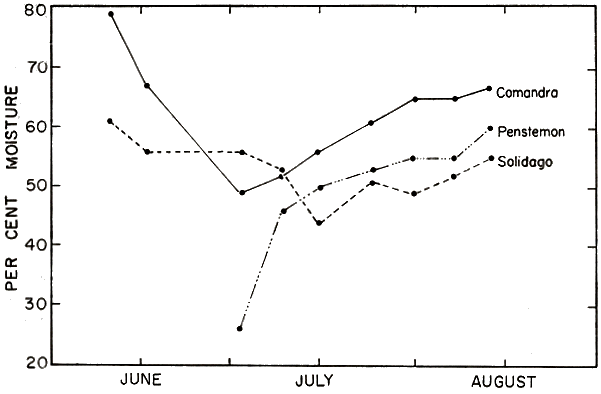
The graph in Figure 20 shows that Comandra contains the highest percentage of water through most of the summer. Water content of both Penstemon and Comandra was greatly reduced in the dry period that occurred in early July. Solidago maintained a relatively constant percentage of moisture; perhaps its woody stem serves for water storage. The rains of July and August increased the percentage of moisture in the plants, but not to the extent expected. Neither Solidago nor Comandra reached the levels of hydration of early June. All plants were collected at or about 11 A. M. At night, when mice are active, these plants would be expected to contain a higher percentage of water than in the daytime.
The data in Figure 20 indicate that mice probably are not endangered by water shortages in most years. The average percentage of moisture in the plants studied was as follows: Comandra umbellata 62.33 per cent; Solidago petradoria 53.0 per cent; Penstemon linarioides 49.28 per cent. If a mouse were to eat ten grams of plant material containing 50 per cent moisture, it would provide him with five grams of food and five grams of water, both of which exceed the minimum daily needs for non-pregnant adults of either species.
The data indicate that there are sufficient differences in water consumption between P. maniculatus and P. truei to account for their habitat preferences in Mesa Verde National Park. In years having average precipitation, water present in the vegetation has the potential for providing enough moisture for the needs of both species. Extended drought would affect individuals of P. truei more adversely than individuals of P. maniculatus.
Fig. 20: Graph showing percentages of moisture contained during the summer of 1964, by three abundant and widely-distributed species of plants in Mesa Verde National Park, Colorado.
Parasitism
Ectoparasites were collected by placing specimens of Peromyscus in separate plastic bags soon after death, adding cotton saturated with carbon tetrachloride, closing the bag for about five minutes, then brushing the fur of the specimen above a sheet of white paper. The ectoparasites were sorted and sent to specialists for identification. Endoparasites were saved when stomach and intestinal contents were examined. Larvae of botflies were collected from mice in the autumn of 1962, placed in sand in containers, and kept over winter until they hatched. Eyelids of alcoholic specimens were inspected for mites by an authority on these organisms.
In 1961, the incidence of parasitism by botflies was the highest for the period 1960-1966. P. maniculatus was more heavily infected with warbles than was P. truei. In 84 individuals of P. maniculatus taken in September 1961, from Morfield Ridge, 32.1 per cent had warbles. The average number of warbles per animal was 1.24, and it was not uncommon to find two or three warbles per mouse. Sixty-nine per cent of the warbles were in the third instar stage, and the rest were in the second instar stage. Warble infestation was higher in the first half of September (40 per cent of mice infected) than in the second half of the month (30 per cent infected), but a larger percentage of the warbles were found (69 per cent) in the second half of the month.
In October 1961, 12.9 per cent of 62 P. truei were infected with warbles. The average number of warbles per infected mouse was 1.37. Seventy-three per cent of the warbles were in the third instar stage; the rest were in the second instar stage. Warble infestation was higher in the first half of October (16 per cent of the mice infected) than in the second half of the month (5.5 per cent infected). These mice were collected from several localities on Chapin Mesa, in pinyon-juniper woodland.
In Mesa Verde the greatest incidence of infestations is in late September and early October. This agrees with the finding of other investigators (Sealander, 1961:58).
Sealander (1961) investigated hematological values in deer mice infected with botflies, and found that infected mice had significantly lower concentrations of hemoglobin than non-infected mice. Myiasis, associated with infection by Cuterebra, is likely to lead to a lowering of the physiological resistance of a segment of the population, and perhaps to a subsequent decline in the population (Sealander, 1961:60).
Mice infected by warbles were less agile than non-infected mice. Other investigators also have reported awkwardness in locomotion in infected mice (Scott and Snead, 1942:95; Sealander, 1961:58). Test and Test (1943:507) noted that parasitized mice did not appear to be emaciated, and this was also true of parasitized mice at Mesa Verde. Healed wounds, where warbles had emerged, were apparent on a number of mice. The warbles, and wounds, usually were found on the flanks and backs of the mice. The large, third instar larvae weighed about one gram apiece; there is little doubt that such large larvae induce trauma in their hosts.
The highest rate of infestation by botflies occurred in 1961, the year in which the population density of P. maniculatus was near its peak. The population of this species was reduced considerably in 1962, and remained low through 1964. In 1965, the density of P. maniculatus appeared to be increasing. Other investigators have reported that increased incidence of Cuterebra infestation in deer mice coincides with lower population densities and with a downward trend in the population (Scott and Snead, 1942:95; Wilson, 1945). My data indicate that this may not be the situation in Mesa Verde.
The intestines or stomachs of almost all individuals of P. maniculatus contained parasites. Endoparasites were less abundant in individuals of P. truei. This heavier infestation of P. maniculatus by tapeworms, roundworms, and spiny-headed worms probably reflects the larger proportion of insects eaten by P. maniculatus than by P. truei.
The most common endoparasite encountered was the nematode, Mastophorus numidica Seurat, 1914; it was found in the stomachs of many individuals of both species of Peromyscus. This nematode has been reported from Felis ocreata in Algeria, Bitis arietans in the Congo, and from the following mammals in the United States: Canis latrans, Peromyscus crinitus, P. gossypinus, P. maniculatus, P. truei, Onychomys leucogaster, Dipodomys ordii, Reithrodontomys megalotis, and Eutamias minimus.
Individuals of P. maniculatus obtained on the northern end of Wetherill Mesa in May and June of 1962 had numerous ectoparasites. At this time, the population of P. maniculatus was high, but on a downward trend.
My data and observations lead me to conclude that individuals of P. maniculatus are more heavily parasitized by both botflies and endoparasites than are individuals of P. truei. The reasons for this unequal amount of parasitism in two species of mice occurring in the same general area remain obscure.
The kinds of endoparasites and ectoparasites collected from P. maniculatus and from P. truei are listed below (m = present in P. maniculatus, t = present in P. truei).
Acarina: Ixodidae: Dermacentor andersoni mt, Ixodes angustus mt, Ixodes spinipalpis m. Laelaptidae: Androlaelaps glasgowi m. Myobiidae: Blarinobia sp. m. Trombiculidae: Euschoengastia lanei mt, Euschoengastia criceticola m, Euschoengastia dicipiens t, Euschoengastia peromysci m, Leewenhoekia americana m, Trombicula loomisi m.
Diptera: Cuterebridae: Cuterebra cyanella mt.
Siphonaptera: Callistopsyllus deuterus m, Catallagia decipiens m, Epetedia stanfordi mt, Malaraeus sinomus mt, Malaraeus telchinum mt, Megarthroglossus procus mt, Monopsyllus wagneri wagneri mt, Orchopeas leucopus mt, Peromyscopsylla hesperomys adelpha mt, Phalacropsylla allos t, Rhadinopsylla sectilis goodi t, Stenistomera macrodactyla m, Stenoponia (ponera or americana) mt.
Cestoda: Choanotaenia sp. m, Hymenolepis sp. t.
Nematoda: Mastophorus numidica mt, Syphacia obvelata mt, Trichuris stansburyi t.
Acanthocephala: Moniliformis clarki mt.
Predation
In order to determine the relative numbers of each species of Peromyscus that were taken on a seasonal basis by predators, scats of coyotes and foxes were collected from trails and roads at least twice each month, from September 1963 through August 1964. Scats were identified, labeled and dried; all bones and samples of hair were later removed from each scat. Scats that were intermediate in size between the droppings of foxes and coyotes, and that could not be identified readily in the field, were not collected. Bones from the scats were identified to species, and hair was identified to genus or species by comparing color patterns or cuticular patterns with samples from known mammals. More than 200 impression slides and whole mounts of guard hair and underfur were prepared.
Seven individuals of P. truei and three individuals of P. maniculatus were represented in 114 coyote scats (Table 13). Both species of Peromyscus comprised only 3.9 per cent of the 253 items of food represented in the 114 scats. Rabbits, Sylvilagus sp. and mule deer, Odocoileus hemionus were the major food items of coyotes. Mice of the genus Peromyscus apparently were preyed upon mostly in autumn (September through November), when mouse populations were near their yearly peaks.
Foxes also prey upon Peromyscus in the park. One P. truei was represented in the 16 scats of foxes that were analyzed. This individual was taken in the winter quarter (December through February).
The bobcat may be an important predator upon Peromyscus in this region, but few scats of this animal were found. Since these could not be assigned to a specific month, they were not saved for analysis. Anderson (1961:58) believed that bobcats and gray foxes were the most abundant predators in the park. My observations over a period of two years led me to conclude that coyotes were more abundant than foxes and that foxes were, in turn, more abundant than bobcats.
Table 13—Food Present in 114 Coyote Scats Collected at Mesa Verde National Park each Month from September 1963 through August 1964.
Food Item Number of occurrences Percentage of total items
Sylvilagus sp. 32 12.65
Spermophilus variegatus 5 1.97
Eutamias sp. 12 4.74
Reithrodontomys megalotis 4 1.58
Peromyscus boylei 2 0.79
Peromyscus maniculatus 3 1.18
Peromyscus truei 7 2.76
Neotoma cinerea 2 0.79
Neotoma mexicana 9 3.56
Neotoma albigula 5 1.97
Neotoma sp. 3 1.18
Microtus longicaudus 1 0.39
Microtus mexicanus 11 4.34
Microtus montanus 1 0.39
Microtus sp. 1 0.39
Odocoileus hemionus 59 23.32
Grass 34 13.44
Juniper berries 23 9.09
Pinyon needles 14 5.53
Pinyon nuts 1 0.39
Arthropods 7 2.76
Juniper needles 3 1.18
Rodent or Lagomorph bones 5 1.97
Sceloporus sp. 1 0.39
Unidentified fruit 2 0.79
Rocks 3 1.18
Paper 4 1.58
Soil 3 1.18
Feathers 5 1.97
Total 253
Hawks, owls and eagles live in the park. Red-tailed hawks were seen frequently in the burned area on the northern end of Wetherill Mesa. Both hawks and owls probably prey upon Peromyscus in Mesa Verde, for they are well-known predators upon mice and small rodents in other areas. I tried to find owl and hawk nests that were occupied, but located only nests that were abandoned or impossible to reach.
Captive gopher snakes, Pituophis melanoleucus, ate adults of both species of Peromyscus. Gopher snakes probably are the most abundant snake in the park; they feed mostly on mice and other rodents. Fur of Peromyscus was found in the stomach of a striped whipsnake, Masticophis taeniatus (Douglas, 1966:734).
Discussion
Five species of Peromyscus inhabit Mesa Verde National Park (Anderson, 1961). Two of these species, P. crinitus and P. difficilis are rare, and none was taken in more than 14,000 trap nights. Several individuals of P. boylei were taken in live traps, but this species could not be regarded as common. The two remaining species, P. truei and P. maniculatus, are the most abundant species in the park. Comparison of the habitats and life-cycles of these two forms and analyses of their interrelationships have been the objectives of this study.
The distribution of P. truei in the park is regulated by the presence of living pinyon-juniper woodland where logs and hollow trees of Juniperus osteosperma provide nesting and hiding places, and where seeds of juniper trees and nuts of pinyon trees provide food. Several other investigators have reported P. truei to be associated with trees, but apparently these findings have not assumed the importance they warrant in understanding the ecology of this species. Bailey (1931:152) observed an individual of P. truei nesting in a tree on Conchas Creek, New Mexico, and thought that this species might be more arboreal than was generally supposed. The type specimen of P. t. truei was taken by Shufeldt from a "nest protruding from an opening in the dead and hollow trunk of a small pinon, at least 2 feet above the ground#8230. The nest, composed of the fine fibers of the inner bark of the pinon, was soon pulled out, and its owner dislodged...." (Shufeldt, 1885:403). Individuals of P. truei usually build nests in trees, or in hollow logs, and are therefore more abundant in pinyon-juniper woodland where there are many such nesting sites.
Rocks and stones are not necessary in the habitat of P. truei, although this species was most abundant where there was stony soil. The coincidence of rock or stones and a high density of P. truei is thought to be explainable in terms of vegetation. Stony soils support mixed shrubs as well as pinyon and juniper trees; the additional cover and source of food probably allow a greater abundance of P. truei than would be possible without the shrubs. Secondarily, the rock provides nesting sites for more mice.
Stands of mixed shrubs, lacking a pinyon-juniper canopy, do not support P. truei. Its absence was noteworthy on Navajo Hill and on the northern end of Wetherill Mesa where only P. maniculatus lived among the mixed shrubs and grassland. On the Mesa Verde, pinyon and juniper trees must be present in order for P. truei to live in an area; and, these trees must be alive. Dead pinyons and junipers still stand in the burned part of Morfield Ridge, but no P. truei were found there.
Although a few individuals of P. truei were taken in stands of sagebrush adjacent to pinyon-juniper woodlands, this species does not ordinarily venture far from the forest.
P. maniculatus lives almost everywhere in Mesa Verde; the preferred habitats are open and grassy with an overstory of mixed shrubs. Individuals of P. maniculatus venture into ecotonal areas lying between grasslands and pinyon-juniper forest, or between sagebrush and pinyon-juniper forest. P. maniculatus is found also in disturbed areas and in stands of sagebrush that occur in clearings of the pinyon-juniper woodland. In such areas, P. maniculatus and P. truei are sympatric; their home ranges overlap and any inter-specific competition that might occur would be expected in these places.
The ability of P. maniculatus to live in many different habitats is correlated in part with its ability to build nests in a variety of sites. Whereas P. truei usually builds nests only in dead branches or logs, P. maniculatus builds nests in such varied places as spaces under rocks, at the bases of rotten trees, and in abandoned tunnels of pocket gophers. This adaptability is advantageous for the dispersal of young individuals and the movement of adults into new areas.
Nesting sites have important bearing on survival of the young. In Mesa Verde the rainy season occurs in July and August, while both species of Peromyscus are reproducing. It is reasonable to assume that young animals that remain dry survive better than those that become wet and chilled. The nestling young of P. truei are in a more favorable position to remain dry and warm than are nestling young of P. maniculatus.
Captives of each species differed in the amounts of water consumed per gram of body weight. Individuals of P. truei consumed more water per gram of body weight than individuals of P. maniculatus. Animals may drink more water than they require when allowed to drink ad libitum, but Lindeborg (1952) has shown that species which consume less water when it is not restricted also fare better on a reduced ration. P. maniculatus appears to be better adapted to aridity than P. truei. The preferred habitats of each species are in accord with these findings.
Within the trapping grid, the most moderate microenvironment, in terms of temperature and humidity, was in the pinyon-juniper forest, where P. truei lives. The temperature extremes were wider in the microenvironments of a thicket of oak brush and of two different stands of sagebrush, where P. maniculatus lives, than in the forest. P. maniculatus tends to live in the harsher, more arid parts of Mesa Verde. Because of its propensity to build nests under things, or in the ground, and because of its ability to use less water per gram of body weight, P. maniculatus is better adapted to withstand harsh environments than is P. truei.
P. truei may be restricted to the pinyon-juniper woodland because of its need for more mesic conditions. Still, Mesa Verde is semi-arid and there are few permanent sources of water available for animals. The primary source of moisture for rodents must be their food. Analysis of the percentages of moisture contained in the three most common plants in the trapping grid showed that P. truei could obtain the required moisture by eating about ten grams of these plants daily; individuals of P. maniculatus would need to eat less in order to satisfy their water needs.
Individuals of P. truei died more frequently in warm live-traps than did individuals of P. maniculatus. This indicates that P. truei can tolerate less desiccation, or a narrower range of temperatures, than can P. maniculatus.
Both species of mice eat some of the same plants, but these plants occur widely. P. truei seems to rely more upon the nuts of pinyons and the seeds of junipers than does P. maniculatus. Mounds of discarded juniper seeds were associated with all nesting sites of P. truei. Bailey (1931:153) also noticed the fondness of this species for pine nuts and juniper seeds. Apparently, the availability of these foods is one of the major factors affecting the distribution of P. truei. However, this is not the only factor, as is shown by the presence of P. maniculatus but lack of P. truei in a juniper-pinyon association with an understory of bitterbrush. This habitat was seemingly too arid for P. truei.
Factors Affecting Population Densities
The production of young, and success in rearing them, is essential to continuity of any population. P. maniculatus is favored in this respect, because the females produce more young and wean them sooner than do females of P. truei. In addition, lactating females of P. maniculatus require significantly less water than do females of P. truei. Since young mice of both species require no more water per gram of body weight than do adults, the young can disperse into any area that is habitable by their species. P. maniculatus probably is affected less by prolonged drought than is P. truei. Since lactating females require the most water of any animal in the population, they are the weakest link in the system. Females of Peromyscus are known to reabsorb embryos when conditions are unfavorable for continued pregnancy. If prolonged drought occurred in the reproductive season, and desiccated the vegetation upon which the mice depend for moisture, the populations should diminish the following year. Lactating females of P. truei would be affected more seriously by a shortage of water than would lactating females of P. maniculatus.
Of two species, the one producing the more young probably would be subjected to more parasitism and predation than the species producing fewer young. A favorable season for botflies, Cuterebra sp., revealed that P. maniculatus has a higher incidence of parasitism by these flies than has P. truei; possibly the adult flies concentrate in the open, grassy areas where P. maniculatus is more abundant, rather than in the woodlands where P. truei lives. Perhaps the lower parasitism of P. truei by warbles is related to the physiology of this species of mouse. Near Boulder, Colorado, the incidence of infection by warbles is lower in P. difficilis, a species closely related to P. truei, than in P. maniculatus (V. Keen, personal communication).