STRUCTURAL GEOLOGY.
Reading edition

In geology, just as in biology, there are two ways of studying structure,—the small way and the large way. In the case of an organism, we may select a single part or organ, and, disregarding its external form and relations to other parts, observe its composition and minute structure, the various forms and arrangements of the cells, etc. This is histology, and it is the complement of that larger method of studying structure which is ordinarily understood by anatomy.
The divisions of structural geology corresponding to histology and anatomy are lithology and petrology. Lithology is an in-door science; we use the microscope largely, and work with hand specimens or thin sections of the rocks, observing the composition and those small structural features which go under the general name of texture.
In petrology, on the other hand, we consider the larger kinds of rock-structure, such as stratification, jointing, folds, faults, cleavage, etc.; and it is essentially an out-door science, since to study it to the best advantage we must have, not hand specimens, but ledges, cliffs, railway-cuttings, gorges, and mountains.
LITHOLOGY.
A rock is any mineral, or mixture of minerals, occurring in masses of considerable size. This distinction of size is the only one that can be made between rocks and minerals, and that is very indefinite. A rock, whether composed of one mineral or several, is always an aggregate; and therefore no single crystal or mineral-grain can properly be called a rock.
Before proceeding to study particularly the various kinds of rocks, a little more preliminary work should be done. As already intimated, the more important characteristics of rocks may be grouped under two general heads,—composition and texture.
Composition of Rocks.
Rocks are properly defined as large masses or aggregates of mineral matter, consisting in some cases of one and in other cases of several mineral species. Hence it is clear that the composition of rocks is of two kinds: chemical and mineralogical; for the various chemical elements are first combined to form minerals, and then the minerals are combined to form rocks.
Of course those minerals and elements which can be described as principal or important rock-constituents must be the common minerals and elements. Now it is a very important and convenient fact that although chemists recognize about sixty-five elementary substances, and these are combined to form nearly one thousand mineral species, yet both the common elements and the common minerals are few in number.
So that, although it is very desirable and even necessary for the student of lithology to know something of chemistry and mineralogy, it by no means follows that he or she must be master of those sciences. A knowledge of the chemical and physical characteristics of a few common minerals is all that is absolutely essential, though it may be added that an excess of wisdom in these directions is no disadvantage.
Chemical Composition of Rocks.
The elementary substances of which rocks are chiefly composed, which make up the main mass of the earth so far as we are acquainted with it, number only fourteen:—
Non-Metallic or Acidic Elements.—Oxygen, silicon, carbon, sulphur, chlorine, phosphorus, and fluorine.
Metallic or Basic Elements.—Aluminum, magnesium, calcium, iron, sodium, potassium, and hydrogen.
The elements are named in each group in about the order of their relative abundance; and to give some idea of the enormous differences in this respect it may be stated that two of the elements—oxygen and silicon—form more than half of the earth’s crust.
Silicon, calcium, and fluorine, although exceedingly abundant, are also very difficult to obtain in the free or uncombined state, and specimens large enough to exhibit to a class would be very expensive. With these exceptions, however, examples of these common rock-forming elements are easily obtained.
My purpose in calling attention to this point is simply to suggest that the proper way to begin the study of minerals and rocks with children is to first familiarize them with the elements of which they are composed. The most important thing to be known about any mineral is its chemical composition; and when a child is told that a mineral—corundum, for example—is composed of oxygen and aluminum, he should have a distinct conception of the properties of each of those elements, for otherwise corundum is for him a mere compound of names.
It is very important, too, if the pupil has not already studied chemistry, that he should be led to some comprehension of the nature of chemical union and of the difference between a chemical compound and a mechanical mixture. For this purpose a few simple experiments (the details of which would be out of place here) with the more common and familiar elements will be sufficient. Mrs. Richard’s “First Lessons in Minerals” should be introduced here.
Mineralogical Composition of Rocks.
The fourteen elements named above are combined to form about fifty minerals with which the student of geology should be acquainted; but not more than one-half of these are of the first importance. It is desired to lay especial emphasis upon the importance of a perfect familiarity with these few common minerals. There is nothing else in the whole range of geology so easily acquired which is at the same time so valuable; for it is entirely impossible to comprehend the definitions of rocks, or to recognize rocks certainly and scientifically, unless we are acquainted with their constituent minerals.
With one or two exceptions, these common rock-forming minerals may be easily distinguished by their physical characters alone, so that their certain recognition is a matter of the simplest observation, and entirely within the capacity of young children. Furthermore, being common, specimens of these minerals are very easily obtained, so that there is no reason why teachers should not here adopt the best method and place a specimen of each mineral in the hands of each pupil. Typical examples, large enough to show the characteristics well, ought not to cost, on the average, over two cents apiece.
A MINERAL is an inorganic body having theoretically a definite chemical composition, and usually a regular geometric form.
The Principal Characteristics of Minerals.—These may be grouped under the following general heads:—
(1) Composition, (2) Crystalline form, (3) Hardness, (4) Specific gravity, (5) Lustre, (6) Color and Streak.
1. Composition.—This, according to the definition of a mineral, ought to be definite, and expressible by a chemical formula. When it is not so, we usually consider that the mineral is partially decomposed, or that we are dealing with a mixture of minerals. It is well to impress upon the mind of the pupil the important fact that the more fundamental properties of the elements, such as specific gravity and lustre, are not lost when they combine, but may be traced in the compounds. In other words, the properties of minerals are, in a very large degree, the average of the properties of the elements of which they are composed; minerals in which heavy metallic elements predominate being heavy and metallic, and vice versa.
To fully appreciate this point it is only necessary to compare a mineral like galenite—a common ore of lead, and containing nearly 87 per cent. of that heavy metal; or hematite (specimen 13), containing 70 per cent. of another heavy metal, iron—with quartz (specimen 15), which is composed in nearly equal parts of oxygen and silicon, two typical non-metallic elements. Many minerals contain water, i.e., are hydrated. Now water, whether we consider the liquid or solid state, is one of the lightest and softest of mineral constituents; and it is a very important fact that hydrated minerals are invariably lighter and usually softer than anhydrous species of otherwise similar composition. Other striking illustrations of this principle will be pointed out in the descriptions of the minerals which follow.
2. Crystalline form.—A crystal is bounded by plane surfaces symmetrically arranged with reference to certain imaginary lines passing through its centre and called axes. Crystals of the same species are always constant in the angles between like planes, while similar angles usually vary in different species; so that each species has its own peculiar form.
“Besides external symmetry of form, crystallization produces also regularity of internal structure, and often of fracture. This regularity of fracture, or tendency to break or cleave along certain planes, is called cleavage. The surface afforded by cleavage is often smooth and brilliant (see specimens 17, 18, and 21), and is always parallel with some external plane of the crystal. It should be understood that the cleavage lamellæ are not in any sense present before they are made to appear by fracture.”—(Dana.)
Crystals are arranged in six systems, based upon the number and relations of the axes, as follows:—
Isometric System.—Three equal axes crossing at right angles. Example, cube.
Tetragonal System.—Two axes equal, third unequal, all crossing at right angles. Example, square prism.
Orthorhombic System.—Three unequal axes, but intersections all at right angles. Example, rhombic prism.
Monoclinic System.—Three unequal axes, one intersection oblique. Example, oblique rhombic prism.
Triclinic System.—Three unequal axes, all crossing obliquely. Example, oblique rhomboidal prism.
Hexagonal System.—Three equal axes lying in one plane and intersecting at angles of 60°, and a fourth axis crossing each of these at right angles and longer or shorter. Example, hexagonal prism.
By the truncation and bevelment of the angles and edges of these fundamental forms a vast variety of secondary forms are produced. The limits of the guide will not permit us to follow this topic farther; but it may be added that for the proper elucidation of even the simpler crystalline forms the teacher should be provided with a set of wooden crystal models and Dana’s “Text-Book of Mineralogy.”
The crystallization of a mineral may be manifested in two ways: first, by the regularity of its internal structure or molecular arrangement, as shown by cleavage and the polarization of transmitted light; and, second, by the regularity of external form which follows, under favorable conditions, as a necessary consequence of symmetry in the arrangement of the molecules.
When a mineral is entirely devoid of crystalline structure, both externally and internally, it is said to be amorphous.
Perfect and distinct crystals are the rare exception, most mineral specimens being simply aggregates of imperfect crystals. In such cases, and when the mineral is amorphous, the structure of the mass may be:—
Columnar or fibrous.
Lamellar, foliaceous, or micaceous.
Granular.—When the grains or crystalline particles are invisible to the naked eye the mineral is called impalpable, compact, or massive.
And the external form of the mass may be:—
Botryoidal, having grape-like surfaces.
Stalactitic, forming stalactites or pendant columns.
Amygdaloidal or Concretionary, forming separate globular masses in the enclosing rock.
Dendritic, branching or arborescent.
3. Hardness.—By the hardness of a mineral we mean the resistance which it offers to abrasion. But hardness is a purely relative term, calcite, for example, being hard compared with talc, but very soft compared with quartz. Hence mineralogists have found it necessary to select certain minerals to be used as a standard of comparison for all others, and known as the scale of hardness. These are arranged at nearly equal intervals all the way from the softest mineral to the hardest, as follows:—
Scale of Hardness.
(1) Talc.
(2) Gypsum.
(3) Calcite.
(4) Fluorite.
(5) Apatite.
(6) Orthoclase.
(7) Quartz.
(8) Topaz or Beryl.
(9) Corundum.
(10) Diamond.
If a mineral scratches calcite and is scratched by fluorite, we say its hardness is between 3 and 4, perhaps 3.5; if it neither scratches nor is scratched by orthoclase, its hardness is 6; and so on. There are very few minerals harder than quartz, and hence the first seven members of the scale are sufficient for all ordinary purposes; and these are all included in the series of specimens accompanying this Guide.
Although it is desirable to be acquainted with the scale of hardness, and to understand how to use it, still the student will learn, after a little practice, that almost as good results may be obtained much more conveniently by the use of his thumb-nail and a good knife-blade or file. Talc and gypsum are easily scratched with the nail; calcite and fluorite yield easily to the knife or file, apatite with more difficulty; while orthoclase is near the limit of the hardness of ordinary steel, and quartz is entirely beyond it.
4. Specific Gravity.—The specific gravity of a mineral, by which we mean its weight as compared with the weight of an equal volume of water, is determined by weighing it first in air and then in water, and dividing the weight in air by the difference of the two weights. Minerals exhibit a wide range in specific gravity; from petroleum, which floats on water, to gold, which is nearly twenty times heavier than water. Although this is one of the most important properties of minerals, yet, being more difficult to measure than hardness, it is less valuable as an aid in distinguishing species. One can with practice, however, estimate the density of a mineral pretty closely by lifting it in the hand.
5. Lustre.—Of all the properties of minerals depending on their relations to light the most important is lustre, by which we mean the quality of the light reflected by a mineral as determined by the character or minute structure of its surface. Two kinds of lustre, the metallic and vitreous, are of especial importance; in fact all other kinds are merely varieties of these.
The metallic lustre is the lustre of all true metals, as copper and tin, and characterizes nearly all minerals in which metallic elements predominate. The vitreous lustre is best exemplified in glass, but belongs to most minerals composed chiefly of non-metallic elements. Metallic minerals are always opaque, but vitreous minerals are often transparent.
Other kinds of lustre are the adamantine (the lustre of diamond), resinous, pearly, and silky. When a mineral has no lustre, like chalk, it is said to be dull.
It should be made clear to children that lustre and color are entirely distinct and independent. Thus, iron, copper, gold, silver, and lead are all metallic; while white or colorless quartz, black tourmaline, green beryl, red garnet, etc., are all vitreous. Generally speaking, any color may occur with any lustre.
6. Color and Streak.—The colors of minerals are of two kinds,—essential and non-essential. By the essential color in any case we mean the color of the mineral itself in its purest state. The non-essential colors, on the other hand, are chiefly the colors of the impurities contained in the minerals.
Metallic minerals, which are always opaque, usually have essential colors; but vitreous minerals, which are always more or less transparent, often have non-essential colors. The explanation is this: In opaque minerals we can only see the impurities immediately on the surface, and these are, as a rule, not enough to affect its color; but in diaphanous minerals we look into the specimen and see impurities below the surface, and thus bring into view, in many cases, sufficient impurity so that its color drowns that of the mineral.
To prove this we have only to take any mineral (serpentine is a good example in our series) having a non-essential color, and make it opaque by pulverizing it or abrading its surface, when the non-essential color, the color of the impurity, immediately disappears; just as water, yellow with suspended clay, becomes white when whipped into foam, and thus made opaque.
What we understand by the streak of a mineral is its essential color, the color of its powder; and it is so called because the powder is most readily observed by scratching the surface of the mineral, and thereby pulverizing a minute portion of it. The streak and hardness are thus determined at the same time. The streak of soft minerals is easily determined by rubbing them on any white surface of suitable hardness, as paper, porcelain, or Arkansas stone.
Essential and Accessory Minerals.—Lithologists, regarding minerals as constituents of rocks, divide them into two great classes: the essential and the accessory. The essential constituents of a rock are those minerals which are essential to the definition of the rock. For example, we cannot properly define granite without naming quartz and orthoclase; hence these are essential constituents of granite; and if either of these minerals were removed from granite it would not be granite any longer, but some other rock. But other minerals, like tourmaline and garnet, may be indifferently present or absent; it is granite still; hence they are merely accidental or accessory constituents. They determine the different varieties of granite, while the essential minerals make the species.
This classification, of course, is not absolute, for in many cases the same mineral forms an essential constituent of one rock and an accessory constituent of another. Thus, quartz is essential in granite, but accessory in diorite.
Principal Minerals constituting Rocks.—Having studied in a general way the more important characteristics of minerals, brief descriptions of the chief rock-forming species are next in order. We will notice first and principally those minerals occurring chiefly as essential constituents of rocks.
1. Graphite.—Essentially pure carbon, though often mixed with a little iron oxide. Crystallizes in hexagonal system, but usually foliated, granular, or massive. Hardness, 1-2, being easily scratched with the nail. Sp. gr., 2.1-2.3. Lustre, metallic; an exception to the rule that acidic elements have non-metallic or vitreous lustres. Streak, black and shining (see pencil-mark on white paper). Color, iron-black. Slippery or greasy feel. Every black-lead pencil is a specimen of graphite. Specimen 9.
The different kinds of mineral coal are, geologically, as we have seen, closely related to graphite, but they are such familiar substances that they need not be described here.
2. Halite (common salt).—Chloride of sodium: chlorine, 60.7; sodium, 39.3; = 100. Isometric system, usually forming cubes. Hardness, 2.5, a little harder than the nail. Sp. gr., 2.1-2.6. Lustre, vitreous. Streak and color both white, and hence color is essential. Often transparent. Soluble; taste, purely saline. In specific gravity and lustre it is a good example of a mineral in which an acidic element predominates. Specimen 11.
3. Limonite.—Hydrous sesquioxide of iron: oxygen, 25; iron, 60; water, 15; = 100. Usually amorphous; occurring in stalactitic and botryoidal forms, having a fibrous structure; and also concretionary, massive, and earthy (yellow ochre). Hardness, 5-5.5. Sp. gr., 3.6-4. Lustre, vitreous or silky, inclining to metallic, and sometimes dull. Color, various shades of black, brown, and yellow. Streak, ochre-yellow; hence color partly non-essential. Specimen 12.
4. Hematite.—Sesquioxide of iron: oxygen, 30; iron, 70; = 100. Hexagonal system, in distinct crystals, but usually lamellar, granular, or compact,—columnar, botryoidal, and stalactitic forms being common. Hardness, 5.5-6.5; good crystals are harder than steel. Sp. gr., 4.5-5.3. Lustre, metallic, sometimes dull. Color, iron-black, but red when earthy or pulverized (red ochre). Streak, red, and color, therefore, mainly non-essential; sometimes attracted by the magnet. Specimen 13.
Hematite has the same composition as limonite, minus the water; and by comparing the hardness and specific gravity of these two minerals we see that they are a good illustration of the principle that hydrous minerals are softer and lighter than anhydrous minerals of analogous composition. Limonite and hematite are two great natural coloring agents, and almost all yellow, brown, and red colors in rocks and soils are due to their presence.
5. Magnetite.—Protoxide and sesquioxide of iron: oxygen, 27.6; iron, 72.4; = 100. Isometric system, usually in octahedrons or dodecahedrons. Most abundant variety is coarsely to finely granular, sometimes dendritic. Hardness, 5.5-6.5, same as hematite. Sp. gr., 4.9-5.2. Lustre, metallic. Color and streak, iron-black, and hence color essential. Strongly magnetic; some specimens have distinct polarity, and are called loadstones. Specimen 14.
The three iron-oxides just described—limonite, hematite, and magnetite—are all important ores of iron, and form a well-marked natural series. Thus limonite is never, hematite is usually, and magnetite is always, crystalline. Again, limonite with 60 per cent. of iron is never magnetic, hematite with 70 per cent. is sometimes magnetic, while magnetite with 72.4 per cent. is always magnetic. As the iron increases so does the magnetism. We have here an excellent illustration of the principle that the properties of the elements can be traced in those minerals in which they predominate. Iron is the only strongly magnetic element: magnetite contains more iron than any other mineral, and it is the only strongly magnetic mineral.
These three iron-ores are easily distinguished from each other by the color of their powders or streak,—limonite yellow, hematite red, and magnetite black,—and from all other common minerals by their high specific gravity.
6. Quartz.—Oxide of silicon or silica: oxygen, 53.33; silicon, 46.67; = 100. Hexagonal system. The most common form is a hexagonal prism terminated by a hexagonal pyramid. Also coarsely and finely granular to perfectly compact, like flint; the compact or cryptocrystalline varieties often assuming botryoidal, stalactitic, and concretionary forms. It has no cleavage, but usually breaks with an irregular, conchoidal fracture like glass. Hardness, 7, being No. 7 of the scale; scratches glass easily. Sp. gr., 2.5-2.8. Lustre, vitreous. Pure quartz is colorless or white, but by admixture of impurities it may be of almost any color. Streak always white or light colored. Quartz is usually, as in specimen 15, transparent and glassy, but may be translucent or opaque. It is almost absolutely infusible and insoluble.
The varieties of quartz are very numerous, but they may be arranged in two great groups:—
1. Phenocrystalline or vitreous varieties, including rock-crystal, amethyst, rose quartz, yellow quartz, smoky quartz, milky quartz, ferruginous quartz, etc.
2. Cryptocrystalline or compact varieties, including chalcedony, carnelian, agate, onyx, jasper, flint, chert, etc. Only three varieties, however, are of any great geological importance; these are: common glassy quartz (spec. 15), flint (spec. 16), and chert.
Quartz is one of the most important constituents of the earth’s crust, and it is also the hardest and most durable of all common minerals. We have already observed (p. 12) that it is entirely unaltered by exposure to the weather; i.e., it cannot be decomposed; and, being very hard, the same mechanical wear which, assisted by more or less chemical decomposition, reduces softer minerals to an impalpable powder or clay, must leave the quartz chiefly in the form of sand and gravel. This agrees with our observation that sand (spec. 30), especially, is usually merely pulverized quartz.
Opal is a mineral closely allied to quartz, and may be mentioned in this connection. It is of similar composition, but contains from 5 to 20 per cent. of water, and is decidedly softer and lighter. Hardness, 5.5-6.5; sp. gr., 1.9-2.3.
7. Gypsum.—Hydrous sulphate of calcium: sulphur trioxide (SO₃), 46.5; lime (CaO), 32.6; water (H₂O), 20.9; = 100. Monoclinic system. Often in distinct rhombic crystals; also foliated, fibrous, and finely granular. Hardness, 1.5-2; the hardest varieties being No. 2 of the scale of hardness. Sp. gr., 2.3. Lustre, pearly, vitreous, or dull. Color and streak usually white or gray. The principal varieties of gypsum are (a) selenite, which includes all distinctly crystallized or transparent gypsum; (b) fibrous gypsum or satin-spar; (c) alabaster, fine-grained, light-colored, and translucent. Gypsum is easily distinguished from all common minerals resembling it by its softness and the fact that it is not affected by acids. Specimen 17.
8. Calcite.—Carbonate of calcium: carbon dioxide (CO₂), 44; lime (CaO), 56; = 100. Hexagonal system, usually in rhombohedrons, scalenohedrons, or hexagonal prisms. Cleavage rhombohedral and highly perfect (specimen 18). Also fibrous and compact to coarsely granular, in stalactitic, concretionary, and other forms. Hardness, 2.5-3.5, usually 3 (see scale of hardness). Sp. gr., 2.5-2.75. Lustre, vitreous. Color and streak usually white. Transparent crystallized calcite is known as Iceland-spar, and is remarkable for its strong double refraction. When finely fibrous it makes a satin-spar similar to gypsum. Geologically speaking, calcite is a mineral of the first importance, being the sole essential constituent of all limestones. It is readily distinguished from allied species by its perfect rhombohedral cleavage; by its softness, being easily scratched with a knife; and above all by its lively effervescence with acids, for it is the only common mineral effervescing freely with cold dilute acid. To apply this test it is only necessary to touch the specimen with a drop of dilute chlorohydric acid. The effervescence, of course, is due to the escape of the carbon dioxide in a gaseous form. Specimen 18.
9. Dolomite.—Carbonate of calcium and magnesium: carbonate of calcium (CaCO₃), 54.35; carbonate of magnesium (MgCO₃), 45.65; = 100. Hexagonal system, being nearly isomorphous with calcite. Rhombohedral cleavage perfect. Hardness, 3.5-4; sp. gr., 2.8-2.9, being harder and heavier than calcite. Lustre, color, and streak same as for calcite, from which it is most easily distinguished by its non-effervescence or only feeble effervescence with cold dilute acid, though effervescing freely with strong or hot acid. Spec. 19.
10. Siderite.—Carbonate of iron: carbon dioxide (CO₂), 37.9; protoxide of iron (FeO), 62.1; = 100. Crystallization and cleavage essentially the same as for calcite and dolomite. Hardness, 3.5-4.5, and sp. gr., 3.7-3.9. Lustre, vitreous. Color, white, gray, and brown. Streak, white. With acid, siderite behaves like dolomite. It is distinguished from both calcite and dolomite by its high specific gravity, which is easily explained by the fact that it is largely composed of the heavy element, iron.
With one exception, the fifteen minerals which we have yet to study belong to the class of silicates, which includes more than one-fourth of the known species of minerals, and, omitting quartz and calcite, all of the really important rock-constituents. The silicate minerals may be very conveniently divided into two great groups, the basic and acidic. This is not a sharp division; on the contrary, there is a perfectly gradual passage from one group to the other; and yet this is, for geological purposes at least, a very natural classification. The dividing line falls in the neighborhood of 60 per cent. of silica; i.e., all species containing this proportion of silica or less are classed as basic, since in them the basic elements predominate; while those containing more than 60 per cent. of silica are classed as acidic, because their characteristics are determined chiefly by the acid element or silica. The principal bases occurring in the silicates, named in the order of their relative importance, are aluminum, magnesium, calcium, iron, sodium, and potassium; and of these, magnesium, calcium, iron, and usually sodium, are especially characteristic of basic species.
Iron is the heaviest base; but all the bases, except sodium and potassium, are heavier than the acid—silica; consequently basic minerals must be, as a rule, heavier than acidic minerals. And since basic minerals contain more iron than acidic, they must be darker colored. In general, we say, dark, heavy silicates are basic, and vice versa. All this is of especial importance because in the rocks nature keeps these two classes separate in a great degree.
11. Amphibole.—Silicate of aluminum, magnesium, calcium, iron, and sodium. The bases occur in very various proportions, forming many varieties; but the only variety of especial geological interest is hornblende, the average percentage composition of which is as follows: silica (SiO₂), 50; alumina (Al₂O₃), 10; magnesia (MgO), 18; lime (CaO), 12; iron oxide (FeO and Fe₂O₃), 8; and soda (Na₂O), 2; = 100. Monoclinic system: usually in rhombic or six-sided prisms which may be short and thick, but are more often acicular or bladed. Hardness, 5-6; sp. gr., 2.9-3.4. Lustre, vitreous; color, black and greenish black; and streak similar to color, but much paler. Compare with quartz, and observe the strong contrast in color possible with minerals having the same lustre. Specimen 20.
12. Pyroxene.—Like amphibole, this species embraces many varieties, and these exhibit a wide range in composition; but of these augite alone is an important rock-constituent. Hence in lithology we practically substitute for amphibole and pyroxene, hornblende, and augite respectively.
Augite is very similar in composition to hornblende, but contains usually more lime and less alumina and alkali. Physically, too, these minerals are almost identical, crystallizing in the same system and in very similar forms, and agreeing in hardness, color, lustre, and streak. Augite is heavier than hornblende, sp. gr., 3.2-3.5. A certain prismatic angle, which in augite is 87°5´, is 124°30´ in hornblende. Slender, bladed crystals are more common with hornblende than augite. When examined in thin sections with the polarizer, augite does not afford the phenomenon of dichroism, which is strongly marked in hornblende. However, as these minerals commonly occur in the rocks, in small and imperfect crystals, these distinctions can only be observed in thin sections under the microscope; so that, as regards the naked eye, they are practically indistinguishable.
It might appear at first that the distinction of minerals so nearly identical is not an important matter; but nature has decreed otherwise. Augite and hornblende are typical examples of basic minerals; but augite is, both in its composition and associations, the more basic of the two. In proof of this we need only to know that it very rarely occurs in the same rock with quartz, while hornblende is found very commonly in that association. Quartz in a rock means an excess of acid or silica, and almost necessarily implies the absence of highly basic minerals. In other words, hornblende is often, and augite very rarely, found in connection with acidic minerals; and it is this difference of association chiefly that makes their distinction essential to the proper recognition of rocks; while at the same time it affords an easy, though of course not absolutely certain, means of determining whether the black constituent of any particular rock is hornblende or augite.
Mica Family.—Mica is not the name of a single mineral, but of a whole family of minerals, including some half-dozen species. Only two, however,—muscovite and biotite,—are sufficiently abundant to engage our attention. These are complex, basic silicates of aluminum, magnesium, iron, potassium, and sodium. The crystallization of biotite is hexagonal, and of muscovite monoclinic; but both occur commonly in flat six-sided forms. Undoubtedly the most important and striking characteristic of the whole mica family is the remarkably perfect cleavage parallel with the basal planes of the crystals, and the wonderful thinness, and above all the elasticity, of the cleavage lamellæ. The cleavage contrasts the micas with all other common minerals, and makes their certain identification one of the easiest things in lithology. The micas are soft minerals, the hardness ranging from 2 to 3, and being usually easily scratched with the nail. Sp. gr. varies from 2.7-3.1. Lustre, pearly; and streak, white or uncolored.
The distinguishing features of muscovite and biotite are as follows:—
13. Muscovite.—Contains 47 per cent. of silica, 3 per cent. of sesquioxide of iron, and 10 per cent. of alkalies, chiefly potash; and the characteristic colors are white, gray, and, more rarely, brown and yellow. Non-dichroic. Usually found in association with acidic minerals. The mica used in the arts is muscovite. Specimen 21.
14. Biotite.—Contains only 36 per cent. of silica, 20 per cent. of oxide of iron, and 17 per cent. of magnesia; colors, deep black to green. Strongly dichroic. Commonly occurs with other basic minerals. Compare color with per cent. of iron.
These differences are tabulated below:—
Muscovite = Biotite =
Acidic mica. Basic mica.
Non-ferruginous mica. Ferruginous mica.
Potash mica. Magnesian mica.
White mica. Black mica.
Non-dichroic mica. Dichroic mica.
Feldspar Family.—Like mica, feldspar is the name of a family of minerals; and these are, geologically, the most important of all minerals. They are, above all others, the minerals of which rocks are made, and their abundance is well expressed in the name,—feldspar being simply the German for field-spar, implying that it is the common spar or mineral of the fields.
Chemically, the feldspars are silicates of aluminum and potassium, sodium or calcium. They crystallize in the monoclinic and triclinic systems; and all possess easy cleavage in two directions at right angles to each other, or nearly so. The general physical characters, including the cleavage, are well exhibited in the common species, orthoclase (specimen 22).
In hardness the feldspars range from 5 to 7, being usually near 6, and almost always distinctly softer than quartz. Sp. gr. varies from 2.5-2.75; lustre, from vitreous to pearly; color, from white and gray to red, brown, green, etc., but usually light. Streak, always white; rarely transparent. By exposure to the weather, feldspars gradually lose their alkalies and lime, become hydrated, and are changed to kaolin or common clay. A similar change takes place with the micas, augite, and hornblende; but these species, being usually rich in iron, make clays which are much darker colored than those derived from feldspars. The fact that the feldspars contain little or no iron undoubtedly explains their low specific gravity and light colors, as compared with the other minerals just named. The only common minerals for which the feldspars are liable to be mistaken are quartz and the carbonates. From the latter they are easily distinguished by their superior hardness and non-effervescence with acids; and from the former, by possessing distinct cleavage, by being rarely transparent, by being somewhat softer, and by changing to clay on exposure to the weather.
The feldspars of greatest geological interest are five in number, and may be classified chemically as follows:—
Orthoclase,—silicate of aluminum and potassium, or
potash feldspar.
Albite,—silicate of aluminum and sodium, or
soda feldspar.
Anorthite,—silicate of aluminum and calcium, or
lime feldspar.
Oligoclase,—silicate of aluminum and sodium, and calcium, or
soda-lime feldspar.
Labradorite,—silicate of aluminum and calcium, and sodium, or
lime-soda feldspar.
This appears like a complex arrangement, but it can be simplified. Orthoclase crystallizes in the monoclinic system, and all the other feldspars in the triclinic system. With the exception of albite, which is a comparatively rare species, the triclinic feldspars all contain less silica than orthoclase; i.e., are more basic. This is shown by the subjoined table giving the average composition of each of the feldspars:—
SiO₂ Al₂O₃ K₂O Na₂O CaO Total.
Orthoclase, 65 18 17 -- -- = 100
Albite, 68 20 -- 12 -- = 100
Oligoclase, 62 24 -- 9 5 = 100
Labradorite, 53 30 -- 4 13 = 100
Anorthite, 43 37 -- -- 20 = 100
As we should naturally expect, the triclinic feldspars occur usually with other basic minerals, while the monoclinic species, orthoclase, is acidic in its associations; furthermore, the triclinic feldspars are often intimately associated with each other, but are rarely important constituents of rocks containing much orthoclase. In other words, the distinction of orthoclase from the basic or triclinic feldspars is important and comparatively easy, while the distinction of the different basic feldspars from each other is both unimportant and difficult. Hence, in lithology, we find it best to put all these basic feldspars together, as if they were one species, under the name plagioclase, which refers to the oblique cleavage of all these feldspars, and contrasts with orthoclase, which refers to the right-angled cleavage of that species.
This statement of the relations of the feldspars is, of course, beyond the comprehension of many children, and yet it should be understood by the teacher who would lead the children to any but the most superficial views.
15. Orthoclase.—This is the common feldspar, and the most abundant of all minerals, being the principal constituent of granite, gneiss, and many other important rocks. The most characteristic colors are white, gray, pinkish, and flesh-red. Specimen 22.
16. Plagioclase.—Like orthoclase, these species may be of almost any color; yet these two great divisions of the feldspars are usually contrasted in this respect. Thus, bluish and grayish colors are most common with plagioclase, and white or reddish colors with orthoclase. Specimen 23 is labradorite, and, in every respect, a typical example of plagioclase. On certain faces and cleavage-surfaces of the plagioclase crystals we may often observe a series of straight parallel lines or bands which are often very fine,—fifty to a hundred in a single crystal. These striæ are due to the mode of twinning, and are of especial importance, since, while they are very characteristic of plagioclase, they never occur in orthoclase. As stated, these twinning striæ in plagioclase are often visible to the naked eye; and when they are not, they may usually be revealed by examining a thin section under the microscope with polarized light. Plagioclase decays much more rapidly when exposed to the weather than orthoclase. This point becomes perfectly clear when we compare weathered ledges of diabase (or any trap-rock, see specimen 2) and granite; for plagioclase is the principal constituent of the former rock, and orthoclase of the latter.
Hydrous Silicates.—Many silicates contain water, and some of these are of great geological importance. What has been stated on a preceding page concerning the softness and lightness of hydrated minerals is especially applicable here; for all the geologically important hydrous silicates are distinctly softer and lighter than anhydrous minerals of otherwise similar composition. Furthermore, they usually have an unctuous or slippery feel; and, with one exception (kaolin), are of a green or greenish color.
17. Kaolinite (Kaolin).—Hydrous silicate of aluminum: silica (SiO₂), 46; alumina (Al₂O₃), 40; and water (H₂O), 14; = 100. Orthorhombic system, in rhombic or hexagonal scales or plates, but usually earthy or clay-like. Hardness, 1-2.5; sp. gr., 2.4-2.65. The pure mineral is white; but it is usually colored by impurities, the principal of which are iron oxides and carbonaceous matter. Kaolin is the most abundant of all the hydrous silicates, and it is the basis and often the sole constituent of common clay,—a very common mineral, but rarely pure. We have already (p. 11) noticed the mode of origin of kaolin or clay. It results from the decomposition of various aluminous silicate minerals, especially the feldspars. Under the combined influence of carbon dioxide and moisture, feldspars give up their potassium, sodium, and calcium, and take on water, and the result is kaolin. This mineral is believed to be always a decomposition product. Perhaps the best, or at least the most convenient, test for kaolin is the argillaceous odor, the odor of moistened clay. Specimen 24.
18. Talc.—Hydrous silicate of magnesium: silica (SiO₂), 63 (acidic); magnesia (MgO), 32; water (H₂O), 5; = 100. Orthorhombic system, but rarely in distinct crystals. Cleavage in one direction very perfect; the cleavage lamellæ are flexible, but not elastic, as in mica. Hardness, 1; see scale. Sp. gr., 2.55-2.8. Lustre, pearly. Color, apple-green to white; and streak, white. The feel is very smooth and greasy; and, in connection with the color and foliation, affords the best means of distinguishing talc from allied minerals. Talc sometimes results from the alteration of augite, hornblende, and other minerals, but it is not always nor usually an alteration product.
19. Serpentine.—Hydrous silicate of magnesium: silica (SiO₂), 44 (basic); magnesia (MgO), 44; water (H₂O), 12; = 100. Essentially amorphous. Hardness, 2.5-4; sp. gr., 2.5-2.65. Lustre, greasy, waxy, or earthy. Color, various shades of green and usually darker than talc, but streak always white. Feel, smooth, sometimes greasy. Distinguished from talc by its hardness, compactness, and darker green. Sometimes results from the alteration of olivine and other magnesian minerals, but usually we are to regard it as an original mineral. Specimen 25.
20. Chlorite.—This is, properly, the name of a group of highly basic minerals of very variable composition, but they are all essentially hydrous silicates of aluminum, magnesium, and iron; and the average composition of the most abundant species, prochlorite, is as follows: silica (SiO₂), 30; alumina (Al₂O₃), 18; magnesia (MgO), 15; protoxide of iron (FeO), 26; and water (H₂O), 11; = 100. The chlorites crystallize in several different systems, but in all there is a highly perfect cleavage in one direction, giving, as in talc, a foliated structure with flexible but inelastic laminæ. The cleavage scales, however, are sometimes minute, and the structure massive or granular. Hardness of prochlorite, 1-2; between talc and serpentine. Sp. gr., 2.78-2.96. All the chlorites have a pearly to vitreous lustre. Color usually some shade of green; in prochlorite a dark or blackish green, darker than serpentine, as that is darker than talc. Streak, a lighter, whitish green. Less unctuous than talc, but more so than serpentine. The chlorites are produced very commonly, but not generally, by the alteration of basic anhydrous silicates, like augite and hornblende. Specimen 26.
21. Hydro-mica.—This, too, is properly the name of a group of minerals; but for geological purposes they may be regarded as one species. Taking a general view of the composition, these are simply the anhydrous or ordinary micas, which we have already studied, with from 5 to 10 per cent. of water added. In crystallization and structure they are essentially mica-like. Although not distinctly softer than the common micas, they are lighter, always more unctuous and slippery, and usually of a greenish color. The micaceous structure with elastic laminæ serves to distinguish the hydro-micas from other hydrous silicates.
22. Glauconite.—Hydrous silicate of aluminum, iron, and potassium: silica (SiO₂), 50; alumina (Al₂O₃), protoxide of iron (FeO), and potash (K₂O), together, 41; and water (H₂O), 9; = 100. Amorphous, forming rounded and generally loose grains, which often have a microscopic organic nucleus. It is dull and earthy, like chalk, and always soft, green, and light, but not particularly unctuous. Glauconite is the principal, often the sole, constituent of the rock greensand, which occurs abundantly in the newer geological formations, and is now forming in the deep water of the Gulf of Mexico and along our Atlantic sea-board. Specimen 27.
This completes our list of minerals occurring chiefly as essential constituents of rocks; and following are three of the more common and important minerals occurring chiefly as accessory, rarely as essential, rock-constituents.
23. Chrysolite (Olivine).—Silicate of magnesium and iron: silica (SiO₂), 41; magnesia (MgO), 51; protoxide of iron (Fe₂O₃), 8; = 100. Orthorhombic system; but usually in irregular glassy grains. Hardness, 6-7. Sp. gr., 3.3-3.5. Lustre, vitreous; color, usually some shade of green; and streak, white. Chrysolite sometimes closely resembles quartz, but its green color usually suffices to distinguish it. It is a common constituent of basalt and allied rocks. By absorption of water it is changed into serpentine and talc. See examples in specimen.
24. Garnet.—The composition of this mineral is extremely variable; but the most important variety is a basic silicate of aluminum and iron: silica (SiO₂), 37; alumina (Al₂O₃), 20; and protoxide of iron (FeO), 43; = 100. Isometric system, usually in distinct crystals, twelve-sided (dodecahedrons) and twenty-four-sided (trapezohedrons) forms being most common. Hardness, 6.5-7.5; average as hard as quartz. Sp. gr., 3.15-4.3; compare with the high percentage of iron. Lustre, vitreous; colors, various, usually some shade of red or brown; and streak, white. Some varieties contain iron enough to make them magnetic. Garnet is easily distinguished by its form, color, and hardness from all other minerals. It is a common but not an abundant mineral, occurring most frequently in gneiss, mica schist, and other stratified crystalline rocks. See examples in specimen.
25. Pyrite.—Sulphide of iron: sulphur, 53.3; iron, 46.7; = 100. Isometric system, occurring usually in distinct crystals, the cube and the twelve-sided form known as the pyritohedron being the most common. Hardness, 6-6.5, striking fire with steel. Sp. gr., 4.8-5.2; heavy because rich in iron. Lustre, metallic and splendent. Color, pale, brass-yellow, and streak, greenish or brownish. Pyrite is sometimes mistaken for gold, but it is not malleable; while its color, hardness, and specific gravity, combined, easily distinguish it from all common minerals. As an accessory rock-constituent, pyrite occurs usually in isolated cubes or pyritohedrons. Specimen 10.
Textures of Rocks.
Texture is a general name for those smaller structural features of rocks which can be studied in hand specimens, and which depend upon the forms and sizes of the constituent particles of the rocks, and the ways in which these are united.
By “constituent particles” we mean, not the atoms or molecules of matter composing the rocks, but the pebbles in conglomerate, grains of sand in sandstone, crystals of quartz, feldspar, and mica in granite, etc. The four most important textures are:—
(1) Fragmental texture.—The rock is composed of mere irregular, angular, or rounded, but visible, fragments. Examples: sand, sandstone, gravel, conglomerate, etc. Specimens 30, 31, 28, 29.
(2) Crystalline texture.—The constituent particles are chiefly, at least, distinctly crystalline, as shown either by external form, or cleavage, or both. Examples: granite, diabase, gneiss, etc. Specimens 45, 1, 41.
(3) Compact texture.—The constituent particles are indistinguishable by the naked eye, but become visible under the microscope, appearing as separate crystalline grains or as irregular fragments. In other words, if, in the case of either the granular or crystalline textures, we conceive the particles to become microscopically small, then we have the compact texture. Examples: clay, slate, many limestones, basalt, etc. Specimens 34, 35, 39.
(4) Vitreous texture.—The texture of glass, in which the constituent particles are absolutely invisible even with the highest powers of the microscope, and may be nothing more than the molecules of the substance, which thus, so far as our powers of observation are concerned, presents a perfectly continuous surface. Examples: obsidian, glassy quartz, and some kinds of coal. Specimens 47, 15.
These four textures, which, it will be observed, are determined by the forms and sizes of the constituent particles, may be called the primary textures, because every rock must possess one of them. We cannot conceive of a rock which is neither fragmental, crystalline, compact, nor vitreous. But in addition to one of the primary textures, a rock may or may not have one or more of what may be called secondary textures. These are determined by the way in which the particles are united, the mode or pattern of the arrangement, etc. Following are definitions of the principal secondary textures:—
(1) Laminated texture.—This exists where the particles are arranged in thin, parallel layers, which may be marked simply by planes of division, or the alternate layers may be composed of particles differing in composition, form, size, or color, etc. Among the laminated textures we thus distinguish: (a) the banded texture, where the layers are contrasted in color, texture, or composition, but cohere, so that there is no cleavage or easy splitting parallel with the stratification; and (b) the schistose or shaly texture, where such fissility or stratification-cleavage exists. If a fragmental, compact, or vitreous rock is fissile, we use the term shaly; but a fissile, crystalline rock is described as schistose. The banded texture may occur with the fragmental,—banded sandstones, etc.; with the crystalline,—many gneisses, etc. (specimen 41); with the compact,—many slates, limestones, felsites, etc. (specimens 34, 42); with the vitreous,—banded obsidian, furnace slags, and some coal. The schistose texture may occur with the crystalline,—mica schist, etc. (specimen 43); and the shaly texture with the compact and fragmental, but rarely with the vitreous.
(2) Porphyritic texture.—We have this texture when separate and distinct crystals of any mineral, but most commonly of feldspar, are enclosed in a relatively fine-grained base or matrix, which may be either crystalline, compact, or vitreous, but rarely fragmental. Specimens 5, 6, 7 are examples of the porphyritic compact texture.
(3) Concretionary texture.—When one or more constituents of a rock have the form, in whole or in part, not of distinct angular crystals, but of rounded concretions, the texture is described as concretionary, the concretions taking the place in this texture of the isolated crystals in the porphyritic texture. This texture occurs in connection with all the primary textures, but the most familiar example is oölitic limestone.
(4) Vesicular texture.—A rock has this texture when it contains numerous small cavities or vesicles. These are most commonly produced by the expansion of steam and other vapors when the rock is in a plastic state; and hence the vesicular texture is found chiefly in volcanic rocks. Except rarely, it is associated only with the compact texture,—ordinary stony lavas (specimen 49); and with the vitreous texture,—pumice (specimen 48).
(5) Amygdaloidal texture.—In the course of time the vesicles of common lava are often filled with various minerals deposited by infiltrating waters, giving rise to the amygdaloidal texture, from the Latin amygdalum, an almond, in allusion to a common form of the vesicles, or amygdules, as they are called, after being filled. The amygdaloidal texture is thus necessarily preceded by the vesicular, and is limited to the same classes of rocks. Specimen 50.
Besides the foregoing, there are many minor secondary textures. The rocks known as tufas have what may be called the tufaceous texture. Then we have kinds of texture depending on the strength of the union of the particles, as strong, weak, friable, earthy, etc.
Classification of Rocks.
Having finished our preliminary observations on the characteristics of rocks, we are now about ready to begin a systematic study of the rocks themselves; but it is needful first to say a few words about the classification of rocks, since upon this depends not only the order in which we shall take the rocks up, but also the ideas that will be imparted concerning their relations and affinities. The classifications which have been proposed at different times are almost as numerous as the rocks themselves. Some of these are confessedly, and even designedly, artificial, as when we classify stones according to their uses in the arts, etc. But we want something more scientific, a natural classification; that is, one based upon the natural and permanent characteristics of rocks. Rocks have been classified according to chemical composition, mineralogical composition, texture, color, density, hardness, etc.; but these arrangements, taken singly or all combined, are inadequate.
A natural classification may be defined as a concise and systematic statement of the natural relations existing among the objects classified. Now the most important relations existing among rocks are those due to their different origins. We must not forget that lithology is a branch of geology, and that geology is first of all a dynamical science. The most important question that can be asked about any rock is, not What is it made of? but How was it made? What were the general forces or agencies concerned in its formation? Rocks are the material in which the earth’s history is written, and what we want to know first concerning any rock is what it can tell us of the condition of that part of the earth at the time it was made and subsequently.
Classification of Rocks.
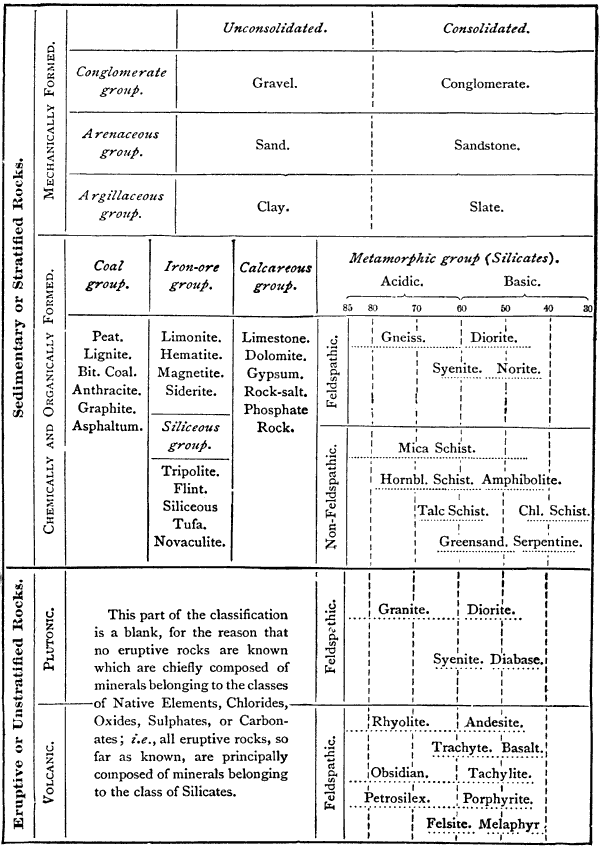
The geological agencies, as we have already learned, may be arranged in two great classes: first, the aqueous or superficial agencies originating in the solar heat, and producing the sedimentary or stratified rocks; and, second, the igneous or subterranean agencies originating in the central or interior heat, and producing the eruptive or unstratified rocks. Hence, we want to know first of any rock whether it is of aqueous or igneous origin. Then, if it is a sedimentary rock, whether it has been formed by the action chiefly of mechanical forces, or of chemical and organic forces. And, if it is an eruptive rock, whether it has cooled and solidified below the earth’s surface in a fissure, and is a dike or trappean rock, or has flowed out on the surface and cooled in contact with the air, and thus become an ordinary lava or volcanic rock.
Here we have the outlines of our classification, and it will be observed that we have simply reached the conclusion, in a somewhat roundabout manner, that there should always be a general correspondence between the classification of rocks and the classification of the forces that produce them. The general plan of the preceding scheme of the classification must now be clear, and the details will be explained as we go along.
Descriptions of Rocks.
1.—Sedimentary or Stratified Rocks.
1. Mechanically formed or Fragmental Rocks.—These consist of materials deposited from suspension in water, and the process of their formation is throughout chiefly mechanical. The materials deposited are mere fragments of older rocks; and, if the fragments are large, we call the newly deposited sediment gravel; if finer, sand; and, if impalpably fine, clay. These fragmental rocks cannot be classified chemically, since the same handful of gravel, for instance, may contain pebbles of many different kinds of rocks, and thus be of almost any and very variable composition. Such chemical distinctions as can be established are only partial, and the classification, like the origin, must be mechanical. Accordingly, as just shown, we recognize three principal groups based upon the size of the fragments; viz.:—
(1) Conglomerate group.
(2) Arenaceous group.
(3) Argillaceous group.
This mode of division is possible and natural, simply because, as we observed in an early experiment, materials arranged by the mechanical action of water are always assorted according to size. When first deposited, the gravel, sand, and clay are, of course, perfectly loose and unconsolidated; but in the course of time they may, under the influence of pressure, heat, and chemical action, attain almost any degree of consolidation, becoming conglomerate, sandstone, and slate, respectively. The pressure may be vertical where it is due to the weight of newer deposits, or horizontal where it results from the cooling and shrinking of the earth’s interior. The heat may result from mechanical movements, or contact with eruptive rocks; or it may be due simply to the burial of the sediments, which, it will be seen, must virtually bring them nearer the great source of heat in the earth’s interior, on the same principle that the temperature of a man’s coat, on a cold day, is raised by putting on an overcoat. The effect of the heat, ordinarily, is simply drying, coöperating with the pressure to expel the water from the sediments; but, if the temperature is high, it may bake or vitrify them, just as in brick-making. Sediments are consolidated by chemical action when mineral substances, especially calcium carbonate, the iron oxides, and silica are deposited between the particles by infiltrating waters, cementing the particles together. This principle is easily demonstrated experimentally by taking some loose sand and wetting it repeatedly with a saturated solution of some soluble mineral, like salt or alum, allowing the water to evaporate each time before making a fresh application. The interstices between the grains are gradually filled up, and the sand soon becomes a firm rock. But the student should clearly understand that, in geology, gravel, sand, and clay are just as truly rocks before their consolidation as after. It is plain then that in each of the principal groups of fragmental rocks we must recognize an unconsolidated division and a consolidated division.
(1) Conglomerate group.—The rocks belonging in this group we know before consolidation as gravel, and after consolidation as conglomerate.
Gravel.—The pebbles, as we have already seen, are usually, though not always, well rounded or water-worn; and they may be of any size from coarse grains of sand to boulders. As a rule, however, the larger pebbles, especially, are of approximately uniform size in the same bed or layer of gravel, with, of course, sufficient fine material to fill the interstices. Although the same limited mass of gravel may show the widest possible range in chemical and mineralogical composition, yet hard rocks are evidently more likely than soft rocks to form pebbles; and hence quartz and quartz-bearing rocks usually predominate in gravels. Specimen 28.
Conglomerate.—Consolidated gravel. Children should be led to an appreciation of this point by a careful comparison of the forms of the pebbles in the gravel and conglomerate. The conglomerate seems to contain a larger proportion of fine material than ordinary gravel. But this is because the gravel is usually, as with our specimen, taken from the surface of the beach, where, of course, the pebbles are clean and separate; but if it had remained there to be covered by a subsequently deposited layer, enough fine stuff would have been sifted into the holes to fill them. And in the finished gravel, just as in the conglomerate, the pebbles are usually closely packed, with just sufficient sand and clay, or paste, as the material in which the pebbles are imbedded is called, to fill the interstices. The paste is usually similar in composition to the pebbles, with this difference: hard materials predominate in the pebbles and soft in the paste.
Stratified rocks generally show the stratification in parallel lines or bands differing in color, composition, etc.; but nothing like this can be detected in our specimens of conglomerate; and the question might be asked, How do we know that this is a stratified rock? In answer, it can be said that our hand-specimens appear unstratified simply because the rock is so coarse; but when we look at large masses, and especially when we see it in place in the quarry, that parallel arrangement of the material which we call stratification is usually very evident; and we often see precisely the same thing in gravel banks. It is, however, wholly unnecessary that we should see the stratification in order to know certainly that this is a stratified or aqueous rock, because the forms of the pebbles show very plainly that they have been fashioned and deposited by moving water; and we have in the smallest specimen proof positive that our conglomerate is a consolidated sea-beach.
Conglomerate shows the same variations in composition and texture as gravel; it may be composed of almost any kind of material in pebbles of almost any size. We recognize two principal varieties of conglomerate based on the forms of the pebbles; if, as is usual, these are well rounded and water-worn, the rock is true pudding-stone (specimen 29); but, if they are angular, or show but little wear, it is called breccia.
(2) Arenaceous Group.—The conglomerate group passes insensibly into the arenaceous group; for, from the coarsest gravel to the finest sand, the gradation is unbroken, and every sandstone is merely a conglomerate on a small scale.
Sand.—Like gravel, sand may be of almost any composition, but as a rule it is quartzose; quartz, on account of its hardness and the absence of cleavage, being better adapted than any other common mineral to form sand. Where the composition of a sand is not specified, a quartzose sand is always understood. By examining a typical sand with a lens, and noting the glassy appearance of the grains, and then testing their hardness on a piece of glass, which they will scratch as easily as quartz, the pupil is readily convinced that each grain is simply an angular fragment of quartz. Specimen 30.
Sandstone.—Consolidated sand. In proving this, children will notice first the granular or sandy appearance of the sandstone; and then, with the lens, that the grains in the sandstone have the same forms as the sand-grains. The stratification cannot be seen very distinctly in our hand-specimens, but in larger masses it is usually very plain, as may be observed in the blocks used for building, and still better in the quarries. However, even if the stratification were not visible to the eye, we could have no doubt that sandstone is a mechanically formed stratified rock; because the form of the grains, just as in the conglomerate, tells us that. Many sandstones, too, contain the fossil remains of plants and animals, and these are always regarded as affording positive proof that the rocks containing them belong to the aqueous or stratified series.
There are many varieties of sandstone depending upon differences in composition, texture, etc., but we have not space to notice them in detail. In sandstone, just as in sand, quartz is the predominant constituent, although we sometimes find varieties composed largely or entirely of feldspar, mica, calcite, or other minerals. Specimen 31 is an example of the architectural variety known as freestone, which is merely a fine-grained, light-colored, uniform sandstone, not very hard, and breaking with about equal freedom in all directions. The consolidation of sandstones is due chiefly to chemical action. The cementing materials are commonly either: ferruginous (iron oxides), giving red or brown sandstones; calcareous, forming soft sandstones, which effervesce with acid if the cement is abundant; or siliceous, making very strong, light-colored sandstones. Ferruginous sandstones are the most valuable for architectural purposes; for, while not excessively hard, they have a very durable cement. Siliceous sandstones are too hard; and the calcareous varieties crumble when exposed to the weather because the cement is soluble in water containing carbon dioxide, as all rain-water does. Specimen 32 is a good example of a ferruginous sandstone, and it is coarse enough so that we can see that each grain of quartz is coated with the red oxide of iron. The mica scales visible here and there in this specimen are interesting as showing that the grains are not necessarily all quartz; and it is important to observe that the mica was not made in the sandstone, but, like the quartz, has come from some older rock.
Quartzite.—This rock is simply an unusually hard sandstone. Now the hardness of any rock depends upon two things: (1) the hardness of the individual grains or particles; and (2) the firmness with which they are united one to another. Therefore, the hardest sandstones must be those in which grains of quartz are combined with an abundant siliceous cement; and that is precisely what we have in a typical quartzite, such as specimen 33. Quartzite is distinguished, in the hand-specimen, from ordinary quartz by its granular texture (compare specimens 15 and 33); and of course in large masses the stratification is an important distinguishing feature.
3. Argillaceous group.—Just as the conglomerate group shades off gradually into the arenaceous group, so we find it difficult to draw any sharp line of division between the arenaceous group and the argillaceous, but we pass from the largest pebble to the most minute clay-particle by an insensible gradation. For the sake of convenience, however, we draw the line at the limit of visibility, and say that in the true clay and slate the individual particles are invisible to the naked eye; in other words, these rocks have a perfectly compact texture, while the two preceding groups are characterized by a granular texture. Although clay, like sand and gravel, may be of almost any composition, yet it usually consists chiefly, often entirely, of the mineral kaolin. The reason for this is easily found. Quartz resists both mechanical and chemical forces, and is rarely reduced to an impalpable fineness; but all the other common minerals, such as feldspar, hornblende, mica, and calcite, on account of their cleavage and inferior hardness, are easily pulverized; but it is practically impossible that this should happen without their being broken up chemically at the same time. Decomposition follows disintegration; and, while calcite is completely dissolved and carried away, the other minerals are reduced, as we have seen, to impalpable hydrous silicates of aluminum, i.e., to kaolin. Hence, we find that the fragmental rocks are composed principally of two minerals, quartz and kaolin,—the former predominating in the conglomerate and arenaceous groups, and the latter in the argillaceous group.
Clay.—That kaolin is the basis of common clay is proved by the argillaceous odor, which is so characteristic of moist clay. Pure kaolin clay is white and impalpable, like China clay; but pure clays are the exception. They often become coarse and gritty by admixture with sand, forming loam; and they also usually contain more or less carbonaceous matter, which makes black clays; or more or less ferrous oxide, which makes blue clays; or more or less ferric oxide, which makes red, brown, and yellow clays. By mixing these coloring materials in various proportions, almost any tint may be explained. Clays are sometimes calcareous, from the presence of shells and shell-fragments or of pulverized limestone. These usually effervesce with acid, and are commonly known as marl. It is the calcareous material in a pulverulent and easily soluble condition that makes the marls valuable as soils.
Slate.—Consolidated clay. The compact texture and argillaceous odor are usually sufficient to prove this. To get the odor we need simply to breathe upon the specimen, and then smell of it. We find all degrees of induration in clay. It sometimes, as every one knows, becomes very hard by simple drying; but this is not slate, and no amount of mere drying will change clay into slate; for, when moistened with water, the dried clay is easily brought back to the plastic state. To make a good slate, the induration must be the result of pressure, aided probably to some extent by heat. True slate, then, is a permanently indurated clay which will not soak up and become soft when wet.
Slate is usually easily scratched with a knife, and it is distinguished from limestone by its non-effervescence with acid. As we should expect, it shows precisely the same varieties in color and composition as clay. A good assortment of colors is afforded by the roofing-slates. Specimen 34 is a typical slate, for it not only has a compact texture and argillaceous odor, but it is very distinctly stratified. The stratification is marked by alternating bands of slightly different colors, and is much finer and more regular than we usually observe in sandstone, and of course entirely unlike the stratification of conglomerate. These differences are characteristic. Some slates, however, are so homogeneous that the stratification is scarcely visible in small pieces. Thus the roofing-slates (specimen 35) rarely show the stratification; for it is an important fact that the thin layers into which this variety splits are entirely independent of the stratification. This is the structure known as slaty cleavage; it is not due to the stratification, but is developed in the slate subsequently to its deposition, by pressure. Some roofing-slates, known as ribbon-slates, show bands of color across the flat surfaces. These bands are the true bedding, and indicate the absolute want of conformity between this structure and the cleavage. Few rocks are richer in fossils than slate, and these prove that it is a stratified rock. Slate which splits easily into thin layers parallel with the bedding is known as shale.
Porcelainite.—This is clay or slate which has been baked or partially vitrified by heat so as to have the hardness and texture of porcelain.
2. Chemically and Organically formed Rocks.—We have already learned that from a geological point of view the differences between chemical and organic deposition are not great, the process being essentially chemical in each case; and since the limestones and some other important rocks are deposited in both ways, it is evidently not only unnatural, but frequently impossible, to separate the chemically from the organically formed rocks. Unlike the fragmental rocks, the rocks of this division not only admit, but require, a chemical classification. This is natural because they are of chemical origin; and it is practicable because, with few exceptions, only one class of minerals is deposited at the same time in the same place,—a very convenient and important fact. Therefore our arrangement will be mineralogical, thus:—
(1) Coal Group.
(2) Iron-ore Group.
(3) Siliceous Group.
(4) Calcareous Group.
(5) Metamorphic Group (Silicates).
Most of the silicate rocks are mixed, i.e., are each composed of several minerals; but some silicate rocks and all the rocks of the other divisions are simple, each species consisting of a single mineral only.
(1) Coal Group.—These are entirely of organic origin, and include two allied series, which are always merely the more or less extensively transformed tissues of plants or animals; viz.:—
Coals and Bitumens.—At the first lesson we examined a sample of peat (specimen 8), and considered the general conditions of its formation, peat being in every instance simply partially decayed marsh vegetation. It was also stated that, as during the lapse of time the transformation becomes more complete, the peat is changed in succession to lignite, bituminous coal, anthracite, and graphite. The coals, indeed, make a very beautiful and perfect series, whether we consider the composition—there being a gradual, progressive change from the composition of ordinary woody fibre in the newest peat to the pure carbon in graphite,—or the degree of consolidation and mineralization—since there is a gradual passage from the light, porous peat, showing distinctly the vegetable forms, to the heavy crystalline graphite, bearing no trace of its vegetable origin. This relation is easily appreciated by a child, if a proper series of specimens is presented. The coals also make a chronological series, graphite and anthracite occurring only in the older formations, and lignite and peat in the newer, while bituminous coal is found in formations of intermediate age.
Bituminous coal is the typical, the representative coal; and from a good specimen of this variety we may learn two important facts:—
(1) That true coals, no less than peat, are of vegetable origin. To see this we must look at the flat or charcoal surfaces of the coal. These soil the fingers like charcoal, and usually show the vegetable forms distinctly.
(2) That coals are stratified rocks. These dirty charcoal surfaces always coincide with the stratification, being merely the successive layers of vegetation deposited and pressed together to build up the coal; and when we look at the edge of the specimen the stratification shows plainly enough.
The bitumens form a similar though less perfect series, beginning with the organic tissues, and ending, in the opinion of some of the best chemists and mineralogists, with diamond. In fact the coals and bitumens form two distinct but parallel series. The coals are exclusively of vegetable origin, while the bitumens are largely of animal origin. The organic tissues in which the two series originate are chemically similar,—the animal tissues, which produce the lighter forms of bitumen, however, containing more hydrogen and less carbon and oxygen than vegetable tissues; while the final terms, as just shown, are probably chemically identical, being pure carbon,—graphite for the coals and diamond for the bitumens; so that the entire process of change in each series is essentially carbonization, a gradual elimination of the gaseous elements, oxygen and hydrogen, until pure solid carbon alone remains.
The principal differences between the coals and bitumens are the following:—
Coals are rich in carbon, with some oxygen and little hydrogen.
Bitumens are rich in hydrogen, with some carbon and little or no oxygen.
Coals are entirely insoluble.
Bitumens are soluble in ether, benzole, turpentine, etc., and the solid forms are soluble in the more fluid, naphtha-like varieties.
Coals are never liquid, and cannot be melted or, with trifling exceptions, even softened by heat.
Many bitumens are naturally liquid, and all become so on the application of heat.
The coals partake of the characteristics of their chief constituent element, carbon, the most thoroughly solid substance known; while the bitumens similarly show the influence of hydrogen, the most perfectly fluid substance known.
The two bitumens of the greatest geological importance are asphaltum or mineral pitch and petroleum; but these substances are too familiar to require any farther description here.
(2) Iron-ore Group.—These interesting and important stratified rocks include the three principal oxides of iron,—limonite, hematite, and magnetite,—as well as the carbonate of iron, siderite; and the rocks have essentially the same characteristics as the minerals. In economical importance they are second only to the coals; and the history of their formation through the agency of organic matter is one of the most interesting chapters in chemical geology (see page 26). The three oxides are easily distinguished from each other by the colors of their powders or streaks, and the magnetism of magnetite, and from all other common rocks by their high specific gravity. Magnetite is the richest in iron, and limonite the poorest. As regards the degree of crystallization and order of occurrence in the formations, they form a series parallel with the coal series, thus:—
Limonite, never crystalline, and found in recent formations.
Hematite, often crystalline, and found in older formations.
Magnetite, always crystalline, and found in oldest formations.
Siderite effervesces with strong acid; and this separates it from all other rocks, except limestone and dolomite; and from these it is distinguished by its high specific gravity. As a mineral, siderite is often light colored; but as a rock it is always dark, and usually black, from admixture chiefly of carbonaceous matter. In studying dynamical geology, we have learned (page 28) the reason for the intimate association of siderite with beds of coal, and this accounts equally for the carbon contained in the rock itself. The connection of this rock with the coal-formations adds much to its value as an ore of iron.
Finally, the iron-ores, at least where of much economical importance, are truly stratified. This can often be seen in hand-specimens; and is well shown by their relations to other rocks, in quarries and mines; and in many cases, for limonite and hematite, by the fossils which they contain.
(3) Siliceous Group.—These rocks are composed of pure silica in the forms of quartz and opal. When first deposited, whether organically, like tripolite, or chemically, like siliceous tufa, the siliceous rocks are soft and light, and the silica is in the form of opal. Subsequently it changes to quartz, and the rocks assume the much harder and denser forms of chert and novaculite, respectively.
Tripolite or Diatomaceous Earth.—This interesting rock is soft, light, and looks like clay; but it is lighter, and the argillaceous odor is faint or wanting. It does not effervesce with acid. Hence, it is neither clay nor chalk. Notwithstanding its softness, it is really composed of a hard substance, viz., silica, in the form known as opal. By rubbing off a little of the dust, and examining it under the microscope, we easily prove that the silica is mainly or entirely of organic origin; for the dust is seen to be simply a mass of more or less fragmentary organic remains, occurring in great variety, and of wonderful beauty and minuteness. There are few rocks so unpromising on the exterior, and yet so beautiful within. We have already learned that these organic bodies are principally Diatom cases, Radiolaria shells, and Sponge spicules. We can form some idea of their minuteness from Ehrenberg’s estimate that a single cubic inch of pure tripolite contained no less than 41,000,000,000 organisms.
The lightness of tripolite (sp. gr., 1-1.5) is due to the facts that opal is a light mineral (sp. gr., 1.9-2.2), and that many of the shells are hollow. Tripolite is a good example of a soft rock composed of a hard mineral; and it owes its value as a polishing material to the fact that it consists of a hard mineral in an exceedingly fine state of division. Tripolite, when pure, is snow-white; but it is rarely pure, being commonly either argillaceous or calcareous. This rock is now forming in thousands of places, in both fresh water and the ocean.
Flint and Chert.—During the course of geological time, beds of tripolite are gradually consolidated, chiefly by percolating waters, which are constantly dissolving and re-depositing the silica; and, finally, in the place of a soft, earthy rock, we get a hard, flinty one, which we call flint if it occurs in the newer, or chert if it occurs in the older, geological formations. Besides forming beds of nearly pure silica, which we call tripolite, the microscopic siliceous organisms are diffused more or less abundantly through other rocks, especially chalk and limestone. In such cases the consolidation of the silica implies its segregation also; i.e., the silica dissolved by percolating water is deposited only about certain points in the rock, building up rounded concretions or nodules. Thus, a siliceous limestone becomes, by the segregation of the silica, a pure limestone containing nodules of chert, which are usually arranged in lines parallel with the stratification. Specimen 16 is a fragment of a flint-nodule from the chalk-formation of England.
Siliceous Tufa.—Hot water, and especially hot alkaline water, circulating through the earth’s crust, is always charged with silica dissolved out of the rocks; and when such water issues on the surface in a hot spring or geyser, it is cooled by contact with the air, its solvent power is diminished thereby, and a large part of the silica is deposited around the outlet as a snowy-white porous material called siliceous tufa. Silica deposited in this way is, like organic silica, always in the form of opal. Siliceous tufa is distinguished from clay, slate, chalk, and limestone by the same tests as tripolite, and from tripolite itself by the absence of microscopic organisms.
Novaculite.—Through the action of percolating water and pressure, siliceous tufa, like tripolite, becomes harder and denser and is thus changed to novaculite, which holds the same relation to chemically deposited silica that chert and flint do to organically deposited silica. The white novaculite obtained at the Hot Springs of Arkansas, and commonly known as Arkansas stone, is a typical example of this rock. The rock which, on account of the use to which it is put, is known as buhr-stone, is also an excellent example of chemically deposited silica. It is usually somewhat porous and fossiliferous.
(4) Calcareous Group.—These are the lime-rocks, including the carbonate of lime, in limestone and dolomite, the sulphate of lime, in gypsum, and the phosphate of lime, in phosphate rock. These rocks are even more closely connected in origin than in composition; and it is for this reason that rock-salt, which of course contains no lime, is also included in this group. Limestones are formed abundantly in the open sea, through the accumulation of shells and corals; but when portions of the sea become detached from the main body and gradually dry up, like the Dead Sea and Great Salt Lake, dolomite, gypsum, and rock-salt are deposited in succession as chemical precipitates. Phosphate rock may be regarded as a variety of limestone, resulting from the accumulation of the skeletons and excrement of the higher animals.
Limestone.—This is the lithologic or rock form of carbonate of lime or calcite, and one of the most important, interesting, and useful of all rocks. Although so simple in composition,—calcite being the only essential constituent,—limestone embraces many distinct varieties, and is really equivalent to a whole family of rocks. A highly fossiliferous limestone, such as specimen 38, is, perhaps, the best variety with which to begin the study of the species. The softness of the fossil shells of which the rock is so largely composed, and the fact that they effervesce readily with dilute acid, proves that they are still carbonate of lime; and by applying the acid more carefully, it can be seen that the compact matrix of the rock also effervesces, consisting of shells more finely broken or comminuted and mixed with more or less clay and other impurity, almost the entire rock being of organic origin.
On the coast of Florida, and in many other places, we find beautiful examples of shell-limestone now in process of formation. These are at first very open and porous, because the interstices between the nearly entire shells are not yet filled up with smaller fragments and sand. But when that is done, we shall have a rock similar to the old fossiliferous limestone. Specimen 37.
The shells and fragments, and the grains of calcareous sand, are, as a rule, quickly cemented together by the deposition of carbonate of lime between them; so that limestone is nowhere observed occurring abundantly in an unconsolidated form.
Limestone, as a rule, is not distinctly stratified in hand-specimens, but of course that it is a true sedimentary rock is abundantly proved by the fossils; and it goes almost without saying that limestone, being necessarily mainly composed of organic remains, must be to a greater extent than any other rock the great store-house of fossils; and in no other rock are the fossils so well preserved and perfect as in limestone.
Nevertheless, there are extensive formations of limestone containing no discernible traces of fossils. And some of these non-fossiliferous limestones, too, are of very recent formation. Some of the modern coral-reefs, for example, are composed of limestone which was formed only yesterday, as it were, and which, from its mode of formation, must consist entirely of corals; and yet it shows no trace of its organic origin, but is perfectly compact, or, possibly, crystalline. This frequent obliteration of the organic remains, as well as the perfect consolidation of the rock, is attributed to its solubility. The calcium carbonate is gradually dissolved by the water, and then deposited in the interstices in other parts of the rock.
Specimen 39 is that variety of limestone known as chalk. It is soft and earthy, resembling both clay and tripolite, but differing from the former in lacking the distinct argillaceous odor, and from both by its lively effervescence with acids. It appears to be entirely destitute of organic remains, but this is a defect of our vision and not of the rock; for, like the tripolite, it often appears under the microscope to be little else than a mass of shells. Tripolite is a deposit built up of the siliceous shells of Diatoms and Radiolaria, while chalk is chiefly composed of the similar but calcareous shells of Foraminifera. Our specimen is from the Cretaceous formation of England; but we have good reason to believe that chalk is now forming on a very extensive scale. There are millions of square miles in the deeper parts of the ocean where the dredge brings up little else but a perfectly impalpable, gray, calcareous slime or ooze. When examined microscopically, this is seen to be composed chiefly of Foraminifera shells, and among these the genus Globigerina predominates; so that the deposit is frequently called Globigerina ooze. Now this gray, calcareous ooze, when dried and compacted by pressure, makes a soft, white rock which can scarcely be distinguished from chalk; in fact, it is a modern chalk. And there seems no good reason to doubt that the deposition of chalk has gone on continuously since Cretaceous time—for several millions of years at least.
Specimen 40 is also a white rock, easily scratched with the knife, and effervescing freely with acid, and therefore a variety of limestone. But its texture is very different from the other varieties we have studied. It has a sparkling surface, which we explain by saying that the rock is crystalline. It is, in fact, a mass of minute crystals of calcite. The crystalline limestones have not always been crystalline, but it is safe to assume that they were originally entirely uncrystalline, and in many cases rich in fossils; but the fossils have been mainly obliterated by the crystallization.
Crystallization generally in rocks is an indication of great age, so that we usually say crystalline rocks must be older than uncrystalline rocks of the same composition; and this is mainly true with the limestones. When the crystallization is rather fine, as in our specimen, resembling granulated sugar, we have what is commonly called saccharoidal limestone. This is the typical marble. Marble is not a scientific name, and the term is usually applied to any calcareous rock which will take a polish, and sometimes even to rocks which are not calcareous at all.
In the section on dynamical geology, we learned that the carbonate of calcium or calcite is deposited from the sea-water, and limestones formed, in two ways: first, in a purely chemical way, where the water becomes saturated with calcite; and, second, organically, where the calcium carbonate is taken from the water by marine organisms to form their shells and skeletons, and the gradual accumulation of these on the ocean-floor builds up a limestone. As before stated, the difference between these two methods of deposition is not so great as it often seems, because we know that the animals never make the carbonate of calcium which they secrete, but it comes into the sea ready made with the drainage from the land.
The limestones forming at the present time are almost wholly organic; but the rock known as calcareous tufa is an exception. This is formed under the same general conditions as siliceous tufa, but much more abundantly, and in cold water as well as warm; because calcite is far more soluble (especially in water containing carbon dioxide) than opal or quartz. It is deposited, not only around the mouths of springs, but also along the beds of the streams which they form, enveloping stones, roots, grasses, etc., and building up usually a loose, spongy mass having a very characteristic turfaceous texture.
The principal accessory minerals occurring in limestone are: (1) kaolin, forming argillaceous or slaty limestone, which may be recognized by the argillaceous odor and dark color; (2) quartz, forming siliceous or cherty limestone, known by its hardness or by the nodules of flint or chert; (3) dolomite, forming dolomitic or magnesian limestone, which effervesces less freely with acid; and (4) serpentine, forming serpentinic limestone, which is sharply distinguished by the green grains of serpentine mingled with the white calcite. A concretionary texture is common with limestone. If the concretions are small, like mustard-seed, we call the rock oölite; if larger, like peas, pisolite.
Dolomite.—If for calcite, which is the sole essential constituent of all limestone, we substitute the allied mineral dolomite, we have the rock dolomite. As might be inferred from its composition, dolomite is very closely related to limestone, although there are some important differences. Physically, the two rocks differ about as the two minerals do. Dolomite is harder than limestone, and being also less soluble, it resists the action of the weather more. Dolomite, if pure, effervesces feebly, or not at all, with cold dilute acid. Here, however, we have to recognize the fact that dolomite is rarely pure; but there exists, in consequence of the admixture of calcite, a perfectly gradual passage from pure dolomite to pure limestone, and parallel with this every degree of vigor in the reaction with acid. Hence, it is entirely an arbitrary matter as to where we shall draw the line between dolomitic limestone and calcareous dolomite. Dolomite is a very much less abundant rock than limestone, and, unlike limestone, it rarely contains many fossils, and is never of organic origin; i.e., there are no organisms which secrete the mineral dolomite to form their hard parts or skeletons. Like gypsum and rock-salt, dolomite is probably never deposited in the open ocean, but only in closed basins. Like limestone, it occurs with both the compact and the crystalline textures.
Gypsum.—When pure, this rock (specimen 36) is identical with the mineral gypsum (specimen 17), except that it is rarely crystalline. It is usually, however, not only perfectly compact, but more or less dark-colored from the admixture of clay and other impurities. Its most notable characteristics are its softness, the absence of the argillaceous odor, except where it contains much clayey impurity, and its non-effervescence with acids. The first two usually serve to distinguish it from slate, while the acid test separates it readily from limestone and all other carbonate rocks. The deposition of gypsum is purely chemical, and it occurs under about the same physical conditions as the deposition of salt; i.e., in drying-up portions of the sea. Hence we usually find gypsum associated with beds of rock-salt; and, since drying-up seas are few in number, and small compared with the whole extent of the ocean, we can easily understand why neither rock-salt nor gypsum are abundant rocks, except in a few localities.
Rock-Salt.—This interesting and useful rock, as we have already learned, is deposited in a purely chemical way, and only in drying-up portions of the sea, like the Dead Sea, Great Salt Lake, etc. In some parts of Europe there are beds of solid rock-salt over a hundred feet thick.
Phosphate Rock.—Although not specially abundant or attractive, this rock is of great economic interest and importance on account of its extensive use as a fertilizer. Under the general head of phosphate rock are included: (1) the typical guano, which is the consolidated excrement of certain marine birds inhabiting in great numbers small coral islands in the dry or rainless regions of the tropics; (2) the underlying coral rock, which is often changed to phosphate rock through the percolation of the rain-water falling on the guano; (3) accumulations of the bones and coprolites of the higher animals; (4) phosphatic limestones from which the carbonate of lime has been largely dissolved away, leaving the more insoluble phosphate of lime.
(5) Metamorphic Group (stratified silicates).—All the chemically and organically formed rocks which we have studied up to this point are simple, i.e., they consist each of only one essential mineral; but most of the rocks in this great group of silicates are mixed, or consist each of several essential minerals. Quartz is the only important constituent of these rocks which is not, strictly speaking, a silicate, but in a certain sense it is also not an exception, since it may always be regarded as an excess of acid in the rock.
This group of stratified rocks composed of silicate minerals is of exceptional importance, first, on account of the large number of species which it includes, and, second, on account of the vast abundance of some of the species. These are, above all others, the rocks of which the earth’s crust is composed. With unimportant exceptions, all the rocks of this group are crystalline; and they constitute the principal part of what is generally included under the term metamorphic rocks—a general name for all stratified rocks which have been so acted upon by heat, pressure, or chemical forces as to make them crystalline. Although the crystalline limestone, dolomite, iron-ores, etc., show us that metamorphic rocks are not wanting in the other groups.
As already explained, the metamorphic or crystalline stratified rocks are usually older than the corresponding uncrystalline rocks; but a point of greater importance here is this: the development in the silicate rocks of crystalline characters has usually made it impossible to determine the method of their deposition, whether mechanical or chemical. In a few cases, as with the rock greensand, we know that the deposition is chemical; while it is equally certain that such common silicate rocks as gneiss, mica schist, and many others, often result from the crystallization of ordinary mechanical sediments, like sandstone and conglomerate. We classify all these rocks as of chemical origin, however, without considering the mode of their deposition, because the subsequent crystallization is itself essentially a chemical process; and that justifies us in saying that these rocks are made what they now are chiefly by the action of chemical forces. Whatever they were originally, they have become, through their crystallization, rocks having a definite mineral composition which can be classified chemically.
Some of the details of the classification of this group, as shown in the table, require explanation. In studying the silicate minerals it was stated to be important to recognize two classes—the acidic and the basic—the dividing line falling in the neighborhood of 60 per cent. of silica. This division is important simply because Nature has in a great degree kept the acidic and basic minerals separate in the rocks; and few things in lithology are more important than the distinction of the silicate rocks in which acidic minerals predominate from those in which basic minerals predominate. The amount of silica which any rock of this group contains is shown at a glance by the chart. The vertical broken lines, with the figures at the top, indicate the proportion of silica, which increases from 30 per cent. on the right to 85 per cent. on the left; so that the percentage of silica which a rock contains determines its position, the acidic species being on the left, and the basic on the right. As most of these rocks are composed of two or more minerals mixed in very various proportions, there is usually a wide range in the percentage of silica which the same species may contain; and this is expressed in each case by the length of the dotted line under the name of the rock. Thus, in syenite, the silica ranges from 55 per cent. to 65 per cent. The horizontal line in the chart separates the gneisses, containing feldspar as an essential constituent, from the schists, in which feldspar is wanting, except as an accessory constituent. We will take up the gneisses first.
Gneiss.—This is the most important of all rocks. It forms not far from one-half of New England, and a very large proportion of the earth’s crust. The name (pronounced same as nice) is known to have originated among the Saxon miners, but its precise derivation is lost in obscurity. To find out what this very important rock is, we will consult specimen 41. The first glance shows us that it is not, like the rocks we have just been studying, composed of a single mineral, but of several minerals, the most conspicuous of which is the pink feldspar—orthoclase. This we recognize as a feldspar: (1) by its hardness, which is a little less than that of quartz, and distinguishes it from calcite, a mineral having the general appearance of feldspar; (2) by its color, which separates it from hornblende and augite; and (3) by its cleavage, which distinguishes it easily from quartz. Finally, we know it is orthoclase, and not plagioclase, by its general aspect, and by its association with an abundance of quartz, which is the next most important constituent of the rock. The quartz is less abundant than the orthoclase, and more easily overlooked, yet anyone familiar with the mineral will not fail to recognize it. It forms small, irregular, glassy grains, entirely devoid of cleavage, and scratching glass easily. On weathered surfaces of the rock the orthoclase becomes soft and chalky, while the quartz remains clear and hard, and then the two minerals are very easily distinguished. Besides these, there are numerous black, thin, glistening scales, which we can easily prove to be elastic, and recognize as mica.
In most books on the subject, these three minerals—orthoclase, quartz, and mica—are set down as the normal or essential constituents of gneiss. But it is now recognized by the best lithologists that we may have true gneiss without any mica; or we may have hornblende in the place of mica. Quartz and orthoclase are the only essential constituents of gneiss; and when these alone are present, we have the variety known as binary gneiss. The addition to these essential constituents of mica, gives micaceous gneiss; and of hornblende, hornblendic gneiss. Of these three principal varieties, the micaceous gneiss is by far the most common and important. The mica may be either the white species, muscovite, or the black species, biotite; but it is usually the former.
Orthoclase is the predominant constituent in all typical gneiss, usually forming at least one-half of the rock. The orthoclase may, however, be replaced to a greater or less extent by albite, or even by oligoclase. But we frequently see the term gneiss carelessly, or ignorantly, applied to rocks which are destitute of feldspar, though having the general aspect of gneiss.
Augite rarely occurs in gneiss; and hence, when we observe a gneiss containing a black mineral which we know is either augite or hornblende, it is pretty safe to call it the latter.
Mica and hornblende, although the principal, are not the only, accessory minerals in gneiss; but the following species are also of common occurrence: garnet, cyanite, tourmaline, fibrolite, epidote, and chlorite. Gneisses, as the table indicates, exhibit a wide range in the proportion of silica which they contain, varying from 60 to 85 per cent.; and there is a concomitant variation in specific gravity, from about 2.5 in the most acidic to 2.8 in the most basic varieties.
That gneiss is a true, stratified rock is very clearly shown in specimen 41; but, unfortunately, the stratification is not always so evident as in this case. The mica-scales, it will be observed, lie parallel with the stratification, and assist very materially to make it visible; and gneisses containing little or no mica, as well as some that are rich in mica, frequently appear almost or quite unstratified. These obscurely stratified varieties are commonly known as granitoid gneiss, having the texture and general aspect of granite. The sedimentary origin of gneiss is also clearly proved by its interstratification with undoubted sedimentary rocks, such as limestone, iron-ores, graphite, quartzite, etc.