Front matter (continued 2)
A. M. (Alberta M.) Parker translation
The women pictured here have nothing in their hands, which they hold stretched forward, as is usually the case in this section. The first woman carries a vulture on her head. Compare 8a. In regard to it see also Schellhas, "Göttergestalten," p. 31. The hieroglyph of the vulture, which we find repeated on page 17c, 24, 37b, 46, 50, 65, is here hieroglyph 1, usually regarded as the sign of the bat deity, and near it in 4 is q.
The second woman would have carried the black deity L (hieroglyph 5), to which q is added in 8.
The third would have had the dog, i.e., the lightning dog, which we find in hieroglyph 9 and in the month sign Kankin; an a is added to them in 12.
The fourth woman carries A, as is proved by his signs in 13 and 16.
The fifth carries nothing; according to the hieroglyphs 17 and 20 she ought to carry D.
Lastly the sixth carries the Moan as is proved by signs 21 and 24.
Pages 16c—17c.
Muluc 8 13 13 13 8 10
Ix
Cauac
Kan
Muluc.
This is a Tonalamatl of 4 × 65 days. The Muluc at the bottom is, therefore, superfluous. I have been obliged to correct the 12 in the last column of the Manuscript by changing it into a 10. The red numerals are again wanting.
This passage admirably continues the one in the preceding Tonalamatl containing the women carrying birds, and is also divided into six parts.
The hieroglyphs stand thus:—
1256 910131721
34781112141822
151923
162024.
Signs 3, 7, 11, 14, 19 and 23 (14 and 15 have changed places) denote women. Of the six women only the first three are here portrayed.
The first carries the Moan with which signs 1, 2 and 4 agree perfectly. The second and third carry two birds, which may be parrots of a different species. They are very seldom represented elsewhere and hence their hieroglyphs, 5 and 9, with the added determinative 10 are unfamiliar. In 8 and 12 the well-known determinatives a and c are added.
Judging by sign 13 the fourth woman would have carried the same vulture, which we see in the middle section of this page; 15 and 16 are again signs c and q.
The fifth woman would have carried an unknown bird of prey, the signs of which are 17 and 18, and 18=10; 20 is again q, but with a superfix different from that in 16.
Finally the sixth woman, like the third in 17b, seems to have carried the dog, as is proved by sign 21, but in 22 the symbol of a bird is again added. This passage ends in 24 with the well-known Imix-Kan.
Pages 17c—18c.
IV 15 VI 33 XIII 4 IV
Ahau
Eb
Kan
Cib
Lamat.
Here we again find the regular red numerals (Roman in my transcription of the text), which were wanting in the last three Tonalamatls. That they were not added until after the black script and drawings were completed, is evident in several passages of our Manuscript and also in this one, where they have been faintly indicated in black by the scribe (or corrector). The absence of red numbers in the passages 17b-18b and 16c-17c is an evidence that I was right in proceeding directly from the former to the latter.
Of the 12 hieroglyphs, 2, 6 and 10 have again the form which we found on pages 16b-17b, and which seems to refer to a carrying-frame; compare, however, the explanation of pages 25-28 below. The women themselves are designated by hieroglyphs 3, 8 and 12. The first woman carries the god A and hieroglyphs 1 and 4 are his regular signs. The second woman has on her back a Kin sign, above that a Yax, and this combination overtopped by a cross between two dots also forms hieroglyph 5; compare the upper section of the same page. That this hieroglyph is nothing else than a designation of god D follows from hieroglyph 7. Finally the fourth woman carries a figure, which has a Moan sign for a head and to which hieroglyphs 9 and 11 certainly refer.
Pages 18c—19c.
XIII 32 VI 20 XIII
Ahau
Eb
Kan
Cib
Lamat.
The first woman carries the god A, who is denoted by hieroglyphs 4 and 1, though somewhat irregularly by the latter. 2 is the carrying-frame and 3 the woman herself.
The second woman has again the Yax-Kin sign on her back as in the preceding Tonalamatl, and hieroglyph 5 is also a combination of these signs, but here in 7 we find, not the sign of D, but that of E, to which also the Imix-Kan in 8 corresponds. 6 is again the carrying-frame, though, as is also the case in 2, more indistinctly drawn than in the earlier Tonalamatls.
Pages 19c—20c.
XIII 11 XI 11 IX 11 VII 10 IV 9 XIII
Ahau
Eb
Kan
Cib
Lamat.
This is a Tonalamatl divided into five parts, to which 20 hieroglyphs belong. The hieroglyphs are in the following order:—
1256 91013141718
3478111215161920.
At places 2, 7 (6 and 7 have changed places), 10, 14 and 18 we find again the sign which we think means a carrying-frame, while signs 3, 6, 11, 15 and 19 are those of the five women.
The first carries a figure with a Moan head and agreeing with this is the second death-god F in hieroglyph 1 and his determinative in 4.
The second woman, who is seated, carries the same object regarding which I am still uncertain, which is carried by the standing woman on page 17a. This object is denoted by hieroglyph 5 (w). Its determinative is probably 8. It may perhaps be a step in the right direction to point out that this sign suggests the god K.
The third, like the first, has a figure with a Moan head, with which a female form of A in 12 and hieroglyph 9 accord.
The fourth woman carries the maize deity E. 13 is his sign and the food hieroglyphs, Imix-Kan in 16, agree with it.
The fifth woman seems to carry the somewhat indistinct form of D, if this may be inferred from the Ahau of the 17th sign. 20 is the universal sign a.
This ends the six Tonalamatls, which are represented in what I have called the section of the burden-bearing women. Five other Tonalamatls follow, which again suggest the idea of conception, which we met once before on pages 13c-14c.
Page 19b.
X 29 XIII 23 X
Ik
Ix
Cimi
Ezanab
Oc
The most frequent sign in the five Tonalamatls, which I have grouped together, is the cross b, which plays the most important part in all the Tonalamatls, excepting the third, which differs from the rest also in other respects. It is essentially the sign for union, referring in the case of the stars to their conjunction and here to sexual union.
In this Tonalamatl we see the cross in hieroglyphs 1 and 5, the sign for woman in 2 and 6, and their determinatives in 3 and 7.
The first woman has a deity facing her who is devoid of all characteristic marks, and sign 4 is also nothing but the universal a.
The second woman whose eyes are closed, sits facing A, whose hieroglyph is in 8.
Pages 19b—20b.
VI 28 VIII 24 VI
Cib
Lamat
Ahau
Eb
Kan.
The arrangement of this Tonalamatl is very similar to that of the preceding.
Hieroglyphs 1 and 5 are again the cross, and 2 and 6 the signs for woman.
The first picture is wanting; hieroglyph 3 with the number 7 as a prefix denotes a deity with whom I am not familiar. The same sign is found on page 50, left, middle; in 4 the usual head q is added.
Beside the woman in the second group—not facing her—is the serpent deity H, again, as on pages 11c and 12b, with the nose-peg resembling a flower. His sign is 7 to which in 8 the familiar Ahau is again added.
Page 20b.
II 20 IX 19 II 13 II
Cauac
Chuen
Akbal
Men
Manik.
The hieroglyphs stand thus:—
125 9
34610
711
812.
The subject now passes into the province of astronomy. This is already proved by sign 1, which represents the clouds, between which the sun or moon is usually pictured; the sun is probably omitted here merely owing to limited space. Sign 3 suggests the storm-god K (compare pages 7a and 47 left) to which in 2 the Ahau might be appropriately added, inasmuch as it rules the year here under consideration as on pages 25b to 26c. On account of the Ben-Ik sign I see in 4 one of the months of 28 days as a more exact determination of time. Below the Ben-Ik a head is represented with eyes apparently closed, and this head is repeated in 6 and 10, though, probably for lack of space, without the Ben-Ik. In each of the three places a sign is used as an affix which might readily be the year sign, contracted laterally.
The two similar hieroglyphs 5 and 9, which have the following form, are especially worthy of consideration:—
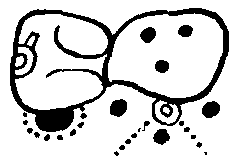
The part on the right recalls by its trisection the sign r, which I regard as the week of 13 days and, in fact, the interval between the two hieroglyphs is 13 days. On the left is the inverted figure of a person in a squatting attitude, the head surrounded by stars as on pages 57b and 58b and a sign on the back which may be a suggestion of the sun-glyph. In this figure, which occurs also in the Tro-Cort. and in the inscriptions, I see the planet Mercury and I believe that that planet's retrogression (which lasts 17-18 days) or disappearance into the light of the sun during this week, is the subject of this passage. 7 and 8 are the sign for D with the usual Ahau, and 11 and 12 are the hieroglyphs of the death-god A.
Instead of three pictures there is only one here, viz:—a woman with nose-peg, sitting on a mat and apparently waiting for something. We also find figures sitting on mats elsewhere, for example on pages 7b and 68b.
Page 21b.
VII VII 7 I 7 VIII 7 II 5 VII
OcAhau
CibCimi
IkEb
LamatEzanab
IxKan.
This is also a Tonalamatl of 10 parts (10 × 26). The first column should be read first from top to bottom and then the second. The days are exactly the same as on page 21a, and here too Cimi and Eb have changed places.
The hieroglyphs run thus:—
156 913
2781014
3 1115
4 1216.
The signs forming the hieroglyphs into groups are, in addition to the cross in 2, 6, 10 and 14, the heads in 1, 5, 9 and 13 with an Akbal sign (indistinct in 9) which, by the lock of hair in 5, 9 and 13, refer to a woman. This lock of hair is replaced by a hand in 1.
Sign 3, with which m in 4 is associated as a determinative, shows that the first group ought to have a picture of the black god L grouped with a female figure.
The second group is the only one with a picture. On the right there is a female figure, which, judging by the headdress, we have already met on page 19a. Opposite her sits the dog which we saw on page 13c. Here (in sign 7), as on page 13c, the hieroglyph of the dog is combined with a Cimi sign, and this hieroglyph is repeated in 8 with the sign c, which is so closely allied to Cimi.
For the third group the god A should have been represented with the woman, as is proved by sign 11 so peculiarly combined with r as a superfix. To this hieroglyph a is added, doubtless referring to the good days, as if merely to fill space.
The hieroglyphs of the fourth group do not, I think, convey a clear idea as to which deity belongs here. His sign is 15, which is compounded of Manik and Chuen with a superfix, nor does the Cimi added in 16 shed light on the subject. As for 15 we have already found it on page 13c with the prefixed 4, which I find prefixed in this way in at least 12 different signs.
Pages 21c—22c.
Caban 5 21 16 10
Muluc
Imix
Ben
Chicchan.
This is a Tonalamatl of five parts in which the red numerals are wanting.
The hieroglyphs are in the following order:—
1256 91113
3478101214
15
16.
Among these are hieroglyphs which are common to all the groups:—the cross in 1, 5 and 9 and the woman in 3, 7 and 15. In 13 this cross is replaced by another sign, perhaps that for the year of 360 days, and in 12 the sign for woman is replaced by the universal a.
Each of the three pictures contains a woman facing a deity. I will consider first the second picture in which H is the deity, as is proved by hieroglyph 6 to which an Imix is added in 8, with the uplifted arm prefixed as in 10c and 13a.
Between the first and third pictures there is some confusion. The first is D, for while his type inclines more to that of N, the other old god of the Maya Olympus, comparison with 23c clearly shows that D is intended here. But the year-sign on his head also suggests in some measure the Uayeyab god N and moreover this sign does not belong to D and only occurs again with him on page 23c. Further, there is no hieroglyph at all for D and instead we find in 2, 5 Zac, the regular sign of N. Also sign 4 fits N better than it does D. Furthermore this passage relates to the day Ik, which might very well be the last day of the year.
On the other hand the third picture contains, unquestionably, the figure of N. I look for his sign in the 11th hieroglyph, which is the head of an old man with a prefixed 4, referring to the four different forms of N in the Kan, Muluc, Ix and Cauac years. The Ahau in 12, however, does not fit N, but D.
This confusion can only be adjusted by transferring D from the first group to the third and also, perhaps, the sign of the woman in 3, which applies to all the three groups, and by transferring to the first group N and the 11th sign of the third group.
The fourth group has no picture. It should have, as hieroglyph 14 shows, the god F, who represents death by violence in human sacrifice and the chase. The hieroglyph Cimi in the 16th place is a suitable sign for this deity.
Pages 22c—23c.
II 10 XII 12 XI 9 VII 6 XIII 7 VII 8 II
Oc
Ik
Ix
Cimi
Ezanab.
The hieroglyphs are arranged in the following order:—
1256 9131417182122
347810151619202324.
11
12
This Tonalamatl, the fifth and last of this section, presents much that is irregular and puzzling.
It can hardly be said that there are comprehensive hieroglyphs here, forming the heading of the six groups. The sign for woman occurs only in 2, 8 and 24, and the cross b only in 14 and 18, but it is sufficient to make it clear that here, too, connection with a woman is the principal theme. Let us pass, therefore, directly to the single groups.
The first group contains A and a woman. The god, however, is not facing the woman but sits beside her. The Cimi sign in 1, the familiar c in 3 and the unknown sign in 4 (=6) hardly explain this particular proceeding.
The second group contains two persons who sit facing each other, but the representation is so obscure and peculiar that it is difficult to determine which is the male figure and which the female. The hair of the person sitting on the right stands up in a manner not found elsewhere. It forms a figure similar to that which is issuing from the mouth of the dog on pages 13c and 21b. The Cimi sign in 5 and the sign c in 7 are familiar, but the infrequent 6=4 remains a puzzle.
Uncertainty regarding the third group is increased by the fact that there is no picture belonging to it. The well-known signs, 10 (Cimi) and 12 (q) afford no explanation, nor does the head with the uplifted arm in 11, which we find with the same hieroglyph on pages 8a and 36a. The most puzzling is the 9th sign, which is composed of two crouching persons leaning back to back, and who also appear in the astronomical sections of the Manuscript on page 68a, not merely in the form of a hieroglyph, but also carried out in a picture. In my article on the Maya chronology published in the Zeitschrift für Ethnologie of the year 1891, I attempted to explain this Janus picture as meaning the change of the year, but that interpretation would make no sense here.
The fourth group contains the woman opposite D, who is clad in the gala mantle and has on his head a bird and apparently the sign for a year, and is designated by the Ahau in 16, while Imix-Kan in 13, b in 14 and a in 15 are rather meaningless.
The fifth group represents the woman united with A, who is designated by the Cimi sign in 17. 18 with its b and 19 with its q display little that is characteristic, r in 20, which I think is the sign for the week of 13 days, invites further study. The sixth picture, which is the last, is very peculiar; it represents three women sitting side by side denoting perhaps the virgins who still remain. Sign 21 as Imix-Kan, 23 as a and 24 as sign of femininity supply nothing in the way of explanation. As 6, 9 and 20 are the characteristic signs in the preceding groups, so here the characteristic sign is 22—an open hand holding the day Ben—which perhaps designates these virgins by referring to the house in which they are held fast by the hand. Cf. Tro. 23* d.
Now of the entire woman section closing with page 23 only the two Tonalamatls on pages 22b-23b remain. These Tonalamatls again display very many peculiarities and seem to be but loosely connected with the five Tonalamatls last discussed.
Page 22b.
III 13 III 13 III 13 III 13 III
Akbal
Men
Manik
Cauac
Chuen.
This is a regular Tonalamatl, in which the 52 days are divided into four equal parts.
The hieroglyphs are in the following order:—
1256 91013
3478111214
15
16.
An Ahau is added here as the 17th sign, which is very unusual.
We find elements here forming the hieroglyphs into groups in three different ways.
1. The signs 1, 5, 9 and 13 designate the four cardinal points as they so often stand together in this Manuscript in the order of East, North, West and South, i.e., in the sequence of the annual and not of the diurnal course of the sun.
2. The hieroglyphs 2, 6, 10 and 14 are all alike and are the head with the Akbal eye, which in 6 is closed.
3. The three persons pictured here all carry a Kan sign in their hands, probably as the offering they have received. Similarly we found the Kan sign held in the hand twice on page 16b.
The first picture is B; his sign is the third with the q in 4 as a determinative, which has above it a Ben-Ik sign.
The second figure is a goddess with a serpent as head-ornament, though we find in the 7th sign, not her hieroglyph, but merely the one generally used to denote a woman. 8 is the usual a, which in my opinion is the sign for the good days, to which also the Kan sign refers in the hands of the three personages.
The third picture is that of the sun-god G; his hieroglyph is the 11th, to which in 12 is added the sign q, the sign for the bad days, with a superfix.
The fourth picture is wanting. According to the 15th hieroglyph it should be the maize deity E. My theory that 16 is the sign for the week of 13 days is supported by the fact that the division into 4 × 13 days is the prevailing one.
Page 23b.
VIII 12 VII 12 VI 12 V 12 IV 12 III 5 VIII
Kan
Muluc
Ix
Cauac
Lamat.
This is a Tonalamatl of 4 × 65 days divided as evenly as possible into 5 × 12 + 5. The 5th day added after the 16th must be a mistake (suggested by the 5th day of the last section) for it is usually the first of the days, which is repeated superfluously.
The hieroglyphs are:—
1 2 711151923
3 4 812162024
5 6 913172125
1014182226.
Contrary to practice the first section has six hieroglyphs, and the other five but four each.
As the characteristic hieroglyph we find in 1, 7, 11, 15, 19 and 23 a sign, the meaning of which is still undetermined and which we shall meet again on page 60, where it may refer to darkness.
The groups have in common, furthermore, the head without an underjaw and the hair gathered up in a tuft in 4, 10, 14, 22 and 25 (in 18 perhaps represented by q, the evil days). We shall find this sign on pages 25, 28, 30-35, 42-44 and 65-69, repeated a number of times in many instances. I consider it the sign for fast-days. It appears also in the Tro-Cort. Associated with this sign here as in other passages are the four sacrifices derived from the animal kingdom:—a haunch of venison, a bird, an iguana and a fish. The fish is beyond doubt denoted by 3, the mammal by 21 and the bird by 13, and I believe, therefore, that the iguana with its spiny back is denoted by 9. We find the four animals, though in a different order, also on pages 29b-30b, 30b-31b and 40c-41c, as well as in Cort. 3-6 and 8, for example. They seem to have a certain reference also to the four cardinal points.
Only the first of the six groups has a picture (I?). This represents a woman with a serpent in her hair, holding in her hand a dish containing a fish. The woman is denoted by the fifth hieroglyph and the fish by the third. The 6th sign is an Ahau, which is not quite intelligible here. Sign 2=5 Zac is very remarkable; it is the hieroglyph of the Uayeyab days and of their god N. If this Ahau refers, as it often does, to the god D, it suggests the relation between D and N, which follows from page 21c.
According to the 8th sign, the second group might refer to the serpent deity H, and the 9th sign would not improperly denote the iguana.
In the same way sign 12 in the third group probably denotes the storm-god K, with whom the bird in 13 accords very well.
In the fourth group both the animal and the sign of fasting, belonging to it, are wanting, while 16 and 17 as well as the unlucky day in 18 clearly refer to the death-deity A.
The fifth passage belongs, as sign 20 shows, to the maize deity E and to this is added the haunch of venison in 21.
In the sixth group we recognize Imix-Kan, the sign for food derived from the vegetable kingdom. It stands beside the grain-deity E of the fifth group. I do not understand the vulture-head in 26.
The five deities specified here may be compared with those on page 24, which are denoted by hieroglyphs 21-25 of the second column, though the agreement is not perfect.
This ends the first great section of the Manuscript, in which Tonalamatls are represented in uninterrupted succession. We come now to a page which stands quite alone, being the first which treats of astronomy and which ends the front of the first part of the Manuscript.
Page 24.
In my article "Zur Entzifferung IV" I discussed this remarkable page in detail and in what follows I shall conform to that treatise, though omitting many things which since then have become the established possession of science, and shall endeavor to shed a still clearer light upon other points.
This page presents in brief the subject which is more fully treated of on the front of the second part of the Manuscript (pages 46-60).
The first problem it presents is to find periods in which the solar year (365 days) is brought into accord with the apparent Venus year (584 days). This takes place in a term of 2920 days = 8 × 365 = 5 × 584. Sequent to this is the still higher aim of bringing the Tonalamatl (260) into harmony with this period, which is accomplished in 37,960 days (= 146 × 260 = 104 × 365 = 65 × 584).
The revolution of the moon (28), the ritual year (364 = 28 × 13) and the apparent revolution of Mercury (115) come in question as secondary matters.
I will now give an approximate reproduction of the page:—
Hieroglyphs.
1 17 29 151,840 113,880 75,920 37,960
2 18 30 (4 × 37,960) (3 × 37,960) (2 × 37,960) (13 × 2920)
3 19 31 I Ahau I Ahau I Ahau I Ahau
4 20 32 185,120 68,900 33,280 9100
5 21 33 I Ahau I Ahau I Ahau I Ahau
6 22 34 35,040 32,120 29,200 26,280
7 23 35 (12 × 2920) (11 × 2920) (10 × 2920) (9 × 2920)
8 24 36 VI Ahau XI Ahau III Ahau VIII Ahau
9 25 37 23,360 20,440 17,520 14,600
10 26 38 (8 × 2920) (7 × 2920) (6 × 2920) (5 × 2920)
11 27 39 XIII Ahau V Ahau X Ahau II Ahau
12 28 40
13 11,680 8,760 5,840 2920
14 (4 × 2920) (3 × 2920) (2 × 2920)
VII Ahau XII Ahau IV Ahau IX Ahau
15
16 2,200 1,366,560 1,364,360
IV Ahau I Ahau I Ahau
8 Cumhu 18 Kayab 18 Zip.
First let me observe that I have restored the four large numbers at the top, which are almost entirely effaced, as follows:—
1 15 10 5
1 16 10 5
1 6 16 8
14 0 0 0.
0
And furthermore, at the right, bottom, I have substituted the third month for the second of the Manuscript, which proceeding will be justified later on.
The least difficult portion of the contents of this page is the first series consisting of 16 members, each being a multiple of 2920. It begins with the date I Ahau (which is always concealed in these series), regularly stops at the month day Ahau (since 2920 = 146 × 20), but necessarily advances in the week days by 8 days each (since 2920 = 224 × 13 + 8), until 37,960 is reached, when the day I Ahau again appears (since 37,960 = 146 × 260).
According to my method of filling in the numbers, the top row of the page consists only of multiples of 37,960.
On the other hand, the four numbers of the second row from the top are more difficult. They are, it is true, all divisible without remainder by 260, but otherwise they seem to be without rule, and they give one somewhat the impression of a subsidiary computation such as one might jot down on a slip of paper in the course of some important mathematical work.
Nevertheless, the following remarkable results are obtained when the first and third and the second and fourth numbers are combined by addition or subtraction:—
1) 185,120 + 33,280 = 218,400, which is just 600 years of 13 × 28 = 364 days, 280 Mars years of 780 days, 840 Tonalamatls of 260 days or 7800 months of 28 days.
2) 185,120 - 33,280 = 151,840, i.e., precisely the highest number of the top row, = 416 solar years of 365 days each or 260 Venus years of 584 days each, i.e., the product of the days of the Tonalamatl multiplied by the Venus years. We shall again find the 151,840 on page 51, and Seler ("Quetzalcoatl and Kukulcan," p. 400) finds this same period on a relief of Chichen Itza.
3) 68,900 + 9100 = 78,000, i.e., 100 Mars years or 300 Tonalamatls. The half of this number, or 39,000, we shall find again on pages 69-73 by computation; also the whole 78,000.
4) 68,900 - 9100 = 59,800, i.e., 520 Mercury years of 115 days, or 230 Tonalamatls, or five times the period of 11,960 days, in which these two periods are united. By computation again we find the 59,800 on page 58. This period of 11,960 days is, however, to the period of 37,960 in the proportion of 23:73, i.e., 23 × 520:73 × 520. 23 is the fifth part of the apparent Mercury year, as 73 is of the solar year.
Let us now turn to the numbers, which form the bottom of my transcription, but only the left hand lower corner in the Manuscript. Here, in the latter, we find the following (with the correction already mentioned of the second to the third month):—
2200 1,366,560 1,364,360
IV Ahau I Ahau I Ahau
8 Cumhu 18 Kayab 18 Zip.
The first thing to be done is to arrange and fill out these numbers to suit our purpose.
The 2200 is clearly nothing more than the difference between the two high numbers. We can therefore dispense with it.
Further, we find by the usual computation, that the second number belongs to the first date and the third to the second. Hence the number corresponding to the third date is wanting from lack of space. This number can be calculated from that date; it is 1,352,400. It would suit this date equally well if the number were higher or lower by 18,980 or a multiple of 18,980; but it will be seen directly that it agrees with the other two numbers only at the value given above.
Now, if we add to this passage the years in which the dates must lie, they are in the case of the date on the left, the year 9 Ix, in the case of the middle date, the year 3 Kan, and of that on the right hand, the year 10 Kan.
Then if we arrange the three numbers with the dates and years belonging to them, according to the value of the first, this part of the page will run as follows:—
1,352,400 1,364,360 1,366,560
I Ahau I Ahau IV Ahau
18 Zip 18 Kayab 8 Cumhu
10 Kan 3 Kan 9 Ix.
Let us now consider the properties of the three numbers individually.
1) 1,352,400 = 28 × 48,300 and = 115 × 11,760, hence it is divisible by the month days of the year of 364 days and by the Mercury year. At all events this is the least important of the three numbers.
2) 1,364,360. This looks as if it referred particularly to the moon and to Mercury; to the latter since it is equal to 115 × 11,864, and to the former if we assume that the lunar revolution has been fixed at 29⅔ days, in which case this number is exactly equal to 46,000 such lunations. If this last number be again divided by 115, the number of days required for a revolution of Mercury, the quotient is 400, which is a round number in the vigesimal system and which was therefore denoted by a single word, by Bák in the Maya (according to Stoll) and by Huna in the Cakchiquel (according to Seler). 1,364,360, therefore, is a Huna of lunar revolutions multiplied by the number of days in the Mercury period. Later on we shall find the lunar revolution fixed at 29⅔ days.
3) 1,366,560. This is the most comprehensive number of the entire Manuscript, for it is divisible into each of the following periods:—Those of the Señores de la noche or Lords of the Cycle (9 × 151,840; this is, however, the first number of the top row), the Tonalamatls (260 × 5256), the old official years (360 × 3796), the solar years (365 × 3744), the Venus years (584 × 2340), the Mars years (780 × 1752), the Venus-solar periods (2920 × 468), the solar year-Tonalamatls (18,980 × 72), the Venus, solar, Tonalamatl periods (37,960 × 36), and the periods which are generally designated Ahau-Katuns (113,880 × 12).
We have next to consider the intervals which elapse between the three dates.
1) From 1,352,400 to 1,364,360 is 11,960 days, which period we have already found once on this page by computation. 11,960, however, is equal to 104 × 115 and 46 × 260, i.e., the Mercury revolution and the Tonalamatl combined. 11,960 is again equal to 32 × 365 + 280, and from the year 10 Kan to 3 Kan it is actually 32 years, and from the date 18 Zip to 18 Kayab it is, in fact, 280 days. The day I Ahau must be common to both dates.
2) From 1,364,360 to 1,366,560 is 2200 days, as the Manuscript expressly states. 2200, however, is equal to 8 × 260+120, and the distance from the day I Ahau to IV Ahau is in fact exactly 120 days. Further 2200=6 × 365+10; from the year 3 Kan to 9 Ix it is 6 years and from the date 18 Kayab to 8 Cumhu it is 10 days.
3) From these two statements the third follows. The distance from 1,352,400 to 1,366,560 is 14,160. This contains first the 14040, in which both the Tonalamatl and the old official year of 360 days meet, and second 120, which is again the interval between I Ahau and IV Ahau. But 14,160 is also equal to 38 × 365 + 290, and the interval between 10 Kan and 9 Ix is of course 38 years, and from 18 Zip to 8 Cumhu it is 290 days.
The numbers with which we have had to do here will again occupy our attention further on, especially the 2920 and the 37,960 on pages 46-50, the 11,960 and 115 on pages 51-58, and the 14,040 on page 73.
That these computations are not confined to the Dresden Manuscript is proved by the cross of Palenque, where we find in signs A B 16 precisely the date I Ahau 18 Zotz, a Tonalamatl before 18 Kayab, in D 1 C 2 exactly the difference 2200 and in D 3 C 4 the date IV Ahau 8 Cumhu. This is in favor of the theory that our Manuscript did not originate far from Palenque.
Now, the question finally arises as to what may, strictly speaking, be considered the significance of these numbers, dates and differences.
In the first place, I would recall the fact that the dates of the monuments of Copan and Quirigua, which doubtless refer to present time, are in the neighborhood of 1,400,000. The high numbers of our Manuscript, so far as they are in question here, form first a group, which extends from about 1,200,000 to 1,280,000, and then there is a blank, and next a large group extending from about 1,350,000 to 1,480,000, then another blank and lastly a group extending from about 1,520,000 to 1,580,000. If we assume that our Manuscript belonged to about the same date as these inscriptions, then the three numbers discussed here would extend over a past period lying about 160-170 years back, when a new period of importance had begun probably dating from the immigration of the Aztecs into Mexico, which they placed in the first half of the 14th century (see "Weltall," Vol. 5. pp. 374-377). Now, however, the number 1,366,560 contains the statement that 3744 years ago (each year having 365 days) an event must have occurred, which can hardly be anything other (according to the belief of the Mayas) than the creation of mankind. Hence all the historical dates of the Mayas were computed from this starting-point. But how did this event come to have the date IV Ahau 8 Cumhu?
In my opinion this date is to be regarded only as the result of the far more important date I Ahau 18 Kayab, lying 2200 days earlier. Day 17, Ahau, belongs, without doubt, to the chief of the gods, and as the first week day it must have been especially sacred. The prophecies of the Tonalamatl preferably begin with the Ahau and with the I. The series on the page under discussion, constructed with the difference 2920 as a basis, begins with I Ahau, and the three series on pages 46-50 also have the same day as the zero point of departure. I Ahau is therefore the starting-point of the astronomical computations as IV Ahau is of the historical.
Now, however, all the periods of 260 days end each time with I Ahau. Why is precisely this day chosen here, which is the 18th day of the month Kayab, therefore in the year 3 Kan, and lying 2200 days earlier than the historical date?
Day 18 Kayab is our June 18th. In my treatise "Schildkröte und Schnecke in der Mayaliteratur" (1892), I have sought to prove that the tortoise served as symbol of the summer solstice, that the sign of Kayab was the head of a tortoise, and that probably the 18th of June was regarded as the longest day. The middle one of the three series on pages 46-50 begins with exactly this date, I Ahau 18 Kayab.
But whence come the 2200 days? I will offer a suggestion which may serve until a better theory is propounded. Let us assume that each of the five principal planets had in succession regulated its time of revolution by this astronomical starting-point, thus:—sun 365, moon 356, Mercury 115, Venus 584, and Mars 780 days, these numbers added together give exactly 2200. It will scarcely excite surprise that I should set down the lunar year at 356 days (and not at the usual 354 days) for there are 12 × 29⅔ lunations in a year and we thought we had already found this period on this page, while discussing the number 1,364,360; also on pages 51-58, in addition to the half lunar year of 177 days, we shall find one of 178 days. Were the planets therefore created 2200 days before the appearance of mankind? Jupiter and Saturn, of course, with their 397 and 380 days are probably not considered here, because their periods of revolution so nearly correspond to that of the sun, and on pages 51-60 they are also treated as of secondary importance.
I confess I am quite unable to discover what may have happened 11,960 days before the creation of the stars—possibly the birth of one of the principal deities. Perhaps one of my fellow-students may succeed in finding an answer in one of the creation myths.
We come now to the 40 hieroglyphs on the left half of the page. These are intended simply to familiarize the reader with those signs which are of importance in the calendrical-astronomical portions of the Manuscript. Since no phonetic system of writing existed, we cannot, of course, expect that the scribe should have explained these signs.
Signs 1-4, which are mostly destroyed, can hardly denote anything other than the four quarters of the globe, at least we can still recognize in 4 the sign for the east, which has also the fourth place in pages 46-50. They stand thus together five times in the middle of the left side of pages 46-50, which pertain to this subject. 5 to 9 are the sign for Venus repeated 5 times, probably denoting the four parts of its revolution as on pages 46-50 and also the revolution as a whole. In connection with this first appearance of the Venus sign, I would mention that the same hieroglyph also occurs in the Tro-Cort., e.g., Cort. 25c, though this Manuscript contains little else that is astronomical, yet it also has the rectangular heavenly shields.
10. This is a well-known form of the Moan sign. In the Globus, Volume LXV, 1894, I sought to make it appear probable that the Moan also denoted the Pleiades, with whose disappearance and reappearance the beginning of the years seems to be connected. Likewise on page 50, where the 2920-period ends, the Venus and Moan signs appear at the top on the right-hand side.
11 and 12 are the same sign, being that of the 13th Uinal (Mac), with which 260 days of the year end, and hence this sign is also used as the sign of the Tonalamatl. The repetition seems to show, that not until the 73 Tonalamatls of the period of 18,980 days are doubled—thus obtaining the number 37,960 of such importance here—are the sun and Venus periods brought into unison (with the whole system).
13. The Kin sign (sun, day) with the superfix, which in all probability expresses conjunction, union, and which, in my opinion, we also see on page 51, combined with Kin and Imix, as the sign for 18,980 days, is used here after the two Tonalamatls to denote the doubling of this period.
14-18. If the preceding signs led us to the Venus-solar period and to the continuation of this subject on pages 46-50, these five hieroglyphs bring us to the Mercury-lunar period and later, on pages 51-58, which are devoted to the same period, we shall find a parallel especially on the last page. First comes 14, which, as has been acknowledged, is the sign for 20 × 360 = 7200 days. 15, a hand holding a rectangle divided by a cross into four parts, is, I believe, the sign for the period of 20 days augmented to 21 by the 1 in front of it. The much more distinct form of sign 16 on the middle of page 58 and also at the top of page 53, should be compared with the sign as given here. The top part is the familiar Ben-Ik sign denoting the 10th and 19th days, and the bottom is the sign of the 14th division of 20 days, which make up the year. Now, however, the 10th day, when it becomes the 19th of the next 20 days, is distant from the first 29 days. The prefix consists of two parts:—First two small circles joined by a zigzag line, which I think denotes the division of a day into halves; the sign would then equal 29½ days, i.e., very nearly the true lunar month. Second, of two vertical lines, which might denote a doubling. The whole would then be equal to 2 × 29½ = 59. I admit that this interpretation is very artificial and I should be very glad if a better explanation could be found. On the other hand the 17th hieroglyph becomes quite clear when it is compared with the parallel passage on page 58; it is 13 × 360 = 4680 days, a third of the remarkable period of 14,040 days.
Thus we have
Hieroglyph 14 = 7200
" 15 = 21
" 16 = 59
" 17 = 4680
———
11960 ,
which is exactly the lunar-Mercury period.
The sign Xul = conclusion, end, is fittingly added in 18 to the end of this period, as also on page 58. This sign is very common on pages 61 and 62 at the end of the long periods.
From signs 19 and 20 we see that the four parts of the Venus year are also about to be treated of here, that is, the periods of 236, 90, 250 and 8 days respectively, which are discussed on pages 46-50. For 19 is the sign for Venus, and 20 is a hand with a knife as a superfix, which divides the Venus revolution. This hand appears 20 times in like manner on the pages mentioned above.
Signs 21-25 represent five gods, who in all probability are N, F, H, the bat-god and A. These are the same signs which are repeated twice on the left-hand side of pages 46-50, both times at the beginning and end of the period of 236 days, that is, the period during which Venus is the morning star and which is under the dominion of the east. The fact that there is a 4 with N has reference to the four forms which this Uayeyab god assumes. Now we ought to expect a similar treatment of the periods of the planet, which are under the rule of the south, west and north, but there is no room for this. Instead, we find in 26, 27 and 28 three different signs plainly belonging together, the first of which is the day Caban, i.e., the earth; the second may be Muluc denoting rain and water; the third is Chuen (the ape) which fittingly denotes the north, for Chuen denotes the little bear, as I have proved in my treatise on the day-signs of the Mayas. The Chuen sign in 28 also has a prefix, which probably refers to the night-god D. I find exactly the same combination in signs 8 A and 8 B of the inscription on the Cross of Palenque, but I must leave to others the task of connecting 26 and 27 likewise with the north, which is very evident in 27 (Muluc).
Sign 29 is entirely effaced. Nevertheless, I am positive that it represented the day IV Ahau, the beginning of Maya chronology, for 30 may still be identified as 8 Cumhu belonging to IV Ahau, and sign 31 is the same sign as 18, i.e., the sign Xul = the end, and denoting here the end of the long period.
The comprehensive hieroglyphs, 29-31, stand here in the wrong place. A more suitable position for them would be before 19 or just after 35. For they are intended to specify the periods during which Venus is in the west and south, i.e., the time during which it is the evening star and the period of its inferior conjunction.
Sign 32 is the black deity, L according to Schellhas, here denoting the west, and 33 is the Venus sign with the prefix denoting division. In the same way we find these two signs together on page 46 at the right in the middle series, where presumably the four Venus periods are specified in close succession. The black deity is also found on page 50 in the middle of the page in the beginning, at the end of a period of 250 days. On page 24 it has as a prefix the sign Imix with three rows of dots proceeding from it. Imix, however, among the Mayas and Aztecs (as Cipactli), under some circumstances often, and under others always, denotes the first of the 20 days. Hence this sign may mean:—here begins the Venus period of 250 days.
34-35. The sign for the south still remains to be found. Sign 35 is again the Venus hieroglyph. In 34 we should expect to find one of the five gods of the south, which are found on pages 46-50, e.g., the Moan, who is represented on page 47 as the regent of this cardinal point. But there is no figure of a god here, and in place of it we find set down here, as on page 47, middle, right-hand, an actual date as the beginning of this short southern period of only eight days. It is the date 10 Zip (third month), the month sign of which does indeed suggest a hieroglyph of the Moan. Now, if we recall that in hieroglyph 21 the god N is designated in exactly the same way by an actual date, viz:—4 Zac (11th month), then we see that the interval between 4 Zac and 10 Zip of the second year following, is exactly 236 + 90 + 250 = 576 days, and this corresponds exactly to the interval of time from the beginning of the period when Venus is in the east to the beginning of the period when she is in the south. If we knew in what years the morning star made its first appearance on February 4th and disappeared as the evening star on the 3d of September, we should make some progress in the comprehension of this subject, but not much, since these events fall approximately on the same dates after each period of 8 years.
36-40. The last five of the 40 signs appear in the same order again on pages 46-50, one sign on each page, in the middle group of the right-hand half of the page at the beginning of the third line, but with this difference, that on page 24 each sign has the same prefix, which is wanting on pages 46-50, where a similar hieroglyph always follows. From their position on pages 46-50 it follows that these are hieroglyphs of five gods, each of whom belongs to a whole Venus year of 584 days. I am not very sure in regard to these gods. I prefer to call 36 K, 37 F, 38 E and 40 A. Sign 39 with the person crouching, I am obliged to leave entirely unsettled. We shall find this hieroglyph again, e.g., on pages 47 and 49 right, middle. Let it suffice that in these five signs we have a repetition of the Venus-solar period of 2920 days, with which we will end the discussion of this page. Only F and A have already been met with among the five gods denoted by hieroglyphs 21-25.
Pages 25—28.
As these four pages, which are the beginning of the back of the first part of the Manuscript, not only belong together, but also display a parallel arrangement of their separate parts, the corresponding parts will be considered together as a whole.
There are seven of these parts on each page, viz:—the column of day-signs on the left hand; the top, middle and bottom pictures, and lastly the top, middle and bottom groups of hieroglyphs; but I will consider the pictures and hieroglyphs of the same section as belonging together.
1. The Columns of Day-Signs.
On the left-hand side of each page two days are repeated 13 times. They are as follows:—On page 25 Eb and Ben, on page 26 Caban and Ezanab, on page 27 Ik and Akbal, and on page 28 Manik and Lamat. Cyrus Thomas first made the important discovery that these pages represent the transition from one year into the next, but held the erroneous opinion that the last two days of each of the four kinds of years were treated of on each page. While Seler, on the other hand, found that we have here to do with the last day of one year and the first of the following year, and that, therefore, Ben, Ezanab, Akbal and Lamat are the beginnings of the years and thus of the 20-day periods. The years, however, were always named after their second day (i.e., Kan, Muluc, Ix and Cauac years), since the New Year's Day was considered unlucky and it was the practice of the Mayas to conceal the real starting-point.
These four pages, therefore, extend over 13 × 52 years, that is, over a period of 18,980 days, after which period all the calendar dates are repeated. A list of all these dates is given in "The Maya and Tzental Calendars" by William E. Gates (Cleveland, 1900).
The transition from the Muluc to the Ix years is represented on page 25; from the Ix to the Cauac years on page 26; from the Cauac to the Kan years on page 27, and from the Kan to the Muluc years on page 28. The Ix years are represented first, because the beginning of the historical chronology lies in an Ix year (IV Ahau; 8 Cumhu). This section treats of ceremonies, especially of the setting up of the idols at the changing of the year, which I can pass over here since they have already been described by Diego de Landa and in our own day by Cyrus Thomas in his "Study of the Manuscript Troano," and elsewhere.
2. The Top Pictures.
The principal representation on all the four pages is a priest, but disguised as an animal with the head of a beast of prey as a mask (always the same one) and also with a tail. He is pictured with the same three articles in each of the four representations, viz:—First, in his right hand, the staff of office with the hand at the top, which, according to Seler, "Mittel-Amerik. Musikinstrum.," p. 112, is the rattle-stick, second the incense-pouch, i.e., for copal, and third in his left hand a rattle, or, according to Schellhas, "Vergleichende Studien" (1880), a fan. There is one point, however, in which the first two pages differ from the other two; on the first two the priest is walking on dry land and on the second two through a stream of water. Was the city, to which this calendar especially refers, bordered in two directions by water, so that the road led across it?
On all the four pages, however, the priest carries on his back a different deity, and I cannot find out by what rule these gods are connected with one another, or with the one which is represented below them, or with the years. On page 25 the god is B, on 26 he has the form of a jaguar (Ix), on 27 he is undoubtedly E, and on page 28 he is the god A, Cimi.
Now to the left of the priest on each page there is one of the familiar Chuen bundles, such as are also frequently found in the the Tro-Cortesianus. Here, on pages 25-28, there are always three of these Chuen signs in a bunch. If Chuen really denotes the eighth day (which, of course, is only possible when Kan = 1), and at the same time the period of 8 days, then in this passage these three Chuen signs would properly designate the 24 days which elapse before the last day of the year, which is the last day of the 18th month. In the same way we shall find the Chuen bundle appropriately given this meaning on pages 42c-45c. Likewise the simple Chuen sign at the top of page 52 seems to denote 8 days. But what do the Chuen bundles in the Tro-Cortesianus mean, some of which are much larger?
In close proximity to these Chuen bundles we find numbers as follows:—on page 25 numbers 8 and 9, on 26 number 13, on 27 number 2 and on 28 number 13. I can offer no opinion, which would be even approximately acceptable in regard to the meaning of these numerals, but we shall discuss them later.
3. The Top Hieroglyphs.
I shall discuss these glyphs in this place, although each group seems to relate not merely to the top picture, but to the whole page. There are 16 on each page, and arranged as follows:—
12 910
341112
561314
781516.
Unfortunately, the writing at the top is obliterated, which makes it impossible to understand not merely this passage, but also those on all the rest of these pages. Of the 16 signs in the top line only one is legible, and that is the first on page 28. This is the usual cross b; as a comprehensive heading it perhaps occupied places 1 and 9 on each page, alternating with another sign in 2 and 10.
In spite of this obliteration there are a few points which can be profitably discussed here.
I would call attention first to signs 7 and 8 on page 25. The first seems to contain twice repeated the figure, which is thought to represent eagle feathers, and which we found on pages 10b and 13a, for example. As this double character is also used to change the 360-sign into a 7200-sign, so it may also combine the 52 years of this passage. The 8th sign on page 25 is the head with the tuft of hair and no underjaw, which I think refers to fast-days, such as might properly occur at the transition point of one long period to another.
The sign for the year stands five times on the other three pages, which is in keeping with their contents. On page 26 it appears three times. This page treats of the transition of the Ix to the Cauac years. In the 6th place the Ix sign seems actually to be used as a prefix, in 7 the prefix is plainly the Kin-Cauac sign, just as on page 37a, and in 5 the prefix is probably Ezanab, the beginning-day of the Cauac years. At this last place the suffix is the same as that which we often see with the year sign on pages 13c-14c. On page 27, in the 7th place, the year sign has a prefix and a suffix, which seem to indicate that here it was intended to represent 365 as separated into 5 × 73 or 360 + 5. Lastly, on page 28 the 8th sign can be explained as meaning that the ritual year of 364 days is separated into 4 Bacab periods of 91 days each.
Resembling the year sign in form, and placed near it on these pages, is the following sign:—

This sign frequently appears on pages 8b-9b, 16b-17b, 17c-20c. We find it with slight variations once on each of the four pages 25-28. It is the 6th on page 25; the 8th on 26; the 6th on 27; the 6th on 28. Its lower part, especially the (phallic?) sign added at the left, suggests the hieroglyphs of the Bacabs, as we find them on pages 52, 55, 56, etc.; they might refer to the separation of the ritual year of 364 days into 4 × 91 days. On the other hand it has been considered simply as the reproduction of the carrying-frame pictured below it (compare above under page 17c.)
While the hieroglyphs, hitherto discussed, demonstrate the connection between the parts on the left of the four pages, two other signs prove the connection of the portions on the right.
One of these looks like the Ik sign surrounded by a dotted circle; it occurs on page 25 as the 13th sign, on page 26 as the 15th, on page 27 as the 14th and on page 28 as the 15th. To this sign are prefixed successively the numbers 9, 7, 11 and 6.
The second is unquestionably the hieroglyph for the numeral 20 or for the moon. It is effaced on page 25 and on pages 27 and 28 has a prefix, which on page 26 is used as a superfix. This sign is the 14th on page 25, the 16th on page 26, the 15th on page 27 and the 16th on page 28. The prefixed numbers are 7, 16, 5 and 6.
The meaning of these two signs and that of the apparently irregular numbers is still a mystery. The latter will be discussed presently.
The 4th sign on all the four pages seems to refer to a period like the one hitherto discussed. On page 26 the sign resembles that for the 13th Uinal (Mac) and hence appears to refer to the Tonalamatl, as in the first column on page 24. Above it is the sign for the south. The corresponding hieroglyphs of the other pages are obliterated, but strange to say the vestiges suggest that they too had below them the sign for the south. Now the south and the Bacab of the south preside over the fourth quarter of the year from which ensues the transition to the new year in question here.
Among the signs on the left side we should expect to find those of the gods to whom the expiring year belonged. On page 25 it ought to be B. Sign 5, however, though it can with difficulty be identified, points rather to god K. Sign 3 on page 26 corresponds better; this is the hieroglyph of the tiger already known to us, which is carried by the priest in the upper section of page 8a; here its prefix is the sign for the west. On page 27 we ought to see the grain-god E carried by the priest; his hieroglyph may be destroyed, but sign 5, which is Kan-Imix (food and drink) is his determinative. Finally the 5th sign on page 28 is, just as we should expect, the hieroglyph of A and, in addition, we find his determinative in 7.
But what is to be said of the fact that the tiger appears again on page 28 in sign 3, and this time with the sign for the east?
The Ahau on page 27, sign 16, refers to the god D of the middle section.
There maybe some reference here to sacrifice, thus:—the 11th sign on page 25 is Kan-Imix, the 12th on page 27 is Kan, which is followed in the 13th sign on page 27 by another one with a Yax and a suggestion of a second Kan-Imix. Also the curious sign in the 8th place on page 27, which we have already discussed under page 8b, is used to denote the sacrifice on pages 18a and 15b. Here its position with reference to sign 6 is the same as on page 8b. On page 26 the prefix of sign 13, which is half destroyed, may be recognized as a serpent. Signs 12 and 15 on page 25 are unintelligible. Unfortunately the following signs are entirely effaced:—Sign 1 on pages 25, 26 and 27, as well as 2 on all the four pages, 3 on page 25, 9 and 10 on all the four pages, 11 on pages 26, 27 and 28, 12 on pages 26 and 28, 13 on page 28, 14 on pages 26 and 28, and 16 on page 27.
4. The Middle Pictures.
On each page at the right there is a house, the back wall of which is always marked with the cross often met with. In front of the house with his back turned towards it, sits a deity. Each of the four deities has the front of his body covered with a gala mantle. Now we know that the god of the new year was set up before the house of the chieftain. On page 25 the god is K with his eyes apparently destroyed, and on page 26 it is B with a Kin sign on his head covering, hence designated here as a sun or day-god. On page 27 the god is D, and on page 28, A with the cross-bones on his robe, his own hieroglyph on his cheek, and the Akbal sign on his forehead. Only on the last page, therefore, and apparently by mistake, the god in the top picture is the same as in the middle picture.
At the left of each page, i.e., opposite the house and the god, is a flaming altar, bearing the sign Ix equivalent to fire.
The centre, between the gods and the altars, is occupied by vessels of which there are two on each of the first three pages and but one on the fourth; they contain food, without doubt intended for the sacrificial feast. On page 25 the lower vessel contains Kan (maize) and the upper probably a food prepared from Kan. Or are the spines on the back of the iguana indicated on this vessel? (Compare 40c and Cort. 8 and 12c). The contents of the lower vessel on page 26 are still unknown (birds?). The upper vessel contains a Kan, but the sign has a superfix, which corresponds to the sign for the west. On page 27 the lower vessel contains a fish and the upper the sign for the south. Lastly, the single vessel on page 28 contains the cross-bones (mammal?) and above them the Kan sign repeated three times.
Finally here on the last three pages, we find some numbers, which are still undetermined; on page 26 there is a 7 with the lower vessel, and on page 27 with the upper vessel two dots with a cross between them (perhaps this may mean 20 - 2 = 18, which is used in place of the usual clumsy numeral?). On page 28 we see above the vessel a 6, and below it, in place of a second vessel, a double Chuen sign, as in the upper section of the page, therefore it can hardly be the Akbal sign resembling Chuen.
5. The Middle Hieroglyphs.
On each page these signs consist of but one line containing 5, 6, 3 and 3 glyphs respectively. The first of these signs in all of the four places is the same (o), which very suitably refers to the change in the year. The second sign is always the hieroglyph of the god represented in the middle section:—K on page 25, B as the sun-god on page 26, and D on page 27. The second sign on page 28, which is the head without an underjaw and with the prefixed four, probably referring to four fast-days, must, therefore, be an uncommon sign for A, who was similarly designated on page 25 in sign 8 of the upper section.
If the gods in the top thirds are those of the past year and those in the middle the gods of the year just beginning, we should expect to find in each top third the deity who is represented in the middle of the preceding page. But this does not hold good. For then we should expect to find K on page 26 and not the tiger, on page 27 B or G and not E, on page 28 D and not A, and on page 25 A and not B.
Hence there is some confusion here. Yet it seems to be in the nature of a correction, that on page 26 the third sign, next to that of the sun-god, is actually the sign for E who is in the top section on page 27, and that the sixth sign is Kan-Imix belonging to this god.
On pages 25 and 26 this line also refers to the past year, i.e., to the year set down in the top third. The fourth sign on page 25 is a Manik, i.e., originally a grasping hand denoting taking away, disappearance, and the fifth sign on this page is a Muluc, which seems to denote the ending of the Muluc years. The fifth sign on page 26, is, in fact, the tiger pictured above.
The lunar hieroglyph as the third sign on page 25 and the a as the fourth on page 26 are strange and unaccountable. Both appear to be almost without significance here and seem almost like mere points between the names of gods in groups of two each.
The Ahau as the third sign on page 27 is the usual determinative of D, whose hieroglyph stands beside it.
On page 28 the main part of the third sign corresponds to the sixth of the upper section. I do not know, however, how to explain either the upper part suggesting a mat or the familiar leaf-shaped prefix.
6. The Bottom Pictures.
In the left-hand lower corner of each page we see the sign for the year of 360 days, which at the same time designates the heap of stones, on which the stelae were erected, the two thick black lines indicating the two columns of hieroglyphs usually found on them. A tree is growing out of this sign, having on its trunk an abbreviated Cauac sign, at least, on pages 26, 27 and 28, which probably refers to rain as the most desired event of the year. The tree on page 25 has no leaves, but the top is carved into the shape of the head of the god B. In the other three cases it has leaves, but instead of ending in the god's head the tree is draped with a mantle and a breech-clout, and a serpent is coiled about it denoting a period of time (here, the year). Furthermore there are foot-prints on the trunk or the drapery of the tree, which represent it as the goal of a pilgrimage.
If the top and middle thirds refer to the mere transportation of the idols, the bottom thirds refer to the feasts connected with this act, or, at any rate, to those dedicated to the new god. For we see here on page 25 the god B, on 26 the god K, on 27 A and on 28 D, i.e., the same deities as in the middle sections, yet so placed that the first two and the last two have changed places.
Each of the four deities hold in one hand a hen with its head cut off; "degollavan una gallina" is the statement made by Landa concerning these feasts. Perhaps all four gods, at any rate the last three, are scattering grain; this was one form of divination; we found the other on page 2. There are besides, on every page, several small objects between the two pictures, just as in the middle section. On page 25 the object is probably an altar, but instead of the flame it has the number 19. Above this is the sign for the west (the Ix days) with that for the sun, and on top of them the sign which we found in the middle section of page 26 as the contents of the lower vessel. On page 26 we see a vessel containing a bird, then another whose contents are indicated by Yax and a double Kan sign. Above it is the sign for the moon or for 20 with a prefix, and above this a 9. At the bottom of page 27 there is a vessel containing two Kan signs and a fish; above this another vessel the contents of which are the same as we found in the vessel in the middle section of page 26 and in that of the lower section of page 25. Above these is again the sign for the moon or 20 with a superfix, which is the same as the prefix on page 26, and beside it is a 16. Page 28 has the usual haunch of venison (Landa:—"una pierna de venado"), above this is a vessel with a bird and Kan and above this again the sign for the moon or for 20 with the same superfix and the numeral 15. I shall discuss below the numbers scattered over these four pages.
7. The Bottom Hieroglyphs.
These hieroglyphs also form but one line on each page and each line contains six hieroglyphs. The first of each line is always the same (p). It consists of a surface divided into four quadrants thus suggesting the four cardinal points, the four Bacabs presiding over them and the four kinds of years. The superfix seems to be the abbreviated hieroglyph of the north; the sign for the north, however, is Muluc and these four pages begin with the Muluc years.
The second sign is the head of D as the supreme god; to this a Yax is joined on pages 26-28 as the symbol of strength, and on page 25, but probably by mistake, the abbreviated sign for the west.
The third sign always represents one of the four cardinal points:—on page 25 the east, on page 26 the south, on page 27 the west and on page 28 the north; here then the usual order is reversed and the signs are set down according to the diurnal instead of the annual course of the sun, probably occasioned merely by exchanging the sign for the west (Ix), which belongs on page 25, with that for the east (Kan), which belongs on page 27.
The other three signs do not stand in the same order on every page.
The fifth sign on pages 26 and 28 and the fourth on page 27 show correspondence most clearly. This sign is always a head, undoubtedly that of the god pictured in the bottom third. But on page 25 it is the hieroglyph of E, who is pictured on the top of page 27, instead of that of B.
In the same way the 6th sign on page 25, the 4th on page 26, the 5th on page 27 and the 4th on page 28 have something in common. One element of the hieroglyph is always the sign for the year of 360 days, combined on page 25 with cross-bones and the Cauac sign, on 26 with Yax and Kan, and on 27 and 28 simply with Yax.
The most puzzling and divergent of these hieroglyphs are the remaining ones. The 4th on page 25 has an oblique cross (or bones?) and the abbreviated glyph for the west, the 6th on page 26 is the head of E, the 6th on page 27 is the 360-day sign combined with Kin and Cauac, and the 6th on page 28 is the usual Kan-Imix sign. Here, too, there seems to have been a displacement.
Before I leave the four pages 25-28, I will glance at the numerals, which are scattered over them and which apparently have no connection with one another. I have discussed these numerals in my article "Die Mayahieroglyphen" in Volume LXXI, No. 5, of the Globus, and the following is borrowed therefrom.
First of all, I believe that I proved there, that the sign composed of two dots with a cross between them is an abbreviation for the usual clumsy representation of the numeral 18 and designates it like a duodeviginti by 20 - 2. Next, that in this passage as on pages 18a, 18c, 19c, 46b and 50c, the sign is combined with the hieroglyphs Yax-Kin. Third, that it is closely related to the god D, inasmuch as it stands on page 27b close beside the picture of that god.
Assuming this as a known fact, we find scattered over these four pages the following numbers:—
25: 9, 7, 8, 9, 19,
26: 7, 16, 13, 7, 9,
27: 11, 5, 2, 18, 16,
28: 6, 6, 13, 6, 15.
It is very remarkable that the sum of the numbers on each of the first three pages is equal to 52, and as an accidental freak it would be most surprising; somewhere on the fourth page six units may have been omitted; but perhaps the 6, which stands above the two Chuen signs in the centre, is to be counted twice. The 52, however, designates the very 52 years, which are treated of on these four pages.
As yet I know no reason to account for the fact that the 52 is here separated into these apparently very irregular numbers. The discovery of this reason would be an important step in advance. Or does it means 52 days, perhaps those which follow a Tonalamatl coming in the middle of the year?
Page 28 is followed in the Manuscript by three empty pages. The scribe's object in reserving them is beyond our ken; possibly they were intended to represent the period of 8 years.
Pages 29-45 (i.e., to the end of the first part of the Manuscript) all belong together. After the Maya manner there is very little system displayed in their arrangement, and though here and there there may be occasion to consider the three parts of each page consecutively, I will discuss them here as follows:—First, the top thirds, which are most difficult owing to the destruction of a large portion of them; then the middle, and last the bottom thirds. They all consist in great part, with a few interruptions, of representations of the regular Tonalamatl, such as we find represented from the beginning of the Manuscript to page 23.
The element which these pages have in common is the fact that the god B, who can hardly be Kukulcan or Quetzalcoatl, occurs on almost all of them. He is the god of wind, fire, breath, i.e., the true god of life and is here represented in his relation to the most varied manifestations and activities of a human being, so that this section bears a certain resemblance to the Tro-Cortesianus. With this is closely connected his relation to all four cardinal points, which so often occur. He may have been the local god of the region from whence this Manuscript came; in the Tro-Cort. It seems rather to be C who lays claim to this office.
Pages 29a—30a.
XI 13 XI 13 XI 13 XI 13 XI 13 XI
Lamat
Ben
Ezanab
Akbal.
This is a Tonalamatl of 4 × 65 days, each part subdivided into 5 × 13 days. The four days written on the left are those which may begin the year.
In each of the five sections B is pictured in a sitting posture, the first four times on a tree (the tree of life rather than the sacrificial tree).
In the first picture he holds in one hand the haunch of venison, so often occurring as an offering, the last time on page 28; the object above it is probably the Kan sign. There is a vessel at the god's feet, probably a receptacle for the venison, bearing the hieroglyph of the 13th day Cib, which, however, refers rather to a bird.
In the second picture an animal with a protruding tongue lies on its back at the feet of the god, who kneels upon its stomach. This probably represents the lightning-dog as vanquished. The same animal is pictured on the next page and also on page 40b and perhaps on page 60. There are a number of small dots around B's head, which on page 11c we attempted to interpret as the starry sky.
I can find nothing of special importance in the third and fourth pictures, but in the fifth, B is sitting in a house, which is marked repeatedly with the sign Caban (ground). Here the god is holding the hatchet (machete) in his hand, as if prepared for some terrestrial activity. Four hieroglyphs in the usual order belong to each of the five pictures. They are almost entirely destroyed, but the vestiges show that the fourth sign was always that of B, while the third sign with the first picture had the abbreviated hieroglyph of the west as a prefix; with the second picture it had that of the south, and therefore with the third and fourth it must certainly have had the signs of the east and north. We should expect the signs with these prefixes to contain references to Ix, Cauac, Kan and Muluc, but they are not distinguishable.
Thus B is represented in pictures 1-4 as ruler of the four cardinal points and in 5 as the ruler of the earth in general.
Pages 30a—31a.
This passage looks like an amplification of the middle picture on page 29a. Here B is represented with the hatchet in his left hand and holding aloft by the tail with his right hand the animal, which is spitting out something upon a stepped pyramidal structure, probably the pyramid of a teocalli. That this is probably meant to represent lightning is rendered almost a certainty by the picture on page 40b. In this passage there are several red and black numerals scattered around the animal in an irregular manner, which we find nowhere else in our Manuscript, but with which the Tro-Cortesianus has made us familiar. The sum of the black numbers still legible is 23, probably a 3 is effaced and the sum should be 26, the sum which so often occurs in the Cod. Troano 8-13 with the animal represented there. The red numbers likewise do not admit of exact determination. This passage also contained hieroglyphs, four standing side by side on each of the two pages. The legible portion is limited to the Cimi sign in the third place, perhaps an Imix in the second, and possibly an Ahau in the first.
Pages 31a—32a.
In my article "Zur Entzifferung, etc., VI," published in the year 1897, I discussed this passage more in detail, and the following will be in continuation of what I stated there.
The real aim of the computation on these pages is to find a number in which the following periods of time are united with the Tonalamatl of 260 days:—1. The ritual year of 364 days, and consequently also a quarter of it, the Bacab period of 91 days. 2. The period of 104 days, being the number of days which remain after a Tonalamatl has been deducted from a ritual year. The hypothesis advanced by Mrs. Zelia Nuttall ("Note on the Ancient Mexican Calendar System," Stockholm, 1894) and also the entirely different opinion held by Mr. Charles P. Bowditch ("The Lords of the Night and the Tonalamatl of the Codex Borbonicus" in the American Anthropologist, N. S., Vol. II, New York, 1900) prove the existence not only of merely arbitrary Tonalamatls for the purpose of prediction, as those in our Manuscript, but also of Tonalamatls having a fixed position in certain years. But after the manner peculiar to priestcraft, the number sought is found only by an indirect and mysterious process.
In the first place we find on page 32a all the days set down in the following manner:—
XIII XIII XIII XIII
Manik Cib Chicchan Ix
Chuen Ahau Muluc Ezanab
Men Kan Ben Ik
Cauac Lamat Caban Cimi
Akbal Eb Imix Oc.
That is to say, a series counting from the day XIII Akbal, the New Year's day of the year I Kan, recurring every 52 years, furthermore a series which shows the same difference of 91 from the day XIII Akbal to XIII Ix, XIII Chicchan, etc., and finally ends with XIII Akbal again, after it has run through a period of 20 × 91, i.e., 1820 days = 7 Tonalamatls, like a similar representation of 7 Tonalamatls on page 51. Above these 20 days, and to the left of them, numbers are set down rather irregularly, which begin with 91 and are multiples of that number. The signs of the days corresponding to these numbers are joined to them; but they are omitted with the numbers of lowest value. Hence we have:—91, 182, 273, 364 (4), 455 (5), 546 (6), 637 (7), 728 (8), 819 (9), 910 (10). Then with a bound follow 1456 and 1820; with the last number Akbal is reached in the natural way, which day the scribe had erroneously set down again with 1456 in place of Cauac.
The number 728 already united the numbers 91, 104 and 364, but did not include the number 260. This inclusion is accomplished by the number 3640 on page 32, quite on the left where we find the numbers 10 and 2, under which only a 0 has been omitted. With the usual hiatuses this series seems to end on page 31, where I think the numbers 4, 0, 16 and 0 ought to stand, but they are almost wholly effaced; this would then be 320 × 91, 280 × 104, 112 × 260, 80 × 364 = 29,120.
We have thus gone far in advance of the first problem, but a second always presents itself in these series, it is that of using these periods for larger numbers, which refer to a not too remote past or to a future not too distant. The first numbers are, as a rule, in the neighborhood of 1,252,680, the close of the eleventh Ahau-Katun, and the latter in the neighborhood of 1,480,440, the close of the thirteenth Ahau-Katun. The Manuscript presents the following:—
1,272,544 1,268,540 1,538,342.
XIII Akbal XIII Akbal XIII Akbal
121 17 51,419
IV Ahau IV Ahau
8 Cumhu 8 Cumhu IV Ahau.
In connection with this it should be noted first that I have restored the 8 in the statement of the months, and second that the two numbers on the right were found with the aid of page 63 only by an easy conjecture. For with the reading of the Manuscript 10, 13, 3, 13, 2, I do not agree, but read instead 10, 13, 13, 3, 2; the number below, however, is given in the Manuscript as 7, 2 and then a black 14 joined to a red 5; I read this 7, 2, 14, 19.
The three numbers nearest the bottom have red circles around them, indicating subtraction, or, according to my present point of view, addition.
Now let us see how the computer arrived at the large numbers.
Day XIII Akbal, the New Year's day of the 1 Kan years, is given; also the differences of the series 91 and 104, therefore also in the proportion of 7 to 8. If we combine these last two numbers by addition and then by multiplication with 260, the result is (7 + 8) × 260 = 3900. If, however, 7, 8 and 3900 be combined by multiplication the product is 7 × 8 × 3900 = 218,400 = 2400 × 91 = 2100 × 104 = 840 × 260 = 600 × 364 = 1120 × (91 + 104). We have already met with the 218,400 on page 24, which was obtained by the addition of 33,280 + 185,120.
My opinion is as follows:—First 11 Ahau-Katuns = 1,252,680, were taken as a point of departure, and to this sum was added 15,600 = 4 × 3900, and 243 as the interval between the normal date IV Ahau and XIII Akbal. The result was 1,268,523. The position of this day, however, is XIII Akbal 11 Xul (1 Ix).
Then the 3900 mentioned above was added to this number and the result was 1,272,423 = XIII Akbal 16 Pop (12 Muluc).
Then to the 1,268,523 was added the 218,400 and the sum was 1,486,923 = XIII Akbal 1 Kankin (1 Kan), the very place in that year where a Tonalamatl ends.
The following numbers were thus obtained:—
1,272,423 1,268,523 1,486,923.
These numbers are suppressed in the Manuscript. But if the encircled numbers are added to them, viz:—121 (interval between XIII Akbal and IV Kan), 17 (interval between XIII Akbal and IV Ahau), and 51,419 (= 197 × 260 + 199; 199, however, is the interval between XIII Akbal and IV Ik), the result is the three large numbers set down in the Manuscript, which have the following properties:—
1) 1,272,544 = IV Kan 17 Xul (12 Muluc). This number = 13,984 × 91 = 12,236 × 104 = 3496 × 364. It also = 4894 × 260 + 104, the interval between IV Ahau and IV Kan.
2) 1,268,540 = IV Ahau 8 Mol (1 Ix) = 4879 × 260 = 3485 × 364 = 74,620 × 17. 17 is the interval between XIII Akbal and IV Ahau.
3) 1,538,342 = IV Ik 15 Zac (12 Muluc). It also = 5916 × 260 + 182. The 182, however, the half of the ritual year of 364 days, is the interval between IV Ahau and IV Ik and between IV Ik and IV Kan. The fact that the interval is the same in each case is clearly the reason for the choice of the days IV Kan and IV Ik, which are otherwise not at all prominent.
It is remarkable that the third number is obtained by the addition of 51,419, i.e., of 197 × 260 + 199 (there are 199 days between XIII Akbal and IV Ik). But it was evidently desirable to obtain as large a number as this. On page 63 a number of nearly similar value is associated with it, viz:—1,535,004. It is set down almost in the middle between the 13th and 14th Ahau-Katuns, for it is 57,902 days greater than 1,480,440, and 55,978 days less than 1,594,320.
Now, however, the Manuscript presents in the last column but one of page 31 a number, 2,804,100, which occupies a very unique position, since it is nearly twice as great as all the other large numbers, with the exception of those in the serpents. It must refer to the year 9 Muluc, and to the date IV Ahau 13 Mol. It has many remarkable properties, for it is:—
1) = 10,785 × 260
2) = 17,975 × 156 (156 = IV Kan - IV Ahau).
3) = 35,950 × 78 (78 = IV Ik - IV Ahau and IV Kan - IV Ik).
4) = 719 × 3900. We have already met with this 3900 above. Now, however, the 2,804,100 by virtue of its magnitude creates the suspicion that it may be composed of two ordinary large numbers. It might be
5) 1,308,580 + 1,495,520, therefore 14,380 (91 + 104).
6) 1,380,600 + 1,423,500, therefore 3,900 (354 + 365).
That is to say, the important 3900 multiplied by the days of the lunar year and also by those of the solar year, hence the 719, referred to under 4, separates into these two parts. The lunar year of 354 = 6 × 29 + 6 × 30 days was not unknown to the Mayas. We shall find its half, 177 days, several times on pages 51-58.
We might also use the two important numbers 14,040 and 18,980, the first of which is divisible by 260 and 360, and the second by 260 and 365, without remainder.
Then we have the large number desired:—
7) 147 × 18,980 + 14,040.
8) 200 × 14,040 - 3900.
What future student will penetrate more deeply into the meaning and purpose of these numbers?
We might now expect to interpret also the upper right-hand corner of page 31, but here almost everything is in a deplorable state of obliteration. In the first three of the five columns over each of the three large numbers there was a date consisting of a numeral and a hieroglyph, but these admit of no certain nor even probable determination.
Four hieroglyphs still remain in the fourth column, respecting which compare my treatise "Zur Maya-Chronologie" in the Berliner Zeitschrift für Ethnologie XXIII, pp. 141-155.
In the top sign I recognize an Imix with a prefix and probably also a superfix. I think this denotes the period of 18,980 days.
I am forced to pass over the second entirely, inasmuch as a red 6 inserted in it remains a mystery (6 × 18,980 = 113,880?).
As I stated in the above-named work, I think the third is three times the sacred period of 2920, i.e., 8760 days.
Finally, the fourth sign certainly denotes the period of 7200 days.
Whether or not there was a fifth sign above the one now at the top is as uncertain as the meaning of the whole.
The most remarkable thing about it is that in three other passages of this Manuscript these three signs appear in close proximity to another. On page 61 we find the third in the 11th place in the second column, the first in the 12th place in the same column, and the fourth in the 14th place in the first column. Page 70 has the first sign in the middle of the 4th column; the second somewhat lower down in the 3d column and the 4th two places below. Finally all three signs appear in succession on the top of page 73 in the same order as on page 31.
The fifth column on page 31 may have contained another numeral belonging to the series, the loss of which is not so serious a matter, but there may have been one or two hieroglyphs above it, the obliteration of which is greatly to be deplored.
Pages 32a—39a.
This is a large section extending over eight pages, which is difficult of interpretation owing to the prevailing disorder and because a large part of the hieroglyphs are effaced. Here, too, the principal subject is the god B, who is represented in manifold activity. A series of numbers extends through the entire representation. I read them as follows:—
I 11 XII 28 I 12 XIII 26 XIII 12 XII 19 V 5 X 1 XI 20 V 12 IV 6 X 8 V 5 X 7 IV 12 III 5 VIII 8 III 11 I.
There are thus 18 divisions, the different lengths of which reveal no rule. They embrace 208 days, i.e., 2 × 10⁴, which may well be considered as a continuation of the computation in the preceding section, of which the 104 was so important a number. The red numbers are entirely lacking in the beginning, then they are very slightly indicated, and finally they are distinctly written out on pages 36-39. I assume that the scribe has set down the 4th, 3d and 2nd numbers from the end, one too little. The last number has been entirely omitted. I have supplied these omissions though in a manner somewhat different from that adopted by Cyrus Thomas, "Aids," p. 28. I would note in addition that a period such as this, consisting of 208 days = 16 weeks, might be explained in an entirely different way, if there were a column of five days at the left having a difference of 8 days; then the whole would signify four Tonalamatls. But there is no such series of days.
Another point of view presents itself, however. If we take cognizance of the fact that a group of four hieroglyphs usually belongs to a picture, then it is evident that here there are such groups not for 18, but for about 22 subdivisions. It may, therefore, be assumed that about four subdivisions averaging 13 days are not specified, in which case this passage would extend not over 208, but over 260 days. The very irregularity in the arrangement of these numbers is an argument in favor of this hypothesis; it may be occasioned by the fact, that the pictures do not correspond exactly to the subdivisions. For the present, however, we shall discuss the single pictures assuming that there are 18 subdivisions.
1. Pages 32a-33a. Here at the very beginning it is uncertain whether the signs at the end of page 32 and at the beginning of page 33 are to be regarded as a single group of 8 hieroglyphs, as seems to follow from the numbers, or as two groups of 4 hieroglyphs each. At the end of page 32 we see two persons facing one another, one of whom, to be sure, is barely visible. The other wears a head-covering like a man's silk hat, similar to that worn by the priests on the inscriptions of Palenque. It is a remarkable fact that of the four hieroglyphs above these figures, 1, 2 and 4 (the last probably the god C) seem to have the sign for the west as a prefix, while the prefix of 3 (Imix) suggests the usual representation of the tortoise head. Below the persons there is a Kan sign, the prefix of which is also the sign for the west.
On page 33, B is represented walking and carrying the Caban sign in his hand. The first of the four hieroglyphs is the sign for B, the second is Imix, probably again with the sign for the west as a prefix, the third is an Akbal sign with Kin, and the fourth is the cross-hatched sign with Kan.