Chapter XVI
Reading edition
Contrast Colours—Measurement of Contrast Colours—Fatigue of the Eye—After-Images.
Fig. 45.—Method of showing Contrast Colours.
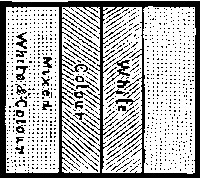
There is a phenomenon in colour which must be alluded to, and which possesses more than a passing interest to the art world, and that is colour contrast. Perhaps one of the best methods of showing this is by our colour patch apparatus. If we throw the reflected beam and the colour patch on a square as before, and place a rather thinner rod in front, so that the two shadows lie on a background of the combined white light and spectral colours, on passing a slit through the spectrum, the shadow which is illuminated by white light will appear anything but white. Thus if we allow yellow spectral light to illuminate one shadow, the other will appear decidedly of a blue hue; if a green ray it will be of a ruddy hue; if a blue ray of a yellow hue; that is, all the contrast hues will appear to the eye to tend towards a complementary tone to the spectral light. The kind of white light illuminating the shadow has a marked effect on the tone, as might be expected. The following table shows the contrast colour of the white illuminated shadow when the white light used was that of a candle.
Spectrum Colour.Contrast Colours in Electric light.Spectrum Colour. Contrast Colours in Gaslight.
Cherry red Green gray Cherry red Green gray
Scarlet Bluish green gray Scarlet Sap green
Terra-cotta Blue gray Light red Green gray
Raw sienna Light blue gray Olive green Pink gray
Olive green Umber Apple green Mauve & black
Emerald green Pinkish lavender Emerald green Pink terra-cotta
Grass green Light pink Emerald green Pink terra-cotta
Bluish green Dark pink Bluish green Pinker terra-cotta
Signal green Salmon Peacock blue Salmon
Cyanine blue Yellow ochre Prussian blue Reddish yellow
Ultramarine Raw sienna Ultramarine Raw sienna
Violet blue Brownish yellow Violet blue Brownish orange
Blue violet Green yellow brown Blue violet Brownish yellow
Violet Burnt sienna Violet Yellow ochre
The contrasts here shown are not so visible when the two shadows of the rod occupy the whole of the white square, but are decidedly increased by the shadows occupying only a part of the field, the margins being illuminated with a mixture of the two lights. Not only are there contrasts with coloured light and white, but the relative position of one colour to another may alter the hue of each to the eye. The following experiments indicate what change can be expected in contrasted colours. The double colour apparatus was used as described at page 122, and a slit was placed in four different positions in the spectrum, viz. in the red, orange, green, and violet, to form patches, and another slit was placed in the same four positions in the other spectrum, and the contrasts noted.
Original Colours.Change due to Contrast.
Red Orange Red became yellower Orange became green grey
Red Green Red unaltered, but brighter Green unaltered, but brighter
Red Blue Red became more orange Blue became greener
Red Violet Red became orange Violet, no marked change
Green Orange Green became bluer Orange became yellower
Green Blue Green became olive Blue became more violet
Green Violet Green became yellower Violet became bluer
Orange Blue Orange became redder Blue became bluer
Orange Violet Orange became greener Violet became bluer
Violet Blue Hardly altered Hardly altered
These contrasts were in most cases very marked, as would be seen by causing the same colours to fall on a different part of the screen, outside that on which the comparisons were made.
This phenomenon of contrast is one which is most valuable for artistic purposes, for it gives a power of increasing the value of the colour of pigments which is used by the artist almost intuitively. Thus he can heighten the tone of his orange pigment, with which he makes a sunset sky, by placing in juxtaposition with it some bit of blue coloured space. The blue becomes bluer, and the orange more orange, by this artifice. All these artifices—or rather we should say intuitive applications of science—are most necessary when the small range of luminosity of colours with which he has to deal is taken into account. For instance, in a picture of a sun-lighted snow mountain and deep pine forests, the utmost luminosity he can give to the former is that of white paper when seen in the shade, which, in comparison with what he sees, is really a mixture of 90% of black with the light from the snow, so that his range of luminosity is only nine-tenths of that which occurs in nature. It is in adapting this low scale to his picture that true genius of the artist is seen.
It might seem that these contrast colours being only a physiological effect, could not be accurately measured, but such is not the case, if a little artifice be employed. If we use the second colour patch apparatus side by side with the first, we can very readily and with very close approximation determine the contrast colours we see. Suppose by the second apparatus we form a colour patch of say red, and place a thin rod in the beam of this ray and of the reflected beam, and about six inches from it form another patch with the first apparatus, using the three slits to make colour mixtures; by first noting the contrast colour, and then approximating in the second patch to what the eye perceives, we can little by little get a fairly exact match to the contrast colour, and can definitely note it. We now give the results of three measures made for the contrast colours which presented themselves to the eye when they were caused by a red ray near the lithium line, another near the E line in the green, and the third near the G line in the violet.
To make white light and the contrast colours, the slits had to be of the following apertures—
Colour.Red.Green.Violet.
White light15·7 6·5 9·8
Contrast to Red13·511·822·5
Contrast to Green15·8 5·1 4·8
Contrast to Violet15·9 7·2 4·2
Thus to form the contrast to red took 13·5 of red, 11·8 of green, and 22·5 of violet. Now from each of these there can be deducted the amount of white light, which will leave only two colours mixed. Calculating this out we find that the contrasts are—
Contrast Colour toRed. Green. Violet.
Red— 3·5 16·7
Green 15·7 3·2 —
Violet 19·4 9·5 —
If the contrasts were exactly complementary colours, the proportions of the two colours left should be the same as those of the same colours as given, which with the original colour make white light. It will be seen that such is not the case. A very simple way of testing this is to form a patch of white light with the three slits in the first apparatus, and then to obtain the contrasts by the other apparatus, with the same colours one after the other that pass through the three slits. If now we cover up the slit in the first apparatus through which the colour whose contrast in the second apparatus is sought passes, we may dilute it with white light as we will, but in no case has the writer found that an exact match to the contrast colour can be obtained in this way. Thus, supposing we wanted to try the experiment with the same red light as that which comes through the red slit, we should use that same light in the second apparatus, and form the contrast colour with the white beam, and then in the first apparatus cover up the red slit, leaving the violet and green to form a patch on the screen. We should then dilute the colour of this patch with white light, and note if it appeared the same as the contrast colour.
Another phenomenon which presents itself is the fatigue of the colour-sensation apparatus of the eye, induced by looking at a bright object. For instance, if we look at a crimson wafer or spot for some time, and then turn the eye so that it rests on a grey surface, an image of the spot will still be seen, but as of a greenish-blue colour. This is due to the fact that the red-seeing apparatus is fatigued and exhausted, whilst the green and violet-seeing machinery has not been largely exercised. Consequently when looking at grey paper the grey of the paper is seen in the retina at all parts as grey, except in the small part of the retina which has got diminished power of perceiving a red sensation; hence a sea-green image will be seen until the fatigue has passed away. This colour can be reproduced with very fair accuracy by allowing only one eye to be fatigued, and then using the other to obtain a colour mixture corresponding to it. It will then be found that the colour is the same as the complementary colour, much diluted with white light.
To the same cause may be traced positive and negative after-images, as they are called. If we look at a strongly-illuminated coloured form, such as a church window, and close the eyes, the window will still be seen, at first of its original colour (a positive after-image), and it will then fade and be seen in its complementary colours (a negative after-image). The positive image is due to the persistence of what we may call nerve irritation, whilst the negative image is due to the physiological excitation of all the nerve fibrils, which ordinarily speaking give the sensation of a very dull white light. The previous fatigue of one set of fibrils, however, prevents them being excited to the same degree as the others, hence we get a complementary image. It would be out of place to pursue this subject further, as we have only dealt with the physical measurement of colour-sensations, and these are beyond it.