Colored Branches Louisville Free Public Library
Reading edition
In organizing the public library for Louisville it was planned to have separate buildings for colored readers. The system consists of the Main library, eight branches, 230 class room collections in 35 school buildings and 62 stations, a total of 301 centers for the circulation of books for home use. This includes two branches, 52 class room collections in 13 school buildings and 6 stations, a total of 60 centers for colored readers. The total circulation of books for the year was 1,045,077. Of this number 104,771 volumes were used by colored readers.
History. After the opening of the Main library, the colored branch came next. It was opened on September 23, 1905 in temporary quarters in a residence on Chestnut Street between Tenth and Eleventh. This was the first free public library in America exclusively for colored readers and it marked an epoch in the development of the race. At the same time the Library Board purchased a corner lot, 69 by 120 feet, at Tenth and Chestnut Streets. On this site was erected a Carnegie building which was occupied: October 29, 1908.
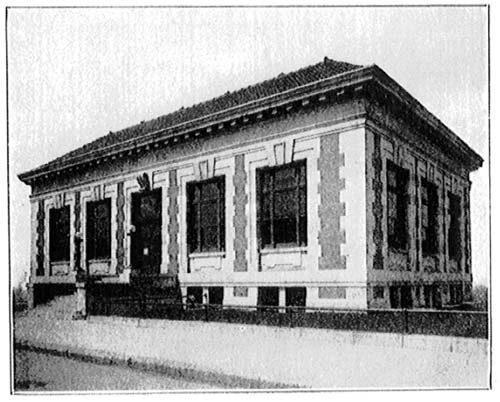
Western Colored Branch
The Western Colored Branch building is 77 feet long and 45 feet wide and is built of brick and stone with tile roof. The building has a main floor and basement. On the main floor near the entrance is the delivery desk and back of it are large tables for reading and reference. To the left on entering is a newspaper alcove, the librarian’s office and the special room for children. To the right on entering is the magazine alcove, a study room and the special room for adults. The basement floor contains a large lecture room, two class rooms and supply and boiler rooms. The building is heated throughout by hot water. The furniture and shelving are beautiful in design and finish, and provision is made for free access to all the books. The arrangement is one of convenience and comfort for those who wish to read or study or to get a book for home use.
Cost of Building and Equipment
Site $3,105.00
Improving grounds 1,123.68$4,228.68
————
Building construction30,935.33
Furniture1,746.6332,681.96
————
Books, pamphlets and periodicals 10,500.00
—————
Total $47,410.64
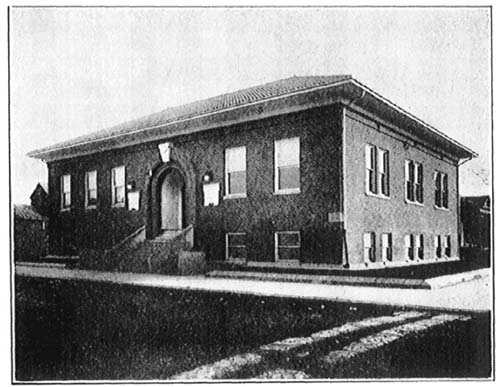
Eastern Colored Branch
The work at the first colored branch library proved so successful that a second Carnegie building was erected in the eastern part of the city. This is known as the Eastern Colored Branch, and was opened with appropriate exercises January 28, 1914.
The building is well adapted for library and social center uses. It occupies a site 75 by 150 feet at Lampton and Hancock Streets. The site cost $5000 of which amount $1000 was raised by colored citizens. The building is 60 by 80 feet, built of brick, concrete and stone with tile roof, and has a main floor and basement. The first floor contains the library room accommodating 10,000 volumes, the librarian’s office, and an auditorium to seat 350 people. The basement has three class rooms for club use, a playroom, 37 by 40 feet, cloak room, boiler room, etc. An experimental garden is under cultivation in the “L” of the building and arrangements are under way to equip a playground 60 by 75 feet in the rear.
Cost of Building and Equipment
Site$5,000.00
Improving grounds 1,000.00$6,000.00
————
Building construction19,250.81
Furniture1,273.5020,524.31
————
Books, pamphlets and periodicals 4,500.00
————
Total $31,024.31
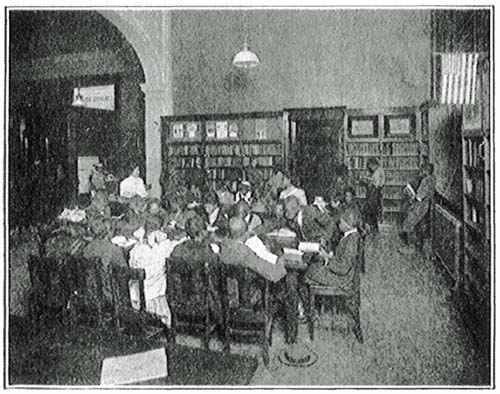
Interior Western Colored Branch
Books in the Libraries. The libraries contain 13,655 volumes; Western 10,554, Eastern 3,101, and receive 137 current periodicals and newspapers, all of which are for free use. New books are being added constantly and readers are urged to make suggestions for additions which they feel are needed and should be added to the library.
Registration. Since the opening 8,958 persons have registered as borrowers and there are now 4,866 cards in force. This number however does not represent all who use the libraries. There are numerous readers daily using books at the tables and there are school room collections which are used by the school children.
Circulation. Since the opening of the libraries 595,048 volumes have been drawn for home use. The following table of circulation by years is interesting:
YearVolumes
1905-06 17,838
1906-07 30,419
1907-08 35,910
1908-09 50,386
1909-10 58,870
1910-11 65,175
1911-12 73,462
1912-13 72,222
1913-14 85,995
1914-15 104,771
———
Total 595,048
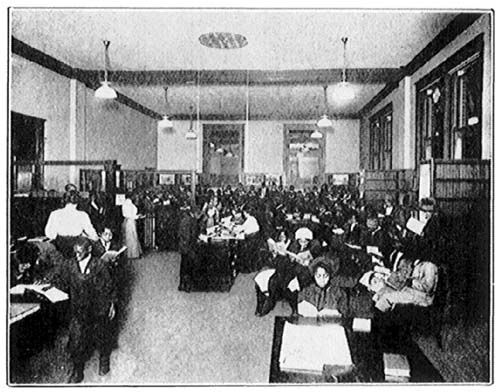
Interior Eastern Colored Branch
Reference Work. A large amount of reference work is done with the pupils and teachers of high schools and graded schools. Since the opening of the libraries 27,968 persons have been assisted in reference work by the librarians. It is impossible to keep an accurate account of the questions asked and information given.
Apprentice Class. The library conducts annually an apprentice class for those who desire to enter library service. An examination is held in June to enter a class which begins work in September. In preparing for service apprentices are given three months’ work under the direction of the branch librarian, heads of departments and chief librarian. The course has been taken by twelve persons, four of whom came from other cities, Houston, Evansville, Memphis and Cincinnati, preparing for service in colored branches in these cities. Arrangements are being made to admit three young women from other cities to take the apprentice work with this year’s class.
Educational Center. Close co-operation with teachers is sought in work with the schools. The libraries not only help pupils during the school life but enable them to continue studies after leaving school.
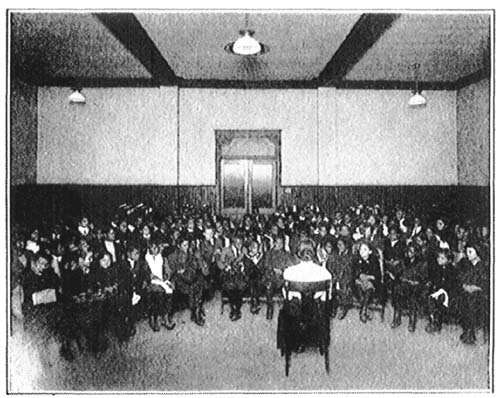
Story Hour
Social Center. Aside from circulating books and doing reference work, the libraries encourage and assist in all efforts to the advancement of our citizens to a social betterment. The people are made to feel that the libraries belong to them and that they may be used for anything that makes for the public welfare. During a single month forty meetings have been held in the buildings. The following clubs and reading circles meet regularly:
Artisan’s Club Banneker Reading Circle Bena Mowya Club Big Sisters’ Committee Douglass Debating Club Douglass Glee Club Fisk Club Girls’ Club Girls’ Gymnastic Club I. K. B. Club Jefferson County Teachers’ Institute Mu-So-Lit Reading Club Normal Alumni Normal School Gymnastic Class Parent Teachers’ Association Story Hour Sunday School Training Class Wilberforce Club Y. W. C. A.
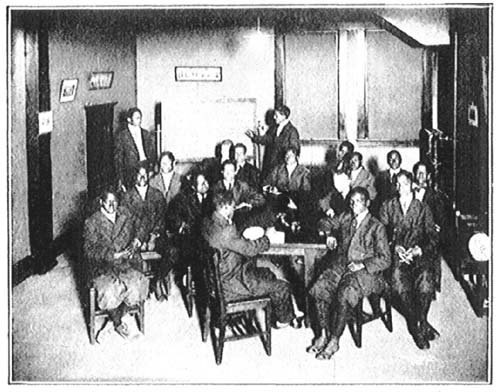
Douglass Debating Club
Meetings in the Libraries. The Story Hour is the children’s delight and is held weekly under the direction of a trained storyteller. In addition to the pleasure that the stories give, new experiences are brought to the children, their imagination is enlarged and an interest is created in books and reading. A story telling contest is held annually and prizes are given to the children who can best reproduce a story told during the year.
The Douglass Debating Club is composed of high school boys and meets weekly under the direction of the branch librarian. The purpose of the club is to acquaint its members with parliamentary usages, to keep before them the great current questions and to train them to speak in public. Public debates are given occasionally and a prize contest is held annually. Following are some of the subjects debated:
“That the right of suffrage should be extended to women.”
“That the influence of women has contributed more to civilization than that of men.”
“That the North American Indian has had greater opportunity for development than the Afro-American.”
“That Lincoln was a greater American than Washington.”
“That the United States was justified in taking up arms against Mexico.”
“That Germany was justified in taking up arms against the Allies.”
“That the United States should interfere to stop the internal strife in Mexico.”