Chapter VI · Hunting and Fishing in Colorado.
Reading edition
One region after another in this country has been proclaimed to be, and was in its day, “A Hunter’s Paradise.” One after the other these places have come under the dominion of the plow until now the situation of that poor man who wants to do above all others that thing he does not have to do at all, is deplorable. In the matter of fishing the question is not so exigent. In that of hunting the question that is oftenest unanswered when asked is “where shall I go to find something to kill; something, too, that I may fancy will kill me if I don’t kill it.”
Now, if Colorado is a hunting country at all, it is one most of whose preserves can be nearly approached in a Pullman car. The climate, even in midwinter, is mild. There is always a town, a mine, a ranch, somewhere within tramping distance; somewhere to go, something to eat, a fire, good women, hospitable men. There is no Nimrod so hearty that these are not to him valuable considerations; if not in the morning, at least at night.
It may seem almost too much to say that nearly every prominent scenery place in the state is contiguous to good hunting. “Over the range” is always, in certain respects at least, another world. There are numbers of men here who habitually prospect in summer and hunt in winter. There is not one of these who does not know where large game is to be found. The trouble is not so much with the place as it is with the unaccustomed man. Find your appropriate and mountain-accustomed man as guide and you will get the game—if you can hit a gray or a light brown spot four hundred yards or such a matter away. It will hardly pay to come to these mountains in order to learn, for the first time, how to shoot at a mark, or how to go hungry because it was not touched.
“Youth’s daring spirit, manhood’s fire, Firm hand and eagle eye, Must he acquire who would aspire To see the gray boar die.”
The forests still cover a large portion of Colorado. Many of these lying away from other interests so far, are almost as silent as they were in the beginning. They are the natural covert for elk, deer, antelope, the mountain sheep and a variety of smaller game. Any prospector will tell one that there is nothing more common than the fresh bear track near the stream, looking like the footprint of a barefoot negro baby. All mountain men 42 encounter droves of elk and deer. Farmers will tell you where they think they are, because they have often seen them there.
For many sportsmen, the northwestern and parts of the northern portions of the state are the best large-game hunting grounds; Routt, Grand and Garfield counties, and the region of which Estes Park is the center. Parts of this northern region are more easily reached by the Burlington’s line from Denver northwest to Lyons than by any other. The region of the foothills, the land between plain and mountain, and including both, is the natural home of the elk. It is in the more outlying regions, of course, that the big shy game now live. Once, in the days of Indian occupation, all Colorado was a hunting field, perhaps the best known. Natural fastnesses, plenty of food and a mild climate made it so. The encroachments of civilization have naturally restricted the field, but with the result that there is now more game in the places they still occupy than there was in former times. This unoccupied region is still in the aggregate, and notwithstanding all the railroad lines, as large as the entire state of New York. One would be illy occupied in prescribing given localities to an accomplished hunter under these circumstances. Every resident hunter knows, if he would always tell, of half a dozen good hunting fields.
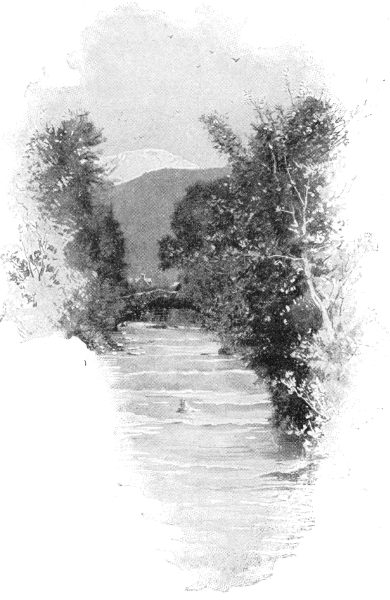
Pike’s Peak as seen from Briarhurst, near Manitou.
In brief, it may be said that there is still game all over Colorado except on the plains, and there the jackrabbit lives in large numbers. In localities where there is fine fishing every summer, such as the Gunnison River, near Montrose or Delta, there is also fine deer hunting in the season, and that is a region largely interested in farming and grazing. Or an inquirer will be rewarded with valuable pointers about the region of the mildest climate in the state; the nooks and valleys on either side of the San Luis Park. A little inquiry developed, perhaps, after the employment of a companion 43 or guide, who is undoubtedly necessary to a stranger, will elicit facts about the hunting grounds and their possibilities that a man might wander over the state for a year and not discover for himself. The best hunting here and elsewhere, is obtained only by him who departs deliberately out of civilization for a period, lives in a cabin, does nothing but hunt while he is thus engaged, and stays long enough to learn the country and the haunts of the beasts for whose life he thirsts. It is not now so easy as it was, even in Africa. The time is coming when it will be a lost art.
People who hunt in Colorado unite in the opinion that the choicest hunting grounds of the Utes were those wilder places that still remain unoccupied. Among such places the country back of De Beque, a town on the line of the Colorado Midland, is prominently mentioned. North of this place lie the Book Cliffs, and through these wind narrow gorges that at places widen out into little parks. There are in these never-failing springs. The region is of large extent, full of trees, and the natural covert of wild animals. A late writer states that he has seen in this region in one morning and counted three hundred and fifty deer. There is also on the mesas an abundance of quail, grouse and sage hens.
In fishing, the case is slightly different. The watercourses of Colorado comprise eight principal rivers, which flow from their sources in the mountains in all directions, increasing in volume from almost countless tributaries. In all these streams the mountain trout is a native. For many years trout fishing has been the principal pastime of the people. The trout is a fish that is particular in his habits to a degree almost absurd, and when he has a place he usually stays there, with an occasional change from pools to riffles, until he grows too large, or until he becomes disgusted with the society of intruders in the persons of large fishes, many of whom have a taste for him when he is young. Like other fishes, they are deaf but they can see quickly, and are known to be gifted with an acuteness above the average. And yet they are great fools, shortsighted and capricious, biting a certain kind of bait one day and refusing it the next, always hunted first by the angler, always a little hard to get, yet caught by the thousands.
But it is only a question of time when the native trout will have disappeared from Colorado waters. Since the propagation of the California rainbow trout in these streams, and the eastern brook trout, he has in many localities already disappeared. The exchange is not a detriment. The rainbow trout grows to a great size here, specimens weighing twelve pounds being often caught. It is rapid in growth, game, and very fecund.
44
Great care is taken in the preservation of the fishing waters. A notable example of this is the South Platte, one of the ideal trout streams of the state. The railroad company plants here each season about two hundred thousand young trout. Platte Cañon, a few hours’ ride from Denver is a favorite ground. The Gunnison River, east of Grand Junction, is another famous fishing stream. There are a great many smaller brooks and streams. Every mountain stream that has not had its waters spoiled by tailings and the refuse of smelters has fish in it. As a rule, the further away from the haunts of many anglers one goes, the more fish there are to be caught. The hunting grounds are fishing grounds as well. The broad statement may be made that no other region of the world has so many streams where game fish naturally live, and that with continual stocking and great care by the railways and the state, the supply has not perceptibly diminished. Many streams are spoiled; many others still remain. They are well known. The accustomed angler knows his fishing place when he sees it, and besides the places where everybody goes he can easily find a domain where he and the fishes can have it out together. There is a United States fish hatchery located at Leadville, and the game laws of the state are well enforced. There is not the essence of truth behind any statement that the days of sport in Colorado are at an end.
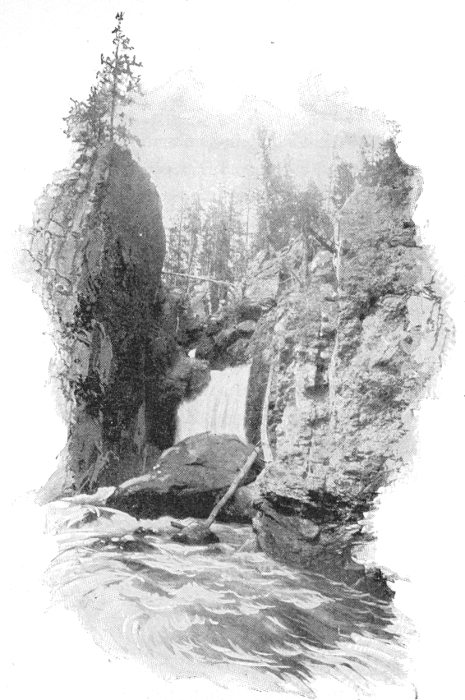
Waterfall in Thompson’s Cañon, Estes Park.
The statutes of the state protecting game permit the killing of game birds from August 15 to November 1; waterfowl from September 1 to May 1. Deer and elk may be killed from August 1 to November 1. The killing of buffalo and mountain sheep is prohibited. It is lawful to take fish with hook and line from June 1 to December 1. Netting, poison and explosives are prohibited.
45