POEMS (continued 2)
Reading edition
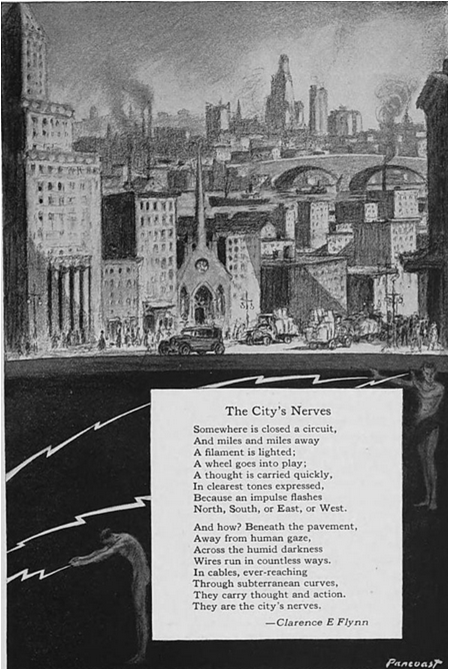
Doing It Well (1926)
I saw him do his act before a large and motley throng That sought relief and laughter in the house of dreams and song. Just who he was or whence he came of course I cannot tell. He only played a banjo, but he played the banjo well. I saw her washing dishes in a simple little cot. Her life was spent in toiling there upon the selfsame spot. Her face was furrowed, and each line a story had to tell. She only kept a household, but she kept the household well. I saw him fire an engine in a vast and grimy room, Though it was hard to see him in the still and dusty gloom. He watched each motion keenly as the pistons rose and fell. He only fired an engine, but he fired the engine well. I saw him digging ditches with the mud upon his hands, And with that steady motion that a digger understands. He claimed no fame nor fortune; only brawn he had to sell. He was but digging ditches, but he dug the ditches well. It matters rather little what task one may choose to do, So long as it is honest and his purposes are true. The years will ring his story far upon their golden bell, If he will only do the thing he may be doing well.
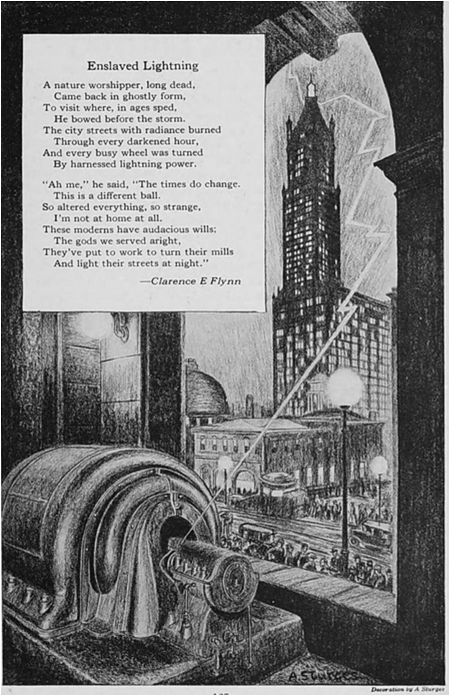
Enslaved Lightning (1926)
A nature worshipper, long dead, Came back in ghostly form, To visit where, in ages sped, He bowed before the storm. The city streets with radiance burned Through every darkened hour, And every busy wheel was turned By harnessed lightning power. “Ah me,” he said, “The times do change. This is a different ball. So altered everything, so strange, I’m not at home at all. These moderns have audacious wills; The gods we served aright, They’ve put to work to turn their mills And light their streets at night.”
Flowers Are Thoughts of God (1926)
The flowers are the thoughts of God. They bloom in sun and shadow, By traveled path, or virgin sod, In every lovely meadow; In dooryards where the children play, And hours are swiftly winging; And Love comes at the close of day, Its selfless tribute bringing. Silent they grow, each in its place, With cheer for all who love them, Breathing their perfume in the face Of all who bend above them. They blossom where the weary plod Their ways of toil and duty. The flowers are the thoughts of God; His love speaks in their beauty.
A Grace for Meals (1926)
Thou who doest hold all things at Thy command The blessing of the sunshine and the rain, Thou never hast withheld Thy kindly hand From giving us the fruitage of the plain. Long hast Thou sheltered us from every storm. Long hast Thou seen that we were duly fed. Long hast Thou kept our fireside bright and warm. And so we thank Thee for our daily bread. As we assemble at our simple board In all the gladness that is ours today, We thank Thee for Thy presence with us, Lord, And ask that Thou wilt be our guest alway. May all Thy children, wheresoe’er they be, Share in Thy bounty, by Thy hand be led, And lift their hearts from every land and sea, With us, to thank Thee for their daily bread.
The Grey Host (1926)
From the silent Southern river, From the reaching Western plain, From the quaint New England hillside Comes a host to march again. From Manila and El Caney, From the depths of many a sea, From the flow’ring fields of Flanders, Come the sons of Liberty. Who are these that tread the silence? They are our departed brave, Who, despite their years of dreaming, Still are troubled in the grave. See, they bear a flaming banner, These who died for us of yore. This the message that it flashes: “Brothers, dream of war no more.”
Heart Gates (1926)
There is a wondrous country, A city built foursquare. And each and all are welcome To find a dwelling there. The nations gather homeward, Peoples from far and wide. Directions do not matter With gates on every side. And is not this the mission That God to us has given— To make the world we live in Seem more and more like heaven? Shall we not seek the friendship Of peoples far and wide, And let the heart’s fair city Have gates on every side?
The High Tension Line (1926)
It has no boast to make at all. Patient it holds unto its task Summer and Winter, Spring and Fall, With naught to tell and naught to ask. Humble and steady, sure and true, Seeking no change of work or place, It has its given work to do, And does it with a changeless grace. In its deep channel underground It serves its purpose day by day, Without a stir, without a sound, Though days be fair, though days be gray. And yet what power is carried down The conduit through which it runs To turn the factories of the town, And flood its streets with blazing suns. I know some men who are the same. They make no boast with foolish lips, But all their spirits are aflame. Power tingles to their finger tips.
“I am not eloquent” (1926)
“I am not eloquent,” he said. “I cannot spin of thought’s fine gold A sentence lovely to be read, A story wondrous to be told.” Thus did he answer God one day Upon a new Tiberian shore. And God said, “No, but you can say The word of love. I ask no more.” And so across the hurried years, Across the mighty land and sea, Through calm and tempest, joy and tears, He bore the message faithfully. He bore it till the set of sun, Until his time and strength were spent. Today the service he has done, Beyond all speech, is eloquent.
Knocking (1926)
THERE’S a sign that always thrills me When its pounding threat I hear, One that always rudely thrills me With the clutching grip of fear. Though the thought of it be shocking, And the homeward journey long, When I hear the engine knocking I am certain something’s wrong. I have known a lot of people, High and low, and near and far, On the street, beneath the steeple, Who were like a motor car. Though successes may come flocking, And though he be going strong, When I hear a person knocking I am certain something’s wrong.

Life (1926)
I said to God: “Life is a wine-cup, A thing to be drained while we may; And those who can drink it most deeply And emptiest cast it away. The ones who have claimed the full measure Of all the joy it can give, Are those who have learned most completely What it means to be conscious and live.” But God said: “No, life is a picture, A thing you may paint as you will. Your colors are of your own choosing, And yours is the measure of skill. You may paint, and the curse or the blessing With all of their burden or worth, When your brush has been dropped will be treasured As your gift to the children of earth.”
The Question v1926
THE women are cutting their tresses To look just the same as the men. They have thrown away skirts, and have taken to shirts, And collars, and neckties; and then The men have begun wearing knickers, With hose of elaborate art. They radiate bliss, but the problem is this: How are we to tell them apart? One day when I saw a young lady Drop a handkerchief, quickly I ran And returned it to her with my heart all astir, But lo, when I spoke, ’twas a man. Then I slapped a young man on the shoulder, And he turned with a manner most tart. ’Twas a lady attired as the fashion required. Say, how do you tell them apart?
The Rooster (1926)
HE RISES at the break of day, Sometimes a little bit before it, To tell us that the dawn is gray And he is proudly gloating o’er it. He makes his boast that nothing’s wrong About him or his constitution. His voice proclaims with accent strong That he’s a going institution. He has been whipped a hundred times, A hundred times run helter-skelter, But still his raucous challenge chimes As though he’d never sought for shelter. He has the courage to arise, And sally forth, and be a booster, Though gray or sunny be the skies. Here’s to the spirit of the rooster.

The Rulers of the Earth (1926)
Jim Jones with a will undivided Toiled on with his reaper and plow. He brought up his brood, and provided For them by the sweat of his brow. Whenever some plan was in question, In kindly and old-fashioned way He gave this unchanging suggestion: “Whatever the women folks say.” The world with its strife and its glory Goes seeking for treasure and charm. The tale of its years is the story Of Jim Jones who toiled on the farm. The men wield the shovel and hammer, But if we should ask them the way The world should be run, they would stammer: “Whatever the women folks say.”
Sing a Little Song (1926)
When the heart is weary And the road is long; When the day is dreary, Sing a little song. Sing it in the spirit; Let joy linger near it; And your heart will hear it, Hear it and be strong. When your hope is paling, When your plans go wrong, When your dreams are failing, Sing a little song. Send it thrilling, winging, Sunshine with its bringing. It will wake to singing Others in the throng.
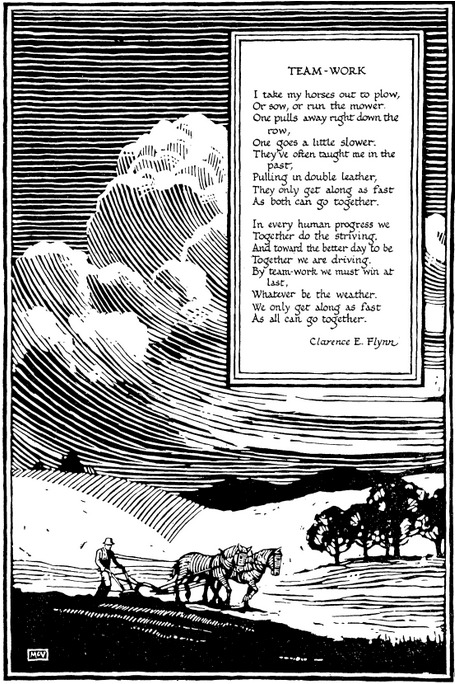
Team-work (1926)
I take my horses out to plow, Or sow, or run the mower. One pulls away right down the row, One goes a little slower. They’ve often taught me in the past, Pulling in double leather, They only get along as fast As both can go together. In every human progress we Together do the striving. And toward the better day to be Together we are driving. By team-work we must win at last, Whatever be the weather. We only get along as fast As all can go together.
Their First Meal (1926)
The ham was cold. The milk was blue, The biscuits all were hard. The eggs and the potatoes, too, Were strong with rancid lard. Life leaned upon a slender staff In that first offering, But never banquet tasted half So pleasant to a king. The years went by. They played the game, And soon amassed a hoard. The richest dainties skill could frame Were found upon their board. With choicest viands did they greet The great who chose to come, But never did they taste so sweet As that first meal at home.

The Umbrella Mender (1926)
“Have you any umbrellas to mend?” He cries down the echoing street. He travels the town to its end— The city of hurrying feet. Why so, when the broad heavens wear No cloud and no shadow of gray? Because, when the weather is fair, We must think of the rainy day. For the rainy season will come, As it has since the world began. And some will be ready, and some Will have left it out of their plan. When it comes, it is always too late To appeal to our patient old friend. We shall not hear his cry at the gate: “Have you any umbrellas to mend?”
The Cross v1927
Luke 22:42. “Nevertheless not my will, but thine, be done.”
Upon some fateful hour and day Each comes to roads that cross. Blossoms and sunshine seems one way, The other care and loss. The spirit will be willing there To take the road that’s best. The flesh will weaken, and despair, And falter in the test. Somewhere along the life we live Each finds his Calvary. There with himself each one must strive, And win his victory. How blessed is the pathway trod When flesh ’neath spirit fails; When cross the ways of self and God, And God’s good way prevails.
Cupid’s Lament (1927)
The coal oil lamp is now no more, With flame to dimness fingered. A gleaming chandelier is o’er The spot where lovers lingered. Where all is bright they will not go. No one can change or doubt it. They want to sit where lights are low. What can I do about it? It was much easier for me In days that now are olden, When prying people could not see. Then all love’s dreams were golden. They sought a corner that the night Had curtained—you have seen them; But now the dusk-destroying light, Alas, has come between them.
A Day at a Time (1927)
A day at a time the world moves on; A day at a time is our toiling done; A day at a time do we have the dawn, And come to the setting of the sun; A day at a time our fate appears; A day at a time do we build the years. A day at a time is the only way; Whatever we do must be done to-day. A day at a time is lifetime sent; A day at a time we must be content. However distant our dream may glow, A day at a time is all we go. A day at a time the stones are brought, And life’s great mosaic grandly wrought. A day at a time—but when all are past We shall reach the goal of our dreams at last.
The Future (1927)
A tyrant called, as tyrants used to do, An artist, skilled in form, and tint, and line. He bade him: “Paint for me a picture true Of the tomorrow of this calm of mine. Unfold for me the future’s portals wide. Unlock the gateway of the years to be. Whatever weal or woe they may betide Return again and prophesy to me.” The painter went and sought the open street. He lingered there through many a watchful day Where sons of wealth and ragged urchins meet To talk, and laugh, and sing, and dream, and play. Then once again the tyrant’s room he sought, Unveiled for him the finished task, and smiled. Lo, on the canvas he had deftly wrought The pictured features of a little child.
God’s Manners (1927)
If you would learn God’s manners, Fare forth some summer morn, And see the roses cover The sharpness of the thorn. See the sun shining brightly, Chasing the clouds away, And hear the words of gladness The little people say. Look at the green crops growing Up through the dewy air, And see the love and beauty Around you everywhere. No ugliness or evil Appears in sky or clod. Ask any summer morning, If you would learn of God.
The Great Adventure (1927)
The great adventure is not death, ’Tis life. It is to feel the pulsing round of breath, To take a place and hold it in the strife. To hope, and plan, and feel, and love, and dream, To look and climb To the far, rugged heights where visions gleam Of things sublime. Let us not live because we must, But live To feel the mighty challenge of a trust, To have a work to do, a gift to give. The pay may not be great in shining gold, But may be had Enough of satisfactions manifold To make us glad.
The Heart of a Child (1927)
Whatever you write on the heart of a child, No waters can wash it away. The sands may be shifted when billows are wild And the efforts of time may decay. Some stories may perish, some songs be forgot; But this ingraven record, Time changes it not. Whatever you write on the heart of a child, A story of gladness or care That Heaven has blessed, or that Earth has defiled, Will linger unchangeably there. Who writes it has sealed it forever and aye. He must answer to God on the Great Judgement Day.
How It Started (1927)
WHEN Thales of Miletus Went to the store one day And bought a bit of amber, In a real human way He got a piece of woolen To rub it up a bit, And lo, the lint and dust grains Were drawn at once to it. “Ha,” said old Thales, “’tis certain, A man half blind could see, This friction has begotten Some unseen energy.” To-day that power is doing The labor of the earth. How much were Thales’s amber And piece of woolen worth?
In Conference (1927)
JOHN JONES was head executive of a big city firm, And countless times had set his heel on some poor human worm. His office force was duly trained. Each knew just what to do To turn the nonelect away, and let the chosen through. People with honest errands there, tired women, busy men, Were told he was in conference, and couldn’t see them then. “Come back a little later on,” the office girl would call, And John would manage not to see the most of them at all. He passed away in course of time, as even rich men do, And came up to the pearly gates as though to hurry through. But lo, the way was firmly barred, and, sitting in a chair, He saw a white-robed office girl who asked his errand there. “I hoped,” said he, “Saint Peter would be here and let me by.” In standard office language she delivered this reply: “Saint Peter is in conference. How long? I do not know. Come back a little later—say a million years or so.”
Inventive Genius (1927)
I’VE listed the inventions Since ages far away, And noted the discoveries Down to the present day. One little thing I’ve noticed, Thus far, of every one. It’s really very simple —When you see how it is done. Somebody finds a secret That no one else has seen, Harnesses laws familiar, And makes a new machine. There’s not a task among them Requiring so much wit, But that I could have done it —Had I but thought of it.
Morning Prayer (1927)
Father, grant to keep and guide me Through the moments of the day. Let me know Thou art beside me, That no evil can betide me In my work or play. Teach my hands some good endeavor While the golden hours shall run, Something that will last forever Let me bring to Thee, the Giver, E’er the day is done. When at last the sun is wending Down the sloping West, And the evening shades descending Tell the world the day is ending, Watch above my rest.
Old-Fashioned Pictures (1927)
The old plush-covered album Upon the parlor stand Is but a distant country, A half-forgotten land Inhabited by people Strong as the sturdy oaks, Firm as the hills they conquered, —The dear old-fashioned folks. Look at the honest faces, The quaint and homely dress, The strained and studied postures That once spelled loveliness. Look at the solemn features. They put away their jokes To have their pictures taken —The dear old-fashioned folks. They carved trails through the forests. They seeded down the soil. They built the busy cities By unremitting toil. They laid the firm foundations, By honest, manly strokes, On which we build the future. —The dear old-fashioned folks.
The Problem (1927)
THOU God of little children, And Parent of us all, Who knowest all our struggles, And hearest every call, Disclose to us the secret, And tell us what to do To keep our children little And have them grow up, too. We treasure the devotion, The little velvet hands, The tender little greetings Love always understands; And yet we want them coming To strength and prospects new. How can we keep them little And have them grow up, too?

The Pupil (1927)
A father’s highest vision, A mother’s fondest prayer Are centered in the future Of that wee fellow there. They roused him from his slumber, And dressed him in his best. They sent him out, and trusted That you would do the rest. The weary planet needs him, And patiently will wait For him to bring his service Down to the future’s gate. He is the hope it treasures. It wants him strong and true. It sends him to your classroom, And leaves the rest to you.
Requisition (1927)
Give me a quiet road to take Where roses deign to grow. Where sunbeams fall, and robins wake, And trees their shadows throw. Give me a little place to try To do my human part, And make my work as days go by A picture of my heart. Give me a hearth where I may be When twilight shrouds the West, With dear ones there to sit with me, And you may have the rest.
Sanctuary (1927)
GOD has a place, and it is never far, Where reach vast arches over golden gates, Where quiet aisles and vaulted ceilings are, And where a spacious altar always waits; A place where weary souls may freely come, Hearts torn by earth’s sharp thorns a refuge find, Sad, lonely spirits feel again at home, And all find rest and balm for heart and mind. It is a house of walls not made with hands. None sees it save the broken child of care. In every place of woe and need it stands, Wherever sorrow dares to breathe a prayer. The weakest, poorest, farthest spirit, tried By grim pursuers of defeat and pain, May claim its shelter. Then when tears are dried It waits in silence till they fall again.

The Secret (1927)
OLD Uncle John is a success, And all his efforts have not hit it. One day we asked him to confess, To all of us just how he did it. “I hardly know, myself,” said he, “But my conviction still is growing, That there’s no fancy recipe. You just begin—and keep on going.” “Don’t wait for things to come just right, For very seldom do they do it. Select a road, then day and night, Through storm and sunshine, still pursue it. Don’t stand debating what is best. The sands of life are swiftly flowing. Most any worthy course is blest, If you begin—and keep on going.”
Sight and Faith (1927)
I walked by sight along the sunlit way, Through pleasant fields and where the flow’rs were fair. By quiet streams, through restful vales it lay, And loveliness and joy were everywhere. I walked by sight, so confident my soul, Nor dreamed that it would ever diff’rent be, As I moved onward to the shining goal That through the distance seemed so clear to me. But lo, there came the hour when dusk increased, And sunset slowly faded into night, As hour by hour the strength of vision ceased, And I no more could make my way by sight. But when the day had failed to shadows dim, Without a star to lend a flickering ray, I took God’s hand and travelled on with Him, And sudden glory flooded all my way.
Starting Things (1927)
THE ghost of Father Gutenberg Came back upon a visit. He saw a modern printing press, And cried, “Good sakes, what is it?” He saw a linotype at work On endless composition, And said, “It must be that my mind Is not in good condition.” He heard the newsboys hawk their wares, And saw the bookstores busy, Found magazines on every stand Until it made him dizzy. He said, “Whoever could have thought All this I was imparting? One never guesses, after all, How much he may be starting.”
Success (1927)
SUCCESS is not the garnering of gold Wrung from the failing grasp of nerveless hands, Nor grim advantage where are bought and sold The cargoes of the fleets from distant lands. It is not deafness to the anguished cry Of blighting poverty or bitter need, Nor a triumphal march to victory Over pale lips and human hearts that bleed. Success is living to the full each hour, Finding the richness of the joy it brings, Leaving unheard no song, unseen no flower, Unfelt no throbbing loveliness of things. Success is soothing human hearts that ache Breathing new hope into despairing ears, Serving with willing hands for love’s dear sake, And sowing happiness across the years.
Thanksgiving v1927
In all the pleasure, care, and stress Of daily human living, Preserve us from forgetfulness, Blindness to heaven’s faithfulness, And failure in thanksgiving; Deliver us from every mood That savors of ingratitude. It is so easy to forget The tempests that have swept us, The barriers that we have met, How much we are in heaven’s debt, The goodness that has kept us. However far we be from good, Preserve us from ingratitude.
The Bantams (1928)
We have got a bantam rooster with a funny little face, And he tells us by his swagger that he thinks he owns the place. He will lord it o’er the chickens with a mien and manner high, And the strangest thing about it is he generally gets by. We have Brahams, Rocks, and Cochins—big and strong and robust, all; But they let this bantam run the place because he has the gall. Big and lazy and good-natured, they seek out a shady spot, Nor dispute the bold assumption of his right to rule the lot. And sometimes I think the whole world is a barnyard, wide and vast. With the selfsame situation, as the ages hurry past. People big and strong and able take the smooth and easy way, While the fussy little fellows feather in and win the day. Singular, at least, I call it that so oft the crown is worn. By some self-elected demagogue, so oft the scepter borne, Not by some one with the vision a commanding swath to cut, But some cocky little bantam who was born to preen and strut.
Charge Account (1928)
YOU may think you are getting by. You may get by awhile. But do not snap your fingers in the face of Fate and smile. Although she may not now demand of you the full amount, Some day you will discover that she keeps a charge account. She never quarrels with us nor bestows unseemly looks, But no one ever yet has found an error in her books. She writes down every item very quietly, but still There certainly will come a day when she presents her bill. She asks no more than is her due, for Fate is always square. No tradesman yet in all the world has ever been more fair. Good business methods, that is all. There is no other way. You may get by awhile, my friend, but some day you will pay.
The Close-Up (1928)
There are many angel faces, Viewed from places far away, Which, upon a near vision, Very quickly turn to clay. There are many matchless heroes Who can hold us in their spell, But who fade away to weakness When we really know them well. There are many hissing villians Who, on closer view, are found To possess a kindly spirit And an honor quite profound. So it runs throughout the picture, As it probably is best, That the close-up tells the story Whether one can meet the test.
Coming and Going (1928)
I GO down when the train comes in, No matter what the day, Where some arrive amid the din, And others go away. I see glad faces looking down The track that rambles on Far from the quiet little town, Impatient to be gone. But oh, the eyes most full of mirth I see upon the train Have seen the wonders of the earth And then come home again. Blest is the road that leads away Where restless ones may roam; But each loves best of all, one day, The road that leads back home. Ambition makes us all to dare The far, intriguing track; But when we’ve had enough of care The heart will bring us back.
The Day’s Success (1928)
When sunset falls upon your day And fades from out the West. When business cares are put away And you lie down to rest, The measures of the day’s success Or failure will be told In terms of human happiness And not in terms of gold. Is there beside some hearth tonight More joy because you wrought? Does someone face the bitter strife With courage you have taught? Is something added to the store Of human happiness? If so, the day that now is o’er Has been a real success.
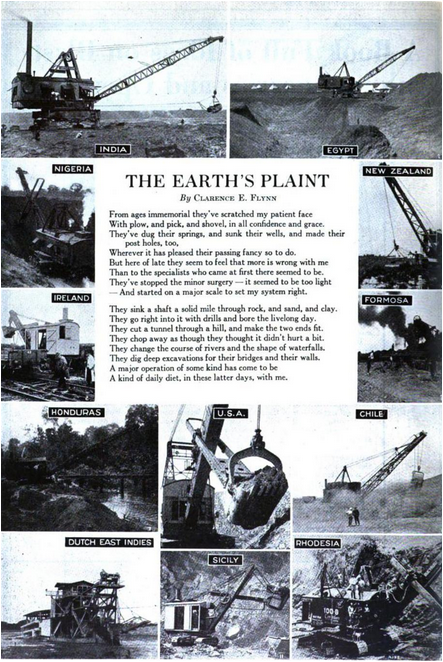
The Earth’s Plaint (1928)
From ages immemorial they’ve scratched my patient face With plow, and pick, and shovel, in all confidence and grace. They’ve dug their springs, and sunk their wells, and made their post holes, too, Wherever it has pleased their passing fancy so to do. But here of late they seem to feel that more is wrong with me Than to the specialists who came at first there seemed to be. They’ve stopped the minor surgery—it seemed to be too light —And started on a major scale to set my system right. They sink a shaft a solid mile through rock, and sand, and clay. They go right into it with drills and bore the livelong day. They cut a tunnel through a hill, and make the two ends fit. They chop away as though they thought it didn’t hurt a bit. They change the course of rivers and the shape of waterfalls. They dig deep excavations for their bridges and their walls. A major operation of some kind has come to be A kind of daily diet, in these latter days, with me.
Evolution (1928)
A shining automobile Was standing at the curb. A glib and crafty salesman Was handing out his blurb. A bicycle was leaning Its well-worn handle bar Against a post—the early Ancestor of the car. Then, snorting down the pavement, A motorcycle flew, Pausing between the cycle And car so bright and new. “Aha,” the auto whispered, “I have evolved, I think, From that bicycle yonder, And here’s the missing link.”
Faith v1928
If you cast out Into the outer darkness of your mind All about which you can conceive a doubt, Or find some strange and vain excuse to flout, Or charge to ages credulous and blind, All about which the whole world is not sure, My friend, you will be pitifully poor. If your faith clings To all the good, and beautiful, and right, That the experience of ages brings, And offers as the necessary things That stand forever by truth’s simple might, Believing each till it is found untrue, The heart’s unmeasured riches are for you.
Freedom v1928
Freedom to make the sturdy climb From sodden depths to heights sublime; Freedom to seek Truth’s ready aid In mastering a chosen trade; Freedom to play an honest part, And make some worthy work an art; Freedom to struggle with a smile— That is the freedom worth the while. Freedom to keep a heart that sings Amid the fret and drive of things; Freedom to serve with heart, and mind, And hand, the races of mankind; Freedom to meet the fiercest test Knowing that one has done his best; Freedom to trudge the upward mile— That is the freedom worth the while.
The Harness (1928)
“What means all this mass of wiring?” Asked the visitor from Mars. “We have nothing that is like it In our section of the stars. All these conduits and cables, This machinery that sings With its whirring wheels and motors —What have they to do with things?” “Very much,” the earth-child answered. “We’ve a giant, all unseen, Who serves every little household, Every factory and machine, Does our work, transports our people, Friendship’s kindly message bears. All this wiring you have noted Is the harness that he wears.”
His Great Hour (1928)
He headed the procession On many a parade. He heard the ringing echoes Where loud applause was made. But naught has ever equalled The time in early youth When first his folks discovered That he had cut a tooth. He published learned volumes And speeches made galore. He traveled and was feted The land and ocean o’er. But never was the hero So praised and sung, forsooth, As on that vanished midnight When first he cut a tooth.

“I held a sea shell to my ears” (1928)
I held a sea shell to my ears A little while today, And heard the echo of the years Sounding from far away. I heard ten thousand soft good-byes To hearts that needs must roam, Ten thousand weekly muffled cries For ships that came not home. I heard the story of the dreams Of those who journeyed far, But brought not back Wealth’s shining gleams To the home harbor bar. I heard the story of the brave Who Freedom’s burdens bore, Who fought their battles on the wave But struggle now no more.
Imminence (1928)
Like to the circuit of a bright day’s glory, Like to a shadow moving on the grass, Like to the telling of an evening story, God’s purposes all shortly come to pass. Like to the nearness of a dewdrop’s brushing, Like to the nearness of a breath of May, Like to the nearness of a wind uprushing, God’s promised kingdom is not far away. Like to the vastness of the stars’ swift motion, Like to the vastness of the course they swing, Like to the vastness of a shoreless ocean, God’s love is here enfolding everything.
Iron (1928)
A piece of iron was refined By highest skill of hand and mind, To steel that formed the keenest blade, Or instruments of wonder made, Or strings awaking symphonies From far across the centuries. Another piece lay dull and dead As days of hope and wonder sped. It felt no prompting of desire For the refiner’s purging fire. Passive it lay, nor ever wist The thrill and gladness it had missed. I speak no word of praise or blame. I only say it is a shame That metal, made for wondrous things, Keen instruments, responsive strings, Should be, its aspiration spent, Arrested in development.
I Want (1928)
IWANT a deep mine where the gold knows no measure, A house with the widest and rarest of rooms, Replete with the objects of beauty and pleasure, With tapestries done on the finest of looms. I want a great fleet that will compass the ocean, And bring me the choicest of all the world’s store. I want a cortege, with the deepest devotion Performing my bidding, my wishes—and more. I want a position of pow’r and of splendor, An empire to rule with the will of a king. I want the rich tribute that vassals can render, The praise that the lips of the loyal can bring. I want earth’s delights without limit or curbing, The richest that skill can conceive or design. One question alone is a little disturbing— Just what shall I do with them when they are mine?
The Lucky Man (1928)
He struggled on and upward, Impelled by high ambition. He bent his strongest efforts To better his condition. He paid the price of labor, As others had before him. A rich and bounteous harvest His earnest efforts bore him. Two loafers were exchanging Their shallow talk one morning, Their conversation ranging From filthiness to scorning. He passed. One said: “There’s Sweezy. My way was always rocky. But some folks have it easy. That fellow sure is lucky.”
The Pioneer v1928
HE marked a trail across the plains In days now long ago. He spared no labor and no pains, Although the work was slow. Today a highway broad is laid To places far and near Along the path he slowly made —Thanks to the pioneer. HE found a green and smiling plot, And built a cabin there. He reared a family on that spot Hallowed by toil and care. Today a broad, smooth roadway lies Where, in a vanished year, He wrought an empire with his hands —Thanks to the pioneer.
The Recruit (1928)
Well, Bill has joined the navy, His vessel sailed today. He heard a ship’s band playing One night across the bay. He hurried to the office And entered the command. He had to take the navy, You see, to get the band. He was that way in childhood. When the town band would play, Bill would just start out with it And follow it all day. He’ll have to peel potatoes And scrub the decks by hand; But he will think it’s worth it If he can hear the band.
Success and Failure (1928)
Whoever builds a mighty name And fills the country with his fame, Who seeks and uses earthly power To make a stately triumph hour, Who rears a mansion rich and high To frown against the kindly sky, If he has not found happiness Is still a failure none the less. Whoever dwells in humble walls Where only toilsome care befalls, Who plans when dear ones are in bed Where shall be found to-morrow’s bread, To cheer whose heart Life only brings The humble joy of simple things, If happiness has crowned his name, He is successful just the same.
Sunshine and Shade (1928)
The rarest picture Art has ever given, On which the studied light has ever played, Is made of these two simple gifts from heaven A little sunshine and a little shade. The grandest day that ever lent its story To the long scroll the hand of Time has made; What is the fair effulgence of its glory? A little sunshine and a little shade. The greatest life the world has ever cherished, The memory that lives while others fade, Is only this when its brief day has perished A little sunshine and a little shade!
The Trouble with the Movies (1928)
The trouble with the movies, As it appears to me, Is not what the wise people About me seem to see. But I do raise objection In accents bold and high To one outstanding evil The waste of custard pie. If all that precious pastry Thrown with such ready grace, Such technique and precision, At some poor fellow’s face, Were gathered all together For my convenience, I Would just retire from labor And live on custard pie.
Walking with God (1928)
WHO walks with God must take his way Across far distances and gray To goals that others do not see, Where others do not care to be. Who walks with God must have no fear When danger and defeat appear, Nor stop when every hope seems gone, For God, our God, moves ever on. Who walks with God must press ahead When sun or cloud is overhead, When all the waiting thousands cheer, Or when they only stop to sneer; When all the challenge leaves the hours And naught is left but jaded powers. But he will some day reach the dawn, For God, our God, moves ever on.
Wander Lust (1928)
“I want to go away somewhere,” Cries every human heart of care. “I want to go across the sea, And find a place where hearts are free. I want to look at bluer skies, And stand where higher mountains rise. To tropic scene, to arctic snow, I want to go, I want to go.” And so we take our varied ways Across the miles and through the days. We see the wonders of the earth. We share its sorrow and its mirth. Time sends its snows upon our hair. We stumble with our loads of care. Then one day sounds a broken cry: “Please, won’t you take me home to die?”
The Divine Image (1929)
Something within me makes me love the roses; Something within me makes me search the sky; Something within me makes me roam the meadows; The woodlands where the trees are still and high. Something within me makes me sit at twilight Enraptured with the starlight on the sod; Something within me thrills at lovely music, That something in me makes me kin to God. Something within me makes me like the brothers Who share with me the path that I must tread; Something within me wakens hope and longing To struggle on to summits far ahead. Something within me keeps me ever dreaming Of heavenly things amid the thorn and clod; Something within me speaks of light and beauty, That something in me makes me kin to God.
Domsie (1929)
Simple his habit, plain his wonted ration, Humble the roof that sheltered him at night. He sought no preferment of rank or station, Save but to be a bearer of the light. He dreamed out futures for the boys before him, And led them ever onward toward the goal. The heights they won the choicest gladness bore him Whose faces were enshrined within his soul. In many a countryside and distant city Were lived strong lives to which the light he gave. Strong hearts beat and strong hands were reached in pity He taught to bless, to brighten, and to save. Upon a quiet hillside he is sleeping, Content to rest, the final school day o’er, But everywhere his boys the faith are keeping. They hold his torch aloft forevermore.
The Happy Ending (1929)
ILIKE to read a stirring tale of peril and of action. I follow every character with heartfelt satisfaction. If, truth and error, right and wrong, defeat and triumph blending, The story rambles steadily toward a happy ending. No matter what vicissitudes the hero strong engages, No matter how the conflict runs across the crowded pages, If at the close all comes out right, with every wrong defeated, Each happy dream at last come true, each worthy task completed. They tell me it is not the style in these days so to write it. The proper thing, they say, is with a smirch of wrong to blight it, To leave the tears unwiped, the wrong unrighted, and the error Unbanished in the general reign of trouble and of terror. But I still have the faith to cling to childhood’s deep conviction That somehow justice does get done in life as well as fiction, That there is more of right than wrong, of pleasure than of weeping, And that a kindly Providence still has us in its keeping. I think when all the years are through the world’s heart will be singing, That bells of bounding happiness will everywhere be ringing, And the great Author of the tale of life, His mercy lending, Will bring the story of the world down to a happy ending.
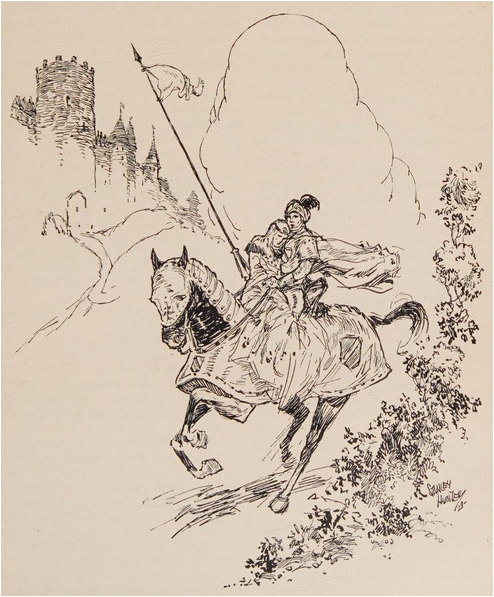
Have You Tried? (1929)
Are you sure you cannot do it? Are you really satisfied That you never can go through it? Have you tried? Do a thousand doubts assail you With their darts from every side Till your hope and courage fail you? Have you tried? Have you ceased to dream of winning? Have your expectations died? Have you really had your inning? Have you tried?
Memorial Day v1929
Exodus 12:14. “And this day shall be unto you for a memorial.”
Their drums are still. Their banners all are furled. They feel no more the battle’s fiery breath. Theirs is the vastest army in the world, Encamped upon the silent fields of death. Of peace and happiness they paid the price. Their Via Dolorosa did they tread. They climbed the Calvary of sacrifice, And found a place among the mighty dead. The years roll on, but as they pass away Let not this tender memory grow old. By the sweet, smiling blossoms of the May Let their fair story be forever told.
The Modern Pupil (1929)
I’ve had a new school teacher Now for a week or two. She seems to be quite clever, And knows her subject, too. She’s pleasant and attractive, As far as I can tell. There’s just one trouble with her. She doesn’t mind me well. In fact, she has a notion, Saved from a former day, That things about the schoolroom Should go the other way. And so the one objection That any one could find Is insubordination. I cannot make her mind.
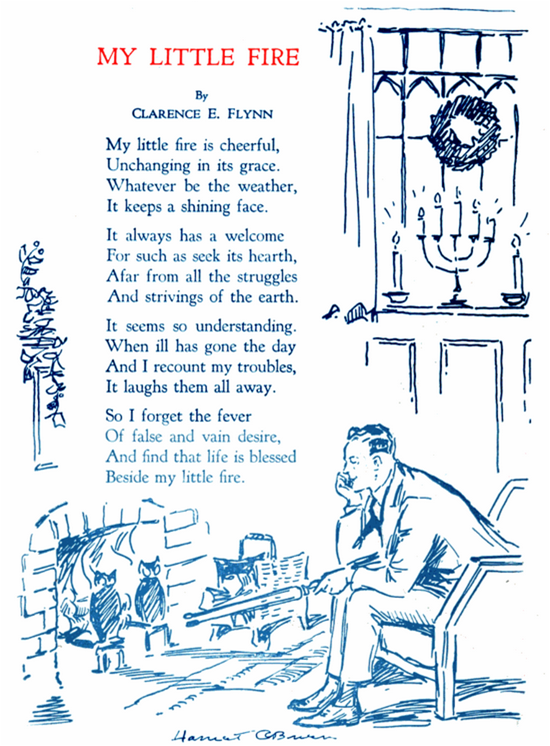
My Little Fire (1929)
My little fire is cheerful, Unchanging in its grace. Whatever be the weather, It keeps a shining face. It always has a welcome For such as seek its hearth, Afar from all the struggles And strivings of the earth. It seems so understanding. When ill has gone the day And I recount my troubles, It laughs them all away. So I forget the fever Of false and vain desire, And find that life is blessed Beside my little fire.
The Red Bird (1929)
I heard a redbird singing Beside my door to-day. Bright his coat of scarlet, And happy was his lay. He trilled and chirped and twittered In varied note and key. It was a great example Of birdland minstrelsy. Then I beheld before me That vast, unnumbered throng Whose weary, sodden voices Have never learned a song; And while I heard the redbird Stand forth and greet the spring, I wished that all earth’s children Were glad enough to sing.
The Road to Tomorrow (1929)
THERE is a road that stretches Through sunny yesterdays, Adown remembered vistas, And over long lost ways. My feet would tread it always, If they could have their will, But Wonder comes to call me Across the future’s hill. THE road to the tomorrows —Its challenge is supreme. I do not know its windings, Its hidden wood and stream, Its distances alluring, Its vales of mystery. But I shall drive and find them. It is the road for me.
Thankfulness (1929)
I HEARD a tiny sound to-day. The flowers all had stopped to pray. Lily, and rose, and goldenrod And violet were thanking God. For what? The sun, and rain, and dew, That had not failed the season through, The soil, the winds with their caress; And simple daily happiness. I blushed, whose thought had found no wings To thank God for the simple things. No sudden fortune had bestowed On me a rich and golden load. But I had known the rain, the sun, Shelter and rest when day was done, Raiment, and food, and happy hours. I was less thankful than the flowers.

“Whatever he may wish or plan” (1929)
Whatever he may wish or plan, Three things will make or break a man: The work to which he gives his hand, To make a living in the land. The friends to whom his heart gives toll, Whose shadows fall across his soul. The goal by which through toil and strife He gives direction to his life.
God and Spring (1930)
Though there were no hint of glory In a pebble or in clod, Though the circling of the planets Gave no evidence of God, Though the wisdom of the ages Not a word of faith could bring, How could one be unbelieving Who had ever seen the Spring? In the Spring God spreads the verdure On a thousand hills and leas. In the Spring he paints the roses, Hangs the clouds, and builds the trees. In the Spring he weaves the wonder Of a flitting redbird’s wing. How could one be unbelieving Who had ever seen the Spring?
The Handicap (1930)
Whatever foe may meet me, Whatever game I play, I’d rather he’d defeat me Than win a walkaway. I do not want an inning With never a mishap. No game is worth the winning Without a handicap. So in the mighty contest That runs across the years, I’d rather wage my conquest In toil and sweat and tears, Than have success’s measure Tossed lightly in my lap, And win life’s golden treasure Without a handicap.
The Mixture (1930)
A little bit of Saxon And a little bit of Gaul, A little bit of Latin And a touch of Celtic small; A little bit of Norman And a dash of Scottish clan, Mixed with a bit of Teuton, Makes a good American. The best of all the races— Let us hope, without the worst— Is mingled in his making By the whole earth he was nursed. So who is there beneath us? Who is there we should ban, When all the world is living In a good American?
Sunsets For Sale (1930)
I heard a man in Paradise Say this to God: “Let’s advertise! You’ve got a proposition here On which you’d make a billion clear If I could manage things my way. My plan is this: Make earth-folks pay For what you give them, night and day. For instance, take the Milky Way; To see that glittering display I’d charge them fifty cents a night; To purchase tickets folks would fight. We’ll charge for flowers, and song of bird— Why give them free? Why, it’s absurd! One dollar for each sunset view, The same for every sunrise, too. Fall landscapes will be costly sights, We’ll reap a sum from mountain heights. Green curving breakers will come high, And men will pay to hear winds sigh.” Then God replied, when he had done, “I charge for all these things, my son. And costly—costly is my fee: A heart of childlike purity!”
Thanksgiving v1930
I thank Thee, Lord of earth and heaven, For all the blessings Thou hast given. Some marched in such a shining line I knew their banner and their sign. Some came to my bewildered eyes Dressed in a fanciful disguise. Some came attired as Bitterness, But stayed to strengthen and to bless. Some nameless came, and passed away, Unknown till after many a day. Some came so silently that I Did not suspect that they were nigh. Some were the blessings, strong and sure, Of things that I did not endure. And so, however they befall, Dear Lord, I thank Thee for them all.
Two Teachers (1930)
One peddled facts with learned air, Intoned with most impressive sound, His pupils timidly would bear Witness to scholarship most profound. In him. Time passed. They older grew. Still passed, and one day he was not. Then what became of all he knew So glibly once? It was forgot. Another dreamed of life supreme, Sun-crowned and strong, for those he taught. The larger manhood was his scheme, Armed with the power of honest thought. He builded souls for service true, Wrought them of fabric real and sure. He also passed, as teachers do. But through the years his works endure.
Two Youths (1930)
One said, “Youth cometh but once to me, So I shall play, and laugh, and sing; I own no chains. I will be free, None shall deny me anything.” He had his fling, then worn and gray, With weary soul and eyelids wet, He tried to wash the tears away, And stem the tide of vain regret. One said, “My youth comes not again, I must not spoil it as it goes. I must not live a day in vain, Nor stain a page, nor mar a rose.” The future found him glad and strong, Unbound by weariness and fears, Treading his journey with a song, Heir to the gladness of the years.
What Do You Know? (1930)
I DO not care a single wink To hear, my friend, what you may think. I’ve heard opinion till I’m sore Please do not give me any more. Your syllogisms all are weak. You slip the track whene’er you speak. Too many people think, of late, And not enough of them think straight. What do you know? I wait to hear A tale of knowledge ringing clear. If you have anything to say That puts a new light in the day, That makes me feel because of it The world is changed a little bit, Then speak. I hark with eyes aglow, If you will tell me what you know.