Chapter X
Reading edition
THE CONSUMPTION OF CACAO
The Kernels that come to us from the Coast of Caraqua, are more oily, and less bitter, than those that come from the French Islands, and in France and Spain they prefer them to these latter. But in Germany and in the North (Fides sit penes autorem) they have a quite opposite Taste. Several People mix that of Caraqua with that of the Islands, half in half, and pretend by this Mixture to make the Chocolate better. I believe in the bottom, the difference of Chocolates is not considerable, since they are only obliged to increase or diminish the Proportion of Sugar, according as the Bitterness of the Kernels require it.
The Natural History of Chocolate, R. Brookes, 1730.
The war has caused such a disturbance that the statistics for the years of the war are difficult to obtain. For many years the German publication, the Gordian, was the most reliable source of cacao statistics, and so far we have nothing in England sufficiently comprehensive to replace it, although useful figures can be obtained from the Board of Trade returns of imports into Great Britain, from Mr. Theo. Vasmer's reports which appear from time to time in The Confectioners' Union and elsewhere, from Mr. Hamel Smith's collated material in Tropical Life, and from the reports of important brokers like Messrs. Woodhouse. In 1919 the Bulletin of the Imperial Institute gave a very complete résumé of cacao production as far as the British Empire is concerned.
Great Britain.
Since 1830 the consumption of cacao in the British Isles has shown a great and continuous increase, and there is every reason to believe that the consumption will easily keep pace with the rapidly growing production. One effect of the war has been to increase the consumption of cocoa and chocolate. Many thousands of men who took no interest in "sweets" learned from the use of their emergency ration that chocolate was a very convenient and concentrated foodstuff.
CACAO BEANS CLEARED FOR HOME CONSUMPTION.
Year. English Tons.
1830450
1840900
18501,400
18601,450
18703,100
18804,700
18909,000
190016,900
191024,550
CACAO BEANS IMPORTED INTO UNITED KINGDOM.
Year.Total Imported tons. Retained in the country tons. Home Consumption tons.
191233,60027,450 24,600
191335,00028,200 23,200
191441,75029,600 24,900
191581,80054,400 40,300
191688,80064,750 29,300
191757,90053,100 41,300
The above figures are compiled from the Bulletin of the Imperial Institute (No. 1, 1919). The total imports for 1918 were 42,390 tons. This sudden and marked drop in the amount imported was due to shortage of shipping. There were, however, large quantities of cacao in stock, and the amount consumed showed a marked advance on previous years, being 61,252 tons.
The Board of Trade Returns for 1919 are as follow:
CACAO BEANS IMPORTED INTO UNITED KINGDOM.
From
British West Africa72,886 tons
British West Indies13,219 tons
Ecuador9,153 tons
Brazil3,665 tons
Ceylon903 tons
Other Countries13,820 tons
Total113,646 tons
Home Consumption64,613 tons
It will be noted that the import of British cacao is over 75 per cent. of the total.
Before the war about half the cacao imported into the United Kingdom was grown in British possessions. During the war more and more British cacao was imported, and now that a preferential duty of seven shillings per hundredweight has been given to British Colonial growths we shall probably see a still higher percentage of British cacao consumed in the United Kingdom.
VALUE OF CACAO BEANS IMPORTED INTO THE UNITED KINGDOM (TO NEAREST £1,000).
Total value of Cacao From British Possessions.
Year.Beans Imported. Value.Per cent.
1913£2,199,000 £1,158,00052.7
1914£2,439,000 £1,204,00049.4
1915£5,747,000 £3,546,00061.7
1916£6,498,000 £4,417,00068.0
1917£3,498,000 £3,010,00086.0
1918£3,040,000 £2,549,00083.8
1919£9,207,000 £6,639,00072.1
That the consumption of cacao is expected to grow greater yet in the immediate future is reflected in the prices of raw cacao, which, as soon as they were no longer fixed by the Government, rose rapidly, thus Accra cacao rose from 65s. per hundredweight to over 90s. per hundredweight in a few weeks, and now (January, 1920) stands at 104s. (See diagram p. 113).
World Consumption.
The world's consumption of cacao is steadily rising. Before the war the United States, Germany, Holland, Great Britain, France, and Switzerland were the principal consumers. Whilst we have increased our consumption, so that Great Britain now occupies second place, the United States has outstripped all the other countries, having doubled its consumption in a few years, and is now taking almost as much as all the rest of the world put together. It is thought that since America has "gone dry" this remarkably large consumption is likely to be maintained.
WORLD'S CONSUMPTION OF CACAO BEANS.
(to the nearest thousand tons) 1 ton = 1000 kilograms.
Pre-war War Period Post-war
Country.1913. Tons. Average of 1914, 5, 6, &. 7. Tons. 1918. Tons.1919. Tons.
U.S.A.68,000 103,000145,000 145,000
Germany51,000 28,000? 13,000
Holland30,000 25,0002,000 39,000
Great Britain28,000 41,00062,000 66,000
France28,000 35,00039,000 46,000
Switzerland10,000 14,00018,000 21,000
Austria7,000 2,000? 2,000
Belgium6,000 1,0001,000 8,000
Spain6,000 7,0006,000 8,000
Russia5,000 4,000? ?
Canada3,000 4,0009,000 ?
Italy2,000 5,0006,000 6,000
Denmark2,000 2,0002,000 ?
Sweden1,000 2,0002,000 ?
Norway1,000 2,0002,000 ?
Other countries (estimated) 5,0008,000 11,00026,000
Total252,000 283,000305,000 380,000
The above figures are compiled chiefly from Mr. Theo. Vasmer's reports. The Gordian estimates that the world's consumption in 1918 was 314,882 tons. In several of our larger colonies and in at least one European country there is obviously ample room for increase in the consumption. When one considers the great population of Russia, four to five thousand tons per annum is a very small amount to consume. It is pleasant to think of cocoa being drunk in the icebound North of Russia—it brings to mind so picturesque a contrast: cacao, grown amongst the richly-coloured flora of the tropics, consumed in a land that is white with cold. When Russia has reached a more stable condition we shall doubtless see a rapid expansion in the cacao consumption.
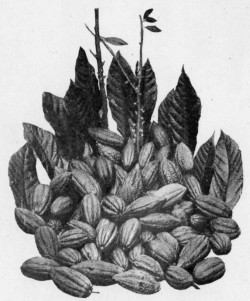
CACAO PODS, LEAVES AND FLOWERS. Reproduced by permission of Messrs. Fry & Sons, Ltd., Bristol.