Front matter (continued 2)
Reading edition
I examined it carefully. The lock worked all right; the drum revolved perfectly. I looked down the barrel; looked straight down it at the firelight, and saw nothing.
"Well?" said Jack.
I handed him the revolver. Jack looked down the barrel as I had; then he took a thin stick and poked at it.
"The demons!" he said; "they've choked it with lead or something. Curse them! it would have burst in your hand if you had fired it! We'll pay them out for this, Peter, if we have to chase them half round the world for it!"
Thirty miles back to the waggon road, twenty miles farther northwards, and then at last we were at the spot where, according to the original map, we should have turned off at the village called Ngami. Our bogus map gave no name to the village, which showed, as Jack said, the fiendish cunning of the Strongs; for if they had called it Ngami, we should have gone on until we had reached a village of that name, and from it we should have plainly seen, as we now saw, the conical hill on our right. As it was, we had gone sixty miles out of our way, and might have gone six hundred, or, indeed, never have struck the right road at all, but for my happy idea on board ship to take a copy of the map in case of accidents.
It was dusk when we arrived, riding with exceeding caution, within a mile or so of the conical hill. Here we dismounted by Jack's orders; for he, by the most natural process in the world—namely, the simple slipping into his proper place, as nature intends that people like Jack should do—had assumed the leadership of our party of two. It was quite right and proper that he should lead, for Jack had twice the resource and the readiness that I had been furnished withal; his wits were quicker workers than mine, and his judgment far more acute and correct. Jack decreed, then, that we should dismount and wait, and listen. If they had not yet found the treasure, he said, they would, of course, still be upon the ground; and if there, they would certainly light a fire when darkness fell.
"Then will come our chance!" added Jack.
"Of doing what?" I asked. "You don't think of shooting them asleep, Jack, surely!"
Jack laughed gently. "That's what they deserve, the blackguards!" he said. "Why do you suppose they spiked your revolver? I'll tell you. So that when they attacked you, as they fully intended to do, and would do now if we gave them the chance, you should be harmless and unable to hit them back."
It certainly did seem pretty mean, viewed in this light—a cold-blooded, premeditated, murderous kind of thing to do. The idea made me very angry. It gave me that almost intolerable longing one sometimes feels—which, at anyrate, I feel—to punch some offender's head; it is a feeling which generally assails one at helpless moments, as, for instance, when a schoolmaster (whose head cannot be punched with propriety) takes advantage of his position to bombard some wretched victim, who can utter no protest, with scathing remarks.
"What are we going to do, then?" I continued. "Of course we are not going to murder them in cold blood; but can't we punch their heads?"
Jack laughed. "Oh, it may come to that, likely enough," he said; "but what we must go for first is to disarm them. It is perfectly impossible to live near these men in any sort of comfort or security unless we first deprive them of their rifles and revolvers. That's what I want to do to-night. One or two of them will be asleep, the other watching. We must stalk them at about midnight, cover them with our revolvers, and make them 'hands up!'"
"No good covering them with my revolver," I said. "I'd better cover a pair with my rifle, and you the other fellow with your pistol. They know mine won't go off, well enough!"
"That's true," said Jack. "All right, your rifle then. We must shiver here till about midnight; you won't mind that for once."
And shiver we did for several hours, as much with excitement as with the cold of the night; for at about nine o'clock we saw the glow of a fire a mile or so away, which gave us the welcome assurance that our friends had not, at anyrate, found the treasure and departed.
I entreated Jack several times to let us be up and at them; but Jack was inexorable, and would not budge until our watches told us that midnight had come. Then Jack arose and stretched himself.
"Are you ready?" he said.
"Rather!" said I; "come on!"
"No hurry," continued my friend exasperatingly. "Change your cartridges first; so. Now take a drop of brandy neat, to correct the chill of the night—not too much. We may have to shoot a man; are you up to doing it?"
"If necessary," I said; "but I'd rather not."
"Of course not, nor would I; but if there is any hitch, or if either of the men show signs of being about to put in a quick shot, yours or mine must be in first; do you understand? Am I to command, or would you prefer to? It is better that one should take the lead."
"You, of course!" I said.
"Then do just as I tell you when we are among them. Now, are you ready? Then come along!"
Cautiously and softly we crept towards the place where the fire twinkled and glowed in the distance. As we came nearer, we could see that it had been built up close to a mimosa bush which lay between us and the circle of light shed by the burning brushwood. This was favourable to our purpose, for we were enabled to creep along without the danger of being seen, as we might have been even in the dark, had we been obliged to cross one of the wide open spaces which checked the plain.
No thieving jackal or designing lion could have stalked that party more patiently and noiselessly than we did; foot by foot, and yard by yard, we drew nearer to our prey, and at last we had reached the mimosa bush and were watching them as they lay, the rays of their fire all but shining upon us as we crouched, but falling just short. Jack placed his hand upon my arm, and whispered—
"James Strong watching, very sleepy," he breathed, scarcely audibly; "the others fast asleep. I take James, and you the other two. Are you ready? Follow me and stand at my side, but keep your rifle at your shoulder from now on, and never lower it for an instant. Are you ready?"
"Ready!" I managed to whisper, but my lips were so dry that hardly any sound came from them. Then Jack instantly rose and stepped out into the firelight—I following him.
CHAPTER XII
SCOTCHING A SNAKE
James Strong was lying half waking and half sleeping, his rifle at his side; he saw us instantly, however, as we stepped into the firelight, and was on his feet in a moment, dragging his rifle up with him.
"Drop the gun, James Strong," said Henderson, "and put up your hands. I am covering you, you see, and this is not the revolver you choked. Drop it at once, or I fire. I will count three. One—two"—Strong let the rifle fall. Neither the thud of this nor the sound of Jack's voice awoke the other two, who still slept, I covering them with my rifle.
"Pick that thing up, Peter," said Jack. "I'll see to the covering." I did as my captain bade me.
"Chuck it on the fire," he continued. "I shall pay you for it, Mr. Strong, but I am afraid you are scarcely to be trusted with a rifle just at present."
I heard Strong grind his teeth as I picked up his gun, took the cartridges out, and threw the weapon on the fire.
"Sit down, Mr. Strong, and empty your pockets," continued Jack, and his victim obeyed, because he could do nothing else.
"Take those other rifles, Peter, and do the same by them," pursued Jack; "then wake those fellows, and see if they sport revolvers. Have you none, Mr. Strong? Come, produce it if you have. Feel his pockets, Peter, and his saddle-bags. What, has he none? Well, you shall give him yours, Peter, one day; perhaps he will know how to get the lead out since he put it in!"
Strong's face through all this was not a pleasant study.
I obeyed Jack's decrees to the letter. I collected all the weapons—three rifles and one revolver—and threw them on the fire; I awoke the two sleepers, who swore frightful oaths when they realised the position of affairs, and cleared their pockets and wallets and saddle-bags of cartridges, all of which I confiscated.
"Good-night, gentlemen," said Jack, when my work was finished. "I shall repay you for all that has been taken from you to-night. Your zeal, you will understand, has been a little too great; you have given yourselves away. But for your premature attempt to rid yourselves of us on the island, and for one or two foolish matters since then, we might never have been aroused to our danger, and you would certainly have enjoyed many opportunities of shooting us at your leisure—in the back, of course. Now, you see, we have the whip hand of you."
"And you will use it, curse you," said James Strong, "to prevent us taking our legal share in the search for my uncle's property. I know you!"
"Nothing of the kind, my good man," said Jack cordially. "Dig away, by all means; you shall see that neither of us will interfere."
"Yes, and if we find the treasure, you will shoot us down; I know you, I say!" replied Strong. We made allowance for his temper, which was shocking to-day; but then his provocation had really been considerable.
"If you find the treasure you shall take it away with you in peace, so far as my friend and myself are concerned," said Jack. "We shall not shoot you, and you can't very well shoot us without rifles, can you? Good-night all; come, Peter."
We could see our good friends frenziedly poking among the embers for their burning weapons the moment we had departed; but, as Jack remarked, they were welcome to the barrels, and since he had taken care to keep up the conversation long enough to allow the woodwork to burn away, that would be all they would get.
Returning to our camp, we made up a fire for ourselves and tossed up for first sleep, for we must keep a stricter watch than ever now, or these desperate fellows would steal our weapons and turn the tables upon us. So we slept and watched by turns until morning, and it was on this night that I heard for the first time in my life the roar of a lion. It was not very near at hand, but, far away as it was, it sounded terrible enough to the inexperienced ear, and I thought over all I had read of the ways of lions in the works of Mr. Selous and other African sportsmen, and recalled an awkward propensity some of them have of coolly coming into camp and foraging among the waggons even in the glare of the firelight. If this brute were to come now and help itself to Jack Henderson before I could interfere, what a truly terrible thing it would be! The idea impressed me so deeply that I awoke Henderson and told him there was a lion roaring somewhere within hearing.
Jack was very sleepy, and my watch was only half over, which made him ridiculously angry to have been awaked.
"Well, what then?" he said. "Let him roar and be hanged! if he didn't wake me, why should you?"
"Why, he might come and bag you while you slept," I said; "travellers say they do that kind of thing."
"Well, what are you there for, man?" said Jack angrily, settling himself to sleep again. "You are there to shoot James Strong, or lions, or she-bears, or anything else that comes and plays the fool around here. For goodness' sake don't wake a fellow to talk about the habits of lions—shoot him if he comes, that's all you have to do!"
I suppose the lion had other engagements for that night, for his roars receded farther away and were lost, presently, in the distance.
We were up in the morning at the first glint of light, for we were naturally anxious to see the ground upon which our labours were to be lavished until the envious soil should reveal to us or the others the secret of old Clutterbuck. There it was, the open space of sandy hummocky soil, and there were the posts, three of them at least; we could not see the fourth. And there, too, was the upturned earth over a considerable area, representing the day's work, or the day and a half's work, of the Strongs, who had evidently toiled for all they were worth in order to make the most of the start they had gained upon us. The result of this haste on their part was to be seen in the shallowness of their digging, which appeared to have nowhere extended to a greater depth than six to nine inches. As we stood and surveyed the ground, our three friends came with their spades and set to work at once. They scowled at us ferociously, but made no reply to Jack's polite "Good-morning."
"I daresay they are rather annoyed with us," said Jack. "Now, Peter, don't be lazy, but begin to dig at once. I'm your bodyguard, remember, and shall do no work except thinking."
"Aren't you going to dig?" I said.
"Certainly not," said Jack; "I'm not one of the authorised. If I dug and found the treasure, there might be a legal point. Now dig up, man, and don't argue; you're wasting your time. Think of the nuggets and diamonds only awaiting the magic touch of your spade! George! if I had a legal position, wouldn't I dig!"
I did dig. I dug that morning until the sweat poured from my face and head like drops of rain. I dug till my arms and back ached so that I almost cried with the pain, while Jack sat or lay and watched, keeping an eye on the Strong party and entertaining me with light conversation. By the evening I was perfectly exhausted, and the greater part of the space of about two acres had been dug over, though not to any great depth, by one or other of the four workers, yet nothing had been discovered.
When Jack awoke me to take my watch at half-time that night, he said—
"Peter, I've been thinking."
"What about?" I asked sleepily.
"About that fourth post," he said.
CHAPTER XIII
AN UNEXPECTED TRAGEDY
"I was wondering what has become of that fourth post," continued Jack. "It can't have disappeared very well."
"It doesn't matter much," I rejoined, "for it can only have been in one spot—the fourth corner of a square; the other three are absolutely symmetrically placed. We can easily judge of the position of the missing one."
"I'm not so sure," said Jack. "I don't think it's a trick of the Strongs, for they seem to take it for granted, as we have done, that the area is a square. I shall look about for it to-morrow while you dig."
"I wish you'd dig while I look about!" said I; "it's the most fatiguing thing I ever tried in my life."
"That's because you never did a day's work till yesterday, my son; but cheer up, you'll find it less fatiguing every day, take my word for it." Jack yawned and lay down, and in a minute was fast asleep. As for me, I very nearly fell asleep also—in fact, I believe I was actually dozing—when my friend the lion suddenly roared from somewhere so close at hand that my heart went into my boots and I felt my knees tremble together as I lay. So loud was it that even Jack awoke and started to his feet.
"What on earth was that?" he said. "Did someone shoot?"
"It was a lion's roar, close behind us here in the bush," I said, my teeth chattering. I don't think I am a coward, but I do hate dangers that I cannot see.
"By George!—fancy those wretched chaps over by that fire," said Jack, "without rifles; what a state of terror they will be in!"
What a good fellow Jack was! I had never thought, in my selfishness, of the infinitely more dangerous position of the others.
At this moment the lion roared again.
"Listen to that!" continued Jack. "What a voice the brute has! It's enough to terrify anyone, especially unarmed people. Ought we to go and stand by those chaps, think you, Peter?"
I am glad to think that I replied in the affirmative.
"And yet," said Jack, "I'm not sure that one of us hadn't better stop here to take care of our horses. Shall we toss up who goes? You see, it was we who disarmed the poor beggars; we can't very well leave them unprotected when real danger comes."
I cordially endorsed the sentiment, and though I would far rather have let our horses go by the board than separate from Jack in this crisis, I tossed up with him as to who should go and who stay.
"Heads stay—tails go," said Jack. "You toss."
I tossed, and the coin showed tails.
"Tails; then you go—lucky rascal!" said Jack; "you get all the fun. Shout for me if anything happens. Cæsar! there he is, roaring again, and nearer their camp. Be off, Peter, and mind your hide!"
I have said that I do not consider myself a coward, but assuredly the greatest coward in the world could not have been more frightened than was I during that most weird and uncanny walk through the darkness towards the twinkling glow of the Strongs' camp fire, but a very few hundreds of yards away. The word darkness hardly expresses the almost opaque blackness of the night as I stumbled over hummock and thorn bush in the direction of the fire.
Beasts were abroad, it appeared, in horrible profusion. Scuttling, growling, rushing, they seemed to jump up from before and around me at almost every step, as though an army of them were stalking me, and came repeatedly within springing distance, only to lose heart as I approached, and dash away into the darkness.
I have since come to the conclusion that these were hyenas, for no other beast would be likely to be about in close proximity to a roaring lion.
The lion advertised himself freely. Once, at least, he roared within twenty yards of me, and though I held my rifle to my shoulder ready for him, I quite gave myself up for lost. But his designs were not, it appeared, directed against myself, for a moment after he roared again much nearer to the Strongs' camp fire, and presently from beyond that point.
I could hear the Strongs talking excitedly and loudly, and could see that they were busily engaged in piling brushwood upon their fire, for at intervals it seemed to blaze up brightly and to smoke more vigorously. The lion, I could not help thinking, was prospecting both our party and theirs, and walking round and round both, working himself up to the necessary pitch of audacity for an attack.
So, stumbling, groping, creeping upon my uncanny way, I came at last within fifty yards of the Strongs' camp. The lion had been silent now for several minutes, a fact which rendered my horror all the more intense, because I could no longer tell where the brute was, and, for all I knew, he might be at my heels or a couple of yards away on either side of me, licking his lips, and, as it were, choosing his joint in preparation for a spring.
Of a sudden I was startled by the most piercing shrieks and yells that I had ever heard. The noise came from the Strongs' camp, and set the seal of horror upon my soul, so that I fell on my knees then and there and prayed aloud with the most intense earnestness I had ever put into prayer. Then I sprang to my feet in a flush of shame. The lion, I suddenly realised, had made his appearance among these wretched, unarmed folk, while I, their protector, knelt and prayed like a coward for the safety of my own skin!
Aroused and stimulated by this thought, I rushed madly for the camp, careless now of the darkness and danger and horror of the night, and in a moment or two had reached, breathless, the circle of light shed by the Strongs' fire. Here a weird sight presented itself to me.
Clutterbuck knelt and gabbled prayers aloud, his eyes, almost starting from his head, fixed upon a spot just on the verge of the firelight, where James Strong stood, armed with a burning log, cursing as loudly as the other prayed, and staring into the darkness beyond.
Both started as I appeared, but both immediately looked away from me again and resumed their occupations.
"What is it?" I gasped. "Has anything happened? Where is your brother, Strong?"
"It's the most infernal murder, that's what it is!" shouted the fellow, turning suddenly upon me and stamping his foot; "as clear a case of murder as ever a criminal committed!"
"What has happened, man? Was it the lion?" I cried. "Stop your blithering and tell me; we may save the fellow yet!"
James Strong growled out some curse.
"Yes; go out into the dark and save him. You are a likely man to do that, you coward!" he shrieked; "you who rob men of their defences and leave them at the mercy of brute beasts. This is as clear a case of murder as need be, and you shall hang for it yet!"
Sick at heart, but not any longer with fear, I seized a burning brand, and, shouting for Jack, rushed away into the bush in the direction which I supposed the brute had taken.
But though I wandered alone for a while, and with Jack, who soon joined me, for another longer while, we found no trace of either victim or lion, and we were obliged to give up the search in despair.
And here I may say that his shriek as the lion sprang upon him was the last that was ever heard of poor Charles Strong. We picked up a piece of cloth which had been a portion of his coat, but beyond this we never found sign of the unfortunate fellow, whose fate sat like a midnight horror upon our souls for many a day.
CHAPTER XIV
A GLIMPSE OF THE WINNING-POST
There was no digging done the next morning, for both we and the rival camp spent all our time wandering about in the forlorn hope of finding poor Strong—wounded, but perhaps still alive—left by the lion, who, we hoped but scarcely believed, might have been terrified by our shouts and by the shots we fired for the purpose of frightening the brute, and have dropped his victim and departed.
James Strong, though frequently within speaking distance of us, neither spoke to us nor looked at us, excepting now and again to scowl fiercely as his way, in the searching, crossed ours. But Clutterbuck spoke to me several times and to Jack also, entreating us, for the love of Heaven, either to provide him with firearms, or to take him at nighttime under our protection. If he had to pass another night unarmed, he said, after this, he should certainly go mad.
We promised, however, to protect the unfortunate fellow, and this soothed him wonderfully.
That night both James Strong and Clutterbuck were encamped close to our fire, between their own and ours, the two fires being built up within ten yards of one another. Strong was too proud to ask for protection as Clutterbuck had, but anyone could see that he was glad and greatly relieved when we came and made our camp near theirs. I was sorry for the fellow, rogue though he was, and thought that it was certainly the least we could do to take him under our wing, since we had deprived him of the means of protecting himself.
As for his brother's death, I do not take any share of responsibility for that misfortune. For, as we learned afterwards from Clutterbuck himself, in all probability no shot would have been fired even if the three men had still been in possession of their rifles.
According to Clutterbuck's narrative, the thing happened something like this: He, Clutterbuck, had been deputed to watch for the first three hours of the night, the two Strongs sleeping meanwhile. But Clutterbuck himself fell asleep, and allowed the fire to languish and almost die out, when of a sudden the roaring of the lion awoke not only him but the Strongs also. Then all three men rushed about, getting brushwood and sticks to make a blaze that would keep the lion at a distance; but while poor Charles Strong was ten yards away in the bush there was a sudden roar and a scuffle, and a shriek for help from him, and that was all that either Clutterbuck or James Strong knew of the matter. Neither of them had seen the lion.
All this Clutterbuck himself told me as we lay awake together on the first night after the mishap, during my watch. The poor fellow, naturally a timid creature, was far too frightened to sleep, and was, I think, grateful for being allowed to talk.
The lion did not come near us, neither did he treat us, even at a distance, to any of those terrible roars which I had found so unmanning. Clutterbuck was even more communicative to Jack when his watch came round; he told Jack many interesting things, and among others this—which I suspect the artful Henderson gradually wormed out of him—that he found himself a companion and partner of the Strongs, whom he disliked, by the stress of circumstances rather than of deliberate choice.
Our suspicions as to the affair near Las Palmas were well founded, said Clutterbuck; for it was the simple truth that the Strongs and he himself set out that day with the deliberate purpose of murdering us. It was James Strong's idea, he declared, and his brother had accepted it readily. He, Clutterbuck, had pretended to do so, but in reality had had no intention of hurting us.
"No, no, Clutterbuck, that won't do!" said Jack at this point of the narrative; "for we counted the shots fired, and there was at least one volley of six shots! You fired with the rest, man; I am not so easily taken in!"
"That's true enough," said Clutterbuck; "but did I hit you?"
"No, that you certainly did not," replied Jack; "but then you are a very poor shot, my friend!"
"I fired wide on purpose, I'll swear to it!" said Clutterbuck.
After this, Jack inquired about the crocodile, and found that here, too, the Strongs had cherished amiable intentions with regard to us. They saw the brute right enough, and that was why they left us to ford the river and themselves stayed behind.
"You ought to have warned us somehow," said Jack.
"I dared not," said the other. "James is an awful fellow, and his brother is nearly as bad—was, I mean—poor chap!"
As for the spiking of my revolver and the changing of the map, Clutterbuck knew nothing of either. It was done in the state-room, and he was not there to see.
"You would probably have been shot as you forded the river," he continued, "if you hadn't rather frightened the Strongs by what you said a moment before—that you were a crack shot, and would have no mercy if they missed you."
"So you see, Peter," concluded Jack, telling me all this afterwards, "it pays to blow your own trumpet sometimes. They wouldn't have hit us, probably, but then we should have been obliged to make three bull's-eyes of them, and that would have been unpleasant too!"
But all this while the treasure still lay hid in the bosom of the veldt. Charles Strong's death was very terrible, but I must dig, dig. Regrets and sentiment are mere waste of time with one hundred thousand pounds waiting to be dug out of the earth!
Whatever measure of grief James Strong may have felt for his unfortunate brother, his sorrow did not prevent him betaking himself very seriously to his digging work as soon as day dawned on the second morning after the mishap. He went about his business in grim silence, vouchsafing us, as before, neither word nor look.
Neither were we dilatory. I went back to my digging with back and shoulders still stiff from the labours of the first day, while Jack expressed his intention to search about for the fourth post.
"Either there's some trick about the position of that post," he said, "or it has got moved away by an accident; some elephant or other big brute has used it for a scratching-post, or knocked it down and perhaps rolled it away; in any case, we ought to know where it was."
I still thought that in all probability the fourth post had simply completed the square suggested by the other three, and that it had been in some way removed from its place—perhaps by an elephant, as Jack said, or more likely by a gust of wind. I did not consider the question at all important.
As it proved, Jack was right. He found the fourth post twenty yards at least out of the square, and planted right in the middle of a prickly-pear bush. But though I extended my operations to the new ground introduced by the change of area, and though the two other men and I together dug it superficially over, so that the entire space between the four posts had now been dug up—to a certain depth—the result of the day's work was "nothing to nobody," as Jack facetiously expressed it. Indeed, I, for one, began to wonder whether we had embarked upon a wild-goose chase, and whether the hundred thousand pounds ever existed save in the imagination of old Clutterbuck; and again, whether, supposing the money to have actually existed, the old miser had not purposely so hidden his treasure that no other human eye should ever behold it, since he himself could no longer gloat over it. But when I communicated these views to Jack Henderson, he said—
"Bosh! man; don't be a fool. Dig for all you're worth!"
If real hard work could have insured success, it would have been a difficult matter to judge between James Strong and myself as to who should bear away the prize. Clutterbuck laboured away too, after his kind; but he was of a different kidney from ours, and I think I turned up more soil in an hour than he did in half a day.
For the best part of a week we vied thus with one another, toiling day-long in the sweat of our brows and meeting with no success.
On the evening of the sixth day Jack said to me, as we walked together towards our camp fire—
"Do you believe in second sight and that kind of thing, Peter?"
"No," I said, "I don't. Why?"
"Because I have a kind of idea that I know where the treasure may be," said Jack unexpectedly.
I laughed.
"I too am beginning to have a pretty firm conviction as to where it is," I said.
"Tell me where you think first," continued my friend; "and then I'll tell you my idea."
"Nowhere," said I; "at least, nowhere that you or I, or anyone else, will ever know of."
"Well, now listen to my idea; you can act upon it or not, as you like. Have you thought of removing the posts and looking into the holes?"
"No, I haven't," I said; "but I'll do it."
"Do it when the others are asleep to-night," Jack rejoined.
"Why, what's the hurry?" I asked. "Must I grope about in the dark, and all among the hyenas and lions? Hang it all, let me wait till morning!"
"The thing is, it's a new idea; and if Strong sees you removing one post, he'll remove another, and Clutterbuck a third, and you split your chances. They may look under the right post while you are busy unearthing the wrong one!"
"You seem to be very cocksure of your posts, old chap!" I said, laughing.
Jack's answer astonished me.
"Do as I tell you," he said; "and begin with the erratic post in the thorn bush. I have a very strong idea about that post."
"Why—have you seen anything?" I gasped. Jack's manner impressed and excited me.
"It's like this," he said; "and, of course, my idea may be worth nothing. The post is not very tightly fixed in the ground, and to-day I shook it about and up and down. Well, it seems to rest upon something hard and smooth, that's all. I left it for you to pull up."
CHAPTER XV
EUREKA!
Jack's communication rendered me frantic with excitement, and I instantly determined that I would do as he had suggested. The idea of wandering about the bush at night, alone, was not pleasant; but if the treasure were really at the foot of Jack's post, why, it would be worth running the gauntlet of a score of lions to get it. Besides, I could take a torch. Of course, the hard and smooth surface the post rested upon might prove to be a stone and no more; still, I would go and see for myself.
Jack and I divided the watching every night. We could not, of course, trust either of the others to undertake the duty. Such a step would have been suicidal indeed on our part; for James Strong, at anyrate, and possibly Clutterbuck also, would have taken so good an opportunity to rid himself of a rival and of a rival's inconvenient friend at a swoop. Hence both men were allowed to sleep, if they would, all and every night.
This evening we supped well upon an antelope shot by Jack in the bush while we laboured in our treasure-field, and by the time darkness was well set in, James Strong and Clutterbuck were already in full snore. Then, moving cautiously, I took rifle, spade, and torch, and sallied forth, not without some trepidation, upon my enterprise.
Whether owing to the occasional shots fired by us in this place in the pursuit of game, or whether by reason of their natural dislike for abiding in the continued proximity of mankind, we had not been bothered during the last few days by the presence of many hyenas or other creatures of the kind about our camp. A few days ago, if I had undertaken the gruesome night enterprise upon which I had now embarked, I should have been startled almost at every step by some suddenly rushing or creeping brute; but to-night I was left to pursue my journey almost in peace.
I had no difficulty in groping my way to our treasure-area, which resembled a ploughed field by this time, with all the digging and re-digging it had suffered. Nor was I long in discovering the post as to which Jack had formed so strong and optimistic an opinion.
After all, it was not unlikely that our old miser should have planted a post over the grave of his treasures, and I was somewhat surprised that it had not occurred either to me or to the Strong faction to remove the posts and look underneath them, since we had dug up the whole of the area enclosed by them without result. Doubtless it would have occurred to us to do so after we had dug a little deeper in the space enclosed.
At all events, here was Jack's post, and I laid hold of it and shook it, and moved it up and down just as he had described that he had done himself. Sure enough, the post struck hard and dead on some flat, unyielding substance beneath. My heart beat in a ridiculous fashion—was I really on the brink of a discovery that would place me for ever out of reach of poverty and of the necessity to embark in some lifelong, uncongenial occupation? I felt so faint in the agitation of the moment that I was obliged to pause and gather strength before I was sufficiently master of my energies to lay hold of the post and pull it up.
"Now, Godfrey," I said to myself, "don't be a fool. In moments of difficulty preserve an equal mind; if you can't do that, what was the use of your learning Horace? Pull yourself together and play the man!"
I seized the post and tugged at it. It was stiff enough to resist displacement, though it had wobbled about when shaken to and fro. But having once mastered my agitation, I was equal to any amount of exertion; and by dint of working it backwards and forwards and up and down for five minutes, and twisting it round in my embracing arms, I succeeded at last in raising and removing it. My torch had gone out meanwhile, and I could see nothing, of course, in the dark hole which had formed the socket of the post.
Kneeling over it, therefore, with palpitating heart, I plunged my hand down. My arm did not reach the bottom in this way, however, and I lay down on my side and plunged it in a second time to the very armpit. This time the ends of my fingers just touched the bottom of the hole, and distinctly felt what seemed a cold, flat substance lying there, but could not grasp and raise it.
I tried to keep cool and think how best to act under the agitating circumstances.
Then I lay down again, after scraping away some of the sandy soil at the edge of the hole, in order to gain a few inches in reach by getting my shoulder lower; and this time I was able to distinguish, by the touch, a small tin box, and to get my fingers under it. In the joy of that moment I could scarcely forbear to shout aloud. Eureka! I had found the treasure! I was a rich man; the whole world was my own—to the full extent of about ninety-eight thousand pounds odd.
Slowly and carefully I raised the little box to the surface; my grip upon it was as tight as that of a drowning man to the hand that will save him. Up it came, a small tin thing like a cheap money-box by the feel; now I had it safely, and was standing shaking it, half dazed, trying to realise what its discovery meant for me. Oh for a light, that I might open it and gloat without delay over its thrice-blessed contents!
The next moment I was careering at full speed towards the camp fire to tell Jack of the marvellous success of my night enterprise, and to open with him the treasure-box that burned my hands as I carried it. But stay! what if James Strong were awake? Could I postpone the joy of raising the lid of that box until the morning, and the almost equal delight of telling Jack all about it? No, I felt I could not. If I might not open the box, and talk about it too, I should certainly "go crazy."
As I approached the fire, however, I saw that both James Strong and Clutterbuck were fast asleep, Jack watching. He heard me coming, though I crept softly for fear of awakening the sleepers, and long before he could possibly have seen me he had his finger to his lip in token that caution was required. I concealed the box in the "hare-pocket" of my Norfolk jacket, and stepped into the firelight. I suppose that Jack thought I was about to speak, for he said very softly, "Ssh!" and made a warning gesture.
It was tantalising indeed. Nevertheless, I sat down by the fire close to Henderson, and for a few minutes neither of us spoke or whispered a word. The only sign that passed between us was an interrogatory uplifting of the eyebrows by Jack, which I took to mean, "Any success?" and to which I responded with the very slyest possible closing of the left eyelid, which I intended to signify "Rather!"
After about ten minutes of listening to James Strong's measured snoring and Clutterbuck's groans, grunts, and snortings, Jack leant over and whispered—
"Strong sat up and looked around while you were away. He made as though he did not notice your absence, but I have an idea that he knew all about it. We must be very careful indeed. Have you really had any luck?"
"The best possible," I whispered back. "Can I show you something?"
"Wait a bit, old man!" said Jack, pressing my hand; "this is splendid! I congratulate you; but for Heaven's sake be careful! I don't trust that fellow Strong's sleeping; he may be wide awake, watching. He's as cunning as they're made."
"Let's try him," I suggested. "I'll suddenly cough loudly, and you keep a careful watch on his eyes; probably he'll wince if he's awake."
"Go on, then," said Jack. I didn't cough; I said "Hello!" very shortly and sharply. Strong gave a slight start, but then so did Clutterbuck, and both went on sleeping.
"We'll give them another ten minutes," whispered Jack, "and then risk it."
At the expiration of that period I looked inquiringly at Jack, and he nodded affirmatively.
Slowly and cautiously, and with my eyes fixed upon Strong's face, I drew the tin box from my deep pocket; I heard Jack's breath come quick and short as he caught sight of the prize. It was, as I thought, a plain tin money-box, painted black and gold, such as anyone may buy at any ironmonger's for a few shillings. It was tied round with a wire, but unlocked, and with trembling fingers I removed the wire and opened the lid.
Within was a second tin box, a small thing like a sandwich-box, and this too was unlocked.
I paused to take a look at the sleepers; both were still, apparently, as fast asleep as ever.
"Go on!" whispered Jack; "it's all right."
I put my hand inside the case and produced a leather pocket-book, and from this I drew an envelope!
"Ah, a cheque!" whispered Jack; "and a fat one if it's for the lot!"
There were several papers in the envelope. First a letter, which I put aside to read later, because the rest were bank-notes, and I was anxious to learn the amount of my inheritance.
Then came two terrible shocks, one after the other.
Shock number one. There were twenty five pound notes. No more, and no less!
CHAPTER XVI
"ALL THAT GLITTERS IS NOT GOLD!"
One hundred pounds!
A nice little sum in itself, but not one that would tempt a man to imperil his life in as many ways as it contained notes! Surely the old man had not brought me all this distance to give me one hundred pounds at the end of it? The letter would prove to be an order upon his bankers for the bulk of his fortune. The hundred was intended to cover my expenses home to England.
In so far as concerned the hundred pounds my surmise was correct enough. But the letter was not a bank order. It was a very original document, and I purpose giving it in extenso. Here it is:—
"THE PRIZE TO THE SWIFT.
"To my Heir: a message from the tomb.
"MY DEAR HEIR,—If ever you read these words it must happen after my death, because I shall take care that no man handles my money until I am in my grave. That is why I call this a message from the tomb. The dead can gain nothing by lying; therefore I give you no other assurance that what I have to say is the absolute truth.
"You have done well to come so far, whichever of my potential heirs you may be. My treasure is not here, neither are your journeys at an end.
"From South Africa to the Finnish Gulf is a considerable stretch, but one hundred thousand pounds is a large sum; it is a sum that has occasioned its owner more trouble to acquire than is involved in a pleasant journey from Africa to Finland. If it is worth your while to undertake this journey, you will act as I shall presently direct you; if not, you will leave my money to rest where it is, and where, assuredly, neither you nor any relative of mine shall ever find it.
"If my treasure fall into hands for which it was not intended, may my curse rest upon it for ever; and if none find it from this day until the day of resurrection, I, William Clutterbuck, shall be just as happy. Let him who is wise read the following instructions, and obey them to his profit:—
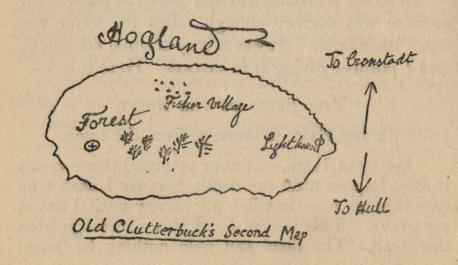
Old Clutterbuck's Second Map
"The island is about five miles in length. Steamers from Hull or London to Cronstadt pass within half a mile of lighthouse.
"Special arrangements must be made with shipowners to land upon island.
"An open space will be found in the forest at about the spot indicated by a cross. Here are four posts, defining the area within which it is necessary to dig.
"The Prize to the Swift.
"W. CLUTTERBUCK."
By the time I had read to the end of this precious document, my heart was in the usual condition of hearts whose cherished "hope" has been deferred. The disappointment was almost more than I could bear; the thing was so unexpected, and the pill so bitter.
If I had followed the impulse of the moment I should have torn that hateful letter into a thousand pieces and danced upon it, then and there, to the tune of all the worst names I could think of to revile its author withal. Yet, when I glanced at Jack to see how he took this disappointment, I saw that he was shaking with suppressed laughter.
"I would give worlds to have known that old chap!" he whispered. "It is the finest notion for giving healthy occupation to a set of lazy nephews that ever an uncle devised. He was a grand old fellow, this, Peter!"
"What nonsense you talk!" I whispered. "I believe the whole thing is a hoax, from beginning to end. The man was mad on all matters concerning money. He was determined no one should ever touch his treasure, since he could not carry it away himself, and this is his dodge; he will trot us backwards and forwards after the infernal stuff until we die or get our throats cut, and the money will rest unfound in Timbuctoo, or Jerusalem, or the Grand Canary!"
"I don't think so," said Jack. "I believe the old man was entirely sane and entirely serious. Just think; if you had a lot of money to leave and no one to leave it to (he didn't know you, remember, when he wrote this!), except a set of good-for-nothing scamps like these Strongs, and"—
As Jack referred to Strong by name, I glanced up at the sleeping form of that individual, whose very existence I had forgotten for the last few minutes in the excitement of examining the money-box and its contents, and to my horror I distinctly saw that his eyes were wide open, and that he was both looking and listening with every faculty at high pressure. He closed his eyes the instant he saw me look up, and was, apparently, as fast asleep as ever.
I whispered my discovery to Jack, but that practical person was not in the least discouraged.
"Much good may it do him!" he said. "Take a copy of the map of the island, though," he added, "and of the instructions."
And this I did, then and there.
It was, of course, useless after this to attempt to conceal our discovery from James Strong and his companion. We therefore determined to take the bull by the horns—in other words, to inform them we had found all there was to be found, and that, consequently, we intended to depart, in order to return presently to England.
It fell to me to undertake the duty of making this communication to my fellow-competitors. I did not care for the job, but, desiring to get it over, I plunged "into the middle of things" at breakfast, in the morning.
"James Strong," I said, "I think I ought to inform you that I have found what we all came to seek, and that it is all up with your chance and Clutterbuck's. I should recommend you to return quietly to England, and if you give me no further trouble I shall take no further steps about the affair at Las Palmas."
"You're a pretty cool hand, I will say," said Strong, forcing a laugh. "And you won't take steps about Las Palmas, won't you? You are too generous to live, hang me if you aren't! And do you suppose I'm going to keep quiet about my brother's murder?"
"Take proceedings against the lion by all means," said Jack with a laugh. "What a fool you are, James Strong! Why can't you talk sense among grown men? We are not schoolboys, my friend; you can't frighten us that way. Now, what do you want for your spoilt guns—the three of them?"
"Curse you and your money!" said Strong; "we shall see what I want for my spoilt guns when we get back to England."
"Very well," said Jack; "then I shall settle with Mr. Clutterbuck."
We did settle with him, paying him one hundred pounds for the three burned guns, to which Jack generously added another hundred pounds for expenses, advising Clutterbuck to return to England at once, and to have, in future, as little to do with Mr. James Strong as circumstances permitted; and this advice Clutterbuck promised to take to heart. I certainly considered Henderson's settlement in the matter of guns and expenses an extremely generous one.
Then those two rode away from the field, leaving me the conqueror. My victory was a barren one, as I feared; but still, I had found all there was to find, and Jack had quite persuaded me by this time to follow up my success, and to treat old Clutterbuck and his "message from the tomb" with perfect seriousness—nay, I was determined that I would have that hundred thousand pounds if I had to seek it in the ends of the earth, and to dig up half a continent to find it!
CHAPTER XVII
LOST!
As for Jack and me, since we had in our pockets the map of the spot in which the treasure lay awaiting our pleasure to come and dig it up, and since James Strong could not possibly know to what quarter of the world we had been directed, or, indeed, any part of the purport of the miser's eccentric letter, we determined to enjoy a week or two of real sport before returning to civilisation and the digging of treasures in high latitudes.
We had given Strong no weapons, since we could not trust him; but to Clutterbuck, who was nervous of travelling unarmed, we presented my old revolver, choked as it was with lead, together with a handful of cartridges, Clutterbuck vowing by all his gods never to give the weapon to Strong, or even to let that untrustworthy person know that he had it.
After he had made us this solemn promise, I revealed to Clutterbuck a plan I had thought of for clearing the barrel. It was simple enough. All he would have to do would be to heat the jammed portion of the barrel in the fire, when the lead would quickly melt and come out.
James Strong's face was a study as he rode away with his companion, and Jack made the remark that he would not for a good sum be in Clutterbuck's shoes and have to ride back all the way to Vryburg, if not to Cape Town, with such a murderous-looking, scowling ruffian as James Strong in his present temper.
"Oh, well," I said; "Clutterbuck's the grey mare this time. It's he that has the pistol, and therefore the last word."
"Yes, if he can keep it," said Jack sagaciously. "But I should be surprised to hear that the poor chap reaches Cape Town in company with his share of the two hundred pounds or the revolver either. However, that's not our affair. I hope we've seen the last of both of them for many a long day, or for ever; and the latter for choice."
After this, for a space, we gave my co-heirs no further attention, but devoted ourselves entirely to the delights of sport.
We first rode back to the village of Ngami in order to see whether our ox-waggon and hunters had arrived, but did not find them waiting for us, as we had hoped might be the case. We therefore decided to employ the hours or days of waiting in a little impromptu sport in the neighbourhood.
We had no guide, and were without any very large stock of ammunition for the light rifles which we had brought with us; therefore, we agreed, it would be foolish to venture too far into the bush. It would be well too, if possible, to keep our conical hill in sight as a landmark in our guideless wanderings.
So away we rode into the jungle, with our rifles slung over our shoulders, half a hundred cartridges apiece disposed about our persons, a blanket each, plenty of matches, very little food of any kind,—for we would shoot our dinner day by day,—and, lastly, with old Clutterbuck's absurd but invaluable "message from the tomb" buttoned up safely within the inner pocket of my Norfolk jacket, and a copy thereof in Jack's secret waistcoat lining in case of accidents.
It was a somewhat unfortunate circumstance that we went astray at the very outset. A herd of beautiful elands crossed the open before our very eyes, and we did the most natural thing for Englishmen of our age: we tally-ho'd and galloped away in pursuit; and a fine chase those elands led us, heading straight for the jungle a couple of miles farther away.
Up to this point our conduct had been that of fairly sane men; but no sooner did the big antelopes disappear, at a distance of some two hundred yards in front of us, into the dense forest, than without a thought we plunged in after them, gaining rapidly upon the hindermost, at which we had fired three shots as we rode, and which—with rare bad luck for the eland, for we were not accustomed to firing at full gallop—we had wounded.
We rode madly into the thick cover, straining every nerve to overtake our prey. We could hear them crashing their way through the trees, very close at hand, and this excited us to even greater exertion.
The result was a foregone conclusion. When, a quarter of an hour later, we succeeded in overtaking the wounded beast and administering the coup de grâce, and had admired to the full the splendid proportions of the beautiful dead animal at our feet, it struck us that we had perhaps done a rash thing in venturing into this jungle.
"I wonder where we are?" one of us remarked laughingly.
"Do you remember the way out of this place?" asked Jack of me, looking around him.
The tangled growths on every side were of such density that it was impossible to see fifty yards in any direction.
"We must follow our tracks back, I suppose," I said. "That won't be difficult, will it, as the elands crashed through the same way?"
Jack did not think it would be very difficult, neither did I. Yet, after we had ridden back for a few hundred yards we came to a place where the right way might be any one of three ways; for either our herd had dispersed at this spot, or other companies of deer or other wild animals had passed, making several trampled tracks which our inexperienced eyes could not distinguish from our own, and any one of which might, as I say, be the right one.
"This is the way, I believe," said Jack, showing one trampled path.
But I was almost sure that the right course was not this, but another. We argued; we laughed; we grew serious; we argued again; but all that we said and adduced in support of our respective contentions only tended to puzzle us both the more. In the end we were no nearer a solution of the difficulty, but rather, if possible, further away; for I believe it is a fact that we were both so muddled by the arguments, and by the general sameness of the look of the place in every direction, that we neither of us knew at last which trampled path we had selected in the first instance to swear by. I daresay I changed over to Jack's and he to mine.
At all events, we eventually agreed to one thing, and that was that we were most distinctly and decidedly lost.
We climbed a tall tree or two in the hope of thus seeing, over the heads of the rest, our old friend the conical hill; but not a thing could we detect near or far but the waving tops of other trees in apparently endless lines of hopelessly innumerable and impenetrable leaf-screens.
We inspected every apology for a track until it branched off into two or more other paths. We rode for several hours, absolutely ignorant whether we went deeper into the forest or towards the open out of which we had entered it, until at last Jack pulled up, tied his horse to a tree, and threw himself down on the ground, rolling from side to side in a paroxysm of laughter, which I found very contagious and in which I joined immediately.
Of course, there was nothing to laugh at that I knew of; on the contrary, our position was somewhat serious. Nevertheless, I laughed simply because Jack did, until he suddenly looked up and pointed, and then at last I saw the reason of his mirth. Our dead eland lay about fifteen paces from us. We had ridden for four or five hours, and had returned to the spot from which we had started!—at which discovery I laughed again until I nearly cried.
CHAPTER XVIII
HOW WE BURIED OURSELVES ALIVE FOR THE LOVE OF SCIENCE
"Talk of returning to one's mutton!" said Jack; "here's our venison!"
I confess I was uncommonly glad to see that eland; for since breakfast I had scarcely tasted food, and the prospect of camping out for the night upon a little tinned meat and a couple of biscuits had not presented itself to my imagination in the brightest of colours.
Under the soothing influence of roast venison, however, and a comfortable fire, our prospects for the night brightened very considerably, our only source of anxiety for the present being the want of a "long drink." We had our brandy-flasks still nearly full, for we were resolved to keep the spirits for medicinal purposes only; but as the stuff was unmixed with water, we were unable to satisfy our thirst by means of a pull from the flask. We were lucky enough, however, to come across a kei-apple tree which provided us with a kind of dessert; not particularly luxurious certainly, but palatable enough to thirsty souls with nothing to drink.
That night passed without adventure. We heard wild animals in the distance, but none came very near us, and if they had we were growing accustomed to them by this time, and my spell of night-watching was passed without serious attacks of "creeps" and "horrors," such as had rendered my first night or two in the bush periods of mental torture to me.
On the morrow we breakfasted upon more of our eland, and cut and cooked sundry slices to take away with us. Our Kaffir apples again served as substitutes for "drinkables," but I think either Jack or I would have given pretty nearly all we were worth for a cup of tea or a drink of water.
"We must get out of this jungle to-day, Peter," said Jack, "and find some water; kei-apples are not good enough."
I quite agreed. We must get out of this jungle, if only for the sake of having a long drink.
Our horses, which had filled themselves with the cactus-like growths abounding at our feet—elephant's-foot, or Hottentot bread, and other delicacies of a like nature—were presumably as anxious to find water as we were. They carried us in whatsoever direction we urged them, but went listlessly, as though by no means in love with our enterprise.
When we had wandered thus for a few hours, and were growing somewhat depressed by reason of our continued failure to find a way out of the jungle, I proposed to Jack to allow the horses to go where they liked.
"They can't make a worse business of it than we have done," I added; "and they may possibly be guided by instincts which we don't possess."
"Good idea," said Jack; "we'll try it."
The result was rather astonishing.
Those two sagacious creatures, feeling their bridles loose upon their necks, and recognising that they were to be permitted to go where they pleased, pricked up their ears and started off at a quick walk.
"I wonder if they really know where they are going, or whether this is only a kind of 'swagger'?" said Jack. It certainly seemed as though they knew all about it. Why should they not, after all, as well as any other animal that is wild and has a vested interest in the forest? Horses came originally from a wild stock, and doubtless possess the inheritance of their species—namely, the instinctive power to find their way unerringly from point to point as well through pathless jungle as over the easy open.
At any rate, our good steeds had scarcely travelled an hour without our interference when we saw to our delight that the forest grew thinner and the light stronger, and a few minutes later we were actually in the open, with the jungle behind us. We could see our conical hill in the distance, but on the other side of the belt of forest through which we had so laboriously passed. It was also clear to us that there existed a way to Ngami, skirting the forest, which would obviate for us the necessity to plunge again into those dangerous fastnesses; and this discovery was a great relief to our feelings, for it would have been a sore test, to my nerves at least, to re-enter those dark shades in order to get into the road for home.
Meanwhile our horses walked briskly onwards, as though determined to see through the matter which had been entrusted to their instinct; and whether my readers believe it or not, it is nevertheless the fact that they travelled as straight as the bee flies, never diverging by a yard from their line, until presently they brought us up on the banks of a wide stream, into whose cool current they promptly plunged their noses, and we ours, in very abandonment to the luxurious delight of thirst-quenching.
This little adventure, or misadventure, was a lesson to us, and a most useful one, throughout our wanderings in search of big game during the next month or more; and as at this time we passed through several "'scapes" and incidents of an interesting if alarming kind I now purpose to set down one or two of these for the benefit of those of my readers who have a taste for adventure and wild beasts. I do not mean to describe in detail the whole of our month of jungle life, but merely to pick out an incident or two as samples of the rest, for an average volume would not contain the narrative of all we saw and did during those momentous thirty days.
Jack and I slept that night by the river which the instinct of our horses (as I suppose) had discovered for us; and, it being a warm evening, we determined to do without a camp fire for once, and to conceal ourselves by means of deep holes dug in the ground, in which we would crouch with our heads and shoulders concealed in the scrub, or by boughs lopped from tree and bush. We had heard of hunters adopting this plan at spots by a river's bank to which wild animals were in the habit of coming down to drink at night, in order to obtain easy shots from their ambush at the unsuspecting lion, leopard, antelope, elephant, or what not, that came to slake its thirst at the stream.
So Jack and I dug holes, being provided with spades brought for quite a different purpose, and lopped heaps of branches and scrub with our hunting-knives; and when darkness fell we got into our graves, a yard or two apart, within whispering distance, and piled branches and greenery around the mouths of each pit so that we might put our heads and shoulders out, if need be, and still not be seen; and then we waited for developments.
The night was full of a holy calm, warm and still, and instinct with a kind of sense of waiting for something to happen. One felt that the silence and peace were very delicious, but that this sort of thing could not continue long, and must not, for it would grow intolerable after a while.
Then, just as one began to weary of the strain of the stillness and utter noiselessness, a leopard, or some such creature, came to the rescue, far away, and roared half a dozen times on end.
I thought, and whispered my conviction to Jack in the next grave, that this habit of roaring when about to go a-hunting was a very foolish trait in leopards, tigers, and other beasts of prey. It amounted to calling out, "Now, then, all you fat deer and juicy antelopes, you'd better clear out or I'll have you for supper!"
Jack said it reminded him of a master at school, who used to call out "Cave, gentlemen, cave!" before going the round of the studies, and was, in consequence, the favourite master in the school.
I was just beginning to propound my opinion as to which was the greater and which the lesser fool, the master or the leopard, when suddenly a sound as of a gust of wind broke in upon us, came nearer, disintegrated itself into the noise of the scurrying of many feet, and in a moment we were in the midst of a splendid squad of antelopes, plunging, bucking, kicking, boring, leaping, grunting, squeaking,—all intent upon the water, and each creature apparently in mortal fear lest its companions should drain the supply before it had its share.
One or two of the beautiful little animals actually leaped over my head as I ducked to avoid being kicked, and I put out my hand and patted another which stood close by, to its unspeakable surprise and terror, causing it to dive madly in among its fellows and raise a pandemonium in the ranks, for which, I am sure, the rest could have discerned no reason. Probably my friend obtained the character of being a mad antelope among his companions from that night forward.
All this—the confusion and the trampling of the mud at the water's edge and the drinking—lasted about five minutes; then, as though they had suddenly realised that they were doing an exceedingly rash and foolish thing, the whole family, as with one accord, turned right about and galloped away into the darkness. A moment—and they were here; another—and they were gone thither whence they came, and where that was, no man knows.
What had startled them? The plunging of our horses, perhaps; for those poor picketed beasts were, for some reason or other, very nervous, and we could hear them stamping their hoofs and shaking their heads as though anxious to break away. A hyena or two were prowling about in the neighbourhood, disagreeably noisy as usual, but the horses could scarcely be nervous on their account.
Suddenly all is explained: the hasty "skedaddle" of the antelope herd; the agitation of our horses; the sudden hush of all voices of the forest. Somebody is arriving—a great and majestic and terrific personage, at whose coming my coward heart goes with a jump into my boots. It is a lion—and a hungry one!
CHAPTER XIX
A NIGHT WITH A LION
Without a sound, without a roar, without warning of any kind whatever, the great creature is suddenly standing before us. He was on his way to the river, doubtless, and became aware, by means of his acute gift of scent, that visitors were somewhere in the neighbourhood.
This is Leo Rex; and he is saying to himself, "Well, I may be mistaken, but unless I were assured to the contrary I should be inclined to think that there was a man about! Yes, I am sure of it. And—yes, upon my life, horse too; is it horse, now, or bullock? Certainly something civilised—horse it is! Well, now, this is really very surprising and delightful! You are in luck to-night, your majesty! Let me see, shall it be man first or horse, or a long drink?"
Then the king decides that he will first roar. That, he thinks, will start the game. At present he does not know exactly where the man is; after a good roar from him there will probably be a rustle and a bolt; as when a terrier gives tongue at a thorn bush in order to set a-running the rabbit that lurks therein.
So the great king set up a terrific roar, and the immediate effect was—besides nearly deafening Jack and me, and frightening me half out of my wits—to terrify our poor horses to such an extent that both broke away at the same moment and fled. We heard the clatter of their hoofs as they galloped away into the sanctuary of the darkness, and we could make out also that the great beast standing so close to us raised his head to listen.
I daresay he was blaming himself in the worst feline language for being so foolish as to drive away good food in this way. I do not know for certain what he thought, for at this moment Jack took his turn at the game of startling poor me, and, before I had any idea of his intention, crashed off first one barrel and then the other, the two reports being almost simultaneous.
I do not know how it was, but I had not thought of shooting; I do not think my rifle was out of the pit. It had been understood between us that we were to observe, this night, not kill; the fact being, of course, that we had not expected a lion to come down to the water, but at most a herd or two of antelopes or zebras, or perhaps an eland. I was not prepared for action when Jack fired, and the succeeding events somewhat took me aback.
It all happened in a single moment, however, so that my confusion did not last more than a second or two at most. It was like this: at Jack's shot the huge brute first gave forth the most awful roar that ever assailed human ears, then in an instant it launched itself into the air, alighting, as I saw to my horror, exactly upon the spot from which Jack had fired. Probably the smoke hung over the place and attracted it.
For an instant I gave up Jack for lost, and the sudden horror of the catastrophe so paralysed me that I had neither thought nor power of action. The next moment the idea came to me that I might at least discharge my rifle into the brute's body, and perhaps prevent it from carrying poor dead Jack into the jungle and eating him there.
The lion was standing over Jack, roaring loud enough to be heard at the Cape, and doubtless tearing the flesh from my friend's bones; but it was too dark to see anything. I could distinguish an opaque mass standing close at my elbow, and I knew this to be the lion; but it was impossible to discern what he was doing.
I put my rifle to my shoulder, but could not see the sights; then I stretched the weapon to arm's length until I could feel the end of it against the brute's ribs, and pulled the trigger—both triggers.
I thought that the great roar to which he had previously treated us had been a fairly effective production, but a terrific noise, half roar, half bellow, to which he now gave vent, put the first completely into the shade. At the same time the brute, so far as I could distinguish, seemed to rise up on his hind legs, paw the air, and fall over backwards.
I thought of dead Jack, and fury lent me courage; I reloaded both barrels of my rifle, climbed out of my pit, and placing the muzzle once more to the brute's side—though he lay quite still and did not seem to require a second dose—I fired both cartridges simultaneously. At the same moment a wonderful thing happened.
Out of the pit in which he had lain hid suddenly popped Jack's head, and Jack's voice cheerily hailed me.
"Peter, old man!" it said, "I'm really awfully obliged to you!" At the words so fierce a flood of joy rushed up to my throat that all utterance was choked and I could say nothing. "You have saved a very precious life," continued Jack. "Do you know the brute was simply feeling for me with his claws when you fired and stopped his game? Look here!"
It was not of much use to look, for the night was pitch dark; but I may say that afterwards, by the firelight, I was somewhat shocked to observe that Jack's Norfolk jacket about the left shoulder was torn to shreds, and that his arm was considerably scratched beneath it. If the pit had been an inch or two shallower, Jack's arm would have been lacerated in a fearful way; as it was, the brute only just touched him.
We found the lion was as dead as a post when we had fired some brushwood and were able to examine him, which we did without loss of time, for it was unpleasant to feel that the brute might possibly be still alive, and gathering up his dying energies for a little vendetta, to be enacted upon us so soon as one of us should come within grabbing distance of that tremendous mouth of his!
I confess that I was very proud and happy over that dead lion. It was "my bird" undoubtedly; for though Jack was a crack shot and had fired both barrels at it, at a distance of about ten paces, or not much more, yet he had missed it clean. He could not see the end of his rifle, he explained, and had simply pointed the weapon according to the grace that was in him, hoping for the best results. The results were a clean miss and a big lion sitting, as he picturesquely put it, on the top of his head and digging at his arm. As a matter of fact, I believe this is what happened: the lion, enraged by the shot, instantly sprang towards the only visible thing that it could see, which was the white smoke of Jack's rifle.
It had alighted with its great carcass stretched over the pit, the hind legs short of the aperture, head and shoulders beyond it, but one of its front legs happened to fall just inside the hole; and it was in struggling to regain its footing and draw its great arm out of the mysterious hole into which it had fallen, that the brute spoiled Jack's coat and very nearly spoiled his arm and shoulder as well.
My shots came at the right moment, and the mystery which that lion must have already felt to exist with regard to the banging and the hole in the ground, and things in general, was, for that lion, never solved. He went away to the Happy Hunting Grounds with his last moments in this world made mysterious by unguessable and incomprehensible riddles, leaving me a very proud and elated young person.
Perhaps other lions who have been shot by a visible creature, and with whom my first victim has by this time scraped acquaintance in those shady retreats, have now explained it all for him, and have described what an artful, tricky, fire-spitting, incomprehensible race are we humans, who have about as much strength in our whole bodies as lions have in one muscle of their forearms, but who can nevertheless spit fire at a lion from the other end of nowhere, and burn him up in an instant from out of sight.
CHAPTER XX
OUR TRUSTY NIGGER TO THE RESCUE
We did not attempt to skin that lion, for the best of reasons—because we did not know how.
Simple Jack was very much inclined to try, because, said he, it could not be very difficult. He had heard that if one cut it straight down the proper place one could pull the whole skin clean off over the beast's head, like a fellow having his football jersey pulled off after a match. But I did not encourage his enterprising spirit in this matter, because I did not think Jack's theory would "come off," or the lion's skin either.
We made up a splendid fire after this adventure, and passed the rest of the night in comfort and self-laudation. We could not expect to see much more animal life out of our pit ambushes after all the banging and talking in which we had indulged.
But we heard several hyenas—probably the pilots and squires of Lord Leo, departed—which came around and said a great many things in derisive tones, as it seemed to us; but whether they intended thereby to rejoice over the downfall of a tyrant, or to abuse us for depriving them of their patron and food-provider; or whether, again, they were addressing their remarks to the lion himself, ignorant of his death, and assuring him, wherever he might be, that he was wasting invaluable time, inasmuch as two fat and juicy young men were ready and waiting for his kind attention down by the river, I really cannot say, not knowing hyenese.
But this I know, that once, when Jack and I had both (oh, how imprudently!) just dozed off for a few minutes of repose, I suddenly awoke to the consciousness—like a person in a ghost story—that we were "not alone."
Up I started, and up started Jack also, aroused by the same sound that had awakened me. What was it?—another lion?
Not only was it not another lion, but lion number one had disappeared. We sat up and rubbed our eyes. We stood up and looked carefully around, and asked one another what in the name of all that was mysterious was the meaning of it?
At the sound of our voices there was a scuffle behind the scrub close in front of us, and a pattering of feet; growlings, moanings, yelpings followed the scuffle: and we ran, rifle in hand, to solve the mystery.
There lay our lion, dragged from the spot in which he had died, and there, under the lee of a prickly-pear bush, his friends the hyenas would, in another minute or two, have torn him to pieces.
I did not know then that the hyenas would have eaten their lord and patron. It struck me that they had dragged away his carcass in order to hide it, in honour, from his enemies, perhaps to bury it. I mentioned this to Jack, who laughed rudely.
"Bury it?" he said. "Yes; in their stomachs."
I had conceived quite a wrong idea of the relations between the hyena and the lion, it appeared. The respect of the former for the latter, I now know, though great during life, vanishes with the breath of his nostrils. The hyena flatters and adores the lion while he can roar and kill food for him; but when the lion dies the hyena instantly eats him if he can get hold of the royal carcass.
The morning after our exploit with the lion, which had first so nearly eaten Jack and afterwards been itself so nearly devoured by hyenas, we left our quarry to take care of itself, for this was the only course open to us, and went on foot towards Ngami, leaving it on the ground at the mercy of vultures or hyenas, or anything else that should smell it out and descend upon it. We went on foot, because our horses had broken away and departed, as we feared "for good," whither we knew not.
But to our great joy and surprise, when we reached a grassy glade near the village (having walked about ten miles from the spot in which we had passed the night), we suddenly came upon them feeding quietly, with their torn halters dangling on the ground, neither surprised nor disconcerted to see us.
They allowed themselves, moreover, to be caught by us, which was really exceedingly obliging of them, for there they were with the whole of Africa to run about in if they pleased, and no one to prevent them; and yet they submitted tamely to be placed once more under the yoke, and to enter into bondage upon the old conditions!
At the village of Ngami we found our waggon, with its, to us, invaluable accompaniment of native hunter and Kaffir driver, and its welcome load of little luxuries such as bottled beer, and big luxuries such as express rifles, with other delights.
The native hunter was a Somali, and knew a little English. His name, for those who liked it, was M'ngulu; but we felt that we could never do justice to such a name as that without a special education, and called him "M" for short. He had convoyed other bands of young English sportsmen, and knew enough English words to convey his meaning when he wanted anything, such as tobacco, which he called "to-bac," or whiskey, which he called "skey," but which, since we soon found that he was better without it, we never offered him.
I do not think our Kaffir driver had a name of his own; we called him "Nig," or, sometimes "Hi!" and he was equally pleased with either, being an extremely good-natured person.
M'ngulu, or M, took to us at once. I think it was on account of the lion of the previous night, to whose remains we very quickly introduced him. I had made sure that the hyenas would have picked its bones by the time we reached the spot, but, to my joy, there the brute lay, untouched. As we neared the place, however, three huge vultures rose from a tree close by and flapped lazily away to another a few yards farther down the bank, which showed that we were only just in time to save our property.
It was a treat to see M skin that lion, or any other animal. There was no mystery about the proceeding when he had a hand in it. Off came the skin as easily as if the fellow were divesting himself of his waistcoat, which, by the bye, is a garment that he did not actually wear. When I come to think of it, I am afraid I should be puzzled to tell you what M did wear. I do not think it can have been much, or I should have remembered it.
When M saw that we had really killed a lion, and without his assistance, he evidently felt that he was in for a good thing. He had cast in his lot with a couple of great sportsmen, and that was enough to make him very happy.
Those who had recommended M'ngulu to us informed us that he knew Bechuanaland as well as most men know their own back gardens. You might set him, they said, anywhere within a hundred or two miles of Vryburg, blindfold; then remove the handkerchief and ask him where he was, and he would tell you. I do not know that this was an exaggeration. I am certain that we, at all events, never succeeded in finding a place which he did not know, or pretend to.
M now desired to be informed where we wanted to go to, and in pursuit of what game?
"Oh, elephant," said Jack. "Let's have a turn after the elephants first, Peter; don't you think so?"
I did, and remarked forthwith to M'ngulu, interrogatively, "Elephants?"
"Oh, elfunts," said M. "M'ngulu know—not here—come."
And M'ngulu took a turn to the north-east and went away with us after those elephants, up through the continent of Africa, as though he knew every clump of trees from sea to sea, and all that dwelt therein.
Wherever the elephant country may have been, we occupied a week in getting there; a week, however, which was not wasted, but which was full of adventure and delight; of days spent in stalking or tracking, and of nights luxuriously passed within the waggon under the comfortable knowledge that M'ngulu lay asleep without by the fireside with one eye open, and that if a lion or any other large beast were to move a whisker within a mile or so, M would know the reason why.
And at length one day, as we passed by a dense copse of trees whose appearance was unfamiliar to us, M remarked, "This right tree; elfunt like him not far now!" from which we inferred that we had passed into a district which produced the food beloved by the big creatures we had come to find.
Soon after this we made a camp, by M'ngulu's directions, and left the waggon under the care of the Nig, to whom we presented a rifle for use in case of accidents, and departed, all three of us, on horseback into the jungle.
Jack said that it was to be hoped no one would alarm Nig and cause him to wish to fire that rifle; for that would be a fatal moment for poor Nig, who knew no more about firearms than he did about the rule of three. Nig spoke English fairly well, and we asked him at parting what he would do if attacked by a lion? Whereupon the Kaffir seized his rifle (which was loaded), and waved it wildly about his head (with accompaniment of bad language and war dance), in a fashion that caused us to ride away in great haste over the veldt, and not to draw rein until we were well out of range of his weapon. It was on the second day after leaving camp that we saw our first elephant, and made our acquaintance for the first time with an animal actually and undoubtedly "possessed," and a pretty lively introduction it was for us!
CHAPTER XXI
THE BAD ELEPHANT
We were riding slowly, in Indian file, through a rather dense belt of forest, M leading, when that worthy suddenly drew up and slowly turned his head round to shoot a warning glance at us. When he did this old M always looked so exactly like a setter drawing up to a point, that it was all Jack and I could do to avoid laughing aloud.
At this particular moment, laughter or anything else of a noisy description would have been a grave mistake, for M was very much in earnest. He beckoned us up to him, and pointed to a tree which had been almost stripped of its leaves and smaller twigs, and said, "Elfunt—bad elfunt!"
"Why bad?" whispered Jack to me; "and how does he know whether it is bad or good?"
To this I could give no reply, for I could not imagine wherein consisted the goodness or the badness of an elephant. There did not appear to me to be anything peculiarly wicked in an animal helping itself to its natural and favourite food without M'ngulu's leave; and I confess that up to this point my sympathies were in favour of the elephant and against his traducer, M; but I was to learn presently that this elephant was a very bad animal indeed—a really wicked creature without one redeeming feature about his character.
It seems that the acute M'ngulu formed his opinion as to the elephant upon whose traces he had suddenly chanced by the manner in which he had eaten his breakfast. He had not only stripped the tree, but had savagely pulled it about and broken its branches, scattering bits far and wide, and from this fact M promptly concluded that he was a bad or "rogue" elephant—namely, one who by reason of his evil temper has found it impossible to remain with the herd to which he belongs, and has therefore separated himself or been forcibly separated from his fellows, and has departed to vent his fury, in future, upon trees, or strangers, or anything that is encountered.
"You know," said Jack, when we discussed this question together afterwards, "it's a capital idea! Why don't we fellows of the human persuasion adopt the plan? Fancy, if one could always banish sulky chaps, at school or anywhere, and send them away to rage about the place until they recovered their senses and returned mild and reasonable!"
I said that I scarcely thought the plan would work in polite society, because, though the community to which he belonged would no doubt be excellently well rid of the rampageous one, the rest of the world would probably object to his being at large, and would likely enough return him to the fold in several pieces.
M'ngulu followed up that elephant, by some mysterious process of his own, for two hours, at the end of which period we had drawn so close to the quarry that we could distinctly hear him somewhere in front of us, still breakfasting, apparently in his own distinctively "roguish" way, for there was a sound of continual rending and tearing of branches, and the ground here and there was littered with wasted food which, Jack whispered, might have been given to the elephantine poor instead of being chucked about in this ruthless way!
A minute or two more, and M'ngulu stopped, sitting motionless upon his horse, finger to lip. Wondering and excited, we followed his example, sitting like two statues.
Presumably M'ngulu had caught sight of the elephant, but I could see nothing of the brute; neither could Jack, it appeared, for he craned his neck to this side and that, and looked excited but vacant. The rending noise had ceased. Doubtless the "rogue" was becoming suspicious; perhaps he had heard us, or seen us, or scented us.
"That's the worst of having a Somali hunter," whispered Jack; "one can smell them quite a long way off! Any fool of an elephant ought to"—
But Jack's frivolity was suddenly broken off at this moment by a loud ejaculation from M'ngulu, who turned swiftly about at the same instant and whipped up his horse, shouting out something to us in his native lingo, which we took for instructions to follow his example.
Off we scudded, all three of us, separating as we went; and as we turned and fled I heard a sound which was somewhat terrifying to the inexperienced—a shrieking, trumpeting noise, accompanied by the crashing of trees and shuffling of great limbs; and I knew, without being told, that the "bad" elephant had taken this hunt into his own hands.
In spite of all the noise and circumstance affording unmistakable evidence that our friend the "rogue" was really close at hand, I had not caught sight of him up to this time, and it was only when M'ngulu had galloped away in one direction and Jack and I (rather close together) in another, and when the elephant had very wisely selected M to pursue, that we two got our first glimpse of him.
He was a huge fellow, and he looked very much in earnest as, with his big, sail-like ears stretched to their full width on either side of his head, his trunk uplifted and his tail cocked, he went crashing after our nimble nigger, trumpeting and squealing like a steam-engine gone mad. I felt some anxiety on M'ngulu's account as pursuer and pursued disappeared in the dense depths of the jungle through which we had come.
M was by far the worst mounted of the three of us, and was armed only with one of our small rifles, a bullet from which might stop an elephant once in a thousand shots, and, certainly, would do nothing of the sort the other nine hundred and ninety-nine times. It would appear that the angry brute had appreciated these facts in choosing M'ngulu to vent his fury upon instead of one of us, for we were armed with our express rifles, bought by Jack with a view to this very work, and we were besides, much better mounted than our good nigger.
But we need not have feared for M'ngulu. That acute person knew very well indeed what he was about; and as Jack and I still sat wondering whether we ought to follow in his tracks, or whether M would have the gumption to bring the elephant round so as to pass within easy shot of us, we became aware that M'ngulu had proved himself to possess the required quality, and was, indeed, at this moment approaching with the elephant at his horse's heels.
The first indication of this was a violent trembling and quaking on the part of my horse as the crashing and trumpeting began to tend in our direction instead of away. Jack's horse, on the contrary, showed signs of a desire to bolt; and it was with difficulty that he restrained it until, just as the hunt came in sight, the brute gave itself up to complete terror, and, refusing all persuasion, twisted round and galloped madly away in the opposite direction.