ANATOLE FRANCE (continued 2)
Winifred Stephens Whale translation · Edition 2
FRA AMBROGIO.
It is only too true: you were the ally of Manfred, the friend of the Sultan of Luceria, of the astrologer, the renegade, the excommunicated.
FARINATA.
Then we swallowed the Pontiff's excommunications like water. I know not whether Manfred had learned to read destiny in the stars, but true it is that he made much of his Saracen horsemen. He was as prudent as he was brave, a sagacious prince, careful of the blood of his men and of the gold in his coffers. He replied to the Siennese that he would grant them succour. He made great promises in order to inspire great gratitude. He gave them but meagre fulfilment through craft and fear of diminishing his own power. He sent his banner with one hundred German horsemen. Disappointed and incensed, the Siennese spoke of rejecting this contemptible aid. I gave them better counsel and taught them the art of passing a cloth through a ring. One day, having gorged the Germans with wine and meat, I induced them to make a sortie at so unlucky a moment that they fell into an ambuscade and were all slain by the Guelfs of Florence, who took Manfred's white banner and trailed it in the dust at the end of an ass's tail. Straightway I informed the Sicilian of the insult. He felt it, as I had foreseen, and, to execute vengeance, he sent eight hundred horsemen, with a goodly number of infantry, under the command of Count Giordano, who was reputed to be the equal of Hector of Troy. Meanwhile Sienna and her allies assembled their militia. Before long our strength was thirteen thousand fighting men. We were fewer than were the Guelfs of Florence. But among them were false Guelfs who merely awaited the hour to declare themselves Ghibellines, while among our Ghibellines there were no Guelfs. Thus having on my side, not all the advantage (one never has all), but advantages which were great and unhoped for, I was impatient to engage in a battle, which, if won, would destroy my enemies, and, if lost, would only crush my allies. I hungered and thirsted after this battle. To make the Florentine army engage in it I used every means of which I could conceive. I sent to Florence two minor friars charged secretly to inform the Council that, seized with repentance and desiring to buy my fellow-citizens' pardon by rendering some signal service, I was ready for ten thousand florins to deliver up into their hands one of the gates of Sienna; but that for the success of the enterprise it would be necessary for the Florentine army, in as great strength as was possible, to advance to the banks of the Arbia, under the pretence of coming to the aid of the Guelfs of Montacino. When my two friars had departed, my mouth spat out the pardon it had asked, and, perturbed by a terrible anxiety, I waited. I feared lest the nobles of the Council should realize the folly of sending an army to the Arbia. But I hoped that the project, by its very extravagance, would please the plebeians and that they would adopt it all the more eagerly because of the opposition of the nobles, whom they mistrusted. And so it happened: the nobility discerned the snare, but the artisans fell into it. They were in the majority on the Council. At their command the Florentine army set forth and carried out the plan which I had formed for its destruction. How beautiful was that dawn, when, riding into a little band of exiles, I saw the sun pierce the white morning mist and shine on the forest of Guelf lances which covered the slopes of La Malena! I had put my hand on my enemies. But a little more artfulness and I was sure of destroying them. By my advice, Count Giordano caused the infantry of the commune of Sienna to defile three times before their eyes, changing their helmets after their first and second appearances, in order that they might seem more numerous than they actually were; and thus he showed them to the Guelfs, first red, as an omen of blood; then green, as an omen of death; then half-black, half-white, as an omen of captivity. True omens! O what delight! when, charging the Florentine horse, I beheld it waver and wheel in circles like a flight of crows, when I saw the man in my pay, him whose name I may not utter for fear of defiling my lips, strike down with one blow of his sword the standard which he had come to defend, and all the horsemen, looking vainly henceforth for their rallying point, the white and blue colours, flee panic-stricken, trampling one another down, while we in their pursuit slaughtered them like pigs brought to market. Only the artisans of the commune stood their ground. Then we had to slay round the bleeding quarry. Finally, there remained before us naught save corpses and cowards, who joined hands to come to us and on their knees to beg for mercy. And I, content with my work, stood apart.
FRA AMBROGIO.
Alas, accursed valley of the Arbia! It is said that after so many years it still smells of death, that by night, deserted, haunted by wild beasts, it resounds with the howls of the white witches. Was your heart so hard, Messer Farinata, that it did not dissolve in tears when, on that evil day, you saw the flower-clad slopes of La Malena drinking Florentine blood?
FARINATA.
My only grief was to think that thus I had shown my enemies the way to victory and that, by humbling them after ten years of pride and power, I had suggested to them what they themselves might do in turn after the lapse of so many years. I reflected that, since with my aid Fortune's wheel had taken this turn, the wheel might take another turn and humble me and mine in the dust. This presentiment cast a shadow over the dazzling light of my joy.
FRA AMBROGIO.
It seemed to me as if you justly detested the treachery of that man who trailed in dirt and blood the standard beneath which he had set out to fight. I myself, who know that the mercy of the Lord is infinite, I, even, doubt whether Bocca will not take his place in hell with Cain, Judas and Brutus, the parricide. But if Bocca's crime is so execrable, do you not repent having caused it? And think you not, Messer Farinata, that you yourself, by drawing the Florentine army into a snare, offended the just God and did that which is not lawful?
FARINATA.
Everything is lawful to him who obeys the dictates of a vigorous mind and a strong heart. When I deceived my enemies I was magnanimous, not treacherous. And if you make it a crime to have employed, in order to save my party, the man who tore down his party's standard, then you are wrong, Fra Ambrogio, for nature, not I, had made him a traitor, and it was I, not nature, who turned his treachery to good use.
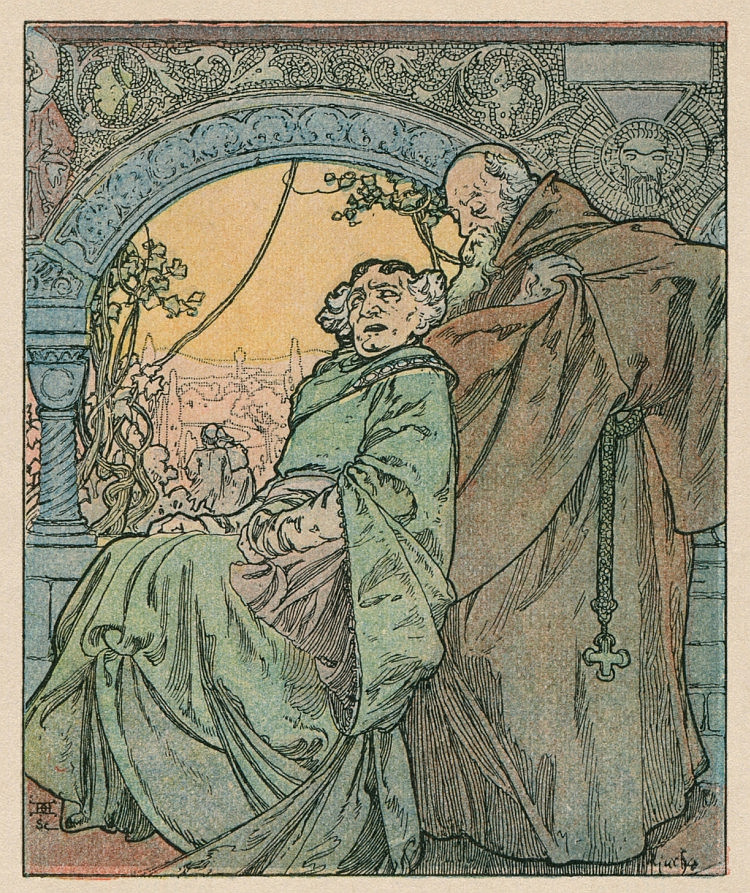
FRA AMBROGIO.
But since you loved your city even when fighting against her, it must have been painful to you that you were able to overcome her only with the aid of the Siennese, her enemies. Were you not somewhat ashamed at this?
FARINATA.
Wherefore should I have been ashamed? Could I have re-established my party in the city in any other way? I made alliance with Manfred and the Siennese. Had it been necessary, I would have sought the alliance of those African giants who have but one eye in the middle of their foreheads and who feed upon human flesh, according to the report of Venetian navigators who have seen them. The pursuit of such an interest is no mere game played according to rule, like chess or draughts. If I had judged one thing lawful and another unlawful, think you that my adversaries would have been bound by such rules? No, indeed, we on Arbia's banks were not playing a game of dice under the trellis, tablets on knee and little white pebbles to mark the score. It was conquest that we were working for. And each side knew it.
Nevertheless, I grant you, Fra Ambrogio, that it would have been better to settle our quarrel between Florentines alone. Civil war is so grand, so noble, so fine a thing, that it should, if possible, be waged without alien intervention. Those who engage in it should be fellow-citizens and preferably nobles, who would bring to it an unwearying arm and keen intelligence.
I would not say the same of foreign wars. They are useful, even necessary enterprises, undertaken to maintain or extend the boundaries of State or to promote traffic in merchandise. Generally speaking, neither profit nor honour results from waging these great wars unaided. A wise people will employ mercenaries, and delegate the enterprise to experienced captains who know how to win much with few men. Nothing but professional courage is needed, and it is better to spill gold than blood. One cannot put one's heart into it. For it would hardly be wise to hate a foreigner because his interests are opposed to ours, while it is natural and reasonable to hate a fellow-citizen who opposes what one esteems useful and good. In civil war alone can one display a discerning mind, an inflexible soul and the fortitude of a heart filled with anger or with love.
FRA AMBROGIO.
I am the poorest servant of the poor. But I have one master alone; he is the King of Heaven. I should be false to Him were I not to say, Messer Farinata, that the only warrior worthy of the highest praise is he who marches beneath the cross, singing:
Vexilla régis prodeunt.
The blessed Dominic, whose soul, like a sun, rose on the darkened Church in a night of falsehood, taught us, concerning war against heretics, that the more fiercely and bitterly it is fought the more does it display charity and mercy. And he must have known, he who, bearing the name of the Prince of the Apostles, like the stone from David's sling, struck the Goliath of heresy on the forehead. Between Como and Milan he suffered martyrdom. From him my order derives great honour. Whosoever draws sword against such a soldier is another Antiochus, fighting for our Lord Jesus Christ. But, having instituted empires, kingdoms and republics, God suffers them to be defended by arms, and He looks down upon the captains who, having called upon Him, draw sword for the deliverance of their country. But He turns away His countenance from the citizen who strikes His city and sheds its blood, as you were so ready to do, Messer Farinata, undeterred by the fear that Florence, exhausted and rent by you, might have no strength to withstand her enemies. In the ancient chronicles it is written that cities weakened by internecine warfare offer an easy prey to the foreigner who lies in wait to destroy them.
FARINATA.
Monk, is it best to attack the lion when he watches or when he sleeps? Now, I have kept awake the lion of Florence. Ask the Pisans if they had reason to rejoice at having attacked him at a time when I had made him furious. Search in the ancient histories and you will find there also, perhaps, that cities which are seething within are ready to scald the enemy who lurks without, but that a people made lukewarm by peace at home has no desire for war abroad. Know that it is dangerous to offend a city vigilant and noble enough to maintain internal warfare, and say not again that I have weakened my city.
FRA AMBROGIO.
Nevertheless, you know that she was like to perish after the fatal day of the Arbia. The panic-stricken Guelfs had sallied forth from her gates and had taken the sad road to exile. The Ghibelline diet, convoked at Empoli by Count Giordano, decided to destroy Florence.
FARINATA.
It is true. All wished that not a stone should be left upon another. All said, "Let us crush this nest of Guelfs." I alone rose to defend her. I alone shielded her from harm. To me the Florentines owe the very breath of life. Those who insult me and spit upon my threshold, had they any piety in their hearts, would honour me as a father. I saved my city.
FRA AMBROGIO.
After you had ruined it. Nevertheless, may that day at Empoli be counted to you for righteousness in this world and the next, Messer Farinata! And may St. John the Baptist, the patron saint of Florence, bear to the ear of our Lord the words which you uttered in the assembly of the Ghibellines! Repeat to me, I pray you, those praiseworthy words. They are diversely reported, and I would know them exactly. Is it true, as many say, that you took as your text two Tuscan proverbs—one of the ass, the other of the goat?
FARINATA.
That of the goat I hardly remember, but I have a clearer recollection of the proverb of the ass. It may be, as some have said, that I confused the two proverbs. That matters not. I rose and spoke somewhat thus:
"The ass bites at the roots as hard as he can. And you, following his example, will bite without discrimination, to-morrow as yesterday, not discerning that which should be destroyed and that which should be respected. But know that I have suffered so much and fought so long only in order to dwell in my city. I shall therefore defend her and die, if need be, sword in hand."
I said not another word and I went out. They ran after me, and, endeavouring to appease me by their entreaties, they swore to respect Florence.
FRA AMBROGIO.
May our sons forget that you were at the Arbia and remember that you were at Empoli! You lived in cruel days, and I do not think it easy either for a Guelf or a Ghibelline to see salvation. May God, Messer Farinata, save you from hell and receive you after your death into His blessed Paradise.
FARINATA.
Paradise and hell are but the creations of our own mind. Epicurus taught this, and many since his day have known it to be true. You yourself, Fra Ambrogio, have you not read in your book: "For that which befalleth the sons of men befalleth Beasts; as the one dieth so dieth the other." But if, like ordinary souls, I believed in God, I would pray to him to leave the whole of me here after death, that soul and body alike might be buried in my tomb beneath the walls of my beautiful San Giovanni. All around are coffins hewn out of stone by the Romans to receive their dead. Now they are open and empty. In one of those beds I would wish to rest and sleep at last. In life I suffered bitterly in exile, and yet I was but a day's journey from Florence. Farther away I should have been more wretched still. I desire to remain for ever in my beloved city. May my descendants remain there also.
FRA AMBROGIO.
It fills me with horror to hear you blaspheme the God who created heaven and earth, the mountains of Florence and the roses of Fiesole. And that which most terrifies me, Messer Farinata degli Uberti, is that you contrive to invest evil with a certain nobility. If, contrary to the hope which I still cherish, infinite mercy were not to be vouchsafed to you, I believe you would be a credit to hell.
THE KING DRINKS
In the city of Troyes, in the year of grace, 1428, Canon Guillaume Chappedelaine was elected by the Chapter to be King of the Epiphany, in accordance with the custom which then prevailed throughout Christian France. For the canons were wont to choose one of their number and to designate him as king because he was to take the place of the King of kings and to gather them all round his table, until such time as Jesus Christ Himself should gather them, as they all hoped, into His holy paradise.
Sieur Guillaume Chappedelaine owed his election to his virtuous life and his generosity. He was a rich man. Both the Burgundian and the Armagnac captains, when ravaging Champagne, had spared his vineyards. For this good fortune he was indebted first to God and then to himself, to the kindness he had shown to the two factions which were at that time rending asunder the kingdom of the lilies. His wealth had contributed not a little to his election; for in that year a setier[1] of corn fetched eight francs, five-and-twenty eggs six sous, a young pig seven francs, while throughout the winter Churchmen had been reduced to eat cabbages like villeins.
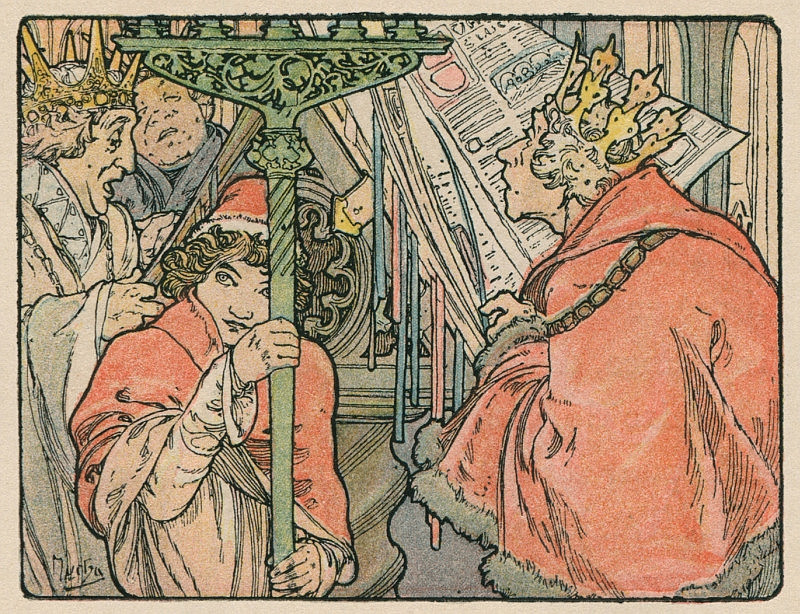
Wherefore on the Feast of the Epiphany, Sieur Guillaume Chappedelaine, clothed in his dalmatica, holding in his hand a palm-branch in lieu of a sceptre, took his place in the cathedral choir, beneath a canopy of cloth of gold. Meanwhile, out in the sacristy, there came forth three canons, wearing crowns upon their heads. One was robed in white, another in red, the third in black. They stood for the three kings of the East, the Magi, and, going down to that part of the church which represents the foot of the cross, they chanted the Gospel of St. Matthew. A deacon, bearing at the end of a pole five lighted candles, to symbolize the miraculous star which led the Magi to Bethlehem, ascended the great nave and entered the choir. The three canons followed him singing, and, when they reached this passage in the gospel, Et intrantes domum, invenerunt puerum cum Maria, matre ejus, et procidentes adoraverunt eum, they stopped in front of Sieur Guillaume Chappedelaine and bowed low before him. Then came three children, bearing salt and spices, which Sieur Guillaume graciously received after the manner of the Infant King who had accepted the myrrh, the gold and the frankincense of the kings of this world. After this divine service was celebrated with due devoutness.
In the evening the canons were invited to sup with the King of the Epiphany. Sieur Guillaume's house was close against the apse of the cathedral. It was recognizable by the golden hood on a shield of stone which adorned its low door. That night the great hall was strewn with foliage and lit by twelve torches of fir-wood. The whole Chapter sat down to the table, groaning beneath a lamb cooked whole. There were present Sieurs Jean Bruant, Thomas Alépée, Simon Thibouville, Jean Coquemard, Denys Petit, Pierre Corneille, Barnabe Videloup and François Pigouchel, canons of Saint-Pierre, Sieur Thibault de Saugles, knight and hereditary lay canon, and, at the bottom of the table, Pierrolet, the little clerk, who, although he could not write, was Sieur Guillaume's secretary and served him at Mass. He looked like a girl dressed up as a boy. He it was who on Candlemas Day appeared as an angel. It was also the custom on Ember Wednesday in December, when the coming of the Angel Gabriel to announce to Mary the mystery of the Incarnation was read at Mass, for a young girl to be placed on a platform and for a child with wings to tell her that she was about to become the mother of the Son of God. A stuffed dove was suspended over the girl's head. For two years Pierrolet had represented the angel of the Annunciation.
But his soul was far from being as sweet as his countenance. He was violent, foolhardy and quarrelsome, and he often provoked boys older than himself. He was suspected of being immoral; and in truth the soldiers garrisoned in the towns set no good example. Little notice, however, was taken of his bad habits. That which most vexed Sieur Guillaume was that Pierrolet was an Armagnac and for ever quarrelling with the Burgundians. The canon repeatedly told him that such a state of mind was not only wicked but absolutely devilish in that good town of Troyes, where the late Henry V of England had celebrated his marriage with Madame Catherine of France and where the English were the rightful masters, for all power is of God. Omnis potestas a Deo.
The guests having taken their places, Sieur Guillaume recited the Benedicite and every one began to eat in silence. Sieur Jean Coquemard was the first to speak. Turning to Sieur Jean Bruant, his neighbour, he said:
"You are wise and learned. Did you fast yesterday?"
"It was seemly so to do," replied Sieur Jean Bruant. "In the rubric, the eve of the Epiphany is described as a vigil and a vigil is a fast."
"Pardon me," retorted Sieur Jean Coquemard. "But I, together with notable doctors of divinity, hold that an austere fast accords ill with the joy of the faithful as they recall the birth of our Saviour which the Church continues to celebrate until the Epiphany."
"In my opinion," replied Sieur Jean Bruant, "those who do not fast on these vigils have fallen away from our ancient piety."
"And in mine," cried Sieur Jean Coquemard, "those who by fasting prepare for the most joyful of festivals are guilty of following customs censored by the majority of our bishops."
The dispute between the two canons began to wax bitter.
"Not to fasti What lack of zeal!" exclaimed Sieur Jean Bruant.
"To fast! How obstinate!" said Sieur Jean Coquemard. "You are one of those proud, reckless men who love to stand alone."
"You are one of the weak who meekly follow the corrupt herd. But even in these wicked times of ours I have my authorities. Quidam asserunt in vigilia Epiphaniæ jejunandum."
"That settles the question. Non jejunetur!"
"Peace! Peace!" cried Sieur Guillaume from the depths of his great raised seat. "You are both right: it is praiseworthy of you, Jean Coquemard, to partake of food on the eve of the Epiphany, as a sign of rejoicing, and of you, Jean Bruant, to fast on the same vigil, since you fast with seemly gladness."
This utterance was approved by the whole Chapter.
"Not Solomon himself could have pronounced a wiser judgment," cried Sieur Pierre Corneille.
And Sieur Guillaume, having put to his lips his goblet of silver gilt, Sieurs Jean Bruant, Jean Coquemard, Thomas Alépée, Simon Thibouville, Denys Petit, Pierre Corneille, Barnabé Videloup and François Pigouchel all cried with one voice:
"The King drinks! the King drinks!"
The uttering of this cry was part of the festival, and the guest who failed to join in it risked a severe penalty.
Sieur Guillaume, seeing that the flagons were empty, ordered more wine to be brought, and the servants grated the horse-radish which should stimulate the thirst of the guests.
"To the health of Monsignor, Bishop of Troyes and of the Regent of France," said Sieur Guillaume, rising from his canonical seat.
"Right willingly, sieur," said Thibault of Saulges, knight. "But it is an open secret that our Bishop is disputing with the Regent touching the double tithe which Monsignor of Bedford is exacting from Churchmen, under the pretext of financing the Crusade against the Hussites. Thus we are about to mingle in one toast the healths of two enemies."
"Ha ha!" replied Sieur Guillaume. "But healths are proposed for peace and not for war. I drink to King Henry VI's Regent of France and to the health of Monsignor, Bishop of Troyes, whom we all elected two years ago."
The canons, raising their goblets, drank to the health of the Bishop and of the Regent Bedford.
Meanwhile there was raised at the bottom of the table a young and as yet piping voice, which cried:
"To the health of the Dauphin Louis, the true King of France!"
It was the little Pierrolet, whose Armagnac sympathies, heated by the canon's wine, were finding expression.
No one took any notice, and Sieur Guillaume having drunk again they all cried in chorus:
"The King drinks! The King drinks!"
The guests, all speaking at once, were noisily discussing matters both sacred and profane.
"Have you heard," said Thibault de Saulges, "that the Regent has sent ten thousand English to take Orleans?"
"In that case," said Sieur Guillaume, "the town will fall into their hands, as have already Jargeau and Beaugency, and so many good cities of the kingdom."
"That remains to be seen!" said the little Pierrolet, growing red.
But, he being at the far end of the table, once again no one heard him.
"Let us drink, monsignors," said Sieur Guillaume, who was doing the honours of his table lavishly.
And he set the example by raising his great cup of silver gilt.
More loudly than ever the cry resounded:
"The King drinks! The King drinks!"
But after the thunder of the toast had rolled away, Sieur Pierre Corneille, who was seated rather low down at the table, said bitterly:
"Monsignors, I denounce the little Pierrolet. He did not cry 'The King drinks!' Thereby he has transgressed our rights and customs, and he must be punished."
"He must be punished!" repeated in chorus Sieurs Denys Petit and Barnabe Videloup.
"Let chastisement be meted out to him," said, in his turn, Sieur Guillaume. "His hands and face must be smeared with soot, for such is the custom."
"It is the custom!" cried all the canons together.
And Sieur Pierre Corneille went to fetch soot from the chimney, while Sieurs Thomas Alépée and Simon Thibouville, laughing unrestrainedly, threw themselves upon the child and held his arms and legs.
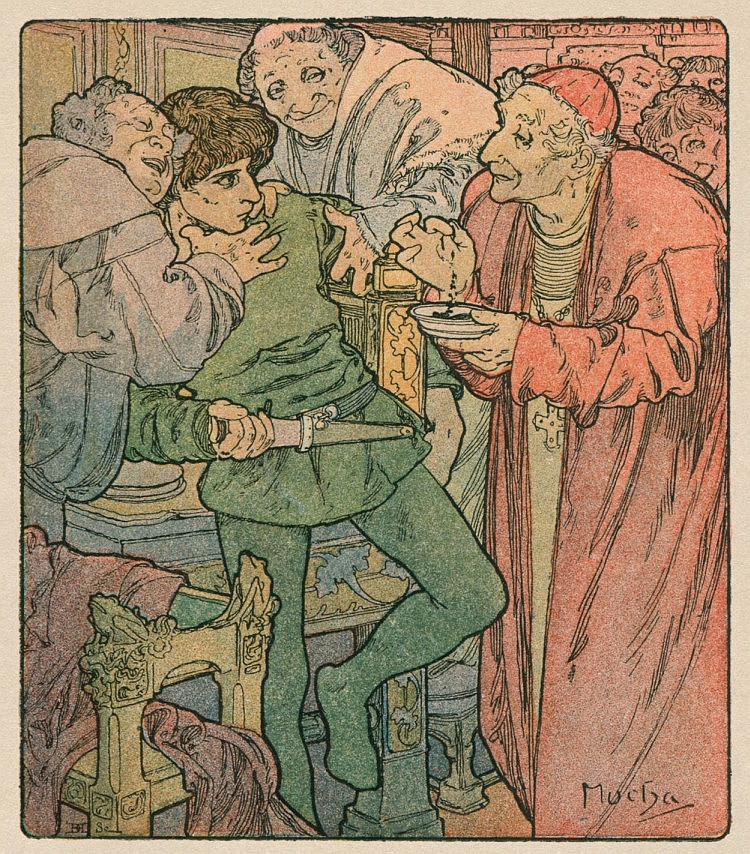
But Pierrolet escaped out of their hands, then, standing with his back to the wall, he drew a little dagger from his belt and swore that he would plunge it into the throat of anyone who came near him.
Such violence highly amused the canons, and especially Sieur Guillaume. Rising from his seat, he went up to his little secretary, followed by Pierre Corneille, who held in his hand a shovelful of soot.
"It is I," he said in unctuous tones, "who for his punishment will make of this naughty child a negro, a servant of that black King Balthazar who came to the manger. Pierre Corneille, hold out the shovel."
And, with a gesture as deliberate as that with which he would have sprinkled holy water upon the faithful, he threw a pinch of soot into the face of the child who, rushing upon him, plunged his dagger into Sieur Guillaume's stomach.
The canon uttered a long sigh and fell with his face to the ground. His guests crowded round him. They saw that he was dead.
Pierrolet had disappeared. A search was made for him all over the town, but he could not be found. Later it became known that he had enlisted in Captain La Hire's company. At the Battle of Patay, under the Maid's eyes, he took prisoner an English captain and was dubbed a knight.
"LA MUIRON"
"And sometimes, during our long evenings, the Commander-in-Chief would tell us ghost stories, a species of story in the telling of which he excelled."—Mémoires du Comte Lavallette.
For more than three months Bonaparte had been without news from Europe, when on his return from Saint-Jean-d'Acre he sent an envoy to the Turkish admiral under the pretext of negotiating an exchange of prisoners, but in reality in the hope that Sir Sidney Smith would stop this officer on the way and enlighten him as to recent events; whether, as might be expected, these had been unfavourable to the Republic. The General calculated rightly. Sir Sidney had the envoy brought to his ship and received him there with honour. Having entered into conversation, the English commander soon learnt that the Syrian army was totally without despatches or information of any kind. He showed the Frenchman the newspapers lying open on the table and, with perfidious courtesy, invited him to take them away with him.
Bonaparte spent the night in his tent reading them. In the morning he had resolved to return to France in order to assume the government in the place of those who were on the point of being overthrown. Once he had set foot on the soil of the Republic, he would crush the weak and violent government which was rendering the country a prey to fools and rogues, and he alone would occupy the vacant place. Before he could carry out his plan, however, he must cross the Mediterranean in defiance of adverse winds and British squadrons. But Bonaparte could see nothing save his purpose and his star. By an extraordinary stroke of good luck he had received the Directory's permission to leave the Egyptian army and to appoint his own successor.
He summoned Admiral Gantheaume, who had been at head-quarters since the destruction of the fleet, and instructed him quickly and secretly to arm two Venetian frigates, which were at Alexandria, and to direct them to a certain lonely point upon the coast. In a sealed document he appointed General Kléber Commander-in-Chief. Then, under the pretext of making a tour of inspection, taking with him a squadron of guides, he went to the Marabou inlet. On the evening of the 7th of Fructidor in the year VII, at the junction of two roads, whence the sea was visible, he came face to face with General Menou, who was returning with his escort to Alexandria. Finding it impossible and unnecessary to keep his secret any longer, he took a brusque farewell of these soldiers, urged them to acquit themselves well in Egypt and said:
"If I have the good luck to set foot in France, the reign of the chatterboxes will be over!"
He seemed to say this spontaneously and, so to speak, in spite of himself. Yet such an announcement was well calculated to justify his flight and to suggest future power.
He jumped into the boat, which at nightfall drew alongside of the frigate, La Muiron. Admiral Gantheaume welcomed him beneath his flag with these words:
"I command under your star."
And he set sail immediately. With the General were Lavallette, his aide-de-camp, Monge and Berthollet. The frigate, La Carrère, which served as a convoy, had on board the' wounded generals, Lannes and Murat, and Messieurs Denon, Costaz and Parseval-Grandmaison.
Hardly had they started when the wind dropped. The Admiral proposed to return to Alexandria lest dawn should find them in sight of Aboukir, where the enemy's fleet lay at anchor. The faithful Lavallette entreated the General to agree. But Bonaparte pointed seawards.
"Have no fear. We shall get through."
After midnight a fair breeze began to blow. By dawn the flotilla was out of sight of land. As Bonaparte was walking alone on deck, Berthollet came up to him.
"General, you were well advised to tell Lavallette not to be afraid and that we should be able to continue on our course."
Bonaparte smiled.
"I reassured one who is weak but devoted. Your character, Berthollet, is different, and to you I shall speak differently. The future must not be counted upon. The present alone matters. One must dare and calculate, and leave the rest to luck."
And, quickening his steps, he muttered:
"Dare ... calculate ... avoid any cast-iron plan ... conform to circumstances, follow where they lead. Take advantage of the slightest as well as of the greatest opportunities. Attempt only the possible, and all that is possible."
At dinner that day, when the General reproached Lavallette with his timidity on the previous evening, the aide-de-camp replied that at present his fears were different but not less, and that he was not ashamed to confess them, because they concerned the fate of Bonaparte, consequently the fate of France and of the world.
"I learned from Sir Sidney's secretary," he said, "that the commodore believes in keeping out of sight during a blockade. So, knowing his strategy and his character, we must expect to find him in our way. And in that case...."
Bonaparte interrupted him.
"In that case you cannot doubt that our intuition and our skill would rise superior to our danger. But you flatter that young madman when you regard him as capable of any consecutive and methodical action. Smith ought to be captain of a fire-ship."
Bonaparte was not fair to the formidable commander who had been the cause of his misfortune at Saint-Jean-d'Acre; and his injustice arose doubtless from a wish to attribute his failure to a turn of fortune rather than to his adversary's skill.
The Admiral raised his hand as if to emphasize the resolve which he was about to express.
"If we meet the English cruisers, I will go on board La Carrère, and, you may depend upon it, I will keep them so well occupied that they will give La Muiron time to escape."
Lavallette opened his mouth. He was about to observe that La Muiron was not a fast sailer and that consequently such an opportunity would be lost upon her. But he feared to displease the General, and swallowed his words. Bonaparte, however, read his thoughts; and, taking him by the coat button, said:
"Lavallette, you are a good fellow, but you will never be a good soldier. You never think enough of your advantages, and you are for ever concerned with irreparable disadvantages. We cannot make this frigate a fast sailer. But you must think of the crew, animated with the brightest enthusiasm and capable of working miracles, if need be. You forget that our boat is La Muiron. I myself gave her that name. I was at Venice. Invited to christen the frigate which had just been armed, I seized the opportunity of honouring the memory of one who was dear to me, of my aide-de-camp, who fell on the bridge of Areola while protecting his General with his own body under a hail of shot and shell. In this ship we sail to-day. Can you doubt that its name augurs well for us?"
For a while longer he continued to hearten them with his glowing words. He then remarked that he would retire to rest. It was known on the morrow that he had decided to endeavour to avoid the British squadrons by some four or five weeks' sailing along the African coast.
Henceforth day followed day in uneventful monotony. La Muiron kept in sight of the low, unfrequented coast, which was not likely to be reconnoitred by the enemy's ships, and every half league she tacked without venturing out to sea. Bonaparte passed his days in conversation and in reverie. Sometimes he was heard to murmur the names of Ossian and Fingal. Sometimes he asked his aide-de-camp to read aloud Vertot's Revolutions[1] or Plutarch's Lives. He appeared neither anxious nor impatient, nor preoccupied, more, probably, through a natural disposition to live in the present than as the result of self-control. He seemed to take a melancholy pleasure in contemplating that sea which, whether angry or serene, threatened his destiny and divided him from his object. On rising from table, when the weather was fine, he would go on deck and half recline on a gun-carriage in the same somewhat unsociable and forlorn attitude that was his when, as a child, he would lie propped up by his elbows on the rocks of his native isle. The two scientists, the Admiral, the Captain of the frigate and the aide-de-camp, Lavallette, would stand round him. And the conversation, which he carried on by fits and starts, most frequently turned on some new scientific discovery. Monge was not a brilliant talker; but his conversation revealed him as a clear, logical thinker. Inclined to consider utility even in physics, he was always a patriot and a good citizen. Berthollet was a better philosopher and more given to evolving general theories.
"It will not do," he said, "to represent chemistry as the mysterious science of metamorphoses, a new Circe, waving her magic wand over nature. Such ideas may flatter vivid imaginations; but they will not satisfy thoughtful minds, who are striving to prove that the transformations of bodies are subject to the general laws of physics."
He had a presentiment that the reactions, which the chemist provokes and observes, occur under precise mechanical conditions which some day may be the subject of exact calculation. And, constantly recurring to this idea, he would apply it to a variety of data, known or surmised. One evening Bonaparte, who had no sympathy with pure speculation, brusquely interrupted him:
"Your theories...! Mere soap-bubbles born of a breath and dissipated by a breath. Chemistry, Berthollet, is no more than a game when not applied to the requirements of war or industry. In all his researches the man of science should set before him some definite great and useful object, like Monge, who, in order to manufacture gunpowder, sought nitre in cellars and stables."
But Monge himself, as well as Berthollet, insisted on representing to the General the necessity of understanding phenomena and submitting them to general laws, before attempting practical applications, and they argued that any other procedure would lead to the dangerous obscurity of empiricism.
Bonaparte agreed. But he feared empiricism more than ideology. And suddenly he inquired of Berthollet:
"Do you, with your explanations, hope to penetrate into the infinite mystery of nature, to enter on the unknown?"
Berthollet replied that, without pretending to explain the universe, the scientist rendered humanity the greatest service by substituting a rational view of natural phenomena for the terrors of ignorance and superstition.
"Is he not man's true benefactor," added Berthollet, "who delivers him from the phantoms introduced into the soul by the fear of an imaginary hell, who rescues him from the yoke imposed by priests and soothsayers, who expels from his mind the terrors of dreams and omens?"
Night rested like a vast shadow on the great expanse of sea. In a moonless and cloudless sky, multitudes of stars glittered like a suspended shower. For a moment the General remained lost in meditation. Then, lifting up his head and half rising, he pointed to the dome of heaven, and with the uncultured voice of the young herdsman and the hero of antiquity he pierced the silence:
"Mine is a soul of marble which nothing can perturb, a heart inaccessible to common weaknesses. But you, Berthollet, do you understand sufficiently what life and death are? Have you explored their confines so far as to be able to affirm that they are without mystery? Are you sure that all apparitions are no more than the phantoms of a diseased brain? Can you explain all presentiments? General La Harpe had the stature and the heart of a Grenadier. His intelligence was in its element in battle. There it shone. At Fombio, for the first time, on the evening before his death, he was struck dumb, as one who is stunned, frozen by a strange and sudden fear. You deny apparitions. Monge, did you not meet Captain Aubelet in Italy?"
At this question, Monge tried to remember, then shook his head. No, he did not recollect Captain Aubelet.
Bonaparte resumed:
"I had observed him at Toulon, where he won his epaulettes, like a hero of ancient Greece. He was as young, as handsome, as courageous as a soldier from Platea. Struck by his serious air, his clear-cut features and the look of wisdom on his young countenance, his superior officers had nicknamed him Minerva, and the Grenadiers also called him by that name, though they were ignorant of its significance.
"Captain Minerva!" cried Monge. "Why did you not call him that at first? Captain Minerva was killed beneath the walls of Mantua a few weeks before I arrived in that city. His death had made a great impression, because it was associated with marvellous happenings which were related to me, though I do not remember them exactly. All I recollect is that General Miollis ordered Captain Minerva's sword and gorget, crowned with laurels, to be carried at the head of the column which one feast day defiled in front of Virgil's grotto, as a tribute to the memory of the poet of heroes."
"Aubelet's," resumed Bonaparte, "was that perfectly calm courage which I have never observed in anyone save Bessières. His passions were of the noblest. And in everything he sacrificed himself. He had a brother in arms, Captain Demarteau, a few years his senior, whom he loved with all the affection of a great heart. Demarteau did not resemble his friend. Impulsive, passionate, equally eager for pleasure and for danger, he was always the life and soul of the camp. Aubelet was the proud devotee of duty, Demarteau the joyous lover of glory. The latter returned his comrade's affection. In those two friends the story of Nisus and Euryalus was re-enacted beneath our flag. The end, both of one and the other, was surrounded with extraordinary circumstances. They were told to me, Monge, as to you, but I paid better heed, although at that time my mind was occupied with greater affairs. I desired to take Mantua without delay and before a new Austrian army had time to enter Italy. Nevertheless I found time to read a report of the incidents which had preceded and followed Captain Aubelet's death. Certain of these incidents border on the miraculous. Their cause must either be assigned to unknown faculties, which man may acquire in unique moments, or to the intervention of an intelligence superior to ours."
"General, you must exclude the second hypothesis," said Berthollet. "An observer of nature never perceives the intervention of a superior intelligence."
"I know that you deny the existence of Providence," replied Bonaparte. "That may be permissible for a scientist shut tip in his study, but not for a leader of peoples who can only control the ordinary mind through a community of ideas. If you would govern men, you must think with them on all great subjects. You must move with public opinion."
And, raising his eyes to the light flaming in the darkness on the pinnacle of the mainmast, he said, with hardly a pause:
"The wind blows from the north."
He had changed the subject with the suddenness which was his wont and which had caused some one to say to M. Denon:
"The General shuts the drawer."
Admiral Gantheaume observed that they could not expect the wind to change before the first days of autumn.
The light was flaring towards Egypt. Bonaparte looked in that direction. His gaze plunged into space; and, speaking in staccato tones, he let fall these words:
"If only they can hold out yonder! The evacuation of Egypt would be a commercial and military disaster. Alexandria is the capital of the controllers of Europe. Thence, I shall destroy England's commerce and I shall change the destiny of India.... For me, as for Alexander, Alexandria is the fortress, the port, the arsenal whence I start to conquer the world and whither I cause the wealth of Africa and Asia to flow. England can only be conquered in Egypt. If she were to take possession of Egypt, she instead of us would be the mistress of the world. Turkey is on her death-bed. Egypt assures me the possession of Greece. For immortality my name shall be inscribed by that of Epaminondas. The fate of the world hangs upon my intelligence and Kléber's firmness."
For some days afterwards the General remained silent. He had read to him the Révolutions de la République romaine, the story of which seemed to him to drag unbearably. The aide-de-camp, Lavallette, had to gallop through the Abbé Vertot's pages. And even then Bonaparte's patience would be exhausted, and, snatching the book from his hands, he would ask for Plutarch's Lives, of which he never tired. He considered that, though lacking broad and clear vision, they were permeated with an overpowering sense of destiny.
So one day, after his siesta, he summoned his reader and bade him resume the Life of Brutus, where he had left off on the previous evening. Lavallette opened the book at the page marked, and read:
"Then, as he and Cassius were preparing to leave Asia with the whole of their army (the night was very dark, and but a feeble light burned in his tent; a profound silence reigned throughout the whole camp and he himself was wrapt in thought), it seemed to him that he saw some one enter his tent. He looked towards the door and he perceived a horrible spectre, whose countenance was strange and terrifying, who approached him and stood there in silence. He had the courage to address it. 'Who art thou,' he asked, 'a man or a god? What comest thou to do here and what desirest thou of me?' 'Brutus,' replied the phantom, 'I am thy evil genius, and thou shalt see me at Philippi.' Then Brutus, unperturbed, said: 'I will see thee there.' Straightway the phantom disappeared, and Brutus, to whom the servants, whom he summoned, said that they had seen and heard nothing, continued to busy himself with his affairs."
"It is here," cried Bonaparte, "in this watery solitude, that such a scene has its most gruesome effect. Plutarch narrates well. He knows how to give animation to his story, how to make his characters stand out. But the relation between events escapes him. One cannot escape one's fate. Brutus, who had a commonplace mind, believed in strength of will. A really superior man would not labour under that delusion. He sees how necessity limits him. He does not dash himself against it. To be great is to depend on everything. I depend on events which a mere nothing determines. Wretched creatures that we are, we are powerless to change the nature of things. Children are self-willed. A great man is not. What is a human life? The curve described by a projectile."
The Admiral came to tell Bonaparte that the wind had at length changed. The passage must be attempted. The danger was urgent. Vessels detached from the English fleet, anchored off Syracuse, commanded by Nelson, were guarding the sea which they were about to traverse between Tunis and Sicily. Once the flotilla had been sighted the terrible Admiral would be down upon them in a few hours.
Gantheaume doubled Cape Bon by night with all lights out. The night was clear. The watch sighted a ship's lights to the north-east. The anxiety which consumed Lavallette had attacked even Monge. Bonaparte, seated, as usual, on his gun-carriage, displayed a tranquillity which might be deemed real or simulated according to the view taken of his fatalism! whether it arose merely from a sanguine temper and the capacity for self-deception or was simply one of his numerous poses. After discussing with Monge and Berthollet various matters of physics, mathematics and military science, he went on to speak of certain superstitions from which perhaps his mind was not completely emancipated.
"You deny the miraculous," he said to Monge. "But we live and die in the midst of the miraculous. You told me the other day that you had scornfully put out of your mind the extraordinary happenings associated with Captain Aubelet's death. Perhaps Italian credulity had embroidered them too elaborately. And that may excuse you. Listen to me. On the 9th of September, at midnight, Captain Aubelet was in bivouac before Mantua. The overpowering heat of the day had been followed by a night freshened by the mists rising from the marshy plain. Aubelet, feeling his cloak, became aware that it was wet. And, as he was shivering slightly, he went near to a fire which the Grenadiers had lit in order to heat their soup, and he warmed his feet, seated on a pack-saddle. Gradually the night and the mist enveloped him. In the distance he heard the neighing of horses and the regular cries of the sentinels. The captain had been there for some time, anxious, sad, his eyes fixed on the ashes in the brazier, when a tall form rose noiselessly at his side. He felt it near him and dared not turn his head. Nevertheless, he did turn, and recognized his friend, Captain Demarteau, in his usual attitude, his left hand on his hip and swaying slightly to and fro. At this sight Captain Aubelet felt his hair stand on end. He could not doubt the presence of his brother-in-arms, and yet he could not believe it, for he knew that Captain Demarteau was on the Maine with Jourdan, who was threatening the Archduke Charles. But his friend's aspect increased Aubelet's alarm, for though Demarteau's appearance was perfectly natural there was in it notwithstanding something unfamiliar. It was Demarteau, and yet there was something in him which could not fail to inspire fear. Aubelet opened his mouth. But his tongue froze, he could utter no sound. It was the other who spoke: 'Farewell! I go where I must. We shall meet to-morrow!' He departed with a noiseless step.
"On the morrow, Aubelet was sent to reconnoitre at San Giorgio. Before going, he summoned his first lieutenant and gave him such instructions as would enable him to replace his captain. 'I shall be killed to-day,' he added, 'as surely as Demarteau was killed yesterday.'
"And he described to several officers what he had seen in the night. They believed him to be suffering from an attack of the fever which had begun to declare itself among the troops encamped in the Mantuan marshes.
"Aubelet's company completed its reconnaissance of the San Giorgio Fort without hindrance. Having achieved its object, it fell back on our positions. It was marching under the cover of an olive wood. The first lieutenant, approaching the captain, said to him: 'Now, Captain Minerva, you no longer doubt that we shall bring you back alive?'
"Aubelet was about to reply, when a bullet whistled through the leaves and struck him on the forehead.
"A fortnight later a letter from General Joubert, which the Directory communicated to the Italian army, announced the death of the brave Captain Demarteau, who fell on the field of honour on the 9th of September."
As soon as he had finished his story the General left the group of silent listeners, to pace the deck with long strides and in silence.
"General," said Gantheaume, "we have passed the most dangerous part of our course."
The next day he bore towards the north, intending to sail along the Sardinian coast as far as Corsica and thence to make for the coast of Provence; but Bonaparte wished to land at a headland in Languedoc, fearing that Toulon might be occupied by the enemy.
La Muiron was making for Port-Vendres when a squall threw her back on Corsica and compelled her to put into Ajaccio. The whole population of the Island flocked thither to greet their compatriot and crowned the heights dominating the gulf. After a few hours' rest, hearing that the whole French coast was clear of the enemy, they set sail for Toulon. The wind was fair, but not strong.
Now, amidst the tranquillity which he had communicated to all, Bonaparte alone appeared agitated, impatient to land, now and again clapping his small hand suddenly to his sword. The ardent desire to reign which had been fermenting within him for three years, the spark of Lodi, had set him in a blaze. One evening, while the indented coast-line of his native island was fading away into the distance, he suddenly began to talk with a rapidity which confused the syllables of the words he spoke:
"If a atop is not put to it, chatterers and fools will complete the downfall of France. Germany lost at Stockach, Italy lost at the Trebbia; our armies beaten, our Ministers assassinated, contractors gorged with gold, our stores empty and deserted, invasion imminent, to this a weak and dishonest government has brought us.
"Upright men are authority's only support. The corrupt fill me with an invincible loathing. There is no governing with them."
Monge, who was a patriot, said firmly:
"Probity is as necessary to liberty as corruption to tyranny."
"Probity," replied the General, "is a natural and profitable quality in men born to govern."
The sun was dipping its reddened and magnified disc beneath the misty circle of the horizon. Eastward the sky was sown with light clouds like the petals of a falling rose. On the surface of the sea the blue and rosy waves rolled softly. A ship's sail appeared on the horizon, and the telescope of the officer on duty showed her to be flying the British flag.
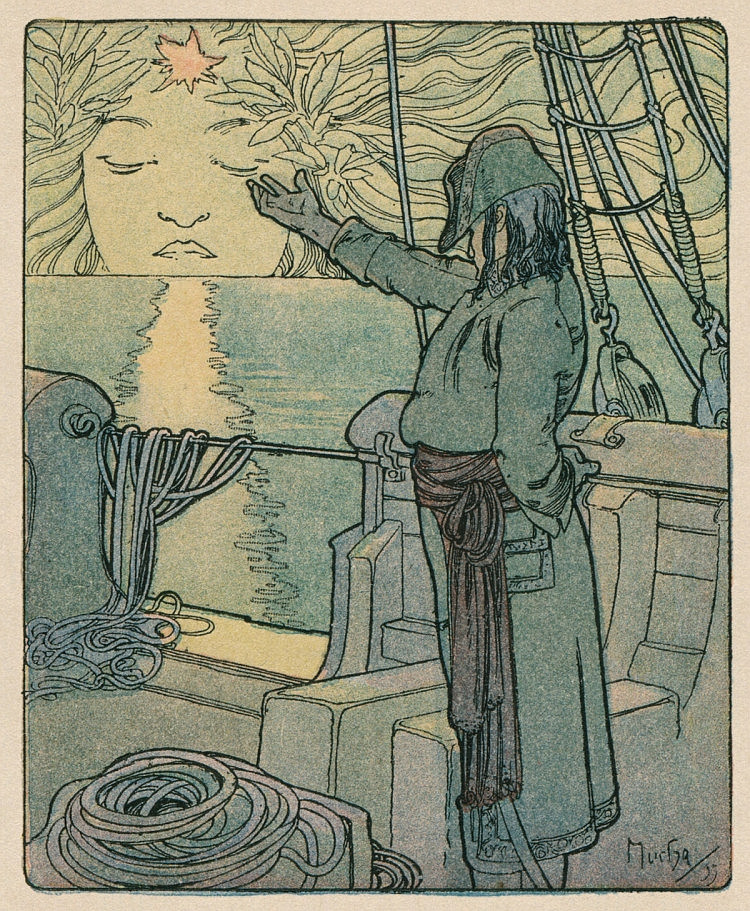
"Have we escaped countless dangers only to perish so near our desired haven!" exclaimed La Valette.
Bonaparte shrugged his shoulders.
"Is it still possible to doubt my good luck and my destiny?"
And he continued his train of thought:
"A clean sweep must be made of these rogues and fools. They must be replaced by a compact government, swift and sure in action, like the lion. There must be order. Without order, there can be no administration, without administration, no credit, no money, but the ruin of the State and of individuals. A stop must be put to brigandage, to speculation, to social dissolution. What is France without a government? Thirty millions of grains of sand. Power is everything. The rest is nothing. In the wars of Vendée forty men made themselves the masters of a department. The whole mass of the people desire peace at any price, order and an end of quarrelling. Fear of Jacobins, Émigrés, Chouans will throw them into the arms of a master." "And this master?" inquired Berthollet. "He will doubtless be a military leader?"
"Not at all," replied Bonaparte swiftly. "Not at all I A soldier never will be the master of this nation, a nation illuminated by philosophy and science. If any General were to attempt the assumption of power, his audacity would soon be punished. Hoche thought of doing so. I know not whether it was love of pleasure or a true appreciation of the situation that restrained him; but the blow will assuredly recoil on any soldier who attempts it. For my part, I admire that French impatience of the military yoke, and I have no hesitation in admitting that the civil power should be pre-eminent in the State."
On hearing such a declaration, Monge and Berthollet looked at one another in amazement. They knew that Bonaparte, in spite of the perils, known and unknown, was about to grasp at power; and they failed to comprehend words which would seem to deny him that which he so ardently coveted. Monge, who, at the bottom of his heart, was a lover of liberty, began to rejoice. But the General, who divined their thoughts, replied to them immediately: "Of course, if the nation were to discover in a soldier such civil qualities as would render him an efficient administrator and ruler, it would place him at the head of affairs; but it would have to be as a civil not as a military leader. Such must needs be the feeling of any civilized, intelligent and educated nation."
After a moment's silence, Bonaparte added:
"I am a member of the Institute."
For a few moments longer the English ship was visible on the purpling belt of the horizon; then it disappeared.
On the morning of the next day, the watch sighted the coast of France. Yonder was Port-Vendres. Bonaparte fixed his gaze on the low, faint streak of land. A tumult of thoughts was surging in his mind. He had a striking and confused impression of arms and togas; in the silence of the sea an immense clamour filled his ears. And amidst visions of Grenadiers, magistrates, legislators and human crowds, he saw smiling and languishing, her handkerchief to her lips, her throat bare, Josephine, the remembrance of whom burned in his blood.
"General," said Gantheaume, pointing to the coast, which was growing bright in the morning sunshine, "I have brought you whither destiny called you. You, like Æneas, reach a shore promised you by the gods."
Bonaparte landed at Fréjus on the 17th of Vendémiaire in the year VIII.
THE CHÂTEAU DE VAUX-LE-VICOMTE
PREFACE
In 1656, Foucquet was forty-one years of age. For five years he had been Attorney-General in the Paris Parliament, and for three Comptroller of Finance, having been the control of the Treasury at the troubles which had afflicted France during the minority of Louis XIV. He had successfully weathered a difficult period, and had acquired no little confidence in his genius and his guiding star. Now, in the prime of life, feeling securely established in office, he proceeded to order his life in accordance with the magnificence of his tastes. Ambitious, pleasure-loving, adoring all that was great and beautiful, sensitive to all that exalts or caresses the soul, he called upon the Arts to surround him with the symbols of glory and of pleasure. The miracles of Vaux were the outcome of this demand, which was first satisfied, then cruelly punished.
On the 2nd of August, 1656, in the presence of Le Vau, his architect, Foucquet signed the plans and estimates for this mansion of Vaux, which was to be built within four years, in a new and noble style. It was to be adorned with magnificent paintings, with statues and tapestries; it was to command a view over gardens, grottoes and bewitching ornamental waters; to abound in gold plate and gems and valuables of every kind. It was destined to receive, with a luxury hitherto unknown, the most powerful and the most beautiful alike, to welcome the Court and the King. Thereafter, when the last lights of a miraculous festival had been extinguished, it was to be the home, for ever, of only solitude and desolation.
Nevertheless, to Nicolas Foucquet remains the honour of having discerned and selected men of superior talent, and of having been the first to employ those great masters of French Art whose works have shed an enduring splendour over the reign of Louis XIV. After he had disgraced his Minister, the King could not do better than take from him his architect Louis Le Vau, his painter Charles Le Brun and his gardener André Le Nostre, and remove to Paris the looms which Foucquet had set up at Maincy and which became the Manufacture des Gobelins. But there was something which the King could not appropriate: the taste, the feeling for art, the delicate yet profound instinct for the beautiful which endeared the Comptroller to all the artists who worked for him. Le Brun, on whom the King showered benefits, regretted notwithstanding his generous host of Vaux.
It is said that during his trial, when in danger of a capital sentence, Foucquet, on leaving the Court, was walking, strongly guarded, past the Arsenal, when seeing some men at work he asked what they were making. Hearing that they were at work on a basin for a fountain, he went to look at the latter and gave his opinion of it. Then, turning to Artagnan, the Musketeer, who was in charge of him, he said, smiling: "You are wondering why I meddle in such a business? It is because I used, to be something of an expert in these matters." And Foucquet spoke the truth. He was surely a sincere lover of the arts whom the sight of men at work upon a fountain could suddenly distract from the thought of dungeons and the imminence of the scaffold.