CLEOPATRA’S NEEDLE. (continued 2)
Reading edition
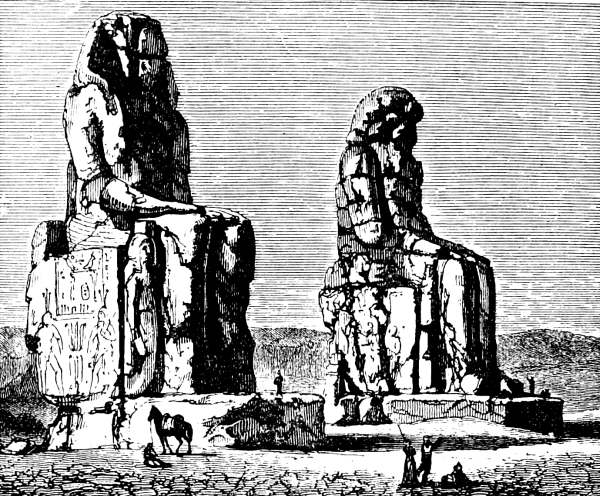
The Memnonian Colossi; one of the two being the “Vocal Memnon.” They are sitting statues of the Pharaoh, Amenophis III.
Once upon a time there existed on this spot a temple of calcareous stone; the temple was named Memnonium, from being situated in a part of the city called Memnonia; and the trumpet of fame has ascribed it to a mythical king, Memnon: it was, however, erected by Amenophis or Amunoph III., who, for no better reason, has likewise been termed Memnon. Egyptologists deplore the loss of this temple, as it no doubt contained the historical record of the reign of Amenophis; but of its pylons, its walls, and its columns, nothing now remains save their foundations; its stones have been broken into bits, and the bits have been carried away and burnt into lime. Nevertheless, a memorial of its former existence happily remains in the two gigantic colossal statues of Amenophis, which were carved out of breccia, a transition rock, that could yield no lime by the burning. These are the two huge Colossi, still grand, but much defaced and injured, which sat at their ease in front of the pylon of Amunoph’s temple, and will sit on, perhaps, for centuries, although the sanctuary which they once guarded and adorned is no more. Of another temple near at hand, M. Mariette says:—“The lime-burners have luckily not yet found their way here. But why? Simply because there is already so much limestone among the ruins on the plain, which is, therefore, more easy of acquisition;” but when this shall have been exhausted, then looms another invasion of those industrious shepherds, the lime-burners.
No doubt, a good deal of the destruction which we see around was the handiwork of man, perhaps of the baffled Cambyses; perhaps of Ptolemy Lathyrus, those two great destroyers; but history reminds us, that in the twenty-seventh year before the birth of Christ, an earthquake visited Egypt, and shook it to its very foundations. This earthquake seriously damaged the Colossi, and more especially the northernmost one, which had its upper part shaken completely off. But a curious phenomenon succeeded. Of a morning, when the sun first rose and warmed the statue, it gave forth a plaintive wail, resembling the sound of the human voice. This, apparently, resulted from some contraction or expansion of the material of the broken stump: it has been supposed that the fractured stone, moistened by the dew of night, crackled under the drying influence of the warm rays of the rising sun. But whatever the physical cause may have been, the sound attracted the notice of travellers; and visitors came from all parts of the surrounding countries to witness the phenomenon. It would seem that the event was a little fickle; it did not always manifest itself, nor precisely at the same time; but it was only at or about the time of the rising of the sun that it was evoked. To the multitude, this sound was the voice of Memnon lamenting to his divine mother, Aurora, the injuries his statue had sustained; and in this wise he sighed forth his lament for 250 years, when Septimus Severus stretched forth his hand to heal his wounds, and perchance to elicit a happier, cheerfuller note. The statue was repaired by means of blocks of stone, as in ordinary masonry; the voice of lamentation ceased, and with it every vestige of sound. Memnon wailed and sighed no more, neither did his voice come more melodiously forth as his restorer hoped. The vocal Memnon sunk at once, from an object of wonder, to the simple rank of the northern colossus of Amenophis. But the term Colossus is well-earned when we reflect that the statue itself was fifty feet in height; while its pedestal of ten feet gave it an altitude of sixty feet. Two figures standing against the arms of the throne on which the giant sits, are those of his mother and sister.
Not far away from the ruin of the Memnonium and the Memnonian Colossi are the fragments of a temple, erected by Rameses II., and dedicated to himself, the Ramesseum; it has likewise been named the Palace of Memnon and the Tomb of Osymandias. But the object of chief interest for us, at the present time, in connection with this ruin, is the broken Colossus, which formerly stood within the entrance-court of the temple. The statue is wrought out of Syenite granite; it was brought from Syené, and is one of the most gigantic monoliths carved by the Egyptians. It is a statue of Rameses the Great, seated on his throne, in the attitude of repose, and was originally nearly forty feet high; whilst its estimated weight was very little short of 900 tons. It is now broken across at the waist; the lower part is shattered into fragments; whilst the upper portion is reduced in size by the cutting out of mill-stones by the Arabs. “It is difficult,” says Mariette, “at what most to wonder, the patience and labour of the sculptor, or the pains and force employed by the destroyer.” Miss Edwards, speaking of this Colossus, remarks, that “the stone is so hard, that when small fragments are mounted on a handle, they are used as a substitute for the diamond by engravers of antiques.”
But we must confess to a little, a very little, malice when we turn the attention of our readers to Deir-el-Bahari, a temple erected to the honour of Hatasou, also on the western and sepulchral side of Thebes. “Here,” says Mariette, “we find a temple mounting the rock behind it by regular steps or platforms, and built of a beautiful white and marble-like calcareous stone. It was formerly approached by a long avenue of sphinxes, and heralded by two obelisks, of which the bases alone are now traceable.”
But how, may we venture to enquire, came obelisks, the offspring of the rising sun, on the Hades side of the Nile? Can the river have changed its course? Alas! no. It is the whim of woman. Hatasou erected the grandest obelisks in existence; she covered the whole shaft, with the exception of the carvings, with gold. She erected a temple that stepped up the side of a mountain, as if it were a flight of stairs. She governed Egypt, the two worlds, and maintained the dignity of the diadems of the upper and lower country during one of the most brilliant periods of Egypt’s greatness; and now we find her imparting sunshine to the dead, and by exception proving the rule, that no obelisks are to be found on the western bank of the Nile, saving her own, and the flouted fragments of Fyoom. “She hath made this work for her father Amun-re, lord of the regions; she hath erected to him this handsome gateway * * * Amun protects the work * * * she hath done this to whom life is given for ever.”[27] So says the Pharaoh Amun-noo-het, or Hatasou. Turn we now to the eastern bank of the Nile, and we find the Arab village of Luxor grown up like a parasitic fungus over the ruins of once stately edifices, the grand temple of Amenophis III., where the Colossi of Rameses guard the entrance; and two miles away, the still more magnificent ruin of the temple of Usertesen and his successors: but of these anon.
The inscription on the paw of the sphynx, already noted, has reminded us how precious to the Egyptian is every “spot of harvest-bearing land,” so precious that not a tittle could be spared for the interment of the dead; the sands were too shifting, and the sandstone rock alone remained for the purposes of burial. The sandstone rock forms a broad shelf at the border of the desert, and thence mounts up in terraces to the summit of the mountain-range. Cheops and Chephren, and the kings of the early dynasties, had the power and the means of raising mountains over their embalmed and mummified remains; but for the people, must suffice a more humble resting-place;—for them a hole was scooped out on the platform of rock, to be built up at its entrance until the day of resurrection should arrive. In the neighbourhood of the Pyramids, the cemetery of kings, the sandstone rock is honeycombed with tombs, in which the population of every degree have their appropriate sepulchral niche. In later times these tombs have been ransacked for antiquarian relics and for the riches they contained; and the desert around is still thickly carpeted with a profuse accumulation of fragments of mummies and mummy-cases, and vestments of every kind.
The word mummy is said to be derived from “mourn,” a kind of wax used in the process of embalming. This process would seem to have been first employed during the eleventh dynasty, about 3,000 years before the Christian era, and to have been practised until the 6th century a.d. Mariette notes differences in the appearance and qualities of the mummies in accordance with their source—from Memphis or Thebes, or their preparation in more recent times. The Memphite mummies are extremely dry, break easily, and are black in colour; those of Thebes are tightly bandaged, yellow and flexible, bending easily, and sometimes preserving so much softness as to admit of being indented by pressure: whereas, in later times, the bodies were saturated with a kind of turpentine from Judea, and became heavy, compact, the bandages seemingly identified with the flesh, and so hard as only to be broken with violence. The Memphite mummies were often filled with amulets and scarabæi, and by their sides, or between their legs, was placed a papyrus, a copy of the Book of the Dead. On the Theban mummies were scarabæi and rings, which were worn on the fingers of the left hand.
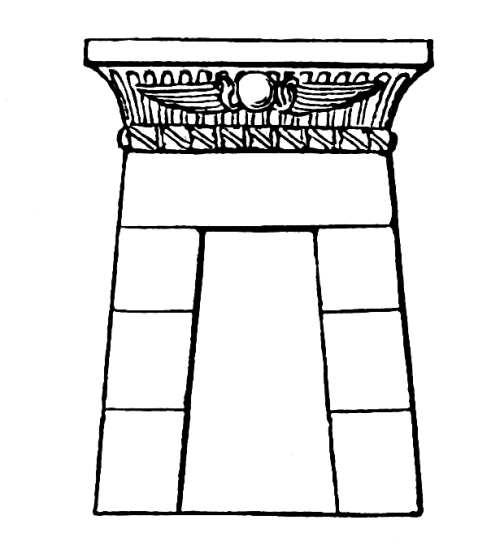
A pylon or doorway of a house or temple.
The essentials of a tomb, for such as could afford the expense, were, a deep quadrangular well in the rock; in the side of this well was a smaller cavity for the deposit of the mummy, or of the mummy-case; after which, the entrance of the cavity, or grave, was carefully walled up; next followed a chamber in which mourners and friends could assemble; and after that a portal, or exterior entrance, by which admission might be obtained. It is easy to understand how this simple design may be amplified until an entire rock of considerable magnitude has been hollowed out into numerous chambers; how these chambers may be ornamented with columns and sculptures; how the portal may assume an architectural form, and become a pylon, and the front of the rock be carved into columns and statues of imposing grandeur and beauty. Indeed, there would seem—as in fact is the case—no bounds to the intricacy and extent of the sanctuary and its chambers, the elegance and decoration of the appurtenant halls, and the magnificence and grandeur of the pylonic front. We should be pleased to imagine that the first efforts of man practised on the rocks, and thence transferred to the plain, were the early origin of Egyptian architecture, were we not aware of the fact, that the work of the mason makes its appearance seemingly contemporaneously with that of the wonderful excavations, of which so many examples are to be met with on the banks of the Nile.
Arrived at Thebes, we find the rock and tomb architecture especially illustrated on the western bank of the Nile; while the masonic element appears in all its grandeur on the eastern bank, in the temples of Karnak and Luxor, magnificent in the midst of overwhelming ruin. At Karnak, the foundation of the principal temple is a mile and a-half in circuit: it was founded by Usertesen, of the twelfth dynasty, and has been enlarged by successive additions of courts and halls, by Thothmes I. and his family, by Seti I. and Rameses II. and their family, and subsequently by a long series of kings, ending with Alexander the Greek.
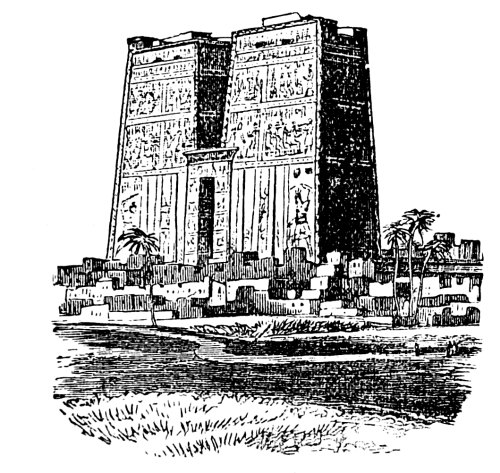
The propylon, or tower-gate, of the temple of Edfoo, one of the most magnificent in Egypt. Its breadth is 250 feet, and height 115. The temple itself, which is one of the most perfect specimens of Egyptian temple-architecture, was founded by Ptolemy Philopater, and the propylon was erected by Ptolemy Dyonysus. The entire structure is Ptolemaic, and it is ornamented on every side with paintings and sculptures. The small buildings at its base are the houses of the village.
One of the most interesting features of these magnificent temples is the doorway, or pylon, which, from the simplest form, ornamented in the simplest manner, and serving as the humble entrance of the cavern in the rock, has become developed into an architectural structure of surpassing grandeur and importance. When it stands independently, in advance of the proper entrance of the temple, it is termed propylon; and the propylon is often a massive structure, which resembles a tower or a fortress rather than a simple gate or portal. It consists usually of a thick wall, pyramidal in its figure, of considerable height, and terminated above by a broad cornice ornamented over the portal with the winged orb, the type of the Eternal and of the sun; the centre of the wall being perforated by the doorway, or entrance. The propylon is generally furnished with two flag-staves fixed to its front, and sometimes divides at the top into a pair of towers.[28] As the propylon is the representative of the ornamented entrance of the temple, the fore-gate, or fore-tower, it is a necessary appurtenance to the temple, and forms a picturesque object when seen from a distance; whilst its walls are made subservient to the purposes of painting and sculpture, destined to illustrate the history of its founder. The propylon of the most modern portion of the temple at Karnak is 140 feet high, 370 feet in breadth, and 50 feet in thickness; it is approached by an avenue of ram-headed sphynxes, 200 feet long, and the sides of the doorway were formerly ornamented with two granite statues, which are now in a state of ruin.
The peculiar characteristics of ancient Egyptian architecture are, its obelisks, its pylons or propylons, its colossal statues, and its superb columns. At the entrance of the temple at Karnak, leading into the Hall of Rameses II., we have the colossal sphynxes and statues and propylon, and passing through the latter we enter a spacious hall decorated with superb columns. At the end of this hall we approach another propylon, its doorway supported on either side by a statue of Rameses III.; and this gives entrance to the great Hall of Seti I. and Amenophis III., enriched with 134 columns, and said to be the largest and most magnificent of ancient Egyptian monuments. Beyond the great hall are a third and a fourth propylon, and between them an obelisk, one of a pair erected by Thothmes I. The obelisk is seventy-five feet high, and is covered on one face with hieroglyphs descriptive of its founder, while the opposite face is occupied with sculptured writing of Rameses II. For the second time we are made aware of this remarkable combination—shall we call it appropriation?—by Rameses. The brother-obelisk has fallen, and is broken into fragments.
Through the entrance of the fourth propylon we are admitted into a hall ornamented with columns whose capitals represent the head of Osiris. This is the Hall of Thothmes I.; and by the side of its doorway stands another obelisk, 92 feet in height, and 8 feet square at the base. There were originally two of these splendid obelisks; but its consort is fallen, and has been dashed into bits. These are the obelisks that bear the legend on their base of having been hewn from the rock, and erected in the short space of seven months; of having been capped with gold taken from the enemies of the country, and of being emblazoned with gold-leaf from bottom to top: they were set up by Hatasou, daughter of Thothmes I., in honour of her father. Hatasou was her father’s favourite; he, no doubt, discovered in her, indications of talent fitting her for the throne, and he appointed her his successor. In this capacity she became the guardian of her brother, Thothmes II., who died at an early age; and, subsequently, of the distinguished potentate, her brother, Thothmes III., who was not admitted to the throne for fifteen years after the death of his brother. Many grand works in architecture owe their origin to Queen Hatasou, and to these her cartouche was affixed; but, in later times, she was treated as an usurper; her name was erased from the monuments, and that of her brother substituted in its place.
Beyond the Hall of Osiris we reach the original temple and sanctuary containing the tomb and funereal chambers founded by Usertesen; and further on still, and forming the end of the pile, a temple erected by Thothmes III. Here, therefore, we observe a striking illustration of the combination of many potentates in the construction of these wonderful examples of architectural skill. The first stone of this temple was laid, probably, 3064 b.c., and the building was scarcely completed in the year 1288 b.c.; a period embracing 1,776, or nearly 2,000 years, being devoted to its construction.
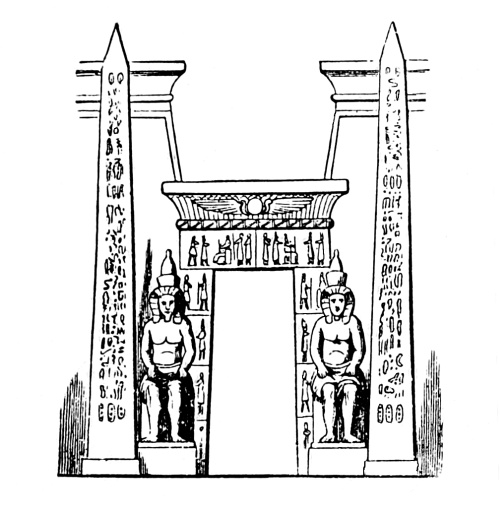
Plan of ornamentation of the entrance of an Egyptian temple—e.g., that of Luxor. In front and on either side of the pylon are the obelisks. Nearer the jambs of the pylon are two colossal sitting statues of Rameses II., wearing the double crown of Egypt; then follows the pylon itself, with its two majestic pyramidal towers. The pylon is surmounted with an over-hanging cornice, on which is carved the winged orb, emblem of the Eternal and of the sun; while two crowned asps, one on each side of the disk, imply dominion over the north and the south, as well as the east and the west; consequently over the whole world.
In the neighbourhood of the great temple of Karnak are the ruins of a smaller temple appertaining to Amenophis III. “It was once adorned with elegant sculptures and two granite obelisks; but is now a confused heap of ruins, whose plan is with difficulty traced beneath its fallen walls.”[29] Of course, the obelisks are lost. The Temple of Luxor likewise owes its origin to Amenophis III.; and was extended, a century and a-half later, by Rameses II.; the latter monarch adding a magnificent hall, a propylon of vast dimensions, two colossal sitting statues of himself, a pair of beautiful obelisks, and an avenue of sphynxes nearly two miles in length, stretching away from Luxor to Karnak. Approaching the temple by the avenue of sphynxes, about 500 in number, we meet with the now solitary obelisk, its consort having been removed to Paris; next comes the majestic propylon, its entrance guarded by two helmeted colossal sitting statues of Rameses II., carved out of black granite, and half buried in the earth. Passing the portal, we enter the great Hall of Rameses, and, beyond that, reach the sanctuary of Amenophis. The obelisk bears the name of Rameses, and is remarkable for the beauty and depth of its carving—a circumstance which may possibly have influenced the French in their selection. Sir Gardner Wilkinson made a curious discovery with regard to the Paris obelisk, which he narrates as follows:—
“Being at Luxor when it was taken down, I observed beneath the lower end on which it stood the nomen and prenomen of Rameses II., and a slight fissure extending some distance up it; and what is very remarkable, the obelisk was cracked previous to its erection, and was secured by two wooden dove-tailed cramps. These, however, were destroyed by the moisture of the ground, in which the base had become accidentally buried.”
The hieroglyphs on its face, announce that “the lord of the world, guardian-sun of truth, approved of Phra; has built this edifice in honour of his father, Ammon-Ra, and has erected to him these two great obelisks of stone, in face of the House of Rameses, in the city of Ammon.”[30]
Besides the Luxor obelisks, numerous others are ascribed to Rameses II.—namely, the two small monoliths at Rome, one in the Piazza Rotunda in front of the Pantheon, the other at the Villa Mattei; as also the ten broken obelisks at San, on the field of Zoan: while two more bear the joint names of his father Seti and himself; for example, the beautiful column of the Piazza del Popolo, known as the Flaminian Obelisk, and that of the Trinita de Monti at Rome.
It is a curious fact in connexion with the history of obelisks, that two of the most stately—indeed, the next in height to that of St. John Lateran—should have been the work of a woman, Queen Hatasou, daughter of Thothmes I., and guardian for a while of Thothmes III. But when the reins of power fell into the hands of the latter, he seems to have treated his sister as an usurper, and to have obliterated her name from the monuments, while he substituted in its place the cartouche of his own; so that the work of Hatasou is usually ascribed to Thothmes III. We find a similar illustration in the relation between Rameses II. and his father, Seti I. Seti was distinguished in his early life as a warrior, but, unfortunately, was stricken with blindness; he thereupon resigned the throne to his son, and retired into solitude. By degrees he recovered his sight, and devoted the rest of his life to architecture and building. His cartouche is to be found amongst the magnificent ruins at Thebes; and he was the author of several obelisks: in the latter instance his name is associated with, and occasionally replaced by, that of his son. The son of the blind man, the great Sesostris, Rameses II., must be supposed to have encouraged this substitution, for he has obtained credit for much that was not really his own; and to such an extent has misconception been carried, that Rameses and Seti have been identified as one and the same person; while a younger son of Rameses, Menephtah, has been described as the son of the king who went blind. Another element of confusion is the Greek name—Sesostris, given to Rameses II. Rameses was celebrated as a victorious soldier; as also was his distinguished predecessor, Thothmes III. Sesostris is described by Herodotus as a great conqueror; and as this character applies equally to Thothmes and Rameses, these two kings, although 200 years apart in point of time, become awkwardly confounded with each other. It would be ungenerous to suppose that such a state of confusion was acceptable to Rameses and favoured his designs; or that it could have led him to adopt that association with the memory of Thothmes which is implied by the sculptures on the Thothmic obelisks: although it must be admitted that there certainly exist grounds for the suspicion. In this respect Rameses would almost seem to have been the victim of an idiosyncrasy. In fact, Rameses II. is accused of monopolising the reputation of all the great deeds enacted during more than 600 years, from the time of Thothmes II. to that of Shishonk, or, as he is named in the Bible, Shishak, the conqueror of Jerusalem.
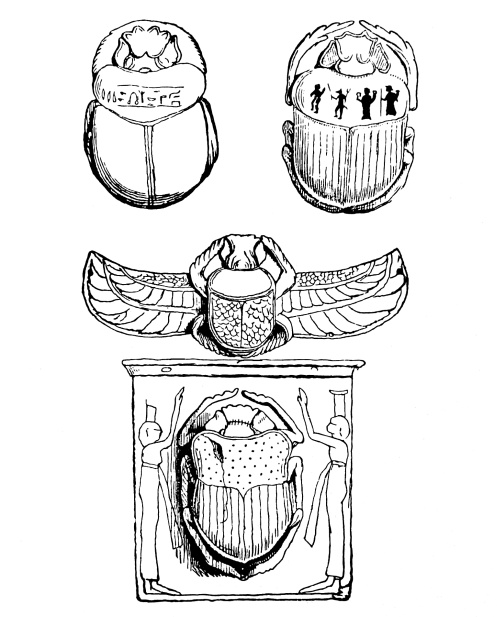
Sacred scarabæi, or beetles. On the back of the thorax of the upper pair are engraven mythological figures and hieroglyphics; the middle scarab is furnished with wings like the winged orb; the lower one has human supporters. The scarabæus is the emblem of future being, or future existence, and is often introduced into the body of the mummy to take the place of the heart, which is embalmed separately. The four figures probably represent the four keepers to whom the heart is confided, and the hieroglyphics are verses from the Book of the Dead.
We have compared the village of Luxor to a crop of mushrooms overgrowing a mountain of architectural ruins; and so it would seem to be: the mud huts of the Arabs and Copts at first sheltered themselves under the massive walls, then crept up to the cornices and roofs, and in time, like swallows’ nests, stuccoed every hollow and niche where sufficient space could be obtained for a resting-place. Only that they were forbidden, they would have occupied the whole of the temples and their halls, hypostyle and hypæthral, and have left nothing visible but themselves. The inhabitants of these huts are poor and ragged; but, according to Lady Duff Gordon (who lived amongst them for a long time, and between whom and them a warm attachment subsisted, fostered by her own humanity and kindness), they are remarkable for cleanliness, both in their persons and in their huts. Luxor, however, is the great emporium of antiques, and an active manufacture of scarabæi or sacred beetles, of statuettes, and even of tablets, is carried on by the Arab traders. “It is the centre,” says M. Mariette, “of a commerce more or less legal, inasmuch as the rummaging of tombs is now prohibited by law. Nevertheless, it requires much judgment, and often that of the expert, to distinguish with certainty between the genuine and the fictitious.” Miss Edwards relates that she was once accidentally ushered into the workshop of a dealer, where she saw tools and appliances in number for the fabrication of these objects, so eagerly sought after by the traveller. On the arrival of the proprietor she was speedily shown out, but overheard the scoldings which were administered to the unfortunate help who had allowed her to enter. She illustrates the simplicity of these people by the following anecdote:—One day, being more than usually pestered by an Arab trader to buy his genuine antiques, she sharply replied, “I don’t like them: I prefer the modern ones.” “Bisallah!” exclaimed the pedlar, “then you will like these; for they were all manufactured by myself.”—“As for genuine scarabs of the highest antiquity,” says Miss Edwards, “they are turned out by the gross every season. Engraved, glazed, and administered to the turkeys in the form of boluses, they acquire, by the simple process of digestion, a degree of venerableness that is really charming.”
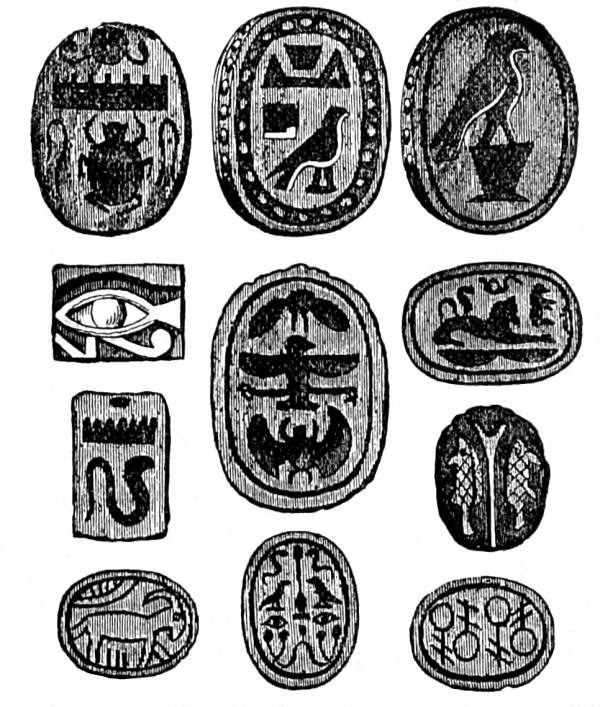
Under-surface of sacred scarabæi, engraven with hieroglyphs.
Apropos of scarabs, the toleration by Egyptians of all living creatures, from the crocodile to the fly, exhibits, in a high degree, the gentleness and amiability of character of the people. It was not always love—often it was superstition, or fear, that made them so lenient; but, nevertheless, we cannot fail to perceive, in their treatment of animals, a recognition of the rights of all created beings, as well as of themselves. Lady Duff Gordon looked warily around her, lest there should be witnesses, when her prejudices led her to kill a serpent that had intruded itself into her apartment; and she was unable to induce the Arab mothers to kill the gorged flies which hung from the inflamed eyelids of their children afflicted with ophthalmia. The Fellaheen look doubtfully at the sportsman as he fills his bag with the superfluous pigeons, although to themselves they are almost a scourge. Different parts of Egypt preferred different animals, and held them sacred; so that we find a Leontopolis, or city of lions; a Lycopolis, or city of the wolf; a Crocodilopolis, or city of the crocodile; a Bubastis, where the cat was held in veneration; and so forth.
But what shall we say of the venerable scarab, the sacred scarabæus. Those who are sufficiently acquainted with the natural history of certain beetles, are aware that they propel, with their hind-legs, objects of domestic use which they are desirous of storing away in their caves. Now, on the banks of the Nile, the object of greatest importance and anxiety to the scarab is its egg. She lays it near the stream; and, to protect it from injury, she plasters it over with mud, enclosing it like a kernel in its shell; and, instinctively mindful of the rise of the Nile, which would wash it away, she sets herself diligently to work to roll it upward from the river’s brink. It has to be propelled often to a considerable distance: she must drive it across the arable belt; for the sepulchre of the scarab, like that of the Egyptian, is the desert; and the male oftentimes helps her in her labour. Arrived at the sandy border of the desert, they dig their well; the precious mummy is deposited therein, to await the return of the spirit of life, and, at the appointed hour, to rise from the tomb into renewed existence. Does not the Egyptian see, in the scarab, the pioneer of his own religious belief?—and hence is led to regard it as the emblem of the divine spirit—the future “to be,” or “to transform.” Too frequently this labour of love, on the part of the scarab, concludes in sacrifice: the exhausted labourer sinks wearily by the side of the finished tomb, and dies.
Another pleasant sail of 133 miles carries us from Luxor to Syené, or As-souan (Coptic, souan, the opening), Egypt’s extremest boundary, where Juvenal pined in exile, where the first cataracts burst through the gates of Egypt, and where those grand quarries are stationed which have supplied the whole of the roseate granite obelisks of Egypt. We have already had occasion to mention the existence, in these quarries, of an unfinished obelisk not yet reft from the parent rock, but bearing the traces of the artificers’ hands, as though they had unexpectedly been summoned from their work. The dimensions of the Syené obelisk have been variously stated: for example, 100 feet by 11 feet 2 inches; and 95 feet by 11 feet: and a flaw was discovered in the shaft, which has suggested an excuse for its abandonment; while others are of opinion that the flaw is an accident of subsequent occurrence.
The excellence of the quality of the granite of Syené, and its property of splitting under the application of suitable force, permitted the separation from the native rock of a single piece of sixty, seventy, and sometimes more than a hundred feet in length. The unfinished obelisk exhibits the contrivance by which these immense stones were severed from the solid rock. In the course of the line which marks the boundary of the obelisk, is a sharply cut groove; and all along this groove, at short intervals, are holes which are intended for the reception of wedges or plugs of dry wood; when the wedges were driven firmly into the holes, the groove was filled with water; the dry wedges gradually imbibed the water and swelled, and the force created by their swelling along a line of considerable length, was sufficient to crack the granite throughout the whole extent of the groove. We are but too familiar with this force in the instance of water congealed into ice; a small fissure or opening of any kind becomes filled with water in the winter-time; the water freezes; frozen water expands, and under the force of that expansion the fissure is doubled in extent. It is this process which is so destructive to the face of buildings constructed of laminated stone; it is this which produces the slide of mountains and the fall of cliffs; and the same force the agriculturist utilises by ploughing, for the purpose of breaking up the clods of his land and pulverising the soil. It has been supposed that the Egyptians sometimes had recourse to another method, which is thus described by our old friend, Charles Knight, in the “Pictorial Gallery of Arts.”
“One of the modes in which large blocks of granite may be severed from a rock, is exemplified by what takes place in some parts of India at the present day. The quarryman, having found a portion of the rock sufficiently extensive, and situated near the edge of the part already quarried, lays bare the upper surface, and marks on it a line in the direction of the intended separation, along which a groove is cut with a chisel about a couple of inches in depth. Above this groove a narrow line of fire is kindled, and maintained till the rock below is thoroughly heated; immediately on which a number of men and women, each provided with a vessel of cold water, suddenly sweep off the ashes, and pour the water into the heated groove, which causes the rock to split with a clear fracture. Blocks of granite eighty feet in length are severed by these means.”[31]
From Syené by the cataract or by the road, a short journey of five miles brings us to the lovely island of Philæ reposing in the midst of the placid stream of the Nile, in the golden land of Nubia.[32] “The approach to the island by water is very striking. The stream winds in and out among gigantic black rocks of the most fantastic form and shape, and then unexpectedly, after a sharp turn or two, Philæ comes suddenly in sight. ‘Beautiful’ is the epithet commonly applied to this spot, justly considered to present the finest bit of scenery on the Nile; but the beauty, or rather grandeur, is more in the framework of the picture than in the picture itself. The view from the top of the propylon tower at Philæ, of all beyond the island, is far finer than the view of Philæ itself from any point.”[33] Philæ is outside the natural boundary and proper frontier of Egypt;[34] and although enriched with a temple dedicated to Isis, its ruins date back no further than the last of the Pharaohs. The Temple of Isis was founded by Ptolemy Philadelphus, and bears the cartouche of Cleopatra; whilst its completion is due to the Roman emperors. Here also may be seen an elegant and picturesque hypæthral, or roofless temple, open, as were many of the temples of Egypt, to the blue vault of the firmament. This temple is called “Pharaoh’s bed;” but appears to have been the work of the Ptolemies and of the Cæsars.
At the landing-place in front of the chief temple at Philæ, a broad flight of steps, leading upwards from the river’s edge, is crowned at the summit by a solitary obelisk, one alone remaining; next follows an avenue of Isis-headed columns, and then the majestic propylon of the temple. The obelisk is of fine sandstone, without sculpture, broken at the summit, and about thirty feet in height. At no great distance is the pedestal, cupped at the top, which formerly supported its companion.
Another obelisk wrought out of red granite is now at Kingston-Lacy, in Dorsetshire, and was brought to England by Mr. William Bankes. It is said to have been carved with the cartouche of Cleopatra, made famous from its furnishing Champollion with two important letters of the hieroglyphic alphabet—namely, K and T—after he had previously gained possession, from the cartouche of Ptolemy, of the five letters P T L M S. These obelisks are not Pharaonic, but were probably erected by Ptolemy Philadelphus, or by one of his successors. We presume that this latter is the obelisk referred to by Sharpe in the following quotation:—
“We possess a curious inscription upon an obelisk that once stood in the island of Philæ, recording, as one of the grievances that the villagers smarted under, the necessity of finding supplies for the troops on their marches, and also for all the government messengers and public servants, or those who claimed to travel as such. The cost of this grievance was probably greater at Philæ than in other places, because the traveller was there stopped in his voyage by the cataracts on the Nile, and he had to be supplied with labourers to carry his luggage where the navigation was interrupted. Accordingly the priests at Philæ petitioned the king that their temple might be relieved from this heavy and vexatious charge, which they said lessened their power of rightly performing their appointed sacrifices; and they further begged to be allowed to set up a monument to record the grant which they hoped for. Euergetes granted the priest’s prayer, and accordingly set up a small obelisk; and the petition and the king’s answer were carved on the base.”
Mr. Walter Ralph Bankes, of Kingston-Lacy Hall, Wimborne, Dorsetshire, has very kindly furnished us with the following information with regard to the Philæ obelisk, which was brought to England by his relative, Mr. William Bankes:—“The height of the three plinths in one block, on which the pedestal rests, is 2 feet 2 inches; that of the lower member of the pedestal, 3 feet 4 inches; and of the upper member, 2 feet 5 inches; the whole pedestal being one block: the height of the shaft, a monolith, 22 feet 1½ inch; making the entire monument 30 feet 8½ inches. The material of the whole is red Egyptian granite.
“On the foot of the obelisk is inscribed:—‘The granite used in the reparation of this monument was brought from the ruins of Leptis Magna in Africa, and was given for that purpose by His Majesty King George IV.’
“William John Bankes, Esq., M.P., eldest son of Henry Bankes, Esq., M.P., caused this obelisk, and the pedestal from which it had fallen, to be removed, under the direction of G. Belzoni, in 1819, from the Island of Philæ, beyond the first cataract; and brought this platform from the ruins of Hierosyesimnon in Nubia.
“The inscription on this obelisk and pedestal records their dedication to King Ptolemy Euergetes II., and two Cleopatras his queens, who authorised the priests of Isis, in the Isle of Philæ, to erect them about 150 years b.c., as a perpetual memorial of exemption from taxation.
“This spot was chosen, and the first stone of the foundation laid by Arthur, Duke of Wellington, August 17, 1827.”
The following is a translation of the three Greek inscriptions on the pedestal of the Egyptian obelisk.
The first two are painted in red letters upon the surface; the lowest is cut into the stone.
Upper Inscription ... “of the gods Euergetes ... gods Epiphanes ... of the gods Eupator, and of the god Philometor, and of the gods Euergetes, greeting. We have submitted to you the copy of the letter written to Lochus, our cousin and general, and we permit to you the setting up of the monument which you apply for ... Pacon 22.”
Second Inscription.—“King Ptolemy, and Queen Cleopatra the sister, and Queen Cleopatra the wife; to Lochus their brother, greeting ... to us ... from the ... a copy ... you shall make ... not to trouble them”....
Third Inscription.—“To King Ptolemy, and Queen Cleopatra the sister, and Queen Cleopatra the wife, beneficent deities; the priests of the great goddess Isis in Abatus and Philæ, greeting. Whereas those frequenting Philæ as generals and prefects and governors of Thebes, and royal scribes, and prefects of the frontier guard, and all other functionaries and constituted authorities, and the rest who are in office, compel us to make contributions to them against our will; and out of this it results that the Temple is deteriorated, and that we are in danger of not having what is appointed for the sacrifices and libations to be made for you and your children.
“We request of you, great deities as you are, if it shall seem good, to order Noumenius, your cousin and secretary for correspondence, to write to Lochus, your cousin and general of the Thebaid, not to trouble us in these things, nor to suffer any other to do the same, and to give us the necessary decrees to that effect; and in them to permit us to set up a monument, on which we may inscribe your kindness to us upon these points, that your favour may be perpetuated upon it to all time. When this shall be done, we and the Temple of Isis shall hold ourselves obliged. Fare ye well.”
It is worthy of remark, that the Egyptian religion, intended to be abolished by Theodosius in his sweeping edict of 381 a.d.,[35] still existed at Philæ seventy years later—namely, in 453, as is proved by the sculptures on the walls of the temple. And Philæ further claims the honour of being the resting-place of a portion of the body of Osiris, to whom a monolithic shrine, now standing in the sanctuary, is dedicated. Osiris, it will be remembered, was slain by Typhon, or Set, who cut his body into pieces, and dispersed the fragments over the country; so that Philæ is not alone in the possession of so sacred a relic: although Isis, the wife of Osiris, presumedly gathered all the pieces together, when they became united, and Osiris was restored to life. Horus, the son of Osiris, was his father’s avenger, and, in his turn, destroyed Typhon. This fable bears several allegorical readings: for example—Osiris, as the setting sun, sinks into the regions of Set, or Saturn, and becomes king of Hades; Isis, or the moon, comes in search of her lost husband; but the sun rises again from the shades of Hades, as Horus, and dispels the darkness of Saturn, and the deadly influences of Typhon.[36] This is, perhaps, more obvious if we join with the Greeks in calling Horus, Phœbus. Osiris, Isis, Horus, are one form of the Egyptian trinity, in which the humble worshipper of the ancient faith still believes. The trinity was the creed of the earliest family of human beings; and so was the death of one member of that trinity, his descent into Hades, and his subsequent resurrection; with the consequent immortality of the soul. This is all pourtrayed in the Egyptian Triad. Moreover, the name of Osiris among the Egyptians was an unspoken word; it was a holy secret, breathed with extremest caution by the priests themselves. Even Herodotus mentions the word with reluctance; while the most solemn of all adjurations was the name of “him who sleeps in Philæ.” Here, then, was a secret, a holy secret, which has descended to Freemasons, and they have since held it, and must ever continue to hold it, sacred.
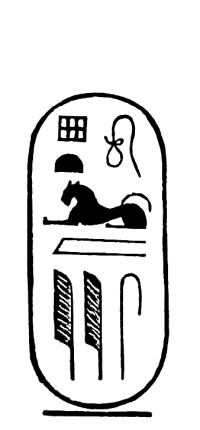
Cartouche of Ptolemy, or Ptolemais.—The hieroglyphs composing the name are—a square cross-barred, which represents P; a hemisphere, T; a knotted ribbon, O or U; a lion, L; an open quadrangle, M; two leaves of a plant, I or AI; the back of a chair, S; making together, PTOLMAIS; the vowel e being lost.
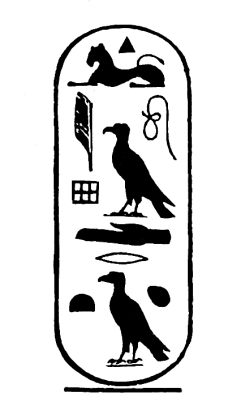
Cartouche of Cleopatra.—The hieroglyphs are—an angle, Q or C; lion, L; leaf, A short, for E; knot, O or U; square cross-barred, P; eagle, A; hand, T; mouth, R; eagle, A; then follow an egg; and a hemisphere t, which indicate sex, and signify daughter. The whole together making CLEOPATRA, a daughter.
The decipherment of Egyptian hieroglyphs was a curious accident, and, at the same time, an important step in the science of Egyptology. The French, in the year 1799, while digging the foundation of a fortress at Rosetta, exhumed a slab of black stone—a precious relic, as it proved to be, now carefully preserved in the British Museum.[37] On this stone was carved an inscription in three languages:—Hieroglyphic, the sacred tongue of Egypt; Demotic, the common language; and Greek. The inscription itself is a decree of the priests in honour of Ptolemy V., Epiphanes. Twenty years elapsed before the value of this writing was realised, although the Greek inscription had not failed to inform its readers that its two companions were translations of itself. The inclusion of royal names and royal titles within an oval had been made known by Zoëga some years before; and, comparing the Greek with the hieratic characters, the signs which indicated the name of Ptolemy were next made out. But it did not suffice to identify the emblazonment of Ptolemy alone; it needed the genius of Champollion to discover that the signs represent the letters of the alphabet. The word Ptolemy had supplied him with certain fixed signs, when a happy chance presented him with the cartouche of Cleopatra as certified by a Greek inscription on the base of an obelisk from Philæ. Comparing the signs of the two ovals, he was put in possession of three consonants and two vowels, which were identical in both, and corresponded as to position in the construction of the words. The three consonants were P T L, and the vowels E and O. Further research supplied him with the ovals of Berenice, Alexander, Cæsar, Tiberius, Trajan, and Hadrian; which together made up a complete alphabet. He was now in a position to read names in Greek when expressed by hieroglyphic signs. The next step was to convert the signs of the hieroglyphic text into words; and these he found to be Coptic, the national language of Egypt. All this seems to be simple enough when it is known; but Champollion had yet to discover that some of the signs were simply alphabetical, others syllabic, and others again symbolic; moreover, that the three kinds of signs were intermingled, without order, in accordance with the taste of the writer; and that the words were one while abundantly, and another while sparingly, interspersed with symbols. Here the funereal hymns of the Ritual, or Book of the Dead, so often repeated in the papyri, came to his help; for sometimes, in these writings, the words were expressed in symbols, and sometimes in alphabetical signs: the latter disclosed the secret of the former, and so the grammar of hieroglyphography came to be conclusively established. Shall we not, then, in admiration of their fruitful labours, invoke the favour of the Horus, the powerful, the sanctified of truth and wisdom, on these our Egyptographical pioneers, sons of the sun, lords of the diadems, beloved of science, children of genius and industry, establishers of alphabets—the de Sacy, Akerblad, Young, Champollion the resplendent, Lepsius, Hinckes, Brughsch, Saulcy, de Rougé, Birch, the Tum of the western hemisphere, approved of the learned, Bonomi, Tomlinson, and all the rest of the scholarly host, beloved of the birds, which follow in their wake like the stars of the firmament. To all and every, we, lord of the panegyrics, piercer of the sheep, convey our warmest congratulations, veneration, and respect, and wish for them a strong and pure life.
As we float gently away adown the sleepy stream of the Nile, luxuriating in the dreamy ease of Dahabeeyah life, to our far-away northern and western home, let us try to summarise the results of our exploration into the history of Our Obelisk and its stately family.
I.—Usertesen I., a Pharaoh of the twelfth dynasty, corresponding with the year 3064 b.c., supplies us with the earliest example of an obelisk, in the venerable monolith still standing at Heliopolis. Its consort is lost, but the pedestal has been recently cleared of rubbish to prove its former existence. The Heliopolis or Matareeah obelisk was originally capped with metal, which has left its mark on the pyramidion; and its shaft is engraven with a solitary column of boldly carved hieroglyphs.
Another quadrangular shaft of syenitic granite, covered with hieroglyphs, and also the work of Usertesen, exists at Biggig in the Fyoom, on the western bank of the Nile, but broken into two pieces. The title, however, of this monument to the rank of an obelisk is a matter of dispute; and for several reasons: first, that it is wanting in the proper proportions of the typical obelisk; secondly, that it is rounded, instead of being pointed, at the apex, and is fashioned in a manner to receive an ornamental finial; and thirdly, and most cogently, that obelisks being consecrated to the rising sun, appertain solely to the eastern bank of the river, whereas this has been set up on the western bank; on which bank it was believed, until quite recently, that no other trace of an obelisk had ever yet been found.
Putting aside the poetical superstition affecting the eastern and western banks of the Nile, and the respective claims of Ra and Tum, the rising and the setting sun, a monolithic shaft, of which the two fragments together measure nearly forty-three feet in length, without accounting for a portion which may have been lost, might, without extreme license, be regarded as an obelisk.[38] It is true that the apex is rounded; but this may have been the consequence of accident; or perchance, being the first, or nearly the first, obelisk hewn from the granite rock, it may simply prove evidence of the “’prentice hand,” and be merely a ruder example of those more elegant, pointed shafts, which were afterwards to follow. It had a groove on its summit; but this was doubtless to bear a cap, like its big brother at Matereeah; and who knows but that this cap may have completed the point of the rounded head, and, to outward inspection, have made the shaft an obelisk complete. Another allegation against the Biggig monolith is, that it is broader on one side than on the other; but so are the majority of obelisks, as is evinced by our own Cleopatra’s Needle; although we are quite willing to confess that the deviation in the candidate before us is more considerable than usual; its mean breadth on two of its sides being 5 feet 2 inches, while that of the other two is 4 feet: its greatest diameter at the base being 6 feet 9½ inches. Under these circumstances it is, that while, by Sir Gardner Wilkinson and M. Mariette, the Biggig monolith is accepted as an obelisk, its privilege to that rank is rejected by Mr. Bonomi.
In a previous page (99) we have alluded to the Temple of Hatasou, at Thebes, on the western bank of the Nile, and consequently its sepulchral side, in the front of which Mariette notes the pedestals of a pair of obelisks. Does not this discovery invalidate, in some degree at least, the theological hypothesis of the rising and the setting sun; the shore of the living, and the shore of the dead? We must confess to considerable hesitation in accepting the sun-theory as an explanation of the site of the obelisks. Nor do we perceive any more reason to assume that a superstitious speculation governed the establishment of the abodes of the living, and of the tombs of the dead, than that the selection was one of simple convenience. The Egyptians are an Asiatic people, and therefore we may presume that they were deeply imbued with theological mysticism from their earliest origin; but, looking upon them in the light of wanderers in search of a home, that word home, and its necessities, we should expect to be a stronger and more rational power to govern their choice of residence than the theosophy of their priests. The first monarchical cities of Egypt, Thinis and Memphis, were founded on the western bank of the Nile; and here likewise sprung up a vast city of tombs. At this early period, the obelisk, the herald of triumph, had not been invented;[39] it was the manifestation of a more advanced period of social progress, when Thebes had asserted her claim of being the head[40] place; and, subsequently, at a time when the western shore was deserted by ancient temple-builders, the obelisks followed in the train of the architectural developments of the Theban kings.
The earliest dynasties were too much occupied with cities, and pyramids, and tombs, to care much for temples and decorative architecture; but Usertesen, whilst he erected temples and obelisks to the sun, likewise excavated tombs on the eastern shore of the Nile; and, as if to exhibit his ignorance of hypothetical sun-worship, planted an obeliskoid monument on the western shore, in the delicious oasis of Fyoom.
Next in the historical series of events followed the five hundred years of stagnation caused by the shepherd invaders; after which, obelisks, delayed for a time, again sprung into existence with the family of their conqueror Amosis, the Amenophs, and the Thothmeses; and once more a contradiction to the sun-theory is presented, by not the least distinguished of the last brilliant family, the great Queen Hatasou, or Amun-noohet.
Furthermore, the legend recorded on the fragments of the Biggig obelisk corresponds precisely with that found on the other obelisks. Upon the upper part of this broken monolith, Sir Gardner Wilkinson informs us that there are five compartments, one above the other, in which are represented two figures of the Pharaoh Usertesen making offerings to two deities; below these are hieroglyphs; and on either side of the shaft is a column of hieroglyphs, including a cartouche of the king, on one side describing him as beloved of Ptah, and on the other as beloved of Mandoo.
Mr. Bonomi remarks, that at the time when obelisks first came into use in Egypt, the patriarchs of the Jews were in the habit of setting up large monoliths to perpetuate the memory of great events, and to dedicate the spot to the Almighty. But these stones were taken as they were found, and were unfashioned by the hand of the sculptor; neither were they engraven. The Egyptians likewise set up tables, or tablets, on which legends were engraved; or they carved inscriptions on the rocks. But the Biggig obelisk differs materially from these, as it does likewise from the remarkable, so-called obelisk of Axum. This latter is a very striking and extraordinary monument, and merits exclusion, both on account of its want of proportion, and likewise the absence of written inscriptions. At Axum, the ancient capital of Abyssinia, Bruce, the celebrated African traveller, observes:—“In one square are forty obelisks, none of which have any hieroglyphics. There is one, larger than the rest, still standing; but there are two, still larger than this, fallen. They are all of one piece of granite, and, on the top of that which is standing, there is a patera (vase), exceedingly well carved in the Greek taste. Below, there is the door-bolt and lock, which Poncet speaks of, carved on the obelisk, as if to represent an entrance through it to some building behind. The lock and bolt are precisely the same as those used at this day in Egypt and Palestine.”
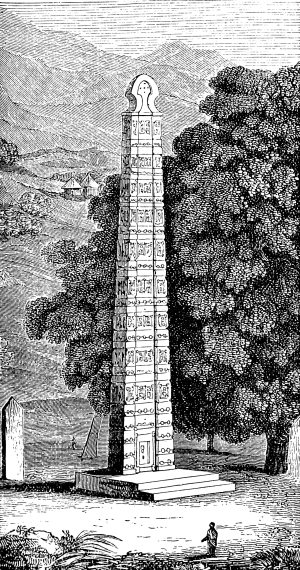
The progress of Egyptological science appears, therefore, to demand that we should adopt the Biggig monolith as a genuine obelisk, however awkward it may be presumed to be in its proportions. It, no doubt, stood once in front of the entrance of a temple dedicated to Ptah, or Vulcan, like the temple of Memphis; and in its broken condition is still highly reverenced by the country-people, who “look on these fragments with the same superstitious feeling as on some stones at the temple of Panopolis, and other places; and the women recite the Fat’ha over them in the hope of a numerous offspring.”[41] That they have some ground for their credence may be gathered from the official legend engraved on the narrow sides, translated by the distinguished Egyptologist, M. Chabas:[42]—
North.—“The heaven, the kingly Horus, life of births, lord of the diadems, life of births, king of Upper and Lower Egypt, Ra-kheper-ka, beloved of Ptah of Res-sobt-ef (Ptah of the southern wall), the life of births, golden hawk, good god, master of domination.”
South.—“The heaven, the kingly Horus, life of births, lord of diadems, life of births, king of Upper and Lower Egypt, Ra-kheper-ka, beloved of Month, lord of Thebais, life of births, hawk of gold, good god, lord of the two lands,”....
So long as the Biggig monolith was the only known example of an obelisk on the western shore of the Nile, there were grounds for considering it as an interloper and an impostor; but at present, since the discovery of the pedestals of obelisks in western Thebes by M. Mariette, it may assert its claim to be admitted into the group of genuine obelisks.
II.—Thothmes I., of the eighteenth dynasty, which embraces the period between 1703 and 1462 b.c., stands next in age to Usertesen, although about 1,500 years must have elapsed between the dates of their respective works. The obelisk now standing in front of the propylon of the Osiris temple at Karnak, is the work of Thothmes I.; the companion obelisk lies broken by its side. The hieroglyphic exordium of Thothmes I. occupies the pyramidion and two of the faces of the obelisk; while the remaining faces have been appropriated by Rameses II. Two hundred and fifty years therefore must have intervened between the dates of the two writings.
III.—Hatasou, daughter of Thothmes I., erected two obelisks within the temple of Osiris at Karnak, to the honour of her father. Like the preceding, one has fallen to the ground, and one only remains. The standing obelisk is ninety-two feet high,[43] and is a beautiful work. It is upon the base of this pair of obelisks that we find the legend of their having been hewn from the rock, erected and finished in seven months. The pedestals of two other obelisks are mentioned by Mariette as standing in front of her temple at Deir-el-Bahari, on the western shore of the Nile, at Thebes; but the obelisks themselves are destroyed.
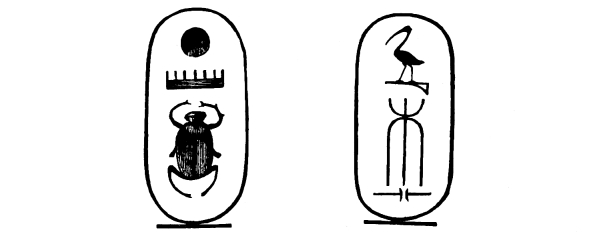
Cartouches of the Pharaoh, Thothmes III.; his prenomen or first or divine name, and his surname or family name; the former being represented by the three syllables; the suns disk, Ra; a turreted parallelogram, men; and the scarab, kheper; i.e., Ra-men-kheper. And the latter by the sacred Ibis, representing Thoth, the god of letters; and the emblem of birth, which stands for mes; making together Thothmes.
IV.—Thothmes III. follows next in succession with four obelisks, the four Needles; all erected at Heliopolis; the two beautiful obelisks termed Pharaoh’s Needles, and the pair at Alexandria called Cleopatra’s Needles. Pharaoh’s Needles were removed by the Emperor Constantine; one he conveyed to Constantinople, where it now stands;[44] and the other was sent to Rome by his son Constantius. The former records the conquest of Mesopotamia by Thothmes III.; while the latter is the celebrated obelisk of St. John Lateran: besides the cartouche of Thothmes III., it also bears in the lateral columns that of his grandson, Thothmes IV.; and of the pair it is said that, unlike the obelisks of Hatasou, they were thirty-six years in the artificers’ hands before they were completed. According to Mr. W. R. Cooper, the obelisk at Constantinople “was originally one of the splendours of Karnak.” It was broken on its journey to Byzantium; and judging from its present appearance, the upper part alone has been erected. An inscription formerly engraved on its pedestal in Greek and Latin, stated that thirty days were occupied in setting it up, and unpleasantly reminds us of “fire and sword:”—
“I was unwilling to obey imperial masters, but I was ordered to bear the palm after the destruction of tyrants. All things yield to Theodosius and his enduring offspring. Thus, I was conquered and subdued in thirty days, and elevated towards the sky in the prætorship of Proclus.”
Of Cleopatra’s Needles, one stands at Alexandria; whilst the other, which had fallen several centuries ago, and been buried in the earth, will, we hope, soon fill a site on the banks of the Thames, by virtue of its privilege of being the British obelisk.
Mr. Bonomi admits into his list of obelisks two small granite monoliths dedicated to Thothmes III., which stand before the Usertesen sanctuary at Karnak. “I put them down,” he says, in a communication with which he favoured us recently, “as obelisks—because they stand in front of a temple, but doubt their claim to be reckoned such, for they never had the pointed apex. On the north face of the square block are three figures of the Papyrus of Lower Egypt, and, on the south face, three of the Papyrus of Upper Egypt. On the east and west sides are figures of Thothmes embraced by one of the goddesses of Egypt, repeated two or three times. The figures are in the sculpture peculiar to Egypt,[45] and a little more than three feet high.” We entirely agree with Mr. Bonomi, that the monoliths in question, however interesting in other respects, do not come up to the standard of the typical obelisk; and, although occupying so distinguished a place of honour as the front of a sanctuary temple, we must refuse them admission into our present list.
V.—Amenophis II., another Pharaoh of the eighteenth dynasty, is the author of a small, but interesting obelisk, which was brought to England by the Duke of Northumberland (then Lord Prudhoe), in 1838, and now stands in the front hall of Syon House, at Isleworth. It is a monolith of syenite granite, 7 feet 6¾ inches in height, supported on a pedestal of 2 feet 8½ inches; making the total altitude of the monument 10 feet 3¼ inches. Its breadth at the base, on two of its faces, is 10⅞ inches, and that of the pyramidion 8½ inches; and, on the adjoining faces, 9⅞ inches, the base of the pyramidion being 8⅞ inches. It therefore happens that the base on two of the sides is only one inch broader than that of the pyramidion; whilst on the other sides the base exceeds that of the pyramidion nearly 2½ inches. The column is broken at the apex, and was found in one of the villages of the Thebaid. This obelisk was made the subject of an interesting paper, published in the “Transactions of the Royal Society of Literature” for 1843, by Mr. Joseph Bonomi, who observes, with regard to it, that it presents the peculiar feature of being inscribed only on one face. Its inscription reads as follows:—
On the apex, the god Chnoumis, ram-headed, is seated on a throne; Amenophis II. kneels before him, offering a pyramidal loaf of bread, and says:—“Khnoum, resident in the heart (or centre) of Phi (Elephantine) Ammenhetf (Amenophis II.), giver of life like the sun.”
On the shaft:—“The Harmachis, the living sun, the powerful bull, the very valiant king of the south and north, Aa-aa-cheferu (prenomen of Amenophis II.), son of the sun, Amenhetf, divine ruler of the Thebaid, has made his offering gift to his father Khnoum (Chnoumis); he has seen given to him two obelisks of the table of the sun (the altar of the sun), that he may make him (the king) a giver of life for ever.”
VI.—Amenophis III., also a Pharaoh of the eighteenth dynasty, and the Memnon of the Greeks, erected two obelisks in front of his temple at Karnak. The temple is now a mass of ruins, and the obelisks have utterly disappeared.
VII.—Seti I., or Osirei, a Pharaoh of the nineteenth dynasty, which ranges in date between 1462 and 1288 b.c., was the author of two, at least, of the obelisks ascribed to his son Rameses the Great. He is said to have been of Semitic origin, and descended from the Hyksos or shepherd kings, and was struck blind at an early period of his career; but having recovered his sight, he devoted himself, for the rest of his life, to the construction of temples and obelisks. Rameses, who delighted in “the bubble reputation,” even to his father’s loss, inserted his own heraldic bearings on some of Seti’s monuments—for example, the Flaminian obelisk, as shown by Tomlinson—and therefore a certain amount of confusion is imported into the differentiation of the works of the two Pharaohs, father and son; although the confusion is at once cleared up when the hieroglyphic writing is investigated. To Seti belong the beautiful Flaminian obelisk at the Porta del Popolo, which is regarded as the first ever removed from Egypt, and that of the Trinita de Monti at Rome.[46] On these his legend occupies the middle column of the shaft; whilst the titles and praises of Rameses are displayed in the side columns. The Flaminian obelisk was conveyed from Heliopolis to Rome by the Emperor Augustus, as a trophy of war, in the tenth year before the Christian era, and was set up in its present place by Pope Sixtus V., in the year 1590. We arrive thus at the number seven for the city of Heliopolis, or more probably eight; for, as we now know, obelisks were set up in pairs; and we have reason to regard a city adorned with so many of these emblems of the sun, as very truly the city of the sun. Heliopolis, however, did not possess the greatest number of obelisks, inasmuch as, through the munificence of Rameses II., there were ten or more in the ruined city of San.
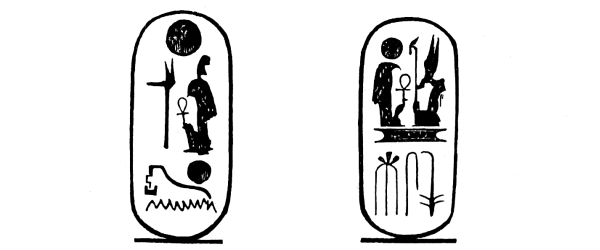
Ovals or Cartouches of Rameses the Great, prenomen and name; the former signifying Ra-ouser-ma-sotep-en-Ra; and the latter, Ra-mer-amen, child of the sun.
VIII.—Rameses II. is the most prolific in the production of obelisks of all the kings of Egypt. The Luxor obelisks owe their origin to him: one is still standing in front of the colossal statues of himself and the magnificent propylon of the great hall of the temple; while the other occupies an admirable site in the Place de la Concorde, at Paris.
Two obelisks, bearing his name, ornament the public places at Rome; one in front of the Pantheon, in the middle of a fountain; the other in the garden of the Villa Mattei, on the Cœlian Hill. The former was originally placed in the Circus Maximus, whence it was removed, by Pope Paul V., to the Piazza di S. Martino, and subsequently erected on its present site by Clement XI., in the year 1711; while that of the Villa Mattei, or Cœli Montana, was set up by Pope Sixtus V. in the year 1590. An unlucky incident happened in connection with the latter event; for as the obelisk was being lowered into its place, the architect inadvertently got his hand entangled between its base and the pedestal; and as there was no means of lifting the obelisk, it became necessary to cut off the imprisoned hand at the wrist.
In addition to these four, we must likewise give to Rameses II. the credit of the ten ruined obelisks at Tanis, the field of Zoan; making a total of fourteen. But although, in the gross amount, Rameses II. exceeds all other Pharaohs, he only equals Thothmes III. in the number of the standing ones. Four only of the Rameses obelisks are erect—namely, Luxor, Paris, Pantheon, and Villa Mattei; whilst Thothmes III. equally lays claim to four—Constantinople, St. John Lateran, and the two Cleopatra’s Needles.
IX.—Menephtah I., a son and successor of Rameses II., also of the nineteenth dynasty, is represented as the author of an obelisk which is placed before the front of St. Peter’s at Rome. It was brought from Heliopolis to Alexandria by Augustus Cæsar, and afterwards transported to Rome by the Emperor Caligula in the fortieth year of the first century of the Christian era, and marks the period when Peter was released from prison and made his entry into Rome (January 18th, 43 a.d.) The obelisk was erected by Pope Sixtus V., in the garden of the Vatican, in 1586; and is without inscription. It is of this obelisk that the anecdote is told of the almost failure of the operation of erection from the stretching of the ropes. Silence among the workmen had been enjoined under extreme penalties; but a sailor perceiving the difficulty and its cause, suddenly shouted, “Water the ropes.” Fontana, the architect, catching the practical force of the suggestion, acted upon it at once, and the danger which had been imminent was averted. Need we say that the sailor was not punished for his infraction of orders, but was handsomely rewarded.
X.—Psammeticus I., a Pharaoh of the twenty-sixth dynasty, corresponding with the year 665 b.c., is the author of an obelisk which was originally erected at Heliopolis, and was brought to Rome by Augustus Cæsar, thirty years before the birth of Christ. It was made to serve the purpose of a gnomon, or pointer, to a great sun-dial in front of the church of St. Lorenzo in Lucina; and was afterwards moved to the Monte Citorio by Pope Pius VI., in 1792. It was found broken into four pieces, and bears marks of extensive repairs.
XI.—Psammeticus II., likewise a Pharaoh of the twenty-sixth dynasty (588-567 b.c.), has his name inscribed on a small obelisk which was set up by Bernini on the back of a marble elephant in the Piazza della Minerva at Rome, by the command of Pope Alexander VII., in the year 1667. It was probably brought from Sais in the first instance, and was found amongst the ruins of the Temple of Isis and Serapis at Rome. An inscription on this monument reminds the reader, in allusion to the elephant, that a strong mind is needed for the maintenance and exercise of wisdom.
XII.—Nectanebo I., a Pharaoh of the thirtieth dynasty (378 b.c.), is represented by two small obelisks of black basalt, preserved in the British Museum. Dr. Birch, in a recent communication to us with regard to them, observes, that they were dedicated to the god Thoth, the Mercury of the Greeks, “by a king now recognised as Nekht-her-hebi, the Nectabes or Nekterhebes of the lists; some call him Nectanebo I. They came from Cairo, and formed part of the antiquities surrendered by the French in Egypt after their capitulation, and were presented by George III. about the year 1801.” Both have been broken into several pieces, and have lost their summit as well as their pyramidion; their present dimensions being about 8 feet in height, by 1 foot 6 inches on two of the sides, and an inch less on the other two. Bonomi and Cooper, however, attribute them to Amyrtæus, a king of the twenty-eighth dynasty. Mr. Cooper states that they bear the cartouche of Amyrtæus, and mentions, as a curious part of their history, that one “was first noticed by Pocock as forming part of a window-sill in the castle of Cairo; and the other, broken in two pieces, was discovered by Niebuhr, one fragment serving as the door-sill of a mosque in the castle of Cairo, while a second was the door-step of a house near Kantara-siedid.... The French army of occupation carried off these obelisks from Cairo to Alexandria, and they consequently fell into the hands of the English at the capitulation of that city in 1801.... The hieroglyphic inscription has only been partly translated; but the portion so deciphered reads:—‘Amyrtæus, the living, like Ra, beloved of Thoth, the great lord of Eshmunayn.’”
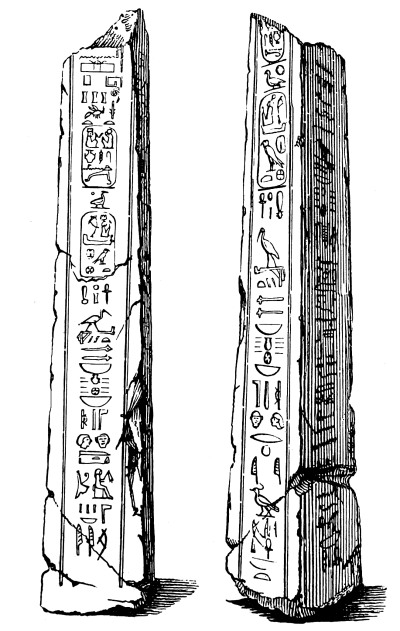
Obelisks in the British Museum.
XIII.—Nectanebo II., the last of the Pharaohs, of the thirtieth dynasty, or 378 b.c., is the author of an obelisk without hieroglyphic sculpture, which was set up at Alexandria by Ptolemy Philadelphus, in front of the tomb of his wife Arsinoë. It was subsequently conveyed to Rome, at the command of Augustus, by Maximus, prefect of Egypt, in the tenth year before Christ; and its pyramidion was cut off with the intention of supplying its place with a gilded one: this intention, however, has never been accomplished. It was originally one of the pair, both uninscribed, and both without pyramidion, which were set up before the mausoleum of Augustus in the Campus Martius, and was subsequently placed by Sixtus V. behind the church of St. Maria Maggiore, in 1587. The fellow-obelisk is that now standing in the Piazza Quirinale, on the Monte Cavallo.
Mr. W. R. Cooper remarks, with regard to these two obelisks, that according to tradition, they “were set up at Memphis by King Pepi Merira (Apappus of Eratosthenes), of the sixth dynasty, a monarch who is recorded on the hieroglyphic texts to have reigned for one hundred years, less one hour.” They were removed from Egypt to Rome by Claudius Cæsar, a.d. 57, and placed in front of the mausoleum of Augustus. Then sharing the universal fate of all the obelisks at the fall of Rome, they became buried in the earth, and when disinterred had lost the pyramidion, and were otherwise broken. The smaller of the two was dug out by Pius VI. so recently as 1786; “but it occupies, perhaps, a finer position than any of its companions in the city of Rome, except the obelisk of the Vatican, since the architect Antinori erected it on the place of the Monte Cavallo, between the two splendid bronze horses called Castor and Pollux, which once adorned the centre of the Baths of Constantine, and are now the glory of Rome.”
In the British Museum, Dr. Birch mentions the existence of a fragment which would appear to be part of an obelisk of Liliputian dimensions. And he further observes that several such small obelisks are known. Mr. Bonomi likewise includes in his list a small obelisk which formerly stood at Constantinople, and quotes from the work of Petrus Gyllus, or Pierre Gilles,[47] as follows:—
“It is very probable that Constantinople had more obelisks than one. When first I arrived at Constantinople I saw two of them: one in the Circus Maximus, another in the Imperial Precinct, standing on the north side of the first hill. This last was of a square figure, and was erected near the houses of the Grand Seignor’s Glaziers. A little time after I saw it lying prostrate without the Precinct, and found it to be thirty-five feet in length. Each of its sides, if I mistake not, was six feet broad; and the whole was eight yards in compass. It was purchased by Antonius Priolus, a nobleman of Venice, who sent it thither, and placed it in St. Stephen’s Market. The other is standing in the Hippodrome to this day.” But, according to Long, writes Mr. Cooper, “this obelisk was never removed, but is identical with one of red granite, which still stands in the Sultan’s gardens, on the most northern eminence there. From its dimensions, this obelisk is probably of the period of the middle empire;[48] but as a copy of its inscriptions has not yet reached Europe, or been elsewhere published, all speculation as to its original place of erection, or the monarch who erected it, would be useless.”
Mr. Cooper also includes, in the series of Pharaonic obelisks, a small monolith of sandstone, eight feet in length, which was found by Rüppel lying prostrate on the ground near the wells of Nahasb, in the deserts of Arabia Petræa. The inscriptions on the three sides exposed to the atmosphere are obliterated; but on the under-surface, the hieroglyphs, as far as he could examine them, appeared to be beautifully preserved. The monument was probably of Saitic origin.
Moreover, we must not fail to notice two obelisks, of large size, which were removed from Thebes by the conquering army of Assurbanipal in 664 b.c., and conveyed to Nineveh; where, as they have not since been found, it is to be presumed that they still lie buried in the ruins. “It is not stated from what temple these monuments were taken, and of course it is unknown now, by whom they were erected; but this was the first instance in which an Egyptian obelisk suffered transportation.”[49]
This concludes our survey of the Pharaonic obelisks; and next in order to these follow the obelisks of Philæ, of Ptolemaic origin; the obelisks constructed at the command of Roman emperors, and regarded by virtuosi as spurious; and other obelisks of obscure origin. The Philæ obelisks are three in number—the two of sandstone and uninscribed, which stood in front of the Temple of Isis, one of which is still erect, while the other is lost; and a very interesting obelisk of syenitic granite, which was found by Mr. William Bankes and Belzoni among the ruins at Philæ, and was brought to England by Mr. Bankes. This latter is known among Egyptologists as the Corfe Castle Obelisk, and the Soughton Hall Obelisk, although it has never possessed any other site than that on the lawn in front of Kingston-Lacy Hall, at Wimborne in Dorsetshire,[50] and would more correctly be described as the Bankes obelisk. The Bankes obelisk enjoys the distinction of bearing the cartouches of Ptolemy and Cleopatra, and was one—and a very important one—of the sources whence Champollion drew his interpretation of Egyptian hieroglyphs.
The obelisks constructed by order of the Roman emperors, include those of Domitian, Domitian and Titus, Hadrian, and a small obelisk “executed in Egypt by Santus Rufus ... in honour of one of the Roman emperors ... and afterwards sent to Rome.” This is termed the Albani Obelisk, and is now at Munich.[51]
Domitian’s obelisk, also styled the Pamphilian Obelisk, and the Obelisk of the Piazza Navona, in Rome, is erected on a base of rock, forty feet high, in the midst of a fountain, and is ornamented at the four corners with statues of river-gods. It is placed in front of the church of St. Agnes, and is supposed to occupy the spot where that saint suffered her martyrdom. The height of the obelisk is 54 feet 3 inches, and its breadth at the base 4 feet 5 inches. It was set up in its present place by Bernini, in 1651, at the command of Pope Innocent X.
Domitian and Titus are represented in cartouches on a small obelisk of red granite, a little more than nine feet high, which stands in the Cathedral Square of Benevento. It is carved with several columns of hieroglyphs, but is much mutilated. The inscription records the dedication of a temple to the goddess Isis by the two emperors.[52] Mr. Cooper, however, takes no notice of a shorter fragment of an obelisk at Benevento, which is set down by Bonomi in his list of erect obelisks.
Hadrian and Sabina are commemorated by an obelisk of red granite, thirty feet in height, which now stands on the Monte Pincio at Rome. It is one of a pair originally planted in front of a temple in the Egyptian city of Antinoopolis, a.d. 131; and records the sacrifice of Antinous, the celebrated favourite of Hadrian. A few years later it was removed to Rome, and erected on the Monte Pincio, where it shared the fate of the rest of the Roman obelisks, thrown down and buried; until, in 1822, it was recovered and set up by Pope Pius VII. “After the erection of this last obelisk,” says Mr. Cooper, “no more inscribed obelisks were set up, either in Egypt or in Rome. For this there was ample reason: the Egyptian language had been entirely supplanted by the Latin and the Greek; the significance of the characters was unknown; already Pliny had proved his entire ignorance of the script; and Pliny, it must be recollected, was the learned centre of all the science of his time.”
Among the obelisks of obscure origin, are a small sandstone monolith, without inscription, in the possession of the Duke of Northumberland, and preserved in the museum at Alnwick Castle; two small obelisks in the museum at Florence; and the obelisk of the city of Arles, on the Rhone.
The two obelisks in the Florentine Museum are only 5 feet 10 inches, and 6 feet high, but differ in breadth, and are the smallest of the obelisk family. They are fashioned of red granite, the pyramidion perfect; but being uninscribed, their authorship and origin are unknown.
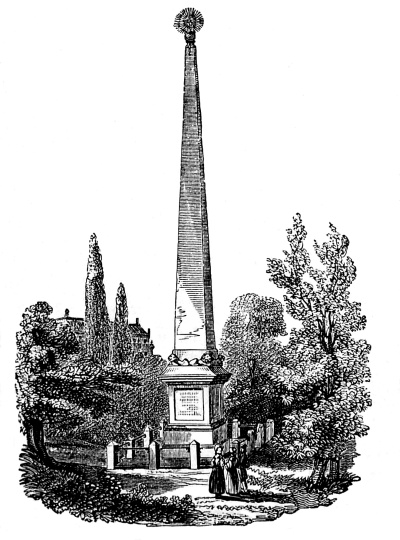
Obelisk at Arles.
The Arles obelisk, from its position in the city of Arles, on the banks of the Rhone, has suggested the idea that it might have been sent from Egypt to Arles by Constantine, at the time when he was projecting a second Constantinople on that spot; but this illusion is dissipated by the discovery that it is composed of granite of a grey colour, which is found in the neighbouring quarries of Mont Esterel, near Frejus. It is uninscribed, and therefore unable to tell the story of its life; is nearly 57 feet in height, by 7 feet 6 inches in greatest breadth, and “is probably of Roman workmanship.” Mr. Cooper remarks, that it must have been left for seventeen centuries on the ground where it was discovered; and, although royal directions were given for its disinterment about the year 1389, it was not until 1676 that it was erected in commemoration of Louis XIV. It is surmounted with a globe representing the earth, and above it a sun: while “beneath the inscription in honour of Louis XIV., is another referring to the late emperor, Napoleon III.”[53]
We have, therefore, brought under our notice a list of thirteen Egyptian Pharaohs (including one Queen), who have left behind them proofs of their taste in the construction of obelisks; namely:—
I. Usertesen I.; three, including the monolith at Biggig; one being lost, one broken, and one remaining entire at Heliopolis.
II. Thothmes I.; two, one broken, the other entire, and known as the small obelisk, at Karnak.
III. Hatasou, Queen; four, one broken, two lost, and one, the great obelisk, standing at Karnak.
IV. Thothmes III.; four, all standing, the four Needles; one each in Constantinople, Rome, Alexandria, and London.
V. Amenophis II.; one, the Alnwick obelisk, at Syon House, Isleworth.
VI. Amenophis III.; two, both broken and lost in the ruins of his temple at Karnak.
VII. Seti I., or Osirei, the blind king; two, both in Rome, the Flaminian and that of Trinita de Monti.
VIII. Rameses II.; fourteen, one each at Luxor and Paris; two in Rome, in front of the Pantheon and in the garden of the Villa Mattei; and ten lost at San, amid the ruins of the “field of Zoan.”
IX. Menephtah; one, at Rome, the Vatican, before the church of St. Peter; uninscribed.
X. Psammeticus I.; one, the “gnomon” obelisk, on the Monte Citorio at Rome.
XI. Psammeticus II.; one, the elephant obelisk, in the Piazza della Minerva at Rome, mounted on an elephant.
XII. Nectanebo I., or Amyrtæus; two, of black basaltic stone, in the British Museum.
XIII. Nectanebo II.; two, at Rome, both uninscribed; one near the church of St. Maria Maggiore, the other in the Piazza of the Quirinal Palace.
We arrive thus at the number thirty-nine; and if to this number we add the two Pharaonic obelisks, Prioli and Nahasb; the two Theban obelisks lost at Nineveh; the three Ptolemaic obelisks of Philæ; the four Roman obelisks of Domitian, Hadrian, and that called Albani; and five of obscure origin—namely, the sandstone obelisk at Alnwick, the fragment at Benevento, mentioned by Bonomi, the two Florence obelisks, and the obelisk at Arles—we shall then have a total of fifty-five, of which thirty-three are still standing, and twenty-two have fallen.
We cannot pretend, at this distance of time, to have traced every obelisk issued from the quarries of Syené, to its present resting-place. We know that there were many important cities with their temples in the Delta, now in ruins, their place alone indicated by tumulus-like mounds, where, doubtless, obelisks once stood; nor have we forgotten the fragment which forms part of the pavement of Cairo; nor the hieroglyphed stump on which Pompey’s Pillar rests for its chief support at Alexandria. But, strange to say, of the twenty-nine obelisks thus ascertained to be standing, only six remain to Egypt herself—namely, Alexandria, one; Heliopolis, one; Karnak, two; Luxor, one; and Philæ, one.
To the eminent Egyptologist, Mr. Joseph Bonomi,[54] science is indebted for a list of thirty-two obelisks, arranged in the order of size, and ranging in altitude between 5 feet 10 inches, the smallest of the two obelisks in the museum at Florence; and 105 feet 7 inches, the height of the giant of the obelisk family, that of St. John Lateran at Rome. This latter obelisk has lost nearly a yard from its base in consequence of injury, and would, when perfect, have measured upwards of 108 feet. Mr. Bonomi’s list is given in the form of a pictorial diagram, from which we quote the figures as follows:—
Ft. In.
1. St. John Lateran, Rome, Thothmes III. 105 7
2. Karnak, Queen Hatasou 93 6 [55]
3. St. Peter’s, Rome, plain 88 2
4. Luxor, Rameses II. — —
5. Piazza del Popolo, Rome, Seti I. 87 5
6. Paris, Rameses II 76 0
7. Monte Citorio, Rome, Psammeticus 75 5
8. Karnak, Thothmes I — —
9. Alexandria, Thothmes-Rameses 69 1
10. Heliopolis, Usertesen I. 67 4
11. Arles, France 59 9
12. Navona, Rome, Domitian 54 3
13. Atmeidan, Constantinople, Thothmes III. 50 0
14. St. Maria Maggiore, Rome 48 0
15. Piazza Quirinale, Rome 47
16. Trinita de Monti, Rome 43 6
17. Prioli, Constantinople 35 0
18. Philæ — —
19. Hadrian, Rome 30 0
20. Corfe Castle, Bankes 22 0
21. Pantheon, Rome 19 9
22. Piazza Minerva, Rome 17 0
23. Alnwick, Syon House 9 0
24. Villa Mattei 8 3
25. British Museum 8 1
26. Florence 5 10
It will be seen that Mr. Bonomi omits to mention the height of the Luxor and of the lesser Karnak obelisk: the former appears in his table as fourth in altitude; while its companion, the Paris obelisk, is sixth, with a difference of upwards of ten feet between them. This, if it be so, may possibly result from the removal of some portion of the base of the French monument; although it has been always known that there was some difference of length between them. The smaller Karnak obelisk is about seventy-five feet high. The British obelisk, being prostrate, does not appear in the list; but it has now been ascertained to be taller than its Alexandrian brother, the precise measurements being 68 feet 5½ inches; and 67 feet 2 inches; while the latter is actually shorter, by two inches, than the Heliopolis obelisk. These data serve to place the British obelisk tenth on the list in point of height. Mr. Bonomi’s researches likewise direct attention to the following interesting facts in connection with the statistics of obelisks—namely, that out of twenty-one of these Pharaonic monuments, eight possess only one column of hieroglyphs; and in the case of the Alnwick obelisk, only on one side of the shaft; one, two columns; and seven, three columns; while the remaining five are plain and without any carving at all.
The obelisks at present erect are distributed as follows, age taking precedence in each of the divisions:—
Rome—Twelve. Ft. In.
St. John Lateran 105 7
Flaminian, Porta del Popolo 87 5
Trinita de Monti 43 6
Pantheon, Piazza Rotunda 19 9
Villa Mattei, Cœlian Hill 8 3
Vatican, St. Peter’s, plain 88 2
Monte Citorio 75 5
Piazza della Minerva 17 0
St. Maria Maggiore, plain 48 5
Piazza Quirinale, plain 47 8
Piazza Navona (Domitian) 54 3
Monte Pincio (Hadrian) 30 0
Italy, in addition to those at Rome—Four.
Florence Museum (2) 5 10
Domitian and Titus 9 0
Benevento, fragment — —
Egypt—Six.
Heliopolis 67 4
Karnak, Thothmes I. 75 0
Karnak, Hatasou 97 6
Alexandria 67 2
Luxor 84 3
Philæ 35 0
England—Six.
Cleopatra’s Needle 68 5½
Syon House 8 0
British Museum (2) 8 1
Kingston-Lacy Hall (Bankes) 22 0
Alnwick Castle, sandstone 33 0
France—Two.
Paris, from Luxor 76 6
Arles on the Rhone 56 9
Constantinople—Two.
Atmeidan (shortened) 50 0
Prioli 35 0
Germany—One.
Albani — —
Making a total of thirty-three obelisks at present standing.
With one exception, all the known obelisks are Egyptian; hewn by the Egyptians, and from the rocks of Egypt itself, granite, basalt, and sandstone; the exception being that of Arles. Putting, however, the Arles obelisk out of consideration, obelisks admit of being grouped into Pharaonic, Ptolemaic, and Roman; while a sub-group may be formed in each class, consisting of the inscribed and uninscribed. The inscribed obelisks narrate their own history as if endowed with life; but uninscribed obelisks are mute, and can alone be identified by their surroundings. As it may be convenient to view the obelisks from each of these points of view, we have compiled a few lists, which, we believe, will be found convenient; adopting in every case an order of seniority.
Pharaonic Obelisks.
Heliopolis, Usertesen.
Biggig, ditto.
Karnak, Thothmes I.
Karnak, Queen Hatasou.
St. John Lateran, Thothmes III.
Constantinople, ditto.
Alexandria, ditto.
London, ditto.
Syon House (Alnwick), Amenophis II.
Flaminian, Porta del Popolo, Seti I.
Trinita de Monti, ditto.
Luxor, Rameses II.
Paris, ditto.
Pantheon, Piazza Rotunda, ditto.
Villa Mattei, ditto.
St. Peter’s, Vatican, Menephtah.
Monte Citorio, Psammeticus I.
Piazza della Minerva, Psammeticus II.
British Museum (two), Nectanebo I.
St. Maria Maggiore, Nectanebo II.
Piazza Quirinale, Monte Cavallo.
Prioli, Constantinople.
Nahasb, Saitic.
Nineveh (two), Theban.
Ptolemaic.
Bankes, Kingston-Lacy Hall.
Propylon at Philæ, sandstone.
Roman.
Domitian, Rome.
Domitian and Titus, Benevento.
Hadrian, Rome.
Albani, Munich.
Uncertain Origin.
Alnwick Museum, sandstone.
Benevento, fragment.
Florence (two).
Foreign.
Arles, France.
Uninscribed Obelisks.
St. Peter’s, Rome, Menephtah.
St. Maria Maggiore, Nectanebo II.
Piazza Quirinale, ditto.
Propylon of Philæ, Ptolemy Philadelphus.
Albani, Munich.
Alnwick Museum, sandstone.
Florence (two).
Arles, France.
The progress of our obelisk to England offers several points of interest which we must leave to another pen than our own to develop. Before its transport to London became the theme of discussion, there were few probably who cared for it; but since the prospect of its arrival has dawned, many have shown an interest in its disposal. Its earliest friend was the Earl of Harrowby, who considered it worthy of one of the noblest sites in London; and sees in that site a “moral fitness.” Indeed, to ourselves, the question is not so much,—Where it will look the best; as, Where it will best be preserved and appreciated:—and we certainly know of no spot in the metropolis so fitting in every respect as St. Stephen’s Green, otherwise Parliament Square, with its noble and its venerable monuments and traditions. We could point out many good spots for its erection, but none better; and when the great weight of the monument is taken into consideration, and the obstacles to moving it through a crowded city, we ought to be more than content with the precincts of Westminster Abbey as its ultimate resting-place.
To the son of one who has served his country—to a sailor’s son—the Egyptian obelisk illustrates a brilliant bit of British history, of “great events, deeds, and characters” of British bravery; of Victory or Westminster Abbey. And of the “moral fitness” of the Westminster site, let us give ear to the gentle teachings of one whose words ought ever to be received with the deepest veneration and respect—Dean Stanley—who, preaching from the pulpit of Westminster itself, on the text—“And who is my neighbour?” illustrating the parable of the Good Samaritan, and the numerous occasions, at home and abroad, on which Christian kindness might be rendered—remarked, the great Egyptian obelisk, now on its way to England, might preach us an useful lesson. “That obelisk,” he observes, “if ever it should be planted, will be a lasting memorial of those lessons which are taught by the Good Samaritan. * * * What will it tell us when it comes to stand, a solitary heathen stranger, amidst the monuments of our English Christian greatness—perchance amidst the statues of our statesmen, under the shadow of our legislature, almost within the very precincts of our abbey? It will speak to us of the wisdom and splendour which was the parent of all past civilisation—the wisdom whereby Moses made himself learned in all the learning of the Egyptians for the deliverance and education of Israel—whence the earliest Grecian philosophers and the earliest Christian fathers derived the insight which enabled them to look into the deep things alike of Paganism and Christianity. It will tell us, so often as we look at its strange form and venerable characters, that ‘The light which lighteneth every man’ shone also on those who raised it as an emblem of the beneficial rays of the sunlight of the world. It will tell us that as true goodness was possible in the outcast Samaritan, so true wisdom was possible even in the hard and superstitious Egyptians, even in that dim twilight of the human race, before the first dawn of the Hebrew law or of the Christian gospel.”
So mote it be.