Chapter XI
Reading edition
The Hieroglyphics of Thothmes III.
Translation of the Fourth Side.
“Horus, beloved of Osiris, King of Upper and Lower Egypt, Ra-men-Kheper, making offerings, beloved of the gods, supplying the altar of the three Spirits of Heliopolis, with a sound life hundreds of thousands of festivals of thirty years, very many; Son of the Sun, Thothmes, divine Ruler, beloved of Haremakhu, ever-living.”
The first part of the inscription, “Horus, beloved of Osiris, king of Upper and Lower Egypt, Ra-men-Kheper,” is similar to the other faces, except that the figure of Osiris, the benignant declining sun, occurs.
“Making offerings, beloved of the gods, supplying the altar of the three Spirits of Heliopolis.”

Chessboard (men) making.
Three Vases (menu) offerings. Plurality is indicated by the vase being repeated thrice.
Hand Plough (mer) beloved.
Hatchet (neter) god. The three vertical lines before the hatchet indicate plurality.
Long Serpent (g) phonetic } The two form gef, supplying.
Horned Snake (ef) phonetic
Altar, altar.
Zigzag (nu) of.
Three Birds, three spirits. These birds represent the bennu, or sacred bird of Heliopolis, supposed to be an incarnation of a solar god. Three are depicted to represent respectively the three solar deities, Horus, Ra, Tum.
Pylon (An) Heliopolis.
Vase (n) complement to (An).
Circle with Cross (nu) determinative of city An.
“With a sound life, hundreds of thousands of festivals of thirty years, very many.”
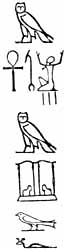
Owl (em) with.
Cross (ankh) life. This hieroglyph is the usual symbol of life. It is therefore known as the key of life, and from its shape is called crux ansata, “handled cross.” It ought to be distinguished from the musical instrument called sistrum, which it somewhat resembles.
Sceptre (uas) sound. The sceptre usually stands for power, but power in life is soundness of health.
Little Man (hefen) hundreds of thousands. This little figure with hands upraised is the usual symbol for an indefinite number, and may be rendered millions, or as above.
Palace (heb) festivals. See face one.
Swallow (ur) very. This symbol generally means great. Here it is an intensive, very.
Lizard (ast) many.
“Making offerings to their Majesties at two seasons of the year, that he might repose by means of them.”
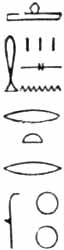
Offering (hotep) offering. The three vertical lines indicating plurality may refer both to offering and succeeding hieroglyph.
Cone (hen) majesty. We have called this cone, from its likeness to a fir-cone.
Two Circles (aten) two seasons. Each is a solar disk, the ordinary symbol of Ra, but here means season, because seasons depend on the sun.
Shoot (renpa) year. This is a shoot of a palm tree; with one notch it equals year.
The following hieroglyphs are obscure, but the highest authorities say that they probably mean, “that he might repose by means of them;” that is, that Thothmes hoped that repose might be brought to his mind from the fact that he made due offerings to his gods at the two appointed seasons.