XX FAMILIAR MEDICINES AND SOME NOTES OF THEIR HISTORIES.
Reading edition
Morbi, non eloquentia sed remediis, curantur.
Celsus: De Re Medica.
Black Draught.
Laxative or cathartic potions have been prescribed in all modern pharmacopœias, most of them being preparations of senna. The original one was devised by Mannagetta, an Italian physician at the court of the Emperor Rudolph II, about 1600. His prescription became popular under the title of Aqua, or Potio Laxativa Viennensis, and was popularly known all over Germany as “Wiener Trank.” The formula was 1 oz. of senna, 6 drachms of currants, 2 drachms of coriander seeds, and 2½ drachms of cream of tartar. These ingredients were packed in a bag and suspended in hot water for a night. In the morning the liquor was strained after the bag had been pressed, and 5 oz. of manna and 3 drachms of cream of tartar added. The dose was 3 to 4 oz. In the London Pharmacopœia the alkaline salt of tartar was at first prescribed with the senna, but later the acid tartrate of potash was preferred. In the Edinburgh Pharmacopœias of the eighteenth century a formula for “Infusi Sennæ Unciæ Quatuor” was included, while the London Pharmacopœias of the same period provided an alkaline infusion, and an “Infusum Sennæ Limoniatum,” containing lemon peel and lemon juice with the object of making the draught less nauseous.
The modern combination of sulphate of magnesia with an infusion or tincture of senna, and sometimes with manna, sometimes with ammonia, and always with some aromatic ingredient, began to be used about the beginning of the nineteenth century. The earliest mention of the term “black draught” that I have met with is in Paris’s “Pharmacologia,” 1824. It was dropped out from later editions. The mixture was called “black dose” in Brande’s “Materia Medica and Pharmacy,” 1839. The phrases “black draught” and “blue pills” were not given as synonyms in the Pharmacopœia until 1885. They are essentially English. Dorvault gives a formula (practically the Mist. Sennæ Co.) entitled “Potion Noire Anglaise,” and Hager has “Pilulæ Hydrargyrosæ seu pilulæ ceruleæ Anglorum.”
Blaud’s Pills.
These pills are probably taken in larger numbers than any other pills sold in Great Britain. If in proper condition they present iron in the form of the protocarbonate, either formed in the pills, or perhaps partially or entirely in the stomach. They are similar to Griffiths’ pills, which were the popular Mist. Ferri Co. in pilular form. Dr. J. Blaud, a French provincial practitioner, in an article published in the Revue Medicale, in 1831, entitled “Memoires sur les Maladies Chlorotiques,” gave the following formula:—
“Gummi Arabici, 5 grammes; solve calore baln. vapor in aquæ distillatæ, 30·5; syrupi simplicis 15 grammes; ferri sulfuric. sicci, 30; quibus caute mixtis adde kalii carbonici, 30; et inter agitatione ope spatula ferreæ in balneo vaporis evaporando ad massam pilularum redige; e qua forma pilulas 120; obducantur argento foliato.”
There has been much discussion concerning the best method of making these pills so as to keep them from oxidation. Honey was for a long time generally used as the excipient, but glycerin and sugar are generally preferred with gum acacia or tragacanth. Pilula Ferri, B.P., is a substitute for Blaud’s pills.
The Chelsea Pensioner.
An electuary for rheumatism bearing this title was evidently popular under the above name in the early part of the nineteenth century, but I have not been able to discover where or when or with whom it originated. The compilers of books of formulas naturally copy from each other, and consequently a legend once started is likely to become crystallised.
In The Chemist and Druggist, of June 13th, 20th, and 27th, 1896, an attempt was made to track this medicine to its origin, and a number of old formulas were sent in by correspondents. The statement is made in many books that the compound acquired its name from the circumstance that the recipe for it was given by a Chelsea Pensioner to Lord Amherst for gout and proved so successful that Lord Amherst gave him £300 and an annuity of £20. Sometimes this story associated Lord Anson with the pensioner and the amounts given in gratitude varied from £300 to 500 guineas, with an annuity sometimes of £20, sometimes of £30, and occasionally of £100. The then living descendants of Lords Amherst and Anson were written to by The Chemist and Druggist, but neither could give any information. It rather looks as if the fiction were concocted as an advertisement in the days when the electuary was a proprietary medicine, if it ever was.
The earliest formula traced in the correspondence referred to was given in Gray’s Supplement, 1821. This ran:—Pulv. gum. guaiaci, ʒi; pulv. rhei, ʒij; pulv. pot. bitart., 1 oz.; flor. sulph., 2 oz.; one nutmeg, and 1 lb. of honey. Of this, the dose was two tablespoonfuls night and morning. Sometimes pulv. pot. nit. is substituted for pulv. pot. bit.; probably a mistake of a copyist. In other formulas mustard appears instead of nutmeg; perhaps a similar slip for myristica. Treacle occasionally takes the place of honey, and the proportions of the ingredients vary considerably.
The Secretary of the Chelsea Hospital was good enough to take some trouble in reply to my inquiry to endeavour to trace this compound, but only negative results were attained. Dr. Thomas Ligertwood, the oldest living medical officer of the Royal Hospital, was appealed to, but he only knew of the remedy as “a very useful combination,” and had never heard the story of Lord Amherst’s purchase of the secret. He thought some information might be found in a work on the “Diseases and Infirmities of Old Age” by Dr. Daniel Maclachlan, a former Principal Medical Officer of Chelsea Hospital. That work (dated 1863) contains two allusions to the Chelsea Pensioner, but nothing about its history. Writing of Chronic Rheumatism the author says:—“ ... The more stimulating diaphoretics and diuretics prove serviceable. Among these the preparations of guaiacum deserve the confidence they have long enjoyed. The virtue of the powder (sic) known as the Chelsea Pensioner is chiefly due to the guaiacum and sulphur it contains.” In the section on gout he writes:—“The once famous Portland Powder has for long been abandoned, as has also the almost equally noted Chelsea Pensioner gout powder. One formula for the latter consisted of rhubarb, sulphur, nitre, and gum guaiacum, in equal parts. Fifteen or twenty grains of the powder were taken morning and evening in treacle. Another was powdered bark, ginger, guaiacum, aa ʒi, cream of tartar 1 oz., flowers of sulphur ½ oz., to be made into an electuary with simple syrup. One teaspoonful to be taken three times a day. This is certainly not a bad combination though a nauseous one.”
The following formula is given in the “Pharmacopœia Batava recusa cum notis et additamentis Medico-Pharmaceuticis,” published by J. F. Niemann, in 1824:—Resin of guaiacum, rhubarb, aa ʒij; supertartrate of potash, 1 oz.; sublimed sulphur, 2 oz.; one nutmeg; despumated honey, 1 lb. It is evident that this “Anti-Rheumatismal Electuary,” as Niemann calls it, and the Chelsea Pensioner had a common origin, and as the formula is not to be found in Niemann’s previous edition, 1811, it would appear to have come into popularity between that date and 1824. So far it remains doubtful whether its composition is due to an English or a Dutch author.
Citrine Ointment.
An ointment thus named appeared first in the P. L. 1650. It was a compound of coral, limpet shells, quartz, white marble, white lead, and tragacanth incorporated into a basis of hogs’ lard, suet, and hens’ grease. It was reputed useful for certain skin complaints, freckles, etc. In the P.L. 1678 some of the old ingredients were omitted, sugar of lead was substituted for the white lead and rose water, and frankincense and citron bark were added.
Nitrate of mercury ointment appeared first in the Edinburgh Pharmacopœia of 1722. It was made by dissolving mercury in a sufficient quantity of nitric acid, and adding the solution to melted lard gradually. This was not a satisfactory formula, and it was not until 1787 that anything similar was introduced into the P.L., when 1 oz. of mercury, 2 oz. of nitrous acid, and 1 lb. of lard were combined. This was intended, according to Christison, as an imitation of the well-known golden eye salve, which, however, was, as we know it, an ointment of the red oxide of mercury. Other authorities, Paris Dorvault, Gray, etc., have stated that Singleton’s golden eye ointment was an ointment of sulphuret of arsenic, orpiment some say, realgar others. Pliny refers to the use of sandrach (probably realgar) as an application in ophthalmic affections.
Apparently the originator of the P.L. nitrate of mercury ointment was a Dr. Thomas Nettleton of Halifax, Yorkshire. In a pamphlet entitled “On a Safe and Efficacious Medicine in Sore Eyes and Eyelids,” by Thomas Dawson, M.D., of Hackney, printed in 1782, the writer relates that he had heard of a yellow ointment specially good for sore eyes, which fifty years previously had been in the possession of Dr. Thomas Nettleton of Halifax, “whose merit as a man and a physician exceeds all encomium.” One day one of Dr. Dawson’s patients told him of a yellow ointment she had had from a Dr. Key, of Manchester, who had been a pupil of Dr. Nettleton’s. Dr. Dawson wrote to Dr. Key, who at once sent him the recipe, which was as follows:—
Take 1 oz. each of aqua fortis and mercury; dissolve and add the solution to 8 oz. of butter melted. To this add 2 drachms of camphor dissolved in 2 oz. of olive oil.
About the end of the eighteenth century, a citrine ointment, made with an ounce of mercury dissolved in nitric acid and incorporated with a pound of lard, was introduced into the Hotel Dieu Hospital of Paris, and used to cure itch. The formula was adopted in the Dublin Pharmacopœia, 1807.
Cold Cream.
The Unguentum Refrigerans, also called “Ceratum,” appeared in the first P.L., the formula being attributed to Galen. Four ounces of white wax were melted in 1 lb. of rose oil (ol. rosarum omphacinum, that is, olive oil in which rose buds 4 oz. to the lb. had been macerated, the maceration being carried out three times, each time with a fresh lot of roses). The melted oil and wax were to be poured frequently from one vessel to another, stirring in a little cold water meanwhile, until the mixture became white. Lastly, it was to be washed with rose water, and a little rose water and rose vinegar were to be added.
Diachylon Plaster.
The original formula for this plaster was compiled by Tiberius Claudius Menecrates, who lived in the reign of the Emperor Tiberius, and was probably his physician. In a Greek inscription discovered at Rome he is described as Physician of the Cæsars, probably Tiberius, Caligula, and Claudius, for he died in the reign of the last named. He wrote a great work on remedies entitled “Autocrator Hologrammatos,” literally, “The Emperor, whose words are written in full.” Probably the book was dedicated to one of the Emperors, and thus got its first title. The second intimates that the recipes are written out in full so that any reader could understand them; suggesting that the other physicians who wrote such books were in the habit of employing abbreviations.
The formula for diachylon and the directions for compounding it were put into iambic verses by Servilius Damocrates, who lived a little later than Menecrates, and it is in this form that they have been preserved by Galen. Briefly the composition was to incorporate 1 lb. each of the mucilages of fœnugreek, of linseed, and of marshmallow root with 3 lb. of old oil, and 1½ lb. of golden litharge. The mucilages were made by boiling the seeds and root in water. Damocrates concludes his poem with the line (I quote from the Latin translation): “Vocabat ipsum non absurde Dia Chylon.”
Mesué wrote at length about this plaster, and devised a much more complicated formula which was named Diachylum Magnum. It contained, besides the mucilages already named, others made from raisins and figs, juices of orris, squill, and dill, œsypus (sheep wool fat), turpentine, rosin, and wax. Subsequent authors also devoted their talents to the further improvement of this famous preparation.
Diachylon meant a preparation of juices, and this plaster received the name of plaster of the mucilages in many pharmacopœias. In 1746 the London College, having dismissed the adjuncts, altered the name of the simple plaster to Emplastrum Commune, but the old term has refused to die. An Emplastrum Commune cum Gummi was also prescribed. This contained galbanum, thus, and turpentine combined with the Emplastrum Commune.
The Menecrates to whom we owe Diachylon is alleged to have written 155 works, and Galen gives a number of his formulas, but no other than Diachylon has survived. He must not be confounded with the perhaps more celebrated Menecrates who was physician to Philip of Macedon. This one was particularly noted for his vanity, which amused the king. Once he wrote a letter to Philip commencing “Menecrates-Jupiter to King Philip, greeting.” The king replied, heading his letter, “Philip to Menecrates, Health and Common Sense.” Menecrates got himself up to look like Jupiter, and had attendants who were made to figure as Apollo, Æsculapius, and Mercury. Philip gave a banquet in his honour. A separate table was reserved for him, and instead of viands only incense was served to him, while the other guests were gloriously feasted. Menecrates was offended at the joke and left the table in anger. He is credited with having written a Book of Remedies, but it has been lost.
Dover’s Powder.
Thomas Dover, to whom we owe “Dover’s Powder,” practised as a doctor in London in the first half of the eighteenth century. He was born and buried at Barton on the Heath in Warwickshire in 1660. How he got his medical training is not on record, but some time in his youth he lived in the house of Thomas Sydenham, the famous physician, from whom probably he acquired his independent ideas of medical treatment, and possibly the germ of his lack of reverence for the College of Physicians. While living with Sydenham he had small-pox, and forty or fifty years later he described how the doctor treated him. First he was bled to the extent of 22 oz.; then he took an emetic. He only took to his bed when he became blind with the disease. In his bedroom he had no fire, the windows were always kept open, and the bedclothes were only allowed up to his waist. This was in the middle of January. For medicine, Dover says, “he made me take twelve bottles of small beer acidulated with spirit of vitriol every twenty-four hours,” and he concludes, “I never lost my senses one moment.”
Having resisted both the disease and the treatment, Dover is first heard of in practice in Bristol in 1684. He plodded along there until 1708, when at the age of forty-eight he set out with a privateering party on a voyage round the world. The expedition consisted of two ships, the Duke and the Duchess. Captain Woodes-Rogers, who has left an account of the voyage, was in chief command, and Dover on the Duke was his lieutenant. He must have had previous experience of seafaring life or he would never have been entrusted with the command of a vessel.
The buccaneers were away from England three years, and when they returned they brought with them a Spanish frigate of twenty-one guns, and a quantity of loot. One event of their voyage proved to be of world-famous importance. On February 2, 1709, Dover, on the Duke, touched at the island of Juan Fernandez and took on board Alexander Selkirk who had lived alone on the island four years and four months, and whose story was to develop in the skilful hands of Defoe into that of the immortal Robinson Crusoe.
A few months after leaving Juan Fernandez the expedition arrived at Guayaquil in Peru. Having duly sacked the city and stored their plunder in the ships, the sailors slept in the churches, and Dover quaintly relates how annoyed they were by the smell of the Spanish corpses; for plague was raging in the place at the time, and the victims were buried just under the floors with only a plank or two over them. Two days later, at sea, the disease broke out among the crews. They had 180 cases all at the same time, and Dover had four surgeons with him. He ordered them to go round and start bleeding all the patients, and to stop the bleeding when the round had been completely made. About 100 oz. of blood, he says, was taken from each man. Then he gave them spirit of vitriol, and only seven or eight died.
The next we know of Dover is that from 1721 to 1728 he was in practice in Cecil Street, Strand; he returned to Gloucestershire for a few years, then came back to London and practised in Lombard Street, removing in 1736 to Arundel Street, Strand.
He is supposed to have died about 1742. It was in these latter years that he wrote his “Ancient Physician’s Legacy to his Country.” He describes himself on the title-page as Thomas Dover, M.B., and his book as “Being what he has collected in forty-nine years’ Practice, or an account of the several diseases incident to mankind, described in so plain a manner that any person may know the nature of his own disease. Together with the several remedies for each distemper faithfully set down.”
In this work Dover relates a number of wonderful cures he had effected, gives names and addresses of many of his patients, often adding grateful letters from them. He had but limited confidence in the “clan of prejudiced gentlemen,” as he calls the College of Physicians, and he complains vigorously of the extortions of the Apothecaries. Metallic quicksilver was his panacea, and he prescribed it so lavishly that he acquired the title of “the quicksilver doctor.” It forms balsam with the blood, he says. That is why it cures venereal diseases. Other doctors gave it, but in disguise, in the form of Ethiops Mineral generally; which was like using the sword in the scabbard.
His formula for “Diaphoretic Powder” is given in a chapter on gout. It was as follows:—
“Take opium 1 oz.; saltpetre and tartar vitriolated, each 4 oz.; liquorish 1 oz.; ipecacuanha, 1 oz. Put the saltpetre and tartar into a red-hot mortar, stirring till they have done flaming. Then powder them very fine. After that slice in your opium; grind these to a powder, and then mix the other powders with them. Dose, from 40 to 60 or 70 grains in a glass of white wine posset going to bed, covering up warm, and drinking a quart or three pints of the posset while sweating. In two or three hours at furthest the patient will be free from pain, and though before not able to put his foot to the ground, ’tis very much if he cannot walk next day. The remedy may be taken once a week or once a month.”
The dose appears to us in these degenerate days a large one, and Dover states that “some apothecaries have desired their patients to make their wills before they venture upon so large a dose.” But he declares he has given up to 100 grains, and the patient has appeared abroad the next day. The notion of danger, he adds, proceeds entirely from their ignorance, and from the want of knowing those ingredients that are mixed up with it, for they naturally weaken the power of the opium.
Dover’s powder first appeared in the London Pharmacopœia for 1788. Probably it was adopted after the quack Ward had made it famous as a “sweating powder.” Ward died in 1761 and the formulæ for his remedies were published soon after his death.
Unguentum Elemi.
Ointment of elemi was in all the London Pharmacopœias, and was only dropped from the B.P. 1898. In the earlier issues it was called “unguentum or linimentum Arcœi,” because it had been introduced and recommended by Arcœus of Amsterdam in 1574, for healing wounds. A similar ointment was called “Balsamum Arcœi” in the Prussian Pharmacopœia of 1847. The inventor’s formula was to melt together six parts each of gum elemi and turpentine, and add six parts of melted stag’s suet, and two parts of oil of St. John’s wort. Arcœus was a Spaniard by birth, and an eminent authority on the treatment of wounds.
Fowler’s Solution of Arsenic.
Thomas Fowler kept an apothecary’s shop in York from 1760 to 1774. In the latter year he relinquished trade, and went to Edinburgh to study medicine. Graduating as M.D. in 1778, he settled at Stafford, and was appointed physician to the Infirmary of that town. Later, he returned to York, where he acquired a large practice, and where he died in 1801.
It was in 1786, during his residence at Stafford, that Dr. Fowler published his treatise, entitled “Medical Reports of the Effects of Arsenic in the Cure of Agues, Remitting Fevers, and Periodic Headaches.” It was only a small work, but it made Fowler’s reputation, and introduced arsenic into the list of recognised remedies. The doctor stated that a certain Patent Ague Drops known as Tasteless Ague and Fever Drops, which had acquired some reputation in this country, had been occasionally tried in the Stafford Infirmary, and had been found efficacious. With the assistance of the apothecary to the Infirmary, a Mr. Hughes (“whose industry, attention, and abilities in his professional line justly merit applause”) he had ascertained that these drops were a preparation of arsenic, and he goes on to detail the experiments which led him and Mr. Hughes to devise the following formula as representative of the patent medicine:—
“Recipe arsenici albi in pulverem subtilissimum triti.
“Salis alkalini fixi vegetabilis purificati, singulorum grana sexaginta quatuor.
“Aquæ fontanæ destillatæ, libram dimidiam.
“Immitantur in Ampullam florentinam qua in Balneo Arenæ posita, Aqua lente ebulliat donec Arsenicum perfecte Solutum fierit. Deinde Solutioni frigidæ adde.
“Spiritus Lavendulæ compositum, unciam dimidiam.
“Aquæ fontanæ destillatæ, libram dimidiam, plus vel minus, adeo ut solutionis mensura libra una accurata fiat, vel potius Pondere unciæ quindecim cum dimidia.”
Fowler reminds his readers that of course troy weights are intended, and he explains that the spirit of lavender is added merely to give the mixture a medicinal appearance, lest patients entrusted to drop it for themselves might be tempted to use a water-white solution too freely. He also suggests that as arsenic conveys rather alarming ideas, this medicine should be described as “mineral solution.”
It is universally recognised that Fowler introduced the modern medicinal employment of arsenic, but it should in fairness be remembered that he was guided to his discovery by a quack remedy, as lie himself fully acknowledged.
The Liquor Arsenici Chloridi, P.L., was adopted from a formula of Dr. F. de Valangin, a Swiss doctor who qualified in England in 1765. He made a quantity and presented it to the Apothecaries’ Hall, where it was sold for some time under the name of Solvent Mineral.
Friar’s Balsam.
Tinct. Benzoin Co., was a copy of Ward’s Balsam, which itself was only the adaptation of compounds which had been for a long time sold under the names of Friar’s Balsam, Commander’s Balsam, Jesuit’s Drops, Turlington’s Drops, and Traumatic Balsam. It was under the last name that it first appeared in the P.L. of 1746. This was only the Latinised name of Wound Balsam, another old designation of a similar preparation.
It is not known how the still popular name for this preparation, Friar’s Balsam, originated. It is included in the Schedule to the Medicine Stamp Act of 1812, suggesting that at that time it was regarded as a proprietary medicine.
A correspondent of The Chemist and Druggist (P. F. R., April 15, 1885) quoted from the Western Antiquary, 1884, page 136, the curious item that a Portuguese merchant named Peter de Frias obtained from the Viceroy of Peru, about the year 1581, the fruit of a balm or balsam. It is not an impossible suggestion that Peter de Frias may have been the originator of our Friar’s Balsam. The substitution of benzoin for the balsam of Peru, which was probably the basis of his “wound balsam,” is easily accounted for. Perhaps a more likely explanation of the introduction of Friar’s Balsam into the Medicine Stamp Act is that there was a patent medicine “called the Frier’s Drops,” patented by Robert Grubb on June 13, 1777. It was intended for the cure of the venereal disease, scurvy, rheumatism, and other complaints. It contained calomel, antimony, guaiacum, and balsam of Peru in spirit.
The Baume de Commandeur, which was also called Baume du Commandeur de Permes, and Baume du Chevalier de Saint Victor, seems to have been the original of these benzoinated tinctures, and acquired considerable reputation in France. It was evidently at first a proprietary preparation, but Pomet in 1694 gave a formula for an imitation of it, with the remark that it would cure in eight days any wound by iron or fire, if it were not a mortal one. His formula prescribes benzoin, 3 oz.; dry Peruvian balsam, 1 oz.; storax, 2 oz.; Socotrine aloes, myrrh, olibanum, angelica root, and St. John’s wort flowers, of each ½ oz. digested in 2½ lb. of spirit, and strained. The Traumatic Balsam introduced into the P.L. substituted Balsam of Tolu for the Balsam of Peru, and omitted the myrrh, olibanum, angelica, and St. John’s wort. This was almost identical with the Tinct. Benzoin Co. of the present B.P.
The simple tincture of benzoin was already popular in this country when the Traumatic Balsam was introduced. It was taken in doses of 20 to 60 drops in asthma, but its more usual employment was as Lac Virginis (1 drachm of the tincture in 4 ounces of water) as an application for the skin.
Gregory’s Powder.
The original of the Pulv. Rhei Co. of the British Pharmacopœia was a prescription very frequently given by Dr. James Gregory, of Edinburgh, in his time the most famous physician of that city. He died in 1822. This Dr. Gregory was Professor of Medicine in Edinburgh University, as his father was before him. His son became Professor of Chemistry in the same university. Direct ancestors of these Gregorys had been professors of history, astronomy, and mathematics at Edinburgh, Oxford, and St. Andrews. Within a century and a half the family furnished sixteen professors to British universities, and it is a curious coincidence that the Church of Rome likewise counts sixteen Gregorys among its Popes.
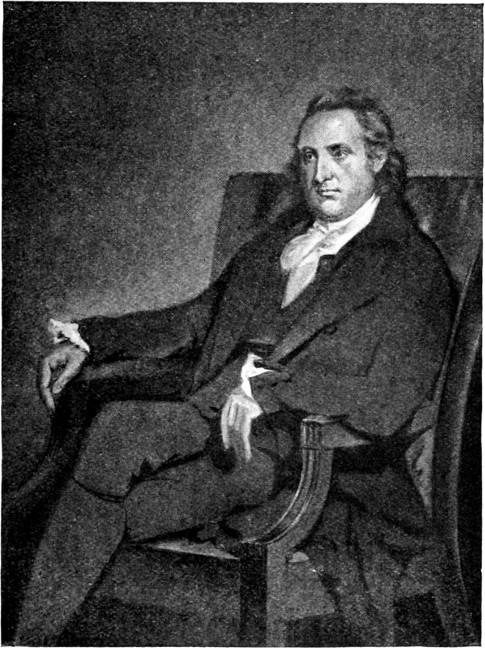
Dr. James Gregory.
Professor of Medicine in Edinburgh University, 1790–1821. Author of Conspectus Medicinæ Theoreticæ and inventor of Gregory’s Powder.
(From a mezzotint, “after Raeburn,” in the British Museum.)
It does not appear that the Gregory of powder fame ever published any special recommendation of his compound. He wrote a “Conspectus Medicinæ Theoreticæ” (1788) but the formula for his powder does not appear in that book. Annexed is a facsimile of one of Dr. Gregory’s prescriptions for his powder. He gave this prescription very frequently, but occasionally varied the proportion of the ingredients.
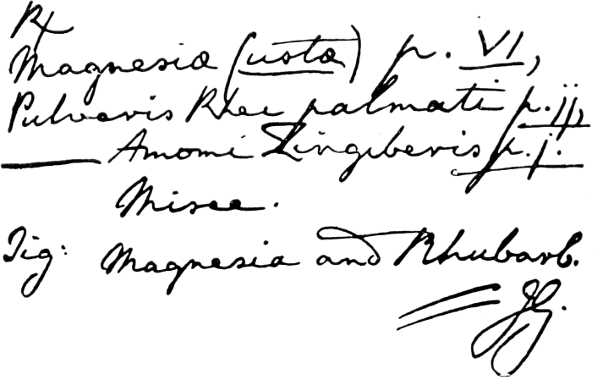
Facsimile of Dr. Gregory’s Prescription.
Hiera Picra.
A medicine with this familiar name can be bought in any chemist’s shop in Europe or America to-day, just as it could in Damascus a thousand, or in Rome and Alexandria two thousand years ago. Probably it is the oldest pharmaceutical compound still in existence. Through all the centuries the hiera picra known to the public has been a preparation of aloes. The adjuncts have varied but aloes has always been the essential ingredient, with one celebrated exception.
The origin of this medicine is variously stated by medical historians. The common theory is that it first acquired fame as a remedy employed in one or other of the Æsculapian Temples. This may have been the case, but there is no evidence in support of the suggestion. It is possible that the name may have suggested the notion, and the drug vendors of Rome would certainly not discourage the fancy.
Before the time of Julius Cæsar there were no physicians in Rome. Greek practitioners of the minor arts of medicine, such as bath-keepers, corn-cutters, tooth-drawers, and herbalists crowded into the great city as it became rich, and opened shops which were known as “medicinas,” and it is likely that most of these brought with them a more or less famous “hiera,” claiming that it had been compounded from a genuine Temple formula.
Leclerc, an excellent authority on all matters concerning ancient medicine, attributes the first Hiera to Themison of Laodicea, who practised in Rome about 50 B.C., and who is reputed to have been the first physician to make use of leeches. The Hiera of Themison was composed of 100 drachms of aloes, with 1 oz. each of mastic, saffron, Indian nard, carpobalsamum, and asarum.
The Hiera of Galen, which was modified from that of Archigenes, was originally in the following form:—
Socotrine aloes, 100; cinnamon, spikenard, xylobalsamum, mastic, asarum, and saffron, of each 6; honey to make an electuary. In the P.L. this was ordered to be kept in the form of species, and was principally used to make a tincture which was called tinctura sacra. In the 1721 edition the mastic and the spikenard were omitted, cardamom seeds being substituted for the latter, and some cochineal was added with a view to colouring the tincture. In 1746 hiera picra became simply a mixture of aloes and canella, and as such it was retained in the following edition (1788), but under the title of Pulv. Aloeticus, which in the Index is given as “olim Hiera Picra.” This was the latest reference to Hiera Picra as such in the London Pharmacopœia. The P.L. of 1788 gave also a Pulv. Aloeticus c. Guaiaco, which consisted of 1½ oz. of Socotrine aloes, 1 oz. of powdered guaiacum, and ½ oz. of aromatic powder (afterwards called Pulv. Cinnamomi Co., and compounded of cinnamon, cardamoms, ginger, and long pepper). The canella mixture did not appear again, but that with guaiacum was repeated in all the subsequent London Pharmacopœias including the last in 1851, but was dropped from the British Pharmacopœias.
Pil. Rufi, our Myrrh and Aloes pill, was originally a Hiera invented by Rufus of Ephesus, who lived in the reign of the Emperor Trajan. The Hiera was made into pills by the Arabs, and were for a long time known as Pilulæ Pestilentiales, which was the name Avicenna gave them. In the early Edinburgh Pharmacopœias they were called Pilulæ Communes.
Scribonius Largus, physician to the Emperor Tiberius, relates (A.D. 52) that one of these noted hieras, the Hiera Pachii, was much sought after, and that large sums had been offered for the formula. When Pachius died at Antioch the Emperor had his library searched, and the true recipe for the famous medicine was there found in a book which Pachius had prepared and had dedicated to the Emperor. Tiberius handed the formula to Scribonius with instructions for its publication. The formula given by Scribonius, which it will be noted contained no aloes, was as follows:—Colocynth, agaric, germander, white horehound, Arabian stœches (a sort of lavender), of each ℥x; opoponax, sagapenum, parsley seeds, round birthwort root, white pepper, of each ℥v; spikenard, cinnamon, myrrh, and saffron, of each ℥iv; despumated honey, 3 lb. 3 oz. 5 drachms, to make an electuary.
It is not necessary to describe the other hieras devised by later authorities, but it may be noted that the Hiera Tralliani compounded by Alexander of Tralles (about 550 A.D.) contained scammony, and that he advises concerning it that the quantity of scammony shall not be increased, as it appears some were inclined to do, not knowing that thereby they make it useless. For he says it is not the intention that the medicine should be carried immediately through the system. It should be detained in the body and conveyed to the remote parts so as to correct the various humours, open the passages, remove the obstructions of the nerves, and make way for the motion of the spirits. This was the formula given in the P.L. 1721 under the name of Hiera Diacolocynthidis, but our present-day hiera picra has descended from the Hiera Simplex of Galen. The old dispensatories up to the eighteenth century give a liberal choice of Hieras, among which were the Hiera Simplex Galeni cum Agarice, Hiera Logadii, Hiera Antiochi, Hiera Archigenes, Hiera Tralliani, Hiera Rufi, Hiera Justi, Hiera Constantini, and others. Originally these were all electuaries made with honey. It became the practice, however, to keep them in the form of “species,” and ultimately electuaries went out of fashion altogether.
Laudanum.
Paracelsus probably invented the name of laudanum, and seems to have called several medicines by that term. In one place he expressly states that his laudanum was made from gold leaf and unperforated pearls; in other places he seems to mean red precipitate, and undoubtedly opium or a compound of it was sometimes intended. Crollius gives a formula for a pill mass, which he designates the laudanum of Paracelsus, which contained one-fourth of its weight of opium, to which were added henbane juice, mummy, salts of pearls and corals, the bone of the heart of a stag, bezoar stone, amber, musk, unicorn, and some species, with a few drops of many of the essential oils. The Anodynum Specificum of Paracelsus was a product obtained by first digesting opium, 4, in a mixture of orange and lemon juices, 180, with distilled frogs’ sperm water, to which cinnamon, 4, cloves, 45, ambergris, 4, and saffron, 45, were added. This mixture was digested for a month, and after pressing and straining, coral, magistery of pearl, and quintessence of gold, of each 2, were added, together with the salt extracted from the marc.
The laudanum of the early London Pharmacopœias was a pill mass made as follows:—Thebaic opium extracted by spirit of wine, ℥i.; saffron, similarly extracted, ℥iss; castorum, ℥i; combined with ℥ss. of species of diambræ made into a tincture with spirit of wine; to these might be added, ex-gratia, ambergris and musk, of each 6 gr., and oil of nutmeg 10 drops. Evaporate the moisture and leave the mass.
One would think that the name laudanum was an echo of laudandum, and that has been the usual opinion. But Professor Skeat is confident that it is a variation of ladanum, which, he says, was a stomachic cordial made and named from gum labdanum, which had been in medical use for centuries. This, of course, is possible, but it must be remembered that Paracelsus was untrammelled by any etymological rules in his invented words, and that the one unlikely thing for him to do would have been to adopt with a slight modification the name of a remedy then in use, if, indeed, a preparation of labdanum was at that time popular, or even known at all in Germany in his time.[2] Adam of Bodenstein, son of the theologian Carolstadt, who wrote both for and against Luther’s doctrines, wrote a treatise in which he professed to explain all the mysterious terms used by Paracelsus. Laudanum, he says, is from a laude, and was a quintessence of mercury and not an opiate.
Sydenham’s Laudanum is the preparation of opium which attained the highest popularity. It has always been the principal liquid preparation of the drug in continental practice, and formulas for it more or less corresponding with the original are in all the principal Pharmacopœias except the British. It was omitted from the P.L. in 1746, or rather a very similar preparation named Tinctura Thebaiaca was substituted for it. Sydenham’s formula, which was given incidentally in his description of the dysentery of 1669–72, prescribed strained opium, 2 oz., saffron 1 oz., cinnamon and cloves of each 1 drachm, and Canary wine, 1 pint.
“I do not think this preparation has more virtue than the solid laudanum of the shops,” he wrote; “but I prefer it before that for its more commodious form, and by reason of the greater certainty of the dose, for it may be dropped into wine or any distilled water, or into any other liquor.”
This passage is quoted from Pechey’s translation of Sydenham’s works. The allusion to “the solid laudanum of the shops” confirms the opinion that Sydenham’s was the first liquid preparation generally designated laudanum. Among the Sloane manuscripts in the British Museum is included what is described as “The Commonplace Book of an Apothecary at Great Dunmow,” which contains several more or less similar recipes for laudanum. The book is dated 1644–5. The most elaborate formula is headed “Laudanum Josephi Michælis,” and lengthy directions for making this are given. The ingredients were opium, extract of henbane, species diambræ (a compound of most of the known spices), pearls, coral, amber, musk, mummy, cloves, and oil of cloves. Some of these were to be extracted with spirit of wine, and the spirituous extracts were to be distilled. Ultimately the whole was to be set aside to ferment for three months. The dose was stated to be 4 or 5 grains at bedtime.
Rousseau’s laudanum, which also became famous among opium preparations, differed from others in being a fermented compound. It was made by dissolving 12 oz. of honey in 3 lb. of warm water, and setting the mixture in a warm place. When it began to ferment, 4 oz. of opium mixed with 12 oz. of water were added, and the fermentation was allowed to continue at a moderate temperature for a month. After straining, the liquid was evaporated to 10 oz., and 4½ oz. of alcohol were added.
Rousseau was a Capuchin monk and was destined for mission work in Asia. Sent from Rome to Paris to study medicine so that he might be better fitted for his life’s work, he carried a letter of introduction to Colbert, the first minister of Louis XIV. Rooms were provided for him in the Louvre, and there before long he set up a laboratory and began to prepare and sell medicines. The Capucin of the Louvre became the fashionable quack, and Louis ordered the Faculty of Medicine to confer on him a degree. The life was so agreeable that, when orders came from Rome that he was to proceed on his mission, Rousseau refused, and, having transferred his allegiance to the order of Cluny, he continued his medical practice in Paris. Falling ill he refused medical aid, treated himself with his own compounds, and died. After his death his brother published his “Remédes et Secréts Eprouvés” (1697).
Black Drop was the name of a celebrated proprietary medicine very popular from the first half of the eighteenth, until the early part of the nineteenth century. Its inventor was one Edward Runstall of Bishop Auckland in the county of Durham, but it also came to be known as the Lancaster or the Quaker’s Black Drop. A formula for it was found by a Dr. Armstrong among the papers of a relative of the proprietor, and was published in a treatise on fevers in the early part of the nineteenth century. The recipe was as follows:—Opium, ½ lb.; good verjuice (the juice of the wild crab), 4 pints; nutmegs, 1½ oz.; saffron, ½ oz. Boil to a proper consistence, set in a warm place, add two spoonfuls of yeast, set in a warm place for six or eight weeks, then in the open air until it becomes of the consistence of syrup. Decant, filter, and bottle, putting a little sugar into each bottle.
This preparation was three times the strength of laudanum. The acetum opii of the Edinburgh and Dublin Pharmacopœias was intended as a substitute, but closer approximations to the original formula were given in the Hamburg Codex of 1845 and in the U.S. Pharmacopœia of 1851. The growing favour with which morphine was regarded gradually destroyed the popularity of the Black Drop.
Tinctura Lavandulæ Composita
has much fallen from its earlier glories. In the P.L., 1721, it was made with French brandy and twenty-seven other ingredients, including besides lavender, sage, rosemary, betony, borage, lilies of the valley, cowslips, balm, orange flowers, bay berries, cinnamon, mace, nutmegs, cardamoms, cubebs, aloes wood, ambergris, saffron, musk roses, and a few other less familiar flowers or cordials. The preparation was known as Palsy Drops, but I am not sure whether the official compound acquired this title, or whether it was an imitation of a tincture previously known as such.
Lenitive Electuary.
The formula prescribed in the first London Pharmacopœia was as follows:—Raisins (stoned), polypody of the oak, Eastern senna, of each 2 oz.; herb mercury, 1½ handful; jujubes and sebestens, of each 20; maidenhair, violets, and cleaned barley, of each 1 handful; prunes (stoned), tamarinds, of each 6 drachms; liquorice, ½ oz.
These drugs were to be boiled in 10 lb. of water to one-third of its volume, and to the strained liquor were to be added pulp of cassia fistula, tamarinds, prunes, sugar of violets, of each 6 oz.; sugar, 2 lb.; and at last 1½ oz. of powdered senna was to be incorporated to each pound of the electuary.
In the Pharmacopœia of 1650 powdered aniseed, 2 drachms to each pound of the electuary, was added in order to correct the action of the senna.
In 1721 figs (20) took the place of the jujubes and sebestens; and powdered coriander seeds were substituted for the aniseed.
In the Pharmacopœia of 1746 the preparation was much simplified, the raisins, polypody, herb mercury, maidenhair, violets, and barley, being rejected. The formula then adopted was very nearly the same as the one now prescribed, but the name of the compound was changed in 1851 to Confection of Senna.
As in the case of most other medicines, the dose of this compound has been gradually reduced. There was more senna in proportion to the finished product in the old formulas than in the modern ones; but the dose was stated by Culpepper to be “one ounce for a man of reasonable strength.” Later a piece the size of a walnut was recommended; now the official dose is 1 to 2 drachms.
For a long time this preparation was grossly adulterated. “I understand,” says Paris, “that a considerable quantity is manufactured in Staffordshire in which unsound or spoilt apples are an ingredient; that jalap blackened with walnut liquor is frequently substituted for pulp of cassia; and that the great bulk of what is sold in London is little else than prunes, figs, and jalap.”
Compound Liquorice Powder.
Although this popular medicine was only made official by being adopted in the B. P. Additions, 1874, it had already acquired reputation as a pleasant laxative in household medicine, and had been familiar in German pharmacy for the better part of a century. It first appeared in the Prussian Pharmacopœia in 1799, and had been devised by a noted physician of Berlin, Dr. E. G. Kurella, who died in the year named. He called the mixture Pectoral Powder, and he made an electuary from similar ingredients.
The Prussian powder looks like a modification of a compound senna powder included in the first London Pharmacopœia, 1618. This contained senna, liquorice, caraway, fennel, cumin, spikenard, cinnamon, galangal, and gromwell seeds. Its “first contriver” (says Quincy) was Isaac Hollandicus.
Opodeldoc.
So far as can be traced Paracelsus first used the term opodeldoc (or as it is generally found in his works, opodelloch or opodeltoch). If he invented the word it is probable that he did not derive it from any etymological elements. Various suggestions have been made from time to time in explanation of the term, but without any sound basis. The most ingenious one is given by Hermann Peters in his “Pictorial History of Ancient Pharmacy.” He derives it from the first syllabic of opoponax, the second syllable of bedellium, and the third syllable of aristolochia root. These were the principal ingredients of the old opodeldoc plaster as it appeared in the last Nuremburg edition of the “Dispensatory of Valerius Cordus.”
In some dictionaries Mindererus is credited with the invention of the word, but incorrectly. He uses it, but expressly attributes it to Paracelsus. In his “Medicina Militaris,” for example, he advises the army doctor to “be provided with a good plaister for wounds made by thrusting (spear-wounds) such as are the opodeldoc of Theophrastus.” Schröder, another medical author of about the same date (1600) also refers to the “oppodeldoch plaister of Paracelsus.” Paracelsus only uses the term opodeldoc for plasters, and for these he does not give a specific formula. One of his annotators, Felix Wurtz, however, states that the following was the method of preparing the great opodeldoch plaster which Paracelsus was in the habit of using. Its formula was as follows:—
Galbanum, opoponax, of each 3 oz.; ammoniacum, bdellium, of each 1 oz. Macerate for eight days in distilled vinegar and slowly evaporate the solution to the consistence of honey. Then boil together, litharge in fine powder, ½ lb., with 1½ lb. of oil, stirring until the compound acquires the colour of bay. Add 1 lb. of wax, and when melted mix with the solution the gums above mentioned, and soon after add 3 oz. of oil of laurinus. Stir all these diligently until they are perfectly mixed, then remove from the fire and work in the following powders, all finely powdered:—
Crocus martial, mummy, prepared magnet, magistery of white coral, and magistery of red coral, of each ½ oz.; calamine, myrrh, frankincense, mastich, aristolochia root, of each 2 oz. Stir these gradually with the liquefied plaster.
Separately mix 1 drachm of powdered amber, 1 drachm of oil of laurinus, and ½ oz. of turpentine, and add to them 1 drachm of camphor and ½ drachm of saffron. Add this mixture to the plaster, and when perfectly blended form into magdaleons (rolls). These may be slightly softened with oil of St. John’s wort.
The author explains that this plaster will heal all wounds and all ordinary ulcers without the formation of pus; but for rodent ulcers he recommends the addition of 1 drachm of the following mixture of powders to each ½ oz. of plaster:—Crocus of antimony, vitriol of calcined rubies, and red precipitate; equal parts worked in with a little oil of turpentine. Other forms were given by different authors, but this was the one which was adopted in the P.L., 1721.
Just when the name was transferred from a plaster to the liquid soap liniment cannot be traced; it was applied to an ointment on the way. There is a formula for an Unguentum Opodeldoch in the first Edinburgh Pharmacopœia, 1722, as follows:—
“Rad. angelicæ, aristolochiæ longæ, imperatoriæ, aa 2 oz.;
“Fol. ocimi (basil), origani, salviæ, serpylli,
“Flor anthos, lavandulæ, aa 1½ oz.;
“Bacc. juniper, lauri, sem. cummini, aa 2 oz.; castorei, 1 oz.
“Affunde Spirit. Vini Rect. congium unum. Digere frigide per triduum in vaso clauso; tandem humitatur in B.M. tepidum per horas aliquot. Colatura expressæ adde
“Camphoræ 1 oz., saponis Venet. minutim incisi, lbii.
“Digere rursus in vase circularorio juncturis lutatis, leni calore B.M. donec coeant in unguentum.”
Steer’s opodeldoc was similar to this compound, but with some ammonia added. It appeared about the middle of the eighteenth century, and foreign dispensatories state that it was the patent of an English doctor. I have not been able to trace either the patent or the doctor. Steer’s opodeldoc was evidently the model imitated in most of the foreign pharmacopœias.
Paregoric.
Paregoric Elixir originated with Le Mort, Professor of Chemistry at the University of Leyden from 1702 till 1718, when he died and was succeeded by Boerhaave. A modification of Le Mort’s formula was given in the P.L., 1721, as Elixir Asthmaticum, thus:—Honey and liquorice root, of each 4 oz.; flowers of benjamin and opium, of each 1 drachm; camphor, 2 scruples; oil of aniseed, ½ drachm; salt of tartar, 1 oz.; spirit of wine, 2 lb. Quincy (1724) says, “there is not any composition of our shops to be compared to it in the intention in which it is ordered.” He explains that opium procures a truce with the cough, and so provides a better opportunity for the other ingredients to rarefy and thin the viscid cohesions in the vessels, and fit them for circulation and secretion. In the P.L., 1746, the honey, liquorice, and salt of tartar were omitted, and the name of the preparation was changed to Elixir Paregoricum. The Edinburgh Pharmacopœia of 1756 left out the honey, liquorice, and salt of tartar, substituted saffron for camphor, and ammoniated the spirit. The P.E. also adopted the name of Paregoric. In the P.L., 1788, the official name became Tinct. Opii Camphorata, and in 1851, Tinct. Camphoræ Co. A similar formula appears in most foreign Pharmacopœias. In the German Pharmacopœia and in some others it is called Tinct. Opii Benzoica.
Paregoric, that is, soothing, remedies were frequently spoken of before the adjective became specific. Leclerc, dealing with the later Greek and Roman remedies, states that preparations into which poppy juice or opium entered as an essential ingredient, whether they were pills or liquids, were called anodyna or paregorica. Bishop Berkeley said of his tar water that it was “both paregoric and cordial.” The word was derived from a Greek combination originally meaning to speak in an assembly, but it acquired the secondary sense of speaking words of consolation.
Pil. Cochia.
Pil. Cochia originated with the Greco-Roman physicians, from Galen onwards, and all the formulas for it associate aloes with a more drastic purgative such as colocynth, which is the usual ingredient. The term, however, did not come into use until about the seventh century, and according to some authorities it was first formally adopted by Rhazes, the Arab. The predecessors of our pills were called “katapotia,” which meant things to be swallowed, and the earlier prescribers directed katapotia of such a size. Celsus, for example, orders katapotia of the size of an almond, of an Egyptian bean, and so on. Subsequently as patients became more fastidious they were humoured by the doctors, and katapotia of the size of a coccus, which was a lentil berry, were prescribed. Coccion meant a diminutive coccus, and as the pill of aloes and colocynth was frequently prescribed in this way the term came to distinguish those pills particularly. Paul of Ægina’s formula (sixth century) ordered aloes and colocynth pulp, and extract of wormwood, of each one part, with scammony two parts. To be made into pills of the size of a coccus. Eleven were to be taken for a dose. The early London Pharmacopœias contained formulas for pilulæ cocciæ majores, from Rhazes, and pilulæ cocciæ minores, from Galen. Only the latter survived. In the P.L., 1746, the name of Pilulæ cocciæ minores was changed to Pilulæ ex Colocynthide cum Aloe, and the formula ordered Socotrine aloes and scammony, of each 2 oz.; pulp of colocynth 1 oz.; oil of cloves, 2 drachms.
Plummer’s Pills.
Pil. Calomel. Co. originated from a formula devised by Dr. Andrew Plummer, Professor of Chemistry in the University of Edinburgh in the middle of the eighteenth century. Dr. Plummer first published his formula in the “Edinburgh Medical Essays,” 1751. It was only a slight modification of the Pilulæ Æthiopicæ which were already official in the Edinburgh Pharmacopœia. These were originally a combination of Ethiops Mineral with the golden sulphide of antimony, but the Edinburgh College had substituted calomel for the former.
Ammoniated Tincture of Quinine.
Under this name Mr. Joseph Ince recorded in the Pharm. Journ., June 13th, 1874, that a preparation was made and called by this name which was a solution of 1 grain of sulphate of quinine in one drachm of compound spirit of ammonia. This did not meet with general approval, and in 1853 Mr. Bastick proposed an Ammoniated Solution of Quinine made by dissolving 32 grains of sulphate of quinine in 3½ ounces of proof spirit and ½ ounce of solution of ammonia. The present B.P. tincture contains less ammonia, and alcohol is employed instead of proof spirit.
Compound Soap Pills.
Pil. Sapon. Co., formerly official as Pil. Sapon. c Opio, Pil. Opii, Pil. ex Opio, and when first authorised in the P.L., 1746, Pil. Saponacea, was adapted from a famous nostrum long sold as Matthews’s Pills, and as Starkey’s Pills. Starkey, a qualified physician, was understood to have devised the process, and Matthews was the vendor in whose name they were sold. But a little before his death in 1665 Starkey told Dr. George Wilson that the formula he had sold to Matthews was not his genuine and best process. In both, however, the characteristic ingredient was “soap of tartar,” which it was claimed added an aperient quality to the opium which made it safe to give in asthmas and other complaints when opium alone was objectionable. The soap of tartar was made by melting together in a crucible equal parts of cream of tartar and saltpetre, the compound being afterwards crystallised and powdered, and with it was incorporated 4 oz. of turpentine to each pound of the resulting salt. Matthews’s Pills were made from 4 oz. each of extract of opium, black hellebore, soap of tartar, and liquorice, with 1 oz. of saffron. Starkey’s deathbed formula ordered 4 oz. of extract of opium, 2 oz. each of nutmeg and mineral bezoar (calx of antimony), saffron and snake root, of each 1 oz., soap of tartar 8 oz., oil of sassafras ½ oz., tincture of antimony, 2 oz. These pills were also known as pilulæ pacificæ.
Decoctions of Sarsaparilla.
Sarsaparilla, guaiacum, sassafras, and mezereon enjoyed fitful periods of fame in the sixteenth, seventeenth and eighteenth centuries, especially for the treatment of syphilis. From the time of their introduction the Paracelsists denounced these remedies, and Paracelsus himself was especially sarcastic about “the wooden doctors,” as he called those who relied on these woods. Still they were employed to an immense extent. A number of remedies were made from them, generally from a combination of them. One of these called the Lisbon Diet Drink became very popular in the eighteenth century. This was taken not only in syphilitic cases, but as an antirheumatic and generally purifying medicine. It was said to contain antimony, and the following was reputed to be a correct imitation of it:—Sarsaparilla, 90, red sandal, 90, yellow sandal, 90, rose root, 30, guaiacum wood, 30, sassafras, 30, mezereon bark, 15, sulphide of antimony, 60, boiling water, 3600. Infuse twelve hours and boil down to half, adding near the end of the boiling fifteen parts of liquorice. An English Dr. Leake wrote a book about this decoction in 1787, describing what he had seen of its good effects in the cure of venereal diseases, scurvy, and other stubborn chronic complaints. He had been to Lisbon, and intimated that he had obtained the correct formula, but he did not give it. He had, however, for some time made it, and would supply it in a concentrated form.
A compound decoction of sarsaparilla was introduced into the London Pharmacopœia of 1788, and the Liquor Sarsæ Co. Conc. of the B.P. is the direct descendant of that preparation.
Sirop de Cuisinier has long been a popular preparation of sarsaparilla in France, and has been officially recognised by the Codex for a century. A compound syrup of sarsaparilla was introduced into the United States Pharmacopœia in 1820 expressly as an imitation of the French syrup. The original Sirop de Cuisinier was evidently a proprietary article, but I have not been able to trace its history. The Codex formula prescribes sarsaparilla, with flowers of borage and white roses, senna, and aniseed, made into a syrup with honey, sugar, and water. The U.S.P. substituted liquorice for the borage. It has often been employed as a vehicle for corrosive sublimate, but a number of experiments have shown that unless this mixture is quite fresh the sublimate will be reduced to calomel.
Seidlitz Powders
are a well known misnomer. Fr. Hoffmann discovered the Seidlitz spring in 1724, and found that it owed its medicinal effect to sulphate of magnesia with some sulphate of soda. Seidlitz or Sedlitz is a small town near Seidschutz in northern Bohemia. There is evidence that at one time sulphate of magnesia was obtained commercially from this spring as it was from the Epsom water, and in this country then, and in some Continental countries still, Seidlitz salt was and is a synonym for sulphate of magnesia. In Christison’s Dispensatory it was suggested that the name as applied to the powders which have so long been known in Great Britain was a corruption of Seignette’s powders. Other writers suggested that the name may have resulted from a confusion between Seidlitz and Selters. The most probable explanation, however, was given in The Chemist and Druggist of February 23 and March 2, 1901, from which it appeared that Thomas Field Savory, of Bond Street, London, took out a patent in 1815 for “the combination of a neutral salt or powder which possesses all the properties of the medicinal spring in Germany under the name of the Seidlitz powders.” The specification was for the production of three powders, namely, (1) tartrated soda, (2) bicarbonate of soda, and (3) tartaric acid, but these chemicals were not designated by their usual names, but old-fashioned methods of producing them were set forth. Then it was stated that ʒij of No. 1, ℈ij of No. 2, and ℈ij of No. 3 were to be taken and mixed in the manner so familiar to us. In 1823 Mr. Savory brought an action against Messrs. Price & Son, of 4, Leadenhall Street, for alleged infringement of his patent, which, however, the Court held to be invalid in consequence of the elaborate directions in the specification for the production of the several ingredients, all of which were chemicals sold in all chemists’ shops. At the same trial it seems to have been admitted that the combination was both new and useful. There is no record of any objection to the title.
In 1778 Bergmann published a treatise on artificial mineral waters, giving analyses of the most popular, and recommending the use of the factitious waters as preferable to the natural ones. About the same time a French pharmacien, named Vanel, introduced a powder with which to make the favourite Eau de Seltz, or Selters water. Apparently the salts for making mineral waters acquired a certain degree of popularity, and it is likely that Seidlitz salt was among them. Nothing would make this palatable, and Mr. Savory’s idea of substituting a pleasant draught for a nauseous one was at least a commercial success.
Turner’s Cerate.
Daniel Turner, M.D., the inventor of Turner’s Cerate, which appeared in several Pharmacopœias as Ceratum Calaminæ, was at first a surgeon in London, but was admitted a Licentiate of the College of Physicians in 1711, and practised in Devonshire Square, Bishopsgate. In William Munk’s Roll of the Royal College of Physicians an opinion of him is quoted that he was too fond of displaying his talents upon paper; the result being that he published many volumes which are now forgotten. (A commentary which might be made on most other authors.) It is also said of him that his cases were not stated in the most delicate terms, nor was politeness among his excellences. As several of his works were about syphilis it may be that his style was merely perspicuous. He wrote comments on Dover’s “Ancient Physician” and on Mr. Ward’s Pill and Drop. His biographer, however, quotes from him with approval a pious exhortation to physicians not to be ashamed to avow their religious principles even if they kept their politics to themselves. “It can be no disgrace,” he wrote, “for a physician who owns himself to be no more than Nature’s minister to acknowledge himself also the servant of Nature’s Master.”
Turner’s original formula for his Ceratum de Lapide Calaminari was to melt together 3½ lb. of freshly made unsalted butter, 3½ lb. of the best yellow wax, and 4 lb. of pure and newly-prepared olive oil. These when melted to be strained through a linen cloth, and while cooling, 3 lb. 10 oz. of the best calamine stone, “sufficiently triturated and passed through a Sierce,” to be sprinkled into the mixture with constant stirring till it sets.
Turner’s comments on this cerate are worth quoting, because they incidentally illustrate the pharmacy of the period. He says:—
“As I have had ample experience of this cerate, I may be allow’d, I hope, to judge of its singular properties and good effects in all cutaneous ulcerations and excoriations either from scalding, burning, or fretting of the said parts by means of salt, acrid, or sharp humours; upon which accounts, not straining a tittle beyond its deserved euology, I am bold to affirm it will do more in all these superficial hurts of the body than either Unguentum Tutiae, Diapompholyx, Nutritum, Desiccativum Rubrum, Rosatum, or all the epuletic medicines now in use; and for which cause I can, for the public benefit, sincerely recommend it to all the professors of the art; and do wish that the Apothecaries would keep it made up in their shops, to deliver, at a suitable price, to indigent or poor people, instead of their ridiculous Locatellus’s Balsam, and other improper medicines which they call for ignorantly to heal their skin-deep maladies. I know the medicine has been imitated by several, and I have seen somewhat like it in some gentlemen’s salvatories; but I know not more than two persons I ever communicated it to, as I was wont to prepare it for my own use. The medicine thus prepared is of a good consistence and a true cerate, serving both for pledget or plaister, neither sticking troublesomely, nor running off or about by the heat of the parts; but keeping its body and performing things incredible. Whoever thinks fit to take it into practice will never repent it, nor perhaps (when he has experienced it as I have done) think I have said too much in its Commendation. This is the medicine I have so often taken notice of, which, that I might contribute my mite to the Surgeon’s Treasure of Medicine, I here have publish’d, and leave it to take its fate.”
The other preparations to which Dr. Turner refers as being at that time in public demand may be briefly noted. Tutty was another impure oxide of zinc generally containing some oxide of lead or copper. It was obtained from the flues of smelting furnaces where zinc ores were purified. Tutty was so called from an Arabic or Persian name given to zinc, or to a zinc and tin bronze imported from China and used as a gong metal by the Chinese. The tutty ointment was properly made up with viper’s fat. Pompholyx was one of the names given to oxide of zinc prepared by combustion. It was a Greek word meaning a bubble in melted metal, from pomphos, a blister. Unguentum Diapompholyx contained besides the flowers of zinc, white lead, the juice of nightshade berries, and frankincense. Unguentum Nutritum was an acetate of lead ointment. Unguentum Desiccativum Rubrum was compounded from litharge, bole armeniac, calamine, and camphor. Unguentum Rosatum was similar to cold cream.