THE COLUMBUS PEDIGREE.
Reading edition
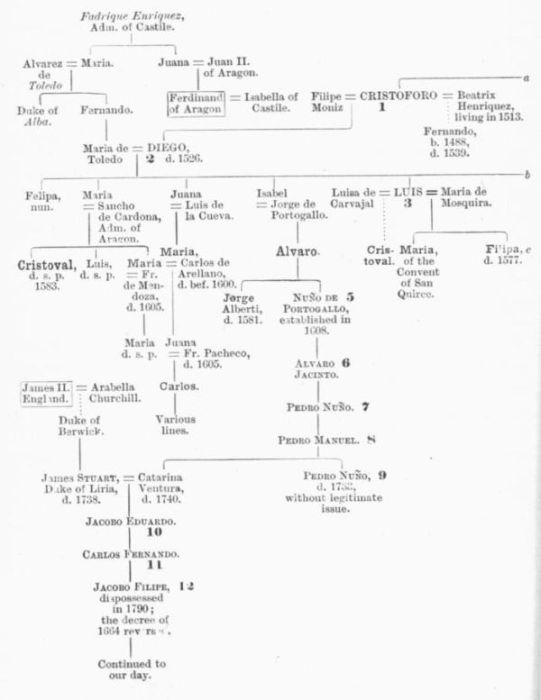
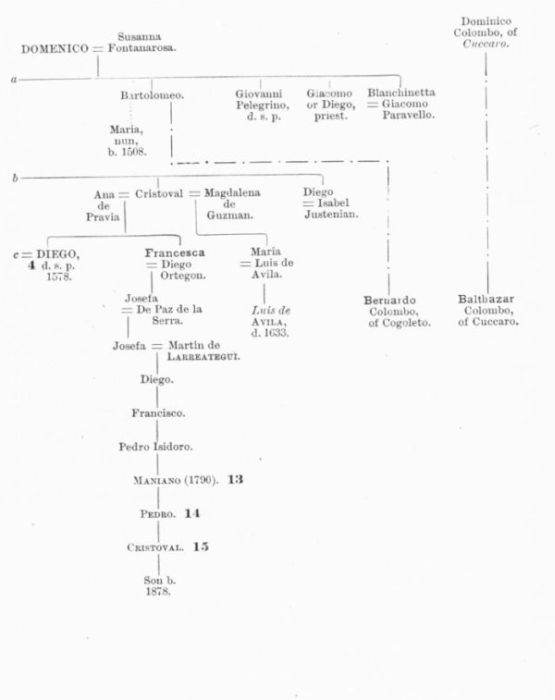
Note. Dotted lines mark illegitimate descents; the dash-and-dot lines mark pretended descents. The heavy face numerals show the successful holders of the honors of Columbus. The lines a a, b b, and c c join respectively.
THE COLUMBUS PEDIGREE (1). [1st part] THE COLUMBUS PEDIGREE. (complete view)
THE COLUMBUS PEDIGREE (2). [2nd part] THE COLUMBUS PEDIGREE. (complete view)
His heirs.
His daughter marries her cousin Diego, the male heir.
Columbus's male line extinct.
Luis left two illegitimate children, one a son; but his lawful heirs were adjudged to be the children of Maria de Mosquera, two daughters, one a nun and the other Filipa. This last presented a claim for the titles in opposition to the demands of Diego, the nephew of her father. She declared this cousin to be the natural, and not the lawful, son of Luis's brother. It was easy enough to forget such imputations in coming to the final conclusion, when Filipa and Diego took each other in marriage (May 15, 1573) to compose their differences, the husband becoming Duke of Veragua. Filipa died in November, 1577, and her husband January 27, 1578. As they had no children, the male line of Columbus became extinct seventy years after his death.
The long lawsuit and its many contestants.
The lawsuit which followed for the settlement of the succession was a famous one. It lasted thirty years. The claimants were at first eight in number, but they were reduced to five by deaths during the progress of the trials.
The first was Francesca, own sister of Diego, the late Duke. Her claim was rejected; but five generations later the dignities returned to her descendants.
The second was the representative of Maria, the daughter of Luis, and sister-in-law of Diego. The claim made by her heir, the convent of San Quirce, was discarded.
The third was Cristoval, the bastard son of Luis, who claimed to be the fruit of a marriage of Luis, concluded while he was in prison accused of polygamy. Cristoval died in 1601, before the cause was decided.
The fourth was Alvaro de Portogallo, Count of Gelves, a son of Isabel, the sister of Luis. He had unsuccessfully claimed the titles when Luis died, in 1572, and again put forth his claims in 1578, when Diego died, but he himself died, pending a decision, in 1581. His son, Jorge Alberto, inherited his rights, but died in 1589, before a decision was reached, when his younger brother, Nuño de Portogallo, became the claimant, and his rights were established by the tribunal in 1608, when he became Duke of Veragua. His enjoyment of the title was not without unrest, but the attempts to dispossess him failed.
The fifth was Cristoval de Cardona, Admiral of Aragon, son of Maria, elder sister of Luis. This claimant died in 1583, while his claim, having once been allowed, was held in abeyance by an appeal of his rivals. His sister, Maria, was then adjudged inheritor of the honors, but she died in 1605, before the final decree.
The sixth was Maria de la Cueva, daughter of Juana, sister of Luis, who died before December, 1600, while her daughter died in 1605, leaving Carlos Pacheco a claimant, whose rights were disallowed.
The seventh was Balthazar Colombo, a descendant of a Domenico Colombo, who was, according to the claim, the same Domenico who was the father of Columbus. His genealogical record was not accepted.
The eighth was Bernardo Colombo, who claimed to be a descendant of Bartholomew Columbus, the Adelantado, a claim not made good.
These last two contestants rested their title in part on the fact that their ancestors had always borne the name of Colombo, and this was required by Columbus to belong to the inheritors of his honors. The lineal ancestors of the other claimants had borne the names of Cardona, Portogallo, or Avila.
Nuño de Portogallo succeeds, and the line later changes.
From Nuño de Portogallo the titles descended to his son Alvaro Jacinto, and then to the latter's son, Pedro Nuño. His rights were contested by Luis de Avila (grandson of Cristoval, brother of Luis Colon), who tried in 1620 to reverse the verdict of 1608, and it was not till 1664 that Pedro Nuño defeated his adversaries. He was succeeded by his son, Pedro Manuel, and he by his son, Pedro Nuño, who died in 1733, when this male line became extinct.
The titles were now illegally assumed by Pedro Nuño's sister, Catarina Ventura, who by marriage gave them to her husband, James Fitz-James Stuart, son of the famous Duke of Berwick, and by inheritance in his own right, Duke of Liria. When he died, in 1738, the titles passed to his son, Jacobo Eduardo; thence to the latter's son, Carlos Fernando, who transmitted them to his son, Jacobo Filipe. This last was obliged, by a verdict in 1790, which reversed the decree of 1664, to yield the titles to the line of Francesca, sister of Diego, the fourth holder of them. This Francesca married Diego Ortegon, and their grandchild, Josefa, married Martin Larreategui, whose great-great-grandson, Mariano (by decrees 1790-96), became Duke of Veragua, from whom the title descended to his son, Pedro, and then to his grandson, Cristoval, the present Duke, born in 1837, whose heir, the next Duke, was born in 1878. The value of the titles is said to-day to represent about eight or ten thousand dollars, and this income is chargeable upon the revenues of Cuba and Porto Rico.
In concluding this rapid sketch of the descent of the blood and honors of Columbus, two striking thoughts are presented. The Larreateguis are a Basque family. The blood of Columbus, the Genoese, now mingles with that of the hardiest race of navigators of western Europe, and of whom it may be expected that if ever earlier contact of Europe with the New World is proved, these Basques will be found the forerunners of Columbus. The blood of the supposed discoverer of the western passage to Asia flows with that of the earliest stock which is left to us of that Oriental wave of population which inundated Europe, in the far-away times when the races which make our modern Christian histories were being disposed in valleys and on the coasts of what was then the Western World.