Front matter (continued 2)
Reading edition
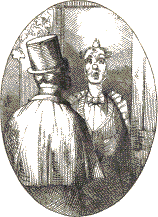
Now, this is the very thing John much wished to do:—he had been imperceptibly backing, for the last five minutes, towards the door, fearing to turn tail upon the enemy—the choleric Mr. and Mrs. Brown; who appeared, in their very fierceness, to counteract each other’s fire—each pulling the other back, seeming to get more and more ferocious the nearer their victim gained the door,—for, when the baited John reached it, he turned the handle of the lock behind him, still facing his
******
The Police Officer has had his word, or rather, word of words, with Mr. Brown:—news, said to be important, but of the wildest and most improbable character—news, appearing to that gentleman beyond all alias Boultoff, &c., &c., and three other persons, names unknown, now incarcerated in Dover Jail, for the robbery of John Brown, of Mizzlington”—a mistake—a foul plot—a base fiction!—At least, so thought the worthy gentleman, who was as ignorant of any wrong done him as the lunatic that resides in the moon. Had the sea-serpent been discovered in the back pond, a gold-mine been found in the dust-bin, or a Sphinx and Centaur been captured in Lincoln’s Inn Fields, Mr. Brown could not have been more astounded!—He knows it to be an imputation that can be disproved in a twinkling, if Mr. Police Inspector will just step next door with him; but, alas!—There the fox’s tail is left in the trap—the skirt of the very coat, borrowed of Mr. Brown, a fortnight since, hangs in the door,—the very door that slammed, when the affrighted gentleman awoke in a dream, last night.
******
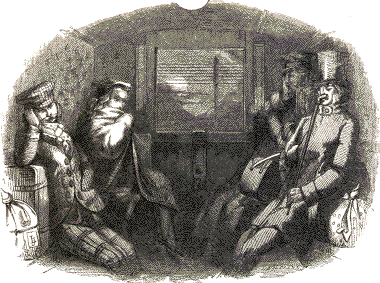
The concluding facts of these eventful sixteen days are simply as follows:—to Mr. Spohf is the issue due—he was bound to spend the sabbath at Canterbury, with the cathedral and organ; upon the journey thither, he happened to recognise some fellow-travellers, better known to him than he was to them. From a slight conversation that transpired, he learned their destination to be Boulogne, or rather, Dover; so he stopped at Ashford, telegraphing their persons to Dover, where, upon arrival, they were provided with lodging free of expense; from that his, under the cruel shears, in Dover Jail!
******
******
******
Captain de Camp, as you may suppose, after these lucky stars, again entered upon foreign service; being ordered to New South Wales, for fourteen years—he sailed in the same transport with his two sons. Lady Lucretia stayed at home, leading a very retired life—she resided in a vast mansion at the “West-end,” a castle at Millbank.
Mr. Spohf, of course, taking advantage of his rival’s absence, wins upon Miss Jemima Brown—in the end, marrying her, to live happy ever afterwards?—No, such was not the case! Mr. Spohf espoused Miss Cecilia Lark, who blessed him with a large family and everything else that woman can. Spohf’s means have increased, annually, with his family:—all are musical, and the eldest girl is to be an “English Lark,” that will surpass the “Swedish Nightingale,” or any other foreign bird—the continentalists attribute it to the southern origin of her papa; and, accordingly, claim Cecilia Spohf as their own.
The Misses Brown still remain open to offers, and are reported to be well worth having. Mr. John Brown, Junr., is married to Miss Gay; a better match there could not be—they both pull one way; but, unfortunately the wrong one—rumour says they are extravagant. Tom is at Westminster School; he has not distinguished himself in any particular study, unless it be boating:—they say he would have won in the last race had he not broken his scull—a mishap that sadly terrified Mrs. Brown; for the note, intimating the catastrophe, said nothing sculls being more wooden than her son’s. Mr. and Mrs. Brown are really very happy!—Victoria and Albert are now united—the party-wall is removed. Mr. B. has retired from business, not even discounting bills:—he does not go to the city now; or at least if he does, it is behind Mr. Strap, who makes an important coachman, having filled out amazingly—may be, thinking, “he who drives fat cattle should himself be fat;” for the bays are too corpulent to kick, and take the journeys at their own pace. John—John Brown, “private,” now keeps a public house—“the Brown Arms,” “the Rampant Locomotive,” “Noted Brown Stout House,” at the corner of Brown Terrace:—it was a beer-shop when John first took it, but he has since obtained a licence, and married Mary, the house-maid.
Mr. Brown is notorious for keeping up the festive Christmas season!—He now makes it a rule to invite only those he loves or respects—not because they are well-to-do in this world, but because he likes or admires them;—seeming fully assured of Time’s progress, and that—
CHRISTMAS COMES BUT ONCE A YEAR!
The End.
The Cuts, inserted in the text, are engraved by the Brothers Dalziel; the Plates (from zinc) printed by Leightons & Taylor; and the Letter-press by Bentleys & Fley, Bangor House,
Shoe Lane.
