Margaret Robertson (continued 5)
Reading edition
Christie didn’t enjoy the last part of her story very well. She could not help thinking that some of the trials that the young lady hinted at existed only in her own imagination. But she did not say so. She listened to the whole with unabated interest, and in return, told Gertrude the story of her own life. It was given in very few words. She told about her mother’s death, and their coming to Canada, and what happened to them afterwards, till they had been obliged to leave the farm and separate.
It is just possible that the young lady, who sat listening so quietly to these simple details, took to herself the lesson which the story was so well calculated to teach. But Christie had no thought of giving her a lesson. She told of Effie’s wise and patient guidance of their affairs, of the self-denial cheerfully practised by all, of her own eager desire to do her part to help keep the little ones together, of Effie’s slow consent to let her go; all this, far more briefly and quietly than Miss Gertrude had spoken of her childish days that were passed in her aunt’s house. By experience the young lady knew nothing of the real trials of life. She had no rule by which to estimate the suffering which comes from poverty and separation, from solitary and uncongenial toil. Yet, as she sat listening there, she caught a glimpse of something that made her wish she had said less about the troubles that had fallen to her lot. Christie faltered a little when she came to speak of the first months of her stay in town, and of the time when her sister went away.
“I was very, very home-sick. If it hadn’t been for shame, I would have gone at the end of the first month. And when my sister went away in the spring, and left me here, it was almost as bad. It seems like a troubled dream to look back upon it. But it has passed now. It will never be so bad again—never, I am sure.”
“You have got over your home-sickness, then? And are you quite contented now?” she asked, with great interest.
“Yes, I think so. I think it is right to stay. I am very glad to stay, especially now that I am out here, in the country almost. There was a while in the spring that I was afraid I should not be able to stay. But I am better now. I shall soon be quite strong.”
The little boy stirred in his crib, and his eyes opened languidly. Christie was at his side in a moment. To the astonishment of his sister, he suffered himself to be lifted out and dressed without his usual fretful cry.
“How nicely you manage him!” she said, at last. “This used to be a troublesome business to all concerned.”
Christie did, indeed, manage nicely. Her experience with the little Lees stood her in good stead now. She was very quick, and gentle and firm with the little boy, beguiling him from his fretfulness by little tales or questions, or merry childish talk, till the last string was tied and the last of his beautiful curls arranged. Then he was put in his favourite place among the cushions of the great chair, and the chair was drawn close to the window. Gertrude leaned over him for a moment, and then, kneeling down, she kissed his little white hands, and stroked his thin, pale face, her own looking grave enough all the while.
“He scarcely knows me now,” she said. “He has almost forgotten me since he has been so ill. But we shall be friends again, my dear little brother.”
“Where’s Clement?” asked the child. “He is your little boy.”
“Oh, but I want two little boys. I want a little boy to take care of and love with all my heart—a gentle, patient little boy, who doesn’t fret and cry when he is dressed, any more. I want a little boy to take into the garden in his little carriage, and to be my little boy always.”
“Christie takes me into the garden. I like Christie she’s good.”
“I’m quite sure of it,” said Miss Gertrude. “Listen: There is Clement. Shall I open the door and call him in, if he will promise to be good?”
What a contrast they made! The cheeks of one flushed with health, his bright eyes dancing with happiness, the other—oh, so wan and thin and fragile! Miss Gertrude’s eyes filled with tears as she tried to restrain Clement’s eager caresses. They were very glad to see each other. Climbing up into the chair beside him, Clement put his arms round his brother’s neck and stroked his cheeks.
“You’ll soon be well now, Claudie,” he said, “and we’ll go and see the pony. Oh, such a fine fellow as he is! You’re getting well now, aren’t you?” he added, wistfully.
“Yes, I’m well; but I am too tired,” said Claude, laying himself back among the pillows, with a sigh. Miss Gertrude lifted Clement down, and held him firmly, saying:
“Clement is not going to tire you any more. He is going to be very gentle and good when Christie lets us come in here; and by and by we will go and sit under the locust-tree and be very good and happy all together.”
And so they did that afternoon, and many afternoons besides. A very happy time they had. Far from banishing Miss Gertrude and little Clement, the doctor encouraged them to be much with the sick boy. The noisy Clement was permitted to become the almost constant companion of his brother, on certain conditions. He was never permitted to weary him or vex him. A walk with his brother was made the reward of good behaviour; and banishment from the green room for an entire day was felt to be so severe a punishment that it was not insisted upon more than once or twice during the time of his mother’s absence. Upon both the boys this intercourse had a very beneficial effect. The little invalid brightened under the influence of Clement’s merry ways, now that the watchful care of Miss Gertrude or Christie kept his mirth within bounds, and prevented him from being wearied with too boisterous play.
The whole of the pleasant summer morning was passed by him in the open air. Up and down the broad garden-walks he was drawn, when the weather was fine. Sometimes he was content to sit for hours in the shadow of the locust-tree near the window, or in the pleasant cedar walk at the other end of the grounds. Sometimes he was permitted to walk a little while on the lawn; and in a few days the dawning colour on cheek and lip was hailed as a hopeful sign of returning health.
Christie grew quite satisfied with her new place, and devoted herself to her little charge with an interest that was untiring; and the increasing affection of the little boy made her service day by day more pleasant to her.
Of Miss Gertrude she scarcely knew what to make. She was always very kind to her, and spent much time with her and little Claude, either in the garden or in the green room. But she was not gentle and pleasant to all the world. She was sometimes full of impatient and discontented thoughts, and now and then let fall words that proved this too plainly. Christie was sometimes pained, and sometimes amused, as she listened to her. Like too many young people, she had a keener eye for defects than for excellences of character; and she never hesitated to amuse herself at the expense of those with whom she came in contact. Sometimes her remarks were amusing and harmless enough, but too often they were unkind and severe; and more than once she tried to place in a ludicrous light characteristics which she could not but acknowledge were real excellences. Christie had an uncomfortable consciousness that there was something wrong in all this, even amid the interest and admiration which the young girl had awakened in her, but she was very far from realising how wrong this spirit of criticism is, or how injurious the indulgence of it might prove to Miss Gertrude.
These things, as they came up, marred but little Christie’s admiration of her bright and winning ways. The young lady’s impatience and pride were never manifested where she or the boys were concerned; and the charm there was in constant intercourse with one of her own age was delightful. Notwithstanding the difference in station, the two young girls had many subjects of interest common to both, which they were never weary of discussing.
The enjoyment of their companionship was not all on Christie’s side. Since her residence in her father’s house, Miss Gertrude had had no companions of her own age for whose society she cared. She was constantly surprised and delighted to find how entirely her brother’s little nurse could understand and sympathise with some of her moods and fancies. She brought out her favourite books and discussed her favourite subjects, and spoke to her of many things as she had never spoken to any one since she bade adieu to her young cousins at home.
It cannot be denied that Christie’s evident admiration of her helped to bespeak Miss Gertrude’s good-will. But the young lady was not very vain. She really liked Christie, and took pleasure in her society; and she admired the tact and patience with which she managed Little Claude.
The first few days of their intercourse was to each like the reading of a pleasant book; nor did their interest in each other fail as they grew better acquainted.
Chapter Fifteen.
Peeps into Fairy-land.
“Christie,” said Gertrude, coming into the green room just as the little nurse had arranged the crib for Claude’s mid-day nap, “did you ever read ‘The Lady of the Lake’?”
Christie was sitting down, with a basket of little socks and a bunch of darning-cotton in her hand, and she looked up eagerly as she entered.
“No, I never read it; but I have heard of it. It is a nice book, isn’t it?”
“Yes. Get your work ready, and I’ll tell Martha to look after Clement for the next two hours, and I will read to you while Claude sleeps. I have read it once; but I would like to read it again.”
And she did read it. Soon Christie’s socks and darning-cotton were forgotten, and she sat listening intently. It was something entirely new to her, and she yielded herself to the charm of the book with an eagerness that delighted the reader. Miss Gertrude liked the book at the second reading even better than at the first. She enjoyed it this time for herself and Christie too.
“There seems so much more in a book when you have anybody to enjoy it with you,” she said, at the end of an hour. “But I am tired of reading aloud. You must take it a while now.”
“But I have got out of the way of reading aloud,” said Christie; “and besides, I do not read so well as you.”
“Oh, never mind; you’ll read well enough. And give me the basket; I’ll darn your socks in the meantime.”
“The socks? Oh, I had forgotten them! But there is very little to do. I’ll read a while if you like; but I know I don’t read so well as you.”
She took the book, however, and another hour passed rapidly away. She shut the book with a sigh when Claude moved.
This was the first of many such readings. During the hours when Claude was asleep and Clement under the immediate superintendence of Martha, Miss Gertrude brought her book into the green room and shared the pleasure it gave her with her little brother’s nurse. And at other times, too, when the little boys were amusing themselves together in the garden, they read and discussed their books, sitting in the cedar walk, or under the shadow of the locust-tree. And a very pleasant month they had. Christie had great enjoyment in all this; and apparently Miss Gertrude had no less; for she refused several invitations, and broke more than one engagement with her aunt, rather than interfere with these new arrangements.
But one day Miss Gertrude came into the green room with a cloud upon her brow. It was plain that something was the matter.
“It has been a great deal too pleasant to last long,” she said, throwing down a letter which she held in her hand. “Here is papa coming home immediately. I wouldn’t mind his coming,” she added, checked by the look of surprise on Christie’s face. “I shall be very glad to see him; and he won’t make much difference—he is so seldom at home. Besides, he will let me please myself about things. He has no fancy for my going here and there at everybody’s bidding. But Mr Sherwood is coming with him—Mrs Seaton’s cousin—a very disagreeable person; at least, I think so. Mamma thinks him wonderfully good, and he is a great favourite with papa, too. I am sure I don’t know why. I think he is conceited; and he is an Englishman, besides.”
Christie laughed.
“That’s not a very good reason.”
“Perhaps not. But he has such a cool, indifferent way of asserting the superiority of the English over all other nations, as though the question need not be discussed. ‘It must be quite evident to everybody,’ his manner seems to say.”
After a pause, Miss Gertrude continued:
“And that is not all. He is very meddlesome. He is always telling mamma what ought to be expected from a young lady like me, and getting her to annoy me about lessons and other things; at least, I think so. I know he thinks me quite childish; and sometimes he interferes between Clement and me. What do you think he had the impertinence to say to me once? That no one was fit to govern who had not learned to obey. That it would be wiser for me to learn the lesson of obedience myself, than to attempt to teach it to my little brother.”
“And what answer did you make?” asked Christie, after a little hesitation.
“I turned and walked out of the room; and I did not see him again. I chose to be out of the way when he came to say good-bye. I dare say that is one reason why I don’t like the thought of his coming just now. I feel a little awkward, you know. I owe him one good turn, however. If it had not been for him, I think father would have listened to Aunt Barbara and sent me to school. I ought to thank him for that.”
“And didn’t you want to go to school?” asked Christie, in some surprise.
“No, indeed! I never was at school, you know. We had a governess and teachers at home. I am to have private teachers for some things here, when the summer is over, unless I should be sent to school, after all.”
When the gentleman made his appearance among them the next day, he did not look like the formidable person Christie imagined him to be. They were sitting on the lawn, in the shadow of the locust-tree, when he arrived; and before he went into the house he came and shook hands with Miss Gertrude and the little boys. Christie thought he must have quite forgotten his falling-out with the young lady, he met her so pleasantly and frankly. The embarrassment was all on her side.
As for the boys, they were beside themselves with delight. It was easy to see they did not share their sister’s dislike. Poor little Claude clasped his arms about his neck and kissed him eagerly. Clement, in a way that showed he felt sure of his sympathy, began to tell him of the pony and the rabbits, insisting that he should come with him to the stable to see them at once.
The next day was Sunday. After a fortnight of lovely summer weather, a great change had taken place. The rain was falling in torrents, and the wind was whistling through the trees in the garden, when Christie looked out. A rainy day in the green room was by no means such a dreary matter as it used to be in Mrs Lee’s attic-nursery, with only a glimpse of driving clouds and dripping roofs to vary the dulness within. So Christie comforted little Claude for the want of his morning ride and ramble in the garden, telling him how glad the dusty leaves and thirsty little flowers would be for all the bright drops that were falling on them. She told him how the bees, that had been so busy all the week, must take a rest to-day, and how warm and dry the little birds would be in their nest in the pear-tree, for all the driving rain. Setting him in his favourite chair by the window, she amused him with talk like this, as she went about putting things in order in the room. While she comforted him she comforted herself; for the rain had brought a disappointment to her too. It had been arranged that Martha should take charge of Claude while Christie went to church in the morning, where she had not been for several Sabbaths. But remembering Mrs Greenly’s oft-repeated warnings against exposing herself to dampness, she did not like to venture in the rain. So she had to content herself at home.
This was an easier matter than it had sometimes been. As the morning wore away, and the time approached for the little boy to take his usual sleep, she was quite contented to be where she was.
“It is very pleasant, all this reading with Miss Gertrude,” she said. “She is very kind, and I like her very much. But I shall be glad to be alone for a little while.”
Claude’s eyes closed at last, and she was just taking her Bible from the table beside her, when the door opened and Miss Gertrude entered.
“I only heard this minute from Mattie that you did not go to church, after all,” she said. “No wonder! What a rain! Papa thought it was too bad to take out the horses. He is tired, too, after his journey. Is it half-past eleven? Everybody is lazy on Sunday morning. But there will be an hour or two before lunch yet. I have brought our friend ‘Jeanie.’ There will be time for a chapter or two.”
Christie looked up with an expression of surprise and doubt on her face.
“Jeanie Deans, is it? But it is the Sabbath-day!”
Miss Gertrude laughed.
“Well, what if it is? I’m sure there is no harm in the book. You looked exactly like Aunt Barbara when you said that; I mean, all but her cap and spectacles. ‘The moral expression’ of your face, as she would say, was exactly the same.”
Christie laughed, but said nothing.
“You don’t mean to tell me that there is any harm in the book?” continued Miss Gertrude.
“It is not a right book for the Sabbath, though,” said Christie, gravely.
“Well, for my part, I don’t see that a book that it is right to read every other day of the week can be so very bad a book for Sunday,” said Miss Gertrude; sharply.
Christie made no reply.
“I declare, I like Aunt Barbara’s way best; to call all tales wicked at once, and have nothing to do with them—these vile novels, as she calls them. Come, now, you are not in earnest?”
“I am quite in earnest,” said Christie, gently, but firmly.
“And you have been reading or listening to this, or something like it, all the week! Well, that is what I should call straining at a gnat and swallowing a camel.”
“Well, perhaps it is. I never thought about it in that way before. But I am sure it is not right to read such books on the Sabbath-day. And perhaps it is wrong to read them at all—at least, so many of them as we have been reading. I almost think it is.”
She spoke sorrowfully, but not in any degree offensively. Indeed, she seemed to be speaking rather to herself than to Miss Gertrude. Yet the young lady was offended. Assuming the tone and manner with which she sometimes made herself disagreeable, she said:
“I should regret exceedingly to be the means of leading you to do anything that you think wrong. I must try and enjoy my book by myself.” And without looking towards her, she walked out of the room.
For a little while Christie sat motionless, gazing at the door through which she had disappeared, and thinking sorrowfully that this was a very sad ending to a very pleasant time. But there was a sharper pain at her heart than any that this thought awakened. All those days that had been so bright in passing had a shadow over them as she looked back upon them. To what end and purpose had all their intercourse tended? What was the cause of the feeling of uneasiness, almost of guilt, that had come on her now and then at quiet moments? It had clung to her all the morning. She was not very wise or far-sighted. She could not reason from cause to effect, or analyse her own feelings very closely. But even when she was congratulating herself on the prospect of a quiet time she was half conscious that she was not very glad to find herself alone. When she sat down with the Bible in her hand, there fell on her spirit no such blessed sense of rest and peace as used to transform the dim attic into something pleasanter than this pretty green room, and fairer than the summer garden.
“There is something wrong,” she said to herself, as she listened to Miss Gertrude’s footsteps on the stair. “I am afraid I am one of the folk that Mrs Grey used to tell about, that an easy life is not good for. Better the weary days and nights than to fall back into my old ways again, just content with the pleasure the day brings, without looking beyond. Who would have thought that I could have forgotten so soon? It is just this foolish novel reading, I think. Aunt Elsie said it was a snare to me; and Effie said something like it once.”
“Well, I’m not likely to have more of it,” she continued, with a sigh. “I suppose I ought to be glad that Miss Gertrude went away vexed; for I dare say I should not have had courage to-morrow to tell her that so much of that kind of reading is not good for me, Sabbath or week-day. It couldn’t have lasted long, at any rate. Of course, when Mrs Seaton comes home it will be quite different. Well, it will be better for me—a great deal better. I must be watchful and humble. To think that I should grow careless and forget, just when I ought to be so mindful and thankful!”
A few tears fell on the leaves of her little Bible; but by and by the former peace came back again, as she felt herself half resting indeed on the only sure foundation. The foolish fancies that had haunted her imagination all the week vanished before the influence of the blessed words on those familiar pages. They were precious still, though the strange charm of her new companionship had turned her thoughts from them for a time. She forgot her idle dreams, the foolish fancies she had indulged, the vain longing for this or that earthly good for herself and for all at home that had at times for the last few days taken possession of her. The peace which flows from a sense of pardon and acceptance and a firm trust was for the time enjoyed. To be and to do just what God willed seemed infinitely desirable to her.
“‘Great peace have they that love Thy law,’” she murmured. “I do love it; and I have the peace.”
Very humble and earnest were the prayers that rose beside the bed of little Claude that day, and very grave, yet happy, was the face that greeted his waking. Christie needed all her patience, for this was one of Claude’s fretful days. He grew weary of being confined to one room; he longed for the company of his sister and Clement. His brother came in for a little while after he had had his dinner; but he was in one of his troublesome moods, and vexed and fretted Claude so much that Christie was fain to give him over to Martha’s charge, bidding him not come into the green room till he was ready to be good and kind.
In the meantime, Miss Gertrude was enjoying her book in her own room; or, rather, she was not enjoying it. It had lost much of its interest to her. She was not in a humour to enjoy anything just then. She wandered into the parlour at last, thinking a chat with her father, or even with Mr Sherwood, would be better than her book. But her father was in the library, with the door shut, and Mr Sherwood had gone out, notwithstanding the rain. The deserted room looked dreary, and she went to her own again.
At six she went down to dinner. They were not a very lively party. Mr Seaton looked sleepy, and yawned several times before they went to the dining-room. Mr Sherwood was very grave, and, indeed, “stupid,” as Gertrude thought.
“What a misfortune a rainy Sunday is!” she said at last. “One scarcely knows what to do with one’s self. This has seemed twice as long as other days.”
“Pray don’t let any one hear you say that, my dear,” said her father, laughing. “If one rainy Sunday exhausts the resources of a well-educated young lady, I am afraid her prospects are not the brightest.”
Miss Gertrude laughed.
“Oh, father, I haven’t quite got to that state of exhaustion! But I have been dull and stupid—not able to settle myself to the enjoyment of anything—all day.”
“Where are the boys?” asked her father.
“Claude is in the green room, with his nurse. Indeed, I suppose both boys are there just now. After dinner I shall send for them. Claude really seems better; he runs about again.”
“Stay,” said Mr Sherwood. “This reminds me that I brought a letter last night for the new nursemaid; at least, I suppose so;” and he took a letter from his pocket, and laid it on the table.
“You don’t mean that you brought that home last night, and have kept it till this time?” said Miss Gertrude, with much surprise.
“Tut, tut, my child!” said her father, touching the hand outstretched to take the letter. She withdrew her hand without a word.
“You could not have been more indignant had the letter been for yourself. It is not such a terrible oversight,” said Mrs Lane, or Aunt Barbara, as she was commonly called, who had looked in on her way from church. “If it is like most of the letters of that sort of people, it would be little loss though she never got it. Such extraordinary epistles as I sometimes read for my servants!”
“This seems quite a respectable affair, however,” said Mr Seaton, reading the direction in Effie’s fair, clear handwriting:
Christina Redfern, Care of J.R. Seaton, Esquire.
“That is a very pretty direction—very.”
“I am very sorry, and very much ashamed of my carelessness,” said Mr Sherwood. “I hope, Miss Gertrude, you will forgive me, and I will never do so again, as little boys say.”
But he did not look either very sorry or very much ashamed, Miss Gertrude thought, and she made no reply. The rather uncomfortable silence that followed was broken by a low voice at the door:
“Am I to take the children, Miss Gertrude?”
Master Clement answered:
“No, I shan’t go to bed yet. It’s only seven o’clock.”
“Come in,” said Mr Seaton, kindly. “I want to know how these little fellows have behaved since their mother went away.”
Christie came forward shyly, curtseying, in some confusion, to Mrs Lane, whom her short-sighted eyes did not discern till she was close upon her.
“I hope they have been good and obedient, and have not given you much trouble?” said Mr Seaton again.
A little smile passed over Christie’s mouth. “Master Clement is Miss Gertrude’s boy, sir,” she said, as she stooped to buckle the belt of that active young gentleman.
“And I’m very good. She punishes me when I ain’t good.”
“I’m afraid she has enough to do, then. And the doctor thinks Claude is better, does he?” he asked, caressing the pale little face that lay on his shoulder.
“Yes,” said Christie, doubtfully. “He says he is better.”
There was no mistaking the look of wistful interest that overspread her face as she looked at the child.
“He is very good and patient, almost always,” she added, as she met the little boy’s smile.
“I’m a great deal better,” said Claude. “The doctor says I may ride on the pony some day.”
“Have you had much to do with children?” asked Aunt Barbara.
“I lived with Mrs Lee eight months.”
“And she parted with you because she needed a person of more experience?”
“Yes, I suppose so. I wasn’t strong enough Mr Lee thought. I was very sorry.”
It was a sore subject with Christie yet, and the colour went and came as she spoke.
“And where were you before?” asked Mr Seaton, wishing to relieve her embarrassment.
“I was with our own children, at home. I was one of the children then myself. I never was away from home before my father died.”
“Look, here is something for you. Cousin Charles says it is for you. It is a letter,” said Clement, holding it up.
If there had been ten Aunt Barbaras in the room, Christie could not have restrained the expression of surprise and pleasure that rose to her lips at the sight of Effie’s familiar handwriting, and her hands quite trembled as she took it from the little boy.
“Now, Claudie,” said the young lady, coming forward, “it is time for you to go with Christie. Say ‘good-night’ to father and Aunt Barbara.”
For a single moment the look of peevish resistance that used to come so often to the child’s face passed over it, but it changed as Christie stooped down, saying softly:
“Will you walk? or shall I carry you, as they carried the little boy home from the field?”
“And will you tell me more?” he asked, holding out his hand.
“Oh, yes; and how glad his mother was when he grew better again. Now walk a little bit, and I will carry you up-stairs. The doctor says he ought to be encouraged to walk,” she said to his father, as she set him down.
The child bade them “good-night” quite willingly, and went.
“Clement, stay with me,” said his sister. “Christie will not get much good of her letter for the next two hours, if you are with her.”
Clement was very willing to stay. But for all that Christie did not get much good of her letter for an hour and more, except the good it did her to hold it in her hand, and feeling the delight that was in store for her. Miss Gertrude came to the green room some time after, to find her still rocking and singing to the wakeful Claude.
“You don’t mean you haven’t read your letter yet?” she said, in astonishment.
“I have opened it. They are all well. I like to be sure of a quiet time to read a letter.”
“Well, take the lamp and go over there. I will take care of him for the present.”
“He is just asleep now,” said Christie, hesitating. She was thinking that she would like to have the room to herself before she read her letter, but as Miss Gertrude seated herself in the low rocking-chair, she had only to take the lamp and go to the other side.
She soon forgot Miss Gertrude, Claude, and all besides, except Effie and the bairns at home. Effie had the faculty, which many people of greater pretensions do not possess, of putting a great deal into a letter. They were always written journal-wise—a little now, and a little then; and her small, clear handwriting had come to be like print to Christie’s accustomed eyes. So she read on, with a smile on her lip, quite unconscious that the eyes that seemed to be seeing nothing but the bright embers were all the time furtively watching her. Miss Gertrude longed for a peep into the unseen world in which her humble friend was at that moment revelling. She felt positively envious of the supreme content that was expressed on Christie’s plain, pale face.
She would not have understood it had the peep been granted. She never could have understood the interest which in Christie’s mind was connected with the various little items of news with which Effie’s letter was nearly filled. There was the coming and going of the neighbours, a visit from blind Alice, and her delight in her canary. There was an account of Jennie’s unprecedented success in chicken-raising, and of little Will’s triumphant conquest of compound division; and many more items of the same kind. There were a few words—a very few—about the day Christie had spent in the cemetery with John Nesbitt, which brought the happy tears into her eyes; and that was all.
No, the best came last. The letter had been opened again, and a slip of paper had been added, to tell how Effie had got a letter from Mrs Lee. It was a very short letter, scarcely more than a line or two; but Effie was to keep it safe to show to Christie when she came home. In the meantime she must tell her that she had never in all her life been so proud and happy as she had been when she read to Aunt Elsie what a help and comfort her dear little sister had been to the writer in the midst of sickness and sorrow; and more than that, how, by means of her little Bible and her earnest, humble words, she had opened to her a way to a higher hope and a better consolation than earth could give, and how the lady could not go away without doing what she knew would give her friend more pleasure than anything else she could do. She must tell Christie’s sister how good and patient and useful she had been.
“And so, Christie, when you are weary or desponding, as I am afraid you sometimes are, I think you may take a little rest and pleasure from the thought that you have been favoured to be made the giver of a ‘cup of cold water to one of His little ones.’”
Oh, it was too much! Such words from her dearest sister Effie! And to think that Mrs Lee should have written them that last night, when she must have been so weary! And had she really done her good? Oh, it was too much happiness! The letter fell from her hands, and her face, as she burst into happy tears, was hidden by them. It was only for a moment, however. She fancied herself quite unobserved as she took up her precious letter.
“Are they all well at home?” asked Miss Gertrude, as Christie, having stealthily wiped away all traces of her tears, came and sat down on the other side of the cot, where Claude was now sleeping soundly.
“They are all quite well. My aunt is better. Everything is just as usual.”
“Your sister is a very pretty writer, is she not?” she asked.
“Yes, she writes very plain and even. Her writing is easily read.” But Christie did not offer to show her the letter, as Miss Gertrude half hoped she would. It was not altogether for the gratification of her curiosity, nor chiefly for that, she wanted to see it. Though her companion was sitting there, with her cheek leaning on her hand, so gravely and so quietly, she knew that her heart was by no means so quiet as her outward appearance seemed to indicate. She saw that it was ready to overflow with emotion of some kind—happiness, Miss Gertrude thought, but was not sure.
But it could not be all happiness. Christie must be longing for the sight of the sister whose written words could call forth such tears as she had seen falling even now. And she wished to be able to sympathise with her, to say some word that would establish confidence between them. Besides, she had a feeling that she ought to atone for her petulance in the morning. At any rate, she wanted to be sure that Christie did not resent it.
But Christie said nothing. She sat quite still, and her thoughts were far-away. When she roused herself, it was not to speak, but to take up her little Bible, that lay within reach of her hand.
“How fond you seem to be of that book!” said Miss Gertrude, as she watched her turning over the leaves.
“Yes,” said Christie, quietly. “Effie gave it to me.”
“Are you going to read now?”
“I was looking for something that Effie wrote about. I can’t mind the exact words, and I am not sure where to find them.” And she still turned over the leaves.
“Have you found it?” said Miss Gertrude, when she paused.
“Yes; I have found it. Here it is. ‘And whosoever shall give to drink unto one of these little ones a cup of cold water only, in the name of a disciple, shall in no wise lose his reward.’”
She read it slowly and gravely, but Miss Gertrude could by no means understand the look of mingled doubt and pleasure that she saw on her face when she had done.
“Well?” she said, inquiringly.
But Christie had nothing to say. Her face was bowed down on her hands, and she did not raise it till she heard the door open and shut; and when she looked up, Miss Gertrude was gone.
Chapter Sixteen.
A talk in the garden.
The next day was rainy, and the next, and the next. There was not a glimpse of sunshine till Friday, and then it was only a glimpse. There was no such thing as going into the garden, or even into the wide gallery that ran along the ends of the house. The only change that little Claude enjoyed all that time was being daily taken into the drawing-room while the green room was aired, or into the dining-room when his father was at home, a little while before he went to bed. He did not grow worse, however. He seemed quite contented with Christie, and fretted less when Clement left him than he used to do.
He was growing very fond of his nurse. She was gentle and patient with him, never sparing herself when he needed to be amused. But her firmness was equal to her gentleness. She never suffered herself to be persuaded to indulge him in anything that had been forbidden by the doctor; and she was faithful to the letter in obeying all his directions. The little boy soon learned to yield to her in all things, and the fretful violence that used to excite fever and exhaust his strength seldom appeared now. The green room was Christie’s acknowledged domain. The “masterful” Clement was taught that he was only admitted there on condition of good behaviour; and really, considering all things, he was very good. He was encouraged to be much in the green room during those rainy days, for his merry ways and pleasant childish talk did his little brother a great deal of good.
As for Miss Gertrude, I am sorry to say she did not recover her good-humour so soon as she ought to have done. She did not resent what she called Christie’s reproof about the book half so much as she did her slowness in responding to her offered sympathy about the letter. She fancied that the little nurse ought to have been very much flattered by the interest she had tried to show in her affairs, and was displeased at the silence with which her advances had been received.
Poor Christie had offended very unconsciously. With her mind full of her letter and all the associations it had awakened, she had been quite unmindful of Miss Gertrude and her attempts to make up the little falling-out of the morning. She only began to realise that the young lady must have been offended, when the days passed over with only a brief visit to Claude. Even then she believed that her vexation rose from what had passed about the book.
But Miss Gertrude was very much out of sorts with herself too. If it had not been a rainy day, she would have availed herself of her Aunt Barbara’s invitation to spend the day with her. But a rainy day at Aunt Barbara’s was not to be thought of. She took a long time to write a short letter to Mrs Seaton, in Scotland. Then she took a fit of practising her music, which, she said to herself, she had sadly neglected of late. Then she read a little. Then she went into the kitchen and superintended the making of a pudding after a new recipe which some one had given to her.
Then she dressed for dinner. But the time is very long from nine in the morning till six at night, when it is rainy without and gloomy within. It wanted full an hour of the usual time for her father’s return when she was quite ready to receive him. She wandered into the dining-room. There were no signs of the dinner-table being laid. She wandered into the drawing-room, and passed her fingers over the keys of the piano once or twice. But she could not settle to steady playing, or, indeed, to anything else.
“I wonder what has become of Master Clement all this time? It is time Martha was in the dining-room. I will go and see.”
She went into the nursery; but it was deserted. She called, but received no answer. A sound of voices from the green room drew her there, and the door opened on as merry a game as one could wish to see. Claude sat in his usual place in the arm-chair, and scattered on the carpet before him were a number of pictured and lettered blocks which his father had brought home. These Master Clement was examining with much pretended gravity. He was looking for the letter C, which Christie had pointed out to him. Whenever he made a mistake and pointed out the wrong letter, he punished himself by creeping on his hands and knees under Claude’s crib; and whenever Christie’s nod and smile proclaimed that he was right, he vaulted over the crib, with such laughter and grimaces, and such a shaking of his tangled curls over his face, that Claude laughed and clapped his hands from sympathy.
Miss Gertrude leaned over the chair and watched the play.
“How noisy you are, Clement!” she said, at last.
“Yes; but it is nice noise. I’m very good to-day, Tudie.”
“Are you? I am very glad to hear it, and very much surprised too.”
“Are you cross to-day?”
“Why? What makes you ask?”
“Oh, because you haven’t been here.”
“I have been busy writing a letter to your mother.”
“Did you tell her that I am a good boy? I am a very good boy; and so is Claudie.”
A leap and a grimace more astonishing than any he had yet accomplished sent Claude into fits of laughter.
“I declare,” said Miss Gertrude, looking down upon him, “I don’t believe your mother would know you if she were to see you now! Why, there is quite a colour in his lips. He really seems better, doesn’t he?”
“Yes, and he has been very good and easily amused all day, though he has not been able to go out.”
There was silence for a time. Both girls stood watching the game that was going on. But soon Christie said:
“If you please, Miss Gertrude, will you show me that stitch again? I have quite lost it.”
“Yes,” said Miss Gertrude; “I will show you. It is quite easy.”
“Yes, I dare say it is. I am afraid I am very dull at learning it.”
She was watching the expert fingers of Miss Gertrude admiringly. It was a piece of work she had commenced long before, but getting tired of it, she had offered to teach Christie, who was to finish it.
“It is very pretty,” said Christie, “and quite easy, when one knows the way.”
“Yes, it is quite easy,” said Miss Gertrude. But her manner was quite different from what it had been at the last lesson.
“She is not going to be vexed with me, if I can help it,” said Christie to herself; and in a little while she said, again:
“Miss Gertrude, have you any objection to my copying this pattern out of your book, to send to Effie? I am going to write to her. She is very quick at such work.”
“Certainly not; no objection at all. You can copy it if you like—if you think your sister can make anything of it.” Then, a little ashamed of her ungracious manner, she added, “I will copy it for you—and another, a much prettier one. When shall you send your letter away?”
“Oh, I am very much obliged! I write so slowly that there is no haste about it. I shall not have my letter ready till Friday.”
The next day Miss Gertrude made herself very busy with her practising, and with a magazine that Mr Sherwood had brought home. The day following she spent with her aunt, who sent for her in the morning. Thursday, she was as tired of her dignity as she was of the rain, and came into the green room with a smiling face, and a nice book in her hand. Christie received her exactly as she would have done had there been no interruption of their intercourse. She did not for a moment think of resenting Miss Gertrude’s coolness. She had been busy every moment of her spare time during these few days, writing to her sister, and she had missed her society far less than it would have pleased the young lady to know. But she was very glad to see her back again, and to hear her declare, as she seated herself in the arm-chair, that after all the green room was the very pleasantest in the house. So, with no more words about it, they fell into their old, pleasant ways again.
Mrs Seaton’s return made less difference in their manner of life than they supposed it would. She seemed to Christie a very different person from the pale, anxious invalid that went away so unwillingly; and indeed she was. Her health and spirits were quite restored. Instead of falling back into the retired mode of life that had become habitual to her since the illness of her little boy, she went into society, as she had done before; and as her circle of friends was large, she had very little time to devote to her children, and Christie continued to have almost as much care of Claude as she had had during his mother’s absence.
There was one change which at first seemed anything but a pleasant one; they left the pretty green room for a smaller one in a higher story. At first it seemed a dull, dismal place, but Christie learned to love it very much before she left it.
Miss Gertrude’s lessons commenced again soon after the return of Mrs Seaton, but there was nothing more said of her going to school, at least for the present. She was not old enough to go much into society, and she had plenty of time to devote to the readings in the upper nursery, as Christie’s new room was called. Her interest in these readings was not uniform. Sometimes for several days at a time her visits were few and brief; but on the whole, she enjoyed them very much, and did not neglect them very long.
The balconied window of the green room was not the only one at which the locust-tree made pleasant music. It shaded also one of the library windows. The library had become so much the resort of Mr Sherwood that it almost came to be considered as his room. He spent much of his time in it undisturbed. So it happened one day, when he was not at all busy, he heard the sound of voices beneath, and looking out, discovered that the nursery party had placed themselves on the rustic seat that always stood there. The September wind had scattered many of the long, slender leaves of the locust; but they had come there rather to enjoy the sunshine than the shade. He could see them quite plainly—Claude sitting on his cushion, Clement running here and there about the lawn, Miss Gertrude, as usual, with her book, and Christie with her work. He could not hear what they said, except a word now and then from the children’s shrill voices. Miss Gertrude pretended to read, but evidently the reading did not prosper; and by and by the book was laid aside, and in the conversation that followed the girls seemed to take an equal part. Mr Sherwood was quite astonished to find himself wishing that he could hear what they were saying; but he could not, except when Miss Gertrude’s voice was raised in warning or in reproof, as Master Clement pursued his own pleasure in a distant part of the garden.
By and by the sound of wheels was heard in the garden, and Miss Gertrude rose quickly.
“Oh, here come visitors!” she exclaimed. Her face was turned towards the window, and he heard every word plainly. “Let us go to the cedar walk. I don’t want to go in; and if they don’t see me they will never think of me. Come, Christie.”
She lifted Claude from his cushion and ran away with him, leaving Christie to follow with the shawls and other things. The book was left behind on the bench, and when the visitors were safe in the house, Mr Sherwood could not resist the desire he felt to go down to see what it was. As he passed the drawing-room door, Mrs Seaton looked out.
“If you are going into the garden, Charles, and should see Miss Gertrude, tell her Mrs Jordan is here, and has asked for her.”
“I dare say she won’t thank me for the message,” he said to himself, as he picked up the book and took his way to the cedar walk. He smiled to himself as he turned over the leaves.
“You are inquired for,” he said. “Mrs Seaton bade me tell you that Mrs Jordan is in the drawing-room with her daughters, and they have asked for you.”
“Oh, dear me! And I thought I was safe for this time! But I don’t think I will go. They’ll forget all about me in a few minutes.”
“Mrs Seaton wishes you to go, however,” said Mr Sherwood, gravely.
Miss Gertrude shrugged her shoulders. They had more than once differed as to the nature and extent of duty she owed to her step-mother. She said nothing, however, but rose.
“I’m going too,” said Clement. “Tudie, you must take me.”
“Cousin Charles, carry me!” entreated Claude.
“No, Clement; you are not to come unless you are sent for. And I’ll come back directly.”
Mr Sherwood took one turn in the garden, and came back to the cedar walk in time to hear the end of Christie’s story:
“And so, when the blind man heard the noise of so many people passing by, he wondered. And they told him that Jesus was passing by, and that all the people were following Him. And he asked, ‘Is it Jesus, who healed the ruler’s little daughter?’ Then he began to call out, as loud as he was able, ‘Jesus, Jesus, Thou Son of David, have mercy on me!’ And all the people told him to be still, and not make such a noise. But he thought, ‘Perhaps Jesus will never come this way again!’ so he cried out all the more.
“Well, Jesus heard him, and He stood still and waited till the blind man came up to Him. And then He said, ‘What wilt thou that I should do unto you?’ And the man said, ‘Lord, that mine eyes might be opened.’
“And with a single word that Jesus spoke, his eyes were opened; and he saw the earth, and the sky, and the wondering crowd, and Jesus. Just think how glad he must have been to come out of darkness to see so many beautiful things! And how good and kind Jesus was!”
“Will Jesus ever come again? And could He make me well and strong like Clement? Oh, I wish He would come!”
It was a very entreating little face that was turned towards her as he spoke. She did not answer him at once, but kissed him, and stroked his hair with loving hands.
“Will He ever come again?” he repeated, eagerly.
“My child, He is near us now. He does not forget little children, and the sick and the blind and the sorrowful. And He hears us, just as He heard the blind Bartimeus, and He cares for us and helps us all the same, though He has gone to heaven.”
“And will He make me well again?”
“I don’t know. If it is best He will. And if He does not make you well, He will make you good and patient, and willing to be sick. And you will be happy—more happy than when you were quite strong and well. Don’t you remember how He took the little children up in His arms and blessed them?”
“Yes; and He said, ‘Suffer the little children to come unto Me.’” But the little boy looked very sad as he said it.
Mr Sherwood took another turn in the garden and approached them from the other side. Christie was wrapping Claude in a plaid, and preparing to wheel him round the garden—as quiet and uninteresting a person, to all appearance, as one could fancy a child’s nurse to be.
“Carry me, Cousin Charles,” entreated little Claude. “It is so much nicer than to be drawn in the carriage. Do take me for a little while.”
“We’ll play horses,” said Clement, making his appearance at the moment, “and I’ll drive. Now, up and away!”
Christie sat down to her work again, while they carried on a merry game up and down the cedar walk, with much shouting and laughter from all.
“And now that must do,” said Mr Sherwood, seating himself on the bench that always stood there. “Your horse is very tired, and he must rest before he goes farther. Sit still, Claude. I am not too tired to hold you—only too tired to run any more.”
“He is very warm,” said Christie, laying down her work to come and pin the plaid more closely about him. She did it very gently, and there was no mistaking the loving looks the little boy gave her.
“I found this book as I came out,” said Mr Sherwood. “Was it you or Miss Gertrude who was making it your study?”
“Did I leave it behind me? It was very careless,” said Christie, in some confusion. “We were both reading it; that is, Miss Gertrude read, and I listened.”
“‘Evidences of the Truth of Revealed Religion’,” he read, turning to the title-page. “Which of you is troubled with doubts on that subject?”
“Neither of us, I hope,” said Christie, quietly. She did not quite like the tone in which he spoke.
“But what is the use of reading the book, if you are quite sure already of what it professes to teach?”
“The book was Miss Gertrude’s choice,” said Christie, scarcely knowing what to say.
“Oh, then it is Miss Gertrude whose faith is wavering?”
Christie shook her head.
“One day Miss Gertrude asked me something about which I was quite sure, but I couldn’t tell her why I was so sure; and she found this book, and we thought we would read it.”
“To make you more sure?” said Mr Sherwood, smiling.
“No, sir, not that. Nothing could make me more sure than I am that the Bible and all it teaches is true. But it is well to be able to tell why I am sure.”
“And so you are sure of these things without knowing why you are sure?”
Christie sent a grave, questioning look into his face, and said:
“I think the true knowledge of these things is not learned in books, unless it is in the Bible—and not in that, unless God teaches one.”
After a pause, she added:
“It must be true, you know. What can one trust to, if not to the Word of God? What else is there that does not fail us in the time of need, in some way or other?”
“Not much, indeed,” said Mr Sherwood, gravely.
“Nothing,” repeated Christie, “except the word and promise of God. They never fail—never change—never!”
“Do they never change? What were you telling that boy just now about the blind man that was healed for the asking? But you could not tell Claude that the same power could make him strong and well again, though I am sure you wish it were so.”
“But I am quite sure He could; and He would, if it were best.”
“But why is it not best for him as well as it was for the blind man? He wishes it, and all who love him wish it. And our poor little Claude is not the only one. Think how much suffering there is in the world that might be relieved.”
Christie looked puzzled and anxious for a moment.
“But it is not that He has changed, or that He breaks His promise. I cannot say just what I would, but I don’t think it is quite the same. You know when Christ came into the world it was not merely to do that kind of good to men; it was to save them. And it was necessary that He should prove to them that He was the Son of God, by doing what none but God could do. So He opened blind eyes, and healed their diseases, and raised the dead. And besides, they were to know another way: ‘Surely He hath borne our griefs and carried our sorrows!’ They might have known He was the Messiah by that too.” She stopped suddenly, and then added: “It is different now.”
“And so, having done enough to prove all that, He forgets the troubles people in the world have now. Does He?”
“It is not that He forgets, or breaks His promise,” said Christie, hesitatingly, yet earnestly. “He has not promised that His people should never have trouble in the world; quite the contrary. But He promises always to be with them, to support and comfort them through all. And that is as good as though they were to have none—and, indeed, far better.”
She spoke very earnestly. Her face was flushed, and the tears filled her eyes, but she spoke very modestly and humbly too.
“Well, it does not seem that you are troubled with doubts, anyway,” said Mr Sherwood, rising, and placing Claude on the seat she had prepared for him.
“No; I do not doubt. It must be a great unhappiness to think at all about these things and not be sure and quite at rest about them.”
“And what would you say to any one who suffered this great unhappiness?”
The question was gravely, even sadly, asked. There was not the echo of mockery in his tone that had made Christie shrink during the first moments of his being there. She looked up wistfully into the face that was still bending over the child.
“I don’t know,” she said. “I cannot tell—except to bid him ask, as the blind man asked, ‘Lord, that mine eyes might be opened!’”
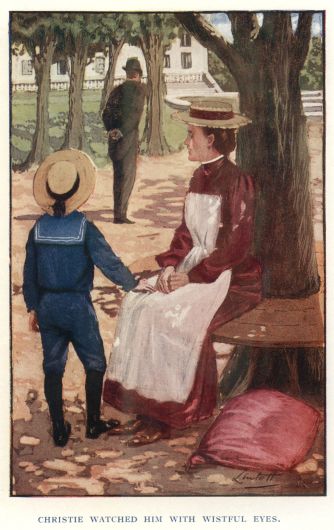
He went slowly down the cedar walk, and Christie watched him with wistful eyes. Whether he asked the gift of sight or not, there was one who, after that day, did ask it for him.
Chapter Seventeen.
The secret of peace.
Gertrude could not find her book. All that Christie could tell her about it was that she had seen it in Mr Sherwood’s hand in the cedar walk, and that he did not leave it when he went away. She looked for it in the library and in the drawing-room, but it was nowhere to be seen. She had a great objection to asking him for it. Mr Sherwood sometimes condescended to jest with the young lady on some subjects about which they did not agree; and she did not like his jests. So time passed on, till the third day.
“I’ll ask him for it at dinner,” she said to herself. “He is never so provoking when father is there.”
But a good opportunity occurred before dinner. Mr Sherwood was standing in the hall, waiting for Mrs Seaton, whom he was to take into town, when Miss Gertrude passed him on her way up-stairs.
“Mr Sherwood,” she said, “you picked up a book in the garden the other day. It was very careless in me to leave it there. Will you give it to me now?”
“I ought to apologise to you for having kept it so long,” he answered, gravely. “I will get it for you this moment.”
Miss Gertrude looked up to see whether there was not a smile upon his face. She had no idea that her new “whim” for serious reading was to be allowed to pass without remark. But his look was quite grave as he turned into the library.
“Do you like this?” he asked, when he came out with the book in his hand.
“I don’t know. I have not read much of it,” she answered, quickly, moving towards him to take the book. He gave it to her without speaking.
A glance at his face induced her to say, “Are you not well to-day, Cousin Charles?”
It was one of Miss Gertrude’s “whims” always to address him formally as “Mr Sherwood”; and in his agreeable surprise at her familiarity, he smiled brightly. But his face grew grave again as he said:
“Yes; I am quite well—only, perhaps, a little more indolent and self-indulgent than usual.”
About this time there came a letter from Effie, in which there was one sentence that cost Christie many a wondering and anxious thought.
“My dear little sister, let your light shine, and who knows but you may be the means of blessing to this household also?”
“Effie doesn’t know,” said Christie to herself. “She thinks I have grown good and wise, but she is much mistaken. I am sure if I did any good to Mrs Lee I don’t know how it happened. And besides, she was ill and in trouble, and had need of the little help and comfort I could give her. But Miss Gertrude! She is the only one I come very near to here; and she is so quick and beautiful and strong—so much above me in every way. Oh, if Effie were to see her, she would never think of my being able to influence her. Everybody admires Miss Gertrude; and I am but a nursemaid, and hardly that.”
And yet the humble little maid did influence Gertrude as the days and months passed on; but Mrs Seaton and her gay friends in the drawing-room were not more unconscious of the influence for good she was exerting over the wayward young lady than was the little maid herself.
Gertrude only vaguely realised that she was beginning to see and estimate things differently from what she used to do—half thinking, as her mother did, that it was because she was growing older and more sensible. She found herself thinking, now and then, that her standard of right was not exactly what it used to be before she had compared opinions with Christie. In her intercourse with her own family and with others also, she often found herself measuring their opinions and actions by Christie’s rule. But she by no means realised that her own opinions and actions were gradually adjusting themselves to the same rule. Yet so it was.
She liked to watch Christie. She was never weary of admiring the patience with which she bore the changing moods of her little charge, when illness made him fretful or exacting. Gertrude saw that she was learning to love the little boy dearly; but she also saw that it was not merely her love for him that made her so faithful in doing her duty to him, nor was it to please the mother and sister or win their confidence, for she was equally faithful in matters that could never come to Mrs Seaton’s knowledge, and Gertrude knew by experience that her pleasure was never suffered to interfere where Claude’s interest or comfort was concerned.
No; Christie lived that useful, patient life from higher motives than these. “She does what is right because it is right,” said Gertrude to herself. She saw her quite cheerful and contented from day to day, doing the same things over and over again, with few pleasures—with none, indeed, unless the hour or two of reading which they managed almost daily to get could be called such.
And yet, by a thousand tokens, Gertrude knew that she would have enjoyed keenly many pleasures that were quite beyond her hopes—leisure, and books, and going to school, and the power to give gifts and confer favours. To be able to live at home, with no heavy cares pressing on the family, would be real happiness for her. All this Gertrude gathered from the conversations they sometimes had, from occasional remarks, and from her intense delight when letters from home came.
And yet she did not repine in the absence of these things. She was happy in the performance of her duties, whether they were easy or not, and enjoyed the few simple pleasures that came in her way.
“It is not because she is stupid, or that she does not know anything else,” said Gertrude to herself. “She enjoys reading and learning as well as I do, and makes a far better use of the chance she has: and yet she lives on from day to day, wearying herself with little Claude, and stitching away, as though she cared for nothing beyond. Wouldn’t she enjoy being rich, and sending things to her family! Why, the delight she had over that common grey plaid that she sent to her aunt was quite absurd—and quite touching too. It cost her two months’ wages at the very least, but she did not seem to think of that. The only thing that marred her happiness at all that day was the want of a few pence that would have enabled her to buy a warm pair of slippers to go with the shawl. She doesn’t seem to think of herself. I wonder why?”
And Gertrude watched her still, thinking her often needlessly particular in the performance of small duties, and losing patience now and then, when these things interfered with her wishes. But the more she watched her daily life the more sure she felt that Christie had some secret of sweet peace which she had not yet found. She knew that her strength and cheerfulness daily renewed came from none of the helps to which one in her circumstances might naturally look. It was not the knowledge that she was valued, nor the feeling that little Claude was beginning to love her dearly, that sustained her; though Gertrude could see that these were pleasant and precious to the little maid. It was not even the thought of home, or Effie’s letters, or the pleasant word they brought of how she was missed and how they wished her with them. It was not the hope of the time when they should all be together again. To these ardent young people this re-union seemed by no means impossible, or even distant. With Gertrude’s help, Christie often built castles in the air, about a farm which was to be the wonder of the country-side, where they were all to live together, and where Gertrude herself was to pass many a pleasant day.
But it was not this, nor all of these, that brought the look of sweet contentment to that pale face, when she thought herself quite unobserved. It was there sometimes when she was wearied. She was not naturally hopeful or cheerful. She had none of that happy self-confidence which makes burdens light and causes difficulties to disappear. The source of her courage and patience was out of herself. Her gentle cheerfulness, flowing evenly through long days and weeks, sprang from some unseen fountain, pure and free and never-failing.
Sometimes it came into the young lady’s mind that Christie’s constant study of her little Bible had something to do with her being so different from any one she had ever known before. But both of them were a little shy about speaking of these things. They talked about the histories, and even about the doctrines, of the Bible. The stories that little Claude so delighted in all came from the Bible; and Christie had no shyness in speaking to him. To these stories, and the simple comments made on them, Gertrude sometimes listened when she seemed to be occupied with far other matters, and she would have liked very much to have heard more on some of the themes of which these conversations gave her only a hint. But Christie seldom talked about herself. It was only by slow degrees that she came to understand the secret of her content.
Coming one night later than usual into the upper nursery, she found Christie sitting with her little Bible in her hand. She shut it as Gertrude sat down beside her, but she did not put it away.
“I suppose it is too late to begin to read anything now?” said Gertrude. “I have been helping Miss Atherton to dress. You should have seen her! Her dress was splendid—too splendid for so small a party, mother thought. I wish I had called you to see her.”
“I wish you had, indeed,” said Christie, with real interest, for she was a great admirer of anything pretty. “I should like to have seen her. She is beautiful always.”
“Yes, but dress makes a difference even in beautiful people. I have seen ladies who looked quite plain at home by daylight, who were thought great beauties by those who only saw them at parties. But Miss Atherton is always beautiful. She will shine to-night.”
Gertrude sat for a little while gazing into the fire.
“Would you like to have gone with her?” asked Christie.
“No, I think not; I am sure not. I was asked, you know, and I dare say mother would not have objected to my going. But I find these parties very stupid.”
“Miss Atherton does not find them stupid, I should think.”
“Miss Atherton! Oh, no! But she is quite different. I dare say I should like them well enough too, if I were quite grown up, and a belle like her. But one like me is only in the way in such a place, unless she sits quiet in a corner. That is all very well for a little time, but it soon becomes stupid enough.”
“But you are not a little girl. You are fifteen,” said Christie.
“Yes, I am too old to be contented with a seat in a corner, so I don’t like parties yet. And I do believe father thinks it is because I am so sensible.”
Christie could not help laughing at the half-grave, half-comic way in which this was spoken.
“It must be very pleasant to be a belle, however,” continued Gertrude, meditatively, “to have all eyes fixed on you in admiration, and to eclipse all the rest of the stars.”
“But that doesn’t often happen, except in books, I fancy,” said Christie.
“Well, I suppose not. It couldn’t happen very often. But it must be delightful when it does happen. Don’t you think so?” she added, as Christie’s face grew grave. “Wouldn’t you like to shine, as Miss Atherton will, at the Youngs’ to-night?”
“You forget I don’t know about these things,” said Christie.
“Nonsense! You can imagine how it would seem. I can imagine how it would seem to be drawn over the snow by reindeer, or to be carried away in a balloon. Now, tell me—wouldn’t you like to be beautiful and rich, and admired by everybody?”
“I can imagine something I would like far better.”
“What, the model farm, and to live at home? Oh, but if you are to wish, you know, you may as well wish for riches and beauty and all the rest at once! You would never stop short at your farm and contentment, if you had your wish.”
Christie shook her head. “I think I would not wish at all.”
“Do you mean that you are so satisfied with your lot that you would not have it different if your wish could change it?” asked Miss Gertrude, in some surprise.
Christie hesitated a moment.
“I mean that I don’t know what is best for me or for those I love, and He who has appointed our lot does; and so all things are best as they are.”
“Do you mean that you would rather be as you are, living away from home, among strangers, poor and not very strong, than to have all that we sometimes talk about, and to be able to be benevolent and live at home with your sisters?”
“Ah, that would be very pleasant; at least, it seems so now. But still it might not be best for us. If it would be best, we should have it so, I am quite sure.”
Gertrude opened her eyes in amazement.
“But I don’t know what you mean by best!” she said, presently.
“Don’t you?” said Christie, smiling a little. “Well, I am not good at explaining things. I don’t mean what is pleasantest just now, but what is really best for us all, now, and—and afterwards.”
“Do you mean to say that you are better off here as Claude’s nurse than you would be if you were to live at home, or go to school, as you were wishing you could the other day? If you had your choice, is that what you would choose?”
“Oh, I don’t speak about a choice. I am content not to choose; at least, almost always I am content. I know it is best for me to be here, or I shouldn’t be here.”
“But, do you know, that seems to me quite absurd. Why, according to that, everybody is just in the right place. No one ought to have any wish to change, even to be better. All the world is just as it ought to be.”
“I can’t tell what is best for all the world and everybody,” said Christie, gravely. “I was only speaking of myself and Effie, and the rest at home.”
“But I suppose what is true for you is true for other people also—for me, for instance! Don’t you think I have anything left to wish for? Do you think I am in the very best place I could be in for my happiness now and always?”
“I don’t know,” said Christie, looking wistfully into her face. “I hope so. I cannot tell.”
“But what makes you so sure in your own case, then, if you can’t tell in mine? I think few people would hesitate as to which of us is most happily placed. What makes you so sure of yourself?”
Christie did not reply for a moment. She was slowly turning over the leaves of her Bible. When at last she stopped, it was to read softly:
“‘For a man’s life consisteth not in the abundance of the things which he possesseth.’”
And, farther on:
“‘Consider the ravens: for they neither sow nor reap; which neither have storehouse nor barn; and God feedeth them: how much are ye better than the fowls?’
“‘Consider the lilies how they grow: they toil not, they spin not; and yet I say unto you, that Solomon in all his glory was not arrayed like one of these.’
“‘If then God so clothe the grass, which to-day is, and to-morrow is cast into the oven, how much more will He clothe you, O ye of little faith!’”
Gertrude had half expected some such answers. She did not speak, but watched her as she continued to turn the leaves. She read again:
“‘And we know that all things work together for good to them that love God.’”
“That is all very well,” she said; “but that is for one as well as another, for me as well as you. And besides, people don’t take all things just as they stand. I am sure all the people I know live as though their life did consist in the abundance of the things they possess.”
“Well, I suppose the promise is not good to them,” said Christie; “but that does not hinder its being good to others.”
“Then one need not trouble one’s self about what is to happen, according to that? One may just rest content and let things take their course?” said Gertrude, incredulously.
“Yes, that is just what one may do, when one is sure of a right to claim the promise.”
“But what do you mean by having a right? And why should one have a right more than another?” asked Gertrude, impatiently. But all the time she was saying to herself that the quiet little maid before her was one of those who might be content.
“I don’t mean that any one has a right to claim the fulfilment of any promise, except the right that God gives. You know the verse says it is to them that love God for whose good all things work together. God’s people, it means—those who love Him, and those whom He loves.”
Looking into her earnest face, it was not easy for Gertrude to answer lightly, but in a little while she said:
“Well, Christians ought to be very happy people according to that.”
“Surely,” said Christie, earnestly, “and so they are.”
“Well, I know some of them who don’t seem very happy. And they strive for riches and greatness, and all that, just as though their happiness depended upon it.”
“But no real child of God does that,” said Christie, eagerly.
“Oh! as to that I can’t say. They call themselves Christians.”
“Well, we can’t always judge people by just seeing them,” said Christie. “There’s many a one who seems to be living just as other folk live, and going the round that other folk go, and all the time he may be really very different. I am not good at speaking about these things, but I know that to a child of God His simple promise is worth more than houses or lands, or anything that this world can give. No; we have nothing to fear. Only we forget and grow desponding.”
The last words were spoken rather to herself than to Miss Gertrude. She sighed; but her face was quite untroubled as she rose, and laying down her Bible, began to arrange the things in the room.
“You always say, ‘child of God,’” said Gertrude, wishing still to prolong the conversation. “Does that mean just a Christian, or does it mean something more?”
“Yes. ‘As many as received Him, to them gave He power to become the sons of God, even to them that believe on His name.’ Yes, it means just the same. You see, it seems to bring us very near to Him, speaking of Him as a Father, and of Christ as an Elder Brother. You know a child will never want for anything that a loving father has to give, if it is for his good; and so surely the children of God may well rest content with what He appoints for them. The only wonder is that they are ever otherwise than content.”
Gertrude made no reply, and there was a long silence.
“‘A child of God.’ ‘Content with what He sends them.’ There is something wonderful in it. She is one of them, I dare say; and that is what makes her so different from almost any one I know. I wish I could understand it. It must be worth a great deal to know that one is a child of God. I wish she could tell me more about it.”
But Christie did not seem inclined to say more on any subject that night. She moved here and there in silence, putting things to rights in the room. Gertrude rose at last.
“That is a hint that it is time for me to go,” she said.
Christie laughed.
“Well, yes. You know Mrs Seaton was displeased to find us sitting up the other night when she came home. It is nearly ten.”
“Oh, she won’t be home to-night till the small hours have struck. Miss Atherton will take care of that. There is no fear of her finding us up to-night.”
There was an expression of surprise on Christie’s countenance.
“Oh, I know very well what you mean. That makes no difference, you would say. Well, I suppose we must do what she would wish, the same as if she were here, though I don’t feel the least sleepy. Good-night.”
Chapter Eighteen.
The cure for a bad temper.
The first days of winter passed away rapidly. Gertrude continued to watch Christie’s daily life, and to draw her own conclusions from what she saw. Humble, patient, and self-denying she always saw her, and almost always she was peaceful and happy. Not quite always; for Christie was not very strong, and had her home-sick days, and was now and then despondent. But she was rarely irritable at these times. She was only very quiet, speaking seldom, even to little Claude, till the cloud passed away. And when it passed it left the sunshine brighter, the peace of her trusting heart greater than before.
It is not to be supposed that Gertrude watched all this with no thought beyond the little nurserymaid. When she had settled in her own mind that it was her religion which made Christie so different from most of the people with whom she had come in contact, she did not fail to bring into comparison with her life the lives and professions of many who wished to be considered Christians. This was not the wisest course she could have taken, but happily she went farther than this. Comparing her own life and conduct with that of Claude’s nurse, she did not fail to see how far it fell short.
There was nothing very difficult in Christie’s daily duties. She had no opportunities for doing great things, or for bearing great trials. But seeing her always as she saw her, Gertrude came to feel that the earnestness, the patience, the self-forgetfulness, with which all her little duties were done, and all her little disappointments borne, would have made any life beautiful. And seeing and feeling all this, there gradually grew out of her admiration a desire to imitate what seemed so beautiful in the little maid; and many a time when she was disappointed or angry did the remembrance of her humble friend help her to self-restraint. With a vague idea that Christie’s power came from a source beyond herself, she groped blindly and only half consciously for the same help. She studied in secret the Bible that seemed to be so precious to her, and she prayed earnestly—or she believed she prayed—to be made wise and strong and self-denying, and in short, did what might be done to build up a righteousness for herself.
Of course she failed, and then came discouragement and despondency; and while this mood lasted, all the days in the upper nursery were not happy ones. For Gertrude, vexed with herself and her failure, grew impatient and exacting with all the world; and as all the world was not at the young lady’s command, a great deal of her discomfort was visited on Christie.
As for Christie, she was very patient and forbearing with her, waiting till her unkind moods were over, not answering her at all, or waiting and watching for an opportunity to win her from an indulgence of her spleen. Sometimes she succeeded, sometimes her gentleness served to irritate the wayward girl to sharper words or greater coldness. But save by silence, or a look of grieved surprise, her unkindness was never resented.
A half perception of how it was with the young lady helped her greatly to endure her petulance. She longed to help her, but she did not know how to do so by words. So she prayed for her and had patience with her, saying to herself, if Miss Gertrude was in earnest to do right, God would guide her to Himself in time.
“Do you know you speak to me just as you speak to Claude when he is fretful and naughty,” said Gertrude one day, when she had been more than usually irritable and unhappy.
“Do I?” said Christie, looking up, gravely; but she smiled brightly enough when she saw by Gertrude’s face that the cloud was passing away for this time.
“Yes. If you would pat me gently, and smooth my hair, and offer to tell me a story, the illusion would be complete. Why don’t you tell me to take myself and my books down-stairs? I am sure you must be sick of the sight of me.”
Christie laughed, and shook her head.
“Come, now, confess that you were just saying to yourself, How cross and unreasonable she has been all day!”
“No; I was wondering what could be vexing you, and wishing I could help you in some way.”
“There is nothing vexing me that you can help. It is just my nature to be cross and disagreeable. I don’t suppose there’s any help for that.”
Christie laughed quite merrily now.
“It’s a wonder I never found out that was your nature before.”
“Oh, well, you are finding it out now. I only found it out lately myself. I never in all my life tried so hard to be good and patient and self-denying, and I was never so bad in all my life. There are times when I quite hate myself; and I am sure I shouldn’t wonder if you were to hate me too.”
She had been gazing moodily into the fire, but she turned as she said this, and met the wistful, almost tearful, eyes of Christie fixed upon her.
“I wish you could tell me something to do,” she added. “You know so much more about these things than I do.”
Christie shook her head with a sigh.
“Oh, no; I know very little; and even what I know I can’t speak about as other people can. You must have patience with yourself,”—“and pray,” she would have added; but Miss Gertrude cut her short.
“Oh, yes! it is easily said, ‘have patience.’ I would give a great deal to be naturally as gentle and patient and even-tempered as you are.”
“As I am!” said Christie, laughing; but she looked grave in a moment. “That shows how little you know of me, if indeed you are not mocking me in saying that.”
“No; you know very well I am not mocking you now, though I was a little while ago. I don’t think I have seen you angry since you came here—really angry, I mean.”
“Well, no, perhaps not angry. Do you really think I am gentle and even-tempered?” she asked, suddenly, turning her face towards her. “I am sure I used not to be. But then I have so little to try me now.”
“Well, I think you have had enough just for to-day, what with the boys and with me. But if you were not always patient and good, what changed you? What did you do to yourself? Tell me about it, as Claude would say.”
“Oh, I don’t know what I could tell,” said Christie, in some embarrassment. “I only mind what a peevish, good-for-nothing little creature I was. The others could have had little pleasure with me, only they were strong and good-tempered and didn’t mind. Even to Effie I must have been a vexation; but mother gave me to her care when she died, and so she had patience with me. I was never well, and my mother spoiled me, they said. I’m sure it was a sad enough world to me when she died. And then my aunt came to live with us, and she was so different. And by and by we came to Canada, and then everything was changed. I mind, sometimes, if a body only looked at me I was in a pet. I was not well, for one thing, and I used to fancy that my aunt liked me less and had less patience with me than with the rest; and no wonder, when I think of it. Effie was good and kind to me always, though I must have tried her many a time.”
“Well,” said Miss Gertrude, “but you don’t tell me what changed you.”
“Well, I can’t tell. I believe I was never quite so bad after the time Effie gave me my Bible.” And she gave Miss Gertrude the history of the miserable day with which our story commenced—of her trying to pray under the birch-tree by the brook, of Effie’s coming home with the book-man, and of their walk to the kirk and the long talk they had together.
“And it was soon after that that my father was hurt and my aunt grew ill again. We had a very sorrowful winter. But there is one good thing in having real trouble to bear; one doesn’t fret so much about little things, or about nothing at all, as I used to do. I think that winter was really happier to me than any time I had had since my mother’s death. I was with my father a great deal towards the end; and though he was so ill and suffered so much, he was very kind and patient with me.”
There was a long pause before Christie could go on again, and she rather hurried over the rest of her tale.
“After he died we left the farm. I came here with Annie. I was very home-sick at first. Nothing but that I couldn’t bear to go home and depend on Aunt Elsie kept me here. I thought sometimes I must die of that heart-sickness, and besides, I made myself unhappy with wrong thoughts. In the spring Annie went away. I couldn’t go, because Mrs Lee and the children were ill; you mind I told you about that. I was unhappy at first; but afterwards I was not, and I never was again—in the same way, I mean.”
The work she had been busy upon dropped from her hands, and over her face stole the look of peace and sweet content that Gertrude had so often wondered at. For a little while she sat quite still, forgetting, it seemed, that she was not alone; and then Gertrude said, softly.
“Well, and what then?”
Christie drew a long breath as she took up her work.
“Well, after that, something happened. I’m afraid I can’t tell it so that you will understand. It seems very little just to speak about, but it made a great difference to me. I went to the kirk one day when a stranger preached. I can’t just mind the words he said, at least I can’t repeat them. And even if I could I dare say they would seem just common words to you. I had heard them all before, many a time, but that day my heart was opened to understand them, I think. The way that God saves sinners seemed so plain and wise and sure, that I wondered I had never seen it so before. I seemed to see it in a new way, and that it is all His work from beginning to end. He pardons and justifies and sanctifies, and keeps us through all; and it seemed so natural and easy to trust myself in His hands. I have never been very unhappy since that day, and I don’t believe I shall ever be very unhappy again.”
There was a long silence. Miss Gertrude was repeating to herself, over and over again:
“His work, from beginning to end! He pardons, justifies, sanctifies, and saves at last.”
So many new and strange thoughts crowded into the young girl’s mind that for the moment she forgot Christie and her interest in all she had been saying. Word by word she repeated to herself, “pardons,” “justifies,” “sanctifies,” “saves.”
“I cannot understand it.” And in a little while, bewildered with her own speculations, she turned from the subject with a sigh.
“Well, and what else?” she said to Christie.
“Oh, there is no more. What were we speaking about? Oh, yes; about having patience. Well, when one has a great good to fall back upon, something that cannot be changed or lost or taken from us, why, it is easy to have patience with common little things that cannot last long and that often change to good. Yes, I do think I am more patient than I used to be. Things don’t seem the same.”
It filled Gertrude with a strange unhappiness to hear Christie talk in this way. The secret of the little maid’s content appeared so infinitely desirable, yet so unattainable by her. She seemed at once to be set so far-away from her—to be shut out from the light and pleasant place where Christie might always dwell.
“I don’t understand it,” she repeated to herself. “If it were anything that could be reasoned out or striven for, or even if we could get it by patient waiting. But we can do nothing. We are quite helpless, it seems.”
In her vexed moments Gertrude sometimes took pleasure in starting objections and asking questions which Christie found it difficult to answer.
“It is all real to her, though. One would think, to see her sitting there, that there is nothing in the world that has the power to trouble her long. And there really is nothing, if she is a child of God—as she says. What a strange thing it is!”