Chapter XXVI · SILICON.
Reading edition

Silicon may well be considered important on account of its quantity in the earth, if on no other. In an earlier chapter it has been shown that oxygen exists in our globe—including its atmosphere and its oceans—in an amount equal to about one-half of the weight of the whole. Now silicon exists in a quantity equal to about one-fourth of this entire weight. In the earth however, neither of these substances exists in the uncombined form. These facts seem to involve as a necessary consequence that they exist in the earth, to a large extent, combined with each other; indeed this is found to be the case. The principal earthy matter of our planet is the compound of silicon and oxygen, existing either alone in the form of sand, quartz crystal and similar minerals, or else in combination with other well-known abundant earth materials, such as oxides of calcium, magnesium and aluminum. It has already been stated that carbon is the characteristic element of animal and vegetable matters; so silicon is the characteristic element of mineral matters. Thus granite and similar archaic rocks contain approximately twenty-five per cent of silicon.
In nature, silicon performs its important office as a constituent of rock material, with a fitness that is referable largely to the high degree of stability possessed by most of its compounds. The permanence of the materials of the earth’s surface under the influence of heat, and water, and frost, and similar agencies is an illustration of this principle.
Silicic oxide (SiO₂), occurs on our globe in many different forms of which diatomaceous earth and rock crystal may be mentioned.
Diatomaceous earth is a powdery material found in abundant deposits in many parts of the world. Its characteristic structure, when examined under the microscope, reveals its nature; then it is seen to be made up of the shells of minute vegetable organisms called diatoms. These assume a great many beautiful forms, and some of them are checkered all over with markings of such extreme fineness that they have been used as test objects for trying the resolving power of the objectives of microscopes. This kind of earth is employed, as has already been stated, in the preparation of dynamite.
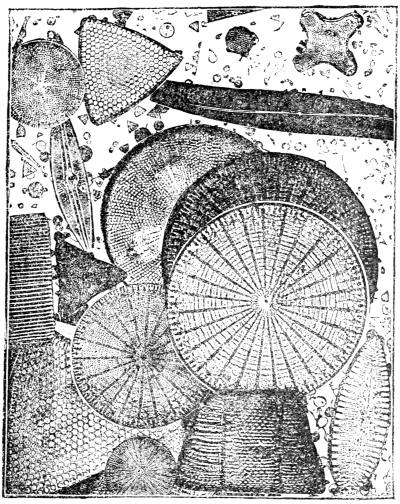
Fig. 95.—Diatomaceous earth as seen through the microscope.
Quartz sometimes occurs in colorless transparent masses of great beauty and clearness called rock crystal. The amethyst is the same substance slightly colored by compounds of the metal manganese, while quartz exists of a variety of other shades, in some of which it is prized as a gem. Quartz generally assumes forms of a hexagonal tendency: they are often hexagonal prisms terminated by hexagonal pyramids.
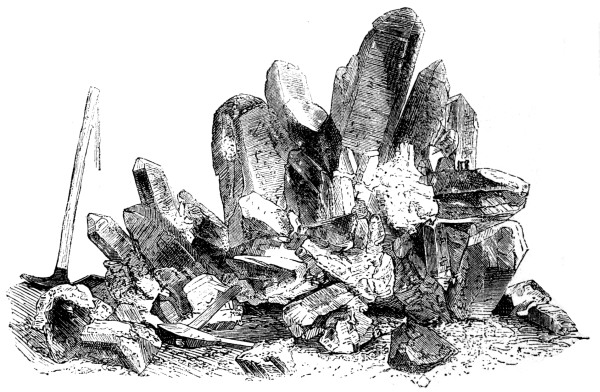
Fig. 96.—Mass of natural quartz crystals.
Quartz and the finer and purer varieties of sand are used largely in the manufacture of glass. The silicic oxide here displays what may be expressed as its acid tendencies; for in the manufacture of glass it is fused with sodic carbonate, and then the silicic oxide displaces the carbon dioxide from the sodic carbonate; as a result there is formed what must be regarded as a true salt, or a mixture of salts, that in the simplest kind of glass may be termed sodic silicate.
Closing Words. The course laid out in the preface is now terminated with silicon, as there planned. From scientific considerations, this is a natural ending; it seems to be appropriate on another account also. After the reader has been carried, in thought, among the various gaseous elements, that make up atmosphere and oceans, it seems suitable that we should say farewell to him upon the discussion of that element that may be called the characteristic material of our solid earth.