Chapter XXIV
Reading edition
CONCLUSION
“Although the style [of Chaucer] for the antiquity may distaste you, yet as under a bitter and rough rind there lieth a delicate kernel of conceit and sweet invention.”—Henry Peacham, “The Compleat Gentleman,” 1622
Into this state of things suddenly came the “Black Death” of 1348-9, the most terrible plague that ever raged in Christendom. This was at once hailed by moralists as God’s long-delayed punishment upon a society rotten to the core. At first the world was startled into seriousness. Many of the clergy fought the plague with that self-sacrificing devotion which, in all denominations, a large fraction of the Christian clergy has always shown at similar moments. But there is no evidence to show that the priests died in sensibly larger proportions than their flocks; and many contemporary chroniclers expressly record that the sick were commonly deserted even by their spiritual pastors. After the first shock was over, the multitude relapsed into a licence proportionate to their first terror—a reaction described most vividly by Boccaccio, but with equal emphasis by other chroniclers. Many good men, in their bitter disappointment, complained that the world was grown more careless and irreligious than before the Plague; but this can hardly be the verdict of most modern students who look carefully into the mass of surviving evidence.
To begin with, the Black Death dealt a fatal blow to that old vicious system of boy-rectors. Half the population perished in the plague, half the livings went suddenly begging; and in the Church, as on the farm, labour was at a sudden premium. Such curates as survived dropped naturally into the vacant rectories; and, side by side with Acts of Parliament designed to keep the labourer down to his old wages, we find archi-episcopal decrees against the “unbridled cupidity” of the clergy, who by their pernicious example encouraged this demand of the lower classes for higher wages. The incumbent, who ought to be only too thankful that God has spared his life, takes advantage of the present stress to desert his parish and run after Mass-money.[287] Chaplains, again, are “not content with their competent and accustomed salaries,” which, as a matter of fact, were sometimes no higher than the wages of a common archer or a farm bailiff. But the economic movement was irresistible; and the Registers from this time forward show an extraordinary increase in the number of priests instituted to livings. In the same lists where the priests were formerly only thirty-seven per cent. of the whole, their proportion rises during and after the Pestilence to seventy-four per cent. The Black Death did in one year what the Ecumenical Council of Lyons had conspicuously failed to do, though summoned by a great reforming Pope and inspired by such zealous disciplinarians as St. Bonaventura and his fellow-Franciscan, Eudes Rigaud of Rouen.
Again, the shock of the Pestilence, the complete desertion of so many poor country benefices by the clergy, and the scandal generated by this quarrel over wages between chaplains and their employers, naturally threw the people back very much upon their own religious resources. The lay control over parish finances in 15th-century England, which, limited as it was, still excites the wonder of modern Catholicism, probably dated from this period. Men no longer gave much to monks, or even (in comparison with past times) to friars; but they now devoted their main religious energies to beautifying and endowing their own parish churches, which became far larger and more richly furnished in the 15th century than in the 13th. Moreover, Abbot Gasquet is probably right in attributing to the Black Death the rise of a new tone in orthodox religious feeling, which “was characterized by a [more] devotional and more self-reflective cast than previously.” There was every probability of such a religious change; all earnest men had seen in the plague the chastening hand of God; and in the end it yielded the peaceable fruit of righteousness unto them which were exercised thereby.
But this bracing process could not possibly, under the circumstances of the time, work entirely on the lines of orthodox conservatism. When we count up the forces that produced Wycliffism—the notorious corruption of the papal court, its unpopular French leanings, the vast sums drawn from England by foreign ecclesiastics, the unpopularity of the clergy at home, the growth of the English language and national spirit—among all these causes we must not forget to note that Wycliffe and his contemporaries, in their early manhood, had struggled through a year of horrors almost beyond modern conception. They had seen the multitude run wild, first with religious fanaticism and then with blasphemous despair; had watched all this volcanic matter cool rapidly down into dead lava; and were left to count one more abortive reform, and re-echo the old despairing “How long, O Lord!” “Sad to say, it seemeth to many that we are fallen into those unhappy times wherein the lights of heaven seem to be turned to darkness, and the stars of heaven are fallen upon the earth.... Our priests are now become blind, dark, and beclouded ... they are now darker than the laity.... Lo, in these days there is neither shaven crown on their head, nor religious decency in their garments, nor modesty in their words, nor temperance in their food, nor shamefastness in their gestures, nor even chastity in their deeds.”[288] Such is the cry of an orthodox contemporary of Wycliffe’s; and words like these explain why Wycliffe himself became unorthodox against his will. If he had died at the age of fifty or thereabouts, towards the beginning of Chaucer’s business career, posterity would have known him only as the most distinguished English philosopher of his time. The part which he played in later life was to a great extent forced upon him by the strong practical sense which underlay his speculative genius. Others saw the faults of religion as clearly, and exposed them as unmercifully, as he. But, while they were content to end with a pious “Well, God mend all!” Wycliffe was one of those in whom such thoughts lead to action: “Nay, by God, Donald, we must help Him to mend it!” No doubt there were errors in his teaching, and much more that was premature; otherwise the authorities could never have managed so nearly to exterminate Lollardy. On the other hand, it is equally certain that Wycliffe gave a voice to feelings widespread and deeply rooted in the country. Orthodox chroniclers record their amazement at the rapid spread of his doctrines. “In those days,” says Knighton, with picturesque exaggeration, “that sect was held in the greatest honour, and multiplied so that you could scarce meet two men by the way whereof one was not a disciple of Wycliffe.” Walsingham speaks of the London citizens in general as “unbelieving towards God and the traditions of their fathers, supporters of the Lollards.”[289] In 1395 the Wycliffite opinions were openly pleaded before Parliament by two privy councillors, a powerful Northamptonshire landlord, and the brother of the Earl of Salisbury; the bishops had to recall Richard II. in hot haste from Ireland to deal with this open propaganda of heresy. Ten years after Chaucer’s death, again, a Bill was presented by the Commons for the wholesale disendowment of bishoprics and greater monasteries, “because of priests and clerks that now have full nigh destroyed all the houses of alms within the realm.” The petitioners pleaded that, apart from the enormous gain to the finances of the State, and to a proposed new system of almshouses, it would be a positive advantage to disendow idle and luxurious prelates and monks, “the which life and evil example of them hath been so long vicious that all the common people, both lords and simple commons, be now so vicious and infected through boldship of their sin, that scarce any man dreadeth God nor the Devil.” The King and the Prince of Wales, however, would not listen either to this proposal or to those upon which the petitioners afterwards fell back, that criminous clerks should be dealt with by the King’s courts, and that the recent Act for burning Lollards should be repealed.[290]
The Lollard movement in the Parliament of 1395 was led by Chaucer’s old fellow-ambassador, Sir Richard Stury, the “valiant ancient knight” of Froissart’s chronicles; and Chaucer himself has often been hailed, however falsely, as a Wycliffite. The mere fact that he speaks disparagingly of the clergy simply places him side by side with St. Bernard, St. Bonaventura, and St. Catherine of Siena, whose language on this subject is sometimes far stronger than his. As a fellow-protégé of John of Gaunt, Chaucer must often have met Wycliffe in that princely household; he sympathized, as so many educated Englishmen did, with many of the reformer’s opinions; but all the evidence is against his having belonged in any sense to the Lollard sect. The testimony of the poet’s own writings has been excellently summed up in Chap. VI. of Professor Lounsbury’s “Studies in Chaucer.” In early life our hero seems to have accepted as a matter of course the popular religion of his time. His hymn to the Virgin even outbids the fervour of its French original; and in the tales of miracles which he versified he has taken no pains to soften down touches which would now be received with scepticism alike by Protestants and by the papal commissioners for the revision of the Breviary. (Tales of the “Second Nun,” “Man of Law,” and “Prioress.”) Even then he was probably among the many who disbelieved in tales of Jewish ritual murder, though not sufficiently to deter the artist in him from welcoming the exquisite pathos of the little scholar’s death. But his mind was naturally critical; and it was further widened by an acquaintance with many cities and many men. The merchants and scholars of Italy were notorious for their free-thinking; and we may see in the unpriestly priest Froissart the sceptical habit of mind which was engendered in a 14th-century “intellectual” by a life spent in courts and among men of the world. It is quite natural, therefore, to find Chaucer scoffing openly at several small superstitions, which in many less sceptical minds lived on for centuries—the belief in Arthur and Lancelot, in fairies, in magic, in Virgilian miracles, in pagan oracles and gods, in alchemy, and even in judicial astrology. These last two points, indeed, supply a very close analogy to his religious views. It is difficult to avoid concluding, from his very intimate acquaintance with the details of the pursuit, that he had himself once been bitten with the craze for the philosopher’s stone. Again, if we only looked at his frequent poetical allusions to judicial astrology, we should be driven to conclude that he was a firm believer in the superstition; but in the prose “Astrolabe,” one of his latest and most serious writings, he expressly repudiates any such belief.
The analogy from this to his expressions on religious subjects is very close. At first sight we might judge him to have accepted to the last, though with growing reserve and waning enthusiasm, the whole contemporary system of doctrines and practices which Wycliffe in later life so unreservedly condemned. But one or two passages offer startling proof to the contrary. Take the Prologue to the “Legend of Good Women”—
A thousand timës have I heard men tell
That there is joy in heaven and pain in hell,
And I accordë well that it is so.
But natheless yet wot I well also
That there is none dwelling in this countree
That either hath in heaven or hell y-be,
He may of it none other wayës witen[know
But as he hath heard said or found it written,
For by assay there may no man it prove.
And, again, the reflections which he adds upon the death of Arcite, without the least authority from the original of Boccaccio—
His spirit changèd house, and wentë there,
As I came never, I can not tell where:
Therefore I stint, I am no divinister;[stop
Of soulës find I not in this register,
Nor list me those opinions to tell
Of them, though that they writen where they dwell.
It is difficult to believe that the man who gratuitously recorded those two personal impressions, without the least excuse of artistic necessity, was a perfectly orthodox Catholic. It is more than possible that he would not have accepted in cold blood all the consequences of his words; but we may see plainly in him that sceptical, mocking spirit to which the contemporary Sacchetti constantly addresses himself in his sermons. This was indeed one of the most obvious results of the growing unpopularity of the hierarchy, intensified by the shock of the Black Death. That great crisis had specially stimulated the two religious extremes. Churches grew rapidly in size and in splendour of furniture, while great lords built themselves oratories from which they could hear Mass without getting out of bed. The Pope decreed a new service for a new Saint’s Day, “full of mysteries, stuffed with indulgences,” at a time when even reasonable men began to complain that the world had too many. Richard II. presented his Holiness with an elaborate “Book of the Miracles of Edward late King of England”—that is, of the weak and vicious Edward II., whose attempted canonization was as much a political job as those of Lancaster and Arundel, Scrope and Henry VI.; and this popular canonization ran so wild that men feared lest the crowd of new saintlings should throw Christ and His Apostles into the shade. On the other side there was the “new theology,” which had grown up, with however little justification, from the impulse given by orthodox and enthusiastic friars—pantheistic doctrines, minimizing the reality of sin; denials of eternal punishment; attempts to find a heaven for good pagans and Jews.[291] Even in the 13th century, willingly or unwillingly, the friars had raised similar questions; a Minister-General had been scandalized to hear them debating in their schools “whether God existed”; and Berthold of Ratisbon had felt bound to warn his hearers against the subtle sophism that souls, when once they have been thoroughly calcined, must reach a point at which anything short of hell-fire would feel uncomfortably chilly. This is the state of mind into which Chaucer, like so many of his contemporaries, seems to have drifted. He had no reasoned antagonism to the Church dogmas as a whole; on the contrary, he was keenly sensible to the beauty of much that was taught. But the humourist in him was no less tickled by many popular absurdities; and he had enough philosophy to enjoy the eternal dispute between free-will and predestination. As a boy, he had knelt unthinkingly; as a broken old man, he was equally ready to bow again before Eternal Omnipotence, and to weep bitterly for his sins. But, in his years of ripe experience and prosperity and conscious intellectual power, we must think of him neither among the devout haunters of shrines and sanctuaries nor among those who sat more austerely at the feet of Wycliffe’s Poor Priests; rather among the rich and powerful folk who scandalized both Catholics and Lollards by taking God’s name in vain among their cups, and whetting their worldly wit on sacred mysteries. We get glimpses of this in many quarters—in the “Roman de la Rose,” for instance, but still more in Sacchetti’s sermons and the poem of “Piers Plowman.” Here the poet complains, after speaking of the “gluttony and great oaths” that were then fashionable—
“But if they carpen of Christ, these clerks and these layfolk[discuss
At the meat in their mirth, when minstrels be still,
Then tell they of the Trinity a tale or twain
And bringen forth a bald reason, and take Bernard to witness,
And put forth a presumption to prove the sooth.
Thus they drivel at their dais the Deity to know,
And gnawen God with the gorge when the gut is full ...
I have heard high men eating at the table
Carpen, as they clerkës were, of Christ and His might
And laid faults upon the Father that formed us all,
And carpen against clerkës crabbed words:—
‘Why would our Saviour suffer such a worm in His bliss
That beguiled the Woman and the Man after,
Through which wiles and words they wenten to hell,
And all their seed for their sin the same death suffered?
Here lieth your lore,’ these lords ’gin dispute.
‘Of that ye clerks us kenneth of Christ by the Gospel ...[teach
Why should we, that now be, for the works of Adam
Rot and be rent? reason would it never ...’
Such motives they move, these masters in their glory,
And maken men to misbelieve that muse much on their words.”[292]
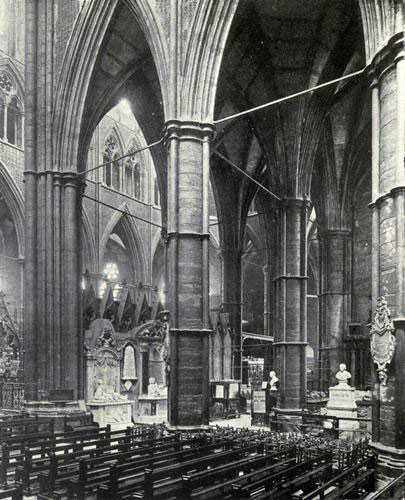
WESTMINSTER ABBEY VIEW FROM NEAR CHAUCER’S TOMB
More unorthodox still were those whom Walsingham would have made partly responsible for the horrors of the Peasants’ Revolt. “Some traced the cause of these evils to the sins of the great folk, whose faith in God was feigned; for some of them (it is said) believed that there was no God, no sacrament of the altar, no resurrection from the dead, but that as a beast dies so also there is an end of man.”
There is, of course, no such dogmatic infidelity in Chaucer. Even if he had felt it, he was too wise to put it in writing; as Professor Lounsbury justly says of the two passages quoted above, “the wonder is not that they are found so infrequently, but that they are found at all.” Yet there was also in Chaucer a true vein of religious seriousness. “Troilus and Criseyde” was written not long before the “Legend of Good Women”; and as at the outset of the later poem he goes out of his way to scoff, so at the end of the “Troilus” he is at equal pains to make a profession of faith. The last stanza of all, with its invocation to the Trinity and to the Virgin Mary, might be merely conventional; medieval literature can show similar sentiments in very strange contexts, and part of this very stanza is translated from Dante. But however Chaucer may have loved to let his wit play about sacred subjects “at meat in his mirth when minstrels were still,” we can scarcely fail to recognize another side to his mind when we come to the end of those “Troilus” stanzas which are due merely to Boccaccio, and begin upon the translator’s own epilogue—
O youngë freshë folkës, he or she In which ay love up-groweth with your age, Repair ye home from worldly vanitee ...
“Come, children, let us shut up the box and the puppets, for the play is played out.” But, though we have nothing of the reformer in our composition; though we are for the most part only too frankly content to take the world as we find it; though, even in their faith, our fellow-Christians make us murmur, “Lord, what fools these mortals be!” though we most love to write of Vanity Fair, yet at the bottom of our heart we do desire a better country, and confess sometimes with our mouth that we are strangers and pilgrims on the earth.
Indeed, if our poet had not been keenly sensible of the beauty of holiness, then the less Chaucer he! As it is, he stands the most Shakespearian figure in English literature, after Shakespeare himself. Age cannot wither him, nor custom stale his infinite variety. We venerate him for his years, and he daily startles us with the eternal freshness of his youth. All springtide is here, with its green leaves and singing-birds; aptly we read him stretched at length in the summer shade, yet almost more delightfully in winter, with our feet on the fender; for he smacks of all familiar comforts—old friends, old books, old wine, and even, by a proleptic miracle, old cigars. “Here,” said Dryden, “is God’s plenty;” and Lowell inscribed the first leaf of his Chaucer with that promise which the poet himself set upon the enchanted gate of his “Parliament of Fowls”—
Through me men go into the blissful place Of the heart’s heal and deadly woundës’ cure; Through me men go unto the well of Grace, Where green and lusty May doth ever endure; This is the way to all good aventure; Be glad, thou Reader, and thy sorrow off-cast, All open am I, pass in, and speed thee fast!