Chapter XI · OLD ENGLISH CHINTZES
Reading edition
CHAPTER XI OLD ENGLISH CHINTZES
By Hugh Phillips
The charm of old English chintz—Huguenot cloth-printers settle in England—Jacob Stampe at the sign of the Calico Printer—The Queen Anne period—The Chippendale period—The age of machinery.
The present chapter has been added with perhaps some justification, since it seemed to the writer that such a subject as old English chintzes might appropriately take its place beside the equally homely craft of the rural cabinet-maker.
For the chintz is the tapisserie d'aubusson of the peasant—it covers his chairs and drapes his windows, giving warmth and wealth of colour to the otherwise barren appearance of his cottage. Further, it reflects his simple horticultural tastes, for the brilliantly coloured roses, pansies, and convolvuluses which shine prominently on the glazed surface of the cloth are those flowers which are always to be found in his garden.
Chintz or printed cotton is the only decorative fabric known to the village upholsterer. When persons of wealth hung their windows with silk brocades and covered their chairs with costly needlework and damasks, the rural cabinet-maker was supplying his modest clientèle with these homely patterns printed upon common cloth.
These unassuming fabrics were as much cherished by the cottagers as anything which they possessed. The classical ornament of expensive silks they did not understand, and the freely treated birds and flowers which figured on chintz represented the Alpha and Omega of beauty in textile design.
So great, indeed, is the fascination of these for the cottagers that to-day, in districts less penetrated by modern advance, the rural populace will not extend their affections to the up-to-date designs of upholsterers, but insist upon the old spot and sprig patterns of their ancestors.
There is much wisdom in the conservative taste of the peasant, for the old chintz of the eighteenth and early nineteenth centuries was of the highest artistic merit. In the heyday of its fame the fabric was exceedingly fashionable amongst the richest persons, and there are abundant records of the popularity of old English chintzes upon the Continent. For, at its best periods, the chintz was not a base imitation of more expensive fabrics; it did not, for instance, occupy the relationship of pewter to silver or moulded composition to genuine woodcarving. On the contrary, the designing of chintzes is an art of distinction, governed by canons which bear little relationship to other decorative textile crafts. For where the silk-weaver is confined to solid patterns which will appear in his transverse threads, the printer of cloths can wander unrestrained into designs of wonderful intricacy and beauty: every colour in nature he can imitate, and no object is too delicate or too rich to stamp upon his cotton. Indeed, his art stops little short of that of the painter of pictures.
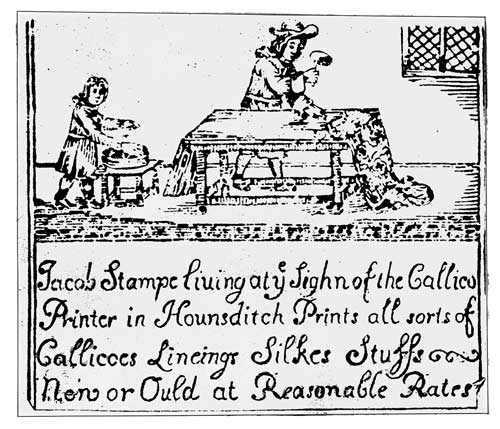
OLD TRADE CARD SHOWING CALICO PRINTERS AT WORK.
"Jacob Stampe living at ye Sighn of the Callico Printer in Hounsditch Prints all sorts of Callicoes Lineings Silkes Stuffs New or Ould at Reasonable Rates."
(From old print at British Museum.)
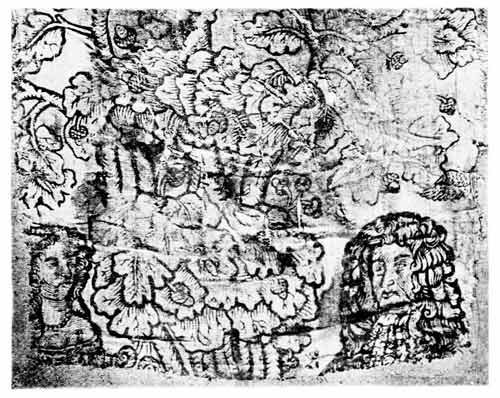
ENGLISH PRINTED CALICO. ABOUT 1690.
With contemporary portraits.
(By courtesy of Mr. T. D. Phillips.)
A glance at the illustrations will more closely confirm this, for such designs could not be imitated by any other textile process, the multitudinous twists and curves and the delicate shades and patches of colour being only possible to the printer.
Interesting as is the study of old chintzes, the history of the art in England is even more fascinating. From the obscurity of a small local craft it became one of our great national industries.
Of its earliest history in England we know nothing, and a search among old documents fails to reveal any traces of chintz-printing before the Renaissance. There are several vague references to the subject in the sixteenth and seventeenth centuries, but none of them disclose any solid information. Thus the question of who was the first chintz-printer remains an unsolved riddle. It appears, however, that in the seventeenth century there was a gradual immigration of foreign workmen of Dutch and French nationalities who were well versed in the art of cotton-printing—then well established upon the Continent. These people came over in gradually increasing numbers, their arrival culminating in the huge influx of foreigners about 1650 to 1700.
The majority of them were by trade silk-weavers and printers. Their departure was a serious blow to France, for they transferred to England what had been great national industries in France. Settling in and about London, the refugees peaceably recommenced their work, and soon the weaving of silks in Spitalfields and the printing of chintzes in Richmond, Bow, and Old Ford became a source of great prosperity to this country.
On p. 319 is an illustration of a seventeenth-century trade card of one of the chintz-printers, or, as they were then called, calico-printers. Here we see in a most lucid manner the process by which chintzes were produced in the time of James II. The inscription runs: "Jacob Stampe living at Ye Sighn of the Callico Printer in Hounsditch Prints all sorts of Callicoes Lineings Silkes Stuffs, New or Ould, at Reasonable Rates."
A printer is standing at a table upon which is stretched a length of cloth, which falls in folds on the floor. He holds in his hand a wooden block, which he is applying at intervals to the cloth. The other hand contains a mallet, which is about to strike the wooden block and stamp the colour firmly into the threads of the material. Behind him is an apprentice boy, standing over a tub of colour, preparing the blocks for his master to use.
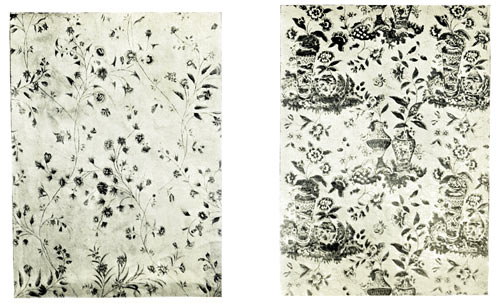
HAND-PRINTED CHINTZ.
Queen Anne Period.
HAND-PRINTED CHINTZ.
Chinese style. Middle Eighteenth Century.
By so clumsy a process very delicate work could not be produced, and, indeed, the few examples of this period which remain are very heavy in character. One of these, which has been lent by Mr. J. D. Phillips, the owner, is illustrated on p. 319. It belongs to the end of the seventeenth century and corresponds to the William and Mary period of English furniture, being contemporary with the pieces illustrated on pp. 77, 117 in the earlier chapters. It will be seen that this example contains two portraits in costume of the late Stuart period, possibly intended for portraits of William and Mary. Their portraits are of frequent occurrence on Lambeth delft of this period.
The printer has only produced the outline, the colour being added by hand with a brush, for at this date the printing of colour by the successive application of blocks had not been mastered. The black ink to-day lies thick upon the cloth, as coarsely as though it had been dabbed on with a stencil. The material is a rough hand-woven canvas. Printed cloths of the period of Charles II. and James II. and William and Mary are exceedingly rare and seldom met with, as, owing to their roughness, they have been destroyed by subsequent owners. A few, however, are to be found on walnut chairs under the coverings of later date. Often, indeed, one meets a chair covered in Victorian horsehair which will reveal underneath the successive coverings of many generations of owners, including perhaps the material in which it was first upholstered.
As the seventeenth century wore on and we enter upon the early years of the eighteenth century—the days of Queen Anne—the chintz-printers became more prosperous. Their work, owing to its increasing delicacy, met with great public approval, and it began to supplant woven silks for the purposes of curtains, coverings, and dresses. Thus the silk-weavers of Spitalfields found a declining market for their goods and soon came into friction with the printers. Much bad feeling ensued, and eventually their quarrels resulted in the distribution of defamatory literature which is to-day most amusing. The weavers circulated the curious "Spittlefields Ballad" against "Calico Madams," or the ladies who wore chintz dresses.
THE SPITTLEFIELDS BALLADS
OR THE
Weaver's Complaint Against the Callico Madams
Our trade is so bad That the weavers run mad Through the want of both work and provisions, That some hungry poor rogues Feed on grains like our hogs, They're reduced to such wretched conditions, Then well may they tayre What our ladies now wear And as foes to our country upbraid 'em, Till none shall be thought A more scandalous slut Than a tawdry Callico Madam. When our trade was in wealth Our women had health, We silks, rich embroideries and satins, Fine stuffs and good crapes For each ord'nary trapes That is destin'd to hobble in pattins; But now we've a Chince For the wife of a prince, And a butterfly gown for a gay dame, Thin painted old sheets For each trull in the streets To appear like a Callico Madam.
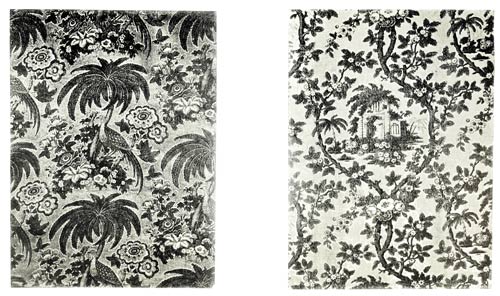
HAND-PRINTED CHINTZ.
Exotic-Bird style. Middle Eighteenth Century.
HAND-PRINTED CHINTZ.
Gothic style. Late Eighteenth Century.
The poet in several long stanzas warms in his indignation, and finally directs his verse against the male friends of all fair wearers of chintzes, suggesting that—
"It's no matter at all If the Prince of Iniquity had 'em, Or that each for a bride Should be cursedly tied To some damn'd Callico Madam."
It is not surprising that the weavers should find it difficult to set their productions against those of the cloth-printers, for the chintzes of this period are surpassingly beautiful. One of them is illustrated on p. 323. Here the material is no longer a rough canvas, but is now a light dress cambric, similar to the thin smooth chintz cloth which has survived till to-day. A delicate pattern of intertwining stems winds upwards, the stalks having blossoms of finely cut outline and brilliant colours. Old chintzes of this period may be recognised by their lightness and by the long thin designs of intermingling flowers of Indian type. These were all more or less borrowed from the Marsupalitan printed cloths brought over by the India trading companies, and the flowers and colourings of this date are nearly always very closely copied from Eastern originals, the cornflower and carnation being among those most frequently met with.
The ill-feeling between the printers and weavers was of long duration, and eventually took the form of open riots and street demonstrations similar to those of to-day. On one occasion, in 1719, they went from Spitalfields to Westminster and protested against the popularity of chintzes and suggested that their use be forbidden. On the return journey they manifested their feelings by tearing off the chintz gowns of various ladies whom they met upon the route. Evidently Parliament pandered to these labour riots, for in 1736 printed cloths were forbidden by Act of Parliament, but this legislation was of short duration; the Act was soon repealed and the fascinating material became the rage once more.
The next stage at which we look upon chintz-printing is about 1760, in the middle of the period of Chippendale furniture. This is the golden period of its printing. Technically and artistically the hand-printed chintz now reached its climax. Colour-work by superimposed blocks was in full swing, and the designer had, in the works of contemporary artists, a wider field for the selection of subjects suitable for his fabric. Among the many varieties of chintzes which we find at this date the most prominent are the Gothic and Chinese designs to suit the current taste in furniture, and the exotic bird patterns, which are perhaps the finest of all.
HAND-PRINTED CHINTZ. ABOUT 1760.
By R. Jones, of Old Ford, London.
The formation of the designs has changed considerably by this time and we no longer find the intertwining or serpentine form as in the Queen Anne chintzes. The flowers and objects to be printed are now massed together and represented as little disjointed islands floating in mid-air. By this distinctive feature they may easily be recognised. One of these charming exotic bird chintzes is illustrated on p. 327. Here a pheasant is resting under a palm-tree upon a small island of densely packed foliage. The whole idea of the design is taken from the Chinese porcelain of the period. The bird, the flowers, and every object portrayed come from the East and are drawn in the manner constantly seen upon the Famille Rose dishes and vases of the period. These exotic bird patterns are not exclusively found upon chintzes, for the collector of English porcelain will be familiar with them in the early productions of the Bow and Worcester factories.
Another feature which one notices in printed fabrics at this date is the buff ground. The cloth is white, and the pattern is printed upon it in this state so that the pinks, blues, and greens of the flowers may have every advantage of transparency. The buff background is then printed in afterwards, leaving a thin margin around the design. In this manner great richness and depth is given to the colours without undue harshness, which would be the result if they were exhibited upon a white background. The illustration on p. 323 shows a chintz in the Chinese manner, designed to conform with the oriental furniture of Chippendale. Here again we see the detached islets of vegetation, but instead of exotic birds we have Chinese vases containing flowers, and in the foreground a rococo shell, one of the then little-known species from the East greatly treasured in England. The carnations and foliage will be readily recognised as copies from Chinese paintings. One might illustrate a very large number of these Chinese chintzes, but space will only permit one example. This particular specimen is probably unique; it is taken from an old roll of chintz printed about 1760 and left over after the owner had curtained his house. The roll (about twenty yards long) has been carefully preserved and handed down from generation to generation, so that its original colours and soft glaze remain intact.
A chintz in the Gothic manner is illustrated on p. 327. It differs slightly from the others in that the island formation is combined with serpentine foliage. In the centre is a patch of ground upon which are the ruins of a Gothic church. The artist, however, has not forgotten to please those patrons who might prefer the Chinese style, and therefore he has quietly added the incongruous elements of prunus flowers in the foreground and palm-trees in the background. At first this quaint admixture may appear a bad art, but it must be remembered that at this quaint period the whole principle of decorative design was upset by the rococo school, and quaintness and delicacy of detail outweighed the greater considerations of line and proportion. We find a similar treatment of design later on in many Spode plates, especially in blue transfer-printed subjects.
PRINTED CHINTZ.
Hepplewhite Period.
PRINTED CHINTZ.
Victorian Period.
In the third quarter of the eighteenth century we enter upon a new era in the history of chintzes. We may appropriately call it the age of machinery, for from this date the mechanical processes came in whereby chintz-printing was raised from the position of a comparatively small craft to that of a huge national industry. The great manufacturing towns in the North, such as Manchester, were rising in importance, and Lancashire was forming the basis of its gigantic cotton trade. Following these trade movements, the old industry of cloth-printing gradually left its centre in London and was developed on a larger scale in the North of England.
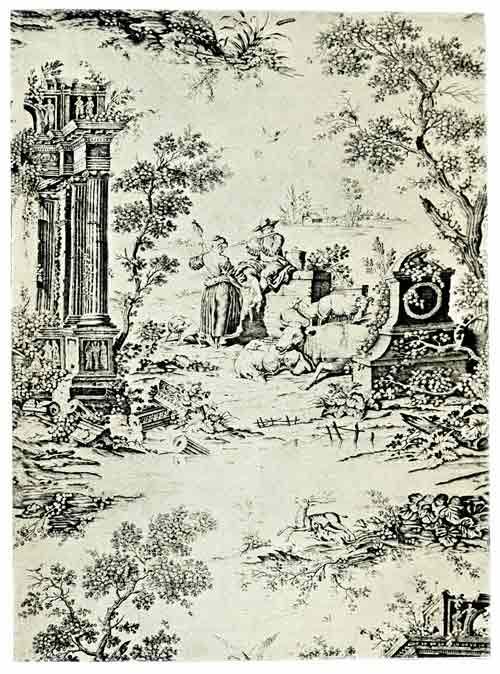
In spite of this great commercial spirit which seized the printing of textiles, hand-block printing did not pass away, for it has survived till to-day as the best method for fine artistic work; cretonnes and chintzes produced in this manner, even during the nineteenth century, are always good. Mechanical roller work, however, was responsible for a large output of work which is little worthy of preservation, and in the nineteenth century we find much machine-printed chintz which, to say the least, is not reminiscent of the fine handwork which preceded it in the mid-eighteenth century. The earliest machine-work was carried out by means of engraved copper plates applied to the cloth in a printer's press. One of these is illustrated on p. 331. It is exceedingly fine in its details, and very few old specimens of this pattern are in existence. In several places are inserted the printer's name and date, "R. Jones, Old Ford, 1761." The design is doubtless borrowed from the Toiles de Jouy, printed by a Bavarian at Jouay, near Versailles, about this time. The drawing, however, is finer than any specimens of his work which have come to the author's notice. A shepherdess is tending to her flock amid a classical ruin while she is listening to the music of a flute. In another portion of the design, a cock and hen are mourning for the loss of one of their brood which has been carried off by an eagle. This design is worthy of interest for its superior quality, as it must have been produced for some very fine house. There is another specimen printed in red in the Victoria and Albert Museum. The one which is illustrated here was found upon an exceedingly fine Chippendale bedstead.
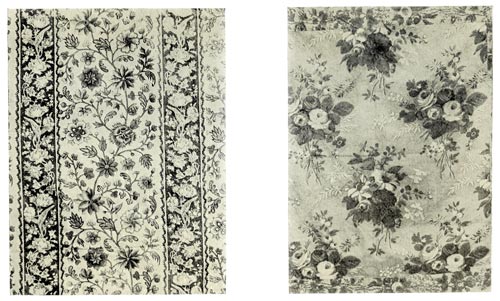
During the Hepplewhite and Sheraton periods of furniture the chintz ceases to have its pattern detached and grouped. Architectural details with figures disappear, and once more the designer returns to flowers as his subject for illustration. The foliage, however, now takes the form of vertical stripes, being contained within lace-like ribands placed at even distances. On p. 335 is an illustration of a chintz about 1790 in which these features will be noticed.
In the nineteenth century we find the chintz covered with disjointed sprigs, as though the flowers had been plucked and cast upon the cloth. Their outline is softened by a margin of dots. An illustration of this style is shown on p. 335.
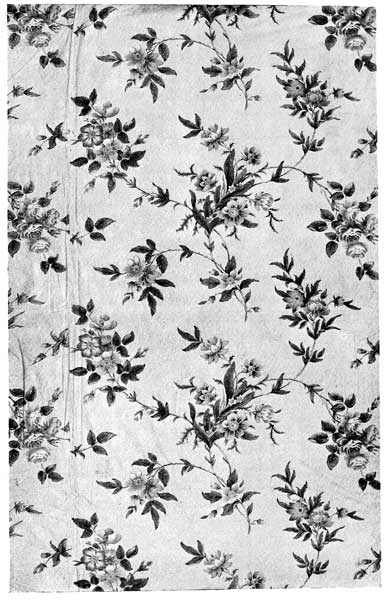
PRINTED CHINTZ.
From the Calico Printing Factory at Sobden, in Lancashire. Printed in 1831 under the direction of Richard Cobden.
(In the collection of Mrs. Cobden Unwin.)
One need not pursue the history of chintzes further, for to do so would entail a discussion of modern methods. Suffice it to say that in the nineteenth century we come across the hideous black grounds, the base imitation of woven designs, leopard skins, and other inartistic perversions. We must rather bid adieu to this beautiful art ere it has begun to decline. It will afford the reader much pleasure if he should form a collection of old specimens and frame them around his walls, for then he will fully appreciate their charm. In examining his own collection the author has spent many a pleasant hour, for these gaily coloured chintzes are among the most articulate relics which have come down to us. They breathe the spirit, the feelings, and the ideals of the periods wherein they were made. They show lucidly the various changes in fashion and the rise and wane in the popularity of certain forms of decoration. So delectable are their soft, faded colours, so fascinating are the designs, and above all, so enchanting is the old-world musty scent which always clings to them, that it would be hard indeed to withhold one's affection from them.