THÉOPHILE GAUTIER (continued 2)
Guy Thorne translation
Balzac came to one of these soirées, and Baudelaire related his visit thus: "Balzac undoubtedly thought that there is no greater shame or keener suffering than the abdication of the will. I saw him once at a reunion when he was contemplating the prodigious effects of hashish. He listened and questioned with attention and amusing vivacity. People who knew him would guess that he was bound to be interested. The idea shocked him in spite of himself. Some one presented him with the dawamesk. He examined it, smelt it, and gave it back without touching it. The struggle between his almost infantile curiosity and his repugnance for the abdication, betrayed itself in his expressive face; love of dignity prevailed. In effect, it is difficult to imagine the theorist of 'will' the spiritual twin of Louis Lambert, consenting to lose even a particle of this precious substance."
We were at the Hôtel Pimodan that evening, and therefore can relate this little anecdote with perfect accuracy. Only, we would add this characteristic detail: in giving back the spoonful of hashish that was offered him, Balzac only said that the attempt would be useless, and that hashish, he was sure, would have no action on his brain. That was possible. This powerful brain, in which will power was enthroned and fortified by study, saturated with the subtle aroma of moka, and never obscured by even a few bottles of the lightest of wine of Vouvray, would perhaps have been capable of resisting the passing intoxication of Indian hemp. For hashish, or dawamesk, we have forgotten to say, is only a concoction of cannabis indica, mixed to a fleshy substance with honey and pistachio-nuts, to give it the consistence of a paste or preserve.
The analysis of hashish is medically very well done in the "Artificial Paradises," and science is able to cull from them certain information; for Baudelaire prided himself on his accuracy, and on no consideration whatever would he slur over the least technical ornamentation of this habit in which he had himself indulged. He specifies perfectly the real character of the hallucinations produced by hashish, which of itself creates nothing, simply developing the particular disposition of the individual, exaggerating it to the very last degree. What one sees is oneself, aggrandised, made sensitive, excited, immoderately outside time and space, at one time real but soon deformed, accentuated, enlarged, and in which each detail, with extreme intensity, becomes of supernatural importance. Yet all this is easily understandable to the hashish-eater, who divines the mysterious correspondence between the often incongruous images. If you hear a piece of music which seems as though performed by some celestial orchestra and a choir of seraphim, compared to which the symphonies of Haydn, of Mozart, and of Beethoven are no more than aggravating clatter, you may believe that it is only that a hand has skimmed over the keys of a piano in some vague prelude, or that a distant organ murmurs through the uproar of the streets—a well-known piece from the opera. If your eyes are dazzled by blinding lights, scintillations, and flames, assuredly it is only a certain number of candles that burn in the torches and flambeaux.
As to the walls, ceasing to be opaque, sinking away into vaporous perspective, deep, blue, like a window opening on the infinite, it is but a glass mirror opposite the dreamer with its mingled and transparently fantastic shadows. The nymphs, the goddesses, the gracious apparitions, burlesque or terrible, come out of the pictures, the tapestries, from the statues displaying their mythological nudity in the niches, or from the grimacing china figures on the shelves.
It is the same with the olfactory ecstasies which transport one to the paradises of perfumes, of marvellous flowers, balancing their calices like censors which send out aromatic scents of penetrating subtlety, recalling the memory of former lives, of balsamic and distant shores and primitive loves in some Tahiti of a dream. One does not have to seek far in the room for a pot of heliotrope or tuberose, a sachet of Spanish leather or a cashmere shawl impregnated with patchouli, negligently thrown over the arm of a chair.
It is understood, then, if one wishes to enjoy to the full the magic of hashish, it is necessary to prepare in advance and furnish in some way the motif to its extravagant variations and disorderly fantasies. It is important to be in a tranquil frame of mind and body, to have on this day neither anxiety, duty, nor fixed time, and to find oneself in such an apartment as Baudelaire and Edgar Poe loved, a room furnished with poetical comfort, bizarre luxury, and mysterious elegance; a private and hidden retreat which seems to await the beloved, the ideal feminine face that Chateaubriand, in his noble language, calls the "sylphide." In such circumstances, it is probable, and even almost certain, that the naturally agreeable sensations turn into ravishing blessings, ecstasies, ineffable pleasure, much superior to the coarse joys promised to the faithful in the paradise of Mahomet, too easily comparable to a seraglio. The green, red, and white houris coming out from the hollow pearl that they inhabit and offering themselves to the faithful, would appear as vulgar women compared to the nymphs, angels, sylphides, perfumed vapours, ideal transparencies, forms of blue and rose let loose on the disc of the sun and coming from the depths of infinity with stellary transports, like the silver globules on gaseous liquor, from the bottom of the crystal chalice, that the hashish-eater sees in innumerable legions in the dreams he dreams while wide-awake.
Without these precautions the ecstasy is likely to turn into-nightmare. Pleasure changes to suffering, joy to terror; a terrible anguish seizes one by the heart and breaks one with its fantastically enormous weight, as though the sphinx of the pyramids, or the elephant of the king of Siam, had amused itself by flattening one out. At other times an icy cold is felt making the victim seem like marble up to the hips, like the king in the "Thousand and One Nights," half changed to a statue, whose wicked wife came every morning to beat the still supple shoulders.
Baudelaire relates two or three hallucinations of men of different temperaments, and one experienced by a woman in a small room hidden by a gilt trellis and festooned with flowers, which is easily recognised as the boudoir of the Hôtel Pimodan. He accompanies each vision with an analytical and moral commentary, through which his unconquerable repugnance for happiness obtained by such means is easily discernible. He counts as nothing the consideration of the help that genius can draw from the ideas suggested by intoxication of hashish. Firstly, these ideas are not so beautiful as one imagines, their charm comes chiefly from the extreme excitement in which the subject is. Then hashish, which produces these ideas, destroys at the same time the power of using them, for it reduces to nothing the will and plunges its victims in an ennui in which the mind becomes incapable of any effort or work, and from which it cannot escape except through the medium of another dose. "Lastly," he adds, "admitting the minute hypothesis of a temperament well enough balanced, strong enough to resist the evil effects of this perfidious drug, it is necessary to consider another fatal, terrible danger, which is that of habit. Those who have recourse to a poison to make them think, will soon find that they cannot think without poison. Picture to yourself the terrible fate of a man whose paralysed imagination no longer fulfils its functions without the aid of hashish or opium."
And, a little later, he makes his profession of faith in these noble terms: "But man is not so lacking in honest means of inspiration that he is obliged to invite the aid of the pharmacy or of sorcery; he has no need to sell his soul to pay for the intoxicating caresses and friendliness of the houris. What is the paradise that one buys at the price of eternal salvation?"
There follows the painting of a sort of Olympus placed on the arduous mount of spirituality where the muses of Raphael or of Mantegna, under the guidance of Apollo, surround with their rhythmical choirs the artist vowed to the cult of beauty and recompense him for his continuous efforts. "Beneath him," continues the author, "at the foot of the mountain, in the brambles and mud, the troop of men, the band of helots, simulate the grimaces of enjoyment, and yell out if the bite of poison is taken away from them; and the saddened poet says: 'These unfortunate beings who have neither fasted nor prayed, and who have refused to work out their own redemption, demand from black magic the means of elevation, with a sudden stroke, to a supernatural existence. Magic dupes them and kindles in them false happiness and light; whilst we, poets and philosophers, who have given new life to our souls by continued work and thought, by the assiduous exercise of the will and permanent nobility of intention, we have created for our pleasure a garden of real beauty. Confiding in the word which says faith can remove mountains, we have accomplished the only miracle which God has allowed.'"
After such an expression of faith it is difficult to believe that the author of the "Flowers of Evil," in spite of his satanical leanings, has often visited artificial paradises.
Succeeding the study on hashish is one on the subject of opium. But here Baudelaire had for his guidance a book, singularly celebrated in England, "Confessions of an English Opium Eater," by De Quincey, a distinguished Hellenist, a leading writer, and a man of great respectability, who has dared, with tragical candour, in a country the most hardened by cant in the world, to avow his passion for opium, to describe this passion, representing the phases, the intermittences, the relapses, the combats, the enthusiasms, the prostrations, the ecstasies and the phantasmagoria followed by inexpressible anguish. De Quincey, incredible as it may seem, had, augmenting little by little each dose, come to taking eight thousand drops a day. This, however, did not prevent him from living till the age of seventy-five, for he only died in the month of December 1859, making the doctors, to whom, in a fit of humour, he had mockingly left his corpse as a subject for scientific experiment, wait a long time. This habit did not prevent him from publishing a crowd of literary and learned works in which nothing announced the fatal influence which he himself described as "the black idol." The dénouement of the book leaves it understood that only with superhuman efforts was the author brought to the state of self-correction; but that could only have been a sacrifice to morals and conventions, like the recompense of virtue and the punishment of crime at the end of a melodrama, final impenitence being a bad example. And De Quincey pretends that, after seventeen years of use and eight years of abuse of opium, he has been able to renounce this dangerous substance! It is unnecessary to discourage the theriakis of good-will. But what of the love, however expressed, in the lyrical invocation to the brown liqueur?
"O just, subtle, and all-conquering opium! thou who, to the hearts of rich and poor alike, for the wounds that will never heal, and for the pangs of grief that 'tempt the spirit to rebel' bringest an assuaging balm;—eloquent opium! that with thy potent rhetoric stealest away the purposes of wrath, pleadest effectually for relenting pity, and through one night's heavenly sleep callest back to the guilty man the visions of his infancy, and hands washed pure from blood;—O just and righteous opium! that to the chancery of dreams summonest, for the triumphs of despairing innocence, false witnesses; and confoundest perjury; and dost reverse the sentences of unrighteous judges;—thou buildest upon the bosom of darkness, out of the fantastic imagery of the brain, cities and temples, beyond the art of Phidias and Praxiteles—beyond the splendours of Babylon and Hekatompylos; and, 'from the anarchy of dreaming sleep,' callest into sunny light the faces of long-buried beauties, and the blessed household countenances, cleansed from the 'dishonours of the grave.' Thou only givest these gifts to man; and thou hast the keys of Paradise, O just, subtle, and mighty opium!"
Baudelaire does not translate De Quincey's book entirely. He takes from it the most salient parts, of which he writes in an analysis intermingled with digressions and philosophical reflections, in such a way that he presents the entire work in an abridgment. Nothing is more curious than the biographical details which open these confessions. They show the flight of the scholar to escape from the tyrannies of his tutors, his miserable and starving life in the great desert of London, his sojourn in the lodgings turned into a garret by the negligence of the proprietor. We read of his liaison with a little half-idiot servant, Ann, a poor child, sad violet of the highways, innocent and virginal so far; his return in grace to his family and his becoming possessed of a fortune, considerable enough to allow him to give himself up entirely to his favourite studies in a charming cottage, in company with a noble woman, whom this Orestes of opium called his Electra. For, after his neuralgic pains, he had got into that ineradicable habit of taking the poison of which he absorbed, without disastrous results, the enormous quantity of forty grains a day.
To the most striking visions which shone with the blue and silver of Paradise or Elysium succeeded others more sombre than Erebus, to which one can apply the frightful lines of the poet:
"As when some great painter dips His pen in gloom of earthquake and eclipse."
De Quincey, who was a precocious and distinguished humanist—he knew both Greek and Latin at the age of ten—had always taken great pleasure in reading Livy, and the words "Consul Romanus" resounded in his ears like a magical and peremptorily irresistible formula. These five syllables struck upon his ear like the blasts of trumpets, sounding triumphal fanfares, and when, in his dreams, multitudes of enemies struggled on a field of battle lighted with livid glimmerings, with the rattling of guns and heavy tramping, like the surge of distant waters, suddenly a mysterious voice would cry out these dominating words: "Consul Romanus." A great silence would fall, oppressed by anxious waiting, and the consul would appear mounted on a white horse, in the midst of a great crowd, like the Marius of the "Batailles des Cimbres" of Decamps, and, with a fatidical gesture, decide the victory.
At other times, people seen in reality would be mixed up in his dreams, and would haunt them like obstinate spectres not to be chased away by any formula of exorcism.
One day, in the year 1813, a Malay, of a yellow and bilious colour, with sad, home-sick eyes, coming from London and seeking some haven, knowing not one word of any European language, knocked to see if he could rest a while, at the door of the cottage. Not wishing to fall short in the eyes of his domestics and neighbours, De Quincey spoke to him in Greek; the Asiatic replied in Malay, and his honour as a linguist was saved. After having given him some money, the master of the cottage, moved by the charity which causes a smoker to offer a cigar to a poor devil whom he supposes has long been without tobacco, gave the Malay a large piece of opium, which the man swallowed in a mouthful. There was enough to kill seven or eight unaccustomed people, but the yellow-skinned man was in the habit of taking it, for he went away with signs of great satisfaction and gratitude. He was not seen again, at least in the flesh, but he became one of the most assiduous frequenters of De Quincey's visions. The Malay of the saffron face and the strangely black eyes was a kind of genus of the extreme Orient who had the keys of India, Japan, China, and other countries of repute in a chimerical and impossible distance. As one obeys a guide whom one has not called, but whom one must follow by one of those fatalities that a dream admits of, De Quincey, in the steps of the Malay, plunged into regions of fabulous antiquity and inexpressible strangeness that caused him the profoundest terror. "I know not," says he in his "Confessions," "if others share my feelings on this point; but I have often thought that, if I were compelled to forgo England, and to live in China, among Chinese manners and methods and scenery, I should go mad.... A young Chinese seems to me an antediluvian man renewed. ... In China, over and above what it has in common with the rest of Southern Asia, I am terrified by the modes of life, by the manners, by the barrier of utter abhorrence placed between myself and them, by counter-sympathies deeper than I can analyse. I could sooner live with lunatics, with vermin, with crocodiles or snakes."
With malicious irony, the Malay, who seemed to understand the repugnance of the opium-eater, took care to lead him to the centre of great towns, to the ivory towers, to rivers full of junks crossed by bridges in the form of dragons, to streets encumbered with an innumerable population of baboons, lifting their heads with obliquely set eyes, and moving their tails like rats, murmuring, with forced reverence, complimentary mono-syllables.
The third and last part of the dreams of an opium-eater has a lamentable title, which, however, is well justified, "Suspiria de profundis." In one of these visions appeared three unforgettable figures, mysteriously terrible like the Grecian "Moires" and the "Mothers" of the second "Faust." These are the followers of Levana, the austere goddess who takes up the new-born babe and perfects it by sorrow. As there were three Graces, three Fates, three Furies, three Muses in the primitive ages, so there were three goddesses of sorrow; they are our Notre-Dame des Tristesses. The eldest of the three sisters is called Mater lacrymarum, or Our Lady of Tears; the second Mater suspiriorum, Our Lady of Sighs; the third and youngest, Mater tenebrarum, Our Lady of Darkness, the most redoubtable of all, and of whom the strongest cannot dream without a secret terror. These mournful spectres do not speak the language of mortals; they weep, they sigh, and make terrible gestures in the shadows. Thus they express their unknown sorrows, their nameless anguish, the suggestions of solitary despair, all that there is of suffering, bitterness, and sorrow in the depths of the human soul. Man ought to take warning from these initiators: "Thus will he see things that ought not to be seen, sights which are abominable, and unspeakable secrets; thus will he read the ancient truths, the sad, great, and terrible truths."
One can imagine that Baudelaire did not spare De Quincey the reproaches he addressed to all those who sought to attain the supernatural by material means; but, in regard to the beauty of the pictures painted by the illustrious and poetical dreamer, he showed him great good will and admiration.
About this time Baudelaire left Paris and pitched his tent in Brussels. One must not presume that this journey was taken with any political idea, but merely from the desire of a more tranquil and reposeful life, far away from the distractions and excitements of Paris. This change does not appear to have been a particularly profitable one for him. He worked little at Brussels, and his papers contain only sketchy notes, summaries almost hieroglyphical, which he alone could resolve. His health, instead of improving, was impaired, more deeply than he himself was aware, as the climate did not agree with him. The first symptoms manifested themselves in a certain slowness of speech, and a more and more marked hesitation in the choice of his words; but, as Baudelaire often expressed himself in a solemn and sententious way, one did not take much notice of this embarrassment in speech, which was the preface to the terrible malady that carried him off.
The rumour of Baudelaire's death spread in Paris with the winged rapidity of bad news, faster than an electric current along its wire. Baudelaire was still living, but the news, though false, was only premature; he could not recover from the attack. Brought back from Brussels by his family and friends, he lived some months, unable to speak, unable to write, as paralysis had broken the connecting thread between thought and speech. Thought lived in him always—one could see that from the expression of his eyes; but it was a prisoner, and dumb, without any means of communication, in the dungeon of clay which would only open in the tomb. What good is it to go into the details of this sad end? It is not a happy way to die; it is sorrowful, for the survivors, to see so fine and fruitful an intelligence pass away, to lose in a more and more deserted path of life a companion of youth.
Besides the "Flowers of Evil," translations of Edgar Poe, the "Artificial Paradises," and art criticisms, Baudelaire left a little book of "poems in prose" inserted at various periods in journals and reviews, which soon became without interest for vulgar readers and forced the poet, in his noble obstinacy, which would allow of no concession, to take the series to a more enterprising or literary paper. This is the first time that these pieces, scattered and difficult to find, are bound in one volume, nor will they be the least of the poet's titles to the regard of posterity.
In the short Preface addressed to Arsène Houssaye, which precedes the "Petits poèmes en prose," Baudelaire relates how the idea of employing this hybrid form, floating between verse and prose, came to him.
"I have a little confession to make to you. It was in turning over, for the twentieth time, the famous 'Gaspard de la nuit' of Aloysius Bertrand (a book known to me, to you, and several of our friends—has it not the right to be called famous?) that the idea came to me to attempt something analogous and to apply to the description of modern life, or rather to a modern and more abstract life, the process that he has applied to the painting of an ancient time, so strangely picturesque.
"Who among us, in these days of ambition, has not dreamt of the miracle of poetical, musical prose, without rhythm, without rhyme, supple enough and apt enough to adapt itself to the movements of the soul, to the swaying of a dream, to the sudden throbs of conscience?"
It is unnecessary to say that nothing resembles "Gaspard de la nuit" less than the "Poems in Prose." Baudelaire himself saw this after he commenced work, and he spoke of an accident, of which any other than he would have been proud, but which only humiliated a mind which looked upon the accomplishment of exactly what it had intended as an honour.
We have seen that Baudelaire always claimed to direct his inspiration according to his own will, and to introduce infallible mathematics into his art. He blamed himself for producing anything but that upon which he had resolved, even though it is, as in the present case, an original and powerful work.
Our poetical language, it must be acknowledged, in spite of the valiant effort of the new school to render it flexible and malleable, hardly lends itself to rare and subtle detail, especially when the subject is la vie moderne, familiar or luxurious. Without having, as at one time, a horror for the calculated word and a love of circumlocution, French verse, by its very construction, refuses particularly significant expressions and if forced into direct statement, immediately becomes hard, rugged, and laborious. "The Poems in Prose" came very opportunely to supply this deficiency, and in this form, which demands perfect art and where each word must be thrown, before being employed, into scales more easy to weigh down than those of the "Peseurs d'or" of Quintin Metsys—for it is necessary to have the standard, the weights, and the balance—Baudelaire has shown a precious side of his delicate and bizarre talent. He has been able to approach the almost inexpressible and to render the fugitive nuances which float between sound and colour, and those thoughts which resemble arabesque motifs or themes of musical phrases. It is not only to the physical nature, but to the secret movements of the soul, to capricious melancholy, to nervous hallucinations that this form is aptly applied. The author of the "Flowers of Evil" has drawn from it marvellous effects, and one is sometimes surprised that the language carries one through the transparencies of a dream, in the blue distances, marks out a ruined tower, a clump of trees, the summit of a mountain, and shows one things impossible to describe, which, until now, have never been expressed in words. This should be one of the glories, if not the greatest, of Baudelaire, to bring within the range of style a series of things, sensations, and effects unnamed by Adam, the great nomenclator. A writer can be ambitious of no more beautiful title, and this the author of the "Poems in prose" undoubtedly merits.
It is very difficult, without writing at great length—and, even then, it is better to direct the reader straight to the poems themselves—to give a just idea of these compositions; pictures, medallions, bas-reliefs, statuettes, enamels, pastels, cameos which follow each other rather like the vertebrae in the spine of a serpent. One is able to pick out some of the rings, and the pieces join themselves together, always living, having each its own soul writhing convulsively towards an inaccessible ideal.
Before closing this Introduction, which, although already too long—for we have simply chased through the work of the author and friend whose talent we endeavour to explain—it is necessary to quote the titles of the "Poems in Prose"—very superior in intensity, concentration, profoundness, and elegance to the delicate fantasies of "Gaspard de la nuit," which Baudelaire proposed to take as models. Among the fifty pieces which comprise the collection, each different in tone and composition, we will number "Le Gâteau, "La Chambre double," "Le Foules," "Les Veuves," "Le vieux saltimbanque," "Une Hémisphère dans une chevelure," "L'Invitation au voyage," "La Belle Dorothée," "Une Mort héroïque," "Le Thyrse," Portraits de maîtresses," "Le Désir de peindre," "Un Cheval de race" and especially "Les Bienfaits de la lune," an adorable poem in which the poet expresses, with magical illumination, what the English painter Millais has missed so completely in his "Eve of St. Agnes"—the descent of the nocturnal star with its phosphoric blue light, its grey of iridescent mother-of-pearl, its mist traversed by rays in which atoms of silver beat like moths. From the top of her stairway of clouds, the Moon leans down over the cradle of a sleeping child, bathing it in her baneful and splendid light; she dowers the sweet pale head like a fairy god-mother, and murmurs in its ear: "Thou shalt submit eternally to the influence of my kiss, thou shalt be beautiful after my fashion. Thou shalt love what I love and those that love me: the waters, the clouds, the silence, the night, the great green sea, the shapeless and multiform waters, the place where thou art not, the lover whom thou knowest not, the prodigious flowers, the perfumes that trouble the mind, the cats which swoon and groan like women in hoarse or gentle voices."
We know of no other analogy to this perfect piece than the poetry of Li-tai-pe, so well translated by Judith Walter, in which the Empress of China draws, among the rays, on the stairway of jade made brilliant by the moon, the folds of her white satin robe. A lunatique only is able to understand the moon and her mysterious charm.
When we listen to the music of Weber we experience at first a sensation of magnetic sleep, a sort of appeasement which separates us without any shock from real life. Then in the distance sounds a strange note which makes us listen attentively. This note is like a sigh from the supernatural world, like the voice of the invisible spirits which call us. Oberon just puts his hunting-horn to his mouth and the magic forest opens, stretching out into blue vistas peopled with all the fantastic folk described by Shakespeare in "A Midsummer Night's Dream." Titania herself appears in the transparent robe of silver gauze.
The reading of the "Poems in Prose" has often produced in us these impressions; a phrase, a word—one only—bizarrely chosen and placed, evoke for us an unknown world of forgotten and yet friendly faces. They revive the memories of early life, and present a mysterious choir of vanished ideas, murmuring in undertones among the phantoms of things apart from the realities of life. Other phrases, of a morbid tenderness, seem like music whispering consolation for unavowed sorrows and irremediable despair. But it is necessary to beware, for such things as these make us homesick, like the "Ranz des vaches" of the poor Swiss lansquenet in the German ballad, in garrison at Strasbourg, who swam across the Rhine, was retaken and shot "for having listened too much to the sound of the horn of the Alps."
THÉOPHILE GAUTIER.
February 20th, 1868.
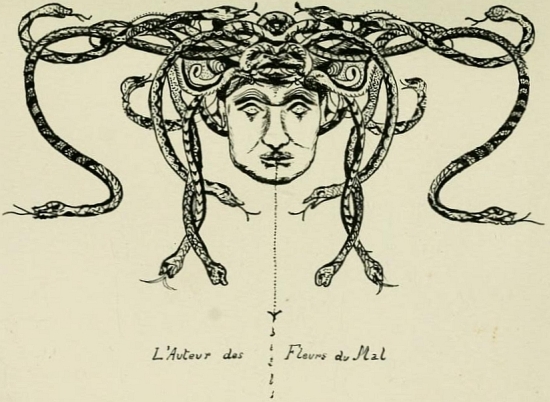
L'AUTEUR DES FLEURS DU MAL
SELECTED POEMS OF CHARLES BAUDELAIRE
DONE INTO ENGLISH VERSE
BY GUY THORNE
EXOTIC PERFUME (Parfum exotique) With eve and Autumn in mine eyes confest, I breathe an incense from thy heart of fire, And happy hill-sides tired men desire Unfold their glory in the weary West. O lazy Isle! where each exotic tree Is hung with delicate fruits, and slender boys Mingle with maidens in a dance of joys That knows not shame, where all are young and free. Yes I thy most fragrant breasts have led me home To this thronged harbour; and at last I know Why searching sailors venture on the foam.... —'Tis that they may to Tamarisk Island go. For there old slumberous sea-chants fill the air Laden with spices, and the world is fair. THE MURDERER'S WINE (Le vin de l'assassin) My wife is stiffened into wax. —Now I can drink my fill. Her yellings tore my heart like hooks, They were so keen and shrill. 'Tis a King's freedom that I know Since that loud voice is still. The day is tender blue and gold, The sky is clear above ... Just such a summer as we had When first I fell in love. ... I'm a King now! Such royal thoughts Within me stir and move! I killed her; but I could not slake My burning lava-wave Of hideous thirst—far worse than that Of some long-tortured slave— If I had wine enough to fill Her solitary, deep grave. In slime and dark her body lies; It echoed as it fell. (I will remember this no more.) Her tomb no man can tell. I cast great blocks of stone on her, The curb-stones of the well. We swore a thousand oaths of love; Absolved we cannot be Nor ever reconciled, as when We both lived happily; ... 'Twas evening on a darkling road When the mad thing met me. We all are mad, this I well think. ... The madness of my wife Was to come, tired and beautiful, To a madman with a knife! I loved her far too much, 'twas why I hurried her from life. I am alone among my friends, And of our sodden crowd No single drunkard understands I sit apart and vowed. They do not weave all night, and throw Wine-shuttles through a shroud! True love has black enchantments; chains That rattle, and damp fears; Wan phials of poison, dead men's bones, And horrible salt tears. Of this the iron-bound drunkard knows Nothing, nor nothing hears. I am alone. My wife is dead, And dead-drunk will I be This self-same night, a clod on earth With naught to trouble me. A dog I'll be, in a long dog-sleep, Oblivious and free! The chariot with heavy wheels Comes rumbling through the night. Crushed stones and mud are on its wheels, It is a thing of might! The wain of retribution moves Slowly, as is most right. It comes, to crack my guilty head Or crush my belly through, I care not who the driver is; God and the devil too —Sitting side by side—can do no more Than that they needs must do! MUSIC (La Musique) Music can lead me far, and far O'er mystical sad seas, Where burns my pale, high-hanging star Among the mysteries Of Pleiades. My lungs are taut of sweet salt air; The pregnant sail-cloths climb The long, gloom-gathering ocean stair. I don the chord-shot cloak of Time While the waves chime! Fierce winds and sombre tempests come And bludgeon heavily All our vibrating timbers ... drum Most passionately. O Sea! Liberate me! So shall thy mighty void express Both depths and surface. There Opens thy magic mirror; men confess To Thee their sick despair ... No otherwhere. THE GAME (Le jeu) In faded chairs old courtesans With painted eyebrows leer. The stones and metal rattle in Each dry and withering ear, As lackadaisical they loll, And preen themselves, and peer. Their mumbling gums and lipless masks —Or lead-white lips—are prest Around the table of green cloth; And withered hands, possest Of Hell's own fever, vainly search In empty purse or breast. Beneath the low, stained ceiling hang Enormous lamps, which shine On the sad foreheads of great poets Glutted with things divine, Who throng this ante-room of hell To find the anodyne. I see these things as in a dream, With the clairvoyant eye, And in a cottier of the den A crouching man descry; A silent, cold, and envying man Who watches. It is I! I envy those old harlots' greed And gloomy gaiety; The gripping passion of the game, The fierce avidity With which men stake their honour for A ruined chastity. I dare not envy many a man: Who runs his life-race well; Whose brave, undaunted peasant blood Death's menace cannot quell. Abhorring nothingness, and strong Upon the lip of Hell. THE FALSE MONK (Le mauvais moine) Upon the tall old cloister walls there were Some painted frescoes showing Truth; so we, Seeing them thus so holy and so fair, Might for a space forget austerity. For when the Lord Christ's seeds were blossoming, Full many a simple, pious brother found Death but a painted phantom with no sting, —And took for studio a burial-ground. But my soul is a sepulchre, where I, A false Franciscan, dwell eternally, And no walls glow with pictured mysteries. When shall I rise from living death, to take My pain as rich material, and make Work for my hands, with pleasure for mine eyes? AN IDEAL OF LOVE (L'Idéal) I hate those beauties in old prints, Those faded, simpering, slippered pets; Vignetted in a room of chintz, And clacking silly castanets. I leave Gavarni all his dolls, His sickly harems, pale and wan, The beauties of the hospitals I do not wish to look upon. Red roses are the roses real! Among the pale and virginal Sad flowers, I find not my ideal ... Vermilion or cardinal! The panther-women hold my heart— Macbeth's dark wife, of men accurst, ... A dream of Æschylus thou art, 'Tis such as thou shall quench my thirst! ... Or Michelangelo's daughter, Night, Who broods on her own beauty, she For whose sweet mouth the Giants fight, Queen of my ideal love shall be! THE SOUL OF WINE (L'Âme du vin) Vermilion the seals of my prison, Cold crystal its walls, and my voice Singeth loud through the evening; a vision That bid'st thee rejoice! Disinherited! outcast!—I call thee To pour, and my song in despite Of the World shall enfold and enthrall thee Pulsating with light! Long labours, fierce ardours, and blazing Of suns on far hill-sides, and strife Of the toilers have gone to the raising Of me into life! I forget not their pains, for I render Rewards; yea! in full-brimming bowl To those who have helped to engender My passionate soul! My joys are unnumbered, unending, When I rise from chill cellars to lave The hot throat of Labour, ascending As one from the grave. The Sabbath refrains that thou hearest, The whispering hope in my breast, Shalt call thee, dishevelled and dearest! To ultimate rest. The woman thy youthfulness captured, Who bore thee a son—this thy wife— I will give back bright eyes, which enraptured Shall see thee as Life! Thy son, a frail athlete, I dower With all my red strength, and the toil Of his life shall be king-like in power, ... Anointed with oil! To thee I will bow me, thou fairest Gold grain from the Sower above. Ambrosia I wedded, and rarest The fruits of our love. High God round His feet shall discover The verses I made, in the hours When I was thy slave and thy lover, Press upwards like flowers! THE INVOCATION (Prière) Glory to thee, Duke Satan. Reign O'er kings and lordly state. Prince of the Powers of the Air And Hell; most desolate, Dreaming Thy long, remorseful dreams And reveries of hate! O let me lie near thee, and sleep Beneath the ancient Tree Of Knowledge, which shall shadow thee Beelzebub, and me! While Temples of strange sins upon Thy brows shall builded be. THE CAT (Le Chat) Most lovely, lie along my heart, Within your paw your talons fold, Let me find secrets in your eyes— Your eyes of agate rimmed with gold! For when my languid fingers move Along your rippling back, and all My senses tingle with delight In softness so electrical, My wife's face flashes in my mind; Your cold, mysterious glances bring, Sweet beast, strange memories of hers That cut and flagellate and sting! From head to foot a subtle air Surrounds her body's dusky bloom, And there attends her everywhere A faint and dangerous perfume. THE GHOST (Le Revenant) With some dark angel's flaming eyes That through the shadows burn, Gliding towards thee, noiselessly, —'Tis thus I shall return. Such kisses thou shalt have of me As the pale moon-rays give, And cold caresses of the snakes, That in the trenches live. And when the livid morning comes, All empty by thy side, And bitter cold, thou'lt find my place; Yea, until eventide. Others young love to their embrace By tenderness constrain, But over all thy youth and love I will by terror reign. LES LITANIES DE SATAN O Satan, most wise and beautiful of all the angels, God, betrayed by destiny and bereft of praise, Have pity on my long misery! Prince of Exile, who hast been trodden down and vanquished, But who ever risest up again more strong, O Satan, have pity on my long misery! Thou who knowest all; Emperor of the Kingdoms that are below the earth, Healer of human afflictions, Have pity on my long misery! Thou who in love givest the taste of Paradise To the Leper, the Outcast and those who are accursed, O Satan, have pity on my long misery! O thou who, of Death, thy strong old mistress, Hast begotten the sweet madness of Hope, Have pity on my long misery! Thou who givest outlaws serenity, and the pride Which damns a whole people thronging round the scaffold, O Satan, have pity on my long misery! Thou who knowest in what corners of the envious earth The jealous God hath hidden the precious stones, Have pity on my long misery! Thou whose clear eye knoweth the deep arsenals Wherein the buried metals are sleeping, O Satan, have pity on my long misery! Thou whose great hand hideth the precipice And concealeth the abyss from those who walk in sleep, Have pity on my long misery! Thou who by enchantment makest supple the bones of the drunkard When he falleth under the feet of the horses, O Satan, have pity on my long misery! Thou who didst teach weak men and those who suffer To mix saltpetre and sulphur, Have pity on my long misery! Thou, O subtle of thought! who settest thy mask Upon the brow of the merciless rich man, O Satan, have pity on my long misery! Thou who fillest the eyes and hearts of maidens With longing for trifles and the love of forbidden things, Have pity on my long misery! Staff of those in exile, beacon of those who contrive strange matters, Confessor of conspirators and those who are hanged, O Satan, have pity on my long misery! Sire by adoption of those whom God the Father Has hunted in anger from terrestrial paradise, Have pity on my long misery! ILL-STARRED! (Le Guignon) To raise this dreadful burden as I ought It needs thy courage, Sisyphus, for I Well know how long is Art, and Life how short. —My soul is willing, but the moments fly. Towards some remote churchyard without a name In forced funereal marches my steps come; Far from the storied sepulchres of fame. —My heart is beating like a muffled drum. Full many a flaming jewel shrouded deep In shadow and oblivion, lies asleep, Safe from the toiling mattocks of mankind. Sad faery blossoms secret scents distil In trackless solitudes; nor ever will The lone anemone her lover find!
Note.—It seems fairly obvious—and perhaps this is a discovery —that Baudelaire must have read Gray's "Elegy." As we know, he was a first-class English scholar, and whether he plagiarised or unconsciously remembered the most perfect stanza that Gray ever wrote, one can hardly doubt that the gracious music of the French was borrowed from or influenced by the no less splendid rhythm of—
"Full many a gem of purest ray serene The dark unfathomed caves of ocean bear: Full many a flower is born to blush unseen, And waste its sweetness on the desert air."
LINES WRITTEN ON THE FLY-LEAF OF AN EXECRATED BOOK (Épigraphe pour un livre condamné) Sober, simple, artless man, In these pages do not look, Melancholy lurks within, Sad and saturnine the book. Cast it from thee. If thou know'st Not of that dark learnèd band, Whom wise Satan rules as Dean; Throw! Thou would'st not understand. Yet, if unperturbed thou canst, Standing on the heights above, Plunge thy vision in the abyss —Read in me and learn to love. If thy soul hath suffered, friend, And for Paradise thou thirst, Ponder my devil-ridden song And pity me ... or be accurst! THE END OF THE DAY (La Fin de la journée) Beneath a wan and sickly light Life, impudent and noisy, sways; Most meaningless in all her ways. She dances like a bedlamite, Until the far horizon grows Big with sweet night, at last! whose name Appeases hunger, soothes the shame And sorrow that the poet knows. My very bones seem on the rack; My spirit wails aloud; meseems My heart is thronged with funeral dreams. I will lie down and round me wrap The cool, black curtains of the gloom That night hath woven in her loom.
LITTLE POEMS IN PROSE
VENUS AND THE FOOL
How glorious the day! The great park swoons beneath the Sun's burning eye, as youth beneath the Lordship of Love.
Earth's ecstasy is all around, the waters are drifting into sleep. Silence reigns in nature's revel, as sound does in human joy. The waning light casts a glamour over the world. The sun-kissed flowers plume the day with colour, and fling incense to the winds. They desire to rival the painted sky.
Yet, amidst the rout, I see one sore afflicted thing. A motley fool, a willing clown who brings laughter to the lips of kings when weariness and remorse oppress them; a fool in a gaudy dress, coiffed in cap and bells, huddles at the foot of a huge Venus. His eyes are full of tears, and raised to the goddess they seem to say:
"I am the last and most alone of mortals, inferior to the meanest animal, in that I am denied either love or friendship. Yet I, even I, am made for human sympathy and the adoration of immortal Beauty. O Goddess, have pity, have mercy on my sadness and despair."
But the implacable Venus stares through the world with her steady marble eyes.
THE DESIRE TO PAINT
Unhappy is the man, but happy the artist, to whom this desire comes.
I long to paint one woman. She has come to me but seldom, swiftly passing from my sight, as some beautiful, unforgettable object the traveller leaves behind him in the night. It is long ago since I saw her.
She is lovely, far more than that; she is all-sufficing. She is a study in black: all that she inspires is nocturnal and profound. Her eyes are two deep pools wherein mystery vaguely coils and stirs; her glance is phosphorescent; it is like lightning on a summer night of black velvet.
She is comparable to a great black Sun, if one could imagine a dark star brimming over with happiness and light. She stirs within one dreams of the moon, Night's Queen who casts spells upon her—not the white moon, that cold bride of summer idylls, but the sinister, intoxicating moon which hangs in the leaden vault of storm, among the driven clouds; not the pale, peaceful moon who visits the sleep of the pure; but the fiery moon, tom from the conquered heavens, before whom dance the witches of Thessaly.
Upon the brow determination sits; she is ever seeking whom she may enthrall. Her delicately curved and quivering nostrils breathe incense from unknown lands; a haunting smile lingers on her subtle lips—lips softer than sleep-laden poppy petals, kissed by the suns of tropic lands.
There are women who inspire one with the desire to woo and win. She makes me long to fall asleep at her feet, beneath her slow and steady gaze.
EACH MAN HIS OWN CHIMÆRA
Beneath a vault of livid sky, upon a far-flung and dusty plain where no grass grew, where not a nettle or a thistle dared raise its head, men passed me bowed down to the ground.
Each bore upon his back a great Chimæra, heavy as a sack of coal, or as the equipment of a foot-soldier of Rome.
But the monster was no dead weight. With her all-powerful and elastic muscles she encircled and oppressed her mount, clawing with two great talons at his breast. Her fabulous head reposed upon his brow, like a casque of ancient days whereby warriors struck fear to the hearts of their foes.
I questioned one of the wayfarers, asking why they walked thus. He replied that he knew nothing, neither he nor his companions, but that they moved towards an unknown land, urged on by irresistible impulse.
None of the wayfarers was discomforted by the foul thing which hung upon his neck. One said that it was part of himself.
Beneath the lowering dome of sky they journeyed on. They trod the dust-strewn earth—earth as desolate as the dusty sky. Their weary faces bore no witness to despair; they were condemned to hope for ever. So the pilgrimage passed and faded into the mist of the horizon, where the planet unveils itself to the human eye.
For some moments I tried to solve this mystery; but unconquerable Indifference fell upon me. And I was no more dejected by my burden than they by their crushing Chimæras.
INTOXICATION
To be drunken for ever: that is the only thing which matters! If you would escape Time's bruises and his heavy burdens which weigh you to the earth, you must be drunken.
But how? With the fruit of the wine, with poetry, with virtue, with what you will. But be drunken. And if, sometime, at the gates of a palace, on the green banks of a river, or in the shadowed loneliness of your own room, you should awake and find intoxication lessened or passed away, ask of the wind, of the wave, of the star, of the bird, of the timepiece; ask all that flies, all that sighs, all that revolves, all that sings, all that speaks—ask of these the hour. And the wind, the wave, the star, the bird, and the timepiece will answer you: "It is the hour to be drunken! Lest you be martyred slaves of Time, intoxicate yourselves, be drunken without cease! With wine, with poetry, with virtue, or with what you will."
THE MARKSMAN
As the carriage passed through the wood he told the driver to halt at a shooting-gallery, saying that he wished to have a few shots to kill time.
Is not the slaying of the monster Time the most usual and legitimate occupation of man?
So he graciously offered his hand to his dear, adorable, accursed wife; the mysterious woman who was his inspiration, to whom he owed many of his sorrows, many of his joys.
Several bullets went wide of the mark; one flew far away into the distance. His charming wife laughed deliriously, mocking at his clumsiness. Turning to her, he said brusquely:
"Look at that doll yonder, on your right, with its nose turned up and so supercilious an air. Think, sweet angel, I will picture to myself that it is you."
He closed his eyes, he pulled the trigger. The doll's head fell upon the ground.
Then, bending over his dear, adorable, accursed wife, his inevitable and merciless muse, he kissed her hand respectfully, and said: "Ah, sweet Angel, how I thank you for my skill!"
CORRESPONDENCE OF BAUDELAIRE
Baudelaire to Sainte-Beuve
19th March, 1856.
Here, my dear patron, is a kind of literature which will not, perhaps, inspire you with as much enthusiasm as it does me, but which will most surely interest you. It is necessary—that is to say that I desire, that Edgar Poe, who is not very great in America, should become a great man in France. Knowing how brave you are and what a lover of novelty, I have boldly promised your support to Michel Lévy.
Can you write me a line telling me if you will do something in the "Athenæum" or elsewhere? Because, in that case, I would write to M. Lalanne not to entrust this to any one else—your pen having a peculiar authority of which I am in need.
You will see at the end of the Notice (which contradicts all the current opinions in the United States) that I announce new studies. I shall speak of the opinions of this singular man later, in the matter of sciences, philosophy, and literature.
I deliver my always troubled soul into your hands.
Baudelaire to Sainte-Beuve
Wednesday, 26th March, 1856.
You well knew that this scrap of good news would enchant me. Lalanne had been warned by Asselineau, and it would have been necessary for the book to have been given to another person if you had not been able to write the article. Lalanne has received a volume.
I can, with respect to the remainder of your letter, give you some details which will perhaps interest you.
There will be a second volume and a second preface. The first volume is written to draw the Public: "Juggling, hypotheses, false rumours," etc. "Ligeia" is the only important piece which is morally connected with the second volume.
The second volume is more markedly fantastic: "Hallucinations, mental maladies, pure grotesqueness, the supernatural," etc.
The second Preface will contain the analysis of the words that I shall not translate, and, above all, the statement of the scientific and literary opinions of the author. It is even necessary that I should write to M. de Humboldt on this subject to ask him his opinion on a little book which is dedicated to him; it is "Eureka."
The first preface, that you have seen and in which I have tried to comprise a lively protestation against Americanism, is almost complete from the biographical point of view. We shall pretend to wish to consider Poe only as a juggler, but I shall come back at the finish to the supernatural character of his poetry and his stories. He is only American in so far as he is a juggler. Beyond that, the thought is almost anti-American. Besides, he has made fun of his compatriots as much as he could.
Now, the piece to which you allude makes part of the second volume. It is a dialogue between two souls, after the destruction of the earth. There are three dialogues of this kind that I shall be happy to lend you at the end of the month, before delivering my second volume to the printer.
Now, I thank you with all my heart; but you are so kind that you run risks with me. After the Poe will come two volumes of mine, one of critical articles and the other of poems. Thus, I make my excuses to you beforehand; and, besides, I fear that when I shall no longer speak with the voice of a great poet, I shall be for you a brawling and disagreeable being.
Yours ever.
At the end of the second volume of Poe I shall put some specimens of poetry.
I am persuaded that a man so careful as yourself would not wish me to ask him to take note of the orthography of the name [Edgar Poe]. No "d," no diæresis, no accent.
Baudelaire to Sainte-Beuve
9th March, 1857.
My dear friend, you are too indulgent to have taken exception to the impertinent point of interrogation that I have put after the word "souvenir" on the copy of the "Nouvelles histoires extraordinaires," that I laid aside for you yesterday at the "Moniteur." If you can be pleased, I shall think it very natural: you have spoilt me. If you cannot, I shall still find it very natural.
This second volume is of a higher and more poetic nature than two-thirds of the first. The third volume (in process of publication in the "Moniteur") will be preceded by a third notice.
The tale of the end of the world is called "Conversation of Eiros with Charmion."
A new pull has just been made of the first volume, in which the principal faults are corrected. Michel knows that he must keep a copy for you. If I have not the time to bring it to you, I shall have it sent to you.
Your affectionate.
Baudelaire to Sainte-Beuve
Wednesday, 18th August, 1857.
Ah! dear friend, I have something very serious, something very awkward to ask you. I wished to write to you, and then I would rather tell you. For a fortnight my ideas on this subject have been changing; but my lawyer (Chaix d'Est-Ange fils) insists that I talk to you about it, and I should be very happy if you could grant me a little conversation of three minutes to-day wherever you like, at your house or elsewhere. I did not wish to call on you unexpectedly. It always seems to me, when I take my way towards the rue Montparnasse, that I am going to visit that wonderful wise man, seated in a golden tulip, whose voice speaks to intruders with the resounding echo of a trumpet.
This morning I am awaiting some copies of my brochure; I will send you one at the same time.
Your very affectionate.
Baudelaire to Sainte-Beuve
Tuesday, 18th May, 1858.
I think that I drop in upon you as inconveniently as possible, do I not? You are engaged to-day; but, by coming to see you after four o'clock I shall perhaps be able to find you. In any case, whether I deceive myself or not, if you are busy this evening with your affairs, put me to the door like a true friend.
Yours always.
Baudelaire to Sainte-Beuve
14th June, 1858.
DEAR FRIEND,
I have just read your work on "Fanny." Is there any need for me to tell you how charming it is and how surprising it is to see a mind at once so full of health, of herculean health, and at the same time most delicate, most subtle, most femininely fine! (On the subject of feminine fineness I wanted to obey you and to read the work of the stoic. In spite of the respect I ought to have for your authority, I decidedly do not wish that gallantry, chivalry, mysticism, heroism, in fact exuberance and excess, which are what is most charming even in honesty, should be suppressed.)
With you, it is necessary to be cynical; for you are too shrewd for deceit not to be dangerous. Ah well, this article has inspired me with terrible jealousy. So much has been said about Loëve-Weimars and of the service he has rendered to French literature! Shall I not find a champion who will say as much of me?
By some cajolery, most powerful friend, shall I obtain this from you? However, what I ask of you is not an injustice. Did you not offer it to me at first? Are not the "Adventures of Pym" an excellent pretext for a general sketch? You, who love to amuse yourself in all depths, will you not make an excursion into the depths of Edgar Poe? You guess that the request for this service is connected in my mind with the visit I must pay to M. Pelletier. When one has a little money and goes to dine with a former mistress one forgets everything. But there are days when the curses of all the fools mount to one's brain, and then one implores one's old friend, Sainte-Beuve.
Now, truly, of late I have been literally dragged in the mud, and (pity me, it is the first time that I have lacked dignity), I have had the weakness to reply.
I know how busy you are and how full of application for all your lessons, for all your work and duties, etc. But if, sometimes, a little strain were not put on friendliness, on kindness, where would the hero of friendliness be? And if one did not say too much good about brave men, how would they be consoled for the curses of those who only wish to say too much evil?
Finally, I will say to you, as usual, that all that you wish will be good.
Yours ever.
I like you more than I like your books.
Baudelaire to Sainte-Beuve
14th August, 1858.
Is it permitted to come and warm and fortify oneself a little by contact with you? You know what I think of men who are depressants and men who have a tonic influence. If, then, I unsettle you, you must blame your qualification, still more my weakness. I have need of you as of a douche.
Baudelaire to Sainte-Beuve
21st February, 1859.
My dear friend, I do not know if you take in the "Revue française." But, for fear that you should read it, I protest against a certain line (on the subject of "The Flowers of Evil"), page 171, in which the author—who, however, is very intelligent—is guilty of some injustice towards you.
Once, in a newspaper, I have been accused of ingratitude towards two chiefs of ancient romanticism to whom I owe all; it spoke, besides, with a judicial air, of this infamous trash.
This time, in reading this unfortunate line, I said to myself: "Mon Dieu! Sainte-Beuve, who knows my fidelity, but who knows that I am connected with the author, will perhaps believe that I have been capable of prompting this passage." It is exactly the contrary; I have quarrelled with Babou many a time in order to persuade him that you would always do everything you ought and could do.
A short time ago I was talking to Malassis of this great friendship, which does me honour and to which I owe so much good advice. The monster left me no peace until I gave him the long letter that you sent me at the time of my lawsuit, and which will serve, perhaps, as a plan for the making of a Preface. New "Flowers" are done, and passably out of the ordinary. Here, in repose, fluency has come back to me. There is one of them ("Danse macabre") which ought to have appeared on the 15th, in the "Revue contemporaine...."
I have not forgotten your Coleridge, but I have been a month without receiving any books, and to run through the 2,400 pages of Poe is some small labour.
Sincerely yours, and write to me if you have time.
Honfleur, Calvados (this address is sufficient).
What has become of the old rascal? (d'Aurevilly).
Baudelaire to Sainte-Beuve
28th February, 1859.
My dear friend, I learn that you have asked Malassis to communicate to you what you wrote to me on the subject of the "Flowers." Malassis is a little astounded; furthermore, he is ill. There were two letters; one, a friendly, complimentary letter; the other, a scheme of the address that you gave to me on the eve of my lawsuit. As, one day, I was classifying papers with Malassis, he begged me to give him that, and when I told him I intended to make use of it (not by copying but by paraphrasing and developing it) he said to me: "All the more reason. You will always find it again at my house. If your printer had it, it could not get lost."
I even think I remember having said to Malassis: "If I had pleaded my cause myself and if I had known how to develop this thesis, that a lawyer could not understand, I should doubtless have been acquitted."
I understand absolutely nothing of this nonsense in the "Revue française." The manager, however, seems to be a very well-bred young man. Every one knows that you have rendered many services to men younger than yourself. How has M. M—— printed this without making representations to Babou and without finding out what prejudice he had towards me?
Malassis, on whom I had not counted at all, has also seen the passage, and his letter is still more severe than yours.
I am going to Paris on the 4th or 5th. It would be very kind of you to write a word to Mme. Duval, 22, rue Beautreillis, to let me know if and when you wish to see me. I shall stay at her house.
Yours sincerely.
Baudelaire to Sainte-Beuve
3rd or 4th March, 1859.
A thousand thanks for your excellent letter. It has reassured me, but I think you are too sensitive. If ever I attain as good a position as yours, I shall be a man of stone. I have just read a very funny article of the "rascal" on Chateaubriand and M. de Marcellus, his critic. He has not missed the over easy witticism: "Tu Marcellus eris!"
In replying to Babou (what was important to me was to assure myself that you did not believe me capable of a meanness) I think that you attribute too much importance to him. He gives me the impression of being one of those people who believe that the pen is made to play tricks with. Boys' tricks, school hoaxes.
Yours sincerely.
Baudelaire to Sainte-Beuve
1860.
DEAR FRIEND,
I am writing to you beforehand, for precaution, because I have so strong a presentiment that I shall not have the pleasure of finding you.
I wrote recently to M. Dalloz a letter couched as nearly as possible like the following:
"Render account of the 'Paradis artificiels'! I know Messrs. So-and-so, So-and-so, etc., on the 'Moniteur.'"
Reply of Dalloz:
"The book is worthy of Sainte-Beuve. (It is not I speaking.) Pay a visit to M. Sainte-Beuve about it."
I should not have dared to think so. Numerous reasons, of which I guess part, perhaps estrange you from it, and perhaps also the book does not please you.
However, I have more than ever need of being upheld, and I ought to have given you an account of my perplexity.
All that has been said about this essay has not any common sense, absolutely none.
P.S.—A few days ago, but then for the pure need of seeing you, as Antæus had need of the Earth, I went to the rue Montparnasse. On the way I passed a gingerbread shop, and the fixed idea took hold of me that you must like gingerbread. Note that nothing is better in wine at dessert; and I felt that I was going to drop in on you at dinner-time.
I sincerely hope that you will not have taken the piece of gingerbread, encrusted with angelica, for an idle joke, and that you will have eaten it in all simplicity.
If you share my taste, I recommend you, when you can get it, English gingerbread, very thick, very black, so close that it has neither holes nor pores, full of ginger and aniseed. It is cut in slices as thin as roast beef, and can be spread with butter or preserve. Yours always. Love me well.... I am passing through a great crisis.
Baudelaire to Sainte-Beuve
End of January, 1862.
Still another service that I owe you! When will this end? And how shall I thank you?
The article had escaped me. That explains to you the delay before beginning to write to you.
A few words, my dear friend, to paint for you the peculiar kind of pleasure that you have obtained for me. Many years ago I was very much wounded (but I said nothing) to hear myself spoken of as a churl, an impossible and crabbed man. Once, in a wicked journal, I read some lines about my repulsive ugliness, well designed to alienate all sympathy (it was hard for a man who has loved the perfume of woman so well). One day a woman said to me: "It is curious, you are very presentable; I thought that you were always drunk and that you smelt evilly." She spoke according to the tale.
Now, my friend, you have put all that right, and I am very grateful to you for it—I, who have always said that it was not sufficient to be wise, but that above all it was necessary to be agreeable.
As for what you call my Kamtschatka, if I often received encouragements as vigorous as that, I believe that I should have the strength to make an immense Siberia of it, but a warm and populous one. When I see your activity, your vitality, I am quite ashamed; happily, I have sudden leaps and crises in my character which replace, though very inadequately, the action of sustained willingness.
Must I, the incorrigible lover of the "Rayons jaunes" and of "Volupté," of Sainte-Beuve the poet and novelist, now compliment the journalist? How do you arrive at this certainty of pen which allows you to say everything and makes a game of every difficulty for you? This article is not a pamphlet, for it is a righteousness. One thing struck me, and that is that I found again there all your eloquence in conversation, with its good sense and its petulances.
Really, I should have liked to collaborate in it a little—forgive this pride—I should have been able to give you two or three enormities that you have omitted through ignorance. I will tell you all this in a good gossip.
Ah, and your Utopia! the great way of driving the "vague, so dear to great nobles," from elections! Your Utopia has given me a new pride. I, also, have done it, Utopia, reform;—is it an old revolutionary movement that drove me, also, long ago, to make schemes for a constitution? There is this great difference, that yours is quite viable and that perhaps the day is not far off when it will be adopted.
Poulet-Malassis is burning to make a pamphlet of your admirable article....
I ask you to promise to find some minutes to reply to the following:
Great trouble, the necessity of working, physical ills, have interfered with my proceedings.
At last I have fifteen examples of my principal books. My very restricted distribution list is made.
I think it is good policy to put up for the Lacordaire chair. There are no literary men there. It was first of all my own design, and, if I had not done so, it was not to disobey you and not to appear too eccentric. If you think my idea good, I will write a letter to M. Villemain before next Wednesday, in which I will briefly say that it seems to me that the choice of a candidate must not only be directed by the desire of success, but must also be a sympathetic homage to the memory of the deceased. Besides, Lacordaire is a romantic priest, and I love him. Perhaps I shall slur over the word "romantic" in the letter, but not without consulting you.
It is imperative that this terrible rhetorician, this so grave and unkindly man, should read my letter; this man who preaches while he talks, with the expression and the solemnity (but not with the good faith) of Mlle. Lenormand. I have seen this lady in the robe of a professor, set in her chair, like a Quasimodo, and she had over M. Villemain the advantage of a very sympathetic voice.
If, by chance, M. Villemain is dear to you, I at once take back all that I have just said; and, for love of you, I shall do my best to find him lovable.
However, I cannot help thinking that, as a papist, I am worth more than him ... even though I am a very-much-suspected Catholic.
I want, in spite of my tonsure and my white hairs, to speak to you as a little boy. My mother, who is very much bored, is continually asking me for novelties. I have sent her your article. I know what maternal pleasure she will draw from it. Thank you for me and for her.
Your very devoted.
Baudelaire to Sainte-Beuve
Monday evening, 3rd February, 1862.
My dear friend, I am trying hard to guess those hours which are your leisure hours, and I cannot succeed. I have not written a word, in accordance with your advice; but I am patiently continuing my visits, in order to let it be well understood that I want, with regard to the election in replacement of Father Lacordaire, to gather some votes from men of letters. I think that Jules Sandeau will speak to you about me; he has said to me very graciously: "You catch me too late, but I will go and find out if there is anything to be done for you."
Twice I have seen Alfred de Vigny, who has kept me three hours each time. He is an admirable and delightful man, but not fitted for action, and even dissuading from action. However, he has shown me the warmest sympathy.
You do not know that the month of January has been a month of fretfulness and neuralgia for me.... I say this in order to explain the interruption in my proceedings.
I have seen Lamartine, Patin, Viennet, Legouvé, de Vigny, Villemain (horror!), Sandeau. Really, I do not remember any others. I have not been able to find either Ponsard, or M. Saint-Marc Girardin, or de Sacy.
At last I have sent a few copies of some books to ten of those whose works I know. This week I shall see some of these gentlemen.
I have written an analysis, such as it is, of your excellent article (without signing it; but my conduct is infamous, is it not?) in the "Revue anecdotique" As for the article itself, I have sent it to M. de Vigny, who did not know it, and who showed me that he wished to read it.
As for the talkers of politics, among whom I shall not be able to find any pleasure, I shall go the round of them in a carriage. They shall have only my card and not my face.
This evening I have read your "Pontmartin." Pardon me for saying to you, "What lost talent!" In your prodigality there is at times something which scandalises me. It seems to me that I, after having said, "The most noble causes are sometimes upheld by bumpkins," I should have considered my work finished. But you have particular talents for suggestion and divination. Even towards the most culpable beasts you are delightfully polished. This Monsieur Pontmartin is a great hater of literature....
I have sent you a little parcel of sonnets. I will next send you several packets of reveries in prose, without counting a huge work on the "Painters of Morals" (crayon, water-colour, printing, engraving).
I do not ask you if you are well. That is sufficiently apparent.
I embrace you and shake you by the hands.—I leave your house.
Baudelaire to Sainte-Beuve
15th March, 1865.
Dear friend, I take advantage of the "Histoires grotesques et sérieuses" to remind myself of you. Sometimes, in the mornings, I talk about you with M. Muller, of Liège, by whose side I take luncheon, —and in the evening, after dinner, I am re-reading "Joseph Delorme" with Malassis. Decidedly, you are right; "Joseph Delorme" is the old woman's "Flowers of Evil." The comparison is glorious for me. Have the goodness not to find it offensive to yourself.
And the Preface of the "Vie de César?" Is it predestinarian enough?
Yours always.
BRUXELLES, RUE DE LA MONTAGNE, 28.
Baudelaire to Sainte-Beuve
Thursday, 30th March, 1865.
My dear friend, I thank you for your excellent letter; can you write any which are not excellent? When you call me "My dear son," you touch me and make me laugh at the same time. In spite of my many white hairs, which make me look (to the stranger) like an academician, I have great need of some one who loves me enough to call me his "son"; but I cannot help thinking of that burgrave of 120 years of age who, speaking to a burgrave of eighty, said to him: "Young man, be silent!" (In parentheses—and let this be between us—if I wrote a tragedy I should be afraid of letting fly some shafts of this energy and of hitting another target than that at which I had aimed.)
Only, I observe that in your letter there is no allusion to the copy of "Histoires grotesques et sérieuses" that I asked Michel Lévy to send you. I swear to you, besides, that I have no intention whatever of getting the least advertisement for this book out of you. My only aim was, knowing as you well know how to distribute your time, to provide you with an occasion for enjoying once more an amazing subtlety of logic and sensations. There are people who will find that the fifth volume is inferior to the preceding ones; but that is of no consequence to me.
We are not as bored as you think, Malassis and I. We have learnt to go without everything, in a country where there is nothing, and we have understood that certain pleasures (those of conversation, for example) grow in proportion as certain needs diminish.
On the subject of Malassis, I will tell you that I marvel at his courage, at his activity, and his incorrigible gaiety. He has arrived at a very surprising erudition in point of books and prints. Everything amuses him and everything teaches him. One of our chief amusements is when he pretends to play the atheist and when I try to play the Jesuit. You know that I can become religious by contradiction (above all here) so that, to make me impious, it would be sufficient to put me in contact with a slovenly curé (slovenly of body and soul). As for the publication of some humorous books which it has pleased him to amend with the same piety that he would have put at the service of Bossuet or Loyola, even I have drawn from them a little, little unexpected gain: it is a clearer understanding of the French Revolution. When people amuse themselves in a certain way, it is a good diagnosis of revolution.
Alexander Dumas has just left us. This fine man has come to show himself with his ordinary candour. In flocking round him to get a shake of the hand, the Belgians made fun of him.... That is unworthy. A man can be worthy of respect for his vitality. Vitality of the negro, it is true. But I think that many others, besides myself, lovers of the serious, have been carried away by "La Dame de Montsoreau" and by "Balsamo."
As I am very impatient to return to France, I have written to J. L. to commission him with my small affairs. I would like to collect, in three or four volumes, the best of my articles on the "Stimulants," the "Painters," and the "Poets," adding thereto a series of "Observations on Belgium." If, in one of your rare strolls, you go along the boulevard de Gand, stir up his good feeling a little and exaggerate what you think of me.
I must own that three important fragments are lacking, one on Didactic Painting (Cornélius, Kaulbach, Chenavard, Alfred Réthel), another, "Biography of the Flowers of Evil," and then a last: "Chateaubriand and his Family." You know that my passion for this old dandy is incorrigible. To sum up, little work; ten days perhaps. I am rich in notes.
Pardon me if I intrude in a delicate question; my excuse is my desire to see you content (supposing that certain things would content you) and to see every one do you justice. I hear many people saying, "What! Sainte-Beuve is not yet a senator?" Many years ago I said to E. Delacroix, to whom I could speak my mind, that many young men preferred to see him remaining in the state of an outcast and rebel. (I alluded to his stubbornness in presenting himself at the Institute.) He replied: "My dear sir, if my right arm was struck by paralysis, my capacity as member of the Institute would give me the right of teaching, and if I always keep well the Institute can serve to pay my coffee and cigars. In two words, I think that, with regard to you, it resolves itself into a certain accusation of ingratitude against the government of Napoleon, in many other minds besides mine." You forgive me, do you not? for violating the limits of discretion; you know how much I love you; and then I chatter like some one who rarely has an opportunity for talking.
I have just read Émile Ollivier's long discourse. It is very extraordinary. He speaks, it seems, with the authority of a man who has a great secret in his pocket.
Have you read Janin's abominable article against melancholy and mocking poets? And Viennet, quoted amongst the great poets of France! And a fortnight after, an article in favour of Cicero! Do they take Cicero for an Orleanist or an academician? M. de Sacy says: "Cicero is our Cæsar, ours!" Oh no, he is not, is he?
Your very affectionate.
Without any transition, I will tell you that I have just found an admirable melancholy ode by Shelley, composed on the shores of the Gulf of Naples, and which ends with these words:
"I know that I am one of those whom men do not love; but I am one of those whom they remember." Very good! this is poetry!
Baudelaire to Sainte-Beuve
Thursday 4th May, 1865.
MY DEAR SAINTE-BEUVE,—As I take up a pen to write you some words of congratulation on your nomination, I find a letter that I wrote you on March 31st which has not yet gone, probably because of stupidity on my part or on the part of the hotel people.
I have read it again. I find it boyish, childish. But I send it to you just the same. If it makes you laugh, I shall not say "So much the worse," but "So much the better." I am not at all afraid, knowing your indulgence, to strip myself before you.
To the passage which treats of J. L. I shall add that I have finished the fragments in question (except the book on Belgium, which I have not the courage to finish here) and that, obliged to go to Honfleur to seek all the other pieces composing the books announced to L..., I shall doubtless go on to Paris on the 15th, in order to torment him a little. If, by chance, you see him, you can tell him.
As for Malassis, his terrible affair happens on the 12th, He thinks he is sure to be condemned to five years. The serious thing is that this closes France to him for five years. That this momentarily cuts off supplies, I do not think so great an evil. He will be constrained to do other things. It is more to count on the universal mind than to brave compulsory public decency. As for me, who am not a prude, I have never possessed one of these silly books, even printed in beautiful characters and with beautiful illustrations.
Alas! the "Poems in Prose" to which you have again sent a recent encouragement, are much delayed. I am always giving myself difficult work. To make a hundred laborious trifles which demand unfailing good-humour (good-humour necessary even to treat of sad subjects), a strange stimulant which needs sights, crowds, music, even street-lamps, that is what I wanted to do! I am only at sixty and I can go no further. I need this famous "bath of the multitude" of which the error has justly shocked you.
M. has come here. I have read your article. I have admired your suppleness and your aptitude to enter into the soul of all the talents. But to this talent there is something lacking which I cannot define. M. has gone to Anvers, where there are magnificent things—above all, examples of this monstrous, Jesuitical style which pleases me so much, and which I hardly know except from the chapel of the college at Lyons, which is made with different coloured marbles. Anvers has a museum of a very special kind, full of unexpected things, even for those who can put the Flemish school in its true place. Finally, this town has the grand, solemn air of an old capital, accentuated by a great river. I believe that this fine fellow has seen nothing of all this. He has only seen a fat fry that he has gone from the other side of the Escaut to eat. He is, nevertheless, a charming man.
Decidedly, I congratulate you with all my heart. You are now the equal (officially) of many mediocre people. That matters little. You wished it, did you not? need, perhaps? You are content, then I am happy.
Yours always.
Baudelaire to Sainte-Beuve
11th July, 1865.
Very dear friend, I could not cross Paris without coming to shake you by the hand. Very soon, probably in a month.
I saw J. L... three days ago, when I was making for Honfleur. L. pretended that he was going to undertake some important business for me with MM. G.... If you could intervene in my favour with one or two authoritative words, you would make me happy. You do not wish my awkward compliments on the subject of the Senate, do you?
Your very devoted friend.
I start again for the infernal regions to-morrow evening. Till then, I am at the Hôtel du chemin de fer du Nord. Place de Nord.
BRUXELLES,
Tuesday, 2nd January, 1866.
MY GOOD FRIEND,
I have just seen that, for the first time in your life, you have delivered your physical person to the public. I allude to a portrait of you published by "L'Illustration." It really is very like you! The familiar, mocking, and rather concentrated expression, and the little calotte itself is not hidden. Shall I tell you I am so bored that this simple image has done me good? The phrase has an impertinent air. It means simply that, in the loneliness in which some old Paris friends have left me (J. L. in particular), your image has been enough to divert me from my weariness. What would I not give to go, in five minutes, to the rue Mont-Parnasse, to talk with you for an hour on your articles on Proudhon; with you who know how to listen even to men younger than yourself!
Believe me, it is not that I find the reaction in his favour illegitimate. I have read him a good deal and known him a little. Pen in hand, he was a bon bougre; but he was not, and would never have been, even on paper, a dandy. For that I shall never pardon him. And it is that that I shall express, were I to excite the ill-humour of all the great beasts, right-thinking, of the "Universe."
Of your work I say nothing to you. More than ever you have the air of a confessor and accoucheur of souls. They said the same thing of Socrates, I think; but Messrs. Baillarger and Lélut have declared, on their conscience, that he was mad.
This is the commencement of a year that will doubtless be as boring, as stupid, as criminal as all the preceding ones. What good can I wish you? You are virtuous and lovable, and (extraordinary thing!) they are beginning to do you justice!...
I chatter far too much, like a nervous man who is tired. Do not reply to me if you have not five minutes of leisure.
Your very affectionate.
Baudelaire to Sainte-Beuve
15th January, 1866.
My dear friend, I do not know how to thank you enough for your good letters. It is really all the kinder of you because I know you are very busy. If I am sometimes long in replying it is on the score of health, which prevents me and even sends me to bed for many days.
I shall follow your advice: I shall go to Paris and I shall see the G...s myself. Then, perhaps, I shall commit the indiscretion of asking you to give me a helping hand. But when? For six weeks I have been immersed in a chemist's shop. If it should be necessary to give up beer, I do not ask anything better. Tea and coffee, that is more serious; but will pass. Wine? the devil! it is cruel. But here is a still harder creature who says I must neither read nor study. What a strange medicine is that which prohibits the principal function! Another tells me for all consolation that I am hysterical. Do you admire, like me, the elastic usage of these fine words, well chosen to cloak our ignorance of everything?
I have tried to plunge again into the "Spleen de Paris" ["Poems in Prose"], for that was not finished. Finally, I hope to be able to show, one of these days, a new Joseph Delorme, grappling with his rhapsodic thought at each incident in his stroll and drawing from each object a disagreeable moral. But how difficult it is to make nonsense when one wishes to express it in a manner at the same time impressive and light!
Joseph Delorme has arrived there quite naturally. I have taken up the reading of your poems again ab ovo. I saw with pleasure that at each turn of the page I recognised verses which are old friends. It appears that, when I was a boy, I had not such very bad taste. (The same thing happened to me in December with Lucain. "Pharsale," always glittering, melancholy, lacerating, stoical, has consoled my neuralgia. And this pleasure has led me to think that in reality we change very little. That is to say, that there is something invariable in us.)
Since you own that it does not displease you to hear your works spoken of, I am much tempted to write you thirty pages of confidences on this subject; but I think I should do better to write them first in good French for myself, and then to send them to a paper, if there still exists a journal in which one can talk poetry.
However, here are some suggestions of the book which came to me by chance.
I have understood, much better than heretofore, the "Consolations" and the "Pensées d'août."
I have noted as more brilliant the following pieces: "Sonnet à Mad. G...," page 225.
Then you knew Mme. Grimblot, that tall and elegant Russian for whom the word "désinvolture" was made and who had the hoarse, or rather the deep and sympathetic voice of some Parisian comediennes? I have often had the pleasure of hearing Mme. de Mirbel lecture her and it was very comical. (After all, perhaps I am deceiving myself; perhaps it is another Mme. G.... These collections of poetry are not only of poetry and psychology, but are also annals.) "Tu te révoltes" ... "Dans ce cabriolet" ... "En revenant du Convoi" ... "La voilà."...
Page 235, I was a little shocked to see you desiring the approbation of MM. Thiers, Berryer, Thierry, Villemain. Do these gentlemen really feel the thunderclap or the enchantment of an object of art? And are you then very much afraid of not being appreciated to have accumulated so many justificatory documents? To admire you, do I need the permission of M. de Béranger?
Good Heavens! I nearly forgot the "Joueur d'orgue," page 242. I have grasped much better than formerly the object and the art of narratives such as "Doudun," "Marèze," "Ramon," "M. Jean," etc. The word "analytical energy" applies to you much more than to André Chénier.
There is still one piece that I find marvellous: it is the account of a watch-night, by the side of an unknown corpse, addressed to Victor Hugo at the time of the birth of one of his sons.
What I call the decoration (landscape or furniture) is always perfect.
In certain places of "Joseph Delorme" I find a little too much of lutes, lyres, harps, and Jehovahs. This is a blemish in the Parisian poems. Besides, you have come to destroy all that.
Indeed, pardon me! I ramble on! I should never have dared to talk to you so long about it.
I have found the pieces that I know by heart again. (Why should one reread, with pleasure, in printed characters, that which memory could recite?)
"Dans l'île de Saint-Louis" (Consolations).
"Le Creux de la Vallée," p. 113. Here is much of Delorme!
And "Rose" (Charming), p. 127.
"Stances de Kirke White" p. 139.
"La Plaine" (beautiful October landscape), p. 138.
Heavens! I must stop. I seem to pay you compliments, and I have no right. It is impertinent.
Baudelaire to Flaubert
Tuesday, 25th August, 1857.
Dear friend, I wrote you a hasty little note before five o'clock solely to prove to you my repentance at not having replied to your affectionate sentiments. But if you knew in what an abyss of puerile occupations I have been plunged! And the article on "Madame Bovary" is again deferred for some days! What an interruption in life is a ridiculous adventure!
The comedy is played on Thursday; it has lasted a long time.
Finally, three hundred francs fine, two hundred francs for the editors, suppression of numbers 20, 30, 39, 80, 81 and 87. I will write to you at length to-night.
Yours always, as you know.
Baudelaire to Flaubert
26th June, 1860.
MY DEAR FLAUBERT, I thank you very much for your excellent letter. I was struck by your observation, and, having fallen very severely in the memory of my dreams, I perceived that, all the time, I was beset by the impossibility of rendering an account of certain actions or sudden thoughts of man, without the hypothesis of the intervention of an evil force outside himself. Here is a great confession for which the whole confederated nineteenth century shall not make me blush. Mark well that I do not renounce the pleasure of changing my opinion or of contradicting myself.
One of these days, if you permit it, in going to Honfleur I shall stop at Rouen; but, as I presume that you are like me and that you hate surprises, I shall warn you some time beforehand.
You tell me that I work well. Is it a cruel mockery? Many people, not counting myself, think that I do not do anything very great.
To work: that is to work without ceasing; that is to have no more feeling, no more dreaming; and it is to be pure volition always in action. I shall perhaps attain to it.
Always your very devoted friend.
I have always dreamed of reading (in its entirety) the "Tentation" and another strange book of which you have published no fragment (Novembre). And how goes Carthage?
Baudelaire to Flaubert
End of January, 1862.
MY DEAR FLAUBERT, I have committed an act of desperation, a madness, that I am changing into an act of wisdom by my persistence. If I had time enough (it would take very long) I would amuse you greatly by recounting my academical visits to you.
I am told that you are closely connected with Sandeau (who said, some time ago, to a friend of mine: "Oh, does M. Baudelaire write prose?"). I should be very much obliged if you would write to him what you think of me. I shall go and see him and will explain the meaning of this candidature which has surprised some of these gentlemen so much.
For a very long time I have wished to send you a brochure on Wagner, beyond which I do not know what to send. But, what is very absurd for a candidate, I have not one of my books with me at home.
On Monday last, in the "Constitutionnel" Sainte-Beuve wrote a masterly article, a pamphlet, enough to make one die with laughing, on the subject of candidates.
Always yours devotedly.
Baudelaire to Flaubert
PARIS,
31st January, 1862.
MY DEAR FLAUBERT,
You are a true warrior. You deserve to be in the Sacred Legions. You have the blind faith of friendship, which implies the true statesman (sic).
But, good recluse, you have not read Sainte-Beuve's famous article on the Academy and the candidateships. This has been the talk for a week, and of necessity it has re-echoed violently in the Academy.
Maxime du Camp told me that I was disgraced, but I am persisting in paying my visits, although certain academicians have declared (can it be really true?) that they would not even receive me at their houses. I have committed a rash action of which I do not repent. Even if I should not obtain a single vote, I shall not repent of it. An election takes place on February 6th, but it is from the last one (Lacordaire, February 20th) that I shall try to snatch two or three votes. I think of myself alone (at least if it comes to a reasonable candidateship) in front of the ridiculous little Prince du Broglie, son of the duke, living academician. These people will end by electing their concierges, and those concierges are Orleanists.
Doubtless, we shall see each other soon. I dream always of solitude, and if I go away before your return I will pay you a visit for some hours down there.