ARTHUR SYMONS
Reading edition
LONDON
ELKIN MATHEWS
CORK STREET
MCMXX
TO
JOHN QUINN
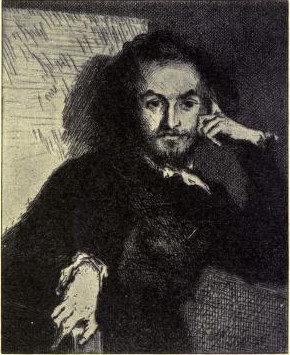
Émile De Roy, 1844
CONTENTS CHARLES BAUDELAIRE: A STUDY. BIBLIOGRAPHY AND NOTES. NOTES.
LIST OF ILLUSTRATIONS
Émile de Roy, 1844. Frontispiece
I.Jeanne Duval: Drawing by Baudelaire, 1860.
II.Baudelaire, designed by himself, 1848.
III.Les fleurs du mal, 1857.
IV.Les paradis artificiels, 1861.
V.Autograph Letter of Baudelaire to Monsieur de Broise, 1859.
VI.Gustave Courbet, 1848.
VII.Édouard Manet, 1862.
VIII.Édouard Manet, 1865.
IX.Autograph Letter of Baudelaire to Charles Asselineau, 1865.
BAUDELAIRE: A STUDY
I
When Baudelaire is great, when his genius is at its highest point of imaginative creation, of imaginative criticism, it is never when he works by implication—as the great men who are pure artists (for instance, Shakespeare) work by implication only—but always from his personal point of view being simply infallible and impeccable. The pure artist, it has been said, never asserts: and the instances are far from being numerous; Balzac asserts, and Balzac is always absolutely just in all his assertions: he whose analysis of modern Society—La Comédie Humaine—verges almost always on creation; and despite certain deficiencies in technique and in style, he remains the greatest of all novelists. As for Baudelaire, he rarely asserts; he more often suggests or divines—with that exquisite desire of perfect and just work that is always in him. With his keen vision he rarely misses the essential; with his subtle and sifted prose he rarely fails in characterizing the right man in the right way and the wrong man—the man who is not an artist—in forms of ironical condemnation. Shelley in his time and Blake in his time gave grave enough offence and perplexity; so did Baudelaire, so did Poe, so did Swinburne, so did Rossetti, so did Beardsley. All had their intervals of revolt—spiritual or unspiritual, according to the particular trend of their genius; some destroy mendacious idols, some change images into symbols; some are supposed to be obscurely original. All had to apprehend, as Browning declared in regard to his readers and critics in one of his Prefaces, "charges of being wilfully obscure, unconscientiously careless, or perversely harsh." And all these might have said as he said: "I blame nobody, least of all myself, who did my best then and since."
In our approach to the poetry, or to the prose, of any famous writer, with whom we are concerned, we must necessarily approach his personality; in apprehending it we apprehend him, and certainly we cannot love it without loving him. As for Baudelaire, I must confess that, in spite of the fact that one might hate or love the man according to the judgment of the wise or of the unwise, I find him more lovable than hateful. That he failed in trying to love one woman is as certain as his disillusion after he had possessed her; that, in regard to Jeanne Duval, she was to him simply a silent instrument that, by touching all the living strings of it, he awakened to a music that is all his own; that whether this "masterpiece of flesh" meant more to him than certain other women who inspired him in different ways; whether he thirsted to drain her "empty kiss" or the "empty kiss" of Rachel, of Marguerite, of Gabrielle, of Judith, is a matter of but little significance. A man's life such as his is a man's own property and the property of no one else. And Baudelaire's conclusion as to any of these might be, perhaps, summed up in this stanza:
"Your sweet, scarce lost estate Of innocence, the candour of your eyes, Your child-like, pleased surprise, Your patience: these afflict me with a weight As of some heavy wrong that I must share With God who made, with man who found you, fair."
"In more ways than one do men sacrifice to the rebellious angels," says Saint Augustine; and Beardsley's sacrifice, along with that of all great decadent art, the art of Rops or of Baudelaire, is really a sacrifice to the eternal beauty, and only seemingly to the powers of evil. And here let me say that I have no concern with what neither he nor I could have had absolute knowledge of, his own intention in his work. A man's intention, it must be remembered—and equally in the case of much of the work of Poe and of Baudelaire, much less so in the case of Balzac and Verlaine—from the very fact that it is conscious, is much less intimately himself than the sentiment which his work conveys to me.
Baudelaire's figures, exactly like those designed by Beardsley and by Rodin, have the sensitiveness of the spirit and that bodily sensitiveness which wastes their veins and imprisons them in the attitude of their luxurious meditation. They have nothing that is merely "animal" in their downright course towards repentance; no overwhelming passion hurries them beyond themselves; they do not capitulate to an open assault of the enemy of souls. It is the soul in them that sins, sorrowfully, without reluctance, inevitably. Their bodies are eager and faint with wantonness; they desire fiercer and more exquisite pains, a more intolerable suspense than there is in the world.
Beardsley is the satirist of an age without convictions, and he can but paint hell as Baudelaire did, without pointing for contrast to any actual paradise. He employs the same rhetoric as Baudelaire—a method of emphasis which it is uncritical to think insincere. In the terrible annunciation of evil which he called The Mysterious Rose-Garden, the lantern-bearing angel with winged sandals whispers, from among the falling roses, tidings of more than "pleasant sins." And in Baudelaire, as in Beardsley, the peculiar efficacy of their satire is that it is so much the satire of desire returning on itself, the mockery of desire enjoyed, the mockery of desire denied. It is because these love beauty that beauty's degradation obsesses them; it is because they are supremely conscious of virtue that vice has power to lay hold on them. And with these—unlike other satirists of our day—it is always the soul, and not the body's discontent only, which cries out of these insatiable eyes, that have looked on all their lusts; and out of these bitter mouths, that have eaten the dust of all their sweetnesses; and out of these hands, that have laboured delicately for nothing; and out of their feet, that have run after vanities.
The body, in the arms of death, the soul, in the arms of the naked body: these are the strangest symbolical images of Life and of Death. So, as Flaubert's devotion to art seemed to have had about it something of the "seriousness and passion that are like a consecration," I give this one sentence on the death of Emma Bovary: "Ensuite il recita le Misereatur et l'Indulgentiam, trempa son pouce droit dans l'huile et commença les onctions: d'abord sur les yeux, qui avaient tant convoité toutes les somptuosités terrestres; puis sur les narines, friandes de brises tièdes et de senteurs amoureuses; puis sur la bouche, qui s'était ouverte pour le mensonge, qui avait gémi d'orgueil et crié dans la luxure; puis sur les mains, qui se delectaient au contacts suaves, et enfin sur la plante des pieds, si rapides autrefois quand elle courait à l'assouvissance de ses désirs et qui maintenant ne marcheraient plus."
Charles Baudelaire was born April 9th, 1821, in la rue Saint Augustin, 8; he was baptized at Saint-Sulpice. His father, François, who had married Mile Janin in 1803, married, after her death, Caroline Archimbaut-Dufays, born in London, September 27th, 1793. François Baudelaire's father, named Claude, married Marie-Charlotte Dieu, February 10th, 1738, at Neuville-au-Port, in the Department of Marne.
From 1838 to 1842 (when Baudelaire attains his majority) there is a family crisis in a certainly impossible family circle. These years he spends in vagabonding at his own will: living a deliciously depraved life; diving, perhaps, into depths of impurity; haunting the night resorts that one finds in the most curious quarters of Paris—the cafés, the theatres, la Rue de Bréda. He amuses himself enormously: even in "the expense of spirit in a waste of shame;" he lives then, as always, by his sensitive nerves, by his inexhaustible curiosity. He is devoured then, as always, by the inner fires of his genius and of his sensuality; and is, certainly, a quite naturally immoral man in his relations with women.
He lives, as I have said; he feeds himself on his nerves:
"The modern malady of love is nerves."
It is an incurable, a world-old malady; and, from Catullus, one of the greatest of all poets, century after century, from the Latin poets of the Middle Ages, from the poets of the Renaissance, of the Elizabethan Age, down to the modern Romantic Movement, no poet who was a passionate lover of Woman has ever failed to sing for her and against her:
"I hate and I love: you ask me how I can do it? I know not: I know that it hurts: I am going through it." Odi et amo; quari id faciam, fortasse requiris. Nescio; sed fiere sentio, et excrucior. "Caelius, Lesbia mine, that Lesbia, that Lesbia whom Catullus for love did rate Higher than all himself and than all things, stands Now at the cross-roads and the alleys to wait For the lords of Rome, with public lips and hands." Cœli, Lesbia nostra, Lesbia ilia, Ilia Lesbia, quam Catullus unam Plus, quàm se, atque suos amavit omnes.
Need I quote more than these three fines? These fines, and those quoted above, are enough to show, for all time, that Catullus was as passionate a lover and as passionate a hater of flesh as Villon. Yet, if we are to understand Villon rightly, we must not reject even le grosse Margot from her place in his life; who, to a certainty, had not for one instant the place in his life that Lesbia had in the life of Catullus. Villon was no dabbler in infamy, but one who liked infamous things for their own sake.
Nor must I forget John Donne, whose quality of passion is unique in English poetry—a reasonable rapture, and yet carried to a pitch of actual violence: his senses speak with unparalleled directness: he can exemplify every motion with an unluxurious explicitness which leaves no doubt of his intentions. He suffers from all the fevers and colds of love; and, in his finest poem—a hate poem—he gives expression to a whole region of profound human sentiment which has never been expressed, out of Catullus, with such intolerable truth:
"When, by thy scorn, O murdress, I am dead, And that thou thinkest thee free From all solicitations of me, Then shall my ghost come to thy bed, And thee, feigned vestal, in worse arms shall see: Then thy sick taper will begin to wink, And he, whose thou art then, being tired before, Will, if thou stir, or pinch to wake him, think Thou call'st for more, And, in false sleep, will from thee shrink; And then, poor aspen wretch, neglected thou Bathed in a cold, quick-silver sweat will lie A verier ghost than I. What I will say, I will not tell thee now, Lest that preserve thee; and since my love is spent, I'd rather thou shouldst painfully repent, Than by my threatenings rest still innocent."
As for Baudelaire's adventures when he is sent, perhaps against his will, in May, 1841, on a long voyage from Bordeaux to Calcutta, to return to Paris in February, 1843, after six months' travel, it is conjecturable that he might return a changed man. Certainly his imagination found in the East a curious fascination, with an actual reawakening of new instincts; and with that oppressive sense of extreme heat, as intense, I suppose, as in Africa, which makes one suffer, bodily and spiritually, and in ways more extraordinary than those who have never endured those tropical heats can possibly conceive of. There he may have abandoned himself to certain obscure rites that to him might have been an initiation into the cults of the Black Venus. And, with these hot suns, these burning midnoons, these animal passions, the very seductiveness of the nakedness of bronze skin, what can I imagine but this: that they lighted in his veins an intolerable flame, that burned there ardently to the end?
For in his Wagner (1861) he writes: "The radiant ancient Venus, Aphrodite, born of white foam, has not imprudently traversed the horrible darkness of the Middle Ages. She has retired to the depths of a cavern, magnificently lighted by the fires that are not those of the Sun. In her descent under earth, Venus has come near to hell's mouth, and she goes, certainly, to many abominable solemnities, to render homage to the Arch-demon, Prince of the Flesh and Lord of Sin." He finds her in the music where Wagner has created a furious song of the flesh, with an absolute knowledge of what in men is diabolical. "For from the first measures, the nerves vibrate in unison with the melody; one's flesh remembers itself and begins to tremble. Tannhäuser represents the eternal combat between the two principles that have chosen the human heart as battle-field, that is to say, of the flesh with the spirit, of hell with heaven, of Satan with God."
In January, 1843, Baudelaire finds himself in possession of a fortune of seventy-five thousand francs. With his incurable restlessness, his incurable desire of change, he is always moving from one place to another. He takes rooms at Quai de Bethune, 10, Isle-Saint-Louis; rue Vanneau, faubourg Saint-Germain; rue Varenne, quai d'Anjou; Hôtel Pimodan, 17; Hôtel Corneille; Hôtel Folkestone, rue Lafitte; Avenue de la République, 95; rue des Marais-du-Temple, 25; rue Mazarine; rue de Babylone; rue de Seine, 57; rue Pigalle, 60; Hôtel Voltaire, 19 quai Voltaire; rue Beautrellis, 22; Cité d'Orléans, 15; rue d'Angoulême-du-Temple, 18; Hôtel Dieppe, rue d'Amsterdam, 22; rue des Ecuries-d'Artois, 6; rue de Seine, l'Hôtel du Maroc, 35.
With a certain instinct for drawing Baudelaire haunts many painter's studios: Delacroix's, whose genius he discovers, giving him much of his fame, becoming his intimate friend; Manet's, whose genius he also divines and discovers; Daumier's, to whom he attributes "the strange and astonishing qualities of a great genius, sick of genius." So also, from the beginning, Baudelaire's judgments are infallibly right; so also his first book, Le Salon de 1845, has all the insolence of youth and all the certitude of a youth of genius. But his fame is made, that is to say, as an imaginative critic, with Le Salon de 1846; for, after the prelude, the entire book is fascinating, paradoxical, and essentially æsthetical; a wonderful book in which he reveals the mysteries of colour, of form, of design, of technique, and of the enigmas of creative works. Here he elaborates certain of his mature theories, such as his exultant praise—in which he is one with Lamb and with Swinburne; his just disdain, and his grave irony, in which he is one with Swinburne; and, above all, that passionate love of all forms of beauty, at once spiritual and absolute, which is part of the quintessence of his genius.
So, as Swinburne, in the fire of his youthful genius, was the first to praise Baudelaire in English, I quote these sentences of his from an essay on Tennyson and Musset: "I do not mean that the Comédie de la Mort must be ranked with the Imitation of Christ, or that Les Fleurs du Mal should be bound up with The Christian Year. But I do say that no principle of art which does not exclude from its tolerance the masterpieces of Titian can logically or consistently reject the masterpieces of a poet who has paid to one of them the most costly tribute of carven verse, in lines of chiselled ivory with rhymes of ringing gold, that ever was laid by the high priest of one muse on the high altar of another. And I must also maintain my opinion that the pervading note of spiritual tragedy in the brooding verse of Baudelaire dignifies and justifies at all points his treatment of his darkest and strangest subjects. The atmosphere of his work is to the atmosphere of Gautier's as the air of a gas-lit alcove is to the air of the far-flowering meadows that make in April a natural Field of the Cloth of Gold all round the happier poet's native town of Tarbes, radiant as the open scroll of his writings with immeasurable wealth of youth and sunlight and imperishable spring. The sombre starlight under which Baudelaire nursed and cherished the strange melancholy of his tropical home-sickness, with its lurid pageant of gorgeous or of ghastly dreams, was perhaps equidistant from either of these, but assuredly had less in common with the lamplight than the sunshine."
To roam in the sun and air with vagabonds, as Villon and his infamous friends did on their wonderful winter nights, "where the wolves live on wind," and where the gallows stands at street corners, ominously, and one sees swing in the wind dead chained men; to haunt the strange streets of cities, to know all the useless and improper and amusing, the moral and the immoral people, who are alone worth knowing; to live, as well as to observe; to be drawn out of the rapid current of life into an exasperating inaction: it is such things as these that make for poetry and for prose. Some make verse out of personal sensations, verse which is half pathological, which is half physiological; some out of colours and scents and crowds and ballets; some out of music, out of the sea's passions; some simply out of rhythms that insist on being used; a few out of the appreciation of the human comedy. The outcome of many experiments, these must pass beyond that stage into the stage of existence.
So, in much of Baudelaire's verse I find not only the exotic (rarely the erotic) but, in the peculiar technique of the lines, certain andante movements, lingering subtleties of sound, colour, and suggestion, with—at times, but never in the excessive sense of Flaubert's—the almost medical curiosity of certain researches into the stuff of dreams, the very fibre of life itself, which, combined, certainly tend to produce a new thing in poetry. A new order of phenomena absorbs his attention, which becomes more and more externalized, more exclusively concerned with the phenomena of the soul, with morbid sensation, with the curiosities of the mind and the senses. Humanity is now apprehended in a more than ever generalized and yet specialized way in its essence, when it becomes, if you will, an abstraction; or, if you will, for the first time purely individual.
In certain poets these have been foiled endeavours; in Baudelaire never: for one must never go beyond the unrealizable, never lose one's intensity of expression, never let go of the central threads of one's spider's web. Still, in regard to certain direct pathological qualities, there is a good deal of this to be found in much of the best poetry—in Poe, in Rossetti, in Swinburne's earlier work, and much in Baudelaire; only all these are moved by a fascination: in Poe for the fantastically inhuman; in Rossetti for the inner life of the imagination, for to him, as Pater said, "life is a crisis at every moment;" in Swinburne for the arduous fulness of intricate harmony, and for the essentially lyric quality, joy, in almost unparalleled abundance.
There can hardly be a poet who is not conscious of how little his own highest powers are under his own control. The creation of beauty is the end of art, but the artist—whether he be Baudelaire or Verlaine— should rarely admit to himself that such is his purpose. A poem is not written by a man who says: I will sit down and write a poem; but rather by the man who, captured by rather than capturing on impulse, hears a tune which he does not recognize, or sees a sight which he does not remember, in some "close corner of his brain," and exerts the only energy at his disposal in recording it faithfully, in the medium of his particular art. And so in every creation of beauty, some obscure desire stirred in the soul, not realized by the mind for what it was, and, aiming at much more minor things in the world than pure beauty, produced it. Now, to the critic this is not more important to remember than it is for him to remember that the result, the end must be judged, not by the impulse which brought it into being, nor by the purpose which it sought to serve, but by the success or failure in one thing: the creation of beauty. To the artist himself this precise consciousness of what he has done is not always given, any more than a precise consciousness of what he is doing.
To Baudelaire as to Pater there were certain severe tests of the effects made on us by works of genius. In both writers there is a finality of creative criticism. For, to these, all works of art, all forms of human life, were as powers and forces producing pleasurable sensations. One can find them in a gem, a wine, a spoken word, a sudden gesture, in anything, indeed, that strikes vividly or fundamentally the senses, that acts instantaneously on one's perceptive passions. "What," says Pater in his essay on Wordsworth, "are the peculiarities in things and persons which he values, the impression and sense of which he can convey to others, in an extraordinary way?"
"The ultimate aim of criticism," said Coleridge, "is much more to establish the principles of writing than to furnish rules how to pass judgment on what has been written by others." And for this task he had an incomparable foundation: imagination, insight, logic, learning, almost every critical quality united in one; and he was a poet who allowed himself to be a critic. Certainly, Baudelaire shared certain of those qualities; indeed, almost all; even, in a sense, logic. His genius was so great, and in its greatness so manysided, that for some studious disciples of the rarer kind he will doubtless, seen from any possible point of view, have always some of his magic and of his magnetism. The ardour, delicacy, energy of his intellect, his resolute desire to get at the root of things and deeper yet, if deeper might be, will always enchant and attract all spirits of like mould and temper; that is to say, those that are most morbid, most fond of imaginative perversities.
Prose, I have said, listens at the doors of all the senses, and repeats their speech almost in their own terms. But poetry (it is Baudelaire who says it) "is akin to music through a prosody whose roots plunge deeper in the human soul than any classical theory has defined." Poetry begins where prose ends, and it is at its chief peril that it begins sooner. The one safeguard for the poet is to say to himself: What I can write in prose I will not allow myself to write in verse, out of mere honour towards my material. The farther I can extend my prose, the farther back do I set the limits of verse. The region of poetry will thus be always the beyond, the ultimate, and with the least possible chance of any confusion of territory.
Prose is the language of what we call real life, and it is only in prose that an illusion of external reality can be given. Compare, not only the surroundings, the sense of time, and locality, but the whole process and existence of character, in a play of Shakespeare and in a novel of Balzac. I choose Balzac among novelists because his mind is nearer to what is creative in the poet's mind than that of any novelist, and his method nearer to the method of the poets. Take King Lear and take Père Goriot. Goriot is a Lear at heart; and he suffers the same tortures and humiliations. But precisely when Lear grows up before the mind's eye into a vast cloud and shadowy monument of trouble, Goriot grows downward into the earth and takes root there, wrapping the dust about all his fibres. It is part of his novelty that he comes so close to us and is so recognizable. Lear may exchange his crown for a fool's bauble, knowing nothing of it; but Goriot knows well enough the value of every bank-note that his daughter robs him of. In that definiteness, that new power of "stationary" emotion in a firm and material way, lies one of the great opportunities of prose.
So it is Baudelaire who has said this fundamental thing on the problem of artist and critic: "It would be a wholly new event in the history of the arts if a critic were to turn himself into a poet, a reversal of every psychic law, a monstrosity; on the other hand, all great poets become naturally, inevitably, critics. I pity the critics who are guided solely by instinct; they seem to me incomplete. In the spiritual life of the former there must be a crisis when they would think out their art, discover the obscure laws in consequence of which they have produced, and draw from this study a series of precepts whose divine purpose is infallibility in poetic construction. It would be prodigious for a critic to become a poet, and it is impossible for a poet not to contain a critic."
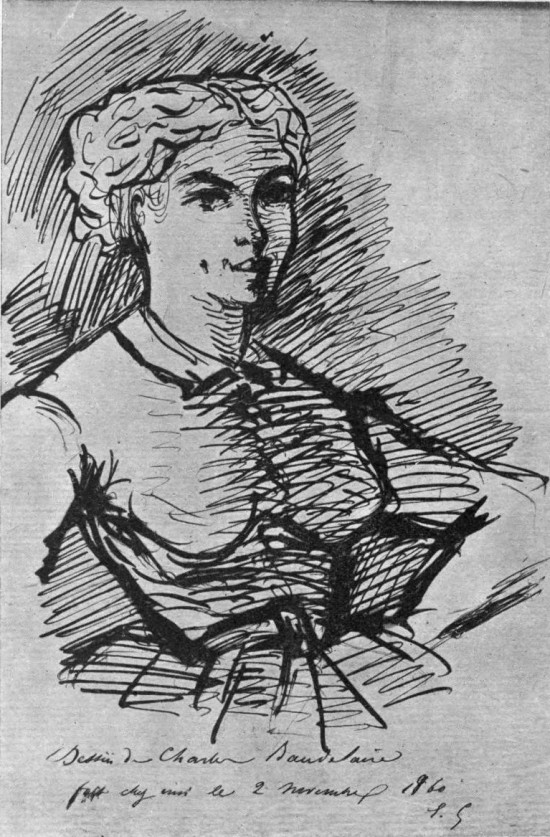
Jeanne Duval by C. Baudelaire
II
Has any writer ever explained the exact meaning of the word Style? To me nothing is more difficult. Technique, that is quite a different affair. The essence of good style might be, as Pater says, "expressiveness," as, for instance, in Pascal's style, which—apart from that—is the purest style of any French writer. It is no paradox to state this fact: without technique, perfect of its kind, no one is worth considering in any art; the violinist, the pianist, the painter, the poet, the novelist, the rope-dancer, the acrobat—all, without exception, if they lapse from technique lapse from perfection. I have often taken Ysaye as the type of the artist, not because he is faultless in technique, but because he begins to create his art at the point where faultless technique leaves off.
Art, said Aristotle, should always have "a continual slight novelty," and his meaning is that art should never astonish. Take, for instance, Balzac, Villiers, Poe, and Baudelaire; only one part of their genius, but a most sinister one, is the desire to astonish. There is, to me, nothing more astonishing in prose fiction than The Pit and the Pendulum and The Cask of Amontillado of Poe; they are more than analysis, though this is pushed to the highest point of analysis; they have in them a slow, poisonous and cruel logic; equalled only, and at times surpassed in their imagination, by certain of Villiers' Contes Cruels, such as his Demoiselles de Bien Filâtre, L'Intersigne and Les amants de Tolède. And—what is more astonishing in his prose than in any of the writers I have mentioned—is his satire; a satire which is the revenge of beauty on ugliness; and therefore the only laughter of our time which is fundamental, as fundamental as that of Rabelais and of Swift.
Baudelaire, when he astonishes, is never satirical: sardonical, ironical, coldly cruel, irritating, and persistent. This form of astonishment is an inveterate part of the man's sensitive and susceptible nature. It is concentrated, inimical, a kind of juggling or fencing; a form of contradiction, of mystification; and a deliberate desire of causing bewilderment. The Philistine can never pardon a mystification, and a fantastic genius—such as that of Baudelaire and of Poe—can never resist it when opportunity offers.
Had he but been one of those "elect souls, vessels of election, épris des hauteurs, as we see them pass across the world's stage, as if led on by a kind of thirst for God!" (I quote Pater's words on Pascal) his sombre soul might have attained an ultimate peace; a peace beyond all understanding. This was cruelly denied him. He, I imagine, believed in God; thirsted for God: neither was his belief confirmed nor his thirst assuaged. He might, for all I know, have thought himself a reprobate—and so cast out of God's sight.
"For, till the thunder in the trumpet be, Soul may divide from body, but not we One from another; I hold thee with my hand, I let mine eyes have all their will of thee, I seal myself upon thee with my might, Abiding alway out of all men's sight Until God loosen over sea and land The thunder of the trumpets of the night."
I am certain Baudelaire must have read the poems of John Keats; for there are certain characteristics in the versification, and in the using of images of both poets. Keats had something feminine and twisted in his mind, made up out of unhealthy nerves—which are utterly lacking in Baudelaire—but which it is now the fashion to call decadent; Keats being more than a decadent, but certainly decadent in such a line as—
"One faint eternal eventide of gems,"
which might have been written, in jewelled French, by Mallarmé. I give one of his sonnets, a perverse and perverted one, made by a fine technical feat out of two recurrent rhymes:
"Ses purs ongles très-haut dédiant leur onyx, L'angoisse, ce minuit, soutient, lampadaphore, Maint rêve vespéral brûlé par le Phénix Que ne recueille pas de cinéraire amphore Sur les crédences, au salon vide: nul ptyx Aboli bibelot d'inanité sonore, (Car le maître est allé puiser des fleurs au Styx Avec ce seul objet dont le néant s'honore.) Mais proche la croisée au nord vacante, un or Agonise selon peut-être le décor Des licornes ruant du feu contre une nixe, Elle, défunte nue en le miroir, encor Que, dans l'oubli formé par le cadre, se fixe De scintillations sitôt le septuor."
Keats luxuriates; like Baudelaire, in the details of physical discomfort, in all their grotesque horror, as when, in sleeplessness—how often these two overstrung and over-nervous poets must have had sleepless nights!—
"We put our eyes into a pillowy cleft, And see the spangly gloom froth up and boil."
He is neo-Latin, again like Baudelaire, in his insistence on the physical sensations of his lovers, the bodily translations of emotion. In Venus, leaning over Adonis, he notes:
"When her lips and eyes Were closed in sullen moisture, and quick sighs Came vexed and panting through her nostrils small."
And, in another line, he writes:
"By the moist languor of thy breathing face."
Lycius, in Lamia:
"Sick to lose The amorous promise of her lone complain, Swooned murmuring of love, and pale with pain;"
and all that trembling and swooning of his lovers, which English critics have found unmanly, would at all events be very much at home in modern French poetry, where love is again, as it was to Catullus and Propertius, a sickness, an entrancing madness, a poisoning. To find anything like it, like this utter subtlety of expression, we must go back to the Elizabethan Age, and then look forward, and find, beyond Keats, traces of it in Rossetti and in Morris's The Defence of Guinevere; as, for instance, in some of the Queen's lines:
"Listen, suppose your turn were come to die, And you were quite alone and very weak; Yea, laid a dying while very mightily The wind was ruffling up the narrow streak Of river through your broad lands running well; Suppose a hush should come, then some one speak: 'One of these cloths is heaven, and one is hell, Now choose one cloth for ever, which they be, I shall not tell you, you must somehow tell Of your own strengths and mightiness; here, see!' Yea, yea, my lord, and you to ope your eyes, At foot of your familiar bed to see A great God's angel standing, with such dyes, Not known on earth, on his great wings, and hands, Hold out two ways, light from the inner skies Showing him well, and making his commands Seem to be God's commands, moreover, too, Holding within his hands the cloths on wands; And one of these strange choosing cloths was blue, Wavy and long, and one cut short and red: No man could tell the better of the two. After a shivering half-hour you said: 'God help! Heaven's colour, the blue'; and he said, 'Hell!' Perhaps you then would roll upon your bed, And cry to all good men that loved you well, 'Ah, Christ! If only I had known, known, known;' Launcelot went away, then I could tell, Like wisest men, how all things would be, moan, And roll and hurt myself, and long to die, And yet fear much to die for what was sown. Nevertheless you, O Sir Gawaine, lie, Whatever may have happened through these years, God knows I speak truth, saying that you lie."
All these rough, harsh terza-rime lines are wonderful enough in their nakedness of sensations—sensations of heat, of hell, of heaven, of colours, of death, of life, of moans, and of lies. It is, in a sense, as far as such experiments go, a return to the Middle Ages; to what was exotic in them and strange and narcotic. Only here, as in Les Litanies de Satan of Baudelaire—to which they have some remote likeness—there are no interludes of wholesome air, as through open doors, on these hot, impassioned scenes.
Rossetti says somewhere that no modern poet, and that few poets of any century, ever compressed into so small a space so much imaginative material as he himself always did; and this, I conceive, partly, also, from that almost child-like imagination of his, for all its intellectual subtlety, that dominated him to such an extent that to tell him anything of a specially tragic or pathetic nature was cruel, so vividly did he realize every situation; and also because of his wonderful saying in regard to his own way of weaving an abominable line at the end of one of his finest sonnets into a sublime one:
"Life touching lips with Immortality:"
that the line he had used before belonged to the class of phrase absolutely forbidden in poetry. "It is intellectually incestuous poetry seeking to beget its emotional offspring on its own identity; whereas the present line gives only the momentary contact with the immortal which results from sensuous culmination, and is always a half-conscious element of it."
Now, to me, both Keats before him and Baudelaire in his own generation, had the same excessive sense of, concentration. "To load every rift with ore:" that, to Keats, was the essential thing; and it meant to pack the verse with poetry so that every line should be heavy with the stuff of the imagination: the phrase I have given being a rebuke to Shelley, significant of the art of both poets. Fox as Keats, almost in the same degree as Baudelaire, worked on every inch of his surface, so perhaps no poets ever put so much poetic detail into so small a space, with, as I have said, the exception of Rossetti. And, as a matter of fact, when we examine the question with scrupulous care, it must be said that both Baudelaire and Keats are often metrically slipshod.
One of Wagner's ideas, in regard to the artistic faculty was, receptivity; the impulse to impart only what comes when these impressions fill the mind "to an ecstatic excess;" and the two forms of the artist: the feminine, who recoils from life, and the masculine, who absorbs life. From this follows, in the case of creative artists such as Baudelaire, the necessity to convey to others as vividly and intelligibly, as far as possible, what his own mind's eye had seen. Then one has to seize everything from which one can wring its secret—its secret for us and for no one else. And all this, and in fact the whole of our existence, is partly the conflict within us of the man with the woman, the male and the female energies that strive always:
"Here nature is, alive and untamed, Unafraid and unashamed; Here man knows woman with the greed Of Adam's wonder, the primal need."
And, in these fundamental lines of Blake:
"What is it men in women do require? The lineaments of gratified Desire. What is it women do in men require? The lineaments of gratified Desire."
And, again, in these more primeval and more essentially animal lines of Rossetti:
"O my love, O Love—snake of Eden! (And O the bower and the hour!) O to-day and the day to come after! Loose me, love—give way to my laughter! Lo! two babes for Eve and for Adam! (And O the bower and the hour!) Lo, sweet snake, the travail and treasure— Two men-children born for their pleasure! The first is Cain and the second Abel: (Eden bower's in flower) The soul of one shall be made thy brother, And thy tongue shall lap the blood of the other. (And O the bower and the hour!)."
Baudelaire, in De l'essence de rire, wrote: "The Romantic School, or, one might say in preference, the Satanical School, has certainly understood the primordial law of laughter. All the melodramatic villains, all those who are cursed, damned, fatally marked with a rictus of the lips that extends to the ears, are in the pure orthodoxy of laughter. For the rest, they are for the most part illegitimate sons of the famous Melmoth the Wanderer, the great Satanic creation of Maturin. What can one conceive of as greater, as more powerful, in regard to our humanity than this pale and bored Melmoth? He is a living contradiction; that is why his frozen laughter freezes and wrenches the entrails."
Distinctly the most remarkable of the British triumvirate which in the early part of the century won a momentary fame as the school of horror, Maturin is much less known to the readers of to-day than either Monk Lewis or Mrs. Radcliffe. Thanks to Balzac, who did Melmoth the honour of a loan in Melmoth réconcilié, Maturin has attained a certain fame in France—which, indeed, he still retains. Melmoth has to-day in France something of that reputation which has kept alive another English book, Vathek. Did not Balzac, in a moment of indiscriminating enthusiasm, couple the Melmoth of Maturin with the Don Juan of Molière, the Faust of Goethe, the Manfred of Byron—grandes images tracées par les plus grands génies de l'Europe? In other words, Maturin had his day of fame, in which even men like Scott and Byron were led into a sympathetic exaggeration. There's one exception. That Coleridge was hostile, possibly unjust, is likely enough. It should be mentioned that in 1816 the Drury Lane Committee, who had, reasonably enough, rejected a play by Coleridge, accepted a monstrous production of Maturin's named Bertram. The gros bon mélodrame, as Balzac calls it, was a great success. "It is all sound and fury, signifying nothing," said Kean, who acted in it; and Kean, who knew his public, realized that that was why it succeeded. The play was printed, and ran through seven editions, sinking finally to the condition of a chap-book, in which its horrors were to be had for sixpence. On this pretentious work Coleridge—for what reasons we need not inquire—took the trouble to write an article, or, as it was phrased, to make an attack. To this Maturin wrote a violent reply, which the good advice of Scott prevented him from publishing. It is curious at the present day to read the letter in which Scott urges upon Maturin the wisdom of silence—not because he is likely to get the worst of the battle, but, among other reasons, because "Coleridge's work has been little read or heard of, and has made no general impression whatever—certainly no impression unfavourable to you or your play. In the opinion of many, therefore, you will be resenting an injury of which they are unacquainted with the existence."
The episode is both comic and instructive. Coleridge and Maturin! Scott urging on Maturin the charity of mercy to Coleridge, as—"Coleridge has had some room to be spited at the world, and you are, I trust, to continue to be a favourite with the public!" Poor Maturin, far from continuing to be a favourite with the public, outlived his reputation in the course of a somewhat short life. He died at the age of forty-three. Like the hero of Baudelaire's whimsical and delicious little tale La Fanfarlo, he preferred artifice to nature, especially when it was unnecessary. Such is the significant gossip which we have about the personality of Maturin—gossip which brings out clearly the deliberate eccentricity which marks his work, which one sees also in the foppish affected and lackadaisical creature who looks at the reader as if he were admiring himself before his mirror.
The word "genius," indeed, is too lofty an epithet to use regarding a man of great talent certainly, but of nothing more than erratic and melodramatic talent. Melmoth the Wanderer is in parts very thrilling; its Elizabethan feast of horrors has a savour as of a lesser Tourneur. But it is interesting only in parts, and at its best it never comes near the effect which the great masters of the grotesque and terrible—Hoffmann, Poe, Villiers de l'Isle-Adam—have known how to produce. A freak of construction, which no artist could have been guilty of, sends us wandering from story to story in a very maze of underplots and episodes and interpolations. Six separate stories are told—all in parenthesis—and the greater part of the book is contained .within inverted commas. What is fine in it is the vivid, feverish way in which, from time to time, some story of horror or mystery is forced home to one's sensations. It is the art of the nightmare, and it has none of the supremacy in that line of the Contes Drolatiques of Balzac. But certain scenes in the monastery and in the prisons of the Inquisition—an attempted escape, a scene where an immured wretch fights the reptiles in the darkness—are full of a certain kind of power. That escape, for instance, with its consequences, is decidedly gruesome, decidedly exciting; but compare it with Dumas, with the escape of Monte Cristo; compare it with the yet finer narrative of Casanova—the unsurpassed model of all such narratives in fiction. Where Casanova and Dumas produce their effect by a simple statement—a record of external events from which one realizes, as one could realize in no other way, all the emotions and sensations of the persons who were undergoing such experiences—Maturin seeks his effect, and produces it, but in a much lesser degree, by a sort of excited psychology, an exclamatory insistence on sensation and emotion. Melmoth the Wanderer is only the object of our historical curiosity. We have, indeed, and shall always have, "lovers of dark romance."
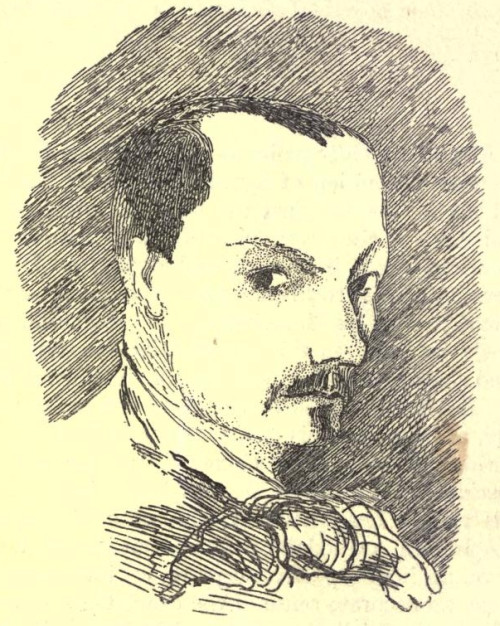
Baudelaire, designed by himself.
III
I
Baudelaire's genius is satanical; he has in a sense the vision of Satan. He sees in the past the lusts of the Borgias the sins and vices of the Renaissance; the rare virtues that flourish like flowers and weeds, in brothels and in garrets. He sees the vanity of the world with finer modern tastes than Solomon; for his imagination is abnormal, and divinely normal. In this age of infamous shames he has no shame. His flesh endures, his intellect is flawless. He chooses his own pleasures delicately, sensitively, as he gathers his exotic Fleurs du Mal, in itself a world, neither a Divina Commedia nor Une Comédie Humaine, but a world of his own fashioning.
His vividly imaginative passion, with his instincts of inspiration, are aided by a determined will, a selfreserve, an intensity of conception, an implacable insolence, an accurate sense of the exact value of every word. In the Biblical sense he might have said of his own verse: "It is bone of my bone, and flesh of my flesh." The work, as the man, is subtle, strange, complex, morbid, enigmatical, refined, paradoxical, spiritual, animal. To him a scent means more than a sunset, a perfume more than a flower, the tempting demons more than the unseductive angels. He loves luxury as he loves wine; a picture of Manet's as a woman's fan.
Fascinated by sin, he is never the dupe of his emotions; he sees sin as the Original Sin; he studies sin as he studies evil, with a stem logic; he finds in horror a kind of attractiveness, as Poe had found it; rarely in hideous things, save when his sense of what I call a moralist makes him moralize, as in his terrible poem, Une Charogne. He has pity for misery, hate for progress. He is analytic, he is a learned casuist, whom I can compare with the formidable Spanish Jesuit, Thomas Sanchez, who wrote the Latin Aphorismi Matrimonio (1629).
His soul swims on music played on no human instrument, but on strings that the Devil pulls, to which certain living puppets dance in grotesque fashion, to unheard-of rhythms, to the sound of violins strummed on by evil spirits in Witches' Sabbats. Some swing in the air, as hanged dead people on gallows, and, as their bones rattle in the wind, one sees Judas Iscariot, risen out of Hell for an instant's gratification, as he grimaces on these grimacing visages.
Les fleurs du mal is the most curious, subtle, fascinating, and extraordinary creation of an entire world ever fashioned in modern ages. Baudelaire paints vice and degradation of the utmost depth, with cynicism and with pity, as in the poem I have referred to, where the cult of the corpse is the sensuality of ascetism, or the ascetism of sensuality: the mania of fakirs; material by passion, Christian by perversity.
And, in a sense, he is our modern Catullus; in his furies, his negations, his outcries, his Paganism, his inconceivable passion for woman's flesh; yet Lesbia is for ever Lesbia. Still, Baudelaire in his Franciscae meae Laudes, and with less sting but with as much sensual sense of the splendour of sex, gives a magnificent Latin eulogy of a learned and pious modiste, that ends:
"Patera gemmis corusca, Panis salsus, mollis esca, Divinum vinum, Francisca."
And he praises the Decadent Latin language in these words: "Dans cette merveilleuse langue, le solécisme et le barbarisme me paraissent rendre les négligences forcés d'une passion qui s'oublie et se moque des règles."
Don Juan aux enfers is a perfect Delacroix. In Danse macabre there is the universal swing of the dancers who dance the Dance of Death. Death herself, in her extreme horror, ghastly, perfumed with myrrh, mixes her irony with men's insanity as she dances the Sabbat of Pleasure. He shows us the infamous menagerie of the vices in the guise of reptiles; our chief enemy Ennui is ce monstre délicat. There are Vampires, agonies of the damned alive; Le possédé with his excruciating cry out of all his fibres: O mon cher Belzébuth! je t'adore! And there are some, subtler and silent, that seem to move, softly, as the feet of Night, to the sound of faint music, or under the shroud of a sunset.
Les fleurs du mal are grown in Parisian soil, exotics that have the strange, secretive, haunting touch and taint of the earth's or of the body's corruption. In his sense of beauty there is a certain revolt, a spiritual malady, which may bring with it the heated air of an alcove or the intoxicating atmosphere of the East. Never since Villon has the flesh of woman been more adored and abhorred. Both aware of the original sin of l'unique animál—the seed of our moral degradation—Villon creates his Grosse Margot and Baudelaire Delphine et Hippolyte. Villon's is a scullion-wench, and in the Ballad a Brothel as infamous, as foul, as abominable as a Roman Lupanar surges before one's astonished vision. And this comes after his supreme, his consummate praise of ruinous old age on a harlot's body: Les regrets de la Belle Heaulmière. It is one of the immortal things that exist in the world, that I can compare only with Rodin's statue in bronze: both equal incarnations of the symbolical conception that sin brought shame into the first woman's flesh.
"Que m'en reste-il? Honte et Péché:"
cries each mouth, cries to the end of earth's eternity.
In Baudelaire's Femmes damnées there is the aching soul of the spirit's fatal malady: that sexual malady for which there is no remedy: the Lesbian sterile perilous divinisation of flesh for flesh, virginal or unvirginal flesh with flesh. In vain desire, of that one desire that exists beyond all possible satisfaction, the desire of an utter annihilation of body with body in that ecstasy which can never be absolutely achieved without man's flesh, they strive, unconsumed with even the pangs of their fruitless desires. They live only with a life of desire, and that obsession has carried them beyond the wholesome bounds of nature into the violence of a perversity which is at times almost insane. And all this sorrowful and tortured flesh is consumed with that feverish desire that leaves them only a short space for their desire's fruitions.
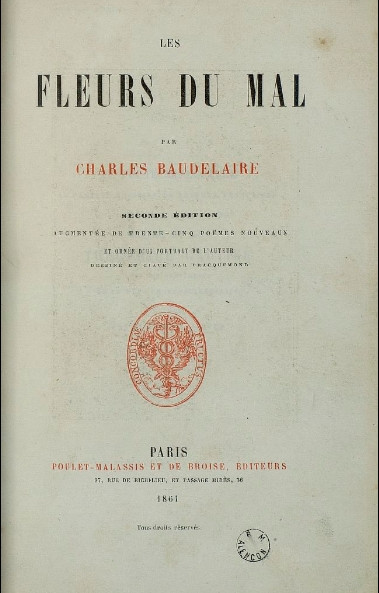
Les fleurs du mal, 1857.
II
Certain of these Flowers of Evil are poisonous; some are grown in the hotbeds of Hell; some have the perfume of a serpentine girl's skin; some the odour of woman's flesh. Certain spirits are intoxicated by these accursed flowers, to save themselves from the too much horror of their vices, from the worse torture of their violated virtues. And a cruel imagination has fashioned these naked images of the Seven Deadly Sins, eternally regretful of their first fall; that smile not even in Hell, in whose flames they writhe. One conceives them there and between the sun and the earth; in the air, carried by the winds; aware of their infernal inheritance. They surge like demons out of the Middle Ages; they are incapable of imagining God's justice.
Baudelaire dramatizes these living images of his spirit and of his imagination, these fabulous creatures of his inspiration, these macabre ghosts, in a fashion utterly different from that of other tragedians—Shakespeare, and Aristophanes in his satirical Tragedies, his lyrical Comedies; yet in the same sense of being the writer where beauty marries unvirginally the sons of ancient Chaos.
In these pages swarm (in his words) all the corruptions and all the scepticisms; ignoble criminals without convictions, detestable hags that gamble, the cats that are like men's mistresses; Harpagon; the exquisite, barbarous, divine, implacable, mysterious Madonna of the Spanish style; the old men; the drunkards, the assassins, the lovers (their deaths and lives); the owls; the vampires whose kisses raise from the grave the corpse of its own self; the Irremediable that assails its origin: Conscience in Evil! There is an almost Christ-like poem on his Passion, Le reniement de Saint-Pierre, an almost Satanic denunciation of God in Abel and Cain, and with them the Evil Monk, an enigmatical symbol of Baudelaire's soul, of his work, of all that his eyes love and hate. Certain of these creatures play in travesties, dance in ballets. For all the Arts are transformed, transfigured, transplanted out of their natural forms to pass in magnificent state across the stage: the stage with the abyss of Hell in front of it.
"Sensualist" (I quote a critic), "but the most profound of sensualists, and, furious of being no more than that, he goes, in his sensation, to the extreme limit, to the mysterious gate of infinity against which he knocks, yet knows not how to open, with rage he contracts his tongue in the vain effort." Yet centuries before him Dante entered Hell, traversed it in imagination from its endless beginning to its endless end; returned to earth to write, for the spirit of Beatrice and for the world, that Divina Commedia, of which in Verona certain women said:
"Lo, he that strolls to Hell and back At will I Behold him, how Hell's reek Has crisped his beard and singed his cheek."
It is Baudelaire who, in Hell as in earth, finds a certain Satan in such modern hearts as his; that even modern art has an essentially demoniacal tendency; that the infernal pact of man increases daily, as if the Devil whispered in his ear certain sardonic secrets. Here in such satanic and romantic atmosphere one hears dissonances, the discords of the instruments in the Sabbats, the howlings of irony, the vengeance of the vanquished.
I give one sentence of Gautier's on Baudelaire. "This poet of Les fleurs du mal loved what one wrongly calls the style of decadence, which is no other thing than the arrival of art at this extreme point of maturity that determined in their oblique suns the civilizations that aged: a style ingenious, complicated, learned, full of shades and of rarities, turning for ever backward the limits of the language, using technical vocabularies, taking colours from all the palettes, notes from all the keyboards, striving to render one's thought in what is most ineffable, and form in its most vague and evasive contours, listening so as to translate them, the subtle confidences of neurosis, the passionate confessions of ancient passions in their depravity and the bizarre hallucinations of the fixed idea." He adds: "In regard to his verse there is the language already veined in the greenness of decomposition, the tainted language of the later Roman Empire, and the complicated refinements of the Byzantine School, the last form of Greek art fallen in delinquencies." See how perfectly the phrase la langue de faisandée suits the exotic style of Baudelaire!
Yet, tainted as the style is from time to time, never was the man himself tainted: he who in modern verse gave first of all an unknown taste to sensations; he who painted vice in all its shame; whose most savorous verses are perfumed as with subtle aromas; whose women are bestial, rouged, sterile, bodies without souls; whose Litanies de Satan have that cold irony which he alone possessed in its extremity, in these so-called impious lines which reveal, under whatever disguise, his belief in a mathematical superiority established by God from all eternity, and whose least infraction is punished by certain chastisements, in this world as in the next.
I can imagine Baudelaire in his hours of nocturnal terrors, sleepless in a hired woman's bed, saying to himself these words of Marlowe's Satan:
"Why, this is Hell, nor can I out of it!"
in accents of eternal despair wrenched from the lips of the Arch Fiend. And the genius of Baudelaire, I can but think, was as much haunted as Marlowe's with, in Lamb's words, "a wandering in fields where curiosity is forbidden to go, approaching the dark gulf near enough to look in."
III
Has Baudelaire l'amour du mal pour le mal? In a certain sense, yes; in a certain sense, no. He believes in evil as in Satan and God—the primitive forces that govern worlds: the eternal enemies. He sees the germs of evil everywhere, few of the seeds of virtue. He sees pass before him the world's drama: he is one of the actors, he plays his parts cynically, ironically. He speaks in rhythmic cadences.
But, above all, he watches the dancers; these also are elemental; and the tragic fact is that the dancers dance for their living. For their living, for their pleasure, for the pleasure of pleasing others. So passes the fantastic part of their existence, from the savage who dances silent dances—for, indeed, all dancers are silent—but without music, to the dancer who dances for us on the stage, who turns always to the sound of music. There is an equal magic in the dance and in song; both have their varied rhythms; both, to use an image, the rhythmic beating of our hearts. It is imagined that dancing and music were the oldest of the arts. Rhythm has rightly been called the soul of dancing; both are instinctive.
The greatest French poet after Villon, the most disreputable and the most creative poet in French literature, the greatest artist in French verse, and, after Verlaine, the most passionate, perverse, lyrical, visionary, and intoxicating of modern poets, comes Baudelaire, infinitely more perverse, morbid, exotic than these other poets. In his verse there is a deliberate science of sensual perversity, which has something almost monachal in its accentuation of vice with horror, in its passionate devotion to passions. Baudelaire brings every complication of taste, the exasperation of perfumes, the irritant of cruelty, the very odours and colours of corruption to the creation and adornment of a sort of religion, in which an eternal mass is served before a veiled altar. There is no confession, no absolution, not a prayer is permitted which is not set down in the ritual. With Verlaine, however often love may pass into sensuality, to whatever length sensuality may be hurried, sensuality is never more than the malady of love.
The great epoch in French literature which preceded this epoch was that of the offshoot of Romanticism which produced Baudelaire, Flaubert, the Goncourts, Zola, and Leconte de Lisle. Even Baudelaire, in whom the spirit is always an uneasy guest at the orgy of life, had a certain theory of Realism which tortures many of his poems into strange, metallic shapes and fills them with irritative odours, and disturbs them with a too deliberate rhetoric of the flesh. Flaubert, the greatest novelist after Balzac, the only impeccable novelist who ever lived, was resolute to be the creator of a world in which art—formal art—was the only escape from the burden of reality. It was he who wrote to Baudelaire, who had sent him Les fleurs du mal: "I devoured your volume from one end to another, read it over and over again, verse by verse, word by word, and all I can say is it pleases and enchants me. You overwhelm me with your colours. What I admire most in your book is its perfect art. You praise flesh without loving it."
There is something Oriental in Baudelaire's genius; a nostalgia that never left him after he had seen the East: there where one finds hot-midnights, feverish days, strange sensations; for only the East, when one has lived in it, can excite one's vision to a point of ardent ecstasy. He is the first modern poet who gave to a calculated scheme of versification a kind of secret and sacred joy. He is before all things the artist, always sure of his form. And his rarefied imagination aided him enormously not only in the perfecting of his verse and prose, but in making him create the criticism of modern art.
Next after Villon, Baudelaire is the poet of Paris. Like a damned soul (to use one of his imaginary images) he wanders at nights, an actual noctambule, alone or with Villiers, Gautier, in remote quarters, sits in cafés, goes to casinos, the Rat Mort. "The Wind of Prostitution" (I quote his words) torments him, the sight of hospitals, of gambling houses, the miserable creatures one comes on in certain quarters, even the fantastic glitter of lamplights. All this he needs: a kind of intense curiosity, of excitement, in his fréquentation of these streets, comes over him, like one who has taken opium. And this is only one part of his life, he who lived and died solitary, a confessor of sins who has never told the whole truth, le mauvais moins of his own sonnet, an ascetic of passion, a hermit of the brothel.
He is the first who ever related things in the modulated tone of the confessional and never assumed an inspired air. The first also who brings into modern literature the chagrin that bites at our existence like serpents. He admits to his diabolical taste, not quite exceptional in him; one finds it in Petronius, Rabelais, Balzac. In spite of his magnificent Litanies de Satan, he is no more of the satanical school than Byron. Yet both have the same sardonic irony, the delight of mystification, of deliberately irritating solemn people's convictions. Both, who died tragically young, had their hours of sadness, when one doubts and denies everything; passionately regretting youth, turning away, in sinister moods, in solitude, from that too intense self-knowledge that, like a mirror, shows the wrinkles on our cheeks.
IV
Baudelaire, whose acquaintance with English was perfect, was thrilled in 1846 when he read certain pages of Poe; he seemed to see in his prose a certain similarity in words and thoughts, even in ideas, as if he himself had written some of them; these pages of a prose-writer whom he named "the master of the horrible, the prince of mystery." For four years he set himself to the arduous task of translating the prose of a man of genius, whom he certainly discovered for France and for French readers. And his translation is so wonderful that it is far and away finer than a marvellous original. His first translation was printed in Le Liberté de Pensée in July, 1848, and he only finished his translations at the end of sixteen years. In 1852 the Revue de Paris printed his Edgar Allan Poe; sa vie et ses ouvrages. His translations came in this order: Histoires extraordinaires (1856, which I have before me); Nouvelles histoires extraordinaires (1857, which I also possess); Aventures d'Arthur Gordon Pym (1858); Euréka (1864); Histoires grotesques et sérieuses (1865).
One knows the fury with which (in 1855) he set himself the prodigious task of translating one of Poe's stories every day; which, to one's amazement, he actually did. Always he rages over his proofs, over those printers' devils, an accursed race; every proof is sent back to the printing press, revised; underlined, covered in the margins with imperative objurgations, written with an angry hand and accentuated with notes of exclamation. Swinburne shared the same fate. He writes to Chatto a violent letter on the incompetence of printers: "their scandalous negligence," "ruinous and really disgraceful blunders," "numberless wilful errors," written in a state of perfect frenzy. "These damned printers," he cries at them, as Baudelaire did; "who have done their utmost to disfigure my book. The appearance of the pages is disgraceful—a chaos." And he actually writes one letter to complain of a dropped comma!
The Notes nouvelles sur Edgar Poe of 1857 are infinitely finer than those of 1856. He begins with: Littérature de décadence! and with a paradox, of his invention, of the Sphynx without an enigma. Genus irritabile vatum! a Latin phrase for the irritable race of artists, is irrefutable, and certainly irrefutable are all Baudelaire's arguments, divinations, revelations of Poe's genius and of Poe's defects.
Poe's genius has been generally misunderstood. He gave himself to many forms of misconception: by his eccentricities, his caprices, his fantastic follies, his natural insolence, his passionate excitations (mostly imaginary), his delinquencies in regard to morals, his over-acute sensibility, his exasperating way of exasperating the general public he hated, his analysing problems that had defied any living writer's ingenuity to have compassed (as in his detective stories); above all, his almost utter alienation from that world he lived in, dreamed in, never worshipped, died in.
And he remains still a kind of enigma; in spite of the fact that the most minute details of his life are known, and that he never outlived his reputation. Yes, enigmatical in various points: as to his not giving even the breath of life to the few ghosts of women who cross his pages; of never diving very deeply into any heart but his own. Are not most of his men malign, perverse, atrocious, abnormal, never quite normal, evocations of himself? From Dupin to Fortunato, from the Man in the Crowd to the Man in the Pit, from Prince Prospero to Usher, are not these revenants, in the French sense?
There is something demoniacal in his imagination; for Poe never, I might say, almost never, lets his readers have an instant's rest; any more than the Devil lets his subjects have any actual surcease of torment. Yet, as there is a gulf between Good and Evil, no one, by any chance, falls into the abyss.
Poe, of course, writes with his nerves, and therefore only nervous writers have ever understood him. It is Baudelaire, the most nervous of modern writers, who says of Poe that no one, before him, had affirmed imperturbably the natural wickedness of man. Yet this statement is a paradox; a lesser paradox is that man is originally perverse; for all are not nés marques pour le mal?
Poe is not a great critic; he says certain unforgettable things, with even an anticipation of the work of later writers. "I know," he says, "that indefiniteness is an element of the true music—I mean of the tme musical expression. Give it any undue decision—imbue it with any very determinate tone—and you deprive it at once of its ethereal, its ideal, its intrinsic and essential character" Where he is great is where he writes: "I have a pure contempt for mere prejudice and conventionality;" and mostly where he defines himself. "Nor is there an instance to be discovered, among all I have published, of my having set forth, either in praise or censure, a single opinion upon any critical topic of moment, without attempting, at least, to give it authority by something that wore the semblance of a reason."
His fault is that he is too lenient to woman poets who never merited that name and to men of mere talent; yet he annihilates many undeserved reputations; perhaps, after all, "thrice slain." No one pointed out the errors in Mrs. Browning's verses as he did; her affectations such as "God's possibles;" her often inefficient rhythm; her incredibly bad rhymes. Yet, for all this, he, whose ear as a poet was almost perfect, made the vile rhyme of "vista" with "sister," that raised the righteous wrath of Rossetti.
In his essay on Hawthorne, he warns one from a certain heresy. "The deepest emotion aroused within us by the happiest allegory, as an allegory, is a very imperfectly satisfied sense of the writer's ingenuity in overcoming a difficulty we should have preferred his not having attempted to overcome." But it is on pages 196-198 of his Marginalia that he gives his final statement in regard to Verse, the Novel, and the Short Story; so far as these questions have any finality. As, for instance, how the highest genius uses his powers in "the composition of a rhymed poem, not to exceed in length what might be perused in an hour." As for the Story, it has this immense advantage over a novel that its brevity adds to the intensity of the effect; that "Beauty can be better treated in the poem, but that one can use terror and passion and horror as artistic means." Poe was a master of the grotesque, of the extraordinary, never of the passionate.
There is an unholy magic in some of his verse and prose; in his hallucinations, so real and so unreal; his hysterics, his sense of the contradiction between the nerves and the spirit; in his scientific analyses of terrible, foreseen effects, where generally the man of whom he writes is driven into evil ways. For did he not state this axiom: "A good writer has always his last line in view when he has written his first line?" This certainly was part of his métier, made of combinations and of calculations.
I read somewhere, "There is nothing wonderful in 'The Raven.'" It is really a tour de force; even if the metre is not invented, he invented the inner double rhymes, and the technique is flawless. It has Black Magic in it; the unreality of an intoxication; a juggler's skill; it will be always his most famous poem. In his analysis of these verses, does not Poe undervalue the inspiration that created them? Yes, by an amusing vanity. And, as Baudelaire says: "A little charlatanism is always permitted to a man of genius, and it doesn't suit him badly. It is like the rouge on the cheeks of a woman actually fair, a new form of seasoning for the spirit."
There was too much of the woman in the making of Poe, manly as he was in every sense. He had no strength of will, was drawn from seduction to seduction; had not enough grip on his constitution to live wisely, to live well. He drifted, let himself be drifted. He had no intention of ruining himself, yet ruined he was, and there was nothing that could have saved him. Call it his fate or his evil star, he was doomed inevitably to an early death. Pas de chance! Yes—let one suppose—had he himself chosen the form of his death, he might have desired to die like the sick women in his pages—mourant de maux bizarres.
Baudelaire, the most scrupulous of the men of letters of our age, spent his whole life in writing one book of verse (out of which all French poetry has come since his time), one book of prose in which prose becomes a fine art, some criticism which is the sanest, subtlest, and surest which his generation produced, and a translation which is better than a marvellous original. Often an enigma to himself, much of his life and of his adventures and of his experiences remain enigmatical. I shall choose one instance out of many; that is to say, what was the original of his dedication of L'Heautimoromenos in Les Fleurs du Mal, and of his dedication of Les paradis artificiels to a woman whose initials are J. G. F.?
The poem was first printed in L 'Artiste, May 10, 1857, together with two other poems, all equally strange, extraordinary, and enigmatical: Franciscae Meae Laudes, and L'Irrémédiable. The Latin verses, composed, not in the manner of Catullus, but in a metre that belongs to the late Decadent poets of the Middle Ages, are as magnificent as inspired, and are written really in modern Latin. This is the Dedication: Vers composés pour une modiste érudite et dévote. The verses are musical and luxurious. He sings of this delicious woman who absolves one's sins, who has drunk of the waters of Lethe, who has spoken as a star, who has learned what is vile, who has been in his hunger an hostel, in his night a torch, and who has given him divine wine. The second, that has the woman's initials, is founded, as to its name, on the comedy of Terence, The Self-Tormentor, where, in fact, the part of Menedemas, the self-tormentor, rises to almost tragic earnestness, and reminds one occasionally of Shakespeare's Timon of Athens. Nor are Baudelaire's verses less tragic. It is the fiercest confession in the whole of his poems in regard to himself and to women. He strikes her with hate, cannot satiate his thirst of her lips; is a discord in her voracious irony that bites and shakes himself; she is in his voice, in his blood (like poison), and he is her sinister mirror. He is the wound and the knife, the limbs, and the wheel; he is of his own heart the vampire condemned in utter abandonment to an eternal laughter.
The third is a hideous nightmare when Idea and Form and Being fall into the Styx, where a bewitched wretch fumbles in a place filled with reptiles; where a damned man descends without a lamp eternal staircases on which he has no hold; and these are symbols of an irremediable fortune which makes one think that the Devil always does whatever he intends to do. At the end a heart becomes his mirror; and before the Pit of Truth shines an infernal and ironical lighthouse, that flashes with satanical glances and is: La conscience dans le mal!
In Les fleurs du mal (1857), a copy of which, signed in Baudelaire's handwriting, is before me on the desk where I write these lines, I find that the two first poems I have mentioned follow each other in pages 123-127, and I feel certainly inclined to attribute those three poems to the same inspiration. Compare, for example, "Puits de vérité" with Piscina plena virtutis; "Dans un Styx bourbeux" with Sicat beneficum Lethe; "Tailler les eaux de la souffrance" with Labris vocem redde mutis! "Au fond d'un cauchemar énorme" with "Je suis de mon cœur le vampire." And, "Je suis le sinister miroir" with "Qu'un cœur devenu son miroir." Compare also the dedication to the Latin verses "A une modiste érudite et dévote" with, in the dedication of Les paradis, "une qui tourne maintenant tous ses regards vers le ciel." His reason for writing Latin verses for and to a dressmaker is evident enough: a deliberate deviation from the truth, a piece of sublime casuistry. One must also note this sentence: "Le calembour lui-même, quand il traverse ces pédantesques bégaiements, ne joue-t-il pas la grâce sauvage et baroque de l'enfance?" And again, when he writes: "Words, taken in quite a new acceptation of their meaning, reveal the charming uneasiness of the Barbarian of the North who kneels before a Roman Beauty;" this sentence certainly is only comprehensible if one realizes that it was written for J. G. F. Finally, take these two lines, which seem to prove satisfactorily the truth of my attribution:
In nocte mea taberna. Flambeau des grâces sataniques.
I return to my copy of Les paradis artificiels (1860). The dedication to J. G. F. begins: "Ma chère amie, Common-sense tells us that terrestrial things have but a faint existence, and that actual reality is found only in dreams. Woman is fatally suggestive; she lives with another life than her proper one; she lives spiritually in the imaginations that she haunts.
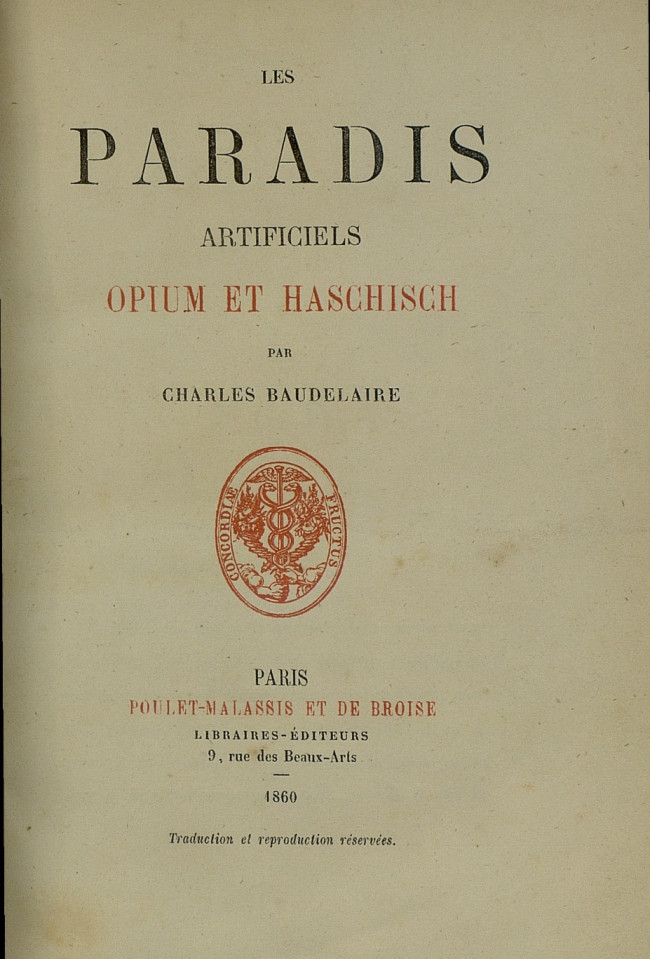
Les paradis artificiels, 1861.
"Besides, it seems to me there is little enough reason why this dedication should be understood. Is it even necessary, for the writer's satisfaction, that any kind of book ought to be understood, except by him or by her for whom it has been composed? Is it, indeed, indispensable that it has been written for any one? I have, for my part, so little taste for the living world that, like certain sensible and stay-at-home women who send, I am told, their letters to imaginary friends by the post, I would willingly write only for the dead.
"But it is not to a dead woman that I dedicate this little book; it is to one who, though ill, is always active and living in me, and who now turns her eyes in the direction of the skies, that realm of so many transfigurations. For, just as in the case of a redoubtable drug, a living being enjoys the privilege of being able to draw new and subtle pleasures even from sorrow, from catastrophe, and from fatality.
"You will see in this narrative a man who walks in a sombre and solitary fashion, plunged in the moving flood of multitudes, sending his heart and his thoughts to a far-off Electra who so long ago wiped his sweating forehead and refreshed his lips parched by fever; and you will divine the gratitude of another Orestes, whose nightmares you have so often watched over, and whose unendurable slumbers you dissipated, with a light and tender hand."
I have to say that in the last sentences I have translated Baudelaire uses "tu" instead of "vous," and that he does the same in his Latin verses and in the verses next after it. The question still remains: who was the woman of the initials?
What is certainly not a solution of the unfathomable mystery of this enigmatical woman, but which is, in a certain sense, a clue, I find on pages 55-67 of the book I have referred to, a narrative that seems more than likely to have been hers. He says this to make one understand better the mixture of dreams and hallucinations in haschisch, as having been sent him by a woman: "It is a woman, rather a mature woman, curious, of an excitable spirit, who, having yielded to the temptation of using the drug, describes her visions." These are superb and fantastic visions, written by an imaginative, sensitive, and suggestive woman. She begins: "However bizarre and astonishing are these sensations that intoxicated my folly for twelve hours (twelve or twenty? I don't know which) I shall never return to them. The spiritual excitement is too vivid, the fatigue too much to endure, and, to say all, in this childish enchantment I find something criminal." She adds: "I have heard that the enthusiasm of poets and of creators is not unlike what I have experienced, in spite of the fact that I have always imagined that such men whose delight is to move us ought to be of a really calm temperament; but if poetical delirium has any resemblance with what a little teaspoon full of drugged jam has given me, I think that all such pleasures cost dear to poets, and it is not without a certain prosaic satisfaction that I return to real life."
In these sentences Baudelaire gives one a certain clue as to the identity of this woman. "But, above all, observe that in this woman's story the hallucination is of a bastard kind, and whose reason of being is to be an exterior spectacle; the mind is no more than a mirror where the surrounding environment is transformed in an extraordinary fashion. Besides, we see intervene what I must call the moral hallucination: the subject believes he is subjected to an expiation, but the feminine temperament, which is little accustomed to analysis, does not permit itself to note the singularly optimistic character of this hallucination. The benevolent regard of the Olympian Divinities is poetized by a kind of varnish essentially haschischin. I cannot say that this woman has escaped from the sense of remorse; but that her thoughts, momentarily turned in the direction of melancholy and of regret, have returned to their former sensibility."
I need not take into account his Latin learning, his Jesuitical casuistry, his erudite reference to Electra; nor his ambiguous but not enigmatical linking together of the names of Orestes and Electra, to make it positively certain that the three poems were inspired by the same woman to whom Le paradis is dedicated. Like Orestes, he might have desired vengeance, as the fugitive did for his murdered father; she, like Electra, might have said, in Sophocles' words: "And my wretched couch in yonder house of woe knows well, ere now, how I keep the watches of the night—how often I bewail my hapless sin." I find exactly the same feeling in the sentences I have given of the dedication as in Electra's speech: nights of weariness and of lamentation. And Orestes exiled is ever in her thoughts. Why not in J. G. F.'s?
In 1859 Poulet-Malassis printed: Théophile Gautier, par Charles Baudelaire; a book of 68 pages; certainly full of perfect praise, as only one so infinitely greater than the writer he writes about was capable of giving. The first question the oriental-looking Gautier asked him was: "Do you love dictionaries?" The reply was instant: "Yes!" As a matter of fact, Gautier knew every word in the French language, even l'Argot.
Now, as Baudelaire defines the genius of Balzac supremely (more than he ever could have defined the incomparable talents of Gautier), I leave it to Swinburne to speak for me of Baudelaire and of Balzac.
"Not for the first," he says, in his Study of Shakespeare, "and probably not for the last time I turn, with all confidence, as well as with reverence, for illustration and confirmation of my own words, to the exquisite critical genius of a long honoured and long lamented fellow-craftsman. The following admirable and final estimate of the more special element or peculiar quality in the intellectual force of Honoré de Balzac could only have been taken by the inevitable intuition and rendered by the subtlest eloquence of Charles Baudelaire. Nothing could more aptly and perfectly illustrate the definition indicated in my text between unimaginative realism and imaginative reality.
"'I have been many a time astonished that to pass for an observer should be Balzac's great title to fame. To me it had always seemed that it was his chief merit to be a visionary, and a passionate visionary. All his characters are gifted with the ardour of life which animated himself. All his fictions are as deeply coloured as dreams. From the highest of the aristocracy to the lowest of the mob, all the actors in his Human Comedy are keener after living, more active and cunning in their struggles, more staunch in endurance of misfortune, more ravenous in enjoyment, more angelic in devotion, than the comedy of the real world shows them to us. In a word, every one in Balzac, down to the very scullions, has genius. Every mind is a weapon loaded to the muzzle with will. It is actually Balzac himself. And as all beings of the outer world presented themselves to his mind's eye in a strong relief and with a telling expression, he has given a convulsive action to his figures; he has blackened their shadows and intensified their fights. Besides, his prodigious love of detail, the outcome of an immoderate ambition to see everything, to bring everything to fight, to guess everything, to make others guess everything, obliged him to set down more forcibly the principal fines so as to preserve the perspective of the whole. He reminds me of some fines of those etchers who are never satisfied with the biting-in of their outlines, and transform into very ravines the main scratches of the plate. From this astonishing natural disposition of mind wonderful results have been produced. But this disposition is generally defined as Balzac's great fault. More properly speaking, it is exactly his great distinctive quality. But who can boast of being so happily gifted, and of being able to apply a method which may permit him to invest—and that with a sure hand—what is purely trivial with splendour and imperial purple? Who can do this? Now, he who does not, to speak the truth, does no great thing.'"
V
"T am far from sure," said Paul Verlaine to me in Paris, "that the philosophy of Villiers de l'lsle-Adam will not one day become the formula of our century." Fundamentally, the belief of Villiers is the belief common to all Eastern mystics. And there is in everything he wrote a strangeness, certainly both instinctive and deliberate, which seems to me to be the natural consequences of his intellectual pride. It is part of his curiosity in souls—as in the equally sinister curiosity of Baudelaire—to prefer the complex to the simple, the perverse to the straightforward, the ambiguous to either. His heroes are incarnations of spiritual pride, and their tragedies are the shock of spirit against matter, the temptation of spirit by spiritual evil. They are on the margins of a wisdom too great for their capacity; they are haunted by dark powers, instincts of ambiguous passions. And in the women his genius created there is the immortal weariness of beauty; they are enigmas to themselves; they desire, and know not why they refrain; they do good and evil with the lifting of an eyelid, and are guilty and innocent of all the sins of the earth.
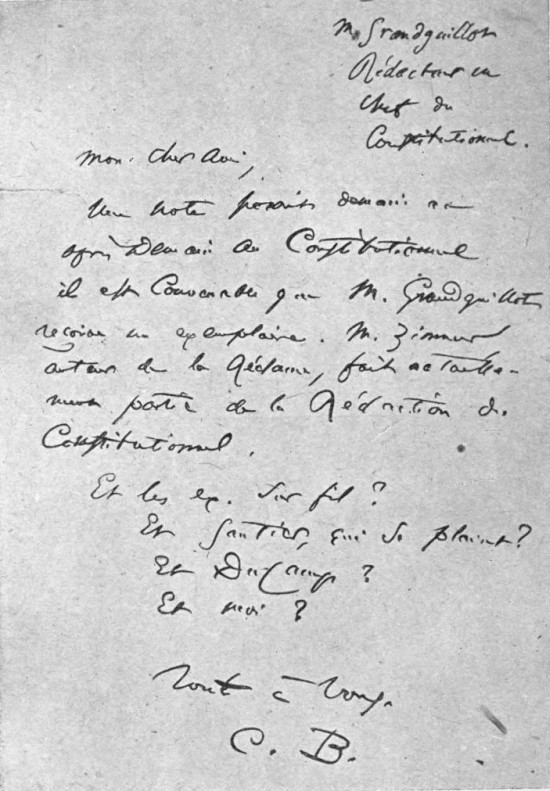
Autograph letter of Baudelaire to Monsieur de Broise, 1859.
Villiers wrote these significant sentences in the preface to La Révolte (1870): "One ought to write for the entire world. Besides, what does justice matter to us? He who from his very birth does not contain in himself his proper glory shall never know the real significance of this word." In the literature of the fantastic there are few higher names than that of the Comte de Villiers de l'Isle-Adam—a writer whose singular personality and work render him perhaps the most extraordinary figure in the contemporary world of letters. The descendant of a Breton house of fabulous antiquity, his life has been, like his works, a paradox, and an enigma. He has lived, as he says somewhere, "par politesse," ceaselessly experimenting upon life, perhaps a little too consciously, with too studied an extravagance of attitude, but at least brilliantly, and with dramatic contrasts. An immense consciousness of his own genius, a pride of race, a contempt, artistic and aristocratic, of the common herd, and, more especially, of the bourgeois multitude of letters and of life: it is to moods of mind like these, permanent with him, that we must look for the source of that violent and voulu eccentricity which mars so much of his work, and gives to all of it so disdainful an air. It is unfortunate, I think, when an artist condescends so far as to take notice of the Philistine element in which an impartial Providence has placed him. These good people we have always with us, and I question if any spiritual arms are of avail against them. They are impervious, impalpable; they do not know when they are hit. But to Villiers "les gens de sens commun" are an incessant preoccupation. He is aware of his failure of temper, and writes at the head of a polemical preface, Genus irritabile vatum.
In considering the work of Villiers I am brought face to face with a writer who seems to be made up of contradictions. Any theory, if it be at all precise, must proceed by making exceptions. Here is a writer who is at once a transcendentalist and a man of the world, a cynic and a believer in the things of the spirit. He is now Swift, now Bernadin de St. Pierre, now Baudelaire or Heine. In reading him you pass from exaltation to buffoonery with the turn of a page, and are never quite sure whether he is speaking seriously or in jest. Above all, everywhere there is irony; and the irony is of so fine a point, and glances in so many directions, that your judgment is distracted, interrupted, contradicted, and confused in a whirlwind of conflicting impressions.
Villiers has written much. The volume of Contes cruels (published in 1880) includes, I believe, work, of many periods; it contains specimens of every style its author has attempted, and in every kind the best work that he has done. The book as a whole is a masterpiece, and almost every separate tale is a masterpiece. I can think of no other collection of tales in any language on which so various and finely gifted a nature has lavished itself; none with so wide a gamut of feeling, none which is so Protean a manifestation of genius. The Tales of Edgar Poe alone surpass it in sheer effect, the Twice-Told Tales of Hawthorne alone approach it in variety of delicate sensation; both, compared with its shifting and iridescent play of colours, are but studies in monochrome. Around this supreme work we may group the other volumes. La révolte, a drama in one act in prose, represented at the Vaudeville, May 6th, 1870, has something of the touch of certain Contes cruels; it is, at least, not unworthy of a place near them. L'Ève future (1886), that most immense and ferocious of pleasantries, is simply one of the scientific burlesques of the Contes swollen out into a huge volume, where it is likely to die of plethora. The volume of the same year, called after its first tale L'Amour suprême, attempts to be a second set of Contes Cruels; it has nothing of their distinction, except in Akëdysséril. Tribulat Bonhomet, which appeared in 1887—"une bouffonnerie énorme et sombre, couleur du siècle," as the author has called it—is largely made up of an "Étude physiologique" published in 1867. In the two later volumes, Histoires insolites (1888) and Nouveaux contes cruels (1889), there are occasional glimpses of the early mastery, as in the fascinating horror of La torture par l'espérance, and the delicate cynicism of Les amies de pension. As for the prose drama in five acts, Le Nouveau Monde (1876), which had the honour of gaining a prize—"une médaille honorifique, une somme de dix mille francs même, d'autres seductions encore"—there is little in it of the true Villiers; a play with striking effects, no doubt, movement, surprises, a grandiose air; but what would you have of a "prize poem"? It was acted at one of the theatres at Paris in 1883, under the auspices of the dilettante Comte d'Orsay, and it had a very gratifying "literary" success. Such, omitting the early works, of which I have every first edition, and the numerous volumes of which the titles and no more have been published, are the works we have before us from which to study "peut-être le seul des hommes de notre génération qui ait eu en lui l'étincelle du génie"—as Catulle Mendès, ever generous in his literary appreciation of friend and foe, has said in that charming book, La légende du Parnasse contemporaine. I shall speak chiefly of the Contes cruels, and I shall try to classify them after a fashion, in order to approach one after another the various sides of this multiform and manysided genius.
First and before all, Villiers is a humorist, and he is a humorist who has no limitations, who has command of every style, who has essayed every branch of the literature of the fantastic. There are some halfdozen of tales—all contained in the Contes cruels—which, for certain of the rarest qualities of writing—subtleties, delicate perversities, exquisite complexities of irony essentially modern—can be compared, so far as I know, with nothing outside the Petits poèmes en prose of Baudelaire. Les demoiselles de Bienfilâtre, Maryelle, Sentimentalisme, Le convive des dernières fêtes, La Reine Ysabeau—one might add the solitary poem inserted, jewel amid jewels, amongst the prose—these pieces, with which one or two others have affinities of style though not of temper, constitute a distinct division of Villiers' work. They are all, more or less, studies in modern love, supersubtie and yet perfectly finished little studies, so light in touch, manipulated with so delicate a finesse, so exquisite and unerring in tact, that the most monstrous paradoxes, the most incredible assumptions of cynicism, become possible, become acceptable. Of them all I think the masterpiece is Les demoiselles de Bienfilâtre; and it is one of the most perfect little works of art in the world. The mockery of the thing is elemental; cynicism touches its zenith. It becomes tender, it becomes sublime. A perversion simply monstrous appears, in the infantine simplicity of its presentment, touching, credible, heroic. The edge of laughter is skirted by the finest of inches; and, as a last charm, one perceives, through the irony itself—the celestial, the elementary irony—a faint and sweet perfume as of a perverted odour of sanctity. The style has the delicacy of the etcher's needle. From beginning to end every word has been calculated, and every word is an inspiration. No other tale quite equals this supreme achievement; but in Maryelle, in Sentimentalisme, and the others there is the same note, and a perfection often only less absolute. Maryelle and Sentimentalisme are both studies in a special type of woman, speculations round a certain strange point of fascination; and they render that particular type with the finest precision. The one may be called a comedy, the other a tragedy. The experiences they record are comic (in the broad sense), certainly, and tragic to the men who undergo them; and in both, under the delicate lightness of the style—the gentle, well-bred, disengaged tone of a raconteur without reserve or after-thought, or with all that scrupulously hid—there is a sort of double irony, a criss-cross and intertexture of meanings and suggestions, a cynicism which turns, in spite of itself, to poetry, or a poetry which is really the other side of cynicism. La Reine Ysabeau and Le Convive des Dernières Fêtes sound a new note, the note of horror. The former stands almost by itself in the calm cruelty of its style, the singular precision of the manner in which its atrocious complication of love, vengeance, and fatality is unrolled before our eyes—the something enigmatical in the march of the horrible narrative told almost with tenderness. Its serenity is the last refinement of the irony with which this incredible episode arraigns the justice of things. From the parenthesis of the first sentence to the "Priez pour eux," every touch tells, and every touch is a surprise. Very different, and yet in certain points akin to it, is the strange tale of Le Convive des Dernières Fêtes, perhaps, after the more epic chronicle of La Reine Ysabeau, the finest of Villiers' tales of enigmatical horror. Quietly as the tale is told, full as it is of complications, and developed through varying episodes, it holds us as the Ancient Mariner held the wedding guest. It is with a positive physical sensation that we read it, an instinctive shiver of fascinated and terrified suspense. There is something of the same frisson in the latter part of Tribulat Bonhomet, and in the marvellous little study in the supernatural L'Intersigne, one of the most impressive of Villiers' works. But here the sensation is not due to effects really out of nature; and the element of horror—distinct and peculiar as is the impression it leaves upon the mind—is but one among the many elements of the piece. In these thirty pages we have a whole romance, definitely outlined characters, all touched with the same bizarrerie—the execution-mad Baron, Clio la Cendrée, Antoine Chantilly, and Susannah Jackson; the teller of the tale, the vague C., and the fantastic Doctor. Narrow as is the space, it is surcharged with emotion; a word, a look, a smile, a personal taste, is like the touching of an electric button; and, indeed, it is under the electric light that one fancies these scenes to enact themselves—scenes which have as little in common with mere daylight as their personages with average humanity. It is a world in which the virtues have changed their names, and coquette with the vices; and in masque and domino one is puzzled to distinguish the one from the other. It is a world of exquisite, delicately depraved beings trembling with sensibility. Irony is their breath of life, paradox their common speech. And the wizard who has raised these ghosts seems to stand aside and regard them with a sarcastic smile.
What is Villiers' view of life? it may occur to us to ask; is he on the side of the angels? That is a question it is premature to answer; I have to look next on another and a widely different aspect of the fantastic edifice of his work.
The group of tales I have been considering reveals the humorist in his capacity of ironical observer: their wit is a purely impersonal mockery, they deal with life from the point of view of the artist, and they are pre-eminently artistic, free from any direct purpose or preoccupation. In the pseudo-scientific burlesques, and the kindred satires on ignorant and blatant mediocrity, the smile of the Comic Muse has given place to "Laughter holding both his sides;" absurdity caps absurdity, order and measure seem to be flung to the winds, and in this new Masque of Anarchy sharp blows are given, the jests are barbed, and they fly not quite at random. "L'Esprit du siècle," says Villiers, "ne l'oublions pas, est aux machines." And it is in the mechanical miracles of modern science that he has found a new and unworked and inexhaustible field of satire. Jules Verne has used these new discoveries with admirable skill in his tales of extravagant wonder; Villiers seizes them as a weapon, and in his hands it becomes deadly, and turns back upon the very age which forged it; as a means of comedy, and the comedy becomes soberly Rabelaisian, boisterous and bitter at once, sparing nothing, so that he can develop the deliberate plan of "an apparatus for the chemical analysis of the last sigh," make a sober proposal for the utilization of the sky as a means of advertisement (Affichage Céleste), and describe in all its detail and through all its branches the excellent invention of Bathybius Bottom, La machine à gloire, a mechanical contrivance for obtaining dramatic success with the expense and inconvenience of that important institution, the Claque. In these wild and whirling satires, which are at bottom as cold and biting as Swift, we have a quite new variety of style, a style of patchwork and grimaces. Familiar words take new meanings, and flash through all the transformations of the pantomime before our eyes; strange words start up from forgotten corners; words and thoughts, never brought together since Babel, clash and stumble into a protesting combination; and in the very aspect of the page there is something startling. The absurdity of these things is so extreme, an absurdity so supremely serious, that we are carried almost beyond laughter, and on what is by virtue of its length the most important of the scientific burlesques, L'Ève future, it is almost impossible to tell whether the author is really in sober earnest or whether the whole thing is a colossal joke. Its 375 pages are devoted to a painfully elaborate description of the manufacture, under the direction of the "très-illustre inventeur américain, M. Edison," of an artificial woman! No such fundamental satire, such ghastly exposure of "poor humanity," has been conceived since Swift. The sweep of it covers human nature, and its essential laughter breaks over the very elements of man. Unfortunately the book is much too long; its own weight sinks it; the details become wearisome, the seriousness of the absurdity palls.