PART II LOVE AND CHANCE (continued 2)
Reading edition
Cantor defines a continuous series as one which is concatenated and perfect. By a concatenated series, he means such a one that if any two points are given in it, and any finite distance, however small, it is possible to proceed from the first point to the second through a succession of points of the series each at a distance from the preceding one less than the given distance. This is true of the series of rational fractions ranged in the order of their magnitude. By a perfect series, he means one which contains every point such that there is no distance so small that this point has not an infinity of points of the series within that distance of it. This is true of the series of numbers between 0 and 1 capable of being expressed by decimals in which only the digits 0 and 1 occur.
It must be granted that Cantor’s definition includes every series that is continuous; nor can it be objected that it includes any important or indubitable case of a series not continuous. Nevertheless, it has some serious defects. In 216the first place, it turns upon metrical considerations; while the distinction between a continuous and a discontinuous series is manifestly non-metrical. In the next place, a perfect series is defined as one containing “every point” of a certain description. But no positive idea is conveyed of what all the points are: that is definition by negation, and cannot be admitted. If that sort of thing were allowed, it would be very easy to say, at once, that the continuous linear series of points is one which contains every point of the line between its extremities. Finally, Cantor’s definition does not convey a distinct notion of what the components of the conception of continuity are. It ingeniously wraps up its properties in two separate parcels, but does not display them to our intelligence.
Kant’s definition expresses one simple property of a continuum; but it allows of gaps in the series. To mend the definition, it is only necessary to notice how these gaps can occur. Let us suppose, then, a linear series of points extending from a point, A, to a point, B, having a gap from B to a third point, C, and thence extending to a final limit, D; and let us suppose this series conforms to Kant’s definition. Then, of the two points, B and C, one or both must be excluded from the series; for otherwise, by the definition, there would be points between them. That is, if the series contains C, though it contains all the points up to B, it cannot contain B. What is required, therefore, is to state in non-metrical terms that if a series of points up to a limit is included in a continuum the limit is included. It may be remarked that this is the property of a continuum to which Aristotle’s attention seems to have been directed 217when he defines a continuum as something whose parts have a common limit. The property may be exactly stated as follows: If a linear series of points is continuous between two points, A and D, and if an endless series of points be taken, the first of them between A and D and each of the others between the last preceding one and D, then there is a point of the continuous series between all that endless series of points and D, and such that every other point of which this is true lies between this point and D. For example, take any number between 0 and 1, as 0.1; then, any number between 0.1 and 1, as 0.11; then any number between 0.11 and 1, as 0.111; and so on, without end. Then, because the series of real numbers between 0 and 1 is continuous, there must be a least real number, greater than every number of that endless series. This property, which may be called the Aristotelicity of the series, together with Kant’s property, or its Kanticity, completes the definition of a continuous series.
The property of Aristotelicity may be roughly stated thus: a continuum contains the end point belonging to every endless series of points which it contains. An obvious corollary is that every continuum contains its limits. But in using this principle it is necessary to observe that a series may be continuous except in this, that it omits one or both of the limits.
Our ideas will find expression more conveniently if, instead of points upon a line, we speak of real numbers. Every real number is, in one sense, the limit of a series, for it can be indefinitely approximated to. Whether every real number is a limit of a regular series may perhaps be 218open to doubt. But the series referred to in the definition of Aristotelicity must be understood as including all series whether regular or not. Consequently, it is implied that between any two points an innumerable series of points can be taken.
Every number whose expression in decimals requires but a finite number of places of decimals is commensurable. Therefore, incommensurable numbers suppose an infinitieth place of decimals. The word infinitesimal is simply the Latin form of infinitieth; that is, it is an ordinal formed from infinitum, as centesimal from centum. Thus, continuity supposes infinitesimal quantities. There is nothing contradictory about the idea of such quantities. In adding and multiplying them the continuity must not be broken up, and consequently they are precisely like any other quantities, except that neither the syllogism of transposed quantity, nor the Fermatian inference applies to them.
If A is a finite quantity and i an infinitesimal, then in a certain sense we may write A + i = A. That is to say, this is so for all purposes of measurement. But this principle must not be applied except to get rid of all the terms in the highest order of infinitesimals present. As a mathematician, I prefer the method of infinitesimals to that of limits, as far easier and less infested with snares. Indeed, the latter, as stated in some books, involves propositions that are false; but this is not the case with the forms of the method used by Cauchy, Duhamel, and others. As they understand the doctrine of limits, it involves the notion of continuity, and, therefore, contains in another shape the very same ideas as the doctrine of infinitesimals.
219Let us now consider an aspect of the Aristotelical principle which is particularly important in philosophy. Suppose a surface to be part red and part blue; so that every point on it is either red or blue, and, of course, no part can be both red and blue. What, then, is the color of the boundary line between the red and the blue? The answer is that red or blue, to exist at all, must be spread over a surface; and the color of the surface is the color of the surface in the immediate neighborhood of the point. I purposely use a vague form of expression. Now, as the parts of the surface in the immediate neighborhood of any ordinary point upon a curved boundary are half of them red and half blue, it follows that the boundary is half red and half blue. In like manner, we find it necessary to hold that consciousness essentially occupies time; and what is present to the mind at any ordinary instant, is what is present during a moment in which that instant occurs. Thus, the present is half past and half to come. Again, the color of the parts of a surface at any finite distance from a point, has nothing to do with its color just at that point; and, in the parallel, the feeling at any finite interval from the present has nothing to do with the present feeling, except vicariously. Take another case: the velocity of a particle at any instant of time is its mean velocity during an infinitesimal instant in which that time is contained. Just so my immediate feeling is my feeling through an infinitesimal duration containing the present instant.
220
ANALYSIS OF TIME
One of the most marked features about the law of mind is that it makes time to have a definite direction of flow from past to future. The relation of past to future is, in reference to the law of mind, different from the relation of future to past. This makes one of the great contrasts between the law of mind and the law of physical force, where there is no more distinction between the two opposite directions in time than between moving northward and moving southward.
In order, therefore, to analyze the law of mind, we must begin by asking what the flow of time consists in. Now, we find that in reference to any individual state of feeling, all others are of two classes, those which affect this one (or have a tendency to affect it, and what this means we shall inquire shortly), and those which do not. The present is affectible by the past but not by the future.
Moreover, if state A is affected by state B, and state B by state C, then A is affected by state C, though not so much so. It follows, that if A is affectible by B, B is not affectible by A.
If, of two states, each is absolutely unaffectible by the other, they are to be regarded as parts of the same state. They are contemporaneous.
To say that a state is between two states means that it affects one and is affected by the other. Between any two states in this sense lies an innumerable series of states affecting one another; and if a state lies between a given state and any other state which can be reached by inserting 221states between this state and any third state, these inserted states not immediately affecting or being affected by either, then the second rate mentioned, immediately affects or is affected by the first, in the sense that in the one the other is ipso facto present in a reduced degree.
These propositions involve a definition of time and of its flow. Over and above this definition they involve a doctrine, namely, that every state of feeling is affectible by every earlier state.
THAT FEELINGS HAVE INTENSIVE CONTINUITY
Time with its continuity logically involves some other kind of continuity than its own. Time, as the universal form of change, cannot exist unless there is something to undergo change, and to undergo a change continuous in time, there must be a continuity of changeable qualities. Of the continuity of intrinsic qualities of feeling we can now form but a feeble conception. The development of the human mind has practically extinguished all feelings, except a few sporadic kinds, sound, colors, smells, warmth, etc., which now appear to be disconnected and disparate. In the case of colors, there is a tridimensional spread of feelings. Originally, all feelings may have been connected in the same way, and the presumption is that the number of dimensions was endless. For development essentially involves a limitation of possibilities. But given a number of dimensions of feeling, all possible varieties are obtainable by varying the intensities of the different elements. Accordingly, time logically supposes a continuous range of intensity in feeling. It follows, then, from the definition of 222continuity, that when any particular kind of feeling is present, an infinitesimal continuum of all feelings differing infinitesimally from that is present.
THAT FEELINGS HAVE SPATIAL EXTENSION
Consider a gob of protoplasm, say an amœba or a slime-mould. It does not differ in any radical way from the contents of a nerve-cell, though its functions may be less specialized. There is no doubt that this slime-mould, or this amœba, or at any rate some similar mass of protoplasm feels. That is to say, it feels when it is in its excited condition. But note how it behaves. When the whole is quiescent and rigid, a place upon it is irritated. Just at this point, an active motion is set up, and this gradually spreads to other parts. In this action, no unity nor relation to a nucleus, or other unitary organ can be discerned. It is a mere amorphous continuum of protoplasm, with feeling passing from one part to another. Nor is there anything like a wave-motion. The activity does not advance to new parts, just as fast as it leaves old parts. Rather, in the beginning, it dies out at a slower rate than that at which it spreads. And while the process is going on, by exciting the mass at another point, a second quite independent state of excitation will be set up. In some places, neither excitation will exist, in others each separately, in still other places, both effects will be added together. Whatever there is in the whole phenomenon to make us think there is feeling in such a mass of protoplasm,—feeling, but plainly no personality,—goes logically to show that that feeling has a subjective, or substantial, spatial extension, as the excited 223state has. This is, no doubt, a difficult idea to seize, for the reason that it is a subjective, not an objective, extension. It is not that we have a feeling of bigness; though Professor James, perhaps rightly, teaches that we have. It is that the feeling, as a subject of inhesion, is big. Moreover, our own feelings are focused in attention to such a degree that we are not aware that ideas are not brought to an absolute unity; just as nobody not instructed by special experiment has any idea how very, very little of the field of vision is distinct. Still, we all know how the attention wanders about among our feelings; and this fact shows that those feelings that are not co-ordinated in attention have a reciprocal externality, although they are present at the same time. But we must not tax introspection to make a phenomenon manifest which essentially involves externality.
Since space is continuous, it follows that there must be an immediate community of feeling between parts of mind infinitesimally near together. Without this, I believe it would have been impossible for minds external to one another, ever to become co-ordinated, and equally impossible for any coördination to be established in the action of the nerve-matter of one brain.
AFFECTIONS OF IDEAS
But we are met by the question what is meant by saying that one idea affects another. The unravelment of this problem requires us to trace out phenomena a little further.
Three elements go to make up an idea. The first is its intrinsic quality as a feeling. The second is the energy 224with which it affects other ideas, an energy which is infinite in the here-and-nowness of immediate sensation, finite and relative in the recency of the past. The third element is the tendency of an idea to bring along other ideas with it.
As an idea spreads, its power of affecting other ideas gets rapidly reduced; but its intrinsic quality remains nearly unchanged. It is long years now since I last saw a cardinal in his robes; and my memory of their color has become much dimmed. The color itself, however, is not remembered as dim. I have no inclination to call it a dull red. Thus, the intrinsic quality remains little changed; yet more accurate observation will show a slight reduction of it. The third element, on the other hand, has increased. As well as I can recollect, it seems to me the cardinals I used to see wore robes more scarlet than vermillion is, and highly luminous. Still, I know the color commonly called cardinal is on the crimson side of vermillion and of quite moderate luminosity, and the original idea calls up so many other hues with it, and asserts itself so feebly, that I am unable any longer to isolate it.
A finite interval of time generally contains an innumerable series of feelings; and when these become welded together in association, the result is a general idea. For we have just seen how by continuous spreading an idea becomes generalised.
The first character of a general idea so resulting is that it is living feeling. A continuum of this feeling, infinitesimal in duration, but still embracing innumerable parts, and also, though infinitesimal, entirely unlimited, is immediately present. And in its absence of boundedness a 225vague possibility of more than is present is directly felt.
Second, in the presence of this continuity of feeling, nominalistic maxims appear futile. There is no doubt about one idea affecting another, when we can directly perceive the one gradually modified and shaping itself into the other. Nor can there any longer be any difficulty about one idea resembling another, when we can pass along the continuous field of quality from one to the other and back again to the point which we had marked.
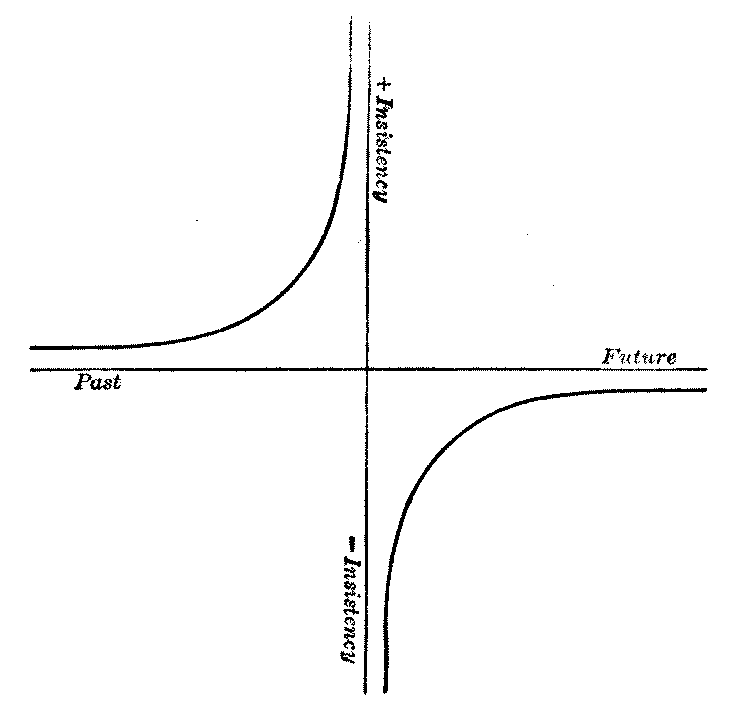
Figure 7.
Third, consider the insistency of an idea. The insistency of a past idea with reference to the present is a quantity which is less the further back that past idea is, and rises to infinity as the past idea is brought up into coincidence with the present. Here we must make one of those inductive applications of the law of continuity which have produced 226such great results in all the positive sciences. We must extend the law of insistency into the future. Plainly, the insistency of a future idea with reference to the present is a quantity affected by the minus sign; for it is the present that affects the future, if there be any effect, not the future that affects the present. Accordingly, the curve of insistency is a sort of equilateral hyperbola. (See the figure.) Such a conception is none the less mathematical, that its quantification cannot now be exactly specified.
Now consider the induction which we have here been led into. This curve says that feeling which has not yet emerged into immediate consciousness is already affectible and already affected. In fact, this is habit, by virtue of which an idea is brought up into present consciousness by a bond that had already been established between it and another idea while it was still in futuro.
We can now see what the affection of one idea by another consists in. It is that the affected idea is attached as a logical predicate to the affecting idea as subject. So when a feeling emerges into immediate consciousness, it always appears as a modification of a more or less general object already in the mind. The word suggestion is well adapted to expressing this relation. The future is suggested by, or rather is influenced by the suggestions of, the past.
IDEAS CANNOT BE CONNECTED EXCEPT BY CONTINUITY
That ideas can nowise be connected without continuity is sufficiently evident to one who reflects upon the matter. But still the opinion may be entertained that after continuity has once made the connection of ideas possible, 227then they may get to be connected in other modes than through continuity. Certainly, I cannot see how anyone can deny that the infinite diversity of the universe, which we call chance, may bring ideas into proximity which are not associated in one general idea. It may do this many times. But then the law of continuous spreading will produce a mental association; and this I suppose is an abridged statement of the way the universe has been evolved. But if I am asked whether a blind ἀνάγκη cannot bring ideas together, first I point out that it would not remain blind. There being a continuous connection between the ideas, they would infallibly become associated in a living, feeling, and perceiving general idea. Next, I cannot see what the mustness or necessity of this ἁνάγκη would consist in. In the absolute uniformity of the phenomenon, says the nominalist. Absolute is well put in; for if it merely happened so three times in succession, or three million times in succession, in the absence of any reason, the coincidence could only be attributed to chance. But absolute uniformity must extend over the whole infinite future; and it is idle to talk of that except as an idea. No; I think we can only hold that wherever ideas come together they tend to weld into general ideas; and wherever they are generally connected, general ideas govern the connection; and these general ideas are living feelings spread out.
MENTAL LAW FOLLOWS THE FORMS OF LOGIC
The three main classes of logical inference are Deduction, Induction, and Hypothesis. These correspond to three chief modes of action of the human soul. In deduction the 228mind is under the dominion of a habit or association by virtue of which a general idea suggests in each case a corresponding reaction. But a certain sensation is seen to involve that idea. Consequently, that sensation is followed by that reaction. That is the way the hind legs of a frog, separated from the rest of the body, reason, when you pinch them. It is the lowest form of psychical manifestation.
By induction, a habit becomes established. Certain sensations, all involving one general idea, are followed each by the same reaction; and an association becomes established, whereby that general idea gets to be followed uniformly by that reaction.
Habit is that specialization of the law of mind whereby a general idea gains the power of exciting reactions. But in order that the general idea should attain all its functionality, it is necessary, also, that it should become suggestible by sensations. That is accomplished by a psychical process having the form of hypothetic inference. By hypothetic inference, I mean, as I have explained in other writings, an induction from qualities. For example, I know that the kind of man known and classed as a “mugwump” has certain characteristics. He has a high self-respect and places great value upon social distinction. He laments the great part that rowdyism and unrefined good-fellowship play in the dealings of American politicians with their constituency. He thinks that the reform which would follow from the abandonment of the system by which the distribution of offices is made to strengthen party organizations and a return to the original and essential conception of 229office-filling would be found an unmixed good. He holds that monetary considerations should usually be the decisive ones in questions of public policy. He respects the principle of individualism and of laissez-faire as the greatest agency of civilization. These views, among others, I know to be obtrusive marks of a “mugwump.” Now, suppose I casually meet a man in a railway-train, and falling into conversation find that he holds opinions of this sort; I am naturally led to suppose that he is a “mugwump.” That is hypothetic inference. That is to say, a number of readily verifiable marks of a mugwump being selected, I find this man has these, and infer that he has all the other characters which go to make a thinker of that stripe. Or let us suppose that I meet a man of a semi-clerical appearance and a sub-pharisaical sniff, who appears to look at things from the point of view of a rather wooden dualism. He cites several texts of scripture and always with particular attention to their logical implications; and he exhibits a sternness, almost amounting to vindictiveness, toward evil-doers, in general. I readily conclude that he is a minister of a certain denomination. Now the mind acts in a way similar to this, every time we acquire a power of co-ordinating reactions in a peculiar way, as in performing any act requiring skill. Thus, most persons have a difficulty in moving the two hands simultaneously and in opposite directions through two parallel circles nearly in the medial plane of the body. To learn to do this, it is necessary to attend, first, to the different actions in different parts of the motion, when suddenly a general conception of the action springs up and it becomes perfectly easy. We think the motion 230we are trying to do involves this action, and this, and this. Then, the general idea comes which unites all those actions, and thereupon the desire to perform the motion calls up the general idea. The same mental process is many times employed whenever we are learning to speak a language or are acquiring any sort of skill.
Thus, by induction, a number of sensations followed by one reaction become united under one general idea followed by the same reaction; while by the hypothetic process, a number of reactions called for by one occasion get united in a general idea which is called out by the same occasion. By deduction, the habit fulfils its function of calling out certain reactions on certain occasions.
UNCERTAINTY OF MENTAL ACTION
The inductive and hypothetic forms of inference are essentially probable inferences, not necessary; while deduction may be either necessary or probable.
But no mental action seems to be necessary or invariable in its character. In whatever manner the mind has reacted under a given sensation, in that manner it is the more likely to react again; were this, however, an absolute necessity, habits would become wooden and ineradicable, and no room being left for the formation of new habits, intellectual life would come to a speedy close. Thus, the uncertainty of the mental law is no mere defect of it, but is on the contrary of its essence. The truth is, the mind is not subject to “law,” in the same rigid sense that matter is. It only experiences gentle forces which merely render it more likely to act in a given way than it otherwise would be. There 231always remains a certain amount of arbitrary spontaneity in its action, without which it would be dead.
Some psychologists think to reconcile the uncertainty of reactions with the principle of necessary causation by means of the law of fatigue. Truly for a law, this law of fatigue is a little lawless. I think it is merely a case of the general principle that an idea in spreading loses its insistency. Put me tarragon into my salad, when I have not tasted it for years, and I exclaim “What nectar is this!” But add it to every dish I taste for week after week, and a habit of expectation has been created; and in thus spreading into habit, the sensation makes hardly any more impression upon me; or, if it be noticed, it is on a new side from which it appears as rather a bore. The doctrine that fatigue is one of the primordial phenomena of mind I am much disposed to doubt. It seems a somewhat little thing to be allowed as an exception to the great principle of mental uniformization. For this reason, I prefer to explain it in the manner here indicated, as a special case of that great principle. To consider it as something distinct in its nature, certainly somewhat strengthens the necessitarian position; but even if it be distinct, the hypothesis that all the variety and apparent arbitrariness of mental action ought to be explained away in favor of absolute determinism does not seem to me to recommend itself to a sober and sound judgment, which seeks the guidance of observed facts and not that of prepossessions.
232
RESTATEMENT OF THE LAW
Let me now try to gather up all these odds and ends of commentary and restate the law of mind, in a unitary way.
First, then, we find that when we regard ideas from a nominalistic, individualistic, sensualistic way, the simplest facts of mind become utterly meaningless. That one idea should resemble another or influence another, or that one state of mind should so much as be thought of in another is, from that standpoint, sheer nonsense.
Second, by this and other means we are driven to perceive, what is quite evident of itself, that instantaneous feelings flow together into a continuum of feeling, which has in a modified degree the peculiar vivacity of feeling and has gained generality. And in reference to such general ideas, or continua of feeling, the difficulties about resemblance and suggestion and reference to the external, cease to have any force.
Third, these general ideas are not mere words, nor do they consist in this, that certain concrete facts will every time happen under certain descriptions of conditions; but they are just as much, or rather far more, living realities than the feelings themselves out of which they are concreted. And to say that mental phenomena are governed by law does not mean merely that they are describable by a general formula; but that there is a living idea, a conscious continuum of feeling, which pervades them, and to which they are docile.
Fourth, this supreme law, which is the celestial and living harmony, does not so much as demand that the special 233ideas shall surrender their peculiar arbitrariness and caprice entirely; for that would be self-destructive. It only requires that they shall influence and be influenced by one another.
Fifth, in what measure this unification acts, seems to be regulated only by special rules; or, at least, we cannot in our present knowledge say how far it goes. But it may be said that, judging by appearances, the amount of arbitrariness in the phenomena of human minds is neither altogether trifling nor very prominent.
PERSONALITY
Having thus endeavored to state the law of mind, in general, I descend to the consideration of a particular phenomenon which is remarkably prominent in our own consciousnesses, that of personality. A strong light is thrown upon this subject by recent observations of double and multiple personality. The theory which at one time seemed plausible that two persons in one body corresponded to the two halves of the brain will, I take it, now be universally acknowledged to be insufficient. But that which these cases make quite manifest is that personality is some kind of co-ordination or connection of ideas. Not much to say, this, perhaps. Yet when we consider that, according to the principle which we are tracing out, a connection between ideas is itself a general idea, and that a general idea is a living feeling, it is plain that we have at least taken an appreciable step toward the understanding of personality. This personality, like any general idea, is not a thing to be apprehended in an instant. It has to be lived in time; 234nor can any finite time embrace it in all its fullness. Yet in each infinitesimal interval it is present and living, though specially colored by the immediate feelings of that moment. Personality, so far as it is apprehended in a moment, is immediate self-consciousness.
But the word co-ordination implies somewhat more than this; it implies a teleological harmony in ideas, and in the case of personality this teleology is more than a mere purposive pursuit of a predeterminate end; it is a developmental teleology. This is personal character. A general idea, living and conscious now, it is already determinative of acts in the future to an extent to which it is not now conscious.
This reference to the future is an essential element of personality. Were the ends of a person already explicit, there would be no room for development, for growth, for life; and consequently there would be no personality. The mere carrying out of predetermined purposes is mechanical. This remark has an application to the philosophy of religion. It is that a genuine evolutionary philosophy, that is, one that makes the principle of growth a primordial element of the universe, is so far from being antagonistic to the idea of a personal creator, that it is really inseparable from that idea; while a necessitarian religion is in an altogether false position and is destined to become disintegrated. But a pseudo-evolutionism which enthrones mechanical law above the principle of growth, is at once scientifically unsatisfactory, as giving no possible hint of how the universe has come about, and hostile to all hopes of personal relations to God.
235
COMMUNICATION
Consistently with the doctrine laid down in the beginning of this paper, I am bound to maintain that an idea can only be affected by an idea in continuous connection with it. By anything but an idea, it cannot be affected at all. This obliges me to say, as I do say, on other grounds, that what we call matter is not completely dead, but is merely mind hide-bound with habits. It still retains the element of diversification; and in that diversification there is life. When an idea is conveyed from one mind to another, it is by forms of combination of the diverse elements of nature, say by some curious symmetry, or by some union of a tender color with a refined odor. To such forms the law of mechanical energy has no application. If they are eternal, it is in the spirit they embody; and their origin cannot be accounted for by any mechanical necessity. They are embodied ideas; and so only can they convey ideas. Precisely how primary sensations, as colors and tones, are excited, we cannot tell, in the present state of psychology. But in our ignorance, I think that we are at liberty to suppose that they arise in essentially the same manner as the other feelings, called secondary. As far as sight and hearing are in question, we know that they are only excited by vibrations of inconceivable complexity; and the chemical senses are probably not more simple. Even the least psychical of peripheral sensations, that of pressure, has in its excitation conditions which, though apparently simple, are seen to be complicated enough when we consider the molecules and their attractions. The principle with which I 236set out requires me to maintain that these feelings are communicated to the nerves by continuity, so that there must be something like them in the excitants themselves. If this seems extravagant, it is to be remembered that it is the sole possible way of reaching any explanation of sensation, which otherwise must be pronounced a general fact, absolutely inexplicable and ultimate. Now absolute inexplicability is a hypothesis which sound logic refuses under any circumstances to justify.
I may be asked whether my theory would be favorable or otherwise to telepathy. I have no decided answer to give to this. At first sight, it seems unfavorable. Yet there may be other modes of continuous connection between minds other than those of time and space.
The recognition by one person of another’s personality takes place by means to some extent identical with the means by which he is conscious of his own personality. The idea of the second personality, which is as much as to say that second personality itself, enters within the field of direct consciousness of the first person, and is as immediately perceived as his ego, though less strongly. At the same time, the opposition between the two persons is perceived, so that the externality of the second is recognized.
The psychological phenomena of intercommunication between two minds have been unfortunately little studied. So that it is impossible to say, for certain, whether they are favorable to this theory or not. But the very extraordinary insight which some persons are able to gain of others from indications so slight that it is difficult to ascertain what they are, is certainly rendered more comprehensible by the view here taken.
237A difficulty which confronts the synechistic philosophy is this. In considering personality, that philosophy is forced to accept the doctrine of a personal God; but in considering communication, it cannot but admit that if there is a personal God, we must have a direct perception of that person and indeed be in personal communication with him. Now, if that be the case, the question arises how it is possible that the existence of this being should ever have been doubted by anybody. The only answer that I can at present make is that facts that stand before our face and eyes and stare us in the face are far from being, in all cases, the ones most easily discerned. That has been remarked from time immemorial.
CONCLUSION
I have thus developed as well as I could in a little space the synechistic philosophy, as applied to mind. I think that I have succeeded in making it clear that this doctrine gives room for explanations of many facts which without it are absolutely and hopelessly inexplicable; and further that it carries along with it the following doctrines: 1st, a logical realism of the most pronounced type; 2nd, objective idealism; 3rd, tychism, with its consequent thoroughgoing evolutionism. We also notice that the doctrine presents no hindrances to spiritual influences, such as some philosophies are felt to do.
238
IV. MAN’S GLASSY ESSENCE[63]
In The Monist for January, 1891, I tried to show what conceptions ought to form the brick and mortar of a philosophical system. Chief among these was that of absolute chance for which I argued again in last April’s number.[64] In July, I applied another fundamental idea, that of continuity, to the law of mind. Next in order, I have to elucidate, from the point of view chosen, the relation between the psychical and physical aspects of a substance.
The first step towards this ought, I think, to be the framing of a molecular theory of protoplasm. But before doing that, it seems indispensable to glance at the constitution of matter, in general. We shall, thus, unavoidably make a long detour; but, after all, our pains will not be wasted, for the problems of the papers that are to follow in the series will call for the consideration of the same question.
All physicists are rightly agreed the evidence is overwhelming which shows all sensible matter is composed of molecules in swift motion and exerting enormous mutual attractions, and perhaps repulsions, too. Even Sir William Thomson, Lord Kelvin, who wishes to explode action at a distance and return to the doctrine of a plenum, not only speaks of molecules, but undertakes to assign definite magnitudes 239to them. The brilliant Judge Stallo, a man who did not always rightly estimate his own qualities in accepting tasks for himself, declared war upon the atomic theory in a book well worth careful perusal. To the old arguments in favor of atoms which he found in Fechner’s monograph, he was able to make replies of considerable force, though they were not sufficient to destroy those arguments. But against modern proofs he made no headway at all. These set out from the mechanical theory of heat. Rumford’s experiments showed that heat is not a substance. Joule demonstrated that it was a form of energy. The heating of gases under constant volume, and other facts instanced by Rankine, proved that it could not be an energy of strain. This drove physicists to the conclusion that it was a mode of motion. Then it was remembered that John Bernoulli had shown that the pressure of gases could be accounted for by assuming their molecules to be moving uniformly in rectilinear paths. The same hypothesis was now seen to account for Avogadro’s law, that in equal volumes of different kinds of gases exposed to the same pressure and temperature are contained equal numbers of molecules. Shortly after, it was found to account for the laws of diffusion and viscosity of gases, and for the numerical relation between these properties. Finally, Crookes’s radiometer furnished the last link in the strongest chain of evidence which supports any physical hypothesis.
Such being the constitution of gases, liquids must clearly be bodies in which the molecules wander in curvilinear paths, while in solids they move in orbits or quasi-orbits. (See my definition solid II, 1, in the Century Dictionary.)
240We see that the resistance to compression and to inter-penetration between sensible bodies is, by one of the prime propositions of the molecular theory, due in large measure to the kinetical energy of the particles, which must be supposed to be quite remote from one another, on the average, even in solids. This resistance is no doubt influenced by finite attractions and repulsions between the molecules. All the impenetrability of bodies which we can observe is, therefore, a limited impenetrability due to kinetic and positional energy. This being the case, we have no logical right to suppose that absolute impenetrability, or the exclusive occupancy of space, belongs to molecules or to atoms. It is an unwarranted hypothesis, not a vera causa.[65] Unless we are to give up the theory of energy, finite positional attractions and repulsions between molecules must be admitted. Absolute impenetrability would amount to an infinite repulsion at a certain distance. No analogy of known phenomena exists to excuse such a wanton violation of the principle of continuity as such a hypothesis is. In short, we are logically bound to adopt the Boscovichian idea that an atom is simply a distribution of component potential energy throughout space (this distribution being absolutely rigid), combined with inertia. The potential energy belongs to two molecules, and is to be conceived as different between molecules A and B from what it is between molecules A and C. The distribution of energy is not necessarily spherical. Nay, a molecule may conceivably have more than one center; it may even have a central curve, 241returning into itself. But I do not think there are any observed facts pointing to such multiple or linear centers. On the other hand, many facts relating to crystals, especially those observed by Voigt,[66] go to show that the distribution of energy is harmonical but not concentric. We can easily calculate the forces which such atoms must exert upon one another by considering[67] that they are equivalent to aggregations of pairs of electrically positive and negative points infinitely near to one another. About such an atom there would be regions of positive and of negative potential, and the number and distribution of such regions would determine the valency of the atom, a number which it is easy to see would in many cases be somewhat indeterminate. I must not dwell further upon this hypothesis, at present. In another paper, its consequences will be further considered.
I cannot assume that the students of philosophy who read this magazine are thoroughly versed in modern molecular physics, and, therefore, it is proper to mention that the governing principle in this branch of science is Clausius’s law of the virial. I will first state the law, and then explain the peculiar terms of the statement. This statement is that the total kinetic energy of the particles of a system in stationary motion is equal to the total virial. By a system is here meant a number of particles acting upon one another.[68] Stationary motion is a quasi-orbital motion among 242a system of particles so that none of them are removed to indefinitely great distances nor acquire indefinitely great velocities. The kinetic energy of a particle is the work which would be required to bring it to rest, independently of any forces which may be acting upon it. The virial of a pair of particles is half the work which the force which actually operates between them would do if, being independent of the distance, it were to bring them together. The equation of the virial is
1/2∑mv2 = 1/2∑∑Rr.
Here m is the mass of a particle, v its velocity, R is the attraction between two particles, and r is the distance between them. The sign ∑ on the left hand side signifies that the values of mv2 are to be summed for all the particles, and ∑∑ on the right hand side signifies that the values of Rr are to be summed for all the pairs of particles. If there is an external pressure P (as from the atmosphere) upon the system, and the volume of vacant space within the boundary of that pressure is V, then the virial must be understood as including 3/2PV, so that the equation is
1/2∑mv2 = 3/2PV + 1/2∑∑Rr.
There is strong (if not demonstrative) reason for thinking that the temperature of any body above the absolute zero (-273° C.), is proportional to the average kinetic energy 243of its molecules, or say aθ, where a is a constant and θ is the absolute temperature. Hence, we may write the equation
aθ = (1/2)avg(mv2) = (3/2)P avg(V) + (1/2)∑ avg(Rr)
where the heavy lines above the different expressions signify that the average values for single molecules are to be taken. In 1872, a student in the University of Leyden, Van der Waals, propounded in his thesis for the doctorate a specialization of the equation of the virial which has since attracted great attention. Namely, he writes it
aθ = (P + c/V2)(V - b.)
The quantity b is the volume of a molecule, which he supposes to be an impenetrable body, and all the virtue of the equation lies in this term which makes the equation a cubic in V, which is required to account for the shape of certain isothermal curves.[69] But if the idea of an impenetrable atom is illogical, that of an impenetrable molecule is almost absurd. For the kinetical theory of matter teaches us that a molecule is like a solar system or star-cluster in miniature. Unless we suppose that in all heating of gases and vapors internal work is performed upon the molecules, implying that their atoms are at considerable distances, the whole kinetical theory of gases falls to the ground. As for the term added to P, there is no more than a partial and roughly approximative justification for it. Namely, let us imagine 244two spheres described round a particle as their center, the radius of the larger being so great as to include all the particles whose action upon the center is sensible, while the radius of the smaller is so large that a good many molecules are included within it. The possibility of describing such a sphere as the outer one implies that the attraction of the particles varies at some distances inversely as some higher power of the distance than the cube, or, to speak more clearly, that the attraction multiplied by the cube of the distance diminishes as the distance increases; for the number of particles at a given distance from any one particle is proportionate to the square of that distance and each of these gives a term of the virial which is the product of the attraction into the distance. Consequently, unless the attraction multiplied by the cube of the distance diminished so rapidly with the distance as soon to become insensible, no such outer sphere as is supposed could be described. However, ordinary experience shows that such a sphere is possible; and consequently there must be distances at which the attraction does thus rapidly diminish as the distance increases. The two spheres, then, being so drawn, consider the virial of the central particle due to the particles between them. Let the density of the substance be increased, say, N times. Then, for every turn, Rr, of the virial before the condensation, there will be N terms of the same magnitude after the condensation. Hence, the virial of each particle will be proportional to the density, and the equation of the virial becomes
aθ = P avg(V) + c/avg(V).
245This omits the virial within the inner sphere, the radius of which is so taken that within that distance the number of particles is not proportional to the number in a large sphere. For Van der Waals this radius is the diameter of his hard molecules, which assumption gives his equation. But it is plain that the attraction between the molecules must to a certain extent modify their distribution, unless some peculiar conditions are fulfilled. The equation of Van der Waals can be approximately true, therefore, only for a gas. In a solid or liquid condition, in which the removal of a small amount of pressure has little effect on the volume, and where consequently the virial must be much greater than P avg(V), the virial must increase with the volume. For suppose we had a substance in a critical condition in which an increase of the volume would diminish the virial more than it would increase (3/2)P avg(V). If we were forcibly to diminish the volume of such a substance, when the temperature became equalized, the pressure which it could withstand would be less than before, and it would be still further condensed, and this would go on indefinitely until a condition were reached in which an increase of volume would increase (3/2)P avg(V) more than it would decrease the virial. In the case of solids, at least, P may be zero; so that the state reached would be one in which the virial increases with the volume, or the attraction between the particles does not increase so fast with a diminution of their distance as it would if the attraction were inversely as the distance.
Almost contemporaneously with Van der Waals’s paper, another remarkable thesis for the doctorate was presented at Paris by Amagat. It related to the elasticity and expansion 246of gases, and to this subject the superb experimenter, its author, has devoted his whole subsequent life. Especially interesting are his observations of the volumes of ethylene and of carbonic acid at temperatures from 20° to 100° and at pressures ranging from an ounce to 5000 pounds to the square inch. As soon as Amagat had obtained these results, he remarked that the “coefficient of expansion at constant volume,” as it is absurdly called, that is, the rate of variation of the pressure with the temperature, was very nearly constant for each volume. This accords with the equation of the virial, which gives
dp/dθ = a/avg(V) - d∑ avg(Rr)/dθ.
Now, the virial must be nearly independent of the temperature, and, therefore, the last term almost disappears. The virial would not be quite independent of the temperature, because if the temperature (i.e., the square of the velocity of the molecules) is lowered, and the pressure correspondingly lowered, so as to make the volume the same, the attractions of the molecules will have more time to produce their effects, and consequently, the pairs of molecules the closest together will be held together longer and closer; so that the virial will generally be increased by a decrease of temperature. Now, Amagat’s experiments do show an excessively minute effect of this sort, at least, when the volumes are not too small. However, the observations are well enough satisfied by assuming the “coefficient of expansion at constant volume” to consist wholly of the first term, a/avg(V). Thus, Amagat’s experiments enable us to determine 247the values of a and thence to calculate the virial; and this we find varies for carbonic acid gas nearly inversely to avg(V)0.9. There is, thus, a rough approximation to satisfying Van der Waals’s equation. But the most interesting result of Amagat’s experiments, for our purpose at any rate, is that the quantity a, though nearly constant for any one volume, differs considerably with the volume, nearly doubling when the volume is reduced fivefold. This can only indicate that the mean kinetic energy of a given mass of the gas for a given temperature is greater the more the gas is compressed. But the laws of mechanics appear to enjoin that the mean kinetic energy of a moving particle shall be constant at any given temperature. The only escape from contradiction, then, is to suppose that the mean mass of a moving particle diminishes upon the condensation of the gas. In other words, many of the molecules are dissociated, or broken up into atoms or sub-molecules. The idea that dissociation should be favored by diminishing the volume will be pronounced by physicists, at first blush, as contrary to all our experience. But it must be remembered that the circumstances we are speaking of, that of a gas under fifty or more atmospheres pressure, are also unusual. That the “coefficient of expansion under constant volume” when multiplied by the volumes should increase with a decrement of the volume is also quite contrary to ordinary experience; yet it undoubtedly takes place in all gases under great pressure. Again, the doctrine of Arrhenius[70] is now generally accepted, that the molecular 248conductivity of an electrolyte is proportional to the dissociation of ions. Now the molecular conductivity of a fused electrolyte is usually superior to that of a solution. Here is a case, then, in which diminution of volume is accompanied by increased dissociation.
The truth is that several different kinds of dissociation have to be distinguished. In the first place, there is the dissociation of a chemical molecule to form chemical molecules under the regular action of chemical laws. This may be a double decomposition, as when iodhydric acid is dissociated, according to the formula
HI + HI = HH + II;
or, it may be a simple decomposition, as when pentachloride of phosphorus is dissociated according to the formula
PCl5 = PCl3 + ClCl.
All these dissociations require, according to the laws of thermo-chemistry, an elevated temperature. In the second place, there is the dissociation of a physically polymerous molecule, that is, of several chemical molecules joined by physical attractions. This I am inclined to suppose is a common concomitant of the heating of solids and liquids; for in these bodies there is no increase of compressibility with the temperature at all comparable with the increase of the expansibility. But, in the third place, there is the dissociation with which we are now concerned, which must be supposed to be a throwing off of unsaturated sub-molecules or atoms from the molecule. The molecule may, as I have said, be roughly likened to a solar system. As such, 249molecules are able to produce perturbations of one another’s internal motions; and in this way a planet, i.e., a sub-molecule, will occasionally get thrown off and wander about by itself, till it finds another unsaturated sub-molecule with which it can unite. Such dissociation by perturbation will naturally be favored by the proximity of the molecules to one another.
Let us now pass to the consideration of that special substance, or rather class of substances, whose properties form the chief subject of botany and of zoölogy, as truly as those of the silicates form the chief subject of mineralogy: I mean the life-slimes, or protoplasm. Let us begin by cataloguing the general characters of these slimes. They one and all exist in two states of aggregation, a solid or nearly solid state and a liquid or nearly liquid state; but they do not pass from the former to the latter by ordinary fusion. They are readily decomposed by heat, especially in the liquid state; nor will they bear any considerable degree of cold. All their vital actions take place at temperatures very little below the point of decomposition. This extreme instability is one of numerous facts which demonstrate the chemical complexity of protoplasm. Every chemist will agree that they are far more complicated than the albumens. Now, albumen is estimated to contain in each molecule about a thousand atoms; so that it is natural to suppose that the protoplasms contain several thousands. We know that while they are chiefly composed of oxygen, hydrogen, carbon, and nitrogen, a large number of other elements enter into living bodies in small proportions; and it is likely that most of these enter into the composition of protoplasms. 250Now, since the numbers of chemical varieties increase at an enormous rate with the number of atoms per molecule, so that there are certainly hundreds of thousands of substances whose molecules contain twenty atoms or fewer, we may well suppose that the number of protoplasmic substances runs into the billions or trillions. Professor Cayley has given a mathematical theory of “trees,” with a view of throwing a light upon such questions; and in that light the estimate of trillions (in the English sense) seems immoderately moderate. It is true that an opinion has been emitted, and defended among biologists, that there is but one kind of protoplasm; but the observations of biologists, themselves, have almost exploded that hypothesis, which from a chemical standpoint appears utterly incredible. The anticipation of the chemist would decidedly be that enough different chemical substances having protoplasmic characters might be formed to account, not only for the differences between nerve-slime and muscle-slime, between whale-slime and lion-slime, but also for those minuter pervasive variations which characterize different breeds and single individuals.
Protoplasm, when quiescent, is, broadly speaking, solid; but when it is disturbed in an appropriate way, or sometimes even spontaneously without external disturbance, it becomes, broadly speaking, liquid. A moner in this state is seen under the microscope to have streams within its matter; a slime-mould slowly flows by force of gravity. The liquefaction starts from the point of disturbance and spreads through the mass. This spreading, however, is not uniform in all directions; on the contrary, it takes at one 251time one course, at another another, through the homogeneous mass, in a manner that seems a little mysterious. The cause of disturbance being removed, these motions gradually (with higher kinds of protoplasm, quickly) cease, and the slime returns to its solid condition.
The liquefaction of protoplasm is accompanied by a mechanical phenomenon. Namely, some kinds exhibit a tendency to draw themselves up into a globular form. This happens particularly with the contents of muscle-cells. The prevalent opinion, founded on some of the most exquisite experimental investigations that the history of science can show, is undoubtedly that the contraction of muscle-cells is due to osmotic pressure; and it must be allowed that that is a factor in producing the effect. But it does not seem to me that it satisfactorily accounts even for the phenomena of muscular contraction; and besides, even naked slimes often draw up in the same way. In this case, we seem to recognize an increase of the surface-tension. In some cases, too, the reverse action takes place, extraordinary pseudopodia being put forth, as if the surface-tension were diminished in spots. Indeed, such a slime always has a sort of skin, due no doubt to surface-tension, and this seems to give way at the point where a pseudopodium is put forth.
Long-continued or frequently repeated liquefaction of the protoplasm results in an obstinate retention of the solid state, which we call fatigue. On the other hand, repose in this state, if not too much prolonged, restores the liquefiability. These are both important functions.
The life-slimes have, further, the peculiar property of growing. Crystals also grow; their growth, however, consists 252merely in attracting matter like their own from the circumambient fluid. To suppose the growth of protoplasm of the same nature, would be to suppose this substance to be spontaneously generated in copious supplies wherever food is in solution. Certainly, it must be granted that protoplasm is but a chemical substance, and that there is no reason why it should not be formed synthetically like any other chemical substance. Indeed, Clifford has clearly shown that we have overwhelming evidence that it is so formed. But to say that such formation is as regular and frequent as the assimilation of food is quite another matter. It is more consonant with the facts of observation to suppose that assimilated protoplasm is formed at the instant of assimilation, under the influence of the protoplasm already present. For each slime in its growth preserves its distinctive characters with wonderful truth, nerve-slime growing nerve-slime and muscle-slime muscle-slime, lion-slime growing lion-slime, and all the varieties of breeds and even individual characters being preserved in the growth. Now it is too much to suppose there are billions of different kinds of protoplasm floating about wherever there is food.
The frequent liquefaction of protoplasm increases its power of assimilating food; so much so, indeed, that it is questionable whether in the solid form it possesses this power.
The life-slime wastes as well as grows; and this too takes place chiefly if not exclusively in its liquid phases.
Closely connected with growth is reproduction; and though in higher forms this is a specialized function, it is universally true that wherever there is protoplasm, there is, 253will be, or has been a power of reproducing that same kind of protoplasm in a separated organism. Reproduction seems to involve the union of two sexes; though it is not demonstrable that this is always requisite.
Another physical property of protoplasm is that of taking habits. The course which the spread of liquefaction has taken in the past is rendered thereby more likely to be taken in the future; although there is no absolute certainly that the same path will be followed again.
Very extraordinary, certainly, are all these properties of protoplasm; as extraordinary as indubitable. But the one which has next to be mentioned, while equally undeniable, is infinitely more wonderful. It is that protoplasm feels. We have no direct evidence that this is true of protoplasm universally, and certainly some kinds feel far more than others. But there is a fair analogical inference that all protoplasm feels. It not only feels but exercises all the functions of mind.
Such are the properties of protoplasm. The problem is to find a hypothesis of the molecular constitution of this compound which will account for these properties, one and all.
Some of them are obvious results of the excessively complicated constitution of the protoplasm molecule. All very complicated substances are unstable; and plainly a molecule of several thousand atoms may be separated in many ways into two parts in each of which the polar chemical forces are very nearly saturated. In the solid protoplasm, as in other solids, the molecules must be supposed to be moving as it were in orbits, or, at least, so as not to wander 254indefinitely. But this solid cannot be melted, for the same reason that starch cannot be melted; because an amount of heat insufficient to make the entire molecules wander is sufficient to break them up completely and cause them to form new and simpler molecules. But when one of the molecules is disturbed, even if it be not quite thrown out of its orbit at first, sub-molecules of perhaps several hundred atoms each are thrown off from it. These will soon acquire the same mean kinetic energy as the others, and, therefore, velocities several times as great. They will naturally begin to wander, and in wandering will perturb a great many other molecules and cause them in their turn to behave like the one originally deranged. So many molecules will thus be broken up, that even those that are intact will no longer be restrained within orbits, but will wander about freely. This is the usual condition of a liquid, as modern chemists understand it; for in all electrolytic liquids there is considerable dissociation.
But this process necessarily chills the substance, not merely on account of the heat of chemical combination, but still more because the number of separate particles being greatly increased, the mean kinetic energy must be less. The substance being a bad conductor, this heat is not at once restored. Now the particles moving more slowly, the attractions between them have time to take effect, and they approach the condition of equilibrium. But their dynamic equilibrium is found in the restoration of the solid condition, which, therefore, takes place, if the disturbance is not kept up.
When a body is in the solid condition, most of its molecules 255must be moving at the same rate, or, at least, at certain regular sets of rates; otherwise the orbital motion would not be preserved. The distances of neighboring molecules must always be kept between a certain maximum and a certain minimum value. But if, without absorption of heat, the body be thrown into a liquid condition, the distances of neighboring molecules will be far more unequally distributed, and an effect upon the virial will result. The chilling of protoplasm upon its liquefaction must also be taken into account. The ordinary effect will no doubt be to increase the cohesion and with that the surface-tension, so that the mass will tend to draw itself up. But in special cases, the virial will be increased so much that the surface-tension will be diminished at points where the temperature is first restored. In that case, the outer film will give way and the tension at other places will aid in causing the general fluid to be poured out at those points, forming pseudopodia.
When the protoplasm is in a liquid state, and then only, a solution of food is able to penetrate its mass by diffusion. The protoplasm is then considerably dissociated; and so is the food, like all dissolved matter. If then the separated and unsaturated sub-molecules of the food happen to be of the same chemical species as sub-molecules of the protoplasm, they may unite with other sub-molecules of the protoplasm to form new molecules, in such a fashion that when the solid state is resumed, there may be more molecules of protoplasm than there were at the beginning. It is like the jackknife whose blade and handle, after having been severally lost and replaced, were found and put together to make a new knife.
256We have seen that protoplasm is chilled by liquefaction, and that this brings it back to the solid state, when the heat is recovered. This series of operations must be very rapid in the case of nerve-slime and even of muscle-slime, and may account for the unsteady or vibratory character of their action. Of course, if assimilation takes place, the heat of combination, which is probably trifling, is gained. On the other hand, if work is done, whether by nerve or by muscle, loss of energy must take place. In the case of the muscle, the mode by which the instantaneous part of the fatigue is brought about is easily traced out. If when the muscle contracts it be under stress, it will contract less than it otherwise would do, and there will be a loss of heat. It is like an engine which should work by dissolving salt in water and using the contraction during the solution to lift a weight, the salt being recovered afterwards by distillation. But the major part of fatigue has nothing to do with the correlation of forces. A man must labor hard to do in a quarter of an hour the work which draws from him enough heat to cool his body by a single degree. Meantime, he will be getting heated, he will be pouring out extra products of combustion, perspiration, etc., and he will be driving the blood at an accelerated rate through minute tubes at great expense. Yet all this will have little to do with his fatigue. He may sit quietly at his table writing, doing practically no physical work at all, and yet in a few hours be terribly fagged. This seems to be owing to the deranged sub-molecules of the nerve-slime not having had time to settle back into their proper combinations. When such sub-molecules are thrown out, as they must be from time to time, there is so much waste of material.
257In order that a sub-molecule of food may be thoroughly and firmly assimilated into a broken molecule of protoplasm, it is necessary not only that it should have precisely the right chemical composition, but also that it should be at precisely the right spot at the right time and should be moving in precisely the right direction with precisely the right velocity. If all these conditions are not fulfilled, it will be more loosely retained than the other parts of the molecule; and every time it comes round into the situation in which it was drawn in, relatively to the other parts of that molecule and to such others as were near enough to be factors in the action, it will be in special danger of being thrown out again. Thus, when a partial liquefaction of the protoplasm takes place many times to about the same extent, it will, each time, be pretty nearly the same molecules that were last drawn in that are now thrown out. They will be thrown out, too, in about the same way, as to position, direction of motion, and velocity, in which they were drawn in; and this will be in about the same course that the ones last before them were thrown out. Not exactly, however; for the very cause of their being thrown off so easily is their not having fulfilled precisely the conditions of stable retention. Thus, the law of habit is accounted for, and with it its peculiar characteristic of not acting with exactitude.
It seems to me that this explanation of habit, aside from the question of its truth or falsity, has a certain value as an addition to our little store of mechanical examples of actions analogous to habit. All the others, so far as I know, are either statical or else involve forces which, taking only the 258sensible motions into account, violate the law of energy. It is so with the stream that wears its own bed. Here, the sand is carried to its most stable situation and left there. The law of energy forbids this; for when anything reaches a position of stable equilibrium, its momentum will be at a maximum, so that it can according to this law only be left at rest in an unstable situation. In all the statical illustrations, too, things are brought into certain states and left there. A garment receives folds and keeps them; that is, its limit of elasticity is exceeded. This failure to spring back is again an apparent violation of the law of energy; for the substance will not only not spring back of itself (which might be due to an unstable equilibrium being reached) but will not even do so when an impulse that way is applied to it. Accordingly, Professor James says, “the phenomena of habit ... are due to the plasticity of the ... materials.” Now, plasticity of materials means the having of a low limit of elasticity. (See the Century Dictionary, under solid.) But the hypothetical constitution of protoplasm here proposed involves no forces but attractions and repulsions strictly following the law of energy. The action here, that is, the throwing of an atom out of its orbit in a molecule, and the entering of a new atom into nearly, but not quite the same orbit, is somewhat similar to the molecular actions which may be supposed to take place in a solid strained beyond its limit of elasticity. Namely, in that case certain molecules must be thrown out of their orbits, to settle down again shortly after into new orbits. In short, the plastic solid resembles protoplasm in being partially and temporarily liquefied by a slight mechanical 259force. But the taking of a set by a solid body has but a moderate resemblance to the taking of a habit, inasmuch as the characteristic feature of the latter, its inexactitude and want of complete determinacy, is not so marked in the former, if it can be said to be present there, at all.
The truth is that though the molecular explanation of habit is pretty vague on the mathematical side, there can be no doubt that systems of atoms having polar forces would act substantially in that manner, and the explanation is even too satisfactory to suit the convenience of an advocate of tychism. For it may fairly be urged that since the phenomena of habit may thus result from a purely mechanical arrangement, it is unnecessary to suppose that habit-taking is a primordial principle of the universe. But one fact remains unexplained mechanically, which concerns not only the facts of habit, but all cases of actions apparently violating the law of energy; it is that all these phenomena depend upon aggregations of trillions of molecules in one and the same condition and neighborhood; and it is by no means clear how they could have all been brought and left in the same place and state by any conservative forces. But let the mechanical explanation be as perfect as it may, the state of things which it supposes presents evidence of a primordial habit-taking tendency. For it shows us like things acting in like ways because they are alike. Now, those who insist on the doctrine of necessity will for the most part insist that the physical world is entirely individual. Yet law involves an element of generality. Now to say that generality is primordial, but generalization 260not, is like saying that diversity is primordial but diversification not. It turns logic upside down. At any rate, it is clear that nothing but a principle of habit, itself due to the growth by habit of an infinitesimal chance tendency toward habit-taking, is the only bridge that can span the chasm between the chance-medley of chaos and the cosmos of order and law.
I shall not attempt a molecular explanation of the phenomena of reproduction, because that would require a subsidiary hypothesis, and carry me away from my main object. Such phenomena, universally diffused though they be, appear to depend upon special conditions; and we do not find that all protoplasm has reproductive powers.
But what is to be said of the property of feeling? If consciousness belongs to all protoplasm, by what mechanical constitution is this to be accounted for? The slime is nothing but a chemical compound. There is no inherent impossibility in its being formed synthetically in the laboratory, out of its chemical elements; and if it were so made, it would present all the characters of natural protoplasm. No doubt, then, it would feel. To hesitate to admit this would be puerile and ultra-puerile. By what element of the molecular arrangement, then, would that feeling be caused? This question cannot be evaded or pooh-poohed. Protoplasm certainly does feel; and unless we are to accept a weak dualism, the property must be shown to arise from some peculiarity of the mechanical system. Yet the attempt to deduce it from the three laws of mechanics, applied to never so ingenious a mechanical contrivance, would obviously be futile. It can never be explained, unless we 261admit that physical events are but degraded or undeveloped forms of psychical events. But once grant that the phenomena of matter are but the result of the sensibly complete sway of habits upon mind, and it only remains to explain why in the protoplasm these habits are to some slight extent broken up, so that according to the law of mind, in that special clause of it sometimes called the principle of accommodation,[71] feeling becomes intensified. Now the manner in which habits generally get broken up is this. Reactions usually terminate in the removal of a stimulus; for the excitation continues as long as the stimulus is present. Accordingly, habits are general ways of behavior which are associated with the removal of stimuli. But when the expected removal of the stimulus fails to occur, the excitation continues and increases, and non-habitual reactions take place; and these tend to weaken the habit. If, then, we suppose that matter never does obey its ideal laws with absolute precision, but that there are almost insensible fortuitous departures from regularity, these will produce, in general, equally minute effects. But protoplasm is in an excessively unstable condition; and it is the characteristic of unstable equilibrium, that near that point excessively minute causes may produce startlingly large effects. Here, then, the usual departures from regularity will be followed by others that are very great; and the large fortuitous departures from law so produced, will tend still further to break up the laws, supposing that these are of 262the nature of habits. Now, this breaking up of habit and renewed fortuitous spontaneity will, according to the law of mind, be accompanied by an intensification of feeling. The nerve-protoplasm is, without doubt, in the most unstable condition of any kind of matter; and consequently, there the resulting feeling is the most manifest.
Thus we see that the idealist has no need to dread a mechanical theory of life. On the contrary, such a theory, fully developed, is bound to call in a tychistic idealism as its indispensable adjunct. Wherever chance-spontaneity is found, there, in the same proportion, feeling exists. In fact, chance is but the outward aspect of that which within itself is feeling. I long ago showed that real existence, or thing-ness, consists in regularities. So, that primeval chaos in which there was no regularity was mere nothing, from a physical aspect. Yet it was not a blank zero; for there was an intensity of consciousness there in comparison with which all that we ever feel is but as the struggling of a molecule or two to throw off a little of the force of law to an endless and innumerable diversity of chance utterly unlimited.
But after some atoms of the protoplasm have thus become partially emancipated from law, what happens next to them? To understand this, we have to remember that no mental tendency is so easily strengthened by the action of habit as is the tendency to take habits. Now, in the higher kinds of protoplasm, especially, the atoms in question have not only long belonged to one molecule or another of the particular mass of slime of which they are parts; but before that, they were constituents of food of a protoplasmic constitution. 263During all this time, they have been liable to lose habits and to recover them again; so that now, when the stimulus is removed, and the foregone habits tend to reassert themselves, they do so in the case of such atoms with great promptness. Indeed, the return is so prompt that there is nothing but the feeling to show conclusively that the bonds of law have ever been relaxed.
In short, diversification is the vestige of chance-spontaneity; and wherever diversity is increasing, there chance must be operative. On the other hand, wherever uniformity is increasing, habit must be operative. But wherever actions take place under an established uniformity, there so much feeling as there may be takes the mode of a sense of reaction. That is the manner in which I am led to define the relation between the fundamental elements of consciousness and their physical equivalents.
It remains to consider the physical relations of general ideas. It may be well here to reflect that if matter has no existence except as a specialization of mind, it follows that whatever affects matter according to regular laws is itself matter. But all mind is directly or indirectly connected with all matter, and acts in a more or less regular way; so that all mind more or less partakes of the nature of matter. Hence, it would be a mistake to conceive of the psychical and the physical aspects of matter as two aspects absolutely distinct. Viewing a thing from the outside, considering its relations of action and reaction with other things, it appears as matter. Viewing it from the inside, looking at its immediate character as feeling, it appears as consciousness. These two views are combined when we 264remember that mechanical laws are nothing but acquired habits, like all the regularities of mind, including the tendency to take habits, itself; and that this action of habit is nothing but generalization, and generalization is nothing but the spreading of feelings. But the question is, how do general ideas appear in the molecular theory of protoplasm?
The consciousness of a habit involves a general idea. In each action of that habit certain atoms get thrown out of their orbit, and replaced by others. Upon all the different occasions it is different atoms that are thrown off, but they are analogous from a physical point of view, and there is an inward sense of their being analogous. Every time one of the associated feelings recurs, there is a more or less vague sense that there are others, that it has a general character, and of about what this general character is. We ought not, I think, to hold that in protoplasm habit never acts in any other than the particular way suggested above. On the contrary, if habit be a primary property of mind, it must be equally so of matter, as a kind of mind. We can hardly refuse to admit that wherever chance motions have general characters, there is a tendency for this generality to spread and to perfect itself. In that case, a general idea is a certain modification of consciousness which accompanies any regularity or general relation between chance actions.
The consciousness of a general idea has a certain “unity of the ego,” in it, which is identical when it passes from one mind to another. It is, therefore, quite analogous to a person; and, indeed, a person is only a particular kind of general idea. Long age, in the Journal of Speculative 265Philosophy (Vol. II, p. 156), I pointed out that a person is nothing but a symbol involving a general idea; but my views were, then, too nominalistic to enable me to see that every general idea has the unified living feeling of a person.
All that is necessary, upon this theory, to the existence of a person is that the feelings out of which he is constructed should be in close enough connection to influence one another. Here we can draw a consequence which it may be possible to submit to experimental test. Namely, if this be the case, there should be something like personal consciousness in bodies of men who are in intimate and intensely sympathetic communion. It is true that when the generalization of feeling has been carried so far as to include all within a person, a stopping-place, in a certain sense, has been attained; and further generalization will have a less lively character. But we must not think it will cease. Esprit de corps, national sentiment, sympathy, are no mere metaphors. None of us can fully realize what the minds of corporations are, any more than one of my brain-cells can know what the whole brain is thinking. But the law of mind clearly points to the existence of such personalities, and there are many ordinary observations which, if they were critically examined and supplemented by special experiments, might, as first appearances promise, give evidence of the influence of such greater persons upon individuals. It is often remarked that on one day half a dozen people, strangers to one another, will take it into their heads to do one and the same strange deed, whether it be a physical experiment, a crime, or an act of virtue. When the thirty thousand young people of the society for Christian 266Endeavor were in New York, there seemed to me to be some mysterious diffusion of sweetness and light. If such a fact is capable of being made out anywhere, it should be in the church. The Christians have always been ready to risk their lives for the sake of having prayers in common, of getting together and praying simultaneously with great energy, and especially for their common body, for “the whole state of Christ’s church militant here in earth,” as one of the missals has it. This practice they have been keeping up everywhere, weekly, for many centuries. Surely, a personality ought to have developed in that church, in that “bride of Christ,” as they call it, or else there is a strange break in the action of mind, and I shall have to acknowledge my views are much mistaken. Would not the societies for psychical research be more likely to break through the clouds, in seeking evidences of such corporate personality, than in seeking evidences of telepathy, which, upon the same theory, should be a far weaker phenomenon?
267
V. EVOLUTIONARY LOVE[72] AT FIRST BLUSH. COUNTER-GOSPELS
Philosophy, when just escaping from its golden pupa-skin, mythology, proclaimed the great evolutionary agency of the universe to be Love. Or, since this pirate-lingo, English, is poor in such-like words, let us say Eros, the exuberance-love. Afterwards, Empedocles set up passionate-love and hate as the two co-ordinate powers of the universe. In some passages, kindness is the word. But certainly, in any sense in which it has an opposite, to be senior partner of that opposite, is the highest position that love can attain. Nevertheless, the ontological gospeller, in whose days those views were familiar topics, made the One Supreme Being, by whom all things have been made out of nothing, to be cherishing-love. What, then, can he say to hate? Never mind, at this time, what the scribe of the apocalypse, if he were John, stung at length by persecution into a rage unable to distinguish suggestions of evil from visions of heaven, and so become the Slanderer of God to men, may have dreamed. The question is rather what the sane John thought, or ought to have thought, in order to carry out his idea consistently. His statement that God is love seems aimed at that saying of Ecclesiastes that we cannot tell whether God bears us love or hatred. “Nay,” says John, “we can tell, and very simply! We know and have 268trusted the love which God hath in us. God is love.” There is no logic in this, unless it means that God loves all men. In the preceding paragraph, he had said, “God is light and in him is no darkness at all.” We are to understand, then, that as darkness is merely the defect of light, so hatred and evil are mere imperfect stages of ἀγἀπη and ἀγαθόν, love and loveliness. This concords with that utterance reported in John’s Gospel: “God sent not the Son into the world to judge the world; but that the world should through him be saved. He that believeth on him is not judged: he that believeth not hath been judged already.... And this is the judgment, that the light is come into the world, and that men loved darkness rather than the light.” That is to say, God visits no punishment on them; they punish themselves, by their natural affinity for the defective. Thus, the love that God is, is not a love of which hatred is the contrary; otherwise Satan would be a co-ordinate power; but it is a love which embraces hatred as an imperfect stage of it, an Anteros—yea, even needs hatred and hatefulness as its object. For self-love is no love; so if God’s self is love, that which he loves must be defect of love; just as a luminary can light up only that which otherwise would be dark. Henry James, the Swedenborgian, says: “It is no doubt very tolerable finite or creaturely love to love one’s own in another, to love another for his conformity to one’s self: but nothing can be in more flagrant contrast with the creative Love, all whose tenderness ex vi termini must be reserved only for what intrinsically is most bitterly hostile and negative to itself.” This is from Substance and Shadow: an Essay on the 269Physics of Creation. It is a pity he had not filled his pages with things like this, as he was able easily to do, instead of scolding at his reader and at people generally, until the physics of creation was well-nigh forgot. I must deduct, however, from what I just wrote: obviously no genius could make his every sentence as sublime as one which discloses for the problem of evil its everlasting solution.
The movement of love is circular, at one and the same impulse projecting creations into independency and drawing them into harmony. This seems complicated when stated so; but it is fully summed up in the simple formula we call the Golden Rule. This does not, of course, say, Do everything possible to gratify the egoistic impulses of others, but it says, Sacrifice your own perfection to the perfectionment of your neighbor. Nor must it for a moment be confounded with the Benthamite, or Helvetian, or Beccarian motto, Act for the greatest good of the greatest number. Love is not directed to abstractions but to persons; not to persons we do not know, nor to numbers of people, but to our own dear ones, our family and neighbors. “Our neighbor,” we remember, is one whom we live near, not locally perhaps, but in life and feeling.
Everybody can see that the statement of St. John is the formula of an evolutionary philosophy, which teaches that growth comes only from love, from—I will not say self-sacrifice, but from the ardent impulse to fulfil another’s highest impulse. Suppose, for example, that I have an idea that interests me. It is my creation. It is my creature; for as shown in last July’s Monist, it is a little person. I love it; and I will sink myself in perfecting it. It is not 270by dealing out cold justice to the circle of my ideas that I can make them grow, but by cherishing and tending them as I would the flowers in my garden. The philosophy we draw from John’s gospel is that this is the way mind develops; and as for the cosmos, only so far as it yet is mind, and so has life, is it capable of further evolution. Love, recognizing germs of loveliness in the hateful, gradually warms it into life, and makes it lovely. That is the sort of evolution which every careful student of my essay The Law of Mind, must see that synechism calls for.
The nineteenth century is now fast sinking into the grave, and we all begin to review its doings and to think what character it is destined to bear as compared with other centuries in the minds of future historians. It will be called, I guess, the Economical Century; for political economy has more direct relations with all the branches of its activity than has any other science. Well, political economy has its formula of redemption, too. It is this: Intelligence in the service of greed ensures the justest prices, the fairest contracts, the most enlightened conduct of all the dealings between men, and leads to the summum bonum, food in plenty and perfect comfort. Food for whom? Why, for the greedy master of intelligence. I do not mean to say that this is one of the legitimate conclusions of political economy, the scientific character of which I fully acknowledge. But the study of doctrines, themselves true, will often temporarily encourage generalizations extremely false, as the study of physics has encouraged necessitarianism. What I say, then, is that the great attention paid to economical questions during our century 271has induced an exaggeration of the beneficial effects of greed and of the unfortunate results of sentiment, until there has resulted a philosophy which comes unwittingly to this, that greed is the great agent in the elevation of the human race and in the evolution of the universe.
I open a handbook of political economy,—the most typical and middling one I have at hand,—and there find some remarks of which I will here make a brief analysis. I omit qualifications, sops thrown to Cerberus, phrases to placate Christian prejudice, trappings which serve to hide from author and reader alike the ugly nakedness of the greed-god. But I have surveyed my position. The author enumerates “three motives to human action:
The love of self;
The love of a limited class having common interests and feelings with one’s self;
The love of mankind at large.”
Remark, at the outset, what obsequious title is bestowed on greed,—“the love of self.” Love! The second motive is love. In place of “a limited class” put “certain persons,” and you have a fair description. Taking “class” in the old-fashioned sense, a weak kind of love is described. In the sequel, there seems to be some haziness as to the delimitation of this motive. By the love of mankind at large, the author does not mean that deep, subconscious passion that is properly so called; but merely public-spirit, perhaps little more than a fidget about pushing ideas. The author proceeds to a comparative estimate of the worth of these motives. Greed, says he, but using, of course, another word, “is not so great an evil as is commonly supposed... 272Every man can promote his own interests a great deal more effectively than he can promote any one else’s, or than any one else can promote his.” Besides, as he remarks on another page, the more miserly a man is, the more good he does. The second motive “is the most dangerous one to which society is exposed.” Love is all very pretty: “no higher or purer source of human happiness exists.” (Ahem!) But it is a “source of enduring injury,” and, in short, should be overruled by something wiser. What is this wiser motive? We shall see.
As for public spirit, it is rendered nugatory by the “difficulties in the way of its effective operation.” For example, it might suggest putting checks upon the fecundity of the poor and the vicious; and “no measure of repression would be too severe,” in the case of criminals. The hint is broad. But unfortunately, you cannot induce legislatures to take such measures, owing to the pestiferous “tender sentiments of man towards man.” It thus appears, that public-spirit, or Benthamism, is not strong enough to be the effective tutor of love, (I am skipping to another page), which must, therefore, be handed over to “the motives which animate men in the pursuit of wealth,” in which alone we can confide, and which “are in the highest degree beneficent.”[73] Yes, in the “highest degree” without exception are they beneficent to the being upon whom all their blessings are poured out, namely, the Self, whose “sole object,” says the writer in accumulating wealth is his individual 273“sustenance and enjoyment.” Plainly, the author holds the notion that some other motive might be in a higher degree beneficent even for the man’s self to be a paradox wanting in good sense. He seeks to gloze and modify his doctrine; but he lets the perspicacious reader see what his animating principle is; and when, holding the opinions I have repeated, he at the same time acknowledges that society could not exist upon a basis of intelligent greed alone, he simply pigeon-holes himself as one of the eclectics of inharmonious opinions. He wants his mammon flavored with a soupçon of god.
The economists accuse those to whom the enunciation of their atrocious villainies communicates a thrill of horror of being sentimentalists. It may be so: I willingly confess to having some tincture of sentimentalism in me, God be thanked! Ever since the French Revolution brought this leaning of thought into ill-repute,—and not altogether undeservedly, I must admit, true, beautiful, and good as that great movement was—it has been the tradition to picture sentimentalists as persons incapable of logical thought and unwilling to look facts in the eyes. This tradition may be classed with the French tradition that an Englishman says godam at every second sentence, the English tradition that an American talks about “Britishers,” and the American tradition that a Frenchman carries forms of etiquette to an inconvenient extreme, in short with all those traditions which survive simply because the men who use their eyes and ears are few and far between. Doubtless some excuse there was for all those opinions in days gone by; and sentimentalism, when it 274was the fashionable amusement to spend one’s evenings in a flood of tears over a woeful performance on a candle-litten stage, sometimes made itself a little ridiculous. But what after all is sentimentalism? It is an ism, a doctrine, namely, the doctrine that great respect should be paid to the natural judgments of the sensible heart. This is what sentimentalism precisely is; and I entreat the reader to consider whether to contemn it is not of all blasphemies the most degrading. Yet the nineteenth century has steadily contemned it, because it brought about the Reign of Terror. That it did so is true. Still, the whole question is one of how much. The Reign of Terror was very bad; but now the Gradgrind banner has been this century long flaunting in the face of heaven, with an insolence to provoke the very skies to scowl and rumble. Soon a flash and quick peal will shake economists quite out of their complacency, too late. The twentieth century, in its latter half, shall surely see the deluge-tempest burst upon the social order,—to clear upon a world as deep in ruin as that greed-philosophy has long plunged it into guilt. No post-thermidorian high jinks then!