IX ON BOARD OUR FLAGSHIPS AT TRAFALGAR
Reading edition
CAPTAIN HARDY AND THOSE WHO MANNED THE VICTORY
Heard ye the thunder of battle, Low in the South and afar? Saw ye the flush of the death-cloud, Crimson o’er Trafalgar? Such another day, never, England shall look on again, When the battle fought was the hottest, And the hero of heroes was slain!
This is a glance at Captain Hardy, the captain of the Victory at Trafalgar, his lieutenants and other quarter-deck officers of Nelson’s flagship, and also something of the men who manned the Victory and where they came from.
Incidentally this should be said of Nelson’s own personal connection with the Victory. Nelson’s first association with the Victory dated back to many years before Trafalgar—ever since, indeed, the year in which he entered the Navy as a boy of twelve. At that time the Victory, in her seventh year afloat, was lying up in reserve at Chatham, the pride of the Medway, as the finest and biggest first-rate man-of-war in the British Navy. The boy Nelson while at Chatham saw her day after day for months, and must have gone on board her. Later on, during the four years that Nelson served in the Mediterranean under Hood and Jervis, between 1793 and 1797, the Victory was flagship of the fleet, and Nelson, as we know, was constantly on board her on business with the Admiral. It was on the Victory’s quarter-deck also that Sir John Jervis, after the battle of Cape St. Vincent, publicly embraced Nelson and congratulated him on the magnificent display of heroic daring that he had made that day. In October, 1805, Nelson had flown his flag on board the Victory for two and a quarter years, ever since the war began, having at the outset gladly accepted the offer of her for his flagship from what he knew of her as the fastest three-decker afloat.
At Trafalgar “Nelson’s Hardy,” Captain Thomas Masterman Hardy, was captain of the Victory. He was not the “Captain of the Fleet,” that post being officially vacant during Captain George Murray’s absence on leave in England owing to urgent private affairs. Hardy’s charming manner and tact, however, and his pleasant way of “getting on” with everybody he had to do with in all circumstances, enabled Nelson to manage for the time being without so invaluable an aid as “Friend Murray” had ever proved himself. Hardy and Nelson had served together for nearly nine years on and off, ever since they first met, when Hardy was a lieutenant in the Meleager, a frigate in Nelson’s flying squadron off the Eastern Riviera. When Nelson hoisted his broad pennant on board the Minerve, towards the end of 1796, Hardy went with him, and he owed something to Nelson during the cruise. Just before the battle off Cape St. Vincent, when the Minerve was passing the Straits off Gibraltar, with the Spanish fleet in pursuit of her, Hardy, then first lieutenant, put off in a boat to rescue a man who had fallen overboard. The man was picked up, but the boat was swept by the current right across the bows of the fast approaching enemy. On board the Minerve they gave the boat up for lost, when Nelson, risking the capture of the ship and all on board, brought-to. “By God,” he called out, “I’ll not lose Hardy!” “Back the mizen topsail!” They picked the boat up almost under the bowsprits of the enemy, and got off scot-free. After that, the brilliant way in which Hardy led the Minerve’s boats at the cutting out of the French brig-of-war Mutine won him his post-captaincy and the command of his prize, in which he served until after the battle of the Nile when Nelson moved him into the Vanguard in place of Flag-Captain Berry, sent home with the dispatches.
Ever since the battle of the Nile Hardy had followed Nelson’s fortunes as his flag-captain in the various ships on board which Nelson had his flag—in the Vanguard first of all, then in the Foudroyant, the San Josef, and the St. George. It was Hardy also who, on the night before the attack on Copenhagen, with cool daring, pulled with muffled oars close alongside the ships of the Danish line and took the soundings which practically enabled Nelson to win the battle.
“A bachelor of 35, rather stout in build, with light eyes, bushy eyebrows, square broad face, plenty of chin, and a mouth whose corners played between humour and grimness,” is the portrait that a contemporary gives of Captain Hardy in 1805.
Hardy—he lived to be Sir Thomas and K.C.B.—now lies in the mausoleum of the old pensioners’ burial ground at Greenwich Hospital—a veteran laid to his rest among veterans. No more fitting last abode surely could have been found for “Hardy of the Victory” than amongst those with whom he had lived and fought and had his being.
And this be the verse that you grave for me, Here he lies where he wished to be; Home is the sailor, home from the sea, And the hunter home from the hill.
He has his monument elsewhere: in his native Dorset, where there stands a massive column of stone, which the men and women of his county in their pride and affection subscribed for, and set up on a spur of Blackdown (or Blagdon) Hill, overlooking the little village of Portisham where Hardy lived as a boy, whence also he set out to accompany Nelson to Trafalgar. It stands in sight of the house where the Captain of the Victory was born, on the one hand; while on the other it looks out across the vales towards the sea, not many miles away: a lonesome, wind-swept spot; a place to visit by oneself, say on some calm December afternoon, a little before the shortening winter twilight closes round, and look out from, seaward for choice—
... where afar The grey sky pales to the dim horizon, And the murm’ring Channel with its wand’ring sails, Drifts down through the winter’s day.
Looking seaward from the top of the monument, standing there over nine hundred feet above the sea—twice and a quarter the height of St. Paul’s Cathedral—“the eye rests on an unbroken panorama of coast-line, extending from the Isle of Wight and St. Katherine’s Point on the east, to Start Point and the Tors of Dartmoor on the west.... Far down below lie, clearly spread out as if on a map, Weymouth and the Backwater, as well as Portland and the Chesil Beach, whilst St. Aldhelm’s Head and the Purbeck Hills to the left, and Thorncombe Beacon with Golden Cap beyond it to the right, stand out in prominent grandeur.”
These were Captain Hardy’s officers on board Nelson’s flagship, a complete list of the lieutenants and other quarter-deck officers serving in the Victory on the 21st of October, 1805:—
Lieutenants—John Pasco [Flag-Lieutenant] (wounded); John Quilliam; John Yule; Edward Williams; Andrew King; George Miller Bligh (wounded); George L. Brown; Alexander Hills; William Ram (killed).
Master—Thomas Atkinson.
Surgeon—William Beatty.
Purser—Walter Burke.
Chaplain—Rev. John A. Scott.
Secretary—John Scott (killed).
Gunner—William Rivers.
Boatswain—William Wilmet.
Carpenter—Wm. Bunce.
Marine Officers—Captain—Charles W. Adair (killed); Lieutenants—Lewis Buckle Reeves (wounded); James G. Peake (wounded); Lewis Roteley.
Master’s Mates and Midshipmen—William Chaseman; J. R. Walker; Thomas L. Robins; Samuel Spencer; Wm. H. Symons; Robt. C. Barton; James Green; Richard Bulkeley (wounded); John Carslake; Henry Carey; John Felton; Festing Grindall; Daniel Harrington; John Lyons; David Ogilvie; Alexander Palmer (killed); John Pollard; James Poad; Oliver Picken; William Rivers (wounded); James Robertson; Richard F. Roberts: Robert Smith (killed); Philip Thovez; Thomas Thresher; James Sibbald; Daniel Salter; Francis E. Collingwood; George A. Westphal (wounded).
Surgeon’s Mates—Neil Smith; William Westenburgh.
Clerk—Thomas Whipple (killed).
First Class Volunteers—Henry Lancaster; Charles Chapell; J. R. Walker.
Midshipman William Ward Perceval Johnson of the Childers sloop-of-war, a former first-class Volunteer in the Victory, was on board the flagship at Trafalgar as the guest of his former messmates. He died in December, 1880, at the age of ninety, one of the five last survivors of Trafalgar, and the last surviving officer of those on board the Victory.
At Trafalgar the Victory’s nominal complement as a first-rate, comprising the “ship’s company,” numbered 837 officers and men, including in the total as well, 40 boys, 145 marines, and 8 “widows’ men.” She had actually on board on the 21st of October 804 of all ranks and ratings, with, in addition, 26 “supernumeraries for victuals”—under which category Nelson himself and his secretary and personal suite and certain others were returned. There were 24 officers, including Captain Hardy and 9 lieutenants, and the various warrant officers; and 31 mates, midshipmen, and clerks. In action 50 men were at the quarter-deck guns; 20 were stationed on the forecastle; 150 on the main-deck; 180 on the middle-deck; and 225 on the lower-deck, where the heaviest guns were. These, it may be observed, had 15 men told off to each, as compared with 12 men each to the middle-deck guns, and 10 men each to the guns on the main-deck, quarter-deck, and forecastle. The signal-staff, comprising a lieutenant, with a mate, 3 midshipmen and 9 men, were on the poop, where the marines had also their post. Forty-eight men and boys were employed in and about the ship’s three magazines in handing and passing cartridges, besides 19 more at the hatchways. All these were in addition to the powder-men—one man to each gun—employed on the battery decks in supplying the guns’ crews in action. Six men were told off to attend to the wounded in the cockpit under the orders of the surgeon and his mates—not a very large number in the circumstances; and there were also the small-arm men, the carpenter’s gangs to stop shot-holes and attend to leaks, men told off to see to the state of the rigging, and others in the various storerooms, at the helm, and so on. This brief résumé will give an idea of the distribution of the Victory’s ship’s company at quarters.
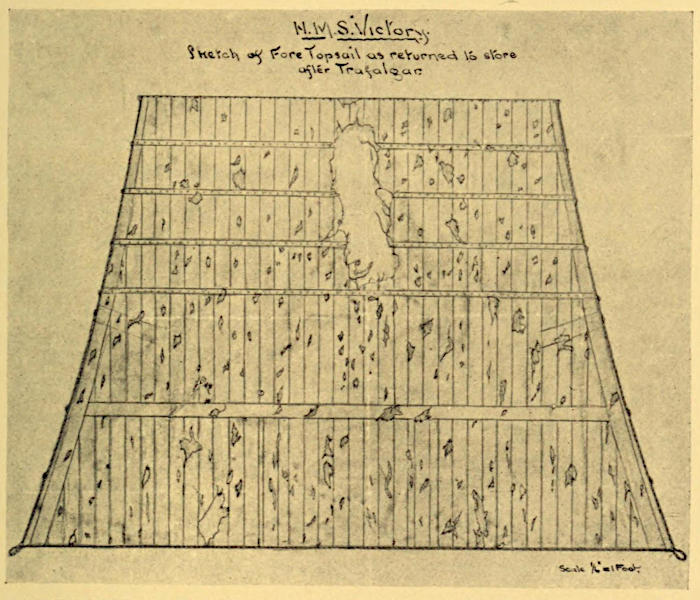
REPRODUCTION OF THE OFFICIAL DRAWING OF THE VICTORY’S FORETOPSAIL AFTER TRAFALGAR AS RETURNED INTO STORE AT CHATHAM DOCKYARD IN MARCH, 1806
The ship’s books account for the nationality, or place of birth, of 633 of the officers and men on board the Victory, as mustered on the 17th of October, the last muster day before the battle (the Thursday before Trafalgar), not taking into reckoning the marines or the boys and supernumeraries. Of the total, 411 were of English birth, 64 were Scotsmen, 63 Irishmen, and 18 Welshmen. Three men were from Orkney and Shetland, 2 from the Channel Islands and 1 (Lieutenant Quilliam) from the Isle of Man. The remainder—71 men, were foreigners, from all quarters of the known world almost, got together, for the most part, out of merchant ships under impress warrants: 7 Dutchmen, 22 Americans, 2 Danes, 3 Frenchmen, 1 Russian, 3 Norwegians, 6 Swedes, 2 North Germans from Hamburg and 1 Prussian, 9 from various islands in the West Indies, 2 Swiss, 2 Portuguese, 1 African, 1 from Bengal and 1 from Madras, 4 Italians, and 4 Maltese.[13]
Of the Englishmen on board: Kent, the old maritime county of England in the day of the Cinque Ports, and the county of Admiral Rooke, who won Gibraltar for the British Empire, contributed twenty-seven; Devonshire, the county of Drake and Raleigh, twenty-four; Hampshire, twenty; Somerset, the county of Blake and Rodney and the Hoods, four; Hardy’s county, Dorset, sent fourteen, one of them from Captain Hardy’s own native village of Portisham; Nelson’s county, Norfolk, contributed fifteen; Suffolk, whence came Admiral Vernon and Broke of the Shannon, twelve; Essex, nine; Sussex, five; Cornwall, the county of Grenville of the Revenge, and “the great twin brethren” of the Seven Years’ War, Hawke and Boscawen, seven; Northumberland, Yorkshire (the county of Martin Frobisher and Captain Cook), and Lancashire, eighteen each; Durham, seventeen; Lincolnshire, seven; Herefordshire and Oxford, six each. Wiltshire and Gloucester, five each. Old Benbow’s county of Shropshire had one representative on board the Victory at Trafalgar. The other counties, men from which were in Nelson’s flagship that day, represented by four men each, or fewer, were Berkshire and Bedford, Worcestershire, Hereford and Cheshire, Surrey, Cambridgeshire, Notts, Middlesex, Leicester, Staffordshire (the county of Anson and St. Vincent), Derby, Northampton, Cumberland, and Westmoreland. London was represented on the Victory’s books by a hundred and fifteen men, Liverpool and Shields by ten each, Newcastle by fourteen, Bristol by five, Sunderland by four, Manchester by three. Birmingham, Leeds, Bury, Winchester, Canterbury were among other places represented on board; and nearly every coast town from Tweedmouth, Hull and Grimsby, and round to Falmouth and St. Ives, had two or three men with Nelson. There were Scotsmen there from nearly every Scottish county, from Caithness and Banff, Ross, and Cromarty, Aberdeen and Inverness, Fife and Forfar, Berwick, Renfrew, Galloway, Lanark, the county of that preux chevalier among British naval officers, Cochrane, Lord Dundonald, “the daring in war,” Ayr and Argyll. Eleven men from Edinburgh were on board; five from Glasgow; seven from Dundee, the birthplace of Duncan of Camperdown; with men from Leith, and Peterhead, Dumbarton, and Greenock. From Ireland, in like manner, men from Donegal fought the Victory’s guns side by side with men from County Down and Roscommon, Meath and Carlow, Galway and Sligo, Cavan, Wexford and Waterford, Tipperary and County Cork. Fourteen men from Dublin were in the British flagship at Trafalgar; eleven from Cork; ten from Waterford City and Belfast; Carrickfergus and Kinsale were also represented on board.
There were men of all ages between twenty and fifty in the crew of the Victory at Trafalgar, and boys from ten years old—the age of little Johnnie Doag, an Edinburgh boy, rated as a “First Class Boy,” and probably the youngest person present on either side at Trafalgar—to lads of eighteen or nineteen. Four others of the thirty-one in the flagship (nine short of the complement) were just twelve years old, and six others, thirteen. The great majority of the men on board were from twenty to thirty years of age. About 10 per cent were over forty, the majority of these being between forty-seven and fifty. One of the “powder-monkeys” on board the Victory, it was discovered later, was a woman. Her husband was also on board the ship. She was a native of Port Mahon, and an officer who saw her there in 1841 described her as being then “a sturdy woman of 70.” The last survivor of the seamen and marines on board the Victory at Trafalgar died at Dundee in November, 1876.
This interesting detail in regard to the Victory’s crew should be mentioned in addition. Practically 30 per cent of the seamen were volunteers, so the ship’s muster-book states. It records in the column headed “Whence and whether Prest or not,” the word “Vol” against 181 of the names, out of a total of 628 able and ordinary seamen and landsmen.
There were, of course, men of all callings in civil life among the crew—as swept on board by the press-gang for the most part. According to inquiries made by officers on their own account, almost every trade and calling of every-day life contributed its quota in those times to the assortment on board our men-of-war. Collingwood, it is on record, had among the impressed men sent to one of his ships, a black San Domingo general, who had somehow found his way across the Atlantic; and also a Sussex market gardener, and a milkman, these last sent to him for top-gallant-yard men—poor fellows!
On board the Elizabeth, a seventy-four, for instance, out of a ship’s company 395 in number, only 177, it is on record, were seamen or of callings connected with the sea: merchantman-sailors, fishermen, watermen, and dockyard hands. The other 218 were stated thus: 108 labourers, 5 joiners, 6 tailors, 14 weavers, 5 coopers, 6 blacksmiths, 3 whitesmiths, 1 slater, 1 umbrella-maker, 1 butcher, 10 shoemakers, 1 poulterer, 2 stocking-makers, 1 dry-salter, 7 farmers, 1 coppersmith, 4 servants, 3 gardeners, 2 curriers, 1 mattress-maker, 1 tobacco manufacturer, 1 fustian-cutter, 1 cotton manufacturer, 1 clockmaker, 1 watchmaker, 2 waiters, 1 brickmaker, 2 bricklayers, 1 soldier, 1 stonecutter, 2 sawyers, 7 painters, 1 corn-factor, 1 staymaker, 1 glassmaker, 2 hatters, 1 wiremaker, 1 potter, 1 miller, 1 mason, 1 miner, 1 chimney sweep. The same kind of mixture was found on board another seventy-four, with these additional items: 1 linen draper, 1 artificial flower-maker, 1 milliner, 1 hinge-maker, 6 more hatters, 5 more barbers, and another umbrella-maker, 1 button-maker and 1 thimble-maker, 2 flax and hemp dressers, 3 coach and harness makers, 4 dyers, 1 tanner, 1 maltster, 1 calendarman, 2 wool-combers, 1 pipe-borer, 1 warehouseman, 1 tallow-chandler, 1 sadler, 3 pedlars, 1 violin-maker, 1 schoolmaster, and 1 optician. All was fish that came to the press-gang’s net.
Again, too, to take another case. Captain T. Byam Martin (afterwards Sir Thomas and Admiral of the Fleet), of the Implacable, in May, 1808, checked the composition of his ship’s company man by man, and sent the results of his investigation to his brother. “I have just now,” he wrote, “been amusing myself in ascertaining the diversity of human beings which compose the crew of a British ship of war, and as I think you will be entertained with a statement of the ridiculous medley, it shall follow precisely as their place of nativity is inserted in the ship’s books: English 285, Irish 130, Welsh 25, Isle of Man 6, Scots 29, Shetland 3, Orkneys 2, Guernsey 2, Canada 1, Jamaica 1, Trinidad 1, St. Domingo 2, St. Kitts 1, Martinique 1, Santa Cruz 1, Bermuda 1, Swedes 8, Danes 7, Prussians 8, Dutch 1, Germans 3, Corsica 1, Portuguese 5, Sicily 1, Minorca 1, Ragusa 1, Brazils 1, Spanish 2, Madeira 1, Americans 28, West Indies 2, Bengal 2. This statement does not include officers of any description, and may be considered applicable to every British ship, with the exception that very few of them have so many native subjects.”
Of those who fought on board the Victory’s special companion-in-arms at Trafalgar, the “Fighting” Téméraire, Ireland contributed just two-fifths of the total ship’s company—220 men out of 550.[14] They came from all parts, according to the ship’s books, mostly from Waterford, Belfast, Limerick, and Wexford; and about a third from Dublin, Newry, Kildare, Galway, Kilkenny, and Cork. Scotland supplied the Téméraire with 58 men; hailing, the greater number of them, from Aberdeen, Inverness, Dundee, Greenock and Glasgow, Leith and Edinburgh. Wales contributed 38 men all told; from Swansea, Cardiff, Pembroke, and Milford, for the most part. Of all the Englishmen on board the “Fighting” Téméraire at Trafalgar, one county by itself contributed practically a third of the number—Devonshire. They counted 52 men, drawn from all over the county: Bideford and Barnstaple, Exeter, Tavistock, Dorlish [sic], Ilfracoome [sic], Tiverton, and Dartmouth and Paignton. From London came 30 men in all. Lancashire had as many representatives in the ship as all Wales, 38—all except three hailing from Liverpool or Manchester. Somerset had 24, Cornwall 20, Yorkshire 13, Northumberland and Durham 10 each. These are the numbers from the other English counties: Norfolk 8 men, Hampshire 7, Kent 6, Cumberland and Gloucestershire each 5; Essex, Dorset, Chester each 4; Middlesex 3; Derbyshire, Warwick, Sussex, Cambridge, Worcester, and Suffolk each 2; Oxfordshire, Buckinghamshire, Shropshire, Leicester, Surrey, Hereford, and The Isle of White [sic] 1 man each. There were 8 Manxmen at Trafalgar on board the “Fighting” Téméraire; 2 Jerseymen, and 1 man from Guernsey. Jamaica had 1 man on board, and Newfoundland 2 men. As usual, a number of foreigners figure on the books—66 altogether. They included: 28 Americans, 9 Germans (mostly from Hamburg and Emden), 6 Swedes, 5 Portuguese, 3 Frenchmen, 3 Spaniards, 1 Dutchman, 1 Cape-Dutchman, 1 from “Sclavonia” (Peter Valentine by name), 1 Viennese (Emil Joaquim), 1 from Old Calabar (a negro named Ephraim) and the remainder from Santa Cruz and other non-British islands in the West Indies.
The log of the Victory for the day after the battle accounts for all who fell on board Nelson’s flagship, whether killed or wounded. It sets out the full list in this form:—
“A return of men killed and wounded on board his Majesty’s ship Victory, bearing the flag of the Right Honourable Lord Viscount Nelson, K.B., Duke of Bronté, Vice-Admiral of the White and Commander-in-Chief, on the 21st day of October, 1805, in an engagement with the combined fleets of France and Spain off Cape Trafalgar. Thomas Masterman Hardy, Esq., Captain.
KILLED
Names Quality
The Right Hon. Lord Viscount Nelson, K.B., Duke of Bronté Commander-in-Chief
John Scott, Esq. Secretary
C. W. Adair Captain, Royal Marines
William Ram 9th lieutenant, R.N.
Robert Smith Midshipman
Thomas Whipple Captain’s clerk.
James Mansel Ab.[15]
Thomas Daniels L.M.
Thomas Thomas (1st) Ab.
James North Ordinary
Alfred Taylor Do.
James Parke Do.
William Shaw L.M.
Richard Jewell Ordinary
Charles Davis (1st) Do.
John Bowlin L.M.
William Brown (1st) Ab.
William Mark Do.
George Smith (1st) L.M.
John Wharton Ordinary
John King Quarter-gunner
Robert Davison Ab.
Edward Waters Do.
John Cowarden Ordinary
William Thompson (3rd) Ab.
Thomas Johnson Quartermaster
Andrew Sack Yeoman of signals
Alexander Walker Ab.
Arthur Hervin Ordinary
John Welch (2nd) Ab.
William Skinner Ordinary
Joseph Ward Do.
James Skinner Do.
Stephen Sabine 3rd class (boy)
George Welch 2nd class (boy)
Collin Turner 3rd class (boy)
Royal Marines
George Cochran Corporal
James Berry Drummer
James Green Private
John Brown (1st) Do.
Lambert Myers Do.
Samuel Wilks Do.
George Kennedy Do.
Daniel Hillier Do.
John Brannon Do.
James Norgrove Do.
Jeremiah G. Lewis Private
George Wilmott Do.
Bernard McNamara Do.
John Ebbsworth Do.
William Coburne Do.
William Jones Do.
William Perry Do.
John Palmer Do.
WOUNDED DANGEROUSLY
John Pasco Signal-lieutenant, R.N.
William Rivers (2nd) Midshipman
Alexander Palmer[16] Do.
John Bush Ordinary
Daniel McPherson L.M.
John Bergen Ordinary
Henry Cramwell[16] L.M.
William Jones (3rd) Do.
Hans Andersen Ab.
David Buchan Do.
Joseph Gordon[16] Ordinary
William Smith (2nd)[16] Do.
John Smith (2nd) Do.
John Saunders 3rd class (boy)
Marines
William Taft Corporal
Thomas Raynor Private
John Gregory Do.
William Knight Do.
James Bengass Do.
William Wells Do.
Benjamin Cook Do.
James Hines Do.
Benjamin Matthews Private
Thomas Wilson Do.
Nicholas Dear Do.
BADLY WOUNDED
George M. Bligh 6th lieutenant, R.N.
Lewis B. Reeves 2nd lieutenant, R.M.
William Honnor Quarter-gunner
Jeremiah Sullivan Ab.
Peter Hale L.M.
Thomas Green (1st) Ab.
John Francois Ordinary
William Castle Ab.
George Burton Ordinary
James Parker Do.
Edward Dunn Do.
Edward Padden Private, R.M.
SLIGHTLY WOUNDED
J. G. Peake 1st lieutenant, R.M.
George A. Westphal Midshipman
Richard Bulkeley Do.
John Geoghegan Clerk to agent victualler
Josiah McPherson L.M.
Thomas Graham Ordinary
Thomas Collard Ab.
Robert Phillips L.M.
John Kinsale Ordinary
Charles Legge L.M.
David Conn Do.
Daniel Leary Ab.
William Taylor Ordinary
John Simm Ab.
Samuel Cooper Do.
William Gillett Ordinary
John Bornkworth Do.
Robert Gibson Ab.
Angus McDonald Do.
George Quinton Quarter-gunner
Edward Grey Ordinary
Samuel Brown Yeoman of powder-room
William Butler Ab.
Samuel Lovett Do.
Daniel Munro Do.
James Curry Do.
Michael McDonald Ordinary
William Fall Ab.
Michael Pennill Do.
Thomas Pain Do.
John Knight Boatswain’s mate
Marines
Giovanni Giunti Private
Charles Chappele Do.
Samuel Green Do.
James Fagen Do.
Isaac Harris Do.
John Dutton Do.
George Graves Do.
James Rogers Do.
George Coulston Do.
Nicholas le Contre Do.
Thomas Crofton Do.
Killed 54
Dangerously wounded 25
Badly wounded 12
Slightly wounded 42”
One or two eye-witnesses’ accounts from on board the Victory, at and immediately after Trafalgar, give interesting glimpses of what went on in the ship during the fight. First of all, there is the formal, matter-of-fact tale as set out in the log:—
“At 11.30 the enemy opened upon the Royal Sovereign. At 11.40 the Royal Sovereign commenced firing on the enemy. At 11.50, the enemy began firing on us and the Téméraire.
“At noon, standing for the enemy’s tenth ship, with all possible (sail) set. Light airs and cloudy. Standing towards the enemy’s van with all sail set. At 4 minutes past 12, opened our fire on the enemy’s van in keeping down their line. At 20 minutes past 12, in attempting to pass through the enemy’s line, we fell on board of the 10th and 11th ships, when the action became general. About 1.15, the Right Honourable Lord Viscount Nelson, K.B., and Commander-in-Chief was wounded in the shoulder.
“At 1.30 the Redoutable having struck her colours we ceased firing our starboard guns, but continued engaging the Santisima Trinidad and some of the enemy’s ships on the larboard side. Observed the Téméraire between the Redoutable and another French ship of the Line, both of which had struck. Observed the Royal Sovereign with the loss of her main and mizen-masts, and some of the enemy’s ships around her dismasted. At 3.10 observed four sail of the enemy’s van tack and stand along our line to windward. Fired our larboard guns at those which could reach them. At 3.40 made the signal for our ships to keep their wind and engage the enemy’s van coming along our weather line. At 4.15 the Spanish Rear-Admiral to windward struck to some of our ships which had tacked after them. Observed one of the enemy’s ships blow up, and 14 sail of the enemy standing towards Cadiz, and 3 sail of the enemy standing to the southward. Partial firing continued until 4.30, when a victory having been reported to the Right Honourable Lord Viscount Nelson, K.B., and Commander-in-Chief, he then died of his wound.”
Then we have this personal narrative from one of the men on deck, as told in a quaint letter which James Bagley, a marine of the Victory, wrote home to his sister, while the ship was lying at Spithead with Nelson’s body on board, awaiting orders to proceed round to the Nore:—
“Victory, Spithead, Dec. 5, 1805.
“Dear Sister,
“Comes with my kind love to you are in good health so thank God I am; for I am very certain that it is by his mercy that me and my country is, and you and your religion is kept up; for it has pleased the Almighty God for to give us a complete victory of the combined fleets of France and Spain; for there was a signal for them being out of Cadiz the 19th of October, but we did not see them till the 21st, in the morning, and about 12 o’clock we gave three cheers, and then the engagement began very hot on both sides, but about five o’clock the victory was ours, and twenty sail-of-the-line struck to us. They had 34 sail-of-the-line and we had 27 of the line, but the worst of it was, the flower of the country, Lord Nelson, got wounded at twelve minutes past one o’clock, and closed his eyes in the midst of victory. Dear sister, it pleased the Lord to spare my life, and my brother Thomas his, for he was with the same gentleman. It was very sharp for us, I assure you, for we had not a moment’s time till it was over, and the 23rd of the same instant we got a most shocking gale of wind, and we expected to go to the bottom, but, thanks be to God, He had mercy on us, for every ship of ours got safe into harbour, and all the French but four got knocked to pieces on the rocks. So that is the most I can tell you of it, for the English is in a right cause you may depend on it, or else the Lord would not have had the mercy on us as He has had, for we made five ships strike to the ship has I am in. We had 125 killed and wounded, and 1500 in the English fleet killed and wounded, and the enemy 12,000; so I shall leave you to judge how your country fight for the religion you enjoy, the laws you possess, and on the other hand how Bounaparte has trampt them causes down in the places he has had concern with, for nothing but torment is going forward. So never think it is disgrace to having brothers in service; but I have had pretty well on it, and when you write to our mother, give my love to my sister Betty and my poor mother, and send me word about her and you shall have your loving brother’s thanks. So must conclude with hoping this will bring you peace and love and unity. Then you and me and our dear mother will meet together to enjoy the fruits of the island as I have been fighting for. My dear, I shall just give you a description of Lord Nelson. He is a man about five feet seven, very slender, of an affable temper; but a rare man for his country, and has been in 123 actions and skrimmages, and got wounded with a small ball, but it was mortal. It was his last words, that it was his lot for me to go, but I am going to heaven, but never haul down your colours to France, for your men will stick to you. These words was to Captain Hardy, and so we did, for we came off victorious, and they have behaved well to us, for they wanted to take Lord Nelson from us, but we told Captain as we brought him out we would bring him home; so it was so, and he was put into a cask of spirits. So I must conclude. Your loving brother,
“James Bagley.”[17]
After her arrival in English waters with Nelson’s body on board, the Victory, while on her way round to the Nore, was delayed for some days by head winds in the Downs. A very interesting letter from a visitor to her, dated from Dover, the 16th of December, 1805, is in existence.
“I am just come from on board the Victory,” says the writer. “She is very much mauled, both in her hull and rigging, has upwards of 80 shot between wind and water: the foremast is very badly wounded indeed, and though strongly fished, has sunk about six inches: the mainmast also is badly wounded, and very full of musket shots: she has a jury-mizen mast, and fore and main top masts, and has a great many shot in her bowsprit and bows; one of the figures which support the Arms has both the legs shot off. I clearly ascertained that Lord Nelson was killed by a shot from the main top of the Redoutable: he was standing on the starboard side of the quarter-deck with his face to the stern when the shot struck him, and was carried down into one of the wings: he lived about one hour, and was perfectly sensible until within five minutes of his death. When carrying down below, although in great pain, he observed the tiller ropes were not sufficiently tight, and ordered tackles to be got on them, which now remain. The ship he engaged was so close that they did not fire their great guns on board the enemy, but only musketry; and manned the rigging on board; but nearly the whole that left the deck were killed. The ship had 25 guns dismounted by the Victory’s fire. A shot carried away four spokes from the wheel of the Victory, and never killed or wounded any of the men steering. Temporary places have been fitted up between the decks for the wounded men, which are warmed by stoves.”
We will take our leave of the Victory for the present with a second letter, dated “Sheerness, the 24th of December,” on the Victory’s arrival in the Medway, bound for her home port, Chatham, to repair there after the battle. It was just two days after Nelson’s remains had been removed to Greenwich Hospital on the way to St. Paul’s.
“The inhabitants of this place had yesterday the satisfaction of welcoming the old Victory and her gallant crew to the River Medway: the noble ship passed close to the Garrison Point, and was received with an enthusiastic cheering from the shore, which was returned by her crew. The civilities of the officers of the Victory have been beyond belief in satisfying the anxious curiosity of numbers who have been on board to see the ship and the spot where our gallant Nelson fell and died. The fatal bullet that deprived him of his valuable life is in the possession of the surgeon of the Victory, just as he extracted it from the body, with part of the epaulet and coat adhering to it. Many of the poor wounded fellows are on board, nearly well and in good spirits. The bullets in the lower part of the mainmast are so thick that it is surprising how anyone on the quarter-deck could have escaped, especially the brave Captain Hardy, whose amiable character seems to be the greatest alleviation the officers and crew of the Victory have for the loss of their Nelson.”
UNDER FIRE WITH COLLINGWOOD And when the loving cup’s in hand, And Honour leads the cry, They know not old Northumberland Who’ll pass his memory by. When Nelson sailed from Trafalgàr With all his country’s best, He held them dear as brothers are, But one beyond the rest!
The splendid service that the Royal Sovereign rendered on the 21st of October, 1805, should appeal to every British man and boy. In the words of Captain Blackwood—“Nelson’s Blackwood”—who watched the fight, written immediately after the battle, “of the Victory and the Royal Sovereign it is impossible to say which achieved the most.” The Royal Sovereign had been with Nelson off Toulon in 1804. She had gone home to refit when Nelson went across the Atlantic in pursuit of Admiral Villeneuve. She rejoined the British fleet off Cadiz just ten days before Trafalgar, when Collingwood, who had hitherto had his flag in the Dreadnought, moved into her.
Two interesting preliminary glimpses of Admiral Collingwood on board the Royal Sovereign, on the morning of Trafalgar Day, are given us by his biographer, Mr. G. L. Newnham Collingwood, who had access to the Admiral’s papers and letters after his death, and took all possible pains to get together everything that could be gathered about him from those who served with Collingwood in the great battle.
Admiral Collingwood’s “personal conduct on that memorable day well deserves to be recorded. It has been said that no man is a hero in the eyes of his valet de chambre, but that this is not universally true is proved by the account which was given ... by Mr. Smith, Admiral Collingwood’s valued servant. ‘I entered the Admiral’s cabin,’ he observed, ‘about daylight, and found him already up and dressing. He asked if I had seen the French fleet, and on my replying that I had not, he told me to look out at them, adding that in a very short time we should see a great deal more of them. I then observed a crowd of ships to leeward, but I could not help looking with still greater interest at the Admiral, who, during all this time, was shaving himself with a composure that quite astonished me.’”
This is what Collingwood said to his flag-lieutenant and the other officers, on the Admiral’s first coming up on deck: “Admiral Collingwood dressed himself that morning with peculiar care, and soon after, meeting Lieutenant Clavell, advised him to pull off his boots. ‘You had better,’ he said, ‘put on silk stockings, as I have done; for if one should get a shot in the legs, they would be so much more manageable for the surgeon.’ He then proceeded to visit the decks, encouraged the men to the discharge of their duty, and, addressing the officers, said to them, ‘Now, gentlemen, let us do something to-day which the world may talk of hereafter.’”
Then we have this incident, which occurred in the forenoon, as the British fleet was closing on the enemy:—
“Lord Nelson had been requested by Captain Blackwood (who was anxious for the preservation of so invaluable a life) to allow some other vessel to take the lead, and at last gave permission that the Téméraire should go ahead of him, but resolving to defeat the order which he had given, he crowded more sail on the Victory and maintained his place. The Royal Sovereign was far in advance when Lieutenant Clavell observed that the Victory was setting her studding-sails, and with that spirit of honourable emulation which prevailed between the squadrons, and particularly between these two ships, he pointed it out to Admiral Collingwood, and requested his permission to do the same. ‘The ships of our line,’ replied the Admiral, ‘are not yet sufficiently up for us to do so now, but you may be getting ready.’ The studding-sail and royal halliards were accordingly manned, and in about ten minutes the Admiral, observing Lieutenant Clavell’s eyes fixed upon him with a look of expectation, gave him a nod, on which that officer went to Captain Rotherham and told him that the Admiral desired him to make all sail. The order was then given to rig out and hoist away, and in one instant the ship was under a crowd of sail, and went rapidly ahead. The Admiral then directed the officers to see that all the men lay down on the decks and were kept quiet.”
The Royal Sovereign’s captain at Trafalgar, Collingwood’s flag-captain, was, like his Admiral, a gallant Northumbrian, Edward Rotherham, the son of a Hexham doctor. Of him that day the following story is told. As the battle was about to open, it was pointed out to Captain Rotherham that the unusually big cocked hat that he wore would probably render him a special target for the marksmen in the enemy’s tops. “Let me alone,” was all Rotherham’s reply, “Let me alone. I’ve always fought in a cocked hat and I always will!”
As pre-arranged by Nelson, the British lee column at Trafalgar, fifteen ships strong, began the action before the weather column, by leading down and breaking the enemy’s line near its centre. The manœuvre was begun a few minutes before noon, when, at Collingwood’s order, the Sovereign, with every sail set and every reef shaken out, dashed forward by herself, sailing “like a frigate,” ahead of the whole British fleet. Taking on herself the fire of the enemy’s line, centre and rear, as she advanced, she swept resistlessly under the stern of the Spanish flagship Santa Anna, a gigantic 112-gun three-decker, nearly a mile in front of Collingwood’s second astern, the Belleisle—“the most remarkable incident of the battle, a feat unparalleled in naval history,” as it has been called. “See,” exclaimed Nelson with delight to Captain Hardy, as he watched the Sovereign’s advance; “see how that noble fellow Collingwood carries his ship into action!” Just at the moment, as it happened, on the Royal Sovereign’s quarter-deck, Collingwood himself was saying to his captain, “Rotherham, what would not Nelson give to be here!”
We know from what a French officer at Trafalgar wrote, that the confident daring of the Sovereign’s single-handed advance “positively appalled Villeneuve!”[18]
King George the Third, in effigy, led his own fleet that day. The Royal Sovereign’s figure-head was an immense full-length carving of the King, represented in the battle-day panoply of a Roman Emperor, his sword at his side and a sceptre in hand, his red war cloak (paludamentum) on his shoulders, with two attendant winged figures, Fortune and Fame, blowing trumpets on either side.
As the Sovereign closed on the enemy, a French ship, the Fougueux, ranged up close under the stern of the Santa Anna, as though to bar the passage through the line to Collingwood. Captain Rotherham noted this, and pointed it out to the Admiral. Collingwood’s reply was: “Steer straight for the Frenchman and take his bowsprit!” So they closed, and then, driving through the line just under the towering Spanish’s ship’s stern, the Sovereign opened the fight with her full broadside treble-shotted. The terrific discharge, at one blow, it has been related, disabled fourteen guns, and put a large part of the crew hors de combat. “El rompio todos” were the words of an officer of the Santa Anna. After that the Sovereign ranged alongside the big Spaniard to leeward to fight the battle out gun-muzzle to gun-muzzle.
TRAFALGAR—12 NOON: AS SKETCHED ON THE SPOT BY A FRENCH OFFICER
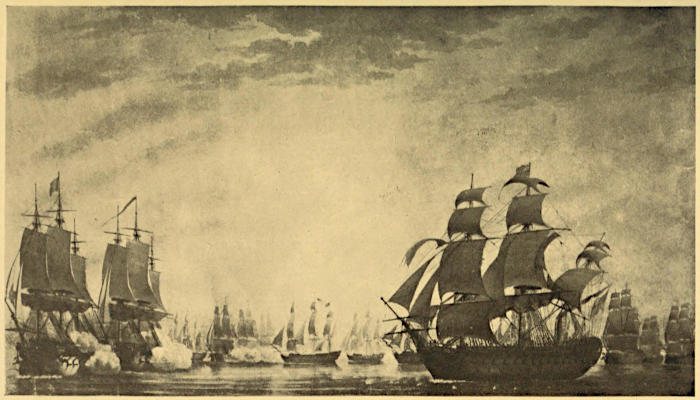
French flagship, “Bucentaure,” 80 guns. “Redoutable,” 74 guns, from which Nelson was shot. Collingwood in the “Royal Sovereign” opening the attack. The “Victory” (Nelson’s flag should be at the fore, not as here.)
From a photograph of the original sepia drawing now in the possession of a descendant of Captain Lucas of the “Redoutable.”
“In passing the Santa Anna” relates Mr. Newnham Collingwood, “the Royal Sovereign gave her a broadside and a half into her stern, tearing it down, and killing and wounding 400 of her men. Then, with her helm hard a-starboard, she ranged up alongside so closely that the lower yards of the two vessels were locked together. The Spanish Admiral, having seen that it was the intention of the Royal Sovereign to engage to leeward, had collected all his strength on the starboard, and such was the weight of the Santa Anna’s metal, that her broadside made the Sovereign heel two strakes out of the water.”
Even a moment like that, though, did not in the least perturb Collingwood. “Her studding-sails and halliards were now shot away, and as well as a top-gallant studding-sail were hanging over the gangway hammocks. Admiral Collingwood called out to Lieutenant Clavell to come and help him to take it in, observing that they should want it again some other day. These two officers accordingly rolled it carefully up and placed it in a boat.”
No sooner was the Sovereign alongside the Santa Anna than four other enemies—two French ships, the Fougueux and the Indomptable, and two Spanish, the San Leandro and the San Justo—closed round and joined in to help the Santa Anna.
So hot a cross fire did these four ships keep up on the single British ship during her, at first, unsupported fight, that, in the words of those on board the Sovereign, “We could see their shots meeting and smashing together in mid-air round us.” The Fougueux, we are also told, “at one time got so much on the quarter of the Sovereign that she almost touched.” It was indeed a battle of the giants—a heroic defiance of heroic odds.
So magnificent, indeed, did the situation of the Royal Sovereign appear, fighting single-handed in the thick of the enemy, that it drew remarks from some of our captains, for the time being lookers-on, on board the nearest ships that were then coming up astern. “The English ships,” to quote Admiral Collingwood’s biographer again, “were pressing forward with their utmost speed in support of their leader, but doubtful at times of his fate, and rejoicing when, on the slackening of the Santa Anna’s fire, they discerned his flag still flying above the smoke. One of his most gallant followers and friend, the captain of the Tonnant, has often expressed the astonishment with which he regarded the Royal Sovereign as she opened her fire, which, as he declared, ‘so arrested his attention, that he felt for a few moments as if he himself had nothing to do but to look on and admire!’”
How Collingwood bore himself in the battle we hear from two sources. Both accounts speak of Collingwood’s unmoved demeanour and cool courage under fire.
“The Admiral,” says one, “directed Captain Vallack, of the Marines, an officer of the greatest gallantry, to take his men from off the poop, that they might not be unnecessarily exposed; but he remained there himself much longer. At length, descending to the quarter-deck, he visited the men, enjoining them not to fire a shot in waste; looking himself along the guns to see that they were properly pointed, and commending the sailors, particularly a black man, who was afterwards killed, but who, while he stood beside him, fired ten times directly into the portholes of the Santa Anna.”
“The Admiral spoke to me,” related Smith, Collingwood’s servant, “about the middle of the action and again for five minutes immediately after its close; and on neither occasion could I observe the slightest change from his ordinary manner. This, at the moment, made an impression on me which will never be effaced, for I wondered how a person whose mind was occupied by such a variety of most important concerns could, with the utmost ease and equanimity, inquire kindly after my welfare, and talk of common matters as if nothing of any consequence were taking place.”
Twenty minutes after the Sovereign had by herself beaten off the Fougueux, the leading British ships following astern of the Sovereign began to reach the spot, and to take off her enemies one by one, except the Santa Anna. With Admiral Alava’s flagship the Royal Sovereign continued in close encounter, until the Santa Anna’s colours came down. It was just at that moment that Collingwood received, by an officer of the Victory, Captain Hardy’s first message that Lord Nelson had been “dangerously wounded.”
The stubborn stand that the Santa Anna made was a disappointment, it would appear, to the Sovereign’s men. Their terrible raking broadside at the outset had plainly “sickened” the Spaniards—as our men expressively put it—and many on board believed that the enemy must surrender forthwith. Captain Rotheram, indeed, “came up to the Admiral, and, shaking him by the hand, said: ‘I congratulate you, sir; she is slackening her fire, and must soon strike!’” The gallant fellows who were fighting at the Royal Sovereign’s guns actually thought, it is on record, that their ship would have the proud distinction of capturing an enemy’s flagship in the midst of her own fleet before another British ship had got into action. In the end, though, they had this consolation: when at length the Santa Anna did surrender; “No ship besides ourselves fired a shot at her,” wrote one of the Sovereign’s officers, “and you can have no conception how completely she was ruined.” “Her side,” wrote Collingwood himself, “was almost entirely beat in.”
“The Santa Anna,” to quote Mr. Newnham Collingwood, “struck at half-past two o’clock, about the time when the news of Lord Nelson’s wound was communicated to Admiral Collingwood, but the Royal Sovereign had been so much injured in her masts and yards by the ships that lay on her bow and quarter that she was unable to alter her position. Admiral Collingwood accordingly called the Euryalus to take her in tow, and make the necessary signals. He dispatched Captain Blackwood to convey the Spanish Admiral on board the Euryalus, but he was stated to be at the point of death, and Captain Blackwood returned with the Spanish captain. That officer had already been to the Royal Sovereign to deliver his sword, and on entering had asked one of the English sailors the name of the ship. When he was told that it was the Royal Sovereign, he replied, in broken English, while patting one of the guns with his hand, ‘I think she should be called the Royal Devil!’”
The Royal Sovereign, on the Santa Anna surrendering, pushed off from her giant prize—so big a ship, indeed, that, in Collingwood’s own words, she “towered over the Sovereign like a castle.” She moved away to seek another enemy. But the fall of her main and mizen-masts, cut through and through by shot, prevented her from taking a further part in the battle until after being taken in tow by the Euryalus frigate, Captain Blackwood’s ship. The Sovereign was able after that, during the rest of the action, to employ her broadsides here and there. Her last piece of work was at the very close of the battle, when she formed one of the group of ships that Captain Hardy summoned round the Victory to support the dying chief’s flagship against a threatened attack on the Victory from the fresh ships of the French van squadron as they passed down the line.
The Royal Sovereign’s list of casualties, as officially reported on the morning after Trafalgar, amounted to forty-seven men killed and ninety-four wounded.
How Collingwood first heard of Nelson’s fate he himself has told us:
“When my dear friend received his wound,” wrote the Admiral, “he immediately sent an officer to tell me of it, and give his love to me. Though the officer was directed to say the wound was not dangerous, I read in his countenance what I had to fear, and before the action was over Captain Hardy came to inform me of his death. I cannot tell you how deeply I was affected; my friendship for him was unlike any thing that I have left in the Navy—a brotherhood of more than thirty years.”
Writing to the Duke of Clarence, an old service friend of Collingwood’s and of Nelson’s as well, he said this:
“He (Nelson) sent an officer to inform me that he was wounded. I asked the officer if his wound was dangerous. He hesitated, then said he hoped it was not; but I saw the fate of my friend in his eye, for his look told what his tongue could not utter. About an hour after, when the action was over, Captain Hardy brought me the melancholy account of his death.”
Another detail of Trafalgar that may be news to some of us is the fact that Collingwood was wounded in the battle. He said nothing about himself to any one in any of his letters at the time, nor did he include himself in the return of wounded sent to the Admiralty. It was only in response to an anxious inquiry from his wife, who, some months afterwards, heard a rumour about it and wrote to inquire, that Collingwood, five months after the battle, first made mention of the matter. His letter to Lady Collingwood is dated March 29, 1806, and in it the Admiral says:
“Did I not tell you how my leg was hurt? It was by a splinter—a pretty severe blow. I had a good many thumps, one way or the other: one on the back, which I think was the wind of a great shot, for I never saw anything that did it. You know nearly all were killed or wounded on the quarter-deck or poop but myself, my Captain, and Secretary, Mr. Cosway, who was of more use to me than any officer after Clavell.
“The first inquiry of the Spaniards was about my wound, and exceedingly surprised they were when I made light of it, for when the captain of the Santa Anna was brought on board, it was bleeding and swelled, and tied up with a handkerchief.”
What was really troubling the frugal north-country mind of Admiral Collingwood at that moment, as far as he was individually concerned, far more than his wound, was his out-of-pocket expenses owing to the damage that the enemy’s shot had done in his steward’s store-room. Writing to Lady Collingwood, he tells her this:—
“I have had a great destruction of my furniture and stock. I have hardly a chair that has not a shot in it, and many have lost both legs and arms, without hope of pension. My wine was broke in moving, and my pigs were slain in battle, and these are heavy losses where they cannot be replaced.”
One gets an idea of the kind of man Collingwood was also from the characteristically sympathetic way in which he wrote in a private letter about one of his officers (Mr. William Chalmers, the master of the Royal Sovereign) who was killed near the Admiral, on the quarter-deck, at his post by the wheel.
“I have written to Lloyd’s about Mr. Chalmers’ family. He left a mother and several sisters, whose chief dependence was on what this worthy man and valuable officer saved for them from his pay. He stood close to me when he received his death. A great shot almost divided his body; he laid his head upon my shoulder, and told me he was slain. I supported him till two men carried him off. He could say nothing to me, but to bless me; but as they carried him down, he wished he could but live to read the account of the action in a newspaper. He lay in the cockpit, among the wounded, until the Santa Anna struck, and joining in the cheer which they gave her, expired with it on his lips.”
The only personal description of Collingwood’s appearance in existence is from the pen of a young officer (Midshipman Crawford, of the Royal George) who had an audience of him, to present a letter of introduction, in October, 1806, just a year after Trafalgar:
“Being provided with a letter of recommendation to Lord Collingwood, the Commander-in-Chief, I took an early opportunity to wait upon his Lordship.... Lord Collingwood was between fifty and sixty, thin and spare in person, which was then slightly bent, and in height about five feet ten inches. His head was small, with a pale, smooth, round face, the features of which would pass without notice, were it not for the eyes, which were blue, clear, penetrating; and the mouth, the lips of which were thin and compressed, indicating firmness and decision of character. He wore his hair powdered, and tied in a queue, in the style of officers of his age at that time; and his clothes were squared and fashioned after the strictest rules of the good old sea school. To his very ample coat, which had a stiff, stand-up collar, were appended broad and very long skirts—the deep flaps of his single-breasted white waistcoat, descending far below his middle, covered a portion of his thighs; and blue knee-breeches, with white stockings, and buckles to his shoes, completed his attire....
“On entering his presence, he took a rapid searching survey of me from head to foot; then ... in a quiet tone, amounting almost to gentleness, he put a few questions to me in nautics, which I believe I answered to his satisfaction.”
Of Collingwood in lighter vein we also get a glimpse. How, a short time after Trafalgar, he got one of his officers to write up his biography for a pertinacious newspaper editor is a story that the Admiral himself tells in a letter to his wife.
“The editors of the Naval Chronicle have written to me for the history of my life and progress, for which they are pleased to say the world is very impatient. Now this rather embarrasses me, for I never could bear the trumpeter of his own praise. So, to get rid of it as well as I can, I have employed ⸺ to write a history for me. For my birth and parentage he has selected two or three chapters of Bamfylde Moore Carew; for my service in the West Indies and on the Spanish Main he has had good assistance in the History of the Buccaneers; and for my shipwreck he has copied a great deal out of Robinson Crusoe; all which, with a few anecdotes from the Lives of the Admirals, a little distorted, will make, I am inclined to think, a very respectable piece of biography.”
Collingwood’s dog, Bounce, was on board the Royal Sovereign at Trafalgar, tied up out of the way below, in comparative safety, on the orlop deck. According to Collingwood himself, Bounce did not like cannon firing. Wrote Collingwood about him, before the battle: “Bounce is my only pet now, and he is indeed a good fellow; he sleeps by the side of my cot, whenever I lie in one, until near the time of tacking, and then marches off, to be out of the hearing of the guns, for he is not reconciled to them yet.” After the battle, on his master being raised to the peerage, Bounce—as Collingwood whimsically describes in one of his home-letters—seemed to grasp the new situation and took to giving himself airs. “I am out of all patience with Bounce. The consequential airs he gives himself since he became a right honourable dog are insufferable. He considers it beneath his dignity to play with commoners’ dogs, and truly thinks that he does them grace when he condescends to lift up his leg against them. This, I think, is carrying the insolence of rank to the extreme, but he is a dog that does it!”[19]
As all the world knows, Collingwood never set foot in England after Trafalgar, doomed, poor homesick fellow, never more to see—
The pleasant strand of Northumberland And the lordly towers thereby.
He wore out his life on duty, waiting and watching at sea for nearly five long and weary years, for an enemy who did not dare to face him. The Admiralty could not spare him to come home.
“He stepped into his boat from Plymouth Dock,” says the writer of a biographical sketch of Collingwood published shortly after the Admiral’s death, “on the last day of April, 1805, and returned, five years after, a peer and a corpse.” Immediately before he embarked, Collingwood had been conversing with a brother officer, who records an affecting incident. “The last time I ever saw Lord Collingwood,” wrote Sir T. Byam Martin, “he was on the point of stepping into his boat, never again to touch the British shore. We walked together for half an hour, and as long as I live I shall remember the words with which, in his accustomed mildness of expression, he alluded to the sacrifices our professional duties exact of us. He told me the number of years he had been married, and the number of days he had been with his family since the war commenced (then of many years duration). ‘My family are actually strangers to me.’ He was greatly overcome by the feelings thus excited, and, taking me by the hand, he said, ‘What a life of privation is ours—what an abandonment of everything to our professional duty, and how little do the people of England know the sacrifices we make for them!’ With this he turned from me to hide the tear which ran down his manly cheek, and saying ‘Farewell!’ walked to his boat.”
Slowly killed, if ever man was, by downright hard work, Collingwood died on the 7th of March, 1810, on board his flagship in the Mediterranean. On the day before he died his old spirit flickered up once more, and he murmured to his captain, who bent down over the brave old face, “I may live to fight the French once more.” The end drew on apace after that, and the soul of one of the grandest veterans of England at her best, passed calmly away to the presence of the God in Whom throughout every hour of his blameless life his trust had been as that of a little child for its earthly father. “He met death,” said the surgeon who attended Collingwood, “as became him, with composure and a fortitude which have seldom been equalled and never surpassed.”
We know something of how his sailors loved “Old Cuddy,” as the whole fleet called Collingwood, from what happened at Collingwood’s funeral on that May day of 1810, when Nelson’s brother-in-arms was laid to his rest beside his old messmate, friend, and companion in the crypt of St. Paul’s Cathedral. Lord Chancellor Eldon, beside whom, as a little boy of nine, the Admiral had sat in class at school, was a mourner at the funeral. “It was very affecting,” he describes, “his sailors crowded so around, all anxious to see the last of their commander. One sailor seized me by the arm, and entreated that I would take him in with me that he might be there to the end. I told him to stick fast to me, and I did take him in; but when it came to throwing some earth on the coffin (you know the part of the service ‘dust to dust’), he burst past me and threw himself into the vault!”
No truer description of the man as a fact was ever penned than the words that Thackeray years afterwards used of Collingwood: “Another true knight of those days was Cuthbert Collingwood, and I think since heaven made gentlemen, there is not record of a better one than that.”
Collingwood’s officers at Trafalgar, those who served with him on board the Royal Sovereign, were these. According to the muster book the ship was two lieutenants short on the 21st of October.
Captain—Edward Rotherham.
Lieutenants—John Clavell, Joseph Simmons, James Bashford (wounded), Edward Barker, Brice Gilliland (killed), Francis Blower Gibbes.
Master—William Chalmers (killed).
Surgeon—Richard Lloyd.
Purser—Brinsley S. Oliver.
Chaplain—Rev. John Rudall.
Secretary—W. R. Cosway.
Gunner—Nicholas Brown.
Boatswain—Isaac Wilkinson (wounded).
Carpenter—George Clines.
Marine officers:—
Captain—Joseph Vallack.
Lieutenants—Robert Green (killed), Armiger W. Hubbard, James Le Vescomte (wounded).
Assistant Surgeons—Primrose Lyon, Henry Towsey.
Master’s Mates and Midshipmen—Thomas Altoft, Charles A. Antram, Richard Davison Pritchard, William Sharp, William Watson (wounded), John Aikenhead (killed), John Doling Morey, Sam Weddle, Thomas P. Robinson, Charles Coucher, Joseph Del Carrotto, John Chaldecott, Henry Davis, William Budd Boreham, Gilbert Kennicott (wounded), Thomas Currell, Granville Thompson (wounded), George Castle, John Parr, Thomas Dickinson (wounded), John Campbell (wounded), Thomas Braund (mortally wounded), John Farrant (wounded), John Redwood, John Dobson, William Stock, James Rudall.
First Class Volunteers—Meredith Milnekoff, Robert Julian, Archibald Nagle, Robert Duke Hamilton, John Hill, Claudius Charles, William Lloyd, Charles Lambert, Charles Chiswick.
From the officers we proceed in natural sequence to the men, and with regard to these, at the outset, there hangs a tale.
A very curious story is related of Collingwood on the morning of Trafalgar Day which most of those who have written about him have repeated. Collingwood, we are told, as the British fleet was approaching the enemy, went round the decks of the Royal Sovereign and bade the men at the guns “show those fellows what the tars of the Tyne can do!” More than that, there is an old print in existence (a copy of which is in the possession of Earl Nelson) artistically depicting the story, and labelled with the legend, “Tars of the Tyne.” The ship’s books unfortunately give quite another version. There were fewer North countrymen on board the Royal Sovereign at Trafalgar, perhaps, than in any other ship of the British fleet. Altogether, according to the muster book, there were in the ship hardly thirty all told, including Collingwood himself and Captain Rotherham and the youngsters, “the northern boys,” as Collingwood called them. Of the seamen—A.B.’s, ordinary, and landmen—the Sovereign’s books name only four as coming from Newcastle, two as coming from Shields, and one as coming from “Northumberland” at large. Sunderland sent four men, and the rest were from Durham, three men, with from Berwick-on-Tweed two, Whitehaven six, Westmorland one. That exhausts the North-country contingent in the Royal Sovereign.
More than a third of the entire ship’s company on board were Irishmen—240 men and boys. Scotland, including Shetland and the Hebrides, contributed forty men, and Wales twenty-one. The London contingent with Collingwood at Trafalgar was the next largest after the Irishmen—seventy-five men and boys altogether. Lancashire was represented by forty-six men, Devon by thirty-four, Hampshire with thirty, Cornwall with twenty-four, Gloucester (Bristol) and Somerset each by eighteen, Yorkshire and Kent by ten men each; Lincolnshire, Cheshire, and Dorset each by eight; Norfolk and Suffolk by seven men each; and so on down to Cambridge, Bedford, Leicester, Hertfordshire, and Worcester with one man each.
Yet another interesting point is brought out by the muster book of the Royal Sovereign. We have been told how Collingwood, in the middle of the fighting, commended a “black man” for his straight shooting. Apparently the man was a West Indian. There were no fewer than seventy foreigners and aliens on board Collingwood’s flagship at Trafalgar, according to the ship’s books, the list being thus made up: Twenty-four Americans (hailing for the most part from New York, Boston, Philadelphia, Baltimore, and New Jersey); seven Dutchmen—Dirks and Franz’s and Hendriks and Rutters—from Friesland, Delft, Maestricht, Amsterdam, and Rotterdam; one Belgian, from Brussels; three Portuguese from the Azores and Lisbon; four Prussians and one Pole from Dantzic; two Danes, two Frenchmen, one Norwegian, one Venetian, one Neapolitan, one Maltese, seven Lascars—two of them entered as “Jonan” and “Lowannah”—from the East Indies; two Malays from Batavia, entered as “Soloman” and “Ballee”; one from Bengal, one from Madras, a third Malay entered as “George”; fifteen West Indians, from St. Kitts, Barbados, Jamaica, and from Berbice, in British Guiana.
Two interesting letters from the Royal Sovereign may serve to conclude our narrative. One was from a Hampshire lad, one of those fighting below at the guns. It runs thus:—
“Honoured Father,—This comes to tell you I am alive and hearty except three fingers; but that’s not much, it might have been my head. I told brother Tom I should like to see a greadly [sic] battle, and I have seen one, and we have peppered the Combined rarely; and for the matter of that, they fought us pretty tightish for French and Spanish. Three of our mess are killed, and four more of us winged. But to tell you the truth of it, when the game began, I wished myself at Warnborough with my plough again; but when they had given us one duster, and I found myself snug and tight, I ... set to in good earnest, and thought no more about being killed than if I were at Murrell Green Fair, and I was presently as busy and as black as a collier. How my fingers got knocked overboard I don’t know, but off they are, and I never missed them till I wanted them. You see, by my writing, it was my left hand, so I can write to you and fight for my King yet. We have taken a rare parcel of ships, but the wind is so rough we cannot bring them home, else I should roll in money, so we are busy smashing ’em, and blowing ’em up wholesale.
“Our dear Admiral Nelson is killed! so we have paid pretty sharply for licking ’em. I never sat eyes on him, for which I am both sorry and glad; for, to be sure, I should like to have seen him—but then, all the men in our ship who have seen him are such soft toads, they have done nothing but blast their eyes, and cry, ever since he was killed. God bless you! chaps that fought like the devil, sit down and cry like a wench. I am still in the Royal Sovereign, but the Admiral has left her, for she is like a horse without a bridle, so he is in a frigate that he may be here and there and everywhere, for he’s as cute as here and there one, and as bold as a lion, for all he can cry!—I saw his tears with my own eyes, when the boat hailed and said my lord was dead. So no more at present from your dutiful son,—Sam.”
A pathetic interest attaches to the other letter. It was written on the morning of the battle by a midshipman of the Royal Sovereign, Mr. John Aikenhead, who was killed in the action. It was apparently meant for his parents and family in general:—
“We have just piped to breakfast; thirty-five sail, besides smaller vessels, are now on our beam, about three miles off. Should I, my dear parents, fall in defence of my King, let that thought console you. I feel not the least dread on my spirits. Oh my parents, sisters, brothers, dear grandfather, grandmother, and aunt, believe me ever yours!
“Accept, perhaps for the last time, your brother’s love; be assured I feel for my friends, should I die in this glorious action—glorious, no doubt, it will be. Every British heart pants for glory. Our old Admiral (Admiral Collingwood) is quite young with the thoughts of it. If I survive, nothing will give me greater pleasure than embracing my dearest relations. Do not, in case I fall, grieve—it will be to no purpose. Many brave fellows will no doubt fall with me on both sides.”
The letter added that the writer had made his will and put it in his desk. It gave also a statement of the property deposited in his chest, with £10 savings, added since the will was made. “Do not be surprised,” says the lad in his letter, “to find £10 more—it is mine.”
“OLD IRONSIDES” AND THE THIRD IN COMMAND
“Britannia Victrix”
The 100-gun three-decker Britannia, was the flagship of the third in command at Trafalgar, Rear-Admiral the Earl of Northesk. In honour of the part that the Britannia took in the battle Lord Northesk was created a Knight of the Bath, and was granted by George the Third the right to place the name “Trafalgar” on his coat-of-arms, with special heraldic augmentations. Ever since 1805 the supporters of the heraldic shield of the earls of Northesk have each borne a staff with a Rear-Admiral of the White’s flag on it bearing the inscription, “Britannia Victrix.”
“Old Ironsides” was the Britannia’s every-day name in Nelson’s fleet, due to the fact, it is said, that the Britannia was the oldest man-of-war in the fighting line of the Navy. The veteran three-decker on the 21st of October, 1805, had been afloat just forty-three years and two days. She was our second Britannia, and the first three-decker launched in George the Third’s reign, the launch taking place at Portsmouth Dockyard on the 19th of October, 1762, in the presence of twenty thousand spectators, “who all had the pleasure of seeing as fine a launch as ever was seen.”
Trafalgar was the Britannia’s fifth battle. She had had her first meeting with the enemy as flagship of the Second in Command in the “Grand Fleet” under Lord Howe, which achieved the relief of Gibraltar in 1782—a feat that nowadays perhaps we think little of, but which was thought enough of at the time for such a personage as Frederick the Great to write an autograph letter of congratulation on it to the British Admiral. After that she had taken part at Lord Hood’s occupation of Toulon, in Admiral Hotham’s two actions off Genoa and off Hyères, as commander-in-chief’s flagship, and on the 14th of February, 1797, “Glorious Valentine’s Day,” as flagship of the second in command in the battle off Cape St. Vincent.[20]
At Trafalgar the Britannia went into action as the fifth or sixth ship astern of the Victory. She had three of the enemy’s ships firing on her as she ranged forward into the battle under full sail. She broke the enemy’s line, firing both broadsides as she drove through, after which she engaged an 80-gun ship and promptly dismasted her opponent. A little later, we are told, a French officer “was seen to wave a white handkerchief from the quarter-deck in token of surrender.” Leaving another of our ships to take possession, the Britannia passed on forthwith to deal with others of the enemy, and was constantly engaged, we are told, sometimes with two or three ships of the enemy at once and fighting on both broadsides.
This is how the Britannia’s log records her part at Trafalgar, in the dry, matter-of-fact style usual with such documents:—
“12.50. We began to engage three of the enemy’s ships, having opened their fire upon us while running down. 1.10. Observed the ship we were engaging on our larboard quarter totally dismasted, continued our course in order to break through the centre of the enemy’s line, engaging on both sides in passing between their ships. At 3 passed through the line. 4.30. Hauled to the wind on the larboard tack per signal. 5.30. Ceased firing. Observed the Achille, a French line-of-battle ship, on fire, which soon after blew up.”
Fortunately the log is not all that we have to rely upon for the story of the Britannia’s doings at Trafalgar. Some of the officers wrote down their experiences and impressions, from which we get a remarkably interesting idea of how things fared on board during the battle. Says, to begin with, Lieutenant John Barclay in his journal:—
“½ past 12. Vice-Admiral Collingwood, in the Royal Sovereign, commenced the action, by an attack upon the whole of the enemy’s rear, in the most gallant manner, and without any immediate prospect of support, from being so far ahead of the lee division. Took in our studding sails. About ¼ before 1, Lord Nelson, after having sustained a most galling fire in running down, opened both sides of the Victory on the headmost ships of their centre division. He was close followed up by the Téméraire, Neptune, Conqueror, Leviathan, and this ship, and pushed through their line about the 14th from the van. Several raking shot called forth exertions about 10 minutes after our noble chief. Here began the din of war. It became impossible to trace farther except at intervals, when the smoke cleared away a little. At ¼ past 1 the masts of the ship we were most particularly engaging (larboard side) fell by the board: supposed to be the Bucentaure, but without any flag observed flying. Continued edging on slowly, for there was very little wind, and our main topsail in particular was shot almost entirely from the yard. At 3, got to leeward of their line and hauled up a little on the larboard tack. Until ¼ past 4 kept up a heavy fire occasionally on both sides on every French or Spanish ensign flying near us, when we hauled to the wind on the larboard tack per signal. ½ past 5, all firing ceased except from the Achille, a very fine French ship—wrapt in flames. The cutters instantly repaired to her assistance, and saved the crew, soon after which she blew up with a tremendous explosion.”
Signal-Midshipman John Wells, in a letter home, written during the week following the battle, has this to say of what he went through and witnessed:
“I am very happy to say that the Britannia was certainly a very fortunate Ship during the whole time, as we had not above 10 killed and 41 wounded although we were the fourth Ship in Action and the last out of it, and I doubt not that it will be found that she does honour to all who belong to her, as our fire was not directed to One particular Ship, but as soon as one had struck to us we immediately made to others and at one time had five ships blazing away upon us, but we soon tired them out. As I told you before, I was stationed at the Signals and Colours in the time of Action and being on the Quarter Deck I had an opportunity of seeing the whole of the Sport, which I must own rather daunted me before the first or second broadside; but after then I think I never should have been tired of drubing [sic] the Jokers, particulary [sic] when my ship mates began to fall arround [sic] me, which in the room of disheartening an Englishman only encourages him, as the sight of his Country Man’s blood makes his heart burn for revenge.
“I am very sorry to inform you that my worthy friend our signal Lieutenant was knocked down by a double-headed shot close by my side and immediately expired, much lamented by his brother Officers and every one in the Ship; I had several very narrow escapes from the Enemy’s Shot, but thanks be to the Lord he [sic] has still spared me thro’ his great goodness.
“Too much credit cannot be given to Lord Northesk and Captain Bullen for their gallant Conduct during the Engagement, indeed it was the case with every Officer and Man in the Ship. Immediately the Enemy had struck I went on board one of the French prizes to take possession of her, and when I got there I may well say I was shocked to see the sight as I believe there was not less than 3 or 400 Bodies lying about the Decks, cut and mangled all to pieces, some dying and others Dead. We took the remainder of the men that were alive on board of our own Ships, at which they seemed very glad. And from the Information that we can get from them they really came out of Cadiz with an intention of fighting, not thinking us to be above 17 sail of the line and them under the command of Sir Robt. Calder (but he was not with us at all), and that Lord Nelson was in England sick. So they thought they were an equal match for our 17 with there [sic] 37—and in fact made themselves so sure of taking us into Cadiz that several Private Gentlemen came out of Cadiz as passengers on purpose to see the Action and have the pleasure of towing us in, but they were once more deceived in our Wooden Walls. Amongst the prisoners in our Ship there are 5 or 6 of these Gentlemen of pleasure, and I think they are in a fair way for seeing an English prison before they return to Cadiz again.”
Another of the Britannia’s officers, who made use of his opportunities for seeing what was going on round him, was 2nd Lieutenant L.B. Halloran of the Royal Marines. He noted this down in his private diary from his own personal experiences and observations:
“We piped to breakfast at eight o’clock, and the ship being clear and ready about nine o’clock, we went to quarters. The Fleet then formed in two lines, standing slowly and steadily, with every sail set, before the light breeze, with ensigns and colours flying. Our ship, the Britannia, was the third from the Victory, which led the Larboard or Lee line; we were next the Neptune, 98 guns. For some time after the men were at quarters, before the firing began we heard many of them amusing themselves with nautical jokes, or reciting scraps from a Prologue which I had spoken at one of our last Dramatic performances. Among the lines repeatedly quoted the following seemed the favourite:—
We have great guns of Tragedy loaded so well, If they do but go off, they will certainly tell.
“About 11.30, the Royal Sovereign, Admiral Collingwood, which led the Starboard or Weather line, after sustaining for nearly half an hour severe firing from the enemy as she approached without returning a shot, opened her tremendous Broadsides close alongside the Sta. Anna, a Spanish Admiral’s ship. Our people were highly amused, and passed many jokes on seeing the Sta. Anna, almost immediately dismasted and falling out of line with her colours down. We had not much time to admire the gallantry of the Royal Sovereign and the ships succeeding her, for it was our turn to commence, and in passing we poured a most destructive fire (the guns being double-shotted) into the Bucentaur, which ship had already received the first fire of the Victory and Neptune. Her masts were at once swept away, and her galleries and stern broken to pieces; her Colours being shot away, some-one waved a white handkerchief from the remains of the Larboard Gallery in token of Surrender.
“We then encountered the Santisima Trinidada, 240 guns [sic] on four decks (the largest ship then known). We passed under stern of this magnificent Ship, and gave her a Broadside which shattered the rich display of sculpture, figures, ornaments, and inscriptions with which she was adorned. I never saw so beautiful a ship. Luffing up alongside her four-decked side, of a rich lake colour, she had an imposing effect.
“We proceeded, and now got into the middle of the Action, where the denseness of the smoke, the noise and din of Battle, were so great as to leave little time for observation. Nearly about this time, between one and two o’clock, a shot struck the muzzle of the gun at which I was stationed (the aftermost gun on the larboard side of the lower deck), and killed or wounded every one there stationed, myself and Midshipman Tompkins only excepted. The shot was a very large one, and split into a number of pieces, each of which took its victim. We threw the mangled body of John Jolley, a marine, out of the stern port, his stomach being shot away; the other sufferers we left to be examined. The gun itself was split, and our second lieutenant, Roskruge, who came down at that moment with some orders, advised me to leave the Gun as useless. He had scarcely left us, when he was brought down senseless with a severe wound in his head: he breathed, but continued senseless until nine o’clock, when he died.
“The Battle continued until five o’clock. Seeing no signal from the Victory, and also missing Admiral Collingwood’s flag, we were in much uneasiness on Board. The scene presented a strange contrast to the morning; twenty-one or twenty-two sail of the Enemy’s Line, Prizes and dismasted, one (L’Achille) burning furiously, which soon after blew up, the sky lowering in the distance, a heavy sea rising, and an awful kind of pause succeeding the crash of falling yards and masts and the roar of the guns.
“Having sent a boat to the Victory, we ascertained the death of Lord Nelson, our Commander-in-Chief.
“With hearts fraught with blended feelings of sorrow and of triumph, we set about putting the ship to rights. The evening was fine, though a storm seemed to be coming up, and around us as the darkness closed in the scattered and forlorn wrecks lay floating in disorder, while the conqueror’s ships were repairing damages, shifting prisoners, or making sail. It was a scene of desolation, helpless prizes and dismantled victors rolling heavily, as the sea began to roughen with the breeze....
“The whole night was occupied in receiving prisoners, and preparing for stormy weather, which was coming on.”
This is from the letter that a seaman on board the Britannia, James West, an A.B., wrote to his parents at Newhaven in Sussex:—
“I am sorry to inform you that I am wounded in the left shoulder, and that William Hillman was killed at the same time: the shot that killed him and three others wounded me and five more. Another of my messmates, Thomas Crosby, was also killed; they both went to their guns like men, and died close to me. Crosby was shot in three places. Pray inform their poor friends of their death, and remind them that they died at the same time as Nelson, and in the moment of glorious victory. Remember me to all my relations and friends; tell them I am wounded at last, but that I do not much mind it, for I had my satisfaction of my enemies, as I never fired my gun in pain I was sure to hit them; I killed and wounded them in plenty. Should have written you sooner, but the pain in my shoulder would not let me.”
During the week following Trafalgar the Britannia received 381 French prisoners on board: 48 from L’Aigle, a captured seventy-four; 140 from the recaptured Berwick, a former British seventy-four; the rest from the captured Intrépide, another seventy-four. The names of all the prisoners are carefully entered in the Britannia’s books, and among them appears the name of a Turk, mentioned also by Lieutenant Halloran as being received on board—Abdalla Fadalla, a prisoner from the Intrépide.
According to the ship’s books these were the officers, in addition to Lord Northesk, serving on board the Britannia at Trafalgar:—
Captain—Charles Bullen.
Lieutenants—Arthur Atchison; Francis Roskruge (killed); John Houlton Marshall; Charles Anthony; Richard Lasham; William Blight; John Barclay; James Lindsay.
Marine Officers.—Captain—Alexander Watson. Lieutenants—William Jackson; L. B. J. Halloran; John Cooke.
Master—Stephen Trounce (wounded).
Surgeon—Allen Cornfoot.
Purser—James Hiatt.
Chaplain—Rev. Lawrence H. Halloran.
Gunner—Michael Aylward.
Boatswain—(not joined).
Carpenter—John Simpson.
Master’s Mates and Midshipmen—John Adamson; Thos. Goble; James Sudbury; Silvester Austin; James Rattray; Henry Canham; Em. Blight; John Lang; William Snell; John W. Pritchard; William Grant (wounded); Francis D. Lauzun; William Geikie; Josh. Thorndyke; John Coulthred; Andrew Parry; Charles Thornbury; James L. Peyton; John Brumfield; George Hurst; George Morey; Charles Pitt; James Robinson; Radford G. Meech; Richard Molesworth; Charles Wilson; John Bidgood; John Lawrence; William Pinet; Richard B. Bowden; Benjamin Sheppard; William Pyne.
Surgeon’s Mates—John Evans; John Owen Martin.
Clerk—Richard Whichelo.
First-class Volunteers—James R. Sulivan; Bowkum Tomkyns; Josh. Bailey.
A glance at the composition of the ship’s company of the Britannia, according to the muster book, shows that the foreigners among the seamen on board numbered 53 in all. Of that total 18 were Americans, 11 Germans, 6 Danes, 4 Frenchmen, 1 Swede, 4 Dutchmen, 1 East Indian, 2 Africans, 2 Italians, and 4 from the West Indies. Ireland contributed 189 seamen ratings (the total number of seamen on board the Britannia, as mustered by the ship’s books on Sunday morning, the day before the battle, was 599); Scotland, 42; Wales, 25; the Isle of Man, 6; the Channel Islands, 5; and the Scilly Isles, Shetland, and Skye, 1 each. The full total of all ranks and ratings on board the Britannia at Trafalgar, as mustered on the 20th of October, numbered 31 officers, 599 seamen ratings (petty officers, able seamen, ordinary seamen, and landmen), 28 boys, 126 marines, 5 supernumeraries, and 8 “widows’ men,” making 797 in all. The ship’s official complement as a first rate was 837, so that the Britannia was really 40 men short in the action.
One incidental fact that we learn from the Britannia may be added. It throws a useful sidelight on life and ways at sea in the navy of Nelson’s day, dealing as it does with the relations that existed between officers and men on board while waiting off Cadiz for the expected battle. It proves for one thing also that Lord Northesk’s flagship quite deserved the designation of a “happy ship.” This was their favourite way of passing the time off duty, according to Lieutenant Halloran’s journal.
“August 22nd. Heard that enemy had gone into Cadiz. We steered direct for that port. Here we remained blockading the place until the arrival of Lord Nelson in the Victory. During this time the officers and ship’s company amused themselves with dramatic performances. Our first drama, acted in the Admiral’s cabin, was as appears in the following playbill:—
This evening, September 4th, 1805, will be performed a drama called
‘LORD HASTINGS.’
Duke of Gloucester, Mr. Hurst.
Earl of Derby, Mr. Martin, assistant surgeon.
Ratcliffe, Mr. Rattray.
Catesby, Mr. Thorndyke, midshipman.
Hastings, Lieut. Halloran.
After which will be performed a drama called
‘THE TRIUMPH OF FRIENDSHIP; or, DAMON AND PYTHIAS.’
Dionysius, Mr. Hurst.
Gelon, Lieut. Halloran.
Palnurius, Mr. Austen.
Argus, Mr. Rattray.
Damon, Mr. Martin.
Pythias, Mr. Thorndyke.
Doors to be opened at 6.30. To begin at 7.
“Wednesday, September 4th. Off Cadiz. The ship’s company also performed two or three plays on the main deck, one of them called ‘Miss in her Teens’: very well done.
“Thursday, September 12th. We acted another play, called The Siege of Colchester, in which Rattray, Wilson, Bowden, and I took part. Between the acts I recited the romance of Alonzo and Imogene. On this occasion, the Admiral’s fore-cabin being found too small to hold stage and audience both, the fore bulk-head of the cabin was taken down, and the cabin itself turned into a stage, leaving the two side doors for the stage exits, and the cabin open to the main deck. The stage being decorated with colours, festoons, wings, etc., with front lights, had a very pretty effect. The main deck, fitted up with seats, made a capacious theatre, and all the officers and ship’s company attended. All the future performances will be represented in the same manner.
“September 27th. Another party of the officers, under Lieut. Blight’s direction, performed (with the addition of some good scenery, painted by Mr. Adams, master’s mate) The Mock Doctor. Characters taken by Messrs. Pitt, Laurence, Johnstone, Geikie, Martin, and Peyton, with Masters Lauzun and Snell as Dorcas and Charlotte. The ship’s company, whose theatre was amidships, near the main mast on the main deck, also performed The Tragedy of Pizarro and at the end of the first act was recited The Soliloquy of Dick the Apprentice.
“Wednesday, October 9th. We had the play of Columbus; or, A World Discovered, and Rattray, Thorndyke, Wilson, Hurst, Pitt, Austin, Bidgood, and myself acted, the character of the High Priest of the Sun being taken by Wichelo, and ladies by Midshipmen Pinett and Pyne, Priestessess by Masters Shepherd, Bowden, Lever, Jones, etc. On the playbill it was announced, ‘In the course of the Performance will be two splendid Processions—a view of the Interior of the Temple of the Sun, with a Grand Altar burning Incense, etc. Grand Hymn of the Priestesses, etc. Towards the close of the Play the Destruction of the Temple by an Earthquake accompanied by Thunder, Lightning, and Hail-Storm! with the rescue of Cora from the Ruins by Alonzo!!
“Catherine and Petruchio was the last performance, a few days before the action of Trafalgar, together with a Play called The Village, which I wrote.
“It was on the evening of the 19th of October—Saturday—while I was with some officers in my cabin in the Gunroom, where we were preparing for another Play for the following Monday, and we were rehearsing, when one of the Midshipmen came to inform us that a Frigate was joining the Fleet, with signals flying ‘That the Enemy were at sea.’ We immediately broke up our theatrical conference. That night was partly passed in the bustle of preparation, while we stood under easy sail towards Cadiz.”[21]
We have in addition the text of a prologue to one of the midshipmen’s plays, presented before Lord Northesk and the officers. It gives one the best possible idea of the magnificent self-confidence with which the British Fleet anticipated the issue of Trafalgar.
Address. [Spoken on board his Majesty’s ship “Britannia,” off Cadiz.] My Lord and Gentlemen,—Alas! off Cadiz, How hard it is we can’t address the ladies, For “if the brave alone deserve the fair,” Britannia’s sons should surely have their share! But, since their valour, tho’ upon record, Like other merits, is its own reward, Tho’ female charms inspire us not—again We welcome you—my Lord and Gentlemen! You, too, brave fellows! who the background tread, Alike we welcome—jackets blue or red; And humbly hope that while we give our aid “To cheer the tedium of a dull blockade,” To banish ennui for a few short hours, However feeble our theatric powers, Our well-meant efforts to amuse awhile, Will meet the wish’d reward—your fav’ring smile. For tho’, while thro’ our parts we swell and pant, We stun your ears with mock-heroic rant; We trust “to pay their suff’rings through your eyes,” By the bright splendours of the gay disguise In which our heroes (nor let critics grin), Bedight in robes of “bunting laced with tin,” As kings or emperors, with mimic rage, Strut their short hour upon this “floating stage.” In times of yore, as grave old authors write, Poets possess’d a kind of “second sight,” And could (tho’, entre nous, ’twas all a hum) Inform you clearly of “events to come.” Oh! could the Bard, who, to amuse your time, Has manufactur’d all this “doggerel rhyme,” From mortal mists clear his desiring eyes, And pry into your future destinies: He would foretell (nor ask you, as a charm, Like other soothsayers, “to cross his palm”) What—yes, he sees!—must on your courage wait, “An happy fortune, and a glorious fate!” Yes!—he foresees—confirm his prospects, Heav’n, “Yon coop’d up boasters,” to your wishes giv’n; Sees their proud ensigns from their standards torn, Their vanquish’d navies in glad triumph borne; Sees added laurels grace our Nelson’s brow, And Victory hovering o’er his glowing prow; His conqu’ring banners o’er the waves unfurl’d, And Britain’s thunder rule the wat’ry world. If aught of prescience to the Muse belong, Soon, soon, the scenes that animate her song, In glowing colours shall salute your eyes, And Heav’n shall bid th’ auspicious morn arise; When France and Spain shall be again subdued, And your “brave leader’s” victories renew’d. Then, to reward your persevering toils, With honours crown’d—enrich’d with hostile spoils— (Her bravest sons—her guardian sailors’ friend) “Your grateful country” shall her arms extend, To greet your glad return with conscious pride, And in her bosom bid your cares subside. And, while our fam’d “Britannia” shall resort, In awful grandeur to her wished-for port, Her loveliest daughters shall with pleasure meet, And bless “the heroes of the British fleet!” Your wives, your children, and your friends shall come, With tears of joy to bid you “welcome home.” Nor storms nor battle more your bliss shall mar, But “Peace and Plenty crown the toils of war!”
At this point we may fitly end the story of “Old Ironsides” at Trafalgar—and this book.