Book 2 — CHAPTER IX. EXTINCTION OF THE OLD CELTIC CHURCH IN SCOTLAND. (continued 2)
Reading edition
A.D. 1203. Foundation of Benedictine abbey and nunnery, and disappearance of Celtic community.
The Lord of the Isles seems, however, to have resolved to adopt the policy of the Scottish kings, and to introduce into his territories the religious order of the Roman Church; and Macvurich tells us that ‘three monasteries were formed by him—a monastery of black monks in I, or Iona, in honour of God and Saint Columchille; a monastery of black nuns in the same place; and a monastery of grey friars at Sagadul or Saddle, in Kintyre.’ We learn from other sources that Reginald did found a religious house at Saddle for Cistercian, or white, monks;[782] and he appears to have established the Benedictines, or black monks, in Iona in the year 1203, after the death of the prior Donald O’Brolchan, and to have founded in connection with it a nunnery for Benedictine, or black, nuns, of which Beatrice or Bethok, the sister of Reginald, was the first prioress. It is of this Benedictine monastery and nunnery that the present ruins are the remains; and they were formerly connected by a causeway which extended in a straight line from the nunnery to the monastery. On the west side of it, next the nunnery, was the 416church called Teampul Ronain, which became the parish church; and on both sides of the causeway were the houses which formed the town traditionally called Baile Mor, in the middle of which stood the cross called Maclean’s Cross, and between it and the abbey was, on the west side of the causeway, Relic Odhrain, with its chapel termed Teampul Odhrain. The deed of confirmation of the Benedictine monastery still exists in the Vatican. It is dated on the 9th December 1203, and is addressed to Celestinus, abbot of St. Columba, of the island of Hy, and his brethren professing a religious life; and the pope takes the monastery of St. Columba under the protection of St. Peter and the Pope, in order that the monastic order which has been instituted in that place according to the rule of St. Benedict may be preserved inviolate in all time to come; and he confirms to them the place itself in which the said monastery is situated, with its pertinents, consisting of churches, islands and lands in the Western Isles.[783] King William at the same time grants to the abbey of Holyrood four churches in Galloway which had belonged to the abbacy of Hy Columcille.[784] These churches are not included in the pope’s confirmation of the possessions of the new monastery, and must have belonged to the prior abbacy. This Benedictine monastery was no sooner established than its abbot, Celestine, appears to have attempted to thrust out the prior Celtic community and place them in a separate building nearer the town; for we are told in the Ulster Annals that in 1203 ‘a monastery was erected by Cellach’—no doubt the Celestinus of the 417Benedictine monastery—‘in the middle of the Cro of Iona (Croi Ia), without any legal right, and in despite of the family of Iona, so that he did considerable damage to the town (Baile). A hosting by the clergy of the north (of Ireland), viz., by Florence O’Carolan, the bishop of Tyrone, Maelisa O’Deery, bishop of Tyrconnell, and abbot of the abbey church of Saints Paul and Peter at Armagh, and by Aulay O’Ferghail, abbot of Derry, with a great number of the family of Derry and of the northern clergy beside; and, in obedience to the law of the church, they pulled down the monastery.’[785] Although the right of the old Celtic community to remain in the monastery which had been rebuilt by Reginald was thus vindicated by the assistance of their Irish brethren, we hear no more of the Keledei at Iona. They probably adopted the Benedictine rule and became amalgamated with the monks; while the functionary formerly known as the Head of the Culdees was represented by the prior of Iona, whom we afterwards find in the monastery.
Remains of the old Celtic Church.
And thus the old Celtic Church came to an end, leaving no vestiges behind it, save here and there the roofless walls of what had once been a church, and the numerous old burying-grounds to the use of which the people still cling with tenacity, and where occasionally an ancient Celtic cross tells of its former state. All else has disappeared; and the 418only records we have of their history are the names of the saints by whom they were founded preserved in old calendars, the fountains near the old churches bearing their name, the village fairs of immemorial antiquity held on their day, and here and there a few lay families holding a small portion of land, as hereditary custodiers of the pastoral staff or other relic of the reputed founder of the church, with some small remains of its jurisdiction.
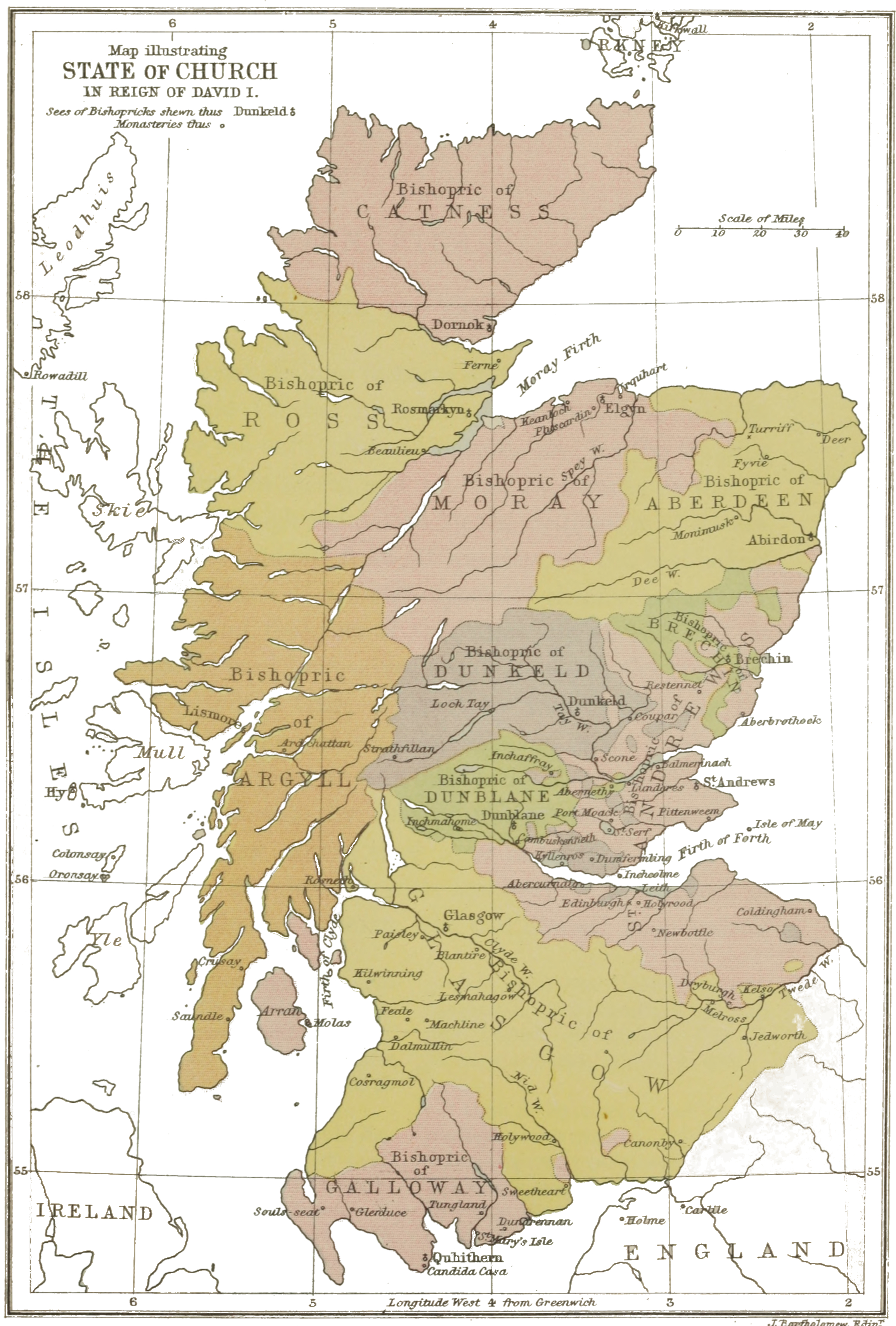
Map illustrating STATE of CHURCH IN REIGN OF DAVID I. J. Bartholomew, Edinr.
419