Chapter VIII · THE PLEISTOCENE CAVES OF GERMANY AND GREAT BRITAIN. (continued 2)
Reading edition
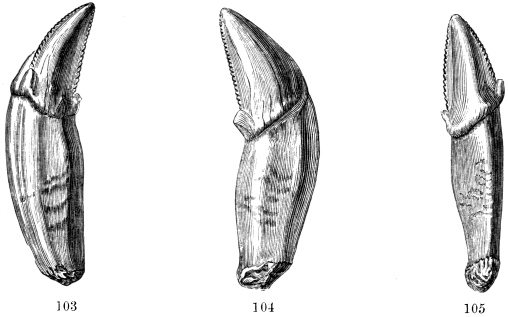
Figs. 103, 104, 105.—Incisors of Machairodus, Kent’s Hole (1/1). (MacEnery.)215
On the other hand, the recent discovery of a second incisor in the uppermost portion of the cave-earth, in July 1872, in the same condition as the remains usually found, and associated with the bones and teeth of hyæna, horse, and bear, is considered by Sir Charles Lyell and Mr. Pengelly proof of the animal having lived during the deposition of the later cave-earth, or in the later stage of the pleistocene. The condition of a bone, however, is a very fallacious guide to its antiquity, and although the fragments of the older contents of the cave are in a different mineral state, it is improbable that the ossiferous contents of so large a cave should have been mineralized exactly in the same way. Nor is an appeal to its perfect state conclusive, since several teeth of bear, which I have examined from the breccia, are equally perfect.
The view of the high antiquity of machairodus in Kent’s Hole derives support from the discovery of Rhinoceros megarhinus at Oreston, a species which is very abundant in the Italian pleiocene strata, and not uncommon in those of France,—a species with its headquarters in the south, but ranging as far north as Norfolk in the early stage of the pleistocene age, represented by the forest bed of Cromer, and that lived in the valley of the Thames, while the gravel-beds of Crayford and Grays Thurrock were being deposited by the ancient river. The occurrence of either of these animals in a cave is exceptional, and the presence of both in caves on the edge of the great plain extending southwards from the present coastline of Devon, seems to me to imply that both were open during the early stage of the pleistocene, while the pleiocene mammalia were retreating before the southward advance of the mammoth, woolly rhinoceros, spotted hyæna, reindeer, and their congeners, at a time anterior to the lowering of the temperature that culminated in the glacial period. For these reasons it seems to me probable that the machairodus belongs to an early rather than a late stage in the history of Kent’s Hole.
There is an important point of resemblance between the mode of the occurrence of the machairodus in Kent’s Hole, and of the megarhine rhinoceros at Oreston. The remains of both were met with only in one spot, and were not scattered through the chambers and passages. It may have happened that in the physical changes which those caves have undergone, both were preserved in a fissure like that described in the Uphill cave (p. 294), and that subsequently they dropped down and became imbedded in a newer deposit. In fixing the age of strata in caves it seems to me that the zoological evidence is of far greater weight than that of mere position, which may be the result of accidental circumstances.
The Caves of Ireland.
The caves of Ireland would probably afford as rich a fauna as those of Britain, had they been explored with equal care. In one at Shandon, near Dungarvan, Waterford, remains of the brown bear (U. arctos) reindeer, horse, and mammoth were discovered in 1859, by Mr. Brenan.216 The first of these animals became extinct in Ireland before the historic period, while it survived in Britain at least as late as the Roman occupation.
The cave-bear is also recorded by Dr. Carte,217 from the same place, but the thigh bone assigned to it seems to me to belong to the brown, or common species. The mammoth, so abundant in Britain, has only been discovered in two other localities in Ireland, at Whitechurch near Dungarvan, and at Magherry near Belturbet.218
The range of these animals over Great Britain and Ireland in the pleistocene age enables us to realize the ancient physical geography, which will be treated in the next and following chapters as part of the general question of the physical condition of north-western Europe at that time.