CATALOGUE
Reading edition
Abbreviations: H. (Height); W. (Width); ft. (Feet); in. (Inches). "Right" & "Left," refer to right & left of the spectator

1 FRANCO-FLEMISH, POSSIBLY ARRAS, BEGINNING OF XV OR END OF XIV CENTURY
Wool, Silk, Gold. H. 11 ft. 4 in. W. 9 ft. 6 in.
THE ANNUNCIATION: The Virgin, in a blue robe lined with red, is seated before a reading-desk in a white marble portico with a tile floor. Behind her is a red and metal gold brocade. The lily is in a majolica jar. The angel, in a green robe with yellow high lights lined with red, has alighted in a garden without. In the sky, God the Father holding the globe and two angels bearing a shield.
The treatment of the sky in two-toned blue and white striations, as well as the conventional landscape without perspective, with small oak and laurel trees, is characteristic of a number of tapestries of the opening years of the XVth century. Most of them depicted hunting scenes. But there was one famous religious piece, the Passion of the Cathedral of Saragossa. In the drawing of the figures and some of the details the piece is closely related to the paintings of that Paris school of which Jean Malouel is the most famous member. The work is by no means by Malouel, but it is similar to that of one of his lesser contemporaries, whose only known surviving work is a set of six panels painted on both sides, two of which are in the Cuvellier Collection at Niort and the others in the Mayer Van der Bergh Collection at Antwerp. The very primitively rendered Eternal Father is almost identical with the one that appears in several of the panels; the roughly indicated shaggy grass is the same, the rather unusual angle of the angel's wings recurs in the Cuvellier Annunciation, as does the suspended poise of the Virgin's attitude. The Virgin's reading-desk, too, is almost identical, though shown in the panel at the other side of the scene. The long, slim-fingered hands and the pointed nose and chin of the Virgin are characteristic of the school.
The tiles in the portico, so carefully rendered, are of interest because they are very similar to the earliest-known tile floor still in position—that of the Caracciolo Chapel in Naples. Some of the same patterns are repeated, notably that of the Virgin's initial and the star, which is more crudely rendered. The colors, too, are approximately the same, the brown being a fair rendering of the manganese purple of the chapel tiles. The majolica vase is also interesting as illustrating a type of which few intact examples are left.
Exhibited: Chicago Art Institute, Gothic Exhibition, 1921. Lent by P. W. French & Company.
The piece maintains a high level of æsthetic expression. The religious emotion is intensely felt and is adequately conveyed in the wistful sadness of the Virgin's face and the expectant suspense of her poised body. The portico seems removed from reality and flooded by a direct heavenly light, in its shining whiteness contrasting with the deep blue-green background. This tapestry by virtue of its intense and elevated feeling, purified by æsthetic calm and by its exceptional decorative vividness, ranks with the very great masterpieces of the graphic arts.
2 FRANCO-FLEMISH, EARLY XV CENTURY
Wool and Gold. H. 5 ft. 5 in. W. 5 ft. 11 in.
THE CHASE: A man in a long dark-blue coat and high red hat and a lady in a brown brocade dress and ermine turban watch a dog in leather armor attack a bear. A landscape with trees and flowers is indicated without perspective and a castle in simple outline is projected against a blue and white striated sky.
Exhibited: South Kensington Museum, French-English Retrospective Exhibition of Textiles, 1921.
This tapestry is an important example of a small group of hunting scenes of the early XVth century. It is closely related in style to the famous pair of large hunting tapestries in the collection of the Duke of Devonshire. It is not definitely known where any of these pieces were woven, but Arras is taken as a safe assumption, as that was the center of weaving at the time, and these tapestries are the finest production known of the period.
The very simple figures sharply silhouetted against the contrasting ground have a decidedly architectural quality, perfectly adapted to mural decoration. Yet the scene seems very natural and the persons have marked and attractive personalities.
Illustrated: La Renaissance de l'Art français, 1921, p. 104; Burlington, vol. 38, opp. p. 171. DeMotte, Les Tapisseries gothiques, Deuxième Série. Lent by Demotte.
These exceedingly rare pieces mark the great wave of naturalism that began sweeping over Europe about 1350 and they exemplify strikingly one of the finest qualities of the primitive—the impressive universality and objectivity that come from the freshness of the artist's vision. Looking straight at the thing itself, free from all the presuppositions that come from an inherited convention, the draftsman saw the essentials and recorded them directly without any confusing elaboration of technique. He was completely absorbed by the unsolved problems of the task, too occupied with the difficulty of rendering the central outstanding features of the scene to be diverted by personal affectations. His realization thus became vivid and intimate, his rendition achieved a singularity and epic force never again to be found in tapestry.
This is one of the few tapestries that have been improved by age. Time has spread over it a slight gray bloom that seems to remove it from the actual world, giving it the isolation that is so important a factor in æsthetic effect; yet the depth and strength of the colors have not been weakened, for we interpret the grayness as a fine veil through which the colors shine with their original purity.
3 FLANDERS, MIDDLE XV CENTURY
Wool. H. 15 ft. 7 in. W. 14 ft. 7 in.
THE ANNUNCIATION, THE NATIVITY, AND THE ANNOUNCEMENT TO THE SHEPHERDS: At the left in a Gothic chapel the Annunciation. The Virgin, in a richly jeweled and brocaded robe, reads the Holy Book. The angel in rich robes kneels before her. The lilies are in a dinanderie vase. Through the open door a bit of landscape is seen, and in a room beyond the chapel two women sit reading. The Nativity, at the right, is under a pent roof. The Virgin, Joseph, and Saint Elizabeth kneel in adoration about the Holy Babe, who lies on the flower-strewn grass. John kneels in front of his mother, and in the foreground an angel also worships. Above and beyond the stable the three shepherds sit tending their flocks, and an angel bearing the announcement inscribed on a scroll flutters down to them from Heaven. Oak-trees, rose-vines, and blossoming orange-trees in the grass.
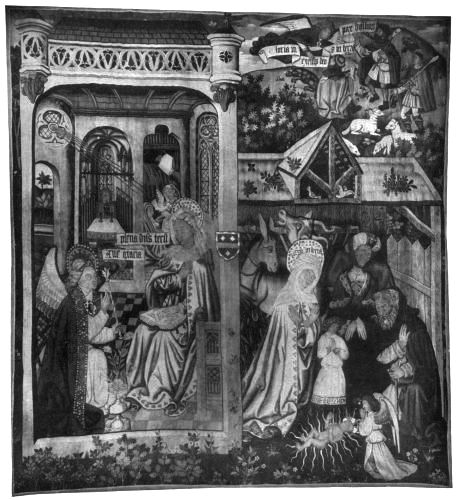
The Annunciation, The Nativity, and The Announcement to the Shepherds No. 3
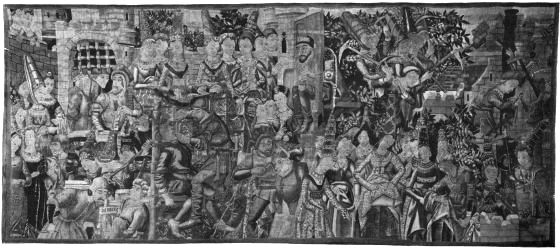
Scenes from the Roman de la Rose No. 4
This tapestry belongs to a small and very interesting group, all evidently the work of one designer. The three famous Conversations Galantes (long erroneously called the Baillée des Roses) in the Metropolitan Museum are by the same man, as are the four panels of the History of Lohengrin in Saint Catherine's Church, Cracow, the fifth fragmentary panel of the series being in the Musée Industrielle, Cracow. A fragment from the same designer showing a party of hunters is in the Church of Notre Dame de Saumur de Nantilly, and another fragment depicting a combat is in the Musée des Arts Decoratifs. Three small fragments—one with a single figure of a young man with a swan, like the Metropolitan pieces, on a striped ground, another showing a king reading in a portico very similar to the portico of the Annunciation, and the third showing a group of people centered about a king—were in the Heilbronner Collection.
Schmitz points out[1] a connection between the three Metropolitan pieces and the series of seven pieces depicting the life of Saint Peter in the Beauvais Cathedral, with an eighth piece in the Cluny Musée, and it is quite evident that the cartoons are the work of the same man. But whereas the other pieces all have the same characteristics in the weaving, this series shows a somewhat different technique in such details as the outline and the hatchings, so that one must assume they were woven on another loom.
Fortunately, there is documentary information on one set of the type that enables us to say definitely where and when the whole group was made. The Lohengrin set was ordered by Philip the Good from the first Grenier of Tournai in 1462. There can be no reasonable doubt that the set in Saint Catherine's Church is the same, for in this set the knight is quite apparently modeled after Duke Philip himself, judging from the portraits of him in both the Romance of Gerard de Rousillon (Vienna Hof-bibliothèque) and in the History of Haynaut (Bibliothèque Royale, Brussels).
Schmitz asserts that it is almost certainly useless to seek the author of these cartoons among contemporary painters, as they are probably the work of a professional cartoon painter, of which the Dukes of Burgundy kept several in their service—and this is probably true. But artists were not as specialized then as they are now, and even a professional tapestry designer might very well on occasion turn his hand to illustrating a manuscript or making a sketch for an enamel, so that it is not impossible that further research in the other contemporary arts may bring to light more information about this marked personality who created so individual a style.
Lent by Duveen Brothers.
This tapestry is exceedingly interesting, not only for its marked style of drawing and its quaint charm, but for the direct sincerity of the presentation and the brilliant and rather unaccustomed range of colors.
4 FLANDERS, MIDDLE XV CENTURY
Wool and Silk. H. 8 ft. 4 in. W. 20 ft. 4 in. Formerly in Skipton Castle, Ireland.
SCENES FROM THE ROMAN DE LA ROSE: This piece illustrates one of the most popular romances of the Middle Ages, the Romance of the Rose, the first part of which was written in 1337 by Guillaume de Lorris, the second part in 1378 by Jean de Meung, and translated into English by Chaucer. The culminating scenes are represented. Jealousy has imprisoned Bel Acceuil in a tower because he helped the Lover see the Rose after Jealousy had forbidden it. The Lover calls all his followers, Frankness, Honor, Riches, Nobility of Heart, Leisure, Beauty, Courage, Kindness, Pity, and a host of others, to aid him in rescuing the prisoner. In the course of the struggle Scandal, one of Jealousy's henchmen, is trapped by two of the Lover's followers posing as Pilgrims, who cut his throat and cut out his tongue. With the aid of Venus, the Lover finally wins.
Exhibited: Chicago Art Institute, Gothic Exhibition, 1921. Lent by P. W. French & Company.
The piece is very close in drawing to the illustrations of the Master of the Golden Fleece,[2] whom Lindner has identified as Philip de Mazarolles. The long bony, egg-shaped heads that look as if the necks were attached as an afterthought, the shoe-button eyes, flat mouths, and peaked noses all occur in his many illustrations. Characteristic of him, too, are the crowded grouping of the scene and the great care in presenting the accessories, every gown being an individual design, whereas many of his contemporary illustrators contented themselves with rendering the general style without variations. The conventional trees are probably the weaver's interpolations. The top of the tapestry being gone, there is no possibility of knowing whether his customary architectural background was included or not.
The tapestry is interesting, not only because it is quaint, but because it is a vivid illustration of the spirit of the time—virile, cruel, yet self-consciously moralistic.
5 FLANDERS, MIDDLE XV CENTURY
Wool. H. 10 ft. 9 in. W. 17 ft. 5½ in.
THE VINTAGE: This piece was probably originally one of a series of the Months, representing September. Groups of lords and ladies have strolled down from the castle in the background to watch the peasants gathering and pressing the grapes.
Formerly in the Collection of Edouard Aynard, Paris. Exhibited: Exhibition of the Middle Ages and the Renaissance, Old Palace of Sagan, Paris, 1913.
The costumes and the drawing indicate that the piece was made in Burgundy at the time of Philip the Good. In fact, it is so close to the work of one of the most prolific of the illustrators who worked for Philip the Good that it is safe to assume that the original drawing for the cartoons was his work. In the pungency of the illustration and the vivacity of the episodes as well as in numerous details it follows closely the characteristics of Loysot Lyedet. Here are the same strong-featured faces with large prominent square mouths, the same exaggeratedly long and thin legs with suddenly bulging calves on the men, the same rapidly sketched flat hands, and the same attitudes. The very exact drawing of the bunches of grapes parallels the exactness with which he renders the household utensils in his indoor scenes, and the dogs, while they are of types familiar in all the illustrations of the time, have the decided personalities and alert manner that he seemed to take particular pleasure in giving them.
Reproduced: Les Arts, Sept., 1913; Gazette des Beaux Arts, 1913. Lent by Jacques Seligmann & Company.
Another tapestry that seems to be from the same hand is Le Bal de Sauvages in l'Eglise de Nantilly de Saumur.
The piece is one of the most vivid and convincing illustrations of the life of the time that has come down to us in tapestry form. The silhouetting of the figures against contrasting colors and the structural emphasis of the vertical lines give the design great clarity and strength.
Loysot Lyedet was working for the Dukes of Burgundy in 1461. He died about 1468. Among the most famous of his illustrations are those of the History of Charles Martel (Bibliothèque Royale, Brussels) History of Alexander (Bibliothèque Nationale, Paris) and the Roman History (Bibliothèque de l'Arsenal, Paris.)
6 GERMANY, PROBABLY NUREMBERG, MIDDLE XV CENTURY
Wool and Gold. H. 3 ft. 6 in. W. 7 ft. 6 in.
SCENES FROM THE LIFE OF CHRIST: The Life of Christ is shown in eight small scenes, beginning with the Entrance into Jerusalem, the Farewell to his Mother, the Last Supper, the Agony in the Garden, the Carrying of the Cross, the Crucifixion, the Pieta, and the Entombment.
The scenes in this tapestry were apparently adapted from the illustrations from a Nuremberg manuscript of the middle of the XVth century. Of course, the weaving may have been done later. The simplified arrangement of the scenes with a reduction to a minimum of the number of actors, the relative size of the figures to the small squares of the compositions, the marked indebtedness in the use of line and light and shade to woodcuts, and the courageous but not altogether easy use of the direct profile, all bring the pieces into close relationship with such book illustrations as those of George Pfinzing's book of travels (The Pilgrimage to Jerusalem), now in the City Library of Nuremberg.[3] In fact, the parallelism is so very close, the tapestry may well have been adapted from illustrations by the same man, the curiously conventionalized line-and-dot eyes being very characteristic of the Pfinzing illustrations and not common to all the school.
Lent by P. W. French & Company.
In weaving many of the figures the warp is curved to follow the contours.
The naïve directness and unassuming sincerity of the piece give it great interest.
7 TOURNAI, THIRD QUARTER XV CENTURY
Wool. H. 10 ft. 6 in. W. 8 ft. 9 in.
THE HISTORY OF HERCULES: Hercules, clad in a magnificent suit of shining black armor, rides into the thickest tumult of a furious battle; with sword in his right hand, he skillfully parries the thrust of a huge lance, while with the other hand he deals a swinging backhand blow that smites an enemy footman into insensibility. His next opponent, obviously bewildered and frightened, has half-turned to flee. The whole apparatus of mediæval combat is shown in intense and crowded action. The piece is incomplete.
This tapestry illustrates one of the favorite stories of the Middle Ages, and was undoubtedly originally one of a set. In design it is closely related to the famous Wars of Troy series, many examples of which are known and some of the first sketches for which are in the Louvre. It is also closely related to the History of Titus set in the Cathedrale de Notre Dame de Nantilly de Saumur.[4] Both of these sets are signed by Jean Van Room, and this piece also is undoubtedly from his cartoon. All of these pieces were probably woven between 1460 and 1470.
Jean Van Room (sometimes called de Bruxelles) is one of the most interesting personalities connected with the history of Gothic tapestry. He was a cartoon painter and probably conducted a large studio, judging from the number of pieces of his which are left to us. Fortunately, he had a habit of signing his name on obscure parts of the designs, such as the borders of garments. His work extends over sixty years and changes markedly in style during that time, adapting itself to the changing taste of his clients. This piece illustrates his earliest manner. In the succeeding decades he is more and more affected by the Renaissance and the Italian influence, until his latest pieces (cf. No. 21) are quite unlike these first designs. At the close of the century he began to collaborate with Maître Philippe, evidently a younger man, who had had Italian instruction and was less restrained by early Gothic training (cf. Nos. 17-19).
Jean Van Room seems to have done designs for enamels, also, that were executed in the studio of the so-called Monvaerni. In the collection of Otto H. Kahn is a Jesus before Pilate very close in style to Jean Van Room's early work,[5] on which appear the letters M E R A, which might even be a pied misspelling of Room, for similar confused signatures appear on tapestries known to be his. A triptych with Crucifixion in the collection of Charles P. Taft[6] has figures very close to the Crucifixion tapestry in the Cathedral of Angers done by Van Room in his middle period. According to Marquet de Vasselot, this enamel bears the letters JENRAGE, but M. de Vasselot also comments on its illegibility in the present condition of the enamel. Could he have misread a letter or two? Still another triptych with Crucifixion, in the Hermitage,[7] actually repeats two figures from the Angers Crucifixion with only very slight variations.
Jean Van Room borrowed liberally from various other artists at different stages of his career. In the Wars of Troy, the History of Titus, and this piece he seems to have relied primarily on Jean le Tavernier for his models, the affiliation being especially close in the Wars of Troy. Le Tavernier is known to have illustrated the Wars of Troy,[8] and Jean Van Room, judging from the close stylistic relations of his Troy tapestries with le Tavernier's drawings, evidently took his hints from this lost manuscript.
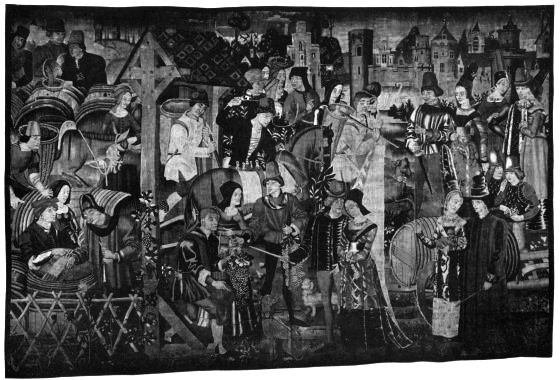
The Vintage No. 5
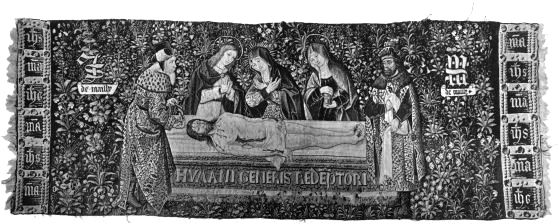
Entombment on Millefleurs No. 8
This piece was probably woven under Pasquier Grenier at Tournai, as were the Wars of Troy, on which there are some documents.
Lent by P. W. French & Company.
This tapestry presents with extraordinary vividness the fury, din, excessive effort, hot excitement, and blinding confusion of crowded hand-to-hand conflicts that marked mediæval warfare. It must have been conceived and rendered by an eye-witness who knew how to select and assemble the raw facts of the situation with such honesty and directness that an overwhelming impression of force and tumult is created, and it was woven for patrons, the fighting Dukes of Burgundy, by whom every gruesome incident would be observed with relish and every fine point of individual combat noted with a shrewd and appraising eye.
8 FRANCE, END XV CENTURY
Wool. H. 2 ft. 10 in. W. 7 ft. 10 in.
ENTOMBMENT ON MILLEFLEURS: Christ lies on the tomb which is inscribed "Humani Generis Redeptori." John in a red cloak, the Virgin in a blue cloak over a red brocaded dress, and Mary Magdalene in a red cloak over a green dress stand behind the tomb. At the head, removing the crown of thorns, stands Joseph of Arimathea and at the foot Nicodemus. Both Joseph and Nicodemus are in richly brocaded robes. Borders at the sides only of alternate blue and red squares inscribed I H S and M A surrounded by jeweled frames. Millefleurs on a blue ground. In the upper left corner the monogram I S and in the upper right W S, with a scroll under each bearing the inscription "de Mailly."
This tapestry is an unusually delicately and perfectly rendered example of the millefleurs aux personnages of France of the late Gothic period. A small piece like this was undoubtedly made for a private chapel, probably that of the de Mailly family. This quality of millefleurs was probably woven in Touraine. An altar frontal showing the Pieta which is very similar in style is in the Kunstgewerbe Museum.
Lent by Demotte.
The drawing has the nice exactness of a finished miniature, the workmanship the brilliance of enamel; yet both are transfigured by the vivid conception of the tragic event. Its utter pathos is expressed with moving power. We are in the presence of an unutterably solemn moment.
9 FRANCE, END XV CENTURY
Wool and Silk. H. 4 ft. 6 in. W. 3 ft. Formerly in the C. D. Barney Collection. Lent by P. W. French & Company.
MILLEFLEURS ARMORIAL WITH WILD MEN: On a delicate millefleurs ground a wild man and woman hold an armorial shield surmounted by a winged helmet.
The wild men, probably a modified revival of the classical satyrs in modified form, were very popular in France in the XIIIth and XIVth centuries. There are tapestries extant depicting the balls where all the company came dressed in hairy tights to represent these creatures. Froissart recounts an episode of a ball at the Hotel St. Pol in Paris in 1392 when the king and five of his companions came in such costumes, all chained together, and the flax used to imitate the hair caught fire from a torch, so that in an instant all were enveloped in flames. The king was saved by the presence of mind of his cousin, who enveloped him in her skirts, and another was saved by jumping into a tub of water he had noticed earlier in the evening in an adjacent service-room. The others were burned to death.
10 FRANCE, BEGINNING XVI CENTURY
Wool. H. 7 ft. 10 in. W. 10 ft. 7 in. Lent by P. W. French & Company.
MILLEFLEURS WITH SHEPHERDS AND THE SHIELD OF THE RIGAUT FAMILY: Against a background of conventionalized millefleurs, shepherds and shepherdesses and their flock. In the center, two peasants holding a shield, evidently of the Rigaut family. In the corners the shield of Rigaut and of another family. The tapestry was evidently made to celebrate a marriage, the corner shields signifying the joining of the families, an oblique reference being intended in the pairing of the shepherds and shepherdesses. A scroll in the center bears the inscription "Par Içi Passe Rigaut."
The naïveté both of the characterization and of the drawing that emphasizes the structural and silhouette character of the figures contributes greatly to the charm of this piece. The clean, sharp rendering of the millefleurs enhances the decorative effect. The piece is probably the work of a small provincial loom.
11 FRANCE, PROBABLY LA MARCHE, BEGINNING XVI CENTURY
Wool and Silk. H. 5 ft. 7 in. W. 9 ft. 4 in. Lent by P. W. French & Company.
MILLEFLEURS WITH ANIMALS: Against a large-scale millefleurs ground on blue, deer are playing about a fountain within a paddock. On a fence-post perches a peacock. Outside the fence a fox waits, watching slyly. In the background conventional castles.
The floreation is rather unusual, as it shows the transition from the Gothic millefleurs to the Renaissance verdure. The enlarged scale of the flowers and the use of the iris and the scrolled thistle-leaves in the foreground show the influence of the Renaissance, but the daisies and wild roses are still Gothic in feeling, as are the unusually charming and vivacious deer. The conventional rendering of the water is skillfully managed. The sly fox is especially well characterized.
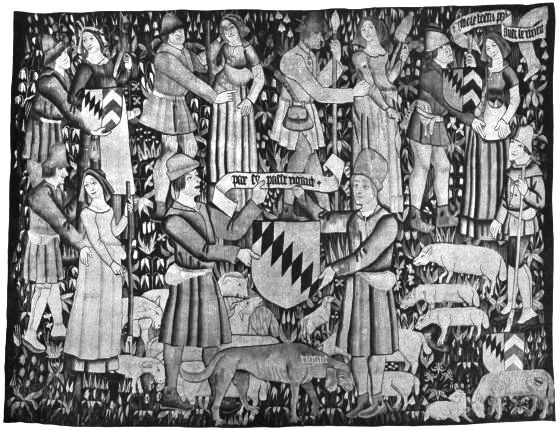
Millefleurs with Shepherds and the Shield of the Rigaut Family No. 10
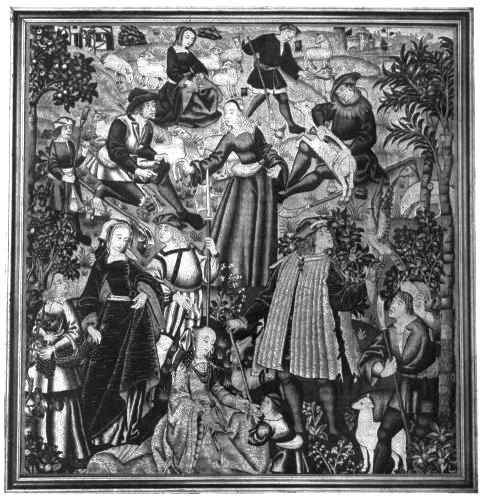
Pastoral Scene No. 13
12 FRANCE, PROBABLY LA MARCHE, EARLY XVI CENTURY
Wool. H. 4 ft. 5 in. W. 9 ft. 5 in. Lent by Dikran K. Kelekian.
MILLEFLEURS WITH ANIMALS: Millefleurs with animals on a blue ground. At the top a narrow strip of conventionalized hilly landscape.
Many tapestries of this type were woven in France at the end of the XVth and beginning of the XVIth century. They are one of the most successful types of tapestry decoration, the quaint animals in this piece being especially charming, and one of the most generally useful kinds of wall decoration, so that the demand for them was large and continuous. As a result, the style was produced almost without modification for over a hundred years. Only the bit of landscape at the top indicates that this was woven in the beginning of the XVIth century and not in the middle of the XVth.
13 FRANCE, LATE XV CENTURY
Wool. H. 9 ft. 6 in. W. 9 ft.
PASTORAL SCENE: Two ladies have strolled into the country with their lords, who are on the way to the hunt, one with a falcon and the other with a spear and dog. On the way they have stopped to talk to a group of peasants who are tending their flocks and to play with their children. One young peasant girl is gathering a basket of grapes.
Such peasant scenes as this were much in demand during the XVth century. A piece very similar both in general spirit and in detailed drawing and facial types is in the Musée des Arts Decoratifs. In this two lords are watching a large group of woodcutters.
Formerly in the De Zolte Collection. Lent by Duveen Brothers.
The piece is an excellent illustration of the clarity of French design. Each figure stands out almost entirely detached against the background. Yet, nevertheless, the naturalness of the grouping is not sacrificed. The piece conveys extraordinarily the impression of a real scene, a common daily occurrence among people that we might reasonably expect to know, at which we are allowed to be present in spite of the intervening four hundred years.
Some of the tricks of drawing and the types portrayed are so very similar to those in some of the stained-glass windows of St. Etienne du Mont and of St. Germain-l'Auxerrois the cartoons must be by members of the same school, one of the groups of l'Ile de France, and may quite possibly be by the same man.
14-16 FLANDERS, FIRST QUARTER XVI CENTURY
Wool and Silk. No. 14: H. 11 ft. 6 in. W. 14 ft. 2 in. No. 15: H. 10 ft. 9 in. W. 7 ft. 3½ in. No. 16: H. 11 ft. W. 10 ft. 5 in.
THREE PIECES FROM A SERIES ILLUSTRATING THE CREED: This series of scenes illustrating the Creed begins (No. 14) with the Creation of the World. The designer, evidently with some allegorical poem in mind, includes in the scene Sapientia, Potencia, and Benignitas, depicted, in characteristic medieval form, as three richly dressed women. In the center scene these three offer the world to God. On the right, Gubernacio, Redempcio, and Caritas stand under the throne of the Trinity.
In the second piece (No. 15) the series continues with the Life of Christ, beginning with the Annunciation, the Nativity, and the Adoration of the Kings.
Reverting to the older tradition of the XIVth century that had been almost displaced during the XVth century, all the events of Christ's public life are omitted, and the third piece (No. 16) depicts the scenes of the Passion, including the popular interpolation of Christ's farewell to his Mother, with the Apostles in the background, the Resurrection, and finally Christ taking his place at the right hand of God while the angels sing hosannas.
Below, throughout the series, is the set of the Apostles facing Prophets, symbolic of the parallelism of the Old and New Testaments, each with a scroll bearing his speech in the conventional responses depicted in so many works of art of the period. So Peter (No. 14), says, "I believe in God the Father Omnipotent," and Jeremiah, who faces him, replies, "You invoke the Father who made the earth and builded the heavens." Next (No. 15) comes Andrew, who originally faced David, a figure now missing. The next pair, John and Daniel, is also missing. There follow (No. 16) Thomas, who originally faced Hosea, and John the Lesser, who is opposite Amos. Above, on either side of the Nativity (No. 15), is introduced another pair, John the Greater and Isaiah.
The complete piece, of which number 16 is the right-hand end, was formerly in the Toledo Cathedral, then in the collection of Asher Wertheimer, of London. The present owner is unknown.[9] Another rendition was in the Vatican, but disappeared in the middle of the XIXth century.[10]
Tapestries illustrating the Creed were common throughout the Middle Ages. They appear frequently in XIVth-century inventories, and a number of examples from the XVth and early XVIth century are left to us. The Apostles and Prophets arranged in pairs are a common feature of this type of tapestry.
Formerly in Evora Palace, Portugal.
The cartoons are evidently the work of the painter who painted the ceiling of the Church of St. Guy at Naarden, whom Dr. Six tentatively identifies as Albert Claesz.[11] The similarity is too close to be overlooked. The Christ of the Naarden Resurrection[12] and this Resurrection are almost identical, the face of God the Father in the Assumption is almost identical with that of an onlooker in the Naarden Betrayal,[13] and Adam in the first piece of this series closely resembles the Christ of the Naarden Flagellation.[14] But more indicative are the lesser peculiarities common to both series. There are in both the same curiously flattened and slightly distorted skulls with very large ears, the same large eyes with heavy arched lids and eyebrows close above them, oblique and not quite correctly placed in the three-quarter views, and always looking beyond their focus. The mouths, too, in some of the faces are overemphasized in the same way, and the feet have the same quaint distortion, being seen from above, as in the figure of the Prophet John (No. 15). And in very conspicuous minor agreement, the cross has a strongly indicated and rigidly conventionalized graining identical in the two renditions. The attitude of the Christ and the indication of the garment in the Toledo tapestry is very close to that in the Naarden painting.
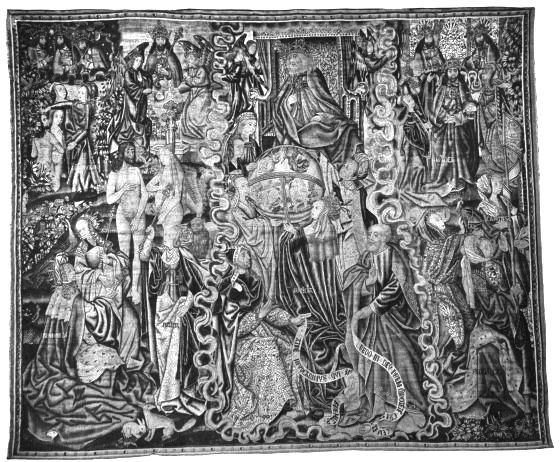
The Creation of the World No. 14
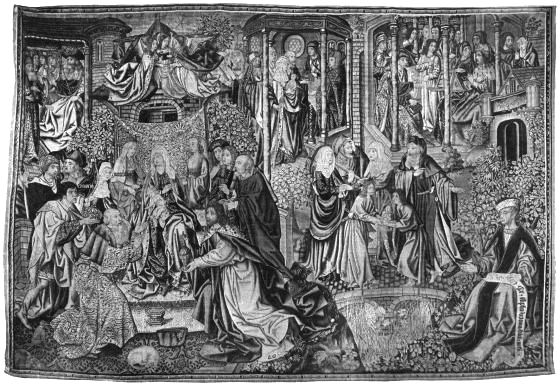
Four Scenes from the Life of Christ No. 17
The floreation was probably introduced by the weaver. The delightfully exact scene of the owl scolded by a magpie, while a pigeon sits near by and another bird flutters about (No. 14), is repeated with slight variations in a number of XVIth-century pieces.
Lent by Demotte.
The drawing in these tapestries is rather unusually primitive for pieces of this period, but the figures have a broad monumental character and a direct sincerity of bearing that make them very convincing.
17-19 FLANDERS, PROBABLY BRUSSELS, BEGINNING XVI CENTURY
Wool and Silk. No. 17: H. 11 ft. 10 in. W. 17 ft. 6 in. No. 18: H. 11 ft. 7 in. W. 7 ft. 5 in. No. 19: H. 12 ft. W. 26 ft.
THREE PIECES FROM A SERIES ILLUSTRATING THE CREED: In the first piece (No. 17) four scenes from the Life of Christ are portrayed: the Adoration of the Kings, the Presentation at the Temple, the meeting of Christ and John, and Christ among the Doctors. In the corner sits a prophet, probably David. The piece undoubtedly began with the Nativity, at the left, and possibly the Annunciation, with the Apostle Andrew in the other corner. This would indicate that the piece was the second in the series, the first probably having been the Creation of the Earth, with Peter and Jeremiah.
The second piece (No. 18) shows the Circumcision and the Assumption of the Virgin, and evidently included at least one more scene at the right.
The Last Judgment was formerly in the Evora Palace, Portugal, and is illustrated from the Louvre example in Migeon, Les Arts de Tissu, p. 220; in part, in E. Mâle, L'Art religieux de la fin du Moyen Age en France, p. 501; Burlington, vol. 20, p. 9; Figaro Illustré, 1911.
The third piece (No. 19) shows the full scene of the Last Judgment with a personage who seems to be Philip in one corner and in the other Zephaniah. The piece is complete except, possibly, for a border. A tapestry from the same cartoon with a narrow border of flowers is in the Louvre. Christ, enthroned, is surrounded by the Virgin, Saint John, and the eleven Apostles. Angels, bearing instruments of the Passion and sounding trumpets flutter through the sky. At the right of the throne angels come bearing crowns for the elect. Below the dead are rising from the graves. Before the throne of Christ Justice bearing a sword and Pity bearing a lily come to punish the Seven Deadly Sins, Pride, Avarice, Luxury, Greed, Anger, Envy, and Laziness, an episode adopted from the Mystery Plays. On the border of the robe of the Virgin appear the letters WOL and on the border of the robe of the last Apostle at Christ's left the letters RIM DACI BAPTISTA ORADI.
The Circumcision and Assumption is illustrated in Demotte, Les Tapisseries gothiques, Première Série, pl. 39.
Seven other large tapestries very closely related to these are known. They represent various episodes involving Christ and numerous allegorical figures that have not been identified. Three of these are in the collection of Baron de Zuylen du Nyevelt de Haar, two in the Burgos Cathedral, and two others have passed into private collections and been lost sight of.[15] Another smaller piece, apparently of the same series, was number X in the Morgan Collection. Three duplicates are also in Hampton Court.
The series is closely related also to the Life of the Virgin set in the Royal Collection at Madrid, and also the Presentation in the Temple of the Martin le Roy Collection. The cartoons are clearly the work of Maître Philippe, and the weaving was evidently done in Flanders, probably in Brussels, about 1510. Marquet de Vasselot suggests that the cartoons of the Martin le Roy piece and of the Madrid series were done after a second master under the influence of Gerard David.[16] Destrée, following Wauters, suggests Jean de Bruxelles, known author of the cartoon for the Communion of Herkenbald, another Maître Philippe piece, to which he sees a resemblance,[17] and Thièry repeats the claim, but on far-fetched evidence.[18]
Certainly the types are very close to those of Gerard David. Some of the figures on David's Tree of Mary in the Lyons Museum[19] are repeated almost exactly, and some of the female figures are very like the Saint in the Marriage of Catherine in the San Luca Academy at Rome.[20] But other types, such as Zacharias in the meeting of Christ and John, are more reminiscent of Hugo Van der Goes, being, for instance, almost identical with Joseph of Arimathea in the Descent from the Cross in the National Museum, Naples,[21] even to such details as the drawing and placing of the ear. The glimpses of landscapes, too, are clearly derived from Hugo in their composition and details, and even the floreations are close to those in some of Hugo's work, notably the Original Sin in the Imperial Gallery of Vienna,[22] where one finds the same upspringing sheaf of iris. The work would seem to be that of a lesser eclectic, such as the author of the Life of Mary in the Bishops' Palace at Evora.
Lent by Demotte.
In all the pieces there are intense sincerity and real grandeur of design. The Last Judgment, in the musical swinging together of the draperies, the perfect control of the great composition, and in the fine development of the dominance of Christ without sacrifice of the minor episodes, as well as in the power of expression of the thrilling solemnity of the moment, deserves to rank with the greatest interpretations of the subject.
20 BRUSSELS, BEGINNING OF XVI CENTURY
Wool and Silk. H. 12 ft. 3 in. W. 13 ft. 2 in. Formerly in the Morgan Collection. Lent by P. W. French & Company.
SCENES FROM A ROMANCE: A queen surrounded by her court awaits the preparation of a document. There is a general interchange of documents among the courtiers at the right. In the background, upper left, a knight indites a letter, and on the opposite side two knights wait on horseback. The scenes illustrate some contemporary romance and are closely related to the Court of Love tapestries that were so often woven at this time.
The cartoon, like those of the Court of Love scenes, is the work of the studio of Maître Philippe. Jean Van Room probably collaborated, as his signature appears on a very similar tapestry of David and Bathsheba in the Royal Spanish Collection.[23] As in that tapestry, the elegantly dressed persons are quite typical of the prosperous burghers of the time and might well be used as fashion plates. The composition is skillful in the balancing of the groups and the massing of the drapes to form a support for the dominant figure of the queen.
21 BRUSSELS, EARLY XVI CENTURY
H. 13 ft. 9 in. W. 22 ft. 1 in. Barberini Collection; Ffoulke Collection. Illustrated: Ffoulke Collection, opp. p. 43. Exhibited: Exposition d'Art ancien bruxellois, Brussels, 1905, No. XXI. Illustrated: Destrée, Catalogue of same, pl. XXIV. Lent by Mrs. Wm. C. Van Antwerp.
THE TRIUMPH OF DAVID: David carrying the head of Goliath on his sword and surrounded by musicians is followed by King Saul and Jonathan on horseback. In the background a hilly landscape with the tents of the Hebrews. A narrow floral border.
The cartoon was painted by Jean Van Room, his signature appearing on another piece[24] of the same series in the Musée du Cinquantenaire, Brussels. Maître Philippe must have collaborated with him in this work, for a strong Italian influence is evident which appears only in the Van Room tapestries that have had Philippe's assistance.
Though the drawing and details show the incoming Renaissance influence, the full continuous narrative arrangement of the group, the strong vertical lines of the figures, and the simple modeling show the tarrying Gothic feeling. The groups are beautifully massed and the individual figures show great dignity.
22 SWITZERLAND, EARLY XVI CENTURY
Wool. H. 4 ft. 3½ in. W. 7 ft. 9½ in. Formerly in the Collection of Comtesse Desautoy.
TWO PAIRS OF LOVERS: Two pairs of lovers are pictured against a background of vines with blue-green scrolled leaves and large red and yellow blossoms on a dark-blue field. The pair at the right is on either side of a Gothic pedestal on which is a small statue. The ladies are in red robes. One man is in a blue doublet, the other in a two-toned red brocaded cloak. Border of rose-vines and daisies.
The piece was probably woven in Basle, and is undoubtedly adapted from a wood-block illustration in one of Leonhard Ysenmuth's publications. The width and richness of the border indicate that it was done in the early XVIth rather than in the late XVth century.
The subject of pairs of lovers was quite a favorite one with German and Swiss weavers, and a number of them in different styles is left to us. The piece is probably the work of an amateur, a nun, or more probably some lady, who thus filled her long leisure hours. The wood-block print has been closely followed for the figures, even to such minor details as the very simple conventionalization of the hair. The vine background in rather a large scale is common to many Swiss tapestries of the period. The limited range of colors used is especially worthy of note, there being only three shades of blue, three of green-blue, three of tan, and two of red, in addition to the black for the outlines.
Lent by Wildenstein & Co.
The work is thoroughly naïve, but it has the strong appeal of genuineness and directness common to naïve designs and shows a strong feeling for decorative quality.
23-25 BRUSSELS, SECOND QUARTER XVI CENTURY
Wool, Silk, Gold. No. 23: H. 13 ft. 5 in. W. 15 ft. 4 in. No. 24: H. 13 ft. 5 in. W. 20 ft. No. 25: H. 13 ft. 5 in. W. 20 ft.
THREE SCENES FROM THE DEEDS OF SCIPIO: In the first piece (No. 23) Scipio enthroned offers the mural crown to Caius Laelius. Roman army officers stand about. In the background the army is assembled.
In the second piece (No. 24) Scipio is about to land in Africa. In the foreground two vessels filled with soldiers. In the background the city of Utica.
In the third piece (No. 25) Hannibal approaches Scipio to sue for peace. In the background the opposing armies face each other on either side of a river.
The pieces bear the Brussels city mark and the monogram H.M. (Hubert de Mecht). The cartoons are attributed to Giulio Romano, fifteen of the original small drawings being in the Louvre. There are in all eighteen pieces in this set, and two subsequent sets, the Triumphs of Scipio and the Fruits of War, make a total of thirty-five pieces in the complete history, one of the largest sequences ever attempted in tapestry.
Illustrated: Hauser y Menet, Los Tapices de la Corona de España, vol. 2, pl. 93; Burlington, 1916, pp. 58-66, in connection with article by George Leland Hunter, Scipio Tapestries Now in America. Lent by Duveen Brothers.
The cartoons have been woven a number of times and examples have been included in many famous collections, including that of Francis I. These pieces were so rich in gold that they were burned to obtain the metal during the Revolution.
These three pieces are from one of the earliest weavings, and in perfection of execution and sumptuousness of material far surpass most of the renderings, ranking with the greatest productions of the early Renaissance. The use of the metal is particularly effective, occurring as it does in three techniques, plain weaving, basket weaving, which always gives a heavy richness, and couching.
The borders with the classical allegorical figures under porticos are of a very fine type, following the example set by Raphael in his panels for the Acts of the Apostles.
For vividness of illustration, strength and clarity of silhouette, and delicacy and freshness of color this set is nowhere surpassed.
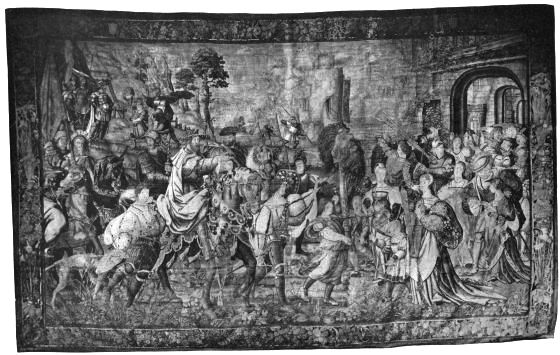
The Triumph of David No. 21
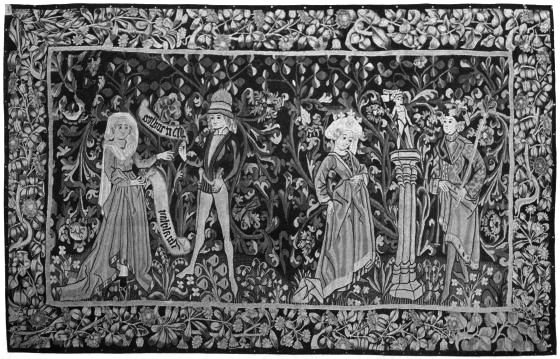
Two Pairs of Lovers No. 22
26, 27 BRUSSELS, XVI CENTURY
Wool and Silk. No. 26: H. 12 ft. W. 15 ft. No. 27: H. 12 ft. W. 16 ft.
TWO SCENES FROM THE LIFE OF CYRUS: In the first (No. 26) Cyrus captures Astyages, his grandfather. Soldiers stand about, and in the background the army is assembled.
In the second (No. 27) Thomyris has the head of Cyrus offered as a human sacrifice. An attendant is placing the head in a gold basin and soldiers standing about draw back in horror. In the background a battle wages.
Illustrated: Hauser y Menet, Los Tapices de la Corona de España, vol. 2, pls. 119, 121. Lent by Mr. & Mrs. Daniel C. Jackling.
These two pieces, showing the moment of greatest triumph and the ultimate defeat of Cyrus, the great world conqueror, are from a famous set that has been woven several times. One of these sets, belonging to the royal family of France, was used in the funeral service of Francis II. Another group from the series is in the Royal Spanish Collection. The only set known with a weaver's signature bears the mark of Nicolas Leyniers, and it is entirely probable that all of the examples, including these two, are from those looms.
They are very fine examples of a type of design perfected in the first half of the XVIth century in Brussels. The fullness of details in the background serves to keep the textile rich and interesting and to throw into sharp silhouette the dominant figures. The intricate and decorative borders that are used on these pieces well illustrate one of the most important contributions of the Renaissance to tapestry design.
28 BRUSSELS, XVI CENTURY
Wool and Silk. H. 8 ft. 10 in. W. 7 ft. 2 in. Lent by William Baumgarten & Company.
THE PENTECOST: The Apostles and the members of the Early Church are gathered together. The tongues of fire descend upon them, and the Holy Ghost appears like a dove between the figures of God and Jesus revealed above. A wide border of scroll with inset medallions of biblical scenes. In the upper border a papal coat of arms.
Renaissance tapestries in so intimate a scale that yet are not miniature occur rather seldom. The piece has great clarity and brilliance and carries forcefully the religious feeling of the episode.
In the selvage the Brussels city mark and the weaver's initials, C. S. The mark is unidentified.
29 BRUSSELS, XVI CENTURY
Wool and Silk. H. 6 ft. 9 in. W. 13 ft. 8 in. Lent by William Baumgarten & Company.
JUDITH DEPARTS FOR THE ENEMY'S CAMP: Judith accompanied by her maid takes leave of her mother. Attendants await to lead her away and a slave awaits in the background holding two camels. Wide border of fruits and flowers.
This is one of a very famous set of the Story of Judith and Holofernes, examples of which are in a number of famous collections. The tapestry bears on the selvage the Brussels city mark and the weaver's monogram, N. X. The mark is unidentified.
This piece is a strong example of a set that combines characteristic Renaissance stateliness with a less customary direct charm.
30 BRUSSELS, MIDDLE XVI CENTURY
Wool and Silk. H. 11 ft. 3 in. W. 12 ft. 9 in. Lent by P. W. French & Company.
GARDEN SCENE: Through a trellis upheld by caryatides a formal garden with fountains and pavilions is seen. In the foreground, deer. In the garden, various animals. Border of scrolls and flowers with inset cartouches showing animals.
Such trellis designs as this were quite often used in the middle of the XVIth century. A famous example very similar to this is the Vertumnus and Pomona set, one of which was in the Palace of the Escurial and two in the Barberini Collection.[25] Another piece so like this that it must be the work of the same designer is in the Vienna Collection, number 142.
It is a rich and resourceful kind of decoration well fitted to the requirements of tapestry. The drawing of the deer is unusually graceful and vivacious.
31 FLANDERS, XVI CENTURY
Wool and Silk. H. 5 ft. 9 in. W. 12 ft. 9 in. Lent by Mrs. William H. Crocker.
VERDURE: In the center a château surrounded by a moat on which swans and ducks swim about. At the left fishermen on the bank and a hunter with his dogs. On the right mounted hunters chasing rabbits through a wood.
The high-keyed landscape on a small scale was the Renaissance successor to the Gothic millefleurs. The drawing in this piece is beautifully clean and exact, and the color delightfully and uncommonly varied and vibrant. The château is so carefully rendered that it is valuable as an architectural record. The piece may have been made by Flemish weavers working in England.
32 FLANDERS, LATE XVI CENTURY
Wool. H. 9 ft. W. 23 ft. Lent by W. & J. Sloane.
HUNTING SCENE: Hunters riding through a woodland. In the foreground a knight and lady strolling. Scroll border.
This piece is a rather uncommon variation of a familiar type. Many tapestries were woven in Flanders in the second part of the XVIth century that were predominantly verdure with a few minor figures, but the figures were seldom as delicately drawn nor the colors so high in key and clear. It is quite possible that the piece was woven by Flemish weavers in England, a few pieces woven there by the Poyntz family being known to have somewhat the same quality. The relatively low height in proportion to the great length also suggests that it was made for an English house.
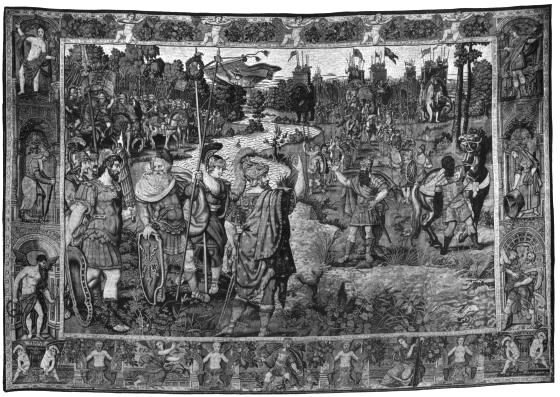
Hannibal Approaches Scipio to Sue for Peace No. 25
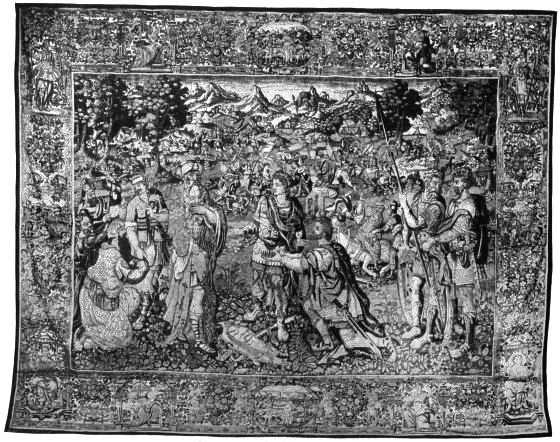
Cyrus Captures Astyages, His Grandfather No. 26
33 FLANDERS, ENGHIEN (?), XVI CENTURY
Wool. H. 9 ft. 7 in. W. 7 ft. 9 in. Lent by Dikran K. Kelekian.
VERDURE: Large scrolling leaves, bluish-green, with bunches of fruit and flowers and small finches. Wide border of fruit and flowers.
Verdures of this type were very much in demand in the Renaissance period. They are typical of the decorative manner of the time and one of its finest inventions.
The heavy, simple leaves are often too obvious and too readily explored for the best tapestry decoration; but in this piece the beautifully drawn birds provide delicacy and interest of detail.
34 BRUGES, MIDDLE XVI CENTURY (1556)
Wool and Silk. H. 9 ft. 1 in. W. 8 ft. 9 in. Lent by P. W. French & Company.
ARMORIAL: Two amorini support a shield. Above, crossed banners; below, dolphins. Six flags radiate from the shield, each bearing the initial P surmounted by a crown. Border of scrolls and classic figures. In cartouches in the side and lower borders the initials F, G, and X respectively, and in the corresponding cartouche of the top border the date, 1556. On the right lower selvage is the city mark of Bruges, with the weaver's monogram, A. F.[26]
This tapestry is very interesting, not only because it is a clear, strong example of a Renaissance heraldic hanging, but because very few pieces of the period can be ascribed definitely to Bruges although it is known that important looms flourished there. The weaver's monogram has not been identified. The coat of arms, which is also unidentified, seems to be Spanish, and judging by the coronet evidently belonged to a family of high station. The amorini are after a follower of Giulio Romano, if not by Romano himself.
The relief effect of the design is quite extraordinary.
35 BRUSSELS, XVI CENTURY (1574)
Wool, Silk, Gold. H. with frame, 4 ft. W. with frame, 3 ft. 9 in.
THE CRUCIFIXION: Christ and the two thieves on the crosses. In the foreground, right, the Roman soldiers; left, the sorrowing Marys. Floral border. Dated in cartouche in the border, 1574.
This is one of a number of small tapestries in silk and gold of religious subjects, most of which have been attributed to Bernard Van Orley, who probably designed this piece also. They are all of them very exact reproductions of paintings, remarkable in weave and very beautiful in color. The type was first woven in the first quarter of the XVIth century, and continued to be produced in very limited numbers until well into the XVIIth century. They were undoubtedly woven only for special orders—probably for private chapels.
The piece is a very brilliant example of one of the richest types of tapestry that has ever been woven.
Lent by P. W. French & Company.
Bernard Van Orley (1492-5 to 1540) was trained by his father, Valentin, and afterwards studied under Raphael in Italy. He was engaged to supervise the translation of Raphael's cartoons for the famous series of the Apostles into tapestry. In 1518 he became court painter. He designed many tapestries, of which the most famous are the Hunts of Maximilian and the Victory of Pavia series.
36 FONTAINEBLEAU, MIDDLE XVI CENTURY
Wool and Silk. H. 11 ft. W. 17 ft.
GROTESQUES: On a red ground, grotesques, of which the principal features are: in the center Flora in an arbor on the top of which stands Atlas upholding the world; two cartouches left and two right with candelabra and various deities. Below at the left in a small oval medallion Leda and the Swan, and in the corresponding medallion on the other side Eve and the Serpent. The remaining spaces are filled with amorini, garlands of fruit and flowers, gods, and various ornaments. Narrow floral borders, and in the center of both side borders a triangle.
The triangles in the border are the Deltas, the ciphers of Diane de Poitiers, indicating that this piece was woven in the reign of Henry II for Diane, possibly for the Château d'Anet.
Lent by P. W. French & Company.
For fertile and varied imagination this piece is quite uncommon even among grotesques, the most imaginative type of decorative tapestries. It exhibits a most entertaining sense of humor and shows a capricious independence never found in the more formal Flemish grotesques of the time.
37 FONTAINEBLEAU, MIDDLE XVI CENTURY
Wool and Silk. H. 12 ft. 8 in. W. 8 ft.
TRIUMPH OF DIANA: The goddess in a blue robe, bearing her bow and arrows, drives a pale-blue chariot on which a nymph is tied prisoner. Love, whose wings are beautifully multicolored, also is a prisoner. Diana's attendants, garbed in blue and red tunics, follow on foot, one in the foreground in a green tunic leading a large grey-hound. In the border shells alternate with crescents on a blue ground and in the corners above are crescents and rams' heads. The mottoes "Non Frusta Jupiter Am Bas" and "Sic Immota Manet" are in the upper and lower borders respectively.[27]
The tapestry was evidently made for Diane de Poitiers, mistress of Henry II, the subject being chosen as a personal tribute.
Formerly in the Collection of Edouard Kann, Paris.
Aside from its evident beauty, the piece is important because it is one of the few remaining examples of the work of the Fontainebleau looms, which adapted to tapestry the characteristic Italian-French Renaissance decoration that was formulated in the frescoes of Fontainebleau. There are few documents left on these looms, but it is known that le Primatice made designs for tapestries woven there, and, judging from the drawing of the figures with the long limbs and heavily marked muscles that reflect the influence of Michael Angelo, and the contour of the small heads with the hair flowing back and the classical features, together with such other details as the long flexible fingers, this piece would seem to be an example of his work. If not by le Primatice, it was certainly done directly under his influence; but it could scarcely be by Baudouin, judging from the recently discovered set in the Viennese exhibition,[28] for it has more poise and clarity of space than any of those tapestries.
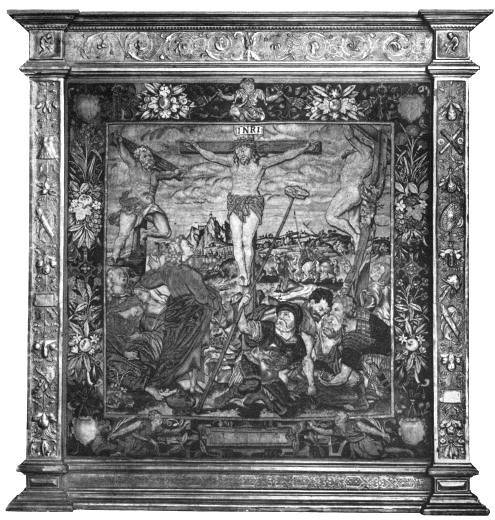
The Crucifixion No. 35
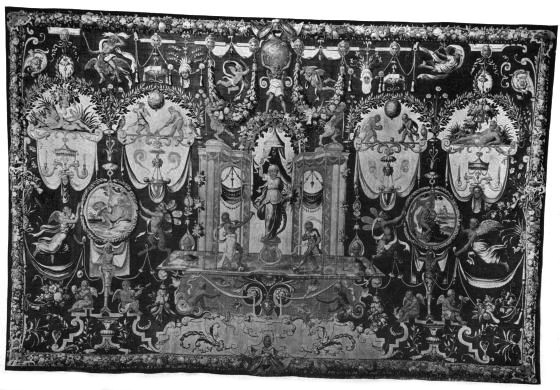
Grotesques No. 36
For grace and charm, without any loss of strength, this surpasses most French work of the period. It is an unusually typical illustration of the French Renaissance which took the technique of the Italian revival of the antique and refashioned it to her own spirit, giving the classic goddesses, even in their dignity, youthful and feminine appeal, and refining the Italian opulence. The floreation in the foreground is as delicate as in a XVIth-century millefleurs, and the colors are unusually luminous.
Lent by Wildenstein & Company.
Francesco Primaticcio (1504-1570) studied under a disciple of Raphael and worked with Giulio Romano on the decorations of the Palace de Te, Mantua. In 1532 he went from Italy to Fontainebleau to work on the decorations there. In 1540 he returned to Italy to collect works of art for the king. He returned to France and continued to create decorations at Fontainebleau with a large staff of Italian painters as his collaborators. Under Francis II he became Superintendent of the Building.
38 PARIS, EARLY XVII CENTURY
Wool. H. 13 ft. W. 16 ft. 9 in.
THE NIOBIDES: Apollo and Artemis from a cloud shoot down the children of Niobe, thus avenging their mother, who had been outraged by Niobe's boasting that she had the more children. Border of fruit garlands and figures in camaieux.
Formerly in Marnier-Lapostalle Collection, Paris. Reproduced: Guiffrey, Les Gobelins et Beauvais, p. 15; Hauser y Menet, Los Tapices de la Corona de España, vol. 2, pl. 132. Lent by Jacques Seligmann & Company.
The tapestry is one of the Artemis series designed for Marie de Medici by Toussaint du Breuil. It was woven on the looms which were under the direction of Marc Comans and François de la Planche, and which later became the Gobelins state manufactory. The cartoons were repeated many times with different borders. Judging by the border, this piece was woven about 1611.
The piece is a splendid example of the dramatic and monumental character of the productions of the pre-Gobelins looms.
The sensitive feeling for decorative fitness and the reserve that are evident in French designs from the Gothic period on differentiate such a cartoon as this from the contemporary Flemish productions, usually so violent and exaggerated in scale, in drawing, and in emotional expression. For, though dramatic, the scene is restrained and the figures have an almost sculptural detachment. This quality is sustained by the fine architectural border, which is very typical of the Paris looms of this period.
Toussaint du Breuil (1561-1602) painted decorations in the Pavilions des Poêles at Fontainebleau, and also in the Galerie des Rois in the Louvre. Most of his work has perished.
39, 40 GOBELINS, XVI CENTURY
Wool and Silk. No. 39: H. 7 ft. 9 in. W. 13 ft. 6 in. No. 40: H. 7 ft. 9 in. W. 11 ft.
TWO SCENES FROM THE HISTORY OF CLEOPATRA: In the first (No. 39) Cleopatra attended by two maidens greets a young prince who is being introduced to her by a general. In the harbor the young stranger's ship is seen.
In the second (No. 40) Cleopatra welcomes a young man. An attendant holds a heavy canopy of silk. Beyond, a Greek temple is seen.
Side borders, only, of classic decorations on a red ground with inset medallions showing the Judgment of Paris.
Formerly in the Collection of Lord Lovelace. Lent by William Baumgarten & Company.
The pieces both signed in the lower right corner—Lefébvre, with the fleur-de-lis and G. They do not, however, appear on the records of the Gobelins, so they must have been done by Lefébvre outside of the official work.
They are strong and fresh examples of the early work of the Gobelins weavers, and typical of the classicism of the late Renaissance in France. The requirements of mural decoration are met by the monumental character and sculptural poise of the figures, but at the same time the design is adapted to a decorative textile through the perfection of the detail and the richness of the colors.
41 FLANDERS, BEGINNING OF XVII CENTURY
Wool and Silk. H. 7 ft. 10 in. W. 13 ft. 4 in. Lent by Mrs. C. Templeton Crocker.
VERDURE: A formal garden with fountains and a château in the distance and various birds in the foreground.
Such landscape tapestries were a characteristic late Renaissance interpretation of the verdure type, a transition between the Gothic millefleurs, that were really originally landscapes without perspective (cf. No. 11), and the XVIIth-century verdures (cf. No. 43). It is a very successful form of verdure, for they are broadly effective from a distance and yet have a sufficient wealth of detail to yield interest on closer exploration. The birds in this piece are especially carefully observed and well drawn, and the purity and vivacity of the color is exceptional for this type.
42 BRUSSELS, LATE XVII CENTURY
Wool and Silk. H. 13 ft. W. 12 ft.
AMERICA: In a tropical landscape an Indian with bow and arrows caressing a crocodile. Two children beside him smoking pipes. In the background on a hill a mission; in the foreground a heap of fruits and flowers and precious objects symbolic of the wealth of the New World. Border of fruits and flowers with corner medallions representing North, East, South, and West. On the lower selvage the Brussels city mark and the signature, I. V. D. BEURCHT.
Another example in Musée Impériale des Ecuries, Petrograd, No. 117. Lent by P. W. French & Company.
The piece is one of a set of four representing the four quarters of the globe. It was woven by Jean Van der Beurcht, one of the great weavers of Brussels, who is known to have been working there between 1690 and 1710. The Van der Beurcht family had for several generations been painters, Jean being the first to turn from that profession to tapestry weaving. He was followed by several other members of the family (cf. No. 56), all of whom did work of the highest quality.
The piece is a splendid illustration of the romantic attitude toward America at the time and a reminder of the importance America had to Europeans as a source of wealth. The mission on the hill, and another mission settlement in the valley of which a glimpse can be caught, are of especial interest.
43 FLANDERS, XVII CENTURY
Wool and Silk. H. 11 ft. 10 in. W. 11 ft. Lent by P. W. French & Company.
VERDURE WITH BEAR HUNT: In a forest of large trees hunters shooting and spearing bears. In place of a border, large columns at the sides with floral garlands hung between them across the top.
The piece is a type of verdure, numbers of which with many variations were produced in Flanders during the XVIIth century. It is one of a set of five, and is a very strong, fresh example.
The substitution of massive columns for formal borders is characteristic of the Baroque period and serves the better to adapt the tapestry to the prevailing architecture.
44 BRUSSELS, XVII CENTURY
Wool and Silk. H. 11 ft. W. 18 ft. 8 in. From the Morgan Collection, No. 17. Another example in the Swedish Royal Collection.
TRIUMPH OF AUGUSTUS AND LIVIA: Caesar offers the crown of victory to Augustus, who kneels before him. He is surrounded by his attendants and his chariot waits in the background. The side borders are of flower-draped columns, top and bottom borders of fruit and flower garlands, with ornaments. On the side borders are cartouches bearing the insignia: Pax. Aug. and Vic. Aug. (Pax Augusta and Victoria Augusta).
The piece is one of a series on the History of Julius Caesar, three of which were in the Morgan Collection. It has all the abundance and dramatic emphasis characteristic of the Baroque period.
Illustrated: Böttiger, Svenska Statins Samling, vol. 3, pl. XLII. Lent by P. W. French & Company.
The massive yet active figures, the large folded, swinging drapes, the luxurious and heavy accessories are all typical of the work of a time when the large, the impressive, and the elaborate were sought in all forms of art. The manner was introduced into tapestry cartoons by Rubens and carried on by many of his pupils and imitators. Even the outline of the composition of this piece follows closely that of Rubens' famous Triumphs, from which the suggestion for the cartoon was undoubtedly taken.
45 FLANDERS, XVII CENTURY
Wool, Silk, Gold. H. 3 ft. 1 in. W. 4 ft. Lent by Duveen Brothers.
THE VIRGIN AND CHILD: The Virgin in a pale red gown with a dark-blue cloak falling about her is seated on the ground. The child holding a staff in the form of a cross sits on her knee. Beyond is a castle, and against the sky a high mountain. Wide floral border. The high lights are in gold.
This is a most exceptional piece of tapestry, evidently made to special order, probably for a private chapel, after an Italian Renaissance painting. The excessive fineness of the weave and the unstinted use of gold to render the high lights indicate that it was made for a person of wealth and importance.
The painting is faithfully and delicately reproduced and the border is remarkably rich and glowing.
46 BRUSSELS, LATE XVII, EARLY XVIII CENTURY
Wool and Silk. H. 12 ft. W. 17 ft. 6 in. Lent by P. W. French & Company.
SANCHO IS TOSSED IN A BLANKET: Sancho, following Don Quixote's example, has refused to pay the innkeeper, as that is against the tradition of knights-errant and their squires. So the clothmakers of Segovia and the needlemakers of Cordova who chance to be there toss him in a blanket, while Don Quixote sits without on his horse cursing lustily.
The piece is one of a set of illustrations of Don Quixote after David Teniers the Younger. The scene has all the casual and convincing informality and boisterous good spirits for which Teniers' paintings are famous. It quite catches the spirit of the romance which it illustrates. The landscape vista is unusually lovely in color.
David Teniers the Younger (1610-1694) was trained principally under his father, David the Elder, also famous for paintings of peasant episodes. In 1633 he became Master of the Guild of St. Lukes, and thereafter was Dean of the Guild and painter to the governor, Archduke Leopold William, a position which he continued to hold under the next governor, Don Juan of Austria. In 1663 he helped form the Antwerp Academy of Fine Arts. He painted innumerable pictures of peasant scenes, many of which have been rendered in tapestry.
47, 48 BRUSSELS, XVIII CENTURY
Wool and Silk. No. 47: H. 11 ft. W. 8 ft. 9 in. No. 48: H. 11 ft. W. 8 ft. 9 in. Lent by Duveen Brothers.
TWO PEASANT SCENES: In the first (No. 47) a group of peasants has stopped to rest and talk beside a stream that comes tumbling down in broken cascades beneath a high stone bridge. On the hills in the background are farmhouses and the ruins of castles.
In the second (No. 48) a group of peasants sits and stands about under a tree in a meadow, in which cattle and goats wander. In the background is a farmhouse.
These tapestries after Teniers are typical of his illustrations of life among the peasants and of his decorative and romantic yet realistic landscapes. They are in weaving and color of the best quality of examples of this type.
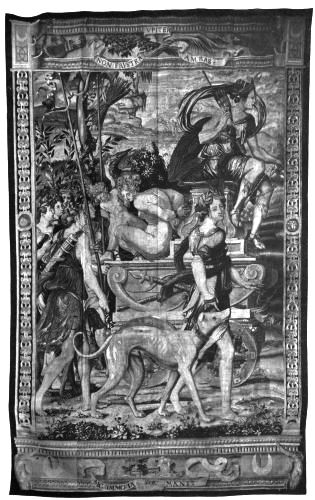
Triumph of Diana No. 37
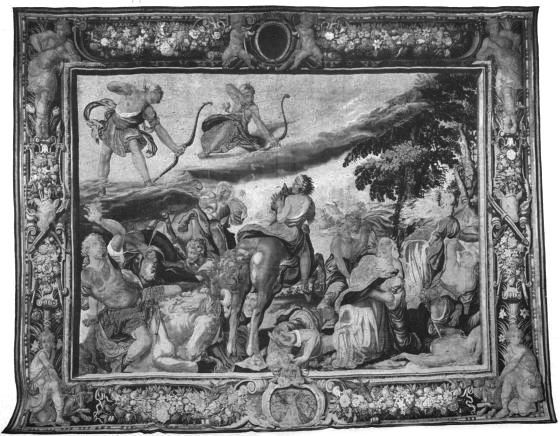
The Niobides No. 38
49 MORTLAKE, LATE XVII CENTURY
Wool and Silk. H. 10 ft. 4 in. W. 7 ft. 6 in. Formerly in the Collection of Sir John Ramsay. Lent by Frank Partridge, Inc.
PEASANTS IN A LANDSCAPE: A group of peasants has stopped by the wayside in a mountainous landscape. Above is a shield bearing the inscription "Iocatur in Parvis sorts ut cum Magna Mercede Fallat."
The cartoon is after Teniers. The Mortlake renditions of these cartoons, which were borrowed from Flanders, have a clarity and sharpness that give them marked distinction. The towering mountain landscape is really impressive.
The rendition of the water is unusually realistic without any loss of decorative interest. The translation of water into a woven design is one of the most difficult problems of the craft. It has been given many solutions, of which this is the most naturalistic.
50 BEAUVAIS, LATE XVII CENTURY
Wool and Silk. H. 10 ft. W. 8 ft. 8 in. Lent by Mrs. James Creelman.
HERMES AND THE SHEPHERD: Hermes has taken the Shepherd's pipe, leaving the caduceus on the ground, and is attempting to play. They are in a wood with large flowers in the foreground. In the background there is a glimpse of a hilly landscape and a formal garden with fountains. Wide floral border.
The piece is one of a set of five verdures, most of which have hunting scenes. While there is no signature, and there are no records on them, the character of the foliage and of the floreation makes it almost certain that these are of Beauvais manufacture. While in some details they resemble contemporary Aubusson tapestries, the quality of the color is rather different.
They are a particularly deep and quiet type of verdure, an excellent background for fine furnishings. The quality of the greens is uncommonly fine.
51 BEAUVAIS, BEGINNING OF XVIII CENTURY
Wool and Silk. H. 10 ft. 9 in. W. 13 ft. 3 in. Lent by Dikran K. Kelekian.
VERDURE WITH DANCING NYMPHS: In a wooded dell are four nymphs dancing. Beyond is a glimpse of an open pasture with cows.
The strong and brilliant trees throw into sharp contrast the delicate perfection of the bit of landscape beyond. The nymphs are probably after Noël Coypel. The use of the red to relieve the general tone of green is especially successful.
52 BEAUVAIS, 1685-1711
Wool, Silk, Gold. H. 15 ft. 8 in. W. 11 ft. 10 in. Formerly in the Lord Amherst Collection. Illustrated: Badin, La Manufacture de la Tapisserie de Beauvais, opp. p. 4. Lent by P. W. French & Company.
THE CONQUEST OF LOUIS THE GREAT: Louis XIV on horseback with two attendants points with his cane to the siege of a city whose defenses are surrounded by water. In the upper border appear the arms of Count Bruhl of Saxony. The piece is one of a set of seven.
This is a very rare example from one of the earliest sets woven at Beauvais when the factory was under the direction of Behagle. The cartoon was designed either by Van der Meulen or his greatest pupil, Jean-Baptiste Martin, later called Martin of the Battles, because of a famous series of cartoons which he made for the Beauvais works illustrating the victories of Sweden over Denmark.
The richness of the king's group stands out brilliantly against the clear, cool color and sharp geometrical lines of the background. The city with its canals and buildings is exquisitely rendered, an interesting anticipation of an aeroplane view.
Adam Frans Van der Meulen (1632-1690) was a native of Brussels and studied there under Peter Snayers, but on recommendation of Le Brun was invited by Colbert to Paris, where he was pensioned by the king and given apartments in the Gobelins. In 1673 be was received into the Academy. He collaborated with Le Brun in making designs for the Gobelins, notably for the series of The History of the King.
53-56 BRUSSELS, BEGINNING XVIII CENTURY
Wool. No. 53: H. 10 ft. 7 in. W. 29 ft. No. 54: H. 10 ft. 4 in. W. 9 ft. 4 in. No. 55: H. 10 ft. 3½ in. W. 7 ft. 2 in. No. 56: H. 10 ft. 4½ in. W. 7 ft. 3 in. Formerly in Stowe House. Lent by Jacques Seligmann & Company.
THE OPERATIONS OF THE SIEGE OF LILLE: Number 53 represents the battle of Wynendael Wood. Lord Cobham on horseback with his sword drawn is in the midst of his troops.
Number 54 shows the burning of Lille. The burning city is seen in the background. Soldiers in the foreground are getting bundles of wood to feed the flames.
Number 55 shows cavaliers foraging. Soldiers are carrying bundles of hay for their horses and a lamb lies on the ground ready to be carried off.
Number 56 shows the poisoning of a spy. The cavaliers have just given a glass of poisoned wine to a young woman who is about to drink.
The borders simulate wooden frames and carry the arms of Lord Cobham.
The set was designed by Van der Meulen for Lord Cobham, who served under the Duke of Marlborough and had a brilliant military career. It was woven at the Royal Manufactory of Brussels under the direction of Leyniers, whose signature appears in the border of three pieces. In the fourth piece is the signature ACASTRO, Latin for Van der Beurcht.
Cobham inherited Stowe House in 1697, and these tapestries until recently hung in the dining-room there.
The set ranks with the strongest and most effective pieces of the period, rich both in illustrative action and in decoration. The weave is technically perfect.
57 GOBELINS, MIDDLE XVIII CENTURY (1747-1751)
Wool and Silk. H. 11 ft. 6 in. W. 8 ft. 3 in.
JULY FROM THE "MONTHS" OF LUCAS: From a series of designs of the Months, used in Brussels since the XVth century and attributed without verification to Lucas Van Leyden. The scene represents a falconing party.
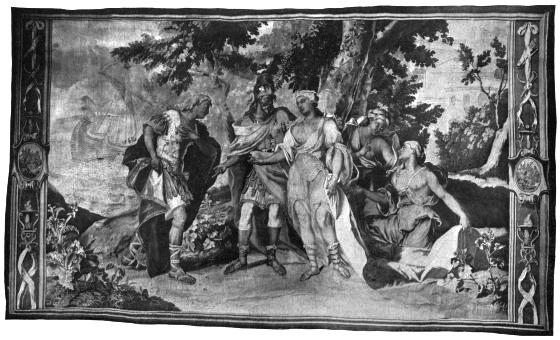
Scene from the History of Cleopatra No. 39
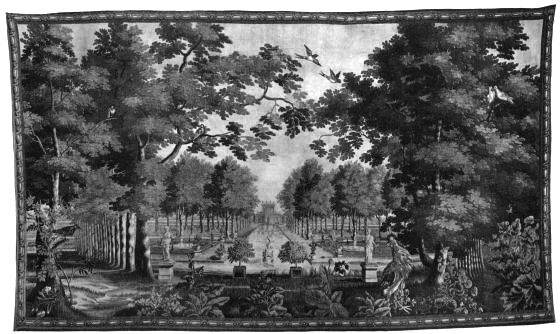
Verdure No. 41
The piece has the last type of border used for the set, the so-called Dresden border, representing a carved and gilded wood frame with corner ornaments surrounded by naturalistic flowers, and with a sign of the Zodiac (Leo) in a cartouche at the top.
Lent by P. W. French & Company.
The piece was probably woven in the tenth weaving between 1741 and 1751 on the upright looms in the atelier of Cozette.[29]
This is an unusually clear and brilliant example of a famous Gobelins set.
58 GOBELINS, XVII CENTURY
Wool and Silk. H. 9 ft. 4 in. W. 6 ft. 8 in. Another example in the Vienna Collection, No. 109. Lent by Wildenstein & Company.
DECEMBER FROM THE "MONTHS" OF LUCAS: A nobleman greets a peasant woman and her child, while a man and woman carrying a baby wait for him. In the background a castle and people skating on the ice. The piece is incomplete.
This tapestry is from the same set as the preceding, but woven almost a century earlier, and it is interesting to contrast the changes that the change in taste has made in the feeling of the rendition and the color key. During the XVIIIth century the cartoon was refined with slight changes. The hand of the old man, for example, was modified to hold a fruit for the child. The piece probably is from the third or fourth weaving. If so, it was done on the horizontal looms in the atelier of Lefébvre, outside of the official work of the Gobelins.[30]
This is one of the few really successful renditions of a snow scene in tapestry.
59 BEAUVAIS, LATE XVII, EARLY XVIII CENTURY (1684-1711)
Wool and Silk. H. 9 ft. 8 in. W. 16 ft. 5 in. Lent by P. W. French & Company.
CHINESE GROTESQUE: Under an arbor clowns conduct a circus. Above the arbor are scrolls, garlands, birds, musical instruments, and other decorations. On a yellow ground.
This is one of a famous series of grotesques by Berain on a yellow ground, woven several times at the Beauvais works when they were under the direction of Behagle.[31]
The entertaining fantasy of the conception, together with the delicate drawing and the beautiful ground color, makes this one of the finest grotesques of the XVIIIth century.
Jean Berain (1638-1711) was appointed in 1674 designer to the king, and in this position designed the scenery and costumes for the court ballets. He is famous for his decorations.
60, 61 BEAUVAIS, XVIII CENTURY
Wool and Silk. No. 60: H. 15½ in. W. 19 in. No. 61: H. 15½ in. W. 19 in. Lent by Maison Jamarin, Paris.
TWO STILL-LIFE PIECES: In one (No. 60) a glass, a napkin, and some vegetables on a table. In the other (No. 61) various vegetables about a china dish.
These panels, after paintings by Chardin, are the only recorded examples of still-life composition in tapestry. From the middle of the XVth century household utensils and various other types of accessories were used to contribute richness of ornamentation to scenes, and during the Baroque period embossed metals and lavish carvings became especially important in creating a luxurious effect, but not until tapestry was thought of as a form of painting was a purely still-life subject attempted. All still-life designs depend so much on contrasted weights, and especially on textures, that they are particularly difficult to translate into a medium which, like tapestry, renders primarily silhouettes and which has such a decided texture of its own. But the extraordinary skill of the XVIIIth-century French weavers was equal even to that problem. The skillful care of the composition of the original paintings and the pure beauty of the colors of the tapestry make of rather unpromising subjects beautiful decorations.
Jean Siméon Chardin (1699-1779) studied under Noël Coypel and assisted Jean Baptiste Van Loo in restoring one of the galleries of Fontainebleau. He was admitted to the Academy in 1728. His early work was devoted to still-life subjects principally, his later to peasant scenes, in which there are often fine incidental still lifes.
62 AUBUSSON, MIDDLE XVIII CENTURY
Wool and Silk. H. 9 ft. 8 in. W. 10 ft. 9 in.
THE PRIEST AND CARDENIO MEET DOROTHY: The priest and the barber while looking for Don Quixote come across Cardenio. While Cardenio is telling them the sad story of how his love, Lucinda, has been stolen from him by the treachery of Don Fernando they hear someone lamenting. Following the sound of the voice, they find Dorothy disguised as a shepherd-boy bathing her feet in a stream. She is on her way to seek Don Fernando, who is her pledged husband and who has deserted her for Lucinda. In the background Don Quixote, exhausted and starved from his wanderings, lies on the ground, while the faithful Sancho pleads with him to return to Toboso.
The border simulates a carved frame. On the lower selvage is the signature M. R. DAUBUSSON. MAGE. PICON.
The piece is one of a series of illustrations by Coypel, originally designed for the Gobelins, and was engraved and used in many editions of the romance both in France and Spain. Several looms made tapestries after the engravings, including those of Santa Barbara in Madrid.
The signature is the mark of the royal manufacture of Aubusson, and of Mage, a tapestry merchant in Paris in 1746, and Picon, dyer to the king from 1748 to 1756. The piece was evidently made in the royal works of Aubusson to the order of the dealer Mage under the supervision of Picon, who, from his position, was evidently one of the most important members of the staff there.
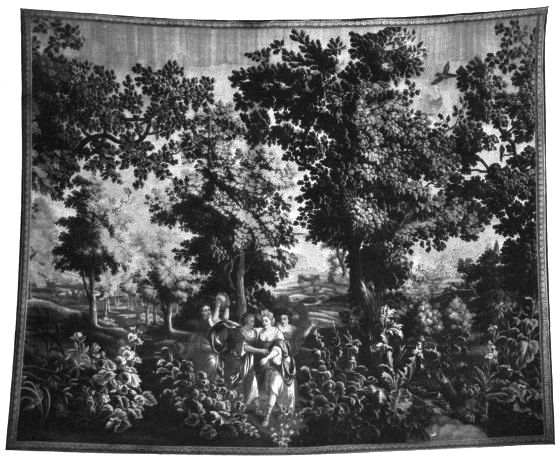
Verdure with Dancing Nymphs No. 51
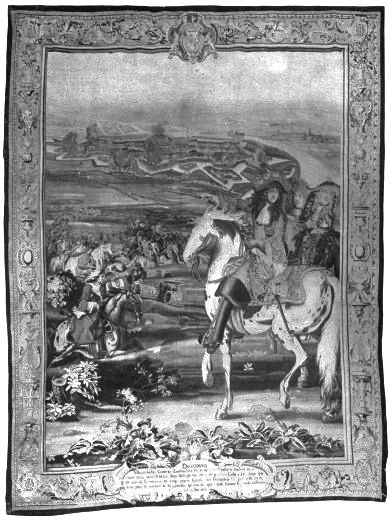
The Conquest of Louis The Great No. 52
The piece shows Aubusson work at its richest and finest. The foliage of the trees with every leaf shown and broken up into small spots of changing color is very typical of Aubusson, and quite different from the manner of the Flemish shops (cf. No. 55). The colors are remarkably fine.
Lent by P. W. French & Company.
Charles Antoine Coypel (1694-1752) entered the Academy in 1715, and the next year made a series of twenty-eight designs illustrating Don Quixote for the Gobelins. A second important series which he designed for the Gobelins illustrated scenes from the theatre. He was a favorite painter of Queen Marie Leczinska. He wrote several comic dramas and had an interest in an understanding of the theatre which is reflected in his tapestry designs, which are conceived always as a theatrical scene in a stage setting, with actors making the proper expressive gestures.
63 PARIS, XVIII CENTURY
Wool and Silk. Oval; H. 28 in. W. 23 in. Lent by Jacques Seligmann & Company.
BACCHANTE: A young bacchante wearing a tigerskin and holding Pan's pipes. In an oval panel.
This panel is after a portrait by Coypel. Though it does not appear on the official registers of the Gobelins, the technique would indicate that it was probably by a Gobelins weaver, who quite often worked outside of the official orders.
The delicate execution reproduces faithfully the piquant charm of the painting; even the most delicate gradations of tones are exactly reproduced.
64. GOBELINS, XVIII CENTURY
Wool and Silk. H. 25 in. W. 21 in. Illustrated: Böttiger, Svenska Statins Samling, vol. 2, pl. XLI; Fénaille, Etat général des Tapisseries de la Manufacture des Gobelins, Dix-huitième Siècle, 2me Partie, p. 311; as portrait of Louis XVI, in Migeon, Les Arts de Tissu, p. 335. Lent by P. W. French & Company.
PORTRAIT OF LOUIS XV: This portrait, after a painting by Van Loo made for the Gobelins in 1760, is one of a series of the royal family. It is in the original frame.
While tapestry is not an appropriate medium for portraiture, a portrait is the supreme test of the skill of the weaver. In this piece the effect of the painting is reproduced with remarkable fidelity. The warp is vertical.
The technical difficulty was the greater because almost the entire piece was woven in wool, the proper material for tapestry, silk being relied on only for a few high lights. As a portrait it has directness and conviction, carrying the essential dignity of royalty. The XVIIIth century, which first undertook to weave tapestry portraits, produced a kind of portrait that was especially ill-adapted to this material; for the likenesses depended primarily on the delicate modeling produced by a very sensitively differentiated scale of values and scarcely at all on lines. Even in Gothic tapestries there are many heads that are striking portraits, but these are entirely graphic in character and so fitted for tapestry. In rendering this portrait the weavers had literally to paint with the shuttle.
Carle Van Loo (1705-1756) studied in Rome under Luti and Le Gros. In his youth he painted scenery for the opera with Boucher. In 1737 he was admitted to the Academy, and in 1762 made first painter to the king.
65 GOBELINS, FIRST HALF XVIII CENTURY
Wool. H. 13 ft. 3 in. W. 8 ft. 3 in. Another rendering in the Vienna Collection, No. 253; another in the Musée Impériale des Ecuries, Petrograd, No. 118. Lent by Demotte.
THE INDIAN HUNTER: This tapestry is one of a set of eight illustrating the New India after designs by François Desportes. The set was first woven in 1687. This piece has the first type of border used with the series, bearing the arms of the king, which means that it was woven before 1768 under either Cozette or Neilson.[32]
The design is typical of the romantic primitivism that Rousseau formulated in his conception of the Noble Savage. The accuracy of detail in the Indian basket is interesting and rather unexpected.
François Desportes (1661-1743) studied under Bernaert, a pupil of Snyders. He entered the Academy in 1699 and was made painter to the king. He is famous for his paintings of animals and hunting scenes.
66 BEAUVAIS, XVIII CENTURY (1777)
Wool. H. 11 ft. 1 in. W. 21 ft. 3 in. Formerly in Collection of Count Polovzoff, Petrograd. Another example in the Swedish Royal Collection. Illustrated: Böttiger, Svenska Statins Samling, vol. 3, pl. LXVI. Lent by Jacques Seligmann & Company.
THE THEFT OF THE TRUNK: A group of gypsies surround a traveler's carriage, and while some tell the lady's fortune and receive alms others attempt to steal a trunk from the baggage-rack behind.
The tapestry is one of the series Les Bohémiens by François Casanova, and was woven in Beauvais when the factory was under the direction of André Charlemagne Charron, whose initials it bears in signature. According to the inventories, the series has been woven only twice—once in 1777 for the king, and again in 1799.[33]
The vividness of the minor episodes and the vivacity of characterization of even the lesser actors make this a most interesting tapestry. The weaving is done with exquisite skill and the color is unusually fresh and charming.
François Casanova (1730-1805) went to Italy in 1727 where he studied under Guardi and Francesco Simonini. He returned to France and later studied under Parocel. In 1763 he was received into the Academy and exhibited in the salons until 1783.
67 BEAUVAIS, XVIII CENTURY (1735-1740)
Wool and Silk. H. 11 ft. 9 in. W. 14 ft. 6 in. Lent by P. W. French & Company.
THE ARMS OF FRANCE AND NAVARRE: Two angels on clouds support the coat of arms before an ermine drape against a ground of fleur-de-lis on blue.
The angels are after Boucher, the only coat of arms in tapestry known to which Boucher has contributed. It is evidently one of several fleur-de-lis pieces listed in the accounts of Beauvais between 1735 and 1740 and may be the one made for the Parliament of Rouen in the latter year.[34]
It is an unusually rich and interesting armorial, the angels with their characteristic Boucher grace adding great beauty to the formal setting.
François Boucher (1703-1770) studied with Lemoyne and during that time painted scenery for the Opera, a work to which he returned in the height of his career (1737-44). In 1734 he became Academician. In 1735 he was appointed head of the Gobelins by Marigny. In 1765 he was made first painter to the king and Director of the Academy. In the years between 1740 and 1755 he painted many cartoons for the Beauvais tapestry works. Among his most famous tapestry suites are the Loves of the Gods, the Chinese Hangings, and the Italian Fêtes.
68 GOBELINS, XVIII CENTURY (1767)
Wool and Silk. H. 4 ft. 11 in. W. 6 ft. 6 in. Illustrated: Fénaille, L'Etat général des Tapisseries de la Manufacture des Gobelins, Dix-huitième Siècle, 2me Partie, p. 238. Lent by Duveen Brothers.
THE FORTUNE-TELLER: Two peasant girls seated on the ground by a fountain are having their fortune told by another girl. A naked baby clings to her skirts. From one side a goat looks on inquisitively. It is signed F. Boucher and dated.
This is one of a series of cartoons in small size made by Boucher for the Gobelins while he was director. They were very popular and have been woven a number of times.
The piece shows how remarkably the delicate gradations of tone, on which Boucher's essential quality depended, could be translated into the weave by the extraordinarily skillful craftsmen of the Gobelins.
As in all of Boucher's cartoons, the subject is only an occasion for his own charming decorative mannerisms. As a rendition of peasant life, it is interesting to contrast this cartoon with the honest literalness of Teniers (cf. Nos. 47-49).
69 AUBUSSON, LATE XVIII CENTURY
Wool and Silk. H. 9 ft. 10 in. W. 7 ft. 5 in. Lent by P. W. French & Company.
BAIGNEUSE: A bather attended by amorini is about to step into a woodland stream. In an oval frame surrounded by an encadrement of garlands upheld by amorini and satin drapes in the manner of Huet, on a gray ground.
The central panel is after Fragonard, a subject that he repeated with many variations. The piece is typical of the Aubusson work, delicate in color with the decorative effect depending largely on the flowery encadrement.
Jean Honoré Fragonard (1732-1806) studied under Boucher, Greuze, and Chardin, and is usually considered the successor of Boucher. In 1752 he was given Grand Prize for Painting. He was a favorite painter of Madame Du Barry, for whom he did a great deal of work.
70 AUBUSSON, LATE XVIII CENTURY
Wool and Silk. H. 8 ft. 10 in. W. 6 ft. 6 in. Formerly in the Vaffrin Collection, Bordeaux. Lent by Wildenstein & Company.
AU BORD DU MER: In an oval panel are peasants landing from a rowboat. In the harbor under a cliff is a sailing vessel. In an encadrement of red and blue flowers and ribbons on a gray ground.
The central panel is after Vernet, who was particularly famous for his port scenes. The encadrement is unusually rich and delicate.
Claude-Joseph Vernet (1714-1789) first studied under his father as a decorative painter of wall and furniture panels. Afterward he studied under Bernardino Fergiori in Rome to be a marine painter. In 1735 he was received by the Academy. His most famous paintings, of the seaports of France, are in the Louvre.
71 AUBUSSON, XVIII CENTURY
Wool. H. 9 ft. W. 5 ft. Lent by A. J. Halow.
CHINESE GROTESQUE: A Chinaman, fantastically dressed, stands between two tall tropical trees. On a pale-blue ground.
The piece is a delightful example of the taste for chinoiseries which the Pompadour fostered for the benefit of the French East India Company, in which she was interested, and which taste was eagerly followed by the frivolous and bored French court, always seeking novelty.
72 AUBUSSON, XVIII CENTURY
Wool and Silk. H. 4 ft. 3 in. W. 3 ft. 9 in. Exhibited: Detroit Museum of Fine Arts, 1919. Lent by Dikran K. Kelekian.
ARMORIAL: On a red ground, two angels support a shield. Border of scrolls.
This crisp and delicate little armorial is a fine example of the best quality of work done at Aubusson in the late XVIIIth century. The clear drawing on the deep-red background makes a vivid piece of decoration.
The rendition of a coat of arms in tapestry is difficult, because the decorative value of heraldic devices depends almost entirely on the beauty of the line-drawing, and tapestry, because of the character of the weave and the surface, is not a good medium for clean lines. In the earlier periods, therefore, the shield was usually made incidental to a design better adapted to tapestry (cf. No. 9). It was only well into the XVIIIth century that the bearings could be woven delicately enough to let them stand alone.
73 IMPERIAL RUSSIAN TAPESTRY WORKS, ST. PETERSBURG, 1811
Wool and Silk. H. 9 ft. 4 in. W. 6 ft. 7 in. Exhibited: Metropolitan Museum, 1912.
CATHERINE THE GREAT: Catherine stands in her robes of state holding the sceptre while the Imperial crown rests on a stool beside her. On the wall is the Russian motto, NACHATOYE SOVERCHAYET ("What is begun is accomplished"). It is signed and dated.
For sheer technical skill the rendition of this portrait is unsurpassable. The representation of textures is remarkable, quite on a par with the cleverest paintings of the period.
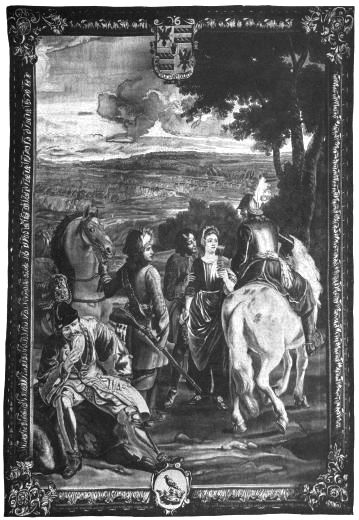
The Poisoning of a Spy No. 56
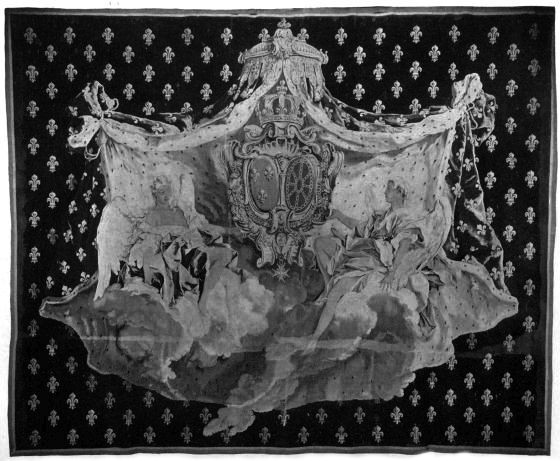
The Arms of France and Navarre No. 67
Illustrated: Hunter, Tapestries, pl. 229; also, Candee, Tapestry Book, opp. p. 133,—but wrongly attributed to the Gobelins. Lent by P. W. French & Company.
It is, in truth, an absolutely perfect reproduction of a painting—a painting, moreover, that from the character of all the accessories is particularly difficult to render in wool; and while it is by no means the business of tapestry to imitate painting, it is nevertheless an interesting display of remarkable virtuosity. The personal power of the forceful old Empress is strongly presented. From every aspect this is one of the greatest portraits in a woven medium. In general color tone the piece has remained faithful to the character of tapestry, sustaining the rich quality that the solid texture demands. In spite, also, of the need for many delicately graded values to render the stuffs and the modeling, the weavers have kept the color in large enough masses to be broadly decorative.
74 MADRID, LATE XVIII CENTURY
Wool and Silk. H. 5 ft. W. 8 ft. Lent by Duveen Brothers.
THE CARD PLAYERS: A group of men and women playing at cards sit about a table on which is thrown a rich brocade. One of the company sits to one side playing a lute.
This piece is one of the rather uncommon examples of the work of the Santa Barbara looms of Madrid. The skill of the weavers is remarkable in reproducing the heavy modeling of the deep shadows and the delicate modulations of the faces. For the perfect rendition of the effect of a painting in tapestry it cannot be excelled.
ADDENDA
The tapestries entered under this heading were received too late to be entered in their proper order in the body of the catalogue.
75 BRUSSELS, BEGINNING OF XVI CENTURY
Wool, Silk, Gold. H. 9 ft. 1 in. W. 7 ft. 8 in.
THE RESURRECTION: The risen Christ discovered by Peter. Upper left, the Agony in Gethsemane; upper right, Christ appearing to Mary in the garden. In the background, the angel appearing to the three women. Border of fruits and flowers, grapes, roses, and iris interspersed with finches and a paroquet.
This tapestry, the last of a series illustrating the Passion of Our Lord, was designed in the studio of Bernard Van Orley, and may be the work of Van Orley himself, though there were some of his students and followers who in purity of conception and elevation and sensitiveness of feeling were superior at times to the master himself. The weaving, unsurpassable in technical perfection, may be the work of the Pannemaker looms. The quality of the design and weaving and the lavish use of gold all indicate that this series was made for a great church or a noble family.
Formerly in the Collection of the Duc d'Albe.
The weavers at this period had attained complete mastery of the shuttle. This absolute technical control made possible the exact translation into tapestry of the intricate Renaissance patterns. The finish and elegance of the goldsmith's art which characterized so much of Renaissance design is perfectly rendered.
However, while the weaving was fitted to the requirements of the Renaissance at this time, it had not yet sacrificed any of its qualities as tapestry. Nor did the designs of Bernard Van Orley force the weavers out of their proper limitations. For though he was Italian trained and saturated with Renaissance influences, he was still close to the technical problems of the weaver's art and he adjusted the new manner in painting to them. So this piece is rich in jewel-like detail that enriches without crowding the whole surface. The drawing of the flowers and the birds is exquisite. The figures also, in spite of their dramatic force, keep the aloof poise that decorative art demands. Finally, by means of a dispersion of substantial tones, the brilliant suffusion of golden light which the Renaissance loved is fully achieved.
Such a scene as this is, in short, one of the last great monuments of the perfection of Gothic tapestry, reinspired by the new insights of the Renaissance before the ostentation and mistaken conventions of Raphael misguided the entire art.
Lent by Mrs. William H. Crocker.
Nor is it merely a technical triumph. It is the direct expression of a profound religious emotion which shines through the material beauty, elevates it above earthly things, and sets it apart in glory. Easter has scarce had a lovelier celebration.
76 BRUSSELS, XVI CENTURY
Wool and Silk. H. 15 ft. W. 19 ft.
THE TRIUMPH OF WISDOM: Wisdom with her two herons rides in a chariot drawn by mythological beasts. In the upper right are Perseus and Pegasus. Before the chariot are Ahasuerus, Abigail, David, and Saba. Cassandra walks beside, while Titus and his soldiers, Rachel, and Judith with the head of Holofernes bring up the rear. In the upper left Prometheus, in the lower Cadmus, contending with the dragons.
This is one of a very famous set of tapestries illustrating the Triumphs of Petrarch and a number of other Triumphs invented by French poets in imitation of Petrarch. The cartoons are evidently the product of the studio of Maître Philippe (cf. Nos. 19, 20), for the heads of several of the minor characters are regular models, often repeated in his work. The cartoons were painted and also executed before 1523, because in that year Henry VII bought eight of the set, four of which are still at Hampton Court. This piece, however, was woven in the middle of the century, as is shown by the character of the heavy floral border. In the selvage is the Brussels city mark and the mark of the Brussels weaver, Leo Van den Hecke.