PUSS AND THE CAPTAIN. (continued 2)
Reading edition
And, really, when a person has been accustomed to see set before him every day, at his own hour, on his own platter, a supply of bread and meat nicely mixed, with perhaps some pudding to finish it, and no trouble required on his part but to eat it tidily, and say "Thank you" after his fashion, it is no small puzzle suddenly to be obliged to provide his own dinner from beginning to end—catching, cooking, and serving it up. There are more in the world than I who would know how to do nothing but eat it. If I had been a wild dog, used to the habits of savage life, I might have hunted down some smaller animal as wild as myself, torn it to pieces, and devoured it raw; but I was a civilised creature, so altered by education, that in my hunting days I always brought the game to my master instead of eating it myself; and here, on the London high road, there was not even game to be caught. I really was quite at a loss what to do.
In course of time I came up with a traveller sitting under a hedge, eating a lump of bread and cheese. I would not have accepted bread and cheese at home if it had been offered me, but now I stopped in front of the eater and began to beg for some, licking my lips, and wagging my tail in my most insinuating manner.
He threw me a scrap of coarse bread, saying, "There's for you; but I dare say you are too well fed to eat it."
His supposition would have been true enough the day before; but hunger cures daintiness, and now I was glad of such a mouthful. I bolted it in an instant, and looked for more. He threw me one other crust, saying that was all he could spare; and, finishing the rest himself, went on his way, leaving me as hungry as ever.
By and by, in passing through a village, I came to a butcher's shop. The butcher was not in sight, and meat was spread in the most tempting manner on the board.
"How easily," thought I, "I could steal that nice raw chop, and run away with it! Nobody could see me, and I do not believe any body could catch me."
Steal it—the thought startled me. Brought up from my earliest puppyhood in the strictest principles of honesty; able, as I imagined, to see the best-stocked larder, or the most amply-supplied table, without even wishing to touch what was not my own;—was I now, on the very first temptation, the first time in my life that I had ever been really hungry, to forget all I had been taught, and to become a thief? Was it only the fear of blows that had kept me honest? Was my honesty worthy the name, if I was only honest when I had no temptation to be otherwise? I was ashamed of myself, and turning from the shop, passed on with drooping ears.
Presently I met with a dog so extra fat as to show plainly that he had never gone without his dinner, and yet he was growling over a bone as if he had been starving. On looking more closely at him, I perceived that he was in possession of two bones, either of them enough for one dog; but he was unable to make use of one, for fear of the other's being taken from him. So there he lay, with his paws upon both, growling instead of enjoying himself. He was a larger dog than I, but not nearly so strong, being grown helpless and unwieldly through long habits of greediness and laziness. I saw that I could easily master him and take one of his bones by brute force, and at first I felt inclined to help myself by this means. I thought I had a good right so to do. I actually wanted the necessaries of life, while he was revelling in superfluous luxury. Was I not justified, nay more, was I not bound in common sense and justice to take from him what he did not want, and give it to myself who did want it? Even if I robbed him of one of his bones, I should leave him as much as I took away.
Robbed—another awkward word! I paused again. Assault and robbery were perhaps not so mean as sneaking theft, but were they more allowable? The bones were his own, his property; given to him by some one who had a right to dispose of them; and though at this moment I might wish for a more equal distribution, I had sense enough to know that it would be a bad state of things if every dog were to seize upon every neighbouring dog's bones at his own discretion. It might suit me at this moment, but to-morrow a stronger dog might think that I had too much, and insist upon my relinquishing half of my dinner. Who was to be the judge? Every dog would differ in opinion as to how much was his own fair share, and how much might be left to his neighbour. No large dog would allow another to dine while he himself was hungry; and it would end by the strongest getting all the bones, while the poor, inferior curs were worse off than ever. So I determined to respect the rights of property, for the sake of small dogs as well as for my own.
After all, starvation was not inevitable. It might be possible to get a dinner without fighting for it. I sat down opposite my new acquaintance, and entered into civil conversation with him. I found him much more friendly than I expected. He had certainly been accustomed to more indulgence and idleness than was good for him, but his natural disposition was not entirely spoilt. He was the peculiar pet of a lady, who thought it kindness to cram him from morning till night with food that disagreed with him, to provide him with no occupation, and to deprive him of healthy exercise, so that no wonder he had grown lazy and selfish; but his native spirit was not entirely extinguished, and he assured me that a bare bone to growl over, and a little comfortable rain and mud to disport himself in like a dog, were still the greatest treats that could be offered to him. His temper had been farther soured by the spite and envy of dogs around him, who, less petted themselves, and not aware how little his petting contributed to his comfort, grudged him every thing that he possessed, and lost no opportunity of snapping and snarling at him.
When I reflected on the difference between his circumstances and my own, I felt more inclined to pity than to blame him; but though I condoled with him kindly, and whined in sympathy, I took care to give him the best advice in my power, and to suggest such changes in his own conduct as might tend to better his lot.
He listened with patience and candour, and showed his gratitude by treating me with the most cordial hospitality. He gave me an excellent bone, and offered to share his kennel with me; but after my dinner and a nap I was so thoroughly refreshed, that I preferred continuing my journey. He pressed me to call on him in my way back, provided I returned alone; but honestly confessed that if I was accompanied by a cat, he feared that the force of habit might be too strong to allow of his being as polite to her as he could wish. Remembering my own early prejudices, I had no right to blame him; and we parted excellent friends, though I declined his invitation.
I met with no more adventures or difficulties. Even my night's lodging gave me no trouble; for when it was growing dark, and I felt too tired to run any farther, I espied a heap of straw thrown out by the stable-door of a roadside inn, and I soon scratched and smoothed it into as comfortable a bed as dog need wish. By break of day I was on my travels again; and being now near my native village, in a road of which I knew every step, I had no further perplexity, and by breakfast-time arrived at my old home.
It had never occurred to me that any body would be surprised to see me. Having always met with a hearty welcome, I expected one as a matter of course; but I certainly never anticipated being received with a shout of astonishment, and to this day I cannot understand why they were all so amazed. But so it was. When the gardener opened the gate and saw me sitting outside, he started as if I had been a strange dog going to fly at him; and instead of speaking to me, began calling as loud as he could to his wife:
"Peggy! why, Peggy, make haste, I say. Here's the dog! How did he ever come here?"
The old lady came bustling along at double her usual speed, and I thought she would immediately explain my appearance; but she seemed even more surprised than her husband; she fairly screamed.
"Well to be sure!" exclaimed she as usual, as soon as she had recovered her breath; "well to be sure! Did any body ever see such a thing? How can he have come? Do you think master is on the road?"
"I'll run down to the turnpike and see," answered her husband; and off he set, without bestowing a word upon me; his wife meanwhile, with her apron thrown over her head, straining her eyes to look after him. I wagged my tail, and patted her with my paw, and did my best to make her understand that I was there on my own account; but her head was too full of fancies to attend to the reality, and she persisted in looking out for my master who was not coming, and neglecting me who was there under her eyes. So I left her to find out the state of the case as she could, and turned my steps towards the house, where I hoped to meet a friend, who would think nothing so natural as my being at her side.
I peeped in at the kitchen window, and there sat my Pussy, in her old place before the fire, looking just as when I left her—the neatest, whitest, softest, and gentlest of creatures. She was not surprised to see me. She winked and blinked a little, as if she was dreaming of me at that moment, and was afraid to open her eyes more than half-way, lest the dream should vanish; but at last she opened them altogether, and the dream turned to reality. Then, had we not a happy meeting!
There was much to tell on both sides before we could properly discuss the grand object of my coming, and our time was a good deal taken up by a constant succession of visitors; not dogs or cats, as might have been expected, but boys and girls, men and women, friends of the servants, all pouring in to see me. From the time that the gardener and his wife had satisfied themselves that my master was not coming with me, they seemed to consider my arrival stranger than ever, and to think it necessary to inform every body of the circumstances,—though I should certainly have supposed there would be more wonder in seeing two persons than one. Pussy did not approve of so much company, as she always disliked to be stared at; I, being of a less retiring turn of mind, was perhaps rather flattered by the notice; but, by the time evening came, even I was glad to have the house quiet. Then we lay by the fire, and explained all our feelings to each other.
I described to my friend how unhappy I had been without her, and how amidst all the pleasures of London I had languished for her company, till I could bear my loneliness no longer; and I entreated her, for my sake, to relinquish all her present habits, and to try a new life and a new home.
She heard me with much sympathy, and owned that she too had been unhappy; and that, notwithstanding the placid exterior which she had thought it right to keep up, she had missed me quite as much as I missed her. But she did not at once, as I hoped, agree eagerly to my proposal of accompanying me to London. She hesitated. The journey seemed an arduous undertaking. What strange dogs she might meet! what showers of rain! what obstacles of all kinds, that had never suggested themselves to me!
I strenuously combated all her objections, trying to convince her that the journey which seemed so formidable would turn out a mere pleasure-excursion. I did not mind getting wet myself; but as she did, I was glad to assure her that there was plenty of shelter in case of rain. Indeed, one might suppose that the whole road had been laid out for the express convenience of cat travellers; there were such hedges, trees, stiles, sheltered nooks, and sunny banks in every direction. Then as for strange dogs, was I not there to protect her? was I not a match for any dog? and did she not know that I would gladly shed the last drop of my blood in her cause, besides enjoying a fight on my own account? She sighed, but her sigh was a nearer approach to a purr than before, though her objections were far from being finished.
She owned that she dreaded change. She had her own habits and her own duties; she had been used all her life to that same house, with its cellars and its pantries under her especial charge, and she was afraid that in a new place she might be idle and uncomfortable.
This seemed to me a most unreasonable punctilio. I allowed that she might fairly prefer the country, but I could not for a moment admit that a town life need be idle. Did she suppose there were no mice in London? I could answer for the contrary. The servants were perpetually complaining not only of mice, but of rats; and only the day before I started, I had heard them declare that they could not do without a cat any longer. A most active life was open to her. The only danger was, that she might find too much to do, and that her love of neatness and comfort might be revolted by the dark crannies and gloomy cellars in which she had to seek her work. But as for being useless, that was indeed an idle fear any where for any body who wished to work.
She listened attentively, and began to purr in a more decided manner.
"Still," said she, "I am afraid they will miss me here."
"No doubt," I replied; "but their loss can be remedied. A house like this can be kept in order by a very inferior cat to yourself; and after all, you are cherished here chiefly because it was Lily's wish. Peggy can easily find another kitten; and you know she has often said that white cats were not to her taste, and she should much prefer a tabby."
"True, true," murmured Puss; and seeing that she was gradually softening, I continued to place every inducement before her in the strongest light. I represented the present unguarded state of the sugar, candles, preserves, &c., in a manner to touch the feelings of any domestic cat, and dwelt at some length on the improvement that must take place in the house under her vigilant superintendence. And I finally crowned my persuasions with the tenderest appeal to her affection for me, drawing a vivid picture of the difference to me and to my happiness that would result from her companionship. Pussy had for some time been wavering, and before I had finished my harangue she purred a full consent.
I need not describe my delight at thus gaining the great object of my life. Some feelings should not be made public property. My happiness was not of a nature to be boisterous, but it was such as to satisfy Pussy that she had decided aright.
At break of day we began our grand adventure, as we were anxious to lose no time; and we had been so well fed over-night, that we could defy hunger for the next twenty-four hours. When I had set out on my solitary journey, I had felt very easy about my accommodations and mode of travelling; but now that I had my less hardy companion, many cares crowded on my mind, and I pondered so profoundly over every arrangement, that Puss seemed the most cheerful and courageous of the two. Indeed, from the moment she agreed to my request, she generously gave to the winds all her former objections, and thought of nothing but helping me, and giving as little trouble as possible herself.
We passed through our native village quietly. All curious observers had visited us the night before; and our friendship was so well known, that the sight of us together attracted no notice beyond a few kind words; but on emerging into the great world of the London road, we were obliged to hold a consultation upon our proceedings. Though our object was the same, our views of the best means of attaining it did not quite agree; Pussy's idea being to avoid fighting, mine to be prepared for it. Doubtless a combination of both principles was our true policy.
We reconnoitred our route. Fields on each side were divided from the road by hedges, and there was a raised path between the hedge and the road. We decided that I should run along the open path, looking out for every danger, while Pussy, as much out of sight as possible, crept along the field on the other side of the hedge. Though this arrangement separated us, it was by far the safest; the thick green hedge hid the cat from observation, and there were plenty of gaps through which we could take an opportunity of peeping at each other, unmarked by any one else. Moreover, the fields had attractions for Pussy besides mere security; she could catch birds and field-mice, and thus secure a comfortable meal at any moment.
In this manner we proceeded pleasantly for many miles; I trotting steadily onwards, and Puss creeping behind the hedge at her usual stealthy pace. When prudence permitted, we enlivened our journey by various agreeable diversions. Sometimes on coming to a paling or a wall, Puss jumped up with her usual activity, and ran along the top. Occasionally we made a halt, while she climbed a pleasant tree, and I reposed on the grass under its shade. Or she would rest on a sunny bank, while I amused myself by watching any passing carriages and horses in the road. Once or twice we left the beaten path in search of water, but we were careful not to wander far out of our way.
In going through one village, we observed some trellis-work on the gable end of a house, affording facilities of ascent quite irresistible to a cat of spirit. Puss was on the perpendicular wall in an instant, climbing hand over hand, or rather paw over paw, till she reached the roof. There she revelled in her favourite exaltation, and enjoyed herself thoroughly in darting over the slates, and making excursions up and down the chimney stacks. As there were several houses adjoining, she had the opportunity of a considerable promenade along the gutters, very satisfactory till she came to the end of the row; but there, unfortunately, she found no means of coming down again. There was no trellis; and a blank wall, without a single projection to afford a footing, was beyond even her dexterity. There was nothing to be done but to retrace her steps, I meanwhile running along the footpath, and looking up with some anxiety.
But we were not obliged to go back very far. The middle house was an inn, with a sign-post before it, from which hung a picture of a red lion rampant,—an ugly beast, and far from royal. I thought I would have shaken him to pieces if he had been alive, but under present circumstances I was very glad to see him. Puss sprang from the roof to the cross-beam which supported him, and from thence easily scrambled down his post to the ground. Very glad I was to have her at my side again, and to make our way through the village unmolested.
THE JOURNEY TO LONDON. Page 84
All these freaks had rather hindered us, as people cannot go out of their way for amusement without wasting more time than they reckon upon; and I now urged Puss to resist such temptations, and to keep up a steady walk on her side of the hedge. Not being able to climb myself, I had no sympathy with her great love of the art; and, in fact, I had sometimes considered her power of ascending heights, and finding footing in places inaccessible to me, as a fault in her character. But as I did not wish to be ill-natured and disagreeable, I indulged her taste, though believing it to be useless, if not dangerous, and often persuading her to keep to the beaten path in every thing.
But I thought myself wiser than I was, and I had to learn by experience that every different nature and endowment may have its peculiar advantages. Before we were out of sight of that village, the very talent which I had despised was the means of saving Pussy's life.
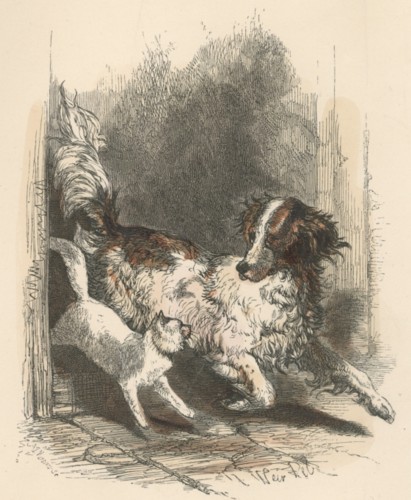
The hedgerow, which had hitherto been our safeguard and screen from impertinent observation, had come to an end; the fields were separated from the road only by an open ditch, and young trees enclosed in palings were planted at regular intervals along the path. We were trotting leisurely, thinking of no mischief, when at a turn in the road there suddenly darted out upon us a fierce and powerful mastiff. To leap the ditch and be at Pussy's side was the work of a moment both for him and for me, though with very different intentions; he to assail, I to defend her. The attack was so sudden, that Puss had not time to use her weapons to any purpose; she just managed to give one spirited claw at his nose with a loud hiss, and then sprang faster and higher than I had ever seen her spring before, and gained the top of the paling just in time to escape his seizure. If she had not been able to jump, she would have been a dead cat. Even then she was not quite out of his reach, and he flew after her; but I threw myself upon him while she bounded to the little tree, and climbed its branches till she gained a place of safety.
Then the mastiff and I had a battle royal. The very recollection of it at this day does me good. We were all in the highest state of excitement. Puss in the tree, her back showing high above her ears, and her tail swelled to the size of a fox's brush, puffing and spitting at her enemy like a snake or a steam-engine; the mastiff running round the paling on his hind legs, banging up against it on every side, and barking and howling with rage; I, no less furious, howling and barking at him in return, and galloping round the tree as wildly as he did. Determined to try every thing, he turned to dash round the other way, and we came full upon each other. I need not describe the consequences. "Greek" may "meet Greek," and I leave the result to the learned; but if any body had ever doubted whether when dog meets dog, "then comes the tug of war," now was the time to convince themselves. We certainly did tug at each other most decidedly. Our strength and courage were so nearly equal, that for some time the victory was doubtful. Again and again each hero, bitten, scratched, and bruised, rolled in the dust, and rose up again shaking ears and coat, ready to rush upon his adversary with undiminished spirit. The final issue seemed to depend entirely upon the power of holding out longest. As I scorn to boast, I candidly confess that I was many times ready to ask for quarter and own myself beaten: indeed, if I had only been fighting on my own account, I must have yielded; but the goodness of my cause supported me, and in defence of my friend I performed exploits of valour that I did not know to be in my nature. At last I had the satisfaction to see my enemy fairly turn round, and with drooping head, and tail between his legs, sneak off to his own home in a very different state of mind and body from that in which he left it. I sent after him a bark of triumph that made the woods re-echo; but my best reward was in my Pussy's thanks and praises, and the happy consciousness of being her successful champion.
I required a little rest after my exertions; but before long we were on the move again, and met with no further impediments till we arrived at our resting-place for the night. This was under the shelter of an empty barn, rather infested by rats, so that Puss found both food and lodging. Tastes differ: I was glad of a comfortable roof and a warm corner; but though Puss pressed me to partake of her provision, I preferred going without a meal for once in my life to sharing a rat.
We were up and dressed time enough for the rising sun to meet us on our road. I have few more "incidents of travel" to recount; indeed, beyond a little difficulty in crossing a puddle or two without wetting my comrade's feet, or dirtying her white stockings, we arrived at the outskirts of London without hindrance.
But I feared that it would not be so easy to creep unobserved through the busy streets, and I grew very uncomfortable when I found myself and my companion in the midst of the throng. I was anxious to conceal my fears from Puss, lest I should alarm her also; but her penetration saw through my forced cheerfulness, and obliged me to confess my apprehensions. True to her determination of making the best of every thing, she was more courageous than I. With her usual good sense, she pointed out to me that the greater the surrounding numbers, the better the chance of any individuals passing unnoticed; that it was the idle who hindered or molested others; and that this multitude of people, intent upon objects of their own, would have neither time nor inclination to annoy us.
"I know by experience, my dear Captain," continued she, "that when I am properly occupied with my own rats, I have no temptation to interfere with my neighbour's mice. It is when I have been sitting too long purring in the sunshine with nothing to do, that I am in danger of being mischievous or troublesome."
"True," I answered; "I can bear witness to that myself: and I am not afraid of the industrious people, if they noticed us, it would be kindly. But these are not all busy,—some may be at leisure to worry us; and I scarcely know how we are to pass unobserved; I fear we are very remarkable. At home you know how much was said about us."
"Yes, at home," she replied, with a significant curl of her whiskers, "but at home we stood alone; there was no one to compare us with. I fancy that many are thought great personages in their own little village, who would be quite unnoticed elsewhere. I hope that may be our case."
"You hope!" exclaimed I, almost with a bark; for in spite of my fears, I by no means admired Pussy's modest style of consolation. Mortification got the better of prudence, and I felt that I would rather fight every day and all day long than not be thought worth fighting with.
"I hope it for myself," she answered; "but I do not expect you to be of the same opinion. I am content to shun danger and avoid blame; but it is your nature to meet peril and to court praise."
"You are rather inconsistent," interrupted I, somewhat nettled: "one of your objections to coming with me was, that you thought you could be of no use in London; and now you are wishing to be altogether unnoticed."
"I do not see any contradiction," she replied; "one may be useful without being conspicuous. If I can fill my own little post quietly, so as to please you and my master, I am content that no one else should even know of my existence. My climbing exploits are only for my own pleasure, as you know. I have no ambition."
"Such a life would not satisfy me at all," I answered.
"So much the better," said Puss; "there would be few great things done in the world if no one were more energetic or daring than I. It is a capital thing that there should be such as you, able and willing to defend the weak, and to stand up for the right without fear of consequences. It is your proper part, and I am truly grateful to you for acting it so nobly as you did yesterday."
This view of the matter soothed my feelings; and for the present, at any rate, I was glad that Pussy's retiring disposition should have its way. The more she crept through by-ways and slunk into corners, the better I was pleased, for I was too fond of her to wish to see her in danger for the sake of my own honour and glory.
So with care and caution we went on our way, taking every means to avoid not only dogs and boys, but even older and wiser beings; and at last, under lamp-posts and door-posts, through kennels and gutters, now creeping along the ledge of a wall, now hiding under the shelter of a friendly porch, always watching each other at every step we took, we arrived at our own door.
All necessity for caution being now happily at an end, I indulged myself in a bark loud enough to rouse the house, though too joyous to alarm it. Presently our good friend John appeared in the area, talking to himself while going about his work. We heard him say in a hesitating manner, "I could not help almost fancying that I heard my poor Captain's bark; but I know it is nothing but my folly, always thinking of him. He's been and got himself stolen by some of those London dog-stealers. I shall never see him again, poor fellow."
I barked again. John looked up, and there I stood, only too happy to be able to contradict him. Extraordinary, that knowing me as he did, he should have thought me capable of deserting my best friends and letting myself be enticed away by a dog-stealer! I hoped I had more sense than that.
John said not another word, but rushed up stairs and threw the street-door wide open. In my rapture at meeting him I forgot all ceremony; and standing bolt upright on my hind-legs, with my fore-paws on his shoulders, I licked his face all over. But he was too glad to see me to take offence at my familiarity, and patted my head and returned my caresses with cordiality equal to my own.
At first he did not see my little fellow-traveller, who, in her modest reluctance to be intrusive, held back during the rough greetings between John and me. But in proper time she felt it due to herself to come forward and assert her presence; so, setting her tail bolt upright like a standard, she began pacing softly backwards and forwards, purring affectionately, and rubbing herself against John's legs at every turn.
"Well, Pussy," said John, as he stooped to stroke her head, "it would take a good many human creatures to surprise me as much as you two dumb animals have done. But come in. Come, Captain, my boy; come, little Puss."
So saying, he ushered us across the hall to our master's study, and tapped at the door.
"Come in," called our master.
John opened the door, and stood there without speaking a word, while Puss and I walked forwards to our master's chair, she purring and I wagging my tail as usual, expecting him to say something civil, but not prepared for astonishment in our wise master. I thought we had left all that sort of thing behind with Peggy. But my master looked up and down, at John and us, us and John again, several times in silence. At last he said, "It is the most extraordinary thing I ever saw. How and when did they come?"
"Not five minutes ago, sir," answered John; "both together, as you see; and to judge from their dusty look, they must have walked all the way."
"No doubt," replied my master. "On what day did we miss the dog?"
"Four days ago, sir, after I told you how he was moping. He must have found his way all alone to the Manor, and brought the other back with him. It beats every thing that ever I heard."
"He must, indeed. Wonderful!" said my master.
"To be sure I did," thought I. "Where is the wonder?"
But as we were very hungry, we left John and our master to express their surprise to each other, while we turned our steps towards the kitchen. Even there, before we got any dinner, we were doomed to encounter a sharp fire of exclamations from the servants; and really such incessant expressions of amazement began to be almost mortifying. Approbation is pleasant enough, but astonishment gives the idea that people had not thought one capable of even one's own little good deeds. However, we bore it all with good humour, and were soon caressed and fed to our complete satisfaction.
The rest of our story may be told in a few words. Puss was soon domesticated on her London hearth, and pursuing her avocations with her customary skill and spirit. She was a universal favourite, though just at first she had to endure a little gossip about her history and appearance; some pronouncing her to be very pretty, others seeing nothing particular in her worth so much trouble. But in due time her reputation was firmly established as the prettiest cat and the best mouser in the neighbourhood.
While she made herself useful in her department, I was not idle in mine; and I think I may safely say that no house could boast of a more faithful and vigilant guardian. It was difficult to determine which of us was most useful to our master; Puss in preserving his property from "rats and mice and such small deer," or I, in keeping off larger depredators. Our joint business was to take care of the house, and thorough care we took, and thoroughly were our services appreciated and rewarded. Welcome guests on kitchen hearthstone or on drawing-room rug, treated as pets by the servants, as friends by our master, and agreeable company by his acquaintances, no animals have ever passed a happier life. Lily has often been to see us; and next to the pleasure of being once more caressed by her own hand, was that of hearing our story told to her husband by her own lips, and our friendship mentioned with approbation to her little son.
It may seem absurd to suppose that a human being can profit by the history of a dog; but I believe that no creature is too insignificant, and no event too trivial, to teach some lesson to those capable of learning it; and a moral to this little story may be found in the advantage of making the best of untoward circumstances, and of cultivating kindness and goodwill in place of prejudice and dislike. In short, to any, small or great, who have hitherto found or fancied their companions uncongenial, I would propose Puss and Captain as an example of a new and better method of
"LIVING LIKE CAT AND DOG."
THE END.
Savill and Edwards, Printers, Chandos-street.