Castles and Chateaux OF O L D N A V A R R E AND THE BASQUE PROVINCES INCLUDING ALSO FOIX, ROUSSILLON AND BÉARN
Reading edition
B Y F R A N C I S M I L T O U N Author of “Castles and Chateaux of Old Touraine,” “Rambles in Normandy,” “Rambles in Brittany,” “Rambles on the Riviera,” etc. With Many Illustrations Reproduced from paintings made on the spot B Y B L A N C H E M C M A N U S
Boston L. C. P A G E & C O M P A N Y 1 9 0 7


Copyright, 1907 By L. C. Page & Company (INCORPORATED) ——— All rights reserved ——— First Impression, October, 1907 COLONIAL PRESS Electrotyped and Printed by C. H. Simonds & Co. Boston, U. S. A.
By Way of Introduction
“Cecy est un livre de bonne foy.” Montaigne.
No account of the life and historical monuments of any section of the old French provinces can be made to confine its scope within geographical or topographical limits. The most that can be accomplished is to centre the interest around some imaginary hub from which radiate leading lines of historic and romantic interest.
Henri de Navarre is the chief romantic and historical figure of all that part of France bounded on the south by the Pyrenean frontier of Spain. He was but a Prince of Béarn when his mother, Jeanne d’Albret, became the sovereign of French Navarre and of Béarn, but the romantic life which had centred around the ancestral château at Pau was such that the young prince went up to Paris with a training in chivalry and a love of pomp and splendour which was second only to that of François I. The little kingdom of Navarre, the principality of Béarn, and the dukedoms and countships which surround them, from the Mediterranean on the east to the Gulf of Gascony on the west, are so intimately connected with the gallant doings of men and women of those old days that the region known as the Pyrenean provinces of the later monarchy of France stands in a class by itself with regard to the romance and chivalry of feudal days.
The dukes, counts and seigneurs of Languedoc and Gascony have been names to conjure with for the novelists of the Dumas school; and, too, the manners and customs of the earlier troubadours and crusaders formed a motive for still another coterie of fictionists of the romantic school. In the Comté de Foix one finds a link which binds the noblesse of the south with that of the north. It is the story of Françoise de Foix, who became the Marquise de Chateaubriant, the wife of Jean de Laval, that Breton Bluebeard whose atrocities were almost as great as those of his brother of the fairy tale. And the ties are numerous which have joined the chatelains of these feudal châteaux and courts of the Midi with those of the Domain of France.
These petty countships, dukedoms and kingdoms of the Pyrenees were absorbed into France in 1789, and to-day their nomenclature has disappeared from the geographies; but the habitant of the Basses Pyrénées, the Pyrénées Orientales, and the Hautes Pyrénées keeps the historical distinctions of the past as clearly defined in his own mind as if he were living in feudal times. The Béarnais refers contemptuously to the men of Roussillon as Catalans, and to the Basques as a wild, weird kind of a being, neither French nor Spanish.
The geographical limits covered by the actual journeyings outlined in the following pages skirt the French slopes of the Pyrenees from the Atlantic Gulf of Gascony to the Mediterranean Gulf of Lyons, and so on to the mouths of the Rhône, where they join another series of recorded rambles, conceived and already evolved into a book by the same author and artist.[1] The whole itinerary has been carefully thought out and minutely covered in many journeyings by road and rail, crossing and recrossing from east to west and from west to east that delectable land commonly known to the Parisian Frenchman as the Midi.
The contrasts with which one meets in going between the extreme boundaries of east and west are very great, both with respect to men and to manners; the Niçois is no brother of the Basque, though they both be swarthy and speak a patois, even to-day as unlike modern French as is the speech of the Breton or the Flamand. The Catalan of Roussillon is quite unlike the Languedoçian of the Camargue plain, and the peasant of the Aude or the Ariège bears little or no resemblance in speech or manners to the Béarnais.
There is a subtle charm and appeal in the magnificent feudal châteaux and fortified bourgs of this region which is quite different from the warmer emotions awakened by the great Renaissance masterpieces of Touraine and the Loire country. Each is irresistible. Whether one contemplates the imposing château at Pau, or the more delicately conceived Chenonceaux; the old walled Cité of Carcassonne, or the walls and ramparts of Clisson or of Angers; the Roman arena at Nîmes, or the Roman Arc de Triomphe at Saintes, there is equal charm and contrast.
To the greater appreciation, then, of the people of Southern France, and of the gallant types of the Pyrenean provinces in particular, the following pages have been written and illustrated.
F. M.
Perpignan, August, 1907.
CHAPTER PAGE
By Way of Introduction v
I. A General Survey1
II. Feudal France—Its People and Its Châteaux18
III. The Pyrenees—Their Geography and Topography46
IV. The Pyrenees—Their History and People73
V. Roussillon and the Catalans95
VI. From Perpignan to the Spanish Frontier110
VII. The Canigou and Andorra130
VIII. The High Valley of the Aude152
IX. The Walls of Carcassonne161
X. The Counts of Foix175
XI. Foix and Its Château185
XII. The Valley of the Ariège197
XIII. St. Lizier and the Couserans211
XIV. The Pays de Comminges222
XV. Béarn and the Béarnais230
XVI. Of the History and Topography of Béarn244
XVII. Pau and Its Château258
XVIII. Lescar, the Sepulchre of the Béarnais278
XIX. The Gave d’Ossau287
XX. Tarbes, Bigorre and Luchon297
XXI. By the Blue Gave de Pau307
XXII. Oloron and the Val d’Aspe324
XXIII. Orthez and the Gave d’Oloron335
XXIV. The Birth of French Navarre354
XXV. The Basques372
XXVI. Saint-Jean-Pied-de-Port and the Col de Ronçevaux393
XXVII. The Valley of the Nive405
XXVIII. Bayonne: Its Port and Its Walls413
XXIX. Biarritz and Saint-Jean-de-Luz422
XXX. The Bidassoa and the Frontier436
Index: A, B, C, D, E, F, G, H, I, J, L, M, N, O, P, Q, R, S, T, U, V, W, Y. 449

PAGE
A Peasant Girl of the AriègeFrontispiece
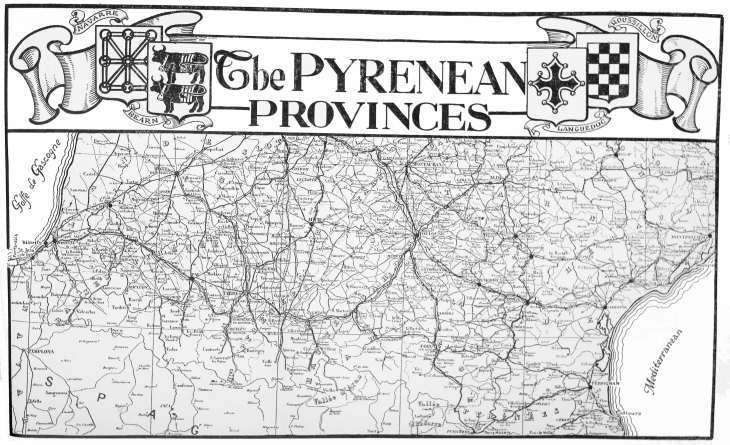
The Pyrenean Provinces Map facing 1
Watch-tower in the Val d’Andorre facing 24
Feudal Flags and Banners 32
The Peaks of the Pyrenees (Map)49
Brèche de Roland facing 50
The Col de Perthus (Map)57
The Five Proposed Railways (Map)68
Stations Thermales (Map)69
The Basques of the Mountains facing 74
In a Pyrenean Hermitage facing 78
A Mountaineer of the Pyrenees facing 84
Gitanos from Spain91
Roussillon (Map)95
Catalans of Roussillon facing 98
The Women of Roussillon facing 100
Arms of Perpignan110
Porte Notre Dame and the Castillet, Perpignan facing 112
Château Roussillon facing 118
Collioure facing 124
Château d’Ultrera facing 126
The Pilgrimage to St. Martin facing 132
Villefranche facing 142
Arms of Andorra147
Château de Puylaurens facing 154
Axat facing 158
Plan of Carcassonne (Diagram)164
The Walls of Carcassonne facing 166
Ground Plan of the Château de Foix (Diagram)190
Château de Foix facing 190
Key of the Vaulting, Château de Foix, Showing The Arms of the Comtes de Foix191
Tarascon-sur-Ariège facing 202
Château de Lourdat facing 210
St. Lizier facing 216
Trained Bears of the Vallée d’Ustou facing 218
St. Bertrand de Comminges facing 224
Pau and the Surrounding Country (Map)258
Arms of the City of Pau259
Château de Pau facing 268
Espadrille-makers facing 288
A Shepherd of Bigorre facing 302
Château de Coarraze facing 308
Château de Lourdes facing 314
Cauterets facing 318
The Pont d’Orthez facing 338
The Walls of Navarreux facing 346
Béarn and Navarre (Map)354
Kings of Basse-Navarre and Kings of France And Navarre (Diagram)360
The Arms of Navarre362
Arms of Henri IV of France and Navarre facing 368
The Basque Country (Map)372
The Game of Pelota facing 378
“Le Chevalet” facing 390
The Quaint Streets of Saint-Jean-Pied-de-Port facing 394
Arms of Bayonne413
A Gateway of Bayonne facing 414
Biarritz and the Surrounding Country (Map)422
Biarritz facing 424
St.-Jean-de-Luz facing 430
Ile de Faisans (Map)437
The Frontier at Hendaye (Map)441
Maison Pierre Loti, Hendaye facing 442
In Old Feuntarrabia facing 446
Castles and Chateaux of Old Navarre and the Basque Provinces