Chapter VII · THE DOG FAMILY.—THE DOMESTIC DOG.[91] (continued 2)
Reading edition
“It was altogether against the rules of the establishment to admit strange Dogs, but under such circumstances what could I do? His genteel appearance pleaded for him. The mere fact of his having, like a blundering, stupid, honest tyke, jumped to the conclusion that I looked just the sort of Man to befriend a houseless Dog, spoke in his favour. Every one was in bed as I opened the door with my latch-key, and not too deeply to compromise myself I pointed out to my canine intruder that his place for the night was the door-mat. I went down-stairs and searched for scraps, and got him together a tolerably good supper, and left him perfectly comfortable.
“I cannot believe that at that time he had it in his mind to abuse my confidence, or to act towards me in any way the reverse of honourable. It must have been that unfortunate one-eighth of cur that, made bold by beef-bones, rose against the animal’s better nature, and conquered it. Anyhow, when the outer door was opened to the newspaper-boy next morning, the servant was scared by the spectacle of a Dog taking the whole flight of steps at a leap, and making off with part of a leg of pork in its mouth. The villain had feloniously extracted it from the pantry, which I had inadvertently left open when I went foraging for him. Besides the pork he had carried off, he had helped himself during the night to a small steak-pie, about a pound of fresh butter, and a fine rasher of ham. I had but little expectation of encountering the canine traitor ever again; but I did so. About a week after, at dead of night, and in the pouring rain, once more I made out his crouching figure in the shadow of the identical lamp-post. Again our eyes met, and, as on the previous occasion, he instantly leapt to his feet. Not to cut capers about me. However, his guilty fears did not make of him a faltering, trembling coward. He took in the whole situation at a glance, including my vengefully-grasped umbrella, and, with one brisk bark of derision, made off at a speed which quickly carried him out of sight. Since then I have frequently encountered him, but it has been in the busy streets at daytime, but he does not run away. If he can avoid my eye he does so. If he cannot—and with his guilt haunting him I imagine it is not easy to do so—he assumes a puzzled expression of countenance, as though half convinced he has seen me before, though when and under what circumstances he could not say though his life depended on it.”[106]
Another very good instance of cunning, produced by a long course of back-slum life and manners, is given by the writer from whom the foregoing anecdote is taken, respecting “a Dog—a low-looking villain, blind of one eye, and, in consequence of his nefarious propensities, with never more than three sound legs to run on, who haunts the neighbourhood of Drury Lane. Nobody owns the brute, but he has contrived to scrape acquaintance with a kind-hearted cheesemonger, who keeps a shop there. I have the worthy tradesman’s own word for it that he always knows when the officer on the look-out for vagrant Dogs is about by the sudden appearance of Tinker and his peculiar behaviour. At ordinary times disdaining to be anything better than a Dog of the streets, his custom is to salute the cheesemonger from the pavement, and by a bark and a wag of his stump of a tail solicit an unconsidered trifle of bone or bacon-rind; but on the special occasion alluded to his tactics are quite different. He enters the shop with a sober and business-like air, and lies down on a mat by the parlour-door, with paws extended and his tail beating a contented tattoo on the floor, as though since his puppyhood that had been his home and abiding-place, and he had known and desired to know no other. It is a joke between the officer and the cheesemonger, and the former enters the shop and loudly demands to know if ‘that Dog lives here.’ I have not as yet had the pleasure of witnessing it, but the cheesemonger informs me that it is ‘as good as a play’ to observe the reassuring blink of his only eye which, at this juncture, Tinker bestows on the policeman, immediately afterwards curling himself round for a doze, as though to say, ‘Let this convince you.’ Tinker’s stay, however, is not protracted. As soon as, according to his calculation, the coast is clear, he is off, as unexpectedly as he came, and until he is again hard pressed by the law never thinks of crossing the cheesemonger’s threshold.”
We spoke just now of Dogs being honest from pure conventionality; there is no doubt that many of them soon acquire a very acute sense of the conventional, and perform certain actions, or assume a certain behaviour, simply because they feel it to be the right and proper thing. We have heard of a Bull-terrier who acquired perfectly that sense of decorum which in many human beings serves in lieu of religious feeling. When this Dog was bought, it was debated whether or not it would be advisable to let him remain in the room at prayers; the question was eventually decided in the affirmative, and the Dog almost immediately seemed to get a sense of what was meant, and to feel that he was expected to behave with propriety. He therefore adopted a particular mode of procedure—a sort of canine ritual—to which he always steadily adhered. While the Bible was being read, he sat straight up on his haunches on the hearth-rug, looking solemnly into the fire. This he continued until the family knelt to pray, when he immediately went off to a corner of the room, and stood there with lowered head until all was over. He did this with such perfect solemnity that the effect was indescribably ludicrous, and friends stopping in the house had to be warned of what to expect.
The tales of canine magnanimity are endless. Every one knows that of the big Newfoundland who, being long plagued by a number of little yelping curs, one of whom at last bit him, revenged himself only by dipping the offender in the quay hard by, and, after he was cowed, plunging in and bringing him safe to land. But all Dogs are not magnanimous. Some of them, like certain men one meets with, have quite a talent for taking offence, and will pick a quarrel on the slightest provocation, or, indeed, on no provocation at all. There are, of course, the wretched little curs one meets in the street, whose sole delight seems to be to rush out suddenly and bark furiously at every passer-by; but these miserable beings act as they do rather from lack of brain, and for want of something to do, than from real badness of heart. There are Dogs, however, who are naturally quarrelsome, and will do all in their power to get up a row, simply for the pleasure of the thing. “There is a well-authenticated instance of a Terrier, who, in picking a quarrel, contrived, as if trained in the Kanzellei of Prince Bismarck, to place himself technically in the right. He would time his movements so that some passenger should stumble over him, and would then fasten on the calf of his leg. With a most statesman-like aptitude, he selected the aged, the infirm, and the ill-dressed, as the objects of his cunningly-planned attacks.”[107]
Not only are instances of quarrelsomeness to be found Dogs, but also of the strongest desire to revenge real or supposed injuries, of the exercise of a wonderful amount of cunning and reasoning power to bring a hated rival to justice. The following anecdote forms a capital antithesis to that of Mr. Romanes’ Terrier, who prevented the escape of the Dog he disliked and was jealous of, although such an event would have brought him the greatest possible comfort:—
“A fine Terrier, in the possession of a surgeon, about three weeks ago, exhibited its sagacity in a rather amusing manner. It came into the kitchen and began plucking the servant by the gown, and in spite of repeated rebuffs, it perseveringly continued in its purpose. The mistress of the house hearing the noise, came down to inquire the cause, when the animal treated her in a similar manner. Being struck with the concern evinced by the creature, she quietly followed it up-stairs into a bed-room, whither it led her; there it commenced barking, looking under the bed, and then up in her face. Upon examination, a Cat was discovered there quietly demolishing a beef-steak, which it had feloniously obtained. The most singular feature in the whole case is that the Cat had been introduced into the house only a short time before, and that bitter enmity prevailed between her and her canine companion.”
Besides illustrating the desire for vengeance, this is as good an instance of reason as any we have given. The Dog evidently argued to himself in this wise:—“If I fly upon this wretched Cat and deprive her of her stolen goods by force, she will get nothing more than a fright, or, perhaps, a few tooth marks; but if I lodge a complaint against her before the proper tribunal, her guilt will be manifest to the whole household, and she will be got rid of, or even killed.” The Dog, by the way he conceived and acted on this plan, showed himself to be nearly as clever and almost as wicked as a great many men one reads about in history.
We have spoken of maternal love as exhibited by the Dog. This is, of course, a case of instinct; but instances are not wanting in which Dogs have shown the high faculty of devoted love towards other than their offspring, and of friendship like that of Ruth for Naomi. Mr. Darwin mentions a Greyhound bitch who, contrary to the usual custom of her race, fell deeply in love with a Pointer, and would have nothing to say to any other Dog during the life of her lover; and, stranger still, when he died, she showed a constancy equal to that of the best of her sex among the human race, and remained strictly faithful to his memory, never afterwards bearing pups.
Rarer than conjugal affection amongst animals, is friendship between individuals of the same sex; of this, too, instances are not wanting. Mr. Youatt relates the following:—“Two Dogs, the property of a gentleman at Shrewsbury, had been companions for many years, until one of them died of old age. The survivor immediately began to manifest an extraordinary degree of restless anxiety, searching for his old associate in all his former haunts, and refusing every kind of food. He gradually wasted away, and at the expiration of the tenth day he died, the victim of an attachment that would have done honour to man.”
Of equally intense devotion to man, instances are so numerous that one hardly knows which to mention. None is, perhaps, more wonderful or more affecting than that we have already mentioned, of the Dog who watched for three months by the corpse of his dead master on Helvellyn. There is also a tale of a Newfoundland Dog, whose master—a soldier—returned to his home, after an absence of many years, when the Dog recognised him at once, “leaped upon his neck, licked his face, and died.” He must have retained, during the whole of the time his master was away, the memory of his care and friendship. One cannot doubt that he often thought of and longed for him; and the rush of joy and hope fulfilled was too much for the great heart of the noble animal. He succumbed to the intensity of his feelings, thereby showing himself to be superior in one of the highest and grandest of qualities to by far the greater proportion of the human race. How many men, or even women, of one’s own acquaintance, are capable of dying of joy?
But there is a dark side to this picture. A very large proportion of Dogs possess but little of this virtue of fidelity, but have greatly developed the contrary vice of extreme fickleness. They will change masters without the slightest objection, and be “off with the old love and on with the new” absolutely without a pang. Froissart, the chronicler, tells a curious tale respecting the treachery of Richard II.’s Dog, “a Grayhounde, called Mithe, who always wayted upon the kynge, and woulde knowe no man els. For where so ever the kynge did ryde, he that kept the Grayhounde dyd lette him lose, and he wolde streyght mime to the kynge, and faune uppon hym, and leape with his fore fete uppon the kynge’s shoulders. And as the kynge and the Erle of Derby (Bolingbroke, afterwards Henry IV.) talked togyder in the courte, the Grayhounde, who was wonte to leape uppon the kynge, left the kynge, and came to the Erle of Derby, Duke of Lancastre, and made to him the same friendly continuance and chere as he was wonte to do to the kynge. The duke, who knewe not the Grayhounde, demanded of the kynge what the Grayhounde would do? ‘Cousin,’ quod the kynge, ‘it is a greate goode token to you, and an evyl signe to me.’ ‘How knowe you that?’ quod the duke. ‘I knowe it well,’ quod the kynge. ‘The Grayhounde acknowledgeth you here this day as Kynge of England, as ye shall be, and I shall be deposed; the Grayhounde hath this knowledge naturally; therefore take hym to you: he wyll follow you and forsake me.’ The duke understood well these words, and cherished the Grayhounde, who wolde never after follow Kynge Richard, but followed the Duke of Lancastre.” This anecdote, curious, if true, would seem to show that rats and men are not the only animals who make haste to leave a sinking ship.
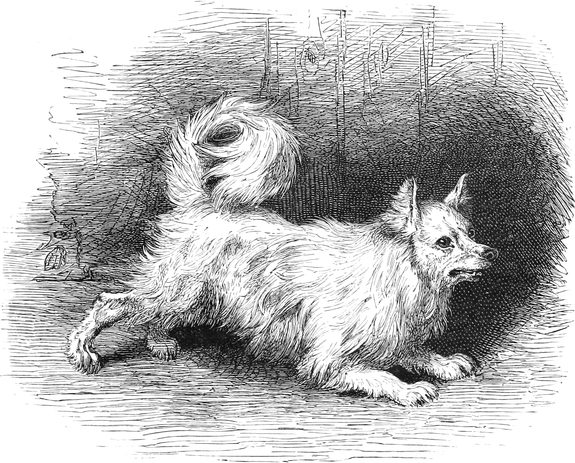
POMERANIAN DOG.
We have made mention of a certain quarrelsome Dog, fond of picking a quarrel, who always took care, with the true instinct of a cowardly bully, to pick out old or infirm persons as objects of his attacks. We are glad to say that we have found a notice of a Setter who showed a becoming respect for age. His owner says:—
“One other curious fact may here be mentioned about this Dog. Although naturally a very vivacious animal, and, when out for a walk with myself or any other young person, perpetually ranging about in search of game, yet, if taken out for a walk by an elderly person, he keeps close to heel all the time, pacing along with a slow step and sedate manner, as different as possible from that which is natural to him. This curious behaviour is quite spontaneous on his part, and appears to arise from the sense of the respect that is due to age.”
We need hardly say that this Dog belongs to Mr. Romanes, amongst whose animals specimens of all the Christian gifts and graces seem to be found.
We thus see that a very large proportion of our own virtues and vices are developed in our canine “fellow-mortals”; there is, however, one state of mind which we should hardly expect to find in any animal, viz., despair. With man it is, alas! sufficiently common to feel that he has had enough of “life’s fitful fever,” and that the only thing left is to make haste
“—— to be hurled Anywhere, anywhere, out of the world.”
But who would expect a dumb quadruped to have feelings of this sort? Yet that such may be the case is rendered probable by the following remarkable story:—
“A day or two since, a fine Dog, belonging to Mr. George Hone, of Frindsbury, near Rochester, committed a deliberate act of suicide by drowning in the Medway at Upnor, Chatham. The Dog had been suspected of having given indications of approaching hydrophobia, and was accordingly shunned, and kept as much as possible from the house. This treatment appeared to cause him much annoyance, and for some days he was observed to be moody and morose. On Thursday morning he proceeded to an intimate acquaintance of his master’s at Upnor, on reaching the residence of whom he set up a piteous cry on finding that he could not obtain admittance. After waiting at the house some little time, he was seen to go towards the river close by, when he deliberately walked down the bank, and, after turning round and giving a kind of farewell howl, walked into the stream, where he kept his head under water, and in a minute or two rolled over dead. This extraordinary act of suicide was witnessed by several persons. The manner of his death proved pretty clearly that the animal was not suffering from hydrophobia.”[108]
The last statement of the writer of this anecdote may be called in question, as it is a well established fact that a mad Dog will often plunge its head into water, and make violent though ineffectual efforts to drink; and it is very likely that the Dog in question had no real intention of committing suicide, but was drowned while attempting to slake his insatiable thirst. This seems a probable explanation, though it takes the point from our tale.
Of that most horrible and fatal disease—rabies—little need be said here. It is accompanied in the Dog by inflammation, inability to swallow, insensibility to pain, even to severe blows or burns, and usually great ferocity, and a disposition to bite everything that comes in its way. The gait, the glance, and also the howl of a mad Dog are very characteristic. But the most terrible thing about rabies is that it can be communicated to man, producing in him the special human form of the disease, hydrophobia. This latter, like rabies, never arises except by inoculation with the saliva of a rabid Dog, so that both these terrible, and it is to be feared increasing diseases, might be stamped out by the adoption for a few months of a rigorous quarantine.[109] When a human being is bitten, symptoms of rabies usually occur in from a fortnight to three months; but a case is on record in which the disease did not appear for twelve years! When the poison is once established in the system a cure seems to be utterly impossible. The only remedy is at once either to cut out the wound or to rub it deeply and thoroughly with lunar caustic (nitrate of silver), which Mr. Youatt states to be far more efficacious than actual cauterising or burning with a red-hot iron.
The varieties or breeds of the Dog are extremely numerous, and differ from each other to a wonderful degree. In the matter of size, we have the Mastiff, as large as a pony, at one end of the series, and the Toy-terrier, a few inches long, at the other. As to the development of hair, there is every gradation, from the hairless Turkish Dog to the Skye-terrier or the Poodle; as to running powers, there are the Greyhound and the Turnspit; in the matter of mental and moral characteristics, we have the intelligent Shepherd’s Dog, the obstinate and courageous Bull-dog, the silly Italian Greyhound, and the lazy Lap-dog. Never was animal so thoroughly, so unanimously, and so successfully selected: never did any show such endless variation in so many particulars.