Chapter I · INTRODUCTION—THE MAN-SHAPED APES—1. THE GORILLA (Troglodytes Gorilla).
Reading edition
The World of Monkeys, and its Division into great Groups—Distinction between the Old World and New World Monkeys—Classification of Monkeys—THE GORILLA, Ancient and Modern Stories about it—Investigations of Savage and Du Chaillu—General Description—The Head, Brain, Teeth, Taste, Smell, and Voice—The Air Sacs, and Ear—The Limbs and Muscles—Method of Climbing—Diet—Hunting the Gorilla—Attempts to Capture Alive—A Tame Gorilla
IF one of each kind of the Apes and Monkeys which are now living on the globe could be collected and placed in a large zoological garden, and if those which lived in former ages, and whose skeletons have been discovered by geologists, could be brought to life, and added to the whole, they would certainly form a very amusing and remarkable assemblage. What endless fun there would be, what scamperings, skirmishes, and quarrels would take place; how they would grin, chatter, and pull tails all the live-long day; and as evening began, how some, which had been quiet spectators before, would commence howling, and how others would rush about amongst their tired and sleepy companions, with noiseless bounds until the return of daylight!
If each of these representative Monkeys could give an account of itself, whence it had come, how it lived in its native forests and woods, and what it did with itself all day, a most interesting and novel Natural History book could be compiled, for only the histories of a few have been written, and they are by no means always veracious. They would have come from Asia and many of its islands, from Africa, from South America, and the Isthmus to the north, and Europe would have sent one from the rocks of Gibraltar; and yet, unless those of the same country had been properly introduced, either by Dame Nature or by the chapter of accidents incident to such a very unlikely meeting as we are imagining, they would not know many of their fellows. They are exclusive in their habits, and their particular parks and forests are limited in extent, and sometimes very much so. Of course, there are some exceptions, and many kinds which roam over large countries, and are even found in different islands, have gained the superior intelligence and the ready affability and easiness of intercourse characteristic of the cosmopolitan and traveller. Every kind of temper and capacity would be shown; the Gorillas would probably be shy and cross, the Chimpanzees lively and kind, the Baboons grumpy, the Spider Monkeys restless, and most of the Macaques impudent and cunning—the result of a knowledge of Apes and of many Monkeys. There would be every shade of colour, and of shape and size; there would be many without tails, some with stumps, and others with long tails of no great use except to afford temptation to the mischievous; and not a few with fine large ones useful in the extreme, by acting as a fifth limb. Many would have very human faces and sharp eyes, others would look more like dogs, and fierce enough, and there would be every variety of posture. Some would sit very well, others would go on all-fours, and there would be others swinging with their long and strong arms, and making tremendous jumps and bounds assisted in some by the prehensile tail. Some would want one kind of fruit, and others different kinds of vegetables, but only two or three tiny little ones would care much about grubs and eggs. All would have the very best possible limbs for climbing, grasping, picking, and stealing, and all would have good hands, that is to say, fingers and thumbs and wrists, in front, and foot-hands, that is to say, feet with a great thumb-like toe behind. In a general sense they would all be four-handed or Quadrumanous, and this peculiarity would distinguish them from any interlopers who might have got into the assemblage unasked.
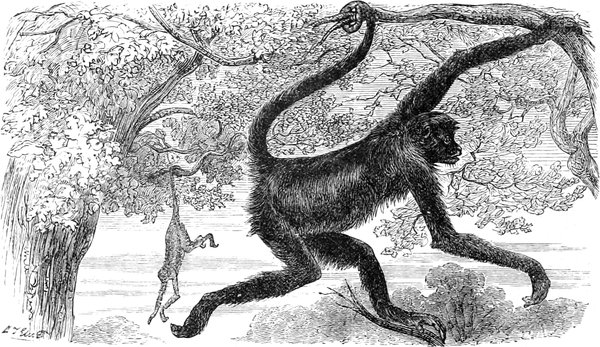
AMERICAN MONKEY, WITH PREHENSILE TAIL.
It may be doubted whether the most scientific of the scientific could do much in the way of science at first with such varied and amusing creatures before him; but the mind will attempt to compare and notice differences under all sorts of circumstances, and therefore some general truths would possibly be got at amidst all the noisy debates, divisions, and cheers and counter-cheers of this Apes’ Parliament. There would be clearly two sides to this house of representatives, the Americans and the Old World-ites, and the most uncritical observer would separate them. It never entered into the mind of a Monkey of the Old World to have a tail which would be as useful as another leg and hand, and as manageable as if it had an eye at its tip—that is an invention of Dame Nature in the American tropics, and is an evident improvement. Now this tail is visible enough, and so is another American peculiarity. The Monkeys there have a broad end to the nose, and the openings of the nostrils look outwards, being separated by a thick gristle; but those of the Old World have a thin gristle in the same place, and the nostrils are not wide apart but open in front, more or less like those of men and dogs. Here are, then, two “parties,” those with nostrils wide apart with a wide and thick gristle—“broad noses,” called in scientific language “Platyrhines”[1]; and those with the nostrils “looking downward,” or “Catarhines.”[2]
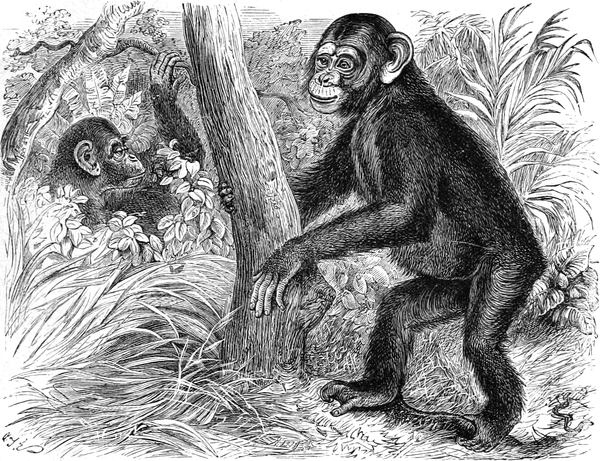
ONE OF THE ANTHROPOMORPHA—THE CHIMPANZEE.
The great American section, or that of the broad-noses, is split up to a certain extent, for all have not long prehensile tails, those of some being short; and others have them feeble in strength and almost brushy with fur. Here are, then, the means of readily knowing one set from another, so far as these far travelled Monkeys are concerned.
The Old World section, with its close and downward-looking nostrils, at first sight appears very united, but after a little noticing there seem to be many different groups in it. Firstly, the commonest kinds make up for the absence of a clinging tail, such as their American cousins have, by having something which the Transatlantics would be glad of, namely, cheek pouches—comfortable receptacles for nuts and such delicacies within the mouth, where food can be kept as in a cupboard, until it is required, or can be enjoyed in safety. These are the valuable properties of many of the smaller African tribes. Then they also have, in the absence of soft clothes and comfortable chairs to sit upon, fur or hair and a natural hardness or “callosity,” or seat, which does not wear out, and which is often strangely coloured. Another group has no cheek pouches, but it possesses the callosities, and these less favoured creatures come mainly from Asia and the great islands, and only a few from Africa.
Finally, the most important group of the section consists of the large Apes, with neither tails, callosities, nor cheek pouches, but having very man-like features; for instance, the great Troglodytes, Chimpanzees, and Orangs, the first two from Africa, and the last from the great Asiatic islands and the mainland.
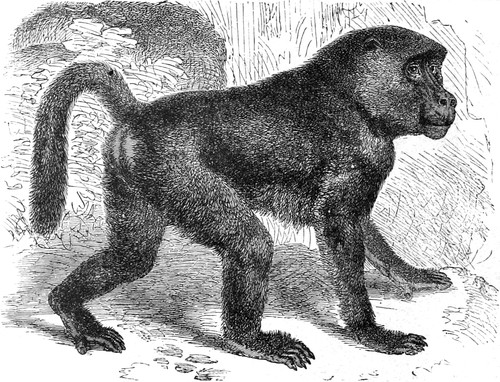
ONE OF THE CYNOMORPHA—THE BABOON.
These tribes could be, with more study (especially if the merry company were broken up by the anatomist taking them one by one and dissecting them), divided over and over again, and separated into kinds or species, which would not, however, always tally with the corresponding arrangement of the naturalist, who would go by the skin and the outside of the animals.
One thing would be quite clear to every one, and that is that some of the creatures greatly resemble man at first sight, and that although this likeness diminishes with study, still there is a group, which deserves the title of the “man-shaped.” Others form a group which go usually on all fours, looking like dogs, more or less, and they are the “dog-shaped,” but they of course retain the more or less man-like peculiarities which characterise the whole of the Monkeys.
Hence, after all these divisions and differences and resemblances have been mastered, it would be found that the noisy assemblage could be arranged as follows:—
1.—CATARHINES.—Old World Monkeys, man-shaped and dog-shaped.
2.—PLATYRHINES.—New World Monkeys.
The first section, the Catarhines, may be divided into the man-shaped, or in the Greek the Anthropomorpha, and the dog-shaped, or the Cynomorpha.
Or they may be arranged as those, with: 1, cheek pouches and callosities, for instance, the Baboons; 2, those with callosities only, the Monkeys; and 3, those without either, and without a tail, the Apes.
The second section, or the Platyrhines, may be divided into those: 1, with prehensile tails; and 2, those with the tails not prehensile; and 3, those whose tail is furry.
This great array of manikins (whence they get their name of Monkey—the word homunculus, “a sorry little fellow,” having possibly something to do with it) is formed by creatures next to man, the highest in the scale of animals. They could be very readily distinguished from all others, were it not for the existence of a group of beings which resemble them in some particulars. These are the next lowest in the scale, and they have thumbs on the hands and thumb-toes on the feet, but their fur is woolly, and they are cat-like in shape. They are called the Lemurs, or by some zoologists “Half Apes.” These Lemurs only resemble in a slight degree some of the Monkeys of the New World, but they are more like them than any other animals, and therefore are classified with them.
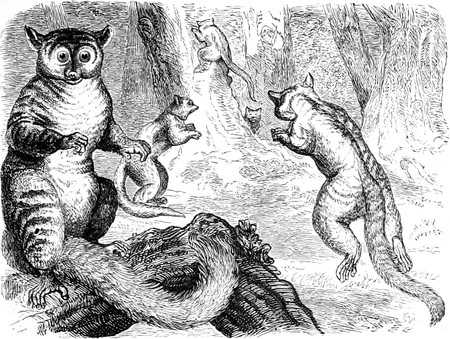
GROUP OF LEMURS. (From the Transactions of the Zoological Society.)
The order of beings to which these various creatures belong is known by the name of “Primates,” which implies the rank they hold in the scale of creation. Man stands first, very distinct in his intellectual powers and spiritual gifts from the most intelligent of the Quadrumana and as much superior to them in his construction. Then comes the world of Monkeys, the “man-shaped” at the head, and the little marmosets, with furry tails, at the bottom of the array, and linked on to these are the Half Apes or Lemurs. They all form a great order of the animal kingdom which stands first and at the head of all other orders of the animal world.
But what would the old Monkeys whose bones have been dug out of strata which are older than the Himalayan mountains and the Alps say could they visit such a collection as that suggested? They would recognise their fellow-monkeys, but would look upon them as pigmies in size. They would be few in number, for though Monkeys go the way of all flesh very rapidly, skeletons of them are very rarely found, so rarely indeed that many Indians believe that the other Monkeys bury them. The fact is, that there are plenty of Jackals, to say nothing of birds of prey, ready to snap up a dead, dying, or invalid Ape, and to turn its protoplasm into their own. Some few tumble into holes, and may be preserved there, and probably that was how the old bones were hidden up. The old kinds resembled the new more or less, but for the most part those which have been carefully examined were larger than the corresponding modern species. They were as great Apes in their nature as are the present, and had this advantage, that their roaming ground was wider, for they lived in Europe as well as in the countries where their modern representatives are found. Nevertheless, even in those old days the Catarhines were kept to the Old World, and the Platyrhines enlivened the American forests alone.
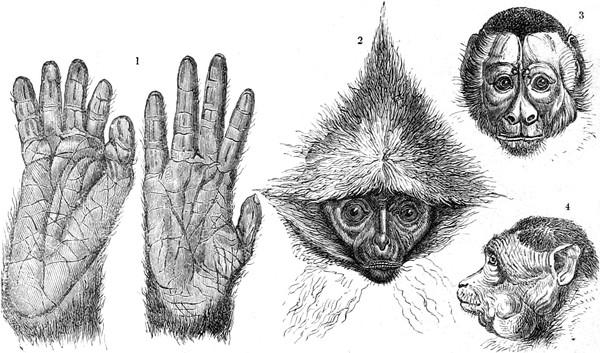
1. FOOT AND HAND OF A MONKEY. 2. A. CATARHINE MONKEY. 3. A. PLATYRHINE MONKEY. 4. MONKEY WITH CHEEK POUCHES.
In the great order of the Primates, after man, stand the man-shaped or anthropomorphous[3] Apes, the Great Tail-less. They are inhabitants of equatorial Africa, and of the large Asiatic islands and the adjacent mainland, and first and foremost amongst them is
THE GORILLA.
Africa, to the south of the Great Desert, has always been a country of wonders, and highly attractive to imaginative and restless men; and its dark population, so ignorant and superstitious, has, from its love of the marvellous, shadowed the truth with much mystery. Hence, travellers in those tropical regions, which are so fatal to Europeans, have from the earliest times told of the man-like creatures they had heard of and sometimes seen; and they have associated them in the equatorial part of the continent with human dwarfs, pigmies, and monsters. For centuries these degraded human races have been sought after, and now whilst it is admitted that dwarfed men exist, it has come to light that most of the stories which led to the belief in their hideous associates were derived from the existence of large man-like Apes—creatures of dread to the natives—whose traditions are full of credulous anecdotes about them. Hidden in the recesses of vast forests, where the silence of nature is intense, and moving with great activity, where men can hardly follow, these animals acquired most doubtful reputations, and their ugly personal appearance, so suggestive of violence, was magnified in every way in the eyes of the timid natives.
So dreaded were the Apes, and so environed were they with a superstitious mystery, that Europeans had travelled and traded close to their haunts for centuries before one of them was seen by any other eyes than those of the timid negroes. Many stories about them had long been told, and indeed some of them are as old as the days of the Carthaginians. For instance, Hanno, a Carthaginian, was ordered to sail on a voyage of discovery round Africa some centuries before Christ, the exact date not being fixed; and he sailed and rowed in his galleys out of the present Strait of Gibraltar, and coasted southwards until he came to the great bay, probably somewhere about the Gaboon River, near the equator, in Western Africa. It is stated in the history of his voyage:—
“On the third day, having sailed from thence, passing the streams of fire, we came to a bay called the Horn of the South. In the recess there was an island like the first, having a lake, and in this there was another island full of wild men. But much the greater part of them were women with hairy bodies, whom the interpreters called Gorillas. But, pursuing them, we were not able to take the men; they all escaped, being able to climb the precipices, and defended themselves with pieces of rock. But these women (female Gorillas), who bit and scratched those who led them, were not willing to follow. However, having killed them, we flayed them, and conveyed the skins to Carthage, for we did not sail any further, as provisions began to fail.”
Probably the streams of fire were a part of a volcanic eruption. Written in the Periplus or voyage of Hanno this story is thoroughly African, and might have been the model upon which hundreds of later ones have been formed, for it is a combination of the novel in nature, and of what is true and false. It is curious that a commander of so civilised an expedition, and a man whose eyes had been accustomed to the grace of Grecian statuary and to the beauty of his own countrywomen, should have mistaken a Gorilla for one of the fair sex; and, moreover, it is possible that from the mounting of the rocks, and the flinging of stones by the males, the whole were Baboons. Nevertheless this is the oldest record of the name which is associated with the most interesting of modern discoveries, and it accounts for many stories which were kept floating in the thoughts of successive generations of travellers.
Gradually the truth came forth, but not until many Europeans had wandered in Gorilla Land. One Andrew Bartlett was an English sailor, who got caught by the Portuguese for some reason or other, and was kept a prisoner in Angola, which is situated nearly ten degrees south of the line, and near the great virgin forests, which are the haunts of the Gorilla and Chimpanzee, and his “strange adventures” were published in 1625, by Purchas, in “His Pilgrimages.”
Battel speaks of two monsters which excited the fears of the natives. “The greatest is called Pongo, in their language, and the lesser is called Engeco. This Pongo is in all proportion like a man, but that he is more like a giant in stature than a man: for he is very tall and hath a man’s face, hollow eyed, with long haire upon his brows. His bodie is full of haire, but not very thick, and it is of a brownish colour. He differeth not from man but in his legs, for they have no calfe. He goeth always upon his legs, and carrieth his hands clasped on the nape of his necke, when he goeth upon the ground. They sleepe in the trees, and build shelter for the raine. They feed upon the fruit that they find in the woods, and upon nuts, for they eat no kind of flesh. They cannot speak, and have no understanding more than a beast. The people of the countrie, when they travaile in the woods, make fires when they sleepe in the night: and in the morning when they are gone, Pongo will come and sit about the fire till it goeth out, for they have no understanding to lay the wood together. They goe many together and kill many negroes that travaile in the woods. Many times they fall upon elephants which come to feed where they may be, and so beat them with their clubbed fists and pieces of wood that they will runne roaring away from them. These Pongos are never taken alive, because they are so strong ten men cannot hold one of them; but they take many of their young ones with poisoned arrows. The young Pongo hangeth on its mother’s belly with its hands clasped about her, so that when any of the country people kill the females, they take the young which hangs fast upon his mother. When they die amongst themselves, they cover the dead with great heaps of boughs and wood, which are commonly found in the forests.”
The Pongo appears to be the Gorilla, and Battel tells much truth about it, mixed up with absurd fiction, whilst the Engeco, or as it is called by the natives of the Gaboon, the enche-eko, is the Chimpanzee.
Early in this century, in 1819, Bowdich says, in a description of a mission from Cape Coast Castle to Ashantee, “that the favourite and most extraordinary subject of conversation when in the Gaboon River was the Ingena. This is an animal like the Orang-Utan, but much exceeding it in size, being five feet high and four feet across the shoulders. Its paw was said to be even more disproportioned in its breadth, and one blow of it is said to be fatal. It is commonly seen by the natives when they travel to Kaybe, lurking in the bush to destroy passengers, not to eat them, for it feeds principally on wild honey which abounds.”
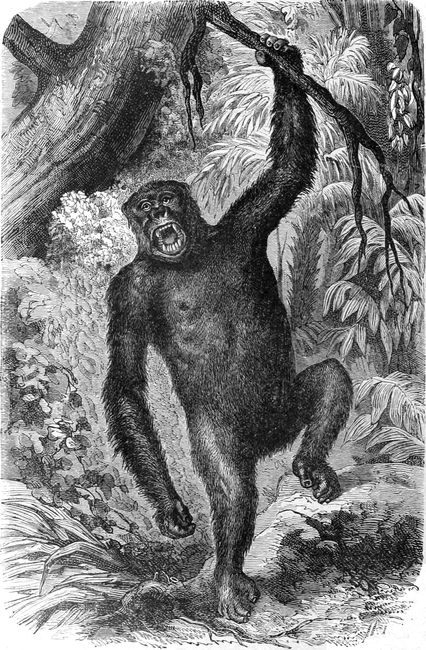
MALE GORILLA.
Sometimes, the natives assert, when a company of villagers are moving rapidly through the shades of the forest, they become aware of the presence of the formidable Ape by the sudden disappearance of one of their companions, who is hoisted up into a tree, uttering, perhaps, only a short choking sob. In a few minutes he falls to the ground a strangled corpse, for the animal, watching his opportunity, has let down his huge hind-hand and seized the passing negro by the neck with a vice-like grip, and has drawn him up into the branches, dropping him when life and struggling have ceased.
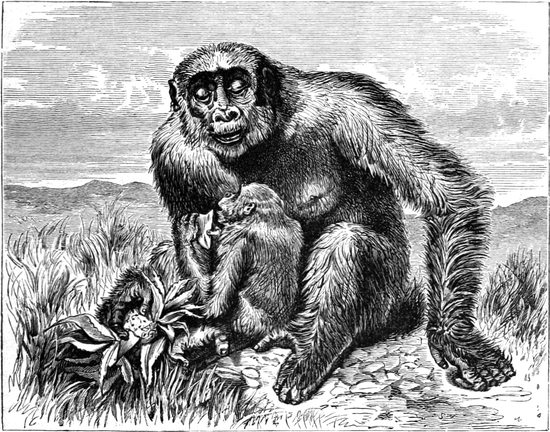
FEMALE GORILLA AND YOUNG. (From the Transactions of the Zoological Society of London.)
The missionaries, when they were established in the Gaboon region, found that all along the coast the Gorillas were believed by the natives to be human beings, members of their own race degenerated. Some natives who had been a little civilised, and who thought a little more than the rest, did not acknowledge this relationship, but considered them as embodied spirits, the belief in the transmigration of souls being prevalent. They said that the enche-eko, or Chimpanzee, has the spirit of a coastman, being less fierce and more intelligent than the enge-ena, or Gorilla, which has that of a bushman. The majority, however, fully believed them to be men, and seemed to be unaffected by the arguments offered to disprove this fancy; and this was especially true of the tribes in the immediate vicinity of the locality. They believed them to be literally wild men of the woods. Nevertheless, they were eaten when they could be got, and their flesh, with that of the Chimpanzee and other Monkeys, formed and still forms a prominent place in the bill of fare.
Impressed thus with a belief in their kinship and of their ferocity, it was not surprising that live Gorillas could not be obtained by European travellers. Even a bold and skilful hunter of the elephant, when pressed to bring in one, declared he would not do it for a mountain of gold.
In 1847 the first sight of a part of a Gorilla was obtained by an American missionary; it was a skull, and its shape struck him as being so extraordinary that he believed the natives were correct in attributing it to the much-talked-of Ape of whose ferocity and strength he had heard so much. Collecting others, he at last handed them over to a fellow labourer, Dr. Savage, who possessed much anatomical knowledge. Every attempt was made to obtain even a dead Gorilla, but without satisfactory results. Savage lived for years in the neighbourhood of the Gaboon river, and not only gradually accumulated a fine collection of the bones of the great Ape, which he at first thought was the Orang-Utan, and which he subsequently described as the Gorilla, but also put together a history of its habits and aspect as gleaned from the natives. He was in the heart of Gorilla Land, which may be said to extend from ten to fifteen degrees of latitude on each side of the equator. It is bounded by the sea on the west, and extends to an unknown distance to the east, being watered by the Gaboon, Danger, and Fernandez Vas rivers. Mountainous far from the coast, and very undulating everywhere, it consists of dense forest, wild jungle, and open places. Traversed as this country is by navigable rivers which are visited by traders, it struck this observer that it was indeed remarkable that the Gorilla should have been so unknown to civilised men; but he was soon impressed with the dread the natives had of it, and also with the fact that it sought the remoter parts of the neighbouring woods. From the descriptions of the natives, who never attempted to interfere with the Gorilla except in self-defence, its height is above five feet, and it is disproportionately broad across the shoulders. It is covered with coarse black hair, which greatly resembles that of the Chimpanzee; with age it becomes grey, and this fact has given rise to the report that there are more kinds than one. Resembling a huge Ape in shape, with a great body, comparatively short legs with large hind-thumbs, its bulk is considerable, and its arms, reaching further down than in man, enable it to grasp and climb well. It does not possess a tail, and the head has a wide and long black face, a very deep cheek, great brows over the deeply-seated hazel eyes, a flat nose, and a wide mouth with very strong teeth. The top of the head has a crest of longish hair, and elsewhere it is exceedingly thick and short. The belly is very large. From inquiry he ascertained that when walking, their gait is shuffling, and the body, which is never upright like that of man, moves from side to side in going along. Usually it walks by resting the hands on the ground and then bringing the legs between them, and swinging the body forward. They live in bands, and the females generally exceed the males in number. They are exceedingly ferocious, never running away from man, and the few that have been captured were killed by elephant hunters and native traders as they came suddenly upon them whilst passing through the woods.
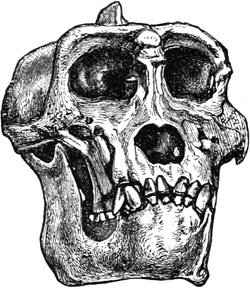
FRONT VIEW OF THE SKULL OF THE GORILLA.
It was said, at this time, by the natives, that the Gorilla makes a sleeping-place like a hammock, by connecting the branches of a sheltered and thickly-leaved part of a tree by means of the long, tough, slender stems of parasitic plants, and lining it with the dried broad fronds of fern, or with long grass. This hammock-like abode may be seen at different heights, from ten to forty feet from the ground, but there is never more than one such nest in a tree. They avoid the abodes of man, but are most commonly seen in the months of September, October, and November, after the negroes have gathered in their outlying rice-crops, and have returned from the “bush” to their valleys. So observed, they are described to be usually in pairs, or if more, the addition consists of a few young ones of different ages and apparently of one family. The Gorilla is not gregarious. The parents may be seen sitting on a branch resting their backs against the tree trunk munching fruit, whilst the young Gorillas are at play, leaping and swinging from branch to branch with hoots or harsh cries of boisterous mirth. This rural felicity, however, has its objectionable sides, for occasionally, if not invariably, the old male, if he be seen in quest of food, is usually armed with a short stick, which the negroes aver to be the weapon with which he attacks his chief enemy the elephant. Not that the elephant directly or intentionally injures the Gorilla, but deriving its subsistence from the same source, the Ape regards the great proboscidian as a hostile intruder. When, therefore, he sees the elephant pulling down and wrenching off the branches of a favourite tree, the Gorilla, stealing along the bough, strikes the sensitive proboscis of the elephant with a violent blow of his club, and drives off the startled giant trumpeting shrilly with pain. In passing from one tree to another the Gorilla is said to walk semi-erect with the aid of his club, but with a waddling and awkward gait; when without a stick, he has been seen to walk as a man, with his hands clasped across the back of his head, instinctively balancing its forward position. If the Gorilla be surprised and approached, whatever the ground may be, he betakes himself on all-fours, dropping the stick, and makes his way very rapidly, with a kind of sidelong gallop, resting on the front knuckles, to the nearest tree. There he meets his pursuer, especially if his family is near and requiring his defence. No negro willingly approaches the tree in which the male Gorilla keeps guard, even with a gun. The experienced negro does not make the attack, but reserves his fire in self-defence. The enmity of the Gorilla to the whole negro race, male and female, is uniformly attested. Thus, when young men of the Gaboon tribe make excursions into the forests in quest of ivory, the enemy they most dread to meet is the Gorilla. If they have come unawares too near him with his family, he does not, like the lion, sulkily retreat, but comes rapidly to the attack, swinging down to the lower branches, and clutching at the nearest foe. The hideous aspect of the animal, with his green eyes flashing with rage, is heightened by the skin over the orbits and eyebrows being drawn rapidly backwards and forwards, with the hair erected, producing a horrible and fiendish scowl. If fired at, and not mortally hit, the Gorilla closes at once upon his assailant, and inflicts most dangerous if not deadly wounds, with his sharp and powerful tusks. The commander of a Bristol trader once saw a negro at the Gaboon frightfully mutilated from the bite of a Gorilla, from which he had recovered. Another negro exhibited to the same voyager a gun barrel bent and partly flattened by a wounded Gorilla in its death struggle.
The strength of the Gorilla is such as to make him a match for a lion, whose strength his own nearly rivals. Over the Leopard, invading the lower branches of his dwelling-place, he will gain an easier victory; and the huge canine teeth, with which only the male Gorilla is furnished, doubtless have been given to him for defending his mate and offspring.
As the appearance and some of the movements of the Gorilla are very man-like, some of the natives consider that the souls of men have entered into their bodies, and hence many apologies are made for some of their tricks and reported doings. Moreover, from this belief some of their skulls are made objects of fetish worship, and are marked with broad stripes of red paint, crossed by a white one. These were the stories told to Savage.
On returning to America, Savage investigated the parts of the skeletons he had obtained, and compared them with those of the Chimpanzee. Owen, in England, having received some corresponding specimens, continued the investigation, and all were agreed in deciding that the Gorilla was a species in itself, differing from the Chimpanzee, but sufficiently like it to be connected with it in a genus. The Gorilla was termed Troglodytes Gorilla, and the Chimpanzee, which will be noticed in the next chapter, kept its name of Troglodytes niger. The word Troglodytes was very ill chosen, and it does not refer in any way to the nature or habits of the animals. It was taken from τρωγλοδύται, the name of an Ethiopian tribe who dwell in holes or caves. The native name is Ngina.
The descriptions of the habits and anatomy of the Gorilla, fragmentary as they were, excited great interest in the minds of many travellers, and especially in that of Du Chaillu, who left America in 1855, determined to explore Gorilla Land, and to obtain some of the great Apes, dead or alive.
He first met with the Gorilla amongst some beautiful scenery, near the Sierra del Crystal, at the head waters of the Ntambounay, a stream which runs into the Muni or Danger River. Close to some rapids down which the torrent was rushing with great velocity amongst huge boulders, and sending its spray up to the tops of the highest trees of the banks, was a deserted village, and amongst its ruins were some broken-down sugar-canes. Here and there the canes had been taken down, and torn up by the roots, and they were lying about in fragments, which had evidently been chewed. He writes:—“I knew that there were fresh tracks of the Gorilla, and joy filled my heart; they (the native hunters) now looked at each other in silence, and muttered, Nguyla, which is as much as to say in Nepongwe, Ngina, or as we say, Gorilla. We followed these traces, and presently came to the footprints of the so-long desired animal. It was the first time I had ever seen these footprints, and my sensations were indescribable. Here was I now, it seemed, on the point of meeting face to face that monster of whose ferocity, strength, and cunning, the natives had told me so much; an animal scarce known to the civilised world, and which no white man before had hunted. My heart beat till I feared its loud pulsations would alarm the Gorilla, and my feelings were excited to a painful degree. By the tracks it was easy to know that there must have been several Gorillas in company. We prepared at once to follow them. The women were terrified, poor things, and we left them a good escort of two or three men to take care of them, and reassure them. Then the rest of us looked once more carefully at our guns, for the Gorilla gives you no time to re-load, and woe to him whom he attacks. We were armed to the teeth. My men were remarkably silent, as if they were going on an expedition of more than usual risk; for the male Gorilla is literally king of the African forest. He and the crested lion of Mount Atlas are the two fiercest and strongest beasts of the continent. The lion of South Africa cannot compare with either for strength or courage. I knew that we were about to pit ourselves against an animal which even the leopard of these mountains fears, and which perhaps has driven the lion out of his territory; for the king of beasts so numerous elsewhere in Africa is never met in the land of the Gorilla. We descended a hill, crossed a stream on a fallen log, and presently approached some huge boulders of granite. Alongside of one lay an immense dead tree, and about this we saw many evidences of the very recent presence of the Gorillas. Our approach was very cautious: we were divided into parties. We were to surround the granite block, behind which the animals were supposed to be hiding, and suddenly I was startled by a strange discordant, half-human, devilish cry, and beheld four young Gorillas running toward the deep forests. We fired, but hit nothing. Then we rushed on in pursuit, but they knew the woods better than we. Once I caught a glimpse of one of the animals again, but an intervening tree spoiled my mark, and I did not fire, but ran till we were exhausted, but in vain, and the alert beasts made their escape.” As the hunters sat round their fire in the evening, before going to sleep, the adventure of the day was talked over, and of course some very tough yarns and stories were told about the Gorillas, most of which ought to have put this traveller on his guard, and impressed him that the greater part of the ferocity and the lion-like courage of the new animal were derived from the imaginations of a very superstitious and not over-courageous race of men. They were great believers in witchcraft, and they believed that many men whose names they mentioned, and who are dead, had their spirits now dwelling in Gorillas. However, Du Chaillu, a few days afterwards, started on a hunt which had a more satisfactory termination than the last. He and the rest got on the track of an old male, and suddenly as they were creeping along in silence, which made a heavy breath seem loud and distinct, the woods were at once filled with the tremendous barking roar of the Gorilla. Then the underbush swayed rapidly just a-head, and presently before them stood an immense male. He had gone through the jungle on all-fours, but when he saw the party he raised himself and looked them boldly in the face. “It stood about a dozen yards from us, and was a sight I think I never shall forget. Nearly six feet high (he proved four inches shorter), with immense body, huge chest, and great muscular arms, with fiercely glaring large deep gray eyes, and a hellish expression of face, which seemed to me like some nightmare vision; there stood before us the king of the African forest. He was not afraid of us. He stood there and beat his breast with his huge fists till it resounded like an immense bass drum, which is their mode of offering defiance; sometimes giving vent to roar after roar. The roar of the Gorilla is the most singular and awful noise heard in these African woods. It begins with a sharp bark like an angry dog, then glides into a deep bass roll, which literally and closely resembles the roll of distant thunder along the sky, for which I have sometimes been tempted to take it when I did not see the animal. His eyes began to flash fiercely, for we stood motionless on the defensive, and the crest of short hair which stands on his forehead began to twitch rapidly up and down, while his powerful fangs were shown as he again sent forth a tremendous roar. He advanced a few steps, then stopped to utter that hideous roar again; advanced again, and finally stopped when at the distance of about six yards from us, and then, just as he began another of his roars, beating his breast with rage, we fired and killed him. With a groan which had something terribly human in it, and yet was full of brutishness, he fell forward on his face. The body shook convulsively for a few minutes, the limbs moved about in a struggling way, and then all was quiet; death had done its work, and I had leisure to examine the huge body. It proved to be five feet eight inches high, and the muscular development of the arms and breast showed the immense strength it had possessed.”
Du Chaillu once had a capital view of some Gorillas at their meal. News having come that Gorillas had been recently seen in the neighbourhood of a plantation on the Fernandez Vas river, just south of the equator and not far from the West African coast, he got up early and went into it. He writes: “The plantation was a large one, and situated on very broken ground, surrounded by the virgin forest. It was a lovely morning; the sky was almost cloudless, and all around was as still as death, except the slight rustling of the tree tops moved by the gentle land breeze. When I reached the place, I had just to pick my way through the maze of tree-stumps and half-burned logs by the side of a field of cassada.
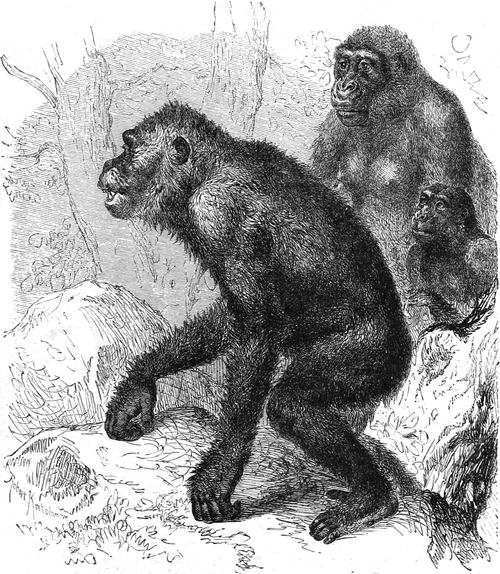
FAMILY OF GORILLAS.
“I was going quietly along the borders of this when I heard in the grove of plantation trees towards which I was walking a great crushing noise like the breaking of trees. I immediately hid myself behind a bush, and was soon gratified with the sight of a female Gorilla; but before I had time to notice its movements, a second and third emerged from the masses of colossal foliage; at length, no less than four came in view. They were all busily engaged in tearing down the larger trees. One of the females had a young one following her. I had an excellent opportunity of watching the movements of the impish-looking band. The shaggy hides, the protuberant abdomens, the hideous features of these strange creatures, whose forms so nearly resemble man, made up a picture like a vision in a morbid dream. In destroying a tree, they first grasped the base of the stem with one of their feet, and then with their powerful arms pulled it down, a matter of not much difficulty with so loosely-formed a stem as that of the plantain. They then set upon the juicy fruit of the tree at the bases of the leaves, and devoured it with great voracity. While eating, they made a kind of chuckling noise, expressive of contentment. Many trees they destroyed, apparently out of pure mischief. Now and then they stood still and looked around. Once or twice they seemed on the point of starting off in haste, but recovered themselves, and continued their work. Gradually they got nearer to the edge of the dark forest, and finally disappeared.” On the next day he was carrying a light gun, having given his heavy double-barrelled rifle to a boy to carry, when in a deep hollow, flanked with sugar-cane, he saw on the slope opposite to him a gigantic Gorilla standing erect, and walking directly towards him. Pointing his rifle, he turned to look for the boy, but he had seen the Gorilla and bolted forthwith. The huge beast stared at Du Chaillu for about two minutes, and then without uttering any noise moved off to the shade of the forest, running nimbly on his hands and feet.
This running movement is performed principally by the arms, for the animal places the backs of its knuckles on the ground, straightens its elbows, and swings the huge body and short legs so that they come in front. Then the feet support the weight of the body until the knuckles are put on the ground in advance.
Anxious to possess some adult Gorillas, Du Chaillu offered rewards to the native hunters, and on one occasion they brought in three live ones, one being full-grown. This was a large adult female, who was bound hand and foot, and with it was her female child, screaming terribly, and the third was a vigorous young male, who was also tightly bound. The female had been ingeniously secured by the negroes to a strong stick, the wrists being bound to the upper part, and the ankles to the lower, so that she could not reach to tear the cords with her teeth. It was dark when they were brought in, and the scene was wild and strange in the extreme. “The fiendish countenances of the Calibanish trio, one of them distorted by pain, for the mother Gorilla was severely wounded, were lit up by the ruddy glare of native torches.” The young male was secured by a chain, and Du Chaillu gave him the name of Tom. His feet and hands were untied, and he immediately showed his want of gratitude by rushing at his possessor, screaming with all his might; but the chain was happily made fast, and he did no harm. The old mother Gorilla was in an unfortunate plight. She had an arm broken, and a wound in the chest, besides being dreadfully beaten about the head; she groaned and roared many times during the night, probably from pain. She lived until the next day, her moanings were more frequent in the morning, and they gradually became weaker as her life ebbed out. Her death was like that of a human being, and her child clung to her to the last, and tried to obtain milk from her breast after she was dead. The young one was kept alive for three days on goat’s milk, but it died on the fourth day. The young male would not be photographed, for pointing the camera at him made the irascible little thing a small demon, but after some attempts his likeness was taken. These Gorillas were caught on a promontory which runs into the sea like a spit. A woman had seen “two sets of Gorillas on it with young ones, and the natives assembled, and armed themselves with great spears and axes, forming a line across the spit, advancing towards its extremity. They made a good deal of noise, and bewildered the Gorillas, who were shot down or beaten in their endeavours to escape. There were eight females together, but no large male.” Du Chaillu, on hearing this, modified his opinion respecting the solitary habit of the animal, and he subsequently obtained proofs that they roam in bands of from five to ten. It is true, however, that when Gorillas become aged, they seem to be more solitary, and live in pairs, or as in the case of old males, quite alone. He was assured by the negroes that solitary and aged Gorillas are sometimes seen almost white, for the hair becomes grizzled with age. Evidently the animal migrates here and there in his restricted district during certain seasons, and they search for a little yellow berry called “rubino,” which grows on a tree resembling the African teak; and also two other fruits, one like the nectarine in size, and of the colour of the peach, but not having the rich bloom, and the other like a plum. The same traveller came suddenly on a band of Gorillas in a forest; “a whole group was on a tree hidden by the dense foliage. They bolted off, making the thinner boughs bend with their weight, and an old male, apparently the guardian of the flock, made a bold stand, and stared at him through an opening. As soon as voices were heard, the shaggy Ape roared a cry of alarm, scrambled to the ground through the entangled lianas that were around the tree trunk, and soon disappeared into the jungle.”
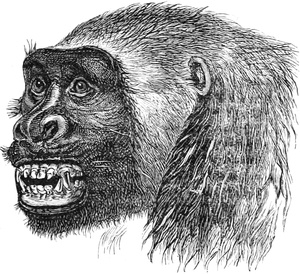
FACE OF THE GORILLA.
Having had, then, so many opportunities of seeing Gorillas alive and dead, Du Chaillu, of course, added largely to the knowledge of their general shape and habits, and obtained skins for stuffing, and bones for the anatomists. Five specimens were sent over by him to England, and great discussions took place; some naturalists asserting that the ferocity and courage of the great Ape were imaginary, and others believing in the truth of Du Chaillu, whose only fault was over-sensational writing, and who strenuously denied many of the native stories. Then the anatomists had a great quarrel about the brain of the creature, and handled each other very severely. Of the nature of the outside of the Gorilla there could be no doubt, fortunately, for there are the stuffed skins and bones to be seen, and an examination of those in the national collection will prove how closely Savage must have questioned the natives who gave him reliable information, and how little can be added to his description. Du Chaillu says that in length the adult Gorillas vary as much as men, and believes that the tallest are six feet two inches in height, but that the average is from five feet two inches to five feet eight inches. The females are smaller, or have a lighter frame, their height averaging about four feet six inches. The colour of the skin in the Gorilla, young as well as adult, is intense black, so far as the face, breast, and palms of the hands are concerned. The fur of a grown, but not aged specimen, is iron-gray, and the individual hairs are ringed with alternate stripes of black and gray. It is long on the arms, and slopes downwards from the shoulder to the elbow, and upwards from the wrist to it. The head is covered with reddish-brown hair, which is short, and reaches the short neck. The chest is bare in the adults, and thinly covered with hair in young males. In the female the breast is bare, and the hair elsewhere is black with a red tinge, but it is not ringed as in the male; moreover, the reddish crown which covers the scalp of the male is not apparent in the female till she has almost become full grown. The eyes are deeply sunken: the immense overhanging long ridge giving the face the expression of a constant savage scowl. The mouth is wide, and the lips are sharply cut, exhibiting no red on the edges, as in the human face. The jaws are of tremendous weight and power. The huge eye-teeth or canines, of the male, which are fully exhibited when, in his rage, he draws back his lips and shows the red colour of the inside of his mouth, lend additional ferocity to his aspect. In the female these teeth are smaller. The almost total absence of neck, which gives the head the appearance of being set into the shoulders, is due to the backward position of the joints which fix the head to the spine, and this allows the chin to hang over the top of the front of the chest. The brain-case is low and compressed, and its lofty top ridge causes the profile of the skull to describe an almost straight line from the back part, or occiput, to the ridge over the brow. The immense development of the muscles, which arise from this ridge, and the corresponding size of the jaw, are evidences of the great strength of the animal. The eyebrows are thin, but not well-defined, and are almost lost in the hair of the scalp. The eyelashes are thin also. The eyes are wide apart; and the ears, which are on a line with them, are smaller than those of man, but very much like his. In a front view of the face the nose is flat, but somewhat prominent—more so than in any other Ape; this is on account of a slightly projecting nose-bone, very unusual in Apes. The chest is of great capacity; the shoulders being exceedingly broad. The abdomen is of immense size, very prominent, and rounded at the sides. The front limbs have a prodigious muscular development, and are very long, extending nearly as low as the knees. The forearm is nearly of uniform size from the wrist to the elbow, and, indeed, the great length of the arms, and the shortness of the legs, form one of the chief differences between it and man. The arms are not long when compared with the trunk, but they are so in comparison with the legs. These are short, and decrease in size from below the knee to the ankle, having no calf. The hands, especially in the male, are of immense size, strong-boned, and thick; the fingers are short and large, the circumference of the middle finger at the first joint being five and a half inches in some Gorillas. The skin on the back of the fingers, near the middle, is callous, and very thick, which shows that the most usual mode of progression of the animal is on all-fours, and resting on the knuckles. The thumb is short, and not half so thick as the forefinger; and the hand is hairy as far as the division of the fingers, which are covered with short thin hairs. The palm of the hand is naked, callous, and intensely black. The nails are black, and shaped like those of man, but are smaller in proportion, and project very slightly beyond the ends of the fingers. They are thick and strong, and always seem much worn. The hand of the Gorilla is almost as wide as it is long, and in this it approaches nearer to that of man than any of the other Apes. The foot is proportionally wider than in man; the sole is callous, and intensely black, and looks somewhat like a giant hand of immense power and grasp. The transverse wrinkles show the frequency and freedom of movement of the two joints of the great toe-thumb, proving that they have a power of grasp. The middle toe, or third, is longer than the second and fourth, and this is unlike the foot in man. The toes are divided into three groups, so to speak; inside the great toe, outside the little toe, and the three others partly united by a web. Du Chaillu thinks that in no other animal is the foot so well adapted for the maintenance of the erect position, and he erroneously believed that the Gorilla is much less of a tree-climber than any other Ape. The foot in the Gorilla is certainly longer than the hand, as in man. These descriptions are fairly correct, but it is necessary to examine the results of the later writers on the subject, from whom we may glean the following facts.
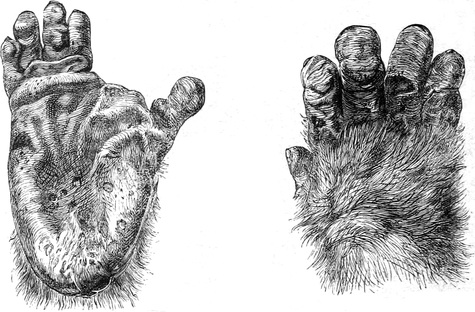
PALM OF THE FOOT OF YOUNG GORILLA. BACK OF THE HAND OF YOUNG GORILLA. (From the Transactions of the Zoological Society of London.)
The Gorilla has a large head, and on looking at a stuffed specimen one is at once struck with the width and length of the face, and the great prominent brows immediately over the eyes. There appears to be no forehead, for the head recedes rapidly backwards, and then comes a high ridge of hair, in old males, running from before backwards on the top of the scalp, and meeting another which is less prominent, and placed across the back of the skull, from the back of one ear to that of the other. The animal has the power of moving the flesh and skin which constitute the scalp freely forwards and backwards, so that when it is in a rage its scowl is made all the more threatening and ugly by its frowning and bringing down the hairy ridge close to above the eyes. The hazel eyes are large, and they are separated by a small prominent bridge belonging to the nose, the rest of which is broad and flattened out. The jaws project forwards, and are long and wide, the teeth being large and strong, and visible when uncovered by the fleshy and rather hairy lips. The ears are small for the size of the head, when they are compared with those of other Apes, and they as well as the skin of the face are naked and dark.
Nature has been kinder to the females so far as beauty is concerned, for they have less marked crests of hair, smaller brows, and shorter side teeth, and therefore more amiable faces under all circumstances.
Of course the outside appearance of the head has much to do with the skull beneath, and this has been very carefully studied by anatomists. As a whole, the skull of a full-grown male Gorilla is larger than that of a man, but it is lighter, although it appears to be more massive on account of its being marked by great bony ridges or crests, which correspond with the lines of hair on the top and back of the head, one being on the top like the crest of a helmet, and the other crossing the back and reaching the other so as to form a rude T shape. Careful measurement proves the great size of the Gorilla’s skull as a whole, and that this is dependent mainly on the dimensions of the bones of the face, the cavity for the brain being smaller than that of man. But it does not appear at first very easy to explain how it is that this massive-looking skull should be lighter than that of man. A careful examination of the bones of the Gorilla’s skull explains the difficulty, and in a very interesting manner.
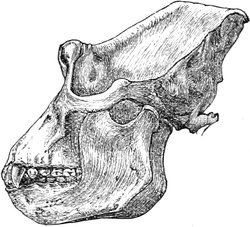
SIDE VIEW OF THE SKULL OF GORILLA.
The massive and solid look is given to it by the crests or ridges beneath the hair already mentioned; they are of great use, for they give attachment to very powerful muscles, especially to those which move the lower jaw, and enable the teeth to bite forcibly. The surface of the bones of the head for a certain depth is solid enough, but below this solid layer there is a cellular arrangement consisting of a network of bone, with cavities communicating with each other with the internal parts of the ears and nose. Below this is solid bone again. So that there are three layers, and the central one gives lightness and strength to the whole; moreover, it protects the brain under the skull from receiving shocks during falls or blows by boughs.
When the skull receives a sharp blow, for instance, in front or behind, or low down at the sides, the outer layer of solid bone is often cracked, and even forced in. If there were no cellular layer, the tender brain would be injured directly, but the network of bone and the large spaces amongst it take off the jar from that important organ, and suffer the outer layer to be pressed in without affecting the deeper structures. It must be a very hard blow that can press the cellular layer in sufficiently to break through the third layer, which is solid but thin. Very possibly the larger air spaces of the cellular layer assist the senses of hearing and of smelling also.
There is another very strong bone connected with the skull, which feels like a ridge, passing backward from the eye to the ear; and it has something to do with the other ridges, for the muscles which are attached to them, and which pass down to the lower jaw to give it great power of mastication, are covered on the cheek by it. This cheek-bone forms a kind of arch, and gives the great breadth to the upper part of the face of the animal.
In a front view of the skull of the male Gorilla the ridge or crest on the top of the head stands up like a little peak; then over the eyes is the great brow ridge, which seems to press the upper part of the cavity for the eye (the orbit) flat, so that it is not round as in most animals, but rather square in outline. These three sets of ridges, those of the upper and back part of the brain case, that of the brow and those of the cheeks, so large and important, are distinctive of the adult male animal, and a skull possessing them belongs to the Gorilla and to no other animal.
The females and the young of both sexes have not the top ridges, and the others are small in comparison with those of the male adults.
Clearly the ridges give strength to the head, muscular power to the jaws, and what is of great importance to a large active animal, do not interfere with the lightness of the strong skull.
The skull is hollow beneath the top and back ridges, and this space is occupied by the brain and its investing membranes, and the nerves coming from it, to supply the muscles of the face and head, the skin over them, and the organs of special sense, such as the eye, the ear, and the nose. The space is considerable, and for an Ape the Gorilla has a large brain. He has a large body, very many muscles capable of complicated movement, and he can see, hear, and smell admirably; and as the nerves which supply the necessary energy for all this come from the great nervous centre, as the brain is called, it must be of considerable size and complexity. Moreover, as many of the motions and sensations of the Ape resemble those of man, the brains of both will resemble each other to a certain extent. But all that part of the brain which serves in a manner, as yet past our comprehension, to assist the production of the high intelligence and moral powers of man, we should expect not to find in the purely sensual animal, and the expectation is realised. Again, although bone for bone, muscle for muscle, and blood-vessel for blood-vessel, those of the great Ape and man may be compared with wonderful exactitude; still man in relation to the Gorilla has a greater power of elegance of movement, and of producing complicated muscular efforts, and of employing many different muscles to produce a common end, and therefore his nervous system must be all the more perfect. Thus, the Ape cannot imitate the graceful actions which sway the body as when a well-made man walks leisurely, and it cannot get all the muscles of the mouth, tongue, and larynx (or organ of voice) to act simultaneously and orderly, so as to produce the sound of articulate voice. Yet these actions are performed by man without any special effort; they may be done without thinking, and are mechanical, as it were, or more properly, “automatic,” done as if by a machine; they require a very perfect arrangement of the nervous system, and an unusual amount of nervous matter.
No amount of schooling, could it be given, would ever make a Gorilla entertain the notion of insuring its life; arithmetic is impossible; the fine arts and poetry are unattainable, and therefore by so much is its brain the smaller and simpler.
The brain case, or the space enclosed by the crested skull bones, is compactly filled with the nervous material in all animals, so it is only necessary to ascertain the relative dimensions of the spaces in different animals to get a notion of the difference in the sizes of their brains. The space can be measured by filling it with sand, and then measuring its bulk in a proper measure.
Some Gorillas have larger spaces for the brain than others, and in this they resemble man, for there is a considerable difference between the capacity or the size of the space in a well-educated European and a savage Australian. And, doubtless, some Gorillas are cleverer than others, or are more active, generally speaking, so have larger brains; but an average may be taken of the different sizes in them as in man, and the results come out as follows:—
The average or mean size or capacity of the brain case in the Gorilla is about 31 cubic inches, a cubic inch being a six-sided space of one inch long, broad, and high. In man, the European may have a brain case holding 114 cubic inches, and the Australian only 63 cubic inches; the mean of the European size is 93 cubic inches, that of the Australian being 75. Hence the brain case, and therefore the mass of the substance of the brain of the Gorilla, is not one-half that of the lowest race of man.
Only the brains of young Gorillas have been examined, and these have not been in a very satisfactory state; but enough has been gleaned from their study to determine that they are not so high, wide, or long, relatively, as those of mankind. The brain of man is a wonderfully complex structure, and the nervous matter is folded and packed in many ways or “convolutions,” and the nerves arise from special parts which are connected by cross and long fibres or “commissures.” All these structures exist, but not in perfection, in the Gorilla’s brain; and although the nerves are large, that portion of the brain which originates their energy and action is much smaller than in man.
Apparently the brain grows to a certain age in the Gorilla, and then the skull increases in outward size, and the creature has a huge body, with mental capacities far below those of a child or man.
The ridges and crests on the top and back of the Gorilla’s skull are larger than those of any of the great flesh-eating animals of the cat tribe, and it has therefore been thought that they were a proof of the occasional bad habits of the great Ape, and of his indulging now and then in negro flesh. Large as are the crests in the old males, they are barely present in the females and young, and they must be regarded partly as of use to the larger animals, and partly as ornamental; for in animal nature, as a rule, the gentlemen are more beautiful than the ladies, the idea of beauty being, of course, very much a matter of taste. They are evidently protections against falls, and they also give origin to muscles. The back crest, when looked at from behind, is almost fan-shaped, the bone being broad, and the great muscles of the neck and back are attached to it. They pull the head backwards, and the single, long crest on the top gives origin to the muscles, which pass downwards on the temples to the lower jaw. Indeed, the energy of the muscles of the side of the head is principally devoted to the lower jaw, to its crushing, crunching, and masticating offices, for the food, although often soft enough, is occasionally inside the sugar-cane, and several harder woods. The powerful upper jaw is, of course, attached to an equally strong lower one, which forms the front and lower part of the face. The upper jaw reaches out far in front of the eyes and nostrils, and is straight rather than bulged, and appears narrow, from side to side, in comparison with the great, wide cheek-bones, but it looks formidable with four strong front teeth, projecting only slightly, and a large, long, eye tooth on each side, sticking out rather far below the others.
On looking at the under surface of the roof of the mouth and palate, the cause of the length of the front of the face is seen. Instead of the back teeth forming an open curve around the roof of the mouth, as in men, they are placed in a long, and almost parallel straight row. Five great teeth on each side thus form with the bone, into which their fangs are planted, a long side to the face. In front of these is the large eye, or dog tooth (canine tooth), mentioned above.
The palate and roof of the mouth are long and comparatively narrow, and hence no Gorilla could speak distinctly, or use his tongue glibly enough to talk as a child. Howling and a kind of bark may, on the contrary, be done to perfection.
But although of no use as regards speech, the long roof of the mouth, with its wide ranges of teeth, is of great importance to a vegetable-eating creature, which does not want the sugary juices of its food to run out of the corners of its mouth, and which spends the greater part of its time in filling its capacious stomach.[4] The lower jaw fits the upper one, and when its teeth clench with those above, the cavity of the mouth is nearly shut, and it is quite closed by the lips and cheeks outside.
As might be expected from the great muscles which unite the lower jaw to the skull, it is large and strong, but it has no projecting chin, and this slopes in a retiring manner. The side of the jaw which supports the teeth is, as in man, curved upwards behind at what is called the angle. The jaw is very movable, and can act sideways in munching, or up and down, as in biting; and having these powers—thanks to the action of different sets of muscles—it has teeth fashioned to bite, and to crunch, and to chew. They greatly resemble those of the upper jaw, on which they work, and a superficial view of them all leads to the opinion that they greatly resemble those of man; there are, however, many differences. As in the upper jaw, the front and eye teeth are nearly straight in front, the last-mentioned projecting outwards, and the front teeth biting inside the upper ones; and the back teeth are in straight rows also.
The following story is told by Du Chaillu to illustrate the cause of the wearing of the front teeth of the Gorillas. He had gone into the interior, and was suffering from hunger, so went out into the forest for game. Not finding any, he was about to retrace his steps, when he heard the unmistakable roar of a Gorilla. He writes, “I plunged forward into the thick of the forest, breaking, as I went along, small boughs to enable me to find my way back, and tearing my clothes in the thorny underwood. The roar became nearer, and seemed to shake the ground under me. I heard the rustling of the branches, and fancied there must be more than one. The excitement of the moment was great, and was increased by the prospect of obtaining food for all our party. Suddenly the roaring ceased. I stopped, thinking that it was a male, which was preparing to advance on me. But I listened in vain—the beast had fled. When I reached the spot I saw nothing but broken branches of trees. I measured some of them with my thumb, and found boughs of five inches’ diameter broken in two by the powerful grip of this monster of the forest. Although disappointed in my chase, I was glad to find a corroboration of the explanation I had given of the wearing down of the animal’s front teeth, for some of the branches plainly bore the toothmarks.”
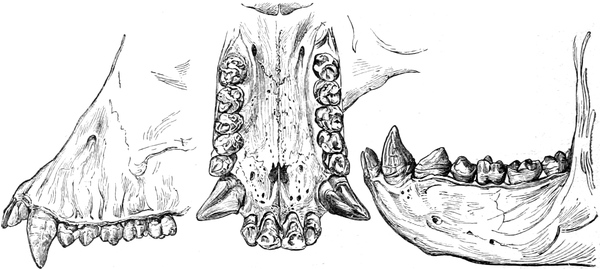
UPPER JAW. PALATE. UNDER JAW. THE TEETH OF THE GORILLA.
As the teeth of the Gorilla are admirably adapted for their duties of masticating and biting vegetable food, sometimes soft and sometimes hard, and as they resemble in number and general arrangement those of man, it is necessary to notice them briefly. They are of three kinds, the front ones, which bite when the jaw is moved up and down, the large eye teeth (or dog teeth), which pierce, and the back teeth, which crush and grind. The first-mentioned are called incisor teeth or cutters, and there are four in the upper and four in the lower jaw, as in man; the inner two in each jaw being larger than the outer two. They project slightly, and those of the upper jaw cut on the lower ones, and are, when the jaws are clenched, in front or “over-hung.” In shape they are adapted for biting a piece out of anything, and they have one fang each, which fits into a socket in the jaw. In the upper jaw there is a space between the incisor teeth and the great eye or dog teeth. This is one of the matters which distinguish the jaw of the Gorilla from that of man, whose teeth are continued in a row without any spaces where the gum is visible between them. The cause of the space is that the lower eye tooth is so large and long that when the mouth is closed it fits in there. This space is called a “diastema,” and, as it is a term which will often be mentioned, it is necessary to notice that it is taken from the Greek word διάστημα, “an interval.” In the lower jaw the incisor teeth are succeeded by the eye teeth without any diastema. The eye or dog teeth are usually called canines, from Canis, a dog, they being very distinct in that animal. They are four in number, two being in each jaw, one on each side, and those of the upper jaw are long and pointed, being rounded, moreover, outside, and marked by grooves inside. The lower canines are nearly as large as the upper ones, and, as already noticed, fit in the diastema in front of those of the upper jaw.
Behind the canine teeth are, on each side in both jaws, five crushing teeth, that is to say, ten in each jaw, and twenty in all. In the upper jaw there is a continuous row of teeth from the canines in front to the last of the crushers, which occupy the position of the upper wisdom teeth of man, but in the lower jaw there is not this serried row of teeth, for, between the crushing ones and the canine, there is another space or diastema into which the upper canine tooth fits when the mouth is closed.
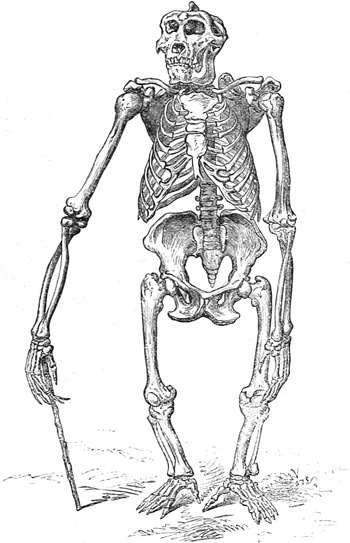
SKELETON OF THE GORILLA.
All these hind teeth are made to endure constant grinding, one over the other, in masticating, besides frequent shocks—as when nuts are cracked—and to last for years. Covered with a beautiful enamel, which gives them strength and smoothness, they are safely fixed by fangs in sockets in the bone, in such a manner that the nerves and blood-vessels supplying them do not suffer from pressure. They are not quite flat at the top, for then they could not grind, and they are not acutely sharp-pointed, for then the points would prevent the side-to-side movement of the jaw, and would be broken off; but they have rounded projections, or cusps, on them, separated by grooves, so that those of the teeth of one jaw can fit into those of the other. All these teeth are not quite alike, and they are divisible into two kinds, the three hinder ones being the molar teeth, from Mola, a mill-stone, and the two in front of them being called false molars or pre-molars (front molars). Every one who has had a back tooth (a molar) taken out, will remember its three fangs, and in a Gorilla there would be the same terrible wrench in extracting a molar for the same reasons as with us. But, fortunately for it, tooth decay is unknown, and the molars, with their three fangs, last as long as life. The pre-molars have two fangs only in man, but it appears that sometimes there are three to those teeth in the upper jaw of the Gorilla, and two only in the lower. They are smaller than the true molars or three back teeth, and in front of them; and that nearest the canine tooth is often tall, and almost like a four-sided pyramid in shape. The size of the crushing or molar teeth is very distinctive of the Gorilla when it is compared with the other great man-like Apes, for the upper ones are equal in size, and in the lower jaw the hindmost tooth is larger than the others. Moreover, these lower teeth have five cusps or projections. There is a ridge extending obliquely across the crowns of the lower molars from an inner to an outer cusp; and the cross-like grooves of the upper surface of the corresponding teeth in man are not seen. The manner in which the teeth of the Gorilla differ from those of other Apes will be mentioned in the several descriptions. Milk teeth, or those of the first set, are found in baby and young Gorillas, and when they fall out the permanent set come out of the jaw and replace them, adding also to their numbers. The long canine teeth are characteristic of the old males, and those of the females and young are much smaller. The thirty-two teeth of the Gorilla, eminently adapted for a mixed vegetable diet, are therefore arranged as follows:—Upper jaw—four incisors, two canines, four pre-molars, and six true molars, and there is the same number in the lower jaw.
It is a very remarkable fact, and one which will be of some interest in comparing one of the other great Apes with the Gorilla, that the skull of the young Gorilla (of both sexes) and that of the full-grown female differs materially from that of the male in the absence of the prominent ridges of the top and back of the head. This gives a roundness to their skulls which would at first sight lead to the belief that they could not belong to the same species.
Living upon such nice things as sugar-canes and pine-apples, the Gorilla has a long and well-formed tongue to taste them with,[5] and a good nose to enjoy their scent and fragrance. The nostrils are open, and look downwards, being separated by a moderately wide piece of flesh covering, gristle, or cartilage, and they are protected above by very dense bones, which form the slight ridges called the nasal bones. Up the nose a passage leads to the air spaces in the bone of the front of the head, and they and some curiously curled bones not very far from the nostrils are covered with a delicate membrane well supplied with the nerves in which the function of smell exists.
Both the natives and Du Chaillu allude to the roaring and yelling of the old male Gorillas, and it will be noticed further on that the young ones can make noise enough. Dr. Savage was told that when the male is first seen he gives a terrific yell that resounds far and near through the forest, something like Kh—ah! Kh—ah, prolonged and shrill, and others have compared the noise to distant thunder. They have an organ of voice on the top of the windpipe, made on the plan of that of man, but deficient in many respects, and especially in those fine adaptations of structure which produce the human voice. But there is a very remarkable arrangement in their larynx, as it is called, which, although it has nothing to do with the formation of sound, may possibly make it more resonant and growling, and this is one of the things which separate the great Ape from man in matters of mere construction.
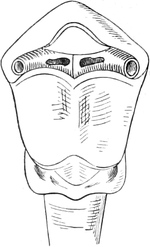
THROAT OF GORILLA.
At the back of our tongues, and also of those of the Gorilla, is a little flap, rather hard and gristly in us, and only membranous and soft in the Ape, which covers over the top of the air-passage into the windpipe when any food is swallowed. The food or drink would otherwise get into the air-passage, and would be constantly going “the wrong way.” Immediately under this flap, or, as it is called, the epiglottis, is a space limited in front by the hard substance we call in our throat the “Adam’s apple,” and at the bottom of it are the movable structures by whose action voice is produced. Now, in the this space is not shut in front as it is in us, but there are two openings in it, one on either side, which lead to a complicated sac or pouch. This pouch is made of thin membrane, and covers, when blown out like a bag—for the air coming out of the windpipe can be forced in—the front of the windpipe, and projects sideways under the muscles of the throat, and even amidst those of the armpits. The Gorilla can thus blow his neck out, as it were, and when he is yelling, the air in the bag or pouch must resound. Possibly this great bag of air may have something to do with making the body lighter when the animal is climbing and using all the force it can with its arms. These so-called “laryngeal” pouches are found in many Apes and Monkeys, but their double opening into the space below the little flap is peculiar to the great Apes, which are sufficiently man-like as to be called by the term Anthropoid—the Gorillas, their allies the Chimpanzees, the Orangs, and the Siamangs.[6] All the other Monkeys of the Old World with sacs have but one opening into a space, or, as it is termed, the ventricle of the organ of voice, or larynx. The Monkeys of the New World have a different arrangement of air pouches, which will be noticed in the proper place.
The Gorilla has one little peculiarity which distinguishes it from all other Apes and Monkeys, and which causes it to be more like man, and insignificant as it may seem, it is of some interest. In man there is a decided projection of bone behind, or rather below the ear, and this is called the teat-shaped process of the ear-bone (Mastoid process), and is of importance to the organ of hearing and also to the muscles which steady and keep the head erect, and allow of its being moved in particular directions. This process exists to a certain extent in the Gorilla but not in the Chimpanzee, Orang-Utan, or in any other of the Quadrumana. It is smaller in the Gorilla than in man, but it is made up, as in us, of a number of spaces enclosed by bones which have to do with the organ of hearing in some way or other, and which are lined with membrane. On the outside a muscle is attached, which passes downwards and inwards to the top of the breast-bone, covering the great blood-vessels and nerves of the neck.
In examining this process of bone, attention is of course drawn to the ear itself, and there is no doubt of the remarkable resemblance of those of man and of the Gorilla. The great Ape has evidently a very quick sense of hearing, for it gets out of the way of men as quickly as is possible, when it can only hear them in the forest and jungle, but that it should have the outside ear fashioned nearly after the resemblance of that beautiful structure in man is very remarkable. The ear of the Gorilla is smaller in proportion to the size of the head than those of other Apes, and is about the same length, but broader than that of man; the lobe, which is perforated by us for earrings, is perhaps less perfect in the Gorilla, but all the curves and folds, which are so complicated yet so graceful in the human ear exist in it, modified more or less, and not so harmonious in their general symmetry, as in man.
With all its great strength, the head of the great Ape cannot move as readily on the neck as that of weaker man, for the skull is not placed on the neck end of the back-bone quite in the same manner, and its position is not that which is admirably (as in us) adapted for carrying the head erect. One of the greatest marvels in the structure of man is the manner in which the tender mass of nerves called the spinal cord or marrow passes out of the hard skull into a bony canal down the spine, and yet does not suffer injury as head and back move and roll about.
The spinal cord or marrow passes out of the skull through a special opening, on the outside of which is a joint on either side. These joints fit on to corresponding ones on a ring-shaped bone (atlas bone), and this bone rests on one equally hollow, and which has an upward projection which enters the ring (axis bone), and is clasped to it by a strong ligament. It is this projection which prevents the spinal marrow from being injured by the head moving too freely, and yet life hangs almost on a thread, for were this strong ligament to break the soft nerve would be pressed in by the bony projection, and death would ensue. All the motions of the head are connected with these bones and their joints, and the way in which it is carried is in relation with the position of the opening in the skull for the spinal marrow. If the head is to be carried erect, as in man and in many birds, the opening is far from the back part of the head. If the face is to look upwards, as it does in a pig or dog, the opening is very far backwards. In the Gorilla it is not quite at the back, but further in that direction than in man, and hence the face of this Ape is more liable to be looking upwards than forwards. This is really the case, for the natural position of the animal is not erect, but on all-fours, and then it wants to look, not on the ground, but upwards and forwards, by tilting the head. Many of the great muscles of the back crest have to do with this. It is noticed also that the joint which permits the head to move on the ring-shaped bone (the atlas bone) is not so long or curved as in man, and therefore the movements of the Gorilla’s head are restricted.
All accounts of the life of a Gorilla tell of its moving rapidly amongst trees, climbing readily and noiselessly, and gathering its food constantly. It is therefore necessary to examine into the manner in which this is done, and how it relates to the shape and anatomy of the creature.
In climbing trees, the Gorilla, like a man under the same circumstances, lifts up the arms over the head, and clasps or holds on with one hand, but the position of the hand is not the same. Apes seize instinctively with the knuckles towards them, and not with the ends of the fingers and palm as man: and this makes a great difference, for the muscles of the back are therefore more important to the Ape than those of the chest in climbing. Then with some muscular effort the body is lifted or rather drawn up, so that the unemployed hand can reach and clasp higher than the other; and having thus two hands holding on to a bough or a tree, the muscles of both arms are used to draw up the ponderous trunk, head, and limbs until the face comes more or less on a level with the wrists. When this is accomplished, one of the arms is suddenly forced upwards to enable the huge grasp of the fingers to tighten upon a higher fixed point, and the “hand-over-hand” process is continued as long as is necessary. Doubtless the clasping feet assist in this movement, which is only rarely performed by man, but which is one of the commonest with the great Ape. A sailor or an acrobat may often use the muscles which are required to perform this feat of carrying upwards the body with the aid of the arms, but ordinary people rarely employ their energies in this manner; the Gorilla, on the contrary, must climb often and for some distance every day of its life, both for food, amusement, and for shelter. It becomes, therefore, an interesting question whether the Gorilla has any special muscles or bones which enable it to climb easily and rapidly, and for a considerable time, or whether there are the same kinds of bones and muscles in its hands, arms, and shoulders, which are to be found in man modified more or less. The results of careful inspection have proved that, although there are no peculiar structures given to the great Ape wherewith it may climb, still the bones of the arms and shoulders, and the muscles which are attached to them, greatly as they resemble those of man, are larger and stronger. Bone for bone, and almost muscle for muscle, the climbing limbs of the man and the Gorilla may be compared with extraordinary exactness; the structures of the last-mentioned being, as it were, simple exaggerations of the former, and the increased size bearing a distinct relation to the agility and energy displayed. It must be remembered, however, that whilst in man the muscles of the chest assist principally in climbing, in the Ape those of the back and shoulders are the most important.
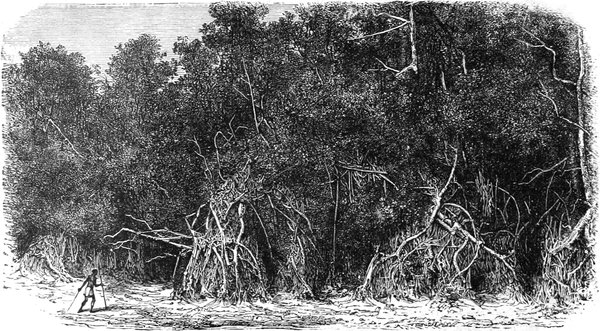
FOREST IN THE GABOON COUNTRY—THE LAND OF THE GORILLA.
It is hardly necessary to notice the relation which bones and muscles have to movement, and the most unlearned in anatomy need only be reminded that muscles are adherent to certain parts of bones. The bone, by itself, is motionless, and the force which can move it, and with it, the surrounding flesh and skin, acts through the muscles, and these consist of vast numbers of long microscopic fibrils, placed side by side, and adherent, at both ends, to different bones. The fibrils have a vast amount of energy in them, and they can contract, or, in other words, shorten; the diminution in length being accompanied by a display of force. As the fibrils shorten, they tend to bring the motionless bones closer together, and to impart motion, which may be rapid, and more or less forcible. If one bone is stationary, the other may be brought towards it by the muscular contraction, or if both are not fixed, both may move. The nervous force produces the muscular contraction, whose vigour and lasting power depend a great deal upon the supply of blood sent to the fibrils through the blood vessels (arteries), and removed through the veins.
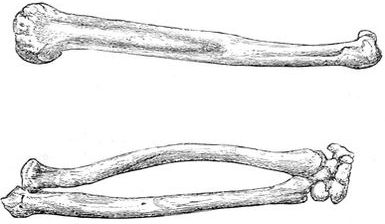
BONES OF THE FORE-ARM AND ARM OF THE GORILLA—SIDE VIEW.
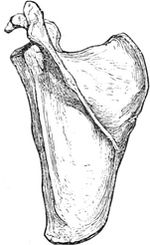
SHOULDER OR BLADE-BONE.
In the principal act of climbing hand-over-hand, a bough or some stationary object is grasped by the fingers, the arm being straight, and the body hanging, as it were, to it. The first motion is the lifting up of the arm; the second is the grasping with the hand; and the third is the bending of the straight elbow, and bringing the shoulder up nearer the fixed point, or the part grasped. Whilst this is being done the body is not limp, but more or less stiffened by the spine, which runs down the back, and consists of many bones, being made rigid by the contraction of many small muscles. Now the bones and muscles of all the parts of the body engaged in climbing are so arranged that the spine shall not suffer any jarring, but shall be lifted up safely. Were all the muscles which pull upon the arms attached to it, every unusual effort would drag it almost to pieces, so there is a wide flat bone placed between the spine and the arm. This so-called blade-bone is jointed by a ball and socket joint to the arm-bone, but is only united to the spine and back part of the head by muscles. Muscles start from the spine to the blade-bone, from the blade-bone to the bones of the arm and fore-arm, and from these last to the bones of the fingers, and by their shortening or contraction, the fingers being stationary, the body is at last brought closer to them.
In order to explain the first motions of climbing, it is necessary to remark that on looking at the skeleton of the Gorilla the shoulder-blades are seen to be of the same general shape as those of man; they are much larger, however, and there are some anatomical points about them, which clearly have to do with the ability of the great Ape to keep its arms up for a long time, and to pull up its heavy body when the hands and fore-arms are fixed and immovable by clasping. One muscle, which in ourselves forms the cushion on the shoulder, and reaches down the outside of the arm for a little distance, is called the deltoid or Δ-shaped muscle, and its especial duty is, when the shoulder-blade is fixed, to lift up the arm by its contraction. The movement is permitted because between the spots where the muscles are adherent to the blade-bone on the one hand, and to the outside of the arm-bone on the other, a distance of several inches, there is a joint like a ball and socket. The muscle is not attached to a flat surface on the blade-bone, but to a raised edge, which runs rather obliquely, and is called the spine of the bone. Now this muscle is of immense importance to the Gorilla, as may be imagined from the nature of its function or office: it is placed in the same position as in man, and between the same kind of bones, but the spine of the blade-bone is longer, broader, and more slantingly set in the Ape, so that extra strength and greater power are attained.
This spine, or rather raised ridge, can be felt when we place the right hand over the left shoulder as far as possible, keeping the fingers between the neck and the end of the shoulder, and its slanting position can be traced best in the Gorilla; and it may be mentioned, that in the Chimpanzee the direction is much more oblique. Above this spine of the blade-bone there is the upper part of the blade, and it is covered with muscle, the space thus occupied being much larger in the Gorilla than in man. This muscle starts from this bone, to which it is attached, and is united to the arm-bone, close to its joint with the blade-bone; it is larger in the Gorilla than in us, and one of its uses is to assist the deltoid just mentioned.
There is rather an interesting arrangement in the old Gorillas, which is not found in the young or in man, and which appears to have to do with the power of this muscle and its prolonged action. The muscle is well supplied with blood, and the nerve which endows it with energy is particularly well prevented from being compressed during the movements of the muscles amongst which it runs, any compression being very injurious. The upper edge of the blade-bone is notched, and a dense tissue or ligament stretches from one point of the notch to the opposite one, enclosing a small open space; now the nerve runs through this space, and is protected by the hard tissues of bone and ligament from the contraction of the soft muscles. In the old Gorilla a further protection is found in the presence of a little projection of bone in this space, which acts as a greater preventer of pressure.
After passing through this space the nerve enters the very substance of the muscle, and is distributed to its fibrils.
The upper arm reaches down from the shoulder to the hips in the Gorilla, and its bone (os humerus, from the Latin) is strongly marked on its surface by roughnesses and ridges, to which the great muscles are attached. In man the shape of the upper arm varies with the strength of the individual, but in the strongest man and in the most beautifully-shaped woman it has a swelling on the front, and tapers more or less towards the elbow. This is caused by the two-headed or biceps muscle, and by other muscles ending in tendons. But the Gorilla has a very shapeless upper arm; it is, as it were, fat and round throughout, and very large above the elbow, and this is because of the size of the bone within, and on account of the muscles not tapering as they do in man, but being well developed right down to their ends. Hence, elegance of shape is sacrificed to extra muscular strength and size of bone.
On looking at the arm-bone, which, being connected to the shoulder by a joint, has much to do with the act of climbing and striking, it will be noticed that it greatly resembles that of man in shape, but is longer, stouter, and clumsier. The joint is nearly in the shape of a rounded knob, and the corresponding depression or cup on the blade or shoulder-bone into which it fits, is an oval and concave surface, and they are kept close together by a kind of capsule which stretches from one bone to the other and encloses the joint. Perfect freedom of movement is insured by the bones being covered with glistening cartilages, and a delicate and moist membrane, and the motion from the shape of the apparatus is almost equal to that of a chandelier where there is what is called a cup-and-ball joint at the ceiling. It has already been noticed that muscles are attached to the blade-bone and to the arm-bone below the joint, and that, this being movable, when they contract they move the arm, and the instance was given of the action of the deltoid muscle in raising the arm. In the Gorilla, this great muscle reaches lower down than in man, and there is a very strong mark in the shaft of the bone for its insertion. This gives the muscle greater play than in us, and enables it to lift, more slowly perhaps, but more efficiently, for the arm-bone between the joint and the place where the muscle is attached, is the long arm of a lever which is shorter in man. Below the globular head of the arm-bone is the shaft or cylindrical part of the bone which gives origin to the three-headed muscle called triceps, and is covered by the two-headed one (biceps) already mentioned, besides the deltoid. A deep groove allows one of the ends or heads of the biceps to pass along and slide over the joint and to reach the shoulder-blade. The shaft as a whole is more or less cylindrical, with a slight angular outline, the angles being projections of bone which strengthen the whole, besides giving attachment to muscles; the cylindrical shape is the best for strength and lightness, and these properties are increased by the adoption of a plan which engineers have long since unwittingly copied. The shaft is hollow, and is cellular at both ends, solid bone covering the outside, conditions which oppose fracture, and produce increased strength, indeed greater strength and lightness than a solid bone would have. Below the shaft is an expansion, on which are placed the surfaces for the jointing on of the two bones of the fore-arm, and the bone is especially in old Gorillas perforated there, a condition seen in some very old human bones. There is an important point in the relative length of the upper arm-bone, and the bones of the fore-arm in the Gorilla, in other Apes, and in man, for in this great Ape and in us the humerus is longer than the others, and in the Chimpanzee they are almost equal, whilst in the rest of the Monkeys they are very unequal, the bones of the fore-arm being much the longest.