Front matter (continued 2)
Reading edition
'Marry, then, in two hours our Captain will expect your answer,' said the pirate, 'and it were best not to trifle with him, as he is sure to keep his word. 'Tis no time to dally.'
'Perros! nos veremos,' exclaimed a soldier after Carlo had turned away in silence--which words mean in English, 'Dogs, we shall meet you,' and were accompanied by some insulting dumb show at the departing messengers.
After this the boy went back to the council-room; but what was his surprise at finding it barred and bolted, whilst a soldier, who was guarding it, said respectfully that the Governor's orders were that no one might enter.
'That does not include me,' said Carlo, angrily.
'Pardon, noble Señor Carlo; the Marquis said, "Not even my son."'
[Illustration: CARLO REFUSED ADMISSION (missing from book)]
Carlo turned away, too indignant to say anything in answer; and then he went sorrowfully upstairs to get some comfort where he knew he should always find it. He told the girls what had just happened, adding:
'It is very unjust of my father.' Then, as Felipa blushed with sorrow, he added: 'No, I ought not to say that, for I fancy he did not mean to exclude me, only that stupid Luis wished to show his importance and invented the order.'
'Tell me, dear Carlo,' put in Etta, eagerly, 'did you speak to the English boy? I saw the soldier escort him and his fellow down the hill; and how I wished I could have had a few words with him!'
'What! with a pirate, Etta? But would that I could go into the council-room! If my father decides to despatch several hundred men, he must give me the command of at least a little band. You should see how well I could command.'
'Your noble father only meant, Señorito, that you must not disturb the meeting,' said Catalina, joining in; 'and I know there is a door at the other end, which is made but of light bamboos, and you can hear well enough there all that goes on.' Catalina spoke with so much certainty that it seemed as if she had herself been eavesdropping.
Carlo was delighted with the idea. 'Is that so, Catalina? The saints reward you, you dear old woman! I will give you a silk kerchief worked in gold thread the next time a merchant ship comes here from Panama. Ah, Etta, I am afraid you will never see your fair English boy again, so do not expect it, unless we take him prisoner; then I will spare him for your sake. That is a bargain. Now, Catalina, come and show me your secret way.' And delighted that he should not be quite excluded from hearing the plans of defence, the eager Carlo followed Catalina, quite believing that after all it was not his father but the stupid guard Luis who had prevented him from joining in the council of war. He was, however, soon to be undeceived.
CHAPTER VII.
TREACHERY.
An hour later, when the Governor came out of the council-chamber and was entering his own private room, he looked ten years older. At this moment Carlo rushed into the room and threw himself at his father's feet.
Don Estevan looked much surprised, and the papers he held in his hand shook visibly.
'Father, you cannot mean it!' cried the Governor's only son, 'say it is not true! There is yet time: the messengers have not yet started. I beseech you think better of it. I heard everything.'
'You heard everything? What do you mean, you insolent boy!' cried the Marquis, angrily; 'you were not in the council-chamber. Get up, Carlo; what is done is done for the best.'
'No, no, it cannot be for the best to betray this island. The stratagem you have suggested is unworthy of you; it cannot be true that Don Estevan del Campo will allow those villains to take this fortress without so much as a blow!'
Poor Carlo was beside himself with grief; he had indeed heard only too much from his hiding-place. The Governor had entirely lost his head, and was unable to make up his mind to fight the dreaded buccaneers; and now that he had found out their real number, and the number of their ships, he could think of nothing but temporising with them. He had forced the council to agree to send two messengers to Henry Morgan with these terms: They were to say that, feeling himself quite unable to hold the island against such a body of desperate men as Captain Morgan had with him, the Marquis begged the Captain to use a certain stratagem of war in order to make it appear to the people that the place was taken in honest fight. Captain Morgan was, according to this plan, to come at night to the bridge which divided the two islands, and here he was to attack Fort St. Jerome. In the meanwhile the pirate ships were to approach as near as possible to Santa Teresa and attack it from the sea; also at the same time to land a body of men at a place hard by, called St. Matthew. Here the Governor was to be intercepted on his way to Fort Jerome, taken prisoner, and forced to give up the keys of the castles of Santa Teresa and St. Jerome, and the possession of these two strong places would virtually mean that of the whole island. There was to be a feint, much firing on both sides, but no bullets were to be used; moreover, they were to fire in the air, to make sure of no one being killed on either side.
This was the shameful plan of surrender that Carlo had heard his father propose, and not only propose but enforce on the majority of the men composing the council; though Don Francisco de Paratta and a few others had firmly refused to give their consent to such a base affair.
The Marquis also knew that Carlo, young as he was, was too bold and fearless ever to give in his obedience to this idea, and for this reason he had had him shut out from the deliberations. He was therefore all the more indignant and angry when Carlo declared he had heard everything, and his burst of indignation was terrible to witness.
'You forget your position and mine,' said the unhappy Marquis in a passion. 'What can you know, Carlo, of the defences of the island? How can I consent to a general massacre of my garrisons, when by this simple means we shall avoid all loss? And in a few days these wild robbers will leave the island for other more profitable fields, and--but why should I explain my reasons to you? What business had you to be eavesdropping? Is that the conduct to be expected from my son?'
Carlo did not seem to hear his father's personal abuse; his mind was bent on averting the terrible blot which, if this plan were carried out, must come on his father's name. However secret these negotiations might now be kept, sooner or later they would become known, and the name Carlo was so proud to bear would be for ever dishonoured.
'Let me go and stop the canoe; or if it is gone, Andreas can easily overtake the messengers. Father, be angry with me, do anything; but do not let us sell our honour!'
The Marquis was now in a worse passion than ever with his son who dared to speak the truth to him.
'Carlo, you shall not speak so! you forget yourself. Go from my presence at once, sir, and consider yourself a prisoner on parole. Do not leave your sister's dwelling-room till I give you leave; and remember, if you disobey I shall have to show my son that he cannot break my rules with impunity.'
Carlo turned away, convinced now that his father could only be obstinate and firm in the wrong place. Covering his face with his hands, the brave boy sobbed as if his heart would break. He had dreamt of honour and glorious deeds, and these dreams had only ended in a story of shame. Going to his own room, he gazed down on the glorious tropical gardens and woods of his beloved home, and caught sight of the Governor's canoe starting off with two men in her carrying the fatal message. The clock struck; the two hours allowed by the pirates were sped, and the Island of St. Catherine was as good as taken by Henry Morgan and his thousand men.
How long Carlo remained sunk in deep despondency, with now and then interludes of sudden impotent rage, he did not heed. He knew that the sham attack would not take place till night, for evil deeds hate daylight, and there was a long time yet before sundown. But, alas! all the need for exertion was gone, all the motive for brave resistance was taken away.
'I will not be included in the treaty, however,' he thought suddenly. 'I have spoken against it, and I will use my bullets and my sword as a good and honourable soldier should do.' Then, suddenly, the idea of danger for his sister and Etta entered his head. Tales of captivity endured by women and children when they fell into the pirates' hands crowded into his head. How could he trust his father now? Certainly he must be losing his mind: this was the only charitable way of looking at his conduct. If this were the case, the welfare of Felipa was his duty, and, slowly rising, he tried to wash away traces of tears which might perhaps seem unmanly to those who did not know the reason.
When he entered the room to which he had been sent as a prisoner, the girls at once noticed the expression of his face.
'Carlo, what is the matter?'
'Surely all will be well now,' added Etta. 'We saw the canoe start with the answer. Ah, those robbers will understand we cannot be taken in brave Santa Teresa, whatever they may do.'
'I should think not!' said Catalina. 'Those infidels don't understand that the saints protect us. So you heard the deliberations, Señor Carlo?'
'Yes, well enough; but look, Catalina: suppose these pirates should get the better of us--for they are reported to be very strong--is there any place where you and the girls might hide? My father is so busy giving orders that he has not time to attend to all these matters.'
'No need to prepare for the impossible,' said Catalina; 'José told me that if Santa Teresa were besieged for a year it would be of no use; we have fleet Indians who can pass through the forest, and could bring in food unseen by any horde of pirates. So, Señorito, do not disturb yourself about us.'
'But impossible things, as we call them, do happen, Catalina, and it is best to be prepared. Well, anyhow, I shall go out to fight to-night; for it is then the attack is expected, and then I will win a right to my knighthood.'
'There is the great cupboard in this chamber,' said Catalina, 'into which opens the secret staircase. Few of the men know it, but the Marquis told me of it. That is safe enough. If any steps are heard without we can easily run down the stairs, and a door there leads to the dungeons below. Never fear, Señor Carlo; old Catalina doesn't mean to be taken by men who would think nothing of murdering me unless they wanted a wife.'
'Dear Catalina, you must never marry,' said Felipa, kissing her old nurse, 'at least not a pirate: I could not spare you. But do leave off talking of danger, Carlo, when there is none. You frighten us for nothing. Look how lovely the garden is after last night's rain: the tamarind has spread out all its leaves to show us it is fine again. How I long to go out and have a game this morning!'
'And did you hear that Andreas killed a fer-de-lance snake this morning?' added Etta. 'He says it is bad luck and an evil sign, but I told him it was a good thing to kill those wicked, poisonous creatures.'
Carlo hardly listened to these remarks; he was thinking only of the coming calamity; and though the affection of two girls comforted him he could not join in their laughter. They no longer feared the terrible pirates, and were anxious now to be allowed to go out into the wood. But as the only gate Santa Teresa possessed was closed, with strict orders to let no one in or out, they had to content themselves with sitting at the open window whilst the sounds of soldiers' clashing armour and noisy drill, mingled with loud orders shouted hither and thither, only increased their excitement.
Then the sun went down on the beautiful island and darkness fell on the exquisite landscape. Carlo dared not leave the room till he knew his father had gone forth with his band of men towards St. Matthew, which was but a little further down the coast, and was not difficult of access by the sea-shore.
As time went on the confusion increased, and no one seemed inclined to go to bed. At last the Marquis collected his men; and though Carlo could not see much from his position, yet as he looked down from the window and saw the torch-light fall on his father's face he would hardly have known him, so changed was he. Carlo knew now that there was no help for it; he must only be thankful that he had heard of the treachery and that he was not himself starting out on this mock expedition as he might otherwise have been doing. This fact surprised the girls much.
'I cannot think why you are not going, Carlo,' said Felipa, very much disappointed at all the fine words of her brother ending in his merely gazing out of the window; 'and is it not strange father has not come to wish us good-bye? Catalina says he told her it was not worth while, as he would be home again so soon. But he might have let you go with him if there is so little danger.'
Etta said nothing, but Carlo saw that she also was much disappointed. Yet, for all this, he dared not betray his father: it was better to be thought a coward himself than to bring blame and discredit on the famous old name of Del Campo.
So the boy walked up and down the room, whilst the girls told each other stories in order to keep awake--so anxious were they to hear the first news of the defeat of the rebels. Then after a time the guns of St. Jerome were heard booming through the night air, and all rushed to the window--to see, however, nothing but the darkness. At the same moment there was a whisper heard through the keyhole, and they recognised the voice of Andreas.
'Señorito Carlo, are you here? Come quickly, in the name of Heaven and Santa Teresa! Do not be afraid; it is I--Andreas. Open the door.'
Carlo rushed to the door and seized the faithful Indian's hand.
'What is it, Andreas? Speak quickly.'
'There must be some treachery, Señor, for a party of pirates are climbing up towards the castle, and the guards below have disappeared from the walls.'
CHAPTER VIII.
A BRAVE DEFENCE.
When Carlo rushed away, an impulse to follow and see what was taking place seized the three whom he left behind. A strange silence had come over the castle. The moon was just rising and throwing a faint light over the forest; but nothing could be seen save the tall palms and the luxurious undergrowth in dark masses against the clear sky.
'Señorita, come here!' cried Catalina, hurrying to another window which looked on the sea side of the castle; and as the two girls hurried after her they beheld the bay below; not silent and calm as usual, but with the pirate boats busily plying backwards and forwards towards the shore lower down.
'What does all this mean, Catalina?' said Felipa, clinging to her nurse. 'Where is my father? And what did Andreas mean by coming to fetch Carlo? What shall we do? Etta, are you frightened?'
Etta was braver than Felipa, but at the same time she understood better the dangers of this attack; and yet she had heard so decidedly, and felt sure Carlo also believed, that Santa Teresa was too well fortified to be taken by assault, that this sudden call from Andreas was a mystery to her.
'I don't understand what can be the matter. Catalina, let me run down to the courtyard: I will be but a few minutes, and I shall find some one there who will tell me. Pedro is always kind to me, and he will tell me all he knows.'
'But the pirates,' cried Felipa--'if they come they will kill you! No, no; stay with us. Come away, Catalina, and let us bolt ourselves into our room.' And the girl tried to drag her nurse away from the window.
But Etta smiled.
'I tell you, Felipa, the pirates cannot come into this place. It would take months to force a passage through the walls, and the gate is too well guarded. I will run down and ask Pedro what Andreas meant.'
Catalina would have liked to go herself, but did not know how to leave Felipa, who was sobbing from fear of she knew not what horrors. Yet poor Felipa, as she crouched near the window with her hand in that of her nurse, could not help admiring the courage of her English playfellow.
'Carlo admires Etta because she is brave,' she said to Catalina; 'she never thinks of danger for herself. I would so gladly not be afraid, but I cannot help it.'
'Never mind about being brave, my darling; that is for men and not for girls. What would the men have to do if we women were as bold as they are themselves? You see, the Señora Etta is English, and the people in her country are not as civilised as we Spanish folk. Dry your beautiful eyes, dearie, and don't be frightened. The noble Marquis will soon be returning, and then we shall find out that he has trapped all these wicked robbers, and that not one remains alive.'
Thus comforting her much-loved young lady, Catalina soon forgot her own fears till quite five minutes had passed away without the reappearance of Etta. What could the girl be doing? And why was there suddenly such a silence about the place? Catalina would not have been so brave had she known the truth or witnessed the assault that was now taking place at the gate of the outer wall.
When Etta ran down she was surprised to notice how few of the garrison could be seen. The loopholes from which poisoned arrows could be shot were deserted; the entrance to the council-room and the arsenal also remained unguarded. She could make nothing of it, so she had wrapped her dark mantle round her head and shoulders hoping to escape notice; but, to her great astonishment, none of the usual servants seemed to be about. She now hastened to the door that led into the courtyard. It stood open and the soft night air blew in.
'Pedro!' she called softly; but no porter answered. Even the Indian slaves were gone. Etta's curiosity was now fairly awakened. It could not be possible that the castle was deserted, and that she and Felipa were forgotten by every one!
'Carlo!' she cried louder, 'Andreas! Pedro!' No answer, and the girl stepped out into the courtyard and walked a little way down to the second gate. Then sounds indeed reached her ears: the clashing of swords, the loud tones of angry voices, the waving of torches, and the shrill whoops of Indians, mingled with many fierce English oaths.
There was no longer any doubt: the enemy, by some means, which of course Etta could not understand, had forced the passage leading over the ditch to the great gate, and were now between that and the inner courtyard, where, as Etta knew, no one remained to defend the gate of the castle itself. Her first impulse was to rush back and fly to some safer place; but so frightened was she that she felt hardly able to move; and at that moment, gazing at the small mass of struggling beings, she saw Carlo at the head of some dozen Indians barring the way before a far larger number of the enemy. This glance showed her also the form of the English lad; so much slighter and so much fairer of face than any about him that she could not mistake him as the torchlight fell on him.
'Carlo! Carlo!' she cried in her agony. No sound came back in answer but the yells and cries of the two parties; and with the instinct of helping her dear Felipa she at last found strength to turn away from the terrible sight and to fly back to the gate and so up the stairs, and as she ran she called out, 'Shut the gates: they are coming! They will soon overpower our people. Quick, make haste! Pedro, where are you?'
And still repeating these words, Etta dashed into the dwelling-room, looking so excited and pale that there was no longer any doubt that the worst had happened, as she exclaimed, 'We are lost! The castle will be taken! What can we do?'
Nor had brave Etta been mistaken. When Andreas had come to fetch Carlo, the faithful Indian had just discovered that the path known only to Don Estevan del Campo and a few of those in authority had been betrayed. Before he could do more than collect the few slaves and soldiers left in the castle, and station them at the entrance to the weakest portion of the wall, fetch Carlo as described, and with the mere handful of men then available make a brave stand, the chief gate of the castle was really taken. Andreas little knew that all his valour was useless; but it was otherwise with Carlo, who, as he threw himself into the mêlée, was conscious that no bravery could really be of any use. Indeed the attack on this side was but a ruse, for another body of men were quietly making their way to the principal gate of Santa Teresa, and were now being let in by one of the Marquis's officers, whom he had easily persuaded that a desperate encounter with these pirates would only result in their all being taken prisoners, and most likely killed.
It was Andreas who suddenly discovered the treachery, and, not understanding the real meaning of the extraordinary events which were taking place, now shouted to those about him that there was yet time to stop the entrance of those rascals.
In this rush Carlo was accidentally thrown down, and in falling his knee struck against a rocky projection, so that for a few seconds he lost consciousness. When he came to himself he tried hard to struggle to his feet, for he beheld at this moment a boy suddenly spring over the wall and come hastily towards him. Carlo heard the confused noise of the assailants and defenders, who had passed on and left him, so that he now found himself alone with a lad of about his own age, whom he had previously seen, and who was doubtless Henry Morgan's son.
Clenching his teeth, and grasping his sword, he tottered to his feet.
'Rascal! infidel! son of a pirate!' cried poor Carlo, not caring what names he bestowed. 'You may kill me, but I will sell my life dearly. You at least shall not come further. Go and tell your father that Carlo del Campo will not be a party to any treachery.'
Carlo threw himself on the tall fair Englishman, and would have dealt him a blow which would have been serious had not his injured knee proved at this minute so painful that he missed his aim, and once again fell on the ground. In a moment the supposed son of Henry Morgan was kneeling by the brave Spanish lad.
'Hold, sir,' he said, surprised at some English words that had fallen from Carlo, 'you are mistaking me. I am no pirate, and will never draw my sword in such an unlawful business. I am but a poor prisoner, though kindly treated, and my name is Harry Fenn.'
As he said these words Harry stooped down to pick up Carlo's sword, which had rolled away from him as he fell, and gently gave it back to the brave youth, who once more struggled to his feet, still blind with rage and disappointment.
'How can I believe you? That is a false story, some new treachery; no one who is with these robbers can be trusted. Stand to it, fellow, or yield to mercy; for you go no farther!' And, regardless of Harry's explanation, Carlo once again prepared to attack his enemy; but he was made more furious at seeing that his supposed foe was not even trying to defend himself.
'Stand to it, base scoundrel, and draw your sword if you have any spirit at all; or, by St. Teresa, I must fall upon you!'
Still Harry Fenn remained motionless. 'If you will not believe, it is no fault of mine. I have vowed to use no weapon during my captivity--at least in an unlawful cause.'
Carlo dropped his hands, for this speech spoke more than weapons. A true knight could not fall upon an unresisting foe; but it was a deep disappointment to find Harry was no pirate.
'But, indeed, Señor, let me help you back to the castle. Captain Morgan's men are by no means particular, and might unintentionally hurt you, though they have sworn to use no violence nor to fire at any one this night.'
'It is true, then, and you know it?' said Carlo, blushing with shame. 'This attack is all a farce, and our men are even now letting the pirates into the castle--is it not so? Tell me all you know.'
'It was the suggestion of the Governor; but I pray you make haste from hence, or you may repent of it,' said Harry, wishing the young Spaniard would retreat into the castle now, for he certainly was in considerable danger.
'And I am Don Estevan del Campo's son,' murmured the unhappy boy. 'Is it true that you are none of them? If so, I will accept your help; for my knee hurts me much, and I must get back to my sister.'
With some unwillingness Carlo put his hand on Harry Fenn's arm, and in spite of what had just taken place a sudden wave of sympathy seemed to flow between them; each felt that among the crowd of fierce men they seemed to be both of them sadly out of place.
The central gate was now deserted; the pirates and the defenders had both disappeared; so the two lads found no difficulty in entering unperceived by a side door into the castle itself.
'You are witness that I have never surrendered,' repeated Carlo several times, afraid, in spite of Harry's kindness, that a trap was being laid for him.
Harry almost smiled as he answered in the affirmative, adding:
'But how is it you talk English, Señor? Yesterday I could not make myself understood; and had I known you understood my language I would have spoken out.'
'My father wished us to learn it. Here, this way; follow me, sir. I do not know what has happened to the garrison, but I fear I cannot fight with this horrid pain. Our men have outrun their fears.'
The two now crept silently up a back way, avoiding the entrance-hall, where, from the sounds that rose toward them, it was not difficult to guess that the pirates were intent on refreshing themselves with what good things Santa Teresa could provide, and making up for the privations of the previous day and night by a carousal.
When Carlo limped up to his sister's door, he found it strongly barricaded within, and it was some time before Catalina could be persuaded to open it and admit him. Then her exclamations knew no end.
'Señorito! where have you been? And who is this young serpent?' she added, looking at Harry; but as she spoke in Spanish he did not understand her, though he noticed her look of disgust.
'Hush! Catalina, where is my sister? and Etta? Have you heard no news? Everything is lost, and this place is in the hands of the pirates. This youth was the same one Etta saw. He is a prisoner, he says. If so, he is a fellow-sufferer; and just now he behaved with much courtesy.'
'Come in, then, and let me bar the door once more. Oh, the noise those wretches have been making. It is as if all the demons were walking below. My poor Felipa is well hidden in that cupboard, and I made Etta go there too. Alas, alas, that I should be alive to hear such things! But, anyhow, they must kill me before they touch her. My cara Felipa! I believe she will die of fright.'
Harry Fenn stood by during this conversation, much perplexed at all he saw; for he did not understand that the Marquis had not acquainted his son with his treacherous surrender. His surprise was still greater when in another moment Etta, hearing Carlo's voice, appeared out of the dark cupboard where Catalina had insisted Felipa and Etta should hide, when on the return of the latter she had understood that something extraordinary was happening.
'Carlo, tell us--but, oh, who is this? The English lad? Are you Captain Morgan's son? No--it cannot be; for then you would not be here, nor would you look so kind.'
'You were right, Etta; this English lad is a prisoner, and has kindly helped me up here; otherwise I should be still lying under the wall, or perhaps I might now be killed by those wretches.'
Harry Fenn was delighted at finding himself face to face with a countrywoman of his own. It seemed almost a miracle to be in a room again--a room which spoke of civilised and refined life, and which contained an English girl; for there was no mistaking her nationality, though she immediately informed him of the fact.
'I knew you were no robber when I saw you come to the castle. I am an English girl, and a prisoner here.'
'Etta, what foolish talk!' said Carlo. 'As long as I am here you are no prisoner.'
'But tell me how you came to be with that dreadful Henry Morgan,' cried Etta, much excited.
By this time Catalina, having gathered that Harry was no enemy, thought that he might be hungry, and brought out some bread from a cupboard; and the poor fellow fell upon it with such evident hunger that Etta's heart was touched, and she continued to talk to Harry.
'Those wicked men have, then, starved you?' she asked, as Carlo, having had his knee bandaged by Catalina, went into the large cupboard and tried to persuade Felipa to come out, for at present there was no visible danger.
'Not more than were all the others; the men all share and share alike; and when we were on the marsh, with the rain falling upon us, we were in such a bad plight that the men began to grumble finely at Captain Morgan; indeed, if a body of Spaniards had appeared at that moment we should never have reached this place. I can tell you Captain Morgan was glad enough to get the Governor's letter; but he laughed in his sleeve when he found his threats had been taken in earnest, for they were but bravado.'
'Oh, hush! don't tell Carlo all this,' said Etta quickly; 'he is so brave and good, and wished to go out this morning against them. But the place must have been betrayed, I think, for all said it could never be taken.'
'Ay, so it was, young mistress; and, now I see it contained such brave people and one of my own countrywomen, I am sorry enough; but before, I was right glad, for we suffered a great deal. Yet I ought to be used to suffering, for all this is nothing to the grief I had when these men kidnapped me from my home. And never a word have I been able to send to my parents that I am alive and well; for they take care I get no chance to speak with any passing ship.'
'But mine were killed,' said Etta, feeling as if she had known Harry a long time. 'It is five years since I have been a captive here. You do not know, I dare say, that this island was in the hands of pirates at that time. There was a Sieur Simon ruling it for the pirate Mansfelt, who was, they said, never happy except at sea. But the Governor of Costa Rica determined to take back Saint Catherine, and when the pirates heard this they sent to ask help of the English Governor of Jamaica, for he was said to sympathise with them. He refused, and pretended to have nothing to say to them; but he hired a merchant ship, as if for honest trade, and fitted it with stores, and put in some of the pirates that found shelter in Jamaica, and gave them and the captain private instructions. My father, who was an honest merchant, never knew of this; and, wishing to take my mother and me to Costa Rica, took passage in this same ship, but on nearing the island the Sieur Simon came aboard and begged the crew to sail into harbour. Yet it was all a wicked device, for the Spaniards had already possession of the island; so that when we landed we were all seized and taken prisoners. My father and some of the others defended themselves bravely, but they were outnumbered before our eyes, and were killed. Mother and myself were brought to one of Don Estevan del Campo's fortresses, and she died of grief there after some weeks. Then the Marquis said I was to be treated well, for he wished me to become the playfellow to his daughter and son who were coming here shortly, so that I might teach them English. Before her death my mother gave me letters and directions, telling me if ever I could get back to my relations in England I was to do so. But how can I? We are indeed both alike prisoners, and I see no chance of getting away.'
Harry listened to Etta's story with much surprise; it made him see that after all he was not the only English sufferer even in these distant islands, and that others had had a much worse fate--for he had been well treated.
'But they are kind to you?' he asked, glancing at Carlo, who, having persuaded Felipa to come forth from her hiding-place, was sitting with his arm round her near the window and telling her of his meeting with the English youth.
'Kind? Ah, yes. I love Carlo and Felipa dearly, and old Catalina is not harsh; but I am afraid of the Marquis; I can never love him, for he looks upon me as one of his slaves.'
'He must be a false Spaniard, a feeble scoundrel, and no true gentleman,' said Harry decidedly, and then in a few words he told his own story, and how, in spite of being such a favourite with Captain Morgan, he had sometimes much to bear from the rough men. At this moment, however, Carlo jumped up and exclaimed:
'There is my father returning, and, gracious saints, he is a prisoner!'
CHAPTER IX.
IMPRISONED.
Before anything further could be said on this matter Pedro's voice was heard at the door, and when Catalina was assured that he was alone she let him in, being herself very curious to know the ins and outs of the occupation, and, as the Marquis had really returned, what was expected of her and her charges.
'Thank heaven, Pedro, that you have come up! Tell me what all this means, and are we to be roasted and eaten alive by those cannibals, who are, I suppose, gobbling up all our stores?'
Pedro's face was doleful in the extreme, and not at all reassuring.
'In truth, Captain Morgan is our master now; and so I suppose we must make the best we can of the matter. He is very angry at the death of one or two of his men, and says we have broken our engagement. As if one could make engagements with such paltry ragamuffins! It seems we were never meant to resist, but I said it was by your orders, Señorito. You remember that you would insist on taking us out to the walls, though our orders were to do nothing. Anyhow, Captain Morgan wishes you, Señor Carlo, to come and deliver up your sword to him at once. He was going to send some of his drunken fellows to fetch you; but, thinking of the ladies, I interfered, and I said you would prefer to come of your own accord.'
'Let me come with you, Señorito,' said Harry Fenn, thinking that he could perhaps soften the Captain's wrath, which, he had learnt by this time, was not to be despised, especially by a Spaniard, who would find but little favour in the English pirate's eyes.
Felipa, pale and utterly miserable, tried to dissuade her brother from going down below, but in vain. Carlo did not know the meaning of the word fear.
'No, no, dear Felipa; that would be the action of a coward. Besides, you might suffer for my refusal. This captain shall see that I am not afraid of his threats.'
'You will petition Captain Morgan for Carlo, will you not?' asked Etta, turning towards Harry. 'How is it that he lets you have your own way?'
'I know not. He took a fancy for me and calls me his godson, which is a title very little fitting. I often think that if my poor father could see me, and kind Mr. Aylett, they would indeed be astonished; and yet I have tried to do my duty and not forget my God and country in the midst of this godless crew. But trust me, even if I did not like this bold young Spaniard, I would do my best for your sake, young Mistress Allison. You should have seen how he scorned to budge a step.'
Etta smiled at these words, and then said impulsively, 'Call me Etta, and I will call you Harry Fenn. Seeing you is almost as if I were at home among my relations, who, my mother used to say, would love me dearly and would not let me want.'
But there was no time now for more words, even though the young people seemed to have much to say to each other. Carlo followed Pedro and Harry, feeling altogether angry and ashamed of his position. He was, too, a little jealous of Etta's evident happiness at talking to one from her own country; and besides, he could not bear to feel that he was himself virtually a prisoner in his own house; and yet, thought he, 'I have never delivered up my sword, and I have never owned myself defeated.' As for his father, he could not bear to think of him as a traitor to his king and country.
When they entered the hall Carlo was dismayed by a sight such as he had never expected to see in Santa Teresa.
Some long wooden planks had been laid on trestles and placed in two rows down the hall, and round them sat some forty or fifty of Captain Morgan's chief men eating and drinking voraciously. A dozen or more of the negro slaves waited on them, filling up their goblets when empty--a duty which was by no means light or infrequent. At a smaller table at the upper end of the hall Captain Henry Morgan was also enjoying what he considered a well-earned breakfast; for daylight was beginning to flood the hall, showing that the long night of anxiety was over. In the sky beautiful clouds tinged with every conceivable shade of crimson and gold were making lovely backgrounds for the tall palm-trees and the other forest giants; but of all this beauty the soldiers and the buccaneers thought nothing. Henry Morgan was anxious, now that he was in possession of the island, to secure it permanently for future need, and, as soon as he could, to send on some of his men in search of still more booty, the thirst for gold in these pirates being quite unquenchable. After a moment's pause Carlo walked proudly up to the top table, bent on showing no fear; yet what made the deepest impression upon him was, not the sight of the much-dreaded sea-robber, but that of his own father seated opposite to the foe, and being treated apparently, not as a prisoner, but as a friend, by the man whom Carlo hated as being both a buccaneer and an Englishman.
The poor Marquis, however, could not be said to look happy; he carefully turned away from Morgan, and now and then rose hastily from his chair and paced nervously up and down the small platform, muttering audibly, 'I did it for the best. There has been no massacre of the people. Who will dare to blame me? How could I do otherwise? Why has Don Francisco left me, and where is my son?'
'Marry! here comes the culprit!' cried Captain Morgan, seeing Carlo approaching. 'Señor Governor, I suppose this young sprig is your son, and the one who led the assault before sunrise? The young scoundrel has a puissant sword and despiteful ire.'
'My son knew nothing of our plans,' said the poor Marquis, who in spite of his own conduct could not help feeling proud of his boy.
'Then, i'fecks, you should have told him. Some one is answerable for the death of two of my men and the wounds of several more.'
'Here, young sirrah! What's your name, and what do you mean by having gone out to prevent the entrance of my skirmishing party, when they held a pass from the Governor himself? Speak out, silly coxcomb, and tell me who set your thoughts agog in this manner.'
'I knew nothing of the pass,' said Carlo haughtily, 'and I was bound to fight in the defence of the castle. We give no quarter to our foes.'
'Marry! proud as a strutting peacock, eh? Ah, well, we'll soon teach you better. How now, Harry--what hast thou been about? Thou shouldst have taught this young pate more wisdom. I'll have no jesting from such a stripling.'
Harry did not answer, thinking silence the wisest course. The curious fancy which Captain Morgan had taken for the kidnapped lad was apparently without rhyme or reason; for Harry, though respectful enough, had never yet been made to act against his will and his conscience; and when some of the men would have liked to use brute force, and shake what they called the young fool's stubborn will out of him, Captain Morgan always interfered; he would not have the lad touched, he said, and whoever did it would have to answer personally to him.
Carlo, the Spaniard, however, touched no chord of sympathy in the Captain's breast. He heartily despised the Governor, who had been such a weak tool in his hands, and was rather glad to punish him through his son, as he had given a sort of promise that his person would be safe from insults.
'Ignorance is a very convenient excuse, young Señor. By my faith, you are answerable for the death of two of my men, and should by rights be hanged on one of your own bananas; but, considering your youth, I will merely imprison you in your own castle. Deliver up your sword to me, sirrah! and, marry, you may thank me for dealing so leniently with you; 'tis more than you deserve.'
Henry Morgan spoke fluent Spanish, having had to mix much with the various traders of the West Indies. Harry Fenn, who could not well understand the language, though he could see the angry frown on the Captain's face, looked from the latter to Carlo, wondering what was being said. Then he suddenly saw the young Spaniard angrily lift his head and clasp his right hand upon the hilt of his sword as he exclaimed:
'I did but my duty, Señor Captain, and I will never deliver my sword to any man, least of all to such rascals as you are.'
'Carlo, it is best to obey; pray do not anger the Captain,' called out his father anxiously. 'Silly boy! what can you do against all these men? If you persist you must abide by the consequences.'
At these words Carlo hung his head, but he did not answer, nor did he look at all as if he meant to give way; so that now Harry Fenn clearly understood what was taking place, and secretly much admired the Spanish boy; but he knew only too well that in the end he would have to yield. As well try to bend a full-grown oak as turn the iron will of Henry Morgan.
'And what good will that toy blade do for you?' asked the pirate captain, laughing scornfully; and when he laughed he was more to be dreaded than when he swore. 'It is no tried steel, young jackanapes, but a somewhat spick-and-span new plaything.'
'I demand a free pass for myself, for my father, and the women in this house,' said Carlo, not daunted, but flushing with anger; 'for it is a shame to remain under the same roof with such as you.'
'A shame! Come, enough of thy vapouring and huffing! We'll see whose shame it will be. Here, Cross, Simon, Watkins: seize that young scorpion and fling him into the dungeons here; for I guess there are some down below in which brave Englishmen have before now groaned away their lives. "A tooth for a tooth" is no bad saying, and in the dark thou mayest learn that "haste makes waste."'
'Prithee, Captain,' said Harry, rushing between Carlo and the advancing men, 'spare this young Spaniard: he was as brave as a lion under the walls, and bravery ought to find favour with you--he rallied a mere handful of men when there was no hope for him.'
'Pshaw, Harry! away, boy, and mind thine own business. I hear there are girls here, and that one is an English prisoner or slave: go and tell them to come here--that is work more befitting thee--and leave this boy alone.'
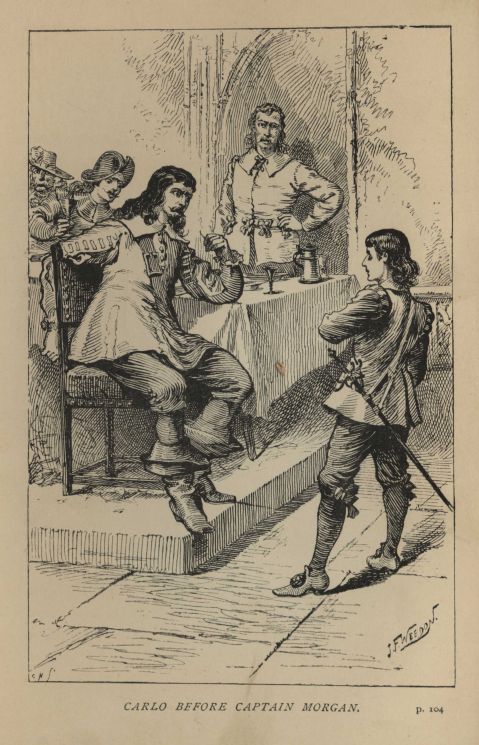
CARLO BEFORE CAPTAIN MORGAN.
In a moment Carlo was seized by the three strong, lusty men; his sword was wrenched from him; and with two long Spanish scarves his arms were bound tightly behind him, and in this helpless state he was dragged from the hall; whilst the Marquis, rising to his feet, protested in vain against the outrage to his son. The truth was that Captain Morgan wished to make an example of some one, and Carlo, being the Governor's son, would satisfy any murmurs his men might be inclined to raise at the death of their comrades.
All was now noise and confusion, for the men began loudly to make all kinds of requests to the Captain; and, seeing nothing would be got out of them in the way of going to seek for cattle and provisions in the island till they had finished their feast, Captain Morgan (who was a very abstemious man himself) left the hall, begging the Marquis somewhat roughly to show him over the place and to give him all the keys of the stores. Harry Fenn was also commanded to be of the company, which request he was glad enough to comply with, so as to get away from the sight of the carouse and the sound of the rude jokes and laughter.
In the meanwhile Carlo, struggling bravely to the last against his fate, and angry and indignant at his treatment, was carried down to the dungeon below, old Pedro being forced to show the way. Presently, after passing through dark passages, the porter opened the door of a cell-like chamber where no light was visible, and which looked most unfit for a living being, much less for the delicately nurtured Carlo.
'This is the only dungeon I know of,' grumbled Pedro; 'and many a pirate has made acquaintance with it,' he added in a low voice. 'Would that I could lock up many more!'
'I fancy this will be good enough,' said Simon in a French accent. 'Here, fellow, give me the key and let me lock it myself; there's no treachery these Spaniards are not equal to. Bum! that will do; the silly boy is safe enough.'
'Take it, then,' growled Pedro, 'it locks well enough;' but as he delivered up the key he thought with a smile on his face, 'but there's sometimes more doors than one even in a dungeon.'
CHAPTER X.
A FELLOW-COUNTRYMAN.
The Indian slaves, who had been scattered like thistle-down in a wind during this memorable night, now began to creep back to their various stations and occupations at Santa Teresa; and from them poor Catalina learnt, with more or less exaggeration, all that had taken place during the memorable night, and that it was the Marquis himself who had really betrayed them into the enemy's hands.
The faithful servant would not abuse her master; but, taking Felipa's head in her arms, she sobbed over her as if this shower of tears would make matters better; at the same time pouring out all her information, which was no comfort to the poor girl. Etta meanwhile stood by, pale and calm, quickly trying to form some plan which would comfort gentle Felipa.
But when all at once the bad news reached them that Carlo had been thrown into a dungeon, and that the pirates had the keys, and, further, that Captain Morgan was on his way to pay the young ladies a visit, Etta could not help feeling afraid, though she made up her mind that she would not show it. She felt very proud of Carlo, and was somewhat comforted by the idea that kind Harry Fenn would help him if he possibly could.
Etta possessed one of those natures which troubles only strengthen. Her captivity, kind though it had proved for her, had not made her forget her religion and her country; yet now she was anxious to do her utmost to return gentle, timid Felipa's love; so she did her best to cheer her with hopeful words, and not to give way herself to fear.
'Do not be afraid, Felipa darling. Captain Morgan cannot eat us, you know, and he will not dare to do us any bodily harm, for your father, the Marquis, is still a free man. Besides, the pirates want food, Pedro says, and when they have that they will most likely go away. Why could we not send Andreas to warn your uncle of this assault? He is a good man, and would send us help.'
'Well, Señorita, that is a good idea, which never entered my head,' cried Catalina; 'but where, in the name of all the saints, shall we find Andreas? The Indians are terribly afraid of the pirates, and are trying to hide in the woods; for I have heard they were very cruel to them the last time they were here.'
'You know, Felipa, that Carlo has taught me the peculiar whistle which will bring Andreas to the foot of the south window,' said Etta. 'If he is still in the neighbourhood he will hear it, and he would take his canoe to the mainland and warn your uncle, the Governor of Chagres--I am sure he would.'
'But how could he leave his own castle?' answered Felipa. 'Dear Etta, you are so hopeful and clever! If this could really come to pass! Poor father would be glad, I am sure; for he must already be sorry all these horrid men are in our hall. Yet he did it for the best.'
This talk was now interrupted by the tread of footsteps without. The girls had not been to bed, and were still in the sitting-room. Felipa turned pale, and tremblingly clung to Catalina till she recognised her father's voice in the passage, though the tones were sadly changed.
The sun this morning shone gloriously in upon the frightened group as the unhappy Marquis and Captain Morgan entered. Felipa at once ran up to her father and put her hand into his, asking in this mute way for his protection; but Etta, who was never at her ease with the Spanish Governor, stood alone by the window. Yet, in spite of her inward fears, she could not help feeling some curiosity at the sight of the dreaded pirate about whom she had heard so much.
After all, the buccaneer was not as dreadful as she had expected; and, even if his appearance were somewhat strange, yet Etta felt she was in the presence of one of her own countrymen; and her fears were further dispelled by the sight of her new friend, Harry Fenn, close behind the Captain. As for Catalina, she turned her face to the wall and audibly muttered her prayers, or perhaps they were curses, on the intruder.
'This, Captain, is my daughter,' said the Marquis, speaking in a very nervous manner, 'and this other maiden is the English girl I mentioned. Her father was an English merchant, and was killed here in fair fight; she will tell you she has been very kindly treated.'
'Thou canst speak thine own tongue, I hope?' said Captain Morgan; 'if so, tell me thy name, little countrywoman. I trust thou hast not altogether forgotten the speech of merrie England.'
'My name is Henrietta Allison, and my mother told me our family was from Kent; but oh, Sir Captain, will you release Carlo? Do not take his words amiss, for he is as brave as any Englishman, and I should be loth that my countrymen did him any harm.' Etta spoke with vehemence; her love for Carlo made her bold, and she altogether forgot her fears.
Captain Morgan frowned a little as he said, 'Marry! An overbold English girl, I see. That young ragamuffin has only got his deserts, for it always goes ill with a son who does not follow his father's footsteps. But I like a wench that is fearless. Speak up, girl, and tell me if thou hast any other boon to ask.'
'If you will not grant me this one, I will have no other,' replied Etta, her flashing eyes saying far more than mere words.
'Marry! That is showing a fine spirit! Nay, nay, Mistress Henrietta Allison, keep your angry looks for those who will be distressed by them. Eh, Harry, hast made friends with your countrywoman? Stay here, boy, and learn the courtly manners of the Spaniards, which, by my troth, our rough fellows sadly lack. Now, please you, Señor, we will finish our inspection of the castle; for as soon as my men have become rational creatures again we must proceed to business. I fear I must disarm all the inhabitants, and for mere form's sake I shall need to examine a few prisoners. I must find, moreover, several bold spirits who will faithfully show me the way to Panama; for I've sworn to take that city, and "St. Catherine" shall serve as the war-cry of Morgan's men. Adieu, fair maids; and do not distress yourselves about your companion; a few days on bread and water will kill no lusty knight who has been routed in battle.'
So saying, he led the way out, and intimated with a wave of the hand that the Marquis was to be his guide. Don Estevan del Campo staggered out, feeling now, at last, that he had indeed made a mistake. Rather would he have perished sword in hand than have heard that the inhabitants were to be made prisoners, and examined, most likely, under torture. His peace had, indeed, been bought dearly!
'Do not be unhappy about your brother,' said Harry kindly, approaching Felipa; 'he will be safe enough so long as the Captain is within this place, and so long, too, as he bears his captivity patiently. That is Captain Morgan's way; he cannot bear to be thwarted; yet I have known him do kind deeds when he was in the humour for it.'
'But I have a plan, bold Harry Fenn,' said Etta, now all eagerness to carry out her ideas, 'only--may we trust you? You will not betray us.'
'You forget what I have told you. I take no part in the affairs of the buccaneers; I do not betray their secrets, because that would not be honourable, but far less would I betray yours. I work enough for them--work that pays for my victuals; but I will not help in their robberies.'
'Forgive me, Harry,' said Etta frankly. 'We are afraid of every one now; yet we heard truly how you defended Carlo. Felipa, where is the parchment? You must write to your uncle at once, and let the writing be very small, for Andreas must carry it in his mouth; he says that is the only safe hiding-place.'
Felipa sat down to write a few words to her uncle Don Alvarez, Governor of Chagres Castle; whilst Catalina, who could not write at all, looked on, giving her advice freely. Etta in the meanwhile told Harry of her plan, but she did not notice the start he gave as she mentioned that Don Alvarez was Governor of the castle of La Chagres, and a noble and brave gentleman who had sometimes paid them a visit at Santa Teresa.
When the note was at last written hopeful Etta went softly out of the room to the end of a long passage. Opening a little window, she imitated the peculiar whistle which Carlo had taught her, and which was his signal between Andreas and himself. Harry had accompanied her, and he seemed as anxious as she was about the arrival of the faithful Indian.
'Did the Señorita Felipa,' he asked, 'say in what distress you were, and what was the reason of your needing help?'
'Nay; she said merely, "We are in great sorrow: come at once," and then something more about her poor father,' said Etta; and Harry could not help admiring the golden hair and sunny face of his new friend.
But though Etta repeated her whistle no one appeared for a long time, but just as she was giving up in despair all hope of seeing the Indian, she noticed Andreas below creeping towards the verandah which he was accustomed to climb in order to get within hearing of Carlo. Now, however, he merely shook his head and whistled softly a few notes which meant 'Come here at sunset'; and with this she was obliged to be contented, knowing that only real danger would keep him away.
'I fancy he is watched,' said Harry; 'to-night he had better escape, if he is wise.' And then, very sorrowfully, the girl led the way back to the sitting-room.
The girls dared not step out of their own chamber all the morning--indeed Catalina kept good guard over them, so that it was some comfort to listen to Harry Fenn's adventures and to hear what he liked best to talk of--the account of his home life. Felipa could not quite understand how he could be so clever, being neither a noble's son nor a young priest; but Etta had English ideas, imbibed from her parents, and her love of England made her listen eagerly to Harry's talk of the old church on the hill and of the learned and kind Mr. Aylett, who had taught him so much and whom she hoped to see some day. And, further, as misfortune draws hearts together, he told Etta of that last day at home, and how he had made the effort of renouncing his roving wishes, and yet how he had been forced to cross the ocean and see strange new sights in spite of himself.
'I have had it often on my conscience that God was punishing me for my many discontented thoughts,' said the boy; 'and yet I think Mr. Aylett would not put it so. He must have told my parents that I was willing to stay.'
'No, no; he could not blame you,' said Etta, clasping her hands, 'for then you would have also to say that God is punishing me for having been often in a passion when I was but ten years old. We must always be friends now, Harry, for our stories are much alike; but some day you will get back home, and you will tell your parents all you went through and of all your adventures, and then you will remember me and send some good merchant to take me away from St. Catherine to my uncle's house in Kent. I will show you the letters I have some time.'
'If an English man-of-war was to touch here, then I would run away,' said Harry. 'I have never given my word not to escape.'
'And did you really always say your prayers?' said Etta under her breath, who looked upon Harry as a very saintly hero. 'For sometimes I have forgotten them when nobody reminded me; and you must have found it very difficult.'
'Nay, but without them I think I should have despaired entirely.'
Catalina now broke in upon their talk by saying, 'Come, young Englishman, if you are as friendly as you pretend, why can you not get my poor Carlo out of that dungeon? He will die there, for I am sure those ruffians will give him no food.'
'I will do my best,' said Harry, 'and anyhow I will bring you news later in the day; and I will go now and see if I can do aught with the Captain for him.'
When he was gone, Felipa and Etta fell fast asleep on a low couch, being quite wearied out with the events of the long night and morning, and so for a little while they forgot their troubles.
CHAPTER XI.
THE SECRET PASSAGE.
Etta's courage came back with new energy after her long rest; the presence of Harry Fenn in the castle seemed to lessen the dangers which now evidently surrounded the little party; and, at all events, so long as he was here they would not be left in uncertainty. But it was nearly sunset before any one came to break their solitude in the sitting-room. At last there was a sound.
'Hish! Open: it is Harry Fenn. Have no fears.'
Etta ran to the door and let him in. He had a basket in his hands full of fruit, and also some bread, on which Catalina seized with joy.
'I knew you must be hungry,' said Harry, 'so I took these when no one was looking. All the slaves are working with unusual activity. In truth, the Captain has enough to do, and the Marquis has been sent to San Salvador to make the garrison deliver up all the guns that are there. It is sad to see him so cast down.'
'But what other news is there? Can we soon go out of this room? It is so cool under the trees, whilst here we are so hot, and everything is miserable,' said poor Felipa, who felt the burden of her life greater than she could bear now her father was away and Carlo in prison, and she herself was not far removed from being a prisoner.
'I fancy, Señorita, that in a few days Captain Morgan will have decided something. He found great difficulty to-day in preventing his men scattering themselves after booty. All the main forts are in his hands, and he is busy ordering the removal of guns and ammunition to the fleet; and those who will show him hidden treasure get a title to his favour. You can see some of the ships from the windows of this castle. As soon as he can finish this work, I expect he will set sail. He does say he will not leave a musket in the island; but I fancy some of the negroes have already hidden away powder and muskets, for the men are inclined to handle them too roughly.'
'They may take all the guns they like,' said Catalina impatiently, 'if they will release the Señorito Carlo to me. I wish I could hang up these villains on our tall groogroos!'
'Unfortunately the man who has the key of the Señorito's dungeon has gone away to the other island,' said Harry, 'but as I passed by the gate just now an old man asked me if I would tell the nurse Catalina that the young Señor was not so fast locked but that she could get at him if she so wished. I know not what he meant, but I thanked him for his good offices.'
At this Catalina clapped her hands, saying that Pedro was more cunning than he seemed to be, and that Carlo need not now starve; but no one understood her.
'It is close on sunset,' said Harry to Etta, 'and if you are going to keep your appointment with the Indian, I would like to come with you. I suppose you are sure he is to be trusted, for some of these Indians are none too brave, our men say, and fly like crows when they smell powder.'
'Andreas! Yes, indeed, he loves Carlo as his own son. They often have gone hunting together.'
So the two returned softly to the place of meeting at the window above the verandah, and, after waiting till the sun had sunk and darkness had suddenly come on, they heard the sound of soft whistling, and in another moment Andreas had swung himself over the balcony and stood by their side.
Etta seized his hand.
'Good Andreas, do you know all our misfortunes? Señor Carlo is still in the dungeon, the Marquis has gone to deliver up some guns, and if it were not for this kind friend we should be almost forsaken.'
Andreas made a low salutation, but, all the same, eyed Harry rather suspiciously.
'Do not be afraid,' continued Etta; 'he is a prisoner as we are, and will help us. Look, Andreas, could you manage to escape and take this note of the Señorita Felipa to her uncle at the Castle of Chagres? He would bring us help if he knew how badly we wanted it.'
Andreas shook his head.
'It is impossible, I fear. I am only at liberty because I can be useful with the cattle and the horses in the compound.'
'But, good Andreas, you cannot know how important it is that this Spanish gentleman should know that Captain Morgan has taken St. Catherine,' said Harry quickly. 'If you cannot go, could you find some one else? Surely we have had enough horrors here and elsewhere,' he added, half to himself.
'The blacks cannot be trusted, and none of my tribe would care to go. However, give it me, Señora; if I cannot go no one shall take the writing from me.' And with this Etta had to be satisfied; but she added in English:
'If Andreas says no, it means no; for he is the cleverest and bravest Indian there is in all the island.'
'When do you think the pirates will go, Andreas?' she asked anxiously.
'The Captain is asking for men who know the roads on the mainland. I believe they intend to attack Panama; and yet that is a big rich city, and is not badly defended, so that I can hardly believe that such is really their intention.'
After this, Andreas said he must not stay longer, as he was obliged to go back to the compound, but that he would come the next day at sundown to the same place, if in the meanwhile he were unable to escape from the vigilance of his new masters in order to go to the mainland, where, some short distance down the Chagres River, stood the castle of that name, strongly garrisoned by Spanish soldiers.
As Harry and Etta returned towards the sitting-room the former promised he would come back early the next morning and bring what food he could find, only begging that the Señorita and Etta would not dream of showing themselves below stairs; for indeed the scenes that went on--the drinking, swearing, and quarrelling--were no fit sight for them--'or, indeed, for any Christian man,' added Harry. 'They will soon fall to and begin to cross their cudgels, fancying they are full of wit and valour; though, indeed, there are many who have only joined them because misfortunes have come upon them in the old country, and they fancy this wild life is better than starving. Some, too, were trained to fight in the late wars, and say that life is naught without a sword and a war-cry; yet I know that many of them disapprove of the cruel deeds they see.'
'But you would escape if you could?' asked Etta.
'Yes, indeed; but Captain Morgan knows that, and I feel sure I am often watched. Good-night, Mistress Etta. I will do my best to free you out of this distress.'
Etta found on her return that everything looked more cheerful, and indeed Felipa ran towards her friend and began kissing her as she laughed and cried alternately.
'What is the matter? what has happened?' said Etta; for Catalina looked just as happy, and was praising all the saints in the calendar.
'Catalina is so clever and so good! Fancy! she has seen Carlo, and, look, he has shared our supper!'
'Where is he? have they freed him?'
'No, no--hush!--but it was good Pedro's doing; they made him show them the way to the dungeons, and he got him locked up in the cell that has another door into it, and we can get at it from here. You know that nasty dirty little staircase which we were always afraid of? Well, that leads to his cell. In former times, Catalina says, they used to go down from here and try to get the secrets out of the prisoners by making them false promises. That is why there are two doors in it.'
'And have you seen him? Oh, Catalina, let me go down at once and speak to dear Carlo! He will know now we are going to send a message to Don Alvarez, for Andreas will try hard to get away.'
'No, no, Señorita, you must not go now. I crept down like a snake, and found my poor boy crouched in a corner quite faint for want of food. How he started up when I pushed back the sliding panel! and, in truth, he was ready to fight me, fancying I was a pirate come to murder him. And when he saw it was only old Catalina he nearly cried; though he laughed, too, afterwards. He knew I could not see the tears, mind you, in that dark hole. Well, he ate the bread and fruit in a very short time, and asked no end of questions, poor boy, and sent an especial message to you to tell you he was not so badly off now he could hear news of us. It was as good as any feast, he said.'
'But, Catalina, why did you not bring him here? We could hide him, I am sure we could; and if not, he could escape by the balcony.'
'I suggested it to him, but he was wiser. "My jailors may come at any moment," he said, "and then, seeing me gone, they would soon search and discover the door, and no one can tell what they might then do." Ah, he is a brave youth; it is a pity his father is not like him.'
It was indeed a great comfort to feel that their Carlo was so near to them, and at all events would not die of starvation, as there was before much chance of his doing if left to the tender mercies of his captors, who were now beginning to recover from their carousal, and were being sent to all parts of the two islands with orders to drive the harmless inhabitants in to the various fortresses as if they had been cattle, and to treat all who resisted the appropriation of their goods as if they were rebels.
It was decided that Carlo could not be visited again till a late hour the next morning, for fear of any one being discovered in the cell. Etta, as more agile than Catalina, was then to visit the dungeon; and, much comforted, the three this evening knelt down to pray together that God would deliver them from their sad plight and take care of their own dear Carlo and the Marquis.
Felipa was very fond of her father in spite of being a little afraid of him; he had always been indulgent to her, and she fretted at seeing nothing of him. The truth was, that the Governor preferred even looking after the betrayed fortresses to seeing the sorrow of his children; and he was much afraid Felipa would reproach him for having allowed Carlo to be imprisoned.
As the girls would not leave the sitting-room, through which alone they could get at Carlo, Catalina spread some mattresses on the floor for them; and this evening they slept soundly in spite of their many misfortunes.
They were up at sunrise, and were all impatience for the first tidings which Harry had promised to bring them; but when at last they heard his voice, and let him in, he was not in a very cheerful mood.
'When is Captain Morgan going away?' asked Etta, whose sweet face and golden hair made Harry hunger all the more for his home, in order that he might send or fetch her. 'Make haste and tell us good news. I have a lovely plan for saving you from these people, Harry Fenn, but I dare not tell it yet I would dearly love to hear their hue and cry after you. How they would boggle at finding you gone!'
'You need not make plans for me, Mistress Etta: the Captain has even just now told me that he wishes me to go aboard one of his ships. He knows I will not fight, but he would fain make me act spy on the others. But see, this is all I could find for you, Catalina. Here are some yams and bananas and bread. I wanted to bring you a cooked fowl, but one of the men was angry at what he called my huge appetite. They think that as I will not do all their work I must not eat the good things, and that I am not worth my provender, as they put it.'
'But when shall you go?' asked Felipa, who looked so much more cheerful this morning that Harry could not help noticing it.
'No, no: you must not go!' said Etta, seizing his hand. 'Stay with us, and we will send you back to England. The Señora Felipa will ask her father, and when the pirates are gone----'
'Thank you for your kind good offices; but your plan is impossible, for Captain Morgan does not mean to leave Santa Teresa just yet; he is sending out four ships and a boat to try how he gets on in those parts.'
'Where?'
'That I durst not say, Señora; it was only by accident that I overheard it; but I know that, in the future, the Captain's mind is set upon taking the great town of Panama.'
'He will never do that,' said Felipa, tossing her head. 'There is a strong garrison there, and His Catholic Majesty would never forgive them if they allowed it to be taken by such needy gallants as your crew.'
'That is what I think too, Señora. However, I dare say our ships will come back from this lesser expedition somewhat humbled and crestfallen. At present their pride knows no bounds. But, dear ladies, I am sorry to say that I am the bringer of evil news, which it goes against me to tell; but it is best to know the worst. I heard Captain Morgan say that the Señorito Carlo was to be released this morning and to be taken on this expedition, because----'
'Oh, how dreadful! Carlo to go with all those wicked men! Nay, I know he will never consent,' cried Felipa.
'But in truth he will be less likely to get harm than in those damp dungeons below. I reminded the Captain that the Señor had had no food, and that men would cry shame on himself if the Señor were to come to harm.'
'Thank you, Sir Harry, for your kind intentions,' said Felipa in her somewhat quaint English, 'but indeed I had rather my brother were in the dungeon than out at sea with such knaves as these buccaneers. Cannot you obtain this boon from your captain for us; for if my brother goes what shall we do?'
Harry would not tell her he had no power; so, promising to do his best, he hurried away, not daring to stay longer.
CHAPTER XII.
A NEW EXPEDITION.
The hours wore away very, very slowly for poor Carlo, who in his damp dark cell reflected with bitter shame on the departed glory of his name. Moreover, it was hard to bear this terrible confinement; and now and then the thought would pass through his mind that he had been a fool for his pains, for his resistance had done no good to any one, and had put him into a very luckless place and a miserable condition. But Catalina's visit and the discovery of the secret door, though it opened only from the outside of the cell into the narrow secret passage, took away all the feeling of loneliness, which is almost unbearable to the young. Now all was different. Upstairs and not far from him there were those who cared for him; and, to say the truth, the food Catalina had brought very much contributed to his more cheerful spirits. When first imprisoned there had been no time to do more than thrust the boy into the cell, so he was free to walk the two steps which were all that the width of the place allowed; but it was a comfort to feel with his fingers for the slight marks of the secret door, and to place his ear against it, listening intently for coming footsteps.
This morning, however, it was in the outside passage that he first heard sounds; and presently the key creaked in the lock, the bolts were drawn back, and a rough voice called out with a seasoning of oaths:
'Here, young cub, take this loaf; it's none of the newest, but good enough for young teeth; and here's water to wash it down with; for, ay, marry, it's all you'll get till to-night, when the Captain has ordered your release. Maybe by then you'll have learnt to cudgel less and show less paltry spite.'
Carlo's heart beat fast, for the very idea of once more seeing the sun and enjoying the lovely sights and sounds of the tropical world made him happy. No, he did not now regret his conduct: he had vindicated his honour, and the price was not too great. He longed to know more, but of course he would not ask this fellow for any news, so he received his communication in silence. In consequence of this he was favoured with another volley of opprobrious titles, which he bore with patience, as beneath the notice of a nobly born Spaniard.
When this visit was over, Carlo set himself again to listen for more welcome footsteps; but it was only after an hour had elapsed that he was rewarded by hearing, not Catalina's heavy tread, but a gentle well-known footfall. It was Etta, who after some difficulty managed to slide back the secret door; and, peering into the darkness without at first seeing anything, she exclaimed:
'Carlo, are you there? Oh, how dreadful! Here, dear Carlo, take this bread, and a fresh banana; for you must be very hungry. How glad I am that you will not be here much longer! And yet----'
'How do you know, Etta? Was it Harry Fenn that told you? Will they give me back my sword? and where is my father?'
'We know hardly anything; for though of course we are not in this horrid hole, yet we are as much prisoners as you are, my poor Carlo; and if it were not for Harry Fenn we should have had to go down to the hall amongst those rough men and beg for bread. Even Catalina dare not do that, for she cannot abide their rude jestings.'
'Never mind: when I am released I shall teach those ruffians manners and see that you are not neglected,' said Carlo, still a little jealous of the doings of this new Harry.
'But, Carlo, did they not tell you? You are to be put aboard one of the pirate ships and to show them the way somewhere; and indeed you must put a good face on the matter for fear they should handle you roughly.'
Carlo was struck dumb at this news; but at last he burst forth with--
'The rascals! What! do they think they are going to use me as a guide to some other unfortunate Spanish settlement? That they never shall. They may tear my limbs, but for such knaves----'
'Hush, hush, Carlo! What if they heard you! But Harry Fenn is to go too. He knows nothing of your father or of what has happened to him; and, alack! poor Felipa, who was so glad and happy yesterday, is now all-sorrowful again. Dear Carlo, when you are aboard try and bear their raillery and stuff your ears, and---- But I dare not stay longer, Catalina is so frightened lest I should be discovered here, or for fear we should receive a visit from the Captain upstairs, and he would assuredly ask what had become of me; so good-bye, dear Carlo! Do not be rash; for, in truth, they may put you on the ship, but they cannot make you speak, and you do not know the roads of the mainland, so you can easily baffle these boors. Ah, now, I was forgetting to tell you that Felipa wanted to come with me, but Catalina would not let her. She sent you all her true love.'
So these two took leave, and Etta, drawing back the tiny door and replacing the bolts, ran lightly upstairs, having put Catalina in a great fright; for hardly had the door of the dark cupboard out of which the turret stairs descended been shut when voices were heard close to the door of the dwelling-room. The old woman was much excited as she exclaimed--
'St. Teresa save us! Etta mi! What heart-palpitations you have given me! Quick, child! lie down on the couch and hide all the cobwebs and dust which are on your petticoat.'
Etta did so, trying to conceal her smiles; and Catalina threw a lace shawl over her, Spanish fashion; so that when Captain Henry Morgan entered, followed by a gentle-looking Frenchman, only the most natural sight in the world met their eyes.
'Marry! see you, Sieur Maintenon, here is the dovecot I mentioned; but the dovelets are not so young but that they can coo. Prithee here, my English maid, and tell me anything thou canst of the mainland. Was thy merchant father wont to trade there? If so, he must often have landed at Panama, where rich stuffs are much à la mode and prized.'
Etta was forced to get up; but Catalina, pretending to help her, privately shook as much dirt as she could from her petticoat.
'No, Sir Captain, my father was an honest merchant who traded among the English isles, Jamaica chiefly, and took trips to England, but he never meddled with the Spanish settlements.'
'Was it so? My experience is that merchants are glad to trudge wherever they can get gold coins. But you, Señorita, you have sometimes left this island? Speak plainly, for I like not capricious or saucy maidens,' said the Frenchman in soft Spanish tones to Felipa.
'Never, Señor, except to go a visit to my uncle, the noble Don Alvarez, Governor of the Castle of St. Lawrence, which some call the Castle of Chagres because of the river of that name; and I wish heartily that I could let him know now of our distress.'
'Marry! pretty dove, do not have the doleful dumps on that score, for such a message will not be difficult to deliver,' laughed Captain Morgan; 'the little Señorita can give it to that valiant warrior her brother, for I purpose despatching four of my ships there this very evening.'
Felipa and Catalina lifted up their heads in horror, and the former burst into tears as she exclaimed, 'You will go to Chagres and attack the great Don Alvarez! That cannot be!'
'Why not? Before the whole cheese is taken one must taste a little bit of it and see if it is good. From Chagres we can easily cross the narrow neck of land, but we want good guides to traverse that marshy region. Know you any such?'
'I will send and warn my uncle,' said Felipa proudly, drying her tears; 'he is better armed than we were here, and he will receive you in a manner you will not like--that I can well foreknow.'
Captain Morgan nodded to his companion.
'So said I, pretty maid. Mark you, Maintenon, I will tell Captain Brodely to keep the ships well together; I hear from that vile caitiff Espada that the mouth of the river is dangerous, and that there are several gunboats stationed there.'
'And if it were not,' put in Felipa incautiously, 'the castle is on the top of the mountain and can never be taken. My uncle Don Alvarez will not be deceived by your tricks as was my father, and your fair promises will be laughed to scorn by him, for he will fight to the death.'
'Thank you, pretty Señorita, for your advice. I will not forget to tell my men what kind of brave gentlemen they will have to meet; an we are worsted we must yield on honourable terms. But, doubtless, your brother will tell us more. I'faith, Maintenon, I must see that the ships are well manned and victualled: it does not do to trust any one but oneself when there is much risk in an enterprise, and, for all we know, a mortal crisis and some mangling of Christian bones.'
So saying, the Captain moved away, and smiled as he noticed old Catalina in her corner busily muttering her usual imprecations against him. When not thwarted Henry Morgan was an agreeable man with much sense of humour; and it was partly this that had enabled him to keep his heterogeneous horde together, though quarrels were frequent enough, and led, as he said, to bangs and knocks sufficient to harden any softer fists.
There was much indignation and many exclamations of despair from the girls and their old nurse when they were once more alone, which were only calmed when Felipa indignantly remarked:
'My uncle Don Alvarez will never be conquered by such people, and dear Carlo will see him and tell him, when he has routed these knaves, to come to our help. If only I could see my brother!'
But it was not thought prudent to descend again after the narrow escape Etta had had, for they could not tell at what hour Carlo might be released.
'May the good God take care of my dear boy!' sighed poor Catalina, much depressed. She was feeling that her responsibilities were almost too great, and she heartily wished the Marquis would come back and take care of his children. Happily, till now Felipa had not fretted too much, though the poor girl was beginning to show signs of fatigue and anxiety. She was far more delicate than sturdy English Etta, whose spirits soon reasserted themselves and made her inclined to forget the dangers that still existed.
In the meanwhile Carlo waited impatiently in his cell for the time when he should hear the steps of a pirate coming to release him; for now, having thought the question out, he had come to the conclusion that he had best take the matter quietly. Not being a prisoner on parole, he was free to escape, and perhaps he should soon find some opportunity of doing so. Once free, he believed that the faithful Andreas could hide him in the woods till such time as peace was restored. He had leisure now to make many reflections as to the future; but at last he heard footsteps in the passage outside. His heart beat fast, though he tried to appear cool. He could not guess the time of day, but he felt sure it was not far off sunset, when at last his door was hastily opened and a man told him roughly to get up and follow him. Carlo did so. He was a little stiff, and almost blinded by the light; but it seemed like a new life to be breathing once more the fresh air, and to feel the warm glow of the sunshine through his chilled veins. At the end of the passage he found several other men awaiting him; but they did not pinion him as before--an insult Carlo would have found it difficult to forgive.
'Quick, young Señor, this way; we have no time to waste. We want no idle vermin among our crew.'
It was fortunate for Carlo that Etta had prepared him for this new bondage, or he might have refused to follow the buccaneers out of Santa Teresa. As it was, however, he would not obey quite silently or without protest.
'Where are you conducting me?' he asked, 'I demand to be taken to my father.'
'Very likely, sirrah; but those are not our orders. Marry! it's best to ask no questions when one is Captain Morgan's prisoner, else some inquisitive knaves have learnt what it means "to swing like a skipper."'
Carlo thought this advice wise, and followed it.
Presently he saw that the men were joined by a fellow he knew well, Espada, who had evidently turned traitor. Carlo had seen him last at the Platform, and he was horrified to hear him say he was prepared to guide the men by a narrow path which led down the face of the steep cliff, and which they could not have found unassisted. It was by no means a pleasant descent, but it saved a few miles of walking, and, once at the bottom, they found a canoe awaiting them. With a heavy heart Carlo saw the massive walls of Santa Teresa disappearing. After a short row the boat he was in was moored alongside one of the pirate ships stationed just outside the bay, and he was bidden to scramble up a very rude rope ladder on to the deck of the ship, which, he found, was called 'The Falcon.'
'Is Captain Brodely on board?' asked the escort, 'for here is the son of that craven-hearted Governor. By my faith! a valuable cargo, I take it; for he's to serve as guide, and to be hostage for the Marquis's good conduct in the future. Now then, young sir, on with you this way. And best budge quickly; for there's to be no tricks here, remember, or it will be the worse for you.'
Poor Carlo! his Spanish pride inwardly rebelled; but, true to his resolution, he replied nothing to all these taunts. The Captain was too busy to attend to him, so he was presently locked up in a small cabin where the spirits stolen from Santa Teresa were stored; still he could see the dancing waves through the tiny port-hole, and, compared to the dungeon he had just left, this place was indeed like a palace, though the only pieces of furniture were barrels of wine and spirit-kegs, in which the Dutch carried on a brisk trade, and which therefore received the name of Hollands.
When darkness fell over the beautiful shore the noise on board in no way diminished, and such a shouting and holloaing was heard that it was easy to see the pirates were in high spirits, and thought themselves invincible and able to do as they liked.
After a time Carlo fell asleep, and was awakened only by feeling himself gently shaken. He started up, and saw by the help of the moonlight the kind face of Harry Fenn bending over him.
'You here! Thank God!' exclaimed Carlo. 'At all events these wretches will not murder me without some one knowing of it and reporting the crime!'
Harry laughed at Carlo's somewhat moody ideas.
'Oh, Señor, in truth you are safe enough now we have started, and I am bidden to ask you to come and sup in the Captain's own cabin. He is under strict orders to treat you well when once we are out at sea. And, look you, Señor: these men have not been told that you can understand English, so prithee keep the secret. They all come from the bigger island, and were not at Santa Teresa. Later on we may find it convenient to understand each other in English whispers. At present, remember, I only know very few Spanish words.'
Carlo nodded, and with new hope followed the English boy into the Captain's cabin.
CHAPTER XIII.
THE ESCAPE.
Captain Morgan had done wisely in thinking that it was quite necessary for him to have some base of operations on the mainland before crossing the narrow neck of land which separated him from the coveted prize, the city of Panama. It was for this reason that the expedition under Captain Brodely was sent out, whilst he detained the rest of his ships at safe anchor at St. Catherine, and also kept his men in good temper by letting them do as they pleased and ransack the two fair Spanish islands of this name.
Captain Brodely was a daring seaman, who had seen before now the inside of Spanish prisons, and knew the ground round about Panama pretty accurately; but the Castle of Chagres was on the opposite side of the isthmus, and the river Chagres, which flowed at the foot of the hill on which stood the castle, was difficult to navigate, and great care would therefore be needed to steer the ships into safe anchorage. The Captain had been told that the Marquis's son knew well the castle and its surroundings; but when Harry Fenn entered his cabin accompanied by Carlo, the sturdy rover looked with scorn on the slight stripling whom Captain Morgan had sent him for guide. As hostage he might be all very well, but for aught else the Englishman preferred trusting his own good sense to the doubtful information abstracted from an unwilling prisoner whose Spanish blood prevented him, in the eyes of Captain Brodely at least, from having any regard for truth.